Tag: Telit

  • ION GNSS+ Product Showcase

    Skydel-gnss-simulator-W
    Skydel Solutions’ GNSS simulator.
    The Averna RP-6100 record-and-playback solution.
    The Averna RP-6100 record-and-playback solution.

    Record & Playback

    The Averna RP-6100 Multi-Channel RF Record & Playback for RF application testing allows users to tecord real-world signals such as GNSS, HD Radio, LTE and Wi-Fi — plus impairments — to significantly advance projects and harden product designs. Skydel Solutions’ GNSS simulator is an entirely software driven innovative and cost-effective simulator that works with the RP-6100, enabling users to test corner cases and future events with a real-time GNSS solution.

    Averna, www.averna.com; Skydel Solutions, www.skydelsolutions.com
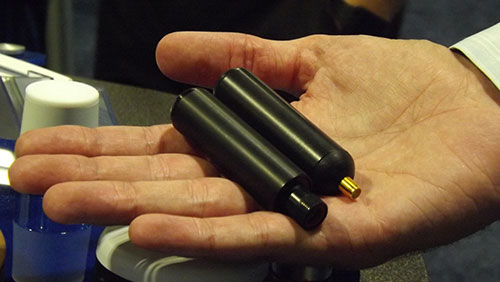
    PCTEL's GEO-GNSS antennas.
    PCTEL’s GEO-GNSS antennas.

    Helix Antennas

    PCTEL’s GPS/GLONASS high-performance asset tracking and synchronization helix antennas are now available commercially. The antennas capture the frequencies needed for GPS, Galileo and GLONASS satellite reception. This cross-compatibility allows global OEMs to use one standard platform to serve both European and U.S. markets.

    PCTEL uses its proprietary filtering design to allow wideband coverage while achieving superior out-of-band rejection. With an IP67 rating, the small form-factor helix antennas will withstand harsh environments.

    PCTEL, www.pctel.com
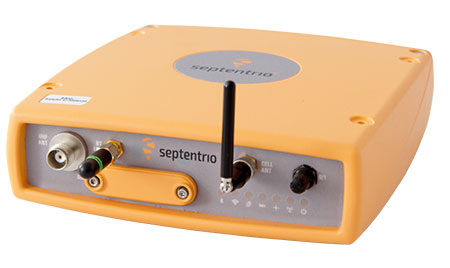
    AsteRx-U dual antenna receiver
    AsteRx-U dual antenna receiver.

    Multi-Constellation Dual-Antenna Receivers

    AsteRx-U and AsteRx-U Marine multi-constellation dual-antenna receivers incorporate the latest GNSS tracking and positioning algorithms and interference mitigation. Machine-control users in the agricultural, construction, marine and mining industries benefit from a complete system with integrated UHF radio, Wi-Fi, USB, Bluetooth and cellular connectivity and a spectrum analyzer. All configurations can be done via the on-board web interface.

    The AsteRx-U has decimeter- and centimeter-level RTK positioning including TerraStar. The AsteRx-U Marine also supports Veripos PPP augmentation services.

    Septentrio, www.septentrio.com
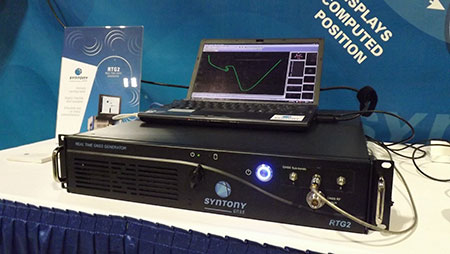
    Syntony-RTG2-W
    The RTG2 constellation simulator by Syntony.

    Constellation Simulator

    The RTG2 is a GNSS constellation simulator that generates realistic GNSS RF signals, taking into account current and future GNSS constellations. RTG2 is able to entirely simulate one or many constellations (GPS, Galileo, etc.) including satellite-based augmentation systems such as WAAS and EGNOS.

    The generator is entirely configurable (troposphere and ionosphere effects, simulated receiver trajectory, etc.) through a user-friendly interface accessible on a separate PC through Ethernet. RTG2 is highly flexible and scalable, offering hardware and software upgrades for capability extensions.

    Syntony GNSS, www.syntony.fr
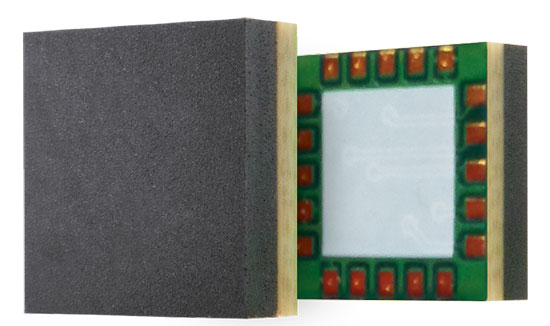
    Telit's Jupiter SE873 GNSS receiver with flash memory.
    Telit’s Jupiter SE873 GNSS receiver with flash memory.

    GNSS Receiver with Flash Memory

    The Jupiter SE873 GNSS receiver is a complete multi-constellation position, velocity and time engine that delivers versatile performance in harsh environments. The 7 x 7 x 1.85 mm module has serial quad I/O flash memory, an integrated low noise amplifier, SAW filter, TXCO and real-time clock. The Jupiter SE873 supports Assisted GPS (both autonomous and server-based) plus SBAS, which improve time-to-first-fix and position accuracy. AGPS data is stored in flash memory and is available even after all power has been removed and then restored. This is especially important for battery-operated equipment.

    The SE873 supports the entire GNSS spectrum: GPS, GLONASS and BeiDou, and it is Galileo ready. It delivers simultaneous low-power tracking of GPS and GLONASS or GPS and BeiDou.

    Telit, www.telit.com
  • Telit Introduces GNSS Receiver with Flash Memory

    Telit Introduces GNSS Receiver with Flash Memory

    Telit's Jupiter SE873 GNSS receiver with flash memory.
    Telit’s Jupiter SE873 GNSS receiver with flash memory.

    Telit has introduced the Jupiter SE873, a GNSS receiver in a 7 x 7 x 1.85 mm module with serial quad I/O flash memory, an integrated low noise amplifier, SAW filter, TXCO and real-time clock.

    The new addition to Telit’s GNSS portfolio is a complete multi-constellation position, velocity and time engine that the company says delivers versatile performance in harsh environments.

    The Jupiter SE873 supports Assisted GPS (both autonomous and server-based) plus Satellite Based Augmentation System (SBAS), which improve Time-To-First-Fix and position accuracy. AGPS data is stored in flash memory and is available even after all power has been removed and then restored. This is especially important for battery-operated equipment, Telit said.

    The SE873 is a high-performance, high-sensitivity product that supports the entire GNSS spectrum: GPS, GLONASS and BeiDou, and it is Galileo ready. It delivers simultaneous low-power tracking of GPS and GLONASS or GPS and BeiDou. In the future, users will be able to add new functionalities.

    “The SE873 outperforms all its competitors, most of which are ROM based. Employing flash memory results in a module that packs a lot of functionality into a small footprint,” said Felix Marchal, CPO of Telit.

    Telit Jupiter SE873 is being presented to the market at Telit DevCon 2015 Sept. 8 and CTIA’s Super Mobility Week in Las Vegas Sept. 9. Telit DevCon is a one-day event that takes place the day before CTIA Super Mobility 2015 and is located close to the Sands Expo and Convention Center in Las Vegas. Visit Telit at booth #5032 during CTIA Super Mobility 2015.

  • Telit IoT Platform Enables CelloTrack Nano System for Tracking

    Telit, a global enabler of the Internet of Things (IoT), today announced that Cellocator, a Pointer Telocation division, has selected the Telit IoT Platform as the underlying IoT Cloud infrastructure for its new CelloTrack Nano system. The platform, powered by deviceWISE, automatically performs all the critical connection, management and integration functions to simplify deployments of the Nano system across markets and industries worldwide.

    The CelloTrack Nano system enables real-time status monitoring of goods in transit. That includes location and a variety of critical operational sensing of the cargo or asset in real time, using a portable hub and a short range Wireless Sensor Network (WSN). The sensors monitoring capabilities include temperature, humidity, light, pressure, impact, movement, tampering and sound. It ensures continuous recording, enables event-triggered logic and “management by exceptions” through flexible programming of business rules to eliminate supply chain mistakes, avoid delays or damages and reduce insurance expenses.

    “We see high demand for the CelloTrack Nano in our traditional markets and count on Telit’s platform to bring us to the new IoT market,” said Joshua Rozanski, VP sales & marketing, Pointer Telocation. “By using the scalable, comprehensive Telit IoT Platform, Pointer has been able to concentrate on the rapid creation of a compelling, market-driven end-to-end solution.”

    “Pointer has been a valued customer of Telit’s modules for almost a decade and we are pleased that they have now also selected the Telit IoT Platform as the go-to-market technology solution for their newly announcement Nano system,” said Gideon Rogovsky, SVP of Sales and Marketing, Telit IoT Platforms. “The deviceWISE Ready certification offers CelloTrack Nano instant exposure across our thriving deviceWISE ecosystem and opens instant opportunities with our global network of business partners and customers.”

    The Telit IoT Platform connects “things” to “apps” — integrating any devices, production assets and remote sensors with web-based and mobile apps and enterprise systems. The platform reduces risk, time-to-market, complexity and cost of deploying solutions for monitoring and control, industrial automation, asset tracking and field service operations across all industries and market segments around the world. The Telit IoT Platform offers extensive developer resources and support and a free trial can be accessed here.

  • Telit’s IoT Portal Combines Connectivity Management with App Enabling

    Telit, a global enabler of the Internet of Things (IoT), has announced a new release of the Telit IoT Portal. The portal consolidates a suite of advanced connectivity management functions with the company’s deviceWISE IoT Application Enablement Platform.

    The service enables companies to deploy, configure and manage end-to-end IoT deployments from a single, cloud-based portal, Telit said. The portal is designed to make it easy to “connect thing to apps” by seamlessly integrating any device, production asset or remote sensor with web-based and mobile apps and enterprise systems, across any wireless network.

    The newly added connectivity management addresses all aspects of mobile communication provisioning, including seamless integration with Mobile Network Operators (MNO) and Connected Device Platforms (CDP).  Users can activate or de-activate devices, manage SIM cards, analyze connection quality, and set all provisioning and data plan parameters. This platform function is especially useful in preventing data overage and overall data cost management.  The advanced CDP integration feature aggregates federated data across multiple wireless networks — a valuable capability when operating IoT deployments in different countries and regions around the world.

    From the same portal, users have continuous access to all the comprehensive functions of the deviceWISE IoT Platform, including device onboarding, edge-intelligence, data collection, data transport, data storage, data delivery and application integration. Developers can connect, collect and control anything with a single, standardized API set that is common across device integration, connectivity management and application development.

    “The developer-friendly Telit IoT Portal provides instant and full access to the mature and comprehensive features and all the necessary tools and resources for your IoT project,” said Alon Segal, CTO, Telit IoT Services.  “No upfront investment is required and companies can focus on developing compelling applications that help transform their business, not the engineering of underlying technology infrastructure.”

    The Telit IoT Portal reduces risk, time-to-market, complexity and cost of deploying solutions for monitoring and control, industrial automation, asset tracking and field service operations across all industries and market segments around the world.  Additionally, customers can enjoy professional maintenance and support and ongoing upgrades to new features and capabilities. Access a free trial of the Telit IoT Portal.

    The new release of the Telit IoT Portal will be featured at Telit DevCon, Sept. 8 in Las Vegas, and live demonstrations of will be held at CTIA Super Mobility 2015, booth #5032, which takes place Sept. 9-11 in Las Vegas. Those attending Telit DevCon can learn how industry leaders use the IoT to create new markets, transform their business and achieve measurable return on investment.

  • Telit, Agnik Join on IoT Apps, Big Data for Smart Devices

    Telit Wireless Solutions and Agnik are collaborating on Internet of Things (IoT) applications and Big Data analytics for connected devices in the auto, home and health industries. Agnik’s solutions expand the quality and quantity of integrated IoT apps and analytics available to customers and ecosystem partners of the industry-leading deviceWISE AEP.

    The rapid proliferation of smart devices and products makes it challenging to aggregate and manage all these different data sources and also requires that this trove of data is harnessed and analyzed to extract valuable insights that help companies make more informed business decisions. The Internet of Things is already starting to transform businesses around the world. For example, in the automotive industry Big Data analytics provide a better understanding of vehicle performance, automotive business, automotive risk management, and connect with customers at a deeper level to improve efficiency and brand-loyalty. In the home, Big Data solutions are helping to manage energy consumption, maintain security while allowing entry to repair services while the homeowner is away. Individuals are wearing quasi healthcare devices on their bodies night and day.

    Telit and Agnik are providing technology and analytics designed to make it easy for large and small companies to get onboard with the Internet of Things — reducing cost, time-to-market, complexity and risk versus trying to engineer a fragmented solution in house. At the core sits Telit’s Cloud-based deviceWISE, an application enablement platform for data acquisition, data and device management and data integration. In turn, Agnik converts the data from thousands of connected things into actionable business intelligence, delivered on custom web-based and mobile apps, and dashboards.

    “We are honored to welcome Agnik as a deviceWISE business partner. Agnik’s leading IoT apps and Big Data Analytics further expand the number of off-the-shelf deviceWISE Ready solutions that are available to customers, MNOs and partners worldwide,” said Gideon Rogovsky, SVP, sales and marketing of deviceWISE platform at Telit. “Telit is creating a growing ecosystem of world-class IoT solution providers — ranging from the device side to applications and analytics.”

    “We are pleased to collaborate with Telit and offer Agnik’s analytics-driven ecosystem of products and services to the deviceWISE AEP community,” said Hillol Kargupta, president of Agnik. “Agnik offers a comprehensive analytics platform for connected devices powered by our patented, onboard data-stream mining technology and wide range of distributed cloud-based analytics for consumer and commercial applications in connected environments.”

    Agnik’s suite of analytics software products provide a wide range of powerful onboard and cloud-based tools that transform data about vehicle performance and user experience into valuable insights, according to the company. The analytics help companies in the automotive industry connect with car owners at a deeper level.

    Agnik has also embarked upon a deep analytics driven path in the connected world of devices and products for industrial environments, home and health. Its collaboration with Telit will blend Agnik’s predictive data analytics capabilities with Telit’s device management infrastructure to develop a patchwork of insights into a holistic quilt of knowledge, from what would appear to be on the surface unrelated sources of information, devices, and products.

  • Telit GNSS Module Enables High-Performance Position Reporting

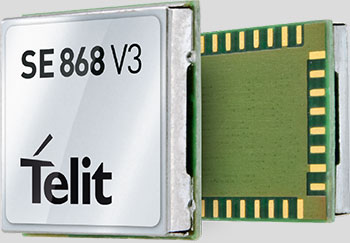
    Telit's Jupiter SE868-V3 module.
    Telit’s Jupiter SE868-V3 module.

    Telit Wireless Solutions has released a new GNSS module, the SE868-V3. The positioning module combines GPS, GLONASS, Beidou, Galileo and SBAS, which enables the creation of high-performance position reporting and navigation solutions.

    The SE868-V3 can navigate to -162 dBm and track to -166 dBm, providing improved performance in harsh environments. It is pin-to-pin compatible with the former SE868-V2 as well as the JF2. This advanced GNSS module can track GPS and GLONASS or GPS and Beidou constellations simultaneously and it is Galileo-ready.

    The 11 x 11 mm QFN package contains a powerful baseband processor, SQI Flash memory and GNSS chip with integrated low noise amplifier (LNA). The ultra-sensitive RF front-end enables multi-GNSS indoor fix and high-quality navigation in challenging outdoor scenarios such as dense urban areas, Telit said.

    In addition, the SE868-V3 supports ephemeris file injection (A-GPS) as well as Satellite-Based Augmentation System (SBAS) to increase position accuracy. Its onboard software engine is able to locally predict short-term ephemeris starting from data broadcast by GNSS satellites received by the module and stored in the internal Flash memory.

    “The SE868-V3 is yet another addition to our positioning product portfolio, which is the result of over 20 years of experience in GNSS applications,” said Felix Marchal, chief product officer, Telit. “Our products are compatible with the GPS constellation as well as its Russian counterpart GLONASS and China’s Beidou.”

  • TireStamp Chooses Telit for Tire Pressure Monitoring with GPS

    TireStamp Chooses Telit for Tire Pressure Monitoring with GPS

    TireVigil-Telit

    Telit Wireless Solutions has announced that TireStamp, a TPMS 2.0-certified vendor of Tire Pressure Monitoring Systems, embeds Telit cellular and positioning modules into its product.

    For fleet managers, tires represent the second-highest operating cost of running a fleet, second only to fuel. Tire maintenance can significantly impact highway safety, revenue potential, operational efficiency, and maintenance costs.

    The TireStamp TireVigil solution communicates with tire pressure sensors to provide real-time monitoring of tire pressure and temperature across vehicle types, tire brands, and location. The comprehensive tire data enables fleet managers to schedule maintenance, intervene in the event of an emergency, improve on-time delivery, and enhance regulatory compliance.

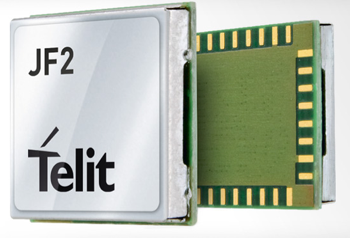
    Telit's Jupiter JF2 GPS module.
    Telit’s Jupiter JF2 GPS module.

    The TireVigil solution uses Telit’s Jupiter JF2 GPS module, a compact, low-power device that provides enhanced accuracy to help locate vehicles in the event of an emergency or at any time. TireVigil receives tire data from TMPS sensors, then communicates in real-time over the cellular network using the Telit HE910 cellular module. Part of the xE910 module family, the HE910 is pin-to-pin compatible with a suite of modules enabling TireStamp to customize its products to enable connectivity across cellular technologies and geographies.

    “Our customers are typically in the maintenance space,” said Scott Feagan, Chairman and CEO of TireStamp. “Reliability and support are extremely important to them – and to me. Pair that with family compatibility for fast time-to-market and global expansion, the opportunity to bundle connectivity with positioning, affordable pricing and on-time availability, and it’s easy to see why we chose to work with Telit.”

    “Between fleets and personal vehicles, more than a billion tires are sold around the world each year,” said Mike Ueland, president of Telit Americas. “Telit has a long history of supporting fleet telematics and automotive solutions and we’re pleased to enable the world’s leading tire pressure management system.”

  • Parsec Antennas Designed for Telit Mini GPS Receiver

    Parsec Antennas Designed for Telit Mini GPS Receiver

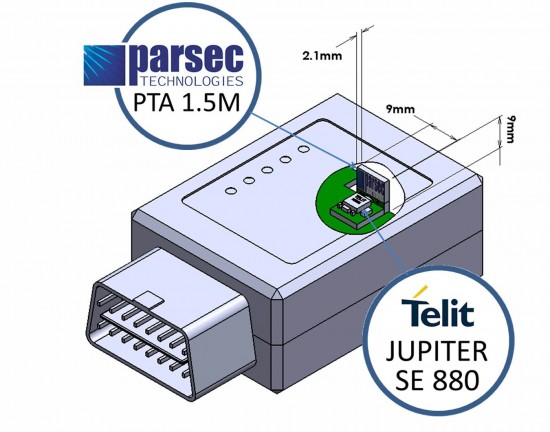
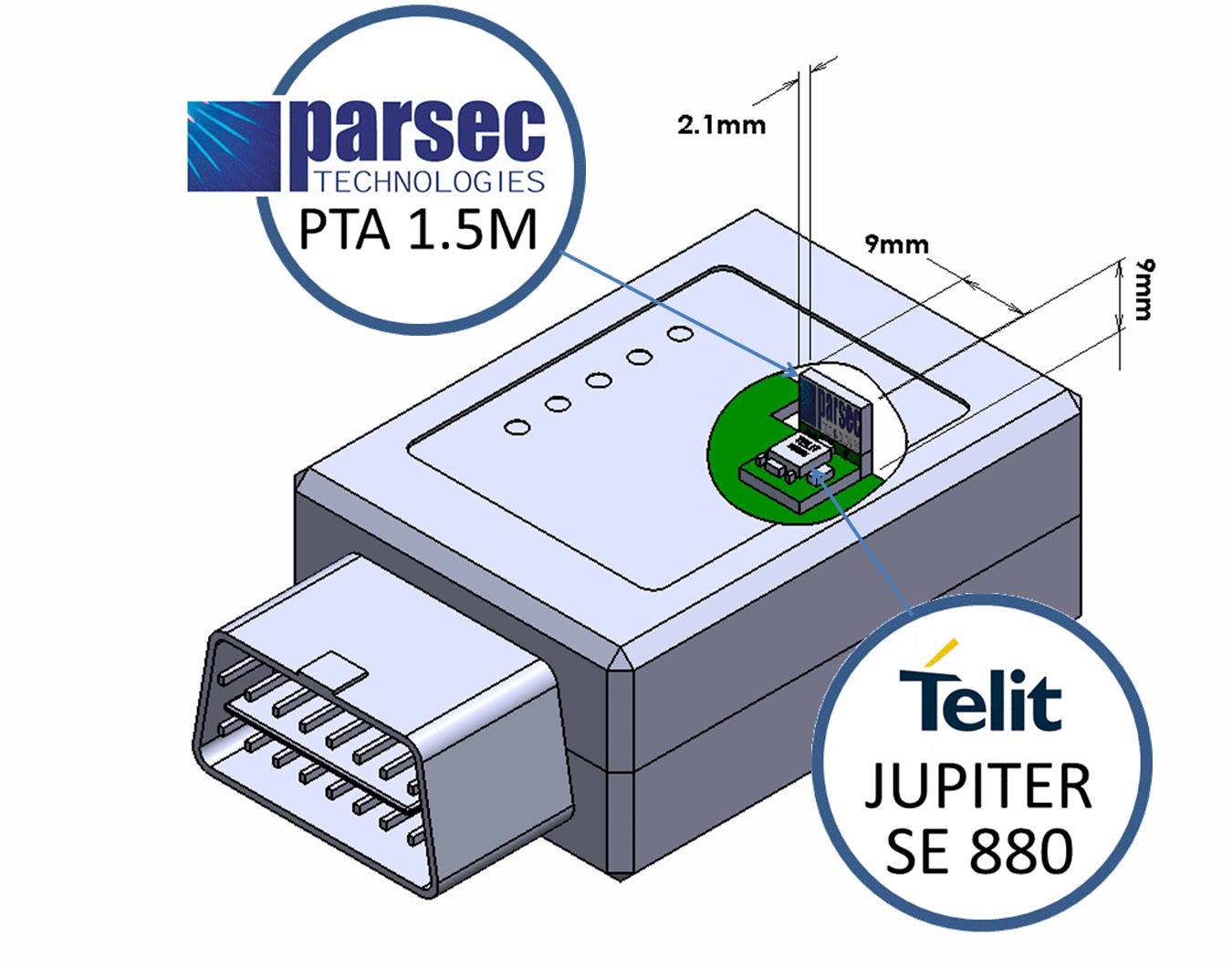
    Telit Wireless Solutions and Parsec Technologies today announced that a combination of the companies’ technologies results in a low profile  companion solution for GPS receiver and antenna. For host devices able to accommodate higher volumetric symmetry, assembly of the components can be made to fit a 6 x 16 x 8 millimeter volume. A flat component arrangement can yield an ultra-low-profile volume of 6 x 16  x 2.4 millimeters.

    ParsecTelitFig1 OBD“Receivers combining the Parsec PTA/PT Family and Telit’s Jupiter SE880 modules deliver good user experience in finished LBS (location-based services) critical products without sacrificing design flexibility, ease of implementation or cost,” said Michael A. Neenan, CEO and founder of Parsec Technologies, Inc. “The combination is ‘bullet-proof’ in providing a rewarding design experience making RF work reliably, passing end-product regulatory compliance testing without re-test.”

    “Miniaturization is a major enabler of new application areas for positioning and M2M,” said Taneli Tuurnala, Vice President and Head of GNSS Division of Telit Wireless Solutions. “With the Parsec antennas, the complete receiver features the industry’s ‘smallest landed footprint,’ making it suitable for use in wearable electronics, UBI devices or adapters for the mobile computing industry.”

    Along with miniaturization, the receiver outperforms top traditional designs, handling a loss of 10 dB or greater in GPS signal reaching, for example, the typical OBD port under a vehicle’s dashboard where many usage-based insurance (UBI) dataloggers are installed. The PTA1.5M active antenna delivers the ultra-sensitive Jupiter SE880 micro receiver over 15 dB of additional gain in the operating frequency range. Both companies are making available complete application notes to simplify the engineering effort for system integrators.

    The miniature 4.7 x 4.7 millimeter LGA (Land Grid Array), SiRFstarIV-based Jupiter SE880 receiver module employs heterogeneous 3D integrated technology to achieve best-in-class performance in all dimensions critical for regular or size-constrained GPS applications. Its RF front-end employs spatially calibrated waveguide-quality radio paths inside the three-dimensional space of its architecture, reducing parasitic impedances characteristic of traditional 2-D RF designs. Inside, a multi-filter system includes not only the traditional SAW filters typical in GPS receiver designs but also a 2.4-GHz notch-filter capable of nullifying the jamming effects of high-energy radio devices such as Wi-Fi hot-spots, Bluetooth systems, cordless phones, and others, which greatly affect a GPS receiver’s ability to resolve timid satellite signals in the hostile radio environment where they need to operate.

    The PTA1.5M, with a gain of 15dB, and PTA1.5x2M, with a gain of 30dB, are tiny GNSS active antenna modules capable of receiving signals down to -192 dBm with frequency centered at 1575.42 (±1.023) MHz. Either model delivers a radiated efficiency greater than 60% when mated to the Jupiter SE880 receiver. Parsec’s PT1233D LNA also has the highest available IP3 at low voltage, helping eliminate interference. Both PTA1.5M and PTA1.5x2M can incorporate the antenna element, an optional SAW filter, the cascadable PT1233D LNA, matching and passives components, on a low cost, easy to integrate 10×16 mm single sided PCBA with “back side” copper clad ground plane. The height of the PTA1.5M and PTA1.5x2M modules vary according to application, allowing their use in even the smallest form factors including Intel’s M.2 Next Generation Form Factor (NGFF) module (23x30x2.4 mm, LxWxH).

  • Parsec Combines Telit Technology with Micro-Mini Modules to Deliver Tiny GPS Receivers

    Parsec Technologies, Inc., today announced that the company’s Micro-Mini PTA/PT family of GNSS/GPS receiver modules seamlessly integrates with the Telit Wireless Solutions Jupiter SE880 three-dimensional system-in-a-package (3D-SIP) to enable what it calls the world’s smallest- to-date, commercial-class, low-cost GPS L1 receiver.

    By combining a PTA/PT family module with the Jupiter SE880 3D-SIP, OEMs and integrators are able to deliver a location-based service product with a GPS L1 receiver in a landed form factor of 20 x 20 x 6 millimenters, or 20 x 10 x 6 millimeters, depending upon component orientation. This contrasts with landed GPS receiver sizes integrating a passive ceramic patch antenna that measure 25 x 25 millimeters, and which Parsec says don’t match the GNSS/GPS frequencies in performance despite being four times the surface area.

    With the Parsec/Jupiter combination, integrators can design LBS-critical products with exceptional user experience in applications with severe use, such as obstructed satellite view and high path loss, including indoors, urban canyons, wearables, smart watches, vehicle under-dash on board diagnostics (OBD) devices, metal containers and aircraft fuselage asset tracking, and M.2/next-generation form factor (NGFF) products.

    Receivers combining Parsec PTA/PT Family and Telit Jupiter SE880 modules deliver good user experience in finished LBS critical products without sacrificing design flexibility, ease of implementation, or cost, Parsec said. The combination is fully vetted and “bulletproof” in providing a rewarding design experience making RF work reliably, passing end-product regulatory compliance testing without re-test.

    According to Michael A. Neenan, CEO and founder of Parsec, customers are future-proofing their LBS critical products when they select a Parsec PTA/PT family for integration with the Telit Jupiter SE880 3D-SIP. PTA/PT family modules receive and amplify any GNSS system signal from 1560 to 1610 MHz, including GPS L1/L1C, with high radiated efficiency in any end product orientation.

    Telit Jupiter SE880 reference design kits will soon be equipped with the Parsec PTA/PT family module. OEMs and integrators can order GPS L1 receiver solutions today.

    The PTA/PT family of GNSS/GPS receiver Micro-Mini modules extends Parsec’s decade-long tradition of stretching the state-of-the-art in small size, ultra-linearity, miniscule energy usage, high gain, low noise, Any Voltage operation, Field-and-Forget reliability, low cost, and ease of integration/use.

  • Telit Chosen as Representative of Italian Tech Industry for Galileo

    Telit Wireless Solutions has been selected among various applicant members of the Italian Technology Industry as one of the nation’s key representatives in the global roll-out of Europe’s Galileo satellite positioning system. The selection reflects the high degree of credibility demonstrated by the Italian government in the strategic plan proposed by Telit to accelerate global adoption of the Galileo technology, Telit said.

    Telit is a global enabler of machine-to-machine (M2M) communications providing cellular, short range and positioning module products. Telit’s positioning technology R&D center is an integral part of the company’s R&D function headquartered in Trieste, Italy.

    Telit also received a grant to execute its proposed strategic plan. The grant offers Telit the opportunity to accelerate its activities in development of projects for the positioning technology market. It bolsters human and financial resources required to enable Telit to quickly advance in this market area and achieve leadership in product performance with services to match. This achievement is likely not only to enhance the company’s competitiveness but is also provide measurable boost for the Italian economy, concretely contributing tangible progress in the strategic and very high growth segment of m2m.

    The inclusion of positioning expertise stems from the company’s mergers and acquisitions over the past few years, which have made it a leading designer and manufacturer of innovative GNSS solutions for OEM applications, from personal and asset tracking to automotive solutions. Telit has sold millions of high-performance GPS modules sold worldwide.

    Galileo is Europe’s global navigation satellite system, designed to provide a highly accurate, guaranteed global positioning service under civilian control. It is inter-operable with GPS and GLONASS, the U.S. and Russian global satellite navigation systems. By offering dual frequencies as standard, Galileo delivers real-time positioning accuracy down to the meter range. It ensures availability of the service under all but the most extreme circumstances and informs users within seconds of any satellite failure, making it suitable for safety-critical applications such as guiding cars, running trains and landing aircraft. A range of services will be extended as the system is built up from initial operational capacity (IOC) to reach the Full Operational Capability (FOC) by this decade’s end. The fully deployed Galileo system consists of 30 satellites (27 operational + 3 active spares), positioned in three circular Medium Earth Orbit (MEO) planes at 23 222 km altitude above the Earth, and at an inclination of the orbital planes of 56 degrees to the equator.

    “Achievement of a leading position in now in Galileo technology not only boosts Telit’s global stance and strength, and consequently that of the Italian technology industry but also extends the reach of our leadership in positioning which already includes two decades of pioneering work in GPS in the United States,” said Dominikus Hierl, chief marketing officer at Telit Wireless Solutions. “The planned work-force expansions in support of this new effort will create extraordinary value-add, not only in terms of project acceleration but also in innovation, vision and new relationships for Telit.”

  • CSR Launches SiRFstarV 5e GNSS Location Solution

    CSR Launches SiRFstarV 5e GNSS Location Solution

    Photo: CSR plc CSR plc has debuted the SiRFstarV 5e, a GNSS engine optimized to enable highly accurate location positioning for devices including mobile phones, cameras, and health and fitness products. By supporting fully concurrent GLONASS, GPS, QZSS, and SBAS from ROM, the highest accuracy and fastest time-to-first-fix (TTFF) are ensured.

    Wireless solutions specialist Telit Communications plc will be using the solution for its Jupiter SE868-V2 module, which was launched at CTIA Wireless 2013 in Las Vegas. The 11 x 11 millimeter QFN packaged receiver module integrates 5e, TCXO, SAW, and RTC oscillator into a small convenient package, accelerating time-to-market and reducing product development risks. CSR believes its advanced power saving modes make it extremely battery-power friendly and ideal for wearable and personal navigation applications.

    “The Jupiter SE868-V2 excels in all positioning tasks and foremost in applications requiring high reliability navigation,” says Felix Marchal, Chief Product Officer at Telit Wireless Solutions. “By using CSR’s SiRFstarV 5e solution, we have been able to create a quick and convenient upgrade path for our Jupiter JF2 GPS module customers to the latest and most robust multi-constellation support available in the market.”

    SiRFstarV 5e offers a range of features to increase accuracy, improve time to first fix and preserve battery power to enable a better user experience. These include:

    InstantFix Extended Ephemeris (EE) — Devices without wireless connectivity, such as cameras, are able to overcome slow TTFF, a common annoyance for the end user. 5e is capable of autonomously forward predicting EE for three days locally, and for connected devices the solution supports server based EE for up to 31 day for GPS and up to 14 day GLONASS EE

    Direct to battery capability — The GNSS chip can connect directly to a Lithium battery supply, enabling system cost reduction and increased power efficiency. This is implemented by an integrated switched PMU, reducing system level power and eBOM costs

    Design flexibility for optimal solution cost — With clear attention to solution implementation, 5e is designed for small size and low power. For example, UART and SPI Flash drive levels are drivable from 1.8v to 3.3v, eliminating the need for level shifters and increasing implementation flexibility

    Intelligent design — The 5e is designed to be optimised for low power battery operated devices. For instance, in asset tracking applications, the 5e engine will intelligently decide how long to try to acquire satellite signal based around its environment, saving a significant amount of battery power

    “The SiRFstarV 5e device allows our customers to select a high performance solution that will deliver end users a seamless navigation and location experience whatever the application,” says Dave Huntingford, Director of Location at CSR. “The fact that Telit has already seen the potential of SiRFstarV 5e and selected it for its Jupiter SE868-V2 module reflects the location accuracy benefits afforded by the 5e.”

    SiRFstarV 5e is offered in a size optimal 0.4-mm pitch Wafer Level Chip Scale Package (WLCSP) and a 0.5-mm pitch Ball Grid Array (BGA) for low cost PCB applications.

  • Sprint Selects Telit as Module Provider, Approves CDMA 1xRTT M2M Module

    Telit Wireless Solutions, provider of high-quality machine-to-machine (M2M) modules, services and solutions, has announced approval by Sprint for its CE910-DUAL cellular M2M module. A dual-band CDMA 1xRTT module, the CE910-DUAL allows Sprint M2M Solutions customers to deploy a wide range of M2M applications benefiting from reliable connectivity over Sprint’s nationwide network while enabling cost-sensitive business plans.

    The CE910-DUAL packs high value features in its ultra-compact 28.2 x 28.2 x 2.04 mm Land Grid Array (LGA) package. USB 2.0 full-speed support and a rich set of drivers make it ideal for embedded applications requiring easy integration to platforms based on the latest desktop and mobile operating systems such as Windows and Linux. Full-duplex data rate of 153.6 Kpbs and extended operating temperature range of -30°C to +85°C make it a suitable platform for mobile and fixed applications such as vending, point-of-sale (POS), tracking,  smart metering, and telematics devices.

    “Sprint plans to maintain our CDMA 1xRTT network capability for the long term as part of our overall Network Vision strategy,” said Wayne Ward, vice president, M2M Group, Sprint. “We have been working with Telit for several years as a Sprint preferred provider and one of the leading module suppliers to the M2M industry and believe their xE910 form factor makes it easy for customers to deploy on either the EV-DO or 1xRTT CDMA Sprint networks.”

    “With this approval, the cost-effectiveness, reliability and functionality of the CE910-DUAL module are accessible to Sprint M2M and Telit customers along with outstanding support and network connectivity from one of the nation’s top-rated cellular networks,” said Mike Ueland, senior vice president and general manager of Telit Wireless Solutions North America.

    Part of the xE910 form factor family, the CE910-DUAL protects investments by offering complete compatibility with the DE910-DUAL, a Sprint-approved companion product for EV-DO Rev. A applications.