Tag: Topcon

  • Topcon Announces MR-1 Precise Heading Solution

    Topcon Positioning Systems has released the MR-1 Heading System, an OEM GNSS solution for high-performance positioning and heading.

    Using the MR-1 receiver and Topcon’s MG-A8 antenna, the system provides “centimeter-accurate RTK positioning and better than 1/10 of a degree heading accuracy in challenging environments,” said Doug Langen, TPS GNSS product manager. “The rugged MR-1 receiver is water and dustproof and operates at a robust operational temperature range of -40°C to 75°C.”

    When combined with Topcon’s Quartz Lock Loop technology, the MR-1 offers continuous operation during “extreme vibration and shock, typical of intense dynamic environments,” he said.

    The MG-A8 antenna of the MR-1 Heading System is designed for moving platforms and provides multipath rejection. It also offers increased resistance to near-band interference from satellite communications systems commonly found in marine applications.

    Additional information is available at www.topconoemsolutions.com.

  • Two Active GLONASS Satellites Could Cause Users Difficulties

    On day 53 (February 22) around 09:15 GPS Time, GLONASS 743 began transmitting on frequency channel 6 using almanac slot 8 (R08). It should replace GLONASS 701K (801) transmitting on frequency channel -5, previously using almanac slot 8. However, GLONASS 701K was not immediately switched off and/or did not switch slot numbers and continued to transmit on frequency channel -5 for several days, continuously identifying itself as a slot 8 satellite.

    While most receivers were just tracking GLONASS 743, some tracked both GLONASS 743 and 701K. While 701K was not in the broadcast almanac, it was transmitting ephemeris records identifying itself as a satellite in slot 8. The net result was that RINEX observation files from certain stations had a mixture of GLONASS 743 and 701K data, with no indication of which satellite was which. Of course, one could use expected Doppler shift and/or code/carrier rate of change to figure out which data records correspond to which satellite.

    Furthermore, the GLONASS navigation files from certain stations contained a mixture of ephemeris records from GLONASS 743 and 701K. For day 54, for example, GLONASS navigation files for 146 (non-MGEX) stations were available at CDDIS. A number of these did not contain any R08 entries, presumably because the corresponding receivers were set to not track unhealthy satellites. Some of the files contained R08 ephemeris records from earlier dates. These were ignored.

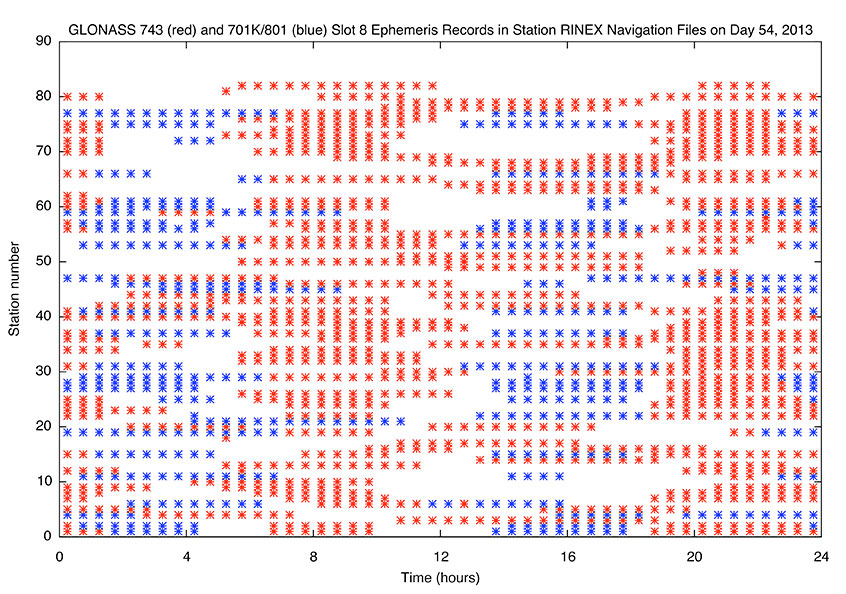
    This left 82 files containing either GLONASS 701K and/or 743 ephemeris records for day 54. These files were parsed to determine, for each file, for which times ephemeris records were available for which satellites. The results are summarized in the following plot (PDF available):

    glonass_slot8_in_nav_files_054_2013
    Results of Glonass

    The station numbers correspond to those in this table.

    The navigation files from 29 stations contain both GLONASS 701K and 743 records. It seems that JAVAD GNSS and Topcon receivers were primarily affected.

    Note that the CDDIS brdc***0.13g files on affected days have a mixture of GLONASS 743 and 701K ephemeris records, but at any one epoch, only one satellite is represented.

    Files from days 53 through 56 are affected.

    It appears that GLONASS 701K stopped identifying itself as a slot 8 satellite after about 15:15 GPS Time on day 56 and was not subsequently tracked by any station supplying data files to CDDIS.

    See also IGSMail-6734, “Irregular GLONASS constellation change (for R08).

  • New Organization Advocates for GPS Industry

    A new group, the GPS Innovation Alliance, has formed and announced itself as the voice of the U.S. GPS industry and community of users, to “support the ever-increasing importance of GPS” in the U.S. capital, Washington, D.C.  The organization subsumes and replaces both the U.S. GPS Industry Council, an entity of longstanding, and the Coalition to Save Our GPS, which arose in March 2011 in response to a Federal Communications Commission (FCC) conditional waiver granted to LightSquared.

    The alliance appears to reflect a desire on the part of some industry members to take a more aggressive approach inside the Washington Beltway, a sign, it would seem, of the political times. Some of those involved spoke informally of a desire to take advantage of contacts made on Capitol Hill and in the media during the highly visible LightSquared combat, fought in the glare of media attention heretofore unknown in industry circles.

    Members of the Alliance are drawn from a variety of fields and businesses reliant on GPS, as well as leading manufacturers of GPS equipment. The former group includes, aviation, agriculture, construction, transportation, first responders, and surveying and mapping, and consumer organizations representing users of GPS for boating and other outdoor activities, and in automobiles, smartphones, and tablets.

    Joining John Deere, Garmin, and Trimble — three lead drivers of the Coalition effort at the FCC — are NovAtel Inc. and Topcon Positioning Systems. All five were previously long-time members of the USGIC, and they appear as founding members of the alliance at www.gpsalliance.org.

    Affiliate members listed on the website include the Association of Equipment Manufacturers, General Aviation Manufacturers Association, National Association of Manufacturers, Association for Unmanned Aerial Vehicles International, and Boat Owners Association of the United States.

    The alliance plans to build on “the proud heritage and extensive expertise of the United States GPS Industry Council (USGIC), which was formed in 1991 to promote broader commercial applications of GPS and to expand global markets while assisting in safeguarding the technology’s military advantages. The council has a long history of highly effective advocacy on behalf of the GPS industry, as well as serving as a trusted source of objective information for policy makers, the media and the public both in the U.S. and around the world.” The alliance website gives a longer statement about the history and record of the USGIC, highlighting its role in international negotiations.

    Michael Swiek, executive director of the USGIC, has transitioned to become the executive director, executive branch and international, of the Innovation Alliance. In addition to working closely with leading offices of executive branch departments of the U.S. government, he will continue well-established dialogs with governmental, private sector and academic entities in areas critical to GPS and satellite navigation among key players in Europe, Japan, Russia, Korea, China, and elsewhere.

    Heather Hennessey, a principal of Innovative Federal Strategies LLC, a “comprehensive government relations firm,” has taken the position of executive director, legislative, at the alliance. Hennessey has seven years of service in the House of Representatives, including two years as chief of staff for Congressman Jack Kingston of Georgia.

    An active voice in alliance representations on Capitol Hill will presumably be that of Jim Kirkland, vice president and general counsel for Trimble. Kirkland was the most prominent spokesperson for the coalition during the LightSquared battle, which appears to be either over or nearly so. “The alliance is committed to ensuring constructive, robust dialog between GPS users, manufacturers and policy makers on critical policy issues affecting GPS,” Kirkland said, “a commitment Trimble is pleased to be a part of as the industry continues to innovate and modernize.”

    The alliance mission statement cites the importance of GPS to global economy and infrastructure; vows to aid further GPS innovation, creativity and entrepreneurship; and to protect, promote and enhance the use of GPS.

    The GPS Innovation Alliance officially launched on February 13 with a reception on Capitol Hill, a traditional lobbying tactic that previous efforts had perhaps not envisioned.  The organization has also hired a public relations firm, Prism Public Affairs, and commissioned a logo.

  • Topcon HiPer SR and Pocket 3D Provide Help to Construction Sites

    HiPer SR_construction_Topcon
    Topcon HiPer SR and Pocket 3D in the field.

    With the introduction of a new version of Pocket 3D software for its HiPer SR GNSS receiver, Topcon Positioning Systems is expanding the delivery of high-accuracy 3D positioning technology to contractors needing a low-cost, one-man layout and measurement system.

    Pocket 3D is powerful, easy-to-use data collection and control software for grade checking and other measurement applications on a job site. Version 10.0.2 makes it fully functional with the HiPer SR receiver, introduced in August.

    The new receiver is not only “perfect for contractors, but also for other non-traditional GNSS users such as landscape architects, law enforcement forensics projects or any others requiring high-accuracy 3D positioning,” said Tony Vanneman, Topcon construction products marketing manager.

    Its field-rugged and fully-integrated design delivers a 1,000-foot working radius through Topcon’s new LongLink technology. “This innovative wireless data link was developed specifically for the HiPer SR, and provides reliable and interference-free base-to-rover communications that don’t require an FCC license to operate,” Vanneman said.

    “We took the best signal tracking technologies and packaged them in a small, energy-efficient design,” he said.  “Anyone looking for a rugged, easy-to-use, low-cost 3D GPS system will find what they need in the HiPer SR.”

    Additional key features of the HiPer SR include:

    • Shock-resistant magnesium alloy housing – allowing the HiPer SR to take a 6 ft. (2m) pole drop onto concrete;
    • Weighs 1.8 pounds (0.8kg);
    • 226-channel Vanguard technology, featuring Universal Tracking Channel technology, supports all satellite constellations;
    • Fence antenna technology;
    • Quartz lock loop technology for superior GNSS tracking in high-vibration environments, such as on a four wheeler;
    • Capable of simultaneous LongLink operation with multiple rovers;
    • Sealed battery pack provides more than 15 hours of operation.
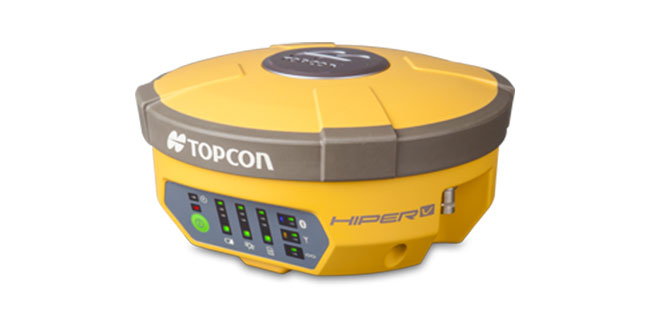
  • HiPer V Featuring Vanguard Technology Offered by Topcon

    HiPer V Featuring Vanguard Technology Offered by Topcon

    Topcon has introduced the HiPer V receiver, which features Topcon’s Vanguard technology. The HiPer V provides users with the choice of GPS and GLONASS signals (as well as Galileo when operationally available), and also includes a variety of choices of internal radio, cellular and Bluetooth communication options and what Topcon calls a state-of-the-art power supply.

    The core of the HiPer V is the new Vanguard GNSS technology, according to Ewout Korpershoek, Topcon senior vice president and chief marketing officer. With its 226 channels and Universal Tracking, the Vanguard chipset is future proof, as it will track signals from all available and currently planned GPS, GLONASS and Galileo satellites.

    “Topcon’s Universal Tracking provides a whole new definition of ‘channel technology.’ There is nothing available like it. Universal Tracking allows a single receiver channel to ‘automatically’ select and track any satellite signal,” Korpershoek said. “Because our channels are not pre-programmed to receive only one specific signal or a type of signal, Topcon users will always receive the maximum number of signals at any given time. In addition, Topcon’s Universal Tracking will automatically weigh the best combination of available signals based on health, geometry and application, providing unmatched accuracy, speed of initialization and fixing. HiPer V will work at places where other receivers will not, at highest accuracy, and with greatest ease of use.”

    Other features include the rugged, durable magnesium alloy housing, the choice of communication options, “and longest life rechargeable battery while maintaining the lightest weight in its class,” Korpershoek said.

  • Topcon Precision Agriculture Announces Receiver/Steering Controller

    Topcon Precision Agriculture,  a business unit of Topcon Positioning Systems, announces the AGI-4, an integrated steering solution that can interface with many manufacturer’s virtual terminals.

    The AGI-4 features multiple-constellation GNSS satellite reception, inertial sensors for full terrain compensation, and Topcon’s line acquisition and on-line steering functionality. It will be released at AgConnect Expo in Kansas City, Missouri, January 29-31.

    The AGI-4’s modular design includes antenna, multi-constellation GNSS satellite receiver and steering controller, with optional high-accuracy inertial sensors snap-in module offering unmatched upgradability, Cobb said. It comes standard with WAAS and EGNOS steering functionality. An RTK communication module is also an option.  It is easily upgradeable to 2-centimeters accuracy with RTK radio options.

    NTRIP capability allows a user to tap into existing reference networks via mobile phone connection (dependent on local availability) and uses existing data plans and infrastructure to minimize costs.

    AGI-4 features include ISO11783 compatibility with virtual terminals, allowing the addition of Topcon’s auto-steering performance to virtually any steer-ready vehicle via a single component installation, according to Kevin Cobb, TPA director of product management. “Being compatible with the displays of many other manufacturers lets the AGI-4 steering controller give true Drop-in and Drive convenience,” Cobb said.

  • Topcon’s Ray O’Connor Receives Honorary Doctorate

    The Dublin Institute of Technology (DIT) has conferred the award of honorary doctorate on Ireland native Ray O’Connor, president and CEO of Topcon Positioning Systems.

    The award was conferred in recognition of O’Connor’s outstanding achievements in international business and innovation. Originally from County Kildare and now based in California, O’Connor attended the ceremony accompanied by his wife Nancy, as well as several family members who are living in Ireland and in the United Kingdom.

    Past recipients of honorary doctorates from DIT include: Pierce Brosnan, actor and philanthropist; Mary Robinson, former president of Ireland; Arthur Ryan, chairman of Penneys; Phil Coulter, musician, composer and music ambassador; Angela Brady, president of the Royal Institute of British Architects; and Dr. Martin McAleese, Irish peace activist.

    The honorary doctorate award is conferred on a small number of individuals who have made an exceptional contribution in their field.  The award is conferred at the annual DIT graduation ceremony and recipients are introduced as standard bearers for DIT graduates starting out on their careers.

    In his speech to the assembly, the DIT president, Professor Brian Norton welcomed O’Connor back to DIT, where he had completed his studies in construction in the early 1980s.

    About O’Connor, Norton said, “Your positive, forward-looking approach to developing new businesses, and your ability to work across geographical and cultural borders, provide a real example to us as educators and to our graduates as young professionals.”

    O’Connor traveled to the U.S. when he finished his studies at DIT. He worked for a number of different companies before joining Topcon America, a division of the Tokyo-based Topcon Corporation in 1993. Outlining his career path, Murphy said O’Connor had joined a Topcon team of 40 people, and now leads a company employing more than 800 worldwide.

    “O’Connor was the first person who was not Japanese or of Japanese descent to receive the prestigious Toshiba Business Performance Award for his superior leadership and performance,” Mike Murphy, dean of the College of Engineering and Built Environment, said.

    In addition to his role as president and CEO of Topcon Positioning Systems, earlier this year Ray O’Connor was appointed senior managing executive officer of Topcon Corporation. O’Connor said, “It is indeed a distinctive honor and humbling experience to be included in this extraordinary group of world leaders in receiving this special award from DIT.”

    O’Connor was conferred in the company of DIT graduates of the Department of Engineering and Built Environment, accompanied by their families. The Dublin Institute of Technology (DIT) is one of the largest institutes of higher education in the country with more than 19,000 students and a staff of about 2,000.

  • How Do You Topcon? Contest Launched


    Topcon Positioning Systems has launched the second annual “How do you Topcon?” video contest with the slogan, “However and whenever you Topcon, we want to see it!”

    The contest includes four categories:

    • Most innovative or creative use of Topcon equipment;
    • Funniest video or infomercial;
    • Best testimonial or “on-the-job” story;
    • The “wow” Factor.

    The contest will run through December 15, 2012.

    Participants will upload a short video (maximum length of three minutes) showing how they use Topcon products and services. Any use of Topcon equipment across all business segments — construction, survey, emerging business and agriculture — will be eligible. Prizes for the contest range from a preselected Topcon product, iPad or gift cards from $50 to $750.

    “We want to engage our customers in a fun way through a social media forum and are finding that the video contest, and the recent ‘Topcon is Everywhere’ and ‘Spirit of Agriculture’ photo contests are excellent ways for everyone to get involved, from first-time-users of Topcon equipment to those who rely on it heavily for extensive projects,” Scott Langbein, director of product marketing said.

    Official rules and information on how to enter are available at www.howdoyoutopcon.com.

  • Topcon Unveils B110 GNSS Receiver Board


    Topcon Positioning Systems announces the light, ultra-compact dual-frequency positioning engine, the B110 GNSS receiver board. The B110 is the first GNSS board with Topcon’s new Vanguard ASIC, supporting 226 universal channels for GPS, GLONASS and Galileo tracking and scalable positioning from sub-meter DGPS to sub-centimeter RTK.

    The B110 board’s small size, low power consumption and flexible communication interfaces make it easy to integrate into any precise positioning application, reducing the time-to-market for OEM customers.

    Features that facilitate easy integration include:

    • Compact 40 x 55mm footprint with low power consumption
    • 226 universal channels with GPS + GLONASS L1/L2, Galileo E1 and SBAS “all in view” tracking
    • High performance RTK engine
    • Industry-leading position update rate of 100Hz
    • SD/MMC card interfaces for quick and easy support for data logging – just add a memory card holder
    • Serial, USB, CAN, I2C, PPS and EVENTIN.
  • Topcon’s MG-A8 Antenna Designed for Accurate Maritime Applications

    Topcon Positioning Systems announces the MG-A8 antenna for navigation and precise positioning in marine applications. According to Topcon, the new MG-A8 marine antenna provides exemplary GNSS signal tracking while not being susceptible to signal jamming from other sources, such as Inmarsat communications.

    The MG-A8 antenna can be used in DGPS mode for meter-level navigation purposes but can also be used for RTK centimeter level positioning in areas where there is a network of reference stations available to support this level of precision. With its RTK capabilities, the MG-A8 is a “preferred solution for applications such as dredging in inland river channels and waterways,” said Tom Morris, TPS senior product development manager.

    “This antenna is designed with challenging marine applications in mind.  It is accurate, rugged, reliable and affordable.”

  • Topcon at the ESRI International Users Conference

    GPS World magazine interviews at the ESRI show, talking with Jason Hooten, the GIS Sales Manager at Topcon Positioning Systems.

  • Topcon Releases High-Accuracy RTK system, HiPer SR

    HiPer_SR_Topcon_

    Topcon Positioning Systems has unveiled the HiPer SR — an advanced GNSS RTK receiver that Topcon describes as having “the most compact and lightweight design of any fully integrated precision receiver — ever.”

    With the HiPer SR, Topcon is expanding the delivery of high-accuracy RTK technology to a variety of users — surveyors who need a tool for small boundary or stakeout work, non-traditional users such as landscape architects who need a low-cost mapping solution, and law enforcement or any others requiring high-accuracy 3D positioning.

    Cable-free and weighing under 2 pounds, the rugged and fully integrated design delivers a 1,000-foot working radius through Topcon’s new LongLink technology. The LongLink wireless data link was developed specifically for the HiPer SR, and provides reliable and interference-free RTK base-to-rover communications that don’t require an FCC license to operate, Topcon said. Base and rover units can be used interchangeably.

    The HiPer SR can also be a dedicated network rover. All standard RTK correction formats and network protocols are supported, and a comprehensive range of field workflows are realized with the Magnet family of cloud-enabled software solutions.

    The HiPer SR’s 226-channel Vanguard GNSS chip provides precision measurement and advanced multipath rejection, offers support for all modernized GNSS constellations, and incorporates Topcon’s patented Universal Tracking Channel technology whereby any channel can track any available signal, reducing power consumption and system weight. As more GNSS signals come online, this flexibility enables the 226-channel Vanguard design to scale up and track more signals than other GNSS systems.

    Additional features of the HiPer SR include:

    • Quartz Lock Loop technology. Designed by Topcon engineers for superior GNSS tracking in high-vibration environments, such as on a four wheeler;
    • Capable of simultaneous LongLink operation with multiple rovers;
    • Sealed battery pack provides more than 15 hours of operation;
    • Lightweight and shock-resistant magnesium alloy housing, allowing the HiPer SR to take a 6 ft. (2m) pole drop onto concrete