Tag: Ukraine War

  • Paris Air Show and kamikaze UAVs

    Paris Air Show and kamikaze UAVs

    Air Mobility Event Illustration. (Image: Paris Air Show)
    Air Mobility Event Illustration. (Image: Paris Air Show)

    The Paris Air Show

    The Paris Air Show rolls out this week, accompanied this year by several urban air mobility (UAM) companies, including Eve Air Mobility with a cabin mock-up of its eVTOL, and demonstrations of its UAM software.

    Eve also announced ahead of the show that United Airlines, its major partner, is moving forward with route and infrastructure planning in San Francisco — where such factors as the size of the city and high traffic volume cry out for mobility alternatives.
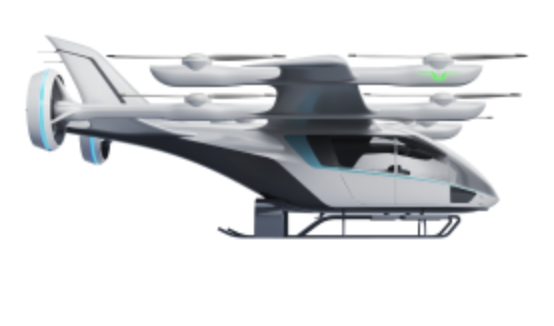
    Eve UAM. (Image: Eve press release)
    Eve UAM. (Image: Eve press release)

    Emerging as a start-up from within the Brazilian aircraft company Embraer, Eve was eventually floated in 2022 through an initial public offering on the New York Stock Exchange. Given the relationship with Embraer, Eve (in particular, United and other Eve customers) stand to gain access to the worldwide maintenance, support, parts and repair organization that Embraer has developed to support its own passenger fleet of thousands of aircraft. An enviable solution for any current or future purchaser of Eve vehicles — this probably has something to do with their huge order backlog for 2,770 vehicles. All that is required now is the full-scale assembly, ground and flight test, verification and certification of the Eve air mobility aircraft — currently forecast to enable a 2026 entry into service.

    Additionally, other UAM companies will be present in a special show exhibit, the “Air Mobility Event,” in Hall 5 in Paris.

    Is Ukraine winning the UAV war with Russia?

    This is not at all clear, as both sides throw at each other many different UAVs in various configurations with different missions. We tend to only see the Ukraine side of the picture, given that Russia does not generally document its successes in the media.

    However, recent news indicates that Moscow is importing Iranian UAV technology to bare in its war with Ukraine. It seems that Iran has been supplying complete kamikaze attack UAVs and may also be assisting with materials to set up an assembly plant near Moscow. Potential one-way attack UAVs include the HESA Shahed 136/Geran-2, the new MERAJ-523 which can carry a 50 kg warhead, and the Mohajer-6 reconnaissance/attack drone.

    Last week, Russia unleashed a volley of about 44 UAVs on the capital Kyiv, thought to be Shahed 136 kamikaze UAVs. Ukrainian defenses brought down the majority, but there were still a number of casualties. These attacks on the center of Kyiv are said to have intensified during the last two months — the UAVs are cheap, long range, and carry significant ordinance.
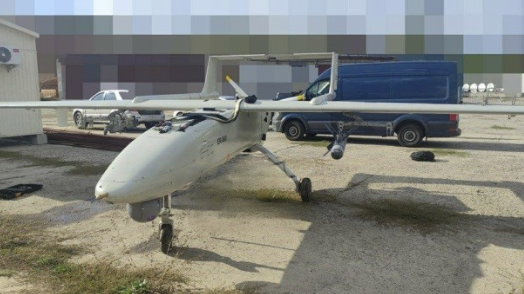
    Mohajer-6. (Image: courtesy of the Ministry of Defense of Ukraine)
    Mohajer-6. (Image: courtesy of the Ministry of Defense of Ukraine)

    The UK is reported to have called Iran’s actions in support of Russia contrary to the nuclear agreements reached between Iran and the European Union in October 2022, which prohibit the supply of any military aid to Russia by Iran.

    Not to be left behind, India has brought its own kamikaze UAV online

    The ALS-50 loitering munition, built by the Mumbai Tata group, was recently inducted into the Indian Air Force (IAF) for use against targets on the ground (i.e., missile batteries) and on the sea (i.e., ships).

    With an apparent range of 1,000 km (62 miles) and a payload of 25 kg (55 lb), the Indian-produced UAV will replace more expensive UAVs, which India has imported from Poland and elsewhere.

    With the war in Ukraine on the mind of all countries near the conflict, it is clear that many may take on defense strategies similar to those that have been used by both Russia and Ukraine.

    UAV news summed up

    So, as the International Paris Air Show, previously a major military exhibition and air show, begins to welcome and feature the coming age of UAM, it is good to see that there are several independent programs that plan to show their wares. Air-taxi services are still some way off from being a reality, as there are still heavy, lengthy investments to be made in building and qualifying these unmanned/manned aircraft for passenger use. Hopefully, however, several of the contenders will make it to the finish line and fulfill the promises made for UAM.

    Meanwhile, as the war in Ukraine plods along, taking lives and destroying property, it is good that both sides have decided that UAVs should be the way to proceed. UAVs, after all, are relatively small and the degree of destruction they can cause is limited. Still, this is not very comforting for people on both sides as they run from the sound of two-stroke and four-stroke engines descending from on high, carrying explosive charges that will kill and maim. Additionally, as the West arms Ukraine with defensive materials, it’s not surprising that Russia is seeking weapons from allies, wherever it can find them.

  • Russia blames Ukraine for overnight UAV attack on the Kremlin

    Russia blames Ukraine for overnight UAV attack on the Kremlin

    Image: Screenshot of video posted by Reuters
    Image: Screenshot of video posted by Reuters

    On May 3, Russia claimed Ukraine had launched an overnight UAV attack on the Kremlin in an effort to assassinate President Vladimir Putin, reported multiple news sources including NBC News and Reuters. President Volodymyr Zelenskiy quickly denied any Ukrainian involvement.

    A video taken of the incident posted on social media shows two UAVs aimed at the Kremlin that were promptly shot down.

    A Ukrainian official stated the incident suggested Moscow was preparing a major terrorist provocation, reported Reuters. Putin’s office said Russia reserved the right to retaliate and that it regards the incident as a planned act of terrorism and an attempt on the president’s life.

    A Russian agency also stated Putin was not at the Kremlin at the time of the incident.

  • UAV and AI update

    UAV and AI update

    A couple of stories about unmanned air vehicles in the war in Ukraine and a response to the recent Open Letter by the “Future of Life Institute” with more than 200,000 signatures on advanced AI, which urged a six-month moratorium to allow the development of seemingly much needed AI regulations.


    The war in Ukraine

    It has been reported that Ukrainian forces were operating the commercially available Chinese Mugin 5 UAV, presumably for surveillance of Russian forces inside Russian-occupied territory. The Mugin 5 can be bought commercially for $10-15,000 and is manufactured by Mugin, which is based in the port city of Xiamen, on China’s eastern coast. In a previous statement posted on the company’s website on March 2, Mugin Limited said that it “condemns” the use of its products during warfare and that it ceased selling products to Russia or Ukraine at the start of the war. However, Russian forces claimed in January 2023 that it had actually shot down one of these Chinese-made UAVs being flown by Ukrainian forces over their territory.

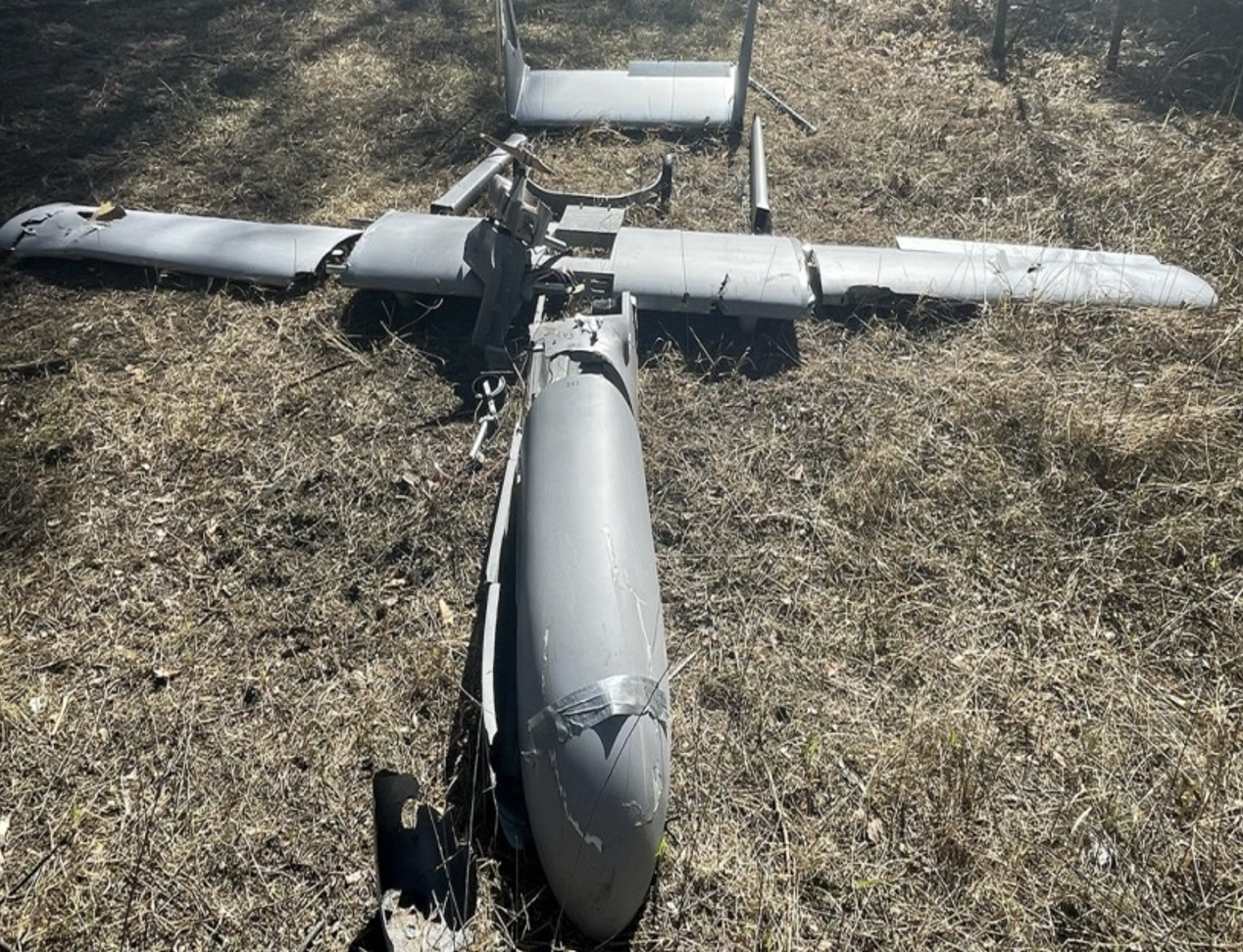
    Then, just this week, Ukrainian forces apparently were able to track a low level, slow-moving air vehicle coming at them from Russian occupied territory. After some time, they were able to intercept the UAV, which carried a flashing navigation light, from the ground, and were able to bring it down using small arms. The remains of the crashed UAV were found in a clearing in the forest; a single 44 lb bomb was removed from the wreckage and safely exploded by the Ukrainian team.

    Weaponized Mugin 5 following crash in Ukraine forest. (Image: Screenshot from video from Kanal13 Youtube)
    Weaponized Mugin 5 following crash in Ukraine forest. (Image: Screenshot from video from Kanal13 Youtube)

    Somewhat worse for wear, the Mugin 5 UAV appears to have been held together in places by duct tape and other patches. Is it possible that having shot down a Ukrainian surveillance UAV the Russians recovered these remains and crudely restored the unit to flying and navigating capability, then sent it back to Ukraine owners carrying a bomb? Anything is possible in this conflict.

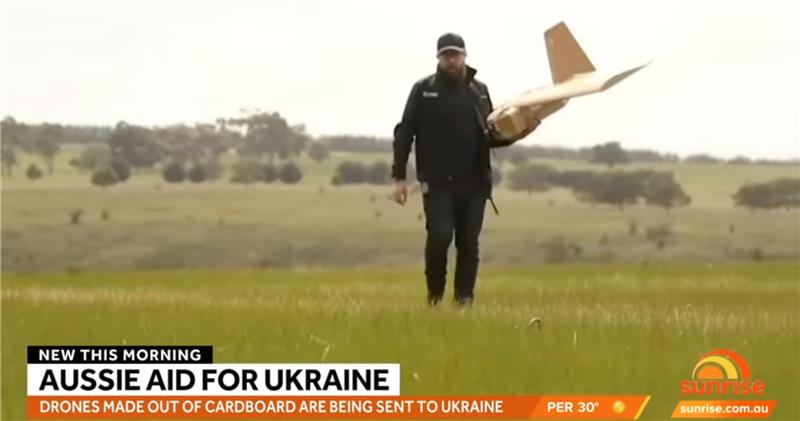
    Staying with this conflict and the use of UAVs by both sides, its seems that Australia has come up with a low-cost surveillance UAV that is virtually undetectable and it’s proving quite popular with the Ukrainians. Most defensive detection involves some form of radar scanning, which relies on radar returns bouncing off a flying target. The Australian company SYPAC in Melbourne has developed the Corvo Precision Payload Delivery System (PPDS). It is a wax-coated cardboard UAV, held together with elastic bands and glue, but carrying sophisticated guidance and control electronics.

    Image: Screenshot of video posted by 7 News Australia 
    (Image: Screenshot of video posted by 7 News Australia)

    SYPAQ has developed the CORVO UAV under an AU $1.1 m government contract with the objective of creating a low-cost, disposable UAV to deliver urgent needs — such as medical supplies or to resupply small arms ammunition to the Australian military. CORVO is autonomous once launched, using GNSS guidance, or dead reckoning if GNSS signal is lost or jammed. Apparently, hundreds of these disposable UAVs have already been shipped to Ukraine.

    While a surveillance role was originally envisaged in Ukraine, it is reported that, “They have been very good at inflicting lots of damage on the enemy,” according to Ukraine’s ambassador to Australia. So, CORVO UAVs may well have already been weaponized.

    Open Letter on AI development

    Following a recent open letter supported by Elon Musk and Steve Wozniak that proposes a six-month halt on advanced AI development, I was recently approached on behalf of Professor Ioannis Pitas, director of the Artificial Intelligence and Information Analysis (AIIA) lab at the Aristotle University of Thessaloniki (AUTH) and management board chair of the AI Doctoral Academy (AIDA) with somewhat different views.

    In order to further the on-going discussion, I thought it would be appropriate to give some space to an alternate view on AI development. So here are some paraphrased comments approved by Pitas:

    Could AI research be stopped even for a short time? It is doubtful. Further AI progress is necessary for us to transition from an information society to a knowledge society.

    Maybe we have reached the limits of AI research carried out primarily by Big Tech, which appears to treat powerful AI systems as black boxes whose functionality may be poorly understood.

    It seems that the open letter reflects welcome and genuine concerns on social and financial risk management. Are expensive lawsuits in an unregulated and unlegislated environment inevitable as a consequence of ill-advised AI pronouncements?

    However, it is doubtful whether the proposal for a six-month ban on large-scale experiments is the solution. It’s impractical for competitive commercial and geopolitical reasons, with very few benefits.

    Of course, AI research can and should become more open, democratic and scientific.

    Here are a number of suggested options:

    • Should elected parliaments and governments make the important decisions on AI rather than corporations or individual scientists?
    • Every effort should be made to facilitate the positive aspects of AI social and financial progress and to minimize any negative aspects.
    • The positive impact of AI systems can greatly outweigh their negative aspects if proper regulatory measures are taken.
    • It is possible that the biggest threat is that AI systems could deceive too many people who have little related knowledge. This can be extremely dangerous.
    • We should counter the big threat coming from the use of AI in illegal activities — cheating on university exams is a rather benign use — while the possibility of criminal exploitation may be very much worse.
    • The impact of AI on labor and markets will be very positive in the medium to long term.
    • AI systems should be required by international law to be a) registered in an ‘AI global register’, and b) users should be notified when they converse with or use the results of an AI system.
    • As AI systems have a huge impact on society, and in order to maximize their benefit and socio-economic progress, it is recommended that:
      o advanced key AI system technologies should become mostly open
      o AI-related data should be at least partially open.
    • However, strong financial compensation schemes should be established now for AI technology developers to compensate them for any component that becomes open source.

    Well, this is a bit of a departure from our nominal UAV/AI report, but there does seem to be a growing number of voices calling for some form of AI regulation and more extensive discussion might well help this movement come to a conclusion. And it would seem that the U.S. administration is listening, as the U.S. Commerce Department has announced that it is seeking inputs from interested parties for methods to test the safety of AI systems — to ensure that they are “legal, effective, ethical, safe and otherwise trustworthy.” In order to enforce these standards, the department is investigating whether audits and inspections to certify AI systems should be required before their release on the unsuspecting public.

    The U.S. Commerce Department is apparently not alone in these concerns, as China is also looking to ensure that systems such as Alibaba Cloud’s Tongyi Qianwen, a competitor to OpenAI’s ChatGPT, are socially beneficial. Meanwhile, following the release of ChatGPT and similar products from Microsoft and Google, awareness has grown of the capabilities of the latest AI tools that generate human-like text passages, and even new images and video. The UK Department for Science, Innovation and Technology and the Office for Artificial Intelligence on the other hand, seem to be looking for an approach to regulation that will not restrict AI innovation.

  • GPS technology helps communities across the globe

    GPS technology helps communities across the globe

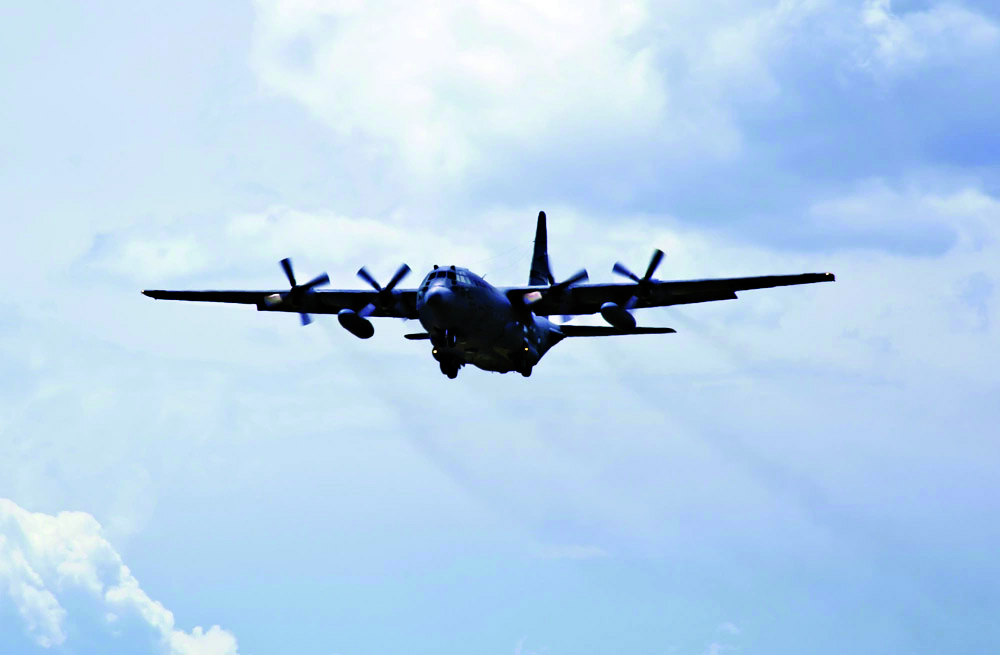
    The C-130 Hercules aircraft is used to rapidly drop cargo to provide relief after disasters or troops into battle zones. (Image: USAF Devin Doskey- 341st Missile Wing Public Affairs)
    The C-130 Hercules aircraft is used to rapidly drop cargo to provide relief after disasters or troops into battle zones. (Image: USAF Devin Doskey- 341st Missile Wing Public Affairs)

    GPS Innovation Alliance (GPSIA) member companies are leaders in technology, transforming the digital and physical world around us. With countless essential applications, GPSIA members improve the industries that feed, build, move and connect communities across the globe. In times of need, the GPS industry is proud to rise to the occasion, whether through agriculture technologies, surveying equipment, navigation systems, essential communications tools, or humanitarian relief efforts. Simply put, GPSIA members are continually investing in lifesaving services at home and abroad.

    Take, for example, the urgent need for humanitarian relief created by the ongoing war in Ukraine. Trimble has stood united to support the many affected and displaced Ukrainians; in addition to contributing through the Trimble Foundation to relief efforts in Ukraine and neighboring countries, Trimble also has provided GPS signal corrections to Ukrainian farmers at no cost, supplied 3D scanners for surveying damaged buildings, and worked closely with The HALO Trust to support demining activities in Ukraine by providing funding and commercial surveying systems to assist in precision mapping of landmines and unexploded ordnances.

    Lockheed Martin’s C-130 Hercules aircraft has assisted essential humanitarian relief across the globe. Since its inaugural flight in 1954, this aircraft has enabled aid delivery, natural disaster relief, medevac services, search and rescue and more. Now equipped with GPS technology, the C-130 fleet has provided aid across the globe for decades — with L3Harris’ missionization solutions often at work to maximize the C-130’s utility. Similarly, Collins Aerospace’s state-of-the-art navigational technology has provided essential support to U.S. Coast Guard helicopters, with avionics upgrades that help pilots save time in emergencies and enhance situational awareness.

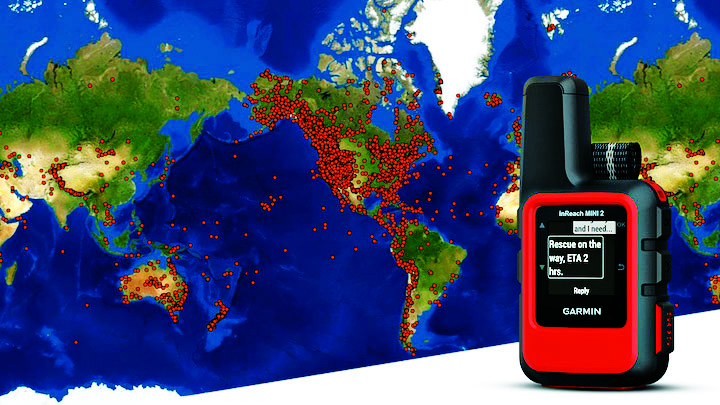
    Garmin inReach devices can send and receive messages, navigate routes, track and share journeys and can trigger an SOS if needed. (Image: Garmin)
    Garmin inReach devices can send and receive
    messages, navigate routes, track and share journeys and can trigger an SOS if needed. (Image: Garmin)

    More broadly, Garmin inReach satellite communication devices have helped more than 10,000 individuals access emergency services, providing critical communications in natural disasters and humanitarian emergencies. In 2022, a powerful underwater volcanic eruption and tsunami devastated the island nation of Tonga, severing traditional communications channels for several weeks. Roy Neyman, a sailor equipped with this Garmin device, set up a communication center at a local restaurant to allow other residents to reach family and friends. Over two weeks, Tonga residents sent about 1,600 messages to loved ones around the world, offering peace of mind in the face of unthinkable destruction. Similarly, Apple recently launched an “Emergency SOS” service, which led to one of the first successful rescue efforts of two people who had driven off a highway in the Angeles National Forest.

    CalAmp’s Fusion routers enable lifesaving emergency services to more than 400,000 residents in Oakland, California. Equipped with GPS, LTE and WiFi technology, these routers help Oakland Fire first responders quickly locate emergencies and access additional resources, such as building layouts or fire records, to provide the best possible emergency response. CalAmp’s technology provides an essential service to residents of Oakland and can be adapted to meet the changing needs of the community.

    As the world of agriculture has come to depend on GPS technology, John Deere’s GPS-based agricultural services have helped farmers become more efficient. In turn, this has allowed farmers to harvest more crops for the masses and meet the ever-growing demand for food. With the annual growth in food demand estimated to be 1.4% over the next decade, John Deere’s critical investment in food banks in Mexico and training for farmers in Africa will help to ensure that all communities are able to access the food they need.

    Across industries and government, GPS technology makes for a safer, more connected world. GPSIA is proud of its members’ dedication to global humanitarian efforts as well as critical services close to home. By constantly innovating, GPSIA member companies are creating technologies that provide critical services for everyday emergencies, natural disasters, and humanitarian crises across the globe.

  • UAVs doing the dirty work in war and nuclear inspections

    UAVs doing the dirty work in war and nuclear inspections

    Now that balloon-season appears to be ending, unmanned aerial vehicles (UAV) are seeing more use in the war in Ukraine. With the delivery of an updated fast transport craft to the U.S. Navy, autonomous ship operations are expected to be tested extensively. In addition, use of collision-protected UAV is demonstrating high returns for nuclear facility inspections.

    UAVs used in Russia-Ukraine war

    UAV attacks on Moscow seem to be escalating. A Ukrainian UJ-22 UAV allegedly crashed March 2 near the village of Gubastovo, about 60 miles from Moscow. It’s not clear what the intended target was, or whether the UAV was armed, but an undamaged Gazprom gas plant is close to where the UAV crashed.

    The UJ-22 UAV has a maximum range of about 500 miles. Therefore, to maximize its range, it’s unlikely that a big payload was onboard. It may have been just an attempt to assess how far the UAV could penetrate Russian airspace and which targets are in range from Ukraine’s border.

    In an earlier apparent UAV attack, the Krasnodar oil facility about 500 miles from the Ukraine border was damaged. A group of Belarusian partisans announced that it attacked and damaged a Beriev A-50 Airborne Warning and Control aircraft (called Mainstay by NATO) using UAVs at the Machulishchy airfield near Minsk, escaping back into Belarus without incident.

    The peaceful use of UAVs for the good of humanity seems to be taking a backseat in the escalating Russian-Ukraine conflict, where armed UAVs are enabling previously unheard-of incursions. Russia will likely respond, hopefully limiting action to legitimate military targets as Ukraine has done. However, the existing Russian stock of Iranian-made Shahed 136 “loitering munition” and the Mohajer-6 reconnaissance UAV might be running low. Ukraine has shot down at least 24 Shahed 136 UAVs through January and February and Russia has recently reduced its UAV attacks on Ukraine.

    US Navy relies on autonomous capabilities

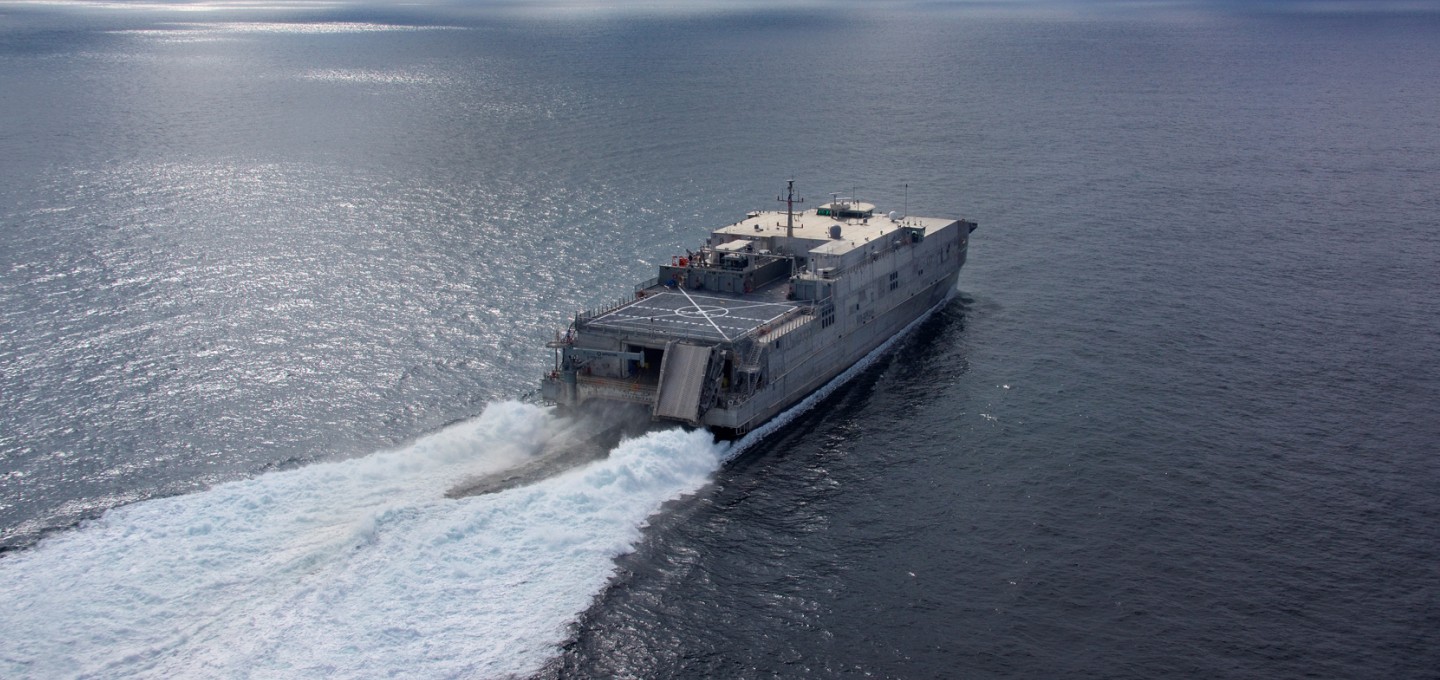
    The U.S. Navy is making great strides in its efforts to incorporate ships with autonomous capability into its fleet. Several developments initiated in 2008 have led to the creation of a fleet of 12 Spearhead EPF Expeditionary Fast Transport ships built by Austal USA. The latest ship, the USNS Apalachicola EPF-13, has been outfitted during build with complete autonomy and has just joined the fleet. The EPF fleet is designed for the rapid deployment of troops, tanks/armaments and heavy equipment. The latest EPF-13 — built by Austal USA, L3Harris and General Dynamics Mission Systems — has a range of 1,200 miles, can accommodate the V-22 Osprey tilt-rotor aircraft, and clocks in at a maximum speed of 40 knots.

    Image: Austal USA
    Image: Austal USA

    The earlier ships incorporated automation of hull, electrical and mechanical/power systems, which are all now accessible on the bridge. The latest EPF-13 has added automated maintenance, health monitoring and mission readiness. The EPF 13 Apalachicola comes with the ability to run independent unmannered operations for up to 30 days. At 337 feet long and displacing 362 tons, the EPF can carry up to 600 tons of weapons and equipment, while running a draft of less than 15 ft. Alternatively, EPFs have sufficient capacity to transport 312 soldiers over short distances, plus a crew of 41 when fully manned.

    Inspecting nuclear facilities with UAVs

    Clean-up operations at nuclear waste facilities are continuing to use UAVs for inspection and assessment of locations that are difficult to access and potentially contaminated. Flyability intends to add a Miron RDS-32 radiation sensor to its Elios-3 UAV family to gather in-situ radiation measurements while inspecting complex confined spaces at nuclear sites.

    In recent activity at a nuclear plant, an annual inspection of three tank rooms and collection of detailed visual video of a suspected leaking valve were readily accomplished in two UAV inspection sessions of a few minutes each.

    The previous manual inspection process required the plant output to be reduced to 20% of normal capacity over a six-hour cooldown. When radiation levels became low enough, two inspectors dressed in protective gear climbed down into the first tank room where radiation levels exposed each person to around 250 millirem (2,500 µSv or about 10% of the allowed annual exposure). They took a few still pictures and measured radiation levels, then exited each hot area before repeating the process for the other two tank rooms. The whole time, the productive output of the plant was significantly reduced. Another six hours was required afterwards to restore the plant back to full output, never mind that personnel were exposed to a bunch of radiation.

    Flyability’s solution is to fly an Elios UAV down into each tank room, take high-resolution video of the entire area in 1-2 minutes and repeat the process for each of the other tank rooms, without reducing plant output power. For detailed inspection of the suspected valve, the UAV was flown deeper into the reaction vessel. Detailed video was collected and the UAV was extracted — all within about 10 minutes.

    The bottom line is that generation of around 4.8 GW of power, worth maybe $456,000, was saved using the Elios UAV inspection approach. No one was exposed to the higher radiation levels inside the facility, and significant time was saved for both the annual and suspected valve inspections. Incidentally, the valve in questions was cleared of any potential leaks.

    Conclusion

    In summary, developments in autonomy include use in the Ukraine-Russian war, more ship automation for the U.S. Navy, and more efficient inspection of nuclear facilities.

  • DOD to provide Ukraine with aerial defense package

    DOD to provide Ukraine with aerial defense package

    Image: U.S. Department of Defense
    Image: U.S. Department of Defense

    The United States Department of Defense (DOD) will provide a new package of security assistance for Ukraine to aid with ongoing Russian aerial attacks. The package includes defense tools such as GPS-guided rockets and counter-UAV equipment.

    The presidential drawdown package includes:

    • additional ammunition for High Mobility Artillery Rocket Systems
    • additional 155 mm artillery rounds
    • additional 120 mm mortar rounds
    • 190 heavy machine guns with thermal imagery sights and associated ammunition to counter unmanned aerial systems
    • 181 Mine Resistant Ambush Protected vehicles
    • 250 Javelin anti-armor systems
    • 2,000 anti-armor rockets
    • Claymore anti-personnel munitions
    • demolitions munitions
    • cold weather gear, helmets and other field equipment.

    Under the Ukraine Security Assistance Initiative (USAI), DOD will provide Ukraine with:

    • two HAWK air defense firing units
    • anti-aircraft guns and ammunition
    • equipment to integrate Western air defense launchers, missiles and radars with Ukraine’s air defense systems
    • equipment to sustain Ukraine’s existing air defense capabilities
    • air defense generators
    • counter-unmanned aerial systems
    • four air surveillance radars
    • 20 counter-mortar radars
    • spare parts for counter-artillery radars
    • Puma unmanned aerial systems
    • precision-guided rockets
    • secure communications equipment
    • medical supplies
    • funding for training, maintenance and sustainment.

    Ukraine has been able to intercept Russian UAVs and missiles; however, having additional air defense will help combat efforts.

  • Iranian UAV downed in Ukraine contains western technology

    Iranian UAV downed in Ukraine contains western technology

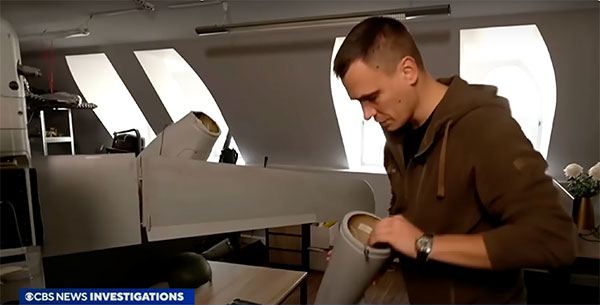
    A Ukrainian intelligence assessment obtained by CNN and CBS reported an Iranian UAV downed in Ukraine contained technology from companies in the United States and other western countries. The White House has since launched an investigation as to how the technology — including semiconductors, GPS modules and engines — were obtained by Iran.

    Screenshot: CBS video
    Screenshot: CBS video

    The components removed from an Iranian Shahed-136 UAV totaled 52, 40 of which were manufactured by 13 different U.S. companies. The remaining components were manufactured by other western companies and companies based in Japan, Taiwan and China.The United States monitors exports and imposed restrictions and sanctions to prevent Iran from obtaining components for UAVs. Officials are now looking to enhance enforcement of the sanctions and are encouraging companies to monitor their supply chain, as well as identify third-party distributors who may be re-selling the technology to Iran.

    U.S. companies are not alone in having to closely monitor their supply chains. U-blox, a Swiss semiconductor company, made a statement reinforcing its company policy, which bans the use of its technology in weapons. This was after u-blox GNSS modules were reportedly found in Russian UAVs.

  • U-blox bans the use of its GNSS modules in war

    U-blox bans the use of its GNSS modules in war

    Logo: u-blox

    On Dec. 20, u-blox banned the use of its GNSS modules in military UAVs in the war between Russia and Ukraine. The company had become aware that its GNSS modules were being used in certain Russian reconnaissance UAVs and stated that this use was against company policy.

    U-blox obtained media reports that Russia had stocked up on components in anticipation of war, then integrated products from the company in UAVs it manufactured after attacking Ukraine.

    After Russia began its invasion of Ukraine, the company halted all sales to Russia, Russian territories, and Russian-occupied areas, as it intends its GNSS modules and other products to be used only commercially. U-blox company policy bans the use of its products in weapons, including systems for target identification.

    U-blox is investigating the infringement of its policy and plans to take legal action if it has been violated. The company also condemns the invasion of Ukraine by Russian forces.

  • Seen & Heard: Goodbye to QE2, saving Ukrainian heritage

    Seen & Heard: Goodbye to QE2, saving Ukrainian heritage

    “Seen & Heard” is a monthly feature of GPS World magazine, traveling the world to capture interesting and unusual news stories involving the GNSS/PNT industry.

    Photo:
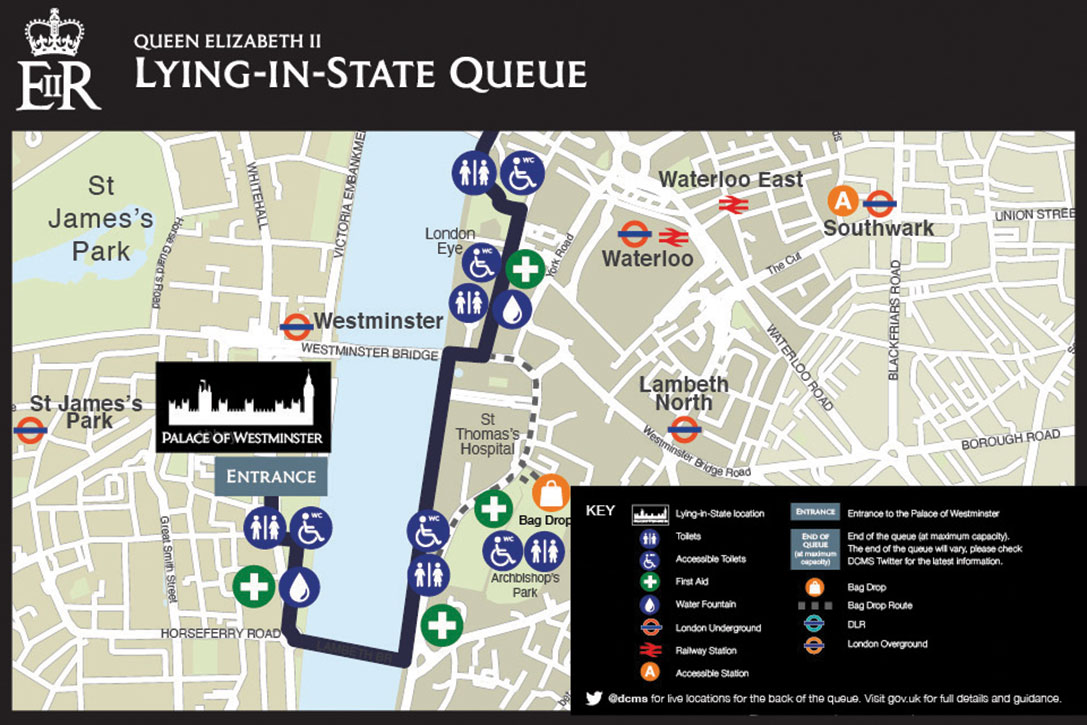
    Screenshot: Lying in State Queue tracker

    Queue Tracker for the Queen

    After the passing of Queen Elizabeth II on Sept. 8, the British government launched a live queue tracker app to give people an idea how long they would have to wait to pay their respects at her lying in state at the Palace of Westminster. The app also used What3Words to help locate the end of the line using a three-word tag. The queue grew dramatically in the days before the funeral as tens of thousands lined up, some waiting as long as 16 hours. The app also showed locations of public toilets, drinking water and first-aid stations along the queue route.


    Lake Sarez. (Photo: Astronaut Photography Collection/NASA)
    Lake Sarez. (Photo: Astronaut Photography Collection/NASA)

    A Dam Problem Solved

    Lake Sarez, deep in the Pamir mountains of Tajikistan, was created only a century ago when a strong earthquake triggered a massive landslide. The area experiences considerable seismic activity, which could result in massive flooding downstream should a landslide dam break. With the help of 40 donkeys, 10 scientists and 30 staff from the National Time Service Center of the Chinese Academy of Sciences transported and installed a BeiDou-based deformation monitoring system at the dam. The team had to resolve technical problems in the rugged area, such as providing sufficient solar power and communications. With the system now operating, the dam is being monitored in real time down to the millimeter.


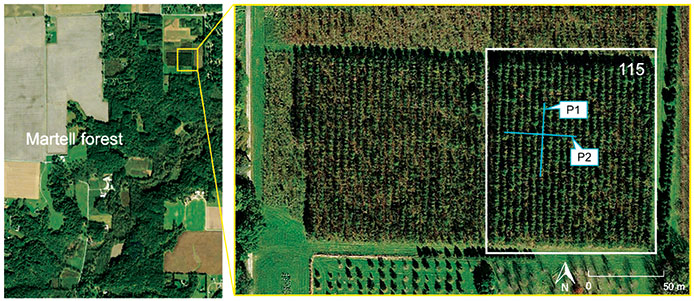
    Figure 3. (Image: CC BY 4.0, Remote Sensing 14, no. 17: 4274) Photo:
    Figure 3. (Image: CC BY 4.0, Remote Sensing 14, no. 17: 4274)

    Counting the Forest for the Trees

    Integration of aerial and ground-based mobile mapping sensors and systems is enabling a team of Purdue digital forestry researchers to locate, count and measure more than a thousand trees in a matter of hours. “The quick, accurate inventory of the global forest ecosystem will improve our ability to prevent forest fires, detect disease, perform accurate carbon counting and make informed forest management decisions,” said Songlin Fei, the Dean’s Remote Sensing Chair. The Purdue-made systems integrate GNSS and inertial navigation devices with lidar and cameras, deployed with manned aircraft, drones and backpack-mounted systems. The technology gathers a variety of information about each tree, including height, trunk diameter and branching formation. The team maintains the precise location and time tags of all acquired features.


    Photo: Skeiron
    Photo: Skeiron

    Saving Ukranian Heritage

    By the end of May, at least 367 incidences of destruction had occurred to Ukraine’s museums, churches, theaters and libraries. Through the project #SaveUkranianHeritage, mapping company Skeiron is capturing sites in high detail using laser scanning and photogrammetry. For a UNESCO-protected church in Lviv, the team gathered more than 300 individual laser scans and 6,000 photos to create a 3D model. The company has two laser scanners — a Leica C10 and Leica ScanStation P20, DLSR cameras and a drone. To support the project with funding or equipment, visit skeiron.com.ua/en/saveukrainianheritage/.

  • Estonia confiscates drones for Russia, sends them to Ukraine

    Estonia confiscates drones for Russia, sends them to Ukraine

    Plus: Visual AI radar aids drone searches, and a drone is released into Hurricane Ian

    Just when you imagine there couldn’t be any more twists and turns to the war in Ukraine, another one turns up. Some may recall that Estonian security forces caught an Estonian/Russian man trying to send drones to Russia. The Estonian government confiscated the shipment of DJI drones.

    Now Estonia has donated those drones to Ukraine for use against Russia in the ongoing war.

    Some might say that this is an example of, “What comes around goes around.” Nevertheless, everyone respects Russia’s nuclear options…

    Making Drones Smart

    It’s all well and good that we have all shapes and sizes of battery- and gas-powered drones, ones that take off and land vertically (eVTOL) or horizontally (generally, fixed-wing). But how do we make them smart enough to complete tasks on their own?

    Artificial intelligence (AI) could be the answer. Take the Boeing Loyal Wingman drone. It is being developed to fly autonomously alongside high-end fighters, and  perhaps to control other drones flying nearby. Those tasks require AI, which is being incorporated into the capabilities of drone systems.

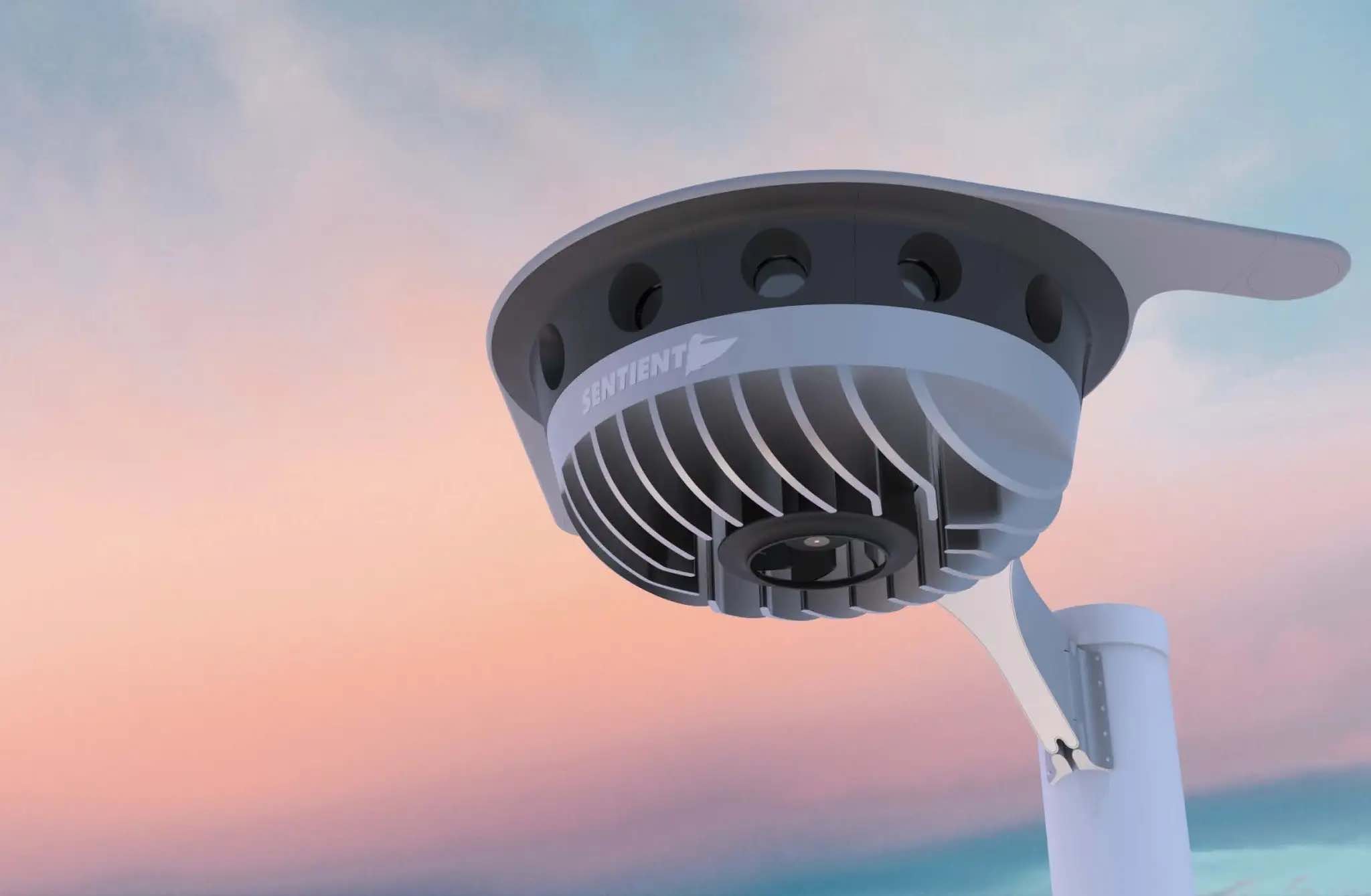
    We also have immediate needs, such as search and rescue, security patrol and inspection (for commercial and military facilities, border and crowd control) and military intelligence, surveillance, target acquisition and reconnaissance (ISR/ISTAR). Along comes Sentient Vision Systems of Australia with a passive, software-based “visual radar” solution.

    Sentient Vision Systems uses its digital AI processing with existing visual and infrared sensors. This combination can apparently surpass human and conventional radar capability to detect and track small moving objects.

    Search and rescue at sea can be a really difficult task for people. It’s not surprising that a lot of lengthy searches end up with zilch. During a search, an aircraft flies from 20,000 feet down to 500 feet over the waves. If you have seen cabin video of air-sea searches in progress, with a searcher gazing out of the aircraft’s window for hours, straining to see something small bobbing in the sea below, it does seem like a herculean task.

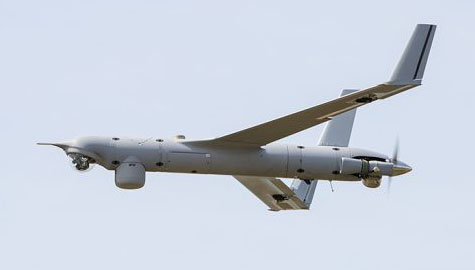
    As an alternative, take a long-range (>55 nautical miles) drone, such as a Boeing/Insitu ScanEagle. Hook up the scanning search camera and high-resolution nose turret to the vidar (visual detection and ranging) processing.

    Boeing/Insitu ScanEagle UAV with vidar pod. (Photo: Insitu)
    Boeing/Insitu ScanEagle UAV with vidar pod. (Photo: Insitu)

    As a result, you have an autonomous airborne system that can find a person in the water from a distance of about 1.7 nautical miles, and spot a ferry deck from ~30 nautical miles. Insitu claims that conventional radar systems cannot do this. In 12 hours it can search an area of about 13,400 square nautical miles.

    Sentient's AI-enabled Vidar Surface sensor. (Photo: Sentient)
    Sentient’s AI-enabled Vidar Surface sensor. (Photo: Sentient)

    Several such sorties might just have found an early trace of Malaysian Airlines Flight MH370 in 2014. The Boeing 777 with 239 people on board disappeared over the South China Sea 38 minutes after takeoff on a flight to Beijing. Over three years, long-range patrol aircraft covered 46,000 square miles before the search was abandoned.

    During 2015 and 2016, pieces of the airplane began washing up on the shores of countries on the Western Indian Ocean. The search would probably not have been easy even for a fleet of ScanEagles, considering the logistics and the available range of the unmanned aircraft, but major incidents might find success with vidar-equipped UAVs.

    Into the Eye of the Hurricane

    The devastation that Hurricane Ian wrought in Southwest Florida has been terrible. A shark swimming up a street in Fort Meyers illustrates the degree of flooding left from landfall of the category 4-5 hurricane.

    Ian was the strongest hurricane to make landfall in the United States in decades, with extremely high winds and strong storm surge. I sat through the storm 75 miles to the North, and it was one scary hurricane even there. I can’t sympathize enough with the residents of Lee County, who only received a warning to evacuate one day before it hit them.

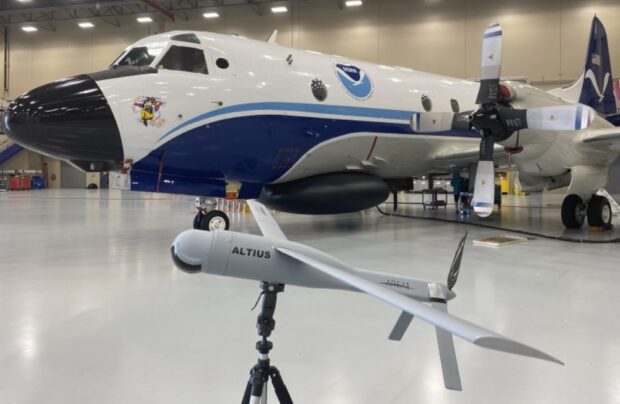
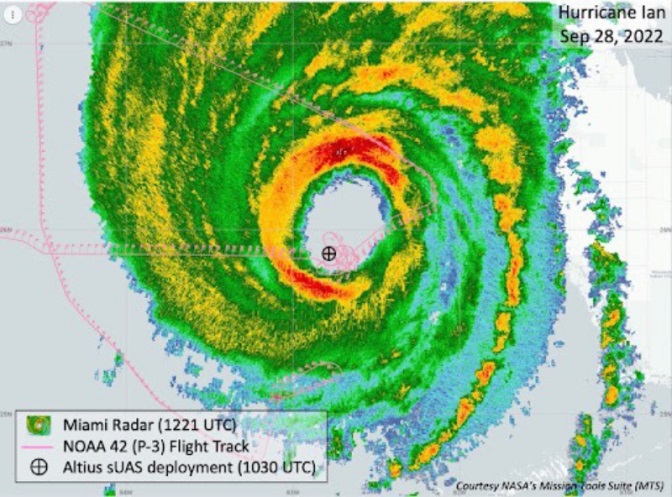
    Nevertheless, the National Oceanic and Atmospheric Administration (NOAA) had its Hurricane Hunter Orion aircraft up to investigate on Sep. 28 as the storm came in from the Caribbean. Despite bad turbulence, the P-3 aircraft flew into the upper regions of the Hurricane and launched an Altus-600 27-pound drone into the eye at 4,500 feet. With a 275-mile range at up to 100 mph, the aircraft crew controlled the small drone, using it to collect data on wind speed, pressure, temperature and humidity.

    The Orion P-3D Hurricane Hunter aircraft and the Altus-600 drone. (Photo: NOAA)
    The Orion P-3D Hurricane Hunter aircraft and the Altus-600 drone. (Photo: NOAA)

    During the two-hour mission, the Altus drone flew into the eye wall, where winds of 187 mph were detected at altitudes between 2,300 and 200 feet. It’s not exactly clear whether the drone survived.

    This radar image of Hurricane Ian shows the Altus release point. (Image: NOAA)
    This radar image of Hurricane Ian shows the Altus release point. (Image: NOAA)

    While information gathered may have assisted with the immediate forecasting for us Florida folks on the ground, the real scientific value comes from feeding the data into National Hurricane Center models for storm detection and analysis to keep us safer in the future.

    Wrap up

    To sum up, this month we saw drones destined for Russia sent to Ukrainian forces. Vidar artificial intelligence on Insitu ScanEagle drones promises huge gains for search and rescue. And, once again, a NOAA crew flew directly into the eye of a hurricane, this time releasing a drone to aid in gathering essential storm data.

    Tony Murfin
    GNSS Aerospace

  • AUVSI analyst shares insights from defense conference

    AUVSI analyst shares insights from defense conference

    Military officials from across all branches, federal security personnel, and industry leaders gathered at the AUVSI Defense conference, held Sept. 22 in Alexandria, Virginia, to discuss critical issues surrounding the integration of uncrewed technologies.

    In a publication released Oct. 11, AUVSI Senior Economic Research Analyst Aaron Bull summarized key topics discussed at the event, including:

    • defense priorities for the next-generation uncrewed system
    • how uncrewed systems will impact the ways wars are fought
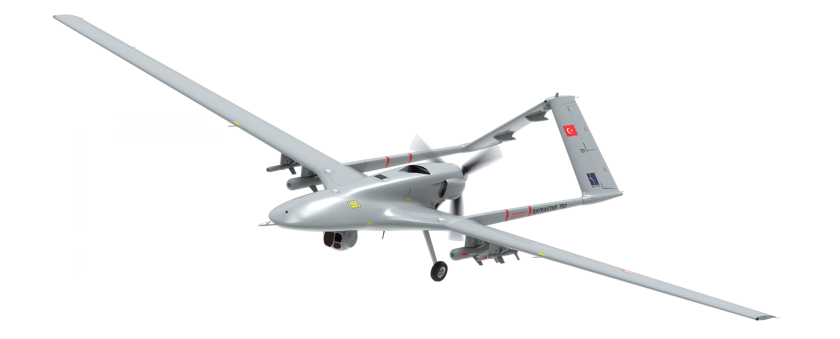
    • lessons learned by senior defense leaders from the Bayraktar TB2 in Ukraine.

    Download the “The Changing Landscape of Military Uncrewed Systems”.

    Bayraktar - TB2 surveillance/attack drone (Photo: Baykartech)
    The Bayraktar TB2 surveillance/attack drone (Photo: Baykartech)

    Highlights from the Report

    Flexibility in the fighting force is needed, which affects the defense requirements for autonomous vehicles heading to the battlefield.

    Multiple speakers pointed to the Turkish Bayraktar TB2, a cost-effective combat-capable drone purchased and fielded by the Ukrainian armed forces that has been a game changer for Ukraine since the war began. While the drone is not top of the line, it was fielded quickly, required little training and could be fitted for a variety of purposes. As a result, “Nearly every speaker came prepared to discuss the need for developing multiple layers of flexibility around the U.S. fighting force,” Bull writes.

    An uncrewed vehicle that can be refitted for multiple missions of different types offers an inherent advantage for missions, and it requires supporting logistical infrastructure.

    Requirements include:

    • flexibility and disguise of role
    • ability to outfit to different technical and operating capabilities
    • flexibility to operate with different levels of human interaction
    • modularity to re-fit the drone around the mission
    • hardware-to-hardware modularity
    • software-to-hardware modularity.

    Download the report.

  • Where have all the flowers gone? Mapping tool shows crop devastation of Ukraine war

    Where have all the flowers gone? Mapping tool shows crop devastation of Ukraine war

    Photo: Alter_photo/iStock/Getty Images Plus/Getty Images
    Photo: Alter_photo/iStock/Getty Images Plus/Getty Images

    Sunflowers — soniashnyk in Ukrainian — have been grown in Ukraine since the mid-18th century. Besides being a popular snack, growing the flower for export helps fuel Ukraine’s economy. Before the war, Ukraine and Russia supplied up to 80% of the world’s sunflower oil exports.

    With the Russia invasion, however, sunflower and other crops have suffered, with growth of spring crops declining as much as 40% in the eastern Donbas region hit especially hard by the war.

    OneSoil Map, by OneSoil, is a new, powerful data visualization and mapping tool that combines proprietary artificial intelligence (AI) with satellite imagery to map crops worldwide. It enables agricultural businesses to visualize massive datasets and deliver insights on a global scale. Another tool, the OneSoil application, helps farmers remotely monitor crop health, detect issues and apply fertilizers and seeds, increasing yields and boosting sustainable farming practices.  

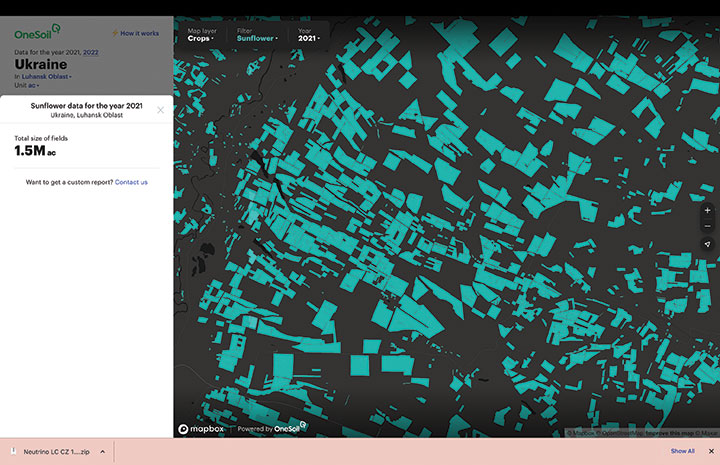
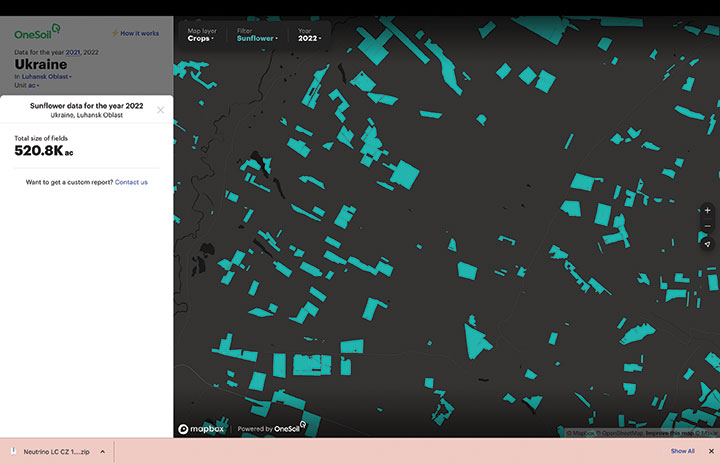
    In Ukraine, satellite imagery and AI-based technologies are helping farmers face shortages and a population confronting food insecurity. OneSoil compared 2021 and 2022, and found  the area used for the country’s spring crops — corn and sunflower — have decreased by 40% in wartorn regions, with the greatest decrease in Kharkiv (–59%), Donetsk (–58%), Luhansk (–57%) and Zaporizhia (–43%). 

    Corn is an export crop that accounts for 16% of the global market. OneSoil Map showed its overall acreage in the main corn production areas (Chernihiv, Poltava, Sumy) has dropped by 19% to 36%, depending on the region. 

    The above sample of sunflower crops in the Luhansk Oblast region — part of the wartorn Donbas — shows the decrease in crop fields from 2021 (top, 1.5M acres). (Image: OneSoil)
    The above sample of sunflower crops in the Luhansk Oblast region — part of the wartor — shows the decrease in crop fields from 2021 (top, 1.5M acres). (Image: OneSoil)
    A sample of sunflower crops in the Luhansk Oblast region — part of the wartorn Donbas — shows the decrease in crop fields in 2022 (520.8K acres). (Image: OneSoil)
    A sample of sunflower crops in the Luhansk Oblast region — part of the wartorn Donbas — shows the decrease in crop fields in 2022 (520.8K acres). (Image: OneSoil)