GPSWorldTV – Javad Ashjaee, founder and CEO of Javad GNSS – speaking at the ION GNSS Show
Blog
-
GPSWorldTV – Javad Ashjaee speaking at ION – Part 4 of 5
GPSWorldTV – Javad Ashjaee, founder and CEO of Javad GNSS – speaking at the ION GNSS Show
-
GPSWorldTV – Javad Ashjaee speaking at ION – Part 3 of 5
GPSWorldTV – Javad Ashjaee, founder and CEO of Javad GNSS – speaking at the ION GNSS Show
-
GPSWorldTV – Javad Ashjaee speaking at ION – Part 2 of 5
GPSWorldTV – Javad Ashjaee, founder and CEO of Javad GNSS – speaking at the ION GNSS Show
-
Galileo Satellites Cleared for Launch
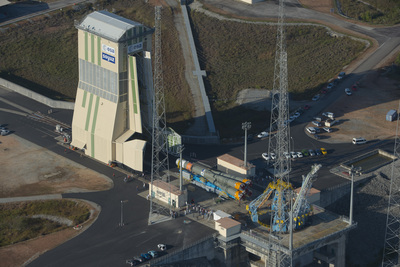
Soyuz VS03, the third Soyuz flight from Europe’s Spaceport in French Guiana, was transferred to the launch zone on October 8. The vehicle was rolled out horizontally on its erector from the preparation building to the launch zone and then raised into the vertical position, in preparation of the launch of two Galileo satellites. Europe’s next two Galileo satellites have received technical clearance for their launch this Friday. They are currently resting in place atop their Soyuz launcher.
Yesterday saw the three-stage Soyuz ST-B launcher moved horizontally to the launch pad on the 600-meter long railway. It was then lifted into the vertical position to await the attachment of the Upper Composite — the combination of twin Galileo satellites, the dispenser holding them in place, the Fregat-MT upper stage and the protective fairing.
Meanwhile, the satellites themselves underwent their formal Launch Readiness Review, after which the Upper Composite joined the Soyuz at the launch pad to be mated to the Soyuz that evening using the mobile gantry. The Soyuz and Upper Composite will undergo a full launch dress rehearsal in the remaining days before the 18:15:00 GMT (20:15:00 CEST) launch on October 12, including preparations for fueling the vehicle, which will begin four and a half hours before liftoff.This follow-up launch marks a major step for Europe’s own satellite navigation system. Four is the minimum number of satellites needed to achieve a navigational fix on the ground, with one satellite each to measure latitude, longitude, altitude and provide a time reference. So once this second pair of satellites has been commissioned and tested, the quartet will form a completely operational mini-constellation that will be used to validate the Galileo system.
The performance of the satellites in space together with the worldwide ground infrastructure serving to maintain Galileo’s service accuracy will be assessed in depth, to prepare the way for the launch of further satellites and then deliver initial services by mid-decade and finally build up to full operational capability.These two new satellites are also the first to carry search and rescue antennas to pinpoint aircraft and ships in distress as part of the international Cospas–Sarsat system.

The two Galileo In-Orbit Validation satellites are protected during their launch by Soyuz by a launch fairing. Once the Soyuz has passed most of the way through the atmosphere, this fairing can then be ejected. -
Handheld Launches the Algiz 10X, a 10-inch Rugged Tablet for Outdoors
Handheld Group, a manufacturer of rugged mobile computers and smartphones, today announced the launch of its new rugged mobile device for field professionals, the Algiz 10X rugged tablet PC. The Algiz 10X can withstand tough weather elements and harsh handling. It has a large, 10.1-inch touchscreen.
“The new Algiz 10X is perfectly suited for field professionals who need a rugged tablet computer that is lightweight and built to withstand the harsh conditions that come with all kinds of industry fieldwork, and that can display detailed maps and other visuals even in bright sunlight,” said Jerker Hellström, CEO of Handheld.
The Algiz 10X is IP65-rated and meets stringent MIL-STD-810G military standards for protecting against dust, water, vibrations, drops, extreme temperatures and varying altitudes. It is lightweight at 1.3 kg (2.9 lbs), and 32 mm (1.2″) thick.
The Algiz 10X’s brilliant display features the latest generation of MaxView technology. The tablet also comes with a u-blox GPS receiver and WAAS/EGNOS/MSAS capability, plus Bluetooth 4.0, WLAN 802.11 b/g/n and it is WWAN Gobi 3000-ready with fully integrated modem and antennas for wireless connectivity. It has a built-in 5-megapixel camera with LED flash, and several connectivity opportunities, including waterproof USB 2.0, VGA and RS232 ports. The Algiz 10X operates on a powerful Intel Atom N2800 dual-core processor with 4 GB of DDR3 RAM, offering top-of-the-line computing capability, and the SSD disk is expandable via microSD for massive storage capacity. The Algiz 10X runs Windows 7 Ultimate, and is ready for Windows 8.
“With the Algiz 10X, we are expanding the popular product family that includes our Algiz 7, which is the preferred choice today for field professionals worldwide. The Algiz 10X comes with increased processing power and storage plus a larger display — something that the market has been asking for,” said Hellström.
Like all of Handheld’s lineup of rugged PDAs, smartphones and mobile computers, the Algiz 10X is specifically developed for field workers in industries such as geomatics, logistics, forestry, public transportation, utilities, construction, maintenance, mining, military and security.
The Algiz 10X rugged tablet PC is being showcased at INTERGEO in Hanover, Germany, on October 9-11, and will be shown Mobility for Business in Paris, France, on October 10-11, plus several shows throughout the fall.
The Algiz 10X will be available in January 2013. Orders can be placed immediately.
-
Trimble Introduces R10 GNSS Surveying Solution
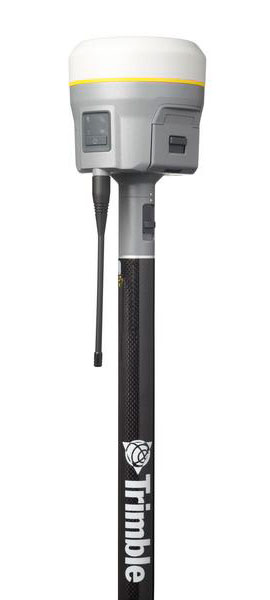
Photo: Trimble Trimble introduced today its next-generation GNSS surveying solution — the Trimble R10 — at the INTERGEO 2012 conference on geodesy, geoinformatics and land management.
As the smallest and lightest receiver in its class, the Trimble R10 combines powerful features and groundbreaking technologies including Trimble HD-GNSS, Trimble SurePoint, Trimble 360, and Trimble xFill to provide surveyors increased productivity, the company said. User-friendly features such as a quick-release adaptor and the ability to configure the receiver from a smartphone make it easy to deploy and use as a base station or rover, Trimble said.
Trimble also released new versions of its field and office software — Trimble Access 2012.20 and Trimble Business Center 2.80 — to extend Trimble’s Connected Site survey solution, which enables surveyors to collect and process reliable data more efficiently.
“Faster results, better reliability and improved overall performance are what our customers have come to expect,” said Anders Rhodin, general manager of Trimble’s Survey Division. “With the introduction of the Trimble R10, Trimble is delivering next-generation capabilities in a smaller, lighter and feature-packed system that is unmatched in the industry today.”
The Trimble HD-GNSS processing engine integrated in the Trimble R10 is a new generation of core positioning technology, Trimble said. Trimble HD-GNSS surpasses traditional fixed/float techniques to provide a more accurate assessment of error estimates than traditional GNSS processing engines. Measurements collected with Trimble HD-GNSS are precision-based so surveyors can confidently collect data in challenging environments where they may have been unable to collect data before. Reduced convergence times and instantaneous point measurements allow surveyors to start measuring sooner and up to 60 percent faster.
Supporting 440 channels with two built-in Trimble Maxwell 6 chips, the Trimble R10’s integrated Trimble 360 technology allows consistent and reliable tracking of available GNSS satellite signals for existing and currently planned GNSS constellations and augmentations.
Trimble has extended its Trimble SurePoint technology, a cornerstone of the S-Series total stations, to the new GNSS surveying system. The incorporation of this technology simplifies the survey data collection workflow by providing faster measurements, increased accuracy and greater quality control. The Trimble R10 includes an electronic bubble that appears on the controller display so that all measurement information is displayed in one place. Trimble SurePoint constantly monitors the pole tilt and protects surveyors from collecting erroneous data by only allowing data to be stored when the survey pole is plumb. Simultaneously, pole tilt angle values are stored for every point collected to ensure data traceability.
Powered by Trimble RTX technology, new Trimble xFill leverages a worldwide network of Trimble GNSS reference stations to deliver position information via geostationary satellites. xFill seamlessly “fills in” for RTK or VRS corrections in the event of a temporary connection outage such as a radio black spot so users experience less downtime in the field.
Designed for ease of use and durability, the Trimble R10 offers the ruggedness and reliability. Additional features include multiple connectivity capabilities such as Wi-Fi and 3G cellular connectivity, a lithium-ion battery, an integrated GNSS antenna, 4 GB internal memory, and an internal 2 Watt radio.
Trimble Access is a field solution that enables wireless connectivity between the project team members to expedite data collection, processing, analysis, and project information delivery through improved workflows, collaboration and control. The complete solution speeds both typical and specialized surveying tasks, and enables easy and fast two-way information sharing between the field survey crew and the office. Surveys can be completed faster with less time spent traveling back and forth to the office. Management and field crews can closely collaborate by viewing the same information in near real-time.
Trimble Access version 2012.20 offers new functionality compatible with the Trimble R10, including:
- Tilt auto-measure: Topo point or Rapid point measurements can now be automatically started when the pole is plumbed to within a predefined tilt tolerance. Coupled with auto store, hundreds of points can be measured with only one tap on Measure.
- Tilt warnings: Users are now notified if the pole moves outside a predefined tilt tolerance during point measurement.
- Tilt distances: Measurements collected with the Trimble R10 can now have an associated tilt distance providing additional quality control information. Use the QC Graph for a quick visual check to see the range of tilt distance errors for any particular job.
- eBubble display: An electronic bubble can be used instead of a traditional pole bubble. The eBubble enables a clearer, easier and more accessible display of the bubble providing the surveyor just one place to focus when leveling and measuring.
- In the Office – Trimble Business Center 2.80
Trimble Business Center office software is a complete surveying office suite designed to manage, analyze and process all field survey data, including data from optical instruments (total stations and levels), GPS/GNSS and spatial stations (imaging and 3D scanning data).
Version 2.80 advances the capabilities of surveying offices with key new functionality, including:
- Trimble R10 support: Users can import RTK and PPK tilt magnitude and quality data from a Trimble Access Job or JobXML file and also export this data using the Custom Exporter. The new version also has the capability to Import Trimble Access Job or Job XML files containing xFill observations.
- Ribbon menu layout: A new ribbon menu layout and quick access toolbar help users quickly locate commands required to complete a task for an improved user experience.
- Microsoft Windows 8 support: Version 2.80 is compatible with the Microsoft Windows 8 Operating System.
- Station View field-of-vision indicator: Users can view which Station Views are open and in which direction they are facing. The indicators improve workflows for measuring points photogrammetrically with images from Trimble VISION instruments.
The Trimble R10 GNSS System can be ordered beginning mid October 2012. Shipping is expected to begin during the latter part of the fourth quarter in 2012. Trimble Access software version 2012.20 and Trimble Business Center Software version 2.80 are available now through Trimble’s Survey Distribution Channel.
Trimble’s Connected Site solutions for surveyors create seamless working relationships among Trimble products, technologies and services. Through the Connected Site, Trimble is focused on providing solutions that address the customers’ full work processes. By carefully combining technology innovation with a deep understanding of the users’ workflows, data integration and maintenance across the lifecycle of projects, Trimble helps surveyors reach new levels of productivity for their businesses.
-
Rand McNally Device Turns GPS Devices into Compliant EOBR Systems
Rand McNally unveiled its HD 100 device — which provides electronic Hours of Service (HOS) recording, text- and dispatch-integrated messaging plus driver performance monitoring capabilities — at the American Trucking Association Management Conference and Exhibition.
The HD 100 will be commercially available in April 2013 for use with Android tablets and the Rand McNally IntelliRoute TND 720 truck GPS device. Later in the year, the HD 100 will integrate with other platforms including Android smart phones and iOS tablets and smart phones.
Designed to work seamlessly with a variety of mobile devices, the HD 100’s Hours of Service recorder qualifies as a compliant electronic driver log. The HD 100 plugs into a truck’s on-board diagnostics port and records the truck’s GPS position along with critical vehicle-specific information such as engine diagnostics and driving behavior. The device — 3 ½ inches by 5 inches — can be installed in less than 10 minutes.
Drivers interact with the HD 100’s HOS and messaging functions through an application that they download and run on their mobile device or Rand McNally’s IntelliRoute TND 720.
“With the HD 100, Rand McNally now provides a wide range of options for compliance, communication, and electronic Hours of Service. Our product line offers large fleets and smaller operators unparalleled flexibility with features and pricing options,” said Dave Muscatel, CEO of Rand McNally. “Our goal is to be hardware agnostic in order to provide a cost-effective EOBR (electronic on-board recording) solution for owner operators who already own a smart phone, tablet, or one of our GPS devices and the HD 100 accomplishes this objective. The HD 100 will help fleets and drivers alike with meeting the upcoming EOBR implementation mandated by MAP 21.”
Just as with the company’s premier enterprise solution, TPC 7600, and the robust cost-effective single-box device, the TND 760, the HD 100 allows data integration with more than 20 third-party dispatch and fuel tax applications via Rand McNally Connect software.
-
GSAT-10 Satellite Placed in Geosynchronous Orbit
The Indian Space Research Organization has announced that the orbit-raising maneuvers of GSAT-10 satellite have been successfully completed from ISRO’s Master Control Facility, Hassan. GSAT-10 was launched September 30. The third and final orbit-raising maneuvers was performed October 3 to place the GSAT-10 in an orbit with 35,734 km apogee (farthest point to earth), 35,585 km perigee (nearest point to earth), and an inclination of 0.172 degree with respect to the equator. Currently, the orbital period of GSAT-10 is 23 hours 50 minutes.
According to the announcement from the Indian Space Research Organization, the two solar panels and the two dual gridded reflector antennas were also deployed later in the day. Currently, the satellite is in final orbital configuration at 70.18 degree East longitude. In the coming days, the satellite will be moved towards its designated location of 83 degree East and in-orbit testing of its communication and navigations payloads will be performed.
As is often the case, NORAD/JSpOC has temporarily “lost” the satellite following one of its orbital maneuvers. The last published two-line orbital element set for the satellite is dated September 30.
-
u-blox Launches u-blox 7 GPS, GLONASS and QZSS Modules
u-blox, the Swiss positioning and wireless module and chip company, has announced its latest multi-GNSS receiver modules MAX-7, NEO-7 and LEA-7 in u-blox’s form factors. They support all satellite positioning systems in operation today: GPS, GLONASS, QZSS and SBAS. The modules target telematics applications such as asset and fleet management as well as portable tracking devices.
“Each MAX-7, NEO-7 and LEA-7 variant delivers fast, accurate and reliable GLONASS and GPS positioning with the industry’s lowest power consumption.” said Daniel Ammann, executive VP of positioning product development at u-blox. “Both GPS AND GLONASS modes perform even better than combined GPS/GLONASS solutions available on the market today.”
All u-blox 7 generation modules are pin-to-pin compatible with previous u-blox 6 and u-blox 5 families allowing easy upgrade from existing designs. Each module is available in cost-effective variants (such as MAX-7C; NEO-7M) as well as performance optimized variants (MAX-7Q, MAX-7W, NEO-7N, LEA-7N).
u-blox 7 modules use GPS/GNSS chips qualified according to AEC-Q100 and are manufactured at ISO/TS 16949 certified sites. Each module is intensively inspected and tested during production. The modules are fully qualified according to ISO 16750 – “Environmental conditions and electrical testing for electrical and electronic equipment for road vehicles” to provide high durability and reliability.
All modules comply with green/halogen free standards.
First variants available will be NEO-7N (November 2012) and MAX-7C (December 2012).
-
Symmetricom Launches RoHS Compliant GPS Time Servers
Symmetricom, Inc., has introduced new RoHS compliant versions of its existing SyncServer S200 and SyncServer S250 GPS Network Time Servers. Designed for large or expanding IT enterprises, the cost-effective SyncServer S200 and S250 with optional rubidium-based atomic clocks will reliably continue operational service for extended periods when primary time sources are impaired.
Accurate network time-keeping is essential for modern data networks to support a number of key functions — including precision time stamping, scheduled data backups, network management and security. These functions all rely on networked clocks to stay synchronized with each other. By using enterprise owned servers, companies are better poised to ensure accurate, reliable and more simplified network timing and synchronization, Symmetricom said.
The European Union’s Restriction of Hazardous Substances directive (or RoHS) assures environmental responsibility for the materials used in electrical and electronic equipment. The SyncServer S200 and S250 now offer network managers and engineers RoHS certified, entry-level time servers that still allow them to take advantage of rubidium-based clock technology. Unlike the more commonly deployed time servers that leverage temperature-compensated crystal oscillator (TCXO) and oven-controlled crystal oscillator (OCXO) technologies, the rubidium-based SyncServers provide superior holdover — technology that allows the network to continue to operate with accurate timing when the primary reference (usually GPS) is temporarily impaired due to events such as GPS jamming, antenna breakage, or solar interferences.
Communications and information technology managers can now take control of their network timing and synchronization and be assured of very accurate timing in their network that will not degrade or disrupt services during long periods where holdover is necessary, Symmetricom said.