Blog

  • Expert Advice: GNSS in the Global Economy

    By Irving Leveson.

    The $100 billion GNSS industry is already stressed. How deeply and how long the pressures persist depends to a great extent on the performance of the world economy. In a time of extraordinary uncertainty and change, the industry faces great challenges over the next 2–3 years and beyond: potential delays in availability of satellites and ground support, adaptation to multiple constellations, shifts associated with the proliferation of portable electronics, and fluctuating demands from governments, businesses, and consumers. Vulnerabilities are already increased with the weakening of the slow U.S. recovery, with recession in Europe, and slowdowns in many other nations. Potential shocks could cause economic conditions to deteriorate further.

    Outcomes for the GNSS industry will depend very much on developments in the U.S. and global economy and associated government decisions. Effects on the industry will be far-reaching. Of course, non-economic factors will weigh in as well, but are beyond the present scope.

    At mid-summer 2012, the economic environment is too fluid to rely on a single forecast. To explore the issues, I compare four scenarios in a discussion that considers what the scenarios depend on, their likelihood, and their consequences for the GNSS industry.

    At the time of this writing, the consensus is that the U.S. and Europe will muddle through and that economic growth will be somewhat higher in 2013 than in 2012. This is evident in the forecasts of the Organization for European Cooperation and Development (OECD) and the International Monetary Fund (IMF). For example, the IMF in its July report expects world gross domestic product (GDP) growth to slow to 3.5 percent in 2012 from 3.9 percent in 2011, but then to rise to 3.9 percent in 2013. It expects GDP in advanced economies to be up to 1.9 percent in 2013 from 1.4 percent in 2012. This is in spite of a greater decline in public consumption.

    I consider global recession scenarios to be more probable than such a rebound. Moreover, there is a risk of a severe world recession led by developments in both Europe and the United States. In all four scenarious outlined here, serious long-run problems remain unresolved.

    Scenario Traits and Probabilities

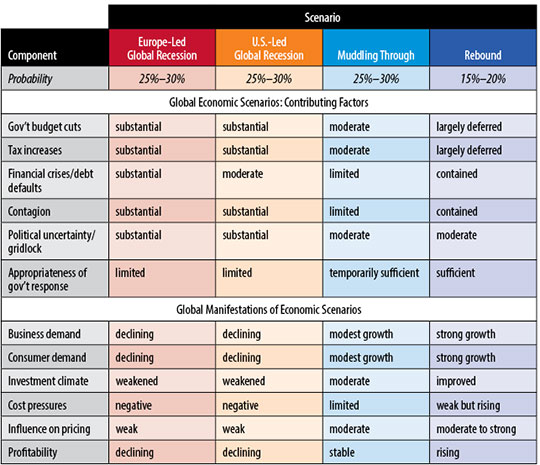
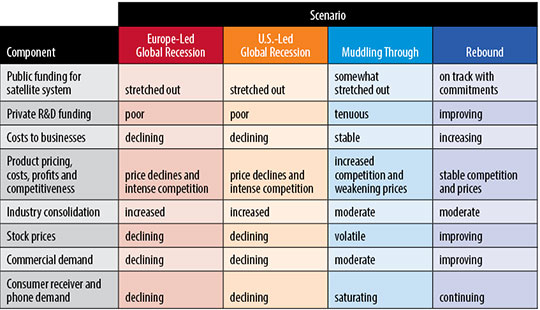
    Table 1 lists the four scenarios and suggested probabilities, contributing factors, and global manifestations. A fuller description of each scenario comes in the next section.

    In the two Global Recession scenarios, the problems in the United States and/or Europe lead to worldwide recession, which is defined by a sharp slowdown in global growth. The Europe- and U.S.-led global recession scenarios are associated with greater government budget cuts and tax increases than in the other scenarios, and with greater political uncertainty, gridlock, and substantial contagion effects. Governments are less able to act, and some policies may be ineffective or counterproductive. Output declines in the U.S., Europe, and Japan, and slowdowns in growth occur in developing countries.

    The recession scenarios are negative for consumer spending, business investment, hiring, and risk-taking. Information technology spending is cut back. While cost pressures abate, companies have little ability to influence pricing; profitability declines.

    In the Muddling Through scenario, crises go to the brink, and little is done to immediately solve fundamental problems, but policies temporarily prevent severe economic and financial disruption. The Rebound scenario is facilitated by the most extensive delays in spending cuts and tax increases, together with increased confidence from agreement on long-term solutions. Serious but incomplete efforts are made to reduce impediments to growth and adjustment.

    As of mid-summer, I rate the probability of a Europe-led global recession and a U.S.-led global recession each at 25–30 percent, with global recession most likely fully underway some time in 2013 in each case. The probability of a more severe global recession led by both Europe and the United States I put at 30–40 percent. The probability for muddling through is 25–30 percent, and for the rebound scenario it is 15–20 percent.

    Developments and impacts are not quantified here, nor are longer-term prospects considered. More extreme possibilities are not addressed; these include wars, a major breakup of the euro in the next two or three years, a large energy price shock, massive immediate U.S. budget cuts beyond the sequester, extensive increases in U.S. regulation after the election, or a Chinese economic collapse.

    I now turn to elaboration and discussion of each scenario.

    Europe-Led Global Recession

    Efforts by European institutions and the IMF to prevent debt defaults by southern European countries by extending credit only delay financial crises into 2013 or early 2014. With a major problem of insolvency (liabilities greater than assets) and not simply liquidity, a Europe without a fiscal union, common banking rules or even deposit insurance is unable to implement new structures in time to forestall severe adjustment. Increased bank capital requirements on January 1, 2013 also restrain lending. Financial market contagion spreads with rising interest rates on debt of already stressed countries, accelerated bank runs, and capital flight.

    These problems spill over to the United States and the rest of the world through declining securities values, losses of financial institutions that are then less able to lend, and declining trade. U.S. business is adversely affected by a strong currency as investors seek relative safety in the dollar. This slows U.S. exports and eventually expands exports from Europe and other countries into the United States. It also leads to lower overseas earnings for U.S. companies as a result of less favorable currency translation.

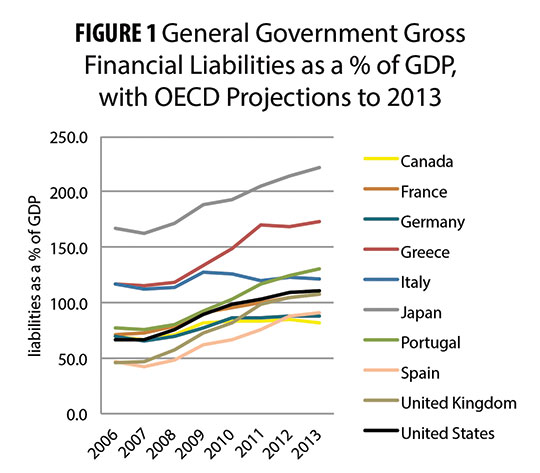
    Efforts to reduce debt in Europe create ongoing financial pressures on many countries, including Brazil, India, and China, and other countries whose economies are already slowing. While the greatest problems are in southern Europe, many other impacted countries including the United States take years to return to pre-crisis levels of growth.
    Source: GPS
    Table 1. Global economic scenarios.
    Source: GPS
    Figure 1. General government gross financial liabilities as a percent of gross domestic product (GDP), with OECD projections to 2013.

    U.S.-Led Global Recession

    The U.S. economy is thrown into recession by a combination of tax increases and budget cuts (the sequester) that together constitute the January 1, 2013 so-called fiscal cliff. Tax and spending changes are modified, but the remaining tax increases from the end of the Bush tax cuts, together with those in the Affordable Care Act, weaken incentives to save, invest, and take risks. Additional pressures come from increased bank capital requirements and other financial regulations that restrain lending.

    The recession in Europe and slowdowns in other countries further weaken the U.S. economy. High debt and unfunded obligations limit the ability to stimulate the economy with additional spending and limit the effectiveness of additional stimulation. Congressional gridlock prevents strong action, and the Federal Reserve has little additional room to stimulate the economy. The U.S. recession exacerbates the recession in Europe and weakens the global economy. U.S. and European recovery is very slow.

    Muddling Through

    The U.S. manages to “kick the can down the road” with enough policy changes to avoid the worst crises, but is unable to stimulate much growth. Tax increases and budget cuts are largely delayed in response to high and rising levels of unemployment but hold back recovery when they return. Economic and policy uncertainty and high levels of financial and business regulation continue to restrain growth and employment. However, underlying technological change is strong and enables continuation of modest growth, along with very low interest rates. Recovery in construction is limited.

    Europe also is able to delay the worst crises, such as would occur if there were insufficient resources to prevent major bank failures or one or more countries abandoning the euro. However, it must work through a recession that is severe in some countries and dampening growth in others. The United States, France, Japan, India, and China institute additional economic stimulus.

    Rebound

    In this scenario the United States temporarily avoids a recession by delaying most tax increases and budget cuts and delaying or modifying some of the most intrusive regulations. A new round of stimulus measures that includes major tax restructuring and infrastructure spending is instituted. A bipartisan plan for long-term fiscal discipline increases confidence. Businesses and consumers take advantage of technological opportunities, low interest rates, and moderated energy prices. Construction begins to recover with renewed housing demand and increased government spending on infrastructure. U.S. banks, with strong balance sheets and modest amounts of loans to Europe, are not heavily affected by the European financial crises and recession. Strong equity prices, bolstered by demand from foreigners seeking a safe haven, boost confidence and add purchasing power. Businesses are willing to take more risks.

    Improved U.S. growth somewhat tempers problems in Europe and elsewhere. Europe manages to implement policies to get through its challenges without a deep crisis or creating severe contagion effects. Counterproductive labor rules in Europe are modified, and tax avoidance is reduced. Austerity is modified and more emphasis is place on growth. The slowdown in the world economy abates, facilitated by the temporary resolution of problems and increased public and private investment in several countries.

    Implications for GNSS

    The most severe consequences for the GNSS industry come in the case of combined U.S.-led and Europe-led recessions, a prospect with a 30–40 percent probability. The reduced contribution of the GNSS industry will in turn impact economies, for which GNSS benefits are great. The effects of deep recession can be seen in the behavior of GPS equipment revenues in North America, which grew 7.9 percent in 2008 and declined by 3.6 percent in 2009, after earlier increases of 17.3 percent in 2006 and 14.5 percent in 2007. Table 2 summarizes the broad implications of the current possibilities for the industry.
    Source: GPS
    Table 2. Implications of global economic scenarios for GNSS.

    Overall Influences

    Even if the budget cuts from the U.S. sequestration are delayed or reduced, the Department of Defense faces severe pressures from the remaining 2013 budget and in out years that are likely to cause launches of GPS satellites to be stretched out. Efforts by House and Senate Appropriations Committees to dramatically reduce the civilian portion of GPS funding in the Federal Aviation Administration FY2013 budget, threatening the timing of civil signals and the ground support system, are a sign of things to come. Delays and modifications are greatest in the recession scenarios. In global recession, plans for GPS III crosslink and spot beam capabilities are dropped.

    The Air Force has requested funding to develop dual-launch capability for GPS III in its 2013 budget. Budget pressures could lead to a more final decision to proceed with dual-launch within the next two or three years if it can be shown to reduce costs. That could make up for the delays later on, but not before several years of falling behind schedules. Budget-induced delays in other programs could alleviate a shortage of launch capacity in the United States, offsetting some of the impacts of shortages on GPS. However, a slowdown in ordering launch vehicles could negate the lessening of delays. Budget pressures also could result in a reduction in the number of satellites in the GPS constellation below 30, as satellites age and replacement slows. Only 24 GPS satellites are guaranteed. Only in the rebound scenario could launches be on track for the next couple of years.

    Budget stringency also affects research and development and production for capabilities that are planned for later years. Military GPS user equipment purchases are stretched out by funding constraints to various degrees depending on budget levels. Military developments could change any aspects of the outlook.

    Budget pressures from the European recession could cause Galileo satellite launches to be stretched out and/or the constellation to stop short of 30 satellites. Russia’s GLONASS program is unaffected by budget pressures as long oil prices do not fall dramatically below the $80 level. China’s Compass program is not likely to be subjected to delays due to funding even if the Chinese economy slows dramatically. However, economic weakness does cause delays in Japan’s QZSS system and India’s IRNSS system.

    Government budget pressures on both sides of the Atlantic, which are greatest in the recession scenarios, could make resolution of the MBOC patent dispute on the common GPS-Galileo civil signal more difficult and drawn out, adding uncertainty and delaying efforts to take advantage of the common signal.

    The impact of economic weakness on private R&D funding for user equipment and services could be substantial in all countries. The private GNSS investment climate is favored by low interest rates, rapid technological change in the industry and in information technology generally, by the evolution of several GNSS systems, and by the growth of markets in developing countries. However, with economies slowing, investment risk remains high.

    In the United States, investment in GNSS product and production process development is hampered by political/policy uncertainty, including satellite deployment, spectrum issues, and European licensing demands. Capital investment and merger and acquisition incentives depend significantly on prospects for scheduled tax increases on capital gains and dividends, and for investment and R&D tax credits, but the composition of tax revisions is not predictable in the present political climate. In Europe, private investment is adversely affected by recession and uncertainty about the economic and policy outlook.

    Business costs decline in the recession scenarios as demand for materials weakens from many industries and the labor market loosens. Company borrowing costs remain low from low interest rates but can rise because of higher risk premiums from lender concerns about the health of borrowers. Costs start to increase in the recovery scenario.

    Percentage swings in profits are much greater than those in revenue, and some firms move from profit to loss when economic conditions deteriorate. Profits fall sharply in the recession scenarios as effects of weakening demand on revenue and unit costs greatly exceed the benefits of lower input costs.

    Prices of products such as chips, antennas, and receivers that have been declining over time fall more rapidly in recession. In the early stages of recession, inventories can pile up, but production cutbacks are incomplete at first because of uncertainty about demand. This contributes to declining profits. More extensive cutbacks that follow are insufficient to offset the allocation of fixed costs over a smaller production base for most companies. Competition intensifies as companies adjust inventories and vie for a shrinking market or one that is growing less rapidly than expected.

    Mergers and acquisitions tend to be most prevalent at the ends of the economic spectrum. When the industry is in recession, some companies merge to obtain cost savings. In early stages of recovery, it is less expensive for companies to acquire existing assets and companies than to build new. When times are good, mergers often occur because the value of the more successful acquirer’s stock is high relative to the stock of the acquired company, and because of a desire to obtain scarce technology and talent. There may be greater interest in bringing a product that has had a limited market to the acquiring company’s larger customer base when the market is growing more rapidly. Over the last century, merger booms in the United States have largely occurred during stock market booms. Initial public offerings of stock also are more frequent during periods of generally high stock prices.

    Mergers and acquisitions can permanently alter the structure of the industry, leading to fewer, more dominant players and redefining customer, partner, and supplier relationships. Some acquisitions may increase pricing power in the long run. More GNSS companies will be owned by firms providing instrumentation, information technology, and other products. Some companies such as Trimble and Hexagon have strategies of making numerous strategic acquisitions; their pace of acquisitions may not vary as much with business conditions as those of more opportunistic acquirers.

    Prices of stocks in companies in the industry tend to move with trends in overall stock markets, but also reflect specific industry developments such as product cycles, technology shifts, and sources of competition. For example, some companies that have thrived with GPS may not be the same ones that are most successful in offering GPS+GLONASS receivers to industry. Some European companies may get a head start in making user equipment that takes full advantage of Galileo. However, a slow product market may give some suppliers a chance to catch up in product development.

    The shift from consumer receivers to smartphones has reduced the stock prices of consumer receiver manufacturers such as Garmin and TomTom. The Navteq division of Nokia and the TeleAtlas division of TomTom that supply maps have had to face great pressures from new sources of competition from Google, Microsoft, Apple, and others just when they had to deal with economic slowdowns.

    Application Sector Impacts

    Both business and consumer demand for user equipment decline in the global recession scenarios. In the muddling through scenario, consumer demand for receivers and smartphones is saturating. Commercial demand continues at a moderate pace, spurred by opportunities for multi-constellation equipment. Demand from both businesses and consumers improves in the rebound scenario.

    Recession scenarios adversely impact demand for GNSS equipment for survey and construction around the world. A U.S. recession would reverse the mid-2012 fledgling start of a housing recovery, but increased spending on infrastructure would raise public construction spending. In the rebound scenario, U.S. private construction picks up along with other investments. Greater construction spending increases demand for survey and construction applications, with public construction heaviest on road paving and building, and private construction heavier on energy and other engineering construction projects. Telecommunications and information technology are encouraged as part of the emphasis on infrastructure.

    A severe outcome for the European economy in the Europe-led global recession scenario stalls growth. Demand for equipment to take advantage of Galileo is slow in the next 2–3 years. In the rebound scenario, European stimulus has only limited impacts on construction because of financial constraints and an overhang of supplies from overbuilding and weakened demand. Financial problems of regional and local governments, for example in the United States, Germany, and Spain, adversely impact construction, especially in recession scenarios. Demand for GIS systems depends both on construction and on government use and is especially sensitive to economic and government budget conditions.

    Economic rebound raises commodity prices, increasing demand for agricultural and mining GNSS equipment. In a stronger U.S. subsidy-cutting environment and/or if there are large declines in commodity prices from economic weakness, demand for GNSS agricultural equipment is reduced. Demand for GNSS mining equipment is closely aligned with the behavior of commodity prices, which are very sensitive to economic conditions.

    Demands for aviation and marine systems are subject to cyclical influences in both transportation and recreation uses. Demand for scientific uses is heavily influenced by government budgets.

    In the rebound scenario, the shift from consumer receivers to smartphones is accelerated as more households are able to afford data plans, and more businesses take advantage of mobile connectivity. In the recession scenarios, receiver markets become saturated more quickly as demand ebbs. Some consumers switch to smartphone use of GPS where it is free, to avoid the cost of purchasing receivers. Nevertheless, smartphone use of GPS grows less rapidly because of a slower shift from unconnected phones to connected smartphones. Purchase of new or upgraded vehicle GNSS systems is more cyclical than the already highly cyclical demand for vehicles, and is further impacted in recession by the availability of phone-based alternatives. Location-based services continue to grow rapidly in all scenarios, with the rate of growth moderated by conditions in the various economies.

    Conclusion

    The overall outlook is cautious in the face of large potential threats and uncertainties. However, the industry has weathered many storms before, and its long-term outlook remains strong.


    Irving Leveson of Leveson Consulting is an economist and strategic planner who has worked extensively on GNSS markets, benefits, and financing. He previously served as director of economic studies of the Hudson Institute and senior vice president and director of research of Hudson Strategy Group. He received his Ph.D. from Columbia University.
     

  • Optimizing Small Antennas for Body-Loading Applications

    By Oliver Leisten and Viktor Knobe.

    Styling for consumer usage has progressively miniaturized of the antenna package to tiny dimensions compared to a free-space wavelength, even as devices with these miniscule antennas are designed to work close to the absorbent tissues of the user’s body and in the electromagnetic maelstrom of city street levels. GNSS antennas have responded with significant advances.

    The selection of the GNSS antenna, especially for small portable wireless devices, demands careful consideration of how it will interact with its expected environment. A physical appreciation can explain how many impairment factors can actually have a common cause: often the effect of human body-loading. This explanation starts with a counter-intuitive foundation: though the GNSS receiver does not transmit signals, for the sake of clarity we invoke the law of reciprocity and proceed with the conceptual thinking that the antenna is radiating outwards. This gives us a basis for understanding the causal physics of how the antenna shares energy with the immediate environment.

    We can visualize the basic radiating action of the antenna by recognizing that it is a resonant component. We must consider what exactly is in resonance, because the antenna designer has two different design options. In the self-resonant configuration, the antenna can be considered to be resonating autonomously, forming the entire dipole of the antenna within the antenna body. Here, dimensions and topological structure act in conjunction with reflecting and absorbing features surrounding it to define where and how the antenna radiates.

    In the second or probe antenna case, a larger radiating space can be configured by resonating the antenna with the housing together. The antenna typically forms a monopole counterpoised by currents and voltages in the housing. Here, the topology of the radiating system (antenna and housing) acts in conjunction with the near environment to define the radiation pattern.

    The value of distinguishing these two configurations is clearly reflected in the contrast between their behaviors with regard to radiation efficiencies in different uses. We conducted an experiment with three example antennas. Each antenna was installed in as common a package format as was practically feasible to model the top portion of a slim-line demonstration platform, with dimensions typical of consumer devices and containing a conductive chassis 55 millimeters wide. Obviously, a probe antenna must be installed in a chassis in order to function, and this directed the experimental approach to be structured around a similar-housing methodology.

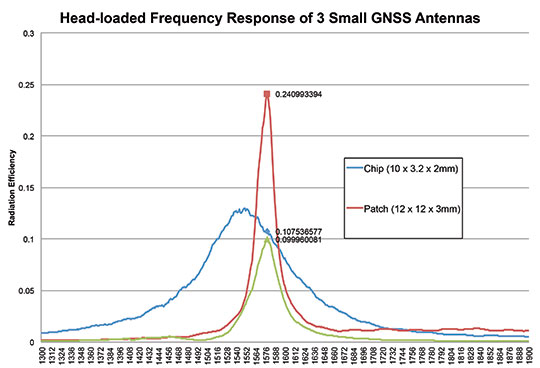
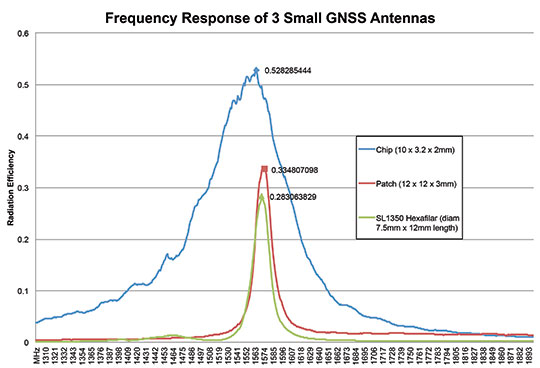
    The probe antenna was a small metal and ceramic chip, and we compared its performance with a small microstrip patch antenna mounted horizontally in a broader but otherwise similar housing, and a hexafilar antenna mounted in an identically dimensioned housing. Strictly, the microstrip antenna is a single terminal element, but it can be considered as self-resonant as the resonance fields are very tightly constrained. Figure 1 plots the radiation efficiencies for benign free-space conditions (without body-loading) together, as frequency responses.

    Source: GPS
    Figure 1. Frequency response of radiated efficiency in unloaded (free-space conditions) and mounted in similar housings (ground-plane width 55mm).

    In benign open-field conditions the probe antenna has excellent efficiency performance and superior bandwidth compared to the two self-resonant configurations. Conversely, the self-resonant antennas (patch and hexafilar) have similarly narrow frequency-response bandwidths and lower efficiencies. We will show how it is important to repeat the test for realistic use scenarios that determine how close the antenna will be juxtaposed to the user’s biological tissues before concluding that the probe antenna is the best solution.

    Antenna studies have shown that the bandwidth reduces very rapidly as the resonant volume of the antenna reduces. This accounts for the reduction in bandwidth shown in Figure 1 for the self-resonant antennas (microstrip patch and hexafilar) with respect to the probe antenna (chip). In the case of the probe, the resonant structure is the entire metal chassis of the device (in this case the circuit-board ground-plane) so that the resonant volume of the resonating system is much larger than those of the self-resonant structures.

    To analyze the behavior of antennas in different use scenarios, it helps to consider the nature of resonance in antennas: open fields, with equal time average amounts of electric and magnetic field energy oscillating in space. These fields, induced by the time-varying voltage potentials and currents in the antenna, can launch a radiating wave into space because time-varying electromagnetic fields can carry or displace energy. We need to appreciate that this volume is where the so-called reactance fields exist, where field oscillations function as a sort of pump that propagates the electromagnetic wave. The antenna induces those fields in a configuration that manages the propagation of waves in useful directions and with desired polarization.

    Any invasion of the reactance field region will disrupt this process and cause impairment. Whilst obstruction of the radiating fields far away from the antenna will just cause a masking effect, a similar obstruction in the reactance-field region can disrupt the basic process of generating radiation. The density of fields in the reactance field region is much higher than would be implied by the straightforward application of the inverse square law.

    Use Near the Body

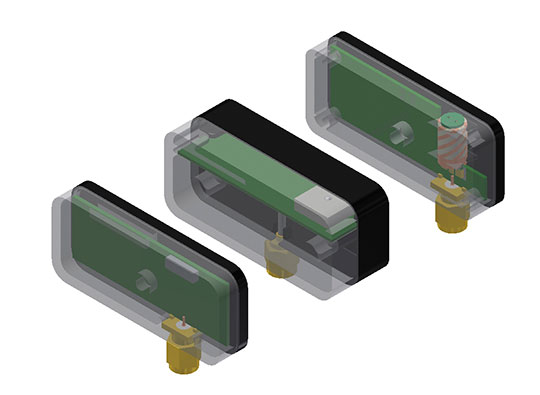
    We evaluated the antenna types, installed in packages as thin as test antenna dimensions allow, to draw conclusions as to how they might operate in slim-line consumer devices held close to the user’s body. Figure 2 shows CAD diagrams of the three antennas installed in their respective test packages.

    Source: GPS
    Figure 2. Antenna test housings for the chip antenna (left), patch antenna (middle) and hexafilar antenna (right). The housings were constructed to have a height of 26mm, a width of 60mm and a depth of 11 mm for the chip antenna and the hexafilar antenna and of 20.5mm for the patch antenna. In all cases the horizontal width extent of the printed circuit board (with continuous copper ground-plane on at least one side) was set at 55mm.

    Consumer devices have drawn antenna technologies from traditional GNSS applications as well as from terrestrial mobile telephone origins. The overall evolution combines adaptation of the circularly polarized technologies (multi-filar and microstrip patch) into smaller body-loaded platforms with insufficient space for effective ground-planes, together with adaptation of the art of low-cost cellular-telephone embedded antenna technologies that were never developed for circular polarization. Taking our three solutions in their embedded test platforms, we can appraise their body-loaded efficiencies by testing them juxtaposed to a phantom head, providing a means of assessing impairment due to body-loading.

    The phantom head in the loading experiment was filled with a tissue simulating liquid conforming to requirements for specific energy absorption measurements according to CENELEC and IEEE procedures. Comparing the antenna efficiencies for open-field conditions (Figure 1) and body-loaded conditions (Figure 3), reveals impairment to antenna efficiency in all three cases, with the most severe loss of approximately 80 percent by the chip antenna.

    Source: GPS
    Figure 3. Combination of FFT-based acquisition with FDAF.

    The self-resonant antennas suffered less impairment: approximately 30 percent reduction for the patch and 65 percent for the hexafilar antenna. The probe’s significant loss of efficiency is typical of this class of antennas, as the resonant fields are heavily loaded by the phantom head. The peak efficiency for this chip antenna has tuned downwards in frequency as the dielectric loading effect of the head-phantom introduced a regime of net higher relative dielectric constant (εr) into the resonance field region of the antenna system.

    By contrast, the self-resonant antennas did not tune down in frequency as they were brought into proximity with the phantom head. This indicates that the resonance fields were not offered to the dielectric materials of the head phantom to an extent that materially changed the relative dielectric constant (εr).

    Nevertheless, there is a significant difference between the impairment that develops between the patch and hexafilar cases as body-loading is applied, with the hexafilar solution losing more radiation efficiency than the patch antenna. There are two explanations for this difference.

    The first is that the patch housing is simply larger, with a greater depth required to accommodate the patch antenna horizontally at the top of the device housing. On average this larger housing size spaces the resonant fields further from the phantom and from the lossy simulated head tissues.

    The second explanation offers an insight into the symbiotic relationship between the hexafilar antenna and the demonstration platform’s vertically orientated housing. The horizontal ground-plane required for the patch antenna is inconvenient from the style and total integration cost point of view, but also ineffective as a ground-plane as it lacks sufficient width in a device styled to minimize depth. In this scenario the patch antenna is not getting much reflection uplift from the ground-plane; therefore there is little impairment when the device is body-loaded.

    The hexafilar solution is designed to benefit from reflective uplift from the vertically disposed ground-plane of the device. This property is convenient for device packaging because it allows the hexafilar antenna to be integrated at a device corner. The installation of a large and effective vertically oriented ground-plane for the hexafilar case is, by contrast, highly convenient and potentially more cost-effective. When the device is not body-loaded, reflections from the vertically disposed ground-plane uplift the gain and efficiency of the hexafilar antenna. The important advantage over the chip antenna (which is also convenient for space-constrained designs) is that for the self-resonant hexafilar antenna, the frequency of resonance does not change for open-field and body-loaded cases.

    Polarization, Pattern, Positioning

    Sufficient data has now been presented to make an antenna selection on the basis of efficiency and styling. The probe antenna in the guise of a chip antenna provided the highest radiation efficiency in free-space, comparable radiation efficiency to the hexafilar antenna in a body-loaded use scenario, and the small physical size supports compact product designs. However, for GNSS applications we must consider wave polarization, especially if there is multipath scattering. GNSS systems employ right-hand circular polarization (RHCP) and ideally should use antennas with hemisphereically omni-directional antennas. The zenith gain of a circularly polarized antenna is expected to be 3dB higher than that of a linearly polarized antenna of the same efficiency.

    If a GNSS terminal is equipped with an omni-directional but linearly polarized antenna, it can receive circularly polarized signals from all directions (albeit with a spatial average 3dB polarization loss). However, the positioning performance of such a terminal will be compromised because a linearly polarized antenna cannot discriminate between RHCP or LHCP, and reflections change the direction of spin of the circularly polarized wave.

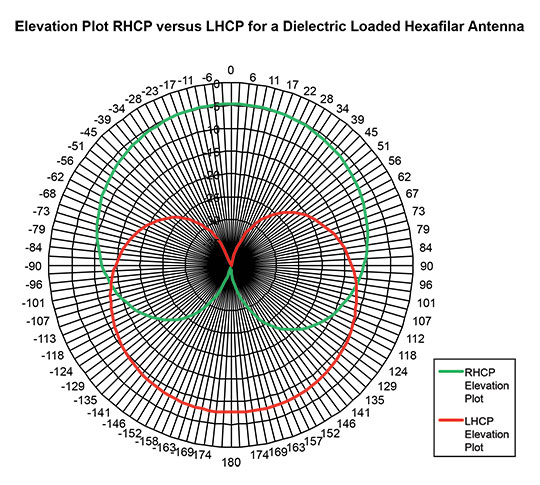
    More color to the subjects of polarization, pattern, and consequential GNSS accuracy can be gained by focussing on the operation of the dielectric-loaded hexafilar antenna, as an example of a small antenna. Figure 4 shows the measured RHCP and LHCP elevation patterns of an exemplary small hexafilar antenna. These are excellent examples of the signature cardiod pattern shapes of good circular polarization antennas, but they point in opposite boresight directions. A dipole rotating anti-clockwise (viewed from above) in a plane would simultaneously excite a RHCP cardiod elevation pattern in the upwards direction and an oppositely directed, but otherwise similar, LHCP cardiod pattern downwards. If the antenna has no ground-plane and the dipole rotation is planar, the power of the upward RHCP and downward LHCP responses are equal. However, the dielectrically-loaded hexafilar antenna is a synthesis of a small travelling-wave upwardly spiralling dipole, emulating the axial-mode of a helical antenna. As the electrical size of such an antenna is increased, the area of the upwardly directed RHCP pattern progressively increases, and the area of the downwardly directed LHCP pattern progressively reduces. The antenna’s dielectric core enables this right-to-left discrimination within dimensions that are very much smaller than a free-space wavelength of the GNSS signal.

    Source: GPS
    Figure 4. RHCP and LHCP elevation for small dielectrically loaded hexafilar antenna (with no ground-plane).

    We can describe the polarization sorting behavior of the small dielectrically loaded antenna in figure 4 as follows. GNSS signals direct from the space vehicles will arrive in the directions of the upper hemisphere of the patterns where the highest sensitivity of the antenna to RHCP is deployed. GNSS signals bounced from a reflective object may also arrive in these upper hemisphere directions, but with reversed polarization: LHCP. In these directions the antenna has a very much lower sensitivity to LHCP, and the GNSS receiving process will accord a low value on these signals that as a result of the low antenna gain will be assessed as relatively noisy.

    Signals that arrive at the antenna from directions in the lower hemisphere will certainly have reflected from the ground surface (assuming that the antenna is held upright). These reflected left-hand polarized signals may have been attenuated by absorption losses of materials present on ground surfaces and also reduced in GNSS receiver process weighting by the antenna’s discrimination in favor of RHCP.

    RHCP and LHCP Gain

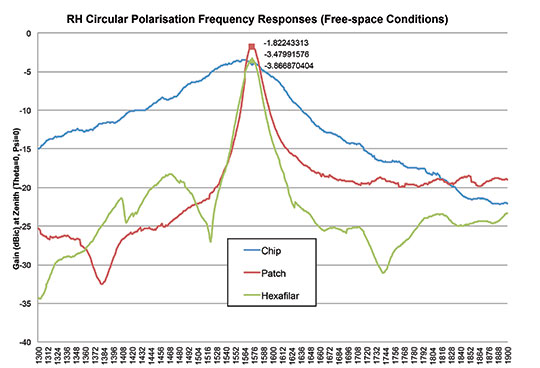
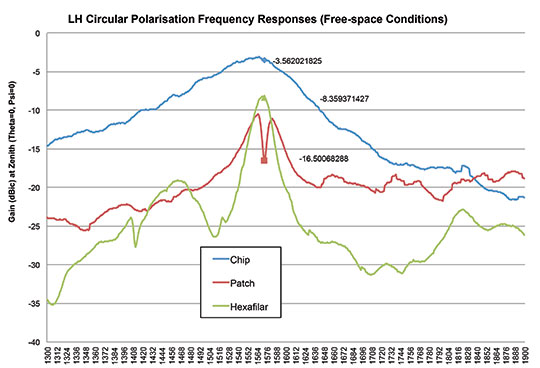
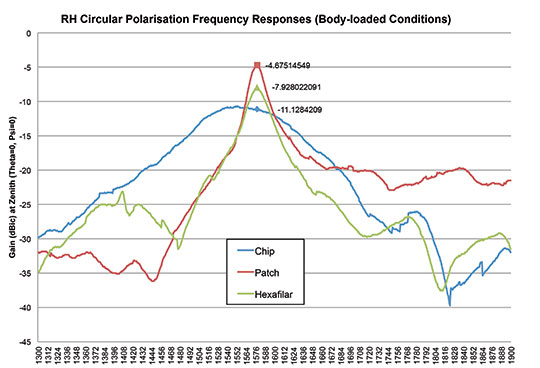
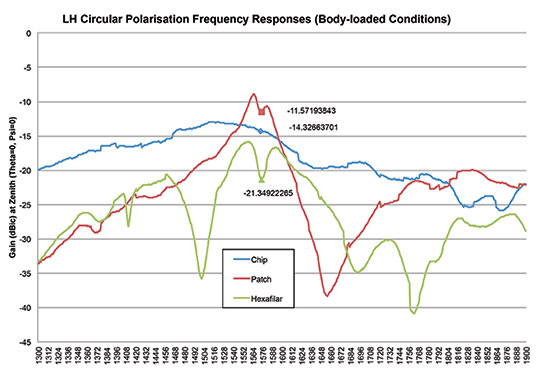
    Whilst appraisal of antenna patterns is certainly the most important method for assessing the performance of antennas in different use scenarios, it is nevertheless difficult to report accurately because the three-dimensional data-set is inevitably complex. To provide a meaningful physical basis for discriminating performance between the test antennas for open-field and body-loaded, we propose a single parameter: cross-pole rejection at zenith as one which is directly relevant to GNSS accuracy in a multi-path environment. Figure 5 plots the right hand and left hand comparative frequency responses for open-field and body-loaded use scenarios. Table 1 summarizes these responses.

    (a)

    Source: GPS

    (b)

    (c)

    Source: GPS

    (d)

    Source: GPS
    Figure 5. RHCP and LHCP frequency responses at the zenith direction for conditions of free-space and body-loading. From top to bottom: a) open-field conditions and RHCP, b) open-field conditions and LHCP, c) body-loaded conditions and RHCP, and d) body-loaded conditions and LHCP.
    Source: GPS
    Table 1. RHCP to LHCP gain ratio at the zenith direction (θ=0, φ=0) at GPS L1 center frequency (1.575.42 GHz).

    In open field, the chip antenna does not have a gain advantage for right-hand versus left-hand polarization and also suffers the highest impairment in gain when body-loading is applied. In this test there is an advantage in favor of RHCP gain for the body-loaded test scenario, but we presume this depends on the mounting position of this particular probe antenna on the test device. Perhaps a mounting position towards the left of the assembly might have incurred a disadvantage of similar magnitude?

    The patch antenna has an excellent RHCP over LHCP advantage in open-field conditions, but this advantage diminishes when this solution is body-loaded. This is the least gain-impacted solution as presumably the horizontal ground-plane and much greater device width produce a relatively low body-loading impact.

    The most interesting result concerns the hexafilar antenna, for which the RHCP to LHCP advantage actually improved in the body-loaded test scenario. As this device had the same depth, one might have expected it to sustain a body-loading impairment similar to that of the chip antenna, but due to the self-resonant character of the hexafilar element the loss in gain (in this zenith direction) was actually only slightly greater than that of the patch antenna.

    The hexafilar element’s CP performance is distorted by the lack of circular symmetry of the vertical ground-plane; therefore in open field this direction has a relatively modest RHCP to LHCP gain advantage of about 5dB. However, when the device containing the hexafilar antenna solution is body-loaded, the re-radiation from reflections from the circuit-board are heavily damped by the phantom head. The radiating source is then predominantly the hexafilar self-resonant element that by design is not itself so significantly impacted by the body-loading scenario. This source is restored to a more autonomous circularly polarized form with an advantage of RHC versus LHCP gain in zenith direction, nearly 13.5dB.

    Walk Tests

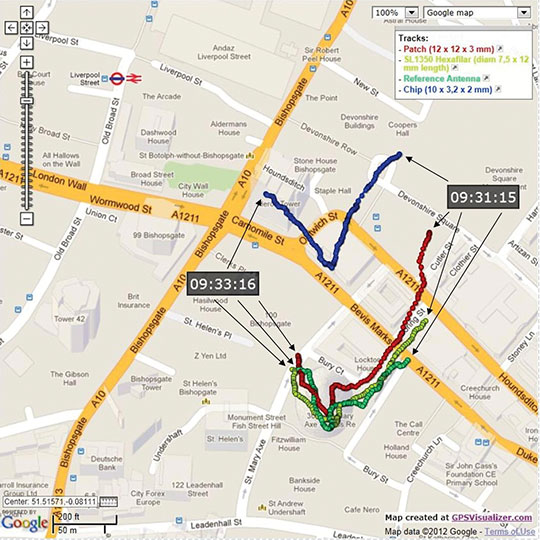
    Free-space and body-loaded test data, together with arguments concerning polarization discrimination and multipath led to an hypothesis that the antennas with the best circular polarization performance should provide the highest GNSS positioning accuracy. We tested the three devices, worn against the lower torso where the body provides a relatively homogeneous dielectric medium, so that position data could be compared with a reference antenna mounted over a large overhead ground plane.

    Many walk tests were conducted around different routes in London, which collectively demonstrate the value of circular-polarization discrimination as a key enabler for accurate street-level position determination. One segment (Figure 6) in the vicinity of an iconic tall London building commonly known as the Gherkin showed that, though the circularly polarized antennas closely followed the path of the reference antenna, the linearly polarized chip antenna produced an error of as much as 200 meters. It is possible that the dominant reflector in this case is the Gherkin itself.

    Source: GPS
    Figure 6. Data, central London walk test.

    Conclusions

    The chip and hexafilar antennas could be integrated tightly into consumer device housings; both experienced gain uplift from the vertically disposed circuit-board ground-plane. The gain uplift from the chip antenna arose as the resonant volume of the device is enlarged as the device size is increased. The gain uplift from the hexafilar antenna arose as a result of constructive reflections from the circuit-board functioning as a vertical ground-plane.

    The patch antenna was not the most convenient from the styling point of view because the depth was dictated by the size of the horizontally orientated patch. Consequently the housing was significantly thicker than for the chip and hexafilar solutions, and the patch antenna was not receiving significant uplift from reflections from the housing because the depth limitation constrained the ground-plane to ineffective dimensions.

    In body-loaded tests, the chip and hexafilar antennas demonstrated roughly equal radiation efficiency, but the hexafilar provided a significant RHCP advantage. Higher right-hand circular gain was measured for the patch antenna; this was expected due to the greater depth of the housing to accommodate the patch antenna. Urban walk tests showed that the RHCP antennas provided the highest position accuracy.

    Whilst the hexafilar antenna did experience some uplift due to reflections from the device circuit board, these were negated when the device was body-loaded. However, the distorting effects of the device ground-plane were also lost, so that the antenna’s advantage of RHCP over LHCP was improved in the body-loading condition.

    The GNSS industry has advanced the miniaturization of polarization-controlled antennas for small body-loaded uses. This is gaining currency as enabling polarization diversity in 4G data-communication terminals.

    Manufacturers

    Sarantel SL1350 antenna was the hexafilar element under test.

    Position data for all four devices was measured with Telit SE868 evaluation kits using CSR (now Samsung) SiRFstarIV chipset.


    Oliver Leisten is chief technical officer and founder of Sarantel Limited, where Viktor Knobe worked as a student intern from Imperial College London.


  • Delorme at the ESRI International Users Conference

    GPS World magazine interviews at the ESRI show, talking with Adrian Smith of Delorme.

  • Altus Positioning Systems at the ESRI International Users Conference

    GPS World magazine interviews at the ESRI show, Eric Gakstatter is talking with Neil Vancans of Altus Positioning Systems.

  • Gatewing at the ESRI International Users Conference

    GPS World magazine interviews at the ESRI show, talking with Maarten Vandenbroucke, President of gatewing.

  • Topcon at the ESRI International Users Conference

    GPS World magazine interviews at the ESRI show, talking with Jason Hooten, the GIS Sales Manager at Topcon Positioning Systems.

  • Geneq at the ESRI International Users Conference

    GPS World magazine interviews at the ESRI show, talking with Marcel Belanger of Geneq.

  • Leica Geosystems at the ESRI International Users Conference

    GPS World magazine interviews at the ESRI show, talking with Mauricio Jaimes of Leica Geosystems.

  • ITT Exelis at the ESRI International User Conference

    GPS World magazine interviews at the ESRI International User Conference 2012, talking with Bo LaGeire of ITT Exelis.

  • Leica Geosystems Upgrades and Expands SmartNet RTK Network in California

    Leica Geosystems Inc. has announced it has significantly upgraded and expanded the coverage of its Leica SmartNet RTK Network in California, making real-time GNSS correction available to 82 percent of the state’s population. A GPS/GLONASS reference station network, Leica SmartNet gives GNSS users access to differential correction for any measurement application without the use of a base station.

    “Leica Geosystems has upgraded the SmartNet California network to improve both the quality and geographic coverage of GNSS correction throughout the state,” said Wendy Watson, Director, Reference Station Operations. “All SmartNet California stations are now GPS and GLONASS capable with additional enhancements being made to accommodate future positioning satellite constellations.”

    A Real-Time Kinematic (RTK) network is a series of permanent GPS and/or GNSS receiver stations whose combined data is used to generate corrections for rover GNSS receivers operating in the coverage area. The rover GNSS unit uses this correction data to improve the native accuracy of its measurement and location calculations. Strategic installation of SmartNet stations throughout California provides wireless RTK data access to nearly every GNSS user in the major population centers of the state.

    In the past six months, Leica Geosystems has installed six new stations and upgraded eight more to strengthen the geometry of the California network. Most new installations have included the Leica GR10 next-generation GNSS reference station receiver and Leica AR10 antenna with integrated radome. New stations have been installed in North Hollywood, Santa Monica, Half Moon Bay, Santa Cruz, Santa Rosa, and Yuba City. Total population coverage in the state with SmartNet now exceeds 30 million.

    “Wireless access to RTK data without a base station is an enormous time savings for surveyors, GIS professionals or other GNSS users who need to improve the native accuracy of their location measurements,” said Wendy Watson, Director, Reference Station Operations. “For any measurement application in California, SmartNet makes this data accessible instantly and affordably.”

    Available through several subscription plan options, SmartNet California is relied upon by GNSS users in surveying, mapping, construction, engineering, agriculture and GIS.

  • Trimble GIS at the ESRI International Users Conference

    GPS World magazine interviews at the ESRI International User Conference 2012, talking with Dan Wallace of Trimble Navigation.

  • Spectra Precision at the ESRI International Users Conference

    GPS World magazine interviews at the ESRI International User Conference 2012, talking with Joe Sass of Spectra Precision.