Blog

  • L-3 Demonstrates TruTrak Evolution Type II SAASM GPS Receiver


    L-3 Interstate Electronics Corporation (IEC) conducted an operational demonstration of its new TruTrak Evolution (TTE) Type II Selective Availability Anti-Spoofing Module (SAASM) GPS receiver at AUVSI’s Unmanned Systems North America 2012 conference, held last week in Las Vegas. The demonstration highlighted the new TruTrak receiver’s multi-use capabilities as a high-performing Ground-Based GPS Receiver Applications Module (GB-GRAM) for use on UAS platforms and precision weapons.

    The TTE offers native Inertial Measurement Unit (IMU) and external oscillator interfaces, user processor, reconfigurable input/output (I/O) and front end, and easy roadmap migration from SAASM to NextGen GPS YMCA modernized technology. Its TTE Type II architecture supports the integration of multiple sensors to simplify all-source navigation solutions for GPS-denied environments. The adaptable architecture allows developers to quickly integrate new sensors without a hardware change, while providing industry-leading core GPS receiver performance and easy migration to NextGen modernized GPS.

    “The TTE Type II highlights L-3 IEC’s integrated SAASM/NextGen GPS M-Code roadmap, providing another innovative path in the development of a Common GPS Module,” said Ric Pozo, general manager and vice president of navigation systems at L-3 IEC. “It allows SAASM- based P(Y) and modernized YMCA multichip modules to share a common circuit card assembly, making this a very flexible solution for drop-in GPS receiver replacement and low-risk integration.”

    L-3’s TTE Type II provides features required by multiple applications, including a small form factor, high performance, and both passive and active antennas. The TTE Type II adopts the common GB-GRAM Type II electrical and physical interfaces, but with expandable I/O to support a wide range of requirements for ground, air, weapon, and projectile needs.

  • Trimble Launches AP20-C GNSS Inertial OEM Module with MEMS Inertial Sensors

    Trimble AP series module

    Trimble has introduced the AP20-C, the latest addition to its AP Series of embedded GNSS-Inertial OEM boards plus Inertial Measurement Unit (IMU). Using a compact, custom-built IMU based on commercial Micro Electromechanical Machined (MEMS) inertial sensors, the AP20-C enables system integrators to achieve high-rate position and orientation measurements with exceptional accuracy, Trimble said.

    The announcement was made at AUVSI’s Unmanned Systems North America 2012 Conference and Exhibition being held this week in Las Vegas.

    Featuring proven Applanix IN-Fusion GNSS-Inertial integration technology, the AP20-C is an embedded GNSS-Inertial OEM board set plus IMU designed for continuous mobile positioning in poor signal environments and high-accuracy direct georeferencing of imaging sensors. The AP20-C delivers full, high-rate position and orientation measurements at 200 Hz, ensuring it can be used in the most demanding mobile environments without sacrificing performance. It is fully compatible with the industry-leading Applanix POSPac MMS office software for enhanced accuracy using network differential GNSS.

    “Compact in form and low in power consumption, the AP20-C can provide cost-effective, accurate, reliable and robust position and orientation measurements suitable for a broad range of survey and mapping applications, including airborne, terrestrial, and marine mapping as well as guidance for unmanned vehicle applications,” said Joe Hutton, director of Inertial Technology and Airborne Products at Applanix, a Trimble Company.

  • Breaking Down Samsung’s Purchase of CSR

    By Kevin Dennehy

    There have not been many earth-shaking acquisitions of companies that have location as a big part of their offerings. However, the recent $310 million acquisition of CSR’s handset connectivity and location business by Samsung merits an additional look. CSR, along with Broadcom and Qualcomm, are looking at the indoor location market as a strong one in the next four years. In other news, the Mobile Resource Management market is seeing 20 percent growth—not a market with consumer excitability, but one that makes money.

    The recent $310 million acquisition of CSR’s handset connectivity and location business by Samsung has put a number of competitors on notice. One analyst, Liam Quirke, IMS Research, says that because of GPS’ increasing presence on smartphones, and Samsung now being the largest handset manufacturer, it made sense for Samsung to want to own this part of the supply chain.

    “This complements its already large manufacturing operations that supply a number of smartphone components, including its own Exynos branded application processor — in addition to manufacturing the Apple-designed Ax range of SoCs,” he said.

    The Samsung-CSR transaction refers only to the mobile business (i.e., handsets and tablets). “Samsung’s GPS strategy here is inevitably focused around such devices. The trend within connectivity, particularly in devices with small form factors such as handsets and tablets, has been one of increasing integration,” Quirke said. “Connectivity has been packaged into a single chip with some IC suppliers also including GPS. An example would be Texas Instrument’s WiLink 8 solution. An alternative is to include GPS on the cellular baseband, a route which Qualcomm decided to take and has since begun to integrate into its application processors — and more recently also including Wi-Fi and Bluetooth.”

    A number of restrictions placed upon CSR by Samsung, as part of the transaction, prevent CSR from selling a GPS product combined with an application processor into the mobile field for 10 years, hinting that this is a direction Samsung may take in terms of integration and subsequently removing additional potential competition, Quirke said.

    In addition to the $310 million deal, Samsung will invest $34.4 million in return for 4.9 percent stake in the remaining CSR business. The completion of this acquisition is expected to be in the fourth quarter. Quirke said that as well as picking up the benefit of CSR’s patent portfolio, the acquisition also adds the research and development and marketing support for its Bluetooth and GPS technology for handsets.

    The deal follows Samsung’s acquisition in June of Nanoradio, a developer of ultra-low power Wireless LAN for chipsets for devices such as smartphones and tablets, Quirke said. It also  provides Samsung with the connectivity technologies with which to make an entrance into the wireless connectivity market.

    During former founder Kanwar Chadha’s tenure at SiRF, which merged with CSR in 2009, the company acquired the GPS businesses of Motorola and Conexant as well some smaller companies such as Centrality, Enuvis, Impulsesoft, Kisel, and TrueSpan.

    Indoor Location Market Will Be Important to CSR

    CSR, along with competitor Broadcom, has become increasingly involved in the indoor location market, with the announcement of its SiRFusion location platform in November. However, Quirke said that the finer details of the transaction between Samsung and CSR indicate that Samsung has only purchased the technology license for GPS, not indoor location. “If correct, this means CSR is free to sell its indoor location technology to other handset OEMs, and in the reverse means that Samsung is not able to do this,” he said.

    With that in mind, indoor location is one of the five key growth areas that CSR is targeting, Quirke said.  “Indoor location, and the various applications associated with it, is centred around mobile devices and, as such, is why I feel CSR was eager to hold on to this portion of their mobile business. Indoor location remains a nascent market with much potential, particularly when considering the opportunity to provide highly targeted marketing material in commercial venues such as shopping malls — not to mention the opportunity in the enterprise space,” he said.

    IMS predicts in its “Indoor Positioning, Mapping, Technology and Services 2012” study that 110,000 supermarkets, shopping malls, or large retail stores will have indoor maps by 2016, making extensive use of indoor location technology.

    CSR has struggled in the mobile space in recent years, while Broadcom and Qualcomm have continued to succeed on the back of their strengths in connectivity combining ICs and cellular baseband chips, respectively, Quirke said.  “Current indoor location solutions offered by the major IC suppliers reside on the GPS chip itself, making use of a number of wireless technologies and MEMS sensors. In light of this, CSR will need to provide a compelling reason for a handset manufacturer to choose its indoor location solution over one from Broadcom or Qualcomm,” he said.  “On a more positive note, early indications suggest that CSR’s solution may be slightly ahead, in terms of providing an accurate working solution — of those from Broadcom and Qualcomm.”

    Enterprise Market Strong…

    In other industry news, the leading suppliers of GPS fleet management solutions for the local fleet and enterprise markets are continuing to grow at a strong rate, nearly 20 per year, said Clem Driscoll, president of CJ Driscoll Associates.

    “FleetMatics, the largest supplier to small fleets, filed an S1 in May and the IPO is expected in the near future. Telogis continues its wave of acquisitions, most recently NavTrak, said Driscoll, who has completed his “2012-2013 Mobile Resource Management Systems Market Study” that profiles 100 MRM suppliers in several markets.

    A strong trend in MRM for both local fleets and the trucking sector is monitoring driver behavior, Driscoll said. “Many suppliers monitor speeding, acceleration, deceleration, speed on turns, etc., and generate driver scorecards to identify the best and riskiest drivers,” he said. “This monitoring of driver performance, along with engine idling time and route adherence, also helps fleet operators minimize fuel consumption, which is a major concern these days.”

  • Next Galileo Satellite Reaches French Guiana Launch Site

    The third Galileo In-Orbit Validation flight model satellite being unloaded from its Antonov 124-100 transport aircraft at Cayenne Airport in French Guiana on August 7.
    The third Galileo In-Orbit Validation flight model satellite being unloaded from its Antonov 124-100 transport aircraft at Cayenne Airport in French Guiana on August 7.

    The next Galileo navigation satellite has touched down at Europe’s Spaceport in French Guiana, to begin preparations for its launch in October, reports the European Space Agency. Cocooned within a protective, air-conditioned container, the satellite left the Thales Alenia Space Italy plant in Rome on Monday evening for nearby Fiumicino Airport.

    At 23:15 CEST it boarded an Antonov 124-100 aircraft for its overnight flight across the Atlantic, stopping in Tenerife at 03:50 CEST for refuelling.
    The satellite touched down on Tuesday, August 7, in French Guiana’s Cayenne Airport at 07:55 local time (12:55 CEST). It was accompanied by a four-person team from Thales, plus one representative each from Astrium and ESA, as well as all the specialized test and support equipment that will be needed during the launch preparations. The satellite was then moved onto a lorry for transport to the Guiana Space Centre, for subsequent removal from its container.

    These third and fourth Galileo In-Orbit Validation (IOV) satellites are due to be launched aboard a Soyuz ST-B vehicle in October. These new satellites will join the first two Galileo satellites — launched last year — in medium-Earth orbit at 23,222 kilometer. This will mark a significant step in Europe’s program because it will complete the deployment of infrastructure required for the IOV phase and will allow for the first time a computation of on-ground position based solely on Galileo satellites, ESA said.

    The IOV phase is being followed by the deployment of additional satellites and ground segment as required to achieve the Full Operational Capability, leading to provision of services. 
The first 22 of these Final Operational Capability satellites are being built by OHB in Germany, responsible for the platforms and final satellite integration, and UK-based Surrey Satellite Technology Ltd., producing the payloads.

    The first four Galileo IOV satellites have been built by a consortium led by EADS Astrium, Germany, with Astrium producing the platforms and Astrium UK responsible for the payloads.

  • CGSIC Subcommittee to Hold Meeting August 14

    The CGSIC States and Local Government Subcommittee, chaired by the Federal Highway Administration, is conducting a meeting in downtown Seattle on August 14. CGSIC is chartered to be an information portal direct from the U.S. government’s GPS program to (and from) the world’s civil users of GPS.

    The Coast Guard’s Navigation Center is assigned responsibility as the operational arm and executive secretariat for the committee and assists the States and Local Government Subcommittee to bring this information to state government and private personnel in regional areas of the United States. View an agenda and directions to the meeting on the Navigation Center’s website.

    CGSIC meetings are free and open to all and present an opportunity to personally interact directly with the people that manage the GPS program. For more information, call CGSIC Executive Secretariat Rick Hamilton at 703-313-5930.

  • A Look at the Diplomatic Facility Support Package

    By Art Kalinksi

    CACI builds a refined geospatial mobile application for emergency response.

    As many of you have seen and experienced, a growing number of mobile applications use smartphones or tablet computers. I had occasion to see a demonstration of a specialized application, produced by CACI in collaboration with DigitalGlobe, designed primarily to support the management of diplomatic facilities during normal and emergency operations. The system is aptly called the Diplomatic Facility Support Package or DipFac for short. According to CACI engineers the system, which bridges both PCs and handheld mobile devices, was designed with a holistic approach from its inception.

    DipFac is designed to prepare for, and manage, planned and unplanned situations as they affect our foreign diplomatic facilities and personnel. It helps embassy leaders manage events affecting facilities and, if needed, to develop contingency plans for the safe movement of diplomatic personnel. The rapid dissemination of geospatial information and real-time data provide a superb common operational picture while providing decision makers the support necessary for effective evacuation and recovery.

    The system manages devices and data similar to an iTunes store, but as a completely secure service operating in its own environment. Below are screen shots showing the easy navigation of the system in field operations.

    Picture1 Picture2 Picture3

    The mobile device accesses content via secure communications. The content is impressive in its scope and includes maps, imagery, biometrics, documents, social media, and all of it in an interactive collaborative environment. Using OGC standards, multiple layers of geospatial data and annotations can be integrated and displayed to form a common operational picture.

    The data sets include the use of Open Street Map, a Wiki crowd-sourced digital street database built through the efforts of countless local contributors. Although it has no single “authoritative” source, users have found that this collaborative street base is impressive in its detail and currency. I haven’t previously used Open Street Map, but reviewing some areas I visited around the world it looked like a very good alternative and supplement to Google Maps.

    Imagery is provided by DigitalGlobe and includes not only current imagery but historic imagery, where available. This is valuable for temporal analysis to identify changes that could possibly be significant. DigitalGlobe also provides numerous vector data layers such as streams, rivers, and political boundaries.

    The collaboration environment is quite robust. There is a Twitter-like question-and-answer section along with the ability to annotate maps with Open Geospatial Consortium (OGC) standard symbols and the ability to draw lines and polygons to identify routes and areas of interest. There is even a biometric identification capability so accurate personnel identification can be done in the field along with document exploitation (DOCEX), media/computer exploitation (MEDEX), cell-phone exploitation (CELLEX), scene photography, and other capabilities. Users can take pictures, link them to a geographic location, and share those with others. The same is true with scanned documents that can also be run through a built-in translator. Although the translator is not perfect, it could be good enough to quickly understand the gist of a document viewed in the field. Headquarters or other users can also import and share CAD drawings, PDFs, and other digital documents and link them to facilities or geographic locations on the map. Site Exploitation (SITEX) functions include collection and sharing of site-specific information including evidence collection, room or building diagrams, dimensions, video of the site, pictures, people on site, and activities.

    The entire system is similar to Palanterra, the National Geospatial Intelligence Agency (NGA) web-based GIS. Palanterra is a spatially and analytically enabled web-based GEOINT system designed to assemble, analyze, and display physical features and geographically located activities. It is also designed to integrate disparate data sources into a common operational picture, but unlike Palanterra, DipFac has a very light learning curve and can be used by operators in the field with very little geospatial training.

    DIPFAC3

    Above is a screenshot showing building footprints on the imagery and standard OGC-compliant annotations. The view on mobile devices is very similar. Other simulated examples permit users to annotate and share areas of interest such as a bomb blast locations and safe evacuation routes.

    Based on my experience during emergency response exercises, one potential limitation of this and other web-based systems could be connectivity degradation, since the system relies on continuous updates. When I participated in a New York City Oil Spill exercise using Pictometry Online imagery, the growing number of emergency responders assembled as the event progressed, ultimately slowed all Internet activity to a crawl. I believe that being able to cache static data, such as imagery, during the early stages of an event is important to reduce total data traffic, permitting important flow of “live” data and communications. In conversations with CACI engineers, they agreed to consider adding that capability.

    Although the turn-key DipFac system was designed for diplomatic facilities, one can easily see how the secure system could be very useful to any emergency responders or the military. I look forward to seeing how it performs in a real-world situation compared to other similar mobile applications. I recommended that they submit a request to demonstrate it at the next USSOCOM TNT.

    The system is intuitive, easy to learn, and easy to use. With hundreds of at-risk U.S. facilities around the world, this could be a subtle game changer that may be very cost effective and save lives.

  • ABI Research: In-Car Nav Market Bottoms out at $22 Billion, New Services Key to Rebound

    ​The total in-car navigation market has been in continual decline for the last three years, but ABI Research believes it has now reached its lowest ebb. While pure navigation is unlikely to reach the highs of 2008 again, the overall market is reaching a revenue plateau, creating a solid platform on which connected in-car services can bring a new generation of revenue growth, the market research firm concluded.

    Senior analyst Patrick Connolly stated,” When we look at the decline from 2008 to 2011, there is a perfect storm of economic conditions, low-cost/free smartphone navigation, the decline of PNDs, and falling car sales. The market is forecast to reach a low of $22 billion this year, before fluctuating around the $22-$24 billion mark, as a new period of growth for factory-fitted solutions, coupled with smartphone solutions, will take in-car navigation towards saturation point in many regions by 2017.”

    Factory-fitted solutions will bring new revenue opportunities, especially for PND manufacturers, ABI Research said. But the real growth opportunity will be the additional revenues that in-car connectivity will bring. Companies are fighting for a near-30 million connected car platform market in 2017, with many of the winners and losers decided over the next two years.

    Practice director Dominique Bonte added, “The opportunity is there to leverage navigation, to bring a host of new services around driver performance, infotainment, car diagnostics, and insurance.”

    These findings are part of ABI Research’s GPS & GNSS Research Service, which includes additional Competitive Analyses, Vendor Matrices, Market Data, and Insights. In ABI Research’s quarterly service, “GPS&GNSS”, all forms of in-car navigation are considered, including factory fitted, aftermarket, PNDs, and smartphones.

  • NVS Technologies Selected by Advanced Navigation for Spatial Miniature GNSS/INS System

    Advanced Navigation, a developer of 3D navigation technologies, has launched its Spatial product series, featuring NVS Technologies AG’s NV08C-MCM high-performance multiple GNSS-constellation receiver.

    The Spatial is a ruggedized miniature GNSS/INS & AHRS system that provides accurate position, velocity, acceleration and orientation under demanding conditions. It combines temperature calibrated accelerometers, gyroscopes, magnetometers and a pressure sensor with an advanced GNSS receiver. These are coupled in a sophisticated fusion algorithm to deliver accurate and reliable navigation and orientation, Advanced Navigation said.

    The Spatial product line takes advantage of the NV08C-MCM’s multi GNSS constellation support, ensuring high availability of navigation signals, high sensitivity, providing reliability, accuracy and performance.

    Advanced Navigation is a privately owned Australian company that specializes in the development of 3D navigation technologies. The company’s engineers come from a background in mission critical robotics built to military specifications.


  • Chronos Welcomes Ofcom Licensing for GPS/GNSS Repeaters in the UK

    Chronos Technology, supplier of GNSS (GPS, GLONASS, and Galileo) products and services, welcomes the decision by the UK regulator Ofcom on June 20 to implement a licensing regime for the use of GNSS repeaters in the UK. Chronos Technology has been at the forefront of GNSS repeater technology for many years and is one of the largest suppliers of this technology to the military in Europe.

    GNSS repeaters provide coverage for the use and testing of GNSS technology inside buildings where the GNSS signals do not normally reach. Until the recent decision by Ofcom, the use of this repeater technology in the UK was not permitted except in specialized (normally military) situations.  Large numbers of consumer and industrial products use GNSS technology for positioning and timing applications including smartphones, telematics equipment, avionics and emergency service applications. GNSS technology can also be used for resource management, civil engineering and military applications.

    The Ofcom consultation prior to this decision highlighted concerns about potential interference to applications by the use of GNSS repeaters; however, the conclusion was that a properly installed repeater system, conforming to the ETSI harmonized Standard for GNSS repeaters, should have no impact beyond 10 meters. This decision enables the use of GNSS repeaters in many applications and will provide significant benefits and cost savings to organizations wanting to develop, test, integrate and manufacture products and systems that use GNSS technology, Chronos said.

    Chronos has installed repeater and other general GNSS infrastructure in more than 50 countries over 15 years.

  • Resource Industry to Mine Data Faster with Actian and Geological Data Design

    Actian Corporation has announced that Geological Data Design (GDD), a specialist in the collection, management and analysis of exploration and mining data, has selected the analytical database Vectorwise to power its Field Data Integrator. GDD’s Field Data Integrator is an end-to-end mining and exploration solution that makes working with large volumes of resource data, including GPS, faster and simpler, Actian said.
     
    GDD’s Field Data Integrator automatically synchronizes sample data from GPS, various field instruments, and cameras onto a "tough" tablet using Bluetooth. Geologists enter notes directly onto the tablet using on-screen or wireless keyboards, enabling all data on samples to be collected automatically into a single source. The tablet then automatically synchronises with a master database running Vectorwise whenever in mobile range, saving geologists time in manual data entry.

    The end-to-end solution enables geologists to collect samples in shorter time frames, and then quickly analyze large volumes of sample data for complex scenarios such as such as project timings, cash flows, and profitability with greater sensitivity levels.
     
    “For the last 25 years GDD has been helping companies in the resource sector collect, manage, and analyze their data. Today’s technology enables us to do this more quickly and effectively,” said Tony Shellshear, principal and founder of GDD. “Geologists traditionally carry a lot of different field equipment to explore, record observations and take samples. They make notes and drawings, record coordinates, take photos, videos, or perhaps audio recordings. Collating this data can be very time consuming, and geologists can spend up to 1-2 hours a day manually entering these different information types into the database. GDD’s Field Data Integrator does all this automatically by synchronizing information from the various devices to the tablet computer, which then uploads the data to the main Vectorwise database when in reach of a wireless signal. This means geologists can spend more time collecting samples, or analysing the data, rather than being tied to the clerical work.”
     
    While the field data collected during the day is not always large, this data often integrates into a very large database, in some cases hundreds of millions or even billions of records. GDD chose the Vectorwise database for its ability to deliver significantly faster analysis of this data on commodity hardware, Actian said.
     

  • Update on EGNOS and GAGAN SBAS Satellites

    Source: GPS
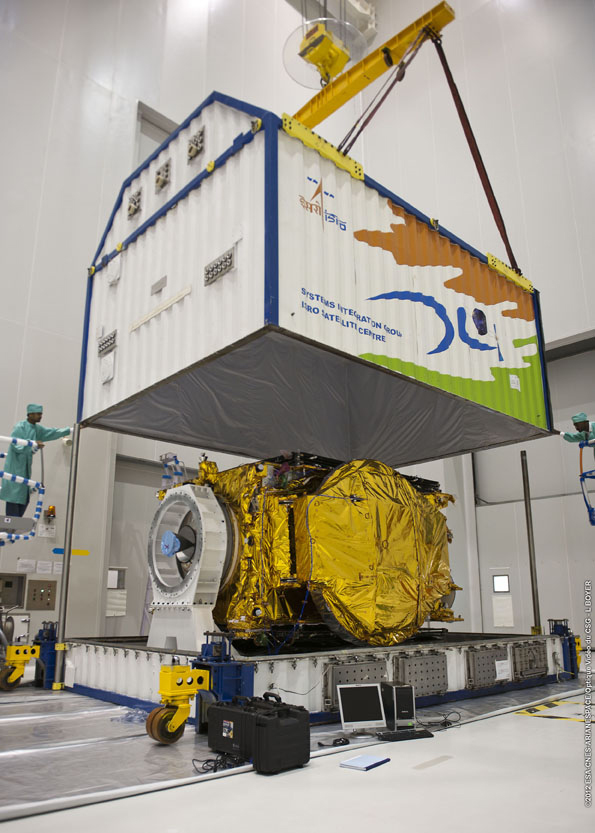
    The shipping container that protected GSAT-10 during its travels from India to French Guiana is removed inside the Spaceport’s S5 payload preparation facility, revealing the spacecraft.


    News courtesy of CANSPACE Listserv.

    UPDATE: According to an Arianespace press release issued Thursday, the launch of the GSAT-10 and Astra 2F satellites is now scheduled for September 21.
    SES-5. The SES-5 geostationary communications satellite (also known as Sirius 5 and Astra 4B), which was launched on July 9, 2012, arrived at its orbital slot of 5 degrees east longitude on or about July 19. The current position is actually about 5.2 degrees.

    The satellite carries L1 and L5 transponders for the European Geostationary Navigation Overlay Service (EGNOS) satellite-based augmentation system. According to a spokesperson from the Space and Missile Systems Center, the Global Positioning Systems Directorate has assigned C/A PRN code 136 and L5 PRN code 136 for use by the satellite.

    GSAT-10. The Indian Space Research Organisation’s GSAT-10 geostationary communications satellite has arrived at the European spaceport in Kourou, French Guiana. The satellite carries a transponder for the GPS and GEO Augmented Navigation (GAGAN) satellite-based augmentation system.

    GSAT-10 will be launched together with the Astro 2F satellite by an Ariane 5 rocket on September 21. GSAT-10 is expected to be positioned at 83 degrees east longitude and use PRN code 128. It will join the first GAGAN-equipped satellite, GSAT-8, which is at 55 degrees east longitude and is transmitting test signals on the L1 frequency using C/A PRN code 127.

    Although GSAT-8 reportedly carries a dual-frequency transponder, no L5 signals from this satellite have yet been detected by International GNSS Service tracking stations.

  • Out in Front: Live Free or Die Hard

    The 2007 action film of that name concerns a domestic criminal plot, disguised as a terrorist attack upon U.S. infrastructure: an Internet-based hack into Federal Bureau of Investigation computers, the transportation infrastructure, the stock market, national video broadcast channels, the utility power grid, the National Security Agency, and the Department of Defense nerve center. One of the film’s two heroes recognizes this as a fire sale, an attack upon the nation’s computer controls, an attack in which “everything must go.”

    Inspiration for the film came from a 1997 article in Wired magazine, “A Farewell to Arms,” written by John Carlin. “For those on the ramparts of the world’s sole superpower, the digital winds are blowing an icy chill through the triumphant glow of the post-Cold War,” the article begins. “Suddenly, the satellites over North America all go blind . . .” it envisions in mid-stride.

    As prescient as the 1997 article is, and as slam-bang inclusive of almost every bit of taken-for-granted infrastructure as the 2007 actioner tries to be, neither one mentions GPS. There’s no reason why they couldn’t — they just didn’t. We can remedy that right now, with the following imagined scenario.

    The placid mood of a lazy spring afternoon shatters at 4:53 p.m. Mountain Standard Time when the GPS constellation goes offline worldwide.

    Long reliant on GPS timing for load management, electrical grids begin to move out of synch. A minor problem in a southern Illinois sub-station quickly morphs into a cascading power outage that plunges the North American continent into darkness.

    The Pentagon command center detects a massive distributed denial of service attack underway on key areas of American military, utility, and aviation infrastructures. Air traffic flow systems are paralyzed, followed by train controls. Cellular networks collapse. Automatic cash machines and banking networks quickly roll down their shutters. All depended on GPS for positioning, navigation, timing, or all three; they simply cannot function without. Backups, long discussed but never deployed, can’t help.

    Computerized transfer of information grinds to a halt nationwide. Mayhem ensues. Riots break out in large cities. Police forces join the ranks of the newly crippled, and are forced to deal with unrest in the old-fashioned way: going out into the streets on foot.

    As a once-beautiful day descends into long dark night, confusion, desperation, and fear spread black wings across the world.

    The information has been lost.

    Doomsday scenarios go in and out of fashion. Lately they’re all the rage. I was startled by an April article in Smithsonian that led to my May editorial “That’s Denial.” But now I’m noticing these portents more and more.

    Every benefit brings its own drawback, every strength its own weakness. The principle applies not only to technology, but to every branch of human endeavor, of the natural adaptive world, even to the laws of physics. We little realize how totally reliant our civilization has become on very precise information. Without backups, defenses, mitigation, and safeguards, even a momentary loss of information can wreak catastrophic effects. Witness the recent Facebook Fumble, described by Chuck Shue of UrsaNav at the ION PLANS meeting:

    “On May 18, 2012 the ripple effect of two (2) extra milliseconds of delay required to calculate the opening price during the Facebook initial public stock offering produced damages to Facebook estimated from $40 million to $400 million — for one stock. Although not as widely known, Nanex reported that the timing glitch, probably from errors in routing software, also affected Apple, Intuit, Netflix, QualComm, Zynga, and other stocks.

    “What if this were the result of time spoofing, rather than simply a programming error?” he asked.

    This is the demonstrated effect of an accidental 2-millisecond delay, in one market of one sector of the national economy. In the case of a prolonged outage, a sustained attack by spoofing, jamming or other means, on the neural center of national infrastructure — that is, GPS — the mind staggers.

    We live by lightning-quick transmission and exchange of data. We may just die by it. The cloud touted as the ultimate warehouse, routing center, and solution to business challenges may dump acid rain on our picnic one day.

    Our world is driven by information flow in ways unfathomed just a few years ago — and don’t we love it? The technological and societal changes associated with computers, the Internet, Information-Age thinking, and all our neo-survival tools still manage to leave us extremely exposed.

    Benjamin Wash, who originated the GPS doomsday scenario at the beginning and many other thoughts throughout this column, wrote “The data sea upon which we sail grows exponentially vaster, and ever more complex and vulnerable, by the day. Our reliance on and need to gain information advantage intensifies as the world becomes more digitally integrated and competitive. Resource competition among nations is fierce, and those who control information exercise control over resources to a greater extent than in any time in our history.

    “Information access, flow, and aggregation enable the achievement of strategic and tactical advantage, but also the potential for mayhem. As an entity and as individuals, we cannot afford to be blind to this paradigm-altering reality: information drives the world.”

    Our correspondent had more to say concerning the Congressional melee — only be sure to call it, please, negotiation — over the defense budget. GPS, although not perceived by most to be at the center of this, does actually occupy that critical, key position because of the way it coordinates everything else.

    The proliferation of sophisticated electronic weaponry and technologies such as GPS jammers and spoofers, empirically evidenced in two articles in this issue, “Drone Hack” and “Going Up Against Time,” show just how vulnerable our golden standard is — and how saliently that vulnerability has emerged — in this information-based era.

    The GPS constellation and its associated signals are the primary source of PNT information, which increasingly drives all other information domains in the nation, not to mention for our overseas combatants and coalition allies. Over the coming decades, rapid technological advances will further remake whole sectors of the national infrastructure and national security.

    These improvements are contingent upon steady resource allocation within the Air Force. Future on-orbit systems, such as GPS III and its associated capability improvements, are under extreme budgetary pressure for their high cost. Some improved capabilities have already been shelved due to budget constraints, and more may follow. Key among these are strengthened defense of the system; only a few steps have been envisioned, and fewer taken. Many more mitigations, defenses, and backups must emerge from conceptualization into design, testing, and deployment.

    Technology’s complexity makes buy-in by policy makers difficult. Technical advances, both achieved and anticipated, are hard to defend in the budget battles on the Hill. But that’s our job, so step up.

    Let’s return briefly to the Carlin article. “For all the bustle, there’s no clear direction. For all the heat, there isn’t a great deal of light. For all the talk about new threats, there’s a reflexive grasp for old responses — what was good enough to beat the Soviet Union and Saddam Hussein will be good enough to beat a bunch of hackers. Smarter hardware, says the Pentagon. Bigger ears, says the NSA. Better files, says the FBI.”

    Has anything changed since those words were written in 1997? Hardly.

    There are no easy answers in the coming knife fights over the defense budget. Vital technologies will vanish under the flailing and battledust of political striving for personal and party advantage.

    Decision makers must understand that information systems are the backbone of all we do — and that GPS drives more and more of those information technologies, through its micro-precise electronic timing.

    It’s our job to educate lawmakers and beancounters. A letter to your three Congresspeople is a simple yet effective educational tool.

    Live free or die hard.