Blog

  • Locata and Leica Geosystems Extend Partnership

    Leica Geosystems Mining and Locata Corporation have announced the extension of their technology partnership in the Mine Machine Automation and Mine Fleet Management Market until June 30, 2014. The extension guarantees the ongoing, commercial provision to the global mining industry of the Leica Jigsaw Positioning System (Jps), powered by Locata technology. 

    The continuance of the technology partnership between Leica Geosystems Mining and Locata Corporation comes on the back of a huge body of work, which has resulted in the first successful operational deployment of the Leica Jps network. The technology at the core of the Leica Jps is a combination of the “Local Constellation” (pioneered by Locata Corporation and adopted by the U.S. Air Force) and Leica Geosystems’ technology portfolio.

    The co-developed Leica Jps network is a high-precision solution that augments standard RTK GPS/GLONASS signals with Locata signals, ensuring no positioning signal loss or machine down time, even against high walls or in the deepest open pit mines, Leica said.

    “It is with great pleasure that we officially announce our continued alliance with Locata Corporation,” said Haydn Roberts, CEO, Leica Geosystems Mining. “Through this partnership, the Jigsaw Positioning System (Jps) will continue to meet and exceed industry expectations. In being available to augment any GPS/GNSS network on any site, we are truly providing a new capability for mining applications, enabling them to operate with unprecedented signal up time and benefit from the huge associated financial return. And we know it works — we have the data.”

    “Through Jps we offer autonomy from sole reliance on satellite-based positioning networks," Roberts said. "In accordance with Leica Geosystems Mining strategy, our technology for machine automation and now HP RTK positioning is completely OEM independent. No longer will machines stop work while waiting for the elusive satellite signal to reconnect. The Jps will seamlessly augment the signals, no matter on what machine, on what system, in what fleet.”

    Nunzio Gambale, CEO and co-founder of Locata Corporation, said, “Locata is truly delighted to extend, for a further two years, the global exclusive rights Leica Geosystems has to integrate and sell our revolutionary technology into the mining market. They deserve this extension. Mr. Haydn Roberts runs a team that is talented, experienced and motivated. They have proven to us many times over that they are some of the finest GPS engineers in the world.”

    The success of the combined technologies and continued relationship between both parties ensures the Leica Jigsaw Positioning System will be commercially available to the mining industry globally from August this year.

    “This Leica-Locata relationship has blossomed over what is now many years of cooperation, and it is one which we value highly,” said Gambale. “The Locata team is proud to be partnering with such a respected and incredibly innovative company.”
  • Russian SBAS Satellite on the Move

    News courtesy of CANSPACE Listserv.

    According to tracking information supplied by NORAD/JSpOC, spacecraft controllers have adjusted the orbit of the Luch-5A relay satellite. Luch-5A is the first of a set of three geostationary satellites being launched to reactivate Roscosmos's Luch Multifunctional Space Relay System. The system will be used to relay communications and telemetry between low-Earth-orbiting spacecraft, such as the Russian segment of International Space Station, and Russian ground facilities.

    The satellites also carry transponders for the System for Differential Correction and Monitoring (SDCM), Russia's satellite-based augmentation system. The transponders will broadcast GNSS corrections on the standard GPS L1 frequency using C/A PRN codes assigned by DoD's Global Positioning Systems Directorate. Luch-5A was assigned PRN 125; Luch-5B, PRN 140; and Luch-5V (previously called Luch-4), PRN 141.

    Luch-5A was launched on 11 December 2011 and was placed in a temporary geostationary orbit with a sub-satellite longitude of about 58.5 degrees east. The previously announced operational location for the satellite is 16 degrees west longitude.

    The satellite's orbit was lowered on or about 30 May and the satellite is now drifting slowly eastwards at a rate of about 1.6 degrees per day. At this rate, the satellite will reach 16 degrees west by November. Today, the sub-satellite longitude is about 81.5 degrees east.

    If the intended destination is actually 16 degrees west, it is not known why the spacecraft operators didn't arrange for the satellite to move westwards so that it would reach the destination in a shorter time. One thought is that to achieve such a move, the satellite's orbit would need to be raised and that could have put it into the graveyard region where defunct geostationary satellites are put to rest and where the chance of a collision might be higher. On the other hand, perhaps the satellite is being moved to another temporary location.

    Luch-5B is scheduled for launch on August 30, 2012.

  • Trial by Vacuum Brings Next Galileo Satellites Closer to Launch

    Source: GPS world staff
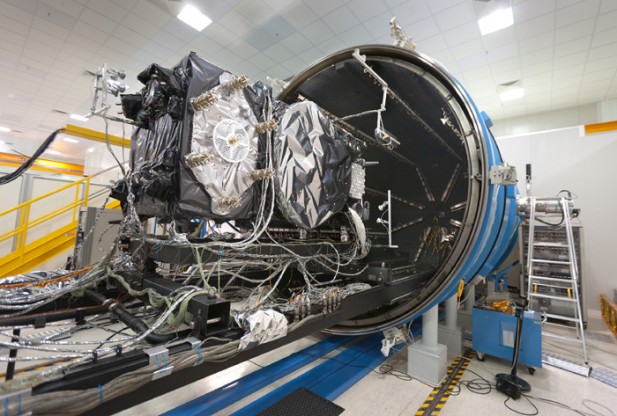
    The fourth Galileo In-Orbit Validation flight model satellite, FM4, pictured at the start of thermal vacuum testing at Thales Alenia Space Italy’s facility in Rome in May 2012. The third Galileo flight model, FM3, had already undergone this testing. Credits: ESA/EADS Astrium – R. Kieffer

    The next two Galileo navigation satellites have now endured the harsh vacuum and temperature extremes of space on the way to their scheduled 28 September launch, according to the European Space Agency. The fourth satellite completed 20 days of thermal vacuum testing at Thales Alenia Space Italy’s plant in Rome at the start of June. The third satellite completed the same tests the previous month.

    “These two satellites are almost identical to the first two Galileo satellites that were launched last 21 October,” explained ESA’s Nigel Watts. “So we don’t need to carry out full-scale qualification tests because we already know from our in-orbit test campaign that the design performs to our expectations. Instead, what we are carrying out is acceptance testing: checking the workmanship, performance and readiness to launch of these new satellites.”

    Thermal vacuum testing involves placing each satellite into a vacuum chamber and pumping out all the air. Its external surfaces are then variously heated and cooled while the satellite is operated. With no air in orbit to moderate temperatures, any part of a satellite in sunlight can become extremely hot, while those parts in shadow or facing deep space grow extremely cold. Critical systems must be kept within a set temperature range, however.
    “To give an idea, Galileo’s laser retroreflector on its exterior reached –110°C during the cold phase of testing,” said Guido Barbagallo, Galileo thermal engineer. “Meanwhile, the navigation high-power amplifiers could be driven to more than +40°C during the hot phase.”

    Like most satellites, Galileo’s uses a variety of methods to maintain its temperature range, including multi-layer insulation, heaters, heat pipes relying on evaporating ammonia to shift heat, and radiators to dump waste heat out to space. Galileo’s passive hydrogen maser atomic clock at the heart of its navigation services is precise to a second in three million years.

    But it requires extremely stable thermal conditions to achieve this. Its operating temperature needs to be regulated within a single degree, though in practice a tenth of that can be achieved.
    “The passive hydrogen maser is mounted on a 3 mm-thick aluminium plate to help hold a uniform temperature, with waste heat finally radiated to space from the external satellite surface,” added Guido.

    The atomic clock and the mounting plate are wrapped in multi-layer insulation and attached to the top panel of the satellite, which is itself kept permanently out of the Sun.

  • L-3 Announces First-Ever Successful Gun Firing of Next-Generation M-Code GPS Receiver

    L-3 Communications announced that its Interstate Electronics Corporation (L-3 IEC) business successfully completed multiple test firings of its next-generation Military Code (M-code) GPS receiver technology. The milestone represents a significant breakthrough in GPS receiver modernization and validates the unit’s survivability and performance in extreme, guided munitions environments, according to the company.

    L-3’s gun-hardened, next-generation M-code GPS receiver prototype was fired from a 155-mm howitzer and tracked the M-Prime signal from several modernized satellites to successful target impacts. This represents the first-ever use of the M-code GPS technology in a weapon system, and provides critical validation of the hardware and software performance in a projectile.

    The successful test supports a Congressional mandate to implement M-code technology on all future and existing U.S. Department of Defense (DoD) platforms and their objectives for technical innovations capable of offsetting future threats. L-3’s new design presents a flexible hardware and software configuration for GPS integrators and is capable of tracking legacy and modernized signals. The receiver will be applicable on a variety of host platforms, including guided munitions, unmanned aerial systems, soldier systems and ground mobile systems.

    “Our backward- and forward-compatible next-generation receiver provides a proven, low-cost solution for development programs as well as an upgrade option for current fielded systems,” said Todd Gautier, president of L-3’s Precision Engagement sector. “Our solution supports a seamless technology transition when M-code is fully operational and deployed, and the design meets long-term security and information assurance standards.”

    Based in Anaheim, Calif., L-3 Interstate Electronics Corporation has a long history in GPS receiver and translator-based products currently in use on multiple aircraft, missiles and precision-guided weapons. L-3 IEC also produces C4ISR hardware and software systems for military and government applications and has been a long-term supplier of critical navigation, test instrumentation and missile tracking systems for the U.S. Navy’s Fleet Ballistic Missile (FBM) weapon systems, including the Trident submarine.

  • ABI Research: Total GPS/GNSS IC Market to Reach 1.8 Billion Shipments by 2016

    GPS/GNSS is now moving beyond cellular and traditional navigation markets, representing a market worth more than $3.3 billion in 2016, according to a new report by ABI Research.

    GPS/GNSS has always been strongly tied to navigation in the in-car, PND, and cellular space, ABI Research said. However, GPS/GNSS is now finding applications in cameras, gaming, and tablets. Furthermore, femtocells and small cells represent huge volume opportunities, with companies like u-blox, Fastrax, and iPosi all developing specific GPS/GNSS solutions to meet the unique requirements of this market.
    Location technologies such as Wi-Fi, Bluetooth, MEMs, and proprietary technologies from companies such as NextNav and Boeing will all see strong penetration. For example, the tablet market will be dominated by Wi-Fi location over the forecast period.
    “Ultimately, GPS/GNSS manufacturers will need to combine an increasing number of technologies, supporting ubiquitous indoor and outdoor location,” said Patrick Connolly, senior analyst, telematics and navigation. “In 2012, CSR, Broadcom, and Qualcomm have all made announcements around increasing convergence of location technologies in the handset. This will meet the outdoor requirements of today, as well as supporting the emerging precision indoor location market.”
    ABI Research’s market data, “GPS IC and Devices Forecasts, Global,” provides forecasts of GPS/GNSS ICs and market shares across nine key CE devices. It also provides forecasts for alternative/hybrid location technologies, providing a complete picture of the future location market.

    It is part of ABI Research’s Location Platforms and Enablers Research Service.

  • VUEWorks and CitySourced Announce Plans for a More Powerful Citizen Request Application

    VUEWorks and CitySourced announced plans to form a broad strategic partnership that would use their complementary strengths and expertise to enhance their GIS-based mobile and web applications that enable citizens to report concerns, opinions, and requests directly to the government.


    According to the announcement, VUEWorks and CitySourced intend to jointly create market-leading mobile products and services designed to offer citizens and governmental agencies an unrivalled choice and opportunity. As each company would focus on its core competencies, the partnership would create the opportunity for rapid time to market execution. Additionally, VUEWorks® and CitySourced plan to work together to integrate key assets and create completely new service offerings, while extending established products and services to new markets.

    Under the partnership:

    • VUEWorks and CitySourced will collaborate on joint marketing initiatives and a shared development roadmap to align on the future evolution of mobile products.
    • CitySourced content and application store will be integrated with VUEWorks for a more compelling consumer experience.
    • VUEWorks is able to provide its existing citizen portal to customers desiring a lightweight solution while now being able to offer a more robust citizen facing mobile application to meet the business needs of the municipalities we serve.

    “We are excited about this partnership with CitySourced,” said Allen Ibaugh, CEO of VUEWorks. “VUEWorks and CitySourced will combine our strengths to deliver incredible expertise in software innovation and a proven ability to execute. The CitySourced-VUEWorks partnership provides an end-to-end solution from problem identification to operations and maintenance.”

    “We’re very excited to partner with VueWorks to offer an integrated service,” said Jason Kiesel, CEO of CitySourced. “Municipalities want to unify work processes, while continuing to increase services to citizens; our two companies are working towards this end goal by using our resident facing mobile app to create services requests directly within VueWorks. We plan to roll out this reporting solution to municipalities nationwide and abroad.”


  • GIS Guide to Public Domain Data Explains Sources and Quality of Spatial Data

    Esri Press announced they have published The GIS Guide to Public Domain Data that provides GIS users with detailed information about the sources and quality of spatial data available in the public domain and the policies that govern its use.


    According to the announcement, this guide covers practical issues such as copyrights, cloud computing, online data portals, volunteered geographic information, and international data. It provides GIS practitioners and instructors with the essential skills to find, acquire, format, and analyze public domain spatial data. Supplementary exercises are available online to help put the concepts into practice.

    “This book fills a very big gap in the literature of GIS and brings together for the first time discussions of issues users of public domain data are likely to confront,” says Michael F. Goodchild, professor of geography at the University of California, Santa Barbara (UCSB), and director of UCSB’s Center for Spatial Studies. “It will prove useful to GIS practitioners in any area of GIS application, including students anxious to learn the skills needed to become GIS practitioners and data producers who want their data to be as useful as possible.”

    Written by Joseph J. Kerski and Jill Clark, the guide provides a critical evaluation of the various public domain data portals available and the merits of their data.

    The GIS Guide to Public Domain Data (ISBN: 978-1-58948-244-9, 388 pages, US$49.95) is available at online retailers worldwide, at esri.com/esripress, or by calling 1-800-447-9778. Outside the United States, visit esri.com/esripressorders for complete ordering options, or visit esri.com/distributors to contact your local Esri distributor. Interested retailers can contact Esri Press book distributor Ingram Publisher Services.

  • Large Turn-Out Demonstrates Government’s Interest in Open Source Software

    A sold-out crowd of more than 650 people filled the Kossiakoff Conference Center at the Johns Hopkins Applied Physics Laboratory on Wednesday, 30 May 2012 to participate in the Open Source Industry Day co-hosted by the National Security Agency and the Open Source Software Institute.


    “The Open Source Industry Day event could not have gone better,” said event volunteer co-chairman John Farrell of HP Enterprise Security. “We had a sell-out crowd, fantastic speakers and packed panel discussions that kept audience and panelist engaged all day. Our thanks go to the many volunteer supporters and government participants who worked together to make this event successful.”
    According to the day-long, unclassified event featured senior-level government leaders, tech industry representatives and open source community experts who participated in interactive panel discussions covering a range of topics identified by government users as specific areas of interest.
    “We worked closely with our government partners to choose topics that were timely and relevant to helping meet their interest and mission needs,” Farrell said. “After we agreed on a set number of primary topics, we reached out to the top-level experts in each field and were flooded with responses from speakers and subject-matter experts. The overwhelming success of this event helps to demonstrate the level of interest for open source software solutions by government agencies.”
    A list of discussion topics and participating speakers is available at the OSSI website: oss-institute.org.
    The event also featured highly-regarded keynote speakers from the Defense and Intelligence Communities. Keynote speakers included John A. Marshall, Chief Technology Officer at US Joint Chiefs of Staff, J2 Intelligence Directorate; Charlie Stein, Program Executive Office for Information Assurance at the National Security Agency; Don Davidson, Chief Outreach & Standardization (Trusted Mission Systems & Networks) at US Department of Defense; and Dan Risacher of the Office of CIO at US Department of Defense.
    As follow up to the Industry Day, OSSI is using the feedback from the event to prioritize follow up discussions at their regular monthly meetings and there will be a “Call for Papers” shortly.
    “The event attracted leaders and senior level professionals from nine government agencies and more than 300 corporations in what can only be described as an open and honest discussion,” said OSSI Regional Director Carl Livesay. “OSSI leveraged resources in the open source community to organize, manage and provide speakers for the event. The results were a tremendous value to attendees and a collaboration from contributors. We thank those who attended and those who contributed.”
    OSSI is in discussion with several other government agencies to hold similar events focused on their individual missions.
  • Military Student Turns Passion for GIS Technology into a Career


    American Sentinel University reports that U.S. Army Sgt. Scott Fierro first fell in love with Geographic Information Systems (GIS) technology during the Army’s Advanced Individual Training at the National Geospatial Intelligence Agency. Since then, he has dedicated himself to learning as much about GIS as possible. That’s why Fierro, 30, from Tampa, Fla., decided to earn his online GIS degree from American Sentinel University using his military education benefits.

    “I chose American Sentinel because it is an accredited school that offers a competitive and challenging Bachelor of Science Geographic Information Systems degree program. I love that it’s online because I move frequently and the flexible online format afforded me the ability to earn my degree and maintain a career,” says Fierro.

    Despite working up to 45 hours a week and traveling around 160 days a year, American Sentinel says that Fierro found a way to finish his online class assignments.

    “Time management is a big key to my success. Earning my degree and working full time has made for some long days, but it just requires being diligent in your time management and planning ahead for your course work,” he says.

    At American Sentinel, Fierro learned skills in high-level digital mapping, data capture, visualization, analysis and geospatial literacy. The college-level knowledge enhanced his ability to analyze, interpret and effectively communicate spatial data sets to U.S. Army and civilian audiences.

    Through Fierro’s course work, interaction with classmates and input from real-world faculty, he says that he learned how to prepare for a higher level of professional and team responsibility, while gaining a deeper understanding of how GIS data can be put to meaningful use in the military and for civilian contractors.

    “As a GIS student at American Sentinel, Scott was exposed to geo-processing, integration of remote sensing date, spatial analysis, high-level systems and solving research problems,” says Devon Cancilla, Ph.D., dean, business and technology at American Sentinel University. “Our students learn how to manipulate and display geographic data, interpret and use geographic information in scientific contexts that are increasingly used in mainstream industries around the world.”

    Using GIS in the Army

    Fierro is assigned to the Army Geospatial Center (AGC) and works with the Buckeye program (high resolution aerial imagery and optical remote sensing technology).

    At his post, he collects, processes and makes data usable. He also beta tested Socet GXP (digital software to determine the geometric properties of objects from photographic images) version 3.0, 3.1 and the latest release, version 3.2. The sergeant is currently working with geospatial imagery software solutions provider, ENVI to develop training software for the Department of Defense.

    He says his biggest accomplishment came in March 2010 when he worked with major civilian contractors to get the Buckeye imagery placed onto the largest and most well-known imagery server in the intelligence community, Web-based Access and Retrieval Portal (WARP).

    “This brought Buckeye into the eyes and fairly easy access of over one million users, where prior to this it was only well known and routinely used by maybe 200,000 people,” says Fierro.

    The Value of GIS

    As Fierro evaluates his future, he realizes GIS is a valuable career field.

    “It is tied into everything now,” he says.

    Police and fire departments use it to maximize efficiency in response times and target high-risk areas to implement action. State, county and city governments use it for planning roads, water and power. Commercial companies, from oil giants like Exxon to retail stores such as Wal-Mart and McDonalds, have GIS specialists working for them.

    Fierro notes that thanks to smartphones and Google Maps that everyone is now using GIS. But no one knows what it is. He likes it that way.

    “The fun part of that is they don’t have to know. They just have to understand and/or use simplistic level tools like MapQuest, a Garmin GPS or Google Earth,” adds Fierro.

  • JNC Live Coverage: SAASM and M-Code Receiver Test

    News from the ION Joint Navigation Conference.

    NovAtel and L-3 Receiver Slated for UAV

    The new OEM625S Selective Availability Anti-Spoofing Module (SAASM) GNSS receiver from NovAtel, launched in a cooperative effort with SAASM expert L-3 Interstate Electronics Corporation (IEC), will get its first applications in the unmanned aerial vehicle (UAV) sector. NovAtel has brought forth the new product in part to meet requirements of UAV manufacturers who are now mandated to have SAASM onboard as well, for in-theater operations in areas of military activity.

    “The new SAASM regulations meant that integrators were looking at having to incorporate another receiver alongside their NovAtel unit, complicating user interface factors and increasing onboard space requirements,” said NovAtel Product Manager Neil Gerein. “The OEM625S gives our customers a drop-in form factor that easily replaces their existing NovAtel OEM receiver.”

    “NovAtel has supplied UAV integrators on the civil scientific side almost since our inception,” Gerein said, adding, “the military has become more and more involved in this market in recent years for budget and various other strategic reasons.” He mentioned that in its 20-year history selling GPS products, for the last 17 years NovAtel has provided receivers and expertise to U.S. and Canada defense contractors, and to defense research labs in Allied countries. Antcom, a wholly-owned NovAtel subsidiary specializing in antennas and microwave products, makes the majority of its sales into military areas.

    Examples of such products in this area — not necessarily from NovAtel customers, who remain unidentified — include hand-launched mini-UAVs like the Aerovironment RQ-11 Raven and Elbit Skylark I, and runway-capable tactical UAVs such as Textron RQ-7 Shadow, Aeronautics DS Aerostar, IAI Searcher II, and InSitu’s ScanEagle UAV system, quickly evolving into a mainstay with the U.S. Navy and its allies thanks to a partnership with Boeing.

    The InSitu ScanEagle was first developed to track dolphins and tuna from fishing boats, to ensure that fish labeled “dolphin-safe” actually are so. The same characteristics needed by commercial fishing boats — low infrastructure launch and recovery, small size, 20-hour long endurance, automated flight patterns — are key for naval operations from larger vessels, and for battlefield surveillance.

    At present the OEM625S, combining a commercial dual-frequency NovAtel GNSS receiver with an L-3 IEC XFACTOR SAASM, provides single-point positioning with SAASM for authorized defense customers. The SAASM position is provided via a dedicated communication port, as well as through NovAtel’s software command protocol, allowing for maximum flexibility. The small form factor and low power consumption expands range of potential defense applications requiring robust SAASM GPS positioning.

    The OEM625S measures 60 x 100 x 9.1 millimeters, and runs on field-upgradeable software. NovAtel will accept orders for the OEM625S from authorized customers starting in Q3 2012.


    L-3 Announces First-Ever Successful Gun Firing of Next-Generation M-Code GPS Receiver

    L-3 Communications announced  that its Interstate Electronics Corporation (L-3 IEC) business successfully completed multiple test firings of its next-generation Military Code (M-Code) GPS receiver technology. The milestone represents a significant breakthrough in GPS receiver modernization and validates the unit’s survivability and performance in extreme, guided munitions environments, according to the company.

    L-3’s gun-hardened, next-generation M-Code GPS receiver prototype was fired from a 155-mm howitzer and tracked the M-Prime signal from several modernized satellites to successful target impacts. This represents the first-ever use of the M-Code GPS technology in a weapon system, and provides critical validation of the hardware and software performance in a projectile.

    The successful test supports a Congressional mandate to implement M-Code technology on all future and existing U.S. Department of Defense (DoD) platforms and their objectives for technical innovations capable of offsetting future threats. L-3’s new design presents a flexible hardware and software configuration for GPS integrators and is capable of tracking legacy and modernized signals. The receiver will be applicable on a variety of host platforms, including guided munitions, unmanned aerial systems, soldier systems and ground mobile systems.

  • DataAppeal Announced Update to 3D GIS Data Visualization Tool

    DataAppeal announced an update to its web-based GIS data visualization software. The new functionality allows users the option of layering multiple maps to compare them and also a new color gradient feature to quickly see common data points.

    Areas of Economic Activity in London, England (Source: DataAppeal)
    Free vs. Fee-base Wifi Hotspots in New York City (Source: DataAppeal)
    Vehicle Collisions in Toronto, Canada (Source: DataAppeal)
    According to the announcement, DataAppeal provides an alternative to complex and boring data visualization and mapping tools through an easy to use, web-based GIS application, offering research-based, visually appealing, three dimensional and animated maps and graphics. The display of data is manipulated through art and design concepts, to increase interest in user-created products, creating greater knowledge transfer between users, quicker decision support, and most importantly a decentralized model of data analytics. DataAppeal originated from research work on artistic  and creative ways to visualize the “invisibles” of a city through data, art and creativity mapping.
  • Latvian State Forest Service Purchases 262 Ashtech Mobile Mapper 100 GPS Handhelds

    Ashtech announced that the Latvian State Forest Service (SFS) recently evaluated four leading brands of GNSS handheld mapping devices in a head-to-head comparison that included rigorous field trials, financial cost and technical specifications. The Ashtech MobileMapper 100 achieved the best results in all comparisons, according to an SFS spokesperson.

    According to the announcement, SFS inspectors carried out the field trials over three days in three different Latvian forest test areas. Sixty percent of the measurements were done in SBAS mode and forty percent in real time DGPS.  All test reference points were positioned in extremely difficult GNSS reception areas using land survey total stations. The MobileMapper 100 won the field trial competition, and the final results showed the MobileMapper 100 delivered the most stable performance across all the test locations and conditions, including dense and experimental forests and under different weather conditions.  “In addition, the MobileMapper 100 provided all the necessary functionality at the best price,” said the SFS spokesperson.

    Ashtech reported that based on all the comparisons, SFS purchased 262 MobileMapper 100 units from Spectra Precision Ashtech distributor Envirotech, Ltd.  Envirotech Ltd., headquartered in Riga, is Latvia’s leading developer and supplier of GIS/GNSS solutions and technologies. The company is the official distributor of Spectra Precision Ashtech products and sole authorized distributor of ESRI software and offers certified training in ArcGIS software in Latvia.