Blog

  • GPS for Truckers

    Magellan, maker of innovative GPS devices for vehicles, outdoor and mobile navigation, has announced the newest addition to its Magellan RoadMate Commercial GPS family for truckers and commercial drivers providing improved safety and productivity before, during and after their on-the-road trips. The compliance-ready Magellan RoadMate Commercial 9270T-LM GPS device is specifically designed for the needs of truckers including an extra-large GPS display, customizable truck-specific routing, hands-free communication, and trip logging.

    To prepare for their trips, truck drivers can use the Magellan RoadMate Commercial 9270T-LM to set up customizable routes based on the height, weight, width, and length of the vehicle, as well as applicable hazmat restrictions. Multi-destination routing allows drivers to plan their stops and optimize routes to help them save time and gas, Magellan said.

    While on-the-road, the Magellan RoadMate Commercial 9270T-LM helps drivers navigate on an extra-wide 7-inch high-definition touchscreen display that adjusts color and contrast for easy night-viewing. The large display also makes maps and other content easy to read when the GPS Navigator is mounted in large vehicles with deep dashboards. The integrated Bluetooth wireless technology, when paired with a compatible Bluetooth phone, enables drivers to safely talk hands-free while keeping their eyes on the road.

    At the end of their trip, the Magellan RoadMate Commercial 9270T-LM facilitates preparing required compliance reports including hours and state mileage for IFTA fuel records. A comprehensive log of trip information by each driver is retained in the Magellan GPS device for easy exporting into reports.

    “We expanded our family of Magellan RoadMate Commercial GPS Navigators to further meet the unique navigation needs of commercial and truck drivers who need a comprehensive solution to efficiently perform their jobs from the initial trip planning stage to their on-the-road requirements and managing required log reporting after their trip,” said Stig Pedersen, Associate Vice President of Product Management for Magellan. “The Magellan RoadMate Commercial series of GPS Navigators are designed to make drivers’ jobs safer and less stressful plus improve productivity, reduce costs and ultimately increase profits.”

    The Magellan RoadMate Commercial 9270T-LM functions as an “information dashboard” that not only navigates, but provides elevation and truck speed limit warnings. The 9270T-LM GPS device includes several valuable safety and convenience features:

    • Highway Lane Assist that shows realistic highway signs and guides truck drivers towards the correct lane when approaching complex highway interchanges and exits;
    • Free Lifetime Traffic Alerts that help drivers avoid traffic incidents on their route by offering an alternative solution;
    • Spoken Street Name guidance that announces the street name and gives turn-by-turn directions;
    • Highway Exit Points-of-Interest and a Truck Stop Directory help drivers find services including gas stations, restaurants, ATMs, rest areas and showers, truck services, Wi-Fi availability;
    • OneTouch lets truckers bookmark and assign a button to their favorite destinations or searches for faster access;
    • Heavy-duty extended windshield mount, designed for deep dashboards, is included to provide fully-adjustable, personalized comfort and safe viewing;
    • An A/V input for easy connection to external devices such as the Magellan Wireless Back-up Camera or a DVD player;
    • Free downloadable Lifetime Map Updates keep the pre-loaded maps of the United States, Canada and Puerto Rico up-to-date.

    The Magellan RoadMate Commercial GPS family now includes two models — the new 7-inch Magellan RoadMate Commercial 9270T-LM ($399.99 MSRP) and the 5-inch Magellan RoadMate Commercial 5190T ($379.99 MSRP). Both models are available in June at truck stops and through Magellan’s consumer electronics and online partners.

  • Toolbox for GIS Location Data

    ikeGPS announced it has released its new toolbox, ikeTools, for rapidly capturing GIS location data and making measurements of complex objects from a remote location. Now you have the ability, right from your ikeGPS screen, to complete the most demanding field data capture jobs far more quickly and efficiently than ever before.

    ikeTools Data Capture Modes:

    Target Position: The work horse of ikeGPS mobile GIS data capture. Point ikeGPS at a remote object such as a tree, pole or building and capture its GPS location using the onboard GPS, laser range finder and compass. One shot and you’re on to the next object.

    Three Shot Height: Directly measure the height of an object, such as a pole, from a remote position, even when the base of the object is obscured.

    Missing Line: Calculate the horizontal distance between any two objects.

    Span Height: Calculate the vertical height above ground of a point on a span, for example the mid-span height of a cable or wire.

    Photo Only: Capture a high resolution photo of an object. Useful for documenting the conditions of located or measured objects, for identifying hazards for field crews and for including in assessments.

    True Size Poles: Capture a calibrated (TrueSize) photo of an utility or telecommunications pole with one shot, then transfer to a PC application for measuring the heights of the pole and its attachments.

    True Size PLS: Capture calibrated photos that are used on a PC to measure the heights of objects on electric utility poles. Exports directly to software products from Power Lines Systems, Inc.

    True Size UVM: A variety of measurements for utility vegetation management. Conduct Tree Assessments by measuring tree height, crown width, and trunk diameter at breast height (DBH).

  • Data-Collection Software

    Nexteq Navigation has release the newest version of its NexGeo software line-up: NexGeo Mobile, NexPos and NexGeo Office. Optimized for Nexteq handhelds, NexGeo Mobile integrates Nexteq Freedom, i-PPP, and RTK positioning augmentation technology into a more reliable, user-friendly data collection software, the company said. With easy display of features, background images, labeling and attributes, data is readily collected, accessed and edited. The tracking feature now allows for efficient communication and management between field workers and the office. Raw data recorded in NexGeo Mobile can be used for post processing in NexGeo Office.

    Those using third-party software with a Nexteq handheld are not left behind. NexPos was created with the intent of allowing freedom in benefitting from Nexteq position augmentation technology, the company said. The NexPos software acts as a bridge, applying Freedom, i-PPP, or RTK algorithms to GPS measurements. The final positions are transferred to third-party software via virtual COM port, allowing users to benefit from improved position accuracy while NexPos runs discreetly in the background. Raw data can also be recorded and used for post processing in NexGeo Office.

    On the desktop, NexGeo Office ties together collected data, attributes, and post-processing information to provide efficient project management capabilities, data organization, live field monitoring and integration with a wide variety of other software, Nexteq said. Building and maintaining a project specific database is easy using NexGeo Office: import existing data, build on the project using a Nexteq handheld and transfer it back to the office for editing. Exporting the project to ESRI or AutoCAD file formats allows for users to seamlessly continue expanding.

    NexGeo software suite is available and included with all Nexteq Navigation handhelds.

  • Entry-Level, Rugged PDA

    Leica Geosystems announced a further enhancement to the Leica Zeno GIS family – the Leica Zeno 5, an entry-level, rugged PDA for organizations that require a durable compact device with integrated modem and high-sensitive GPS. The new Leica Zeno 5 supports field workers by combining a mobile phone with asset collection and management capabilities.

    Senior Product Manager Johannes Hotz comments ”Together with our Leica Zeno Field and Zeno Connect applications, the Zeno GIS family continues to grow and further addresses all mobile GIS market segments ranging from utilities and natural resources to municipalities”.

    The new Leica Zeno 5 provides a complete, integrated package of positioning, imaging and communications tools:

    • 48 channel, high-sensitivity GPS receiver (SirfStarIV)
    • GSM HSPA+ and CDMA with full phone capabilities, Wi-Fi and Bluetooth
    • Texas Instruments latest high performance processor, the Sitara 3715 (OMAP3) at 800 MHz
    • Large 3.7” full VGA transflective display
    • Windows Embedded Handheld 6.5.3 Operating System
    • Rechargeable and hot-swappable all-day battery (10 hours +)
    • Full range of interactive sensors including camera, digital compass, gyroscope, light sensor, proximity sensor and accelerometer

    “The new Leica Zeno 5 is the fastest and best equipped rugged PDA for a mobile user”, said Johannes Hotz. “Designed to be, at the same time, a mobile phone, GPS-enabled data collector and a controller for our out-standing Leica GG02 plus GNSS SmartAntenna. This new handheld will help users to get the maximum out of from their investment. Together with our Zeno Field application, the Zeno 5 provides an easy-to-use, streamlined GIS data collection and management solution. The Zeno Connect, as stand-alone application or SDK, enables our software partners to combine their industry specific solution with our high-accuracy data collection solutions”.

    According to the announcement, the Leica Zeno 5 is shock resistant, withstands a drop from to 1.8 m, and is protected against water and dust. The large 3.7 inch screen is optimized for sunlight readability and maintains exceptional clarity in outdoor conditions, including direct sunlight. Field workers can collect features and descriptive information using the in-built, high-sensitive GPS data, attach photos to the collected assets, and synchronize, with high-speed up- and download times, with the office using a single and compact device, all in a full working day without re-charging the Zeno 5.

  • GPS-Enabled Sports Watch

    TomTom and Nike have unveiled a new range of the Nike+ Sportwatch, coinciding with the launch of a brand new Nike+ website. The range includes several editions and color combinations, and introduces a starter product for those new to running.

    Whether they own an original or new edition, all Nike+ Sportwatch users can now access Nike’s intelligent measure of athletic ability, Nikefuel. This converts a runner’s mileage into universal units that measure movements in a wide variety of different sports. As a result, it’s easy for people to compare their performance against that of athletes in other sports, and share their achievements with friends, the companies said.

    “Our extended range of products will be very useful to those adding running into their exercise regime. And the new NikeFuel measurement brings added motivation, allowing people to share and compare their performance with friends in other sports,” says Corinne Vigreux, managing director, TomTom.

    The new Nike+ Sportwatch colors have been chosen to match Nike’s apparel and shoe ranges. They include black/anthracite, anthracite/blue glow, and high-impact volt green. The anthracite/blue glow edition is available as a starter product, priced at €149.

  • Multi-Channel RF Recorder

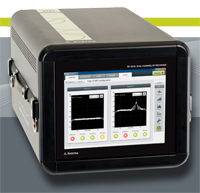
    Averna, developer of test solutions and services for communications and electronics device makers, announces the availability of a field-ready multi-channel RF Recorder for RF applications covering 330 MHz to 2.5 GHz.

    The Averna RP-5300 RF Recorder is an advanced tool for both field testing and performance testing, Averna said. With 50 MHz of recording bandwidth at 16-bits, it can record multiple GNSS signals in up to two bands (L1, L2, L5), such as GPS or GLONASS. Its compact size and integrated display was designed for field operation.

    Wireless products need to perform well in the complicated and difficult-to-predict RF environments found in the real world. Simulators can bring the design up to a certain point in the development process, but Averna’s RF Recorder captures all the multi-path, interference and general degradation of signals that end-users will experience. Capturing the segment of spectrum of interest, from minutes to hours, allows a technician to return to the lab with data necessary to diagnose and solve the problem, while building a library of environments to harden their products for the future, Averna said.

    “Recording live, impaired, RF signals of interest in the field, without demodulation or alteration, reduces the need for traditional field-testing of RF receivers,” said Brendan Wolfe, director of product management at Averna. “We are thrilled to bring to the GNSS market a portable and high-fidelity multi-channel RF recorder designed for the optimal capture of real-life RF environments.”

    The RP-5300 comes preloaded with Averna’s RF Studio Recorder. RF Studio is workflow software for making trouble-free RF recordings, managing collected data, and analyzing or playing back collected RF environments. With RF Studio Recorder, the intended signals are captured during and after a recording session without the need for RF experts on site, Averna said.

    Key features include:

    • 50 MHz recording bandwidth to capture multi-GNSS signals
    • Two channels to capture signals operating at different frequencies
    • Up to 11 hours of recording time with external RAID (2×50 MHz channels @ 16-bit-depth)
    • Field-ready with an integrated touchscreen display, ruggedized chassis and compact size
    • Simple field setup, intuitive user interface and test-case profiles

    For customers interested in a complete solution of RF recording to playback, Averna recommends the Averna RP-5300 Series be paired with the Averna URT-5000, a world-class RF Player and Signal Generator.

  • Averna Introduces Portable, Multi-Channel RF Recorder for GNSS Applications

    Averna Introduces Portable, Multi-Channel RF Recorder for GNSS Applications

    Photo: AvernaAverna, developer of test solutions and services for communications and electronics device makers, announces the availability of a field-ready multi-channel RF Recorder for RF applications covering 330 MHz to 2.5 GHz.

    The Averna RP-5300 RF Recorder is an advanced tool for both field testing and performance testing, Averna said. With 50 MHz of recording bandwidth at 16-bits, it can record multiple GNSS signals in up to two bands (L1, L2, L5), such as GPS or GLONASS. Its compact size and integrated display was designed for field operation.

    Wireless products need to perform well in the complicated and difficult-to-predict RF environments found in the real world. Simulators can bring the design up to a certain point in the development process, but Averna’s RF Recorder captures all the multi-path, interference and general degradation of signals that end-users will experience. Capturing the segment of spectrum of interest, from minutes to hours, allows a technician to return to the lab with data necessary to diagnose and solve the problem, while building a library of environments to harden their products for the future, Averna said.

    “Recording live, impaired, RF signals of interest in the field, without demodulation or alteration, reduces the need for traditional field-testing of RF receivers,” said Brendan Wolfe, director of product management at Averna. “We are thrilled to bring to the GNSS market a portable and high-fidelity multi-channel RF recorder designed for the optimal capture of real-life RF environments.”

    The RP-5300 comes preloaded with Averna’s RF Studio Recorder. RF Studio is workflow software for making trouble-free RF recordings, managing collected data, and analyzing or playing back collected RF environments. With RF Studio Recorder, the intended signals are captured during and after a recording session without the need for RF experts on site, Averna said.

    Key features include:

    • 50 MHz recording bandwidth to capture multi-GNSS signals
    • Two channels to capture signals operating at different frequencies
    • Up to 11 hours of recording time with external RAID (2×50 MHz channels @ 16-bit-depth)
    • Field-ready with an integrated touchscreen display, ruggedized chassis and compact size
    • Simple field setup, intuitive user interface and test-case profiles

    For customers interested in a complete solution of RF recording to playback, Averna recommends the Averna RP-5300 Series be paired with the Averna URT-5000, a world-class RF Player and Signal Generator.

  • Google Enhances 3D Maps: Is It Enough To Keep Competitors at Bay?

    Kevin Dennehy
    Kevin Dennehy

    Google’s recent announcement that it plans to enhance its 3D maps on the Android platform was seen as a preemptive strike against Apple, which is planning a similar announcement. In other recent news, some analysts and trade press are saying Verizon is paying way too much for Hughes Telematics. All of this is making for an interesting summer for the location industry.


    Google recently demonstrated new 3D capability for Google Earth, in a move that some say preempted a similar announcement by Apple, which will roll out its own product at our deadline during the Worldwide Developers Conference.

    While Apple is set to announce its own version of a mapping program for iOS that does not use Google Maps, some in the industry are wondering if the 3D capability is enough for developers to stay with Google, particularly with the fees the company is charging high-volume users. The big winner in the Apple announcement was TomTom, which has signed a global agreement with Apple for maps and related information. No further details of the agreement will be provided, the company said.

    In terms of upstaging Apple via 3D, one company executive thinks that is overblown. “I don’t think Google was trying to do that directly on just that feature. I think they are very concerned about the Apple announcement — not just because they will lose Apple as a customer, they will, but because they fear a ‘wow’ factor upstaging them despite all the great work [Google] has done to date,” said Kim Fennell, deCarta president and CEO. “Their press conference last week was more about reminding everyone how hard it is to do this stuff really well, and I think they wanted to remind Apple, and the market, it takes a lot do the complete mapping solution really well. I think their Google Earth capabilities with street views and their new 3D modeling is a major investment and they wanted to set the overall bar high for Apple.”

    DeCarta says half of its new developers are coming from Google Maps. The company says that, in the last 90 days, 488 new companies have signed up to its developer’s program.

    In a white paper, de Carta says:  “The timing of this surge confirms that Google is no longer seen as the ‘Benevolent Provider of Free Stuff’ that it once was. What is more surprising is that not all of the companies jumping ship are big guys…in fact some are not even close to the 25,000/day map threshold that Google uses to trigger the hounds.”

    The company contends that there is a common theme that developers want to work within clearly defined partnerships, how much they will need to pay, and whether or not they can execute their business model — especially if that involves advertising. “They want to create some differentiation and most of all, they want to know whether or not their partner will one day decide to compete with them,” the company white paper says. This restriction trickles down to real estate, travel, local search, and other sites, the company says.

    Fennell said deCarta started working with Google competitor OpenStreetMap in 2009 when it was early in the market and there were almost no takers.  “We were too early, the market wasn’t really looking for an alternative yet — and the map data quality wasn’t good enough. Three years later, it is looking much more interesting both from supply (map data availability) and demand (customer interest),” he said.

    Verizon’s Purchase of Hughes Telematics a Financial Reach?

    To strengthen its presence in the machine-to-machine and connected car market, Verizon Communications said it plans to buy Atlanta-based Hughes Telematics Inc. for $612 million, or $12 per share. The high price has some analysts scratching their heads — particularly because Hughes was trading at only $4.35 per share the day the deal was announced.

    Hughes Telematics, which competes with OnStar, began to provide LBS, connected safety and convenience services to Mercedes-Benz customers in 2009.

    “I was frankly surprised at the valuation considering HTI’s financial position. I assume Verizon sees a lot of value in the Mercedes account and potential value in HTI’s VW account — and at least one other OEM account which they are expected to get,” said Clem Driscoll, president of CJ Driscoll Associates.  “I think it is also clear that Verizon’s plans called for increasing its role in telematics through acquisition of a telematics service provider. A previous attempt at a TSP acquisition was unsuccessful. HTI clearly has some good technology, as evidenced by the Mercedes Mbrace solution.”

    Driscoll said that Hughes Telematics’ financial problems probably discouraged some auto OEMs from using them in the past, but those issues should now be resolved.

    The Verizon-Hughes Telematics acquisition is expected to close in the third quarter. Verizon plans to retain Hughes Telematics’ management, operate the company as a subsidiary of its Verizon Enterprise Solutions group, and keep the company headquartered in Atlanta.

    ITS America Holds Small Annual Meeting — Why?

    It isn’t big news that private companies still court government contracts and attend the ITS America Annual meeting in Washington to work on connected vehicle committees. However, this is the first time I’ve covered this conference, and I’ve attended off-and-on since 1993, to notice attendance has reached the point that only a few die-hard private sector companies are going to this government-focused meeting.

    Remember, the ITS America meeting was the only game in town in the 1990s and early 2000s, with two of the dominant players at that time, Navteq and Etak (later to be purchased by Tele Atlas) anchoring a growing navigation and location industry.

    Instead of ITS America dominating the entire connected vehicle conference market, most private companies choose to attend the pricier Telematics Update Detroit meeting. What made the meeting more disappointing is the fact that ITS America does attempt to focus on the connected vehicle. The U.S. Transportation Department invited delegates and the press to a connected vehicle demonstration with Ford, General Motors, and Toyota, among other team members. The demonstration highlights this summer’s testing of 3,000 vehicles, which will test crash-avoidance technologies in Ann Arbor, Michigan, in a year-long government program.

    Still, some companies attended such as Inrix, Beat the Traffic, and TomTom. The Virginia Transportation Department is partnering with TomTom to analyze where travelers entered and exited the I-95/I-64 corridor.

    Some companies are getting ITS grants, such as Xerox, which grabbed $15 million from the U.S. DOT for a pilot program incorporating real-time parking guidance systems, among other projects. These parking systems, using smartphone apps from Streetline, enable motorists to view spaces based on price, location, and real-time availability.

    Simulators Keeping LBS Companies on Target

    Spirent Communications, which is monitoring the popularity of LBS, said its new GNSS simulator supports simulation of signals from individual or combined GPS/SBAS, GLONASS, and Galileo constellations, with eight satellites per constellation.

    The company, which said it recognizes the increase in LBS’ momentum and the market need for improved positioning performance on mobile devices, has expanded its LBS LTE test product to support an LTE Positioning Protocol and Observed Time Difference of Arrival. The company says both are critical enablers for LBS adoption.

  • 2012 CoreLogic Storm Surge Report Reveals more than 4 Million U.S. Homes at Risk

    CoreLogic released its annual Storm Surge Report detailing exposure of single-family homes to storm-surge damage within several predefined geographic areas in the United States. The 2012 CoreLogic Storm Surge Report provides the first-ever property-level analysis of residential property risk along the Atlantic and Gulf Coasts broken down by region and by individual state, in addition to a snapshot of risk within previously reported major metro areas.

    According to the announcement, this year’s report indicates that just over four million homes in the U.S. along the Atlantic and Gulf Coasts are at risk of hurricane-driven storm-surge damage, with more than $700 billion in total property exposure. In the Atlantic Coast region alone, there are approximately 2.2 million homes at risk, valued at more than $500 billion. Total exposure along the Gulf Coast is nearly $200 billion, with just under 1.8 million homes at risk for potential storm-surge damage.

    “Though more frequently impacted states like Florida, Texas and Louisiana get the most attention when it comes to hurricane vulnerability and destruction, Hurricane Irene made it very clear last summer that hurricane risk is not confined to the southern parts of the country,” said Dr. Howard Botts, vice president and director of database development for CoreLogic Spatial Solutions. “That’s why we felt it was important this year to highlight storm-surge risk in a brand new way to establish a better understanding of exposure throughout the states that are most at risk of a direct hurricane hit. As we got a glimpse of during Irene, our 2012 report shows even a Category 1 storm could cause property damage in the billions along the northeastern Atlantic Coast and force major metropolitan areas to shut down or evacuate.”

    CoreLogic reported they generated the Storm Surge Report using the company’s extensive database of parcels to identify the properties that fall within the perimeter of each category of the storm-surge inundation polygon. A parcel is the individual property associated with an address, and is the most granular way to analyze properties exposed to natural hazards. To determine residential exposure value, the proprietary CoreLogic storm-surge model was paired with the company’s industry-leading database of residential valuations for structures at the parcel level. CoreLogic identified every property contained within each category of the storm surge polygon and matched the structure valuation for each residence. Valuations for individual geographic areas were then totaled by hurricane category. The final results depict the value of the total residential properties as of April 2012 exposed to each potential storm surge event.

    A full list of all Core Based Statistical Areas (CBSAs) at risk for storm-surge damage, as well as the top ten zip code areas at risk associated with each CBSA, is available at http://www.corelogic.com/about-us/researchtrends/2012-storm-surge-cbsa-fact-tables.aspx. Maps detailing storm surge risk are also available for all CBSAs upon request.

    According to the announcement, CoreLogic developed the Storm Surge Report to enhance understanding of the additional risk that storm surge poses to homes located in areas prone to tropical storms.  Storm surge is triggered primarily by the high winds and low pressure associated with hurricanes, which cause water to amass inside a storm as it moves across the ocean before releasing as a powerful rush overland when the hurricane moves onshore.  In addition to the property damage and potential lives lost to flooding, the speed and force associated with storm-surge waves can significantly increase geographic and economic impact in hurricane disaster areas.

    “The data we compile is useful for insurance providers and financial services companies, to help them better understand potential exposure to damage for homes—particularly those that do not fall into designated FEMA Special Flood Hazard Areas,” said Botts.  “Homeowners who live outside of high risk flood zones are not required to carry flood insurance under the National Flood Insurance Program (NFIP), and may not be fully aware of the risk storm surge poses to their home or property.  When a storm strikes the coast, storm-surge flooding can inundate homes far inland and cause significant losses from powerful surge waters, damaging debris and standing water left behind.”

    According to the 2012 report, Florida tops the list of states with the highest total number of properties at risk of being impacted by the effects of storm-surge risk at approximately 1.4 million homes and with the highest total potential exposure to damage at more than $188 billion. Louisiana ranks second in total properties at risk with nearly 500,000, while New York is second in total value of coastal properties possibly exposed at $111 billion.  Differences in the rankings between the total number of properties and total property value at risk are due to varying levels of home values, trends in primary residence versus, vacation homes, and population density between the states throughout the Atlantic and Gulf regions.

    At the metro-level, cities examined in the analysis include New York, N.Y.; Virginia Beach, Va.; Miami, Fla.; New Orleans, La.; Tampa, Fla.; Boston, Mass.; Houston, Texas; Cape Coral, Fla.; Jacksonville, Fla.; Charleston, N.C.; Bradenton, Fla.; Philadelphia, Pa.; Mobile, Ala. and Corpus Christi, Texas. According to the U.S. Census Bureau, two of the top five and five of the top 20 most densely populated cities in the U.S. are located along either the Gulf or Atlantic Coast.  The report reveals that the 10 cities with the highest total potential exposure to storm-surge damage represent more than two million properties, with total property value at risk exceeding $420 billion.  The New York City metropolitan area, which encompasses northern New Jersey and Long Island as well, contains both the highest total number of properties as well as the highest financial exposure of properties at risk, with estimated values at more than $168 billion.

    “The summer of 2011 gave us some startling insight into the damage that even a weak storm can cause in the New York City metro area,” said Botts. “Hurricane Irene was downgraded to a tropical storm as it passed through New Jersey and New York City, but the impact of the storm was still estimated at as much as $6 billion.  Economic losses mounted swiftly as businesses shuttered, the New York City mass transit system came to a sudden halt and emergency response teams were called into action to prepare for the worst.”

    CoreLogic said it’s important to note is that the total properties and structural values included in the CoreLogic analysis are based on all homes that could potentially be damaged from hurricane-driven storm surge, and are not meant to infer that a single storm or storms in a specific hurricane season will result in these damage totals.

    This is the third annual CoreLogic Storm Surge Report. The report complements the Federal Emergency Management Agency (FEMA) flood zone information to provide a comprehensive picture of potential damage exposure at the property level, as many properties located outside designated flood zones are still at risk for storm-surge damage.

    To request storm surge data for a particular zip code, CBSA or county not detailed in the report, or for a complete copy of the 2012 CoreLogic Storm Surge Report, visit http://www.corelogic.com/about-us/researchtrends/2012-storm-surge-report.aspx.

  • Wright State Wins 2012 ION Robotic Lawn Mower Competition

    Wright State Wins 2012 ION Robotic Lawn Mower Competition


    Photo: The Institute of Navigation (ION)

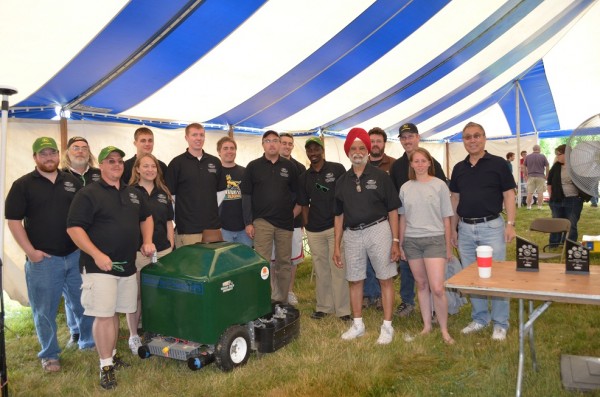
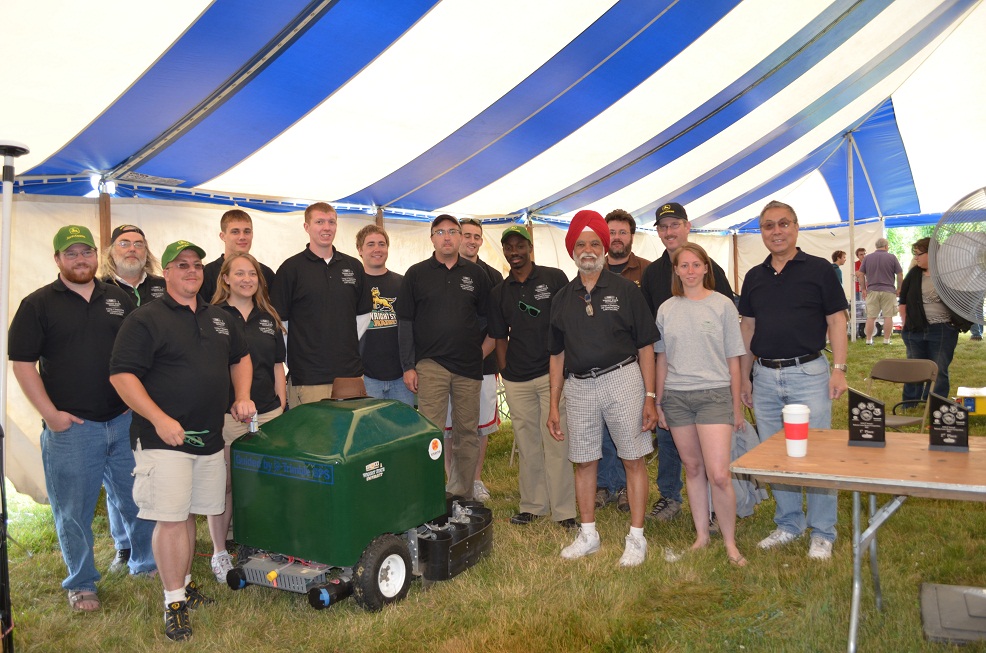
    The Institute of Navigation (ION) announces that Wright State University won top prize at the ninth annual 2012 Robotic Lawn Mower Competition held May 31 – June 2 at Siebenthaler’s Beaver Valley Garden Center in Dayton, Ohio.

    Sponsored by the Institute of Navigation Satellite Division and the Air Force Research Laboratory (AFRL) Sensors Directorate, the ION Annual Robotic Lawn Mower Competition is a national event for college and university students, future engineers and problem solvers, that challenges them to design and operate a robotic, unmanned lawn mower using the art and science of navigation to rapidly and accurately mow a field of grass.

    Eleven teams participated during the three day competition, each using unique design approaches. Teams included students and faculty advisors from Auburn University, Auburn, Alabama; Case Western Reserve University, Cleveland, Ohio; University of Florida, Gainesville, Florida (two teams); California State University, Fullerton, Fullerton, California; Miami University, Oxford, Ohio; University of Michigan Dearborn, Dearborn, Michigan; University of North Florida, Jacksonville, Florida; Syracuse University, Syracuse, New York; Southern Polytechnic State University, Marietta, Georgia; and Wright State University, Dayton, Ohio.

    The 2012 ION Robotic Lawn Mower Competition consisted of two separate categories: Basic Autonomous Mowing (Static) and Advanced Autonomous Mowing (Dynamic). The teams were judged in each category based on their total scores; 80% of the total score was  based on the mowing competition and 20% of the total score was based on the presentation and report.

    First place in the advanced Dynamic Competition, with $15,000 in prize money, was awarded to Wright State University, Dayton, Ohio. Second place in the Dynamic Competition, with $10,000 in prize money, was awarded to Miami University, Oxford, Ohio. Third place in the Dynamic Competition, with $5,000 in prize money, was awarded to Case Western Reserve University, Cleveland, Ohio.

    First place in the beginning Static Competition was awarded to the California State University, Fullerton, California. Second place prize in the Static Competition was awarded to the Syracuse University, Syracuse, New York. Third place in the Static Competition was awarded to the University of Michigan, Dearborn, Dearborn, Michigan.

    In addition to The Institute of Navigation Satellite Division and the Air Force Research Laboratory, sponsors included Honeywell, John Deere, The Joint Services Data Exchange, Northrop Grumman and Siebenthaler’s Garden Center.

    The Tenth Annual ION Robotic Lawn Mower Competition will be held May 30 – June 1, 2013, in Dayton, Ohio.


  • NovAtel SAASM to See First Action in Aerial Drones

    The new OEM625S Selective Availability Anti-Spoofing Module (SAASM) GNSS receiver from NovAtel, launched in a cooperative effort with SAASM expert L-3 Interstate Electronics Corporation (IEC), will get its first applications in the unmanned aerial vehicle (UAV) sector. NovAtel has brought forth the new product in part to meet requirements of UAV manufacturers who are now mandated to have SAASM onboard as well, for in-theater operations in areas of military activity.

    “The new SAASM regulations meant that integrators were looking at having to incorporate another receiver alongside their NovAtel unit, complicating user interface factors and increasing onboard space requirements,” said NovAtel Product Manager Neil Gerein. “The OEM625S gives our customers a drop-in form factor that easily replaces their existing NovAtel OEM receiver.”

    “NovAtel has supplied UAV integrators on the civil scientific side almost since our inception,” Gerein said, adding, “the military has become more and more involved in this market in recent years for budget and various other strategic reasons.” He mentioned that in its 20-year history selling GPS products, for the last 17 years NovAtel has provided receivers and expertise to U.S. and Canada defense contractors, and to defense research labs in Allied countries. Antcom, a wholly-owned NovAtel subsidiary specializing in antennas and microwave products, makes the majority of its sales into military areas.

    Examples of such products in this area — not necessarily from NovAtel customers, who remain unidentified — include hand-launched mini-UAVs like the Aerovironment RQ-11 Raven and Elbit Skylark I, and runway-capable tactical UAVs such as Textron RQ-7 Shadow, Aeronautics DS Aerostar, IAI Searcher II, and InSitu’s ScanEagle UAV system, quickly evolving into a mainstay with the U.S. Navy and its allies thanks to a partnership with Boeing.

    The InSitu ScanEagle was first developed to track dolphins and tuna from fishing boats, to ensure that fish labeled “dolphin-safe” actually are so. The same characteristics needed by commercial fishing boats — low infrastructure launch and recovery, small size, 20-hour long endurance, automated flight patterns — are key for naval operations from larger vessels, and for battlefield surveillance.

    At present the OEM625S, combining a commercial dual-frequency NovAtel GNSS receiver with an L-3 IEC XFACTOR SAASM, provides single-point positioning with SAASM for authorized defense customers. The SAASM position is provided via a dedicated communication port, as well as through NovAtel’s software command protocol, allowing for maximum flexibility. The small form factor and low power consumption expands range of potential defense applications requiring robust SAASM GPS positioning.

    The OEM625S measures 60 x 100 x 9.1 millimeters, and runs on field-upgradeable software. NovAtel will accept orders for the OEM625S from authorized customers starting in Q3 2012.

  • NIST and Metrology

    I must govern the clock, not be governed by it.
    — Golda Meir

    The Question

    A few months ago at a speaking engagement, I took questions from the audience after my presentation. The audience was made up of GPS enthusiasts, GPS equipment vendors, and evidently GPS neophytes as well, because the last question was asked by a young lady, from a large well known government user segment, who was intrigued by but obviously knew little about the inner workings of GPS. Her question so stunned me and the audience that it brought the questions to an abrupt end. Thank goodness no one actually laughed out loud, and frankly I was so incredulous that I almost gave an impertinent answer that would not have served any purpose other than to embarrass the young lady and expose some insensitivity on my part. No, fortunately, after recovering from the initial shock due to the naiveté of the question, I answered her with a straight face, because it seemed to be an honest and sincere question.

    Allow me to set the stage. My talk was on the Perfect Handheld GPS Transceiver and how the PHGPST could be aided by a Symmetricom Chip Scale Atomic Clock (CSAC).

    The young lady’s comment and eventual question was exactly as follows: “I came here this afternoon because I was intrigued by your columns in GPS World and I wanted to know more about the Perfect Handheld GPS Transceiver and possibly learn how I could even purchase one or more for my organization. However, most of your comments have been focused on the benefits of atomic clocks. Frankly, I am a bit disappointed. So where can I buy a PHGPST and what do atomic clocks have to do with GPS anyway?”

    Retrospective

    I have had a few months to think about that episode, and although all ended well, with no one being overly embarrassed, despite some good-natured ribbing, it was a little unsettling. It also takes me back to a previous theme in several of my columns concerning educating users about the Global Positioning System. Not just what GPS can do for you — certainly that is well covered in GPS World, other publications, and on the Internet. Indeed, just type the acronym “GPS” into any search engine and you will be rewarded with the rather daunting number of 1,670,000,000 hits — yes that’s 1 billion, 670 million hits.

    A Daunting Perspective

    Considering that the average person today, who has reached my advanced age, my will probably live to be approximately 80 years of age or more, the obvious question is does anyone actually have the time to peruse ~1.6B websites on GPS?

    You don’t have to be a professional metrologist or an expert mathematician to determine the logical answer, but if you are really concerned about time it might help. Consider the following answers — yes, plural — to the question posed, which assumes that a person would spend one minute or 60 seconds at each website — which begs the question, just how many minutes are there in an 80-year life span anyway? Of course, this answer assumes the hopefully unlikely event that one would come out of the womb Googling “GPS.”

    Calculations

    By the nominal quartz clock on the wall, and using the Gregorian calendar, and not considering leap years, 80 human years equates to 42,048,000 minutes.  If we utilize the Julian calendar and add leap years, it equates to 42,076,800 minutes. By a standard years definition it equates to 42,075,936 minutes. By SI, international system of units, or true metrology standards, 80 years equates to, 42,075,901.3 minutes. The differences have to do with metrology and atomic reference systems versus the nominal unaided quartz clock. And although we say GPS runs on atomic clocks, the true answer is GPS runs on highly stable (accuracy is not a relevant term to be used here) atomic reference systems — noble gases and all that.

    Now stay with me and allow me to explain the 80-years-in-seconds answers (and you naively thought there was only one answer) in terms a metrologist (the guys and gals who really care about time and frequency) at NIST, the National Institute of Standards and Technology in Boulder, Colorado, would use:

    80 Years by the Calendar and Clock

    For an entire block of 80 years, containing 20 leap years, the number of minutes would be the same as in 80 Julian calendar years of 365.25 days.

    The number of minutes as calculated by calendar and clock is 42,076,800 — 80 years x 365.25 days/year x 24 hours/day x 60 minutes/hour = 42,076,800.

    Or 80 times the number of minutes in a year, which is calculated as 525,960.

    SI or Leap Years

    Now, when we approach the question from an SI perspective, the answer is slightly but significantly different. The definition of a year is 31,556,926 standard seconds, while the standard leap year calculation is equal to 365 days, 5 hours, 49 minutes, and 12 seconds (31,556,952 seconds). Instead of 525,960 clock minutes, you have 525,949.2 (standard) minutes. For 80 years, the results equal 42,075,936 minutes.

    The variation between clock/calendar minutes and the measured length of the year only becomes important to those unfortunate enough to be born on the 29th of February. That’s when the two calculations and calendars diverge by enough to subtract an entire day from the normal leap year system, hence the varying length of February, on the Gregorian calendar, every four years. However, to metrologist and GPS experts, who define an SI second as the duration of 9,192,631,770 periods of the radiation corresponding to the transition between the two hyperfine levels of the ground state of the Caesium 133 atom, the differences are astronomical (pun intended).

    Caesium, Rubidium, Hydrogen…

    At this point many GPS/PNT cognoscenti are probably saying, wait a minute, there are also Rubidium and hydrogen maser clocks on orbit today, so why use the Caesium standard for the SI second?

    The Standard Tale

    The Caesium standard for the SI second was established in 1960 when it was decided that it was time to abandon the astronomical or ephemeris, revolution of the Earth around the Sun, basis for the second. Indeed Louis Essen from the National Physical Laboratory (NPL in Teddington, England) and William Markowitz of the United States Naval Observatory (USNO in Washington, D.C.) determined the relationship between the hyperfine transition frequency of the Caesium atom and the ephemeris second. Using a common-view measurement method based on the received signals from radio station WWV  (operated by NIST and broadcast continuously from Boulder, Colorado) they determined the orbital motion (ephemeris) of the Moon about the Earth. From this data they inferred the apparent motion of the Sun, in terms of time as measured by an atomic reference system, in this case Caesium. They determined a second of ephemeris time (ET) to be equal to 9,192,631,770 ± 20 cycles of the atomic Caesium frequency. Consequently, in 1967 the 13th General Conference on Weights and Measures formally defined a second of atomic time in the International System of Units as the duration of 9,192,631,770 periods of the radiation corresponding to the transition between the two hyperfine levels of the ground state of the Caesium-133 atom.

    So, since 1967 the Caesium atom has determined and supplied the atomic time reference for the globe. Caesium clocks have certainly undergone numerous refinements, and companies like Symmetricom in the U.S. still build Caesium reference systems that are used globally to determine the SI second and hence coordinate both International Atomic Time (IAT) and UTC or Coordinated Universal Time. And just how accurate is Caesium as a standard? The Swiss have built a continuous cold Caesium fountain atomic clock in Switzerland that started operating in 2004 at an uncertainty of one SI second in 30 million years.

    Numbers Can Be Deceiving

    Now while that sounds and is very impressive, the fact of the matter is one SI second is a long duration when it comes to atomic clocks — notice I avoided saying a “long time.” Indeed, today metrologists routinely speak in terms of 18 orders of magnitude less than an SI second. That is 18 places to the right of the decimal place, a very small number, destined to become even smaller.

    Unit

    Size

    Notes

    yoctosecond 10−24 s
    zeptosecond 10−21 s Future of optical reference systems
    attosecond 10−18 s Shortest time uncertaintyin present measurements
    femtosecond 10−15 s Pulse time of ultrafast lasers(100 as = 0.1 fs) – Hydrogen Maser
    picosecond 10−12 s
    nanosecond 10−9 s Time for molecules to fluoresce
    microsecond 10−6 s Think millionths of a second
    millisecond 0.001 s, 10E-3 Think thousandths of a second
    second 1.0 s SI base unit

    We are speaking of incredibly short measures of duration (time) and they keep getting smaller.

    So What?

    Now many of you may be thinking, this is all very well and good, possibly even interesting, but so what? OK, here is the “so what.” Asking what GPS and all the incredible technology it enables has to do with atomic clocks is like asking what gas or electricity, as the case may be, has to do with my automobile. Atomic clocks, and the increasingly minute measurements of time they define, fuel our global economy today. And if you doubt the veracity of that statement, think about all that GPS/PNT enables in around the globe. All of our critical national infrastructure depends on a coordinated time, and the primary distribution system for that time for the last 20+ years has been GPS.

    While there are academically numerous definitions of time and several so-called standards, primarily today the world runs on UTC (Universal Coordinated Time) distributed by GPS and other PNT systems with the requisite corrections.

    System

    Description

    UT1

    UTC

    TT

    TAI

    GPS

    UT1

    Mean Solar Time

    UT1

    UTC = UT1 – DUT1

    TT = UT1 + 32.184 s + LS – DUT1

    TAI = UT1 – DUT1 + LS

    GPS = UT1 – DUT1 + LS – 19 s

    UTC

    Civil Time

    UT1 = UTC + DUT1

    UTC

    TT = UTC + 32.184 s + LS

    TAI = UTC + LS

    GPS = UTC + LS – 19 s

    TT

    Terrestrial (Ephemeris) Time

    UT1 = TT – 32.184 s – LS + DUT1

    UTC = TT – 32.184 s – LS

    TT

    TAI = TT – 32.184 s

    GPS = TT – 51.184 s

    TAI

    Atomic Time

    UT1 = TAI + DUT1 – LS

    UTC = TAI – LS

    TT = TAI + 32.184 s

    TAI

    GPS = TAI – 19 s

    GPS

    GPS Time

    UT1 = GPS + DUT1 – LS + 19 s

    UTC = GPS – LS + 19 s

    TT = GPS + 51.184 s

    TAI = GPS + 19 s

    GP


    Note: In June 2012, GPS will add another leap second.


    NIST and Metrology

    What then is time? If no one asks me,
    I know what it is. If I wish to explain

    it to him who asks, I do not know.
    — Saint Augustine
    Now, just how do you learn about atomic time and frequency, GPS, UTC, clock errors, ephemeris errors, and all the other multitude of errors that affect the GPS time we all, meaning the world, depend on every day?

    Obviously there are many routes to that knowledge, but for me, and I have been involved with GPS since 1978, the best resource I have experienced to date was the annual week-long Time and Frequency Metrology Seminar that has been held at NIST in Boulder, Colorado, for the last 37 years.

    I was kindly invited by Dr. David Howe, the seminar chair and group leader of the Time and Frequency Metrology Physics Measurements Laboratory, Time and Frequency Division at NIST, to attend this year’s seminar, and it was an eye-opening experience. Not only for the knowledge gained, but for the people met and the networking opportunities as well.

    The Metrology Seminar

    The seminar is billed as a course on understanding clocks, oscillators, atomic frequency standards, RF (radio frequency) and optical synchronization, optical oscillators, quantum information, optical cooling and heating (think lasers); making precise frequency, time, phase-noise, and jitter measurements; and establishing measurement accuracy and traceability. I am convinced the four-day course is the most comprehensive available anywhere today.

    The June 2012 seminar included extremely informative presentations by Judah Levine, David Howe and David Allan (Ph.D.s all) — David Allan is the author of the Allan Variance — and 23 other presenters in subjects as diverse as direct-digital PM (phase modulation) noise measurements, how to specify frequency uncertainty, oscillator needs for new radars and surveillance systems, GPS vs. other global navigation satellite systems, photonic (laser-based) oscillators, chip-scale atomic clocks, femtosecond laser dividers, active PM-noise reduction techniques in oscillators, millimeter-wave applications and noise measurements, and ultra-low noise amplifier design techniques.

    As the seminar descriptor says it is comprehensive in nature and there is no wasted time. One day the presentations lasted from 8 a.m. until 9 p.m. that evening. So it is an intensive metrology seminar filled with incredible learning opportunities. This year’s activities included an enjoyable and educational evening with Symmetricom, a forward-looking company that I sincerely view as the last true major commercial atomic reference builder in the United States. Symmetricom produces Hydrogen, Cesium (the ubiquitous 5071A), and Rubidium atomic reference standards, as well as high-end quartz oscillators with superior spectral purity and short-term frequency stability that support more military communications, satellite ground stations, and test and measurement applications than any other precision frequency references in the world today. Plus the incredible Symmetricom Chip-Scale Atomic Clock (CSAC), the world’s smallest atomic reference, has achieved historic breakthroughs in size, weight and power consumption — you can and I have balanced a CSAC on the end of my little finger. It is tiny yet powerful, and supports reference requirements as small as 1x10E-12 for specified periods of time. Indeed, this is the device that has the potential to revolutionize the Perfect Handheld GPS Transciever (PHGPST), but that is the subject for another column. As are the interviews I conducted with Judah Levine, who I refer to as “Father Time,” a Fellow at NIST, and David Allan, the originator of the Allan Variance and Allan Deviation, which allows the GPS Kalman Filter to work wonders and assures a GPS position accuracy of less than 1 meter possible for us all, with the right equipment of course.

    The Right Equipment

    Which leads me to my closing comments for this month’s column. While it is true that you can now routinely utilize GPS for real-time centimeter accuracy, since GPS does have the best atomic reference systems of any PNT system in orbit today, without monitoring systems and excellent GPS receivers you can’t depend on those parameters — the integrity is just not guaranteed without adequate signal monitoring, corrections, and augmentations.

    Consequently, to ensure the best possible results, the receivers in the GPS global monitoring stations, of which there are hundreds more than those sanctioned by the U.S. government, tend to be high end and of stellar quality. And a majority of those receivers, according to my sources are, NovAtel receivers. Certainly NIST has a good number of NovAtel reference receivers, even though they are not allowed to specify or recommend a reference-grade receiver. I have also noticed large numbers of NovAtel receivers at FAA facilities around the U.S., and NovAtel’s reference receivers are at the core of national aviation ground networks around the world.

    Recently NovAtel announced the development of a new receiver card known as the OEM625S Selective Availability Anti-Spoofing Module (SAASM) Global Navigation Satellite System (GNSS) receiver, which is actually a collaborative effort between NovAtel and L-3 Interstate Electronics Corporation (IEC). Since this is designated an OEM card, it is primarily for system integrators. However, since many users worldwide have come to rely on the centimeter-level positioning accuracy of real-time kinematic (RTK) GPS receivers, this may be a card you want to specify in your next high-end GPS receiver purchase or upgrade.

    PPS Accuracy

    Since defense users routinely rely on access to the Precise Positioning Service (PPS) for single-point positioning and this is certainly available with the OEM625S, it should be of special interest to those users. The card combines a commercial dual-frequency NovAtel GNSS receiver with an L-3 IEC XFACTOR SAASM in a single card solution, reducing overall size and power requirements for user applications. The new card maintains the OEMV-2 form factor, meaning it should be a drop-in replacement with backward compatibility for existing users.

    NovAtel has promised to ship me a card to review in depth at the end of the third quarter of this year, so more on the new NovAtel/L3 card at that time. It promises real-time centimeter level accuracy and I can’t wait to see how it performs.

    Make Your Reservation

    Meanwhile, give Dr. David Howe a call at NIST and sign-up for the 38th Annual Time and Frequency Metrology Seminar — you will be glad you did.

    I hope to see you all at ION JNC (Institute of Navigation – Joint Navigation Conference) in Colorado Springs, June 12-15, 2012! The classified Warrior Panel promises to be the hit of the show. Don’t miss it!

    Until next time, Happy navigating.