Contract strengthens the company’s growing portfolio of U.S. government-funded PNT initiatives
TrustPoint has been awarded a $1.9 million Small Business Innovation Research (SBIR) Direct-to-Phase II contract focused on adapting and upgrading TrustPoint’s commercial C-band positioning navigation and timing (PNT) payload to integrate with U.S. Department of Defense (DoD) architectures and meet advanced government requirements.
The Air Force Research Laboratory and AFWERX, the innovation arm of the U.S. Air Force, have partnered to streamline the SBIR and Small Business Technology Transfer (STTR) process by accelerating the small business experience through faster proposal to award timelines, changing the pool of potential applicants by expanding opportunities to small business, and eliminating bureaucratic overhead by implementing process improvement changes in contract execution.
The Air Force began offering the Open Topic SBIR/STTR program in 2018, which expanded the range of funded innovations. Now, TrustPoint will accelerate its journey to create and provide innovative capabilities that will strengthen the national defense of the U.S.
TrustPoint is developing a low size, weight, power and cost (SWaP-C) payload designed to address the U.S. Space Force’s growing need for tactically responsive and resilient space capabilities. The upgraded payload will bolster resistance to GPS jamming and spoofing, and expand the operational resilience of PNT in contested environments — an essential requirement for future proliferated space architectures and for the autonomous systems, including drones, that depend on trusted timing and navigation.
The effort will culminate in laboratory testing in collaboration with the Air Force Research Laboratory (AFRL), setting the stage for potential Phase III deployment opportunities.
The award marks TrustPoint’s fifth Phase II SBIR in 18 months, spanning projects with the Air Force, Space Force and Navy, and adds to the company’s participation in government-funded PNT initiatives.
The Department of the Air Force (DAF) has successfully launched the Navigation Technology Satellite-3 (NTS-3) Vanguard aboard the United Launch Alliance (ULA) Vulcan rocket on the USSF-106 mission from Cape Canaveral Space Force Station, Florida, on August 12, 2025. This mission marks the first U.S. national security payload launched on the Vulcan Centaur rocket, which represents a new era of launch vehicle capability for national defense.
“We have a strategic imperative to deliver science and technology that enables and accelerates a resilient hybrid space architecture for the space capabilities that the joint force depends on,” said Air Force Research Laboratory (AFRL) Commander and DAF Technology Executive Officer (TEO), Brig. Gen. Jason E. Bartolomei.
NTS-3’s Advanced Architecture
NTS-3 is an experimental integrated navigation satellite designed by the AFRL to enhance the robustness, resilience and responsiveness of space-based positioning, navigation and timing (PNT) services, crucial to both military and civilian applications. The satellite aims to advance the capabilities of existing global navigation satellite systems, such as GPS, through innovative technology that includes an advanced atomic clock timekeeping system, a reprogrammable receiver compatible with both legacy and advanced signals (the Global Navigation Satellite System Test Architecture), and Chips Message Robust Authentication, which defends against GPS spoofing.
NTS-3 features a fully reprogrammable software architecture that spans the space-based satellite, ground-based control system, and agile user receivers. This enables rapid software updates either on orbit or in the field, a significant departure from previous GPS satellites that required hardware changes for upgrades. This approach delivers not only military advantages in contested environments but also substantial benefits for civilian users who rely heavily on GPS for banking, agriculture, telecommunications and air traffic control.
“We rely on GPS so much, in ways that we don’t always think about,” said Rachel Gleichmann, NTS-3 deputy program manager, AFRL Space Vehicles Directorate. So, to make sure that it is resilient and that it’s always available and always accurate — or, as the military likes to say, ‘assured’ is extremely important to your average American.”
Industry partner L3Harris Technologies serves as the prime contractor, working alongside AFRL on the design, development, integration, testing, launch vehicle interface, and on-orbit operations of the satellite. The collaboration embodies a comprehensive ecosystem approach that leverages resources from government, industry, academia, and venture capital to foster innovation in national security space.
The Air Force Research Laboratory awarded Xona Space Systems a contract to demonstrate and refine its commercial positioning, navigation and timing (PNT) solutions for Department of Defense (DOD) missions. The agreement, facilitated through the Space Technology Advanced Research — Fast-tracking Innovative Software and Hardware (STAR-FISH) program, increases Xona’s total contracted commitments to more than $20 million.
Under the contract, Xona will evaluate its PULSAR satellite navigation service across commercial user devices in scenarios where GPS/GNSS signals may be denied or challenged. Testing will focus on assessing resistance to jamming and spoofing, reducing multipath interference and implementing secure key distribution protocols. The initiative aims to expedite the development of advanced alternative PNT capabilities in commercial off-the-shelf equipment, aligning with DOD requirements for rapid deployment.
Xona has collaborated with GPS/GNSS hardware providers QinetiQ, StarNav and Locus Lock to integrate PULSAR-enabled devices. These partners will participate in performance demonstrations as part of the multi-year effort, which includes leveraging Xona’s simulation tools and plans to utilize the first PULSAR satellite scheduled for launch in June 2025.
The Air Force Research Laboratory selected Zephr.xyz — a company specializing in augmented position, navigation and timing technologies — to receive a $1.74 million Small Business Innovation Research Direct-to-Phase II contract. Under the contract, Zephr.xyz aims to develop a system for real-time detection of GPS/GNSS jamming and spoofing in contested environments while also geolocating the sources of these attacks.
The company’s Networked GNSS technology, which converts standard mobile phones into a high-fidelity GNSS receiver network, will undergo extensive testing in Ukraine and various U.S. military exercises. Following these trials, the system is set to be integrated with the Department of Defense’s Tactical Assault Kit and the Department of Homeland Security’s Team Awareness Kit.
Zephr.xyz has conducted field research in conflict zones in Ukraine and Israel, revealing limitations in current GNSS interference detection and localization techniques. The company’s solution aims to address these challenges by leveraging distributed mobile devices to create a decentralized sensor network. This network collects raw GNSS measurements to identify electronic attack indicators, which are processed in real time for detection and classification.
The technology also aims to enhance positioning accuracy on TAK devices by integrating GNSS measurements from multiple devices with Position, Velocity, Attitude and Timing data. Zephr.xyz plans to make its detection and classification capabilities available as a software development kit, enabling mobile applications to alert users and improve positioning accuracy in electronic warfare scenarios.
SpaceWERX, the innovation arm of the U.S. Space Force, has selected Xairos Systems Inc. for a $1.9 million Direct-to-Phase II contract to develop a fusion positioning, navigation and timing (PNT) system. This project aims to integrate quantum and optical synchronization of clock ensembles to address critical challenges faced by the Department of the Air Force (DAF).
Xairos Systems is collaborating with Luminous Cyber Corporation and Eritek on this initiative. The team has recently completed a Preliminary Design Review. The Air Force Research Laboratory (AFRL) shared that the collaboration is part of a broader effort by the AFRL and SpaceWERX to streamline the Small Business Innovation Research and Small Business Technology Transfer processes.
AFRL and SpaceWERX seek to streamline the Small Business Innovation Research (SBIR) and Small Business Technology Transfer (STTR) process through faster proposal-to-award timelines, changing the pool of potential applicants by expanding opportunities to small businesses and eliminating bureaucratic overhead by continually implementing process improvement changes in contract execution, according to AFRL.
In 2018, the DAF launched the Open Topic SBIR/STTR program to broaden its funding for innovations. As part of this initiative, Xairos is developing innovative technologies that enhance the national defense of the United States.
NAVSYS Corporation has secured a $4.4 million contract from the Rapid Architecture Prototyping and Integration Development (RAPID) Laboratory of the Air Force Research Laboratory (AFRL). The contract is part of AFRL’s Commercial Alternative Positioning, Navigation and Timing (PNT) for RAPID (CAPR) program, which aims to provide the Department of Defense improved access to reliable and resilient PNT services, particularly in situations where GPS is unavailable or compromised.
The contract involves developing and maturing NAVSYS’ PNT as a Service (PNTaaS) system architecture. This technology uses existing SATCOM signals for PNT services, utilizing broadband signals outside of the L-band frequencies, which are often subject to jamming. The system employs multiple frequency allocations, including C-band, Ku-band and K-band, to offer high resilience and performance equivalent to GPS.
Test results previously published by NAVSYS have demonstrated the system’s capability to use satellites operated by Intelsat, Viasat, Eutelsat, SES and Telesat to deliver backup PNT capability to GPS.
The U.S. Air Force Research Laboratory (AFRL) and RTX, formerly Raytheon, have successfully completed a three-week field test of the CHIMERA high-power microwave (HPM) weapon at White Sands Missile Range in New Mexico. During the test, CHIMERA applied directed energy to multiple static target variations and demonstrated end-to-end fire control by acquiring and tracking UAVs and maintaining tracking for the entire flight path.
The Counter-Electronic High-Power Microwave Extended-Range Air Base Defense system, known as CHIMERA, was built to fire highly concentrated radio energy at multiple middle-to-long-range targets. The ground-based demonstration system wields more power than other HPM systems to defeat airborne threats at the speed of light, according to Raytheon.
CHIMERA is part of the Directed Energy Front-line Electromagnetic Neutralization and Defeat (DEFEND) program, which is a joint service effort to design, build and test HPM systems for front-line deployment. Raytheon is partnering with experts at the AFRL, Naval Surface Warfare Center Dahlgren Division, and the Undersecretary of Defense for Research and Engineering to complete this project.
Vigilant Aerospace Systems, a provider of multi-sensor detect-and-avoid safety systems for UAVs and advanced air mobility (AAM), has been awarded a contract by the U.S. Air Force to develop a detect-and-avoid system for the Air Force’s new long-endurance UAV.
According to the published project description, the objective is to “integrate a mature detect and avoid capability on an existing long-endurance, Group V UAS platform, for increased aircraft and pilot-in-the-loop operational awareness that leverages new and evolving C-SWaP sensors and sensor fusion software.”
The project is sponsored by the Air Force Research Lab (AFRL) and is a Small Business Innovation Research (SBIR) Phase II project through the SBIR program. The program is designed to bring dual-use technologies, which can help both civilian and military users, into the military, with a focus on high-impact, near-term implementations.
FlightHorizon is detect-and-avoid and airspace management software that combines data from aircraft transponders, radar, UAV autopilots and live Federal Aviation Administration (FAA) data to create a single picture of the airspace around a UAV. The software displays air traffic, predicts trajectories and provides avoidance commands to the remote pilot or autopilot. The system can be used on the ground or onboard the UAV and can be configured for any size of aircraft.
The software is based on two licensed NASA patents and the company has completed contracts with NASA, the FAA and a project with the USAF’s 49th Operating Group’s MQ-9 Reaper fleet to track training flights. It is designed to meet industry technical standards and to help UAS operators fly beyond visual line-of-sight (BVLOS).
The new Air Force project incorporates prior research and development by the company in solving the automatic self-separation and collision avoidance problem for UAVs. To evaluate sensors and algorithms and establish standards-compliance and risk ratios, the company has completed hundreds of hours of flight tests with the system and thousands of simulated aircraft encounters inside the software’s built-in simulation engine, according to Vigilant Aerospace Systems.
The U.S. Air Force Research Laboratory has pushed back the launch of the Navigation Technology Satellite-3 (NTS-3) until spring 2024 as the debut of the Vulcan Centaur rocket from the United Launch Alliance (ULA) — that NTS-3 was set to be launched on — has been delayed, reported Defense News.
NTS-3 was scheduled to launch later this year aboard and would remain in a near-geosynchronous orbit for an inaugural year of testing. The experimental satellite aims to shape the future of U.S. positioning, navigation and timing capabilities and to help U.S. forces to operate in GPS-denied environments and areas prone to spoofing.
According to Defense News, ULA delayed the debut of the Vulcan Centaur rocket as it is incorporating a fix to a testing anomaly, which was discovered in March.
NTS-3 minimizes the impacts of GPS jamming through rapidly reprogrammable signal waveforms, frequency agility and increased signal strength. Its embedded software and firmware are reprogrammable on-orbit.
When paired with reprogrammable receivers, the U.S. Air Force and U.S. Space Force can react in real time as threats evolve on the battlefield. In addition, NTS-3 has enhanced processors to support more complex signals.
In January, L3Harris delivered the NTS-3 vehicle to Kirtland Air Force Base, New Mexico, to prepare the satellite for launch. The Air Force Research Laboratory and L3Harris are working together to complete space vehicle testing, as well as to launch vehicle integration and enterprise integration to confirm compatibility between the control segment, ground receivers and the satellite vehicle.
The Navigation Technology Satellite–3 (NTS-3) — designed, built and tested by L3Harris — is on track to launch this year. The experimental satellite aims to shape the future of U.S. positioning, navigation and timing capabilities and to help U.S. forces to operate in GPS-denied environments and areas prone to spoofing.
NTS-3 minimizes the impacts of GPS jamming through rapidly reprogrammable signal waveforms, frequency agility and increased signal strength. Its embedded software and firmware are reprogrammable on-orbit.
When paired with reprogrammable receivers, the U.S. Air Force and U.S. Space Force can react in real time as threats evolve on the battlefield. In addition, NTS-3 has enhanced processors to support more complex signals.
In January, L3Harris delivered the NTS-3 vehicle to Kirtland Air Force Base, New Mexico, to prepare the satellite for launch. The Air Force Research Laboratory and L3Harris are working together to complete space vehicle testing, launch vehicle integration and enterprise integration to confirm compatibility between the control segment, ground receivers and the satellite vehicle.
NTS-3 is scheduled to launch later this year aboard United Launch Alliance’s Vulcan Centaur rocket. Once launched, NTS-3 will remain in a near-geosynchronous orbit for an inaugural year of testing.
News from the U.S. Air Force Research Laboratory (AFRL)
The Navigation Technology Satellite-3 (NTS-3) Vanguard program has reached a milestone in preparation for launch of the satellite in late 2023. NTS-3 is expected to push the boundary of positioning, navigation and timing (PNT) technology, paving the way for a more flexible, robust and resilient architecture for satellite navigation.
Prime contractor L3Harris Technologies delivered the NTS-3 space vehicle to an Air Force Research Laboratory (AFRL) integration and test facility at Kirtland Air Force Base, New Mexico. The satellite integrates an agile PNT payload with a Northrop Grumman ESPAStar bus to provide a space platform for AFRL and partner organization experiments and integrated capability demonstrations.
In 2019, the U.S. Air Force designated NTS-3 one of the first three Vanguard programs to deliver innovative, game-changing capabilities to the warfighter at an accelerated pace. NTS-3 is managed by the AFRL Transformational Capabilities Office and has program partners in both the U.S. Space Force and the U.S. Air Force.
“This major milestone marks the transition from space system development at contractor’s facilities to the final stage of integration and test activities,” said Arlen Biersgreen, NTS-3 program manager. “The AFRL team will be overseeing and working closely with L3Harris and other key industry partners to apply an effective combination of contractor and government resources to successfully complete this phase of the effort.”
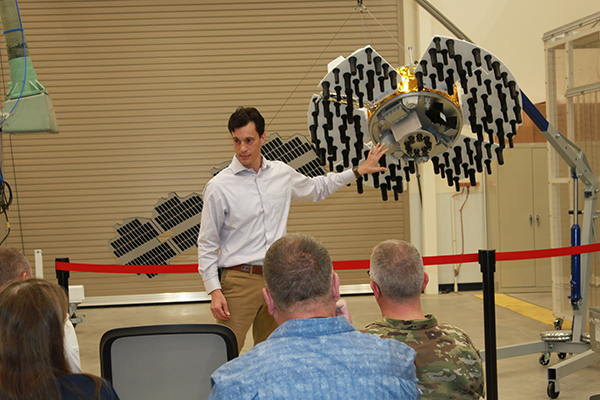
Arlen Biersgreen, NTS-3 program manager, uses a 1:3 scale model to describe the spacecraft and details of the one-year experimental mission during Media Day on June 23, 2022, at Kirtland Air Force Base. (Photo: U.S. Air Force/Andrea Rael)
AFRL and L3Harris are now completing the remaining intra-payload and payload-to-bus functional and performance tests, including the first radio frequency broadcast tests of the novel PNT signals that will be demonstrated from near-geosynchronous orbit after the NTS-3 launch.
Following those activities, the team will perform standard space environment tests that simulate the launch and space environments to verify that the system is ready for the rigors of experimental operations in space. Biersgreen added that experimental performance data from ground testing will be available for sharing with program partners in the next several months.
The Global Navigation Satellite System Test Architecture, or GNSSTA, developed by the Mitre Corporation in partnership with the AFRL Sensors Directorate, is crucial for meeting end-to-end NTS-3 mission objectives. GNSSTA is a reprogrammable software-defined receiver allowing users to receive both legacy GPS and advanced signals generated by NTS-3. It lays the groundwork for future operational receivers to provide the Space Force with options to prevent and respond quickly to common threats on the battlefield, such as GPS jamming and spoofing.
Joanna Hinks, NTS-3 principal investigator, worked closely with the Sensors team on GNSSTA development and testing. “The entire team is excited that earlier this month, we successfully generated signals on the actual spacecraft and received them with our experimental GNSSTA user equipment,” Hinks said. “Showing the space segment and user segment working together like that is an important step to being ready to conduct experiments on-orbit.”
NTS-3 is the first U.S. experiment of its kind in nearly 50 years, since the Navy Research Laboratory’s NTS-1 and NTS-2 spacecraft led the way for the GPS constellation in the 1970s.
“This Vanguard not only aims to support GPS users through vital development of new technologies and techniques, but also to show how an agile and responsive U.S. satellite navigation architecture is paramount to defeating the most challenging threats to warfighter success, both today and through the coming decades,” Biersgreen said.
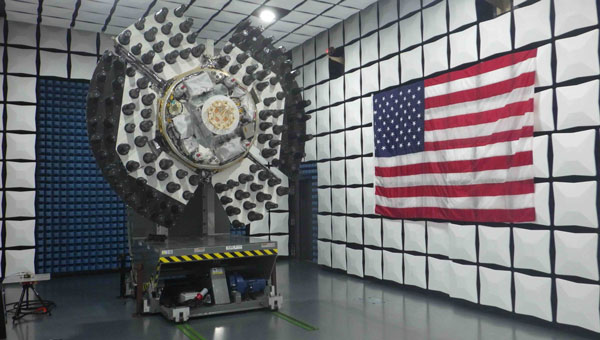
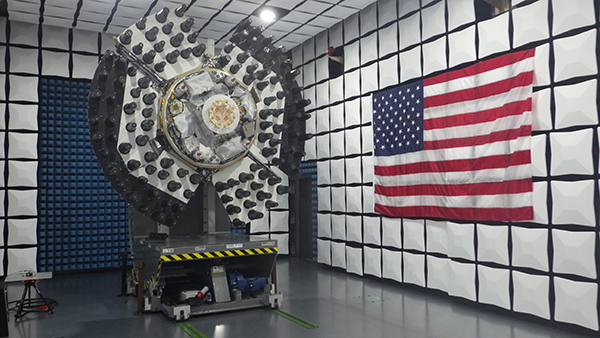
The NTS-3 spacecraft was placed in an anechoic test chamber for electromagnetic interference and electromagnetic compatibility testing in Palm Bay, Florida. (Photo: AFRL)
More than 100 experiments will be conducted with the Navigation Technology Satellite-3 (NTS-3), set to launch next year, according to a U.S. Air Force official and reported by FedScoop.
“We’re really excited to push the state of the art with more than 100 experiments on this little [NTS-3] spacecraft and we’re looking at ways that we can solve warfighters’ problems in the contested environment,” Maj. Gen. Heather Pringle, commander of AFRL, told reporters April 6 at the 37th Space Symposium in Colorado Springs.
Maj. Gen. Heather Pringle
Set to launch in 2023, NTS-3 is designed to push the boundary of today’s position, navigation and timing (PNT) technology to pave the way for a more flexible, robust, and resilient architecture for satellite navigation technology.
NTS-3 is a product of the Air Force Research Laboratory (AFRL) and industry, designed to test advanced techniques and technologies to detect and mitigate interference to PNT capabilities and increase system resiliency for military, civil, and commercial users.
Unlike the GPS medium-Earth-orbit satellites, NTS-3 will operate for one year in geosynchronous Earth orbit. Ultimately, NTS-3 will identify key aspects for new GPS receivers that incorporate multiple signals and readily adapt to warfighter needs.
The NTS-3 experiments will also involve ground equipment and terminals such as command and control stations and software-defined radios. Specific improvements to the ground segment will enable experimentation with automated “lights-out” operations, control station failover, and near-real time environment sensing and generation of error correction and tailored waveforms. Onboard systems will monitor clock accuracy and orbit parameters to mitigate errors and notify the user.
NTS-3 will test a new digital signal generator that can be reprogrammed on-orbit, enabling it to broadcast new signals, improve performance by avoiding and defeating interference, and adding signatures to counter spoofing.
AFRL also will explore antenna configurations to provide Earth coverage and steerable regional beams in multiple frequencies and signal codes. The NTS-3 satellite will be equipped with 110 antennas to help counter attempted GPS jamming.
Ultimately, NTS-3 is expected to provide users with enhanced signal stability, availability, integrity and accuracy.
L3Harris plans to deliver NTS-3 later this year. The company is assembling the satellite at its Palm Bay facility near Cape Canaveral, Florida. The plant was expanded in 2021 to accommodate the NTS-3 program.