Author: Allison Kral

  • NGS 2018 GPS on BMs program in support of NAPGD2022 — Part 6

    NGS 2018 GPS on BMs program in support of NAPGD2022 — Part 6

    My last column described how the U.S. National Geodetic Survey (NGS) used the detailed analysis of the latest GPS on Bench Marks dataset to:

    1. generate a prototype hybrid geoid model to evaluate the residuals at stations not used in the hybrid geoid model,
    2. confirm that the stations recommended for re-observations should be observed again, and
    3. identify void areas that need additional observations.

    Since GEOID12B was created, users have been instrumental in providing OPUS with results on benchmarks in areas where NGS said that additional stations were needed. It showed how NGS used the detailed analysis to prepare material to assist users on strategically occupying stations to help support the GPS on Bench Marks Program and create a hybrid geoid model that accurately represents a current NAVD 88.

    To eliminate confusion of where NGS would like new observations, NGS’ material contains a specific list of stations that it would like occupied with GNSS during the 2018 GPS on BMs program. My previous column provided a summary of the latest details of NGS’ 2018 GPS on BMs campaign, which will be used to create the next hybrid geoid model in 2019.

    The analysis described in my column was the first cut at identifying stations that should not be used in a hybrid geoid model, and providing a list of specific stations that could help improve the hybrid geoid model. All new data received by the cut-off date of Aug.31, 2018, will be analyzed by NGS and, if appropriate, the results will be included in the next hybrid geoid model.

    This is a great opportunity to provide data that will help to improve the hybrid geoid model in your region.

    This column will describe NGS’ GPS on BMs 2018 interactive web map and provide an update and status report on stations observed in support of the 2018 GPS on BMs Program.

    First, NGS has a web page dedicated to the 2018 GPS on BMs program. See the box titled “GPS on Bench Marks Web Page.”

    GPS on Bench Marks Web Page
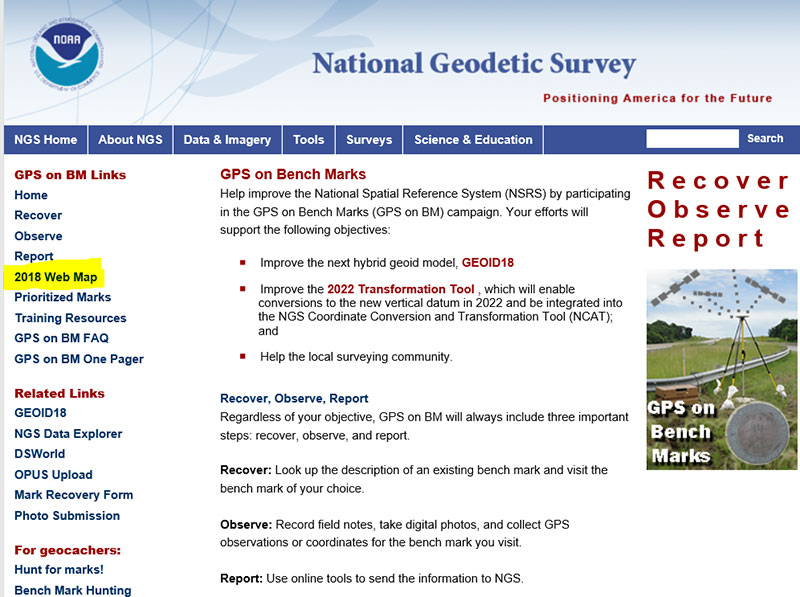
    The GPS on BMs 2018 web page contains a link to a web map where users can determine which bench marks NGS would like users to occupy before the Aug.31 deadline. On the left-hand side of the web page there is a link titled “2018 Web Map” (see highlighted section of box titled “GPS on Bench Marks Web Page”). The next few boxes demonstrate how a user can use the web map tool to locate bench marks in their local area of interest. The box titled “2018 Web Map” depicts what the user will see when the link “2018 Web Map” is clicked.

    2018 Web Map
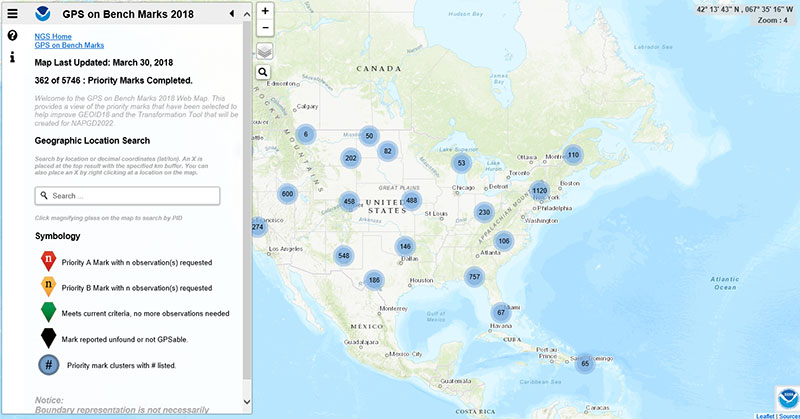
    The user can then click on the map and the tool will provide more details. The box titled “Map After Clicking on Priority Mark Cluster #488 in the Great Plains Region“ is a depiction of the map after clicking on a priority mark cluster.

    Map After Clicking on Priority Mark Cluster #488 in the Great Plains Region
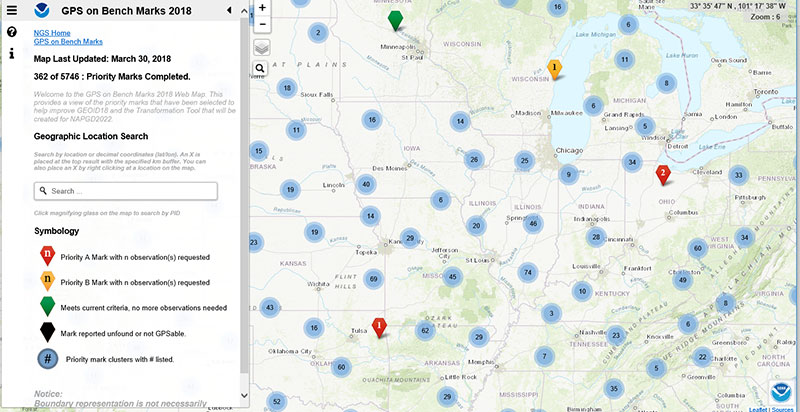
    The user can continue to check on the map until the map depicts individual bench marks where the symbology indicates the status of the monuments. The symbology labels are fairly straightforward. The box titled “The Web Map Symbology” provides the five different categories of monuments.

    The Web Map Symbology
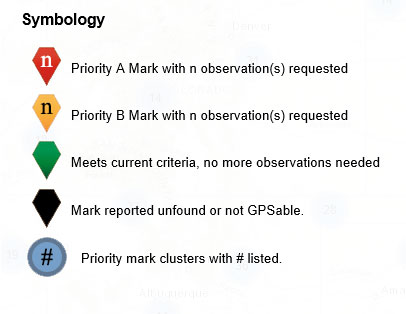
    NGS is updating the map weekly to reduce users occupying stations that already have enough redundant observations. Clicking on a station provides the status of the station. The box titled “An Example of a Priority A Station” depicts station (PID KZ1401) that is labeled as a Priority A station and requires two observations.

    An Example of a Priority A Station
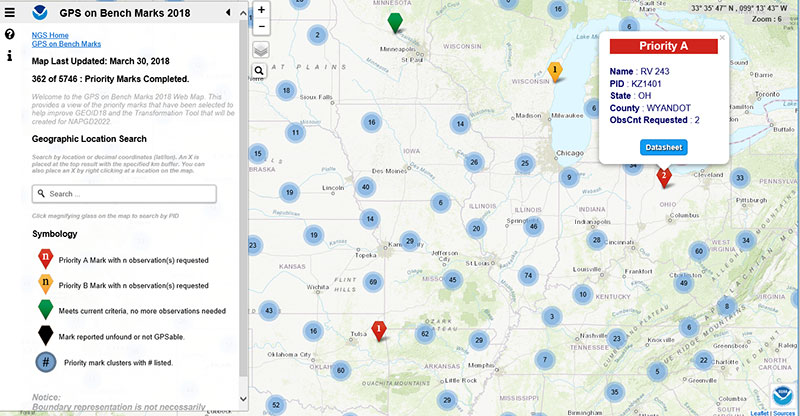
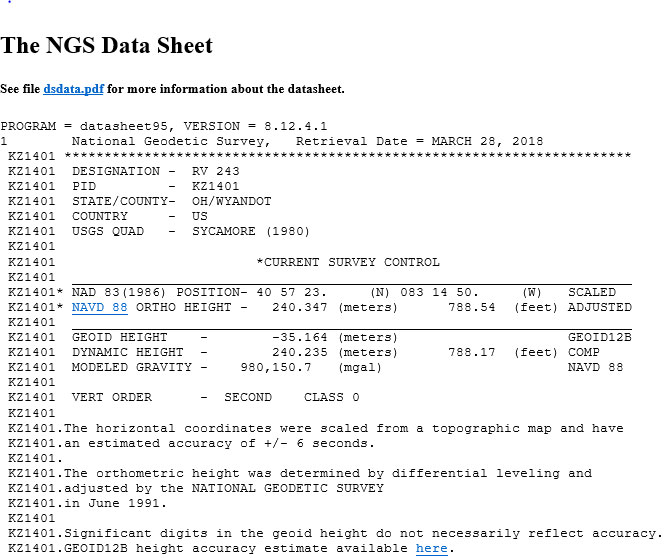
    The user can obtain the datasheet for the station by clicking on the Datasheet button in the box (see box titled “Excerpt from the Datasheet for PID KZ1401”).

    Excerpt from the Datasheet for PID KZ1401
    The box titled “An Example of a Priority B Station” depicts a priority B station (PID PM0117) that NGS would like one more observation. Users should remember that priority A stations are more important than priority B stations but B stations are still important for the development and analysis of the hybrid geoid model.

    An Example of a Priority B Station
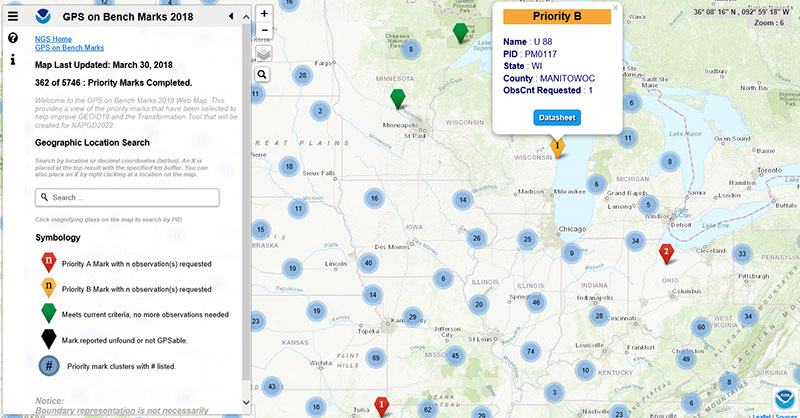
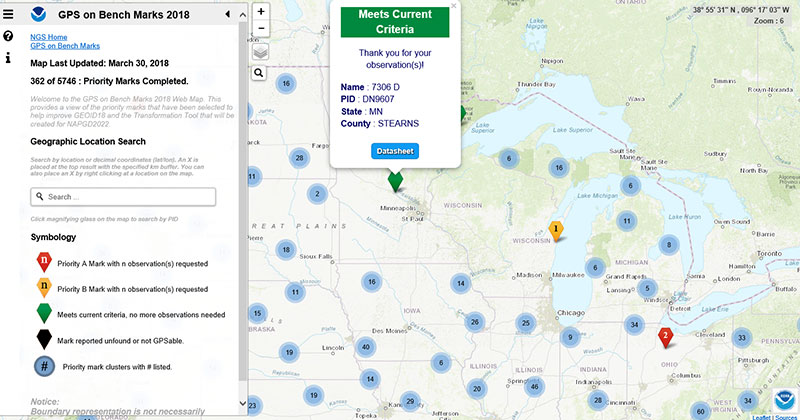
    The box titled “An Example of a Station that Meets Current Criteria” provides an example of a station that does not need any more observations. As previously stated, NGS will be updating this web map on a regular basis so users will not waste their time and resources.

    An Example of a Station that Meets Current Criteria
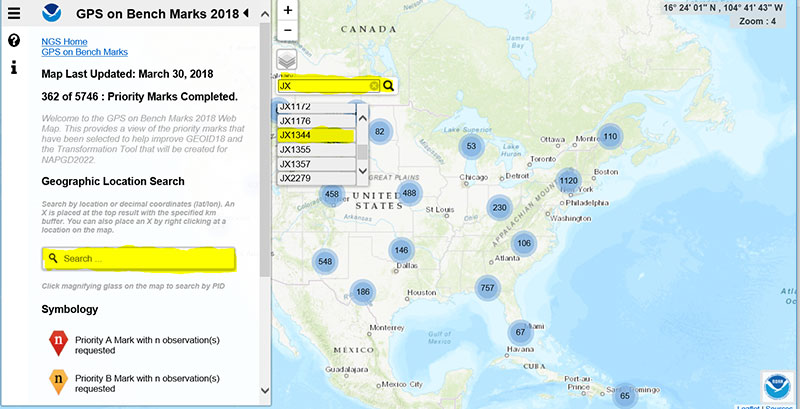
    The web map has a search feature, so if the user knew a priority A or B station’s PID, they could locate the station on the map. The box titled “An Example of Using the Web Map Search Feature“ demonstrates the search feature using PID JX1344 (see highlighted section in the box).

    An Example of Using the Web Map Search Feature
    The box titled “Output from Search Feature for PID JX1344“ is a depiction of the output using the search feature.

    Output from Search Feature for PID JX1344
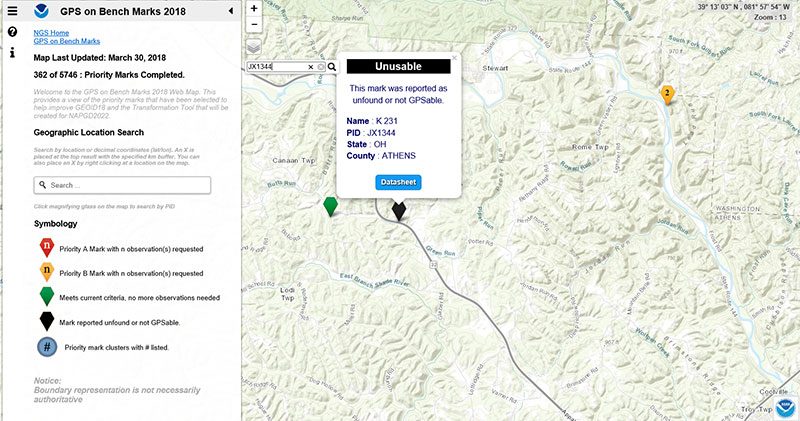
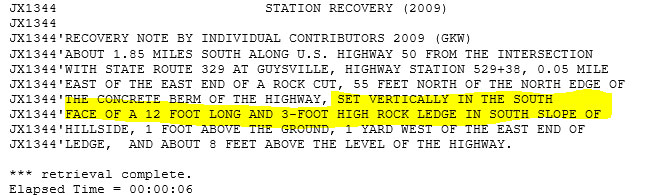
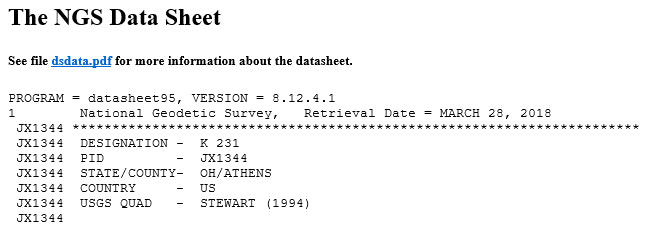
    The last category of stations that are shown on the web map are monuments that are reported as unfounded or not GPSable. This is very useful information for NGS and others to have on datasheets. The box titled ” Output from Search Feature for PID JX1344 “ depicts bench mark PID JX1344 that is labeled as unfound or not GPSable. The datasheet for JX1344 indicates that the bench mark is set vertically in a rock ledge (see highlighted section in the box titled “Excerpt from the Datasheet for PID JX1344.”

    Excerpt from the Datasheet for PID JX1344
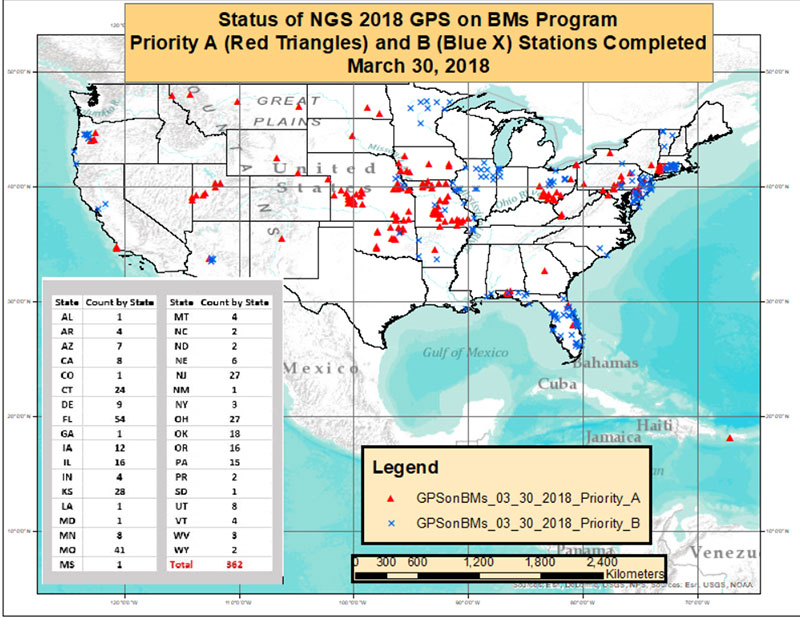
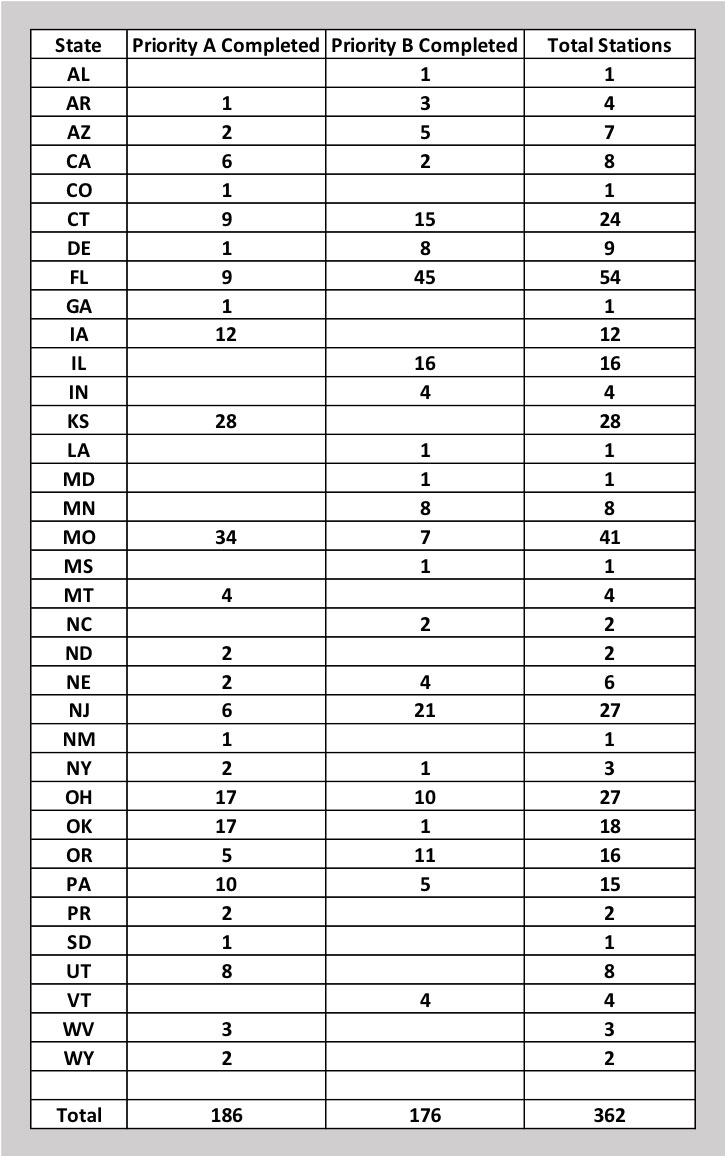
    As of March 30, 362 of the 5745 priority marks have been completed. The box titled “Status of NGS 2018 GPS on BMs Program as of March 30, 2018“ is a plot of the stations that are completed, and the box titled “Count of Stations Completed by State “ provides the number of stations completed by state. The red triangles are priority A stations completed and the blue “X” are priority B stations labeled as completed.

    It appears that the central portion of the country has been very active. For example, there are 34 priority A stations completed in Missouri and 28 completed in Kansas. The State of Florida has completed 45 priority B and nine priority A stations for a total of 54 stations (see box titled “Count of Stations Completed by State “).

    Status of NGS 2018 GPS on BMs Program as of March 30, 2018
    Count of Stations Completed by State

    March 30, 2018
    The number of stations completed to date represents about 6 percent of the total number of stations that need to be observed. Aug. 31 is only five months away. Hopefully, the number of completed stations will significantly increase during the next several months.

    If you have a GNSS receiver, please identify a priority monument nearby and occupy it. As I have explained in previous columns, there are many invalid GPS on BMs stations that may be used in the next hybrid geoid model unless more benchmarks with valid NAVD 88 heights are observed with GNSS.

    Please encourage your fellow surveyors and friends to occupy a benchmark to support the next NGS hybrid geoid model. This is your opportunity to help develop a current, valid hybrid geoid model in your area.


  • AUVSI reveals Xponential 2018 keynote speakers

    The Association for Unmanned Vehicle Systems International (AUVSI) announced the keynote speakers for AUVSI Xponential 2018, taking pace April 30-May 3 at the Colorado Convention Center in Denver.

    According to AUVSI, the experts will present keynotes devoted to themes critical to the advancement and growth of unmanned systems.

    On Tuesday, May 1, the Massachusetts Institute of Technology’s David Autor and PrecisionHawk’s Michael Chasen will highlight how unmanned systems are changing the way we work and how technology is influencing different industries.

    On Wednesday, May 2, the University of North Carolina’s Zeynep Tufekci, Lockheed Martin’s Stephanie Hill and UPS’ Eduardo Martinez will explore the cross section between technology and society. This keynote will also cover the emergence of artificial intelligence, unmanned systems and robotics in the military, and the automated delivery of medication and vaccines to remote areas around the globe.

    Finally, on Thursday, May 3, Northrop Grumman’s Chris Hernandez, as well as a panel, will discuss the humanitarian and public safety applications of unmanned systems to provide aid and support.

    The panel will consist of the National Council on Public Safety UAS’ Charles L. Werner, Texas A&M University’s Robin Murphy, the Alameda County (California) Sheriff’s Office’s Thomas Madigan and the Colorado Division of Fire Prevention and Control’s Mike Morgan.

    “We are pleased to welcome this exceptional line-up of experts to keynote the themed sessions at Xponential 2018,” said Brian Wynne, AUVSI president and CEO. “These outstanding speakers will enhance Xponential’s educational programming by lending their expertise, experience and unique perspective in unmanned systems, giving attendees a priceless opportunity to apply critical learning to real-life business challenges.”

  • Intergeo 2018 to focus on geoinformation, digitalization

    Intergeo 2018 to focus on geoinformation, digitalization

    The theme for this year’s Intergeo, taking place Oct. 16-18 in Frankfurt, Germany, is “Geoinformation — The DNA of digitalization.”

    According to event organizers, this year’s event will focus on the digital transformation of business and society. The event, hosted by the German Society for Geodesy, Geoinformation and Land Management (DVW), will contextualize key developments and scenarios for a geoinformation-based digital future.

    “Over the course of three days, the spotlight will be placed on the products, solutions, know-how, innovations and visions behind geoinformation in the era of digitalization,” said Professor Hansjörg Kutterer, president of DVW. “And we confidently label geoinformation the DNA of digitalization. After all, in the same way as humans are shaped by their genes, geoinformation is steering the digital revolution.”

    Intergeo 2018 will feature 130 speakers, with each day of the show beginning with keynote speeches. Among the keynote speakers are Kutterer; Professor Jürgen Döldner from the Hasso Plattner Institute in Potsdam, Germany; and Ron Bisio from Trimble.

    In addition, more than 600 companies will be exhibiting at the show.

  • ION names winners of 8th annual Autonomous Snowplow Competition

    ION names winners of 8th annual Autonomous Snowplow Competition

    The winner’s of ION’s 8th annual Autonomous Snowplow Competition was team “Snow Squirrel” from the University of Minnesota. Photo courtesy of ION.

    The Institute of Navigation’s (ION) Satellite Division held its 8th annual Autonomous Snowplow Competition Jan. 25-28 at Rice Park in St. Paul, Minnesota.

    The ION Autonomous Snowplow Competition, held in cooperation with the ION North Star Section, is an international event open to college and university students, as well as the general public. According to ION, the competition challenges teams to design, build and operate a fully autonomous snowplow using state-of-the-art navigation and control technologies.

    Eleven teams entered the competition, and eight of those teams successfully completed all the phases of the competition. Each team used a variety of navigation systems, including lira, optical navigation systems, inertial instruments, magnetic sensors, ultra wide-band radio reflectors, visual odometry, GNSS and differential GPS, to rapidly and accurately clear a designated path of snow.

    Teams were judged based upon their cumulative scores earned throughout the competition phases, including presentations and dynamic vehicle events.

    The first place team was the University of Minnesota’s “Snow Squirrel” team. The team was awarded $7,000 and a Golden Snow Globe Award, and is invited to present during the ION GNSS+ 2018 conference Sept. 24-38 in Miami. The second place team was the Dunwoody College of Technology’s “Wendigo 2018” team, which was awarded $4,000 and a Silver Snow Globe Award. Finally, the third place team was North Dakota State University’s “Thundar 3.0” team, which received $2,000 and a Bronze Snow Globe Award.

  • NGS 2018 GPS on BMs program in support of NAPGD2022 — Part 5

    NGS 2018 GPS on BMs program in support of NAPGD2022 — Part 5

    My last column highlighted two components of the North American-Pacific Vertical Datum of 2022 (NAPGD2022) — the geoid undulation model of GEOID2022 and gravity model of GRAV2022. It expressed that these two models will be very important to future surveyors and mappers that are incorporating geodetic data into NAPGD2022. The last column also emphasized the significant differences between NAPGD2022 and the U.S. National Vertical Datums of NAVD 88 and NGVD 29. A year ago, my February 2017 column provided information on strategically occupying benchmarks to support NGS 2017 GPS on BM Program. The column focused on addressing the following questions: (1) Is the large GPS on BM residual due to an issue with the NAVD 88 orthometric height or the NAD 83 (2011) ellipsoid height? and (2) Should stations with large GMS on BM residuals be included in the development of NGS’ hybrid geoid models? The column provided suggestions on how users can assist NGS in determining the reason for the large difference between the modeled hybrid geoid value and computed GNSS/leveling geoid computed value. My October 2016 column demonstrated how to use the GPS on BMs dataset to identify potential issues in published NAVD 88 and NAD 83 (2011) heights. It focused on analyzing the NGS’ GPS on BM data set that was used to create NGS’ GEOID12B hybrid geoid model. It provided procedures that users could employ when analyzing the differences between the modeled geoid values and the computed geoid values using GNSS/Leveling data (GNSS-derived ellipsoid height minus leveling-derived orthometric height). The October 2016 column provided several examples of large relative differences in residuals between neighboring stations.

    It should be noted that many of these large GPS on BM residuals could be due to an invalid NAVD 88 published height because the bench mark moved since the last time the height of the bench mark was adjusted and published, and/or an undetected error in an ellipsoid height due to a weak GNSS project design. Either way, in my opinion, most of these stations with large GPS on BMs residuals don’t accurately represent a bench mark with a current NAVD 88 height (or what I call a valid NAVD 88 height). When performing a geodetic survey, these stations would be identified as bench marks with invalid heights when following the appropriate Federal geodetic survey guidelines, procedures, and specifications. These bench marks should not be used in the hybrid geoid model just like they would not be used in controlling geodetic surveys. NGS’ goal is to create a hybrid geoid model that is consistent with published valid NAVD 88 values. User participation in NGS’ GPS on BMs Program is critical to creating a hybrid geoid model consistent with a current NAVD 88.

    Recently, NGS performed a detailed analysis of the latest GPS on BMs data file using the published NAD83 (2011) ellipsoid heights, NAVD 88 orthometric heights, and the latest experimental geoid model height, xGeoid17b, to compute a new set of GPS on BMs residuals. At this time, the analysis has only included the 48 conterminous States, District of Columbia, Puerto Rico, and Virgin Islands. These data included NAD 83 (2011) ellipsoid heights from all submitted GNSS projects and OPUS Shared results. The goal of the detailed analysis was to create a statistical ranking of the marks based on a quantitative analysis of the leveling and GPS data. The following attributes were considered during the analysis:

    • Total number of GPS observations to and from the station
    • Date of last GPS observation to and from the station
    • Whether or not the GPS station has repeat baselines between closely spaced neighboring GPS on BMs stations
    • Total number of times the mark has been leveled to
    • Date of latest leveling
    • Quality of leveling (single run; double run; or single run, double simultaneous)

    The analysis of this data set was used to identify stations that should not be used in the creation of a hybrid geoid model or a NAPGD2022 Transformation tool. The stations identified as outliers and labeled as “Do Not Use” in a hybrid geoid model were based on issues associated with the NAVD 88 published orthometric height and/or the NAD83 (2011) ellipsoid height. I have described some of these issues in previous columns (August 2015 column, June 2016 column, October 2016 column and February 2017 column) so I won’t go into details in this column. NGS used the detailed analysis of the latest GPS on BMs dataset to: (1) generate a prototype hybrid geoid model to evaluate the residuals at stations not used in the hybrid geoid model, (2) confirm that the stations recommended for re-observations should be observed again, and (3) identify void areas that need additional observations.

    Since GEOID12B was created, users have been instrumental in providing OPUS results on bench marks in areas NGS said that they needed additional stations. Saying that, NGS realizes that everyone is busy and has limited resources to collect GNSS data on bench marks to support the next hybrid geoid model. NGS has used the detailed analysis to prepare material to assist users on strategically occupying stations to help support the GPS on Bench Marks Program, and create a hybrid geoid model that accurately represents a current NAVD 88. To eliminate confusion of where NGS would like new observations, NGS’ material contains a specific list of stations that they would like occupied with GNSS during the 2018 GPS on BMs program. This column provides a summary of the latest details of NGS’ 2018 GPS on BMs campaign which will be used to create the next hybrid geoid model in 2019 (see box titled “Personal Communication received from Galen Scott, Project Lead of NGS’ GPS in BM Program.”).


    Personal Communication received from Galen Scott, Project Lead of NGS’ GPS on BM Program

    In early 2019, NOAA’s National Geodetic Survey (NGS) will replace GEOID12B with GEOID18, a new hybrid geoid model to deliver improved GPS-derived NAVD 88-equivalent orthometric heights. This new model will serve as the official means for obtaining NAVD 88-equivalent heights via GPS. It will be the last hybrid geoid model that NGS will create before NAVD 88 is replaced by NAPGD2022.NGS will use available GPS on bench mark data to create the new model. Recent analysis of existing GPS on bench mark data and a prototype of the new hybrid geoid model created using that data has highlighted areas where additional data is needed to either confirm or update the local relationships between the ellipsoid, orthometric, and geoid heights.

    This email provides a prioritized list of bench marks for which additional GPS data is needed to improve the hybrid model. Data submitted on these marks will also support the development of the transformation tools that will be developed as part of the transition to the new datums.

    Data to support the hybrid geoid model will be accepted through August 31, 2018. NGS will continue to accept data to support the transformation tools through 2020. New prioritized lists of marks to support the transformation tools will be made available over the next few years as analysis of data requirements progresses.

    For the marks included in the attached document, NGS is requesting support in two ways:

    1. Attempt to locate the marks on the list and submit a mark recovery through DS World. Check this NGS page for more information on mark recovery.
    2. Collect 4 or more hours (more is better) of GNSS data on the mark following NGS guidelines, submit the data to OPUS and select the option to Share.

    More information, including training material, is available on the NGS GPS on Bench Marks (GPS on BM) website. Two matching, independent GPS observations are required for each mark. The list indicates how many observations we have so far on each mark (obs_cnt column). A tracking map showing the currently prioritized marks and the number of observations we have on each will be added to the GPS on BM website in the near future. To maximize efficiency, please check this map before observing a mark to ensure that the required data has not already been submitted.

    Please note: Marks on this list may be inaccessible, destroyed, or not GPS’able. If this is the case, please locate and observe another nearby NAVD 88 mark, within ~10 km.

    The mark list is provided in three file formats, but all contain the same information, so choose the format you are most comfortable with: excel spreadsheet, esri shapefile, and Google Earth kmz.

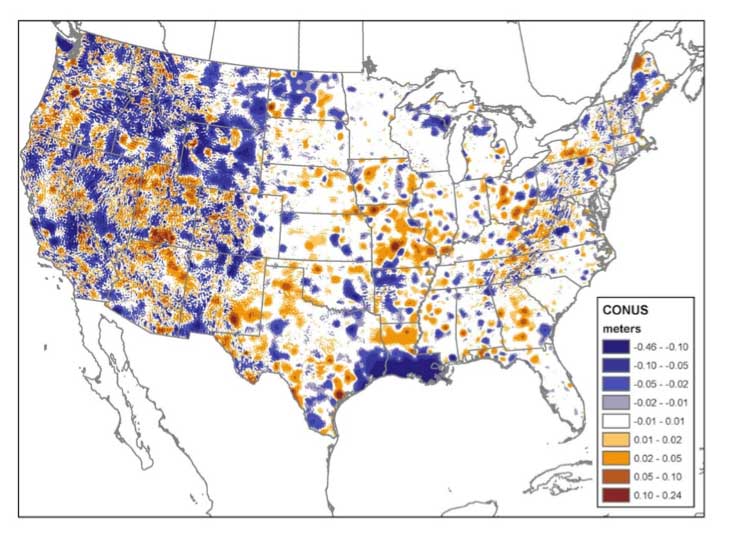
    The image below shows the changes between GEOID12B and the prototype hybrid geoid model. While data is needed on all the marks in the list, you may further focus your data collection efforts by looking for areas in this image that show large changes in your region.

    It is important for users to understand that NGS needs to have a high level of confidence that the OPUS Share results are accurate; therefore, they are requiring that “two matching, independent GPS observations are required for each mark.” The list of stations that they would like observed includes a count of the number of times that station has already been observed. NGS will be updating a website as stations are submitted so participants will not be wasting resources observing a station that has already been observed by someone else. It should be noted that if a station is only occupied once, it will still be useful for validating the hybrid geoid model; but stations occupied twice can be used in defining the hybrid geoid model.

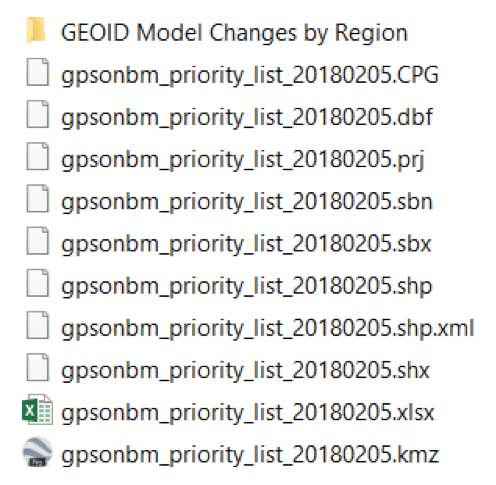
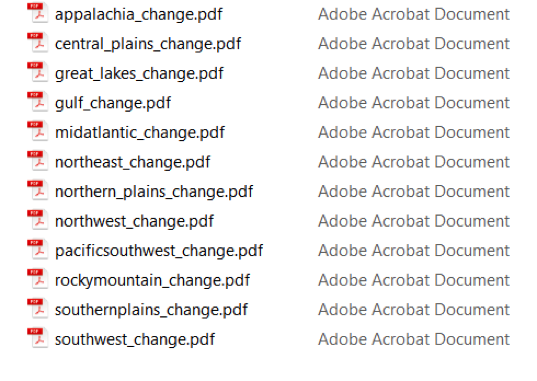
    The attached file includes the list of stations that NGS would like observed to support the next geoid model. The information is provided in three different formats — excel spreadsheet, esri shapefile, and Google Earth kmz (See the box titled “List of Files for the 2018 GPS on BMs Program.”)


    List of Files for the 2018 GPS on BMs Program

    The data set also contains a folder titled “GEOID Model Changes by Region” which contains plots that depict changes between GEOID12B and the Prototype Hybrid Geoid Model (Note: at this time, NGS is denoting this prototype hybrid geoid model as GEOID18v2.2).


    List of Files from Folder Titled “GEOID Model Changes by Region”


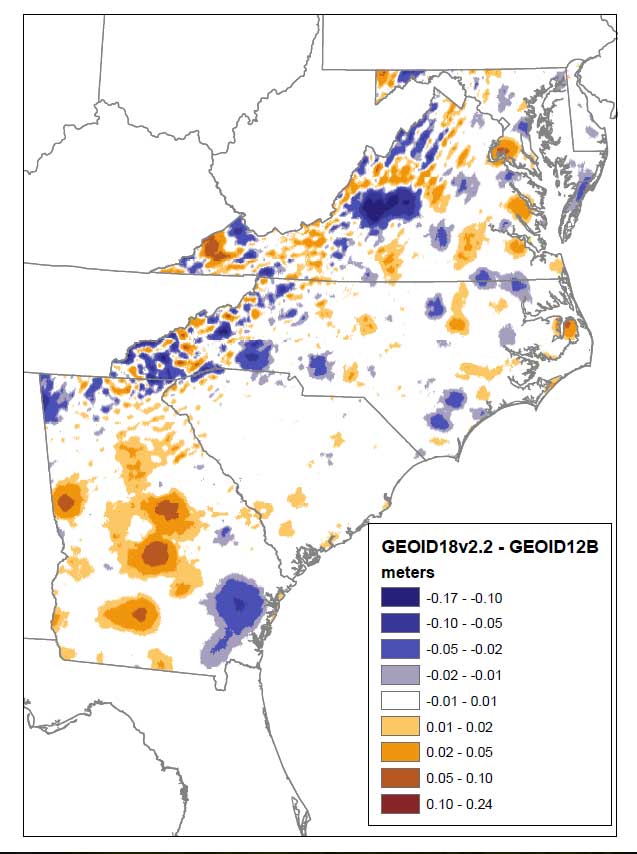
    Figure 1 is a plot of the change between the prototype GEOID18v2.2 and GEOID12B in the Mid-Atlantic States. Looking at figure 1, the reader can see that there are some significant differences between the prototype hybrid geoid model values and the published GEOID12B values. On figure 1, all of the dark blue values are differences at the -10 cm level and the dark orange values are differences at the 10 cm level. There are several reasons for these changes including newly observed gravity data observations (especially in area with new GRAV-D data), improved data and models from satellites programs, new and improved algorithms for processing gravity data and estimating topographic effects, additional OPUS Share results in areas where GEOID12B didn’t have observations, and differences based on stations that were included in GEOID12B but rejected in the prototype model based on the latest detailed analysis.

    Figure 1 – Changes between Prototype GEOID18v2.2 and GEOID12B in the Mid-Atlantic States (units = meters).

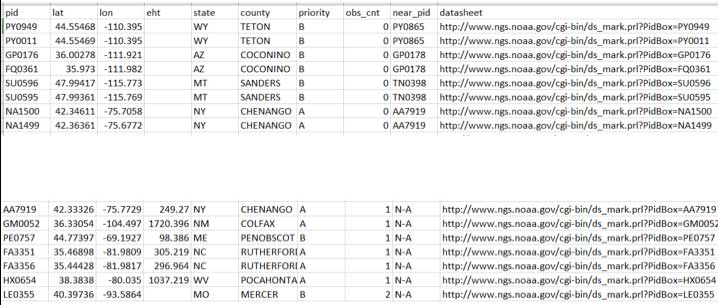
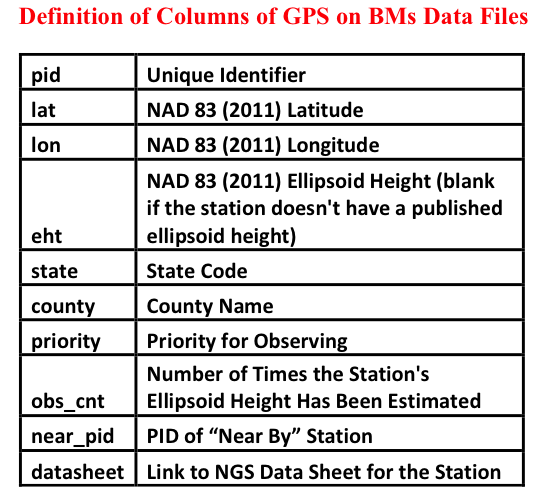
    As previously mentioned, the list of stations that NGS would like observed with GNSS are provided in three formats: excel spreadsheet, esri shapefile, and Google Earth kmz. The box titled “Sample Data Elements Extracted from the Excel File Titled “gpsonbm_priority_list_20180205.xlsx” provides a sample of the data from the excel file. The box titled “Definition of Columns of GPS on BMs data file” provide the columns and a brief definition of the data field.

    Sample Data Elements Extracted from the Excel File Titled “gpsonbm_priority_list_20180205.xlsx”

    The priority column has two entries – A or B. Priority A is more important than priority B. In other words, if the user has to make a choice, NGS would like the priority A station observed first. The obs_cnt field will be updated as users submit their OPUS Shared results. Remember, NGS is requiring two matching, independent GPS observations for the station to be included in the development of the hybrid geoid and transformation tool.

    The near_pid provides the pid of the station that is near the original station. The selection of the near_pid was based on the original station’s position and a search of the NGS database for a station within 5 to 15 kilometers of the original station. NGS’ analysis indicated that the original GPS on BMs station may have moved so an additional observation on the same station will not help to generate a hybrid geoid model that represents the current NAVD 88. It would warp the geoid model to fit the published NAVD 88 height but if the station moved since it was last leveled to, then it does not have a valid NAVD 88 height. As previously stated, when performing a geodetic survey, these stations would be identified as bench marks with invalid heights when following the appropriate Federal geodetic survey guidelines, procedures, and specifications. The surveyor would then level to another bench mark until they met the survey’s specifications. These bench marks with invalid heights should not be used in the hybrid geoid model just like they would not be used in controlling geodetic surveys. If the near_pid column is “n-a” then NGS would like the original station observed.

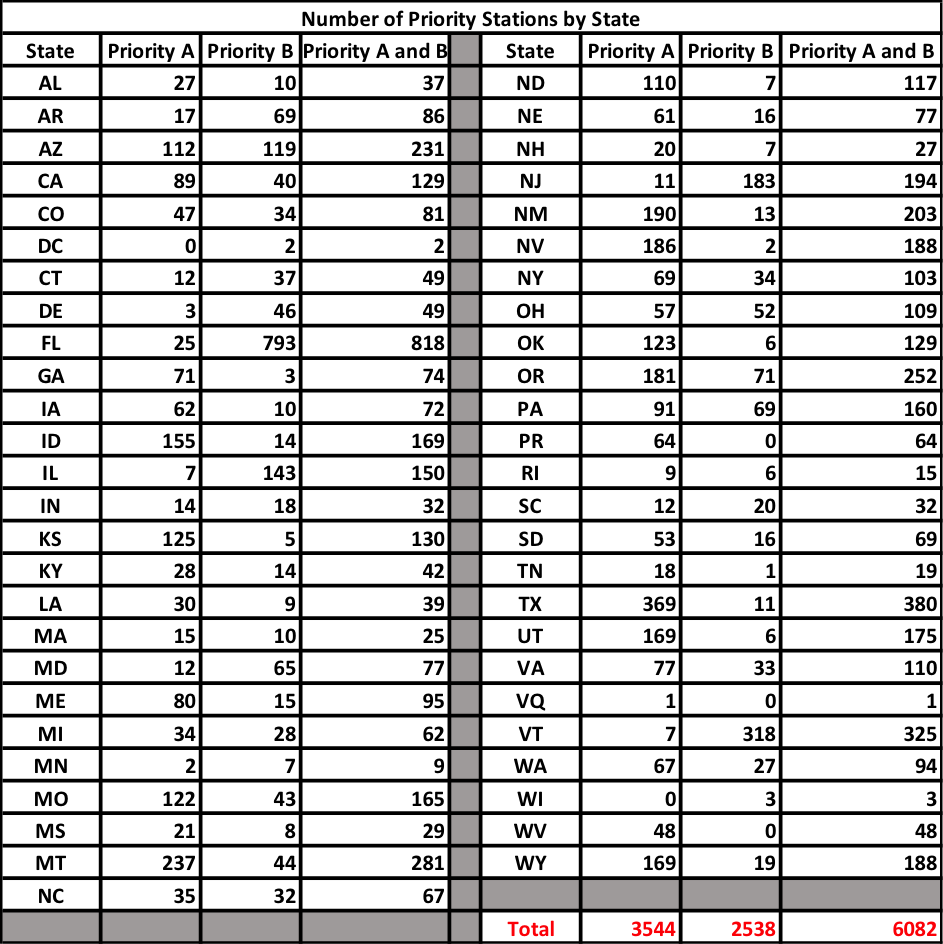
    The box titled “Number of Priority Stations in Each State” provides the number of priority A and B stations for every State in the lower 48, the District of Columbia, Puerto Rico, and the Virgin Islands. Overall, there are 6082 stations in the list – 3544 Priority A stations and 2538 Priority B stations.

    Number of Priority Station in Each State

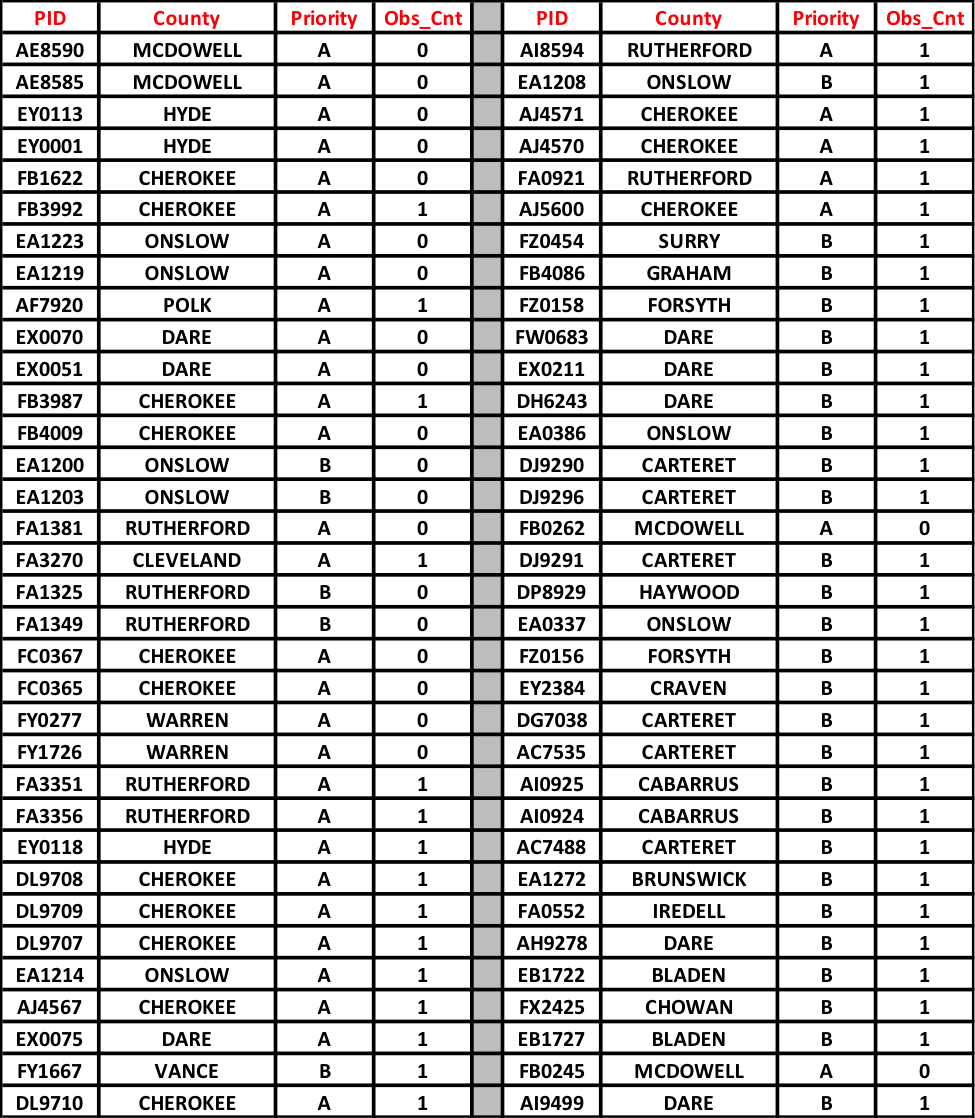
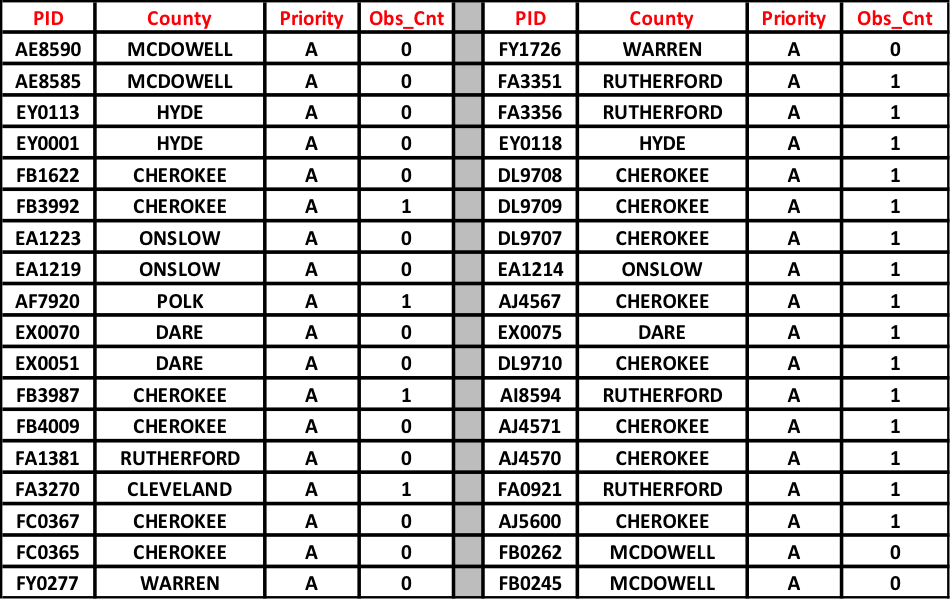
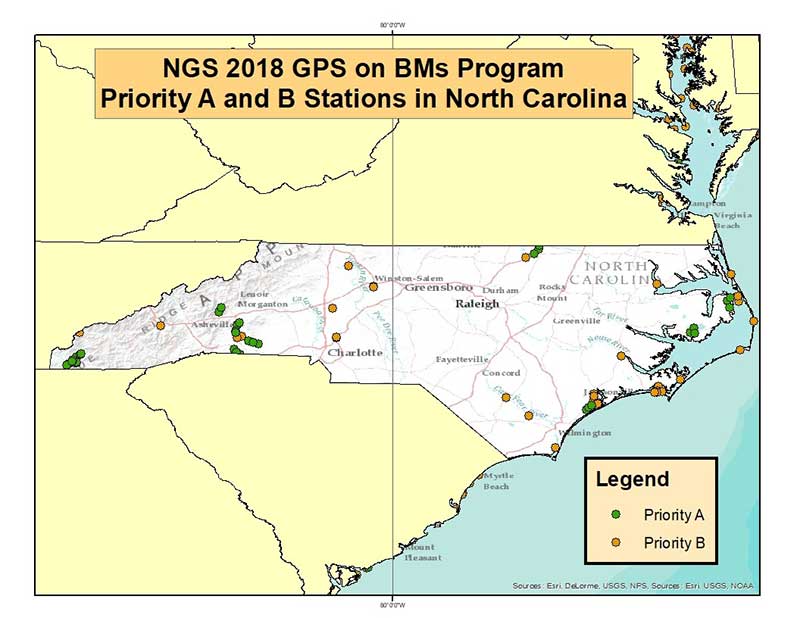
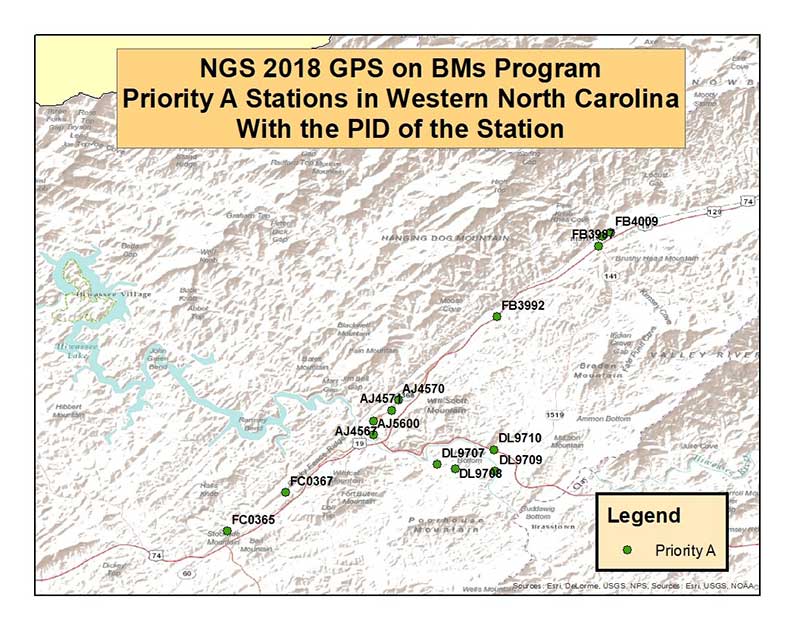
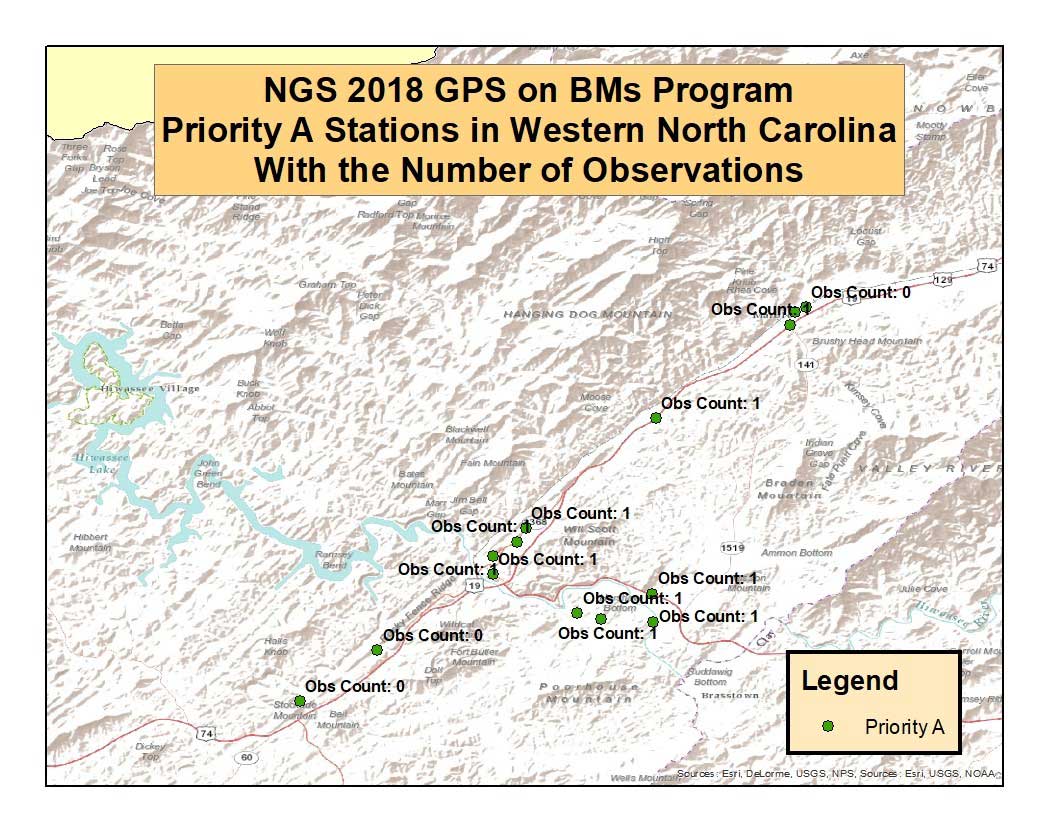
    As an example of a State in eastern United States, the box titled “List of PIDs of Priority “A” and “B” Stations in North Carolina” provides the list of priority A and B stations that need to be observed in North Carolina. The box titled “List of PIDs of Priority “A” Stations in North Carolina” provides the list of priority A stations in North Carolina. Figure 2, titled “NGS 2018 GPS on BMs Program, Priority A and B Stations in North Carolina,” depicts the locations of these stations. Figure 3 depicts the location and PID of the priority A stations in western North Carolina. Figure 4 depicts the same stations with their Obs_Cnt value.

    List of PIDs of Priority “A” and “B” Stations in North Carolina That Need to be Observed
    Information extracted from Excel File Titled “full_priority_list.csv”

    (Note: The stations in this table may not be the final list of priority A and B. The attached zip file contains the latest list of stations. The latest list was received too late to modify the table.)

    List of PIDs of Priority “A” Stations in North Carolina

    (Note: The stations in this table may not be the final list of priority A and B. The attached zip file contains the latest list of stations. The latest list was received too late to modify the table.)

    Figure 2 – NGS 2018 GPS on BMs Program – Priority A and B Stations in North Carolina.
    Figure 3 – NGS 2018 GPS on BMs Program – Priority A Stations in Western North Carolina With the PID of the Station.


    Figure 4 – NGS 2018 GPS on BMs Program – Priority A Stations in Western North Carolina With the Number of Observations.

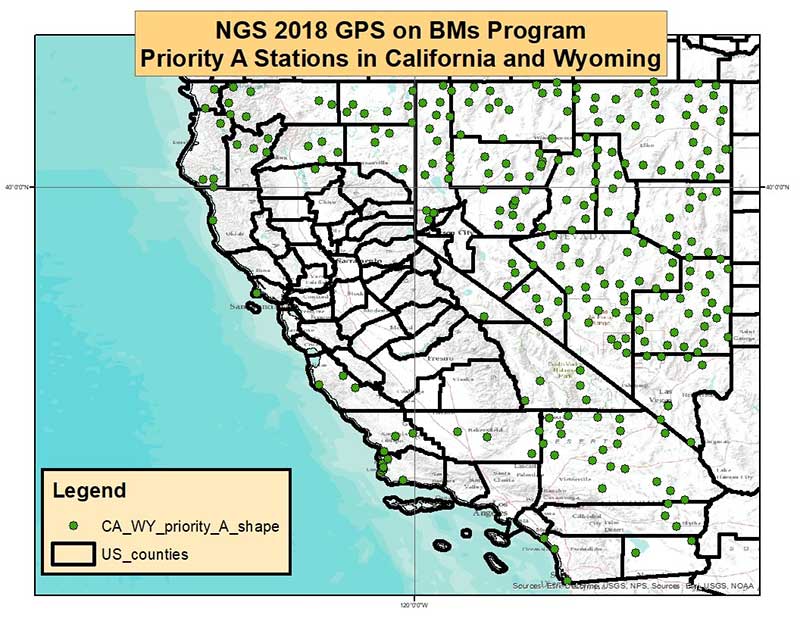
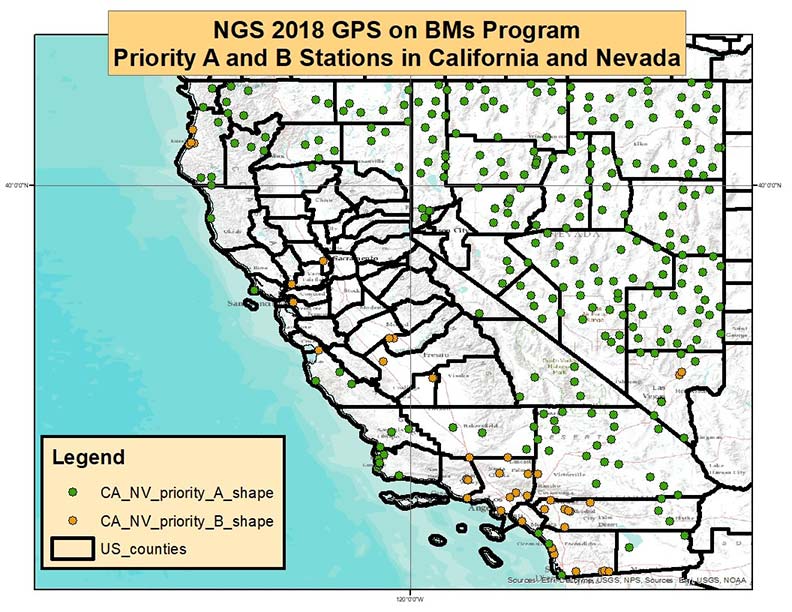
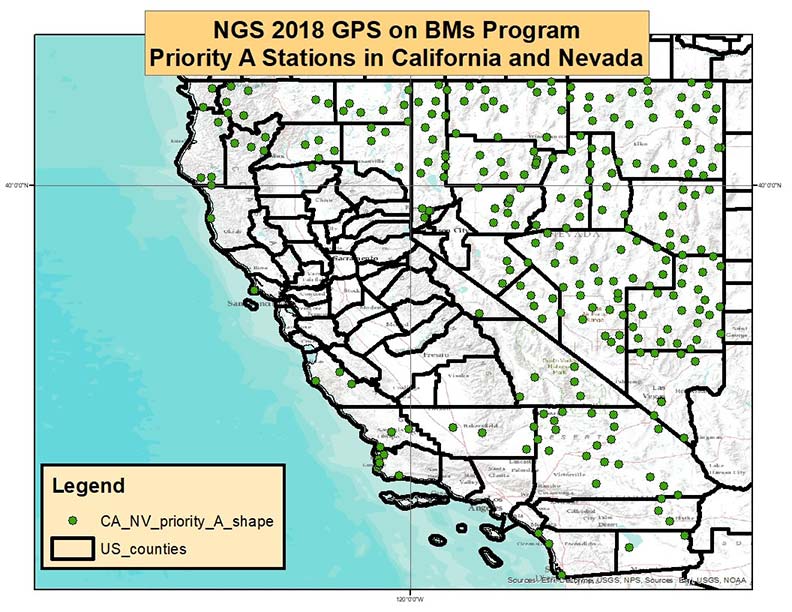
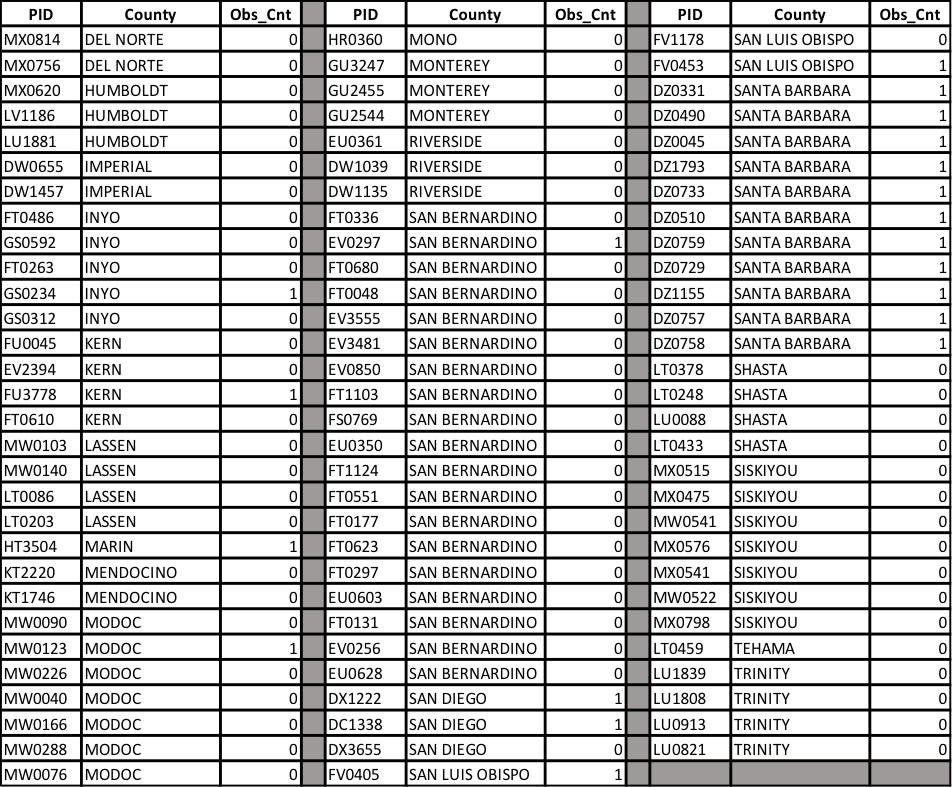
    For completeness, I will provide an example of a region in the western United States – California and Nevada. They are larger States than North Carolina and have more Priority A stations that need to be observed. Figure 5 depicts the Priority A and B stations in California and Nevada, and figure 6 depicts the Priority A stations in California and Nevada. It is recognized by NGS that managing how these stations are observed and who does what is a monumental task. Some state agency may undertake observing all of the Priority A stations; for example, Gary Thompson, Chief of the North Carolina Geodetic Survey, has committed to observing all of the Priority A stations (personal communication). Other States have County and City surveyors that will help observe and manage the process. All of the information provided in the 2018 GPS on BMs allow individuals to sort the data in ways that meet their needs. For example, the box titled “List of Priority “A” Stations by County in California” provide the list of stations in California by county.

    Figure 5 – NGS 2018 GPS on BMs Program – Priority A and B Stations in California and Nevada.
    Figure 6 – NGS 2018 GPS on BMs Program – Priority A Stations in California and Nevada.

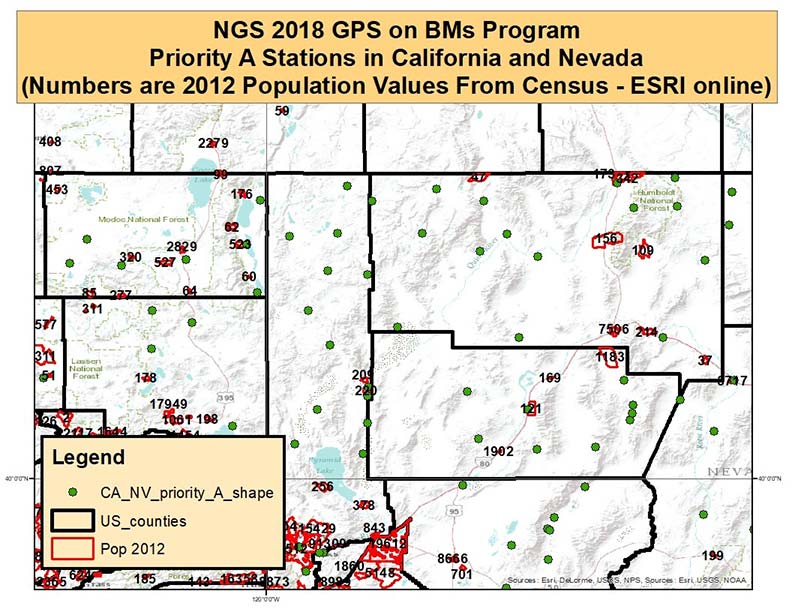
    It should be noted that NGS identified the priority stations based on hybrid geoid requirements. The NGS geoid team would desire a valid GPS on BMs observation every 30 km. Therefore, some of the priority A stations are in areas void of any GPS on BMs stations. There may be many reasons for this but, most likely, it’s because it’s located in an unpopulated or mountainous region of the county. Either way, it may be difficult to obtain observations at these stations. The new hybrid geoid model will be created using whatever data are available. In these void areas, the geoid will be controlled by the nearest GPS on BMs stations. There is nothing wrong with this approach. The only issue will be that it will not be possible to evaluate the relation of the hybrid geoid model and NAVD 88 in these void areas. Figure 7 depicts the priority A stations and the population of cities in Northwestern Nevada and Northeastern California. The figure indicates that these priority A stations are located in an unpopulated region of Nevada. It’s obvious why there’s no GPS on BMs in this region since nobody lives there but the geoid doesn’t depend on population. In any event, if the user can obtain an observation in these regions it will really help in creating an accurate hybrid geoid model.

    List of Priority “A” Stations by County in California

    (Note: The stations in this table may not be the final list of priority A and B. The attached zip file contains the latest list of stations. The latest list was received too late to modify the table.)


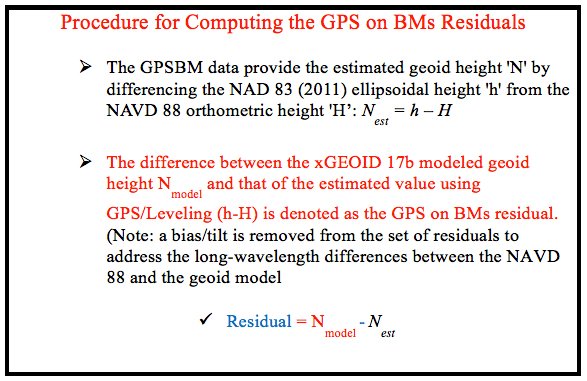
    NGS’ process for determining which stations were outliers and which stations should be re-observed involved analyzing both GNSS and leveling data from NGS’ database. The GPS on BMs residuals were computed using the procedure described in the box titled “Procedure for Computing the GPS on BMs Residuals.”

    Figure 7 – NGS 2018 GPS on BMs Program – Priority A Stations in California and Nevada. (Numbers are 2012 Population Values from Census – ESRI online)

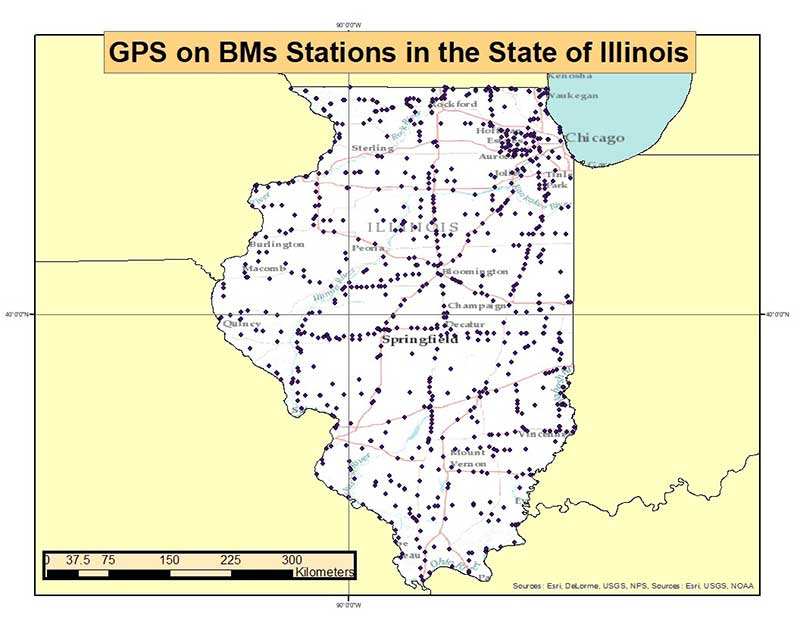
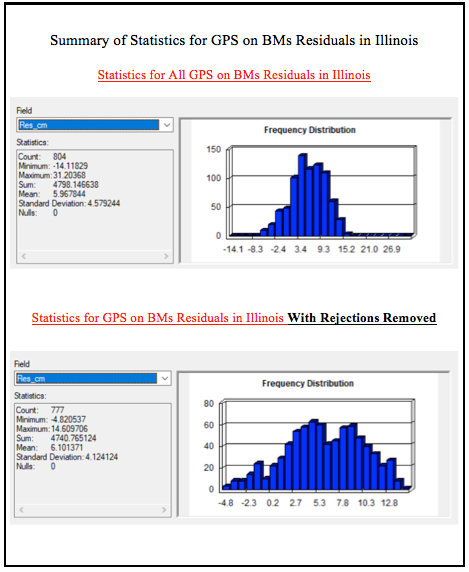
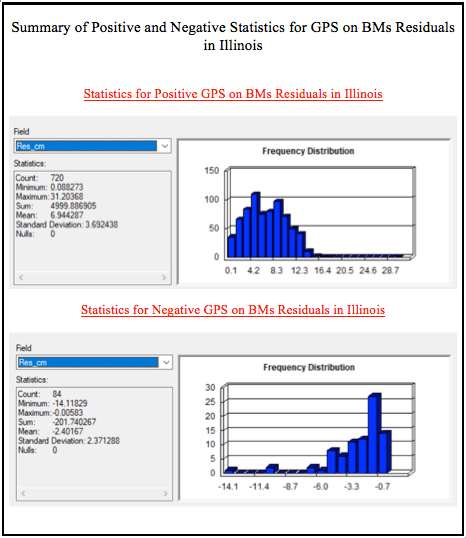
    Figure 8 depicts the location of the GPS on BMs stations in Illinois. The box titled “Summary of Statistics for GPS on BMs Residuals in Illinois” provides a summary of the GPS on BMs residuals for the State of Illinois. The results indicate that there are 804 GPS on BMs in Illinois and the residuals range between -14.1 cm to 31.2 cm. They have a mean of 6.0 cm with a standard deviation of 4.6 cm. The table titled “Statistics for GPS on BMs Residuals in Illinois With Rejections Removed” indicates that most residuals fall between 2 and 10 cm. The box titled “Summary of Positive and Negative Statistics for GPS on BMs Residuals in Illinois” provides a summary of the statistics for the positive and negative set of residuals.

    Figure 8 – GPS on BMs Stations in the State of Illinois.

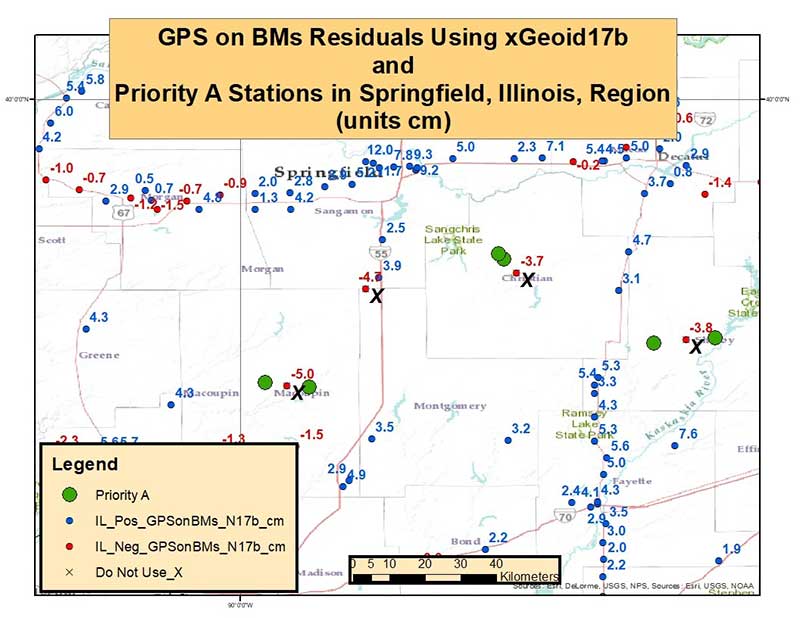
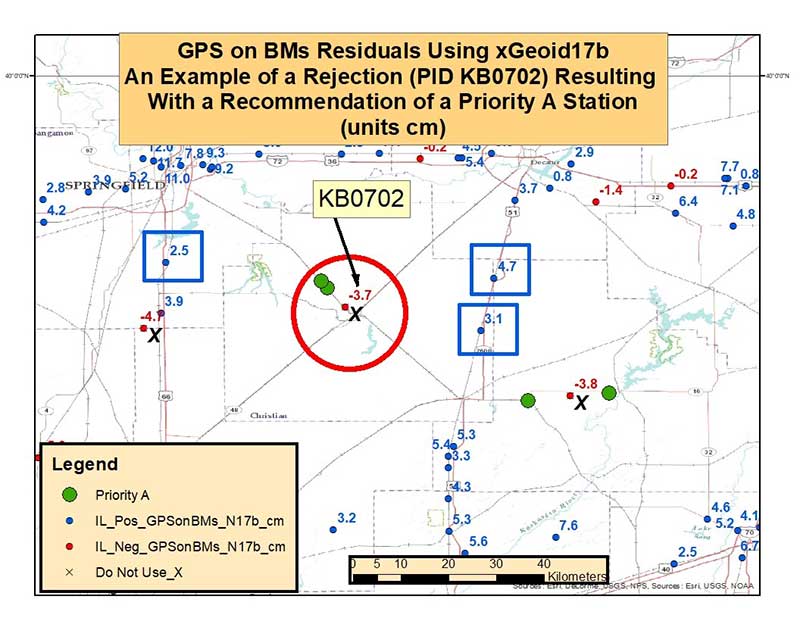
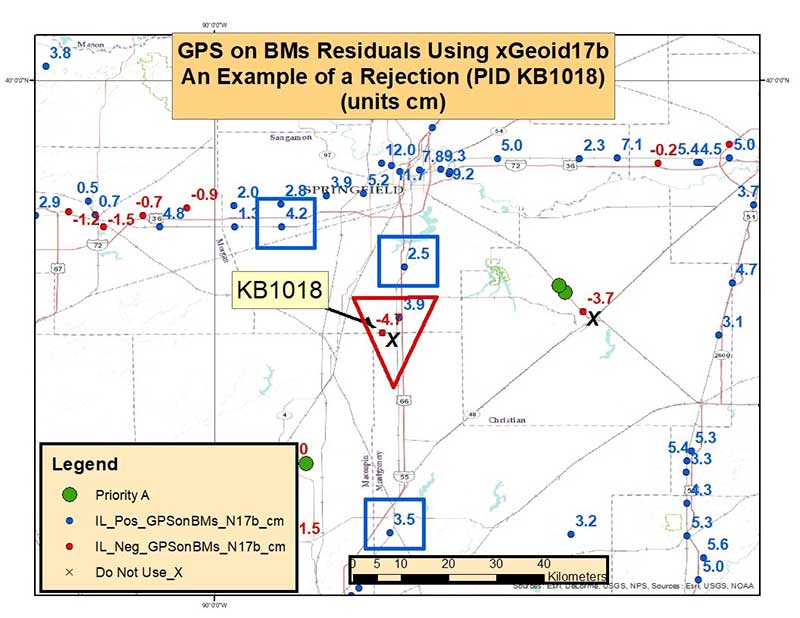
    Figure 9 depicts the GPS on BMs residuals in the Springfield, Illinois, Region. During the detailed analysis of the latest GPS on BMs dataset, the analysts identified outliers that appeared to be large relative to their neighbors. Figure 9 depicts these outliers with a “X.” Stations designated with a “X” are stations that were designated as DO NOT USE in the creation of the hybrid geoid model. Figure 9 also indicates were the analyst recommended that a station should be observed before the creation of the next hybrid geoid model. These stations are labeled as Priority A stations on figure 9. Figure 10 is an enlargement of the same area that depicts a station that was recommended to be rejected in the hybrid geoid model (PID KB0702). The stations surrounding PID KB0702 all seem to be consistent with each other (residuals in smaller blue squares) so the analyst recommended that station KB0702 be rejected. At the same time, by rejecting this station, this creates a void area that needs to be filled. Therefore, the analyst also recommended that a new station be observed here; hence, the two priority A station plotted near the rejected station. Figure 11 is a plot of another rejected station (KB1018) in the same region but, in this case, the analyst did not recommend an additional observation in the area because there was another nearby station (station in red triangle) that was consistent with its neighbors (residuals in smaller blue squares).

    Figure 9 – GPS on BMs Residuals Using xGeoid17b and Priority A Stations in Springfield, Illinois, Region (unit cm).
    Figure 10 – GPS on BMs Residuals Using xGeoid17b – An Example of a Rejection (PID KB0702) Resulting with a Recommendation of a Priority A Station (units cm).

    As previously mentioned, and provided in the box titled “Attributes Considered During Analysis,” several attributes were analyzed before making the recommendations but, typically, GPS on BMs residuals between +/- 5 cm were used to identify which stations needed to be investigated.

    Attributes Considered During Analysis

    ➢ Total number of GPS observations
    ➢ Date of last GPS observation
    ➢ Whether or not the GPS station has repeat baselines
    ➢ Total number of times the mark has been leveled to
    ➢ Date of latest leveling
    ➢ Quality of leveling

    Figure 11 – GPS on BMs Residuals Using xGeoid17b – An Example of a Rejection (PID KB1018) of an Outlier (units cm).

    This analysis is the first cut at identifying stations that should not be used in a hybrid geoid model and providing a list of specific stations that could help improve the hybrid geoid model. All new data received by the cut-off date of August 31, 2018, will be analyzed by NGS and, if appropriate, the results will be included in the next hybrid geoid model. This is a great opportunity to provide data that will help to improve the hybrid geoid model in your region. My next column will provide a status report on the 2018 GPS on BMs Program.

  • Research Online: Urban positioning accuracy enhancement using 3D buildings model

    Research Online: Urban positioning accuracy enhancement using 3D buildings model

    By Nesreen I. Ziedan, Zagazig University, Egypt / Presented at ION GNSS+ 2017, September 2017

    Above: The constructed 3D model for 26 buildings; below: illustration of the direction of recording of surfaces. (Images: Authors)
    Above: The constructed 3D model for 26 buildings; below: illustration of the direction of recording of surfaces. (Images: Authors)

    Multipath is a major source of positioning accuracy degradation in urban areas. Advances in 3D mapping and the availability of 3D city models have encouraged a set of new techniques for multipath mitigation.

    This paper presents three algorithms to enhance the accuracy of urban positioning using all the available line-of-sight, multipath and non-line-of-sight signals:

    • An accelerated ray tracing technique that first eliminates the 3D surfaces that are invisible with respect to a position, and then analyzes the visible surfaces to predict the existence and path lengths of reflected signals. The ray tracing algorithm is applied on the possible range of positions.
    • A Markov Chain Monte Carlo-based algorithm that applies both the Gibbs sampler and the Metropolis-Hastings technique to analyze the received correlated signals to estimate the delays of reflected signals for all the received signals.
    • A Van Rossum-based technique that measures the discrepancy between the estimated delays and the predicted ones at a range of possible positions, where the position that generates the minimum discrepancy is taken as the estimated position. Test results indicate the ability of the algorithms to successfully utilize reflected signals to enhance urban positioning accuracy.
  • The promises of M-code and quantum

    November has certainly been a busy month, and I’ve been lucky enough to be involved in a number of standout events where defense PNT was discussed.

    The National Space-Based Positioning, Navigation, and Timing (PNT) Advisory Board met in California; GPS World hosted a webinar on military PNT technology; and the International Navigation Conference took place in the U.K. Check out a brief roundup of what’s been taking place.

    Next-generation GPS takes steps in the right direction

    The December issue of GPS World magazine has an excellent update from Col. Steven Whitney. GPS itself is often referred to as the “gold standard” by which other GNSS and PNT solutions are benchmarked. And GPS is undergoing a fairly monumental modernization program, in order to stay current and provide the right services to the military. There are broadly three aspects to this: the next-generation ground segment, the space segment, and the user equipment.

    It’s fair to say that the ride hasn’t been a particularly smooth one, and the Next Generation Operational Control System (OCX) has been plagued by delays and challenges. Following a Nunn-McCurdy breach in 2016, the future of the OCX development program looked to be hanging on a knife edge, but the program was recertified and continued.

    At the PNT Advisory Board meeting on Nov. 15, Col. Gerry Gleckel (deputy director, GPS Directorate, Space & Missile Systems Center) gave an upbeat presentation on the status of GPS modernization. Describing the current status of OCX as “working through program challenges,” he described how the first integrated launch rehearsal between GPS III and OCX Block 0 had been completed in August.

    The GPS III satellites themselves are in full production flow, with five satellites at various stages of assembly.

    Figure 1. Five GPS III satellites are in production flow. (Credit: Gerry Gleckel, Nov. 15, 2017).

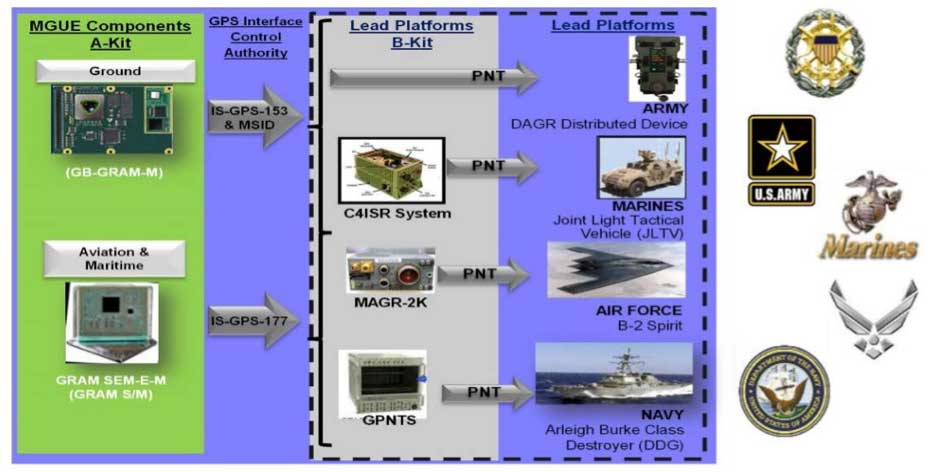
    The next-generation military receivers, known as Military GPS User Equipment (MGUE), are also under development by a range of vendors, of which L-3 Technologies was the first vendor to receive security certification in 2016. A number of equipment form factors are being developed to address land, sea and air platforms, and great progress is being made.

    Figure 2. Military GPS User Equipment (MGUE) will address a range of platforms. (Credit: Gerry Gleckel, Nov. 15, 2017)

    The U.S. Air Force recently completed a number of successful test flights of a prototype M-code receiver on board a B-2 stealth bomber, which marks an important milestone for the GPS modernization effort. Let’s remind ourselves what M-code is, and what it does for us.

    The promise of M-code

    Until now, the military has relied on the encrypted P(Y) code to provide advantage on the battlefield. Compared to the civilian C/A code, the P(Y) offered improved accuracy, ionospheric correction, resistance to spoofing and a marginal level of jamming resistance.

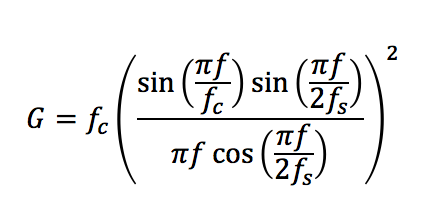
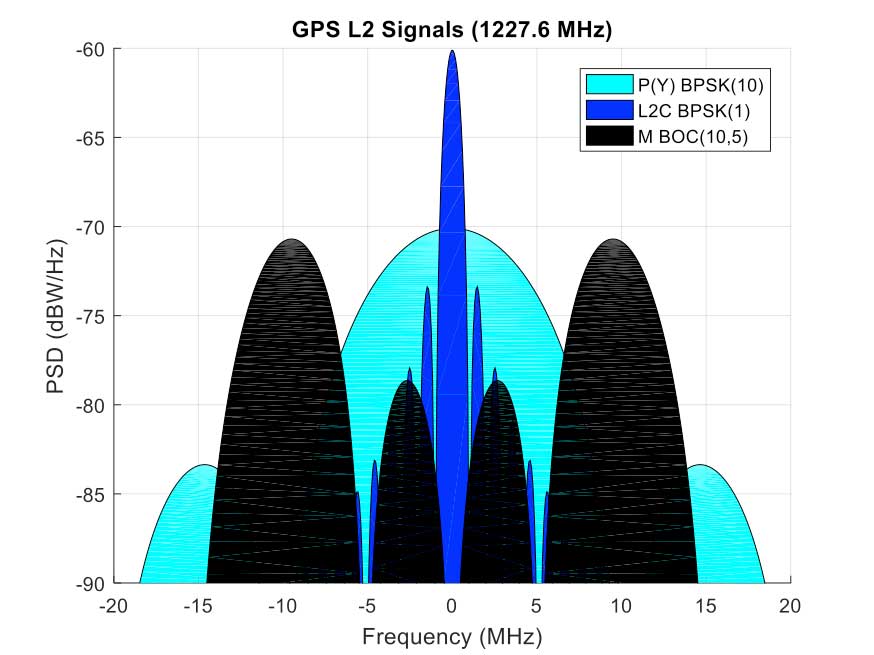
    M-code is quite a different picture. Rather than the traditional BPSK modulation schemes used by legacy signals, M-code utilizes a type of binary offset carrier (BOC) signal. In the case of M-code, the signal is a BOCsin(10,5) modulation, which has a power spectral density given by:

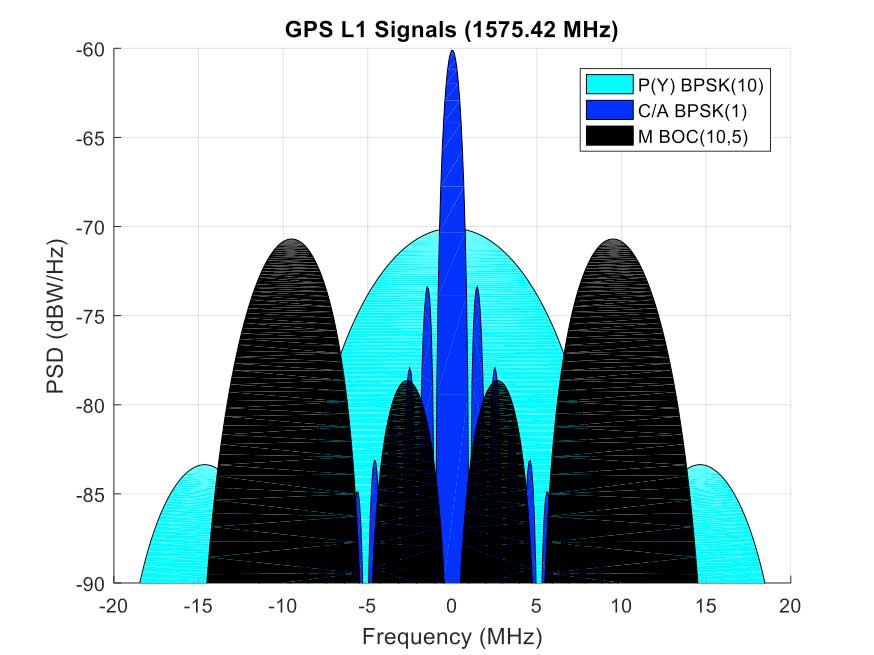
    This power spectral density can be seen in the figures below, along with legacy C/A and P(Y) codes (and also the new L2C signal on L2). The M-code BOC signal has a number of important properties; I won’t describe all of them, but I will pick out a couple.

    Firstly, the signal is able to support navigation warfare activities. Because the energy in the signal is spread in two lobes away from the center, it allows for the C/A code to be selectively jammed without affecting the military receivers. This is often referred to as “blue force jamming” or “blue on blue jamming,” where friendly forces might wish to perform jamming in an environment in which they are themselves operating. Currently, such blue force jamming is not possible with P(Y) code receivers, without also degrading the friendly force’s receiver.

    Another promise of M-code is the ability to use spot-beam transmissions from Block III satellites. This is where a high-gain antenna on the satellites aims the M-code signal at a specific region of the earth, with much greater received satellite power in that region. The received signal from the spot beam is expected to be around 20-dB more powerful than the conventional full-Earth coverage beam. This means that, in a given conflict region, military GPS receivers should be able to benefit from a large increase in jamming resistance.

    Figure 3a. M-code signal compared to traditional L1 GPS signal. (Image: Michael Jones)
    Figure 3b. M-code signal compared to traditional L2 GPS signal. (Image: Michael Jones)

    Shortly after the GPS Advisory Board meeting in California, on the other side of the Atlantic a range of defense PNT technologies was also discussed.

    International PNT experts gather in the UK

    The International Navigation Conference (INC 2017) is now in its third year, and has been steadily growing in prominence. This year’s event, which took place Nov. 27-30, focused on the themes of resilient PNT, autonomy, and sensor and data fusion. As usual, there was a substantial defense presence.

    I had the pleasure of chairing a few sessions, including a panel discussion on resilient PNT. The event began with a cross-government meeting, where representatives from across the UK government met to discuss PNT issues concerning defense and national security.

    What I loved about this conference is the sheer diversity of PNT topics that were discussed. In the military domain, it wasn’t just the traditional subjects of GNSS, inertial, visual and signals-of-opportunity that were discussed. Also considered was cognitive navigation — how does a soldier’s brain work when in an unfamiliar battlefield? And how will quantum technology benefit defense PNT in the medium to long term?

    The promise of quantum

    Quantum technology has for some time been touted as the future of PNT: clocks so accurate that you’ll never need to worry about timing again. Inertial measurement units that have so little drift, you’ll never need anything else for navigation.

    If you’re not familiar with quantum technology, let me explain. Quantum technology exploits science that cannot be explained by classical physics, such as Newtonian mechanics, thermodynamics and Maxwell’s electromagnetism.

    As atoms get colder, they have lower energy levels and move more slowly. Taking this argument all the way down to absolute zero, the atoms would stop moving. By using lasers to cool atoms to very near absolute zero, the atoms are essentially placed under precise control, and hence are sensitive to changes in the local magnetic and gravitational fields. What does this mean for navigation?

    An excellent INC 2017 session on quantum navigation revealed some of the answers. Dr. Tim Freegarde of the University of Southampton gave the keynote “Navigator’s Introduction to Quantum Technologies,” which was followed by sessions on quantum/classical combined navigation, and quantum technology for performing gravity gradient map matching.

    Quantum sensors rely on a phenomenon known as entanglement, where two physically separated systems are linked in such a way that a measurement of one affects the results of the other. Once atoms have been cooled, they can be made to travel in opposite directions around a loop, where the interference pattern generated allows rotation to be sensed.

    But the atoms can also be sensitive to gravitational and magnetic fields, and frequency. So, amongst many other things, quantum technology allows for more accurate atomic clocks, and rotational and gravitational sensors.

    A huge amount of money has been poured into quantum research in recent years and, whilst it’s clear there is still a long way to go, progress is certainly being made. At the UK National Quantum Technology Hub in Sensors and Metrology, the focus is on achieving sensors that are useful, and not necessarily to look for the highest possible precision. This is essential if quantum sensors for PNT are to be adopted by governments and industry.

    Cyber takes center stage

    At the end of the conference, I had the pleasure of chairing a lively panel discussion on resilient PNT, where I put a number of questions to both the panel and the audience.

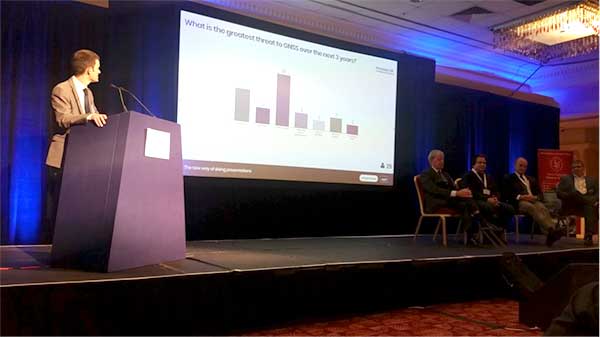
    Coming back to satellite navigation, my first question was, “What is the greatest threat to GNSS over the next three years?” You may be forgiven for thinking that “jamming” or “spoofing” was the top answer because, no, the top answer was in fact “cyber attack”.

    Figure 4. At the International Navigation Conference, the audience voted “cyber attack” as the greatest threat to GNSS. (Photo: Michael Jones)

    But what exactly do we mean by “cyber attack”? The word “cyber” is a pretty loose word, which is often misused as a catch-all phrase to cover anything that’s not RF related. Let’s quote the NIST definition of cyber attack:

    “An attack, via cyberspace, targeting an enterprise’s use of cyberspace for the purpose of disrupting, disabling, destroying or maliciously controlling a computing environment/infrastructure; or destroying the integrity of the data or stealing controlled information.”

    How does this apply to military PNT? Well, a key theme from the conference was the trend towards more complex PNT systems. No longer do we have a simple GPS receiver, but an ever-increasing mix of different PNT sensors, and a system more comparable to a computer than a traditional GPS receiver.

    What this means is that modern and future military PNT will be susceptible to the full range of cyber attacks currently associated with computing environments. Guy Buesnel from Spirent Communications gave an excellent keynote presentation where he covered this topic. Describing the “attack surface” for GNSS, he noted how many GNSS receivers currently run embedded operating systems such as VxWorks or Linux, and many support standard protocols such as TCP/IP and USB, all of which leaves them vulnerable to cyber attacks.

    But let’s not despair. The good news is that there is an awful lot to learn from the computing domain. After all, when computers first became vulnerable to cyber attacks, we quickly learned to make use of virus checkers, firewalls and other such mechanisms available to us. And now the domain of cyber security gives us an arsenal of defensive measures to combat cyber-space risks.

    I’ll finish by returning to the PNT Advisory Board meeting in California on Nov. 15, where Harold Martin, director of the National Coordination Office for Space-Based PNT, said “GPS is more computer than radio… GPS receivers lack cyber resilience. This is a national issue.”

    Don’t forget it.


    Equation figure: Michael Jones

  • Discussing the new North American-Pacific Geopotential Datum of 2022 — Part 4

    Discussing the new North American-Pacific Geopotential Datum of 2022 — Part 4

    My last column focused on the National Geodetic Survey’s (NGS) current plans for estimating North American-Pacific Geopotential Datum of 2022 (NAPGD2022) GNSS-derived orthometric heights and incorporating geodetic leveling data into NAPGD2022 to establish orthometric heights consistent with GNSS-derived NAPGD2022 orthometric heights. It emphasized that after NAPGD2022 is established, the primary means for deriving orthometric heights on monuments will be using GNSS observations combined with the geoid model.

    Recently, NGS published its second blueprint for the 2022 document titled “Blueprint for 2022, Part 2: Geopotential Coordinates.” The report addresses NAPGD2022 in detail. The intent of the document is to provide to the public the current status of plans by NGS to modernize the geopotential component of the National Spatial Reference System (NSRS) in 2022. This particular document covers the definition and determination of orthometric heights, geoid undulations, gravity, deflections of the vertical, dynamic heights, and any other quantity directly related to the geopotential field of the Earth. As mentioned my previous columns, NAPGD2022 will be replacing the North American Vertical Datum of 1988 (NAVD 88). The executive summary of report NGS 64 is provided in the box titled “Executive Summary, NOAA Technical Report NOS NGS 64, Blueprint for 2022, Part 2: Geopotential Coordinates.” Surveyors and mappers should obtain a basic understanding of the four interrelated products of NAPGD2022. They are GM2022, GEOID2022, DEFLEC2022, and GRAV2022. I’ve highlighted them in executive summary box below.

    Executive Summary


    NOAA Technical Report NOS NGS 64

    Blueprint for 2022, Part 2: Geopotential Coordinates
    In 2022, the entire National Spatial Reference System (NSRS) will be modernized. This document addresses the geopotential aspects of the NSRS, including every vertical datum, the geoid, gravity, deflections of the vertical, and other quantities related to Earth’s gravity field. Every one of these related, yet semi-independent sources of information will be replaced with an internally consistent geopotential datum called the North American-Pacific Geopotential Datum of 2022 (NAPGD2022). Within NAPGD2022 four primary, interrelated time-dependent products will exist:

    • A global model of Earth’s geopotential field (GM2022)
    • Regional gridded geoid undulation models (GEOID2022)
    • Regional gridded deflection of the vertical models (DEFLEC2022)
    • Regional gridded surface gravity models (GRAV2022)

    The three regions for the gridded models will be North America (covering CONUS, Alaska, Hawaii, the Caribbean, Canada, Mexico, Central America and Greenland), American Samoa and Guam/Commonwealth of Northern Mariana Islands (CNMI).

    NAPGD2022 will be built upon the IGS frame, as only minor (entirely horizontal) differences will exist between the IGS frame and the four new terrestrial reference frames developed as part of the NSRS in 2022 (see NGS, 2017). Since these differences will be relatively small horizontal displacements (mainly due to Euler pole rotations), NAPGD2022 will operate equally well in any of four new frames.
    Orthometric heights in NAPGD2022 will be defined through ellipsoid heights and GEOID2022. This means NAPGD2022 orthometric heights will primarily be accessed through Global Navigation Satellite System (GNSS) technology. GEOID2022 will be defined in a manner that best fits global mean sea level at the epoch of NAPGD2022. When global sea level changes by a threshold level of 20 centimeters, a new geoid model, and thus geopotential datum, will be released. Until then, updates to any component of NAPGD2022 will result in updating all components of NAPGD2022 using sequential version numbering.

    Leveling in NAPGD2022 will retain its current role of providing high-accuracy local differential orthometric heights. The determination of absolute heights, however, which will provide the context of local differential heights, will reside in the GNSS domain (i.e., will be based on IGS ellipsoid heights).

    Find this entire report here.

    There is a lot of good information in the report and I would encourage everyone to download the report and read it. Some of the report is technical but most of it provides simple and easy to understand explanations of very technical terms. Pages 22 and 23 of NGS 64 provides a good summary of the different components of NAPGD2022 (see box tilted “Excerpt from Section 9 of NGS 64”).

    Excerpt from Section 9 of NGS 64

    9 The 2022 Geopotential Datum


    1. In 2022, the NSRS will contain one geopotential datum, capable of providing (at a minimum) the geoid undulation, acceleration of gravity, geopotential number, and deflection of the vertical at any given latitude, longitude, ellipsoid height, and time in a global ideal reference frame, such as the International Terrestrial Reference Frame (ITRF) or International GNSS Service (IGS) frames. The name of this datum will be the North American-Pacific Geopotential Datum of 2022 (NAPGD2022).
    2.  

    3. The foundational component of NAPGD2022 will be a spherical13 harmonic model of Earth’s external gravitational potential, called (for now) the Geopotential Model of 2022 (GM2022).
       
      The GM2022 will be created for the entire Earth and will contain two components:
      1. The first component will be time independent, fixed at some epoch (TBD14) to a at least degree and order of 2160,15 called (for now) the Static Geopotential Model 2022 (SGM2022).
      2. Complementing SGM2022 will be a time-dependent model of Earth’s external gravitational potential, capable of capturing both secular and episodic changes of significance. This time-dependent model will be called (for now) the Dynamic Geopotential Model 2022 (DGM2022).


    4. Three derivative products, based upon GM2022, but requiring additional information and providing higher-resolution regional information than is contained in GM2022 will be created:
      1. A gridded geoid model GEOID2022,16 which will contain two components:
        1. The first will be time independent, fixed at some epoch (TBD) called (for now) the Static Geoid model of 2022 (SGEOID2022).
        2. Complementing this will be a time-dependent geoid undulation model, encompassing permanent geoid changes >= 1 millimeter per year, called the Dynamic Geoid model of 2022 (DGEOID2022).
      2. A gridded deflection of the vertical, DoV, model (at the surface of the Earth) DEFLEC2022, which will contain two components:
        1. The first will be time independent, fixed at some epoch (TBD) called (for now) the Static Deflection of the Vertical model of 2022 (SDEFLEC2022).
        2. Complementing this will be a time-dependent DoV model, called the Dynamic Deflection of the Vertical model of 2022 (DDEFLEC2022).
      3. A model for interpolating surface gravity GRAV2022, which will contain at least one, possibly two components:
        1. The first will be time independent, fixed at some epoch (TBD) called (for now) the Static Gravity model of 2022 (SGRAV2022).
        2. As a second, possible component, NGS will investigate the feasibility of a time-dependent surface gravity model.


    The three derivative-gridded products (GEOID2022, DEFLEC2022, and GRAV2022) will encompass three non-global areas. These three areas will be (latitude and longitude convention being positive north, positive east):

    The boxes titled “Figure 9-1 From NOS NGS 64,” “9-2 from NOS NGS 64,” and “9-3 from NOS NGS 64” depict the regions that GEOID2022, DEFLEC2022 and GRAV2022 will cover.

    Figure 9-1 From NOS NGS 64

    The North American region for GEOID2022, DEFLEC2022 and GRAV2022

    Figure 9-2 From NOS NGS 64

    The American Samoa region for GEOID2022, DEFLEC2022 and GRAV2022
    Figure 9-3 From NOS NGS 64

    The Guam and CNMI region for GEOID2022, DEFLEC2022, and GRAV2022

    So, what does this mean to the surveying and mapping community? First, as mentioned in my previous columns, there will be significant differences between NAPGD2022 and NAVD 88. Figure 1 depicts the approximate differences between NAPGD2022 and NAVD 88 in the conterminous United States.

    Figure 1 – Approximate Change Between NAPGD2022 and NAVD 88 Using GPS on BMs Data (units = cm). [Figure 1 is from June 2017 Survey Scene column.]

    For those still referring their products to NGVD 29, figure 2 depicts the approximate differences between NAPGD2022 and NGVD 29 in the conterminous United States.

    Figure 2 – Approximate Change Between NAPGD2022 and NGVD 29 Using GPS on BMs Data (units = cm). [Figure 2 is from the June 2017 Survey Scene column].

    My April 2017 Survey Scene column provided an estimate of the change between NAPGD2022 and NAVD 88 at bench marks with GNSS-derived ellipsoid heights in Alaska. Figure 3 is a plot of the GPS on BMs residuals computed using xGeoid16b geoid values, IGS08 ellipsoid heights, and NAVD 88 orthometric heights.

    Figure 3 – Approximate Change Between NAPGD2022 and NAVD 88 Using GPS on BMs Data (units = cm). GPS on Bench Mark Residuals Using xGeoid16b in the State of Alaska – Referenced to IGS08 (units = cm) – Green Line Represents the Leveling Lines [Figure 3 is from the April 2017 Survey Scene column.

    As outlined in NOS NGS 64 report and previously mentioned in this column, there are four interrelated products of NAPGD2022 – GM2022, GEOID2022, DEFLEC2022, and GRAV2022. What most surveyors will be using is GEOID2022 (SGEOID2022 and DGEOID2022). As explained in my last column, and part of NGS’ frequently asked questions about the new datums, users will access the NSRS using GNSS-derived ellipsoid heights and GEOID2022.

    How will accessing the National Spatial Reference System (NSRS) change with the release of the new datums?
    The NSRS will be accessed using Global Positioning System (GPS) technology that references Continuously Operating Reference Stations (CORS) and relies on a time-dependent gravimetric geoid model. This method of accessing the NSRS is a paradigm shift from accessing NAD 83 and NAVD 88 through the use of geodetic survey marks.

    It will not be necessary to connect to a geodetic monument, i.e., a bench mark, because the NATRF2022 ellipsoid height (hNATRF2022) is determined using the NGS CORS and the geoid model (NGEOID2022) is consistent with NATRF2022. In other words, GNSS ellipsoid heights (e.g., NATRF2022) combined with the geoid model (e.g., GEOID2022) will become the primary means for deriving orthometric heights on marks.

    There will be a static geoid model of 2022, denoted as SGEOID2022, which will be fixed at a specific epoch. Since the geoid model changes due to various factors, such as changes in sea level, glacial rebound, and seismic activities, there will be a dynamic aspect of the 2022 geoid model, denoted as DGEOID2022. The permanent changes to the geoid model are small and will take several years to become significant to affect the typical survey and mapping product. Saying that, it is important to understand that there is a static and a dynamic aspect of the National geoid model. NGS will provide a single GEOID2022 value which will apply the appropriate static and dynamic components of the geoid model.

    Even though, the primary access to NAPGD2022 will be using GNSS and a geoid model, users will still want to perform precise leveling observations and incorporate the results into NAPGD2022. My last column discussed incorporating leveling data into NAPGD2022. Differential leveling of high precision is used to observe elevation differences which are then used to establish precise heights of vertical control points (bench marks) above or below a reference surface, e.g., the North American Vertical Datum of 88 (NAVD 88) or North American-Pacific Geopotential Datum of 2022 (NAPGD2022). Differential leveling, conceptually a simple procedure, in practice lends itself to many types of small errors. To detect, reduce, and control these errors, specific procedures need to be adhered to and corrections must be applied. FGCS has documented the necessary procedures to be used in first-, second- and third-order geodetic leveling projects. Procedures do not always reduce error to tolerable values; therefore, additional corrections are applied by the office processing the data to remove known systematic errors.

    The box titled “Excerpt from Special Report Results of the General Adjustment of the North American Vertical Datum of 1988” provides a summary of the corrections applied to the leveling data used in NAVD 88. As you can see, gravity (highlighted in the box) plays an important role in estimating accurate orthometric heights. This is where GRAV2022 is important, it is used during the process of converting observed leveling height differences into orthometric height differences.

    Excerpt from Special Report – Results of the General Adjustment of the North American Vertical Datum of 1988

    (https://www.ngs.noaa.gov/PUBS_LIB/NAVD88/navd88report.htm)
    David B. Zilkoski, John H. Richards, and Gary M. Young
    American Congress on Surveying and Mapping Surveying and Land Information Systems, Vol. 52, No. 3, 1992, pp.133-149
    Corrections Applied to Leveling Data

    The leveling observations used in NAVD 88 were corrected for rod scale and temperature, level collimation, and astronomic, refraction, and magnetic effects (Balazs and Young 1982; Holdahl et al. 1986). All geopotential differences were generated and validated, using interpolated gravity values based on actual gravity data. Geopotential differences were used as observations in the least-squares adjustment, geopotential numbers were solved for as unknowns, and orthometric heights were computed using the well-known Helmert height reduction (Helmert 1890): H = C/(g + 0.0424H), where C is the estimated geopotential number in gpu, g is the gravity value at the benchmark in gals, and H is the orthometric height in kilometers. The weight of an observation was calculated as the inverse of the variance of the observation, where the variance of the observation is the square of the a priori standard error multiplied by the kilometers of leveling divided by the number of runnings.

    This column highlighted two components of NAPGD2022 – the geoid undulation model of GEOID2022 and gravity model of GRAV2022. It expressed that these two models will be very important to future surveyors and mappers that are incorporating geodetic data into the North American-Pacific Vertical Datum of 2022 (NAPGD2022). As previously mentioned, I would encourage everyone to download and read NGS recently published second blueprint for 2022 document, titled “Blueprint for 2022, Part 2: Geopotential Coordinates.” This column also emphasized the significant differences between NAPGD2022 and the U.S. National Vertical Datums of NAVD 88 and NGVD 29. My next column will provide the latest details of NGS’ 2018 GPS on BMs campaign which will be used to develop transformation tools for converting products and services from NAVD 88 to NAPGD2022.

  • Unicore presents heading module, GNSS SoC at Intergeo 2017

    Unicore Communications’ Kongzhe Chen discusses the company’s UM482 all-system multi-frequency high-precision heading module and UFirebird UC6226 GNSS SoC at Intergeo 2017, which took place Sept. 26-28 in Berlin, Germany.

  • Juniper debuts tablet, GNSS receiver at Intergeo 2017

    At Intergeo 2017, Juniper System Ltd.’s Simon Bowe gives GPS World a rundown on two of the company’s latest products: the Mesa 2 tablet and Geode real-time sub-meter GNSS receiver. Learn about the features of the two products.

  • Hemisphere GNSS introduces new boards, smart antenna at Intergeo 2017

    Hemisphere GNSS’ Miles Ware gives GPS World an overview of the new products the company brought to Intergeo 2017, including its H220 OEM board, H328 GNSS compass board, P328 OEM board and S321+ survey smart antenna.

  • Lidar USA showcases scanner at Intergeo 2017

    Lidar USA’s Daniel Fagerman discusses the company’s Snoopy A-Series multi-vehicle configurable scanner at Intergeo 2017, which took place Sept. 26-28 in Berlin, Germany. According to the company, you can use the Snoopy A-Series to scan almost anything with a click of a button.