Author: Alan Cameron

  • Out in Front: Beyond Cute

    Michibiki has more Twitter followers than you and me put together. All of you, and all of me with my 17 followers. Michibiki hit 16,284 when I signed on just now, and she (he?) has not yet even emerged upon the global stage. Perhaps by the time you read this, if the September 11 launch date holds true, s/he will be an orbiting, broadcasting entity.

    Michibiki-Alan
    Michibiki

    Why follow a satellite? One might well ask why follow anything or anyone these days. For utterings momentous or vacuous, leavened in lucky moments by a bit of gossip, or an even rarer bit of news. It’s a good bet that Michibiki’s scriptwriters will display more intelligence than the mass of online mouths. Right now it’s hard to tell; they communicate in Japanese, which comes through my browser as so many question marks.

    For intelligence is what the Michibiki anthropomorphizing — from the creation of a friendly, pettable caricature to the establishment of a Twitter voice — is all about. Savvy marketing by purposeful people to an audience that they have studied and know well. This goes beyond the cute that large segments of Japan have a fondness for. It has the goal of buliding a solid, sustained client core for location-based services, powered by QZSS signals.

    Other places where LBS have failed to take hold — and this means everywhere — despite their vast potential utility, would do well to watch and learn.

    As cell-phone text-message readers and e-mail users (could there be a broader market segment, other than people who eat and breathe?) become accustomed to receiving messages from Michibiki, they will subtly but increasingly think of this 4,000-kilogram, 40,000-kilometer high hunk of orbiting metal and circuitry as a personality, and even, a friend. They will be open to suggestions, impressionable and cute-prone teens and twenty-somethings, especially so. This is the next generation of satnav users. Or I should say, this is the Now Generation of satnav users.

    Young men and women with places to go and friends to see will remember Michibiki, and call upon her/him often. “My guide will tell me how to get there. With added services, my guide will also track my friends right now, and tell me where they are. My guide can do many more wonderful things for me: here is a list of them.”

    By no means  do I suggest that the U.S. GPS Industry Council or the Galileo Supervisory Authority or Roscosmos rush out and commission a cartoon character based on their respective space vehicles. Different markets require different approaches, and careful study.

    The Now Generation of satnav users is coming through, to supplant current users, and uses. They’ll soon rattle your windows and shake down your walls. If your time to you is worth saving, I do suggest that you pick up on social media. That is the message my own marketing staff keeps drumming into this obdurate old head.

  • Out in Front: EGNOS Up

    We now definitively declare “curtain up!” on the second act of the human and technological drama, Interoperable Global Navigation Satellite Systems, by many authors, directors, and actors, upon the global stage. It happened on August 2 with removal of the message 0 (“Do Not Use in aviation”), by the European Satellite Services Provider, from the European Geostationary Navigation Overlay Service (EGNOS) signal. It enables EGNOS use for en-route and lateral guidance approaches.

    The first act of our drama, of course, saw the U.S. GPS achieve operational capability, not to mention enthusiastic worldwide reception and application. We might have declared the second act open upon GLONASS operability, intermittent though that has been — but GLONASS is not (yet) interoperable with GPS. We might have marked its beginning in 2003, when the European Council of Transport Ministers approved the Galileo program, or in 2006, when Galileo launched its first satellite and broadcast its first signal in space. But no useable navigation message has yet emanated.

    The EGNOS signal is essentially a corrected GPS signal. Still, its certification for use in aviation embodies an international, interoperable navigation signal from space.

    (Legalistic note: “After an operational period of three months [following August 2], the EC will declare the Safety of life (SoL) service available to the aviation community, enabling the publication of precision approach procedures with vertical and lateral navigation guidance (APV) based on EGNOS. At that time, European air navigation service providers will be in position to implement satellite-based precision approaches . . . .)

    Chairman Mao said “The march of 10,000 li begins with a single step.” We have taken more than a few steps, though still at the beginning of our journey. Curtain’s up, vistas are wide. Let’s keep moving.

  • Kick It in and Push!

    By Alan Cameron

    The Elephant Charge (“Dust, Sweat, and Gears”), an annual off-road motorsport charity event, brings together competitors, their families, and supporters for a wilderness weekend of GPS-driven fun and frenzy in the Zambian bush. I’m for fun, but I always wince when I see folks tearing up habitat in the name of saving it.

    Elephant Charge 2010 seeks to raise funds and awareness for local conservation in Zambia, specifically for two hides, or wildlife observation posts, in Lusaka National Park along with funding for the South Luangwa, Lower Zambezi and Kafue National Parks private-sector conservation efforts. Organizers hope to attract more than 300 campers over the weekend of October 23–25 and as many day observers and participants, en route to a fundraising goal of $35,000.

    Focus of the weekend is an event for car and motorbike teams that requires stamina, sweat, driving, and navigation skills through the Zambian bush. Maps showing the location and GPS coordinates of nine checkpoints are issued to teams on the evening before the race. To win, a team must complete the nine-checkpoint course in the shortest distance among competitors. Each team finds it own route between the checkpoints, in any order, through valleys, over ridges, and up (or down) escarpments. The goal of short distance explicitly encourages teams to go off-road in their vehicles. Bush roads are cut to each checkpoint and marked on the issued maps, however they never give the shortest distance.

    The blog piece you are reading is armchair bushwhacking at best, and it’s hard for me to preach at a distance to Zambians on how to use, exploit, preserve, or tear up their own turf. Of course it’s heartening to see GPS enlisted in conservation and education efforts. I just wish they weren’t harming habitat — by cutting bush roads and further encouraging racers to rip off through the vegetation — in order to help preserve it.

    Visit www.elephantcharge.org for more information.

    Alternatively, for a terrific vicarious experience of the Africa savannahs and bush without leaving home, read either Don’t Let’s Go to the Dogs Tonight by Alexandra Fuller, set in Rhodesia, Zambia, and Malawi, or Sand Rivers by Peter Mathiessen, set in Tanzania. “The crack of the dry grass, the intense heat, the startling beauty of the birds, the fleeting glimpse of wary wildlife . . .”

  • Out in Front: Welling Up

    oilcover
    September 1992.

    One of the first industrial uses of GPS came in survey and seismic exploration for offshore oil, as evidenced by the cover story of this magazine’s September 1992 issue. A salient passage from that 18-year-old “Quality Control For Differential GPS in Offshore Oil and Gas Exploration” article:

    “Users are in danger of being mesmerized by the apparent simplicty of the technology and abandoning quality-control principles . . . . The key to routine operations is rigorous real-time quality control.” Eerily, among the companies acknowledged for support of that article was BP Exploration.

    Oil companies early-adopted GPS and private satellite differential correction services, and remain enthusiastic users today, for monitoring of and navigation around deep-sea rigs. The March 2010 cover story shows how this field continues to forge ahead, now as early adopters of multi-GNSS technology.

    Positioning, navigation, and timing had nothing to do with the disaster in the Gulf of Mexico, but some important lessons float there for our learning. They concern engineering principles — principally in not forsaking them.

    The full Deepwater Horizon story has yet to emerge, but it seems abundantly clear that corner-cutting and downright elimination of basic practices led to the disaster. When a natural aberration occurred, it blew right through several weakened backup systems and safety guards, ones that were withdrawn or restricted only days earlier, to shave costs and time.

    Beancounting and other modern business practices have undermined vital enginering principles — rigorous mathematical analysis, based firmly in the laws of physics, situational and historical experience, and what may seem to be overcautious safety margins — not just in the Gulf, but everywhere we look, including our own GNSS backyard. Control of technical programs in both private and public sectors now rests in the hands of non-technical people who owe highest allegiance to the almighty dollar. CPAs trump engineering Ph.D.s. If a disaster hasn’t happened (yet), there’s no need to guard against it, they believe.

    Has anybody here seen my old friend Loran-C?
    Can you tell me where he’s gone?
    He guided ships and airplanes,
    But it seems the budget’s slashing-prone.
    You know, I just looked around, and he’s gone.

  • The System: First IIF Satellite Speeds into Orbit


    At press time, GPS spacecraft IIF-1 was set to be launched May 27 from Cape Canaveral Air Force Station in Florida. This first of a new generation of satellites will travel quickly — instead of taking several days to reach its orbital slot, the new satellite should make the journey in three-and-a-half hours.

    The new IIFs will broadcast the operational civil L5 signal, intended for safety-of-life applications. It will be compatible with Galileo, GLONASS, and QZSS, with the goal to be interoperable as well. L5 will transmit at a higher power than current civil GPS signals, with wider bandwidth and lower frequency that may enhance indoor reception.

    IIF-1 caught its breathless ride aboard a Delta 4 rocket from the United Launch Alliance, a joint venture of Lockheed Martin and Boeing, formed in late 2006.

    Earlier GPS satellites rode on smaller Delta 2 rockets that, although reliable, did not possess the oomph to place space vehicles directly into the orbiting constellation, 11,000 miles high. Delta 2s put satellites into highly elliptical orbits looping from as low as 100 miles above Earth at perigee to the 11,000-mile apogee. At a strategic point, a solid-fuel kick motor attached to the satellites pushed them into position for circular orbit on high.

    The more powerful Delta 4 will shoot the IIFs directly into their destination slots. Future IIF launches may also use similarly equipped Atlas 5 rockets. The next IIF satellite, GPS IIF-2, could rise aboard an Atlas 5 as early as November.

    The IIF generation, manufactured by Boeing for the U.S. Air Force, is designed not only to broadcast the new civil L5 signal, but have a longer design life of 12 years and faster processors with more memory. “These next-generation satellites provide improved accuracy through advanced atomic clocks, a more jam-resistant military signal, and a new civil signal that benefits aviation safety and search-and-rescue efforts,” said Craig Cooning, vice president and general manager, Boeing Space and Intelligence Systems.

    “GPS IIF will increase the signal power, precision, and capacity of the system, and form the core of the GPS constellation for years to come,” said Air Force Col. David Madden, GPS Wing commander.

    A total of 12 IIF satellites will make their contribution to getting the new L2C and L5 signals closer to operational capability before the GPS III generation takes over, beginning with a 2014 launch.

    As the first spacecraft in the GPS IIF series, GPS IIF-1 underwent stringent and comprehensive testing following shipment to the launch site in February. Tests included verification of key satellite functions as well as end-to-end system testing to verify operations between the satellite and the ground control segment at Schriever Air Force Base in Colorado.

    Commands were sent from Schriever to GPS IIF-1 at Cape Canaveral to turn on payloads, reprogram processors, and verify interoperability with user receivers and equipment, both civil and military.

    Launch of the satellite, originally scheduled for May 20, was delayed four times because of various technical problems.


  • Out in Front: Brussels Calling

    The European Commission rang up the other day, concerned that a recent column contained misperceptions about the Galileo Open Service Signal-in-Space Interface Control Document (ICD). I replied that if misperception exists, it is shared by at least some in industry. Though the EC has abandoned a plan to charge for licenses, its requirement for a free license and continued talk of patents on the Galileo signal dampen industry enthusiasm for making Galileo receivers, at least in North America.

    Herewith, some Brussels counterpoint. “In the previous [ICD] there were some patents characterizing the signal, that could not be commercially exploited. The new publication completely removes these. We now propose a licensing agreement that aims to eliminate any barrier in the wide exploitation of the asset. Both licenses [research and manufacture] are based on non-discrimination. There is no exclusive basis, and they are absolutely free of charge. Furthermore, there is no geographical limitation.

    “Regarding the duration of the license, we are assuming 10 years. We believe this is a proper timeframe, considering the lifecycle investment of this sector. A patent can be enforced for 20 years. The patents that we own are already about five or six years old. If you add 10 years, you almost get to the end.

    “We ask companies to provide us with information on the use of these patents: whether they are used for high-precision receivers, for testing purposes, and so on. We ask for an update on a yearly basis, for information on the intended use. The only purpose is to have a good grip on the marketing, to guarantee a traceability of market needs, to interpret its evolution in a fast-changing context, and therefore enable the Commission to closely follow and support customer needs. In case a manufacturer will develop some patent on top of our patents, they have to notify us. That is, I believe, standard practice.

    “It is not our intention to create barriers to access of this signal. Manufacturers have nothing to fear from providing basic information in these licenses. We want to foster innovation and promote competition.

    “It might seem we are a team of lawyers creating problems where there should not be any. I am an aerospace engineer, not a lawyer.

    “[Complaints] could be more a point of perception. In concrete terms, we are not much different [than GPS]. We want to keep track of what we are giving away for free. We want the widest possible access to the signals. If there are any doubts, we invite manufacturers to contact us directly to work out any misunderstandings.”

    The EC was sincerely surprised to learn of discontent with the process and the patents, and hopes to have further dialog with all manufacturers.

    I was puzzled by the patents: why were they taken in the first place? It’s as if you had drawn a line in the sand, from which you now feel unable to back away, even though you might like to, and it’s clearly the best idea. The EC maintains these date from the public-private partnership effort, where intelllectual property rights were (IPR) were for the private sector a non-negligible form of revenue. Since funding has shifted to public money, “the situation has changed, and we have modified our approach.”

  • World Domination: The Sequel

    Perhaps we should call this The Interquel rather than The Sequel, as the latter will take place September 23 in Portland, Oregon, during the ION GNSS 2010 Conference.

    In January, 12 brave individuals joined me in San Diego to see if this thing would work at all.  It did!  The exercise revealed many adjustments needed to the game, but overall, a successful role-playing, negotiation game grounded in the workings of GNSS.

    The rules are briefly recounted in an earlier blog, and to large extent, they will remain unchanged for the full-on game, to be played by 12 teams of 9 people each in Portland. It’s mostly the metrics that need some tinkering, a few of the quantities that govern exchange, and renewal of each team’s resources at the end of each quarter.

    Here are each team’s goals over three quarters of play, and the points that they actually racked up. User communities could purchase receivers for as many signals as were “on the air,” from any national satellite system.  Interoperability rules!

    GPS System Operator     Goals: 40 satellites, 3 global signals     Achieved: 45 satellites, 3 global (civil) signals
    U.S. GPS/GNSS Industry     Goals:$750 million     Achieved:$1.55 billion
    U.S. User Community     Goals 100 million 3-frequency receivers, 100 million 4-frequency receivers      Achieved: 50 million 3-frequency receivers, 100 million 4-frequency receivers

    Galileo System Operator     Goals:30 satellites, 2 global signals     Achieved:35 satellites, 2 global civil signals
    European GNSS Industry    Goals: $750 million     Achieved: $1.25 billion
    European User Community    Goals:100 million 3-frequency receivers, 100 million 4-frequency receivers     Achieved:100 million 3-frequency receivers, 200 million 4-frequency receivers

    GLONASS System Operator     Goals:35 satellites, 2 global signals      Achieved: 25 satellites, 1 global sigal
    Russian GLONASS/GNSS Industry      Goals: $500 million     Achieved: $1.325 billion
    Russian User Community     Goals: 50 million 3-frequency receivers, 50 million 4-frequency receivers    Achieved: 300 million 3-frequency receivers

    Compass System Operator      Goals: 30 satellites, 2 global signals     Achieved: 45 satellites, 3 global civil signals
    Chinese GNSS Industry     Goals: $1 billion      Achieved: $1.3 billion
    Chinese User Community     Goals: 50 million 4-frequency receivers, 200 million 3-frequency receivers      Achieved: 150 million 3-frequency receivers

    As you can see, those performing strongest relative to their goals, or outperforming their goals (in other words, the gamemaster’s expectations) were all industries, across nations (making out like bandits), and the Compass system operator.

    Auguries for the future?

    Those performing less well, relative to goals, were the Russian system operator, and the Chinese user community.

    Again, auguries anyone?

    Those playing the respective parts above were: Frank van Diggelen, John Betz, Chris Hegarty, Dorotoa Grejner-Brzezinska with Kathleen Bosely, Sam Pullen, Ron Hatch, Matt Harris, Sasha Mitelman, Maarten Ujit de Haag, Tim Murphy, Thomas Pany, and Jade Morton.

    Here is some of the feedback gathered at the scene:

    have smaller-denomination bills in the mix;
    at the same time, multiply all cost amounts by factor 5 to make them more realistic;
    have a banker available on the side during play;
    all deals/transactions must complete in the quarter when negotiated; no carryover;
    increase the number of receivers;
    create moment(s) of randomness with a wheel of fortune or change cards;
    use a laptop to quickly compute each quarter’s new payouts for each team;
    satellites that reach end-of-life should do so during a quarter, rather than once it ends.

    All will be fine-tuned and trotted out again in Portland. Thanks to all players for participating.

    Sleep was what I wanted, you know what I got.  Wide awake, staying up late, wishing I was not.

  • Out in Front: What’s in a Number?

    Computers killed a trusty companion of my teenage years. That is, after those proto-computers known as pocket calculators knocked him out and left him unconscious on the cooling floor.

    But I come to praise my slide rule, not to bury him.

    I marveled at the way he worked. You had a tactile relationship with numbers on a slide rule. You could see — and feel — how a small adjustment here effected a big change over there. With computers, it’s just numbers in, numbers out.

    Maybe that high-tech approach led both the GPS Wing and the Government Accountability Office into trouble with constellation gaps. GPS satellites have proven themselves very hardy in space, outlasting their predicted lifetimes. The GPS Wing has grown to lean on those longer lives a bit, and what with Congress and the Administration booting budgets a year or two to the right with addictive regularity, the Air Force has saved money by replenishing upon need. And need has been not all that great, so replenishment, and the contract awards and manufacturing that feed the replenishing line, have been allowed to relax.

    But not the mathematical models that someone has held to more conservative standards. Those models use the shorter predicted satellite lifetimes. When those models were projected against the real-world timelines for IIF and Block III — whoa GAO! Some black gaps suddenly yawned.

    Now we learn that GAO and the Wing will re-undertake this exercise, factoring instead the longer lifetimes that the satellites have proved capable of. Tinker a small adjustment here, see a big change out there.

    Speaking of numbers, I’ve grown fond of 20, and lately enamored of 200. The former being the number of years we have published this magazine, the latter the new world record for GNSS technical articles, attained by one Richard B. Langley.

    With characteristic Canadian unbravura, Langley fidgets and frets that we have made too much of him on this magazine’s cover and page 42. It looks too braggy for him and he feels uncomfortable with it. But I have prevailed upon him to swallow his humility, to take one for the team. We bask in his reflected glory.

    Quick, what’s the difference between 160 and 144.5? Not in absolute terms, but in tactical advantage. If I add a metric, east longitude, geosynchronous orbit, does that help? I’m puzzling out why Compass would move its G1 satellite from one location to another after only ten days in space. Better ground control might be the answer. But more mystifying, why China’s spokespersons at the Munich Summit would proffer the first location, when they must know very well — in fact, they so admitted when I confronted them with it — that the second is actually the case.

    Numbers don’t obfuscate. People do.

  • The System: Vistas from the Summit

    “This is an event where one gets one’s goals for the next year.” Paul Verhoef, program director for satellite navigation programs of the European Commission, may have exaggerated for effect, and for the benefit of his audience and hosts at the Munich Satellite Navigation Summit in March. But not by much.

    The conference, now in its eighth year, has assumed increasing importance on the international circuit of GNSS policymakers and communicators. Although with a decidedly European bent, it draws representatives from most if not all systems to mingle and present. A 16-member delegation from China’s Compass system furnished one of the liveliest topics of conversation — and speculation.

    “When we started in 2003, there were many technical conferences on the one side, and we saw a niche for the institutional and political side of satellite navigation,” said Berned Eissfeller of the Institute of Geodesy and Navigation, German Federal Armed Forces University, conference director and host. You can watch video clips of Eissfeller and other speakers.

    GNSS came in for a check-up, a sort of self-examination this time. The 2009 conference was titled “The GNSS Race,” but this year it was “GNSS — Quo Vadis?” The Latin phrase means “Where are you going?” Following program updates, sessions focused on safety-of-life, compatibility, legal/intellectual property, and privacy issues.

    Galileo. Paul Verhoef continued his remarks that open this story. “I have been given [my goal]: Galileo must succeed.

    “You know the world today is not what it was a year ago. It means obviously the financial crisis has had an impact on our economies, on public finance, and therefore I would not be surprised it may leave its mark on satellite navigation. The reason is simple: the systems that are either operating or being deployed are being publicly financed. Galileo is the only system that is financed from a purely civilian budget. All the systems need more than ever to demonstrate their public utility.

    “I put it to you that this is an opportunity. As we’ve already heard, there is much to be gained in this market. After the PC, mobile communications, and Internet, satellite navigation is the next breakthrough technology. There are enormous revenues foreseen and already present in this market. There are many jobs possible for those who want to get it, and we think from the European side we have an enormous chance of capitalizing on this among other things by investing in this technology. Therefore, Galileo- and EGNOS-based innovation is certainly politically of interest.

    “Obviously, it is not a path of roses. There will no doubt be many more critical questions during these days. However, from our side, we have set our goals. I think they are modest, but they are firm. We want to be the second system of choice. At least in the first instance, we will see where we will go after that. Obviously, this is going to cost a bit of time. I shall invite you, if you get impatient, if the public gets impatient, to look at the history of the other systems. Developing and deploying these other systems is costing time.

    “We think that Galileo will meet its deadlines. I think one of the important messages this year, and you have seen it, we are putting things in place. There are contracts in place, there are satellites on order, there are launches on order, there are installations being built — Oberpfaffenhoffen, Fucino, there are others around the world — EGNOS is operational, we’re going to declare the safety-of-life of EGNOS later this year. So we are really moving forward at good speed at the moment.

    “We need to win the hearts of the users, the application providers, and the service providers. At the downstream market is the real challenge for these systems. We need to help do that. We are addressing this among other things by providing a more and more reliable schedule for availability of Galileo and EGNOS services.”

    Galileo ICD Soon. “We are about to publish in the next couple of weeks the so-called signal-in-space Open Service interface control document, which I know a number of you have waited for a long time.

    “We need also to move forward at a political level. In this case, no GNSS system can be credible if it is not backed by a long-term political commitment particularly by its owner. So after the decision of the Parliament and the Council to deploy the system, these two institutions are now clearly called upon to provide us such political long-term commitment that is credible in the eyes of the users.”

    GPS. Anthony Russo, director of the U.S. National Space-Based PNT Coordination Office, said “Keeping cards close to the chest in a competitive situation can well become a liability, creating a future need for a re-work or undoing if you paint yourself into a technological corner.” This appeared to refer to China and its Compass system; information has been singularly difficult to obtain on almost every aspect of this budding constellation.

    Regarding the April 2009 U.S. General Accountability Office report that forecast gaps in constellation availability, Russo stated, “The GAO will revise its report somewhat. They were using a model that was a little too cautious, one used by the [GPS] Wing. But satellites on orbit have been performing past estimated life. Further, we can turn off secondary payloads to conserve energy onboard satellites [and thus extend life] if needed.”

    The next morning, Lt. Col. Liz Roper, Air Force Space Command, gave a status and modernization briefing; the most eagerly awaited development is the launch of the first Block II-F satellite, scheduled for some time in May. She alluded to “a few setbacks” from the August 2009 launch of SVN49 with its well-documented signal problems, but emphasized the episode’s “positive aspects: the relationships we’ve been able to build in seeking solutions to that situation.”

    GLONASS. Grigoriy Stupak, deputy general director and general designer on GLONASS systems, briefed the audience in fluent Russian. For a recent launch update, see story below.


    Compass. Two of the Chinese delegates spoke in the opening session. Jiao Wenhai from China Satellite Navigation Office did elaborate the basic principles of the Beidou (Compass) system:

    • openness (“China will widely and thoroughly communicate with other countries on satellite navigation issues.”)
    • independence
    • compatibility (“China will pursue solutions to realize compatibility and interoperability with other satellite navigation systems.”)
    • gradualness.

    He promised an English-language version of the governmental website www.beidou.gov.cn or www.compass.gov.cn “soon.” Wenhai recapped:

    • the frequencies Compass will use: 1561.098, 1207.14, and 1268.52 Mhz in Phase II until 2012; and 1575.42, 1191.795, and 1268.52 in Phase III by 2020.
    • the general development plan: five geosynchronous, five inclined geosynchronous, and four mid-Earth orbit satellites providing a Chinese regional service using mainly Compass Phase II signals; then development of a global service broadcasting mainly Compass Phase III signals from five GEO, three IGSO, and 27 MEO satellites.

    The Chinese speakers displayed a certain disingenuousness in giving verbally and in their slides the location of the January launch, Beidou G1 geostationary satellite, as 160 degrees East, somewhere over the open Pacific. When GPS World pointed out that NORAD satellite tracking shows G1 has been repositioned to a slot at 144.5 degrees East longitude, they huddled for several minutes before stating that yes, it had moved to that position and was undergoing in-orbit testing. That spot was previously occupied by Beidou 1D, apparently decommisioned about a year ago due to power problems. 1D currently orbits in graveyard above geostationary altitude.

    A personage civilly associated with the U.S. Air Force confirmed the actual G1 location to the magazine, and could only speculate that it was more advantageous to Chinese ground control for monitoring and testing. As to why spokespersons misstated the location, that remains inscrutable.

    GLONASS Back in Black

    Three GLONASS-M satellites launched on March 1 are expected to enter service on March 22 and March 30, according to deputy general director Grigoriy Stupak’s statement in Munich. This would bring the constellation, according to his calculations, to 23 operational satellites, though two of those are held in reserve.

    With 21 satellites broadcasting signals, the system claim 98.5 percent global availability. Block 42 (three more satellites) has an August 2010 launch date, and Block 43 one for November 2010. By December, Stupak predicted 24 active satellites on orbit, for 99.5 percent global availability.

    The GLONASS-M satellites have a stated seven-year lifetime. CDMA signals will begin with next-generation GLONASS-K satellites, while FDMA signals continue in parallel. The Russians plan to “reach 5-meter accuracy by 2017, almost equal to accuracy of other GNSS,” and are “paying more attention to differential corrections for integrity monitoring.”

    ICG Questions

    The International Committee on GNSS (ICG) Working Group on Compatibility and Interoperability invites GPS industry members to fill out a questionnaire, provided online in two formats: as a downloadable MS Word document or a PDF.

    The Industry and User Community Questionnaire is designed to obtain worldwide input from industry, academic institutions, and other representatives of the GNSS user community with technical expertise regarding GNSS signals and other system characteristics that aid or hinder the combined use of the signals in applications, equipment, or services. For instance, respondents are asked to grade certain signal characteristics as to their importance in overall interoperability considerations for a particular type of application.

    Respondents are asked to e-mail completed questionnaires to the ICG by May 28.

    To download instructions and the form, go to env-gpsworld-integration.kinsta.cloud/icg.

  • Research and Other Hard Things

    Once again, I reach into the mail bag to pull out this gem, from someone both high up and deep down in administrative matters relating to GPS and other technologies. Herewith:


    Two quotes — with Some Accompanying Thoughts

    “If we knew what we were doing, it wouldn’t be called research, would it?”
    —Albert Einstein
    Too often these days we seem driven to produce, forgetting the purpose and value of research and development.  R&D allows us to assess alternatives, identify and mitigate risks, and develop practicable plans to achieve results.  It promotes an iterative process that moves us steadily towards our goals.  It understands both of the 80/20 rules: First, that achieving 80% of the solution usually takes only  20% of allocated resources, and second, that for  any normal program, things will go wrong 20% of the time, so plan accordingly.

    The fact is that we simply do not do enough real research and development.  We have forgotten that the development of products or systems or solutions does not proceed on a single path point-to-point.  It is a continuum that has many ideas going in, a reasonable number that survive intermediate vetting processes, and a manageable field of candidate solutions coming out, from which to pick “the best” alternative.

    We are not comfortable planning for sufficient small failures to ensure that we will not end up with one big one.  We limit the potential value of our successes by not supporting  wild and crazy ideas — even though such ideas may hold the key to real and sustained improvements.  We are too risk adverse.  We are too “results – NOW!” oriented.  We are afraid of failures – even small ones.  We are scared to dream.

    “We choose to go to the moon in this decade and do the other things, not because they are easy, but because they are hard, because that goal will serve to organize and measure the best of our energies and skills, because that challenge is one that we are willing to accept, one we are unwilling to postpone, and one which we intend to win…”
    —John F. Kennedy

    Sadly, we have lost what made us great in the past: our willingness to take risks, fight for ideals, vigorously debate technical and operational alternatives, and move forward as one — either towards a celebration of a successful conclusion or, if nothing else, a celebration of a significant learning experience from which we can dust ourselves off and do better next time.   We have abandoned our can-do attitude for lists of excuses of why we cannot.  We over-think and over analyze and over-control everything — at every level.  Most seriously of all, we have given up seeing ourselves as one team with one goal.  Everyone’s looking out for themselves — with more time spent looking back in fear than forging new pathways forward.

    The question is not “Where have all the leaders gone?” but rather “As leaders, what can each of us do to re-build and re-energize our risk taking leadership structure, our can-do team culture, our engineering inquisitiveness, our research and development mentality?

    As with all things, the solution starts with the true recognition of the problem.

    Therapy, anyone?

    Sleep was what I wanted, you know what I got.  Wide awake, staying up late, wishing I was not.

  • Wide Awake Bridging the Gap

    I gave this talk at the Munich Satellite Navigation Summit, in a concluding session titled “Bridging the Gap: A Journalistic View on Progress and Problems of GNSS.”

    __________
    Before telling you what I came here to say today, I should really attempt to answer the question posed by our moderator:Is the world ready for new GNSS applications and services?

    If by that we mean system modernization and newly envisioned applications, the  cutting edge, I say: No. What the world has a crying need for are older GNSS applications and services, ones that we in this room may take for granted, perhaps even view as somewhat passé.  But the vast majority of the world knows nothing of them, and has yet to experience their benefits.

    Giving a journalist’s perspective could be difficult because journalists aren’t supposed to have perspective. Our task is to report the news, just the facts.

    In satellite navigation, governed by physics and radio frequency, one might expect facts to prevail.

    Not always.

    Of course in the technical articles at the core of the magazine, facts rule.

    But in the news that I write, The System, in effect GNSS Quo Vadis — in the news, facts may be in short supply.

    This news is filled with projections, timelines, trends, expectations, a triumph or two, some disappointments, budgets, negotiations, market readiness. Facts come in a distant second.

    Because I cover new developments in constellations on orbit, in ground control and monitoring, in plans and policies and rivalries. All these are created by people.

    By you, in fact. You and your colleagues.  The global navigation community — living and working within the global community.

    These maps, courtesy of Todd Walter and his colleagues at Stanford, show aircraft landing capability and its development over time. You saw them twice yesterday, maybe three times, if you read the magazine in your bag.

    But I use them here to illustrate availability and benefits of high-precision PNT of all kinds.

    Global positioning is available globally, everywhere. Pull out a receiver in the middle of the Sahara, you’ll get a position. What good does that do you, you and your nomad band, if you live in the Sahara?  Not much good, if you don’t have a map, or a frame of reference of some kind.

    If you are a small industry, a local government, a market economy, any manifestation of a society, you need a reference network to get an advantage from your position, no matter how precise.

    And in this white expanse, by and large, no such networks exist. The people living in these white areas are beyond the pale, outside the realm of the marvelous benefits of global positioning.

    Patricia Doherty writes in this magazine, “The leading problems that continue to cripple much of Africa include hunger, extreme poverty, erosion of natural resources, and natural disasters. GNSS can help address these problems.  GNSS applications can increase food security, manage natural resources, provide efficient emergency location services, improve surveying and mapping, and provide greater precision and safety in land, water, and air navigation.”

    This holds true not just for Africa, but across the Southern Hemisphere and swathes of the northern: often known as the Second and Third Worlds – coincidentally, all the white space on this map.

    Why should we, the GNSS community living happily in our First World, the color on the map, care about this? I put it to you that it is in our own best self-interest to do so.

    We’re very busy using GNSS to solve our problems of dense air traffic, and road congestion, hazardous material transport, extracting more from agriculture, finding our way in urban canyons, finding our friends, finding coffee, rescuing people.

    Yes, we have problems.  They may be a higher quality of problem than the rest of the world experiences.

    The rest of the world has poverty, hunger, disease, disaster.  When I hear “Bridging the Gap,” the title of our session – this is the gap that jumps immediately to mind.

    From these problems global conflict arises: terrorism and persistent war in troubling regions.  Violent ideologies are born and nurtured in impoverished circumstances. Our prosperous societies will not know lasting peace until all the world shares some kind of equity in terms of quality of life. There will always be differences. But as long as abject poverty and hunger and unaided disaster exist, as long as a wide, deep gap persists, there will never be peace, lasting peace, or tranquility.

    GNSS can help solve these problems.  But it’s moving awfully slow. These charts don’t have dates, but they imply that by 2018 or 2025 or perhaps later, an aircraft can land with precision in central Africa. The charts don’t offer anything for the people living there at that time.

    How can we ensure that the spread of this marvelous capability applies not only to pilots and passengers, but to all people?

    One way, one suggestion, is to inform our governments and legislators, to insist that every foreign aid program, every school-building project, every hospital or roadbuilding project, shipment of foodstuffs and medical aid, must be accompanied by the hardware for a reference frame, for a regional or portable RTK network, and by the training to install it and maintain it.

    We know that GNSS leverages other technologies. It is a multiplier.

    These regions lack infrastructure. GNSS can provide the infra inside that infrastructure.  A road network, regional development plan, transportation plan to foster local markets and economic development, exploration and extraction of natural resources — these things go better with GNSS.

    For more background on what I’ve discussed, see env-gpsworld-integration.kinsta.cloud/Africa, env-gpsworld-integration.kinsta.cloud/afref, and env-gpsworld-integration.kinsta.cloud/chile.

    Put the power of GNSS where it can do the most good – for everyone.  Let’s remember — and honor — Ivan Getting, the visionary who launched the very first GNSS. His vision: “lighthouses in the sky, for the benefit of all mankind.”

    I’m a journalist. That’s my perspective.
    Thank you.


    Sleep was what I wanted, you know what I got.  Wide awake, staying up late, wishing I was not.

  • The System: New Kid on the Block: IIF Readied

    The System: New Kid on the Block: IIF Readied

    New Kid on the Block: IIF Readied

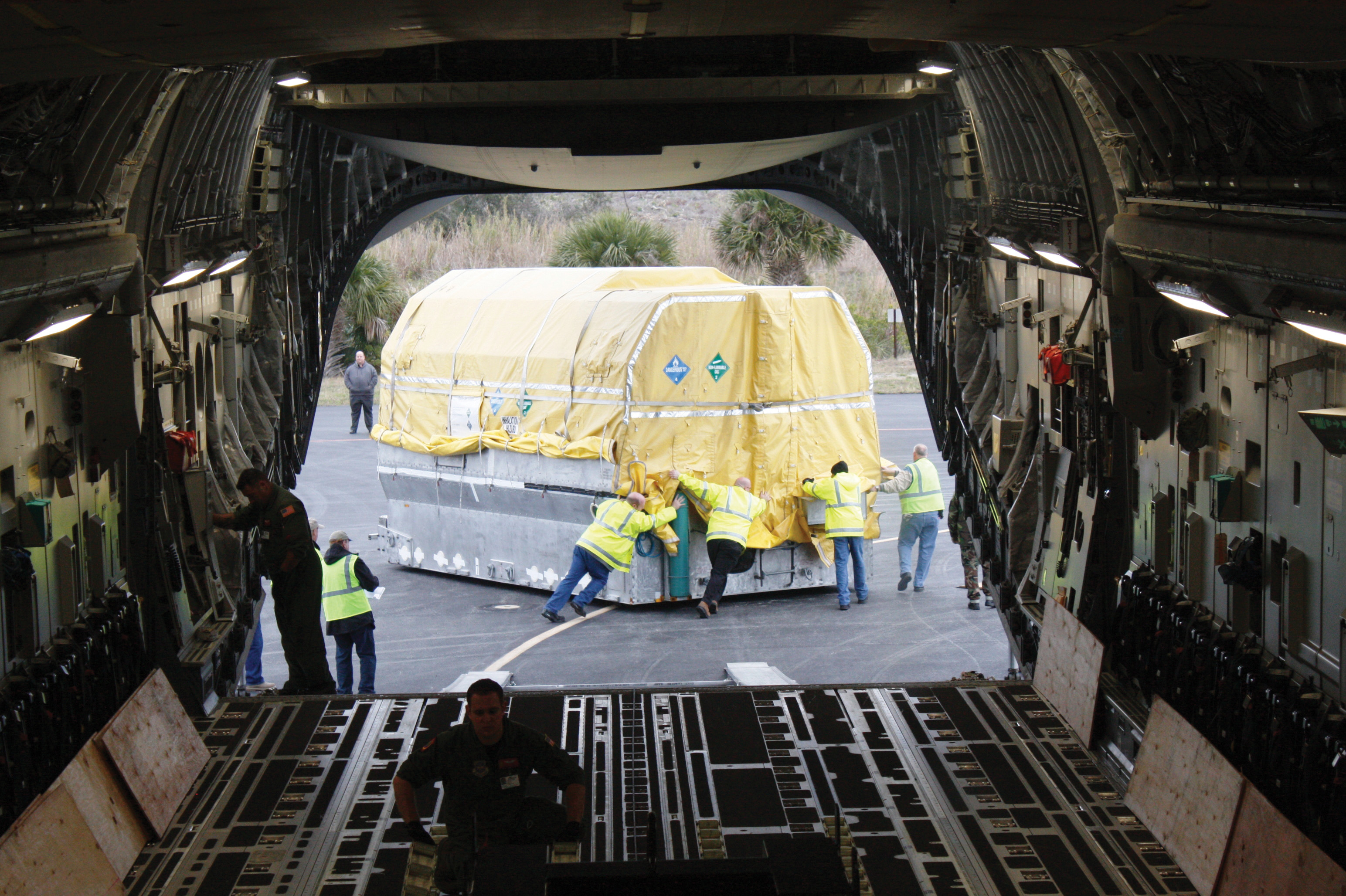
    The first Block IIF satellite destined for orbit arrived at the Navstar Processing Facility at Cape Canaveral, Florida, aboard an Air Force C-17 cargo aircraft on February 12. It is now undergoing preparations for its launch this spring on a Delta IV rocket. Block IIF will enhance GPS performance by reportedly providing twice the navigational accuracy of heritage satellites, more robust signals for commercial aviation and search-and-rescue, and greater resistance to jamming in hostile environments.

    New L5 Signal. The new IIFs will broadcast the operational civil L5 signal, whose spectrum allocation was secured by broadcast of the signal by a IIR(M) satellite last year. L5, at 1176.45 MHz, lies in the Aeronautical Radionavigation Services band and can be used for safety-of-life aviation. It will be compatible with Galileo, GLONASS, and QZSS, with the goal to be interoperable as well. L5 will transmit at a higher power than current civil GPS signals, with wider bandwidth, and lower frequency that may enhance indoor reception.

    More L2C Beacons. The IIF generation will also add to the number of satellites on orbit that broadcast the L2C signal at 1227.6 MHz, bringing it closer to full operational capability. L2C enables the development of lower-cost, dual-frequency civil GPS receivers for correction of ionospheric time-delay errors. Once the control segment modernization is complete, enhancements such as dataless and pilot channels for improved performance and an improved navigation message with more precise clock and ephemeris information will be available. L2C will also be interoperable with the Quasi-Zenith Satellite System (QZSS) under development by Japan.

    Long Life. Built by Boeing, the IIF has a longer design life of 12 years, faster processors, and more memory. It will be followed by 11 other IIFs before modernization shifts into a higher gear with the GPS III generation.

    It takes four hefty guys to wheel the new satellite along the tarmac, but it will only take one Delta IV rocket to lift it 20,171 kilometers into space on May 13.
    It takes four hefty guys to wheel the new satellite along the tarmac, but it will only take one Delta IV rocket to lift it 20,171 kilometers into space on May 13.

    Some Receivers Run Afoul of GPS Ground Control Software Update

    On January 11, 2010, when the GPS Wing and the 2nd Space Operations Squadron (2SOPS) loaded the updated AEP 5.5C software to the ground control segment, a problem surfaced with a specific subset of GPS selective availability anti-spoofing module (SAASM) receivers.

    The GPS Wing did not revert to the previous AEP 5.4 because of the upcoming IIF-SV1 launch. The scheduled sequential AEP 5.5C and AEP 5.5D updates are required before the ground control segment can adequately manage the more advanced capabilities of the IIF satellites.

    One purpose of the 5.5C AEP update is to enable SAASM functionality in coded receivers. The software for this functionality has been resident in various certified SAASM receivers for some time, but was never implemented in the ground control segment. The update alleviates that problem for the majority of SAASM receivers, but for one manufacturer it has caused problems. The updated software sends a specific code to SAASM receivers that enables them to authenticate the message and ensure that the code is correct, and is being sent from the GPS and not some other source. For most receivers this worked without a hitch, but for one manufacturer, a software (SW) bug or glitch occurred that must be corrected before the receiver can authenticate. This fix is in progress and will most likely be implemented as a software or firmware update to the receivers.

    Timing. Another problem with a different set of receivers manifested itself exactly two weeks after the AEP 5.5C update occurred. Those that have researched this problem in some depth feel that the problem is totally unrelated to the AEP update and would have occurred regardless.
    This is also considered to be a receiver software bug for the manufacturer, and that process is ongoing.

    ICD. Prior to activating the software update, the GPS Wing issued an updateable ICD or Interface Control Document that all receiver manufacturers use as a voluntary guide to determine compliance. Strict compliance by the manufacturer with the receiver interface control document (ICD) may have prevented the first issue, but the second may be a serendipitous event of the type that occurs from time to time no matter what precautions are taken.

    The GPS Wing has issued two Notice Advisory to NAVSTAR Users (NANUs) for civilian and commercial GPS users and for military users, asking for user comments.

    Letter to the Editor. Meanwhile, a reader wrote in: “I have issues with misleading e-mails containing inaccurate titles of articles posted on the site. There have been multiple cases recently claiming AEP software (SW) upgrades caused problems with receivers. In fact, and as proven by the vendors involved and others analyzing the problems, the AEP SW did not cause any of the observed conditions. ICD noncompliance of SAASM user equipment (UE) caused the problems, and the AEP SW upgrade allowed DoD, FAA, and vendors to finally discover the noncompliance issues and begin the process to resolve them. The community should view the 5.5 SW upgrade for what it is: a valuable new capability implemented correctly, which helped us all understand some unexpected shortcomings in UE.”

    The editor concurs, and apologizes for misleading article titles. However, hard information was scant — in fact, completely unavailable — at the time.

    GLONASS Gets Regional; Beidou Moves; Galileo Inks

    The three new GLONASS-M satellites launched on December 14 have been set operational: GLONASS 730 in orbital slot 1 was set healthy on January 30, joining 734 and 733, which were set healthy earlier in the month. This brings to 18 the number of satellites currently in service, although GLONASS 722 continues to provide a healthy signal only on its L1 frequency. At present, the constellation only suffices to provide a 24-hour regional signal over Russian territory, although satellites can and frequently are pulled in by global high-precision users to complete an RTK solution, along with GPS.

    Two satellites are in maintenance mode and set unhealthy, and two others, launched in 2003 and 2005, respectively, are in the process of being decommissioned.

    The next GLONASS launch, of the GLONASS Block 40 satellites originally set to rocket up last September but returned to the Reshetnev factory with problems in the signal generator, is scheduled for March 2. Three more will rise in August, and a November 10 booster will put two GLONASS-M satellites and the first GLONASS-K satellite into orbit.

    Beidou. According to tracking data from the United States Strategic Command, Beidou’s G1 satellite has drifted from its original location of 160°E and is currently at about 147°E longitude, that is, no longer in geostationary lock. Perhaps it is moving to another assigned Beidou slot, to back up or replace one of the other satellites in the constellation, but this can be no more than speculation. Hard data on the Beidou/Compass system is extremely difficult to come by. The new Chinese government Beidou/Compass website does not provide up-to-date information on the status of the constellation — something we take for granted with GPS, GLONASS, and Galileo.

    Galileo. The European Space Agency signed contracts for Galileo’s full operational capability phase on January 26: with OHB for the manufacture of 14 satellites, delivery of the first in July 2012, followed by two satellites every three months; for launch services with Arianespace; and for system support with Thales Alenia Space.


    24+3 FAQ

    Eric_Gakstatter_125Survey editor Eric Gakstatter posed these questions to the GPS Wing; their answers follow.

    Will the satellites (SVN24, SVN26) remain healthy during their repositioning journey?

    Yes. The satellites will be set unhealthy for the initial Delta-V, but will return to healthy status approximately 24 hours after initiation of the Delta-V. Initial Delta-V for SVN24 was accomplished on 13 Jan 10 and returned healthy on 14 Jan 10. SVN24 will take up to a year to reach its final destination. Initial Delta-V for SVN49 was accomplished on 21 Jan 10 and will arrive at its expanded position in Jun 10. Initial Delta-V for SVN26 will begin early Feb 10.

    Why the two-year timeframe to realize the benefits when all repositioning will be complete in 12 months?

    The two-year timeframe is a conservative estimate which takes into account potential operational necessities which could extend the time required for completion. We must take a disciplined approach to cover possible failures and ensure continuity of coverage during the transition. We will be adding GPS IIF vehicles to the constellation and older vehicles may fail during the transition timeframe. As vehicles are added and removed, the current plan is subject to change in order to provide the best service to all civil and military users. Some of these decisions could require additional time to complete the expanded constellation. However, benefits will likely be realized well in advance of 24 months.

    What is the reasoning behind using SVN49 as a key component of the 24+3 configuration since it won’t benefit a significant portion of the civilian user community, namely aviation and marine navigation as well as other SBAS (WAAS) and DGPS users? In my understanding, the FAA’s and the Coast Guard’s user bases are primarily single-frequency pseudo-range, users who won’t be able to use SVN49.

    SVN49 was selected because it is a brand new satellite with four good clocks. Although issues with SVN49’s navigation signals may make it unusable for all civil use, it could still put out a valid set of signals for military use. The Air Force team is continuing to work “open book” with civil and industry GPS experts to determine the possible outcome of SVN49. Although SVN49 is not currently healthy, GPSW and 50th SW are actively working a mitigation that may allow setting the vehicle healthy in the future. As a mitigation in case we are unable to set SVN49 healthy, SVN30 will be rephased to the same slot following a successful launch and on-orbit checkout of IIF-1. We expect to have either SVN30 or SVN49 healthy and broadcasting from the expanded slot within a 24-month timeframe. At this time, no decisions have been made and no options have been ruled out regarding SVN49.