
Author: Alan Cameron

  • The Spy Who Loved Me

    With apologies to James Bond, Ian Fleming, and, well, just about everybody else. Here is a grab from my mail bag.  The message was subject-lined: GPS Spy Applications.

    “I recently suspected my wife of cheating, having been involved with gps as a land surveyor since 1995, I used and application called mobile-spy.

    “In order to install the application onto an iPhone you have to “jailbreak” the phone. Once its installed it will forward all text, url’s, and a gps location every 30 minutes if it has satellite availability. To make a long story short, I caught my wife in a pretty precarious spot, or spots. It’s my opinion that she was sneaking out and meeting someone at various spots on our normal routes, little hidden offroad trails if you know what I mean. Well I tested and retested the phones gps and the data from the mobile-spy website where I purchased the software, which is actually sold under the name “retina-x” and they make there money by giving you access to these logs through mobile-spy.com.

    “However, my wife contests that all this data is wrong, of course, and she’s never been anywhere near these places. On the other hand, I have a ton of evidence saying she WAS at these locations. She says she’s read an article on AT&T that shows evidence that the gps in the iPhone is faulty and gives out bogus locations. As I said, I tested this a couple of times and it seemed to work perfectly.

    “In good faith we’ve agreed to let me take the iPhone and perform more in depth tracking over a span of a few weeks. I am not really a writer but I’ll definitely keep detailed logs of my observations. Have you guys already had this particular issue come up before? If so, I’d love to know anything you can tell me because the way it stands I am getting a divorce unless this application can be proven wrong! My email is [email protected]
    Cell phone is XXX.XXX-XXXX, I don’t check voicemails, so if I don’t answer just send me a text with your name and number. I look forward to hearing from you soon.”


    Sleep was what I wanted, you know what I got.  Wide awake, staying up late, wishing I was not.

  • The System: New Math for GPS

    New Math for GPS: the Geometry of 27

    The U.S. Air Force GPS Wing and 50th Space Wing have begun repositioning GPS satellites in space to fly what they call the 24+3 or Expandable 24 constellation plan. The initiative will take up to 24 months to fully implement. Benefits to users will be slowly realized during that time, as the number of GPS satellites in view will increase, potentially increasing GPS receiver accuracy.

    The plan significantly alters the current configuration of 30 GPS satellites on orbit. Several newer satellites now fly in tandem, side by side, with older satellites, as a hedge against their eventual failure. This policy has effectively limited constellation geometry to that of 24 satellites.

    The policy change was driven at least in part by the desire to improve satellite visibility for U.S. and allied military operations in Afghanistan and Iraq, where mountainous terrain can hamper signal coverage for troops on the ground.

    The first GPS space vehicle (SV) to move, SVN24, began its long journey on January 13. This satellite has the farthest to travel, and will not reach in its new slot for approximately 12 months (January 2011). The two others, SVN49 and SVN26, will affect the geometry much sooner. SVN49 started its four-month journey on January 21, destined to reach its new home in May 2010. SVN26 will stir on February 8 and should also find itself in its new slot by that time, if all goes as planned.

    SVN24 will take a full 12 months because the operators must have maneuvering fuel onboard when it reaches its final orbit location for station keeping and Delta-V maneuvers; and they must conserve fuel for end-of-life in as much as 15 years to boost the satellite into a safe retired orbit.

    Civil Benefits. 24+3 will especially benefit surveyors and other professionals using real-time kinematic (RTK) positioning. These users currently require six satellites in view for a very precise (centimeter accuracy) position.

    In the last few years, some users that require long dwell times and experience high mask angles have been forced to use GLONASS satellites as an augmentation, which works, although GLONASS satellites have historically been less accurate than the GPS. When 24+3 is fully implemented, GLONASS augmentation may no longer be necessary for these users.

    New Ground Software. The GPS Wing also trumpeted the advent of improved capabilities through a new ground-system software release. These include telemetry, tracking, and commanding for the new GPS IIF space vehicle — as yet unlaunched. On-orbit capabilities planned to arrive with the IIF Block span the new L5 navigation signal for civil users, continued and more robust security-wise deployment of the encrypted military-only code known as M-Code, on-orbit crosslink (between GPS satellites) improvements, and overall signal power increases.

    In November and December 2009, the new software uploaded operational GPS IIA and IIR space vehicles with navigation data and completed normal operational functions.

    Penny-Wise, Pound-Foolish U.S. Coast Guard to Pull Loran Plug

    The U.S. Coast Guard announced on January 7 that the it will cease broadcasting the North American Loran-C signal on February 8.
    “As a result of technological advancements during the last 20 years and the emergence of the U.S. Global Positioning System, Loran-C is no longer required by the armed forces, the transportation sector, or the nation’s security interests.”

    The force, and President Barack Obama’s fiscal year 2010 budget which it cited, go against the unanimous recommendation of the Independent Assessment Team, empanelled by a previous administration and led by Bradford Parkinson, founding program director for GPS: “complete the eLoran upgrade and commit to eLoran as the national backup to GPS for 20 years.” To pay for expert advice and then ignore it is a time-honored tradition of U.S. government.

    Senator Susan Collins, ranking member of the Senate Homeland Security and Governmental Affairs Committee, called the Coast Guard plan a “mistaken decision,” adding that “A lone system is problematic and ill-advised on so many levels. We need Loran as a backup to GPS.
    “Pulling the plug on Loran now will likely prove penny-wise and pound foolish, because there is no other system, or constellation of systems, that offers a more robust and cost-effective backup to GPS than eLoran. It is my urgent request that the Secretary reconsider this ill-informed decision.”

    Galileo Satellites Awarded to OHB

    The European Commission awarded on January 7 contracts for deployment of Galileo’s initial operational capability in space. The first order of 14 satellites goes to OHB System AG of Bremen, Germany (as indicated, but not confirmed, in these pages last month).

    The EC bestowed a contract for system support services upon ThalesAleniaSpace of Italy, and one for launch services to Arianespace of France. Initial deployment and service provision of Europe’s satellite navigation system is now envisioned for early 2014.

    Procurement contracts for ground mission infrastructure, ground control infrastructure, and operations should be awarded by mid-2010.
    The OHB order carries a value of €566 million (U.S. $811 million), with delivery of the first satellite in July 2012. One satellite is expected every 1.5 months thereafter, with the last one scheduled to be delivered in March 2014.

    Compass at Three

    China launched a third Beidou-2 or Compass navigation satellite on January 17, destined for geostationary (GEO) orbit. A previous middle-Earth orbit (MEO) craft went up in April 2007 and a GEO in April 2009. By January, that GEO had drifted about 16 degrees from its initial slot, possibly indicating it is uncontrollable although some reports indicate the satellite is still usable.

    Eventually, China plans five GEOs and 30 MEOs. The initial Compass system will provide the Asia-Pacific region with navigation, timing, and short-message communication services as early as 2015, with a plan for global coverage by 2020.

    Compass will offer an open service (free positioning and timing services, positioning accuracy 10 meters, timing 10 nanoseconds), and an authorized service, with “more secure” position, velocity, timing, and communications data as well as a higher level of integrity.

    The government also unveiled an official, Chinese-language-only Compass website, www.beidou.gov.cn.


  • Out in Front: Rocky Road to Robustness

    The news arrived after this issue had gone to press, so I pulled back this column to write about it. By early February, it will be oldish news, and further details will have appeared on our website.

    The crux: another pitfall for the GPS constellation.

    The system’s command and control operational software update uploaded in late 2009 has started wreaking some havoc with installed military receivers across many fielded platforms, as well as with some civil receivers. Whether major or minor havoc, I don’t pretend to know yet. The concept of selective availability anti-spoofing module (SAASM) figures in it, though now I’m toeing classified turf.

    Whatever the control features may be, they are designed to work with authorized military receivers that have successfully passed security tests prior to fielding. But actual live introduction of the new software has produced different results than those seen in testing: some receivers in question are intermittently not tracking Y-code.

    Corrective action could encompass either the Air Force rolling back the update or revising its software, or manufacturers modifying software within the receivers — thousands or perhaps tens, hundreds of thousands already in the field.

    The conscientious, hardworking engineers at the GPS Wing had barely recovered from the SVN49 debacle, or perhaps not even, as a work-around has yet to surface. Now this.

    In the category of small comfort, they are not alone. Recently manufactured GLONASS satellites have significant signal-generation problems. A new Compass satellite on orbit may no longer be controllable. And while Galileo inches forward, European political and industrial bickering perseveres. Ah, the bickering . . . .

    Despite these distractions in the sky and elsewhere, we should all keep our heads down, noses to the grindstone, fingers to the keyboard — and eyes on the prize. A radio-frequency signal in space, like Heinlein’s moon, is a harsh mistress. Very exacting, very demanding. Occasionally punishing. Ultimately rewarding.

    This Just In. By the time you read these words, the Loran signal may be dead and gone from U.S. territories. Thanks to the Coast Guard Commandant, the Secretary of Homeland Security, and those in the administration — perhaps the president himself — who know or care nothing about secure PNT, and who braggadaciously proclaim, “Back-up? We don’t need no steenkeen back-up!”

    Meanwhile the Air Force Chief of Staff has started saying it is critical for the military to “reduce its dependence on GPS-aided precision navigation and timing” because of its vulnerability, and supporting officers confirm that GPS has been jammed or interfered with recently.

    Do these people talk to one another? Surely they must.

    The PNT Key. More robustness will always be a good thing. Once I have two coded signals on widely spread frequencies, I’m well on my way there. This is not just within the narrow band allocated to GNSS, but across many radio frequencies, many technologies.

  • Out in Front: GPS World, 20 Years Young

    GPSW_20th_LogoThis magazine, the very one you hold in your hand or peruse digitally, hereby celebrates its 20th birthday. Hooray!

    Since its inception in 1989 and first appearance in the public eye in 1990, GPS World has provided — and continues to provide — technical and business information on global navigation satellite systems (GNSS) to engineers, product designers, manufacturers, researchers, system developers, executives, and high-level managers around the world who incorporate global positioning, navigation, and timing (PNT) technologies into their corporate strategies, operations, and product offerings to maximize profit and performance.

    Many things have changed since our birth: changes in the world, changes in GPS itself and now in GNSS, and changes in this magazine.

    The book has repositioned itself over the years from its early focus on applications to the present comprehensive yet detailed grasp of design concepts at both the space system and integrated circuit level.

    We can still say, as Glen Gibbons wrote in the inaugural issue, “Perhaps the most remarkable thing about GPS today is the enthusiasm that we find

    everywhere among people involved with the field. We want to share that enthusiasm with our readers. GPS — our world and welcome to it.”

    Double-Decade Insights

    Langley_new-mug_REV_lmRichard Langley: in the fall of 1989, GPS World’s founding editor, Glen Gibbons, approached Dave Wells, Alfred Kleusberg, and me — faculty members in the then Department of Surveying Engineering at the University of New Brunswick — about editing a “technology/product development column” in a new magazine. Since readers would have marked differences in their knowledge and expertise in the GPS area, “the column should deal with issues that have broad application and interest and are presented in terms that are accessible to as wide a range of readers as possible,” he wrote. The column was to be called simply Innovation.

    We decided that Alfred Kleusberg and I would manage the column, with Dave Wells serving as one of the inaugural members of the magazine’s Editorial Advisory Board. I took over sole responsibility for the column in 1997.

    Many Innovation columns have been tutorials including the one in the very first issue of the magazine. Written by Dave Wells and Alfred Kleusberg and titled “GPS: A Multipurpose System,” it used three different positioning scenarios to explain how GPS could provide positioning accuracies all the way from a Selective Availability-constrained 100 meters down to the sub-centimeter level. It also outlined GPS’s ability to determine platform attitude with multiple antennas and its use for accurate time transfer.

    The Innovation column has run continuously in every issue of the magazine except for August and December, when it gives way to the Almanac GNSS information pages. Next April’s column will be the 200th!

    Ed Aster, Founding Publisher: 20 Years Ago, GPS World almost didn’t happen. The idea of a magazine focussed on an unknown technology shrouded in military guise was turned down by 10 publishers before the idea was thrown at me while developing our international offices in Chester, England. It immediately made sense, as long as you had long eyes. A technology that has changed the world almost as much as the invention of the telephone. Who woulda thought. GPS leads the world and allows all countries to benefit from its quite simple premise, “Where am I?”


    GPS World: That Was Then

    During the last decade of the 20th century, the U.S. Global Positioning System achieved full operational capability. Prior to and after that key 1995 event, the technology saw active use and growth, primarily in the fields of surveying, mapping, and high-precision positioning. The technology most often took the form of a GPS receiver, frequently a stand-alone box, although active research and development into smaller form factors and integration with other technologies began.

    A 1996 Presidential Decision Directive reiterated GPS’ global availability for peaceful use. Russia’s GLONASS became irregularly active.

    Marking the practical — that is, the true — start of the GNSS era, the first integrated GPS+GLONASS RTK surveying system appeared in 1997: the GG-24 from Ashtech. The first GPS IIR (for replenishment) satellite rose that year, proving that satnav was not only here to stay, but to improve.

    Europe’s Galileo became a topic of earnest discussion.

    Double-Decade Insights

    McNeff_Jules_boxJules McNeff: Twenty Years ago, GPS was just a promise. The first Block II satellite was not yet a year old. GPS was known to only a few. It had not contributed to victory on the battlefield; it had not revolutionized earth science nor changed the way businesses and people conduct their daily activities. Now it has done all of that. It has awakened a global awareness of precise and ubiquitous position and time and of their value as essential elements of every human endeavor.

    I look forward to its next 20 years with the same anticipation and excitement I felt then.

    GerardLachapelleGerard Lachapelle: The Launch of the Block II satellites, starting in February 1989 after a hiatus of more than three years, was the most remarkable, exciting news of the time. By January 1990, six satellites had been launched with four more to come throughout 1990, an impressive accelerated schedule that had a major impact on equipment manufacturers, technology, performance, and users. It accelerated investments in research and development, and in long-term planning of major users and suppliers of positioning services.

    GPS would be a reality! The world has never been the same since!


    First Advertisers

    These companies advertised in the inaugural January 1990 issue — and we thank them!

    Three Full Pages

    • Ashtech

    Two Full Pages

    • Trimble

    Full Page

    • McDonnell Douglas
    • Magellan
    • Geodimeter
    • Wild Leitz
    • Interstate Electronics Corp.
    • Ball Aerospace
    • Oscilloquartz
    • Navstar
    • Stanford Telecom
    • Plessey/ITT
    • GE Astro Space
    • Odetics
    • CAST
    • ITT Defense

    Fractional Ads: Holden GPS, Sensor Systems, Racal, Alcatel, FTS/Austron, Allen Osborne Associates, Datum, McIntosh & McIntosh, Intermetrics, Piezo Crystal, Van Martin Systems, Navtech Seminars, GEOSurv.

    Map these companies onto their present names/ownership and enter to win the editor’s Happy Anniversary to Us Prize! Send your answers to [email protected].


    GPS World: This is Now

    During the first decade of the 21st century, the GPS industry entered early maturity and saw action in an ever-increasing number of fields: avionics, transportation, wireless communication, burgeoning consumer devices, and location-based services. Emphasis in product design shifted to the board and chip level, and GPS chips began “disappearing inside the application,” going inside other boxes fo
    r integration with other technologies.

    GLONASS declined, then rose again; Galileo got underway in fits and starts; international regional augmentations began.

    GPS World held its first Summit for 1001 GNSS VIPs with a top-level panel during the 2002 ION-GNSS conference, and a second Summit in 2004. It became the Leadership Dinner in 2006, with a Great Debate in 2007, a GNSS Election in 2008, and Brad Parkinson’s “True History of the Origins of GPS” in 2009. In each case, proceedings were subsequently shared with all our readers.

    The magazine became more than a magazine, redesigning its website to track developments in ever-diverging industry sectors, and launching e-mail newsletters focused on these specialized interests, followed by discussion forums, webinars, video interviews, job listings, and more.

    Double-Decade Insights

    ashkenazi_vidal_boxVidal Ashkenazi: As a geodesist, I consider GPS as the natural follow-on to satellite triangulation-trilateration and Transit Doppler (in the 1960s), when navigation and timing were added to straight positioning, and geodetic concepts of accuracy and reliability (renamed integrity) were adopted. We still had some difficulties in convincing the navigation community of the need to adopt a precise geodetic coordinate system (like WGS84), instead of just latitudes and longitudes.

    The imposition of Selective Availability led civilian ingenuity to come up with differential GPS, carrier-phase, and RTK. Who could have predicted in the 1990s that countless GPS applications would develop, benefiting business, governments and citizens everywhere?

    StephenC_BOXStephen Colwell: I started GPS World back in 1989. With a $1,200 investment and business plan in hand, I struggled through 43 investor presentations until finally receiving an approval nod for funds to launch the magazine. What I remember most during these times was invariably a potential investor would say “Now explain this to me again — what is GPS, and why does it need a magazine?”


    LONG HAULERS
    These memoirs come from founding members of our Editorial Advisory Board who still serve in that capacity! Jules McNeff is now vice president, strategy and programs, Overlook Systems Technologies; Gérard Lachapelle is professor and CRC/iCORE chair in wireless location, Department of Geomatics Engineering, University of Calgary; Vidal Ashkenazi is CEO, Nottingham Scientific Ltd. Other advisors still on board from that first issue are Paul Cross, Larry Hothem, William Klepczynski, Keith McDonald, and Brad Parkinson.Richard Langley is, as ever, a professor of geodesy and geomatics at the University of New Brunswick; Ed Aster is a vineyard owner and entrepreneur in New Zealand; Stephen Colwell writes a monthly e-mail column on the Consumer OEM sector; Glen Gibbons is a publisher in his own write, familiar to many readers.

    GPS World: Behold the Future

    Alan-CameronIn this nascent decade, the GNSS industry will enter its full maturity as truly an indispensable utility for everyday life, at individual consumer, industrial enterprise, and government organization levels. Multi-technology circuitry, which now integrates positioning with other capabilities on a single chip, will only continue its astonishing march.

    Galileo and GLONASS will achieve their promise, and Compass will join the family, forming together with GPS a veritable system of systems with highly accessible and accurate coverage and availability even in challenging environments. GPS itself will modernize, strengthen, and expand its considerable capabilities.

    As ever, GPS World will be there, up close and personal with the technology and the business, providing eyewitness accounts by researchers, product designers, program managers, and end users.

    The magazine will continue serving its international readers and advertisers, accomplishing its mission through an integrated information system of print, e-mail newsletters, websites, webinars, and videos, all communicating critical intelligence to decision-makers and technical experts.

    GPS World’s media platform, designed for and dedicated to industry’s use, is a searchable, application-specific knowledge base of GPS/GNSS-related technologies that is mapped to the markets and needs of the community’s core purchasing audience.

    Despite its name — and names may change — the magazine has never limited itself to coverage of the U.S. Global Positioning System. We chronicle the development of all GNSS: Galileo, GLONASS, and Compass; of augmentations WAAS, EGNOS, MSAS, NDGPS, QZSS, GAGAN, and GRAS. We track the integration of GNSS with other PNT technologies, such as inertial, laser, Loran, and radio frequency fields such as wireless communications, RFID, Bluetooth, ultra-wideband, and others.

    While busy writing and talking, we are also busy listening. We encourage online comments to articles appearing at env-gpsworld-integration.kinsta.cloud. We’ve started one technical discussion forum, Tech Talk, and plan to have another, on chip and circuitry design, flying within months. We administer a LinkedIn network for GNSS professionals to communicate interests, leads, queries, referrals, and open positions; our Facebook page enables members to create unique user content to build meaningful and resource-full discussion.

    We have unparalleled personal reach in every industry sector. You’ll find one or more of GPS World’s dozen correspondents and business development consultants at every important technical and business conference. Come right up and give us a piece of your mind. Please.

    GNSS — your world. We feel privileged to play a key part in it. — Alan Cameron, Editor-in-Chief


  • Out in Front: From IAIN to 101


    This is one of those mind puzzles that challenge you to transform one word to another in as few moves as possible.

    No, it’s not. But it does constitute a journey of sorts. I made it in a few minutes, while listening to David Last give the keynote address at the 13th World Congress of the International Association of Institutes of Navigation.

    Departure point: ballroom of the Clarion Hotel, Stockholm, Sweden, late October. Destination: GPS 101, an online webinar for engineers from PNT-related (as in, kissin’ cousins) disciplines, sometime in the near future.

    Last described the United Kingdom’s Royal Institute of Navigation (RIN), of which he is president, as “a failing business in a booming industry.” He added that many institutes of navigation struggle with falling membership and declining revenues, if not outright losses. Contrast this with huge satnav growth, and the exploding numbers of  “products that are more powerful, more user-friendly, more cost-effective, every time we have met.” Rising industry, falling professional associations.

    My concern here is not the well-being of institutes, but the global technical awareness possessed by engineers and designers from a range of industries whose products now seek to incorporate position, navigation, and/or timing. Phones, cameras, cars, binoculars, road tolling, parole anklets, and so on.

    This magazine reaches and educates those far-flung technical personnel, in addition to our readers already working in and supplying the surveying, aviation, military, marine, mapping, precision agriculture, and other more traditional positioning fields. I think we do so very successfully.

    But I was surprised by the low level of awareness evidenced by participants in July’s webinar, “The GPS Constellation and More,” with Colonel David Madden, GPS Wing Commander. Presumably attendees came from among our readers and web visitors, but some of their questions were beyond (or below) elementary. Editor Don Jewell, who moderated that webinar, saw the need for a GPS 101 course, and I fully agree.

    We don’t intend to compete with companies or institutes offering technical tutorials. Rather, to offer a stepping stone up to those tutorials, and to leverage our free and extensive global reach to engineers everywhere.

    Returning to the RIN president for Last words, “What was once a specialized set of professional techniques has expanded into an industry with hundreds of millions of users. Navigation is a unique place where bright engineers — hardware and software — work alongside systems analysts, geographers, surveyors, geodesists, mapmakers, and those who design, manufacture, market, and support navigation equipment, and those who use their products as practitioners. These people are today’s navigators.”

  • The System: Galileo Removes Manufacturing Barrier

    With final satellite construction bids pending as this magazine goes to press, the Galileo program clarified a recent round of launch postponements and announced that the European Union (EU) will rescind its requirement for a special license to manufacture and sell Galileo receivers.

    “We have an ambition to become, after GPS, the second system of choice,” stated Paul Verhoef, program manager of the EU satellite navigation programs, at the World Congress of the International Association of Institutes of Navigation (IAIN) on October 28. “In order to reach that, the user market is key. We are currently putting our hands to the last bits and pieces of the documentation [revising the previous Galileo Interface Control Document], to be published in a few weeks’ time. We will no longer require a licensing document in order to manufacture and sell devices. We had to do this bit of work to follow up on the initial [different] preparations made under the public-private partnership.”

    Contract by Christmas. The first two in-orbit validation (IOV) satellites will be launched in November 2010, and the next two in April 2011. Verhoef referred to the previous Galileo full operational capability (FOC) date of 2013. “You now know we are not going to meet that date,” said Verhoef.

    “We come to the procurement as it stands at this moment. We are procuring the capacity through six main work packages. We are on track to announce the satellite contracts before Christmas, as well as the system support contract. Perhaps the launch contract, but perhaps not until after Christmas. The other contracts are not time-critical at this point, therefore we have delayed them slightly; to be announced in first quarter 2010.

    “We have split the total of the 28 satellites we will order into two work orders. In the first, we will procure up to 22 satellites, and in the second the rest. Industry bidders are to submit their best and final offer for 8, 14, and 22 satellites. The most crucial decision in the whole procurement will then be for us to go single-source with one of them, or dual-source with both.”

    The final and “best” bids were due to the EU and ESA on November 13 from the two consortia competing to build out the constellation.The EADS Astrium-Thales Alenia Space partnership, larger of the two, has by conventional wisdom the inside track to win the contract. However, the competion, led by OHB of Germany, includes Surrey Satellite Technology Limited (SSTL) of the UK, which has the better track record in Galileo satellite manufacture to date.

    “A double supplier would mean spending extra money,” said Verhoef in his IAIN remarks, “but it would bring some risk reduction. Will it be worth the extra money we will have to pay for it? By the end of the year we hope to have the answer for that. By the end of the year we will have under contract the delivery of 22 satellites, and the launch contract. Then we will be able to give a very clear schedule on deployment.

    “There remains uncertainty on where it will end. Budget questions depend on parliament and the EC, which will drive the final aspects of the work. We live in difficult economic times, and there are some things to be determined in 2014, when the next funding cycle will begin.

    “By the end of 2013, we will have an initial constellation of 16 satellites: four IOV and 12 FOC satellites. This is targeted to provide the open service, and parts of the other services: safety of life, PRS, and commercial. Completion of these will depend on funding questions.”

    See the Satellite. An online story on Britain’s BBC News channel contains a two-minute video clip (see PHOTO) showing close-ups of the antennae and other elements of the IOV satellite under manufacture at an EADS Astrium facility in Portsmouth, United Kingdom.

    Once completed, the payload will travel to Thales Alenia Space in Rome, Italy, for attachment to the main spacecraft bus, with a propulsion system, avionics, and solar panels, and then go to the European Space Agency (ESA) port in Kourou, French Guiana. Both intial satellites are intended to rise aboard a Russian Soyuz rocket, which has had its own problems recently, with delays due to changes necessary for the ESA launch pad.

    System Updates

    GPS to Fly Without Back-Up. U.S. President Obama and Congress have removed a key back-up system for GPS. The president signed the Department of Homeland Defense appropriations bill that allows termination of Loran-C in January 2010. Loran-C and modernized eLoran could prevent national and industrial infrastructure breakdown in the event of disruptions, interference, or intentional jamming. The House of Representatives passed a Coast Guard authorization bill calling for Loran termination, in line with the DHS appropriations bill. For details see www.pnt.gov; see also “Letters” in this issue, page 13. The Coast Guard Commandant and DHS are expected to sign off almost immediately that Loran-C can be terminated. Once they sign it, Loran signals could go off the air as early as January 4, 2010.

    GLONASS Signal Misbehavior. The planned September and October launches of three new GLONASS-M satellites were scrubbed, and the traditional Christmas launch appears doubtful at best. The Russians have commissioned a special task force to investigate a problem with the signal generator aboard an orbiting satellite, detected in late August. It is not known whether the same problem affects three satellites on the ground, destined for imminent launch.

    Beidou’s Second Bird. Beidou G2, launched last April, has drifted 10 degrees from its initial geostationary orbital slot. This may mean that it is uncontrollable and has been abandoned. Such a failure — if it is one — may delay launch of new satellites to begin filling out the Chinese GNSS. As previously reported, demonstration satellite Beidou 1D is also adrift.

  • The System: Galileo Slips, EGNOS Operates

    Four Galileo in-orbit validation (IOV) satellites scheduled to launch next year have already missed their first pad date.The European version of Russia’s Soyuz rocket is now scheduled to carry the four IOV satellites into orbit in two launches in November 2010 and early 2011, as announced by European Space Agency (ESA) Director-General Jean-Jacques Dordain on October 9.
    Both launches had been set for earlier in 2010, but ESA has encountered difficulties with the satellites, built by a consortium led by Astrium Satellites and Thales Alenia Space. Introduction of Russia’s Soyuz rocket at Europe’s Guiana Space Center in French Guiana, on the north coast of South America, has also been repeatedly delayed.

    The European Union and ESA plan to select a builder for the remaining 28 satellites late this year. Final bids from 11 companies bidding for on six Galileo work packages are expected by November 11.

    Experimental Satellite Moved. In July and August, Surrey Satellite Technology Ltd (SSTL) repositioned GIOVE-A, the first Galileo test satellite, to an orbit 113 kilometers above the orbit that the operational Galileo navigation satellites will occupy.

    Since its December 2005 launch, GIOVE-A has achieved all of its mission objectives and remains in excellent condition well beyond its design life of two years, SSTL stated.

    The test satellite secured the Galileo frequency filings with the International Telecommunication Union (ITU), collected data to characterise the medium-Earth Orbit (MEO) environment, and flight-proved technologies such as highly accurate atomic clocks.

    GIOVE-A remains fully operational, and has sufficient propellant remaining for further maneuvers. A further repositioning exercise may be performed to raise the orbit higher still before GIOVE-A is finally decommissioned.

    SSTL and its new owner, OHB of Germany, jointly form one of the two consortia now bidding for the development and construction of 28 satellites for the operational Galileo service.

    EGNOS. The European Commission (EC) declared on October 1 the official start of operations by the European Geostationary Navigation Overlay Servic (EGNOS), with its Open Service available free of charge to businesses and consumers. EGNOS is Europe’s first contribution to satellite navigation and a precursor of Galileo, the global satellite navigation system in development.

    EGNOS is a satellite-based augmentation system that improves the accuracy of satellite navigation signals over Europe. The system is composed of transponders aboard three geostationary satellites hovering high above the Eastern Atlantic and the European continent, linked to a ground network of about 40 positioning stations and four control centers, all interconnected. The EGNOS ground stations receive signals sent out by GPS satellites. Information on the accuracy and reliability of these signals is relayed to users via the geostationary satellite transponders. This allows them to determine their position to within two meters in real-time, according to EC spokespersons.

    The EGNOS coverage area includes most European states and has the built-in capability to be extended to other regions, such as North Africa and European Union neighboring countries.

    The commission seeks to support new applications in sectors such as agriculture (high-precision spraying of fertilizers) and transport (for example, automatic road-tolling or pay-per-use insurance schemes). EGNOS can also support much more precise personal navigation services, both for general and specific uses, such as systems to guide blind people and to improve signal reception in urban areas.

    EGNOS will be certified for use in aviation and other safety-critical areas in compliance with the Single European Sky regulation. Through EGNOS a safety-of-life service is expected to be in place by mid 2010. This service will provide a valuable warning message informing the user within six seconds in case of a malfunction of the system. A commercial service is under test and will also be made available in 2010.

    EGNOS operations are managed by the European Satellite Services Provider, ESSP SaS, a company based in Toulouse, France, founded by seven air navigation services providers. A contract between the EC and ESSP SaS covers management of the EGNOS operations and maintenance until the end of 2013.

    The EGNOS Open Service is accessible, without service guarantee or resulting liability, to any user equipped with a GPS/SBAS compatible receiver within the EGNOS coverage area. Most receivers sold today in Europe meet that requirement. No authorization or receiver-specific certification is required.

    GLONASS Signal Generates Slip

    A planned late-September launch of a three new GLONASS-M satellites from the Baikonur space center was postponed due to a problem with signals emanating from a previously launched GLONASS-M satellites, now on orbit. Initially, a new launch date of October 29 was set by Roscosmos, the Russian space agency, but no word had yet come at press time regarding investigation of a problem with the signal generator aboard the orbiting satellite, detected in late August. The spacecraft was taken out of service on August 31.

    GPS Wiggles: SVN49, CNAV

    The GPS Wing held an extraordinary session at ION GNSS in Savannah, Georgia, September 23, frankly explaining the SVN 49 satellite’s problem and probable solutions.

    SVN49, the IIR-M) + L5 civil-signal satellite, will be set healthy in the coming months and it will be useable, the GPS Wing said. Its L1 an L2 signals contain a pseudorange error that remains within specifications for compliant GPS user equipment.

    On the ground, a receiver sees from this satellite both a direct signal and a weaker reflected signal, which looks like a multipath component. According to models, if the direct and reflected L1 signals are in phase at zenith, a standard code-correlating receiver will measure a C/A-code pseudorange that is 1.62 meters too long. The error becomes smaller as the elevation angle drops, reaching zero at an elevation angle of about 42 degrees, and then rising slightly as the elevation angle drops to zero.

    During audience input following the Savannah panel presentations, Javad Ashjaee of JAVAD GNSS proposed simply turning the satellite on as is and using it as an opportunity, given the “defined multipath” that it effectively transmits, to study multipath and other phenomena. JAVAD GNSS Triumph receivers have demonstrated the ability to remove almost all anomalies and satellite multipath from the SVN49 signal.

    An as-yet-unconfirmed report has it that U.S. Air Force representatives and others, in an informal meeting after the session, came to a provisional agreement as to the best course. However, this has not yet worked its way through channels nor been announced.

    New Message. The first test of the CNAV navigation message format to be used in the future on Block IIR-M and IIF satellites was announced at the September CGSIC meeting in Savannah, and will begin soon. A Type 0 message will be broadcast on the L2C signal by SVN49. By the end of the year, this message is to be switched on, on all IIR-M satellites. However, this initial message type will not contain useful information for end users.

    Message Type 0 consists of a 12-second, 300-bit long message including the preamble, satellite pseudorandom noise (PRN) number, message type ID (=0), GPS time of week, a sequence of alternating 1s and 0s, and a cyclic redundancy check (CRC) parity block. The GPS time of week will change every 12 seconds, as will the CRC bits.

    Penny Axelrad Honored

    Penina Axelrad, professor of aerospace engineering sciences at the University of Colorado, received the Institute of Navigation’s 2009 Kepler Award for her “contributions in the field of satellite navigation and dedication to the education of future generations of navigation engineers.”

    Axelrad has done advanced research in topics including receiver autonomous GPS integrity monitoring (RAIM), GPS bistatic radar, satellite formation flying using GPS, GPS-based orbit and satellite attitude determination, and multipath characterization, modeling, and mitigation.

    She received a Ph.D. in aeronautics and astronautics from Stanford University and S.B. and S.M. degrees from the Massachusetts Institute of Technology. She has taught for 17 years at the University of Colorado.

  • On the Edge: Multipath Measures Snow Depth

    On the Edge: Multipath Measures Snow Depth

    The September “Innovation” column in this magazine, 
“It’s Not All Bad: Understanding and Using GNSS 
Multipath,” by Andria Bilich and Kristine Larson, mentions the use of multipath in studying soil moisture, ocean altimetry and winds, and snow sensing. An 
experiment the authors conducted, designed to study soil moisture, yielded a surprise bonus: a new methodology for measuring snow depth via GPS multipath. It has important implications for weather and flood forecasting, and could also bring new insight to bear on GPS antenna design.

    In the “Innovation” column, the authors wrote, “Motivated by our studies showing that multipath effects could clearly be seen in geodetic-quality data collected with multipath-suppressing antennas, we proposed that these same GPS data could be used to extract a multipath parameter that would correlate with changes in the reflectance of the ground surface. . . .

    “We carried out an experiment designed to more rigorously demonstrate the link between GPS signal-to-noise ratio (SNR) and soil moisture. Specifically, we were interested in using GPS reflection parameters to determine the soil’s volumetric water content — the fraction of the total volume of soil occupied by water, an important input to climate and meteorological models. Traditional soil moisture sensors (water content reflectometers) were buried in the ground at multiple depths (2.5 and 7.5 centimeters) at a site just south of the University of Colorado.”

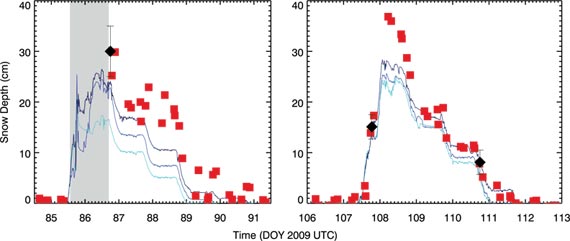
    Here Comes the Storm. During the experiment, two late-season snowstorms swept over Boulder. Larson and colleagues discovered that changes in multipath clearly correlated with changes in the snow’s depth, as measured by hand and with ultrasonic sensors at the test site. While it has been long recognized that snow can affect a GPS signal, this demonstrates for the first time that a standard GPS receiver, antenna, and installation — deliberately designed to suppress multipath — can be used to measure snow depth.

    On September 11, Geophysical Research Letters, published by the American Geophysical Union, featured an article titled “Can We Measure Snow Depth with GPS Receivers?” by Larson and Felipe Nievinski of the Department of Aerospace Engineering Sciences, University of Colorado; Ethan Gutmann and John Brown of the National Center for Atmospheric Research; Valery Zavorotny of the National Oceanic and Atmospheric Administration; and Mark W. Williams, from UC’s Department of Geography, all based in Boulder.

    The authors adapted an algorithm used for modeling GPS multipath from bare soil to predict GPS SNR for snow, introducing a uniform planar layer of the snow on the top of soil. The algorithm treats both direct and surface-reflected waves at two opposite circular polarizations as plane waves that sum up coherently at the antenna. They write:

    “The amplitude and the phase of the reflected wave is driven by a polarization-dependent, complex-value reflection coefficient at the upper interface of such a combined medium with a known vertical profile of the dielectric permittivity e. The reflection coefficient is calculated numerically using an iterative algorithm in which the medium is split into sub-layers with a constant e. For the soil part, we use a known soil profile model that depends on the soil type and moisture. For frozen soil, soil moisture (liquid water) is low, as for very dry soil. For the snow part, we take a constant profile with e, considering relatively dry and wet snow layer thicknesses.

    “After calculating the complex amplitude of the reflected wave at each polarization, we multiply it by a corresponding complex antenna gain. The same procedure is applied to the complex amplitude of the direct wave. After that, the modulation pattern of the received power, or the SNR, as a function of the GPS satellite elevation angle is obtained by summing up coherently all the signals coming from the antenna output and taking the absolute value square of the sum.”

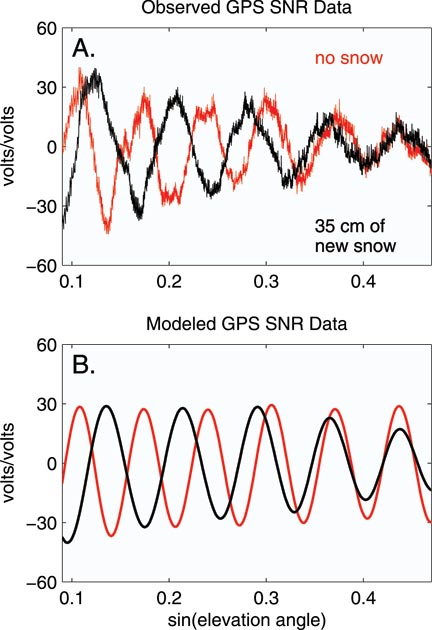
    Figure 1(a) shows GPS SNR measurements for one satellite on the day immediately before and the day immediately after an overnight snowfall of 35 centimeters (roughly 10 inches). Figure  1(b) shows the corresponding model predictions for multipath. The two figure 
portions amply demonstrate that the multipath has a significantly lower frequency if snow is present as compared with bare soil. The authors further noted that the model amplitudes do not show as pronounced a dependence on satellite elevation angle as the observations, and state the necessity of further work on antenna gains in order to use model amplitude predictions.

    Figure 1. (a) GPS SNR measurements for PRN 7 observed at Marshall GPS site on days 107 (red) and 108 (black) after direct signal component has been removed. Approximately 35 centimeters of snow had fallen by day 108. (b) Model predictions for GPS multipath from day 107 with no snow on the ground (red), and day 108 after 35 centimeters of new snow fall had accumulated (black) using an assumed density of 240 kg m-3 (figures reproduced by permission of American Geophysical Union).
    Figure 1. (a) GPS SNR measurements for PRN 7 observed at Marshall GPS site on days 107 (red) and 108 (black) after direct signal component has been removed. Approximately 35 centimeters of snow had fallen by day 108. (b) Model predictions for GPS multipath from day 107 with no snow on the ground (red), and day 108 after 35 centimeters of new snow fall had accumulated (black) using an assumed density of 240 kg m-3 (figures reproduced by permission of American Geophysical Union).

    How Deep the Snow. The authors propose that the hundreds of geodetic GPS receivers operating in snowy regions of the United States, originally installed for plate deformation studies, surveying, and weather monitoring, could also provide a cost-effective means to estimate snow depth.

    Currently, a few conventional monitor points measure snow depth, but only at that point, and the data does not extrapolate well. Snow forms an important component of the climate system and a critical storage component in the hydrologic cycle. Accurate data of the amount of water stored in the snowpack is critical for water supply management and flood control systems. As more snow falls at higher elevations, varying greatly even within one valley or watershed, current remote-sensing snow monitors do not supply adequate data. Further, snow may be redistributed by wind, avalanches, and non-uniform melting, so that continuous data would be very helpful.

    Using GPS multipath to map snow depth could improve watershed analyses and flood prediction — and, carried steps further, produce data to help better understand multipath, bringing innovation to future antenna designs.

    FIGURE 2. Snow depth derived from GPS (red squares), the three ultrasonic snow depth sensors (blue lines), and field measurements (black diamonds). Bars on field observations are one standard deviation. GPS snow-depth estimates during the first storm (doy 85.5–86.5) are not shown (gray region) because the SNR data indicate that snow was on top of the antenna.
    FIGURE 2. Snow depth derived from GPS (red squares), the three ultrasonic snow depth sensors (blue lines), and field measurements (black diamonds). Bars on field observations are one standard deviation. GPS snow-depth estimates during the first storm (doy 85.5–86.5) are not shown (gray region) because the SNR data indicate that snow was on top of the antenna.

    Kristine Larson was featured as one of the “50 GNSS Leaders to Watch” in the May 2009 issue of GPS World.

    Manufacturer

    For the experiment a Trimble NetRS receiver was used with a TRM29659.00 choke-ring antenna with SCIT radome, pointed at zenith.

  • Block IIF: Follow-on, or Failure?

    A few short weeks ago, the U.S. GPS program had its posterior firmly planted in the catbird seat. Government spokespeople in international fora looked on benignly as European, Chinese, and Russian GNSS programs struggled to resolve their issues and meet their heady challenges. All was well with the world. A new GPS satellite launched, a segment of radio-frequency spectrum secured for a promising new signal, a next-gen satellite shipped to the Cape, and the next-next-gen program nearing successful preliminary design review (since completed).

    In the blink of an eye, the world is turning.

    A progression of seemingly unrelated events began to affect GPS outlook.

    • While successfully broadcasting the new L5 signal, IIR-M (20) also began generating “out of family” measurements on L1 and L2 at low elevations.
    • The long-withheld Independent Assessment Team (IAT) report on eLoran appeared, unanimously recommending that “the U.S. government complete the eLoran upgrade and commit to eLoran as the national backup to GPS for 20 years.” While in itself this is good news — that is, if you believe in backing up critical systems — it does not augur well that a two-year Freedom of Information Act fight had to be waged to pry the report loose from know-nothings in the Department of Homeland Security, and that the vaunted Obama administration, heralded as a breath of change, had earlier come down on the same-old same-old government side of taking Loran out.
    • Then, the motherlode. The U.S. Government Accountability Office (GAO) issued a report on the future of GPS, characterizing the constellation as susceptible to falling below full operational capability between 2010 and 2018.
    • It turns out that while a IIF payload did travel to Cape Canaveral on May 7, this was solely for the purpose of preliminary launch-system compatibility testing. The satellite itself is not ready to operate in space, and in fact the IIF currently at the Cape is just a placeholder. Or, to use press-release verbiage, to “serve as a risk-reduction pathfinder for SV1 processing later this year.” The real satellite, the IIF that may, repeat may, go into orbit at the end of this year or early next year, continues in critical payload testing at the contractor facility.
    • Here’s a bright spot, at long last. Brad Parkinson, the first GPS Program Office Director, chief architect and advocate for GPS, has a plan for mitigating possible GPS brownouts — the gaps in service that may occur if the constellation should fall below quorum. Parkinson states that “It is possible that the constellation will be at a level of less than 24 satellites. I would like to focus on the options that would help reduce this risk.”

    Parkinson cites two principal causes for the current at-risk status of GPS service. “The first is that the generation of replacement satellites called IIF has been greatly delayed.  A substantial part of the reason for this is that the contract for IIF satellites was placed during a period when DOD imposed a grand experiment in contracting.  In addition there were some changes to the satellite to modernize its design, but the bottom line is the satellite has been on contract since 1996 and will not be launched until 2010. The design is quite old, and the capability of the satellites does not meet the latest requirements.”

    The second cause is protracted delays by the decision-making and budgeting processes in getting Block IIIA going. These issues have now been resolved, and Parkinson points out that both reasons “are now a matter of history. The current issue, that should concern us all, is: what options should we pursue to substantially reduce the risks of brownout.”

    Parkinson makes three recommendations in his personal presentation to the PNT Advisory Board meeting; the same presentation was also submitted as written testimony to the Congressional hearing following on the GAO report. Download the full Powerpoint file, with written details.

    “In my view, there are three major options for mitigating brownouts. Fortunately, these  options could be done together. These are:

    1. To reactivate the previously retired GPS satellites that are still operating in normal GPS orbits.
    2. To speed up the GPS IIIA development space (expedite the milestone approvals).
    3. To develop a simplified GPS IIIA based design, Spartan satellite (IIIS) that would not include the extra payloads, and, once designed, could be built quickly and launched into space with two satellites on a booster. This would be done in parallel with the current program.”

    Dr. Parkinson adds that “There is a fourth option, which may have been offered by some. This is to restart or expand the GPS IIF production line. The apparent advantage of this is that the GPS IIF is close to its first launch. Some might think major advantage would have been the fact that it is already designed. Weighing against this advantage is the fact that the design and the parts are obsolete. Virtually all the boxes and components would have to undergo a major redesign. Furthermore, the design is still untried, and was developed during an era of flawed procurements.”

    Counterpoint. Boeing says its engineers are working “very closely with the Air force and its team” and that the company has taken “aggressive steps to resolve the technical issues on IIF with a strong emphasis on mission assurance.” It maintains that it is on track to deliver the first IIF satellite, ready for launch, later this year.

    “Boeing’s GPS IIF satellites,” the press release continues, “will deliver more capability and improved mission performance to military and civilian users. . . . Design changes were required to ensure performance over the satellite design life and these have caused schedule delays, but these changes are in the final phase of implementation and a fully integrated satellite (SV1) has already successfully completed the thermal-vacuum test program — the most stressing system level test. SV2 was shipped to the Cape (Canaveral) on May 6 to perform system-level compatibility tests and serve as a risk reduction pathfinder for SV1 processing later this year.”

    The Department of Defense also made a presentation to the May 14–15 National Space-Based PNT Advisory Board meeting, and in it highlighted three risks: delay of IIF, delay of the ground control segment (OCX) contract award, and delay of GPS IIIA.

    Some in the GNSS community feel that the GAO-generated furor focuses too much on Block IIF and not enough on these other unknowns. They foresee a strong likelihood that the IIF satellites will get aloft on time, suitably “following on,” as they have been named. The real scary part will come later, in the 2015-2017 timeframe when GPS IIIA doesn’t get into orbit in sufficiently quick
    numbers.

    Further, the GAO report did not account for two mitigation tools that the DoD has in reserve: three retired satellites still in space that could be brought back into operation, and power-shedding as a means to extend satellite life.

    Back to the Mitigation Talk.Coming up are some of the strongest words Parkinson employed in the PNT Advisory Board presentation: further congenital defects.

    “While the Air Force has undertaken a very rigorous test program,” read the presentation notes, “it is still conceivable that we will find further congenital defects. The IIF satellite lacks the powerful military signal that will be extremely helpful against potential hostile jammers. In addition, it does not broadcast the new international signal L1C. Because of the extensive redesign it seems probable that the satellite would have to be re-competed. Finally, this would be a major near-term budget hit in a period when the IIF satellite is still over running its budget.”

    Not Even Half the Picture. GPS program planners have one of the most complex tasks going. They must consider many other issues in addition to keeping an integer number of satellites flying. Dual handling of the space and ground segments while both undergo modernization so that they remain in phase with each other, further synchronization with military user equipment on its own track of development, operating under a leadership and decision-making structure that lacks unity at the top, structuring future interoperability with other GNSS neither aloft nor complete in their signal-structure design — and then the various PR issues involved with servicing a worldwide, multinational, multi-industry, multi-requirement customer base.

    Personally, I feel much more comfortable here in my armchair.

    And despite all the grim news this month, I remain confident that GPS will continue to lead the field of GNSS, providing exemplary service round the clock, round the world.