Author: GPS World Staff

  • P3 predicts connected car focus of upcoming automotive, tech shows

    Automotive and consumer technology teams in Detroit and Silicon Valley remain hard at work preparing to kick-off the New Year with new technology at two of the nation’s biggest showcases of automotive connectivity: CES 2016, held Jan. 6–9 in Las Vegas, and the North American International Auto Show, held Jan. 11–24 in Detroit.

    Samit Ghosh, Ph.D., president and CEO of P3 North America, has worked with U.S. automakers on connected vehicle technology since 2005. He shared his thoughts on the future of driving and what to expect at the upcoming shows in a news release from the company.

    “Autonomous driving, information and entertainment systems will continue to take center stage in 2016 as automakers focus on chips, sensors and smartphone applications as key consumer differentiators,” Ghosh said. “In-car entertainment and safety capabilities provided through telematics and infotainment technologies are rapidly becoming the reasons consumers buy vehicles, so the stakes have never been higher.”

    Underscoring the growing intersection of consumer technology and the car, Ghosh pointed to CES reports that its automotive exhibit space will grow 25 percent at the 2016 show, with nine auto makers and 115 automotive tech companies debuting products.

    “Complex technologies require efficient processes,” Ghosh said. “The connected car ecosystem is complicated and faces many challenges, but automakers are beginning to think differently about the way they incorporate technology into cars. They need to start by rethinking their organizations and processes, breaking down organizational silos and taking an end-to-end view of all the touch points that spell success in the rapidly changing IoT ecosystem.

    “Hot topics at this year’s auto shows will be the security of connected vehicle systems and the safety implications of evolving driver interfaces. Automakers also face the tough decision to remain proprietary or join the open source software movement, as smartphones become universal devices for controlling every consumer’s world. From personalized in-car entertainment to smart home integration, the car is becoming a critical link in our interconnected world,” he said.

    According to Ghosh, in the software-focused world, carmakers can achieve far greater economies of scale by sharing technology with all other automakers. He cited GENIVI open source In-Vehicle Infotainment software as one force working to shorten development cycles and reduce OEM costs.

    “As an independent systems integrator, P3 efficiently connects and unites large industry players to quickly and successfully innovate,” Ghosh said. “The way we manage projects and optimize our clients processes is extremely unique. Our international experience in both the automotive and the telecommunications industries gives us the exact perspective needed to help these converging industries accelerate the development of connected car technology.”

  • CES 2016: DJI upgrades Phantom 3 and Inspire 1 drones

    Drone maker DJI is introducing enhancements to its Phantom 3 and Inspire 1 quadcopters at CES 2016, a consumer electronics and technology trade show held Jan. 6–9 in Las Vegas.

    The newest models, the Phantom 3 4K and Inspire 1 Pro Black Edition, were designed to capture stunning aerial photography.

    \The Phantom 3 4K’s introduction is the result of strong consumer demand for top resolution cameras and ultrasonic sensors, the company said, which enable flight indoors and in areas with a weak GPS signal. The Phantom 3 4K comes with an integrated, gimbal-stabilized 4K camera and has remote-control buttons for playback, video recording and camera shutter.

    Instead of DJI’s Lightbridge video-transmission system, the Phantom 3 4K uses built-in WiFi to transmit the video downlink and on-screen data. The drone’s WiFi video downlink is effective up to a distance of 1.2 kilometers.

    “The Phantom 3 4K fills an important gap in our Phantom portfolio. It offers a high-quality camera and smart navigation system for a lower price than our professional models. This is possible, as we have replaced the DJI Lightbridge system with a built-in WiFi link,” said Paul Pan, DJI’s senior product manager.

    The Phantom 3 4K will stay aloft for 25 minutes on a full battery charge. DJI also has made stylistic change to its Inspire 1 Pro. The Inspire 1 Pro Black Edition comes with a black controller, battery and a shell with a matte finish. It comes equipped with DJI’s best-in-class Micro Four Thirds camera, the Zenmuse X5.

    In celebration of DJI’s 10th anniversary, the promotional price of the DJI Phantom 3 4K edition is $799, starting Jan. 6. This promotion also extends to the Phantom 3 Advanced model, now priced at $799, and the Phantom 3 Standard, at $499. DJI says the price may be subject to change.

    The original Inspire 1 Pro, with a white shell, battery case and controller, will continue to be sold alongside the new model.

    “One of the most-frequent questions we get from professional drone operators is ‘when will DJI come out with a black Inspire?’ The answer is now,’” said Ferdinand Wolf, manager of DJI Studios Europe.

    DJI’s main booth at CES 2016 will be in South Hall 2, No. 25602, and Central Hall, No. 9845. The exhibits will feature a flying cage for attendees to attempt flying a drone with First Person View, an Osmo Zone for testing the filmmaking tool, a showcase of solutions created with the DJI SDK and a display of work created by the SkyPixel community.

  • Europe closes out first decade of satellite navigation

    News from the European Space Agency

    Ten years ago saw the launch of Europe’s very first navigation satellite. A decade of hard work later, more than a third of the Galileo constellation has followed it into orbit and a ground network sharpening the satnav system’s accuracy encompasses the globe.

    Galileo's GIOVE-A retired in June 2012. (Photo: ESA)
    Galileo’s GIOVE-A retired in June 2012. (Photo: ESA)

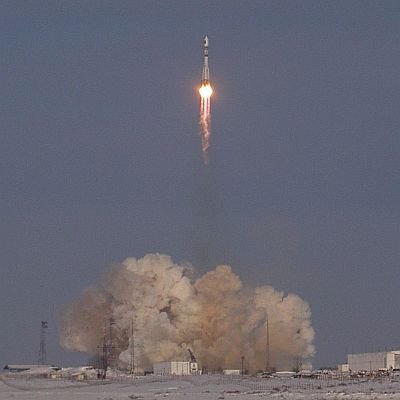
    GIOVE-A, short for Galileo In-Orbit Validation Element-A, was launched by Soyuz from Baikonur cosmodrome in Kazakhstan on Dec. 28, 2005.

    “Much work had already taken place on the ground, but GIOVE-A marked the first time that Galileo hardware went into orbit,” recalls Didier Faivre, heading ESA’s navigation directorate.

    “It had a crucial role: to claim operating frequencies that had been set aside for Galileo by the International Telecommunications Union, to demonstrate essential technologies such as Galileo’s rubidium atomic clock, and to gather data on the radiation-rich environment of medium-altitude orbit, which was a relatively unknown region for Europe.

    Didier Faivre (Photo:ESA)
    Didier Faivre (Photo: ESA)

    “So GIOVE-A opened the way to all that followed — the follow-up GIOVE-B in 2008, and then the launches of the Galileo satellites proper — a total of six double-satellite launches from 2011 to earlier this month, with 12 satellites placed in orbit so far, on the way to the full 30-satellite constellation.

    “Our three launches this year doubled the number of satellites in orbit, and the pace of progress is set to increase further in 2016, when we will see Ariane 5 called on to launch Galileo for the first time, doubling the number of satellites released on each flight.”

    Progress in space has been mirrored on Earth, with the establishment of Galileo’s ground segment: two control centers in Fucino, Italy, and Oberpfaffenhofen, Germany, sit at the heart of a worldwide network of ground stations.

    The Soyuz launcher carrying GIOVE-A climbs into the sky above Kazakhstan on Dec. 28, 2005.
    The Soyuz launcher carrying GIOVE-A climbs into the sky above Kazakhstan on Dec. 28, 2005. (Photo: ESA)

    This ground segment, as one of the most complex infrastructures ever overseen by ESA, has the task of keeping all the satellites healthy and their navigation signals synched — the timing system accurate to a few billionths of a second that provides the submetre precision.

    Sensor stations to monitor Galileo signals and return data to the control centers are required all across the vast footprint of the system. Their locations range from the Arctic to Antarctic to lonely mid-ocean islands, all connected back to Europe via satellite.

    Initial Galileo services are set to be available during next year. New generations of commercial satnav receivers are already Galileo-ready, having received extensive technical checks from ESA’s Navigation Laboratory.

    GIOVE-A in a clean room at ESA's ESTEC technical centre in the Netherlands, having instrumentation sensors installed in advance of testing in 2005.
    GIOVE-A in a clean room at ESA’s ESTEC technical centre in the Netherlands, having instrumentation sensors installed in advance of testing in 2005. (Photo: ESA)

    And national governments are already preparing to make use of Galileo’s Public Regulated Service — PRS, the most secure and precise class of service, restricted to authorized users. Belgium, France, Italy and the UK have all performed their own PRS acquisitions and positioning testing.

    As for GIOVE-A, the satellite that started it all, its ESA mission concluded in 2012, once the first four Galileo satellites followed it to orbit. Remarkably, it is still operational, controlled by builder Surrey Satellite Technology Ltd in the UK.

    In the past it has carried out tests of high-altitude satnav detection. Its radiation monitor continues monitoring the medium-altitude orbit environment, helping to forecast the future long-term performance of its Galileo descendants.

  • DJI launches public beta of geofencing software for drones

    Drone-maker DJI has launched a public beta version of its new geofencing system in North America and Europe.

    Geospatial Environment Online (GEO) will provide drone users with up-to-date guidance on locations where flight may be restricted by regulation or raise safety or security concerns. With this major upgrade to DJI’s existing geofencing system, users will have access to live information about areas temporarily restricted from flight due to forest fires, major stadium events, VIP travel and other changing circumstances.

    The GEO system will also show restricted areas around locations like prisons, power plants and other sensitive areas where drone flight would raise non-aviation security concerns.

    To accommodate the large variety of authorized applications, GEO will allow drone operators with verified DJI accounts to self-authorize and temporarily unlock flight in some locations. Certain areas where drone flight is not allowed, such as Washington D.C., will remain as unlockable no-fly zones. Unlocking requires a DJI account verified with a credit card, debit card or mobile phone number. DJI will neither collect nor store the information, and the service is free.

    The verified account is required only if a user chooses to fly in a location that might raise aviation safety or security concerns.

    Use of GEO requires a drone firmware update and installation of a beta version of the DJI Go app.

    Android users can directly download the APK file. Users of iOS devices can request a download of the beta app by providing an email address to [email protected].

    DJI expects to release a final version of GEO after completion of this short beta period.

    The GEO public beta will work with both DJI’s Phantom 3 and Inspire 1 drones, with specific versions available for download.

  • Santa caught delivering presents via UAV

    Santa Claus has apparently gone high-tech. This past Christmas, he was captured delivering presents using a Hexo+ unmanned aerial vehicle.

  • Skyworks launches GNSS front-end modules with integrated filters

    Skyworks Solutions, which manufactures analog and mixed-signal semiconductors, has launched three low-noise amplifier (LNA) front-end modules with integrated filters for GNSS. The devices are designed to provide high linearity, excellent gain, a high 1-dB input compression point and a superior noise figure.

    The pre-filters provide the low in-band insertion loss and integrated notch filtering for excellent rejection of desired frequency bands.

    Each device is supplied in small-footprint, surface-mount technology multi-chip module packaging — 1.1 x 1.5 x 0.7 millimeters for the SKY65713-11, and 1.7 x 2.3 x 0.7 millimeters for the SKY65715-81.

    The SKY65713-11 and SKY65715-81 both support products integrating GNSS functionality such as smartphones, personal navigation devices, wearables, machine-to-machine (M2M) systems, base stations, asset tracking instruments, professional radios and Internet of Things (IoT) applications. Both are designed for BeiDou and GPS receiver applications.

  • New Galileo Interface Control Document released

    The European Commission has published a new release 1.2 of the Galileo Open Service Signal In Space Interface Control Document (OS SIS ICD v1.2). The document provides the information needed by receiver and chipset manufacturers, application developers and service providers to process and make use of the open signals generated by the Galileo satellites.

    The OS SIS ICD contains the publicly available information on the Galileo Open Service Signal In Space, specifying the interface between the Galileo space and user segments. The Galileo user segment is of particular interest to the European GNSS Agency (GSA), which has been delegated responsibility for the program’s service provision by the European Commission.

    In fulfillment of this role, the GSA is developing the European GNSS Service Centre (GSC), which provides the single interface for information and help to users of the Galileo Open Service (OS).

    Once fully developed, the GSC will operate on a 24/7 basis and offer a range of services, including hosting the Galileo User Helpdesk, providing the interfaces between the Galileo System and OS users, and hosting a center of expertise for OS service aspects.

    The OS SIS ICD is a key document that provides the information required by receiver and chipset manufacturers, application developers and service providers to be able to process the Open Service signals generated by the Galileo satellites. In particular, the document specifies:

    • Galileo signal characteristics
    • Characteristics of Galileo spreading codes
    • Galileo message structure
    • Message data contents

    The latest version is based on feedback from receiver manufacturers and other stakeholders received during an extensive public consultation in 2014.

    The GSA further highlights the importance of this document for the development of receiver technology, which is the key enabler for translating Galileo signals into useful services. Over the past several years, the GSA has been engaged in open dialogue with chipset and receiver manufacturers, paving the way for Galileo to be fully integrated into a new generation of receivers and ensuring its signals will provide a wide array of new applications and services that directly benefit European citizens.

    In addition to a number of minor editorial improvements including corrections and clarifications, an annex with numerical examples of FEC coding and interleaving has been added and the license agreement has been revised and simplified.

    The document now refers to a companion document, “Ionospheric Correction Algorithm for Galileo Single Frequency Users,” containing details on the ionospheric model used for Galileo. The E1-B, E1-C and E5 Primary Codes in Annex C are no longer included in the paper version, but are available in the electronic version of the ICD.

    Download the ICD here. Paper copies are available on request by contacting the European Commission [email protected].

  • Summit CE Group to debut Car and Driver dash cam line at CES 2016

    Summit CE Group, in its partnership with Hearst Brand Development, has announced in a news release it will launch a new line of Car and Driver-branded dash cams at the Consumer Electronics Show, which will be held Jan. 6–9 in Las Vegas, in booth No. 14617.

    The new line of dash cams, created with the automotive magazine Car and Driver, features 1080p recording, loop recording, accident/motion detection, auto on/off, parking mode, night vision to Wide Dynamic Range, GPS logger, lane departure warning, speed alerts, WiFi, 3G and Android-powered touch screen models.

    “The Car and Driver Dash Cams allow drivers to hit the road with confidence, knowing that every mile and minute will be recorded in HD video,” said Glen Ellen Brown, vice president, Hearst Brand Development. “Our partner Summit CE Group has developed a high-quality line of dash cams with innovative features that consumers expect from the leading automotive media brand.”

    Summit CE Group has more than 50 years of experience in the designing and manufacturing of consumer electronics. The Car and Driver dash cams will be available at leading consumer electronic stores, auto care and online retailers in spring 2016.

  • WayRay offers holographic navigation system for cars


    Swiss startup WayRay has introduced an augmented reality navigation system that projects holographic GPS imagery and driver notifications onto the windshield of a car.

    Navion, billed as the “first-ever holographic navigation system for cars,” is placed on a car’s dashboard and projects a virtual route into the regular focal range of the driver. The driver sees the navigation signs laid out directly on the road ahead of the moving vehicle, while the driver’s eyes are safely focused on the road at all times. “We call this concept natural navigation, and we believe it will change the way we drive,” WayRay said in a press release.

    In contrast to other augmented reality devices currently on the market, no additional eyewear or headgear is needed to see the image. Navion’s interface provides the driver with clear route indicators even in bright sunlight, the company said.

    Navion responds to simple hand gestures and voice control. Certain features are available for use only when the car is stopped or moving at a very low speed.


    WayRay is a Swiss-based innovator working with augmented reality technology to develop holographic navigation systems and advance the connected car. The WayRay story goes back to 2012, when Founder and CEO Vitaly Ponomarev had an unexpected experience.

    “I was living in Moscow at the time, and I was driving at a low speed while also trying to adjust my brand-new GPS,” Ponomarev said. “My attention got distracted just for an instant and I had my first-ever car accident. The accident had a profound effect on me and I began to think about how the windshield is the perfect place to start when it comes to improving car safety. That began this remarkable journey and inspired the creation of WayRay.”

    In its two years of development, the company has emerged as a premier developer in connected cars by applying aerospace technology to land navigation — the principles behind its two key products.

    The company first developed the WayRay Element, a smart car tracker that collects data from the car and transforms it into statistics about the driver. Element works in conjunction with the WayRay Navion. Both products are to be released in 2016.

    “I think WayRay is the step between where we are now and the future self-driving car that is connected to a city’s infrastructure,” Ponomarev said.

    WayRay is headquartered in Switzerland with offices in Moscow and San Francisco.

  • Magellan to highlight DashCam navigators at CES 2016

    Magellan expands MiVue DashCam lineup

    Magellan has expanded its lineup of MiVue DashCam devices to be displayed at the Consumer Electronics Show, which will take place Jan. 6–9 in Las Vegas. The four new models include the MiVue 320, MiVue 420, MiVue 430 and MiVue 450D.

    “Magellan is excited to expand its award-winning line of MiVue DashCam models. Our four new models are designed with superior image quality, large storage capacity and extended battery life,” said Stig Pedersen, Magellan associate vice president of product management, in a news release. “Plus, select new models have new features such as lane departure and collision avoidance warnings, dual cameras and wide angle lenses that increase driver peace of mind and safety.”

    All MiVue DashCams include the MiVue Manager to record and manage videos that can be shared on social media. A parking mode for the MiVue DashCams allows an event to be recorded in case there is no impact. The impact sensor records the impact force and has a night view enhancement. A camera mode collects photos for evidence immediately, and it can be taken off out of the car for close-up photos. There also is a rotating mount design with a built-in GPS receiver that records location and time for playback of videos.

    Magellan to debut new RoadMate DashCams

    \Magellan is set to introduce its new family of three DashCam Navigators at CES 2016, according to a news release from the company. The flagship model for the family, the RoadMate 7670T-LM — project name: Hybrid 360Vue — is a CES 2016 Innovation Awards Honoree in the Vehicle Intelligence category.

    Magellan’s DashCam Navigator family is designed for safety-conscious drivers who want to record traffic incidents, as well as scenic and unusual events., the company says. It also includes a host of advanced navigation features and location-based content.

    “Our new DashCam Navigators give users flexibility, peace of mind and the confidence gained from using dependable Magellan engineering,” Pedersen said. “Plus, each model comes with well-known Magellan navigation features such as landmark guidance, junction view, parking mode and red light and speed camera warnings from PhantomALERT for improved driver safety.”

    The RoadMate 6630T-LM and RoadMate 7630T-LM devices include a fully integrated DVR and a software interface for recording, viewing and deleting videos and photos. The Lane Departure ­feature is an audio alert and icon that appears when departing to the left or right of the current lane. There also is an alert and icon that appears when a traffic-facing camera detects that the driver is getting too close to the car ahead.

    The devices will be displayed at in the Magellan booth in LVCC South Hall MP25441.

  • CES 2016: Excelfore to launch cloud solutions for intelligent transportation

    Excelfore, a provider of cloud solutions for intelligent transportation, will launch its comprehensive suite of secure cloud and connectivity solutions at CES 2016, the Consumer Electronics Show that will be held in Las Vegas this week.

    Excelfore provides an end-to-end intelligent transportation framework to the automotive industry using a cloud solutions platform along with in-vehicle connectivity technologies.

    Excelfore will demonstrate solutions during CES 2016 in two locations: at the Excelfore Suite (MGM Grand, Las Vegas, Nevada (Jan. 6-8), and at GenIVI Showcase at Trump International (Jan. 6-7).

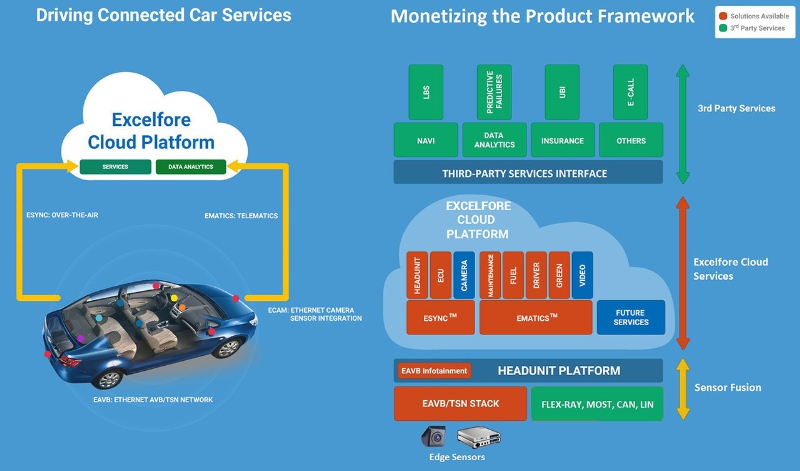
    ESync enables full vehicle over-the-air update of all vehicle components for the Headunit, multiple Electronic Control Units (ECU) and Telematics units. ESync updates the firmware components (FOTA), and software components (SOTA), including OS, kernel, kernel, drivers and applications.

    Excelfore provides a cloud-based solution for connected car services. (Image: Excelfore)
    Excelfore provides a cloud-based solution for connected car services. (Image: Excelfore)

    Excelfore leverages its patented machine-to-machine (M2M) distributed architecture to support cloud-to-vehicle connectivity and multiple in-vehicle networks including LIN, CAN, FlexRay and Ethernet. New advanced security features include enhanced Hash functions, multiple-levels of encryptions, content-delivery network (CDN) integration and end-to-end security from the cloud to the vehicle-components.

    “Connected cars are revolutionizing the automotive industry,” said Erich Geiger, former CEO of Harman/Becker Automotive Systems. “Excelfore’s EMatics and ESync platform with their advanced security and scalability will help accelerate adoption of innovative solutions for the automotive industry.”

    “By continuing to deliver to the automotive industry over the last several years, our cloud platform has architecture has evolved into a sophisticated offering with advanced security and scalability,” said Shrinath Acharya, CEO of Excelfore. “Within our product framework, we also offer data analytics and monetization by integrating with third-party services. Our platform enables fast and cost-effective deployment solutions for OEMs and Tier-1s.”

    The Excelfore team has delivered OEM programs (US, European, and Japanese Tier-1s and OEMs) and aftermarket automotive solutions to millions of vehicles.

    Highlights of ESync

    • Tailored for automotive headunit and electronic control units (ECUs)
    • Updates headunits, ECUs, telematics units (TU), and IoT edge devices, including cameras
    • Updates using any communication link (over the air, other networks)
    • Ease of implementation of the cloud platform for SOTA/FOTA deployment
    • Key features of the OTA updater
    • Full campaign management capability
    • Secure administration
    • Creation and delivery of packages for faster transmission and updates
    • Complete, differential and incremental software updates
    • Patented adaptive compression and M2M technology

    Highlights of EMatics

    Fleet Monitoring: Access a fleet from anywhere in the world at anytime. Quickly access vehicle information including location, driver, fuel and battery voltage. Monitor vehicles closely when needed using high frequency tracking.

    Automated Service Scheduling: Automatically get timely reminders on upcoming services, and schedule vehicle servicing by notifying preferred vendors.

    Fuel Management: Get detailed fuel data for an entire fleet including usage, consumption and mileage trends.

    Driver Rating: See who the most fuel-efficient drivers are. Get insights on how to improve driving behavior to reduce fuel usage and costs.

    Vehicle Travel History: Get detailed trip information including distance, duration, idling time along with date and time of trips. Easily differentiate personal versus business trips and automate reporting.

    Vehicle Safety: Set geo-boundaries and curfew periods. Get notified instantly when any vehicle violates curfews.


  • Antenova’s latest modules add GNSS to consumer devices and wearables

    Antenova Ltd., manufacturer of antennas and RF antenna modules for machine-to-machine (M2M) and the Internet of Things, has released two new modules for GPS and GNSS. Both provide an easy drop-in receiver solution — a way to add a location capability to very small consumer devices.

    The two modules are similar, both measuring 9.0 x 9.0 x 1.8 millimeters, with low current consumption, making them suitable for smaller portable devices such as smartwatches, navigation devices, OBD II modules, asset tracking, personal safety, sports cameras and equipment. They are based on a MediaTek processor.

    The M10578-A2 module operates with GPS, with a 1-5 Hz update rate, and the M10578-A3 operates with GPS, GLONASS, BeiDou and Galileo with an update rate of 1-10 Hz.

    Antenova has added two features to enhance performance of the modules. An internal self-generated orbit prediction uses two GNSS systems simultaneously to give a faster time to fix, and a second high-quality low noise amplifier (LNA) boosts low-powered satellite signals.

    The new M10578 modules are the latest in Antenova’s Radionova series of fully optimized RF modules for wireless M2M and embedded devices. Both modules are pin compatible, offering easy integration and upgrade from GPS to GNSS; for the antenna function, Antenova offers the small Sinica SR4G008 GNSS antenna.

    The new modules are built on high-grade FR4 substrates with a high density, multi-layered design that places the critical RF functions in the best position for location finding and performance.

    The M10578-A2 and M10578-A3 are available to order now.