Author: GPS World Staff

  • TomTom Redesigns PNDs, Introduces NavKit Engine

    TomTom Redesigns PNDs, Introduces NavKit Engine

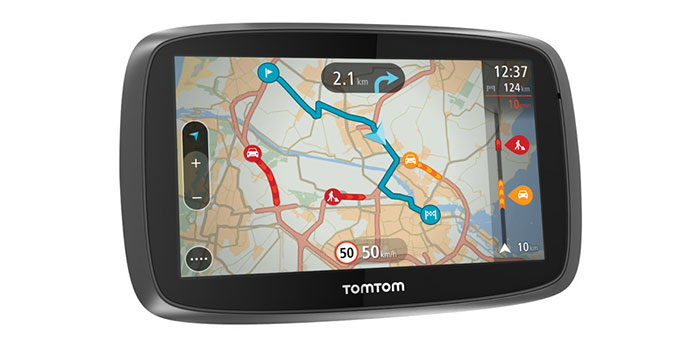
    TomTom has redesigned its personal navigation devices with new TomTom GO. The TomTom GO has new interactive map, lifetime TomTom Traffic and 3D maps that give drivers the ability to know precisely what is going on around them, as well as what lies up ahead, TomTom said.

    TomTom has also launched its new navigation engine, NavKit.

    “Where navigation used to be about getting people to unfamiliar destinations, we are now empowering drivers with easy access to the information they need to make the smartest driving decisions, every day,” said Corinne Vigreux, managing director of TomTom Consumer. “We have completely redesigned the PND to become an essential daily driving tool. By providing easy access to our world class TomTom Traffic and enabling drivers to see more than just the road ahead, drivers will feel on top of their journey like never before.”

    Drivers can easily access the travel information they need via a high-resolution, capacitive touchscreen, TomTom said. A new Interactive Map responds and scales to touch. Drivers can  zoom in and out to find and explore places on the map with their fingertips and tap on the map to get an instant route to a destination.

    New NavKit Engine

    TomTom’s navigation engine, NavKit, will power all future TomTom navigation products and be available for licensing to automotive and enterprise customers. The configurable component architecture has been designed to enable rapid integration. NavKit has programming interfaces for adding a customised user interface, porting to any operating system and integrating navigation services. As a result, the development of a connected navigation system on any device platform becomes far quicker and simpler, TomTom said.

    The new NavKit engine incorporates all the navigation logic of an on-board turn-by-turn navigation application. Every element has been enhanced to deliver an improved user experience including route planning, free text search, 2D map browsing and 3D guidance view, map-matched positioning and real-time guidance, TomTom said.

    “The automotive industry’s next challenge is to create a seamless connected car experience,” said Harold Goddijn, CEO at TomTom. “To help our customers achieve this, we created NavKit, a flexible, future-proof navigation platform. NavKit makes the creation of connected navigation solutions easier and faster than ever before.”

    NavKit’s architecture will allow customers and industry partners to replace components in a modular way. Its new routing engine achieves faster and more accurate dynamic routing, both on TomTom’s maps and on Navigation Data Standard (NDS) maps. Additionally, it provides better routes around traffic and fully supports TomTom Traffic, Version 6.0, including incident duration predictions and jam tail warnings. The new free text search engine provides easier and faster address and POI search. A new map visualization engine greatly improves 2D map browsing and introduces a 3D guidance view.

    TomTom GO Features

    The new TomTom GO series also comes with Lifetime TomTom Traffic. TomTom’s world-class traffic information pinpoints exactly where delays start and end, helping drivers to get to their destinations faster. Drivers can choose to connect to TomTom Traffic in one of two ways, either via Smartphone Connected or Always Connected. Smartphone Connected devices are ready to receive TomTom Traffic by connecting to a smartphone via Bluetooth. Smartphone Connected uses an existing smartphone data plan to access TomTom Traffic, as well as other services like TomTom Speed Cameras.

    Always Connected devices offer the simplest way to receive TomTom Traffic straight out of the box, TomTom said. With connectivity built-in and with no additional costs for roaming, drivers can access TomTom Traffic and other services, including TomTom Speed Cameras.

    3D Maps bring buildings and landmarks to life so that drivers always know exactly where they are.

    The new TomTom GO range has a simplified product line-up. Customers can select their preferred screen size, choosing from a 4.3″, 5″ or 6″ model; then decide how they prefer to receive their TomTom Traffic information, either via Smartphone Connected or Always Connected.

    Additional TomTom GO Features

    Route Bar: Essential traffic and travel information at a glance. The Route Bar shows precise traffic and speed camera information on the road ahead.

    Quick Search: Drivers can find their destination faster with intuitive search results. Quick Search starts finding destinations as soon as the driver starts typing.

    My Places: Drivers can see their favourite locations on the map and personalise their map with My Places. This makes it easier to find and navigate to favourite locations again and again.

    Lifetime Maps: Always drive with the latest map. For the life of the product, drivers can download four or more full updates of the map onto the device, every year. Drivers receive all updates to the road network, addresses and Points of Interest.

    Speed Cameras (three month trial): Drivers can drive in a more relaxed way, receiving alerts for speed cameras ahead. These timely warnings increase drivers’ awareness of local speed limits and help to save money on speeding fines. As part of TomTom’s global driving community, drivers will benefit from an advanced and highly accurate warning service.

  • ISGNSS 2013 Issues Call for Papers

    The International Symposium on GNSS 2013 (ISGNSS 2013) will be held in Istanbul from October 22 to 25 at Congress Center in Yildiz Technical University of Istanbul. It is being organized by Bulent Ecevit University of Zonguldak, Yildiz Technical University of Istanbul and Turkish Chamber of Survey and Cadastre Engineers. The symposium has been organized since 1999 by the International Program Committee of International Symposium on GPS/GNSS.

    The theme of ISGNSS 2013 is “Connecting Continents through GNSS where Europe and Asia Meet.” As for all the past symposiums on GNSS, this symposium will provide opportunities to connect scientists, researchers and professional all around the world, as Istanbul connects the continents.

    Organizers invite presenters to submit abstracts and papers until July 21. Paper topics include those listed below, or any other related topic.

    • GNSS Current Status, Organizational and Governance Issues
    • Regional Navigation Satellite Systems
    • Atmospheric Effects on GNSS
    • GNSS Augmentation Systems
    • GNSS-Related Remote Sensing and GIS
    • GNSS Policy, Services and Opportunities
    • CORS
    • Surveying, Mapping and Geodesy
    • Indoor Positioning
    • GNSS Receivers, Antenna, Algorithms and Products
    • Signal Processing, Interference, Multipath
    • Land applications and Intelligent Transport Systems
    • Aviation, Marine and Space Applications
    • Inertial Navigation
    • Sensor Networks
    • Precise Point Positioning
    • RTK and e-GNSS
    • LBS and Telematics
    • Alternatives and Backup to GNSS
    • Timing and Scientific Applications
    • Engineering applications
    • Multisensor Fusion
    • International GNSS Applications and Developments
    • Agriculture, Mining and Rural Industries
    • Consumer and Urban Applications
    • Machine Automation and Control

    For more information, email [email protected]

  • PayGo’s Auto Insurance Solution to Be Based on Telit GSM/GPRS Tech

    Telit Wireless Solutions and PayGo Systems, an Israel-based telematics service provider (TSP) have announced that PayGo’s new TTM Type B family of PAYD solutions will include Telit’s ultra-compact GSM/GPRS cellular module, the GE865-QUAD. The solutions include self-contained consumer installable data collection devices for high-growth application area — UBI/PAYD — in the automotive insurance industry. PayGo and Telit plan to expand connected automotive data collectors into new and existing markets made possible by PayGo’s self-powered product concept.

    The TTM Type B is a self-powered peel-and-place product family with a multi-year internal battery power source. Smart energy consumption algorithms in conjunction with Telit’s energy efficient GE865-QUAD module, which is fully certified by mobile network operators worldwide, allow PayGo to deploy the TTM Type B family in any regional market its customers offer auto insurance, Telit said.

    The TTM Type B family incorporates a feature set designed to address specific insurance industry application requirements beyond basic UBI including distance traveled, minutes of use, trip start and end time and geo-zones where vehicle was driven in a continuous data collection stream. It is also able to notify appropriate service centers in real time about crashes and crash location, and to provide trip summaries (time, distance, etc.) via text message for each trip as well as curfew violations (time and geo-zone). The PayGo device is packaged in a cellphone-size enclosure requiring no external wires and  is ready to be affixed, out of the box, to the inside of the car’s windshield like a traditional toll-pass module. The unit is self-powered and completely independent of any vehicle system, including power. To meet requirements from the insurance industry, the TTM Type B senses and reports installation of the device as well as tampering or post-installation removal. The products are fully FCC and CE certified.

    The GE865-QUAD isfor embedded cellular applications where small size and energy efficiency are crucial. Measuring 22 x 22 x 3 miilimeters, the GE865-QUAD is significantly smaller than most cellular modules in the industry. It features an optimized power consumption profile with very low standby current compared to the majority of current competing products. Because of its extremely compact form factor and a rich set of features, including an on-board Python interpreter, it is well positioned for vertical application areas such as telemetry, mobile asset tracking telematics and telemedicine.

  • Smartphone App Locates Injured Farmers in the Field

    Tractor rollovers are the leading cause of death among farmers and claim about 250 lives each year, according to the National Institute of Occupational Safety and Health (NIOSH). These accidents are deadly because they often occur far away from farmers’ homes or roads and they may be unable to reach a phone to call for help. Now, University of Missouri researchers have developed an application for smartphones that uses GPS systems to locate farmers who have rolled their tractors.

    The app, called VRPETERS (Vehicle Rollover Prevention Education Training Emergency Reporting System), uses sensors and GPS capability built into smartphones that can detect rollovers. Once the app detects a rollover, it sends an automatic emergency e-mail and phone message with the coordinates of the accident location to family or emergency responders.

    “The tractor is the main power source for field operations, and tractor rollover accidents have been killing people since the beginning of their use in agricultural production,” said Bulent Koc, assistant professor of agricultural systems management at MU and developer of the app. “More and more farmers are using their smartphones to monitor weather or calculate production inputs while operating machinery. Since they already have their phones with them, installing VRPETERS could help save lives.”

    Data from the NIOSH show that one out of every 10 tractor operators will roll a tractor at least once. NIOSH also notes that only half of the 4.7 million tractors on U.S. farms have rollover protection. In order to minimize false alarm rollovers on the app, Koc and his research assistant Bo Liu designed a device that must be attached to the tractor. This device helps calculate the stability characteristics of the tractor and will provide a warning to the driver when the tractor approaches its rollover point.

    “Many farmers think they can jump out of their tractors in the event of a rollover, but this isn’t the case usually,” Koc said. “Side rollovers can occur in just three-quarters of a second and most people need a second or more to react to an event. So, VRPETERS can benefit farmers when a rollover occurs because they often can’t reach their phones to make an emergency call.”

    VRPETERS can benefit more than just farmers, as the app also can be used on construction vehicles, trucks, snowmobiles, military vehicles, riding lawnmowers and all-terrain vehicles.

    In addition to the rollover device installed on tractors and other dangerous equipment, Koc and Liu designed another device that can be used with VRPETERS. This device can be installed on vehicles and can be used as a backup to stream data to a smartphone or tablet. “With this additional device, parents or fleet managers can obtain real time data on how machines are being used,” Koc said. “If the device detects improper operation, an intervention can occur before an accident happens.”

    Initial testing of VRPETERS was done using a remote-controlled model tractor. Once fully tested on a standard tractor, Koc and Liu will look for an industry partner to market the app.

  • Sprint Selects u-blox for Long-Term CDMA Network Support

    Sprint and u-blox have expanded their collaboration in support of Sprint’s commitment to the 2G (1xRTT) CDMA network. As a carrier committed to network choice, Sprint believes M2M customers should be able to choose or combine 2G, 3G and 4G LTE capabilities, depending on their particular requirements, u-blox said.

    Sprint expects to maintain its 2G network capability for the long term as part of its overall network vision strategy. Both companies believe 2G remains an important network option for business customers, including those that deploy machine-to-machine (M2M) solutions as part of their service or product offerings.

    This collaboration will allow business customers to extend the product lifetime of their existing 2G M2M devices by seamlessly migrating to the CDMA network with minimal effort. Those customers concerned about the continued availability of 2G GSM networks in the U.S., can now select from a variety of affordable u-blox modems tested for compatibility on Sprint’s CDMA 1xRTT network. The u‑blox FW75-C200 modem, a pin-compatible replacement for widely used GSM modem MC75i and its variants, is well suited to continue on 2G without having to migrate to much more expensive 3G and 4G modems.

    “Now is the opportune time for any customers migrating off GSM or designing new products for telematics, telemetry, automotive, and security applications to take advantage of Sprint’s 2G platform,” said Wayne Ward, vice president, M2M Group, Sprint. “Sprint’s network vision strategy enables ongoing 2G connectivity with the security and performance advantages of CDMA, while also supporting a smooth path to CDMA 3G and LTE 4G for customers who choose that transition. We are pleased to collaborate with u-blox to bring these options to 2G-embedded M2M customers.”

    Sprint’s network vision supports network choice for our customers nationwide. As with 3G, Sprint Network Vision is expected to improve Sprint 2G coverage, capacity, and reliability. M2M and other emerging solutions can involve widely varying data transmission speeds. Sprint expects to be able to provide all these network platforms for the long haul as part of a continuing portfolio of technology options.

    “We are proud to have been selected as the preferred provider by Sprint. It will allow customers to leverage Sprint’s impressive CDMA coverage in the US. Forced migration from 2G GSM to HSPA can now be avoided, given Sprint’s commitment to 2G longevity of the CDMA network,” said Nikolaos Papadopoulos, president of u-blox America. “Should customers still want to offer their devices in 2G and 3G, we at u-blox have already prepared for this parallel track with our nested-design module philosophy for 2G/3G platforms, where customers can select the inexpensive CDMA SMT modem LISA-C200.”

    u-blox CDMA module series consists of the FW75 CDMA 1xRTT module in an industry-standard package, as well as the LISA and PCI-express form factors. In addition to technical support, reference designs, evaluation kits, firmware and free module samples, Sprint and u-blox will soon announce nationwide hands-on seminars focusing on GSM to CDMA modem migration.

  • NovAtel SPAN-CPT Receiver Supports OEM6 GNSS Platform

    NovAtel’s single-box SPAN-CPT GNSS/INS receiver now supports the company’s next-generation OEM6 GNSS technology platform. The OEM6 GNSS engine significantly improves positioning performance through its support of GPS and GLONASS, all-in-view satellite tracking and intelligent measurement selection, the company said.

    “We kept the design of the enhanced SPAN-CPT identical to our legacy product to ensure a seamless upgrade process for our customers who would like to take advantage of the improved positioning capabilities,” said Jason Hamilton, NovAtel director of marketing. “The enhanced SPAN-CPT is fully backwards compatible with the previous generation of product. It retains the same compact form factor with identical pin-out and log structure.”

    As with the previous generation product, the upgraded SPAN-CPT integrates NovAtel’s precision receiver technology with fiber optic gyro and MEMS accelerometer inertial components from KVH Industries in one compact unit. The tight-coupling of the GNSS and INS technologies optimizes the raw GNSS and IMU data, delivering a superior position, velocity and attitude solution, NovAtel said. Comprised entirely of commercial components, the SPAN-CPT minimizes the operational complexities of working across international boundaries.

    Production of the OEM6 supported SPAN-CPT begins June 1.

  • NIST Demos Transfer of Time Signals over Wireless Optical Channel

    By bouncing eye-safe laser pulses off a mirror on a hillside, researchers at the National Institute of Standards and Technology (NIST) have transferred ultraprecise time signals through open air with unprecedented precision equivalent to the “ticking” of the world’s best next-generation atomic clocks.

    Described in the April 28 issue of Nature Photonics, the demonstration shows how next-generation atomic clocks at different locations could be linked wirelessly to improve geodesy (altitude mapping), distribution of time and frequency information, satellite navigation, radar arrays and other applications. Clock signals of this type have previously been transferred by fiber-optic cable, but a wireless channel offers greater flexibility and the eventual possibility of transfer to and from satellites.

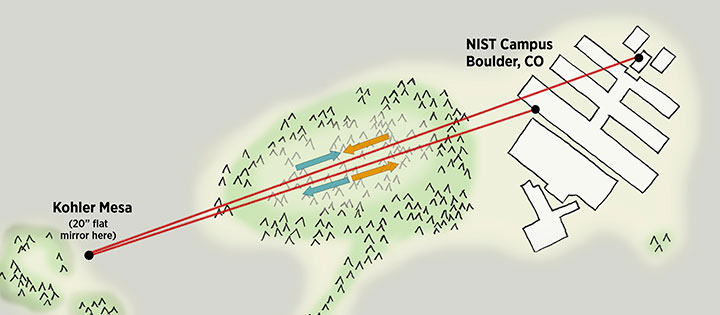
    NIST researchers transferred ultraprecise time signals over the air between a laboratory on NIST?s campus in Boulder, Colorado, and nearby Kohler Mesa. Signals were sent in both directions, reflected off a mirror on the mesa, and returned to the lab, a total distrance of approximately two kilometers. The two-way technique overcomes timing distortions on the signals from turbulence in the atmosphere, and shows how next-generation atomic clocks at different locations could be linked wirelessly to improve distribution of time and frequency information and other applications.
    NIST researchers transferred ultraprecise time signals over the air between a laboratory on NIST’s campus in Boulder, Colorado, and nearby Kohler Mesa. Signals were sent in both directions, reflected off a mirror on the mesa, and returned to the lab, a total distrance of approximately two kilometers. The two-way technique overcomes timing distortions on the signals from turbulence in the atmosphere, and shows how next-generation atomic clocks at different locations could be linked wirelessly to improve distribution of time and frequency information and other applications.

    The stability of the transferred infrared signal matched that of NIST’s best experimental atomic clock, which operates at optical frequencies. Infrared light is very close to the frequencies used by these clocks, and both are much higher than the microwave frequencies in conventional atomic clocks currently used as national time standards. Operating frequency is one of the most important factors in the precision of optical atomic clocks, which have the potential to provide a 100-fold improvement in the accuracy of future time standards. But the signals need to be distributed with minimal loss of precision and accuracy.

    The signal transfer demonstration was performed outdoors over a two-way wireless link using two laser frequency combs. A frequency comb generates a steady stream of ultrashort optical pulses with a spacing that can be synchronized perfectly with the “ticks” of an optical atomic clock. (Click here for more on how frequency combs work.) In the experiment, the two combs were synchronized to the same stable optical cavity, which serves as a stand-in for an optical atomic clock. Each comb pulse was sent from one of two locations on NIST’s campus in Boulder, Colorado, reflected off a mirror on a mesa behind the campus, and returned to the other site, traveling a total distance of two kilometers.

    Researchers measured travel times for pulses traveling in opposite directions between the two sites. The cumulative timing differences and frequency instabilities were infinitesimal, just one million-billionths of a second per hour, a performance level sufficient for transferring optical clock signals.

    The transfer technique overcomes typical wireless signal problems such as turbulence in the atmosphere—the phenomenon that makes images shimmer when it’s very hot outside. Because turbulence affects both directions equally, it can be cancelled out. The transfer technique can also withstand signal losses due to temporary obstruction of the light path. The method should be able to operate at much longer distances, possibly even over future ground-to-satellite optical communication links as an added timing channel, researchers say.

    The combs potentially could be made portable, and the low-power infrared light is safe for eyes. The research is funded in part by the Defense Advanced Research Projects Agency.

  • Surveyors Invited to ‘Survey Earth in a Day’

    sealOn the day of the solstice, June 21, geospatial professionals around the world and members of Land Surveyors United (a global support network for land surveyors) will be simultaneously recording survey grade GPS data from thousands of points around the globe, in order to gain a more accurate understanding of the earth’s surface.

    This will be the second Survey Earth in a Day event; in 2012 the first Survey Earth event was held, establishing many new understandings between geospatial and geomatics professionals and the general public on geospatial issues, organizers said. “With a mission not only to learn more about the Earth’s surface but also monitor its changes over time, and the changes in public perspective, as a global community, we may be more capable of assessing our future,” organizers said.

    “Our results will change the knowledge we currently have of the shape of the earth and thus provide new information about our planet’s surface for the benefit of all man-kind. Help the surveying industry and the surveyors in your region of the world by representing your area as we re-measure the entire globe in one single day,” organizers said.

    “If you are a geospatial professional with access to survey grade GPS equipment, you should consider helping us set a world’s record, right from where you live and work. Only a surveyor can provide the kind of precision that will be needed to truly understand the shape of planet earth. Just imagine how much this can help our industry,” organizers said.

  • Advanced Navigation Releases Dual-Antenna GNSS/INS

    Advanced Navigation Releases Dual-Antenna GNSS/INS

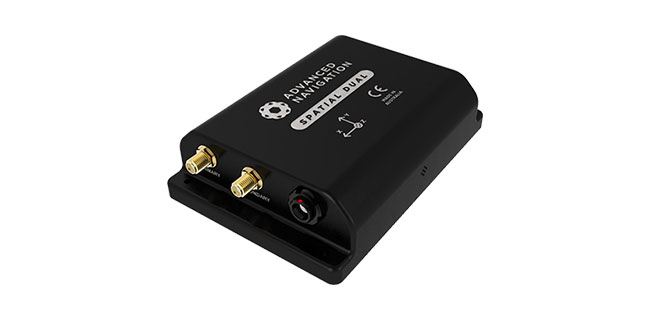
    Advanced Navigation has released Spatial Dual, its new dual-antenna GNSS/INS. Spatial Dual is a ruggedized miniature GPS-aided inertial navigation system and AHRS that provides accurate position, velocity, acceleration and orientation under demanding conditions. It combines temperature calibrated accelerometers, gyroscopes, magnetometers and a pressure sensor with a dual-antenna RTK GNSS receiver. These are coupled in a sophisticated fusion algorithm to deliver accurate and reliable navigation and orientation, the company said.

    Spatial Dual contains the Trimble BD982 GNSS receiver, which is a triple frequency dual-antenna RTK GNSS receiver. Using dual-frequency moving baseline RTK, Spatial Dual is able to provide heading accuracy of less than 0.1 degrees using its dual antennas. The dual-antenna heading works while both stationary and moving and allows for very accurate heading in both slow moving and 3D vehicles, where equivalent single antenna systems must rely on magnetic heading. An additional benefit of the dual antennas is the ability to measure slip angle to within 0.2 degrees.

    Spatial Dual supports all of the current and future satellite systems, including GPS, GLONASS, Galileo and BeiDou. In addition, Spatial Dual supports RTK for centimeter positional accuracy and the recent Omnistar G2 network for 10 centimeter accuracy.

    Spatial Dual provides position, velocity and orientation at rates up to 1000 Hz for highly dynamic applications. When Spatial Dual loses a GNSS fix it continues to navigate using dead reckoning inertial navigation to provide seamless navigation data through tunnels and other outage situations.

    Spatial Dual is housed in a precision marine-grade aluminum enclosure that is waterproof and dirtproof to the IP67 standard and shockproof to 2000g, allowing it to be used in tough conditions.

    Spatial Dual supports a wide range of peripherals including odometers and wheel speed sensors for ground vehicle navigation, DVLs and USBLs for underwater navigation and many other external sensors. It supports both industry standard NMEA output and an efficient binary protocol.

  • NVS Technologies Releases Firmware Update for NV08C Receivers

    NVS Technologies has released updated firmware for its NV08C receiver series. Firmware v0206 is compatible with current and preceding hardware revisions of the NV08C receiver series. Firmware v0206 can be downloaded free of charge.

    Firmware v0206 offers:

    • Stabilized raw data output for output rates up to 10 Hz
    • Extended $POUTC NMEA message, including current LEAP SECONDS value, flags for expected UTC correction, and PPS edge shift relative to UTC (sawtooth correction SW).
    • Stabilized sleep mode operation ($POPWR,1111*66) for all NV08C series HW versions
    • Increased position accuracy and stability in urban canyon conditions with poor SV visibility
    • Cold start initialized to LEAP SECOND 16 (LEAP SECOND 16 came into effect July 1, 2012)

    Benefits include:

    • Obtain initial receiver coordinates more quickly, in cold starts, low satellite signal (foliage/canopy) and loss of satellite signal conditions (indoor, garages, tunnels…).
    • Greater satellite tracking reliability in poor visibility conditions (urban canyon/tall buildings, bridges/underpasses…).
    • Stable raw data output up to 10Hz rate.
    • Full sleep mode support for effective power savings.
    • Complies with ERA-GLONASS requirements.
  • GeoGathering 2013: Have You Developed Your Geospatial Data Strategy?

    GeoGathering logo NO_YEARThe conference GeoGathering: GIS for Gathering and Production Lines will be held Colorado Springs at the Cheyenne Mountain Resort on August 21-22, 2013. With the theme of “Developing a Data Strategy: Data Collection and Sharing,” the conference focuses on how operators collect and share information about their assets to increase operational safety and improve pipeline decision-making.

    “Today, acquisitions and fast growth in the gathering industry are forcing operators to develop a data strategy and look deeper at all aspects of their pipeline asset data – from how it is collected, to making it available to decision makers,” said Victoria Skogman, is the conference manager. “Currently, gathering systems are unregulated, but trends in the industry show this is likely to change in the future. Preparing for this impending change is crucial, hence the theme of the conference.”

    The goal of the GeoGathering Conference is to provide valuable information to gathering system and upstream operators who want to create efficient, accurate, and collaborative data strategies that work for their organizations. Presenters will demonstrate how GIS technology allows attendees to collect and share data between the field and the office, enabling their organization to make well-informed decisions. The versatile agenda focuses on real-world experiences — everything from integrity management and data requirements to data security and making GIS technology more accessible to stakeholders, Skogman said.

    The GeoGathering Conference committee estimates that close to 150 GIS professionals and top-level management from leading oil and gas companies will attend this year. Attendees will be able to attend sessions that include:

    • Developing a Data Strategy
    • Data Collection Methods to Meet Requirements
    • Data Security and the Cloud
    • Data Sharing: GIS as an Enterprise
    • Organizing Data for Decision-Makers
    • PHMSA MAOP Strategies
    • Web-enabled Data Sharing Technologies & Portals
    • Collecting & Sharing Data to Enhance Safety

    This year, attendees will experience the new, audience-focused format that offers two simultaneous tracks giving attendees the chance to tailor their own conference schedule. Plus, two of the biggest improvements are the addition of “structured networking” sessions and a “GIS Think Tank.”

    Structured Networking facilitates a small group setting, in which attendees have the opportunity to meet people with common interests, share practical ideas, and network with individuals who might possibly help your organization. When attendees leave the networking session, they will have a solid list of new business contacts, Skogman said. The networking sessions are strategically placed at the beginning of the conference to help you build new relationships over the duration of the conference.

    The GIS Think Tank session is also a unique addition to the agenda. It will feature five to seven GIS managers from a variety of gathering operators around the country. This is not a typical Q&A panel session; instead, it will allow the participating GIS managers to converse among themselves as the audience listens in. This will be mostly an unstructured session so that managers can spend more or less time on topics as they choose, Skogman said. It will be facilitated with questions from the audience. The purpose is to lead an informal discussion on some of the successes that each manager has had along with their opinions on pressing issues that gathering operators are facing.

    This year’s conference has a seven-person steering committee with pipeline gathering background. Members include Trisha Menasco of DCP Midstream, Tom Coolidge of Esri, Ellen Nodwell of Hess, Cameron Collins of Williams, Rob McElroy of McElroy Consulting, Ron Brush of New Century Software and Victoria Skogman of New Century Software.

    “The conference topics are very timely,” said Menasco. “Just when I thought I had all the data requirements figured out, it feels like we are starting over. I look forward to helping build an agenda that will be useful to the gathering community.”

    Early bird registration is open. The conference committee welcomes senior management, project managers, integrity management specialists, GIS professionals, field operations managers, regulatory compliance personnel, and engineers.