Author: GPS World Staff

  • Propeller Aero and DJI join on PPK drone solution

    Propeller Aero, a cloud-based drone analytics company, is partnering with DJI to create the Propeller PPK Solution leveraging the DJI Phantom 4 RTK drone.

    The solution provides customers in the civil, mining, aggregates and waste management industries with a reliable and fully integrated drone mapping system, helping them collect highly accurate data from any worksite without the challenges of traditional workflows, the companies said.

    The DJI Phantom 4 gathers data at a construction site. (Photo: DJI)
    The DJI Phantom 4 gathers data at a construction site. (Photo: DJI)

    According to Propeller Aero, Propeller PPK Solution is a fully integrated software and hardware system that reliably provides photogrammetric model outputs in geodetic, projected or local coordinate systems.

    The solution provides accuracy of 1/10 feet (3 cm) from independent checkpoints across small and large survey areas (checkpoints up to 1 km from GCPs). To capture surveys of this accuracy, all that is needed is one AeroPoint on the ground (over a known point if working in local coordinates).

    The Propeller PPK Solution has been shown to reduce the time required to complete a drone survey by 70 percent as compared to a traditional workflow using multiple GCPs across a worksite, Propeller Aero said.

    “DJI has led the drone market with their reliable and innovative products, and quickly demonstrated the ability for these machines to become useful tools in the heavy civil and natural resource industries,” said Rory San Miguel, CEO of Propeller Aero. “Globally, these industries are seeing real cost savings and efficiencies through cloud-based analytics and using innovative new technologies like PPK drones combined with AeroPoints. Accurate data is paramount to worksite analytics and Propeller has always been obsessed with helping teams achieve this. We introduced the world’s first smart ground control point, AeroPoints, and now we’ve partnered up with DJI to build an end-to-end PPK solution.”

    On today’s construction sites, lack of project data costs businesses more than $177 billion annually. To help solve this problem, Propeller developed a tightly integrated PPK workflow across the DJI Phantom 4 RTK drone, an AeroPoint, and Propeller’s cloud processing platform that visualizes real-time site data. Surveyors and contractors can Propeller PPK solution to gather verifiable, trustworthy data to help make data-driven decisions and prevent costly mistakes, the companies added.

    “Propeller’s deep expertise in aerial mapping and analytics coupled with DJI’s industry-leading open-platform drone hardware creates a highly accurate turnkey solution,” said Jan Gasparic, director of strategic partnerships at DJI. “We are excited about this partnership because it broadens the use of DJI drones to deliver accurate data at a cost-efficient price point, helping teams better answer questions about site progress and productivity.”

    The complete PPK solution will be distributed through channel partners, including Trimble’s SITECH distribution network. Trimble Stratus, a 3D cloud-based visualization platform developed by Propeller, along with AeroPoints, is already integrated with Trimble Connected Site solutions.

    “The advent of drones in the construction industry has improved efficiencies, and Trimble Stratus users are already benefiting from the ease-of-use and scalability of drone-based surveys,” said Scott Crozier, general manager, Trimble Civil Engineering and Construction. “With the new Propeller PPK Solution and Trimble Stratus software, we’ve seen first-hand how surveyors and contractors can collect aerial survey data in a fraction of the time it used to take, and get repeatable and reliable results.”
  • Karamba Security joins with STMicroelectronics on cyber security

    Karamba Security, a provider of automotive cybersecurity, and STMicroelectronics (ST), a global semiconductor company, are integrating Karamba’s Carwall end-to-end protection on the ST Telemaco3P STA1385 Automotive Telematics and Connectivity Processor.

    Together, ST and Karamba are leveraging the security architecture of the Telemaco3P with the addition of Carwall Electronic Control Unit (ECU) hardening software.

    The combined solution provides cyber security features for both contents and run-time integrity verification by detecting attempts at modifications and preventing deviations from the ECU’s intended behavior, the companies said.

    Karamba Security’s deterministic approach has shown to prevent vehicle cyberattacks with zero false positives.

    “STMicroelectronics is a leading provider in the connected-car ecosystem,” said Ami Dotan, Karamba Security’s co-founder and CEO. “We are pleased to collaborate to protect automotive systems based on ST’s Telemaco3P microprocessor by automatically hardening them against cyberattacks to assure consumer safety.”

    “Karamba Security’s differentiated cyber-prevention solutions have generated significant market traction in a very short time and are a strong fit to enhance the security and value of ST’s Telemaco3P architectures,” said Antonio Radaelli, director of STMicroelectronics’ Infotainment, Automotive Digital Division. “Karamba’s Carwall adds another layer of security to the Telemaco3P benefits, which include its state-of-the-art power-efficient design, fast connectivity interfaces, domain isolation, and embedded Hardware Security Module. The combination provides customers with even stronger cybersecurity protection for in-vehicle systems.”

    For more information, visit STMicroelectronics’ booth at Electronica Munich on Nov. 13-16 in C3 Stand 101, where ST and Karamba will be available to discuss this joint security solution.

  • SmartDrive, Geotab collaborate for fleet data and hardware convergence

    SmartDrive, Geotab collaborate for fleet data and hardware convergence

    SmartDrive Systems, a video-based safety and transportation intelligence company, is collaborating with Geotab to provide fleets with integrated solutions that leverage the SmartDrive platform as a single on-board data collection hub.

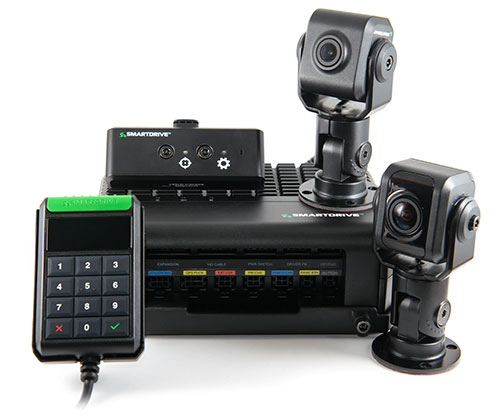
    The SmartDrive SR4 video hardware platform. (Photo: SmartDrive Systems)
    The SmartDrive SR4 video hardware platform. (Photo: SmartDrive Systems)

    SmartDrive and Geotab are helping to simplify the on-board technology footprint, providing fleets the freedom to choose solutions that fit their business and their budget, and dramatically lowering the total cost of ownership.

    SmartDrive offers a single integrated and aligned understanding of time, location and driver and vehicle performance to third-party applications. Fleets will be able to select solutions without incurring the additional costs associated with managing and maintaining multiple onboard devices.

    “The ability to integrate and operate applications from a single data collection platform breaks through significant technology and operational barriers — unlocking efficiency gains for fleets across routes, drivers and risk,” said Steve Mitgang, SmartDrive CEO. “Collaborating with Geotab allows us to make good on the promise of convergence with a company that shares our commitment to providing open, connected and flexible solutions for fleets of every size. We believe this is a transformational shift — and it’s only the beginning of what is possible for our customers.”

    With the growth of technology in the cab, fleets are struggling with how to manage the number of devices on the windshield and the connection of those devices in the vehicle.

    Video-based safety cameras, electronic logging devices and advanced driver assist system (ADAS) sensors are causing fleets to look for integrated solutions that solve the hardware and data overload problem. Beyond the number of devices on the vehicle, fleets also are contending with the cost to install, maintain and train on each of these technologies. With the migration from 3G cellular networks to 4G, and resulting need to upgrade onboard hardware, fleets have an opportunity to re-think and streamline their technology strategy.

    “For too long, traditional telematics systems have saddled fleets like ours with costly hardware that is expensive to maintain and upgrade, and monthly subscription costs that continue to escalate,” said Matt Penland, vice president of safety, Cypress Truck Lines. “There has to be a better way. Fleets should have the same freedom and flexibility to consolidate devices and applications that we all now have on our cell phones. The technology is available to make this possible.”

    The SmartDrive platform provides a unified video and telematics data stream that can be leveraged by third parties to power their applications, the companies said. This same data stream powers the SmartDrive video safety program, ADAS and transportation analytics applications.

    Through the collaboration, Geotab telematics and compliance offerings take advantage of the SmartDrive single box architecture and unified data stream, eliminating redundancy across hardware, cellular connectivity, GPS modules, connections to the ECU and cabling. It also provides data alignment across the two providers’ applications, unlocking new fleet performance insights and eliminating problematic data discrepancies.

    As a result of the collaboration, fleets can benefit from:

    • The SmartDrive video safety program
    • SmartDrive SR3 or SR4 video hardware platform
    • “Single box” architecture enabling the convergence of data, devices and network connectivity
    • Analytics powered by SmartDrive SmartIQ
    • Geotab tracking, which delivers real-time and historical visibility to location, speed and geofencing information
    • Geotab regulatory compliance, including hours of service, driver vehicle inspection reports, International Fuel Tax Agreement (IFTA) recording and tax reports
    • Access and integration to Geotab Marketplace partners.

    “Geotab’s open platform centers on a reliable, scalable and secure approach to data access for business solutions,” said Colin Sutherland, executive vice president of sales, Geotab. “We have always said that our hardware is agnostic. The SmartDrive video hardware integration is a solution that not only leverages Geotab’s platform strength to incorporate data from non-Geotab hardware, but it is a great example of telematics solutions that extend the capital investments across multiple solution providers.”

    With more than three billion data points collected daily from over one million vehicles, Geotab helps companies access critical business intelligence and benchmarking data to help increase productivity, reduce fuel consumption, improve driver safety and strengthen compliance.

    The integration with Geotab will be generally available early in the first quarter 2019, and the SmartDrive convergence early adopter program is in progress.

    Current and prospective customers will be able to take advantage of the integration to Geotab from either the SmartDrive SR3 or SR4 platform.

    Released in March 2018, the new SR4 hardware includes unprecedented compute power in a small, flexible footprint; new sensors for advanced risk identification and real-time driver-assist; innovative architecture enabling the convergence of data, devices and network connectivity; new analytics powered by SmartDrive SmartIQ; and a video safety program.

  • Galileo constellation grows by 4 satellites

    Galileo constellation grows by 4 satellites

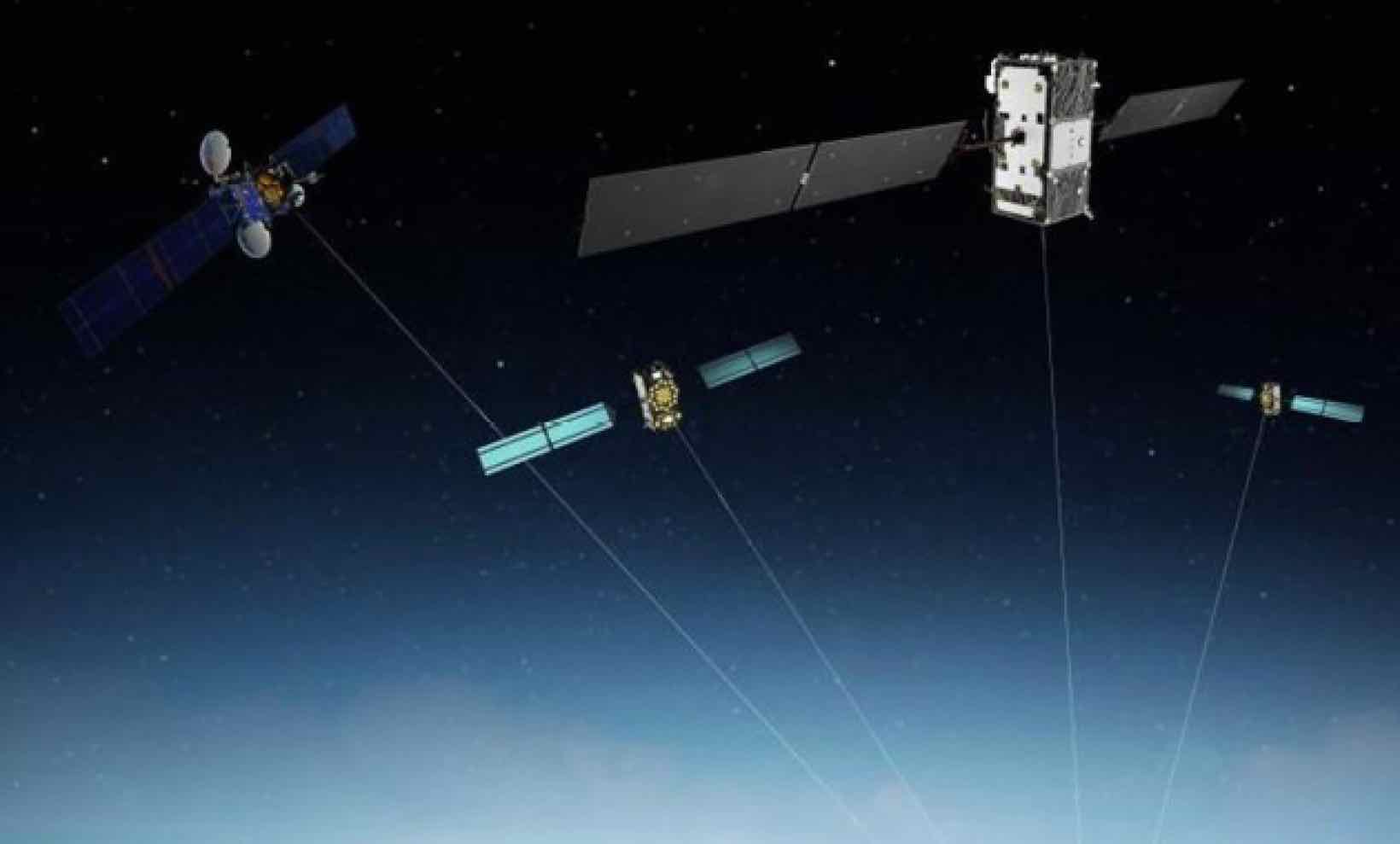
    Galileo satellites GSAT0215, GSAT0216, GSAT0217 and GSAT0218, launched in December 2017, were commissioned for operational use as of Oct. 12, with all signals usable: Open Service, Public Regulated Service and Search and Rescue Service.

    This increases the number of Galileo satellites that are available for service provision to 18. Initial operational capability for the constellation was declared on December 15 2016.

    The additions to the GNSS almanac include the following:

    GSAT0215:  space vehicle E21 aka Nicole, occupying slot A03 if the constellation, with its payload running on a phased hydrogen maser (PHM) clock.

    GSAT0216: E25, Zofia, slot A07, PHM clock.

    GSAT02017: E27, Alexandre, slot A04, PHM clock.

    GSAT0218: E31, Irina, slot A01, PHM clock

    Each satellite weighs 715 kilo;  measures 2.7 x 1.2 x 1.1 meters with a deployed solar array span of 14.67 meters; has onboard power of 1,900 W; and broadcasts navigation signals in 3 bands: E5, E6 and E1. Design life of the new satellites is more than 12 years.

    Satellites GSAT-219 (Tara), GSAT-220 (Samuel), GSAT-221 (Anna) and GSAT-222 (Ellen) were launched on July 25 and are currently listed as under commissioning.

    Galileo status information

    Updated information on the status of the Galileo constellation can be found in the Constellation Status section of the European GNSS Service Centre’s (GSC’s) website.

    Delivery person uses Galileo on a mobile device to deliver a package. (Photo: GSA)
    Delivery person uses Galileo on a mobile device to deliver a package. (Photo: GSA)

    According the the European GNSS Agency (GSA), more than 100 million devices are using Galileo today.

    For more information on user technology, see GSA’s 2nd User Technology Report and a commentary, “Farewell to the Golden Age of GPS.”

    To keep track of Galileo-enabled devices serving a variety of needs as they become available, visit usegalileo.eu.

    The Galileo Initial Services allow the use of Galileo Open Service (OS), which enables a free of charge, global ranging, positioning and timing service for the OS users.

    Galileo is interoperable with the GNSS constellations (GPS, GLONASS, Beidou). By offering dual frequencies as standard, Galileo is set to deliver real-time positioning accuracy down to the meter range.

    For questions about Galileo, contact the GSC Helpdesk.

    Four Galileo satellites were added to constellation in October 2018. (Image: GSA)
    Four Galileo satellites were added to constellation in October 2018. (Image: GSA)
  • For those who served: GNSS helps expand Arizona national cemetery

    For those who served: GNSS helps expand Arizona national cemetery

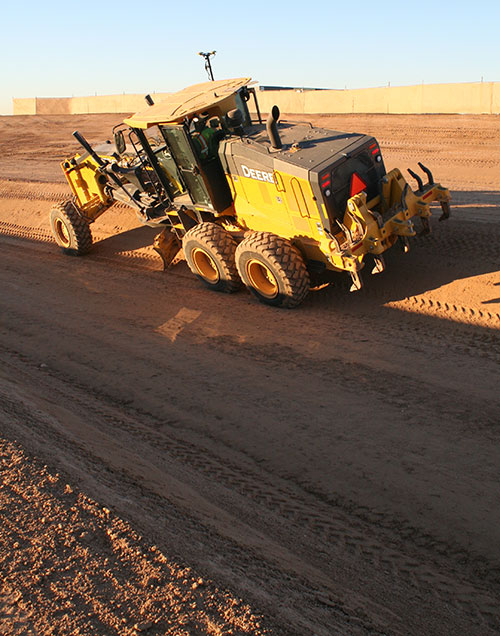
    The base of the channel was just wide enough (12 feet) to fit the John Deere machine for grading the 2:1 slope. With GNSS, the operator did not have to reference grade stakes or stop for grade checks. (Photo: Topcon)
    The base of the channel was just wide enough (12 feet) to fit the John Deere machine for grading the 2:1 slope. With GNSS, the operator did not have to reference grade stakes or stop for grade checks. (Photo: Topcon)

    Noel Guevara, president and owner of JAG Construction, considers it an honor to have been involved in a project to expand the National Memorial Cemetery of Arizona.

    To get the job done as quickly and efficiently as possible, the fledgling company drew upon GNSS technology for the bulk of its grading and specialized excavation needs.

    Doing so, it was able to wrap up the major expansion on time, with as little disruption as possible.

    Additional Space Needed. The cemetery expansion will help alleviate a shortage of burial space brought about by the passing of veterans of World War II, the Korean Conflict and the Vietnam War.

    The project involves development of 22 acres adjacent to the existing cemetery including construction of two columbarium courts to house 4,688 niches for cremains; 2,180 pre-placed crypts; grading for 1,900 in-ground cremains; 650 linear feet of roadway; two retention ponds; and 1,350 feet of shotcrete drainage channel.

    A look around the expansion site — previously scrub land — revealed few grade stakes, a sign that GNSS technology was at work. “I first used GPS when I was with a company back in 2000,” Guevara said. “So I know the tremendous boost in productivity it can give, and felt that I had to have it on this project.”

    Critical Support. While Guevara may have felt at home with machine control, some of his team needed a crash course in working within a GNSS environment. RDO Integrated Controls outfitted JAG’s two motor graders with Topcon 3D-MC2 machine control in a twin-antenna, single-mast configuration.

    Guevara’s decision to place his faith in the GNSS solution put his company at what Topcon calls the “intersection of infrastructure and technology,” a conceptual crossroads where Topcon helps industry professionals best meet growing infrastructure demands through technological innovation — increasing both productivity and profitability.

    A Channel Runs Through It. Though the majority of the cemetery expansion site is relatively flat, the retention ponds and drainage channel could have proven problematic, had they been done using traditional survey methods.

    Guevara said being able to do the detail work with the Topcon system dramatically ramped up production.

    “This is easily 70% faster than doing things old-school,” he said. “Having the blades equipped with GPS gave us the confidence to walk away each day knowing that the numbers were there.”

    JAG was also contracted to excavate foundations for a pair of columbarium courts. Guevara once again turned to GNSS to streamline that effort, specifically a dual-antenna Topcon MC-i3 system with a GX-55 control box.

    “Because of the GPS system on that machine, the operator knew exactly how far down he had to go; there was no questioning or verifying depths — that was a nice solution for us.”

    In 2017, JAG invested in six GNSS-based machine control systems. This year they are looking at additional machine purchases to meet what is forecast to be more than double 2017’s numbers.

  • Research Online: Optimizing performance of dual-frequency mass-market chips

    By Paolo Crosta, Paolo Zoccarato, Rafael Lucas and Gerarda De Pasquale, European Space Agency

    Test set-up. (Image: Authors)
    Test set-up. (Image: Authors)

    Most mass-market manufacturers have already developed a dual-frequency chip or will soon do so. What is still not completely clear is the main benefit of adding the second frequency. Is it beneficial just for correcting ionospheric error?

    Will it provide an improvement of the ranging error thanks to the wideband nature of the signal broadcast on the second frequency and their multipath rejection capabilities? Is it improving the measurement quality by means of a higher transmitting power?

    Could it be exploited as a source of data for the provision of accurate orbit and clock corrections? What is the best PVT algorithm to apply to a multi-constellation dual-frequency mass-market chip?

    To answer these questions, an evaluation kit of the Broadcom chip BCM4775 has been tested — the first dual-frequency mass-market chip commercially available.

    Results show:

    • the code noise (multipath) is often the main source of error, hiding the benefits of more accurate clocks and orbital data.
    • wide-band signals are very beneficial for multipath rejection. Position fix based on E5a-L5-only measurements even with fewer satellites can outperform L1-E1-only in tests performed this September (impact of the new Galileo satellites).
    • after deactivation of the duty-cycle tracking on Android phones, the carrier phase measurements are improved and we do not experience any longer filter resets in the position Kalman filter.

    More information at www.ion.org/publications/browse.cfm.

  • EU ‘GLAD-2’ develop low-cost nav for UAVs

    EU ‘GLAD-2’ develop low-cost nav for UAVs

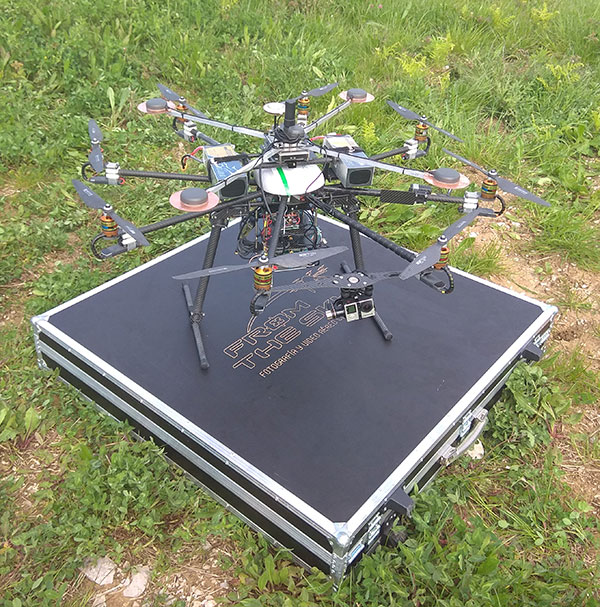
    A European Union-funded initiative has developed a low-cost positioning and navigation system for unmanned aerial systems (UAS).

    Photo: GSA
    Photo: European GNSS Agency

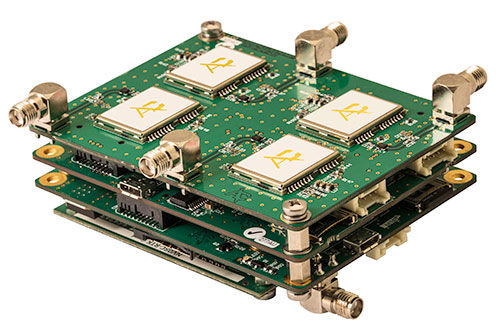
    Using multiple antennas, the device is based on off-the-shelf components and advanced data-fusion algorithms. It fuses GNSS and inertial data to enable accurate and reliable navigation.

    The EU-funded Horizon 2020 GLAD-2 project developed the system. The work involved in-depth analysis of algorithms, hardware and software redesign, exhaustive refinement and repeated in-field testing.

    Researchers used low-cost GNSS receivers, together with advanced data fusion with an inertial measurement unit, and barometer data to enhance the attitude and position of UAS in harsh GNSS environments. The system also avoided the use of magnetometers, making it immune to magnetic fields, and removing the need for system calibration when the magnetic environment is modified.

    Photo: GSA
    Photo: European GNSS Agency

    Engineers selected different GNSS antennas and measured their performance according to technical and economic criteria. A multi-antenna approach enabled UAS to take accurate headings without suffering the usual problems inherent to magnetometers.

    “The inertial sensors provide an excellent dynamic response at very high data rates, while GNSS serves as an absolute reference to prevent drift. In addition, differential GNSS carrier phase measurements can be used to obtain great accuracy in orientation by using the multi-antenna configuration,” said project coordinator Esther López of Spanish technology company ACORDE.

    GLAD-2 achieved the commercialization of the low-cost navigation system, culminating in the European Conformity (CE) certification mark following the corresponding certification process. The CE mark indicates conformity with health, safety and environmental protection standards for products sold within the European Economic area.

    The result is a highly competitive product aimed at the low-cost sector of the navigation systems market. “Due to its flexibility, the system fulfils the needs of a wide range of users, not only in UAS, but also in terrestrial and maritime environments applications,” López said.

  • Thales receives contract to upgrade Galileo ground segment

    Thales receives contract to upgrade Galileo ground segment

    News from the European Space Agency

    The European Space Agency has awarded a new framework contract and two new work orders to Thales Alenia Space in France to upgrade the Galileo Mission Segment, the element of the worldwide Galileo ground segment dedicated to delivering navigation services. Included are upgrades to the Galileo Security Monitoring Centre (GSMC) near Paris, and implementation of a second GSMC in Spain, near Madrid.

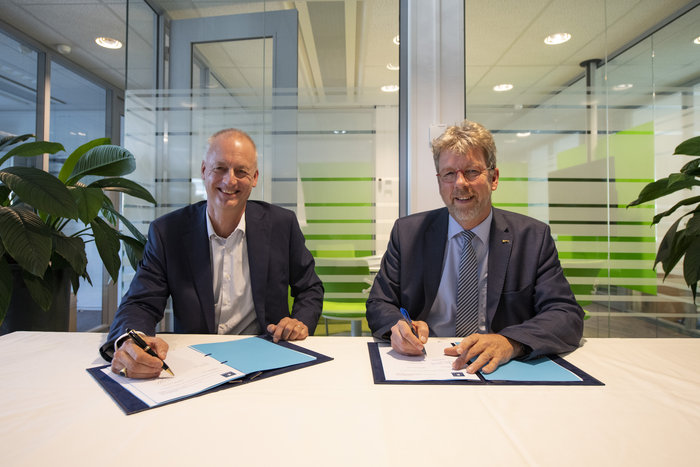
    ESA Director of Navigation Paul Verhoef signed the contract with Thales Alenia Space Senior Vice President of Sales Martin van Schaik on Oct. 17 at ESA’s ESTEC technical centre in Noordwijk, the Netherlands.

    “Galileo has already proven to be the highest performing satellite navigation system in the world, even before the constellation is complete,” Verhoef said. “This achievement is the result of the close collaboration between the public sector — the European Commission, the European GNSS Agency and ESA — and our industrial partners throughout Europe.

    Contract signing: van Schaik (left) and Verhoef. (Photo: ESA)
    Contract signing: van Schaik (left) and Verhoef. (Photo: ESA)

    “Today I am very happy to announce a continued relationship with Thales Alenia Space in one of the most complex parts of the system, namely the Ground Mission Segment, and thank them for their commitment to the programme.”

    The constellation in orbit is only one element of the overall satellite navigation system – the tip of the Galileo iceberg. At the same time as the satellites were being built, tested and launched, a global ground segment was put in place.

    Complex System

    Establishing Galileo’s ground segment was among the most complex developments ever undertaken by ESA, having to fulfil strict levels of performance, security and safety.

    In 2017, responsibility for operating the Galileo ground segment was passed to ESA’s partner organization, the European GNSS Agency (GSA). Nevertheless, ESA continues to be in charge of the maintenance, development and evolution of the ground segment, as well as the development of the space segment.

    GSMC upgrade and construction. The first work order contracts Thales Alenia Space as prime contractor to undertake all necessary activities to upgrade the Galileo Mission Segment and the GSMC as part of Galileo’s exploitation phase.

    This work includes upgrading Galileo’s system architecture to provide more accurate navigation products for broadcast by Galileo satellites, updating obsolescent elements in the current system, and improving operability linked to the provision of services and enhanced robustness.

    This work order also includes the construction of additional uplink stations – tasked with uplinking the latest navigation messages to the Galileo constellation — at the existing Galileo ground station sites of Papeete in French Polynesia and Svalbard in Norway.

    A new sensor station — providing a ground-based measurement of Galileo signal quality and precise satellite position — will also be installed at Wallis Island in the Pacific.

    Photo: ESA
    Galileo’s Nouméa ground station’s Sensor Station and Uplink Station. (Photo: ESA)

    The work order will also augment the capabilities for implementation of the Public Regulated Service (PRS), the single most accurate and secure class of Galileo signals. Encrypted PRS signals will be made available only to authorised governmental users through approved national authorities.

    Together, the two GSMCs will ensure the security of the overall Galileo system and manage PRS access and operations.

    Security monitoring. The second work order contracts Thales Alenia Space as prime contractor to implement security monitoring functions for Galileo operational assets — including the control centres, service facilities and ground stations.

    The integration, qualification, deployment and migration into operational services of the various upgraded segments will be undertaken over the next three years.

    ESA has issued these work orders in its role of undertaking the design and development of future upgrades and the technical development of infrastructure as well as overseeing Galileo’s deployment, on behalf of the European Union, Galileo’s owner.

  • Hexagon’s M.App Enterprise update includes mobile workflow

    Hexagon’s Geospatial division released a new version of M.App Enterprise for 2018, M.App Enterprise 16.5. This privately hosted solution allows organizations to deploy Hexagon Smart M.Apps that dynamically address their location-based business problems, the company said.

    M.App Enterprise is the ideal platform to monitor assets, evaluate changes and take action, with the new release now including a native mobile client. The mobile workflow enables managers to assign tasks to field workers when it’s necessary to act. With the new mobile application, the platform is available from anywhere, including areas without internet access.

    The new M.App Enterprise Studio comes with the Spatial Workshop user interface to manage spatial recipes. Its geoprocessing capabilities make it possible to make calculations with any type of geospatial data.

    Updates to the Feature Analyzer component, such as thematic cluster markers, tooltips for boundary data and the option to share your views according to user type, make it easier to interactively derive insights from a variety of data, the company said.

    The new product localization feature ensures that users are no longer lost in translation. New languages can be added to any local M.App Enterprise instance within minutes.

    “M.App Enterprise provides a unified geospatial enterprise platform enabling customers and partners to create vertical solutions for their markets and industry segments,” said Georg Hammerer, chief technology officer of Hexagon’s Geospatial Division. “M.App Enterprise perfectly fits into the movement to the cloud and the trend towards self-service BI.”

  • Orolia launches Horizon search-and-rescue system

    Orolia launches Horizon search-and-rescue system

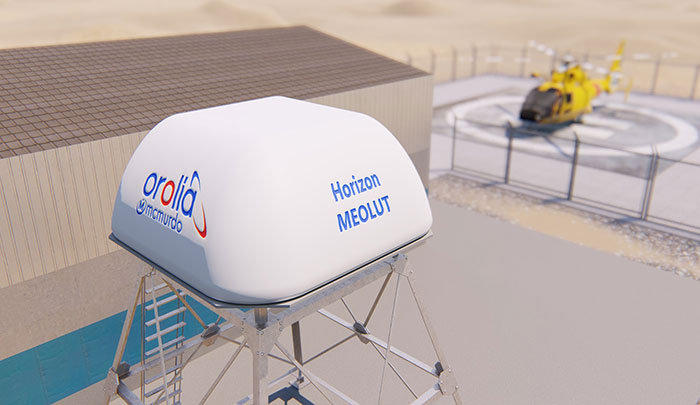
    Orolia has introduced the McMurdo Horizon system, an S- and L- band compatible phased array system featuring antennas developed by Ball Aerospace with horizon-to-horizon coverage to capture search-and-rescue signals relayed from orbiting satellites immediately after line-of-sight is established.

    The McMurdo Horizon system is now available to enhance regional search and rescue services worldwide with technology to complement existing and emerging ground-based systems at Medium-altitude Earth Orbit Search and Rescue (MEOSAR)ground stations.

    Orolia’s McMurdo Horizon Medium Earth Orbit Local User Terminal (MEOLUT) can deliver enhanced search and rescue coverage and second-generation signal processing capabilities, in a compact form factor with no moving parts. The key technology innovation, based on a modified off-the-shelf phased array antenna developed by Ball Aerospace, is a custom-designed Orolia solution.

    By pointing to satellites near the horizon, the McMurdo Horizon MEOLUT can detect and locate emergency beacons much farther away. This enhanced detection ability, combined with the McMurdo Selective Schedule Algorithm, enables the system to monitor more diverse regions, including the translation of oblong and irregular data points that are invisible to traditional systems.

  • Rugged tablet purpose-built for high-accuracy measurements

    Rugged tablet purpose-built for high-accuracy measurements

    RealSense 3D camera is fully integrated to capture real-time detailed images

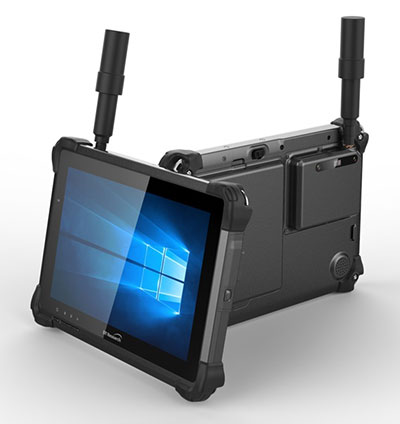
    DT301X rugged tablet. (Photo: DT Research)
    DT301X rugged tablet. (Photo: DT Research)

    DT Research has released the DT301X rugged tablet, a lightweight military-grade tablet that is purpose-built to enhance the precision of crime and crash scene reconstruction, bridge and other construction inspections, and 3D surveying.

    DT Research made the announcement at Intergeo, being held Oct. 16-18 in Frankfurt, Germany.

    The DT301X rugged tablet has MIL spec and IP ratings, yet is lightweight — offering the versatility to be used in the field, office and vehicles, the company said. A high brightness 10.1-inch touchscreen offers flexible viewing in a wide range of lighting, and an Intel eighth-generation Core i5 or i7 processor offers high-performance while still being energy-efficient.

    With high-capacity 60- or 90-watt hot-swappable batteries, the DT301X keeps working continuously, complemented with a variety of battery chargers so fully-charged batteries are always available.

    The DT301X integrates the Intel RealSense depth camera, which provides real-time 3D imaging to shorten the workflow and create extremely accurate measurements for CAD, engineering, design, utility management and crime-scene forensics.

    Scientific grade data, which is important for court evidence as well as building plans, just got easier and is now available to a wider group of workers. With this 3D camera technology, depth perception is integrated to add the most accurate image to make projects stay factual and consistent, DT Research said.

    Optional data capture offered on the DT301X besides the 3D camera are a 2D barcode scanner for equipment/location tags, a dual-frequency GNSS module for real-time mapping and positioning, long-range Bluetooth for 1000-foot range, and 4G LTE mobile broadband for the latest in high speed communications.

    The rugged tablet gives detailed accuracy combined with the latest 3D camera technology all in one device that is rugged and easy to use in the field.

    “DT Research’s high-performance rugged tablet equipped with the RealSense depth camera combined with DotProduct’s Dot3D Scan software allows speedy and efficient field-to-office 3D workflows for a wide range of applications from construction verification to asset management to crime scene mapping,” said Tom Greaves, chief marketing officer at DotProduct.

    The DT301X is built to operate in real-world situations, with an IP65 rating for water and dust, MIL-STD-810G for shock and vibration protection, and MIL-STD-461F for EMI and EMC tolerance. The tablet can be paired with a detachable keyboard for ease of use, and Wi-Fi and Bluetooth for smooth networking and constant communications.

    The DT301X rugged tablet is compatible with existing applications with Microsoft Windows 10 IoT Enterprise operating systems for flexible integration, and it brings together the advanced workflow for data capture, accurate positioning and data transmitting.

    Whether at the electrical substation, at the crash scene, or at the construction site, the DT301X is ideal for accurate measurements as well as other needed tasks, able to travel to wherever the work is.

    The DT301X rugged tablet will be available in November 2018 from DT Research’s authorized resellers and partners.

  • Harxon brings latest surveying technologies to Intergeo

    Harxon brings latest surveying technologies to Intergeo

    Photo: Harxon
    Photo: Harxon

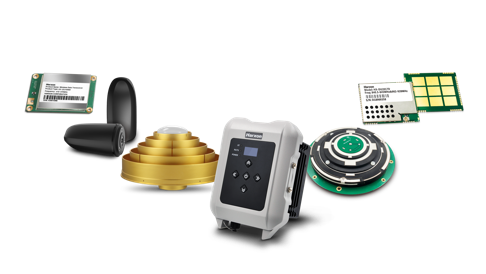
    Harxon is showcasing high-precision positioning GNSS antennas and its latest wireless data transmission technologies for surveying applications at Intergeo, Oct. 16-18, in Frankfurt, Germany.

    Image: Harxon
    Image: Harxon

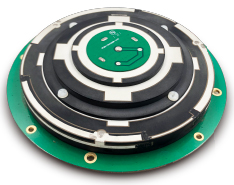
    X-Survey is an 4-in-1 OEM antenna for both navigation and communication in the real-time kinematic (RTK) surveying applications. It provides standard Wi-Fi, Bluetooth, 4G, and multiple-constellation signal reception for GNSS positioning.

    Its 3D design ensures a higher phase center stability and longer communication distance at a 360-degree direction, while lowering the impact of electromagnetic interference (EMI), hence increasing the overall machine efficiency and simplifying the RTK integration, the company said.

    Photo: Harxon
    Photo: Harxon

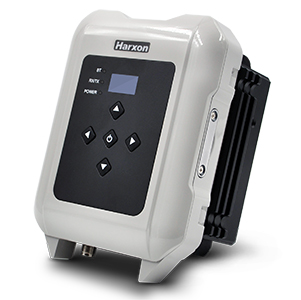
    The smart eRadio is a long-range and highly efficient radio modem designed to support RTK applications in surveying and precision agriculture. It can automatically identify RTK serial baud rate and provide a plug-and-play form for easy connection between eRadio and RTK.

    According to Harxon, the eRadio’s diagnostic reporting software can configure data and update radio status, allowing users to effectively deal with potential issues. In addition, it is equipped with the unique ETALK communication protocol that increases the communication distance by 20 percent.

    Other Harxon GNSS products showcased at Intergeo are for UAVs and precision agriculture, as well as surveying.

    The D-Helix antenna HX-CHX600A is featured with its patented D-QHA technology.


    Both 3D structured and mini-designed choke-ring antennas HX-CGX601A and HX-CGX611A can be used for base-station communication.

    The multi-constellation survey antenna GPS 1000, frequency hopping modem HX-DU2017D and external radio modem HX-DU8608D are also popular products for high-precision performance.