Author: Tracy Cozzens

  • WingtraOne drone maps site for EuroTube high-speed track

    EuroTube is Europe’s first testing ground for high-speed vacuum maglev transportation.

    In May, a WingtraOne drone conducted a topographic survey of a construction site where a EuroTube vacuum high-speed test track will be built.

    The futuristic project is the European answer to its American counterpart Hyperloop of the SpaceX and Elon Musk fame. The EuroTube project plans to provide a 3-kilometer-long vacuum tube to developers of pod technologies for testing.

    The Eurotube test infrastructure for high-speed vacuum transportation will provide an environment free of air resistance to test “pods”, or cars, that can be accelerated to speeds as high as the Boeing 747 in flight. (Photo: EuroTube)
    The Eurotube test infrastructure for high-speed vacuum transportation will provide an environment free of air resistance to test “pods”, or cars, that can be accelerated to speeds as high as the Boeing 747 in flight. (Photo: EuroTube)

    The project proved to be surprisingly challenging from the very beginning. First, the team had to find a long, flat stretch of land for EuroTube’s construction in Switzerland, a country famous for its mountains.

    And just as the right location was found in the canton of Valais, another challenge came along. How to survey such a complicated site surrounded with mountains, water bodies, forests and railway tracks? Luckily, the fellow Swiss company Wingtra already had a solution — the vertical-take-off-and-landing (VTOL) drone WingtraOne.

    After spending months in research and development of prototypes, the team at EuroTube selected the stretch of land in the Valais region of Switzerland as its candidate location. The chosen construction site is located next to railways tracks. A few water bodies, forests and ditches flank the other side of the construction site, making available a mere 3-meter-wide piece of land for take-off and landing of the drone.

    Fortunately, the WingtraOne’s VTOL capabilities were designed with exactly these kind of constraints. But why choose such a peculiar construction site in the first place?

    Bringing Europe’s transportation system to 21st century

    The answer lies in the technology behind the EuroTube itself. One of the main limitations in speeding objects on ground is the high air resistance, also called drag (drag is a type of friction force acting opposite to the relative motion of any object). By maintaining a low-pressure environment or even a vacuum, this air resistance can be lowered drastically, and hence objects can be accelerated to high speeds.

    Technologies such as the EuroTube provide this vacuum environment inside a long tube. Within such tubes, cars called “pods” can be accelerated to speeds as high as 800 km/h, meaning a journey between Zurich and Paris, which currently takes 4 to 6 hours, would be reduced to a mere half an hour. This is the vision driving the EuroTube project, which will provide a 3-kilometer-long vacuum tube to developers of pod technologies for testing.

    Aerial surveying of the construction site
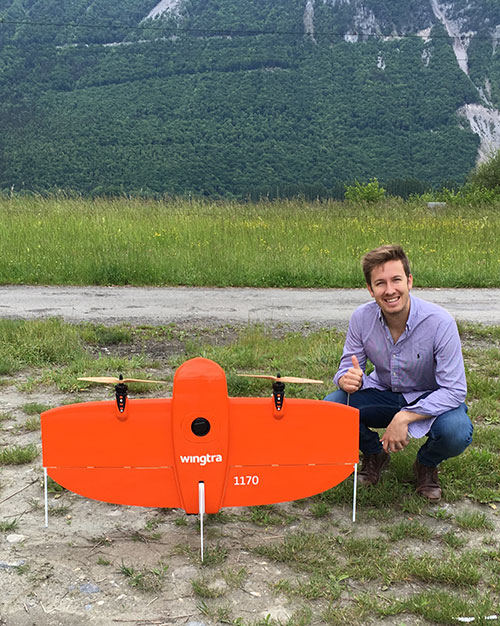
    Gerard Güell, the construction director of EuroTube, at the construction site with the WingtraOne. (Photo: Wingtra)
    Gerard Güell, the construction director of EuroTube, at the construction site with the WingtraOne. (Photo: Wingtra)

    Before the construction of the tube could begin, however, the EuroTube team needed to survey the construction site. Looking at solutions that would cut time and cost, Sascha Mark, the technical director at the EuroTube project, reached out to Wingtra in early May.

    A partnership between Wingtra and EurtoTube was quickly formed where Wingtra would provide the WingtraOne as well as conduct the surveyof the construction site.

    “For a cutting-edge research project involving significant infrastructure, time is of crucial importance,” Mark said. “We were looking at surveying solutions that can provide the dataset required for a construction site quickly without compromising on the accuracy. From this perspective, WingtraOne looked like a viable prospect.”

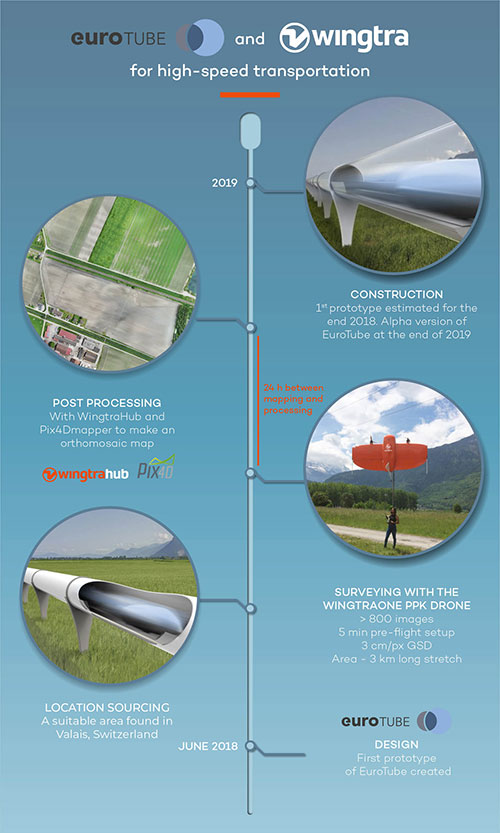
    The survey was conducted on May 21 when Gerard Güell, the construction director at EuroTube, met Adyasha Dash from Wingtra on site. To survey the area quickly with high accuracy, a WingtraOne equipped with an RX1RII camera and post-processed kinematics (PPK) was chosen. As the survey required flights over a straight, flat piece of land, flight planning was done on site, and took less than 5 minutes for the setup.

    The wind on site ranged from 2 m/s to 5 m/s. After letting the flight planning app WingtraPilot run a host of automatic pre-flight checks, the drone started its flight to collect aerial imagery at a ground sampling distance (GSD) of 3 cm/px. At the end of two consecutive flights taking less than an hour in total, the drone had collected a little more than 800 individual images.

    “It was nearly effortless to conduct the aerial surveying with the WingtraOne,” Güell said. “All we had to do was to walk to the take-off area, double-check the survey area we wanted to cover on the flight planning app, and hit go.”
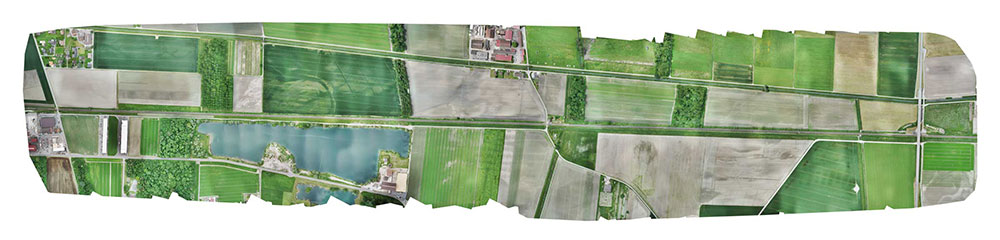
    Final orthomosaic generated by the images collected by the WingtraOne: the 3-km long Eurotube will be constructed along the indicated area. (Image: Wingtra)
    Final orthomosaic generated by the images collected by the WingtraOne: the 3-km long Eurotube will be constructed along the indicated area. (Image: Wingtra)

    From aerial imagery to point cloud

    Infographic: Wingtra
    Infographic: Wingtra

    After two flights, the images were pre-processed with WingtraHub, a desktop app, to add geographical identification metadata to the images. PPK processing was also done in this step. The base file for PPK processing was obtained from Swisstopo, which monitors GNSS receivers at 30 permanent locations in Switzerland. These receivers form the modern-day reference points for positioning and surveying, and help enhance the geolocation information of the images in conjunction with the flight data (hence the name, post-processed kinematics). It took a little more than half an hour to pre-process the entire dataset.

    The images with their accurate geolocation information were then uploaded to Pix4Dmapper to generate a point cloud of the site. All in all, it took less than 24 hours to go from data collection to point-cloud generation, without compromising on the quality of survey itself.

    “We are pleased to say that the dataset gathered by the WingtraOne was precise enough to let the engineering office begin planning construction,” Mark said. “The generated point cloud has a vertical accuracy of 10 centimeters and horizontal accuracy of 3 centimeters. Thanks to the WingtraOne, we are now well on track on our timeline to begin construction.”

    According to EuroTube’s scheduled timeline, a shorter prototype of the tube will be completed at the end of this year, and an alpha tube at the end of 2019. European research and development teams across institutes and universities can then start testing pod technologies to make ultra-high speed transportation systems a reality.


    Adyasha Dash works as a software developer at Wingtra, where she focuses on developing safe flight control and planning algorithms. When she is not tinkering with drones, you can find her writing about the ethics of artificial intelligence and human machine interactions.

  • Android, lidar experts to deliver addresses at ION GNSS+

    Android, lidar experts to deliver addresses at ION GNSS+

    Steve Malkos
    Steve Malkos

    Steve Malkos of Google, and a GPS World contributor, will address the ION GNSS+ plenary session at the technical meeting and showcase, to be held Sept. 24-28 in Miami.

    Malkos will address “Emergency Location Service in Android.” When emergency services get a call, they need to know the caller’s location to send help and save lives. More than 80 percent of calls to emergency services come from mobile phones, but locating these mobile callers can be a major issue.

    Current emergency solutions rely on cell tower location (which can have a radius of several kilometers) and, in some countries (like the U.S. and Japan), on A-GNSS. But A-GNSS can fail with weak signal reception, in urban canyons and indoors.

    Malkos will discuss how Emergency Location Service in Android is delivering more accurate location (computed from fusion of Wi-Fi, cell, GPS and sensors) to emergency services when an emergency call is detected.

    Photo: Teledyne Optech
    Paul LaRocque

    Also speaking is Paul E. LaRocque, Teledyne Optech‘s vice president of Special Projects. In his presentation, “A Lidar History: From Ship to Air to Space,” LaRocque will give a historical review of the airborne laser mapping systems that Teledyne Optech has designed and built over the years.

    Optech has been active in laser radar systems beginning with marine lidars and later moving to airborne and spaceborne systems. Navigation has been an important subsystem in these developments, and its role will be described as part of this story.

    LaRocque has been involved in the development of Optech’s lidar systems since the late 1980s. Dr. LaRocque was instrumental in the design of Optech’s airborne lidar bathymeters, airborne lidar terrain mappers (ALTM), and waveform digitizers, as well as other special lidars.

    Both Malkos and LaRocque will speak during Session P: ION GNSS+ Plenary Session on Tuesday, Sept. 25, 6:30-8:30 p.m.

    Read more ION GNSS+ news.


  • Rebrand GIS to better showcase its power

    GIS specialists are much more than mapmakers. Make sure your organization and customers understand how spatial analytics can help them succeed.

    By Adam Carnow

    Most non-GIS users hear the term “G-I-S” and think “M-A-P.” That is, they think of GIS, and GIS practitioners, as mapmakers. Most GIS practitioners have unknowingly perpetuated this image. Ask any GIS practitioner what they do for a living and most will say, “I make maps;” however, the reality is that what they do for a living is help people make better decisions through the power of location. This is what I call location intelligence.

    There is a tremendous growth opportunity for GIS in government across the enterprise. GIS was created to perform spatial analysis. GIS can often be underutilized because non-GIS users sometimes don’t understand the reach of spatial analysis and how it can help them. GIS practitioners need to market and evangelize the power of spatial analysis to help change that image.

    Photo: rmnoa357/Shutterstock.com
    Photo: rmnoa357/Shutterstock.com

    You can break down location intelligence into six categories. As you move down this list, the value of the location intelligence increases:

    • Understanding Where. A map (could be paper or PDF, but should be an interactive web map) showing where the fire stations are located across a city.
    • Measuring Size, Shape and Distribution. A map showing the size, shape and distribution of wetlands across an area would help with wetland protection and preservation.
    • Determining How Places Are Related. Showing how certain soil types correspond to flood zones.
    • Finding the Best Locations and Paths
      • To find the best location for a new fire station, run a drive-time polygon process to show the coverage area for each fire station. The areas that are uncovered are where a new fire station is needed.
      • To find the best path for field inspectors: We have 50 inspections to do today and three inspectors. Divide the inspection locations among each inspector and create the most efficient route to get their work done.
    • Detecting and Quantifying Patterns. Crime analysts look at crime data to try to predict where the next one may occur and to help identify known perpetrators. (See also An inside look at fighting crime with GIS.)
    • Making Predictions. Modeling a watershed can allow for flood predictions based on anticipated rainfall.

    Another way to help break the mapmaker image is to rebrand. Most staff in any organization use spreadsheets daily for a multitude of things that bring value to the organization – some say it’s the number one business intelligence (BI) tool.

    There are GIS software tools that are as easy to use as a spreadsheet; in fact, you can use GIS inside of spreadsheets.

    Wetlands map, Oregon's Klamath Lake. (Map: USGS)
    Wetlands map, Oregon’s Klamath Lake. (Map: USGS)

    Even though spreadsheets are such a useful tool, you don’t see a Spreadsheet Department. Spreadsheet is just the name of the tool, so you don’t have, or name, a department for it. A department should be named based on the function, or value, it serves.

    GIS should be thought of as BI with location data and spatial analysis, or location intelligence. A great way to get people to understand the real value and power of GIS is to rebrand your GIS department to something like Enterprise Location Intelligence.

    One such example of this is Walgreens. As the drugstore chain’s GIS department became more strategic and tied to the analytics of the organization, the company rebranded it as Enterprise Location Intelligence.

    If your organization has a BI group, they should consider reorganizing to put GIS with that BI group. I’m seeing real-world examples of this rebrand:

    • GIS job title changes to things like:
      • Data Analytics Manager
      • Content Delivery Manager
      • Business and Location Intelligence Manager
    • Reorganization putting GIS with BI: A major city has a Smart City initiative, and in response the city has reorganized its IT group — they now have a Data Analytics Group that consists of a BI team and their GIS team.

    This rebrand, and expansion of the understanding of the true purpose and value of GIS, will not just help the organization realize more return on investment (ROI) for their GIS investment, it will help the GIS practitioners elevate their value to the organization and hence their careers.

    What can you do? If you’re a GIS practitioner:

    • Explore rebranding your title and your GIS group as a start to changing your image from mapmaker to solution provider.
    • Evangelize the power of location intelligence. This is actually pretty easy to do. When someone asks for a map, ask them why they need it, probe to find out more about their project; you will probably uncover a need for spatial analysis.
    • Start to enable others in your organization to become GIS users via easy-to-use web maps and apps. As they use GIS, they will realize its full potential and seek to utilize it more often.

    If you’re not a GIS practitioner, seek out your GIS team to learn more about their capabilities and how they can help you. And, become a GIS user, there are plenty of GIS tools available that are easy to learn and use.


    This article originally appeared on Govloop.com and is reprinted with permission.

    Adam Carnow is an Esri community evangelist and part of the GovLoop Featured Contributor program.

  • GIS is key to developing smart cities and buildings

    ItalImage: Italy3d/Shutterstock.comy3d/Shutterstock.com
    Image: Italy3d/Shutterstock.com

    GIS is growing in importance to urban development, whether for environmental impact studies, geofencing or building information modeling (BIM). Sharing GIS data with developers is critical to a coordinated approach to smart city growth.

    By Christine Easterfield, Principal Analyst, Cambashi

    Just over half the world’s 7 billion population lives in cities. In Europe, this rises to three quarters, and 30 cities worldwide have populations of more than 10 million — the majority in India, China and South America.

    This trend will continue. It is projected that the global population will reach almost 10 billion by 2050, which means cities will need to cope with increasing demands on housing, transport and communications.

    Growing urban populations place considerable stress on housing stock. Cities need to provide scope to build new, but also to look at best use of existing properties.

    In the growing urban population, there will always be a proportion that needs more support as employment rates shift and wages do not always keep up with city expenses. Social housing projects need to keep pace, and making the most of city resources opens opportunities for smart buildings.

    The role of GIS

    Proposed Indianapolis zoning map. (Image: City of Indianapolis)
    Proposed Indianapolis zoning map. (Image: City of Indianapolis)

    Coordinating new build and refurbishment plans across a city requires planning and organization, and a set of tools to support planners and designers. The layout of city-planning zones is the starting point for many new developments — sharing data about these areas is typically achieved using a GIS (geographic information system).

    The standard city map with records of roads, emergency routes, bike routes, key buildings, new development zones, existing housing stock, utility services and street lighting are a central resource for most cities.

    Sharing data between these city maps and developers’ plans is critical to a coordinated approach to city growth.

    Environmental impact

    The early stages for many developments involve an environmental impact study. How will the new development fit into the existing landscape? What restrictions are imposed because of the conditions of the site or the current demands on local resources? What options are there for addressing these constraints?

    This last point is important for acceptance of the development. Being able to show a level of flexibility to accommodate local concerns and developers’ challenges will build a cooperative relationship. The ability to easily integrate building plans with the city map means that confidence is quickly built into the new plans.

    Combining the geography of the city view with the building model destined for development provides a perfect foundation for an integrated GIS/BIM model to take the development from drawing board to handover.

    Maintaining a digital twin of a development, in the form of a BIM, provides a rich source of information about the as-built building — exact measurements, materials used, changes from the original design and more. Integrating this with the city maps held in GIS means a continuous dataset can be formed.

    Tools for construction site inspection and reporting

    construction
    Photo: Alen Ajan/Fotolia.com

    Developing building information models (BIMs) requires monitoring the build activity and accurate recording of the construction. The best way to do this is as it happens.

    Simple-to-use tools that are robust enough to cope with a construction site are becoming more available from software providers. These support gathering data by construction teams and contractors as the work is completed.

    As well as recording data, these tools are also useful in registering the progress and completion of tasks. Many enable interaction with central systems that can send changes and updates directly to the site for immediate action.

    The same tools can register the location of the user, enabling safer working practices to be enforced.

    The practice of geofencing to monitor or even restrict access to parts of a construction site, by registering the location of a device against a predefined region on a map of the site, can track critical activities and react with the most appropriate action if an incident is reported.

    Remote site inspection and reporting

    The Aeryon SkyRanger. (Photo: Aeryon Labs)
    The Aeryon SkyRanger. (Photo: Aeryon Labs)

    The safest inspections don’t involve human intervention at all. Sending an unmanned aerial vehicle, UAV or drone, to fly over your site removes risk to staff when viewing hazardous environments.

    Photographic imagery collected by drone can be loaded into GIS tools and accurately registered against the map of the area to provide a seamless view of the site.

    Data integration is key

    The range of data that can be accurately gathered and viewed together now covers original 3D designs, 2D construction plans, inspection photo-imagery and as-built updates.

    Integration of BIM and GIS tools means that these different data types can be viewed together and in the same spatial context.

    Support for building operation, management and maintenance in the wider context of a smart city

    On-the-spot data capture of accurate as-built building information models that can seamlessly integrate with existing city plans leads to a data resource that cities can build on to improve safety, security and facilities for their citizens.

    So what should the smart city planner be looking for?

    Existing geospatial and data management tools already address many of these challenges, and when an opportunity for a technology refresh is presented, the approach to smart city support should be a big part of the mix.


    Christine Easterfield
    Christine Easterfield

    Christine Easterfield is principal analyst for Cambashi. She has more than 20 years’ experience in the software business. Her experience has covered geospatial asset management for the utility industry: assessing market needs and opportunities, managing customer requirements, liaising with development teams and running global product introduction programs.

    Previous roles include programming, training, consultancy and product marketing management.

    She has worked for a range of companies from multinationals to small start-ups, resulting in an understanding of how different sized organisations operate, grow and manage change. Christine has a BSc in Computational Sciences and an MA in English Literature.

  • Rohde & Schwarz adds GPS L5 and Galileo E5 to SMW200A GNSS simulator

    Rohde & Schwarz adds GPS L5 and Galileo E5 to SMW200A GNSS simulator

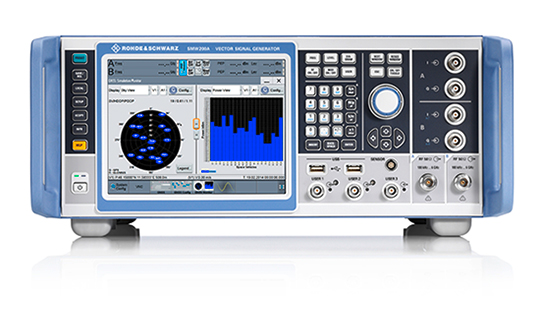
    Rohde & Schwarz has added GPS L5 and Galileo E5 simulation capabilities to its R&S SMW200A GNSS simulator.

    The R&S SMW200A GNSS simulator is designed for efficient test and characterization of multi-constellation and multi-frequency GNSS receivers. With its additional simulation capabilities for GPS L5 and Galileo E5, the R&S SMW200A enables generation of complex and highly realistic test scenarios with up to 144 channels in the GNSS frequency bands L1, L2 and L5, the company said.

    In addition to GPS (L1/L2/L5), GLONASS (L1/L2), Galileo (E1/E5) and BeiDou (L1/L2), the R&S SMW200A also supports signal generation for QZSS and SBAS on L1. The available channels can be routed to up to four RF outputs, so that even multi-antenna systems can be tested.

    Apart from its new GNSS simulation capabilities, the R&S SMW200A can generate complex coexistence and interference scenarios with multiple interferers. GNSS signals, noise and all interference signals are generated directly in the instrument. Additional signal sources for external generation of interference signals are not required, resulting in small, compact and simple test setups.

    Launched in 2017, the R&S SMW200A can be turned into a high-end GNSS simulator and is able to internally simulate complex interference environments in parallel with GNSS signals.

    An increasing number of GNSS receivers are capable of receiving signals on multiple different frequencies, such as L1, L2 and L5. Although this multi-frequency capability, as well as having to process signals from diverse navigation systems such as GPS, GLONASS, Galileo or BeiDou, make the receiver design more complex, they ensure a better quality of service for the end user.

    According to the company, multi-frequency and multi-constellation processing not only improves positioning accuracy, service availability and robustness, it also makes the positioning process less vulnerable to interference, jamming or spoofing attacks.

    The R&S SMW200A with its new GNSS simulation capabilities will be showcased at the ION GNSS+ 2018 trade show in Miami.

  • PCTEL showcases 4×4 LTE multi-GNSS antennas at InnoTrans

    PCTEL showcases 4×4 LTE multi-GNSS antennas at InnoTrans

    PCTEL Inc. will demonstrate its next generation of multi-band, multi-network 4G LTE antennas at InnoTrans 2018 for the transit and rail industries, which takes place Sept. 18-21 in Berlin.

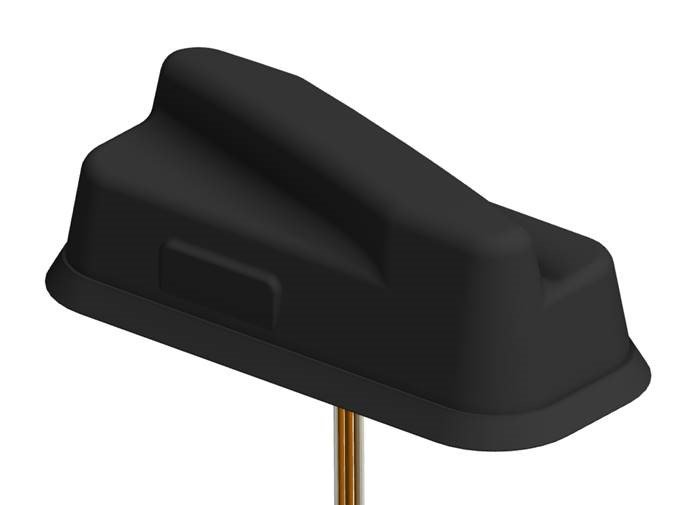
    PCTEL’s new Trooper II and Coach II dual-carrier antenna platforms are designed to meet the requirements of increasingly complex RF communication systems in transportation applications.

    The Trooper II antenna. (Photo: PCTEL)
    The Trooper II antenna. (Photo: PCTEL)

    Both Trooper II and Coach II antennas feature four 4G LTE antenna elements, and four 802.11ac Wi-Fi MIMO elements compatible with the world’s leading multi-network cellular routers.

    The antennas support carrier aggregation for high-speed data transmissions in dense RF environments, such as transit depots and rail stations.

    They also incorporate PCTEL’s proprietary high-rejection multi-GNSS technology for high precision tracking and asset management. Both platforms are housed in attractive low-profile housings and can be easily installed on all types of mass transit vehicles, or even fixed surfaces, the company said.

    “PCTEL has a strong portfolio of products for rail and mass transit applications,” said Rishi Bharadwaj, PCTEL’s COO. “Our products have been qualified and deployed by major railroad equipment manufacturers and operators for over a decade. We are excited to showcase our industry-leading technology and capabilities at InnoTrans.

    “High-performance antennas play a crucial role in the implementation of wireless technologies to improve safety and operational efficiency,” Bharadwaj said. “PCTEL’s innovative MIMO antenna technology also enables transit operators to deliver a better passenger experience through more reliable high-speed internet access.”

  • NovAtel provides SMART7 smart antennas for agriculture

    NovAtel provides SMART7 smart antennas for agriculture

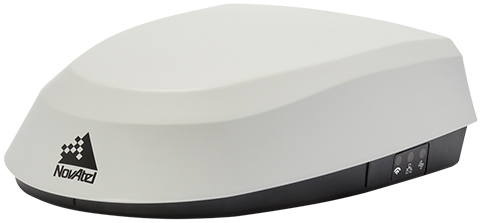
    Photo: NovAtel
    Photo: NovAtel

    NovAtel has introduced its SMART7 family of SMART antennas for demanding applications like precision agriculture and machine control.

    The SMART7 family features NovAtel’s GNSS + inertial navigation system (INS) SPAN technology; future-ready GNSS; Wi-Fi and internet protocol connectivity; superior tracking performance; and TerraStar-C PRO corrections.

    It is ready to increase GNSS  availability, accuracy and reliability for major precision-agriculture equipment manufacturers, the company said.

    “Manufacturers that serve these demanding industries can now take advantage of the best in precise positioning technology, with added next-generation features including wireless connectivity, SPAN GNSS+INS integration and superior tracking performance, in an even more robust format,” said Gordon Ryley, Precision Agriculture Segment manager at NovAtel. “With this combination of technologies, guidance systems can continue to steer during satellite signal outages and under challenging conditions.”

    The SMART7-S includes NovAtel’s tightly coupled SPAN technology, an advanced GNSS+INS integration technology NovAtel said. SPAN provides accurate attitude information that can simplify the development of vehicle guidance systems and bridge GNSS signal outages.

    For easier connection to mobile devices and cellular gateways, the SMART7-W includes Wi-Fi and an integrated NTRIP client; the SMART7-I model also incorporates Ethernet. A new advanced ISOBUS-compatible CAN interface also supports NovAtel logs, commands and firmware upgrades.

    All models in the SMART7 family provide exceptional positioning availability using signals from all constellations and frequencies to deliver assured positioning anywhere.

    Each model includes a VEXXIS antenna, and supports TerraStar-C PRO, the newest offering from TerraStar correction services, which delivers 2.5 centimeters and convergence times of less than 18 minutes in most regions.

  • GNSS Compare app now available for download

    GNSS Compare app now available for download

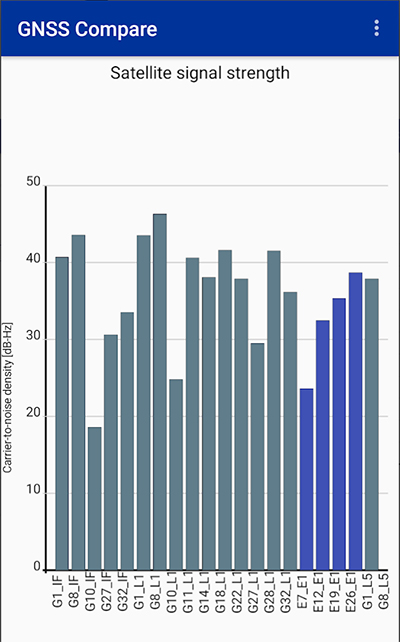
    Screenshot: TFI Systems
    Screenshot: TFI Systems

    The GNSS Compare app, winner of ESA’s Galileo Smartphone App Challenge, is now available for download on the Google Play Store for Android devices.

    Taking advantage of the recent release of Android API 24 and the GnssMeasurement class, developers now have access to unprocessed pseudorange measurements in certain smartphones.

    GNSS Compare is basically a tool for scientists to compare their algorithms. For those who are not GNSS experts, it can also serve as a teaching tool on the subject.

    The Galileo Smartphone App Challenge was about creating a smartphone application that will allow the user to choose which satellite constellation to use for PVT estimation.

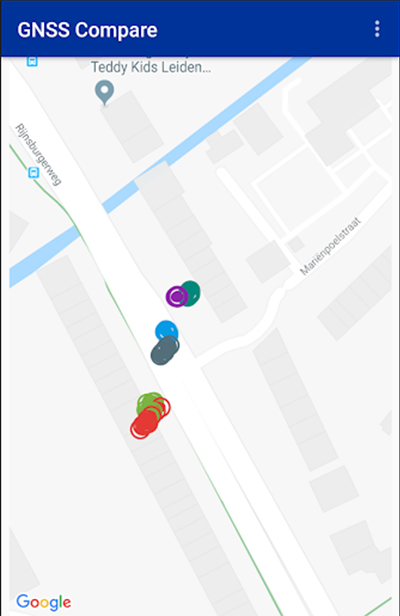
    Screenshot: TFI Systems
    Screenshot: TFI Systems

    The aim was to increase the awareness about the European Union’s Galileo satellite navigation program and also to allow users from the public to compare the performance of Galileo signals with the performance from other global satellite navigation constellations.

    The app has been tested on Samsung Galaxy S8 and Xiaomi Mi 8 phones. To download, visit the store.

  • University research uses smartphones for precision GNSS

    New research conducted at the University of Otago, New Zealand, and published in the August issue of Journal of Geodesy demonstrate that it is possible to achieve centimeter(cm)-level precise positioning on a smartphone.

    The research, conducted in collaboration with Curtin University, Australia, combined signals from four different GNSS, according to Otago’s Dr. Robert Odolinski and Curtin University colleague Prof. Peter Teunissen.

    “It’s all down to the mathematics we applied to make the most of the relatively low-cost technology smartphones use to receive GNSS signals, combining data from American, Chinese, Japanese and European GNSS. We believe this new capability will revolutionize applications that require cm-level positioning,” Odolinski says.

    He said to understand the new technology, a look back at the historical scientific context is needed.

    Precise centimeter-level positioning on a smartphone during 24 hours in Dunedin, New Zealand. Blue dots show repeatability of one epoch data in comparison to precise benchmark coordinates. The repeatability is more or less the size of a one-dollar New Zealand coin (diameter of 2.3 cm) in all three dimensions. (Image: University of Otago)
    Precise centimeter-level positioning on a smartphone during 24 hours in Dunedin, New Zealand. Blue dots show repeatability of one epoch data in comparison to precise benchmark coordinates. The repeatability is more or less the size of a one-dollar New Zealand coin (diameter of 2.3 cm) in all three dimensions. (Image: University of Otago)

    “For decades, construction, engineering, cadastral surveying and earthquake monitoring have relied on high-cost, dual-frequency GPS positioning to obtain centimeter-level location information. The challenge is that GPS signals, traveling from Earth-orbiting satellites to receivers on the ground, are disrupted along the way, and this generates errors and limiting precision.

    “The traditional solution is to combine GPS signals sent at two different frequencies to improve the positions, but the antennas and receivers required have been expensive, far beyond the reach of many who would benefit from the technology,” Odolinski said.

    The new approach uses only one of two frequencies but collects data from more satellites for a multi-constellation GNSS solution. The extra data and algorithms are used to improve the positions without adding cost.

    Odolinski and Teunissen have shown that this approach can work in smartphones, producing competitive results compared to dual-frequency GPS solutions (see figure).

    Odolinski believes that countries and industries of all sizes can benefit from using smartphones as GNSS receivers, and is confident commercial application and development will spring from this research.

    “This significant reduction in costs when using smartphones can increase the number of receivers that can be deployed, which will revolutionize a range of disciplines requiring centimeter-level positioning, including precise car navigation, surveying and geophysics (deformation monitoring), to name a few.”

    Read the full research paper.

    Robert Odolinski configuries a smartphone to collect multi-GNSS data. (Photo: University of Otago)
    Robert Odolinski configuries a smartphone to collect multi-GNSS data. (Photo: University of Otago)
  • Aceinna launches open-source GNSS+IMU development kit for drones, robots

    Aceinna launches open-source GNSS+IMU development kit for drones, robots

    Photo: Aceinna
    Photo: Aceinna

    MEMS-based sensing solutions company Acienna released OpenIMU, a professionally supported, open-source GPS/GNSS-aided inertial navigation software stack for low-cost precise navigation applications.

    Integrating an inertial measurement unit (IMU)-based sensor network will greatly improve its navigation and self-location capabilities, Acienna said.

    It is aimed at developing autonomously guided vehicles for industrial applications, autonomous cars, factory or industrial robots, drones, remotely operated underwater vehicle or any kind of smart machine that needs to move fast or slow, on land, in the air or in water.

    “Our breakthrough open-source software for INS/GPS algorithm development is the first professional grade open-source navigation stack running on a low-cost IMU,” said Mike Horton, CTO of Aceinna. “Not only will this kit save developers time and money, it is simple to use and does not require a Ph.D.”

    OpenIMU enables advanced, easy-to-deploy localization and navigation algorithm solutions for a fraction of the time and cost of traditional methods, Aceinna said.

    OpenIMU’s combination of open-source software and low-cost hardware enables rapid development of advanced solutions for drones, robotics, and autonomous applications. Its extensible software-infrastructure provides all the code needed for algorithm development.

    The freely downloadable stack includes:

    • FreeRTOS-based data collection and sampling engine
    • Performance-tuned, real-time, navigation-grade GPS/INS Kalman filter library
    • Free IDE/compiler tool chain based on Visual Studio Code
    • JTAG debugging for debugging code loaded on IMU
    • Data logging, graphing, Allen Variance plots and maps
    • Extensive documentation
    • Robust simulation environment with advanced sensor error models

    To install OpenIMU stack now, follow the directions. Several ready-to-install free GPS/INS and IMU applications are available at Aceinna’s Navigation app store.

    The OpenIMU Development hardware development kit includes JTAG-pod, precision mount fixture, EVB and an OpenIMU300 module.

    The OpenIMU module features Aceinna’s 5 deg/Hr, 9-Axis gyro, accelerometer, and magnetometer sensor suite with an onboard 180-MHz ARM Coretex floating-point CPU.

    The IMU is delivered in a 24 x 37 x 9.5 millimeter module that operates at 2.7-5.5 VDC.

    The OpenIMU Development kit is available for immediate delivery.

  • GPS problem reports now published on NAVCEN website

    GPS problem reports now published on NAVCEN website

    The U.S. Coast Guard Navigation Center (NAVCEN) is now publishing reports of GPS problems on its website. Any notes about problem resolution, if available, will also be listed.

    The website will be updated as new reports are received and processed. All reports made in 2018 are now available, and reports for prior years will be made available in the future.

    The reports are being made “to provide better service and situational awareness to the public,” wrote Rick Hamilton, CGSIC executive secretariat, NAVCEN.

    Reports of GPS problems submitted to NAVCEN through the GPS Problem Reporting webpage will be posted to the GPS Problem Report Status webpage after review by NAVCEN staff.

    Reports will be anonymized to protect the submitter’s personal information and any equipment manufacturer data.

    After user and interagency partner input has been collected, any findings will be added to the report along with the suspected cause and resolution, if available.

    The webpage will include the following information for each report:

    • Date/Time of Disruption: Date and time of the report as provided by the reporting source.
    • Date Submitted: Date the report was submitted to NAVCEN.
    • Location: The general location of the reported problem based on input from the reporting source. Latitude and longitude may be used for maritime reports.
    • Type: Installation type as provided by the reporting source. Choices include agriculture, automobile, aviation, communications, first responder, marine, law enforcement, research, surveying, timing, transportation and other (with a fillable field).
    • Description: Description of the problem. This information from the reporting source is edited for clarity and to remove personal and equipment manufacturer identifying details. The description also provides GPS satellite constellation analysis information as provided by the GPS Operations Center, a determination if authorized GPS testing might have been a factor, and information on correlating reports from other users and interagency partners.
    • Cause: The most likely cause of the report based on interagency input.
    • NAVCEN Closed Date: NAVCEN collects interagency input and provides a detailed response to the reporting source for each report submitted. If there are no further questions from the reporting source, and NAVCEN has no other correlating information, NAVCEN will close the case. The results of interagency input will be included in the description field when the case is closed. This date may not correspond to the event end date.

    Civil GPS users are encouraged to submit reports of GPS problems to the Coast Guard Navigation Center.

    Civil aviation users are encouraged to report GPS anomalies to the Federal Aviation Administration, and military users should contact the GPS Operations Center.

  • Trimble adds Galileo and BeiDou to VRS Now service in North America

    Trimble adds Galileo and BeiDou to VRS Now service in North America

    Galileo and BeiDou observation data are now included with Trimble VRS Now subscriptions in North America.

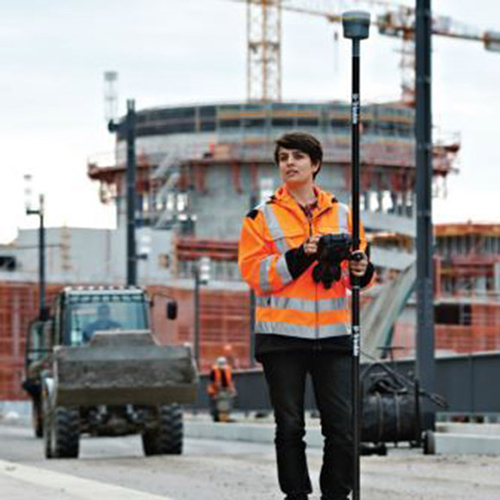
    Photo: Trimble
    Photo: Trimble

    The addition of the Galileo and BeiDou constellations allow users to make use of more satellites, enabling more robust performance when working in harsh GNSS environments such as in urban canyons and under canopy, the company said.

    Trimble VRS Now in North America fully supports GPS, GLONASS, QZSS and now, Galileo and BeiDou satellite systems.

    The service is powered by the Trimble Pivot Platform GNSS real-time network software, Trimble said. As a true five-constellation solution, it delivers improved real-time positioning performance for customers in North America.

    VRS Now is designed for surveying, mapping and GIS, construction and agriculture professionals who require high-accuracy positioning in their workflows.

    Adding Galileo and BeiDou observation data provides significant benefits by enabling users to:

    • Operate in environments where traditional GPS + GLONASS systems’ performances are limited
    • Improve accuracy and reliability of GNSS solutions
    • Minimize the effects of multipath and interference

    “By including Galileo and BeiDou data, customers can achieve greater accuracy and positioning performance than ever before,” said Patricia Boothe, vice president of Trimble’s Advanced Positioning Division.

    With the addition of North America, Trimble VRS Now networks worldwide now support all five GNSS constellations. Besides North America, coverage is available throughout Europe, Australia and New Zealand when using a compatible GNSS receiver or display.

    Subscriptions are available through Trimble’s Authorized Business Partners or Trimble’s online store at tpsstore.trimble.com.

    VRS Now provides positioning professionals with instant access to real-time kinematic (RTK) and post-processing (PP) corrections using a network of permanent (fixed) continuously operating reference stations (CORS). Professional management and monitoring 24/7 by a global operations team provides peak performance and high reliability, Trimble said.