Author: Tracy Cozzens

  • ESA investigates high-altitude pseudo-satellites

    ESA investigates high-altitude pseudo-satellites

    News from the European Space Agency

    High-altitude pseudo-satellites (HAPS) are platforms that float or fly at high altitude like conventional aircraft but operate more like satellites. (Image: ESA Earth Observation Graphics Bureau)

    The European Space Agency (ESA) is considering extending its activities to a new region of the sky via a novel type of aerial vehicle, a missing link between drones and satellites.

    High-altitude pseudo-satellites, or HAPS, are platforms that float or fly at high altitude like conventional aircraft but operate more like satellites — except that rather than working from space, they can remain in position inside the atmosphere for weeks or even months, offering continuous coverage of the territory below.

    The best working altitude is about 20 kilometers, above the clouds and jet streams, and 10 kilometers above commercial airliners, where wind speeds are low enough for them to hold position for long periods.

    From such a height they can survey the ground to the horizon 500 km away, variously enabling precise monitoring and surveillance, high-bandwidth communications or back up to existing satellite navigation services.

    Several ESA directorates have teamed up to investigate their potential, explains future-systems specialist Antonio Ciccolella.

    “For Earth observation, they could provide prolonged high-resolution coverage for priority regions, while for navigation and telecoms they could shrink blind spots in coverage and combine wide bandwidth with negligible signal delay,” Ciccolella said. “ESA is looking into how these various domains can be best brought together.”

    “We’ve been looking into the concept for the last 20 years but now finally it’s becoming reality,” explained Earth observation specialist Thorsten Fehr. “That’s come about through the maturing of key technologies: miniaturised avionics, high-performance solar cells, lightweight batteries and harness, miniaturisation of Earth observation sensors and high-bandwidth communication links that can deliver competitively priced services.”

    “There’s obvious potential for emergency response,” added Navigation engineer Roberto Prieto Cerdeira. “They could also be employed semi-permanently, perhaps extending satnav coverage into high, narrow valleys and cities.”

    The QinetiQ-designed and Airbus-owned Zephyr-7 solar-powered unmanned aircraft holds the world flight endurance record at 14 days. (Photo: Airbus)

    European companies have already unveiled product lines. For instance, Airbus has developed the winged, solar-powered Zephyr, which in 2010 achieved a world record 14 days of continuous flight without refuelling.

    The Zephyr-S is designed to fly payloads of a few tens of kilograms for up to three months at a time, with secondary batteries employed to keep it powered and aloft overnight. A larger Zephyr-T version now in preparation will support larger payloads and power needs.

    The first flight is projected for 2021 for Thales Alenia Space’s Stratobus airship. (Artist’s rendering: Thales Alenia Space/Briot)

    Meanwhile, Thales Alenia Space is preparing the lighter-than-air Stratobus, with its first flight expected in 2021.

    The buoyant Stratobus airship can carry up to 250 kilograms, its electric engines flying against the breeze to hold itself in position, relying on fuel cells at night.

    Many other firms are also developing vehicles, payloads and services. Last month saw them gathered at ESA’s inaugural workshop, together with representatives of potential customers, including the European Defence Agency, Frontex — the European Union (EU) agency tasked with Europe’s border management — and EU Copernicus environmental monitoring services.

    Airbus’s double-tailed Zephyr-T variant HAPS aircraft is designed to support larger payloads, keeping them aloft for months at a time. (Image: Airbus)

    “This was the first meeting of its kind in Europe, with more than 200 HAPS experts,” said Juan Lizarraga Cubillos, from ESA’s telecoms area. “We heard from them on the needs, opportunities and critical issues within the field, particularly as a complement for existing satellite services, to start preparing a future ESA programme.”

    ESA regards the vehicles as a valuable way of establishing applications that complement its satellites while also accelerating space technologies through early, high-altitude flight testing.

    The point was also made that market acceptance of HAPS would come down to their efficiency and cost-effectiveness — and the best way to show that would be through demonstration projects.

    “We have to fly them,” said Alvaro Rodriquez of EU’s Satellite Centre. “The technology is there, all the ingredients are there, now it’s time to mix them into a nice recipe.”

    Thales Alenia Space’s Stratobus is topped with solar panels, powering its propellers to fly against the wind at 20 km for prolonged periods of service. (Image: Airbus)
  • SimActive introduces new technology for true orthophotos

    SimActive Inc., a developer of photogrammetry software, has released Correlator3D version 7.1 with new technology for true orthophotos.

    Users can now automatically generate enhanced true orthomosaics through a technological breakthrough that significantly minimizes artifacts, the company said.

    This major release successfully addresses the industry-wide challenges of generating true orthophotos without artifacts, such as distortions around buildings and vertical structures. Along with the enhanced output quality, the overall mosaicking speed of the software has increased five-fold, furthering the gap with competing tools.

    “While DTM-based orthophoto generation has been the norm for decades, we observe a shift toward true orthos,” said Louis Simard, CTO of SimActive. “The advancement provides consistent quality of results without any manual intervention.”

    For a live demonstration at the Geospatial World Forum (Jan. 17-19, Hyderabad, India), send an email to [email protected].

    To register for an online training session on how to generate high-quality orthomosaics with Correlator3D (Nov. 30, 10 a.m. Eastern Time, sign up at the website.

  • Ariane 5 with Galileo satellites ready for Dec. 12 mission

    The Ariane 5 for Arianespace’s Dec. 12 year-ending flight for 2017 has completed its initial build-up at the Spaceport in French Guiana — where preparations also are moving ahead with four satellite passengers that will further expand Europe’s Galileo global navigation system once in their final orbit.

    During activity in the Spaceport’s Launcher Integration Building, the heavy-lift vehicle for Arianespace Flight VA240 underwent the assembly process that began by mating its two solid propellant strap-on boosters with the main cryogenic stage.

    The next step was integration of Ariane 5’s vehicle equipment bay, which serves as the launch vehicle’s “brain,” providing autonomous control during the various mission phases.

    It was followed by installation of the EPS storable propellant stage, powered by a reignitable engine that operates with MMH and N2O4 propellants. This differentiates the Ariane 5 ES configuration from Arianespace’s Ariane 5 ECA version, which has a cryogenic upper stage and typically is used on Arianespace missions with telecommunications satellites to geostationary transfer orbits.

    Inside the Spaceport’s Launcher Integration Building, Ariane 5’s vehicle equipment bay is lowered atop the core cryogenic stage on Flight VA240’s Ariane 5 ES launcher version (left and center). This cleared the way for installation of the launch vehicle’s EPS storable propellant upper stage (right). (Photo: Arianespace)

    After completion of verifications and systems checkout by production prime contractor ArianeGroup, the Ariane 5 ES launch vehicle will be moved to the Spaceport’s Final Assembly Building for payload integration and readiness for rollout to the launch zone.

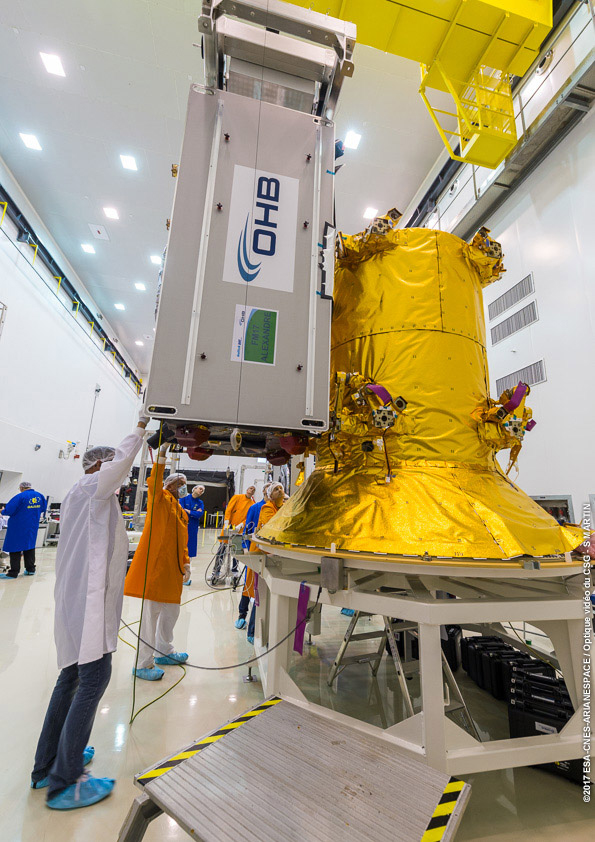
    The mission’s ongoing payload preparations — including checkout and fit-check procedure for each of the four Galileo satellites — took place inside the Spaceport’s S1A processing facility. This involved a one-by-one verification of the spacecraft’s interface with the payload dispenser that will release them into circular orbit during the mission.

    After the fit-check procedure in the S1A facility, the four satellites were readied for transfer to the S5 payload preparation center for fueling.

    For Ariane 5’s Dec. 12 mission, the heavy-lift vehicle will carry its quartet of Galileo satellites (weighing 700 kg. each) and their dispenser system for a medium-Earth orbit deployment.

    A Galileo satellite undergoes its fit-check validation at the Spaceport. Flight VA240. (Photo: Arianespace)

    Galileo is the European initiative to develop a global satellite navigation system. Under civilian control, it will offer a guaranteed, high-precision positioning service. As a European Union-funded program, the Galileo constellation will comprise 24 operational satellites, along with spares.

    Overall responsibility for Galileo’s management and implementation is held by the European Commission, with the European Space Agency assigned design and development of the new generation of systems and infrastructure.

    Ariane 5’s mission with the four Galileo spacecraft will close out a busy year of launch activity for Arianespace, which has performed 10 missions from French Guiana so far in 2017 — all of which were successful. The flights to date involved five launches of the heavy-lift Ariane 5, two with the medium Soyuz and three with the lightweight Vega.

  • OGC seeks participants for 'interoperability plugfest'

    Open Geospatial Consortium (OGC) is calling for interested participants in its Geospatial to the Edge Interoperability Plugfest.

    OGC Plugfests, initiatives of the OGC Innovation Program, provide a venue for sponsors and technology implementers to come together to solve geospatial interoperability challenges in a collaborative, agile process.

    A plugfest is organized around scenarios and a testing environment to advance the implementation of OGC standards and profiles of OGC standards in commercial and open source software products. A plugfest allows organizations to test and validate implementations of OGC standards in their software products, verifying that they can interoperate with other products implementing the same standards.

    The Geospatial to the Edge Interoperability Plugfest is co-sponsored by Army Geospatial Center and the National Geospatial-Intelligence Agency (NGA/CIO&T). The Plugfest will assist tool enhancement and provide guidance to improve the delivery of enterprise geospatial data to end users. The Plugfest will test profiles and extended capabilities of the GeoPackage, WMS, WMTS, and WFS standards for the end user.

    Examples of end user communities that will benefit include:

    • first responders, relief workers, and firefighters preparing for and operating in limited network environments;
    • emergency planners and managers in their efforts to support hurricane, wildfire, and earthquake preparedness, relief/response activities, and damage assessment;
    • soldiers/warfighters planning and executing operations, specifically in disconnected, intermittent, and limited network environments.

    What is an OGC profile?

    An OGC profile is a subset of a standard that helps better share information within a community of interest. A profile is a specification that imposes additional constraints on an existing standard to make that standard more focused to the needs of the user community. A profile can also be extended to offer specialized functionality, for example, make previously optional capabilities mandatory, or define extensions where permitted by the base standard.

    The profiles that are planned to be used in the Plugfest include: raster and vector NSG GeoPackages, NSG WMTS, NSG WMS, and NSG WFS.

    Interested parties can respond to the Call for Participation by filling in the web form  (due Jan 8).

    For more information on the Plugfest, visit  the websitte, or contact Luis Bermudez, executive director, Innovation Program.

  • Remote Geosystems geoDVR deployed for search and rescue

    Remote GeoSystemNorth Shore Rescue and Talon Helicopters have successfully deployed a geoDVR Gen2 with a FLIR daylight EO/IR gyro-stabilized video camera on an Airbus TwinStar (AS355) for search-and-rescue (SAR) missions.

    NSR and Talon team operate the geoDVR and FLIR during ground training in October 2017.
    NSR and Talon team operate the geoDVR and FLIR during ground training in October 2017.

    The geoDVR Gen2 is an advanced mil-spec DVR for recording multiple channels of HD & Standard-Definition geospatial full motion video in airborne and rugged vehicle environments.

    The geoDVR’s ability to reliably record HD color and infrared, along with continuous GPS data and Live Moving Maps, make it suited for professional airborne search and rescue, law enforcement and infrastructure inspection applications that utilize multi-sensor gimbal video cameras.

    “Remote Geo has a reputation for building one of the industry’s most dependable and user-friendly airborne geospatial video recorders, complete with flexible post-flight mapping tools. So the geoDVR Gen2 was an obvious choice when we were asked to fly the FLIR on the TwinStar for mountain search and rescue,” says Peter Murray, Founder/Operations Manager at Talon Helicopters.

    “Adding the FLIR camera to North Shore Rescue’s toolbox has been a great enhancement to NSR’s capabilities,” said Jim Loree, North Shore Rescue SAR manager and air operations coordinator. “Having the ability to record and geo-track the location of the video seemed essential to maximizing the full potential of the FLIR camera. The geoDVR allows searchers to review recorded video for clues that may or may not have been observed during the flight.”

    “This feature could also be highly valuable in a large-scale disaster such as an earthquake where widespread areas are surveyed for damage,” Loree said. “Emergency Operation Centers would be able to use the data to help them make decisions on where and how to deploy resources based on the exact location and extent of damages provided by the video recording.”

    North Shore Rescue and Talon Helicopters will use the geoDVR with a FLIR generously donated by Port of Vancouver to perform helicopter-based SAR operations with color and infrared. Then, using LineVision™ software post-flight, North Shore Rescue will review the geoDVR videos and flight tracks overlaid on Google Earth and Esri maps for training mission planning and recovery operations.

    Because North Shore Rescue is an all volunteer organization, Remote GeoSystems donated 18 LineVision Esri Maps and LineVision Google Earth licenses as part of the implementation.

  • Think 3D, Applanix combine on UAV-based airborne lidar mapping

    The Think 3D Stormbee multicopter integrated with Trimble’s AP15 provides efficiency, accuracy and performance for lidar surveys from unmanned vehicles.

    Historically, lidar-based aerial surveys were impractical for all but the largest unmanned systems. Because of Applanix’ development of small, lightweight and low-powered direct georeferencing solutions, airborne lidar scans from small drones are now practical, cost-effective, highly accurate and excellent options for lidar surveys, according to the company.

    The Stormbee is a directly georeferenced UAV lidar solution for 3D industrial mapping applications, designed to collect survey grade spatial data in a significantly more cost effective and efficient way than static lidar.

    Think3D-Stormee-UAV-lidar-O
    The Stormbee, a Faro Focus 130 laser scanner, and the AP15.

    Stormbee’s 3D mapping technologies include Faro’s Focus 130 laser scanner, Trimble’s AP15 high performance GNSS/inertial receiver, Applanix’s POSPac UAV GNSS/inertial post-processing software and Stormbee’s proprietary Beeflex software for lidar point cloud generation.

    Industrial applications (GNSS-denied environments) pose unique challenges for laser scanning using traditional static systems, due to obstructions and poor signal environments. These issues lead to increased costs and operational time.

    By using the high-performance Trimble AP15 with two antenna and the Applanix post-processing software (POSPac MMS) for georeferencing the lidar data, Stormbee provides an accurate real-time and post-mission solution for all motion variables.

    Applanix has brought together its decades of experience in multi-frequency, multi-constellation Differential GNSS and inertial based positioning and orientation with the best in small-form factor hardware and powerful software, to produce a DG solution for professional aerial mapping on UAVs.

    With a system delivering better than 5-cm accuracy (real mean squared) and high resolution, Stormbee and Applanix offer 3D detail from a platform moving at speeds up to 15 meters per second. The Stormbee leverages Applanix’s decades of experience in direct georeferencing of lidar systems to collect the most accurate 3D data.

    Benefits of the system:

    • compact, easy-to-operate and cost-effective
    • centimeter-level mobile positioning accuracy for 3D mapping products
    • improved productivity, with optimized workflow from data capture to georeferenced point cloud generation
    • superior visualization: Lidar scanners provide more accurate information of structures than camera technologies

    Think 3D, a Belgian company, is a 3D scanning company for many industrial applications including those in the beverage, steel, pharmaceuticals, chemicals and tank terminals industries. Think3D helps companies make changes to their installations by providing a full 3D CAD model of their installation.

    Stormbee to date has proven to be effective in many industries including mining, engineering, dredging, forensics, universities and survey.

  • Active digital map for French armed forces will provide decisive mission advantage

    La Direction générale de l’armement (DGA), the French Defence Procurement Agency, has entrusted the firm tranche of the 10-year SYSENV contract to Airbus Defence and Space and its four partners, for the production of the SI GEODE4D information system for the French Armed Forces.

    This system is an essential component of the GEODE4D programme (geography, hydrography, oceanography and meteorology for defence) and will be available via a single and secure portal.

    It will allow all Ministry of Defence actors to access and share the same geophysical environment data and select and present them in a coherent way, according to the “one card for all” principle.

    “This programme shows the confidence of the DGA in Airbus and its partners for the construction of this information system for the French Armed Forces,” said François Lombard, Head of the Intelligence Business Cluster at Airbus Defence and Space. “One of the major challenges for the SI GEODE4D, which can truly be qualified as the active digital map of the 21st century, is also to assist our armed forces with their digital transformation.”

    It is vital to reinforce the ability to manage information and intelligence for early threat detection and identification. To provide an appropriate response to these varied and constantly changing threats, an accurate understanding of the geophysical environment is crucial for deployed forces.

    In future, the SI GEODE4D system, consisting of various services and applications, will provide the armed forces with an interoperable, coherent and shared vision of the geophysical environment, consistent with the NATO REP concept (Recognised Environmental Picture).

    The consortium is headed by Airbus Defence and Space and built around four innovative and specialised partner companies: Magellium for geography; Météo France International for meteorology, hydrography and oceanography; Bertin for the tool providing decision-making aids; and Deloitte for change management.

    The contract also includes the refurbishment of the geographical and meteorological–oceanographic data production centres in Creil, Haguenau and Toulouse. In particular, this refurbishment is designed to meet the need for the increased volume and transmission rates involved in the visualisation of all the environmental data on the future GEODE4D portal.

  • Lockheed Martin assembles third U.S. Air Force GPS III satellite

    Lockheed Martin assembles third U.S. Air Force GPS III satellite

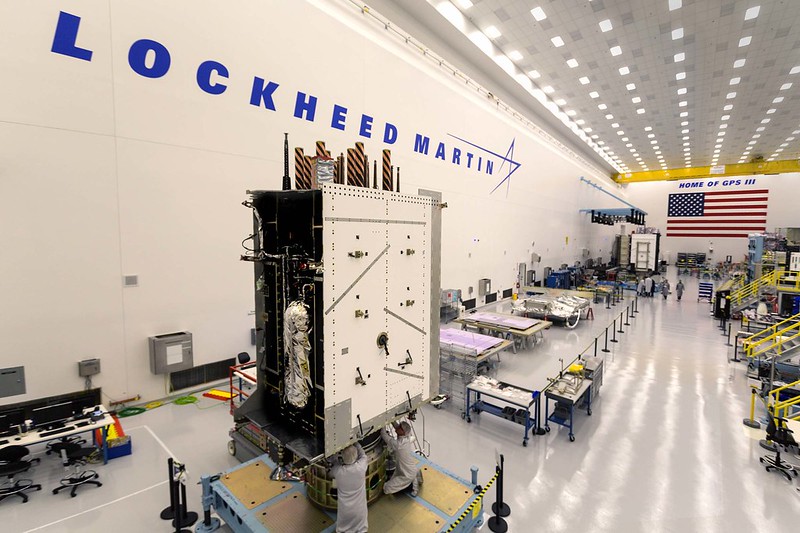
    The U.S. Air Force’s third GPS III satellite in production flow at Lockheed Martin’s advanced satellite manufacturing facility in Denver is now fully integrated into a complete space vehicle.

    GPS III Space Vehicle 03 (GPS III SV03) followed the first two GPS III satellites on a streamlined assembly and test production line. Technicians successfully integrated the satellite’s major components — its system module, navigation payload and propulsion core — into one fully assembled space vehicle on Aug. 14.

    GPS III SV03 was assembled in Lockheed Martin’s GPS III Processing Facility, a $128 million, cleanroom factory designed in a virtual reality environment to drive efficiency and reduce costs in satellite production. Now fully assembled, the third satellite is being prepared to begin environmental testing.

    GPS III SV03 is scheduled to launch on June 30.. (Photo: Lockheed Martin)
    GPS III SV03 is scheduled to launch on June 30. (Photo: Lockheed Martin)

    GPS III SV03 closely follows the company’s second satellite in production flow. GPS III SV02 completed integration in May, finished acoustic testing in July and moved into thermal vacuum testing in August. The second GPS III satellite is expected to be delivered to the U.S. Air Force in 2018.

    The fourth GPS III satellite is close behind the third. Lockheed Martin received the navigation payload for GPS III SV04 in October and the payload is now integrated with the space vehicle. The satellite is expected to be integrated into a complete space vehicle in January 2018.

    In August, Lockheed Martin technicians began major assembly work on GPS III SV05.

    All of these satellites are following Lockheed Martin’s first GPS III satellite, GPS III SV01, through production flow. In September, the Air Force accepted and declared GPS III SV01 “available for launch,” with launch expected in 2018.

    “GPS III is the most powerful and complex GPS satellite ever designed and built, and it’s now into a smooth production flow,” said Mark Stewart, Lockheed Martin’s vice president for navigation systems. “The real credit goes to the Air Force for all the Back to Basics work done in advance, reducing program risk for all the GPS III satellites going forward. We are looking forward to bringing GPS III’s advanced capabilities to our warfighters in 2018.”

    Lockheed Martin is under contract for 10 next-generation GPS III satellites as part of the Air Force’s modernized GPS. GPS III will have three times better accuracy and up to eight times improved anti-jamming capabilities. Spacecraft life will extend to 15 years, 25 percent longer than the newest GPS satellites on-orbit today. GPS III’s new L1C civil signal also will make it the first GPS satellite to be interoperable with other international global navigation satellite systems.

    Lockheed Martin’s unique GPS III satellite design includes a flexible, modular architecture that allows for the insertion of new technology as it becomes available in the future or if the Air Force’s mission needs change. Satellites based off this design are already proven compatible with both the Air Force’s next generation Operational Control System (OCX) and the existing GPS constellation.

    The GPS III team is led by the GPS Directorate at the U.S. Air Force Space and Missile Systems Center. Air Force Space Command’s 2nd Space Operations Squadron (2SOPS), based at Schriever Air Force Base, Colorado, manages and operates the GPS constellation for both civil and military users.

  • Velodyne, BoE Systems partner on UAV lidar

    Velodyne LiDAR is partnering with BoE Systems to integrate its VLP-16 Puck and Puck LITE 3D lidar sensors into BoE Systems’ UAV fleet for geospatial data collection and analysis.

    With this integration, BoE Systems provides full 360° imaging of geography and equipment for a multitude of industries with a critical need for quick, safe and accurate aerial inspections, including transportation, utilities, telecommunications/infrastructure, construction, aggregate, forestry and agriculture.

    BoE Systems acquires imaging data, processes it, and works with customers for tailored analysis and inspection reports, allowing them to address immediate and future needs and compliance issues.

    In addition, BoE Systems’ proprietary hardware and software integrations provide digital maps with a level of detail that allows for the development of highly accurate flood models, drainage analysis, building information modeling (BIM), contour mapping and more.

    “UAV mapping is a nascent industry that has quickly evolved with the adoption of lidar sensor technology,” said Mike Jellen, president and chief commercial officer, Velodyne LiDAR. “With BoE Systems’ integration of Velodyne’s advanced VLP-16 Puck and Puck LITE sensors, the result is an incredibly valuable service that quickly and accurately maps geography and equipment to save customers critical man-hours, cost, and effort.”

    “BoE Systems’ hardware and software integrations leverage cutting edge technology like Velodyne’s VLP-16 lidar sensors to produce highly accurate three-dimensional environmental models for industry professionals,” said Jason Littrell, president, BoE Systems. “Those professionals appreciate that our systems can do the job quickly, safely, accurately, and without breaking the bank.”

  • Microsemi timing module designed for IEEE 1588 protocols

    Microsemi timing module designed for IEEE 1588 protocols

    Microsemi Corporation has launched a new IEEE 1588 timing synchronization module, offering a complete self-contained platform for customers to implement IEEE 1588 network timing client protocols.

    The solution, which consists of hardware, firmware and software, combines capabilities from Microsemi’s broad product portfolios by leveraging the company’s SmartFusion2 system-on-chip (SoC) field programmable gate array (FPGA), ZL30363 IEEE 1588 phase-locked loop (PLL) and VSC8575 Ethernet PHY devices.

    Microsemi’s new IEEE 1588 timing synchronization module streamlines customers’ developments to add synchronization network timing to their designs, simplifies the sourcing process and reduces development time while providing an easy integration.

    The module also includes drivers, servos/algorithm firmware, IEEE 1588 Precision Time Protocol (PTP) stack software, a user guide and reference board schematics to deliver a fully tested chip-set solution from a trusted tier-one vendor.

    The IEEE 1588 timing synchronization module blends Microsemi’s expertise in nanosecond-level accurate timestamping for IEEE 1588 via the VSC8575 Ethernet PHY; embedded IEEE 1588 protocol engine and servo via its SmartFusion2 SoC FPGA host processor; and high precision clock generation, holdover and reference switching via its ZL30363 system synchronizer.

    The solution is addressed via a command line interface to minimize software integration efforts.

    The combination of these capabilities makes the new solution suitable for applications within the industrial networking, smart grids, communications, defense and data center markets.

    Depending on the applications holdover and reliability requirements, either an XO, TCXO or OCXO can be used to provide holdover supported by the IEEE 1588 timing synchronization module.

    According to a 2017 GNSS Market Report, issue 5, the timing capability offered by satellite navigation systems is at the core of most vital infrastructures; telecom networks operation, energy distribution, financial transactions and TV broadcast are some examples of areas where a GNSS is used for timing or synchronization purposes.

    The annual shipments of GNSS devices used in the timing and synchronization market will exceed 300,000 units in 2017 and are expected to grow at a compound annual growth rate (CAGR) of 5.3 percent over 2017-2025.

    Catering to this growth opportunity, Microsemi’s new IEEE 1588 timing synchronization module is designed specifically for such applications, which require much more precise timing, including base stations and small cell markets for 5G, 4G, 4G LTE, LTE-Advanced, microwave and millimeter wave based fixed wireless networks, smart grids and secure edge networks.

    Other key features of Microsemi’s new IEEE 1588 timing synchronization module include:

    • High accuracy timestamping of less than 4 nanoseconds
    • Frequency and phase synchronization
    • Holdover with initial accuracy of <1ppb and long-term holdover of 1.5µs over 24 hours using the appropriate performance OCXO
    • Hitless reference switching
    • Precision frequency and phase control
    • Multiple profiles, including IEEE 1588-2008 Annex J.3 End-to-End
    • IEEE 1588-2008 Annex J.4 Peer-to-Peer
    • IEEE C37.238-2011 Power Profile
    • ITU-T G.8275.1 Telecom Profile for Phase
    • ITU-T G.8265.1 Telecom Profile for Frequency
  • PNT Advisory Board presentations now available

    Presentations from the 20th meeting of the National Space-Based Positioning, Navigation, and Timing Advisory Board (PNTAB), held Nov. 15-16, are now available online at GPS.gov.

    Ligado Networks was scheduled to appear and present at the meeting, which was held in Redondo Beach, California. Read more about the issues here.

    Ligado and its predecessors have sought to install high-powered ground transmitters that have been shown to harm and overwhelm GPS signals and receivers in their general vicinity. The controversy has simmered for at least eight years without resolution.

    PNTAB provides independent advice to the U.S. government on GPS-related policy, planning, program management, and funding profiles in relation to the current state of national and international satellite navigation services.

  • Tersus announces BX316D to extend GNSS OEM board offering

    Tersus announces BX316D to extend GNSS OEM board offering

    Tersus GNSS Inc. has announced the BX316D to extend its GNSS OEM RTK PPK board and offer more compatibility to the market.

    BX316D is a GNSS real-time kinematic (RTK) OEM board for accurate positioning and heading. It is able to integrate with other host devices or to serve as an independent positioning system. The versatile interface and log/command formats make it compatible with major GNSS OEM boards in the market, the company said.

    Key Features

    • Supports RTK positioning mode or RTK positioning+ heading mode, and modes are software configurable
    • Up to 20Hz RTK solution and raw data output
    • Supports IMU raw data output
    • Pin-to-pin compatible with Novatel OEM617D
    • LOG & Command compatible with Novatel Protocol
    • Supports PPS output and event mark input
    • Serial ports with LVTTL level
    • External antenna input through MMCX connectors
    • Data output: NMEA-0183 and Tersus Binary format
    • Correction: RTCM 2.x/3.x/CMR/CMR+
    • Easy to integrate with Pixhawk and other autopilots
    • Compact design