Author: Tracy Cozzens

  • Topnet Live GNSS network expands to meet digitalization demands

    Topnet Live GNSS network expands to meet digitalization demands

    Topnet Live coverage map for 2021. (Image: Topcon)
    Topnet Live coverage map for 2021. (Image: Topcon)

    Topcon Positioning Group has expanded its Topnet Live GNSS network of correction solutions with more types of correction services and subscription options. According to Topcon, the growth is a result of the increasing demand for digitalization in various industries including construction, surveying, machine control and agriculture.

    Flexible service options include Realpoint, the real-time kinematic (RTK) service, and Starpoint, a Precise Point Positioning (PPP) service. The different services have varying delivery methods, coverage and reliable centimeter-level accuracy.

    Under a flexible subscription model, customers can purchase to suit their needs. An RTK service supported by precise point positioning (PPP), Skybridge, is available to maintain connectivity and productivity if the customer temporarily leaves RTK coverage.

    Topnet Live uses all four GNSS constellations — GPS, GLONASS, Galileo and BeiDou — to provide continuous accuracy and always-on service coverage. The service provides advantages for these industries:

    • Survey, Construction and Machine Control. Topnet Live removes the need for individual base stations, dramatically increasing flexibility, productivity and safety, and can drive large-scale projects with constant, reliable accuracy.
    • Precision Agriculture. The solution delivers fast, consistent, accurate positioning at any time day or night for soil preparation, seeding, spreading, spraying and harvesting.
    • OEMs, System Integrators, Product Designers. The solution provides scalable precise positioning and supports the implementation of flexible business models tailored to fit both OEMs’ and their customers’ needs.

    “The Topnet Live RTK network, first established over a decade ago, continues to grow, with 5,100 reference stations globally, a 14% increase in the last year,” said Ian Stilgoe, Topcon vice president. “We are growing throughout the world in areas where there is an increasing demand for productivity and accuracy through digitalization, with strong growth particularly in North America and Europe. We are focused on continued expansion to maximize support for our customers, so they always have the best options globally.”

    Original equipment manufacturers (OEMs) supplying automotive, industrial internet of things (IoT), autonomous robotics and all sectors that require positioning, navigation and guidance also benefit from the enhanced robustness of the network, Topcon said. OEMs can sell their hardware with correction services onboard and preconfigured for immediate use by customers, regardless of geographic location, with flexible subscription and licensing options to suit exact needs.


  • Defense Innovation Unit seeks GNSS interference solutions

    Defense Innovation Unit seeks GNSS interference solutions

    A surveillance system is demonstrated during a Naval Information Warfare Systems Command (NAVWAR). (Photo: Rick Naystatt/U.S. Navy)
    A surveillance system is demonstrated during a Naval Information Warfare Systems Command (NAVWAR) exercise. (Photo: Rick Naystatt/U.S. Navy)

    The U.S. Defense Innovation Unit (DIU) is asking for commercial solutions to fight GNSS disruptions, including jamming and spoofing.

    DIU is particularly asking for “solutions leveraging machine-driven analytics and datasets derived from publicly/commercially available information to provide a situational awareness capability” against intentional disruptions.

    Responses to “HARMONIOUS ROOK — Situational Awareness for Intentional Disruption of Global Navigation Satellite System (GNSS) Users” are due by Aug. 22.

    DIU is a Department of Defense organization focused exclusively on fielding and scaling commercial technology across the U.S. military to help solve critical problems.

    The solicitation is focused on “persistent, large-area coverage of falsified GNSS emitters that result in localized spoofing phenomenology.”

    It cites intentional manipulation of GNSS signals as enabling “nefarious activities, to include narcotics trafficking, unapproved operation of autonomous vehicles, illegal fishing and sea-borne piracy.”

    “Additionally, nation-state use of GNSS jamming or spoofing systems may extend beyond the area of conflict, causing deleterious effects on civilian populations,” the solicitation states. “Such activities degrade or deny critical geolocation capabilities and further introduce hazards to safety-of-life-navigation, critical infrastructure, and emergency response services. “

  • Control of GPS III SV05 transferred to 2 SOPS

    Control of GPS III SV05 transferred to 2 SOPS

    Photo: U.S. Space Force
    GPS III SV05 (nicknamed Armstrong) was launched on June 17. (Photo: U.S. Space Force)

    The U.S. Space Force’s Space and Missile Systems Center (SMC) transferred Satellite Control Authority of the GPS III SV05 to the 2nd Space Operations Squadron at Schriever (2 SOPS) Air Force Base on June 28. The fifth GPS III satellite — nicknamed Armstrong —was launched into space on June 17.

    On June 29, GPS III SV05 received Operational Acceptance approval, marking the first GPS III SV to receive SCA handover and Operational Acceptance within 24 hours and decreasing the time from launch to on-orbit operational capability by 97 percent.

    In 2020, the GPS enterprise launched two GPS III SVs in the midst of a global pandemic. According to Los Angeles Air Force Base, home of SMC, the delivery time from launch to Operational Acceptance approval has continued to shrink, with innovation and teamwork across the GPS enterprise enhancing rapid identification and elimination of redundant on-orbit verification steps.

    Launch of SV05 was the first National Security Space Launch on a previously flown Falcon 9 booster, reusing the same booster that delivered GPS III SV04 to orbit in November 2020.

    GPS III SV05 joins a constellation of 31 operational satellites. “The inclusion of GPS III SV05 into the operational constellation marks another significant milestone for the enterprise with 24 M-code capable satellites,” said Colonel Heather J. Anderson, transition director.

    The Lockheed Martin-built GPS III SVs provide improved accuracy, advanced anti-jam capabilities, and increased resiliency for the GPS constellation and 4 billion users worldwide. GPS III SV05 will be set healthy to all global users in September, following the completion of on-orbit testing.

  • Galileo G2 navigation payloads begin testing

    Galileo G2 navigation payloads begin testing

    Testing on Galileo’s second-generation hardware has begun.

    Test versions of the satellites’ navigation payloads is undergoing evaluation by Airbus Defence and Space at its Ottobrunn facility in Germany and by Thales Alenia Space at the ESTEC technical center in the Netherlands of the European Space Agency (ESA).

    Known as the Galileo Payload Testbeds (GPLTBs), these are development models of the navigation payloads intended for the Galileo Second Generation (G2) satellites. The navigation antennas of the testbed payloads are being testing to check whether they meet the ambitious performance levels set for the G2 satellites.

    Instead of being assembled from space-ready components like an actual satellite payload, the GPLTBs are built from electronic parts placed in test racks, with a proof-of-concept version of a navigation antenna attached.

    “The goal with these test campaigns is to prove their design concepts early, and anticipate any technical issues that might arise as early as possible,” said Cédric Magueur, ESA’s payload manager for the Thales G2 satellites.

    “These campaigns also make it possible to develop and validate new performance measurements concepts for these new generation of complex navigation payloads,” said Dirk Hannes, ESA’s payload manager for the Airbus G2 satellites. “This will allow us to optimize the production efficiency of the flight model series.”

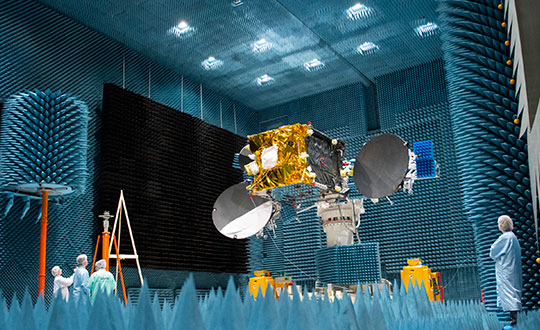
    The second satellite in the European Data Relay System (EDRS) undergoes tests at Airbus's Compact Antenna Test Range facility. (Photo: ESA)
    The second satellite in the European Data Relay System (EDRS) undergoes tests at Airbus’s Compact Antenna Test Range facility. (Photo: ESA)

    “Results from the testing will feed into the up-coming Preliminary Design Review for the new satellites, backing up the analyses by the companies with solid measurements,” Cédric said. “Such early testing also supports the ambitious timescale for the development and construction of G2 satellites, with the first satellites planned to reach orbit by the middle of this decade.”

    There are 26 Galileo satellites now in orbit; deployment of 12 more will begin by the end of this year. Next will come the first 12 G2 satellites, featuring enhanced navigation signals and fully digital payloads. The new generation will be made up of two independent families of satellites meeting the same performance requirements, produced by Thales Alenia Space in Italy and Airbus Defence and Space in Germany.

    Airbus Defence and Space’s GPLTB is undergoing radiated testing at the company’s Ottobrunn facility, inside a Compact Antenna Test Range (CATR). Meanwhile, the Thales Alenia Space GPLTB is about to start testing inside ESTEC’s own Hybrid European Radio Frequency and Antenna Test Zone (Hertz) chamber. The metal-walled chambers are isolated from external radio interference, with inner walls studded with foam pyramids to minimize radio-frequency signal reflections, mimicking the void of space.

    “Up until now all GPLTB testing has taken place by plugging them into test boards,” Cédric said. “These test campaigns mark the first time that their performances will be confirmed in terms of radiating signals. In our first phase we will perform near-field measurements directly around the antenna to measure all the characteristics of the signal shape, to check it matches previous conductance tests. Then, via computation, we can derive its far-field performance.”

    In the second test phase, the actual far-field measurements will be performed using another feature of the chambers, a pair of paraboloid reflectors. In this way, the signal from the testbed can be reshaped as if it had traveled the long distance that actual Galileo signals need to travel, from an altitude of 23,222 km down to Earth’s surface.

    At Airbus, the testing is being undertaken in reverse order, with the far-field measurements taking place before performing the near-field measurements.

  • Masten to develop beacon navigation system for the Moon

    Masten to develop beacon navigation system for the Moon

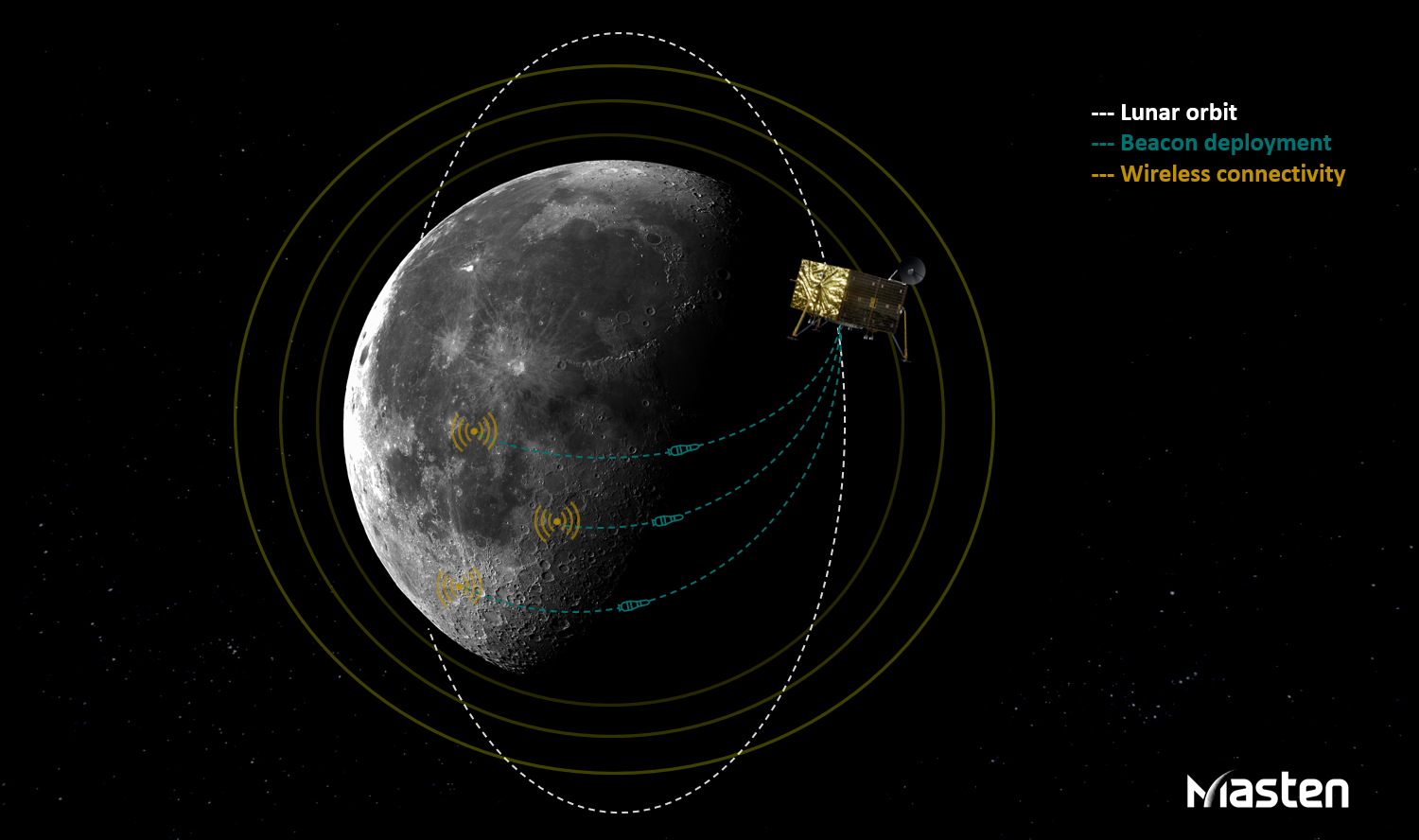
    PNT beacons can be deployed in orbit to penetrate the lunar surface and enable consistent wireless connectivity. (Image: Masten Space Systems)
    PNT beacons can be deployed in orbit to penetrate the lunar surface and enable consistent wireless connectivity. (Image: Masten Space Systems)

    Masten Space Systems has been awarded a U.S. Air Force contract to develop and demonstrate a lunar positioning and navigation network prototype that functions much like GPS.

    The Phase II Small Business Innovation Research (SBIR) contract was awarded through the Air Force Research Laboratory’s AFWERX program. AFWERX connects innovators across government, industry and academia.

    The navigation network will enhance cislunar security and awareness by enabling navigation and location tracking for spacecraft, assets, objects and astronauts on the lunar surface or in lunar orbit. As the lunar infrastructure grows, the network will help advance lunar science and resource use by improving landing accuracy and hazard avoidance near critical lunar sites.

    “Unlike Earth, the Moon isn’t equipped with GPS so lunar spacecraft and orbital assets are essentially operating in the dark,” said Matthew Kuhns, vice president of research and development at Masten. “As a result, each spacecraft is required to carry heavy navigation hardware and sensors on-board to estimate positioning and detect potential hazards. By establishing a shared navigation network on the Moon, we can lower spacecraft costs by millions of dollars, increase payload capacity, and improve landing accuracy near the most resource-rich sites on the Moon.”

    In Phase I, Masten completed the concept design for the network prototype that offloads positioning, navigation, and timing (PNT) beacons from a spacecraft into a dedicated sensor array on the Moon.

    In Phase II of the project, scheduled to be complete in 2023, Masten will develop PNT beacons equipped to survive harsh lunar conditions. Masten is collaborating with Leidos to build shock-proof beacon enclosures that can be deployed in lunar orbit to penetrate the lunar surface and create an autonomous surface-based network. Similar to a mesh network, the surface-based network can enable consistent wireless connectivity to lunar spacecraft, objects, and orbital assets.

    “Leidos is proud to collaborate with Masten Space Systems in their quest toward a successful lunar surface-based positioning and navigation network,” said Thomas Sereno, vice president and division manager of the Applied Science operation at Leidos. “We are prepared to support the team as they progress through the next phase of the contract.”

    In Phase II of the project, the PNT technology will also be tested aboard Masten’s rocket-powered lander, Xodiac, to demonstrate payload integration and beacon operations in a terrestrial environment, enabling a path towards lunar demonstration.

    Masten has more than a decade of experience maturing PNT systems, including Jet Propulsion Laboratory’s lander vision system that was tested on Masten’s Xombie rocket to enable a successful Mars mission for the NASA Perseverance rover.

    “As one of the first commercial companies sending a lunar lander to the Moon, we’re in a unique position to develop and deploy a shared navigation system that can support other government and commercial missions and enable a thriving lunar ecosystem,” said Masten CEO Sean Mahoney. “We are literally blazing the trail with this effort, creating the pathway for regular, ongoing and reliable access to the Moon.”

  • John Deere acquires Bear Flag Robotics to accelerate autonomous farm tech

    John Deere acquires Bear Flag Robotics to accelerate autonomous farm tech

    Photo: John Deere
    Photo: John Deere

    Deere & Company has signed a definitive agreement to acquire Bear Flag Robotics for $250 million USD. Founded in 2017, Bear Flag is a Silicon Valley-based startup that develops autonomous-driving technology compatible with existing machines.

    The deal accelerates the development and delivery of automation and autonomy on the farm and supports John Deere’s long-term strategy to create smarter machines with advanced technology to support individual customer needs.

    Deere first started working with Bear Flag in 2019 as part of the company’s Startup Collaborator program, an initiative focused on enhancing work with startup companies whose technology could add value for Deere customers. Since then, Bear Flag has successfully deployed its autonomous solution on a limited number of farms in the United States.

    The Bear Flag team consists of agriculture professionals, engineers and technologists focused on autonomy, sensor fusion, vision, data, software and hardware. They will remain in Silicon Valley where they will work closely with Deere to accelerate innovation and autonomy for customers across the world.

  • US Space Force to host GPS document forum

    US Space Force to host GPS document forum

    CGSIC logo

    The U.S. Space Force will host the 2021 Public Interface Control Working Group and Open Forum in September and November. The meetings are open to the public in person and virtually on Wednesday, Sept. 29, 8:30 a.m. to 4 p.m., and Tuesday, Nov. 19, 8 a.m. to 4 p.m. (Pacific Time).

    The meeting and forums will discuss the following documents:

    The purpose of the meeting is to update the public on GPS public document revisions and collect issues and comments for analysis and possible integration into future GPS public document revisions.

    The meeting will be held in person at

    Los Angeles Air Force Base
    Great Room, -PCT Campus
    100 Sepulveda, Blvd.
    El Segundo, CA 90245

    Attendees are highly encouraged to participate virtually. It can be accessed at this link or at this link.

    • Primary Dial In: 571-200-1700, Meeting ID: 160 913 1495, Password: 813441
    • Backup Dial In: 410-874-6300, Conference PIN: 961616381

    The official public notice in the Federal Register provides further information, including how to register, submit comments and dial in on the telephone.

  • India seeks global adoption of its NavIC system

    India seeks global adoption of its NavIC system

    Logo: Indian Space Research OrganisationA new draft policy in India seeks to foster global use of its Indian NavIC satellite navigation system. The draft Indian Satellite Navigation Policy 2021 (SATNAV Policy 2021) is part of reforms of the Indian Space Research Organisation (ISRO)/Department of Space (DoS).

    “ISRO/DOS shall work towards expanding the coverage from regional to global to ensure availability of [the] NavIC standalone signal in any part of the world without relying on other GNSS and aid in wide utilization of [the] Indian navigation system across the globe,” states the policy document.

    DoS will push NavIC for global use to meet demand for positioning, navigation and timing in commercial, strategic and societal applications. It aims to ensure the continuous availability of free-to-air navigation signals for civilian uses, while providing secured navigation signals for strategic uses.

    The draft document plans for continuity of NavIC and GAGAN services, while also ensuring Indian satellite navigation and augmentation signals are compatible and interoperable with other GNSS/SBAS signals. The International Telecommunication Union (ITU) regulated frequency allocation to prevent interference among signals from different systems. This interoperability allows users to seamlessly switch from one constellation system to another and results in improved navigation signal, especially in a situation where an area is obscured from one satellite system.

    DoS will continue to work with ITU for frequency allocation. It will also take part in the United Nations Committee on Peaceful Uses of Outer Space (UNCOPUOS), International Civil Aviation Organisation (ICAO) and International Maritime Organisation (IMO).

    In addition, ISRO will provide technical support for academic institutions in GNSS research and applications.

  • Parrot, Verizon and Skyward bring 4G-connected drone to US

    Parrot, Verizon and Skyward bring 4G-connected drone to US

    Photo: Verizon
    Photo: Verizon

    The Parrot ANAFI Ai is powered by Verizon 4G LTE and integrated with Skyward software to pave the way for near real-time data transfer, remote deployment and beyond-visual-line-of-sight (BVLOS) flight operations.

    Verizon, Parrot and Skyward have entered a partnership to bring an out-of-the-box 4G LTE connected drone to the United States.

    The Parrot ANAFI Ai is an off-the-shelf drone that connects to Verizon’s 4G LTE network. Verizon 4G LTE connectivity is provided exclusively to Skyward subscribers at no additional cost. The Skyward Connected Drone Solution gives enterprises one complete experience for planning, flying, data transfer and processing data.

    The Parrot ANAFI Ai professional drone is open to developers with a full open-source app, autonomous one-click photogrammetry and new levels of cybersecurity. Combined with the Skyward Connected Drone Solution, the ANAFI Ai makes complex missions simpler, safer and quicker in photogrammetry, mapping, modeling in construction, infrastructure, inspection, surveying, public safety and enterprise.

    The drone features an omni-directional obstacle-avoidance system, 48 MP imaging accuracy, 4K 60 fps smooth videos, and up to 32 minutes of flight time in an airframe that weighs less than 2 pounds.

    Parrot ANAFI Ai’s embedded Secure Element secures the 4G LTE link between the drone and the user’s device. Parrot’s streaming software quickly optimizes the definition and frame rate for the connected 4G network.

    Parrot ANAFI Ai pilots can subscribe to a paid account or a free trial of the Skyward Connected Drone Solution to:

    • plan with Skyward’s airspace map and fleet management tools
    • obtain fast, automated access to controlled airspace from the Federal Aviation Administration with LAANC
    • fly over Verizon 4G LTE with the Skyward InFlight mobile app
    • process with Skyward Mapping & Modeling, powered by Pix4D
    • transfer data during flight over 4G LTE.

    Users can activate 4G LTE connectivity in a few taps exclusively in the Skyward InFlight mobile app. Once activated, the connectivity provides a seamless backup connection to the flight controller in case of interference or interruption. It paves the way for near real-time data transfer, remote deployment and BVLOS flight operations, allowed with a waiver from the FAA.

    “Enterprise drone programs are pushing the limits of technology available today and advanced operators are ready for a connected, trusted and capable drone to take their drone programs to the next level,” said Mariah Scott, Head of Verizon Robotics Business Technology. “Parrot ANAFI Ai connected to Verizon 4G LTE marks an industry milestone toward distributed, remote, persistent operations that lets users fly to anywhere from anywhere with near real-time data transfer.”

    “Cellular connectivity is the new communications standard for the professional drone industry and Parrot ANAFI Ai seeks to set new standards for drones at work” said Henri Seydoux, Founder and CEO of Parrot.  “We designed ANAFI Ai’s 4G LTE connectivity, which enables precise, robust and secure control at any distance with a 4G LTE connection that avoids obstacles. Advanced artificial intelligence, autonomous flights, best-in-class imaging, photogrammetry accuracy and reliable 4G LTE connectivity on the Verizon network, put powerful new tools in the hands of professionals like never before and we truly believe it is a game changer for the professional drone industry.”

    The Skyward Connected Drone Solution with Parrot ANAFI Ai on Verizon 4G LTE will be available in the second half of 2021 through Skyward.

  • WingtraOne GEN II debuts for professional VTOL flights

    WingtraOne GEN II debuts for professional VTOL flights

    A new vertical-takeoff-and-landing (VTOL) drone — the WingtraOne GEN II — is now available. The GEN II offers industrial reliability and mapping versatility with an oblique camera configuration for high-quality 3D drone-mapping data capture.

    Drone maker Wingtra spent six years developing the GEN II, and tested it over 100,000 flights. Its WingtraOne is being used by professionals worldwide across many industries.

    According to Wingtra, the GEN II represents a solid step forward in industrialization and reliability along with new perks that push the previous limits of commercial mapping drones.

    The WingtraOne GEN II. (Photo: Wingtra)
    The WingtraOne GEN II. (Photo: Wingtra)

    Oblique 3D Mapping Payload

    “We wanted to make the WingtraOne drone even more versatile for our customers. So next to our flagship 42MP Sony RX1, we’re including new, high-end mapping payloads,” said Maximilian Boosfeld, co-founder and CEO of Wingtra. “I’m especially excited to announce our oblique solution, which offers outstanding 3D mapping results. It’s the perfect choice for capturing infrastructure — from a single industrial plant to entire cities.”

    WingtraOne’s GEN II oblique mapping solution is backed by signed partnership agreements with Bentley Systems and Esri. To demonstrate the power of GEN II carrying its Oblique Sony A6100 payload, the Wingtra team mapped the city of Zurich, Switzerland, in six flight hours, producing a 3D model processed with both Bentley ContextCapture and Esri’s Site Scan for ArcGIS. Bentley and Esri’s software are both recommended for processing Wingtra oblique datasets.

    “Bentley Systems is delighted to partner with Wingtra to transform high-resolution oblique imagery from WingtraOne drones into 3D reality meshes — an ideal starting point for infrastructure digital twins,” said Phil Christensen, VP, Industry Solutions, iTwin Context, Bentley Systems. “This enables our common users to perform analytics on the resulting models as well as leverage Bentley’s iTwin platform to share performant, city-scale digital twins.”

    “Our partnership with Wingtra unlocks new capabilities for Site Scan for ArcGIS users by allowing them to create wide-scale and accurate 3D meshes leveraging the oblique payload on the WingtraOne Gen II,” said Richard Cooke, director of Global Business Development at Esri. “These high-resolution images processed through Site Scan produce an enriched 3D GIS for our users who require modelling of open-pit mines, accurate construction updates, creation of digital twins for cities, and more.”

    Digital twin of Zurich mapped with the WingtraOne GEN II drone. (Image: Wingtra)
    The WingtraOne GEN II drone was used to map Zurich and create a digital twin of the city. (Image: Wingtra)

    Integrated PPK and Self-Diagnosis

    WingtraOne GEN II features post-processed kinematic (PPK) ability integrated on every drone, including multispectral Altum and RedEdge payloads, as well as advanced fail-safe and self-diagnosis algorithms and services for dependable operations.

    “We have studied over 100,000 flights and all incoming customer reports to understand what the limits might be so we can push them further,” said Julian Surber, Wingtra product manager. “As a result, we’ve designed many reliability tools for GEN II to guarantee uninterrupted operations.”

    Wingtra’s engineering team has redesigned the electronics of the GEN II from its predecessor WingtraOne for increased reliability, including a more powerful onboard computer, optimized PCB designs, and a new navigation and heading unit developed inhouse.

    The GEN II runs through health-monitoring algorithms for motors, servos, batteries, camera, PPK and onboard sensors, health self checks that minimize the potential of flight  with unsafe equipment.

    Precision Agriculture Boost

    Wingtra’s top-of-the-line multispectral payloads Micasense Altum and RedEdge will now be paired with high-accuracy PPK, which improves the quality of multispectral insights for uses such as irrigation management and prescription maps for pesticides.

  • uAvionix receives FAA order for certified drone GPS receiver

    uAvionix receives FAA order for certified drone GPS receiver

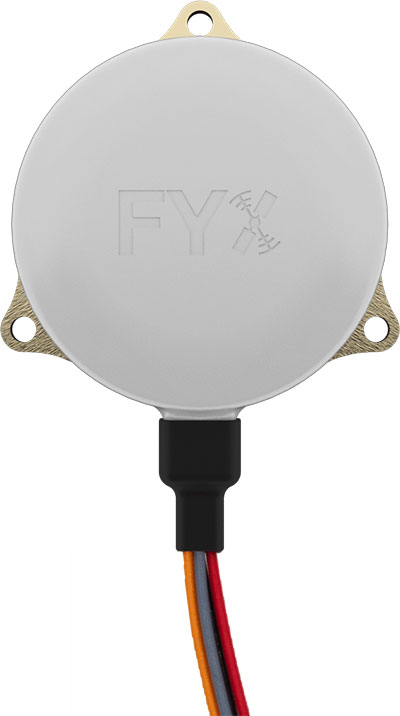
    The truFYX receiver. (Photo: uAvionix)
    The truFYX receiver. (Photo: uAvionix)

    uAvionix Corp. has received a Technical Standard Order (TSO) from the U.S. Federal Aviation Administration (FAA) for its truFYX GPS receiver for unmanned aircraft systems (UAS).

    Capable of receiving satellite-based augmentation system (SBAS) and wide area augmentation system signals, the receiver specifically targets UAS platform navigation and surveillance solutions.

    With an increased regulatory focus on certifiability of UAS for beyond visual line of sight (BVLOS) operations, truFYX provides a critical component to enable safe navigation and airspace integration. A uAvionix’s blog article — “Why Certified GPS with Integrity for UAS Navigation Matters” — describes the importance of GPS receivers for UAS BVLOS operations.

    The TSO-C145e Class Beta 1 GPS weighs 20 grams, which includes the receiver, antenna, DO-160G power supply and interface protection circuits. A Class Beta 1 GPS enables the truFYX to be the primary position source for domestic enroute and terminal navigation, as well as the primary position source for ADS-B OUT solutions.

    The Source Integrity Level 3, System Design Assurance 2 system ensures reception and processing by Air Traffic Control and Traffic Collision Avoidance System when used as a position source for ADS-B. For these reasons, the Airbus Zephyr program was announced as a truFYX launch customer in January.

    A certified position source for UAS navigation reduces position error by implementing a strict Receiver Autonomous Integrity Monitoring (RAIM) / Fault Detection and Exclusion (FDE) engine, and processing advanced SBAS messages designed to improve accuracy and integrity. These systems combine to detect unhealthy GPS satellite transmissions and remove them from the position calculation, providing critical differentiation from a typical commercial GPS receiver.

    Design Assurance Level C software and hardware is achieved through the use of RTCA DO-178C and DO-254 engineering processes. As with all uAvionix TSO certified avionics, truFYX is manufactured in Montana under an FAA Manufacturing Inspection District Office approved quality-control process and facility.

    truFYX technology has been previously TSO-certified in several form factors, including the highly integrated and complex skyBeacon, tailBeacon and tailBeaconX platforms.

  • Topcon and DDK Positioning to provide GNSS hardware for maritime market

    Topcon and DDK Positioning to provide GNSS hardware for maritime market

    Photo: arild lilleboe/iStock/Getty Images Plus/Getty Images
    Photo: arild lilleboe/iStock/Getty Images Plus/Getty Images

    DDK Positioning will provide services and Topcon hardware to Oceaneering International

    Topcon Positioning Systems has entered into an original equipment manufacturer (OEM) contract with DDK Positioning Ltd. to supply GNSS hardware components.

    In July, Oceaneering announced an exclusive agreement with DDK Positioning to be the new provider of products and services to the offshore maritime market, delivered through the Iridium network and with Topcon OEM GNSS products.

    Image: Topcon
    Image: Topcon

    Topcon OEM GNSS components will be used by DDK Positioning to deliver its MAX services to Oceaneering International’s clients. These clients, primarily in the marine energy sector, can achieve accuracy to less than 5 centimeters with this new service.

    Founded in 2016, DDK Positioning has combined technical ingenuity with the Iridium satellite network to create a robust, resilient and completely independent GNSS-augmenting positioning solution.

    Oceaneering recently conducted an extensive review of how it delivers positioning services to its clients and evaluated the significant advances made in communications infrastructure and services over recent years.

    “Our extensive research of receivers in the market, and the performance of Topcon, made the decision for our route going forward,” said Kevin Gaffney, CEO of DDK Positioning. “Topcon’s experience, their extensive support network and leadership will allow us to effectively support multiple clients, in addition to Oceaneering. We see this as a long-term partnership. Both companies worked tirelessly to bring this together.”

    “With Topcon Positioning System’s extensive history in precise positioning, providing high performance and quality GNSS boards, antennas and receivers to the OEM industry for over 20 years, the company is well-positioned to supply DDK Positioning with the hardware needed to support their clients globally,” said Ian Stilgoe, vice president of Topcon emerging business. “Working closely with DDK Positioning and Iridium was key to meet the requirements of Oceaneering and the maritime market. Topcon is pleased to be part of this effort to bring the latest positioning technology to this market segment.”