Category: Machine Control / Agriculture

  • Agriculture robots market projected to reach US$5.7 billion by 2024

    Agriculture robots market projected to reach US$5.7 billion by 2024

    The agriculture robots market is projected to reach US$5.7 billion by 2024, according to a report by Transparency Market Research (TMR).

    The diverse nature of the competitive landscape in the global agriculture robots market presents a number of prominent players for each of its key regions, TMR analysts said.

    PrecisionHawk Inc., Clearpath Robotics and Harvest Automations Inc. were the leaders of the agriculture robots market in North America, while SenseFly SA and Naio Technologies led the market in Europe for 2015. At the time, Shibuya Seiki was the leading player in the agriculture robots market for Asia Pacific.

    Also, a diverse array of names is appearing as emergent players in the global agriculture robots market within each region, denoting a strong scope of entry for advanced innovations and increased player competition.

    Agriculture robots include UAVs, driverless tractors, automated harvesting machines and more.

    According to the report, the global agriculture robots market was led by North America until 2015. It was considered to be the base for several of the stronger players in the market and the leading region in terms of technological development and rate of implementation.

    In 2015, the global agriculture robots market was dominated by driverless tractors. This segment is likely to hold the leading share in the market in the immediate future, followed by automated harvesting machine. Driverless tractors are currently in very high demand due to factors such as their ability to automatically plough the field, and pick and place articles from one place to another at an extremely consistent rate.

    By revenue, the global agriculture robots market is likely to reach US$1.01 billion by the end of 2016. Its revenue generation is expected to continue expanding at a CAGR of 24.1% within a forecast period from 2016 to 2024, and is expected to reach US$5.7 billion by the end of 2024.

    agriculture-robots-market
    Source TMR Analysis, 2016

    Urban Migration Pushes Need for Agriculture Robots Globally

    “The progress of regions and cultures has primarily driven a growing number of people towards the urban areas and the suburbs. The chance of industrial progress and growth in personal income are key factors attracting more and more people to the city life. This, in turn, has caused a twofold need for the incorporation of agriculture robots in several countries,” said a TMR analyst.

    “Firstly, the growing global population — a lot of it being urban — is pressuring countries to increase food production while steadily reducing the hands available for the agriculture industry. Secondly, the overall land slotted for agriculture in nearly all countries is reducing, thanks to the burgeoning industrial sector and residential construction projects. This is creating an additional layer of demand for agriculture robots as they are as close as the industry can get to precision farming,” said the analyst.

    Other factors driving the global agriculture robots market include the reduction in the use of chemicals through the efficient performance of jobs such as weeding, spraying, and pick-and-place, and the increasingly accepted modes of corporate farming.

    Functionality Still Limited for Multiple Robotic Farming Aspects

    It is currently not feasible to aim for constructing robots that are capable of performing multiple functions that constitute running a farm. Between crop management, irrigation, and even livestock rearing, the design of robotic programs and functions can be utterly difficult to accomplish.

    This results in the requirement of multiple robot types in a single farm in order to completely automate the process, which is a serious financial burden to consider. The scope of utility in the global agriculture robots market is thus limiting the overall customer pool, which is already thinned out by the heavy investments required in installation and maintenance of single function robots.

    “Future opportunities in the global agriculture robots market lie in the adoption of telematics sensors to reduce the complications that are caused by tractor failure and other functions, the use of crop sensors to increase the precision of pesticide use and gauge overall crop health, and the use of robotic farm swarms,” said the analyst.

    The information presented in this review is based on a Transparency Market Research report, titled, “Agriculture Robots Market (Products — UAV, Driverless Tractors, Milking Robots and Automated Harvesting Machines; Applications — Field Farming, Dairy Management, Indoor Farming and Horticulture) — Global Industry Analysis, Size, Share, Growth, Trends and Forecast, 2016-2024.”

    A PDF research brochure of this report is available.

  • SenseFly, Agribotix offer agricultural end-to-end solution

    SenseFly, Agribotix offer agricultural end-to-end solution

    Agribotix_senseFly_data-W
    Photo: SenseFly

    Agribotix, drone-enabled agricultural intelligence, has partnered with senseFly, producer of professional fixed-wing drones, to offer a new combined solution optimized for the early identification and troubleshooting of crop issues.

    It combines the eBee SQ — senseFly’s advanced, long-range agricultural drone — with Agribotix’s FarmLens cloud-processing platform to make collecting and analyzing aerial data easier, with more coverage per flight than is possible with most quadcopter solutions.

    By adopting the eBee SQ as its new fixed-wing drone platform, Agribotix is signaling its ongoing commitment to sourcing the best hardware on the market to bundle with its award-winning FarmLens SaaS platform, a 100-percent agricultural data-processing cloud solution.

    The eBee SQ is built around Parrot’s Sequoia sensor, which features multispectral sensors that capture calibrated data across four highly distinct spectral bands (near-infrared, red-edge, red and green), plus RGB imagery, in a single flight.

    The FarmLens Professional subscription now being bundled with the eBee SQ gives users the ability to perform the full crop scouting workflow in the field: fly large areas efficiently, capture ground truthing images, make notes, and share detailed information about trouble spots with farmers from the field. FarmLens users gain valuable insights about crop conditions without having to become experts in data processing.

    “The combined solution of the eBee SQ and FarmLens is a great fit for people who are looking for a simple, yet powerful, 100-percent agricultural solution,” said Lou Faust, Agribotix CEO. “After evaluating the fixed-wing options available today, there was no question that the eBee SQ is the easiest to use long-range drone on the market. It also has the best-in-class agricultural sensor, while FarmLens does the heavy lifting in the background, returning superb quality data presentation via the Agribotix Digital Scouting Report and enabling farmers to make time-critical adjustments.”

    “We’re delighted to join forces with Agribotix in pairing the eBee SQ with FarmLens,” said Jean-Christophe Zufferey, senseFly’s CEO. “This partnership creates a professional end-to-end solution that is uniquely easy to use.”

    Once the combined solution is purchased, customers will receive full professional hardware support via senseFly’s network of expert distribution partners.

  • Vertical RTK system increases accuracy for agriculture

    Vertical RTK system increases accuracy for agriculture

    Trimble has launched a patent-pending VerticalPoint RTK system for grade control in agriculture.

    VerticalPoint RTK provides significantly enhanced vertical accuracy and stability of standard single-baseline RTK systems reducing the downtime and costly delays experienced by many agriculture land improvement contractors today.

    Photo: VerticalPoint RTKVerticalPoint RTK is available in North America and Australia as an unlock on the Trimble FmX integrated and TMX-2050 displays and works in combination with the Trimble FieldLevel II system, which streamlines the surveying, designing and leveling steps required for land leveling projects.

    The VerticalPoint RTK system also includes two stationary supplemental rovers for live, dynamic data collection.

    When vertical accuracy inconsistencies occur, agriculture contractors must wait to restart leveling until the vertical signal is once again accurate, and in some instances even rework portions of the field that were incorrectly leveled before the vertical signal inconsistency was discovered.

    VerticalPoint RTK significantly reduces vertical design errors in leveling and land forming projects, which occur from inconsistent vertical GPS signals resulting from atmospheric interference. With VerticalPoint RTK, contractors can experience an approximate 25 percent increase in overall uptime.

    The industry experiences about 75 percent uptime; however, with VerticalPoint RTK uptime can increase to approximately 95 percent. In addition, this increase in uptime occurs even in the most challenging environments and at any time of year.

    “Trimble is excited to launch a world-first technology that enhances vertical GPS accuracy, enabling agriculture contractors to better perform leveling or land forming operations,” said Josh Shuler, product manager for Trimble’s Agriculture Division. “Our new VerticalPoint RTK system can significantly reduce downtime leading to reduced expenses in labor and fuel while also increasing productivity.”

    “On average during the summer months we may see 5-6 hours a day where we don’t have the level of vertical GPS accuracy that we need to complete finish passes,” said Jarrett Lawfield, owner of Lawfield Land Grading, a custom land leveling business. “At times all we lack is a finish pass and then we very well may have to stop and wait. I can’t get onto the next job since I’m waiting for the vertical accuracy to be where it needs to be.”

    “The vertical accuracy capabilities of VerticalPoint RTK allows the whole project—from bulk hauling to finish passes—to be more efficient. The more accurate bulk hauling is, the less work to be done while finishing,” Lawfield said. “From first thing in the morning until the evening or even to the next day, VerticalPoint RTK is consistent and repeats elevation, so it has virtually eliminated the times when we are unsure of the vertical GPS accuracy. It has helped us to be more timely and efficient in our work.”

  • Towering solutions: Using GNSS, BIM and a head-up display for speed, safety

    Towering solutions: Using GNSS, BIM and a head-up display for speed, safety

    Modern tower cranes can reach a height of more than 200 meters. They operate in a complicated, chaotic and constantly changing environment. This creates obstacles for the crane operator: poor visibility and dead angles — places the operator can’t see.

    Aiming to solve the problem is the Augmented Crane Navigation System (ACNS) project, which provides innovative intelligent operation of tower cranes on construction sites through the integration of highly accurate navigation receivers and a powerful processor unit.

    Photo © Natasza Figiel
    Photo © Natasza Figiel

    Polish researcher Piotr Krystek took home the DLR Special Prize from the European Satellite Navigation Competition (ESNC) for the ACNS, which is designed to increase efficiency and safety at construction sites.

    Using the ACNS, the position of the crane elements can be determined and oriented using four to five low-cost yet highly precise Galileo or GNSS receivers. The central processor calculates the best possible route for load management. In addition to the position values of the various satellite navigation receivers, the digital model of the physical structure or Building Information Model (BIM) is used. Using a head-up display, the visualization is projected directly onto the crane operator’s field of view to enable easy and precise navigation.

    The ACNS has a modular design and can be mounted on the crane easily; this includes the retrofitting of existing cranes.

    The project is still in the concept phase. To implement the idea, the market must be explored and feasibility studies carried out with cranes in collaboration with crane manufacturers, Krystek said.

    The ACNS also could be transferred to other construction machinery and commercial vehicles, Krystek said. As one of the leading economic sectors, the construction industry can benefit immensely from GNSS-based solutions.

    Krystek was inspired to pursue the project because of the tower cranes visible from his window in Krakow — along with the availability of low-cost RTK receivers. He is also inspired by the trend to automate everything that can be automated, such as self-driving cars.

  • Trimble introduces dynamic compaction system

    Trimble has introduced itsDPS900 Machine Control System for Dynamic Compaction, a dedicated 3D system for dynamic compaction applications such as airports, roads and large structures.

    The DPS900 increases worker safety by eliminating the need for surveyors to work in close proximity to large machines. The number of drops per location and the depth of the hole can be accurately and automatically tracked and recorded, reducing errors from a manual reporting method.

    In addition, the DPS900 system reduces setup time for each drop location, which can increase production and reduce costs.

  • Airbus Farmstar service improved with new recommendations

    (Photo: Farmstar)
    (Photo: Farmstar)

    Farmstar, a service of Airbus Defence and Space and ARVALIS – Institut du végétal for precision farming based on satellite information, has been further improved.

    New images acquired by the SPOT 6 and SPOT 7 satellites will make it possible to issue intra-field recommendations for areas as small as 1 hectare. Also,  new interactive advice is provided for nitrogen input at the 1-centimeter ear stage.

    Automatic and manual modulation files are accessible to all farmers via the Farmstar web portal. An additional advice for calculating the nitrogen input at the 1-centimeter ear stage enables this input to be broken down and adjusted for wheat, barley and triticale crops. The nitrogen fertilization recommendations now take into account the objectives of the Proteins Plan for wheat quality thanks to new nitrogen requirement specifications for soft wheat, to optimize how this two-fold yield–protein content objective is addressed.

    These new developments come at the right time: after an extremely difficult year, due to exceptionally poor meteorological conditions, French farmers are looking to save on farm inputs while continuing to manage their crops sustainably and with a focus on environmental protection.

    The number of farmers signed up for the service has constantly risen over the past 15 years. Nearly 800,000 hectares of plots were monitored by Farmstar last season, enabling more than 18,000 farmers to save time and money through precise management of the exact needs of their crops.

    Farmstar is a service distributed by the cooperatives, chambers of agriculture and traders dedicated to precision agriculture and crop management developed by Airbus Defence and Space and ARVALIS – Institut du végétal, in partnership with Terres Inovia.

    Throughout the season, the service provides reliable information that can be directly used by farmers to help them quickly make relevant decisions. This advice, combining satellite, UAV and aircraft imagery with agronomic expertise, exposes the real need of plants within each plot at different key stages in the crop growth and allows the right amount of inputs to be added in the right places at the right time.

  • Going beyond GPS is the new order of the day

    The Trimble Dimensions conference.
    The Trimble Dimensions conference.

    Times have changed, and the technology landscape is much, much different today than it was as recently as ten years ago when GPS was the driving-force technology for geospatial users and geospatial equipment, and the exclusive concern of many companies in the industry. In that era, their challenges were to design the best performing receiver in terms of accuracy, size, weight, ruggedness and so on.

    Now, GPS technology has been commoditized in mobile devices (the GNSS chip in your smartphone costs about $1.50), and high-precision GNSS is heading in that direction. It’s hard to make a living designing “GPS boxes.”

    Sure, GPS is still a core technology offered in most hardware products that geospatial professionals use, but it’s not the centerpiece. It’s all about system solutions, of which software (and hardware besides GPS) is a major component.

    As just one example of this overall industry trend, let’s look at how the message of system solutions was abundantly clear last week at the Trimble Dimensions User Conference  in Las Vegas. This event reportedly drew 4,400 attendees from more than 80 countries.

    More than 4.400 attended Trimble Dimensions at the Las Vegas Venetial Hotel.
    More than 4.400 attended Trimble Dimensions at the Venetian Hotel.

    Virtual/Augmented (AR/VR) Reality

    The Trimble Dimensions general plenary discussion didn’t feature the latest GNSS technology. In fact, there was barely a mention of GNSS. Nonetheless, the cool factor was present, with the highlight being a live demonstration of virtually reality using Microsoft HoloLens goggles and Trimble SketchUp software.

    Over the years I’ve written quite a bit about augmented and virtual reality. This technology has a bright future for locating hidden assets (think underground and inside wall infrastructure) and visualizing design ideas. For this technology to work, it’s not just about having a set of goggles. One needs software and an accurate geo-database.

    During the plenary, architect Greg Lynn demonstrated the value of virtual reality technology by “displaying” a building concept on an empty table on the stage. Lynn and a colleague donned HoloLens goggles while a camera was set up with HoloLens goggles to display what they were “seeing” through the HoloLens.

    AR/VR reality are a step closer to being a practical technology to deploy in the field. In a way, AR/VR technology seems to be taking the same path as tablet computers. Tablet computers existed way before the iPad was introduced. They were expensive, and history is littered with failed tablet computer ventures, just like Google Glass failed in the AR/VR world.

    I remember paying ~$2,500 for a Fujitsu Stylistic tablet about 10 years ago for my work. Like the Stylistic, HoloLens isn’t cheap. It’s $3,000 for a development kit and $5,000 for the commercial version. It’s not priced for the average consumer, but the attraction is undeniable and due to the price tag; industrial markets will pick it up before the consumer market will.

    It might take a Steve Jobs-like push to punch it through the finish line, but it’s just a matter of time before AR/VR technology is commonplace.

    Solutions

    Hardware isn’t sticky. Software is. Even better, hardware and software bundled tightly together is the sweet spot. Dimensions showed how, more and more, geospatial technique is geared around solutions, not boxes.

    Trimble partner solutions area at Trimble Dimensions 2016.
    Trimble partner solutions area at Trimble Dimensions 2016.
    Trimble solutions area at Trimble Dimensions 2016.
    Trimble solutions area at Trimble Dimensions 2016.

    One case in point: I took a 45-minute ride from the Venetian Hotel on the Vegas Strip to the outdoor demonstration site in the desert east of Las Vegas.

    The demonstration site was a playground for heavy equipment utilizing Trimble hardware and software — from tractors to scrapers to bulldozers and paving machines. It’s difficult to imagine the scale of the outdoor demonstration site, so following are a few images.

    Demonstration site facing south with the Las Vegas Strip to the southwest.
    Demonstration site facing south with the Las Vegas Strip to the southwest.

    I caught a ride in a fully autonomous tractor that was outfitted with  guidance technology (GNSS using RTX satellite correction service), collision avoidance sensor and display console. It repeatedly stayed within the track defined by the orange cones you see in the above image.

    What good is autonomous guidance without collision avoidance? A sensor on the front of the tractor senses objects and either avoids them, slows down or stops. Trimble says they are working on perfecting the turns at the end of each line where traditionally a driver had to take control. This is a difficult task when the tractor is pulling an implement such as a planter or sprayer.

    In the not-too-distant future, tractors will be completely hands-free from start to finish.

    Wi-Fi radio.
    Wi-Fi radio.

    Back inside the Venetian Hotel, I saw this little beast. No, it’s not a funky GNSS antenna. It’s an industrial Wi-Fi radio. Yes, Trimble owns some pretty cool outdoor Wi-Fi technology vis-à-vis Fidelity Comtech, a company that Trimble acquired in 2015.

    I’ve set up outdoor Wi-Fi infrastructure before in relatively benign environments (think agriculture), but I didn’t use anything like this. This equipment is built to propagate outdoor, long-range Wi-Fi connectivity in nasty, noisy environments like shipping terminals and construction sites. It can reshape the antenna pattern on the fly in microseconds, and shape the beam width/range to cover a specific geographic area.

    GNSS Gear

    Even though I’ve been talking about how this isn’t a just a GPS or GNSS environment anymore, I can’t leave without investigating the latest GNSS gear.

    Check this out.

    Trimble Catalyst software GNSS receiver.
    Trimble Catalyst software GNSS receiver.

    In the past, I’ve written about GNSS software receivers. They exist, but require some serious computing power. Well, some smartphones have powerful CPUs, such as the Samsung Galaxy 6 and 7. Trimble has developed a software GNSS receiver called the Trimble Catalyst that uses the CPU of a Samsung smartphone as the GNSS receiver…dual frequency. The antenna on the range pole is just an antenna, albeit an L1/L2 antenna. Using an RTK network, Trimble says it can deliver centimeter accuracy. Wow.

    To be fair, it’s got some significant limitations such as it only uses GPS and Galileo, only runs on certain Android devices (it will likely never run on iOS devices), and eats up the smartphone battery. And although Trimble said it shares resources in a friendly manner, I must think that a rogue app or update might cause things to slow down. Although it won’t behave as snappy as RTK on an R10 and won’t recover as quickly from obstructions like trees, terrain and buildings, it most certainly could bring high-precision GNSS to a wide-array of previously non-RTK users.

    Thanks, and see you next month.

    Follow me on Twitter.

  • Going beyond GPS is the new order of the day

    The Trimble Dimensions conference.
    The Trimble Dimensions conference.

    Times have changed, and the technology landscape is much, much different today than it was as recently as ten years ago when GPS was the driving-force technology for geospatial users and geospatial equipment, and the exclusive concern of many companies in the industry. In that era, their challenges were to design the best performing receiver in terms of accuracy, size, weight, ruggedness and so on.

    Now, GPS technology has been commoditized in mobile devices (the GNSS chip in your smartphone costs about $1.50), and high-precision GNSS is heading in that direction. It’s hard to make a living designing “GPS boxes.”

    Sure, GPS is still a core technology offered in most hardware products that geospatial professionals use, but it’s not the centerpiece. It’s all about system solutions, of which software (and hardware besides GPS) is a major component.

    As just one example of this overall industry trend, let’s look at how the message of system solutions was abundantly clear last week at the Trimble Dimensions User Conference  in Las Vegas. This event reportedly drew 4,400 attendees from more than 80 countries.

    More than 4.400 attended Trimble Dimensions at the Las Vegas Venetial Hotel.
    More than 4.400 attended Trimble Dimensions at the Venetian Hotel.

    Virtual/Augmented (AR/VR) Reality

    The Trimble Dimensions general plenary discussion didn’t feature the latest GNSS technology. In fact, there was barely a mention of GNSS. Nonetheless, the cool factor was present, with the highlight being a live demonstration of virtually reality using Microsoft HoloLens goggles and Trimble SketchUp software.

    Over the years I’ve written quite a bit about augmented and virtual reality. This technology has a bright future for locating hidden assets (think underground and inside wall infrastructure) and visualizing design ideas. For this technology to work, it’s not just about having a set of goggles. One needs software and an accurate geo-database.

    During the plenary, architect Greg Lynn demonstrated the value of virtual reality technology by “displaying” a building concept on an empty table on the stage. Lynn and a colleague donned HoloLens goggles while a camera was set up with HoloLens goggles to display what they were “seeing” through the HoloLens.

    AR/VR reality are a step closer to being a practical technology to deploy in the field. In a way, AR/VR technology seems to be taking the same path as tablet computers. Tablet computers existed way before the iPad was introduced. They were expensive, and history is littered with failed tablet computer ventures, just like Google Glass failed in the AR/VR world.

    I remember paying ~$2,500 for a Fujitsu Stylistic tablet about 10 years ago for my work. Like the Stylistic, HoloLens isn’t cheap. It’s $3,000 for a development kit and $5,000 for the commercial version. It’s not priced for the average consumer, but the attraction is undeniable and due to the price tag; industrial markets will pick it up before the consumer market will.

    It might take a Steve Jobs-like push to punch it through the finish line, but it’s just a matter of time before AR/VR technology is commonplace.

    Solutions

    Hardware isn’t sticky. Software is. Even better, hardware and software bundled tightly together is the sweet spot. Dimensions showed how, more and more, geospatial technique is geared around solutions, not boxes.

    Trimble partner solutions area at Trimble Dimensions 2016.
    Trimble partner solutions area at Trimble Dimensions 2016.
    Trimble solutions area at Trimble Dimensions 2016.
    Trimble solutions area at Trimble Dimensions 2016.

    One case in point: I took a 45-minute ride from the Venetian Hotel on the Vegas Strip to the outdoor demonstration site in the desert east of Las Vegas.

    The demonstration site was a playground for heavy equipment utilizing Trimble hardware and software — from tractors to scrapers to bulldozers and paving machines. It’s difficult to imagine the scale of the outdoor demonstration site, so following are a few images.

    Demonstration site facing south with the Las Vegas Strip to the southwest.
    Demonstration site facing south with the Las Vegas Strip to the southwest.

    I caught a ride in a fully autonomous tractor that was outfitted with  guidance technology (GNSS using RTX satellite correction service), collision avoidance sensor and display console. It repeatedly stayed within the track defined by the orange cones you see in the above image.

    What good is autonomous guidance without collision avoidance? A sensor on the front of the tractor senses objects and either avoids them, slows down or stops. Trimble says they are working on perfecting the turns at the end of each line where traditionally a driver had to take control. This is a difficult task when the tractor is pulling an implement such as a planter or sprayer.

    In the not-too-distant future, tractors will be completely hands-free from start to finish.

    Wi-Fi radio.
    Wi-Fi radio.

    Back inside the Venetian Hotel, I saw this little beast. No, it’s not a funky GNSS antenna. It’s an industrial Wi-Fi radio. Yes, Trimble owns some pretty cool outdoor Wi-Fi technology vis-à-vis Fidelity Comtech, a company that Trimble acquired in 2015.

    I’ve set up outdoor Wi-Fi infrastructure before in relatively benign environments (think agriculture), but I didn’t use anything like this. This equipment is built to propagate outdoor, long-range Wi-Fi connectivity in nasty, noisy environments like shipping terminals and construction sites. It can reshape the antenna pattern on the fly in microseconds, and shape the beam width/range to cover a specific geographic area.

    GNSS Gear

    Even though I’ve been talking about how this isn’t a just a GPS or GNSS environment anymore, I can’t leave without investigating the latest GNSS gear.

    Check this out.

    Trimble Catalyst software GNSS receiver.
    Trimble Catalyst software GNSS receiver.

    In the past, I’ve written about GNSS software receivers. They exist, but require some serious computing power. Well, some smartphones have powerful CPUs, such as the Samsung Galaxy 6 and 7. Trimble has developed a software GNSS receiver called the Trimble Catalyst that uses the CPU of a Samsung smartphone as the GNSS receiver…dual frequency. The antenna on the range pole is just an antenna, albeit an L1/L2 antenna. Using an RTK network, Trimble says it can deliver centimeter accuracy. Wow.

    To be fair, it’s got some significant limitations such as it only uses GPS and Galileo, only runs on certain Android devices (it will likely never run on iOS devices), and eats up the smartphone battery. And although Trimble said it shares resources in a friendly manner, I must think that a rogue app or update might cause things to slow down. Although it won’t behave as snappy as RTK on an R10 and won’t recover as quickly from obstructions like trees, terrain and buildings, it most certainly could bring high-precision GNSS to a wide-array of previously non-RTK users.

    Thanks, and see you next month.

    Follow me on Twitter.

  • Trimble grade control available for  precision guidance on Engcon excavators

    Trimble grade control available for precision guidance on Engcon excavators

    The GSC2000 now works with Engon tiltrotator excavator attachments.
    The GSC2000 now works with Engon tiltrotator excavator attachments.

    Trimble and Engcon announced at Trimble Dimensions that the Trimble GCS900 Grade Control System can now be used with Engcon tiltrotator excavator attachments. Trimble machine control gives excavator operators using an Engcon tiltrotator precision guidance, which can result in time and fuel savings for contractors.

    “Working closely with Trimble, we have made high-precision guidance available for Engcon tiltrotator attachments,” said Fredrik Jonsson, development manager at Engcon. “Major gains in productivity and precision can be realized by customers when the Engcon tiltrotator is used with the Trimble GCS900 Grade Control System.”

    “We are excited about linking Trimble machine control to Engcon’s tiltrotator system,” said Scott Crozier, marketing director for Trimble’s Civil Engineering and Construction Division. “When operators receive accurate guidance in the cab about the tilt and rotation position of the bucket, excavations to designs can be performed faster and more productively.”

    When Engcon tiltrotators are used with the Trimble GCS900 Grade Control System the bucket position and orientation are always visible regardless of bucket rotation. The operator can see the height and the rotation, so the attachment can be more efficient when used for mass excavation, fine grading and working in confined areas.

  • Trimble and Hilti deliver integrated solutions for construction professionals

    Trimble and Hilti deliver integrated solutions for construction professionals

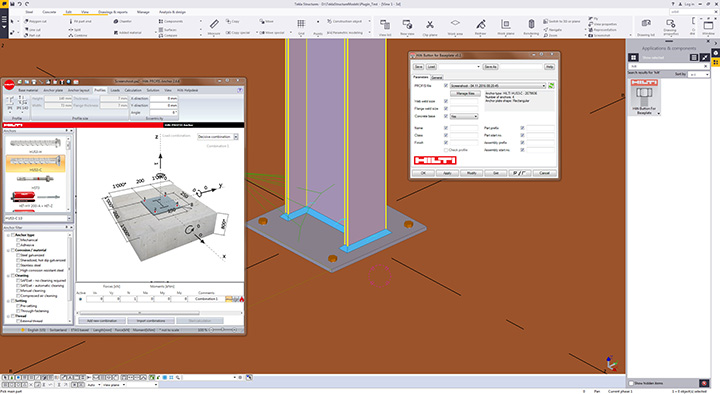
    Trimble  and the Hilti Group announced today that they are collaborating to deliver new software integration and data exchange solutions. These new integrated solutions provide a connected and improved digital experience for building construction professionals.

    The announcement was made at Trimble Dimensions.

    The Hilti PROFIS Plugin for Trimbe's Tekla Structures.
    The Hilti PROFIS Plugin for Trimbe’s Tekla Structures.

    New software and data exchange solutions include:

    • Sharing design information between software applications — Hilti PROFIS Plugin for Tekla Structures allows engineers and detailers to apply PROFIS design information directly in a Tekla Structures model through the Trimble Connect collaboration platform.
    • Easy access to data in the cloud — Hilti’s total stations POS 150/180 and PROFIS Layout Office solutions, and PROFIS detection solutions are now integrated with the Trimble Connect collaboration platform, enabling data to be easily exchanged and shared with others.
    • More design content, specification information and pricing at a user’s fingertips — Hilti has significantly increased its design content in the Tekla Warehouse to include anchors and cast-in solutions as well as providing more than 7,000 items through Trimble’s TRA-SER and LuckinsLive pricing services.

    Since 2010, Trimble and Hilti’s relationship has been built upon shared values that focus on a deep understanding of customer needs and harnessing innovation to develop value-added solutions that increase customer productivity.

    Hilti Corporation supplies the worldwide construction industry with technological products, systems, software and services.


  • Caterpillar and Trimble to expand mining technology collaboration

    As part of an ongoing commitment to transform the way mines manage their business, Caterpillar Inc. and Trimble are extending their collaboration to bring mining customers improved operational decision-making capabilities.

    The collaboration will leverage Caterpillar Global Mining’s industry expertise and combine its in-pit operational execution system, Cat MineStar, with Trimble’s portfolio of technology-enabled mining information solutions.

    This expanded collaboration in mining will include product integration and development, marketing, distribution and support of Trimble Connected Mine solutions.

    The companies have signed an agreement that outlines areas for increased engagement to begin in early 2017. Caterpillar Global Mining is anticipated to become the primary sales, marketing, distribution and support channel for Trimble’s Connected Mine platform.

    In addition, Cat MineStar and Trimble’s Connected Mine platform will be integrated and collaboratively developed. The expanded Caterpillar-Trimble collaboration will enhance both companies’ efforts to serve global customers with technologies and services across a mine?s entire operation and equipment fleet, regardless of brand, language or location.

    “Caterpillar and Trimble have enjoyed a very successful relationship for decades and we are pleased to be working more closely to better leverage the products and capabilities in both companies for our mining customers,” said Tom Bluth, Caterpillar vice president with responsibility for the Surface Mining & Technology Division. “Whether it’s the mining pit supervisor or a corporate operational analytics teams, Caterpillar Global Mining continues to go beyond the iron by providing the technologies and expertise to help customers improve productivity and lower their cost per ton.”

    “This collaboration demonstrates our mutual commitment to provide mine professionals with complete visibility from the mine to the mill,” said Bryn Fosburgh, vice president at Trimble. “As a result, mine operations can leverage accurate production, fleet and spatial data to optimize their workflow and control costs.”

    Cat MineStar is a mining operational execution system purpose built to help miners boost productivity, enhance safety and improve equipment availability, regardless of equipment manufacturer. The system consists of five capability sets: Fleet, Terrain, Detect, Health & Command, which can be configured to suit the unique needs and capabilities of any mine, both surface and underground.

    Cat MineStar has been a critical part of the digital transformation in mining since 1996 when it was first introduced. Today it is installed at more than 200 mine sites around the world. Utilizing improved interoperability, the Cat MineStar platform is uniquely positioned to help customers connect data and decision-making across the mining value chain, from the mine plan to plant processing or from an individual machine to across an enterprise.

    Trimble Connected Mine provides an integrated and complete view of mine data to improve and accelerate operational and strategic decision making. Visual Intelligence is an optional module that enables the 3D visualization of Trimble Connected Mine data.

    With a proven track record of enterprise-level implementations in some of the largest mines worldwide, Trimble is transforming the way mines work by combining mining expertise, spatial technology, business analytics, visualization and decision support tools to enable mining companies to fully optimize their resources for safe, productive and profitable mining.

    Collaborating Since 1996. Caterpillar and Trimble have been collaborating in mining since 1996, when the two companies jointly developed a best-in-class machine control and guidance product, known today in the marketplace as Terrain. Today, Terrain is a leading guidance system for mining, with many of the world’s largest mining companies improving their productivity through use of this technology.

    The companies’ first collaboration evolved into a joint venture in 2002 with the formation of Caterpillar Trimble Control Technologies (CTCT). Today CTCT develops machine control and guidance products for both the mining and construction industries, for any make or model of equipment regardless of manufacturer. Trimble positioning technologies, such as GPS and inertial navigation systems, are also used in many of Caterpillar’s semi-autonomous and autonomous systems.

  • Trimble xFill for machine control sustains RTK positioning during outages

    Trimble xFill for machine control sustains RTK positioning during outages

    Trimble’s GCS900 Grade Control System is now available with xFill technology to sustain real-time kinematic (RTK) positions during correction outages.

    xFill uses Trimble RTX technology, delivered via satellite, to “fill in” for RTK corrections in the event of temporary radio or Internet connection outages. As a result, contractors can experience fewer interruptions and less machine downtime.

    The announcement was made at Trimble Dimensions.

    Photo: TrimbleThe Trimble xFill technology maintains RTK-level accuracy during periods of radio or cellular interruption and will continue to extend RTK fixed positions with a gradual decrease in accuracy for a period of up to 5 minutes in construction applications. The technology provides seamless transitions between RTK and xFill. It functions by using the last known RTK position in conjunction with satellite-delivered RTX technology to sustain high-accuracy positions.

    The xFill service is available throughout most of the world, in areas where Trimble RTX-based services are delivered via satellite.

    “Contractors can now take advantage of improved RTK performance and reliability with the addition of xFill technology to the GCS900 Grade Control System,” said Scott Crozier, director of marketing for Trimble’s Civil Engineering and Construction Division. “Trimble xFill gives users who require uninterrupted connectivity and accuracy a more reliable solution, resulting in more machine uptime and fewer work stoppages.”