Hexagon’s technologies span the geospatial information life cycle from data capture to information delivery. Its portfolio includes land and airborne sensors as well as GNSS receivers, complemented by software applications for data processing, interpretation and analysis. These tools not only display the world as it is, but model the world as it will be.
The company is making a range of presentations at Intergeo 2016, held Oct. 11-13 in Hamburg, Germany. Hexagon is focusing on delivery of geospatial information to facilitate mission- and business-critical decision making.
On the opening day of Intergeo 2016, Cathy Hayes — director of Building Information Modeling (BIM) technology for architecture, engineering and construction (AEC) at Intergraph — spoke on the company’s Smart Build program.
While construction companies have accelerated adoption of information technologies to help manage the complexity of multi-year planning efforts for million- and billion-dollar projects, many of these efforts have proven to be costly, complicated and more disruptive than helpful.
Smart Build is an application for the construction industry to improve profit margins and help complete projects safely, on time and on budget. Hayes presented background and case study material from some of the world’s largest and most challenging industrial projects.
432 Park Avenue, New York
Recent major construction projects involving Hexagon-owned Leica have included using GPS for high-accuracy monitoring and alignment of the 432 Park building in New York (tallest residential structure in the City), a similar project on the Lotte World Tower, a super-tall skyscraper in Korea, and using GPS to align the Gerald Desmond Bridge in Long Beach.
Other Hexagon presentations at Intergeo include:
GNSS and the Value of More Satellite Systems
The rapid evolution of the current and future state of GNSS and how it will affect the geospatial industry.
Digital Realities for Infrastructures
Mobile mapping is supporting the reality capture of critical infrastructures above and below ground for better city management.
IGNITE Your M.App Experience
A new approach to solving business-critical problems. Harnessing the power of the cloud and a community of developers, we can create a better map (and M.App) experience.
Airborne Urban Mapping Made Easy
Best practices for 3D city modeling with the new Leica CityMapper.
Digital Reality Management
Updates on the latest point cloud software.
Centralizing All Monitoring Information to a Single Server for Fast Decisions
Leica’s GeoMoS platforms.
SBG Systems displays their full range of MEMS-based inertial sensors at InterGeo 2016, with a major firmware update for its Ekinox and Apogee product lines. The key improvements in the update include a 15% improvement on orientation and navigation data and better robustness under harsh environments. This firmware is a complete rework of existing functionalities with the addition of new features and improved configuration interface to ease device configuration.
Performance. Up to 15% inertial navigation system (INS) performance improvement from a reworked data fusion algorithms; and improved performance using NMEA GNSS aiding.
Ease of use. Alignment and new status flags have been added to ensure the unit reaches optimal accuracy. The unit can now compute and output on each port a full deported navigation and ship motion data. A completely reworked web interface with 3D views eases mechanical installation. Stability and reliability improvements are reported, especially while using two GNSS at the same time
Various input and output protocols have been added. See SBG Systems website for further information.
UAVs, precision agriculture and robotic guidance require high accuracy at low cost.
Emerging high-volume markets call for RTK technologies previously limited to niche markets by complexity and cost. This article discusses design and implementation of a very precise RTK-based module solution while maintaining cost, size and power consumption as low as possible. Several tests under a range of signal environments benchmark the new module’s performance against existing L1 RTK products.
Real-time kinematic (RTK) positioning has matured over the last few decades into a well-understood technology that, to date, has remained confined to high-end applications by high costs and complexity. Meanwhile, the rapid rise of robotic guidance applications has increased the need for higher accuracy for navigation purposes, fostering an ever-increasing demand for affordable and energy efficient high-precision solutions. Here we discuss the challenges associated with bringing RTK technology to mass markets.
The main challenge for any RTK receivers is resolving carrier-phase ambiguities to their integer values. To do so, an RTK receiver needs clean carrier-phase measurements. In general, high-end RTK receivers typically rely on multi-frequency, multi-constellation solutions and complex estimation models to improve ambiguity resolution performance. However, to reduce size, complexity and power consumption, mass-market receivers typically use narrowband single frequency front-ends, which increase noise and code multipath. Furthermore, mass-market GNSS modules have much less processor and memory resources to call upon. Therefore, to fully integrate the RTK engine, mass-market receivers typically need to restrict the computational burden by optimizing complex RTK algorithms.
Here we discuss our efforts to overcome these challenges while delivering centimeter-level positioning. Performance evaluation under challenging signal environments of a new mass-market L1 RTK module is benchmarked against an existing high-end L1 RTK product.
Multi-Constellation Support
A straightforward approach to improve reliability of the ambiguity resolution is to extend support to other constellations in addition to GPS. GLONASS and BeiDou have respectively reached full and initial (regional) operational status offering significant satellite availability improvements. Both systems broadcast their L1 open service signals using a frequency band that is offset with respect to that of the GPS L1 open service signals and, therefore, concurrent reception of GPS/GLONASS or GPS/BeiDou requires two distinct RF paths. Since the new L1-RTK based module can support reception of GNSS constellations using two independent RF paths, RTK support was implemented for both GLONASS and BeiDou, allowing either of these systems to be used with GPS. On the other hand, the low availability of operational Galileo satellites limits the benefits of a GPS/Galileo solution and, therefore, RTK support for Galileo was not implemented.
GLONASS Ambiguity Resolution
The Russian GNSS transmits L1 signals using a frequency division multiple access (FDMA) technique. While this increases the constellation’s resilience to narrowband interference, it creates two major problems for ambiguity resolution. First, GNSS pseudorange and carrier-phase measurements contain frequency dependent biases related to the receiver’s analog and digital hardware. For GPS (and other code division multiple access [CDMA]-based GNSS), all measurements share the same frequency and the biases cancel out during between-satellite differencing. However, this is not the case for GLONASS where the remaining inter-frequency biases are absorbed by the ambiguities, complicating their resolution. Second, GLONASS signal wavelengths are not common for all satellites within the L1 frequency band.
In addition to the double-difference ambiguity, GLONASS double-difference observations also consist of the between-receiver single-difference ambiguity related to the reference satellite scaled by the wavelength difference of the two signals.
Due to a lack of observability, the single-difference reference ambiguity cannot simply be estimated along with the double-difference ambiguity. On the other hand, merging the two ambiguity terms into a modified one results in an ambiguity that is no longer an integer and therefore cannot be fixed.
Both issues are well understood and several methods have been proposed to circumvent them. However, it is not yet clear whether the performance benefits brought by GLONASS ambiguity fixing outweigh the computational overhead.
BeiDou Ambiguity Resolution
China’s GNSS currently broadcasts B1 open service signals using mixed satellite and signal types, which could complicate ambiguity resolution. The limited orbit variability of BeiDou geostationary and inclined geostationary Earth orbit satellites produces poor carrier-phase ambiguity.
Despite this limitation, recent investigations reported very good dual- or triple-frequency GPS/BeiDou RTK performance, regardless of satellite type. Therefore our approach is to estimate BeiDou ambiguities for all satellites using appropriate weighting of the different carrier phase and pseudorange observations.
Cycle-Slip Detection
Single-frequency RTK inherently offers more limited measurement redundancy than its dual or even triple-frequency counterparts, making cycle-slip detection a difficult task. While a posteriori residuals checks provide a powerful mean to detect outliers, they are computationally expensive and therefore can only be used sparingly. To detect cycle slips prior to the measurement update, heuristic checks are performed on innovation sequences and complemented by systematic analysis of phase lock and C/N0 values.
Configuration Trade-Offs
The RTK positioning modules can concurrently receive and track up to two GNSS systems. By default, the reference receivers are configured for concurrent GPS and GLONASS reception. This can be modified to enable the combined use of GPS and BeiDou.
To optimize the use of processor and memory resources, the number of channels has been limited to 20. This is sufficient for dual-constellation operation almost everywhere except for a limited area in Asia where the number of visible GPS and BeiDou satellites can occasionally exceed 20.
Furthermore, the rover receiver can operate in RTK fixed or RTK float mode. In RTK fixed mode, the receiver will try to resolve ambiguities to their integer values whenever possible whereas in RTK float mode, the receiver will keep the ambiguity estimate as a floating number. The RTK fixed mode will provide the highest level of accuracy but can exhibit position jumps when transitioning from a float to a fixed solution or reliability issues when operating in degraded signal environments where multipath can lead to wrong ambiguity fixes. The RTK float mode, on the other hand, will typically provide dm-level accuracy but a much smoother trajectory.
Static Performance Evaluation
The static test data was collected on the roof of an office building in Singapore in April 2016. Twelve hours of data were collected by four receivers connected to a high-precision receiver forming zero-baseline for both GPS/GLONASS and GPS/BeiDou configurations. This allowed a thorough statistical evaluation of the ambiguity resolution performance for both configurations.
Static Data Processing
The static data sets were post-processed with a software using exactly the same algorithms as those embedded in the receivers’ firmware, allowing for direct comparison of different receiver configurations. The time-to-first ambiguity fix (TTFAF) is often used as a key indicator to assess the ambiguity resolution performance. The TTFAF differs from the time-to-first fix (TTFF) in that it only includes the time required by the ambiguity resolution algorithm to converge. To measure the TTFAF, the software is modified to perform a hot start (where position, time and ephemeris are kept) at regular intervals. This is done to increase the data set sample size and to provide a relevant statistical analysis of its reliability and rapidity.
Static Test Results
As expected, FIGURE 1 shows that the use of the GPS/BeiDou configuration significantly improves satellite visibility over the GPS/GLONASS configuration. The average number of navigation channels used is close to 20 when combining GPS and BeiDou whereas it remains below 16 when combining GPS with GLONASS. This produces faster TTFAF in GPS/BeiDou mode (FIGURE 2).
Walk Performance Evaluation
Two walk data sets were collected around Priory Park in Reigate, England on October 2015 and February 2016. Approximately one hour of data was collected each time with the equipment depicted in FIGURE 3. The antenna was mounted on a survey pole to ensure the best sky visibility possible. The radio frequency (RF) signal was then split three-way and distributed to a high-precision receiver, our rover receiver and a record and replay simulator. The RTCM correction stream was generated by a high-precision receiver connected to an antenna located on the roof of an office building and made available on a server. Using a Raspberry Pi and a 3G modem the RTCM stream was forwarded to both our receiver and the recorder. As shown in FIGURE 4, the Priory Park was selected because it provides excellent satellite visibility and is located approximately one kilometer away from the the reference station. While the open-sky test aimed at evaluating the performance of the RTK engine under ideal conditions, the tree-loop test was carried out to assess its ability to recover from moderate signal degradations. To this end, several loops were performed through the trees shown in FIGURE 5. [Click on an image to enlarge it.]
FIGURE 1. Number of satellites used vs. time for GPS/GLONASS (top) and GPS/BeiDou (bottom).
FIGURE 2. Zero-baseline TTFAF in Singapore.
FIGURE 3. Walk test set-up.
FIGURE 4. Open-sky walk test in Reigate.
FIGURE 5. Tree-loop walk set in Reigate.
Walk-Test Data Processing
The walk-test data sets were post-processed with a software using the same algorithms as those embedded in the receiver’s firmware. For the tree-loop walk test, the default GPS/GLONASS RTK fixed (Fxd-GR) configuration was used. The reference trajectory was obtained by post-processing the raw measurements from the high-precision rover and reference receivers with NovAtel GrafNav software. As it relies on a forward/backward post-processed dual-frequency GPS/GLONASS RTK solution, the reference trajectory is expected to be reliable and cm-level accurate. It can then be used to evaluate ambiguity resolution performance and baseline accuracy. Additionally, the recorded scenarios were replayed to a high-precision receiver. This receiver has an L1 RTK engine that supports GPS, GLONASS, BeiDou and Galileo constellations and is expected to deliver 1-2 cm positions. While this receiver addresses high-end markets, it was used to benchmark the performance of our RTK solution. Since the high-precision receiver supports the BeiDou and Galileo constellations using proprietary correction messages and not RTCM multi-signal messages (MSM), this direct comparison was only done for the GPS/GLONASS configuration using RTCM RTK messages. The high-precision default configuration will hereafter be referred to as Fxd-GR. The receiver was configured to output, amongst other, the NMEA global positioning system fix data (GGA) message which contains latitude, longitude and altitude data, as well as a quality indicator that can be used to see whether the receiver has achieved an RTK fixed solution.
Limitations of Walk-Test Setup
To generate a reliable and robust reference trajectory, a high-end dual-frequency wideband antenna was used. The antenna has excellent inherent multipath mitigation and phase center stability which is not representative of mass-market applications where the use of affordable patch antennas is likely to result in higher code multipath and lower C/N0. However, these issues can be efficiently mitigated by the use of a ground plane and a carefully selected reference antenna site.
Walk-Test Results
The open-sky walk test was performed in a location with clear satellite visibility so that the number of satellites with continuous phase is close to 20 during most of the test. Continuous phase lock is defined as the amount of time during which the receiver is able to track the satellite using a phase lock loop (PLL). Any interruption in PLL tracking is likely to trigger a reset of the ambiguity estimation. As can be seen in FIGURE 2, ambiguity resolution can take up to a minute, even for zero baselines. As such, having continuous tracking for longer time intervals is required to achieve high rates of RTK fixed solutions. As can be seen in FIGURE 6, this translates into cm-level position errors. Note that the open-sky walk in Reigate started and ended in an office area with low-rise buildings. The degradations brought by these buildings can also be clearly observed in FIGURE 6.
During the tree loop test, signal degradations caused by trees are experienced by the receiver approximately every five minutes, causing the number of satellites to drop to zero at regular intervals.
FIGURES 7 and 8 show the resulting position error for the mass-market and high-precision RTK receivers in Fxd-GR mode. The corresponding position error statistics are summarized in TABLE 1. The statistics are computed over the entire duration of the test and therefore can include position fixes that are computed using code differential or RTK float mode. While the large position errors that sometimes occur in these modes will tend to dominate the statistics, they are deemed representative of field applications.
Both receivers exhibit similar accuracy when they can fix ambiguities but the high-precision receiver sometimes recovers faster from signal loss-of-lock than the mass-market receiver.
UAV Performance Evaluation
A UAV data set of approximately half an hour was collected around a farm in Reigate, England in April 2016. The UAV test duration is effectively limited by the capacity of the UAV’s battery which, with the payload deployed for this test, was limited to less than 15 min. To extend the test duration, approximately 10 min of static data was recorded at the beginning of the flight while the UAV was standing in the middle of the field with no obstruction around it. The data collection was performed with DJI S900 hexacopter shown in FIGURE 9 and a payload similar to that depicted in FIGURE 3. The patch antenna was mounted on ground plane with a 15 cm diameter to mitigate multipath effects and ensure the best signal reception possible. The RF signal was then split two-way and distributed to our rover receiver and a record and replay simulator. The RTCM correction stream was generated by a high-precision receiver connected to an antenna located on the roof of an office building in Reigate and made available on a server. Using a Raspberry Pi and a 3G modem the RTCM stream was forwarded to both our receiver and the recorder. This farm provides clear satellite visibility and is located approximately three kilometers away from the reference station. It meets all the regulatory requirements to recreationally fly a UAV. The tree-line test was carried to assess the ability of our RTK engine to recover from moderate signal degradations and dynamics. To this end, the UAV was flown repeatedly along the tree line shown in FIGURE 10. [Click on an image to enlarge it.]
FIGURE 6. Position errors vs. time during the open-sky walk test in Reigate for mass-market receiver in Fxd-GR mode.
FIGURE 7. Position errors vs. time during the tree-loop walk test in Reigate for mass-market receiver in Fxd-GR mode.
FIGURE 8. Position errors vs. time during the tree loop walk test in Reigate for high-precision receiver in Fxd-GR mode.
FIGURE 9. UAV test set-up.
FIGURE 10. Tree-line UAV test in Reigate.
Test Data Processing
The UAV test data was processed in a similar fashion as the walk-test data. Two additional configurations, namely GPS/GLONASS RTK float (Flt-GR) and GPS RTK fixed (Fxd-G) were tested with the aim of illustrating their benefits and drawbacks. Due to payload weight restriction, it was not possible to embark a dual-frequency receiver for reference trajectory generation. Instead, the single-frequency raw measurements generated by the mass-market receiver were used. Recorded scenarios were replayed to a survey-grade receiver for performance benchmarking.
The main limitation of the UAV test setup is that the generation of the reference trajectory relies on raw measurements from our narrow-band single frequency rover receiver.. The lack of measurement redundancy and the increased probability of code multipath make the reference trajectory less reliable than that used during the walk test. However, UAV applications typically enjoy more favorable signal environment than their pedestrian counterparts. Additionally, it is possible to confirm the reliability of the reference trajectory using both the GrafNav backward/forward processing option and the reported accuracy.
However, the patch antenna used during the UAV test campaign is representative of mass-market applications. In fact, some tests have been conducted to compare the performance that could be achieved with various antenna types including, but not limited to, a high-precision antenna without its casing and a patch antenna with and without ground plane. The details of this investigation are beyond the scope of this article. Suffice to say that the performance of the patch antenna with a reasonably sized ground plane (15 cm in our case) was deemed the best compromise for mass-market applications in terms of size, weight and cost.
During the tree-line test, moderate signal degradations caused by trees are experienced by the receiver which cause the number of satellites to decrease at regular interval. [Click on an image to enlarge it.]
FIGURE 12. Position errors vs. time during the tree line UAV test in Reigate for high-precisions receiver in Fixed-GR mode.
FIGURE 14. Position errors vs. time during the tree line UAV test in Reigate for mass-market RTK receiver in Fixed-G mode.
FIGURE 13. Position errors vs. time during the tree line UAV test in Reigate for mass-market RTK receiver in float-GR mode.
FIGURE 11. Position errors vs. time during the tree-line UAV test in Reigate for mass-market RTK receiver in Fixed-GR mode.
FIGURES 11 to 14 show the resulting position error for the mass-market and high-precision receivers in Fxd-RD mode as well as those for the mass-marekt reeiver in Flt-GR and Fxd-G modes. The corresponding position error statistics are summarized in TABLE 2. Once again, this table can include position fixes that computed using code differential or RTK float mode.
Comparing the performance of the receivers in Fxd-GR mode, it can be seen that both receivers exhibit similar accuracy when they can fix ambiguities that the high-precision receiver suffers from an erroneous ambiguity fix at take-off which is also reflected in the position error 95 and 100 percentiles.
In Flt-GR mode the mass-market receiver is able to rapidly converge to dm-level accuracy. It is able to maintain this level of accuracy throughout the entire duration of test, highlighting the potential benefits of this mode for applications that do not require the highest level of accuracy but rely on smooth trajectory for guidance control.
For this test the mass-market receiver is able to fix ambiguity as often in Fixed-G mode than in Fixed-GR mode which is linked to the excellent satellite availability in the context of UAV applications. Additionally, the passes that were done close to the tree line were only performed later in the test, when ambiguities had already been fixed. This demonstrates the robustness of u-blox’s RTK engine to mild signal degradations. As a result, the NED position errors in Fxd-G mode are on par with those of the Fxd-GR mode. This highlights the potential benefits of this mode for high-dynamic applications that require higher navigation rate and operate in favorable signal environments.
[Click on an image to enlarge it.]
TABLE 2. NED position error statistics during the tree line UAV test in Reigate for different receivers and receiver configurations.
TABLE 1. Position error statistics during the tree-loop walk test in Reigate for different receivers.
Conclusion
Static tests showed that with fewer than 20 tracking channels, a single frequency GPS/GLONASS or GPS/BeiDou RTK receiver can successfully fix ambiguities in a reasonable time frame. During the walk and UAV tests, the performance of the mass-market receiver is similar to that of high-end receivers with respect to position accuracy and availability. For example, the availability of the RTK fixed solution was shown to be excellent under open-sky conditions for both but, as expected, in presence of moderate signal degradation and increased receiver dynamics, the availability of the RTK fixed solution decreases in a similar way for both receivers.
The kinematic data sets also served to demonstrate the versatility of the new mass-market receiver’s RTK solution. More specifically, the usefulness of the float-only solution for applications that do not require the highest level of accuracy but rely on smooth trajectory for precise guidance was shown. Similarly, the value of the GPS-only solution for high-dynamic applications operating in favorable environment was highlighted.
Finally, it is important to remember that while the walk-test results shown were obtained using high-end antennas, the UAV test results were obtained using a low-cost patch antenna, validating the suitability of RTK technology for affordable mass-market applications.
Acknowledgments
The authors thank Oscar Miles for his support with the data collection efforts in Reigate, and Alex Parkins for his contributions to the design and implementation of the RTK engine.
Manufacturers
The mass-market receiver described here is manufactured by u-blox. The RTK technology comprises a rover (NEO M8P-0) and a reference station (NEO M8P-2).
NovAtel has introduced its new VEXXIS series of GNSS antennas. NovAtel made the announcement at ION GNSS+, which is being held this week in Portland, Oregon.
The VEXXIS series includes two lines of antennas, the new GNSS-800 series and the GNSS-500 series introduced earlier this year. The series offers the latest advancements in GNSS antenna technology for multi-constellation and multifrequency GNSS applications.
The VEXXIS GNSS-800 series of antennas provide exceptional tracking performance previously unachievable in such a small form factor. Patented multi-point feeding network and radiation pattern optimization technology provides stable phase center and enhanced multipath rejection as well as exceptional low elevation satellite tracking while achieving high peak zenith gain.
The new technology enables the antenna to track the maximum number of satellites in any environment for an enhanced positioning solution. The GNSS-800 family of antennas are the toughest high precision antennas NovAtel has designed to date, ensuring their survivability in even the harshest operating environments.
The VEXXIS GNSS-500 series of antennas were designed with a low profile, aerodynamic enclosure, useful for ground vehicles in applications such as agriculture, machine control and mobile mapping.
Featuring the same multi-point feeding network as the GNSS-800 family, GNSS-500 antennas offer excellent multipath rejection and stable phase center. Signal reception is unaffected by the rotation of the antenna or satellite elevation, simplifying placement and installation. Vehicle mounting is easy with the antennas’ magnetic or screw mounting options.
VEXXIS GNSS-500 antennas are available for immediate ordering. GNSS-800 antennas will be available in the fourth quarter of 2016.
Housed inside the construction trailer, the RTK Bridge-X with its Ethernet connectivity can physically connect to the internet via an Ethernet cable and then transmit corrections it obtains via both an internal and an external radio, simultaneously.
Intuicom has released the Intuicom 4G LTE RTK Bridge-X Communication Hub for the survey, machine control and precision agriculture markets.
Enhancing the extensive communication capabilities of the standard-setting RTK Bridge product line, the 4G LTE RTK Bridge-X lets users leverage the faster upload/download speeds, the expanded coverage and enhanced connectivity offered by 4G LTE providers including Verizon, AT&T and T-Mobile.
Supporting all leading precision guidance systems and GNSS manufacturers, the 4G LTE RTK Bridge-X is different from less robust modems by allowing users to access, configure and manage their device from their smartphone, tablet or laptop without being connected by a physical cable.
With the 4G LTE RTK Bridge-X, productivity in the field can increase. Key features include:
The 4G LTE RTK Bridge-X by Intuicom.
Faster upload and download speeds.
Access, configure and manage without a cable.
Improved Wi-Fi and internet capabilities.
Enhanced connectivity.
Bluetooth functionality.
UHF and 900-megahertz radio options.
Expanded coverage.
Quicker access to real-time networks.
Ethernet interface for LAN (local area network) connectivity to the internet.
Compatible with all major precision guidance systems and GNSS manufacturers.
Cloud-based remote support available.
“Given the success of the RTK Bridge-X, some manufacturers might be tempted to leave well enough alone, but Intuicom has never been satisfied to sit on our laurels,” says Tom Foley, Intuicom president and CEO. “The 4G LTE RTK Bridge-X further extends our functionality while maintaining our commitment to robust communications in an easy to use device.”
Ethernet interface. Users can take advantage of the device’s Ethernet interface rather than the embedded cell modem to access the Internet. This capability enables the 4G LTE RTK Bridge-X to be connected via Ethernet to a LAN that has internet access, further enhancing flexibility and expanded functionality.
The Advanced Autonomous Waterborne Applications Initiative (AAWA) published a white paper in June as part of presentations at the Autonomous Ship Technology Symposium 2016 in Amsterdam. The white paper outlines the Project’s vision of how remote and autonomous shipping will become a reality.
Oskar Levander, Rolls-Royce vice president of Innovation – Marine, said, “This is happening. It’s not if, it’s when. The technologies needed to make remote and autonomous ships a reality exist. The AAWA project is testing sensor arrays in a range of operating and climatic conditions in Finland and has created a simulated autonomous ship control system which allows the behaviour of the complete communication system to be explored. We will see a remote controlled ship in commercial use by the end of the decade.”
The AAWA white paper explores the research carried out to date on the business case for autonomous applications, the safety and security implications of designing and operating remotely operated ships, the legal and regulatory dimensions and the existence and readiness of a supplier network to deliver commercially applicable products in the short to medium term.
Positioning Technologies. The proposed system draws on a range of sensors (see Figure 1) including GPS, inertial, lidar, cameras, short-range radars, and electronic charts. “When combined witha global or local positioning reference such as GNSS, and with wind sensors and inertial measurement units, the ship is able to keep its position even in rough weather conditions,” states the report. “The main question is therefore not whether the implementation of autonomous ship navigation is technically possible, but what is the combination of technologies and methods that provides the level of performance and reliability that is required for practical operation of large vessels, and at a reasonable cost.”
The white paper draws on a wide range of expertise from academic researchers at some of Finland’s leading universities. Industry input has been provided by leading members of the maritime cluster including Rolls-Royce, Brighthouse NAPA, Deltamarin, DNV GL and Inmarsat.
The project also has the support of shipowners and operators. The tests of sensor arrays are being carried out aboard Finferries 65-metrer double ended ferry, the Stella, which operates between Korpo and Houtskär. ESL Shipping Ltd is helping explore the implications of remote and autonomous ships for the short sea cargo sector.
Iran Reiterates Loran Effort
Researchers at Iran’s Malek-Ashtar University have developed a 1-megawatt transmitter with half-cycle technology for a national project announced as a replacement for GPS, which is currently employed for all positioning, navigation and timing services across the country. Given the lack of control on the GPS’s accuracy and quality and a possible outage of the system in critical conditions, the country’s defense ministry has set out to develop a local positioning system (LPS) for positioning and timing.
Experts at the U.S.-based Resilient PNT Foundation say the description of the system make it appear to be a variant of Loran, probably similar to those operated in Russia and China. If it is such a Loran variant and if it complies with international standards, it should complement Saudi Arabia’s Loran signals in the Persian Gulf, they said.
Iran will establish five stations with powerful transmitters in appropriate locations to provide navigation, positioning and timing services in compliance with international standards, according to the country’s defense minister.
Iran made a similar announcement about a land-based navigation system in December 2013. The country’s military experts and technicians have reportedly logged significant progress in manufacturing a broad range of indigenous equipment.
U.S. eLoran August demonstration
The Wildwood, New Jersey, eLoran transmitter will continuously broadcast from July 29 through 12 p.m. Eastern time on Aug.15. Wildwood will broadcast as 8970 Master and Secondary most of the time but occasionally may operate at other rates.
Komatsu America Corp., a global heavy equipment manufacturer, is offering its first fully radio controlled machine with Komatsu’s intelligent Machine Control (iMC) technology.
The 155AXi-8 Radio Control dozer is part of a line of next-generation machines operating semi autonomously with intelligent machine control.
The D155AXi-8 is designed for applications where customers may want to remove the operator from the machine and still maintain high levels of efficiency and productivity. The dozer uses Komatsu’s automated rough-cut-to-finish-grade technology.
For many operators, the ability to feel machine response to blade load is important to effective dozing. To compensate, the D155AXi-8 RC dozer uses iMC, which automates operation whether dozing heavy material or during fine grading. iMC can sense and control the load the blade carries by using stroke-sensing hydraulic cylinders and an inertial measuring unit.
It can optimize the start of the cut, lowering the blade to the correct grade, then raising the blade when the system senses that a maximum load.
Equipping the machine with remote control was done to accommodate quarry, pit and other applications where concerns over high water or extremely rocky conditions may put the operator in harm’s way or give the operator an uncomfortably rough ride.
The Komatsu 155AXi-8 Radio Control dozer is one in a line of next-generation machines operating semi-autonomously with intelligent machine control.
Intellgent machine control
Base station corrections fix satellite errors and usemachine settings to generate an accurate current position of the blade, which is compared to the 3D model of the project.
An automatic hydraulic interface moves the blade to the exact design grade.
The cab displays a simple interface to provide grading information, including cut or fill values.
Benefits include faster grading operations, fewer passes, less rework and lower machine operating costs.
Harxon, a high-precision GNSS antenna manufacturer in China, has released a new GNSS + L-band antenna.
The GPS1000 receives GPS L1/L2/L5, BDS B1/B2/B3, GLONASS L1/L2, Galileo E1/E2/E5a/E5b and L-band frequencies, which can be used in land survey, marine survey, channel survey, seismic monitoring, bridge survey, container operation and agriculture applications. Customers can use the same antenna for GPS only or dual-constellation applications.
It has high gain and wide beam width to ensure the signal receiving performance of satellite at low elevation angle. The phase center of this antenna remains constant as the azimuth and elevation angle of the satellites change. Signal reception is unaffected by the rotation of the antenna or satellite elevation, so placement and installation of the antenna can be completed with ease.
The GPS1000 is housed in a IP67 waterproof enclosure for permanent installation, and maintains good performance in a variety of harsh environments. Plus, it can be customized by Harxon for the best solution for customers. Orders can be placed at www.harxon.com.
CHC has launched its new N72 GNSS series, a high-end sensor designed for GNSS applications including offshore surveys and machine control, national geodetic networks, crustal deformation monitoring and bathymetry
CHC N72 GNSS series.
The N72 GNSS series is designed to offer all necessary technical features, making it one of the most complete and reliable GNSS receivers for scientific and surveying industries professionals.
“To meet the market requirements from geodetic survey and demanding applications such as CORS, on-board machine control and disaster monitoring, CHC research and development has designed one of the most feature-rich GNSS receivers available on the market. The N72 GNSS went through extensive validation and stringent quality process to achieve high performance and reliability,” said George Zhao, CEO of CHC. “This new-generation GNSS sensor reinforces our commitment to provide complete solutions to GNSS professionals.”
N72 features top level specifications:
Embedded battery supporting 15 working hours without external power supply
32GB internal memory integrated and 1TB+ external memory supported
8 threads of logging with circulating storage and FTP push functions
Wi-Fi, LAN, Bluetooth and serial ports for data communications
LCD display and function buttons for direct configuration
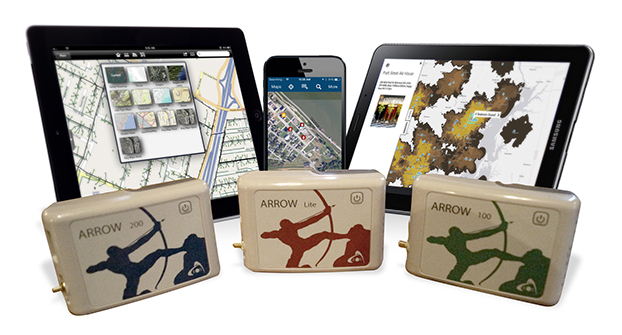
SST Software and Eos Positioning Systems have announced a technology partnership to deliver in-field mobility solutions to precision agricultural service providers. The offering is now available to Sirrus for iPad users.
The new pairing allows agronomists and service providers to have reliable geospatial tools when and where they need it, the companies said in a press release.
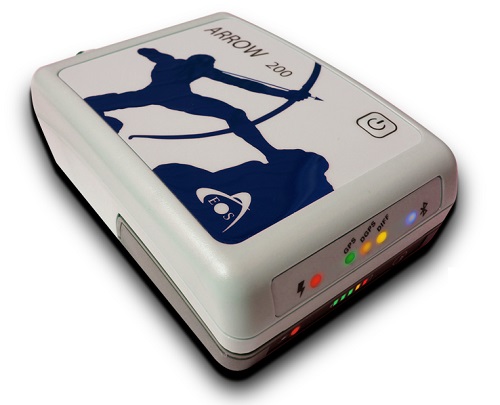
Eos Positioning’s Arrow 200 Bluetooth receiver.
Instead of relying on iOS location updates, Sirrus for iPad users can purchase one of Eos’ Arrow series GNSS products to stay connected anytime, anywhere. This connectivity coupled with real-time kinematic (RTK) or submeter receivers provides the location accuracy and quality needed when creating field boundaries and collecting data. Eos’ Arrow Series real-time positioning creates efficient workflow with universal Bluetooth and multi-frequency capabilities.
Sirrus for iPad users can connect to Eos Positioning devices by doing the following:
Tap the “Tools” at the bottom of the screen
Tap “Setup”
Tap “GPS Info,” then “GPS”
Tap the device to connect.
“We strive to deliver quality convenience and precise data through Sirrus for iPad,” Drew McMahon, SST Software product manager for Sirrus said. “The technology partnership with Eos Positioning Systems will offer the service reliability and real-time accuracy our users depend on while in the field. Sirrus for iPad users will have the capability to come within an inch of accuracy when creating a field boundary.”
“We are happy to team with SST Software in bringing high-precision GPS and GNSS receivers into their workflow,” said Jean-Yves Lauture, chief technology officer, Eos Positioning Systems. “The submeter and centimeter positioning from our Arrow receivers turns Sirrus for iPad into a powerful mapping tool on Apple devices.”
Based in Canada, Eos Positioning Systems specializes in the design and manufacture of high-accuracy GNSS for geographic information system (GIS) mapping and surveying. Eos’ Arrow Series products are waterproof, provide high-accuracy Bluetooth connectivity, advanced real-time accuracy, long battery life and compatibility with all mobile devices.
SST Software is a privately owned company headquartered in Stillwater, Oklahoma, with branch offices in Oklahoma City, Tulsa, Illinois, Iowa, Brazil and Australia.
Volvo Construction Equipment (Volvo CE) launched a new approach to how it offers services and solutions to customers. The new method gives greater clarity on both the range of services and solutions offered, and the value they deliver for customers’ operations and businesses, according to Volvo CE.
The announcement was made at bauma 2016, a building trade fair being held this week in Munich.
Volvo CE also unveiled its Volvo Co-Pilot onboard services display. Co-Pilot is designed for use on machines as diverse as excavators and pavers. It uses a tablet computer to deliver a new generation of intelligent machine services, including Load Assist, Dig Assist, Compact Assist and Pave Assist.
Volvo CE has arranged its services into six streams:
Uptime Services
Efficiency Services
Genuine Volvo Parts
New Life Services
Attachments
Financial Services
This new way of organizing the offering will make it easier for customers to choose the most appropriate cluster of services. Volvo CE dealers will also bundle services into packages as well as offering tailor-made solutions.
New within Uptime Services is Proactive Monitoring, which utilizes innovative technology that enables Volvo dealers to remotely monitor alarms and fault codes on customers’ machines. Any problems can be diagnosed early and corrective steps taken, often before the customer realizes a problem exists, to maximize machine uptime and reduce repair costs.
Efficiency Services sees the launch of Fuel Advice and Fuel Report, two new services that are designed to lower operating costs of new and existing Volvo machines by targeting long-term fuel efficiency. The two services allow customers to decide in what way they would like to drive fuel efficiency improvements in their operations.
Fuel Reports provide customers with tailor-made reports that help customers identify areas of improvement.
Fuel Advice, meanwhile, leverages the competence of Volvo CE dealers in identifying corrective actions and ensuring fuel efficiency improvements are sustainable.
Volvo Co-Pilot
Ruggedized for use in a construction environment, Volvo Co-Pilot and the Assist-functionalities are introduced to the market as part of Efficiency Services, with the ultimate aim of producing higher quality outcomes, in less time and with less effort.
Dig Assist, Load Assist, Compact Assist and the soon-to-be-launched Pave Assist are the first of a new generation of intelligent machine offerings that increase machine efficiency and uptime.
Available as either 2D or In Field Design, Dig Assist allows excavators operators to complete digging tasks to a greater accuracy in less time. Safety is also improved, as there is no need to repeatedly get out of the cab and physically check grades or levels.
Load Assist is designed for Volvo wheel loaders L110-L250 and delivers real time accurate load information to the operator. Preventing under-or-overloading (and additional machine wear and even potential fines), the system allows wheel loaders to work to their maximum efficiencies. Fully automatic, the system logs all load information and the data is then displayed on the operator’s in-cab Volvo Co-Pilot display.
The information can also be accessed remotely, thanks to Volvo’s advanced CareTrack telematics system. This allows complete payload management — giving access to data such as total transported load in tonnes; tonnes transported per liter of fuel and number of cycles.
Compact Assist offers two module options at launch — Intelligent Compaction and Intelligent Compaction with Density Direct. Intelligent Compaction records and displays a pass counter and thermal mapping, while Density Direct cleverly calculates 100% of the surface density.
Pave Assist is a family of paver-related modules and applications that will automate many of the paving parameters that today have to be recorded manually in order to meet stringent road authority reporting requirements. Providing a powerful set of tools to improve productivity, quality and site safety, Pave Assist combines Thermal Mapping, Weather View, Material Manager and (as a complementary option) Volvo Smartview modules.
Hemisphere GNSS is significantly expanding its strategic partnership with CPAC Systems, Gothenburg, Sweden, owned by the Volvo Group. After signing a large contract, Hemisphere will now be the sole source of GNSS positioning and heading systems to CPAC Systems.
Hemisphere’s technology is being used in the recently announced Co-Pilot series for Volvo Construction Equipment (Volvo CE) as part of Volvo CE’s industry-changing machine control solutions.
“We were extremely pleased to be chosen by CPAC for use of our GNSS technology,” said Chuck Joseph, Hemisphere GNSS President and CEO. “We are proud of the relationship we have developed with CPAC over the years. It is one of the most innovative companies in the industry and this latest, deeply integrated solution proves how well we collaborate to create value together. It is the very nature of this agreement that defines Hemisphere GNSS as a company, willing to work with and for our strategic partners. We see it as our responsibility to make certain we align ourselves and our business strategy with our OEM and integrator partners like CPAC.”
Initially offering its GNSS positioning and heading technology to CPAC to be used in marine applications, Hemisphere’s diverse cross-platform technology portfolio allows it to be applied in other areas where high-precision, high-accuracy GNSS is required.
“Over the years, Hemisphere GNSS has provided our company with top tier innovation, technology, and service,” said Richard Berkling, President of CPAC Systems. “Hemisphere GNSS’ long term strategy and awareness of their value-added contribution to our customer’s solutions are in perfect alignment with ours which is why we chose them as a partner for the GNSS technology. We look forward to executing this next major phase of our partnership with them.”