
Category: Mobile

  • Expert Advice: Location by Database

    Expert Advice: Location by Database

    Tarun Bhattacharrya, Hassan El-Sallabi, Jian Zhu, Jeff Wu, and Per Enge.

    Radio-Frequency Pattern Matching

    By Tarun Bhattacharrya, Hassan El-Sallabi, Jian Zhu, Jeff Wu, and Per Enge

    Radio-frequency pattern matching (RFPM) is the engine that enables the use of mobile-phone signals to locate wireless devices in any environment, including dense downtown areas and indoors. This exciting technology leverages the power of the database to improve location accuracy to within 50 meters in even the toughest signal environments. Significant advances in RFPM technology have been made over the last 10 years. The system described here is deployed in more than 24 wireless networks to provide the location of E-911 callers and help save lives. For simplicity, we focus on the RFPM using signal strengths even though the technology also works with arrival times, signal-to-noise ratios, differential signal strengths and any signal parameter that varies in a predictable fashion over the coverage area.

    Like GPS, RFPM is based on correlation. However, it does not correlate a received spread-spectrum code with a replica code stored in the receiver. Rather, it correlates the signal strength of cell-phone signals measured by the roving phone to a database that contains a map of those signal strengths for the covered area. Consider Figure 1. It shows this key correlation operation. As shown, the database contains a k-vector for each location within the covered area, where the k elements give the estimated strength for the k mobile phone signals that can be received at the given grid point. These k-vectors are typically stored over a 10- or 30-meter grid. This grid of predicted signal strengths is built in advance and is updated only when the topography of the wireless network changes. Thankfully, base stations do not generally move!
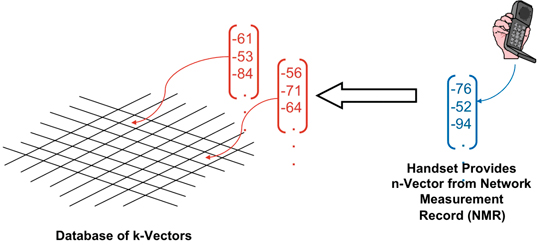
    Figure 1. Radio-frequency pattern matching of n-vector from mobile user to k-vectors within database.

    The mobile phone provides the network measurement report (NMR) in real time. This report does not require any network hardware or on-phone software beyond that required by the 2G, 3G and LTE standards for all mobile phones. Thus, the Polaris Wireless solution is capable of locating any mobile phone over any air interface. The NMR is also shown in Figure 1. It contains an n-vector of received signal strengths, where k ≥ n. A multiplicity of n-vectors are backhauled to the server that contains the database. They are correlated with the k-vectors, and the estimated location of the mobile phone is the location associated with the maximum correlation.

    For Example, San Francisco

    Figures 2, 3, and 4 explode the RFPM database for the financial district of San Francisco. Figure 2 is the top view, and the Bay Bridge is shown heading northwest across the Bay. The numbered black dots are some of the base stations in action for this area. Figure 3 digs down one level. It shows the individual k-vectors contained within the database. As shown, this database is based on a 30-meter grid. Figure 4 is a super-zoom that explodes the individual k-vectors. As shown, each of these vectors contains an element for each base station that can be received at the given location. In Figure 4, each element is color coded to correspond to the strength for the signal from the given base station.


    Figure 2. Coverage area of an RFPM database within San Francisco.
    Figure 3. Zoomed view of San Francisco database showing a multiplicity of k-tuples.
    Figure 4. Radio-frequency pattern matching of n-vector from mobile user to k-vectors within database.

    Building the Database

    RFPM accuracy depends strongly on the quality of the database, which needs to be built with great care. In fact, signal propagation depends on the network topology including:
    ◾    antenna location, heights, patterns, effective radiated power, tilt, and azimuth
    ◾    cell type, such as micro-cell, macro-cell, indoor or distributed antenna systems.

    Signal propagation also depends on information available     from geographical information systems such as:
    ◾    tree canopy
    ◾    height of buildings and terrain
    ◾    topography (water, open area, suburban, urban)
    ◾    roads.

    With this data, the signal strength radiating from a base station can be estimated. This is not a simple business. For example, the calculation must identify the points where terrain or buildings interrupts the ray from the transmitter to the receiver. It must also identify the points where these obstacles break the Fresnel zone that surrounds the ray.

    Finally, these open-loop predictions are tuned based on a sparse set of measurements. Once tuned, the database is time invariant or nearly so. If minor changes are made to the network topography, the open loop predictions alone are sufficient to accommodate the changes. If network changes are significant, such as the building of many new base stations, then the open-loop predictions must be updated, and a new set of measurements used to tune the predictions.

    Figure 5 shows a typical map of signal strengths surrounding one mobile phone in a completely open area. Absent terrain and buildings, the signal strengths vary rather smoothly. Figure 6 is for one of the transmitters in the San Francisco financial district, which is a much more complicated urban environment due to the dense concentration of high-rise buildings and uneven terrain. In this case, the signal-strength signature has a gratifying abundance of detail. This detail enables RFPM to work very well in the complicated signal environments that we find in downtown areas and also indoors. In short, RFPM benefits from the buildings and terrain that hinder satellite measurements.
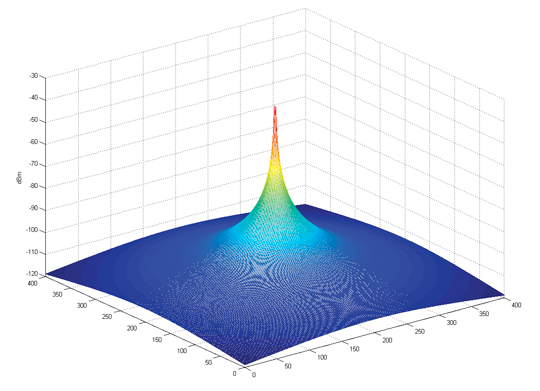
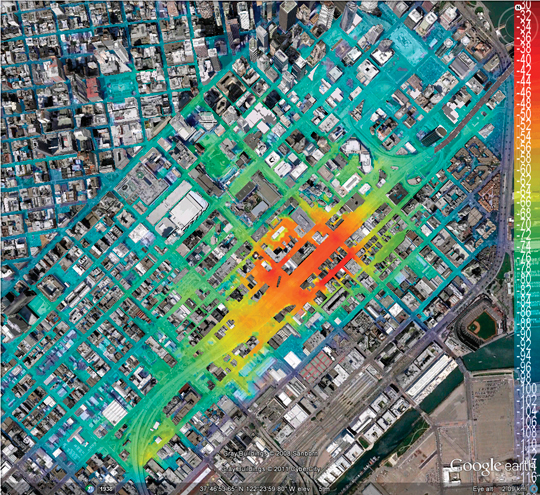
    Figure 5. Predicted signal strength for a transmitter surrounded by open ground.
    Figure 6. Predicted signal strength for one transmitter in the San Francisco financial district.

    Performance and Summary

    RFPM works well. It provides high accuracy in a in a wide variety of environments. Polaris Wireless routinely tests the accuracy of its solution in urban settings. Table 1 shows the results of such evaluations, based on measurement sets that are not used to tune the database.
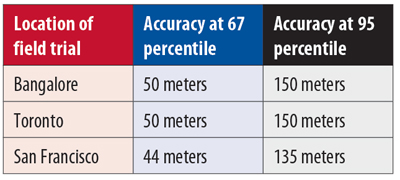
    Table 1. Evaluations based on routine accuracy tests of RFPM in urban settings.

    These days, robust navigation for downtown and indoors is based on an expanding suite of location technologies. These include: assisted GPS, new satellite constellations (Galileo, GLONASS, Compass, and so on), inertial measurements, Wi-Fi ranging, and signals from low-Earth orbit. RFPM, and its unique reliance on database-derived location, should remain an important part of this mix.


    Tarun Bhattacharrya is vice president of research at Polaris Wireless. He earned his Ph.D. in electrical engineering from the Indian Institute of Science.

    Hassan El-Sallabi received his D.Sc. in electrical and communications engineering from Helsinki University of Technology, Finland. At Polaris he works on RF propagation modeling.

    Jian (JET) Zhu received his Ph.D. in electrical engineering from Georgia Institute of Technology; he is a research engineer at Polaris.

    Jeff Wu focuses on algorithm development for propagation modeling at Polaris, and is a Ph.D. candidate in electrical engineering at Stanford.

    Per Enge is the Kleiner Perkins professor of engineering at Stanford University, where he directs the Stanford Center for Position, Navigation, and Time. He is also a technical advisor to Polaris Wireless.

  • GSA Releases 2012 SatNav Market Report

    The European GNSS Agency (GSA) has published its second Global Satellite Navigation System (GNSS) Market Report, providing key information to entrepreneurs in the satellite navigation sector.

    GNSS market forecasting is of great interest to private and public GNSS stakeholders, for business and strategic planning and policymaking, according to the GSA. According to the 2012 GSA Market Monitoring Report, the worldwide GNSS market is growing fast and the total market size is expected to increase at an average of 13 percent per year until 2016.

    The total enabled GNSS market size is expected to stabilise in the latter half of the decade due to market saturation, price erosion and platform convergence. Global shipments of GNSS devices are lower than previously forecasted up until 2015 yet are forecasted to continue growing to over 1.1 billion units per year.

    Expanding coverage. Following up on the first GNSS Market Report published in 2010, the GSA’s 2012 Report includes an analysis of two new sectors: maritime and surveying. Relevant examples from EU research projects have also been included for each sector.

    2012 Report Highlights

    Road and location-based services (LBS) still in the lead. Road and LBS dominate GNSS device sales (54% and 44% respectively). LBS constitutes 87% of the total GNSS market in terms of units sold and GNSS penetration in smartphones is set to increase from 30% today to almost 100% in 2020. For road navigation, traditional Personal Navigation Devices (PNDs) will gradually disappear from the European market yet remain present in other regions in the form of low cost OEM products. Smartphones and in-vehicle devices will be the preferred means of navigation.

    Commercial aviation use will grow. In the Aviation sector, the segment that will see the greatest growth in terms of GNSS equipment revenues will be Commercial Aviation, surpassing general and business aviation by 2018.

    GNSS use in agriculture continues to rise. In agriculture the current positive growth trend will continue; low cost precision agriculture solutions based on EGNOS are driving GNSS adoption by farmers in Europe.

    Surveying: a growing opportunity. In surveying, the construction segment is dominating the market in terms of units and value. North America is leading in terms of market penetration but the other regions will catch up by 2020 as GNSS is rapidly replacing the traditional surveying and mapping methods in Europe and around the world.

    Safer seas with GNSS. In the open sea segment, shipments of search-and-rescue (SAR) beacons will exceed those of other categories making the SAR segment the largest in terms of shipments and second largest in terms of market size.

    The 2012 GSA Market Monitoring Report can be downloaded for free.

  • Indoor Positioning May Need Several Solutions, Says IMS Research

    A range of solutions are vying to replicate what GPS does outdoors in an indoor environment, from Wi-Fi to Bluetooth to “terrestrial” GPS, plus many others. Which one is likely to be successful? IMS Research (recently acquired by IHS Inc.) said the answer will not simply be just “one.” Locating a smartphone in an outdoors environment is straightforward, with more than 90 percent of smartphones providing GPS functionality. However, GPS becomes less useful in built-up areas and can be useless indoors, reports IMS Research.

    Indoor location enables a number of exciting applications that may previously have been considered impossible, for both the consumer and the venue owner, said IMS Research. Not only can it provide analytics, tracking footfall and understanding consumer behavior, but also improve the shopping experience, helping the consumer to find a particular store or product. Whilst these examples are useful, the real benefit and revenue generation is likely to arrive in the shape of advertising.

    Bluetooth in Nokia’s HAIP variety can provide accuracies claimed to be less than one meter, making it suitable for “aisle level” positioning. NextNav is beginning to roll out a technology described as “terrestrial GPS” in the United States, using transmitters based on the ground, and the existing GPS chipsets found in many smartphones. Other solutions include the IMES system in Japan and cellular-based solutions from companies such as Path Intelligence.

    While the roll out of commercial solutions has only recently begun, Wi-Fi has, to date, been the primary technology used. “Its high penetration in smartphones, combined with an existing infrastructure of access points, in venues such as shopping malls and airports etc., means minimal additional investment is required to support some level of positioning solution,” noted Alex West, Connectivity and Location research director at IMS Research. “For this reason, a range of different companies from Google, to Qualcomm and CSR, to Qubulus, all have solutions incorporating Wi-Fi.” Current location accuracies through Wi-Fi make it suitable for “store-level” positioning but less so for product or aisle-level, although IMS Research forecasts that consumers’ exposure to store-level accuracy will drive demand for aisle/product-level accuracy.

    In reality, it is unlikely that one solution will meet all requirements, and among recent announcements is CSR’s SiRFusion platform, which uses not only Wi-Fi, but also cellular and MEMS sensors such as accelerometers and gyroscopes, to provide a hybrid solution. MEMS sensors, which are becoming increasingly common in smartphones, are expected to play a bigger part in positioning, not only improving accuracy levels but also aiding in cutting down power consumption.

    Other leading IC suppliers, including Broadcom and Qualcomm, have announced solutions incorporating these technologies, and Bluetooth in some cases, with the necessary software. As such, a more accurate indoor positioning service is expected to be included on smartphones over the next 12 months, and is expected to provide the platform for the many apps and services that are being developed utilizing indoor location, according to IMS Research.

  • LightSquared Bankrupt, But Spectrum Void Still Beckons

    By Alan Cameron.

    LightSquared, the company that mounted a powerful threat to GPS signals, declared bankruptcy on May 14, after losing a lengthy struggle in the court of the Federal Communications Commission (FCC) with the GPS industry, the U.S. military (behind the scenes), the Federal Aviation Administration, and many other GPS users. However, the vacuum into which Lightsquared sought to step — a dearth of spectrum for exploding mobile data use, up 123 percent last year — remains a gaping hole that will likely attract other entrants.

    The Lightsquared bankruptcy move followed collapse of negotiations with lenders to the company, and will likely give CEO Philip Falcone several further months of control. It is not known whether his efforts will seek to salvage the business plan to provide wholesale broadband capacity to wireless carriers, who need more capacity to feed a ravenous market. In her May Wireless Pulse column, GPS World contributing editor Janice Partyka writes, “Carriers [at the CTIA industry show] sounded alarms about running out of spectrum to support ballooning mobile data consumption.”

    As a result of the February FCC decision to revoke LightSquared’s conditional waiver to broadcast a powerful terrestrial signal immediately adjacent to a band reserved for satellite services, the company’s main asset, its spectrum license, lost most of its potential value, unless significantly repackaged and redirected, or traded for another spectrum band..

    In late 2010, when the LightSquared threat first surfaced, Falcone maintained that LightSquared’s interference issues were not his to solve, because GPS users were encroaching on his spectrum. “People who are in adjacent bands have to understand that there is now a new driver in town driving on that highway,” he said. “And they can’t be weaving in and out of that highway.”

    Falcone now has to deal with creditors who include Carl Icahn, the near-legendary corporate raider. Icahn and other investors have bought about $300 million of LightSquared debt. “Icahn is a take-control, alpha-male investor,” said Brad Balter, head of Balter Capital Management, as quoted in a May 3 Business Week story. “Falcone is both desperate and naive if he thinks of Icahn as anything other than an adversary who would wrest control of the spectrum if LightSquared went into bankruptcy.” What Icahn might venture if he gained control of LightSquared spectrum represents another unknown on the GPS horizon.

    Spectrum Shortage. Meanwhile, writes GPS World editor Partyka, “Verizon Wireless and T-Mobile executives complained that the future of data use is at risk if more spectrum isn’t put to use. FCC Chairman Julius Genachowski defended the agency’s decision to block the AT&T T-Mobile deal with a rejoinder about spectrum shortage. ‘Some have argued that transactions — let’s be frank, one transaction — is somehow causing a shortage,’ said Genachowski. ‘But the overall amount of spectrum hasn’t changed.’  While this is true, spectrum is a concern. CTIA reports that U.S mobile data traffic surged 123 percent in 2011.”

    In a statement regarding the company’s bankruptcy filing, Marc Montagner, interim co-chief operating officer and chief financial officer, stated “All LightSquared distribution partners and customers, including public safety, emergency response, government, and military users of LightSquared’s satellite-based communications services can continue to rely on LightSquared to provide them with mission critical communications services. The filing was necessary to preserve the value of our business and to ensure continued operations. The voluntary Chapter 11 filing is intended to give LightSquared sufficient breathing room to continue working through the regulatory process that will allow us to build our 4G wireless network.”

  • TeleCommunication Systems Selects Locaid as Location-as-a-Service Partner

    Locaid, a location-as-a-service company, and TeleCommunication Systems, Inc., (TCS) mobile communication technology company, have announced that TCS’ portfolio of mobile location-based products and services (LBS) will now incorporate Locaid’s location-as-a-service capabilities. This partnership provides wireless operators with access to rapidly deployable location technology for additional financial yield from their location infrastructure, the companies said.

    The TCS-Locaid partnership provides a turn-key LBS solution that includes location network capabilities via TCS’ Xypoint Mobile Positioning Center (MPC) or Xypoint Gateway Mobile Location Center (GMLC) platforms and cross-carrier, multi-source, location aggregation enablement. Through this partnership, Locaid’s aggregation solution integrates with TCS’ network location platforms and enables wireless operators to rapidly enhance their monetization of a location technology investment. Further, TCS facilities enable hybrids of in-network, hosted or managed services location platforms and cloud-based location aggregation enablement, the companies said.

    Locaid President and CEO Rip Gerber said, “TCS is known for providing carriers with new revenue opportunities and delivering them in a rapidly deployable, hosted and turn-key way. This agreement is testimony to the importance of Location-as-a-Service among the biggest players in mobile, and it is an historic first step between our two companies.”

    “With the appropriate privacy protections, the location of an individual has proven to be a valuable asset that can enhance the value of a carrier or enterprise’s service,” said Lynne Seitz, vice president of location products, TCS. “One of our key goals is to help our carrier customers to monetize this asset by making it available on demand to third parties across a wide-variety of verticals. After an extensive study of the mobile location market and providers, we selected Locaid for their commitment to privacy and impressive portfolio of content providers, enterprises, application developers and merchants who will compensate operators for access to location.”

  • Indoor Positioning: Overhyped or Just What LBS Needs?

    Because LBS Insider’s deadline is this week, CTIA coverage from New Orleans is not included in this month’s column.  Janice Partyka, editor of GPS World’s Wireless Pulse, is covering CTIA in the Crescent City for the latest location-based services, M2M, and connected vehicle news.  So instead of talking about CTIA (and why there aren’t many pure LBS players or sessions there anymore), this column examines the hype surrounding indoor positioning — is it LBS’ savior, or just another technology that may, or may not, pan out?


    The location industry will know very soon whether indoor positioning is just another overhyped technology niche — or the needed capability that will drive the largest advertisers and retailers to finally embrace location-based services. Some industry analysts say indoor location may take off in as few as 12 months — particularly if smartphones include the feature in new product offerings.

    At several location industry conferences, the obligatory indoor positioning panel is cropping up, leading some to believe that while intentions are good, perhaps the technology hasn’t developed fast enough. The jury is still out on indoor positioning. “It is badly needed, but also needs to be down to the meter-level,” said Ralph Eschenbach of Sand Hill Angels, a venture capital firm, at the recent GPS-Wireless 2012 conference. “The technology is not here yet.”

    Another contrarian said that industry segments like automakers need not just show users how to navigate to destination, but give folks information when they near the area. “It would be nice if a BMW told me where’s the cheapest gas,” said Gary Gale, Nokia director of places, location and commerce.

    Some analysts, like those at IMS Research, believe that an indoor positioning technology will be from multiple sources — though Wi-Fi has been the primary tech solution. IMS cites reports that say Bluetooth in Nokia’s HAIP can meet the one-meter threshold of accuracy for indoor markets.

    IMS said the major indoor positioning players, so far, are Google, Qualcomm, Broadcomm, CSR, Qubulus, Nokia, NextNav, and Path Intelligence.

    While intangible benefits such as measuring consumer behavior and shopping experience will be important for retailers and advertisers who are hoping to fund indoor positioning systems, the goal is to drive customers to the stores. This will also be tied into the “what do I do when I get there” answer to the navigation question.

    Still, the benefits will be transparent to advertisers once consumers are able to save time, and perhaps money, with indoor positioning capability on their smartphones, said Ankit Agarwal, CEO of indoor positioning company, Micello. “There is definitely a business model for indoor positioning. It enables product search and walking paths throughout a store,” he said. “Stores will be able to track multiple routes folks are interested in taking [through a store].”

    Once again, Google seems to be the major player in indoor positioning. LBS Insider reported late last year that Google went indoors with the launch of Google Maps 6.0. The company has attracted some of the big-box retail stores such as IKEA, Macy’s, Home Depot, and Bloomingdales to have their stores mapped. However, a lot of the bigger malls, and Target and Wal-Mart, have not been mapped. The Google product tells customers what floor they are on in a building, but so far is only available for Android.

    Google’s indoor mapping partners include 18 U.S. airports, which will open up more partners and LBS relationships in the future.

    In other news, but related to indoor positioning and other LBS markets, Greg Tarr, partner at Rogers Venture Partners, said at GPS-Wireless: “There is no privacy…get over it.”

    TomTom Launches Global Geocoding Web Service

    As GPS World reported, TomTom launched a new volume batch geocoding web service late last month at the Geospatial World Forum in Amsterdam. Geocoding, the process of converting addresses into geographic coordinates to allow location analysis for businesses, is taking on a new twist with the new product.

    “This not your father’s geocoding. The turn-around time to download the product will be attractive to companies,” said Dan Adams, TomTom vice president, location and live services. “When I was with GDT and we were acquired by Tele Atlas, it gave us more exposure to global geocoding. Since the TomTom acquisition, there has been a recasting of those products, with the same sort of dynamics, but bringing them to the Cloud.”

    What Investors Look for in a Location Company

    In a venture capital panel at GPS-Wireless, industry experts basically say that location markets mean more than just navigation now. They also have some strong opinions on the composition and strategies of companies they plan to invest in.

    “We notice that some startups don’t have enough engineers,” said Sanjay Subhedar, Storm Ventures managing director.

    Other VCs say they look first at the market size of the location niche, but still believe the personality of the company’s management team is important. However, there was no location market segment any VC agreed on; some were sold on the promise of enterprise markets; others believe a strictly consumer play is where the future is.

    LBS Insider Covering ITS America Conference

    Not a sexy show like CTIA or Telematics Detroit (which is being boosted by the connected car craze, despite its jaw-dropping price to attend), ITS America’s annual meeting this month in the Washington, D.C., area will feature connected vehicle sessions and government programs. Before market-centric conferences as Telematics Detroit and Where 2.0, ITS America, even with its government focus, was the only game in town for companies looking to get into the navigation and location business.

    One of these “government programs” traditionally featured at ITS America is distracted driving sessions, which at least one analyst says younger drivers don’t want to be bothered with. “Only 20 percent of young consumers are worried about distracted driving [we found in our studies],” said Thilo Koslowski, Garnter vice president, who also said, unlike what some automakers and analysts believe, that a car is not a “laptop with four wheels.”

    LBS Insider will be covering the ITS America annual meeting. If attending, contact us with your story ideas.


  • Esri Releases Free Business Analyst Online Mobile App for Android Smartphones

    Esri announced the release of a free Business Analyst Android app for retail and commercial real estate professionals, allowing them to access demographic data anywhere with the Esri Business Analyst Online (BAO) application. The application is designed for anyone who needs access to population and consumer marketing data on the go.

    According to the announcement, the BAO application enables users to access up-to-date facts on demographics, lifestyle, and consumer spending for any region in the United States. With it, users can compare any address with another or with the county, state, or United States and analyze an area within one mile of a prospective location. Unlike traditional market research, users can quickly compare and contrast regional information with the regional average and show that data to clients in the field. Reports created in the mobile BAO application can also be e-mailed to share with a broader audience. More extensive data, capabilities, and reports are available through the application with a subscription to the BAO web application.

    The BAO application is free and can be downloaded directly from Android Marketplace.

    To learn more, visit esri.com/BAOapp.

  • Tablet Users Will Help Shape Future Mobile App Market

    Between 2010 and 2011 the global installed base of app consumers increased by 104%, according to a report released by  mobile research specialists Research2guidance. While the installed base of smartphones increased by nearly 274 million, tablets were the fastest growing segment. The number of new tablet app consumers increased by 58 million. As a result, tablet owners now constitute 8.6% of the installed app consumer base.

    Based on Q2 projections for tablet shipments in 2012, the installed base of tablet users is set to increase more than 150% by 2013.  As tablet users become a larger and larger app downloading segment, their app behavior and preferences will have an increasing influence on the app market – illustrated already in the growth in the number of apps and stores devoted to them.

    Installed base of tablet users to increase more than 150% by 2013

    During 2011, apps in the Apple App Store for iPad grew 180% to more than 140,000 apps by the end of Q4 2011. While this cannot be easily quantified for Android as tablet apps are not separated out, the growth of niche stores and niche store categories focusing on Android tablets reflects their growing presence. For example, Archos Appslib focuses completely on Android tablet apps, while other stores like Android Tapp has a dedicated category.

    Several studies have shown that tablet users exhibit different behaviour towards app downloading/usage and mobile browsing than smartphone users.  Based on the breadth of use cases for gaming, ecommerce, digital publishing and the enterprise – tablet user growth is likely to have a marked effect on consumption in these areas.

    Tablet apps for the enterprise market

    In the enterprise, for example, tablets have already been largely implemented at upper levels of management and are quickly working their way throughout organizations – according to Apple’s CEO Tim Cook in 2012, 92% of Fortune 500 companies are testing or deploying iPads. As more and more use cases are developed and penetration increases, so too will the number of apps being developed for enterprise tablet users. While Apple has already carved out a niche section for iPad and iPhone Business users called “@Work”, other players like Lenovo and Cisco are trying to do the same for Android Business users.


  • u-blox Acquires 4M Wireless for LTE Technology

    u-blox, fabless provider of positioning and wireless semiconductors, software and solutions, will acquire 4M Wireless, a company that designs and develops software and test solutions for developing fourth-generation (4G) mobile wireless devices based on the latest Long Term Evolution (LTE) standards.

    The acquisition will give u-blox ownership of advanced protocol stacks that are licensed to chipset vendors whose products enable 4G user equipment for applications with needs for high-speed data connectivity such as smartphones, tablet computers, notebooks, and any other high-speed wireless modems, u-blox said. Also a variant of the products is licensed to manufacturers of 4G test equipment. 4M Wireless was founded in 2006 and has headquarters in the UK and operations in Lahore, Pakistan.

    Key terms of the transaction include acquisition of 100% of the shares of 4M Wireless at a price of approximately $9 million US, depending on earn-out; intellectual property and software in the area of LTE wireless technology; and integration of the 4M Wireless business and employees into u-blox’ organization.

    LTE is a unifying technology for almost all mobile operators around the world. All GSM/UMTS operators as well as most CDMA operators have agreed to evolve to LTE. Currently, there are 35 commercially available LTE networks in more than 20 countries, and 48 manufacturers have already announced 197 different LTE end-devices. 300 Million LTE subscribers are expected by 2015.

    The acquisition is subject to customary closing conditions and pending regulatory approval. Closing is expected by September 2012.

  • Urban Airship Partners with Meridian for Indoor Location Targeted Mobile Messaging


    Urban Airship has announced a strategic partnership with Meridian for indoor location targeted mobile messaging. Meridian’s technology will enable Urban Airship customers with physical locations to reach people at the point of decision with indoor location targeting. Together, the companies’ solutions offer broad capabilities for location-targeted messaging, from quickly identifying audiences with certain behaviors or preferences in regions down to a neighborhood level, to delivering pinpoint targeted messages inside buildings.

    Since partnering with Cisco to build an “indoor GPS” app for the American Museum of Natural History, Meridian has helped many different types of venues offer apps with campus and building-specific search functionality, multimedia, turn-by-turn directions, and push messaging powered by Urban Airship. Urban Airship Segments enables marketers to segment mobile audiences by location, time, context and preferences to improve the relevancy and targeting of messages and offers. Together, the organizations offer capabilities to utilize context and location to drive mobile audiences to and through physical locations.

  • Qualcomm Announces Commercial Availability of MCP50 for Fleet Management


    Qualcomm announced the commercial availability of the Mobile Computing Platform 50 (MCP50). For fleets of all sizes, the fleet management solution helps transportation companies meet safety and regulatory compliance requirements to manage their business operations, Qualcomm said. Qualcomm also launched flexible new monthly pricing plans.

    “We are committed to helping fleets succeed and grow as they adapt to new industry demands and regulations,” said Norm Ellis of Qualcomm Enterprise Services. “With more than 150 private and for-hire fleets of all sizes already committed to adopting the MCP50, we are pleased that our industry-leading fleet management applications are now more accessible than ever to help fleets address a broad range of operational challenges, including safety, compliance, productivity and fuel efficiency.”

    MCP50 delivers applications to meet the core operational needs, including safety and compliance requirements, such as FMCSA’s HOS regulations and CSA program. Applications include: Qualcomm Hours of Service, CSA Safety Performance Service, Critical Event Reporting, CoPilot Truck In-Cab Navigation provided by ALK Technologies, Performance Monitoring with Fuel Manager, Analytics Manager and Vehicle Inspection Report. Other Qualcomm applications planned for future releases of the MCP50 include Circle of Service Workflow, Trip Manager and Vehicle Maintenance.

    MCP50 is available for $799 SRP through local dealers and resellers that are part of the Pana-Pacific distribution network or directly from Qualcomm Enterprise Services. Qualcomm Enterprise Services also offers six different monthly service pricing plans, starting at $19.95 per month.

  • Stonewalling, Mapping, Google, and Fines

    After a long investigation, the FCC hit Google with a resoundingly soft penalty for stonewalling the FCC inquiry into its controversial street-mapping program. Google was picking up a payload of sensitive information from home wireless networks from 2007 through 2010. This included emails, passwords, and Internet usage history. The FCC declared that the data collection was technically legal because the information gathered was unencrypted. However, the FCC stated that, “for many months Google deliberately impeded and delayed the bureau’s investigation” and fined Google a paltry $25,000 for their behavior. After initially denying any wrongdoing, Google admitted in a blog entry in 2010 that it had made a mistake by collecting the data.

    Google and foursquare shared a panel at the GPS-Wireless conference, an interesting pairing given foursquare’s recent announcement that it is betting on the future of open source map data. New API pricing of Google Maps has a number of solution providers shopping for mapping alternatives. Google says that only the top .35 percent of Google map users is affected by the pricing (under 25,000 map views a day are still free). foursquare was among them, and re-launched its web maps using MapBox based on OpenStreetMap data. “These maps are adequate,” said Holger Luedorf of foursquare. “This helps the open street community and it felt like it was right thing to do. Google is very good and we will continue to use their products elsewhere.”

    Interesting tidbits. Heard at the “O’Reilly Where” and “GPS-Wireless” conferences this month:

    “People will pay for apps for family and safety. There is real monetization in this realm. When was the last time that people put an alarm on their house and paid for it with ads?”

    “I see nothing to augmented reality. I don’t think it will go anywhere. It feels like I’m looking through a toy camera viewer.”

    “Any location technology that has tried to compete against GPS has failed. They are useful but can’t compete head on against GPS. They now have a second life as a technology that supplements core location, which is GPS.”

    “Consumers are willing to share location if you can give them something in exchange of value. Not every company does that.”

    What’s happening to the vehicle aftermarket? It used to be that the vehicle aftermarket would lead innovation and benefited from a significant time-to-market advantage. The traditional aftermarket is currently struggling to find its special niche. The world has changed and the aftermarket is having a tough time rivaling connected vehicles. In the past, the aftermarket also offered consumers more value, but OEMS have gotten lighter on their feet. The aftermarket is now the consumer market, such as smartphones.

    Who will capture the indoor location frontier? Companies are lining up to get a shot at the indoor location market. Companies like Meridian, Google, aisle411, Point Inside, and Micello, and many others, have found their own niches. Meridian has staked out a niche for indoor navigation and mapping that is managed by the customer. “We aim to be the WordPress of indoor location,” says Jeff Hardison of Meridian. Meridian uses Wi-Fi when available and provides interactive mapping and navigation for various types of indoor venues including the American Museum of Natural History. For retail, the system can be tied into inventory systems to pinpoint items on shelves. One store has added advertisements for books on the indoor navigation system and reports 33 percent of users are clicking on the ads.

    Search rules location-based mobile ads. Locally targeted ads that accompany mobile search results are much more potent than locally targeted display ads. xAd, a mobile local ad network, reports significantly greater click-through rates for targeted local search (7 percent) compared to targeted local display ads ( 0.6 percent). Clicks alone don’t fully satisfy advertisers who want to see measured outcome. xAd self-reports secondary action rates of targeted local search ads of 37 percent and targeted local display ads of only five percent. Secondary actions include calls and requests for driving directions.

    It’s a race. Local and nationally targeted mobile advertising is currently neck and neck. This year, mobile local ad revenues have caught up with nationally targeted mobile ads, for a combined $2.7 billion in revenue, says BIA/Kelsey Group. This is an increase from last year, in which local ads were estimated to be 45 percent of total mobile ad revenues. According to projections by BIA/Kelsey Group, local mobile ads will exceed national ads in 2016 and total $5 billion of the estimated $7.7 billion in mobile ad revenues.

    Not everyone is convinced. “The financials for mobile advertising aren’t there for us. We won’t do it until our customers are asking for it,” says Bryan Trussel of Glympse at the GPS-Wireless show. “We tried it and got advertisements for toe fungus and Playtex on our screen. It wasn’t worth it. We don’t want generic banner ads. We’ll wait.”