
Category: Applications

  • GPS IIF-9 Successfully Lifts Off from Cape Canaveral

    GPS IIF-9 Successfully Lifts Off from Cape Canaveral

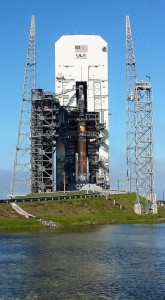
    Photo credit: ULA.
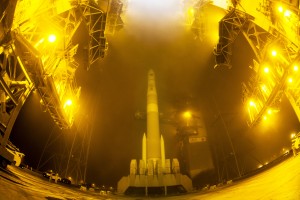
    Photo credit: ULA.

    UPDATE: The GPS satellite has been deployed by the Delta IV rocket, completing today’s launch. The deployment occcurred as scheduled about 3 hours after launch.


    The U.S. Air Force’s ninth GPS Block IIF satellite (GPS IIF-9) launched on time Wednesday at 2:36 p.m. EDT (1836 GMT) from Space Launch Complex 37 at Cape Canaveral Air Force Station, Fla.

    The GPS IIF-9 rode aboard a United Launch Alliance (ULA) Delta IV rocket, which has been the workhorse of the GPS fleet for successful launches.

    GPS IIF-9 is one of the next-generation GPS satellites, incorporating various improvements to provide greater accuracy, increased signals, and enhanced performance for users.

    The Air Force and the 45th Space Wing supported the successful launch of the ULA rocket. This launch is the fourth ULA launch this year and the 95th launch since the company was formed in December 2006.

    GPS IIF-9 launched aboard a Delta IV Medium-plus (4,2) Evolved Expendable Launch Vehicle, using a single ULA common booster core powered by an Aerojet Rocketdyne RS-68 main engine, along with two ATK GEM 60 solid rocket motors. The upper stage was powered by an Aerojet Rocketdyne RL10B-2 engine with the satellite encapsulated in a four-meter diameter composite payload fairing.

    GPS Launch Workhorse. The launch marks the 29th Delta IV launch and the 57th operational GPS satellite to launch on a ULA or heritage launch vehicle. Delta IV has delivered numerous satellites for the National Reconnaissance Office (NRO), as well as GPS satellites for the Air Force and weather satellites for NASA, according to a ULA media release.

    “Many thought the Delta IV and GPS days were long gone, but the recent questions concerning reliable and proven launch vehicles have brought them back online, so to speak, for GPS,” said GPS World Defense Editor Don Jewell. The upcoming (April 27) 20-year milestone for GPS space vehicles on orbit translates to approximately 500 orbital years just for the IIR and IIF constellations alone,” Jewell said. “The IIAs may account for that many orbital hours as well. Quite a record, and something of which the U.S. Air Force (USAF) and all the companies involved should be very proud.”

    Yet Another USAF Success. Jewell points out that this is another successful government launch in a long string of successive launches, without a failure. “It is by far the most successful launch record ever put together by any nation or government. No other space-faring nation even comes close. The U.S. Air Force and all the players should be proud of all these records and more, plus we have one more GPS asset on orbit, providing GPS signals to the world and all they enable, courtesy of the USAF.”

    “I’m elated with today’s successful launch, the GPS constellation remains healthy, strong and robust and in over 20 years since initial operational capability, GPS has never failed to deliver on its global positioning, navigation, and timing commitments,” said Brig. Gen. Cooley, director of Space and Missile Systems Center’s Global Positioning Systems Directorate.

    “Each new generation of GPS satellites provides enhanced capability over the prior generations, and has delivered reliable performance demonstrating our commitment that GPS remain the Gold Standard space-based positioning, navigation, and timing service for the future,” Cooley said. “Thanks to the men and women of SMC, the 45th, 50th 310th Space Wings, Boeing, United Launch Alliance, the Aerospace Corporation, GPS IIF and Delta IV launch teams, the GPS IIF program continues to meet GPS enterprise needs.”

    45th Space Wing. Once again, the 45th Space Wing team of military personnel, government civilians, and contractors provided support to the ULA launch of the Air Force Space Command mission, including weather forecasts, launch and range operations, security, safety, and public affairs.

    The 45th Space Wing commander was both proud and pleased with the team she works with on the Eastern Range. “First, let me offer my heartiest congratulations to ULA, Boeing, Space and Missile Systems Center, the Launch Systems Directorate, the Global Positioning Systems Directorate, and all the mission partners who made this happen,” said Brig. Gen. Nina Armagno, 45th Space Wing commander, who also served as the Launch Decision Authority.

    “What a treat — and an honor — it is to know that we have played such a significant part in something that we will celebrate two decades of helping people all around the world,” Armagno said. “Every GPS satellite since the program’s inception has been launched right here from Cape Canaveral Air Force Station safely and reliably by members of the 45th Space Wing.

    “And that’s because we continue to take a ‘one launch at a time’ mentality and focus on our number one priority — 100 percent Mission Success. I am so very proud to be part of Team Patrick-Cape.”

    Constellation Changes. The Air Force Second Space Operations Squadron (2 SOPS) indicates that IIF-9, SVN-71/PRN-26, will replace SVN-35 (currently being operated in Launch, Anomaly Resolution and Disposal Operations [LADO]) in the B plane slot 1F. SVN-35 is a GPS 2A-22 satellite originally launched aboard Delta 222 on August 30, 1993. It was decommissioned from active service in 2009, remained in orbit as a spare, then was set usable again in 2011. The satellite was declared unusable in 2013 and decommissioned a second time, reports Spaceflight Now. It was tested again in 2014.

    SVN-38/PRN-08 will be taken out of the operational constellation prior to SVN-71 payload initialization and sent to LADO. PRN-08 will be assigned to SVN-49 in May and set to test, but is tentatively scheduled for assignment to IIF-10 to launch June 16.

    SVN-35, launched on August 30, 1993, has been in a residual status since March 2013 in an expanded node slot in the B plane and successfully served 21.5 years, 14.0 years beyond its designed service life, due to the diligent efforts of the men and women of the U.S. Air Force.

    SVN-51 is still in a re-phase journey from E1 (GLAN=146 °) to an auxiliary node at E7 (GLAN=60.7 °) scheduled to arrive sometime this summer.
  • Uber and Decarta: Automated Taxi Tomorrow?

    Uber and Decarta: Automated Taxi Tomorrow?

    Janice Partyka
    Janice Partyka

    The force of mapping was punctuated this month when Uber, the juggernaut taxi service, acquired long-time mapping and navigation company deCarta. Uber and its competitor, Lyft, redefined taxi service with a smartphone app that connects users and drivers. These services have exceled by offering reliable low-cost rides and quick pick-ups, functionality that is enabled by seamless mapping and navigation technologies. Acquisition of a mapping company serves Uber’s high ambitions.

    Following introduction in San Francisco and New York, Uber just rolled out its ride sharing service, UberPool, in my city, Los Angeles. The service allows multiple individual customers going in the same direction to share a ride and lower their fare by as much as half. The potential for reducing traffic in congested cities is large, but how likely is it that UberPool can find matches and people willing to ride with strangers?

    New-Logo-Vertical-Dark-TEffective vehicle routing, navigation and traffic prediction is critical to making UberPool work. First, Uber must find pairs of trips that are similar enough in their timing and pathways to make a pairing attractive to the riders. Then, Uber needs to execute quickly and on time, given the unpredictability of whether the other rider is ready when expected. Coping with these uncertainties will be a huge challenge for Uber. Just 10 percent of work trips in America are by carpool. Can Uber develop the algorithm to make ride sharing attractive? Let’s wait and see.

    It is no surprise that Uber has announced that it will be developing self-driving car technology with the goal of self-driving Uber taxis. This puts it in direct competition with Google, one of Uber’s largest investors. Uber has partnered with Carnegie Mellon University to create a research center for mapping, vehicle safety and autonomy technology. If Uber can someday build cars that drive themselves, they can eliminate the need for a driver. The question for 2015 may well be, who is not pursuing driverless cars? Maybe Macy’s and Martha Stewart will partner on a particularly tasteful automated vehicle? Do you think you’d still have to tip?

    In other news, two former leading location competitors, LocationSmart and Locaid, have merged. Together they have the largest location-as-a-service platform for enterprise location for mission-critical applications in a number of industries including service assistance, proximity marketing, workforce management, emergency alerting, mobile gaming and transaction verification. As far as I know, they are not developing a self-driving vehicle.

  • Latin America Sanitation Company Goes with ProMark

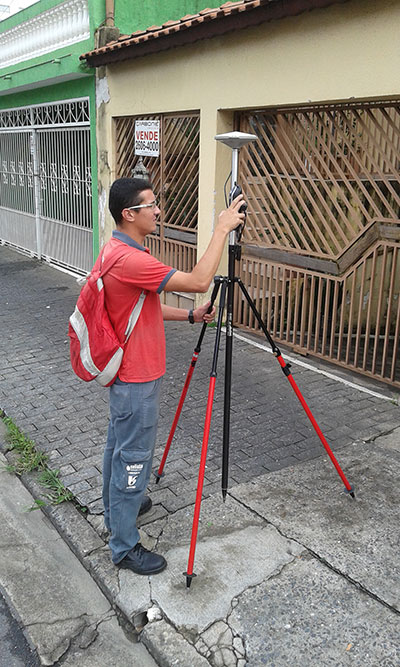
    Photo: Saneamento Basico do Estado de São Paulo (SABESP)Saneamento Basico do Estado de São Paulo (SABESP), a Brazilian water and sewage collection utility owned by São Paulo state and Latin America’s largest water company by market capitalization, has selected Spectra Precision ProMark 120 and 220 GNSS receivers to assist in gathering the geographic location of all SABESP network assets and the location of all customers.

    SABESP provides water to more than 28.7 million customers, or 67 percent of the population of São Paulo state. Water loss due to leakage in the SABESP network is a significant problem. The biggest reason behind water loss is leaks in the network; additional factors include sub-metering, caused by low water pressure; unauthorized consumption; and fraud. 

    Improving water management, recovering lost revenue and improving the quality of the customer experience is a priority for SABESP, Spectra Precision said. To help improve revenue generation and reduce water loss, SABESP developed two projects: LigGeo, to geo-reference the water meter location of approximately 4.8 million SABESP customers; and CadGeo, to geo-reference and register the location of the SABESP water and sewage network infrastructure.

    According to Marcos Almir, sanitation systems analyst for the metropolitan department of development and management of SABESP, the twin projects of LigGeo and CadGeo were motivated by SABESP’s desire to improve productivity and competitiveness. “We created an innovative GIS effort to geo-reference and register SABESP distribution networks and buried assets. Tests showed the technical feasibility of using ProMark GNSS receivers and collectors with NTRIP technology to efficiently and effectively register all SABESP equipment in real time with geo-referenced attributes connected to the technical and commercial enterprise systems to optimize processes and reduce costs.”

    To implement the LigGeo and CadGeo projects, SABESP purchased 50 ProMark 120 and 220 GNSS receivers from Hezolinem Equipamentos Topograficos, Spectra Precision’s Brazil dealer. Both SABESP technicians and outsourced service providers will use the receivers.

    ProMark 120/220 GNSS receivers were chosen for their multiple advantages: They could be purchased as rovers only; they could run LigGeo and CadGeo proprietary software; they are compatible with local third-party networks, including CEGAT, Brazil’s largest private RTK geodetic base network, that delivers RTK network corrections enabling real-time accuracy of less that 20 cm; and they offered direct two-way 3G communication of information with the SABESP central cartographic base raster files.


  • POB Magazine to Present Top 100 Project at MAPPS/NSPS Conference

    POBTop100InsideLogoPOB (Point of Beginning) magazine is conducting a surveying and mapping market study that will rank the top 100 companies based on total geospatial revenue for 2014.

    Michael Anderson, editor of POB, will be presenting the “POB Top 100″ project at MAPPS and the National Society of Professional Surveyors (NSPS) national surveying, mapping and geospatial conference, Collaboration: The Map of the Future, to be held April 13-16 at the Hilton Crystal City in Arlington, Va.

    Rankings will be based on total revenue from surveying, aerial mapping, geospatial imagery, 3D modeling, BIM, GIS/IT, underground mapping and other geospatial services.

    “Collaboration is key to success in the geospatial community,” said John Palatiello, MAPPS executive director. “We’re pleased POB has chosen this forum to help launch this important project.”

    Collaboration: The Map of the Future will bring together associations, professional societies, companies and government agencies in the surveying, mapping and geospatial fields. The event hopes to bridge gaps between government agencies and the private sector, as well as explore different disciplines in the community. It also will prove a forum for discussions on best practices, technology, issues and policies.

    The conference features a “conference within a conference” format, in which participating organizations will hold respective meetings and sessions.

    “Surveyors have long relied on POB as a major source of news and information about the profession and its market study and Top 100 listing will be a significant contribution,” said Curtis W. Sumner, LS, executive director of NSPS.

  • Topcon Acquires Precision Ag Company Digi-Star

    Topcon Positioning GroupDigiStar_Logo_clr has acquired Digi-Star, an international provider of agricultural solutions involving weight sensors and control systems for feeding, planting, fertilizer and harvest equipment manufacturers.

    “After several years of working on development projects together, we are delighted with this acquisition,” said Ray O’Connor, president and CEO of Topcon Positioning Group. “Digi-Star and Topcon Precision Agriculture are a perfect fit, bringing complementary technologies and distribution channels to our rapidly growing precision agricultural division. At a time when many companies are decreasing their investment in agricultural markets, we are increasingly optimistic about their growth based upon our strong commitment to developing management systems and solutions that bring the power of the Internet of Things (IoT) to every farm.”

    Based in Fort Atkinson, Wis., Digi-Star supplies electronic equipment, precision sensors, optical yield and feed management sensors, displays, position verification and software used by farmers and other equipment operators to precisely measure and analyze valuable data from critical farming processes. Digi-Star has expertise in the livestock and grain equipment markets, according to a news release from Topcon.

    Mac Moore, president and CEO of Digi-Star, said, “Topcon and Digi-Star have numerous synergies with electronics, sensors, and integration of specific user interfaces for the agriculture and industrial markets that will complement each other’s customers. Both companies will benefit from the expanded product lines and solutions that progressive customers depend upon for maximum profitability.”

    In 2012 Digi-Star purchased RDS Technology, a United Kingdom-based company, which possesses similar technology for agricultural and construction applications, adding engineering, development and manufacturing facilities in Europe.

    “We are very enthusiastic about the opportunity of combining these companies. In addition to expanding our reach into the farm market segment, this will further extend our scope of field solutions to help us continue strong growth while serving an expanded customer base for Topcon Precision Agriculture, for the aftermarket and original equipment manufacturer (OEM) clients,” said Albert Zahalka, president of Topcon Precision Agriculture. “We are also excited to add the skilled employees and world-class facilities located in the Midwestern United States, the United Kingdom and the Netherlands to our global agricultural family.

    Digi-Star currently employs more than 220 employees in its three locations, with approximately half located in the United States or Europe.

  • IGN France International to Update Congo’s Roadway Database

    Photo credit: © Vincent LECAMUS/ IGN FI
    Photo credit: © Vincent LECAMUS/ IGN FI

    A contract between the Congolese Ministry of Roads and Public Works and IGN France International for a preliminary study on updating the country’s existing roadways database was signed on Jan. 12 at the Congolese Embassy in France.

    Once this database is fully operational it will be used as a decision-making tool for the Ministry and various institutions in charge of road network maintenance, as well enabling the management of Congo’s road heritage.

    IGN France International will carry out a preliminary study for the Ministry, which aims to update the existing roadways database for the whole of the country.

    Among those present at the signing of the contact was a large Congolese delegation led by the Ministry of Roads and Public Works Minister, Emile Ouosso.

    Photo credit: ©Aude ARESTE-LAMENDOUR / IGN FI
    Photo credit: ©Aude ARESTE-LAMENDOUR / IGN FI

    This project is the next phase of an overall program of large-scale works undertaken by the Congolese government since 2009, which have already included the extension and improvement of the country’s road network, which no longer resembles the map created by IGN — French National Institute for Geographic and Forest Information — in 1993.

    The preliminary study will define:

    • the expected functionalities of the future database;
    • the status of reference data;
    • the status of various “trades;”
    • the general organization to be implemented for the effective update of the database;
    • the equipment required for data acquisition, treatment and conservation;
    • and the knowledge transfer to be provided in order that work can be carried out locally.

    This database will constitute a road heritage management and decision-making tool for the Ministry.

    At present, the National Transport program (PNT) adopted by the Parliament of Congo in 2007 remains the general framework governing the actions to be taken in terms of the construction, rehabilitation or maintenance work on roadway infrastructures includes in the societal program created by the President of the Republic.

  • Geofeedia, IDV Form Partnership for Threat Assessment

    idvsolutions_visual_command_center Photo: IDV Solutions
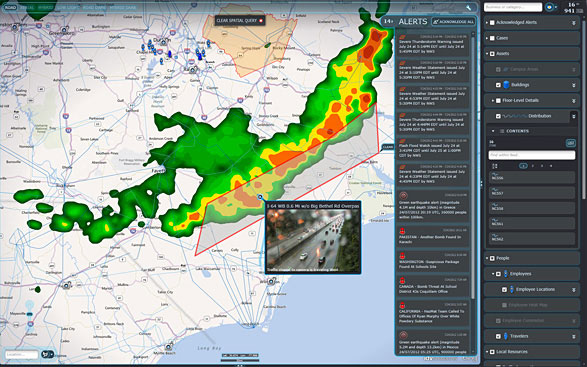
    IDV Solutions’ Visual Command Center is a physical security and risk visualization (PSRV) software that unites data from external sources, enterprise systems and internal devices into a real-time, common operating picture of risk and security. Photo: IDV Solutions

    IDV Solutions, a corporation that specializes in business intelligence, physical security and risk visualization software, has formed a technical partnership with Geofeedia, producer of a cloud-based social media monitoring platform. Through the partnership, Geofeedia’s location-based social media monitoring data will now be integrated into IDV Solutions’ Visual Command Center Enterprise Risk Visualization (ERV) software.

    The companies say the combination of the two technologies enables security, supply chain and business continuity teams to gain instant intelligence from multiple social media networks for a myriad of risk events — from a political demonstration to a natural disaster. The location-based visualization filters out excess noise to show important social media posts in the context of locations of interest, such as facilities, employee locations, supply routes or traveling executives.

    “Companies are looking for ways to efficiently gain actionable intelligence from social media,” said Ian Clemens, chief technology officer and co-founder of IDV Solutions. “The immediacy of social media combined with the alerting and locational context offered by Visual Command Center enables organizations to make more effective use of social media to protect employees, facilities and business continuity.”

    The Visual Command Center provides a real-time, common operating picture of assets, personnel and operations in relation to potential threats to those assets. It unites information on global sources of risk — such as weather, terrorism and natural disasters — with data from internal data stores and physical security systems on an interactive map and timeline. When a risk is detected near an asset or employee location, the Visual Command Center automatically generates an alert and provides tools to assess whether the risk is a threat and take immediate action to mitigate the impact of the threat.

    The Geofeedia integration complements the Visual Command Center’s Twitter Visualization and Alerting Module by providing information from more social media networks and visualizing all posts within a selected area.

    Geofeedia enables organizations to filter and analyze social media content by location in real time across multiple sources. Users search for a city, address or location name, draw a virtual perimeter around the specific area of interest,and access geo-tagged social media content from within those boundaries.

    “Location resolves the challenge of monitoring the massive amounts of cluttered data to identify meaningful, real-time on-the-ground intelligence when and where it matters most,” said Phil Harris, CEO and co-founder of Geofeedia. “We are thrilled to be able to help more organizations take advantage of our real-time, geotagged social media data to prevent, protect and respond to valuable intelligence.”

  • GEO Business 2015 Returns for Second Year

    geo_business2015_logo_TFollowing its debut in 2014, GEO Business returns to The Business Design Centre in London on May 27-28.

    GEO Business 2015 combines a central trade exhibition with a conference program with 50 presentations and 140 live commercial workshops.

    The presentations and workshops, which provide first-hand demonstrations, have grown in number by 34 percent over the first year. Also larger this year is the exhibit space, by 64 percent, organizers said. The exhibit features more than 200 exhibitors showcasing the latest geospatial technology and services.

    The show’s unifying vision is to promote closer collaboration across the geospatial community and to provide a platform that effectively showcases both the professionalism of this industry and the role that it will play in future economic growth. It was born out of consultation with industry and as a result is organized in collaboration with the Chartered Institution of Civil Engineering Surveyors (ICES), the Royal Institution of Chartered Surveyors (RICS), The Survey Association (TSA), the Association for Geographic Information (AGI) and more recently the Institution of Civil Engineers (ICE).

    In 2014, more than 1,600 attendees from 39 countries took part. Learn more at the conference website.

  • FAA Gives Amazon Go-Ahead for Delivery Drone Tests

    Amazon-drone-O

    The Federal Aviation Administration has issued an experimental airworthiness certificate to an Amazon Logistics, Inc. unmanned aircraft (UAS) design that Amazon will use for research and development and crew training. Amazon has said it wants to use drones for delivering packages to customers.

    The FAA typically issues experimental certificates to manufacturers and technology developers to operate a UAS that does not have a type certificate.

    Under the provisions of the certificate, all flight operations must be conducted at 400 feet or below during daylight hours in visual meteorological conditions. The UAS must always remain within visual line-of-sight of the pilot and observer. The pilot actually flying the aircraft must have at least a private pilot’s certificate and current medical certification.

    The certificate also requires Amazon to provide monthly data to the FAA. The company must report the number of flights conducted, pilot duty time per flight, unusual hardware or software malfunctions, any deviations from air traffic controllers’ instructions, and any unintended loss of communication links. The FAA includes these reporting requirements in all UAS experimental airworthiness certificates.


  • Navitel Offers Navigation Map of India

    Navitel Offers Navigation Map of India

    Navitel_India
    Photo: Navitel

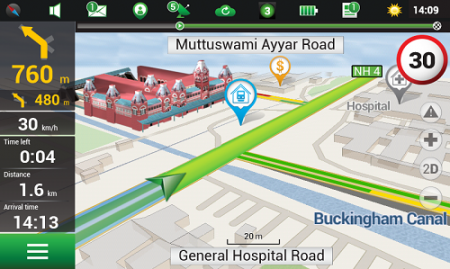
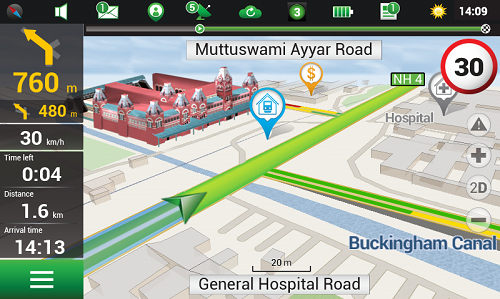
    Navitel’s navigation map of India is now available for purchase, for use with the Navitel Navigator GPS & Maps app on Google Play. Navitel Navigator is a precise offline GPS navigation with free geosocial services and detailed maps of 59 countries, with 20 million downloads worldwide.

    The map of India contains 2,092,013 km of road graph, 594 627 cities, towns, and other settlements, as well as 5,294,344 POI. Coupled with the address search in more than 6 000 residential and industrial areas of settlements, this map includes the detailed housing system data with due account for the number of floors, detailed road networks with all streets, roads, and indicated traffic direction, road interchanges, roundabouts, and other important road information.

    The map contains 149 3D points of interest, including:

    • Delhi – Akshardham Temple, Qutub Minar, Laxmi Narayan Mandir, and Lotus Temple.
    • Gujarat – ISCON Mall, Satyam Centre, the Metropole Hotel, Kaizen Hospital.
    • Karnataka – Bangalore Palace, Software Technology Park of India, Jamia Masjid, Hotel Savannah Sarovar Premiere, Jawahar Bal Bhawan park.
    • Tamil Nadu – Chennai International Airport, Chennai Railway Station, Manorama Hotel, Lemon Tree Hotel.
    • Haryana – Vardhman Star Mall, YMCA University of Science and Technology, Mini Secretariat, Sarvodaya Hospital, Gurgaon Centre.
    • Chandigarh – Panjab University, Chandigarh College of Engineering & Technology, Haryana and Punjab Secretariat, Hotel Royal Plaza.

    Details for Map of India, Q1 2015:

    • 2,092,013 km of road graph;
    • 594,627 settlements on the map;
    • 6,614 settlements allowing the address search;
    • 8,217,526 addresses;
    • 149 3D points of interest;
    • 5,294,344

    Android OS device users can purchase a license key to the new product at Google Play and from the program menu by selecting “My Navitel” > “Purchase maps”.

    The Q1 2015 map of India is compatible only with 9.1.0.0 and later versions of Navitel Navigator.

  • AgJunction to Acquire Novariant

    Precision-agriculture company AgJunction has agreed to acquire precision-steering company Novariant, according to a joint press release.

    AgJunction holds numerous patents and markets its products and services under the brand names Outback Guidance, Satloc and AgJunction Cloud Services. AgJunction supports advanced farming practices and enables seamless data connectivity among growers and their agricultural service providers. Headquartered in Hiawatha, Kansas, AgJunction has facilities in Arizona, Pennsylvania, Winnipeg, and Queensland, Australia.

    Based in Silicon Valley, Novariant’s steering solutions are used in more than 60 countries. With 55 employees worldwide, Novariant generated revenues of approximately $30 million in 2014. Novariant offers interoperable auto-steer capabilities to original equipment manufacturers (OEMs) and value-added resellers worldwide with more than 750 unique platform-install kits and more than 30,000 systems in the field.

    According to the statement, when combined the two companies will be better positioned to achieve market objectives through leveraging:

    • A larger presence with more resources
    • A broader OEM partner list
    • One of the precision agriculture industry’s most comprehensive intellectual property portfolios, providing increased IP protection for OEM partners
    • Increased R&D capability and efficiency
    • Complementary customers, market geographies and distribution channels
    • Reductions in operating redundancy to further improve profitability.

    Completion of the transaction is expected to take place this summer.

    “Novariant established itself as a pioneer in guidance and auto-steer technologies over 20 years ago,” said Dave Vaughn, CEO of Novariant. “Most recently, Novariant has sharpened its focus on precision agriculture and has positioned its offerings to address a major shift in our industry from after-market channels to factory-installed solutions.”

    “A shift like this occurs only once during the lifecycle of a technology, and great companies can be created by accelerating and innovating at the right time,” added Vaughn. “At Novariant we believe this is a transformational opportunity, and AgJunction is the right partner.”

    As global machine manufacturers increasingly target the integration of auto steer technologies at the factory level, the combined companies can bring advanced levels of machine automation to both current and future OEM clients faster and at lower cost.

    “The combination of Novariant and AgJunction creates an exciting opportunity for our company, for our customers, and for our shareholders,” said Rick Heiniger, president and CEO of AgJunction. “This merger extends the reach and influence with which we pursue a common passion — delivering the most accurate, innovative and reliable steering solutions in the world.”

    Once the merger is complete, the combined company will have approximately 200 employees worldwide and will be headquartered at Novariant’s corporate headquarters in Silicon Valley. The combined company plans to maintain additional offices in Kansas, Arizona, Pennsylvania, Canada and Australia.

    Dave Vaughn, CEO of Novariant, will be appointed CEO of the combined company, with current AgJunction CEO Rick Heiniger serving as senior advisor to the CEO. In addition, Wes Dittmer will continue to serve as the combined company’s CFO.


  • Fugro Offers High-Accuracy Offshore Positioning Service

    Fugro has introduced its high-accuracy G2+ service, designed to benefit offshore operators around the globe who require positioning and measurement accuracy at centimeter level.

    G2+ is an enhancement of Fugro’s G2 service (based on GPS and GLONASS). The service uses highly advanced GNSS augmentation algorithms developed in house. The code and carrier-phase signals transmitted by GPS and GLONASS satellites are monitored globally by Fugro’s worldwide network of reference stations.

    These observations are processed centrally in real-time using the company’s proprietary algorithms to generate precise corrections which are used to augment the standard signals broadcast by GPS and GLONASS satellites.

    Customers receive corrections via seven high-powered communications satellites, providing at least two independent G2+ data sources. The new satellite positioning service will be particularly beneficial when seeking to measure latitude, longitude, elevation and speed with high accuracy in real-time, Fugro said.

    Applications include offshore construction, survey services, vessel monitoring and structural monitoring. The ultra-high accuracy enables the real-time correction of tidal changes — which impact the accuracy of seabed mapping — as well as the real-time monitoring of the motion of floating and fixed structures.

    The 3D accuracies of the system approach those of GNSS RTK (real-time kinematic) systems while avoiding the need for an RTK base station or local transmission link, overcoming the logistical challenges and range limitations associated with coastal RTK systems, Fugro said.

    The launch of G2+ follows the recent launch of Fugro’s G4 satellite correction service, which takes advantage of all four global navigation satellite systems: GPS, GLONASS, BeiDou and Galileo.