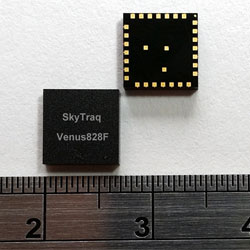
The SkyTraq Venus828F GNSS receiver module. Photo: SkyTraq Technology
SkyTraq Technology has introduced a stand-alone multi-GNSS receiver module in a compact 7 x 7 millimeter form factor, the Venus828F, designed with a sensor hub function for wearable and “Internet of Things” (IoT) applications.
The Venus828F is capable of communication with multiple satellite systems and tracking up to 28 satellites concurrently, SkyTraq said. The compact LGA module integrates all the necessary components for wearables and IoT, forming a complete working GNSS receiver, including GNSS chipset, 0.5ppm TCXO, Flash memory, LDO regulator, DC/DC switching regulator, and passive components. It only requires external antenna and power supply to output accurate position, velocity, and time information in standard NMEA-0183 format, enabling ease of use and fast time to market, Skytraq said.
The Venus828F features low power consumption, a 29-second cold start TTFF, -165 dBm tracking sensitivity, 10 nsec 1 PPS timing accuracy, on-board geofencing, 8 Mbit – 512 Mbit external SPI Flash data logging, and an industrial operating temperature range of -40C +85C. It has an UART and I2C interface for flexible connection to the host processor.
Via SPI and I2C connection, data from MEMS sensor can be calculated by Venus828F using sensor-hub-enabled firmware, offloading computation from the host processor. Engineers can concentrate on their wearable and IoT applications instead of spending hundreds of hours reinventing the wheel developing sensor-fusion algorithms, according to SkyTraq.
“Fast-acquisition high-sensitivity multi-GNSS chipset hardware are just becoming available in recent years, the internal firmware supporting multi-GNSS typically are not as fully optimized as GPS-only firmware that has matured for more than a decade to allow ROM codification with optimal performance for any existing GNSS chipset vendors; the multi-GNSS firmware is still being continuously improved over time,” said Michael Chung, VP of sales and marketing, SkyTraq. “By offering Venus828F multi-GNSS receiver module with Flash memory, it’s shipped with the latest, best-performance firmware. It is also later upgradeable in the field if the customer’s design allows. Targeting very high volume, cost-sensitive wearable and IoT applications, Venus828F is offered at price comparable to crystal-based ROM GPS modules on the market, setting a new benchmark in terms of performance, size, and cost for multi-GNSS receiver modules.”
An engineering sample, datasheet, and reference design for the Venus828F are available now.
Big Market Research is offering a “2014 Market Research Report on Global GPS Antenna Industry” that discusses the world’s major regional market conditions for antennas, including North American, Europe and Asia, and the countries Germany, Japan, China, and the United States, among others.
The report introduces basic GPS antenna information, including antenna definition classifications and applications, and an industry-chain overview; GPS antenna industry policy and plans; GPS antenna product specification; and the manufacturing process and cost structures. Then the analysts look at regional market conditions, including product price, profit, capacity, production, capacity utilization, supply, demand and industry growth rate.
The report introduces a GPS antenna new project SWOT analysis, investment feasibility analysis, investment return analysis, and the global GPS antenna industry.
The report has six parts:
basic product information;
an analysis of the Asian GPS antenna industry;
an analysis of the North American GPS antenna industry;
an analysis of the European GPS antenna industry;
an analysis of the entry-level market and investment feasibility;
GeoOptics, a satellite-based environmental data services company, in cooperation with Atmospheric and Environmental Research (AER), an environmental research and development company, has announced the initial results of an Observing System Simulation Experiment (OSSE) showing the reliability of radio occultation data in improving predictions of severe weather and flash flood events.
Using weather prediction models and data assimilation techniques, AER evaluated the potential benefit of observing Earth’s atmosphere with a vast future constellation of many hundreds of orbiting GNSS – Radio Occultation (GNSS-RO) receivers. As a case study, the model used the convective system that brought severe weather to Oklahoma in 2013, which included an Enhanced Fujita Scale-3 tornado and heavy rains.
“The improved characterization of moisture in the lowest 4-5 km of the atmosphere is very significant and, working with our colleagues at AER, we believe quite a rigorous scientific conclusion,” said Conrad Lautenbacher, GeoOptics CEO. “We see commercial provision of GNSS-RO as a valuable complement to public sector systems and a reliable, low-cost way to achieve the levels of scale tested. We are very excited by the results.”
Through collaboration begun in 2014, the two companies set out to assess the impact of vastly increased numbers of GNSS-RO profiles on regional weather forecasting within the context of a global weather satellite system. Oklahoma was the region of focus of the study, an area with a history of severe weather phenomena. Today’s total global GNSS-RO profiles number approximately 1,800 per day, of which 0.64 profiles per day are readings taken over Oklahoma.
In the study, AER and GeoOptics modeled from 50,000 to 2,000,000 global profiles per day through the deployment of the planned CICERO satellite constellation. Such large scale would correspondingly increase the profiles per day over Oklahoma to between 17 and 700.
“We see commercial remote sensing and particularly the GNSS-RO technology as a paradigm change in developing and maintaining a cost-effective, next-generation operational observational infrastructure for environmental prediction,” said AER President Ron Isaacs. “The superb GNSS-RO technology knowledge base at GeoOptics provides an ideal and exciting complement to AER’s decades-long experience in today’s operational remote sensing and weather prediction practices, which include the current use of GNSS-RO sensing.”
GNSS-RO profiles provide measurements of atmospheric temperature, moisture, and pressure with a precision unrivaled by other space-based techniques. The RO sensor gathers this information by precisely observing perturbations imposed on ubiquitous GPS radio signals as they pass through the atmosphere. Today, nearly 3,000 organizations in more than 80 countries use RO data in Numerical Weather Prediction (NWP) and research. NOAA’s own studies show that more accurate mid- to long-term forecasts can be made up to 15 hours sooner using the data collected from the current limited set of experimental GPS-RO sensors.
GeoOptics plans to launch an array of powerful GNSS-RO sensors on its CICERO constellation of low-Earth-orbiting satellites. The rollout of the constellation will begin in the third quarter of 2015 and will deliver more than 50,000 global profiles per day when fully deployed. As demand grows, the 24-satellite CICERO constellation will be expanded to carry additional and complementary instruments, such as scatterometry and gravity sensors.
“GeoOptics will advance a small satellite observing model that starts with GPS radio occultation,” Lautenbacher added. “We believe an integrated private company like ours can deploy such systems for a fraction of current costs to the government.”
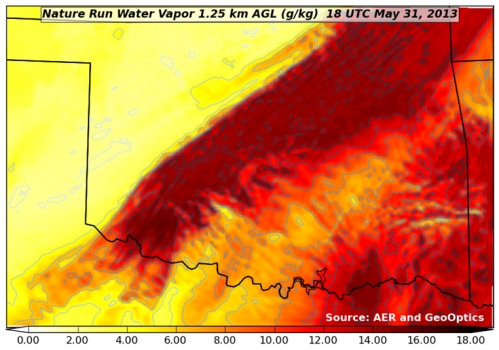
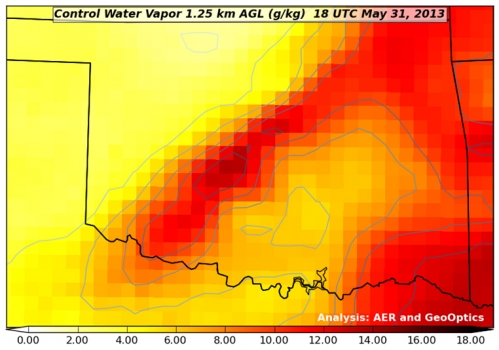
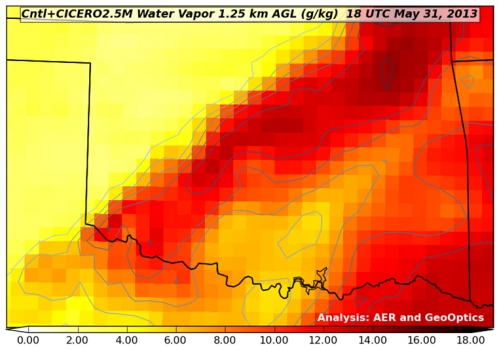
Figure 1. “Nature Run” (the truth reference) atmospheric water vapor at about 4,000 feet above the ground. The yellow-to-red color scale (bottom of figure) indicates how much water vapor is present, i.e., yellow is dry and red is moist. This realization of atmosphere moisture during an Oklahoma severe weather outbreak in May 2013 is the yardstick against which our assimilation experiments are compared for realism. It has a horizontal resolving power of about 1 1/4 mile (i.e., 2 km).Figure 2. Atmospheric water vapor analysis using conventional observing system. Valid time, vertical level and color scale are the same as in Figure 1. Note that the data fusion experiments use a bigger grid than the Nature Run (Figure 1) with a horizontal resolving power of about 11 miles (i.e., 18 km).Figure 3. Atmospheric water vapor analysis using conventional observing system + CICERO radio occultation observations. The distribution of water vapor in this analysis is much closer to the Nature Run (Fig. 1) in pattern and magnitude than the Control result (Fig. 2).
Mark Fields, President and CEO, Ford Motor Company, delivers the opening keynote address at the 2015 International CES. (Photo by: Sam VarnHagen/Ford)
Ford Motor Company highlighted the semi-autonomous vehicles it has on the road today and fully autonomous vehicles now in development at the 2015 Consumer Electronics Show in Las Vegas this week.
“We’re already manufacturing and selling semi-autonomous vehicles that use software and sensors to steer into both parallel and perpendicular parking spaces, adjust speed based on traffic flow or apply the brakes in an emergency,” said Raj Nair, Ford chief technical officer and group vice president, Global Product Development. “There will be a Ford autonomous vehicle in the future, and we take putting one on the road very seriously.”
Ford’s semi-autonomous vehicle features available today include lane-keeping assist, adaptive cruise control, Pre-Collision Assist with Pedestrian Detection and active park assist — with Traffic Jam Assist coming.
A fully autonomous Ford Fusion Hybrid research vehicle is undergoing road testing. The vehicle uses the same semi-autonomous technology in Ford vehicles today, while adding four LiDAR sensors to generate a real-time 3D map of the surrounding environment.
The vehicle can sense objects around it using the LiDAR sensors, and uses advanced algorithms to help it learn to predict where vehicles and pedestrians might move.
“Our priority is not in making marketing claims or being in a race for the first autonomous car on the road,” Fields said. “Our priority is in making the first Ford autonomous vehicle accessible to the masses and truly enhancing customers’ lives.”
Ford Smart Mobility
The automaker also laid out its Ford Smart Mobility plan for connectivity, mobility, autonomous vehicles, the customer experience and big data. Included are 25 experiments set for this year — eight in North America, nine in Europe and Africa, seven in Asia and one in South America.
Each experiment is designed to anticipate what customers will want and need in tomorrow’s transportation ecosystem. “We see a world where vehicles talk to one another, drivers and vehicles communicate with the city infrastructure to relieve congestion, and people routinely share vehicles or multiple forms of transportation for their daily commute,”said Ford President and CEO Mark Fields. “The experiments we’re undertaking today will lead to an all-new model of transportation and mobility within the next 10 years and beyond.”
The 25 experiments address four global megatrends — explosive population growth, an expanding middle class, air quality and public health concerns, and changing customer attitudes and priorities — challenging today’s transportation model and limiting personal mobility, especially in urban areas.
Fourteen of the 25 experiments are Ford-led research projects, and 11 are part of the company’s Innovate Mobility Challenge Series. The experiments include:
With the Innovate Mobility Challenge Series, Ford invited innovators and developers around the world to create solutions for specific mobility challenges in North America and South America, Portugal, Africa, India, China, England and Australia. Challenges included finding technology solutions to identify open parking spaces in urban areas, better ways to navigate crowded cities and the use of navigation and other tools to help people gain access to medical care in remote areas.
SYNC 3
Also at CES, Ford is demonstrating SYNC 3, the company’s new communications and entertainment system that is faster, more intuitive and easier to use with enhanced response to driver commands. SYNC 3 has more conversational speech recognition technology, a more smartphone-like touch screen and easy-to-read graphics to help drivers connect and control their smartphone while on the road.
The next-generation system builds on the capability of SYNC technology already in more than 10 million vehicles on the road globally. SYNC 3 begins arriving on new vehicles this year.
“Ford is delivering an easier way for customers to stay connected,” said Nair. “SYNC 3 is another step forward in delivering connectivity features customers most want, and they tell us this kind of technology is an important part of their decision to buy our vehicles.”
“Even as we showcase connected cars and share our plans for autonomous vehicles, we are here at CES with a higher purpose,” Fields said. “We are driving innovation in every part of our business to be both a product and mobility company — and, ultimately, to change the way the world moves just as our founder Henry Ford did 111 years ago.”
Russia’s S7 Airlines has received approval for three Boeing 737-800s to perform landings using GNSS, becoming the country’s first carrier to do so, reports Air Transport World.
According to an S7 statement, more than 50 airports in Russia have installed equipment allowing global positioning landings (GLS). Russia’s State Air Transport Management Corp. plans to certify 10-15 airports per year for GLS landing.
“GLS will allow the airline to improve flights’ regularity, which is one of our priorities,” Globus Airline CEO Vadim Klebanov said. Globus Airline is a member of the S7 Group.
Visteon Corporation is demonstrating its latest vehicle connectivity system at the 2015 International CES being held this week in Las Vegas. Visteon’s system provides a secure and reliable gateway to advance the connected driving experience for drivers and automakers, the company said.
A robust vehicle communication gateway is essential to ensure reliable connectivity that can keep pace with advances in 4G LTE, Wi-Fi, and vehicle-to-vehicle and vehicle-to-infrastructure (V2X) developments. Visteon’s latest solutions address personal and vehicle security, increased data complexity and vehicle architecture challenges.
Visteon’s Wireless Gateway is a 4G-compatible connectivity module that manages a complex network of GPS, cellular, Wi-Fi and Dedicated Short Range Communications (DSRC) inside and outside of the vehicle to provide seamless connectivity when mobile. The gateway incorporates a high level of security to protect multiple owners over a vehicle’s lifetime and is capable of handling future data bandwidth, wireless communication and security needs.
Visteon’s V2X platform provides short- to medium-range wireless communications between similarly equipped nearby vehicles that permit very low latency data transfer, which is critical in communications-based active safety applications. The platform is designed to maximize communication range and provide the greatest amount of warning or notification time to the driver.
Addressing the connected vehicle architecture, Visteon’s SmartCore integrated solution integrates traditional driver information, infotainment and connectivity through one seamless human-machine interaction (HMI). Multiple domains can run side-by-side on scalable hardware through different operating systems, greatly reducing complexity, Visteon said. The system actively prioritizes critical information for the driver on a situational basis and enhances driver information management on the road to autonomous driving.
“With the increased complexity of connected services and applications, today’s challenge is not about providing a platform with extensive features, but creating a future-ready vehicle gateway that has the flexibility to adapt and accommodate evolving network technologies,” said Christian Feltgen, vice president, Visteon technology office.
First of all, on behalf of all of us here at GPS World magazine, allow me to welcome you to 2015. We wish you a healthy and prosperous new year!
I’d like to start out the new year stating the obvious for some of you, maybe most of you…perhaps all of you: GNSS is the new GPS.
In the high-precision GNSS community, I think this is already our mindset, and has been for quite some time. The benefit of using signals from as many satellite navigation systems to the high-precision user is obvious. We saw this with the adoption of GLONASS more than a decade ago. It’s to the point now that even many consumer receivers (such as my Samsung Galaxy S5) utilize both GPS and GLONASS satellites.
I think it’s pretty obvious we’ll see the same phenomenon with Galileo (Europe) and BDS (China’s BeiDou system). It’s exciting to think about what high-precision GNSS positioning is going to look like just 2-3 years from now. Think about how much better RTK positioning will be with 30+ satellites in view. By the way, that’s already a reality in China where BDS has 14 regional satellites in addition to GPS and GLONASS. It’s the best place in the world for RTK positioning due to the number of satellites in view at any one time, and it might be the reason that China consumes more RTK receivers than the rest of the world combined.
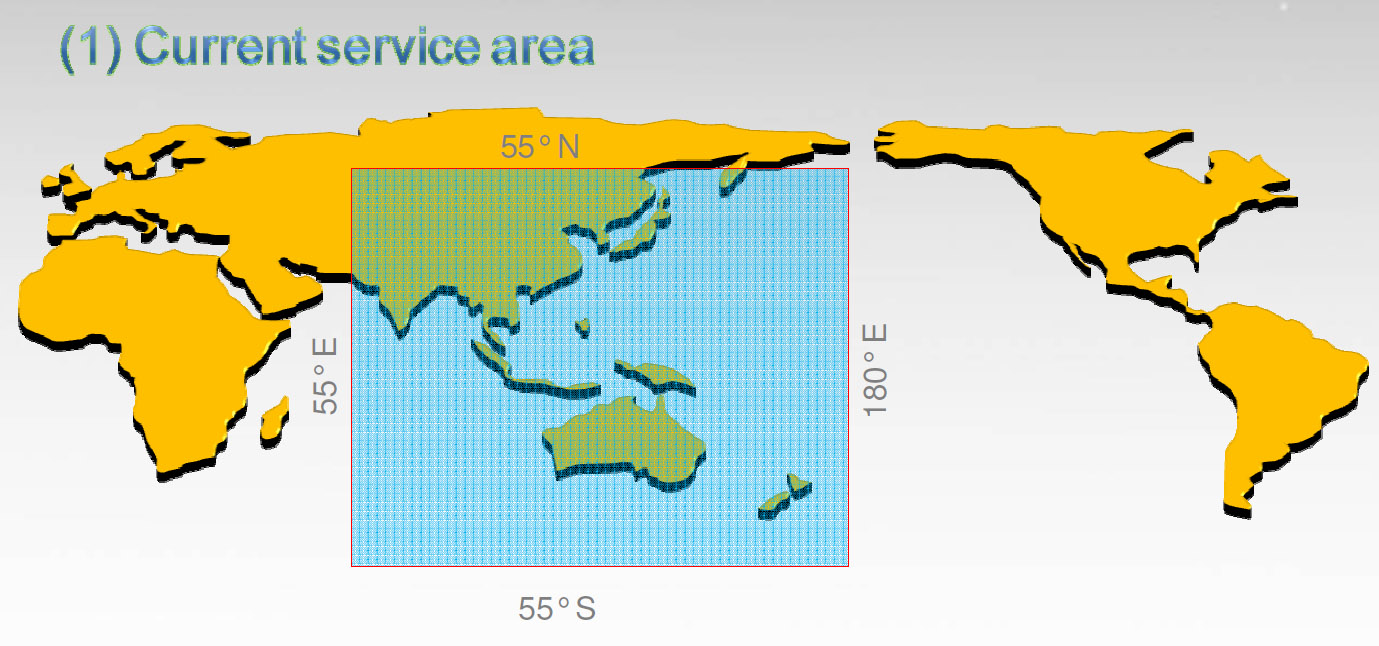
BDS coverage area.
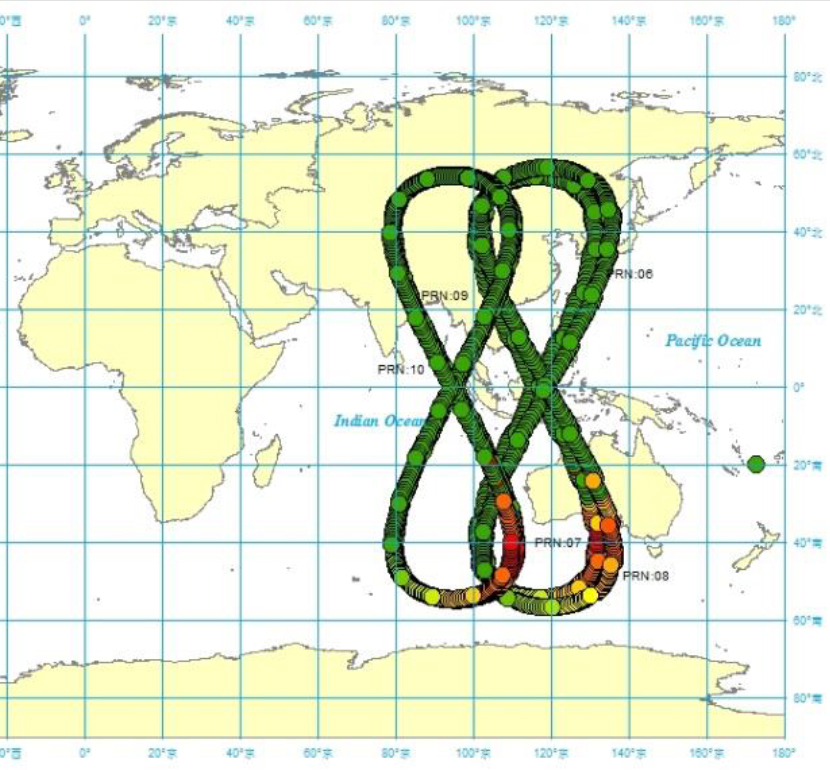
BDS satellite orbit map.
I certainly look forward to the deployment of Galileo and BDS. It will only make us more productive in accomplishing our work. Yet I’m reminded frequently when reading mainstream news headlines that Galileo, BDS, and GLONASS compete with GPS. Even some of those who hold GPS dear to their hearts, such as those who were involved in the development, promotion and deployment of GPS, view the other satellite systems as competition.
Maybe that’s not a bad thing because competitors push each other to perform better. However, where it might hurt is when it comes to support, such as funding. Galileo, in particular, because it’s funded with civil funds instead of defense funds like GPS and GLONASS, has been criticized as a wasteful use of resources because GPS already exists. What more can it add, they ask? The mainstream media doesn’t have a clue that the satellite navigation systems are complementary rather than competitive. You and I know that more satellites generally equates to increased productivity no matter who owns/operates the satellite that is sending the signal. I cringe when I read these headlines:
News Headlines
GPS and its Three Main Competitors: Galileo, Beidou, GLONASS
GPS vs. Galileo; Where Are They Headed?
China Spreads Alternative To U.S. GPS System
China’s Beidou Navigation Satellite System More Precise than GPS in Certain Areas
GPS vs GLONASS: Which Is Best for Tracking Applications?
Generally, I dismiss the mainstream media in the GNSS arena, but these misleading articles can have an impact on funding of the various GNSS, such as Galileo. Politicians and various purse-string holders can be influenced by these stories.
Galileo Moving Forward
The Europeans are pushing forward after the recent hiccup when the first two Full Operation Capability (FOC) Galileo satellites were inserted in the incorrect orbits due to an improper fuel line installation on the rocket launcher resulting in the satellites being inserted in an orbit far below its intended orbit (an elliptical orbit, 49.8 degrees at 26,200 km, vs. the intended circular orbit, 55 degrees at 29,900 km).
In October 2014, shortly after the faulty launch, the outlook for the two satellites was bleak. The consensus was that there was no feasible method to move the satellites to their intended orbits. The good news was that besides the fact that they were in New York instead of Los Angeles :-), they checked out healthy, were properly oriented to the sun, and were “thermally stable.” Would they join GPS SVN-49 in being demoted to permanent test mode status, never being allowed to join the operational constellation, further delaying the deployment of Galileo? Not so.
The first live test was completed on December 9, 2014, when the satellite was one of four Galileo satellites that delivered a position fix of better than two meters. Furthermore, in a January 1 article published on GPS World’s website, Peter Steigenberger and André Hauschild of the German Aerospace Center wrote that the rogue Galileo FOC satellites can likely be used by commercial, multi-frequency, high-precision GNSS receivers for carrier-phase positioning. One drawback is that because the satellite’s orbit doesn’t fall within the limits of the standard Galileo almanac, it may take receivers longer to begin tracking the satellite.
Flight engineers are now working on maneuvering the second rogue Galileo satellite in the same manner, hoping for the same result.
All in all, this is about as good of a result that could possibly be expected. My hat’s off to the folks who made this happen.
Meanwhile, the next four Galileo FOC satellites are moving through the production process. Originally slated for a December launch, I suspect last year’s launch anomaly had the Galileo folks double-triple-quadruple checking, dotting i’s and crossing T’s, so make sure the next launch has the best chance of success. They haven’t announced a new launch schedule yet, but I would guess it’s likely in the next six months, with quarterly launches resuming if things goes smoothly. If all goes well, we could be benefiting from 10 healthy Galileo satellites by the end of the year.
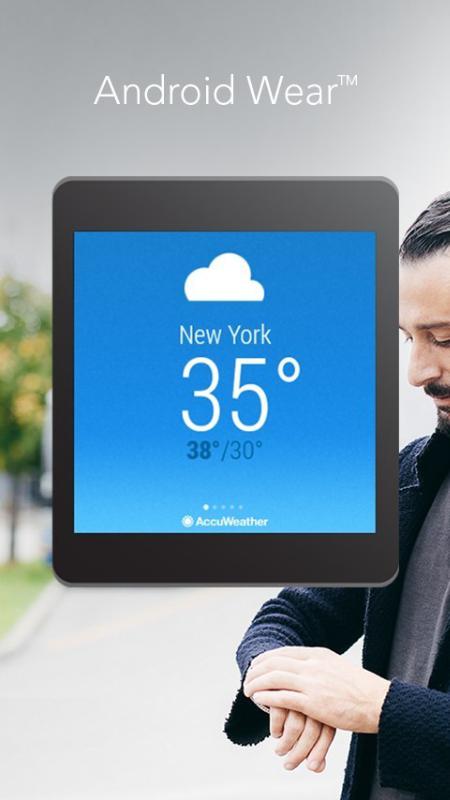
AccuWeather App for Android Wear (PRNewsFoto/AccuWeather)
The AccuWeather app for Android is now available for Android Wear, providing users with up-to-the-minute weather information wherever they go. Android Wear is the Android platform for wearables such as smartwatches. The app is available through the Google Play store.
AccuWeather’s app for Android Wear features AccuWeather MinuteCast, a global minute-by-minute precipitation forecast for a person’s exact street address or GPS location. AccuWeather MinuteCast includes precipitation type and intensity, as well as start and end times for precipitation, and gives users by-the-minute precipitation forecasts for the upcoming two hours. The GPS technology that localizes the weather to the user’s location is protected by patents in the United States and many of the major countries around the world, AccuWeather said.
In addition to AccuWeather MinuteCast, AccuWeather for Android Wear and for Android smartphones and tablets provides users with severe weather alerts, hourly forecasts, and current conditions.
“This is an exciting opportunity for AccuWeather to deliver weather information in innovative new ways to users,” said Steven Smith, chief digital officer of AccuWeather, Inc. “As the global weather leader, we provide weather forecasts wherever, whenever, and however our users most want them. Easy access, hyper localization, ease of use, and the superior accuracy that is the hallmark of our organization, help our audiences everywhere make decisions and improve their lives.”
AccuWeather MinuteCast is available for the contiguous United States, Canada, Japan, Ireland, France, Germany, Belgium, Switzerland, Netherlands, Luxembourg, the United Kingdom, and parts of the Czech Republic, with additional locations to come.
AccuWeather for Android Wear, and for Android smartphones and tablets, is available from Google Play.
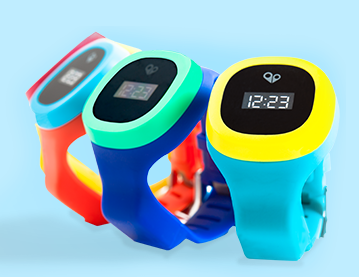
The hereO cellular GPS watch for kids will be officially unveiled at the 2015 International CES, being held in Las Vegas this week. Designed for children ages three and up, the hereO works in sync with a mobile app to provide real-time location sharing, safe-zone alerts, and group messaging, allowing parents to monitor their children’s safety and whereabouts at all times directly on their mobile phones or desktop computers.
The engineers at hereO miniaturized components to make the watch fit children’s wrists, the company said. The watch comes in a variety of bright and colorful water resistant designs to appeal to children. For parents, the hereO Family App for smartphones/tablets (iOS and Android) and desktops provides real-time location information on all family members and loved ones, plus location history, live-updates, panic alerts, safe-zone definition, and more.
“CES is a crucible of amazing minds, emerging ideas, and groundbreaking new technology; it’s the Mecca for today’s most inspired innovators,” said hereO Co-Founder and President Daniel Ivesha. “After three years of developing and perfecting our prototype, we couldn’t think of a better place to debut hereO, the world’s smallest cellular-connected GPS tracking watch for kids, which we believe is not only a game-changer in child safety technology but in the way families stay connected.”
Features include:
hereO LOCATION: Parents can locate their child anytime, anywhere. Historical locations are also available so parents can track where their child have been throughout the day.
Wi-Fi ENABLED: Wi-Fi allows indoor tracking whenever an indoor map is available. When indoor mapping is unavailable, an indoor confirmation will be sent to the parent’s smartphone.
SAFE-ZONE ALERTS: Parents can create Safe Zones for frequently visited areas (kindergarten, office, etc.) and are notified when their child arrives or departs from that location.
PANIC ALERT: In case of an emergency, children can use their hereO watch to send a panic alert that immediately notifies family members of their location.
TAMPER ALERT: Parents receive an alert when any authorized person tries to remove the watch.
EMERGENCY TRACKING: In emergency situations, parents can turn on real-time tracking to facilitate locating the child.
TIME DISPLAY: Time is displayed on a beautiful e-ink display.
USB charger: Built-in USB connector allows portable charging. Simply plug the hereO watch into any USB port to charge and to get firmware updates.
LONG BATTERY LIFE: With our standby mode, the hereO watch can last up to 60 hours.
BUILT-IN SIM: Each hereO watch is equipped with a built-in SIM card that works in over 120 countries, making it the perfect travel companion.
The hereO watch retails for $179, which includes a three-month subscription to the hereO Family App. Thereafter, a monthly fee of $4.95 applies.
At CES, the hereO watch is at booth #74545 (Tech West: Sands Expo at The Venetian).
The Hobbico ORA, a new drone system for aerial photographers, is being demonstrated at the 2015 International CES, running January 6-9 in Las Vegas. The camera-equipped drone displays captured aerial images on a seven-inch touchscreen integrated into the transceiver. With a 370-mm diameter and an onboard 1080p HD camera, the ORA also delivers high-quality images, reliability and long range through its recording method and choice of radio frequencies.
Designed for taking aerial views of action sports, outdoor weddings, real estate, vacation vistas and more, the ORA delivers out-of-the-box aerial photo and video capture with no need for radio-control piloting experience. All images are recorded on an SD card built into the drone, providing higher resolution than systems that use the transceiver for data capture, Hobbico said. Use of the 5.8-GHz radio band instead of the typical 2.-4GHz or Wi-Fi ensures a robust connection and a 500-meter flight control and video signal range.
The seven-inch first-person view touchscreen built into the ORA transceiver displays what the UAV’s onboard camera sees in real time, eliminating the need to use a cell phone, tablet or other third-party device to view captured images. Users can frame scenes exactly as they want them filmed by remotely controlling the camera gimbal. One-, two- and three-axis gimbal options are available, each designed also to accept GoPro cameras.
The transceiver has an integrated Android device for programming ORA functions through the touchscreen. A separate OLED telemetry screen displays flight data such as GPS coordinates, altitude and battery power status.
Other highlights include:
30 minutes of flight time per battery charge
Built-in GPS programming that puts flight routes, speed and altitude on auto-pilot
Support for 32 separate GPS waypoints to execute complex flight patterns
The ability to hold a steady altitude and position via GPS to film desired scenes
The option to save coordinates and fly the identical path again any number of times.
Selecting “Return to Home” brings the ORA back to its pilot with a single command. An “Actual Direction” option prevents control reversal confusion during manual flight — when activated, the quad always moves in the same direction as the control sticks. Additional failsafe systems watch for dangers such as low-battery power and automatically bring the ORA and camera home for safe landing.
The Hobbico ORA is scheduled for early 2015 release at an MSRP of $1,500-$2,000 depending on the battery, gimbal and camera configuration. The package will include the drone, 10-channel touchscreen transceiver, gimbal, batteries and charger.
The drone is on display at CES Booth #25214 in the Unmanned Systems Marketplace at the Las Vegas Convention Center’s South Hall 2.
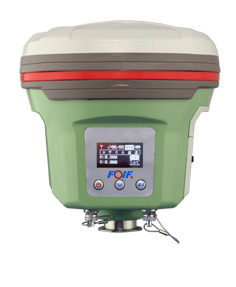
Chinese company FOIF is offering a new survey receiver, the A50. FOIF said that with the A50, the company focused on developing a smart design for a receiver to make it lightweight, yet powerful, making it easy to use for fieldwork. Besides Bluetooth, wireless radio, and mobile network (2G and 3G), Wi-Fi feature was added to broaden data communications for GNSS. The A50 is designed to provide excellent performance, with a high-sensitivity GNSS module.
According to FOIF, the A50 has not only sophisticated onboard software, but also optional application programs such as FOIF FieldGenius and Carlson SurvCE, providing multiple field solutions.
The A50’s features include:
Wi-Fi to achieve quick and long distance parameters settings and data transferring;
Tracking of GPS, GLONASS, Galileo, BeiDou satellites on 220 channels;
An industry-standard GNSS engine (Trimble, NovAtel) that can access local CORS;
horizontal real-time accuracy (rms) of 10mm+1ppm, and vertical of 20mm+1ppm;
OLED display with superior brightness and temperature range
Rugged design, with an IP67 rating;
Voice messaging.
RTK(<30km)
H:8 mm + 1 ppm
V:15 mm + 1 ppm
DGPS
H:0.25 m + 1 ppmV:0.50 m + 1 ppm
SBAS
0.5m (initialization time < 10s, initialization reliability > 99.9%)
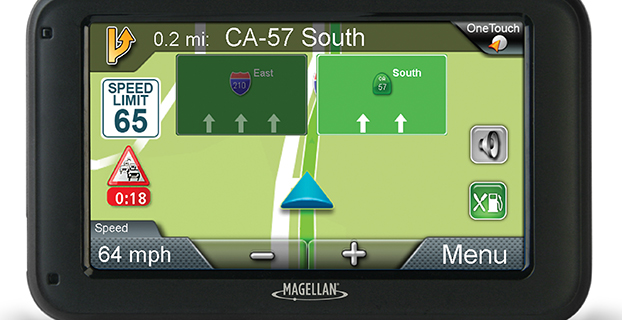
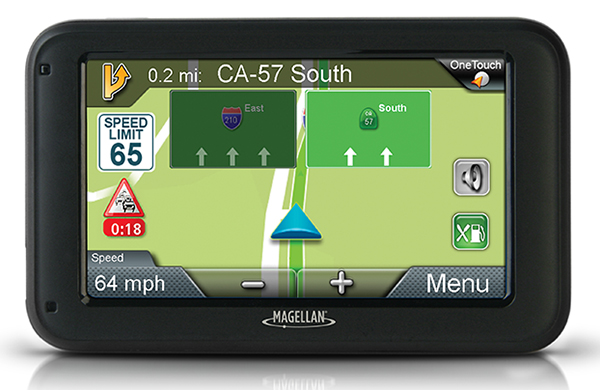
Magellan has introduced its newest lineup of 5-inch RoadMate auto navigators at the International Consumer Electronics Show, being held this week in Las Vegas. To provide a more realistic view of a user’s surroundings, each of the GPS models comes equipped with 3D renderings of buildings and landmarks.
The new models are: RoadMate 5322-LM, RoadMate 5330T-LM with real-time traffic alerts, and RoadMate 5375T-LMB with real-time traffic alerts, Bluetooth connectivity and portrait viewing mode.
The units will be displayed at CES in the Magellan booth, LVCC South Hall 2, MP25441.
“Our new RoadMate 5-inch GPS devices for 2015 have large, vibrant displays and include a vast collection of renowned Magellan navigation features,” said Stig Pedersen, Magellan associate vice president of product management. “Plus, each model includes 3D renderings of buildings and landmarks to make it easier and quicker for users to identify where they are. Whether driving to work, across country, or going to grandma’s, drivers can count on these Magellan navigation units to safely guide them to wherever their destination is.”
Below are a few of the features that the three RoadMate GPS devices share.
3D Renderings – Selected buildings and landmarks are presented in 3D for a more realistic view.
Lifetime Map Updates – Owners of these three models can download the latest map information (up to four times a year) for all 50 states and Canada.
Traffic Camera Alerts – Sends audible and visual warnings of upcoming red lights, speed cameras, and more; provided by PhantomALERT.
7,000 POIs – Includes branded and highway exit POIs to conveniently search for restaurants, hotels, gas stations, and more.
OneTouch Favorites Menu – Creates shortcuts to favorite destinations and searches.
Multi-Destination Routing – Users can plan their entire day or multi-day trip in one route.
Junction View – Realistic images of freeway signs and arrows guide drivers to the correct lane.
SmartDetour – Provides immediate options when traffic suddenly comes to a halt.
RoadMate 5330T-LM
In addition to the features above, the 5330T-LM also includes:
Free Lifetime Traffic Alerts – Helps users avoid traffic jams and delays, suggests detours, provides travel times; no hidden fees or subscriptions.
RoadMate 5375T-LMB
In addition to the features above, the 5375T-LMB also includes:
Free Lifetime Traffic Alerts – Helps users avoid traffic jams and delays, suggests detours, provides travel times; no hidden fees or subscriptions.
Portrait Viewing Option – Provides extended view of the road ahead.
Bluetooth Compatibility – Turns this RoadMate model into a hands-free speakerphone, making drive time safer and more productive.
The Magellan 5-inch RoadMate family of auto navigation devices will be available at retailers throughout the U.S. and Canada as well as online in March 2015. MSRPs are as follows: $149.99 (RM5322-LM); $159.99 (RM5330T-LM); and $199.99 (RM5375T-LMB).