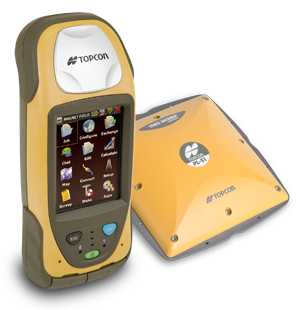
“With the addition of Vanguard technology, the GRS-1 fully integrated, dual-constellation, network-enabled receiver and controller optimizes tracking and performance regardless of job site conditions or location,” Scott Langbein, director of product marketing, said.
Topcon’s 226-channel Vanguard technology with Universal Tracking allows each individual GNSS channel to be fully optimized to track any of the available satellite signals that are supported in today’s GNSS receivers.
The GRS-1 can be used in various configurations from handheld to network enabled RTK measurement, and grade management. “The system can be configured to perform at various levels of accuracy that fit any budget and application,” Langbein said. Choices include centimeter level, sub-decimeter and sub-meter, with accuracy upgradeability options available.
Working with Topcon’s Magnet suite of software products, “the GRS-1 streamlines the workflow for surveyors, contractors, engineers and mapping professionals,” Langbein said.
The GRS-1 with Vanguard has DGPS capability with the internal single frequency antenna for use in GIS and navigation applications. Add the external antenna and connect a GRS-1 rover to a local GNSS network, or Topcon Magnet Relay, for centimeter accuracy RTK performance. Magnet Relay allows a mobile base receiver to host up to 10 rovers through the Magnet Enterprise “cloud.”
The GRS-1 has an optional 2MP built-in camera, integrated SD memory card slot, and includes an optional internal GSM or CDMA cellular modem and internal GNSS antenna, plus wireless connectivity via wireless LAN or Bluetooth technology.
CMTINC.COM announces the release of the Utility Data Collection app for the Apple iPad. This powerful GPS/GIS mapping and data collection app was mainly designed for utility asset management and meter reading. However, it could also be used by other professionals who need to map points, lines and areas and record pertinent information for the mapped Features, such as for fish & wildlife, natural resources, land management, oil and gas, archaeology, sales route management, and others.
According to the announcement, the Utility Data Collection app provides a dedicated data entry form for entering meter readings and other observations. The meter readers can opt to have the meter route displayed on a satellite map. They will be able to tell which meters have been read as the corresponding symbols will display in a different color on the map. They will also be able to sort and search the meter records. The import and export functions makes it easy to set up meter routes, upload meter database and export meter readings.
Between the monthly meter reads, the app can be used by the maintenance crew to map the locations and record the conditions of land plots, utility poles, utility meters and other equipment. The surveyed items can be easily tagged with pre-defined descriptions as well as photos taken on the spot.
The company reports that the Utility Data Collection app is the answer for small towns and utility cooperatives who are looking to transition to a newer and more effective utility management and meter reading system on a budget.
To fly a UAV in the U.S., you’d better be able to avoid any other aircraft — and ADS-B is one component of that capability. When the FAA and agencies around the world get their UAV regulations aligned with those levied on passenger-carrying aircraft, GNSS receivers on board UAVs will likely need to be qualified to equivalent standards. One company is already there.
When I was wandering around the show floor at the Association of Unmanned Vehicle Systems International (AUVSI) in Washington, D.C., in August, I got a pleasant surprise when I bumped into an old friend I knew from Calgary. Jayanta Ray was a grad student at the University of Calgary (U of C) when I was at NovAtel a few years ago. The students of the GNSS courses at U of C were often at local Calgary ION chapter meetings I organized or attended; there were also a few joint industry-university projects, and there were many, many discussions. So meeting Jayanta (Jay) at the Accord Systems/NexNav booth was a pleasant surprise, and it was good to renew our acquaintance.
This got me thinking that maybe some of that U of C receiver magic had somehow found its way through Jay into the airborne qualified receivers that Accord Technology is offering for UAVs. Jay is actually a member of the GPS World Advisory Board, and provides a great overview of what’s good and what’s different about airborne qualified receivers in this month’s issue of GPS World.
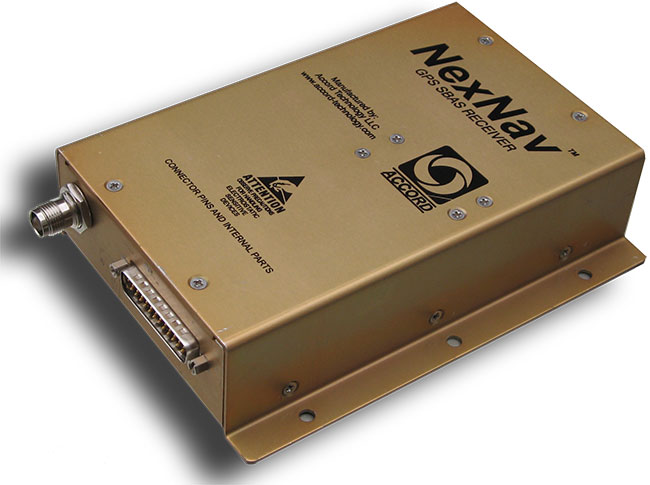
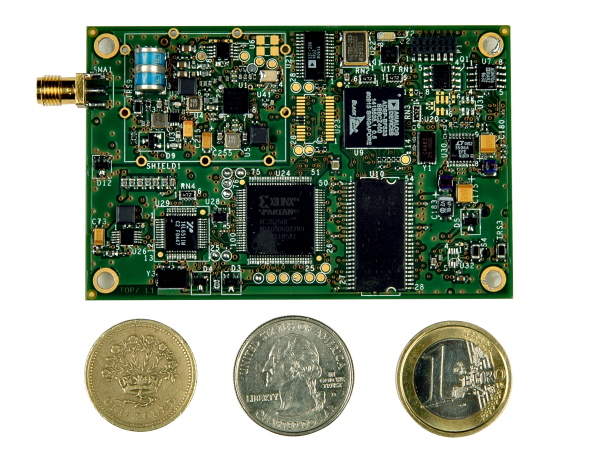
NexNav mini is also qualified for airborne GPS and ADS-B use.NexNav mini is also qualified for airborne GPS and ADS-B use.
Accord Technology is based in Phoenix, Arizona, and is the U.S. arm of Accord Software and Systems of Bangalore India, specializing in FAA-certified airborne versions of Accord’s GPS receivers.
At AUVSI, one of the hot topics was “Sense and Avoid” — if you are to fly a UAV in the U.S. National Airspace System (NAS), you’d better be able to avoid any other aircraft, and maybe also be able to tell other aircraft in the NAS where you are. ADS-B (Automatic Dependent Surveillance-Broadcast) is one component of that capability. ADS-B uses a network of ground stations that relay ADS-B transmissions from aircraft (called ADS-B Out) in the NAS to the Federal Aviation Administration (FAA) air-traffic management system, and the signal is also available to aircraft flying in the system if they are equipped to listen to the message (ADS-B In). Air Traffic Control (ATC) can then verify that you are where you are supposed to be, and your actual position shows up more readily on their tracking systems. Right now, ATC makes extensive use of radar tracking and aircraft transponder signals to track aircraft — ADS-B will be more efficient, less costly to maintain, and is capable of aircraft-to-aircraft position reporting. By 2020, it will be mandatory if flying within the U.S. NAS.
The other part of this story is that, eventually, when the FAA and other agencies around the world get their UAV certification regulations aligned with those levied on passenger-carrying aircraft, GNSS receivers on board UAVs will likely need to be qualified to equivalent airborne standards.
Accord has already done an enormous amount of work to qualify its NexNav receivers for both requirements, and was at the AUVSI conference to let the UAV community know that these receivers are available now. If you were developing a new UAV now, with a view to selling lots into the anticipated wide range of commercial applications, its certainly going to help your case with the certification authorities to install as much off-the-shelf certified avionics as you can. Accord already sells these receivers to a number of general aviation system manufacturers, and also supplies stand-alone ‘TSO’ed” receivers in enclosures for use on a number of aircraft types. When an airborne receiver is granted the TSO (Technical Standard Order) designation by the FAA, it recognizes that the receiver has been designed, built and qualified to stringent airborne technical requirements and is authorized by FAA for use on aircraft.
So how does a company with its HQ in India get to hold an FAA TSO for a GPS receiver? Well, other than taking years to develop the receiver in accordance with approved development standards, document the hardware and software design, and conduct test and verification activities, the company also proves to the FAA that the receiver meets the FAA-specified airborne GPS functional requirements. Loads of engineering work — and then you have to convince FAA that you did it all and did it right.
Accord in Bangalore actually teamed up with AvValues in Phoenix to form a joint venture known as Accord Technology (AT) to work the project together. Most of the original receiver development work was done in Bangalore, while AT in Phoenix became responsible as the design authority, and for production, certification activities, customer service, product support, and business development. Naturally, Accord in India still does ongoing engineering support and supplies receiver cards to AT under contract. The other twist to the story is that final assembly and test is carried out at the AT facility in Anchorage, Alaska, where the TSO was approved by the local FAA office.
But Accord isn’t only into airborne receivers. The company has been around since 1991 and has significant engineering resources (around 400 electronic and computer engineers) — with more than 700 man-years of GNSS R&D and production involvement. Here are some examples of the other GNSS products which Accord has in its technology/product inventory:
GPS L1 RF down-converter.
GPS RF & baseband.
GPS module.
GPS Spacecraft Positioning System (SPS).
Time-code generator.
SPS was developed for the Indian Space Research Organization (ISRO) and has been flown on all Indian low-Earth-orbit satellites, including IRS P4/5/6, TES, CartoSat, SRE and OceanSat.
IRNSS Reference Receiver.
The Reference Receiver is fielded in the ground-monitoring network for the Indian Regional Navigation Satellite System (IRNSS), which may mean that the ground network is using at least dual-redundant reference data, as NovAtel has also provided a similar receiver for IRNSS. Accord is also working on IRNSS user receivers.
Other receivers include high-dynamic GPS-GLONASS receivers, GPS/GLONASS/Gagan SBAS receivers, an internal GPS/GLONASS/Gagan simulator, and a handheld GPS/Gagan receiver with integrated three-axis compass and pressure altitude sensor — the latter used by a number of paramilitary forces.
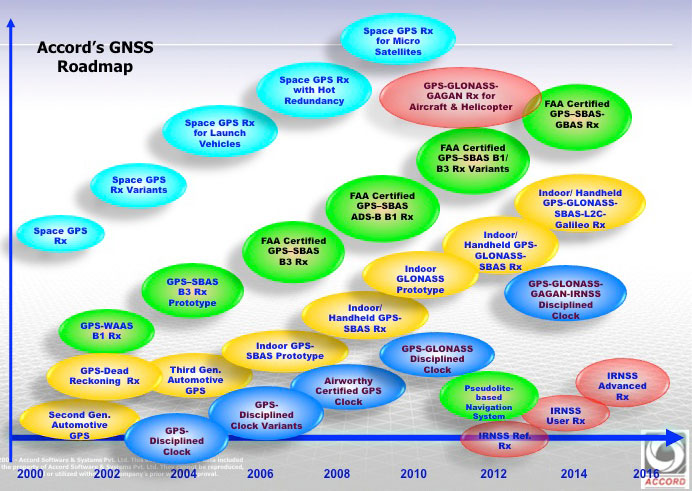
Accord GNSS roamap.
And as can be seen from the Accord GNSS Roadmap, they aren’t done yet!
You might ask yourself, where in the heck did all this come from? Certainly, there is an element of internal support with work for ISRO and Indian forces, but you don’t jump into this without some background. Well, the principle activity for Accord has been and still remains high-integrity software development for avionics systems — this is probably what Accord is known for in Europe and to a certain extent in North America. Its customer list for RTCA DO-178B/C airborne software sounds like a who’s who of aircraft and helicopter manufacturers — including Airbus, Boeing, Mitsubishi, Gulfstream Eurocopter/AugustaWestland/NHIndustries, Sikorsky, and Hindustan Aeronautics Limited (HAL).
Accord’s activities have included complete and partial life-cycle activities — all the way from requirements definition, software design and development, to independent verification and validation. For those of us who’ve worked in this field, we recognize that these are considerable technical capabilities — indeed, more than 50 engineers at Accord have been trained in the art of airborne software development by FAA-qualified engineering representatives. Working in this area and successfully bringing avionics systems through the qualification/certification process, companies either become capable or break all their bones trying! Clearly, Accord has been schooled in systems that are at the forefront of avionics technology, and has passed through the practical fire of qualifying airborne systems successfully.
So, it’s not really surprising that Accord went on to spin off into airborne GNSS receiver development once it gained wide visibility and knowledge of aviation technology and began to look at related markets. And with the Indian government policy of developing indigenous industries, Accord likely had some internal Indian customers. Quite a number of parallels with the way Europe has encouraged its own GNSS industry through the Galileo program.
With several avionics OEM manufacturers already using embedded NexNav TSO certified receivers in their systems using incorporating licensed designs, Accord looks well positioned to continue its airborne market growth. Accord’s success has so far been in general aviation, but it has wider aspirations, which include commercial transport aircraft (airline aircraft) — this is a segment which has the highest level of development/certification scrutiny and is therefore the most expensive segment in which to compete. Let’s hope Accord continues its growth and there is room in an expanding market for these relative newcomers.
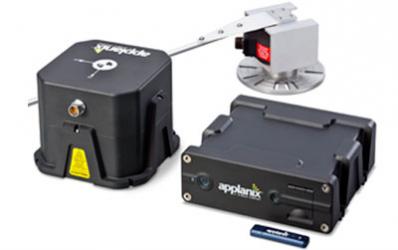
Applanix, a mobile mapping and positioning company, has introduced new versions of its positioning and orientation systems for airborne and land-based mapping — the POS AV 610 and POS LV 610. Delivering the same industry-leading performance as previous versions of POS AV and LV, the new systems use next-generation commercial inertial technologies that are offered globally.
Applanix POS AV and LV products integrate precision GNSS with advanced inertial technology (accelerometers and gyroscopes) to provide uninterrupted measurements of the position, roll, pitch and true heading of moving vehicles. Geospatial projects using POS can be completed more efficiently, effectively and economically. The POS AV 610 and POS LV 610 offer new advantages to customers:
Global availability: commercial technology.
Smaller and lighter: achieved by integrating a new state-of-the-art FOG (Fiber Optic Gyro) based Inertial Measurement Unit (IMU).
Exceptional performance with Applanix SmartCalTM software: SmartCal is a new compensation technology designed to achieve unrivalled performance from IMUs manufactured specifically for mobile mapping applications.
Cost efficiency: exceptional accuracy, even in demanding conditions, at unprecedented price points.
POS LV 610 and AV 610 are also available to systems integrators in the form of an OEM board set called the Trimble AP60. The Trimble AP is a series of embedded GNSS-Inertial OEM boards that provide both continuous mobile positioning in poor signal environments and high-accuracy direct georeferencing of imaging sensors. The AP series is ideal for a variety of commercial mobile positioning and orientation applications including airborne and terrestrial mapping and guidance for unmanned vehicles.
“The latest versions of POS LV and POS AV take Applanix’ state-of-the-art positioning technologies worldwide for land and air applications,” said Steve Woolven, President of Applanix. “Wherever mobile mappers operate, the new POS technology provides users with accurate, reliable and robust position and orientation solutions.”
POS AV 610, POS LV 610 and Trimble AP60 are available now through the Applanix sales network.
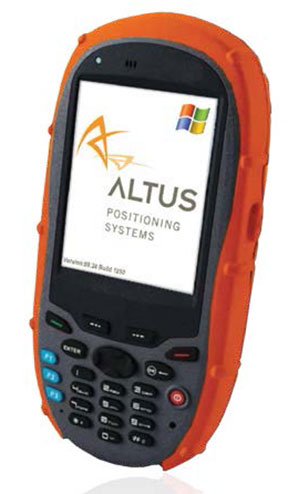
Altus Positioning Systems is expanding its line of GNSS surveying products with the introduction of the GIS-1, a versatile personal digital assistant (PDA) for data collection and geolocation.
The GIS-1 is a powerful PDA that integrates modern wireless technologies on a rugged Windows Mobile platform for effective portable computing for mobile survey applications. It can be used as a data collection device with Altus’ APS-series GNSS survey instruments, providing up to eight hours of operation time in the field between charges. In addition, the unit’s built-in L-1 GPS receiver and 3.2 megapixel camera can be used for navigation and GIS applications. It can even be used as a smartphone.
“The GIS-1 is a versatile tool for surveyors and GIS professionals,” said Neil Vancans, president of Altus Positioning Systems. “With the Windows Mobile operating system, it supports a wide range of software applications for data collection. By itself, the GIS-1 is a convenient low-cost GPS navigation device with 2.5-meter accuracy.”
“It’s ideal for GIS work,” Vancans added. “The user can quickly and easily locate assets with 2.5-meter accuracy with the GIS-1, then switch to the APS-3 for more precise RTK work if needed.”
The GIS-1 supports a wide range of wireless options, including Wi-Fi, Bluetooth and a Tri-Band GSM/GPRS/EDGE/HSPA cellular modem.
According to a new research report from the analyst firm Berg Insight, the number of active fleet management systems deployed in commercial vehicle fleets in Europe was 3.05 million in Q4-2012. Growing at a compound annual growth rate (CAGR) of 16.0 percent, this number is expected to reach 6.40 million by 2017. A group of international aftermarket solution providers have emerged as the leaders on the European fleet management market. Masternaut is ranked as the largest player overall in terms of installed base with close to 287,000 units deployed today. TomTom Business Solutions was the fastest growing vendor also in the past year and has now surpassed 275,000 subscribers in this region. Digicore and Trimble have also joined the exclusive group of fleet management providers in Europe having more than 100,000 active devices in the field. Transics is number one in the heavy trucks segment with an estimated 80,000 active units installed.
A major trend in the past two years has been the announcements of standard line fitment of fleet management solutions. Since the end of 2011, Scania is rolling out the Scania Communicator as standard on all European markets and includes a four-year basic service subscription. The new generation of the Actros trucks from Mercedes-Benz contains the FleetBoard vehicle computer as standard in all EU27 countries since October 2011. Volvo is going in the same direction offering Dynafleet as standard in Europe. MAN TeleMatics is since July 2012 standard on the new truck model TGX EfficientLine.
A second wave of M&A activities started in 2013 after 18 months of lull. “Six major mergers and acquisitions have so far taken place this year among the vendors of fleet management systems in Europe”, said Johan Fagerberg, Senior Analyst, Berg Insight. Danaher Corporation is betting on the fleet management market and acquired Navman Wireless and Trafficmaster from Prairie Capital and Vector Capital respectively. TomTom made its second acquision in the fleet management space when picking up Coordina headquartered in Spain. The latest transaction was done in September 2013 when Oskando and Autolog merged and at the same time launched the new brand EcoFleet. Mr. Fagerberg anticipates that the market consolidation of the still overcrowded industry will continue in 2014.
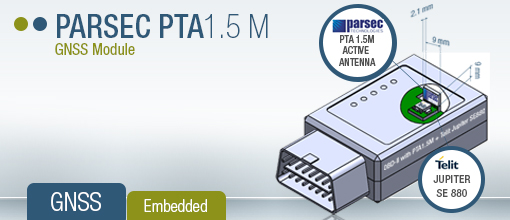
The Parsec PTA and PT active and passive antenna modules integrate seamlessly with the Telit Jupiter SE880 GPS receiver for market leading location aware applications in performance and miniaturization.
The PTA/PT family delivers best-in-class linearity in the third-order-intercept point (IP3), the measure of a receiver’s critical ability to differentiate signal from noise. All PTA and PT antenna modules are based on Parsec’s family of low noise amplifier (LNA) integrated circuits (ICs).
The antennas are designed for embedded LBS receivers requiring good user experience that operate with obstructed view of orbiting satellites. The PTA1.5M improves GNSS receiver sensitivity to offset high path loss, improves immunity to receiver descending caused by close proximity radio transceivers, and mitigate the effects of interference from radio mixing products.
ORBCOMM Inc., and Savi Technology have announced a strategic relationship to provide advanced location-based monitoring solutions to government and commercial markets.
ORBCOMM is a global provider of machine-to-machine (M2M) solutions, and Savi Technology is a provider of sensor-based analytics and radio-frequency identification (RFID) solutions.
ORBCOMM and Savi have submitted a proposal in response to the U.S. Army RFID IV project, which will provide both ISO18000-7 RFID tags and a suite of satellite solutions for military logistics support. ORBCOMM’s GlobalTrak division has been a leading player in providing military Enhanced-In-Transit-Visibility (EITV) solutions to the government market since 2008, and Savi has been a market leader in military RFID solutions, enabling it to offer vast market experience with the right blend of technology platforms for this proposal.
“The combination of ORBCOMM’s satellite expertise and broad network service portfolio with Savi’s state-of-the-art RFID technology offers a full spectrum of innovative monitoring solutions to our collective market base with focus on our government and international customers,” said Marc Eisenberg, Chief Executive Officer of ORBCOMM. “Although RFID and satellite tracking have traditionally been divergent technologies, the synergy of these solutions within a common operating environment creates a seamless transition from infrastructure to wireless-based location services for tracking and monitoring high-value assets.”
“By bringing two market leaders with highly complementary technologies together, we have created a best-of-breed solution for our customers in both government and commercial markets,” said Bill Clark, chief executive officer of Savi Technology. “This relationship will support Savi’s operational analytics capabilities by providing additional ways to collect critical data and deliver timely and reliable operational intelligence to our customers. We look forward to partnering with ORBCOMM on RFID IV and other global opportunities in the near future.”
Parsec Technologies, Inc., today announced that the company’s Micro-Mini PTA/PT family of GNSS/GPS receiver modules seamlessly integrates with the Telit Wireless Solutions Jupiter SE880 three-dimensional system-in-a-package (3D-SIP) to enable what it calls the world’s smallest- to-date, commercial-class, low-cost GPS L1 receiver.
By combining a PTA/PT family module with the Jupiter SE880 3D-SIP, OEMs and integrators are able to deliver a location-based service product with a GPS L1 receiver in a landed form factor of 20 x 20 x 6 millimenters, or 20 x 10 x 6 millimeters, depending upon component orientation. This contrasts with landed GPS receiver sizes integrating a passive ceramic patch antenna that measure 25 x 25 millimeters, and which Parsec says don’t match the GNSS/GPS frequencies in performance despite being four times the surface area.
With the Parsec/Jupiter combination, integrators can design LBS-critical products with exceptional user experience in applications with severe use, such as obstructed satellite view and high path loss, including indoors, urban canyons, wearables, smart watches, vehicle under-dash on board diagnostics (OBD) devices, metal containers and aircraft fuselage asset tracking, and M.2/next-generation form factor (NGFF) products.
Receivers combining Parsec PTA/PT Family and Telit Jupiter SE880 modules deliver good user experience in finished LBS critical products without sacrificing design flexibility, ease of implementation, or cost, Parsec said. The combination is fully vetted and “bulletproof” in providing a rewarding design experience making RF work reliably, passing end-product regulatory compliance testing without re-test.
According to Michael A. Neenan, CEO and founder of Parsec, customers are future-proofing their LBS critical products when they select a Parsec PTA/PT family for integration with the Telit Jupiter SE880 3D-SIP. PTA/PT family modules receive and amplify any GNSS system signal from 1560 to 1610 MHz, including GPS L1/L1C, with high radiated efficiency in any end product orientation.
Telit Jupiter SE880 reference design kits will soon be equipped with the Parsec PTA/PT family module. OEMs and integrators can order GPS L1 receiver solutions today.
The PTA/PT family of GNSS/GPS receiver Micro-Mini modules extends Parsec’s decade-long tradition of stretching the state-of-the-art in small size, ultra-linearity, miniscule energy usage, high gain, low noise, Any Voltage operation, Field-and-Forget reliability, low cost, and ease of integration/use.
XRS Corporation, a mobile trucking intelligence company, has announced that Verizon is the official wireless provider for its new collaboration with Samsung Telecommunications America. The new product — NXT — creates what XRS says is the first integrated mobile device and software package designed specifically for the trucking industry.
The new solution brings together powerful XRS compliance and performance tools with Samsung Mobile’s devices, XRS said. Now, NXT is powered by the Verizon 4G LTE network, which provides the platform with superior performance and speed.
“Technology forces in the trucking industry have long been on converging paths, and our new NXT product — powered by XRS in collaboration with Verizon and Samsung Mobile – is a perfect example of how our industry is harnessing the power of technology to benefit drivers and fleet managers,” said Christian Schenk, senior vice president, XRS Corporation. “An integrated platform is the next evolution of convergence, and we are proud to be working with industry leaders like Samsung Mobile and Verizon to deliver the ultimate trucking intelligence solution.”
NXT allows drivers and fleets to purchase select Samsung Mobile devices with an XRS trucking intelligence software subscription and ready for activation on the Verizon 4G LTE network. The first device available is the Samsung Galaxy Tab 7.0, priced at a $100 discount from its suggested retail value. The data plan and subscription cost is $54 per month, including $39 for the monthly XRS fee and $15 for the monthly wireless data fee. This charge covers all required subscriptions and data, including the Relay onboard hardware component, as well as FLX messaging, hours of service, electronic DVIR, IFTA state mileage reporting and more.
“With the explosive growth of mobile electronic devices in the trucking industry, drivers have come to expect reliable and fast wireless service while they are on the road,” said Michael Toto, director of alternate channels for Verizon Enterprise Solutions. “This solution is one example of how Verizon is investing in the success of our channel partners as we collaborate to bring new innovative solutions to the market.”
NXT also offers integration with many enterprise transportation products. Over time, the platform collaboration will expand to introduce additional components, including MDM and wearable products.
The XRS trucking intelligence platform operates in both over-the-road and private carrier configurations, and is suitable for fleets of all sizes. XRS runs on certified smartphones, tablets and rugged handhelds that transmit vehicle and operator data through the cloud to a fleet management dashboard, helping companies to comply with current regulations and soon the pending Electronic Logging Device (ELD) mandate for electronic recording of a driver’s hours-of-service. Nearly 90 percent of drivers already use mobile devices while on the job.
NXT was developed through the Samsung Solutions Exchange, a newly announced strategic engagement model from Samsung Mobile that delivers a range of end-to-end solutions that address real world business challenges. The program is aimed at achieving shared value across Samsung Mobile’s rapidly growing ecosystem of enterprise customers, sales channels and alliances.
“NXT is a holistic solution for trucking that addresses performance, safety, and compliance challenges unique to the industry,” said Tim Wagner, vice president and general manager, enterprise business unit – Samsung Mobile. “Through the Samsung Solutions Exchange, we have worked closely with XRS and Verizon to enable a solution that leverages our respective strengths – which for us includes our robust suite of enterprise-grade devices.”
Customers can buy the NXT product either directly through Verizon or through XRS.
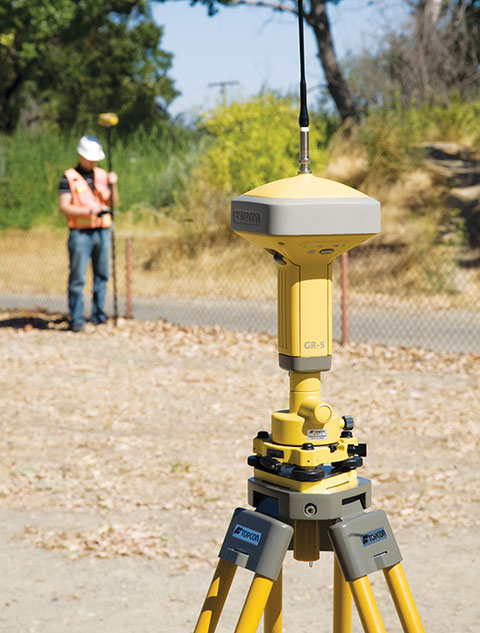
Topcon Positioning Group has released the GR-5 receiver with Vanguard technology, designed to optimize tracking and performance.
“The GR-5 is a next-generation GNSS receiver, built on multi-constellation integrated technology pioneered by Topcon,” said Scott Langbein, director of product marketing.
“Now with the inclusion of Topcon’s exclusive 226-channel Vanguard technology with Universal Tracking, and the power of full-wave Fence Antenna technology that provides multipath rejection in difficult environment, the GR-5 operates with unsurpassed sensitivity, tracking accuracy and performance.”
In addition to Universal Tracking, Vanguard technology includes Quartz Lock Loop for signal processing in heavy vibration applications and Intelligent Tracking Optimization to select the best combination of available satellite signals.
“At any time, end-users can track all available satellite signals and be assured of getting accurate measurements regardless of environmental conditions,” Langbein said.
Additional features of the GR-5 include:
Cellular and radio: The GR-5 has both cellular and radio communications, which allows it to be used in radio-based RTK and network RTK systems;
Long-range UHF radio: The top-mounted radio antenna extends the range of RTK radio performance;
Operating time: GR-5 hot-swappable batteries are designed for full-day operation;
MAGNET Field: MAGNET Field software can be used with the GR-5 RTK system, providing the ability to share data to cloud storage and connect field crews to each other and the office.
According to a new report by Research and Markets, the winners in making and operating mobile phones will offer the most compelling new functionality, IPS being a major enabler. The winners in making, integrating and operating RTLS will reduce cost and improve usefulness, not least to encompass mobile phones and other mobile computing. The world’s largest companies are locking horns on this.
The term Indoor Positioning Systems (IPS) primarily concerns location-based services on mobile phones where GPS does not work. The term Real Time Locating Systems (RTLS) primarily concerns locating people and things at a distance, securely, using second generation RFID. The subjects are converging with Apple, Samsung, Google, Nokia, Microsoft, Hewlett Packard and IBM clashing for the tens of billions of dollars of business that is emerging.
This subject heavily involves short range communications, notably Wi-Fi and Bluetooth, and inertial navigation and advanced RFID as it progresses to determining 3D position including orientation and line of travel. Emergency services, healthcare, retailing, manufacturing, logistics and many other industries will be transformed by what is becoming possible, Research and Markets said.
The topics of IPS and RTLS embrace a value chain from research and consultancy to software, services, hardware, integration and facilities management. Mobile phone app developers and value added enhancements plus ecosystems of mobile phones, web services and more are also involved.
Most of the development and use is in the USA, but other territories are racing to catch up. For example, the new Indoor Location Alliance came from Europe but has global players and companies, such as Samsung in East Asia, and is taking an exceptionally broad view from new phone design to RTLS in smart cities. Siemens in Europe and several Japanese and U.S. companies seamlessly integrate GPS outdoor navigation and services with IPS and RTLS.
This report consists entirely of evidence-based analysis following seven years of conferences, masterclasses and reports on the subject produced by the PhD level IDTechEx analysts and team.
The main features of the report, which is continuously updated, are the following:
Ten year forecast of the RTLS market 2014-2024, platform hardware vs system integration/services.
Full explanation of what IPS and RTLS are and how these technologies are evolving and converging, with detailed, original graphs and diagrams, largest orders landed and lessons arising. Threats, opportunities and company strategies are revealed.
Comparison of 105 organisations in the IPS/ RTLS value chain by country, basic measuring principle, standards, frequencies, protocol, range, accuracy, applications targeted and background information. Pie charts and graphs give analysis by parameter.
Comparison of 74 case studies of RTLS with many pie charts presenting the lessons arising.
Detailed original interviews carried out from mid 2013 with important organisations in this space.
Glossary of the challenging jargon, which is different between IPS and RTLS yet often refers to the same or similar things.