Spectra Precision introduced at Intergeo this week new and updated products to expand its portfolio of solutions addressing the needs of the mainstream surveying and construction markets. Intergeo 2013 is a geodesy, geoinformatics and land management trade event being held in Essen, Germany.
“Earlier this year, we introduced a new reflectorless entry-level total station, the lightweight ProMark 700 RTK Network Rover and the Layout Pro construction layout software suite. With our latest additions, the Spectra Precision portfolio continues to evolve to meet the changing needs of our users,” said François Erceau, general manager of Spectra Precision’s GeoInstruments Business Unit. “Spectra Precision now offers one of the broadest and most complete portfolios of survey and construction products in the industry — from construction lasers and total stations to survey GNSS receivers and GIS handhelds — all from a single supplier that customers can trust.”
New and updated Spectra Precision products include:
Spectra Precision EPOCH 50 firmware 4.81 –now supports RTK positioning using the Chinese BeiDou open service GNSS satellite signals. Adding the BeiDou constellation to the full range of GPS and GLONASS signals already tracked by EPOCH 50 further boosts the capabilities of this GNSS receiver to enable faster initialization and performance, even in conditions where satellite visibility is obstructed due to tree canopy or tall buildings.
MobileMapper 120 Decimeter Edition –this new kit, based on the MobileMapper 120 handheld GNSS receiver, includes the Flying RTK, GLONASS tracking and NTRIP correction options. With accuracy of 20cm or better, the Decimeter Edition kit is a competitively priced solution for precise Mobile Mapping applications.
ProFlex 800 firmware version 1.9 – now supportsGLONASS-only mode and tracking of QZSS signals to meet the needs of specific markets (Russia and Japan, respectively). This updated firmware also improves RTK performance in VRS networks, particularly in challenging GNSS environments, through Z-Blade technology enhancements.
Layout Pro Field and Office software – a recent release of the Layout Pro field software added support for the FOCUS 30 Robotic Total Station, offering the highest level of productivity and accuracy in a construction layout solution. The Layout Pro version 2.1.1 update now includes language packs for major markets worldwide, in addition to many other minor enhancements. Customers with a current Layout Pro maintenance agreement are eligible to download this update from www.spectraprecision.com.
Survey Basic software for total stations – further enhancements to this entry-level software application make for the simplest starting point, with workflows that mirror the familiar Nikon-style FOCUS 6 user interface in a modern full-color touch-screen instrument (FOCUS 8). Further language packs have been added, including Czech, Traditional Chinese, Korean and Polish.
Survey Pro Field software version 5.4 – the latest release of this award-winning survey field software includes many new features and enhancements such as:
Updated Digital Terrain Model (DTM) features and interface
Support for new GNSS constellations and an improved GNSS workflow
Additional Active Map enhancements that make it easier than ever to work directly from the map screen
Updated point staking routines and a new interface for building design point lists
A new Plane and Vertical Angle Offset routine
A new electronic compass display in various map screens
Enhanced total station and GNSS setup routines
An improved Code/Description entry and display system
Customers with a current Survey Pro maintenance agreement are eligible for this update and can download the software from .
Spectra Precision Survey Office software v3.10 and v2.95 – both versions are companions to Survey Pro 5.4 field software and FAST Survey field software, and offer enhanced baseline processing with more reliable outlier detection and improved accuracy statistics. Additionally, version 3.10 features a new customized ribbon UI and is optimized for 64-bit PCs (with notably faster processing).
These new and updated Spectra Precision products are now available for order through the Spectra Precision global reseller network.
u‑blox has announced the launch of its newest core positioning platform, the u-blox M8. The new chip forms the basis of u-blox’ upcoming line of positioning modules, which are able to acquire and track different satellite systems concurrently to achieve higher accuracy and reliability.
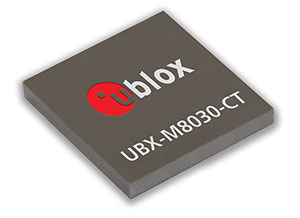
Supporting all deployed as well as upcoming GNSSs, the platform is based on the UBX-M8030 concurrent multi-GNSS receiver IC which is able to track American GPS, European Galileo, Japanese QZSS, Russian GLONASS, and Chinese BeiDou satellites.
Concurrent tracking of GPS (QZSS) and GLONASS or BeiDou, or concurrent tracking of GLONASS and BeiDou satellites increases performance for applications requiring maximum availability and accuracy. The chip is prepared for the European Galileo system through a future firmware upgrade once the constellation is fully available.
The new platform will ultimately support special functions such as Automotive Dead Reckoning and precision timing to support a wide variety of vehicle, industrial and consumer applications.
To further improve acquisition performance, u-blox’ globally available “AssistNow”assisted-GNSS service for accelerated positioning has been extended for u-blox M8 products; the service supports both GPS and GLONASS, and the validity of downloaded assistance data is now able to support offline operation for up to 35 days.
“With the proliferation of multiple new GNSS systems beyond GPS, our u-blox M8 platform is designed to take full advantage of the increasing number of visible satellites to further increase accuracy and availability, particularly in urban and vehicle-based applications,” said Daniel Ammann, executive vice president, head of the Positioning Product Centre, and co-founder of u-blox, “At the same time we realize the ongoing requirement for extremely low-power and cost-sensitive portable applications where operation with a single GNSS system is more than sufficient. That is why we will continue to offer both u-blox M8 and u-blox 7 based products to the market.
The new u-blox M8 chip is at the heart of u-blox’ next generation of positioning modules based on the company’s popular MAX, NEO and LEA module form factors.
u-blox M8 chips feature low power consumption in concurrent reception mode, thanks to an innovative single-die architecture combined with sophisticated software algorithms. The extended supply voltage supply range and 1.8 V/3.0 V I/O compliance supports a wide variety of system architectures. Sophisticated radio architecture and interference suppression using active jamming detection ensure maximum performance even in GNSS hostile environments. UBX-M8030 chips are available in miniature WL-CSP (2.99 x 3.21 x 0.36 mm) and QFN (5.00 x 5.00 x 0.59 mm) packages. The chip is also available in automotive quality grade according to AEC-Q100.
The new platform maintains backwards compatibility with u-blox 7 modules and QFP chip products which remain in the company’s portfolio as the industry’s lowest power standalone satellite positioning receivers. u‑blox’ capability of delivering GNSS technology in both integrated circuit and form-factor consistent modules provides maximum design flexibility and protects customers’ development investments over successive product generations.
First samples of the multi-GNSS receiver chip UBX-M8030 are available for customer evaluation. Soon, module customers can easily migrate to the MAX, NEO, and LEA form factors, u-blox’ popular, industry-standard module form factors.
Leica Geosystems Inc. today announced that Tuck Mapping Solutions Inc. has completed the first integration of a Leica RCD30 airborne camera with the Applanix POSTrack system. With technical support from Leica Geosystems and Applanix, Tuck Mapping contracted Lead’Air Inc. of Kissimmee, Florida, to perform most of the software upgrades and new cabling required to integrate the Leica digital camera with the POSTrack all-in-one GNSS-aided inertial direct georeferencing and flight management system.
The Leica RCD30 is a true metric camera built for mapping. Introduced by Leica Geosystems as a digital follow-on to its RC30 film cameras, the RCD30 is a medium-format digital imaging system developed for a variety of photogrammetric and remote sensing applications. The 60 MP single-camera-head design delivers co-registered, multispectral imagery in the Red, Green, Blue and Near IR portions of the spectrum. The sleek modular design allows the camera to fit easily in aircraft previously outfitted with film cameras, and the RCD30 integrates with many LiDAR sensors, including the Leica ALS series.
For the many current owners of the POSTrack system, the availability of integration by Lead’Air makes the Leica RCD30 a more affordable and attractive choice among medium-format digital cameras. When buying a new Leica RCD30, POSTrack owners do not have to purchase the Leica flight management system, train flight crews in the use of multiple interfaces, and install redundant equipment in their aircraft.
“The integrated systems enable our flight crews to operate the Leica RCD30 and a third-party LiDAR sensor with a single flight management interface,” said Tuck Mapping President, Bobby Tuck. “In addition, POSTrack collects the GNSS location and Inertial Measurement Unit (IMU) attitude data needed to georeference the imagery and LiDAR data sets.”
Based in Big Stone Gap, Virginia, Tuck Mapping is a photogrammetric services and aerial mapping firm with a reputation for engineering innovative solutions related to geospatial data collection. Tuck was among the first aerial mappers to use a helicopter for LiDAR scanning operations, and more than a decade ago the firm took the lead in successfully integrating an airborne camera and LiDAR sensor for simultaneous collection. Tuck Mapping owns four POSTrack systems, three helicopters, two fixed-wing airplanes, and state-of-the-art airborne cameras and laser scanners.
“Bobby Tuck deserves credit for driving the integration of the Leica RCD30 with the POSTrack system,” said Jean Gardiner, General Manager of Leica Geospatial Solutions. “From a business perspective, Leica believes that supporting the compatibility of our products with other manufacturers’ products is an integral part of providing solutions to our clients.”
“This joint integration project exemplifies the maturity of Leica and Applanix,” said Joe Hutton, Applanix Director of Inertial Technology and Airborne Products. “It’s a natural progression of good customer support.”
Jointly developed by Applanix and Track’Air, the POSTrack product integrates the Applanix POS AV direct georeferencing technology, utilizing GNSS and IMU components, with the XTRACK Flight Management System software from Track’Air into a single, compact package. POSTrack provides direct georeferencing for airborne mapping sensors, mission planning, real-time sensor control and pilot guidance.
Lead’Air, a subsidiary of Track’Air, specializes in integrating the Track’Air flight management systems with any airborne camera or LiDAR sensor. Now that the first Leica RCD30/POSTrack integration has been completed for Tuck Mapping, Lead’Air offers this integration as a commercially available service.
Many may consider it a distinction without a difference, but quality matters, whether it concerns a life-changing decision or something as simple as which conference to attend. When resources are scarce, making the right decision, or sometimes just making any decision, matters — for many in our government this paradigm should reign supreme.
Over the past 24 months, it seems there have been more conferences and symposia that depend on government attendees cancelled or postponed than there have been quality events to attend. Politics aside, the U.S. government’s fiscal woes, which include sequestration and the latest partial U.S. government shutdown, are merely endemic of a much greater problem. Decision makers are unable to make decisions, negotiate or even consider compromise, and the last time I checked, decisions, indeed quality decisions, are critical to the success of any endeavor, be it government or business.
More than 2500 years ago, Pythagoras (yes the Pythagorean Theorem mathematician) said “Choices are the hinges of destiny,” and make no mistake about it, the decision to not make a decision or the inability to act is still in the end a decision, just not an action or non-action of which one should be proud. And this inability to make a decision still affects your destiny today or our destiny where Congress is concerned. William James may have been thinking about the U.S. Congress when he said, “When you have to make a choice and don’t make it, that in itself is a choice.” Actually, my secretary summed it up nicely, extolling her frustration with our do-nothing Congress, “…in the end if I conducted myself as your employee the way Congress has conducted their affairs for the last 24 months, I would no longer be in your employ. You would have fired me long ago.”
Fortunately, for the rest of the world, there are people who seem capable of making momentous decisions on a daily basis — imagine that. And despite what the entrenched U.S. Congress doesn’t decide, the world does go on, even as the somnolent U.S. government shuts down and irrationally decides not to allow government employees and the military to attend critical conferences or symposia. Since Congress can’t do anything, it appears they want to mandate that everyone else emulate their indecisiveness. Despite the governmental ennui, there are some bright spots. In the last two months I had the pleasure of attending two separate conferences concerning GIS, GPS, GNSS, and PNT respectively that I highly recommend for your consideration. As I said earlier, quality matters, and both of these conferences have quality in abundance, especially in the areas of planning, presentations, location and attendees.
GeoGathering
As the comfortable, casual name implies, GeoGathering 2013 was more of a gathering than a full-blown mega conference, but then, that is also what sets this event apart. Especially from the National Space Symposium, which also takes place in Colorado Springs at a major resort but which draws more than 10,000 participants.
GeoGathering 2013 managed to gather ~150 GIS participants from around the globe, and in its own way was just as informational as many larger events. The four-star venue was outstanding, as the Cheyenne Mountain Resort has always been a laid-back location with restaurants and ambiance almost second to none. GeoGathering played out comfortably, with little stress, over two days, 21-22 August, during which the Rocky Mountain weather graciously cooperated.
The event was subtitled “GIS for Gathering and Production Lines,” which simply means it was primarily about gathering and using GIS data and meta-data successfully in a business environment. If that sounds a bit dry, in actuality it was a wonderful conference, since the prime ingredient for any successful conference is the people and the venue. Both were outstanding. The networking time between speakers and panels made for a very productive two days. I highly recommend this conference for those interested in anything to do with GIS (geographical information systems). GeoGathering 2015 will be held somewhere in Colorado, and right now you can influence that decision by going to the GeoGathering website and voting on a location. See you there.
ION GNSS 2013
Institute of Navigation Global Navigation Satellite System Symposium
The first question I typically hear when I mention the acronym GNSS in a non-PNT-oriented crowd is “What is GNSS?” GNSS stands for Global Navigation Satellite System(s), and is the standard generic term for satellite navigation systems that provide autonomous geospatial positioning, and sometimes time and frequency data, with global and/or regional coverage. This oft-used term has expanded to include GPS, GLONASS, Galileo, BeiDou and other regional or global PNT systems. And for me, there is no better global technical GNSS event than the annual ION GNSS symposium. For the last two years, with an attendance figure of about 1,000 per year, this seminal event has been held in Nashville, Tennessee. Next year and the following year, ION GNSS moves to Tampa, Florida, the home of our elite military special forces.
If you would like the bottom line up front, several years ago I penned a review of the ION GNSS event and it went something like this: “The ION GNSS Symposium is simply the best international technical symposium on GNSS that exist today, bar none.” Frankly, my opinion has not changed. The GNSS symposium has not changed in quality, even though the U.S. military participation has dwindled significantly due to circumstances detailed earlier in this column, but in many ways the symposium continues to improve.
The venue for the last two years was the Nashville Convention Center in Nashville, Tennessee — or Music City, as those of us in the U.S. know it — and it was a great location. This year, there were also FOUO sessions, which were extremely interesting, but because of the classification, I cannot say much more in this medium. The FOUO sessions were essentially a hold-over from the ION Joint Navigation Conference (JNC) event that was canceled earlier in the year due to the last-minute lack of participation by government participants. However, Lisa Beaty, the executive director for ION, assured me that the JNC 2014 event will take place come h*** or high water.
The new ION Military Division, which is headed by my long-time friend and colleague Jim Doherty (USCG, Ret), a former president of ION, now sponsors the Joint Navigation Conference, which is billed as the largest U.S. military navigation conference with joint service and government participation. The event focuses on technical advances in guidance, navigation, and control (GN&C) with emphasis on joint development, test and support of affordable GN&C systems, logistics and integration.
ION describes the JNC event as a conference that includes technical exhibits that showcase guidance, navigation and control technology products and services as well as operational products and demonstrations. With a decidedly operational perspective, the conference focuses on advances in battlefield applications of GPS, critical strengths or weaknesses of fielded navigation devices, warfighter PNT requirements and solutions, and navigation warfare.
As I mentioned, JNC is the annual ION event that normally features the FOUO U.S.-only presentations. Next year, ION JNC conference attendance June 16-18, 2014, is controlled by the Joint Navigation Warfare Center (JNWC) and is restricted to U.S. citizens only. The classified sessions on June 19, which typically feature a warfighter panel, which I have had the honor to help populate for the last several years, will feature 4-eyes access for citizens of the U.S.A., Australia, Canada and the United Kingdom. All participants must establish a need to know and be approved by the Joint Navigation Warfare Center security office. The 2014 Joint Navigation Conference takes place at the Renaissance Orlando at SeaWord in Orlando, Florida.
But that is JNC next year and I digress, so let’s get back to this years ION GNSS symposium. The amazing feature of this event is that you can literally attend a presentation on any aspect of GPS/PNT that you can name. For example, I wanted to attend specific presentations on: GPS time, PNT frequency stability, PNT atomic reference systems, L2C, L5, AEP, OCX, L1C, M2PS, and M-code, as well as jamming and spoofing mitigations. The problem, of course, is that there are numerous presentations on these topics, and many of them occur simultaneously. You have to carefully plan your time, and I frequently found myself, along with many others, sprinting from presentation to presentation. I did not want to miss anything, and I can truthfully say there are very few conferences where this is the case. The ION Papers Committee does a great job screening the papers and making sure they are relevant.
Plus, one of the best perks of being an official ION member is that, in case you miss a presentation, the symposia papers are all available online at the ION site within just a few days of the event.
Don Jewell visits the Exelis table at the GPS World Leadership Dinner.
Galas and Awards
The after-hours highlight of the ION GNSS event every year is the GPS World Leadership Dinner or gala, which includes the GNSS Leadership Awards. Only 150 guests may attend, by invitation only, because there are typically more than 1,000 attendees at ION GNSS. This has become one of the “must-attend” events. This year, both Exelis and Lockheed Martin sponsored the dinner along with GPS World, and we are grateful for their sponsorship. Each GPS World editor nominates 10 guests, so be nice to your favorite editor this year and, who knows, maybe you will be among the elite next year (hint, hint)!
The GPS World 2013 Leadership Awards.
This year, as last, the gala was held in the sumptuous ballroom of the Hermitage Hotel in Nashville, which was built in 1910, exudes Southern charm, and is dedicated to General and President Andrew Jackson, a true son of the South. Harking back to our earlier theme concerning decision-making, President and General Andrew Jackson made many difficult decisions in his tenure and one of his greatest quotes certainly applies:
“Any man worth his salt will stick up for what he believes right, but it takes a slightly better man to acknowledge instantly and without reservation that he is in error.” — Andrew Jackson
And if you can’t quite remember your history, just pull out a $20 bill and there he is.
The food and camaraderie were outstanding as usual. The evening’s entertainment, which is always provided in the form of an original Alan Cameron game that has dinner guests participating in a novel event, this year was based on a clandestine “spoofer” at each table that had to be identified by Q&A only. It was a fine and fun evening, and for the award winners, it was a special evening. Four awards were given this year, to Satoshi Kogure, Attila Komjathy, Peter Grognard and my good friend Per Enge from Stanford. Congratulations to all the award winners — you never know, you could be a guest or an award winner next year. (A full report on this year’s dinner and awards will appear in the December issue of GPS World.)
ION Kepler Award
ION GNSS also presents prestigious awards at this event. This year, the coveted Kepler Award went to a good friend and colleague Dr. John Betz.
Dr. John Betz, winner of the ION 2013 Kepler Award.
Now, the ION GNSS awards committee keeps the name of the award winner totally secret, in a mayonnaise jar on Funk and Wagnall’s front porch. No wait, that’s another award, but they do keep it a closely held secret — so close, in fact, that this year’s award winner’s wife was not in attendance, even though she made the trip with him. So, while I had no idea who would win, I did happen to be sitting at Dr. John Betz’s table, right across from him, when the hints were announced by Dr. Jade Morton, the ION Satellite Division Chair and therefore also the luncheon and award master of ceremonies.
You see, there is a long-held presentation tradition associated with this award. No one knows who has won the award, but the announcement is not just blurted out. Rather, there are about ten hints given about the identity of the person. As the identify of the winner becomes apparent to those in the room, they are asked to stand up, signifying they have determined the identity of the award winner. It was clear to me who had won with the first hint, and of course it was clear to Dr. Betz as well. It was very interesting to watch his facial expression as he realized he had finally won. It dawned on him, and then there was a slight smile, but at the same time a very humble expression.
Dr. John Betz, a MITRE and ION Fellow, certainly deserves this award, and indeed, has deserved it for some time, so it was great to see his considerable accomplishments recognized. And, BTW, remember that you heard it here first: John is working on a book about GNSS that should be published in the next six months. It is not an edited volume, but rather an original work by Dr. Betz, and I for one can’t wait to read it. You can bet I will review it here at GPS World. Congratulations, John.
The other outstanding features of ION GNSS are the excellent and numerous exhibits, plus the time allowed between sessions that provide an excellent atmosphere for networking. And the excellent Nashville Renaissance Hotel, which is attached to the Nashville Conference Center, provided numerous quiet and semi-secluded locations for extemporaneous meetings and is a networking friendly location. The restaurants were excellent, as was the ubiquitous Starbucks barista-manned coffee shop located in the hotel. In other words, Lisa Beaty and her team always manage to choose an event location with accommodations and amenities perfect for this event. I am looking forward to next year in Tampa. Hope to see you there.
What Is Don Reading?
Both books reviewed this month came to my attention because, contrary to the old adage, I was able to tell a good book by its cover.
Phantom, by John Bell.
Phantom An Adventure Novel by Ted Bell
This is a singular novel, frighteningly prophetic in many respects and virtually unprecedented in the multitudinousgrappling-hook approach employed to entice the reader. This is not a criticism, merely an observation, as I obviously thoroughly enjoyed the yarn.
Many novelists “set the hook” by using the old standby, “It was a dark and stormy night…the wind howled, lightning flashed.” Many novelists hook you with rollicking train stories, or Romanoff tales of excruciatingly frigid White Russian winters with Tsars, Tsarinas and Tsarvitches. They hook you with stories of beautiful bounding yachts or fancy racing cars. Or, in the late Tom Clancy style, they hook you with stories of Air Force One and the president versus terrorists, or of course the most modern genre hook concerns terrorism in any guise. In Phantom, Ted Bell does not pick just one of these hooks, he includes them all and more. It is a riveting high-action drama that will keep you turning pages late into the night. The cherry on top of this action-filled sundae of a novel is that the story is really about Singularity (with a capital S), which Ted Bell and many computer scientists today define as “that epic moment in human evolution when artificial, or machine, intelligence (in the form of extremely powerful, superhuman computers) first matches and then exceeds human intelligence by a factor incalculable.”
Author Ted Bell.
In other words, this novel is about all the hooks mentioned, plus it foretells a time when computers obtain parity with and then rapidly exceed human intelligence. Now, if that is not a hook, I don’t know what is. If you are wondering how Ted managed to pull it all together, you will just have to read the book. You won’t be disappointed.
Remember, I was hooked by the cover, and it was not the picture of the beautiful yacht on the cover but rather the quote: “Ted Bell can really write” by James Patterson. Hook, line and sinker.
West with the Night, by Beryl Markham.
West With the Night An Autobiography by Beryl Markham (1902-1986)
The aviation enthusiasts among you may be scratching your heads and thinking, “Wait a minute, where have I heard the name Beryl Markham?” Beryl initially gained fame and notoriety not as a novelist but as a Kenyan-born British aviatrix in the tradition of Amelia Earhart. Indeed, Beryl was the first solo aviatrix to fly the Atlantic eastbound in the pioneering days of aviation. She was also an adventurer and renowned (the first female) racehorse trainer in Kenya, or in all of Africa, for that matter. She married three times, conducted numerous affairs, and was anything but conventional in most every aspect of her life. And, of course, she could write, and write very well. Many of her thoughts are so riveting and presented in such a unique way that you may find yourself going over them again and again just to experience the sheer beauty of her prose. The autobiography covers her early life and upbringing in Africa, and it is a tour de force of the written word. But don’t take my word for it, because this is the quote that caught my attention on the cover of this incredibly well-written piece of literature, that in my opinion should be required reading in every English Literature class today.
Beryl Markham in 1936.
“Written so well, and marvelously well, that I was completely ashamed of myself as a writer…[Markham] can write rings around all of us who consider ourselves as writers…It is really a bloody wonderful book.” — Ernest Hemingway
Until next time, happy navigating. Now, go register for a PNT conference, and then go read a good book.
Juniper Systems has announced the availability of a new rugged handheld, the Archer 2. With radical improvements over the first generation Archer, the Archer 2 promises better overall performance with an astonishingly bright display, an extra-long battery life, enhanced GPS capabilities, and rugged IP68 construction.
Juniper Systems will be showcasing the Archer 2 at the Intergeo 2013 conference from October 8-10 in Essen, Germany.
According to the announcement, the latest generation handheld incorporates several new technological advancements. Sporting a custom 4.3-inch Illumiview high-visibility display, the Archer 2’s screen brightness has been well received by reviewers. Its battery features a unique technology inspired by the technology used in hybrid car batteries to prevent excessive battery drainage in low temperatures. Referred to as Overtime Technology, this Archer 2 super battery will last 20 hours and up on one charge.
The new device is the first Juniper Systems handheld to feature a capacitive touchscreen for improved response and ruggedness. The Archer 2 also includes a glove-friendly numeric keypad for rapid data entry, a feature which many Juniper Systems customers highly value. Like other Juniper Systems handhelds, the Archer 2 is built to very strict standards at its ISO 9001:2008-certified facility, having been tested to MIL-STD-810G and given a top IP68 rating for dust and water.
Photo: Juniper Systems
“We have been looking forward to the release of the Archer 2 for some time,” said Rob Campbell, CEO at Juniper Systems. “We have taken special care in addressing the needs of customers in the design of the Archer 2. It is a product of utmost quality, and the excellent reviews we have received on our Archer 2 beta units have made us very optimistic that the Archer 2 is going to meet our customers’ needs exceptionally well.”
Trimble announced today new additions to its aerial imaging portfolio — the Trimble AX60, a new airborne LIDAR system; and an updated version of its Inpho processing software.
The announcement was made today at Intergeo 2013, being held this week in Essen, Germany.
The Trimble AX60.
The Trimble AX60 is a versatile system that can be operated at up to 15,500 feet above ground level (AGL), which meets the requirements for aerial survey projects such as wide area mapping, corridor mapping and remote sensing. Together with integrated flight planning and analysis software tools, the platform has been specifically designed as end-to-end solution that provides enhanced mission flexibility, rapid and efficient point cloud capture, excellent resolution, in-service reliability and high-productivity workflows. The Trimble AX60 can be installed on either fixed wing or rotary aircraft.
The AX60 has a 400-kHz laser pulse repetition rate (PRR) with a single channel downward-looking laser. An optional, fully calibrated 80-megapixel camera with forward motion compensation can be added. The camera is integrated into the sensor head package and harmonized with the laser system so that it does not need re-calibration each time the solution is fitted to an aircraft. Another key feature is Trimble’s rotating polygon mirror technology for beam deflection that can allow survey missions to be completed faster. This technology provides higher accuracy and a uniform distribution of laser points across the entire field-of-view to widen the usable swath width. Operators can reduce track overlap or duplication, or fly at higher altitudes to achieve a given resolution. Together with a high precision positioning system, integral power supplies, and an in-flight monitoring tool, the Trimble AX60 can allow operators to lower the complexity of airborne LIDAR surveys while increasing the quality of the output.
“The performance, operational flexibility and reliability of the Trimble AX60 make it an ideal solution for aerial survey companies,” said Phil Sawarynski, business area director of Imaging Solutions for Trimble’s Geospatial Division. “In addition, the Trimble AX60 has been designed as a true end-to-end solution, which includes field-proven Trimble flight planning software and Trimble Inpho analysis software. Since the hardware and software are all supplied by Trimble, operators can have confidence that the complete solution works together seamlessly, and that the flight planning and post-mission analysis suites can enable them to provide a high quality service to their customers.”
In conjunction with the new airborne laser scanner launch, Trimble also announced its Inpho version 5.6 processing software suite. Version 5.6 now includes the UASMaster module, which has been designed for the complete processing of data acquired by remote piloted aircraft systems (RPAS/UAS). The module georeferences RPAS/UAS images and generates point clouds and othophoto mosaics that allow users to create high quality deliverables for CAD and GIS applications. The UASMaster module is fully compatible with Inpho photogrammetric software modules.
The Trimble AX60 solution is expected to be available in the first quarter of 2014 through Trimble’s Geospatial Division distribution network. The Inpho version 5.6 and UASMaster is expected to be available in the fourth quarter of 2013.
Sales of smart glasses, smart watches and wearable fitness trackers reached 8.3 million units worldwide in 2012, up from 3.1 million devices in the previous year, according to researchers at Berg Insight. Growing at a compound annual growth rate of 50.6 percent, total shipments of wearable technology devices are expected to reach 64.0 million units in 2017.
According to the announcement, today wearable fitness and activity trackers constitute the vast majority of the shipments. By the end of the forecast period, smart watches are predicted to incorporate much of the functionality of these and will then be the largest wearable device segment. “A perfect storm of innovation within low power wireless connectivity, sensor technology, big data, cloud services, voice user interfaces and mobile computing power is coming together and paves the way for connected wearable technology,” said Johan Svanberg, senior analyst, Berg Insight.
The first generation of products appeal to specific markets and certain use cases, but refinement in design, technology and connectivity will broaden application areas and speed up market adoption. Initially, the wrist is the most attractive location for wearable devices, which is shown by the success of the Pebble smart watch and the popularity of wristband activity trackers such as the Nike Fuelband and the Fitbit Flex.
“However, today’s devices need to evolve into something more than single purpose fitness trackers or external smartphone notification centers in order to be truly successful,” continues Svanberg.
Berg Insight predicts that wearable technology will shift from being smartphone accessories into becoming proper stand-alone computing devices. Furthermore, closeness to the body and always aware capabilities will enable them to be more than merely miniaturized smartphones. Google, Sony and Samsung have already launched products and other major players such as Apple and LG are expected to soon enter the market. Wide market availability of wearable devices also raises privacy concerns. “It is still uncertain where lines should be drawn, but as in the case with most new technology, individual users and solution providers have the responsibility not to misuse the capabilities enabled by wearable tech,” concludes Svanberg.
Trimble announced today several enhancements to the Trimble R10 GNSS Surveying System designed to drive field productivity to a new high. With sophisticated tilt-compensation technology, CenterPoint RTX correction service support, and updated field and office software, the R10 platform demonstrates Trimble’s commitment to driving improved surveying productivity.
The announcement was made at Intergeo 2013, being held October 8-10 in Essen, Germany.
“Innovations in techniques such as our tilt compensation technology can have a pervasive impact on the everyday surveying experience,” said Elmar Lenz, business area director of GNSS Solutions for Trimble’s Geospatial Division. “With our innovative approach to total surveying workflow, Trimble is redefining the way surveying work is done.”
The Trimble R10 is now augmented to further speed GNSS field work. With its new internal tilt-compensation, Trimble SurePoint technology takes field efficiency to the next level. The system will automatically adjust for pole-tilt up to 15 degrees from plumb, saving time and reducing fatigue. With tilt compensation, surveyors can now utilize GNSS in more situations and with 100 percent measurement traceability.
In addition, Trimble introduced its high-accuracy correction service, CenterPoint RTX, into the geospatial market with support in the Trimble R10. Powered by Trimble RTX technology, CenterPoint RTX is a subscription service that delivers real-time 4 centimeter (1.5 inch) or better corrections via satellite directly to the receiver without requiring the use of a base station, VRS network, or investment in additional hardware.
Both Trimble Access field software and Trimble Business Center office software have been updated to streamline data flow and automate data processing. Faster in the field and more flexible in the office, Trimble’s premium GNSS surveying system enhances the entire surveying workflow.
The updates to Trimble R10 GNSS System, CenterPoint RTX service support, Trimble Access version 2013.40 and Trimble Business Center version 3.10 are expected to be available in the fourth quarter of 2013 through Trimble’s Geospatial Division distribution network. For current R10 users, the tilt-compensation feature and CenterPoint RTX support will be available through a free firmware update.
Carlson Software Inc. has developed the new Carlson SurveyGNSS post-processing program, which it introduced today at Intergeo 2013, being held in Essen, Germany. The program is designed for surveyors and positioning professionals looking to achieve centimeter accuracy when working on the edge of their RTK infrastructure, perform sub-centimeter positioning, or provide the highest quality assurance to their customers.
The data post-processing solution is tightly integrated into the Carlson field and office workflow. SurveyGNSS is designed to accept GNSS data from any receiver in RINEX format. Furthermore, it will also accept proprietary GNSS data in an increasing number of manufacturer formats including NovAtel, Hemisphere GNSS, Altus/Septentrio, and Javad. Additional manufacturer formats will be added in concert with manufacturer cooperation and customer demand.
“The software has been tested extensively on data sets from around the world with very good results and feedback,” says Bruce Carlson, president of Carlson Software. “Many of our business partners are planning to carry SurveyGNSS and have participated in our pre-release testing.”
Carlson SurveyGNSS will process GNSS observations in traditional static, “stop and go” (static-kinematic), and kinematic (moving) antenna positioning modes. The software provides a straightforward, workflow-oriented user interface, which includes an overview map and the observation files, computed vectors, and positions presented in fully functional spreadsheet-like grids.
In addition, Carlson SurveyGNSS provides:
A highly autonomous “hands-free” baseline processor offering on-the-fly ambiguity resolution, automated cycle slip detection/removal, and more for baselines up to 200km (125 mi).
Automated search and retrieval of reference geodetic control and GNSS observations from public data sources such as the National Geodetic Survey and Continuously Operating Reference Station (CORS) networks in the United States.
Rigorous least squares adjustment and analysis of all computed vectors.
Seamless integration with downstream applications from Carlson Software and other vendors.
Carlson SurveyGNSS is being developed in partnership with WaSoft of Dresden, Germany, and its line of GNSS software technologies.
“SurveyGNSS helps make our survey product line the most extensive in the industry, from field data collection through all forms of processing to as-built mapping and plat drafting,” Carlson adds. “Our flexible licensing arrangements allow single users to process the field data of any number of crews using a wide range of GNSS equipment.”
Announced at Intergeo in Essen, Germany, Carlson SurveyGNSS is slated to be available from your local Carlson representative or dealer by December 1.
Trimble announced today that its Trimble CenterPoint RTX correction service will be available to survey and land administration professionals around the world. Powered by Trimble RTX technology, the GPS, GLONASS and QZSS enabled correction service can offer better than 4 centimeter (1.5 inch) repeatable horizontal accuracy, without requiring the use of a base station or local VRS network.
The announcement was made today at Intergeo 2013, being held this week in Essen, Germany.
In addition to previously announced Agriculture devices, the CenterPoint RTX correction service is now compatible with the Trimble ProXRT for Land Administration and the Trimble R10 GNSS receivers. The worldwide subscription service is expected to be available to geospatial users in the fourth quarter of 2013.
Delivered via L-band satellite, CenterPoint RTX is designed for geospatial professionals who are not using RTK as the primary correction source. Advantageous in remote areas that lack local infrastructure and/or cellular coverage, the corrections are delivered directly to the GNSS receiver. No additional hardware, including radios, antennas, or even cellular data plans, is required to use the correction service.
“By combining global coverage, fast initialization times, and high-accuracy correction data, Trimble CenterPoint RTX offers geospatial professionals unprecedented operating freedom,” said Patricia Boothe, general manager of Trimble’s Positioning Services Division. “We are committed to offering field-proven positioning corrections to address a variety of users’ needs across applications and markets, starting with agriculture and now reaching into the geospatial markets.”
Carlson Software has introduced a new and improved version of its affordable Qmini data collector. The rugged, but lightweight Qmini2 provides fast processing, yet fits comfortably in one hand.
Carlson also launched the Carlson MINI2 data collector, which is more rugged, fast, and reliable than its predecessor. It comes with a numerical keyboard for easy coding of points.
Both products were introduced at Intergeo, being held October 8-10 in Essen, Germany.
Photo: Carlson Software
The Qmini2. Weighing 11 ounces (315 grams), the Qmini2 includes a 5 megapixel camera and has a 3.7-inch (480 x 640) sunlight-readable display and comes with a stylus for ease of use. Other specifications include:
Works on Windows Mobile 6.5 OS with a PXA310 processor 806Mhz, 256 RAM
Provides 8GB non-volatile data storage plus a micro SD card slot
Comes with Bluetooth (200-250 meter range to CRx with BT handle), WiFi, Internal GPRS module (data and voice) capabilities
Has an internal 32-channel GNSS receiver (GPS + GLONASS) with SBAS (WAAS, EGNOS, MSAS) support
Rated IP65 waterproof and dustproof
The Qmini2 comes with two batteries, a U.S. wall charger, and a soft carrying case. It may be purchased with Carlson’s SurvCE data collection software on board, or with Carlson GIS360, which uses both GIS and surveying technology in the field to collect data. For crash or crime reconstruction, The Qmini2 may also be used with Carlson’s CSI Mobile software.
For more information or to see the Qmini2 in action, stop by the Carlson Stand #3.097, Hall C, or outdoors at #100 at Intergeo, Oct. 8-10 in Essen, Germany.
The Carlson MINI2.
The MINI2. Manufactured to Carlson’s exacting specifications by Juniper Systems, the MINI2 has an extra-large 800 × 480 TFT display for easy viewing of survey data and comes with a fast 1.0-GHz processor. It comes with an integrated 3G modem, 5-megapixel camera, and GPS/GNSS module.
Its scratch-resistant, touchscreen display is highly readable in both low light and glaring sunshine, providing a sharper image together with notable durability in tough conditions. With a dustproof and waterproof rating of IP68, the Carlson MINI2 also meets the MIL-STD-810G military standard.
The Qmini2 will be available for purchase from your local dealer on November 1.
Both products can be viewed at Intergeo Stand #3.097, Hall C, or outdoors at #100. at Intergeo.
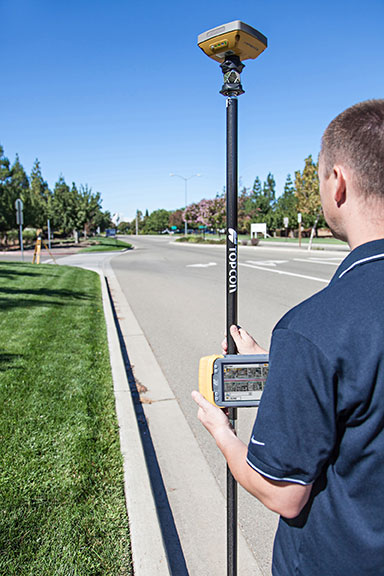
Topcon Positioning Group announces a new technology — Hybrid Positioning — that increases efficiencies and improves productivity on job sites, regardless of conditions, terrain or location. Hybrid Positioning is enabled through the Topcon Magnet software suite, a Topcon enterprise solution for the geomatics industry.
The new Topcon technology allows precise positioning professionals in the survey, construction, civil engineering and GIS industries to simultaneously connect to GNSS signals and standard robotic measurements on a single rover pole.
“This extremely clever and unique combination of GNSS and optical measurement is aimed squarely at improving a company’s profitability by allowing the use of GNSS positioning and optical positioning data at the same time,” said Ewout Korpershoek, chief marketing officer of Topcon Positioning Group. “When used with Topcon Magnet software, Hybrid Positioning improves field measurement efficiency at every phase of a project. With Hybrid Positioning technology, the key is versatility. For example, when line-of-sight is blocked, shots can be easily and quickly measured with the GNSS receiver. Now it is so easy to combine a standard Topcon robot and GNSS receiver to guarantee an integrated solution for the highest performance and productivity.
Photo: Topcon Positioning Group
“Combine these two proven solutions, plus advanced Magnet Field software, and you have Hybrid Positioning technology,” Korpershoek said. “By utilizing both GNSS and optical measurement, any project can be completed faster and with unsurpassed accuracy. By adding Magnet cloud-connected data workflow, truly outstanding increases in productivity and cost savings are assured.”
The new technological breakthrough has four key components: Hybrid Lock, Hybrid Resection, Hybrid Switch and Auto-localization.
Hybrid Lock allows accurate prism tracking by simply turning the instrument toward the prism location. Hybrid Resection ensures quick job site setup, as well as establishing RTK and geodetic coordinates. Hybrid Switch ensures a quick changeover from GNSS to optical measurement with a single touch. Auto-localization utilizes Bing Maps background, multi-point localization and works with RTK and NMEA positioning.
“Regardless of job site location or adverse conditions or terrain, Hybrid Positioning systems will perform faster in the field than other instruments and with more versatility than an RTK-only system,” Korpershoek said.