Category: Applications

  • New Offerings and Retarded Growth

    NEW ORLEANS — CTIA was both about new offerings and the issues retarding industry growth. The hyper local mobile advertising contingency proclaimed 2012 as the year of its breakthrough. Indoor location companies hoped that 2012 would be their year. Although the car manufacturers didn’t exhibit, mobile apps for the connected vehicle were prominent. Mobile wallet and safety apps were hot. The connected home raised its hopeful head once again. Winning back consumers’ trust that their privacy would be safeguarded, including location information, was acknowledged as standing in the way of deeper, more personalized offerings. Carriers sounded alarms about running out of spectrum to support ballooning mobile data consumption.

    Industry leaders provided their perspectives on where our industry is headed:

    “The reputation of our industry has dropped to the lowest of any major industry. Even the cable and oil industries rate higher with consumers than we do. That’s a bummer.” Dan Hesse, Sprint Nextel

    “We are waiting for the Steve Jobs of automotive. We need a platform that lets apps run with zero friction. Jobs listened to consumers; we need that for connectivity to the vehicle.” Alon Atsmon, iOnRoad Technologies

    “In two years we will see more vehicle connectivity, indoor location, and mobile based advertising. We are not pursuing indoor location now, but it is on our radar. In the future we will see incremental map updates. Map updates are now done on a country or state basis. We can’t yet pull out a tile of the map and just update it.” Darianna Gessner, TomTom

    “There will be advances in location accuracy, reliability, ubiquity and indoor position. We will see a more connected infotainment system in the vehicle­. It will connect to the vehicle and make phone calls, provide safety and security, understand proximity, and give lane guidance.” Brian MacLeod, Trimble

    “Companies need to be concerned about monetization, distribution, and functionality. Some companies are putting money into developing apps when it doesn’t make sense, and they don’t need to be in an app store. The Financial Times pulled their app out of the app store, because they no longer wanted to share the revenue.” Todd Simpson, Mozilla

    How would you like to pay for that? The credit card companies, carriers, and Google are vigorously vying for best market position in the mobile payment industry. Has Ralph de la Vega of AT&T found a new reality plane? During a keynote, he predicted that mobile payments would replace the wallet by next year. With public concerns about privacy and security, a shift needs to occur in the U.S. before it will be widely adopted. Strong, simple, and convincing privacy controls that win consumers’ trust will the first step.

    Location Protects Location Labs is the provider of the Sprint “Safely Bundle,” which offers families a way to monitor or restrict their phone-carrying children through location checks and limits on texting, such as while driving or at school. “We are working on developing a way to offer geo-fencing,” says Tasso Roumeliotis of Location Labs. “The challenge is that continuous location checks drain a phone battery greatly.” The goal is always-on location. Geo-fencing has long been used for asset tracking in devices that draw power from the car battery.

    Eye on the Road. iOnRoad showed off its clever driver assistance app and came away with the show’s Mobile Application Automotive Driving and Transportation prize. A cell phone, placed in a dashboard mount, provides a forward collision warning by monitoring the distance to the vehicle ahead. It also provides a lane departure warning if the vehicle is traveling over 37 mph and the wheel touches a solid line (not dotted line). The product is being sold for $4.99, a one-time license fee.

    CTIA Reveals. TechnoCom has launched a new division dedicated to the LocationSmart platform, a location integration solution. “This cloud-based location and messaging service adds device location awareness to enterprise and consumer applications,” says Mario Proietti of TechnoCom. “It is a cross-carrier platform for location and messaging.” Asked for his perceptions of CTIA, Proietti summed it up as the year of the credit-card companies (mobile payment), mobile solutions for in-car experience, and swarms of booth babes. I would like to see new product reveals, not skin.”

    Lost? How far can Hertz NeverLost go without expanding its market beyond their rental cars?  Hertz was at CTIA showing off expanded city guides that will provide enhancements to their users. When asked if they had plans to enlarge their market beyond customers of their rental fleets, Linda Senigaglia of Hertz seemed surprised by the question, and asserted that their play is solely with Hertz customers. Ouch.

    Sprint Mobile Ad Policy. Sprint Nextel plans to introduce a new mobile advertising privacy policy that it will distribute to all new subscribers, allowing them to opt-out of services. Sprint reported that an independent third party would audit Sprint’s compliance. “We must ensure customers are fully informed of our data collection practices,” explained Dan Hesse of Sprint. “As an industry, we’ve got to work together to get this right.” Hesse has previously called for stricter guidelines on driving while using cell phones and for the use of renewable and reusable materials.

    Spectrum Shortage. Verizon Wireless and T-Mobile executives complained that the future of data use is at risk if more spectrum isn’t put to use. FCC Chairman Julius Genachowski defended the agency’s decision to block the AT&T T-Mobile deal with a rejoinder about spectrum shortage. “Some have argued that transactions — let’s be frank, one transaction — is somehow causing a shortage,” said Genachowski. “But the overall amount of spectrum hasn’t changed.” While this is true, spectrum is a concern. CTIA reports that U.S mobile data traffic surged 123 percent in 2011.

    Rumors. The grapevine is buzzing with rumors that Deutsche Telekom is in talks with MetroPCS about combining with T-Mobile. Sanford Bernstein’s Craig Moffett had a field day with the possibility, “Oh, my, what an ugly baby,” he writes. Bloomberg reports that MetroPCS is in discussion with other partners as well.

    At the movies. Have you seen the fabulous new Norwegian thriller Headhunters? Spoiler alert: the main character is tracked via nano-sized location devices smeared somewhere on his body.   See the movie to find out where.
  • Have Apple and Google Killed Personal Nav Devices?

    Two prominent tech magazines are tolling the death knell for portable GPS devices today, spurred in large part by Apple’s announcement of Maps, its own mapping and GPS navigation service.

    “Apple made a number of significant announcements at its Worldwide Developer Conference (WWDC) yesterday, but one of the most insidious was its widely expected move to launch Maps, the company’s homespun mapping and GPS navigation service,” reads PC World’s article “Apple Moves to Kill GPS Devices, Reduce Dependence on Google.

    “The updated app marks the first time the iPhone will have free, voice-enabled GPS navigation. It also includes real-time traffic, Yelp integration, crowd-sourced traffic data (hello Waze), Siri support, and the ability to work in the lock screen. In a move to match Google, Apple is also working on 3D modeling for buildings and terrain data, which it will acquire by flying planes over U.S. cities.

    Wired Magazine was even more dire; its article titled “Apple, Google Just Killed Portable GPS Devices,” begins, “If it wasn’t obvious before, it’s crystal clear today. The dedicated portable GPS device is dead, with Apple and Google playing pallbearer to Garmin, Magellan and TomTom’s hardware businesses.

    “Between last week’s hastily organized Google Maps event, where the search giant showed off a new interface, new features and — most importantly for Android users — offline map downloading, and Apple’s new Maps app announcement at WWDC, a dedicated device for mapping and navigation comes across as superfluous. Or even worse, incredibly low-tech.

    Meanwhile, Apple signed TomTom for mapping services over Google Maps for its new operating system. Also read LBS Insider editor Kevin Dennehy’s latest column on Google’s plans to enhance its maps on Android.

  • Apple Chooses TomTom for Mapping Services, Setting Up Battle with Google

    Apple signed TomTom for mapping services, and is apparently jettisoning Google Maps, to set up a potential collision between the two industry giants.  The deal between the media giant and TomTom came after Apple rolled out mapping options for its new operating system at a conference in San Francisco.

    The deal can’t come soon enough for TomTom, which provides maps for Google. However, that deal is ending soon, according to published reports.

    “Apple’s choice of TomTom is a marriage of necessity on both sides. From Apple’s perspective, they needed a worldwide, navigation-quality digital map that was not built by a competitor,” said Marc Prioleau, principal Prioleau Advisors and author of industry blog, prioleauadv.com. “That leaves only TomTom. From Tom Tom’s perspective, they needed a toehold in the mobile mapping business which was otherwise going to Google and Nokia. The partnership was needed by both parties.”

    Prioleau said it be interesting to see if the relationship involves deeper cooperation between the two companies than is typical. “That will likely determine if this is a long term arrangement,” he said. “Google obviously has a new, well-resourced competitor in Apple. I doubt they cared whether Apple chose TomTom or someone else. They are reducing Tom Tom’s role on Google Maps anyway.”

    What will be more interesting to Google will be whether Apple will share traffic and user data with TomTom to improve and maintain the maps, Prioleau said.

    Until perhaps now, Google has dominated all phases of the location and navigation industry. Google Maps software not only runs on the Android operating system, but also on Apple’s iOS platform.

    Both Apple and TomTom have been tight-lipped about the new licensing agreement. Industry observers believe that the deal will be a windfall for TomTom, though how much of one remains to be seen. TomTom, along with other navigation companies, has seen a huge drop in the sale of portable navigation devices


  • Aviation Receiver/Sensor

    Accord Technology LLC was recently authorized TSO-C145c for its latest receiver/sensor in the NextNav product family, the NextNav MAX GPS WAAS Class Beta-1, -2, -3. This successful GPS development is a key solution in a series of Accord Technology’s affordable civil aviation GPS receivers and sensor, the company said.

    Available as circuit card receivers (CCA) for avionics OEM hosting or as line replaceable sensor units (LRU) for aircraft installations, MAX is affordable and meets the latest standards, worldwide. It supports ADS-B (Automatic Dependent Surveillance-broadcast), all normal GPS procedures, as well as precision approach requirements such as LPV (Localizer Performance with Vertical Guidance) and RNP AR (Required Navigation Performance with Authorization Required).

    The NextNav MAX GPS technology is the most advanced in the world and is compatible with Satellite Based Augmentation System (SBAS) solutions such as the United States’ WAAS, the European EGNOS, Japan’s MTSAT, and GAGAN in India.

    “This TSO authorization for the NextNav MAX gives us greater flexibility to serve our customers with WAAS Beta 1 Only or Beta 1, 2, 3 LRU’s and CCA’s to fit their need,” commented Hal Adams, chief operating officer for Accord Technology. “The NextNav MAX is another important first for Accord Technology and we are anxious to move forward now with our AC 20-165 approved GPS sensor,” added Adams.

    Accord Technology received TSO-C145c for its NextNav mini in 2010. The NexNav mini GPS technology was the first GPS WAAS sensor to be authorized by the Federal Aviation Administration TSO-C145c WAAS Class Beta-1 Only. The NexNav mini solution is a market-breaking hybrid of automotive technology and aviation requirements providing an affordable solution for ADS-B GPS source.

    NextNav MAX’s DO-229D compliant aerospace GPS-SBAS receiver is certified by the FAA for TSO-C145c Class Beta-3 operation and is the enabling technology for several key applications, including:

    • Primary means of navigation
    • Localizer Precision with Vertical guidance approaches (LPV)
    • Airborne spacing assurance
    • Airborne Collision Avoidance (Non-TCAS System)
    • Constant descent approaches
    • Surface area movement management
    • Current and advanced Terrain Avoidance Warning System (TAWS)
    • Advanced Air Traffic Management (ATM)
    • Required Navigation Performance enhancements (RNP AR)

    “Whether it’s a need for LP/LPV approach precision or highly reliable PVT, NextNav MAX offers standard and custom solutions according to what our customers need,” Adams said. Designed around a small form-factor, the NextNav MAX CCA is delivered ready to integrate into host avionics systems, an LRU sensor or as a standalone module to ARINC 743 requirements. “We can even package the CCA in a module, tailored to your application,” Adams said.

  • Compact Modules for RTK GNSS

    Hemisphere GPS announces the Eclipse P300 and Eclipse P301 OEM modules — its next-generation high‑performance compact modules for RTK GNSS applications. Based on new Hemisphere GPS multi-function application firmware and Eclipse GNSS multi‑constellation technology, P300 and P301 provide the ability for tracking commercially available GNSS signals for precise positioning.

    P300 is a drop-in board replacement for Hemisphere GPS’ successful Crescent L1 board as well as the first‑generation miniEclipse P200 GPS-only OEM board. P301 is the company’s 20‑pin OEM module configured as a drop-in replacement for a different industry standard interface. Eclipse P300 and P301 improve GNSS positioning performance, particularly with RTK applications, through Hemisphere GPS’ patent-pending SureTrack technology. Benefits include extended and more robust RTK solutions as the rover RTK receiver will process all available signals even if they are not common with the base receiver. RTK solutions are therefore better maintained in challenging environments, with baselines of up to 50 km, and reacquisition times are improved resulting in more robust overall performance, the company said.

    P300 and P301 are designed for OEM system integrators who demand the highest level of multi-frequency positioning, accuracy, fast initialization time, and GNSS RTK solutions. Hemisphere GPS’ miniEclipse series includes a single frequency L1 GPS + L1 GLONASS model named P202. Both series are designed for developing integrated high-precision and control applications for geomatics, survey, machine control, and unmanned vehicle solutions.

    “P300, P301, and P202 all improve upon our already successful miniEclipse OEM modules adding GNSS support to our most compact modules for excellent accuracy and affordability,” said Phil Gabriel, vice president and general manager, Precision Products, for Hemisphere GPS. “System integrators have a wider range of Hemisphere GPS solutions from which to choose to develop world‑class high‑precision products.”

    Measuring 71 mm long and 41 mm wide, miniEclipse allows for easy integration, especially for integrators who are accustomed to Hemisphere GPS’ Crescent and miniEclipse OEM module performance and footprint.

    All miniEclipse modules are available through the Hemisphere GPS Precision Products global dealer network.

  • Spectra Precision Introduces GNSS Receiver

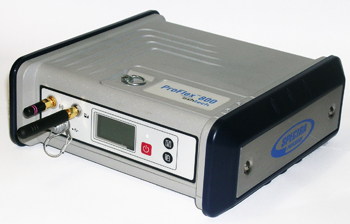
    Spectra Precision Introduces GNSS Receiver

    Photo: Spectra Precision

    Spectra Precision introduced the new ProFlex 800, a GNSS solution with Z-Blade GNSS-centric technology. The ProFlex 800 delivers fast and reliable RTK positioning, even in environments where GNSS signals may be difficult to acquire, Spectra Precision said. Rugged and IP67 rated, the ProFlex 800 is built to withstand harsh operating conditions for a variety of positioning applications.

    “The ProFlex 800 is an ideal solution for customers wanting a single GNSS receiver for multiple applications,” said François Erceau, general manager of Trimble’s Spectra Precision, Nikon and Ashtech Business Area. “It offers a unique design with a range of mounting and communications options.”

    Used as a backpack rover or reference station, the ProFlex 800 with Z-Blade technology is a flexible GNSS solution for land surveying. Its innovative design also makes it ideal for hard-mounted survey applications such as coastal work, dredging, bathymetry or offshore vessel operations.

    The weatherproof, high-impact-resistant molded aluminum housing allows the ProxFlex 800 to operate in harsh conditions.

    In addition to a 3.5G internal cellular modem, the ProFlex 800 can use a variety of internal or external UHF modules, providing stable and reliable wireless communications. It can be used as a rover or a base without additional accessories in the field. Its Z-Blade long-range RTK capability combined with industry-leading UHF options help to ensure maximum productivity while in the field.

    With its built-in Ethernet capability and embedded web server, users can access the ProFlex 800 from any computer connected to the Internet. This capability allows instant real-time multi-data streaming over an Ethernet connection to build an RTK corrections server without any additional software or equipment, the company said.

    Spectra Precision ProFlex 800 CORS Receiver. The Spectra Precision ProFlex 800 is also available as a Continuously Operating Reference Station (CORS). This configuration is an optimal solution when collecting, storing and transferring high-quality GNSS raw data for post processing surveys, geodetic and other applications. Automatic sessions programming, a user-friendly Web-interface, an embedded RINEX converter, FTP push functionality and many other advanced CORS features make the ProFlex 800 CORS a powerful, robust and easy-to-use GNSS solution.

    Advanced Ashtech Z-Blade Technology. Z-Blade is a new GNSS centric signal processing technology. Z-Blade uses all of the available satellite signals equally, without preference to any particular satellite constellation, maximizing the user’s ability to obtain reliable GNSS positions in tough conditions. Z-Blade allows users to receive and maintain RTK positioning even if GPS coverage is insufficient. In many work locations, just a few GPS and GLONASS satellites may be visible due to obstacles such as trees or buildings.

    The ProFlex 800 is now available through the Spectra Precision global dealer network. For more information visit: www.spectraprecision.com and www.ashtech.com or email: [email protected]

  • Trimble Introduces Receivers for GIS and Mobile Mapping

    Trimble has introduced the next-generation of its Trimble GPS Pathfinder family — the Trimble Pro 6H and Pro 6T receivers for GIS and mobile mapping. The Trimble Pro series with advanced features allows mobile workers to configure a solution for a wide range of applications, delivering flexibility in professional GIS data collection, Trimble said. The series offers a new streamlined form-factor and dramatic productivity improvements in difficult GNSS environments with Trimble Floodlight technology.

    The modular Trimble Pro series receiver gives users the flexibility to choose their setup configurations:

    • Optimized for use with Trimble data collection devices such as the Trimble Juno or Nomad G series handhelds, or Yuma tablet computer, the Trimble Pro series can also be used with other tablets and handhelds with NMEA output.
    • Real-time or postprocessed GIS workflows.
    • The receiver can be deployed in a backpack, on a pole or mounted on a vehicle.
    • Two models are available: the Trimble Pro 6H delivers decimeter accuracy, while the Pro 6T is the submeter model for standard GIS applications.

    “With the availability of the new Pro series receivers, data collection professionals now have access to the productivity-enhancements of Floodlight technology in both integrated and modular configurations,” said Daniel Wallace, general manager of Trimble’s GIS Data Collection Division. “While some prefer the convenience of an integrated, all-in-one handheld, others will appreciate the Pro series’ flexibility to choose from a range of data collection devices such as a high-resolution tablet or lightweight Trimble Juno.”

    Trimble Floodlight technology allows users to collect decimeter accuracy data in tough GNSS environments, Trimble said. Buildings and trees can cause satellite shadow and limit the environments where high-accuracy GNSS data collection can be performed. Trimble Floodlight technology combines a range of techniques to increase the availability of positions and boost accuracy in areas affected by satellite shadow. Using Floodlight technology, the Pro series can keep teams productive without compromising on accuracy. Users can work with fewer disruptions and ensure better data, faster data collection and higher field efficiency.

    Trimble Pro series receivers are rugged and built to withstand the rigors of long hours in tough outdoor conditions, yet optimized for high-accuracy GIS data collection workflows, Trimble said. For applications such as utilities inspections and timber stand valuations, Trimble Pro receivers provide long battery life and tough construction for dependable service over the course of rigorous data-collection projects.

    With its IP65 rating, the receivers offer reliable operation, even after prolonged exposure to water and dust, Trimble said. An integrated antenna reduces the complexity of the system for fast setup and swift data collection campaigns. Field workers can be up and running with minimal training, saving time and money. Combined with a Trimble handheld solution and Trimble TerraSync software, the complete system provides dedicated field workflows to simplify data collection and improve integration with the GIS for total workflow improvements.

    The new Trimble Pro 6H and 6T receivers are available from Trimble’s worldwide Mapping & GIS authorized distribution channel.

  • Spatial Plexus

    Two weeks ago I attended a somewhat different GIS conference at Georgia Tech called Spatial Plexus touted to be a new conference devoted to solving “Wicked Problems.” This was not to be confused with “Wicked,” the only musical I ever attended where the audience went home humming the scenery. As stated in the program brochure, “Wicked problems are those difficult to solve because of incomplete, contradictory, and changing requirements. By inspecting wicked problems with “geospatial goggles,” complexities and interdependencies can be exposed, better defined, dissected, better managed through the geospatial approach and reassembled for overall improvements.”

    One of the reasons that I attended this conference is that most of the attendee names were not familiar to me so I had a chance to meet some new people in the GIS community. The conference was all plenary sessions, so we didn’t have to play the game of running from one break-out session to another and missing some because of conflicts. It was held at the Georgia Tech Hotel & Conference center in Atlanta, a new, nicely designed conference center.

    Danielle Ayan, GISP of GTRI (Georgia Tech Research Institute), organized the conference and it was perfectly planned, executed, and well-documented. The dominant themes of this new conference included higher education sustaining academic programs in ever-shrinking budget times and getting spatial thinking accepted in more disciplines across the campus disciplines. Geospatial technology in infrastructure and economic development were also major topics.

    Key speakers included: David DiBiase of Esri, GTCM, and Penn State fame; Dr. Peter Lea of the NSF ATE program serving geospatial technologies; Peter Folger, specialist in energy and natural resources, Policy Resources Science and Industry Division, Library of Congress; and Dr. Helen N. Parker, regional administrator for the Atlanta Region of the Employment and Training Administration at the Department of Labor. You can view some of the key presentations online by clicking here.

    A major portion of the conference was devoted to GeoTECH, a collaborative organization of colleges, universities, and industry working to enhance GIS education. The organization is funded by the National Science Foundation supporting the efforts of the Department of Labor to build a Geospatial Technology Competency Model (GTCM). Simply put, the GeoTech Center goals are to provide resources and guidance that will expand the geospatial workforce with qualified technicians that meet the GTCM guidelines. Most of the GeoTECH programs are aimed at two-year college programs but there was also discussion about K-12 programs.

    Attendees were asked to review sample curricula developed by GeoTECH participants to make sure that they reflected current technology and thinking. Without going into the details, I can tell you that the sample curricula were very thorough and well thought out. Only minor tweaking was recommended by the reviewers.

    If any of you are doing volunteer work at your local K-12 schools, you may want to investigate two resources that came up in several discussions: “ESRI Press” and an organization called “GIS etc.”

    GIS etc was created by Roger and Anita Palmer to provide GIS professional development, curriculum, and software to support K-12 and post-secondary educators and students. Roger and Anita started out as high school teachers so they had hands-on experience teaching science and technology. Along with Lyn Malone, they co-authored “Mapping Our World” and “Analyzing Our World” as well as the first GPS activity book “Going Places with GPS” that many conference attendees cited as superb entry-level GIS resources. They also authored a beginner’s GIS program called “20 Minute GIS for Young Explorers” for teachers who want to add geospatial elements to their classroom but have only one computer in the classroom, have minimal GIS skills, and are not permitted to use Google Earth, but want a virtual globe experience for students.

    The new version of “Mapping Our World” contains a GIS media kit including a CD and DVD that contain files with student worksheets, GIS data for completing the lessons, and additional files and resources for teachers. The DVD contains a one-year trial version of ArcView 9.3 software for computers using Microsoft Windows operating systems. This is proving to be ideal for entry-level GIS programs.

    There were also several “ignite” sessions, at which presenters were limited to 7 minutes each. These were the equivalent of Pecha Kucha sessions or elevator pitches that quickly get to the point and focus the mind sharply. One of those sessions that I wish was longer was from Max Baber, director of Academic Programs for USGIF. For those of you not familiar with USGIF, it is a non-profit geospatial organization comprising geospatial industry partners that puts on GEOINT and other geospatial activities that NGA can’t do itself.

    Max provided advanced word of a pending USGIF credentialing process that was officially announced at USGIF Tech Days last week. The credentialing is in response to NGA desires to have minimally qualified personnel working on NGA contracts similar to URISA’s GISP qualifications. The credentialing process will eventually be required for all geospatial analysts working for NGA and should be in place within three years. I saw some angst in the audience from potential contractors, but hopefully this will minimize past problems resulting from delays and communication errors caused by contractors using personnel with little or no prior geospatial experience.

    As with most conferences, there were new sidebar lessons to be learned. One example was an Apple Bluetooth keyboard. How many times have you been at a conference or on a plane where you wish you could do a little unobtrusive typing without breaking out a laptop and power cord or struggling with the tiny on-screen iPhone keyboard? One of the attendees was typing his notes using a nicely designed solid keyboard with his iPhone. I’ve seen several cheesy foldable plastic keyboards, but this Apple keyboard was small, high quality, and had a nice tactile feel. I had to get one and wrote most of this article while flying to D.C. using it and my iPhone. Minimalists would approve.

    I learned another item of interest from one of the presenters, Randy Hale, GISP of North River Geographic Information Systems, Inc. Imagine being able to view a video of the best teachers in the country covering concepts and topics that many of us struggled with in school. The Khan Academy is a not-for-profit organization with the goal of changing education for the better by providing free world-class online lessons to anyone anywhere. With more than 3,000 separate video lessons in science, math, economics, and others, this is a free resource you should share with anyone in school or needing a refresher.

  • GNSS Handheld Data Collector

    Nexteq Navigation, based in Calgary, Alberta, Canada, has announced the T5A, its new flagship multifunctional GNSS handheld data collector. The device is a high-accuracy GPS unit capable of 2-centimeter accuracy using real-time kinematic (RTK) and 50-centimeters globally using Nexteq’s i-PPP technology. With the T5A, users can achieve extremely accurate and consistent results anywhere in the world with no loss in flexibility, Nexteq said, adding that the unit’s centimeter-level precision coupled with versatility allows for accurate data collection in the most diverse weather conditions.

    Suitable for projects in all-environments, the T5A has a professional quality internal GPS receiver that provides accurate real-time results. Using Nexteq’s Freedom, i-PPP, or RTK technologies, the T5A data collector can provide flexible and accurate positioning in all parts of the world, Nexteq Navigation said.

    The T5A has a 3.7-inch color touchscreen that is both waterproof and dustproof. The device includes features such as Bluetooth, Wi-Fi, digital cellular data and voice, microSD card slots, and a 3.0 megapixel digital camera.

    Like all Nexteq Navigation GPS handhelds, the T5A is a ruggedized and tough unit. The T5A has an IP66 rating with excellent dust and water resistance.

  • GPS for Truckers

    Magellan, maker of innovative GPS devices for vehicles, outdoor and mobile navigation, has announced the newest addition to its Magellan RoadMate Commercial GPS family for truckers and commercial drivers providing improved safety and productivity before, during and after their on-the-road trips. The compliance-ready Magellan RoadMate Commercial 9270T-LM GPS device is specifically designed for the needs of truckers including an extra-large GPS display, customizable truck-specific routing, hands-free communication, and trip logging.

    To prepare for their trips, truck drivers can use the Magellan RoadMate Commercial 9270T-LM to set up customizable routes based on the height, weight, width, and length of the vehicle, as well as applicable hazmat restrictions. Multi-destination routing allows drivers to plan their stops and optimize routes to help them save time and gas, Magellan said.

    While on-the-road, the Magellan RoadMate Commercial 9270T-LM helps drivers navigate on an extra-wide 7-inch high-definition touchscreen display that adjusts color and contrast for easy night-viewing. The large display also makes maps and other content easy to read when the GPS Navigator is mounted in large vehicles with deep dashboards. The integrated Bluetooth wireless technology, when paired with a compatible Bluetooth phone, enables drivers to safely talk hands-free while keeping their eyes on the road.

    At the end of their trip, the Magellan RoadMate Commercial 9270T-LM facilitates preparing required compliance reports including hours and state mileage for IFTA fuel records. A comprehensive log of trip information by each driver is retained in the Magellan GPS device for easy exporting into reports.

    “We expanded our family of Magellan RoadMate Commercial GPS Navigators to further meet the unique navigation needs of commercial and truck drivers who need a comprehensive solution to efficiently perform their jobs from the initial trip planning stage to their on-the-road requirements and managing required log reporting after their trip,” said Stig Pedersen, Associate Vice President of Product Management for Magellan. “The Magellan RoadMate Commercial series of GPS Navigators are designed to make drivers’ jobs safer and less stressful plus improve productivity, reduce costs and ultimately increase profits.”

    The Magellan RoadMate Commercial 9270T-LM functions as an “information dashboard” that not only navigates, but provides elevation and truck speed limit warnings. The 9270T-LM GPS device includes several valuable safety and convenience features:

    • Highway Lane Assist that shows realistic highway signs and guides truck drivers towards the correct lane when approaching complex highway interchanges and exits;
    • Free Lifetime Traffic Alerts that help drivers avoid traffic incidents on their route by offering an alternative solution;
    • Spoken Street Name guidance that announces the street name and gives turn-by-turn directions;
    • Highway Exit Points-of-Interest and a Truck Stop Directory help drivers find services including gas stations, restaurants, ATMs, rest areas and showers, truck services, Wi-Fi availability;
    • OneTouch lets truckers bookmark and assign a button to their favorite destinations or searches for faster access;
    • Heavy-duty extended windshield mount, designed for deep dashboards, is included to provide fully-adjustable, personalized comfort and safe viewing;
    • An A/V input for easy connection to external devices such as the Magellan Wireless Back-up Camera or a DVD player;
    • Free downloadable Lifetime Map Updates keep the pre-loaded maps of the United States, Canada and Puerto Rico up-to-date.

    The Magellan RoadMate Commercial GPS family now includes two models — the new 7-inch Magellan RoadMate Commercial 9270T-LM ($399.99 MSRP) and the 5-inch Magellan RoadMate Commercial 5190T ($379.99 MSRP). Both models are available in June at truck stops and through Magellan’s consumer electronics and online partners.

  • Data-Collection Software

    Nexteq Navigation has release the newest version of its NexGeo software line-up: NexGeo Mobile, NexPos and NexGeo Office. Optimized for Nexteq handhelds, NexGeo Mobile integrates Nexteq Freedom, i-PPP, and RTK positioning augmentation technology into a more reliable, user-friendly data collection software, the company said. With easy display of features, background images, labeling and attributes, data is readily collected, accessed and edited. The tracking feature now allows for efficient communication and management between field workers and the office. Raw data recorded in NexGeo Mobile can be used for post processing in NexGeo Office.

    Those using third-party software with a Nexteq handheld are not left behind. NexPos was created with the intent of allowing freedom in benefitting from Nexteq position augmentation technology, the company said. The NexPos software acts as a bridge, applying Freedom, i-PPP, or RTK algorithms to GPS measurements. The final positions are transferred to third-party software via virtual COM port, allowing users to benefit from improved position accuracy while NexPos runs discreetly in the background. Raw data can also be recorded and used for post processing in NexGeo Office.

    On the desktop, NexGeo Office ties together collected data, attributes, and post-processing information to provide efficient project management capabilities, data organization, live field monitoring and integration with a wide variety of other software, Nexteq said. Building and maintaining a project specific database is easy using NexGeo Office: import existing data, build on the project using a Nexteq handheld and transfer it back to the office for editing. Exporting the project to ESRI or AutoCAD file formats allows for users to seamlessly continue expanding.

    NexGeo software suite is available and included with all Nexteq Navigation handhelds.

  • Entry-Level, Rugged PDA

    Leica Geosystems announced a further enhancement to the Leica Zeno GIS family – the Leica Zeno 5, an entry-level, rugged PDA for organizations that require a durable compact device with integrated modem and high-sensitive GPS. The new Leica Zeno 5 supports field workers by combining a mobile phone with asset collection and management capabilities.

    Senior Product Manager Johannes Hotz comments ”Together with our Leica Zeno Field and Zeno Connect applications, the Zeno GIS family continues to grow and further addresses all mobile GIS market segments ranging from utilities and natural resources to municipalities”.

    The new Leica Zeno 5 provides a complete, integrated package of positioning, imaging and communications tools:

    • 48 channel, high-sensitivity GPS receiver (SirfStarIV)
    • GSM HSPA+ and CDMA with full phone capabilities, Wi-Fi and Bluetooth
    • Texas Instruments latest high performance processor, the Sitara 3715 (OMAP3) at 800 MHz
    • Large 3.7” full VGA transflective display
    • Windows Embedded Handheld 6.5.3 Operating System
    • Rechargeable and hot-swappable all-day battery (10 hours +)
    • Full range of interactive sensors including camera, digital compass, gyroscope, light sensor, proximity sensor and accelerometer

    “The new Leica Zeno 5 is the fastest and best equipped rugged PDA for a mobile user”, said Johannes Hotz. “Designed to be, at the same time, a mobile phone, GPS-enabled data collector and a controller for our out-standing Leica GG02 plus GNSS SmartAntenna. This new handheld will help users to get the maximum out of from their investment. Together with our Zeno Field application, the Zeno 5 provides an easy-to-use, streamlined GIS data collection and management solution. The Zeno Connect, as stand-alone application or SDK, enables our software partners to combine their industry specific solution with our high-accuracy data collection solutions”.

    According to the announcement, the Leica Zeno 5 is shock resistant, withstands a drop from to 1.8 m, and is protected against water and dust. The large 3.7 inch screen is optimized for sunlight readability and maintains exceptional clarity in outdoor conditions, including direct sunlight. Field workers can collect features and descriptive information using the in-built, high-sensitive GPS data, attach photos to the collected assets, and synchronize, with high-speed up- and download times, with the office using a single and compact device, all in a full working day without re-charging the Zeno 5.