Category: Applications

  • Google Enhances 3D Maps: Is It Enough To Keep Competitors at Bay?

    Kevin Dennehy
    Kevin Dennehy

    Google’s recent announcement that it plans to enhance its 3D maps on the Android platform was seen as a preemptive strike against Apple, which is planning a similar announcement. In other recent news, some analysts and trade press are saying Verizon is paying way too much for Hughes Telematics. All of this is making for an interesting summer for the location industry.


    Google recently demonstrated new 3D capability for Google Earth, in a move that some say preempted a similar announcement by Apple, which will roll out its own product at our deadline during the Worldwide Developers Conference.

    While Apple is set to announce its own version of a mapping program for iOS that does not use Google Maps, some in the industry are wondering if the 3D capability is enough for developers to stay with Google, particularly with the fees the company is charging high-volume users. The big winner in the Apple announcement was TomTom, which has signed a global agreement with Apple for maps and related information. No further details of the agreement will be provided, the company said.

    In terms of upstaging Apple via 3D, one company executive thinks that is overblown. “I don’t think Google was trying to do that directly on just that feature. I think they are very concerned about the Apple announcement — not just because they will lose Apple as a customer, they will, but because they fear a ‘wow’ factor upstaging them despite all the great work [Google] has done to date,” said Kim Fennell, deCarta president and CEO. “Their press conference last week was more about reminding everyone how hard it is to do this stuff really well, and I think they wanted to remind Apple, and the market, it takes a lot do the complete mapping solution really well. I think their Google Earth capabilities with street views and their new 3D modeling is a major investment and they wanted to set the overall bar high for Apple.”

    DeCarta says half of its new developers are coming from Google Maps. The company says that, in the last 90 days, 488 new companies have signed up to its developer’s program.

    In a white paper, de Carta says:  “The timing of this surge confirms that Google is no longer seen as the ‘Benevolent Provider of Free Stuff’ that it once was. What is more surprising is that not all of the companies jumping ship are big guys…in fact some are not even close to the 25,000/day map threshold that Google uses to trigger the hounds.”

    The company contends that there is a common theme that developers want to work within clearly defined partnerships, how much they will need to pay, and whether or not they can execute their business model — especially if that involves advertising. “They want to create some differentiation and most of all, they want to know whether or not their partner will one day decide to compete with them,” the company white paper says. This restriction trickles down to real estate, travel, local search, and other sites, the company says.

    Fennell said deCarta started working with Google competitor OpenStreetMap in 2009 when it was early in the market and there were almost no takers.  “We were too early, the market wasn’t really looking for an alternative yet — and the map data quality wasn’t good enough. Three years later, it is looking much more interesting both from supply (map data availability) and demand (customer interest),” he said.

    Verizon’s Purchase of Hughes Telematics a Financial Reach?

    To strengthen its presence in the machine-to-machine and connected car market, Verizon Communications said it plans to buy Atlanta-based Hughes Telematics Inc. for $612 million, or $12 per share. The high price has some analysts scratching their heads — particularly because Hughes was trading at only $4.35 per share the day the deal was announced.

    Hughes Telematics, which competes with OnStar, began to provide LBS, connected safety and convenience services to Mercedes-Benz customers in 2009.

    “I was frankly surprised at the valuation considering HTI’s financial position. I assume Verizon sees a lot of value in the Mercedes account and potential value in HTI’s VW account — and at least one other OEM account which they are expected to get,” said Clem Driscoll, president of CJ Driscoll Associates.  “I think it is also clear that Verizon’s plans called for increasing its role in telematics through acquisition of a telematics service provider. A previous attempt at a TSP acquisition was unsuccessful. HTI clearly has some good technology, as evidenced by the Mercedes Mbrace solution.”

    Driscoll said that Hughes Telematics’ financial problems probably discouraged some auto OEMs from using them in the past, but those issues should now be resolved.

    The Verizon-Hughes Telematics acquisition is expected to close in the third quarter. Verizon plans to retain Hughes Telematics’ management, operate the company as a subsidiary of its Verizon Enterprise Solutions group, and keep the company headquartered in Atlanta.

    ITS America Holds Small Annual Meeting — Why?

    It isn’t big news that private companies still court government contracts and attend the ITS America Annual meeting in Washington to work on connected vehicle committees. However, this is the first time I’ve covered this conference, and I’ve attended off-and-on since 1993, to notice attendance has reached the point that only a few die-hard private sector companies are going to this government-focused meeting.

    Remember, the ITS America meeting was the only game in town in the 1990s and early 2000s, with two of the dominant players at that time, Navteq and Etak (later to be purchased by Tele Atlas) anchoring a growing navigation and location industry.

    Instead of ITS America dominating the entire connected vehicle conference market, most private companies choose to attend the pricier Telematics Update Detroit meeting. What made the meeting more disappointing is the fact that ITS America does attempt to focus on the connected vehicle. The U.S. Transportation Department invited delegates and the press to a connected vehicle demonstration with Ford, General Motors, and Toyota, among other team members. The demonstration highlights this summer’s testing of 3,000 vehicles, which will test crash-avoidance technologies in Ann Arbor, Michigan, in a year-long government program.

    Still, some companies attended such as Inrix, Beat the Traffic, and TomTom. The Virginia Transportation Department is partnering with TomTom to analyze where travelers entered and exited the I-95/I-64 corridor.

    Some companies are getting ITS grants, such as Xerox, which grabbed $15 million from the U.S. DOT for a pilot program incorporating real-time parking guidance systems, among other projects. These parking systems, using smartphone apps from Streetline, enable motorists to view spaces based on price, location, and real-time availability.

    Simulators Keeping LBS Companies on Target

    Spirent Communications, which is monitoring the popularity of LBS, said its new GNSS simulator supports simulation of signals from individual or combined GPS/SBAS, GLONASS, and Galileo constellations, with eight satellites per constellation.

    The company, which said it recognizes the increase in LBS’ momentum and the market need for improved positioning performance on mobile devices, has expanded its LBS LTE test product to support an LTE Positioning Protocol and Observed Time Difference of Arrival. The company says both are critical enablers for LBS adoption.

  • NovAtel SAASM to See First Action in Aerial Drones

    The new OEM625S Selective Availability Anti-Spoofing Module (SAASM) GNSS receiver from NovAtel, launched in a cooperative effort with SAASM expert L-3 Interstate Electronics Corporation (IEC), will get its first applications in the unmanned aerial vehicle (UAV) sector. NovAtel has brought forth the new product in part to meet requirements of UAV manufacturers who are now mandated to have SAASM onboard as well, for in-theater operations in areas of military activity.

    “The new SAASM regulations meant that integrators were looking at having to incorporate another receiver alongside their NovAtel unit, complicating user interface factors and increasing onboard space requirements,” said NovAtel Product Manager Neil Gerein. “The OEM625S gives our customers a drop-in form factor that easily replaces their existing NovAtel OEM receiver.”

    “NovAtel has supplied UAV integrators on the civil scientific side almost since our inception,” Gerein said, adding, “the military has become more and more involved in this market in recent years for budget and various other strategic reasons.” He mentioned that in its 20-year history selling GPS products, for the last 17 years NovAtel has provided receivers and expertise to U.S. and Canada defense contractors, and to defense research labs in Allied countries. Antcom, a wholly-owned NovAtel subsidiary specializing in antennas and microwave products, makes the majority of its sales into military areas.

    Examples of such products in this area — not necessarily from NovAtel customers, who remain unidentified — include hand-launched mini-UAVs like the Aerovironment RQ-11 Raven and Elbit Skylark I, and runway-capable tactical UAVs such as Textron RQ-7 Shadow, Aeronautics DS Aerostar, IAI Searcher II, and InSitu’s ScanEagle UAV system, quickly evolving into a mainstay with the U.S. Navy and its allies thanks to a partnership with Boeing.

    The InSitu ScanEagle was first developed to track dolphins and tuna from fishing boats, to ensure that fish labeled “dolphin-safe” actually are so. The same characteristics needed by commercial fishing boats — low infrastructure launch and recovery, small size, 20-hour long endurance, automated flight patterns — are key for naval operations from larger vessels, and for battlefield surveillance.

    At present the OEM625S, combining a commercial dual-frequency NovAtel GNSS receiver with an L-3 IEC XFACTOR SAASM, provides single-point positioning with SAASM for authorized defense customers. The SAASM position is provided via a dedicated communication port, as well as through NovAtel’s software command protocol, allowing for maximum flexibility. The small form factor and low power consumption expands range of potential defense applications requiring robust SAASM GPS positioning.

    The OEM625S measures 60 x 100 x 9.1 millimeters, and runs on field-upgradeable software. NovAtel will accept orders for the OEM625S from authorized customers starting in Q3 2012.

  • NIST and Metrology

    I must govern the clock, not be governed by it.
    — Golda Meir

    The Question

    A few months ago at a speaking engagement, I took questions from the audience after my presentation. The audience was made up of GPS enthusiasts, GPS equipment vendors, and evidently GPS neophytes as well, because the last question was asked by a young lady, from a large well known government user segment, who was intrigued by but obviously knew little about the inner workings of GPS. Her question so stunned me and the audience that it brought the questions to an abrupt end. Thank goodness no one actually laughed out loud, and frankly I was so incredulous that I almost gave an impertinent answer that would not have served any purpose other than to embarrass the young lady and expose some insensitivity on my part. No, fortunately, after recovering from the initial shock due to the naiveté of the question, I answered her with a straight face, because it seemed to be an honest and sincere question.

    Allow me to set the stage. My talk was on the Perfect Handheld GPS Transceiver and how the PHGPST could be aided by a Symmetricom Chip Scale Atomic Clock (CSAC).

    The young lady’s comment and eventual question was exactly as follows: “I came here this afternoon because I was intrigued by your columns in GPS World and I wanted to know more about the Perfect Handheld GPS Transceiver and possibly learn how I could even purchase one or more for my organization. However, most of your comments have been focused on the benefits of atomic clocks. Frankly, I am a bit disappointed. So where can I buy a PHGPST and what do atomic clocks have to do with GPS anyway?”

    Retrospective

    I have had a few months to think about that episode, and although all ended well, with no one being overly embarrassed, despite some good-natured ribbing, it was a little unsettling. It also takes me back to a previous theme in several of my columns concerning educating users about the Global Positioning System. Not just what GPS can do for you — certainly that is well covered in GPS World, other publications, and on the Internet. Indeed, just type the acronym “GPS” into any search engine and you will be rewarded with the rather daunting number of 1,670,000,000 hits — yes that’s 1 billion, 670 million hits.

    A Daunting Perspective

    Considering that the average person today, who has reached my advanced age, my will probably live to be approximately 80 years of age or more, the obvious question is does anyone actually have the time to peruse ~1.6B websites on GPS?

    You don’t have to be a professional metrologist or an expert mathematician to determine the logical answer, but if you are really concerned about time it might help. Consider the following answers — yes, plural — to the question posed, which assumes that a person would spend one minute or 60 seconds at each website — which begs the question, just how many minutes are there in an 80-year life span anyway? Of course, this answer assumes the hopefully unlikely event that one would come out of the womb Googling “GPS.”

    Calculations

    By the nominal quartz clock on the wall, and using the Gregorian calendar, and not considering leap years, 80 human years equates to 42,048,000 minutes.  If we utilize the Julian calendar and add leap years, it equates to 42,076,800 minutes. By a standard years definition it equates to 42,075,936 minutes. By SI, international system of units, or true metrology standards, 80 years equates to, 42,075,901.3 minutes. The differences have to do with metrology and atomic reference systems versus the nominal unaided quartz clock. And although we say GPS runs on atomic clocks, the true answer is GPS runs on highly stable (accuracy is not a relevant term to be used here) atomic reference systems — noble gases and all that.

    Now stay with me and allow me to explain the 80-years-in-seconds answers (and you naively thought there was only one answer) in terms a metrologist (the guys and gals who really care about time and frequency) at NIST, the National Institute of Standards and Technology in Boulder, Colorado, would use:

    80 Years by the Calendar and Clock

    For an entire block of 80 years, containing 20 leap years, the number of minutes would be the same as in 80 Julian calendar years of 365.25 days.

    The number of minutes as calculated by calendar and clock is 42,076,800 — 80 years x 365.25 days/year x 24 hours/day x 60 minutes/hour = 42,076,800.

    Or 80 times the number of minutes in a year, which is calculated as 525,960.

    SI or Leap Years

    Now, when we approach the question from an SI perspective, the answer is slightly but significantly different. The definition of a year is 31,556,926 standard seconds, while the standard leap year calculation is equal to 365 days, 5 hours, 49 minutes, and 12 seconds (31,556,952 seconds). Instead of 525,960 clock minutes, you have 525,949.2 (standard) minutes. For 80 years, the results equal 42,075,936 minutes.

    The variation between clock/calendar minutes and the measured length of the year only becomes important to those unfortunate enough to be born on the 29th of February. That’s when the two calculations and calendars diverge by enough to subtract an entire day from the normal leap year system, hence the varying length of February, on the Gregorian calendar, every four years. However, to metrologist and GPS experts, who define an SI second as the duration of 9,192,631,770 periods of the radiation corresponding to the transition between the two hyperfine levels of the ground state of the Caesium 133 atom, the differences are astronomical (pun intended).

    Caesium, Rubidium, Hydrogen…

    At this point many GPS/PNT cognoscenti are probably saying, wait a minute, there are also Rubidium and hydrogen maser clocks on orbit today, so why use the Caesium standard for the SI second?

    The Standard Tale

    The Caesium standard for the SI second was established in 1960 when it was decided that it was time to abandon the astronomical or ephemeris, revolution of the Earth around the Sun, basis for the second. Indeed Louis Essen from the National Physical Laboratory (NPL in Teddington, England) and William Markowitz of the United States Naval Observatory (USNO in Washington, D.C.) determined the relationship between the hyperfine transition frequency of the Caesium atom and the ephemeris second. Using a common-view measurement method based on the received signals from radio station WWV  (operated by NIST and broadcast continuously from Boulder, Colorado) they determined the orbital motion (ephemeris) of the Moon about the Earth. From this data they inferred the apparent motion of the Sun, in terms of time as measured by an atomic reference system, in this case Caesium. They determined a second of ephemeris time (ET) to be equal to 9,192,631,770 ± 20 cycles of the atomic Caesium frequency. Consequently, in 1967 the 13th General Conference on Weights and Measures formally defined a second of atomic time in the International System of Units as the duration of 9,192,631,770 periods of the radiation corresponding to the transition between the two hyperfine levels of the ground state of the Caesium-133 atom.

    So, since 1967 the Caesium atom has determined and supplied the atomic time reference for the globe. Caesium clocks have certainly undergone numerous refinements, and companies like Symmetricom in the U.S. still build Caesium reference systems that are used globally to determine the SI second and hence coordinate both International Atomic Time (IAT) and UTC or Coordinated Universal Time. And just how accurate is Caesium as a standard? The Swiss have built a continuous cold Caesium fountain atomic clock in Switzerland that started operating in 2004 at an uncertainty of one SI second in 30 million years.

    Numbers Can Be Deceiving

    Now while that sounds and is very impressive, the fact of the matter is one SI second is a long duration when it comes to atomic clocks — notice I avoided saying a “long time.” Indeed, today metrologists routinely speak in terms of 18 orders of magnitude less than an SI second. That is 18 places to the right of the decimal place, a very small number, destined to become even smaller.

    Unit

    Size

    Notes

    yoctosecond 10−24 s
    zeptosecond 10−21 s Future of optical reference systems
    attosecond 10−18 s Shortest time uncertaintyin present measurements
    femtosecond 10−15 s Pulse time of ultrafast lasers(100 as = 0.1 fs) – Hydrogen Maser
    picosecond 10−12 s
    nanosecond 10−9 s Time for molecules to fluoresce
    microsecond 10−6 s Think millionths of a second
    millisecond 0.001 s, 10E-3 Think thousandths of a second
    second 1.0 s SI base unit

    We are speaking of incredibly short measures of duration (time) and they keep getting smaller.

    So What?

    Now many of you may be thinking, this is all very well and good, possibly even interesting, but so what? OK, here is the “so what.” Asking what GPS and all the incredible technology it enables has to do with atomic clocks is like asking what gas or electricity, as the case may be, has to do with my automobile. Atomic clocks, and the increasingly minute measurements of time they define, fuel our global economy today. And if you doubt the veracity of that statement, think about all that GPS/PNT enables in around the globe. All of our critical national infrastructure depends on a coordinated time, and the primary distribution system for that time for the last 20+ years has been GPS.

    While there are academically numerous definitions of time and several so-called standards, primarily today the world runs on UTC (Universal Coordinated Time) distributed by GPS and other PNT systems with the requisite corrections.

    System

    Description

    UT1

    UTC

    TT

    TAI

    GPS

    UT1

    Mean Solar Time

    UT1

    UTC = UT1 – DUT1

    TT = UT1 + 32.184 s + LS – DUT1

    TAI = UT1 – DUT1 + LS

    GPS = UT1 – DUT1 + LS – 19 s

    UTC

    Civil Time

    UT1 = UTC + DUT1

    UTC

    TT = UTC + 32.184 s + LS

    TAI = UTC + LS

    GPS = UTC + LS – 19 s

    TT

    Terrestrial (Ephemeris) Time

    UT1 = TT – 32.184 s – LS + DUT1

    UTC = TT – 32.184 s – LS

    TT

    TAI = TT – 32.184 s

    GPS = TT – 51.184 s

    TAI

    Atomic Time

    UT1 = TAI + DUT1 – LS

    UTC = TAI – LS

    TT = TAI + 32.184 s

    TAI

    GPS = TAI – 19 s

    GPS

    GPS Time

    UT1 = GPS + DUT1 – LS + 19 s

    UTC = GPS – LS + 19 s

    TT = GPS + 51.184 s

    TAI = GPS + 19 s

    GP


    Note: In June 2012, GPS will add another leap second.


    NIST and Metrology

    What then is time? If no one asks me,
    I know what it is. If I wish to explain

    it to him who asks, I do not know.
    — Saint Augustine
    Now, just how do you learn about atomic time and frequency, GPS, UTC, clock errors, ephemeris errors, and all the other multitude of errors that affect the GPS time we all, meaning the world, depend on every day?

    Obviously there are many routes to that knowledge, but for me, and I have been involved with GPS since 1978, the best resource I have experienced to date was the annual week-long Time and Frequency Metrology Seminar that has been held at NIST in Boulder, Colorado, for the last 37 years.

    I was kindly invited by Dr. David Howe, the seminar chair and group leader of the Time and Frequency Metrology Physics Measurements Laboratory, Time and Frequency Division at NIST, to attend this year’s seminar, and it was an eye-opening experience. Not only for the knowledge gained, but for the people met and the networking opportunities as well.

    The Metrology Seminar

    The seminar is billed as a course on understanding clocks, oscillators, atomic frequency standards, RF (radio frequency) and optical synchronization, optical oscillators, quantum information, optical cooling and heating (think lasers); making precise frequency, time, phase-noise, and jitter measurements; and establishing measurement accuracy and traceability. I am convinced the four-day course is the most comprehensive available anywhere today.

    The June 2012 seminar included extremely informative presentations by Judah Levine, David Howe and David Allan (Ph.D.s all) — David Allan is the author of the Allan Variance — and 23 other presenters in subjects as diverse as direct-digital PM (phase modulation) noise measurements, how to specify frequency uncertainty, oscillator needs for new radars and surveillance systems, GPS vs. other global navigation satellite systems, photonic (laser-based) oscillators, chip-scale atomic clocks, femtosecond laser dividers, active PM-noise reduction techniques in oscillators, millimeter-wave applications and noise measurements, and ultra-low noise amplifier design techniques.

    As the seminar descriptor says it is comprehensive in nature and there is no wasted time. One day the presentations lasted from 8 a.m. until 9 p.m. that evening. So it is an intensive metrology seminar filled with incredible learning opportunities. This year’s activities included an enjoyable and educational evening with Symmetricom, a forward-looking company that I sincerely view as the last true major commercial atomic reference builder in the United States. Symmetricom produces Hydrogen, Cesium (the ubiquitous 5071A), and Rubidium atomic reference standards, as well as high-end quartz oscillators with superior spectral purity and short-term frequency stability that support more military communications, satellite ground stations, and test and measurement applications than any other precision frequency references in the world today. Plus the incredible Symmetricom Chip-Scale Atomic Clock (CSAC), the world’s smallest atomic reference, has achieved historic breakthroughs in size, weight and power consumption — you can and I have balanced a CSAC on the end of my little finger. It is tiny yet powerful, and supports reference requirements as small as 1x10E-12 for specified periods of time. Indeed, this is the device that has the potential to revolutionize the Perfect Handheld GPS Transciever (PHGPST), but that is the subject for another column. As are the interviews I conducted with Judah Levine, who I refer to as “Father Time,” a Fellow at NIST, and David Allan, the originator of the Allan Variance and Allan Deviation, which allows the GPS Kalman Filter to work wonders and assures a GPS position accuracy of less than 1 meter possible for us all, with the right equipment of course.

    The Right Equipment

    Which leads me to my closing comments for this month’s column. While it is true that you can now routinely utilize GPS for real-time centimeter accuracy, since GPS does have the best atomic reference systems of any PNT system in orbit today, without monitoring systems and excellent GPS receivers you can’t depend on those parameters — the integrity is just not guaranteed without adequate signal monitoring, corrections, and augmentations.

    Consequently, to ensure the best possible results, the receivers in the GPS global monitoring stations, of which there are hundreds more than those sanctioned by the U.S. government, tend to be high end and of stellar quality. And a majority of those receivers, according to my sources are, NovAtel receivers. Certainly NIST has a good number of NovAtel reference receivers, even though they are not allowed to specify or recommend a reference-grade receiver. I have also noticed large numbers of NovAtel receivers at FAA facilities around the U.S., and NovAtel’s reference receivers are at the core of national aviation ground networks around the world.

    Recently NovAtel announced the development of a new receiver card known as the OEM625S Selective Availability Anti-Spoofing Module (SAASM) Global Navigation Satellite System (GNSS) receiver, which is actually a collaborative effort between NovAtel and L-3 Interstate Electronics Corporation (IEC). Since this is designated an OEM card, it is primarily for system integrators. However, since many users worldwide have come to rely on the centimeter-level positioning accuracy of real-time kinematic (RTK) GPS receivers, this may be a card you want to specify in your next high-end GPS receiver purchase or upgrade.

    PPS Accuracy

    Since defense users routinely rely on access to the Precise Positioning Service (PPS) for single-point positioning and this is certainly available with the OEM625S, it should be of special interest to those users. The card combines a commercial dual-frequency NovAtel GNSS receiver with an L-3 IEC XFACTOR SAASM in a single card solution, reducing overall size and power requirements for user applications. The new card maintains the OEMV-2 form factor, meaning it should be a drop-in replacement with backward compatibility for existing users.

    NovAtel has promised to ship me a card to review in depth at the end of the third quarter of this year, so more on the new NovAtel/L3 card at that time. It promises real-time centimeter level accuracy and I can’t wait to see how it performs.

    Make Your Reservation

    Meanwhile, give Dr. David Howe a call at NIST and sign-up for the 38th Annual Time and Frequency Metrology Seminar — you will be glad you did.

    I hope to see you all at ION JNC (Institute of Navigation – Joint Navigation Conference) in Colorado Springs, June 12-15, 2012! The classified Warrior Panel promises to be the hit of the show. Don’t miss it!

    Until next time, Happy navigating.


  • INTERGEO 2012: Cloud Computing will Dominate the GIS Environment

    INTERGEO 2012, which is taking place October 9-12 in Hanover, Germany, announced the conference will show that the key topics at INTERGEO, such as capturing, processing, archiving and presenting data can be made available on an entirely new basis using cloud computing. Accessing geoinformation systems (GIS) via the cloud unlocks a whole new range of uses and makes them more accessible to new user groups who have found existing solutions too complex and ultimately too expensive.

    Otmar Didinger, President of the Rheinland-Pfalz Regional Authority for Surveying and Geoinformation, on how the cloud can benefit users: “It solves the issue of how they can access information without having to worry about where it is located.” Didinger cites WebAtlasDE. As part of this national pilot project, the Regional Surveying Authorities in Germany are providing access to their geodata. Merged into a single standardised national inventory, this geodata forms the basis of a web service. Similar to Google Maps, users surf a map that covers the whole of Germany and is based largely on the very latest official data, presented in a more professional format. Authorities, companies and citizens can access the store of geodata at WebAtlasDE (e.g. via www.geoportal.de) and combine it with their own information. This creates an excellent basis for making a whole range of decisions relating to everything from infrastructure management to sales campaigns.

    According to the announcement, Johannes Schöniger was the man responsible for the ambitious aim of making a high-performance IT system – a cloud solution – available in a short space of time. As Strategic Account Director Geoinformation Germany at Fujitsu Technology Solutions GmbH, he was certain of one thing in particular: “Cloud Computing is a pioneering and sustainable operator model. Just as with geoinformation, it’s no longer a question of whether or not we want cloud computing. Instead, we have to choose whether to actively engage with it and look to the future or not. If we do, we can ride the wave, if we don’t, it will come crashing down on us sooner or later.” Schöniger is in no doubt: “Cloud computing will dominate the GIS environment over the coming years.”

  • GeoEye to Receive Payment of $111 Million from the National Geospatial Intelligence Agency

    GeoEye, Inc. announced that it has successfully passed a major milestone for the development of the GeoEye-2 satellite under the EnhancedView program. GeoEye’s completion of this milestone triggers the $111 million cost-share payment from the National Geospatial-Intelligence Agency (NGA).

    GeoEye reports that this critical milestone demonstrates the company’s capabilities to meet all of the U.S. government’s EnhancedView program requirements, on time and under this firm-fixed-price contract.

    Matt O’Connell, GeoEye’s CEO and president, said, “This is a terrific achievement by our team and a great confirmation of our strong partnership with the NGA, especially during these uncertain economic times. We look forward to providing the NGA with the highest resolution color imagery from GeoEye-2, which will be an important long-term security asset to the DoD and the intelligence agencies of the United States.”
    “GeoEye-2, designed and built by Lockheed Martin Space Systems, includes market-leading technology features, such as robust tasking capabilities, faster imagery collection rates and a new state-of-the-art, ITT Exelis Geospatial Systems camera,” said Carl Alleyne, GeoEye’s vice president of Engineering.
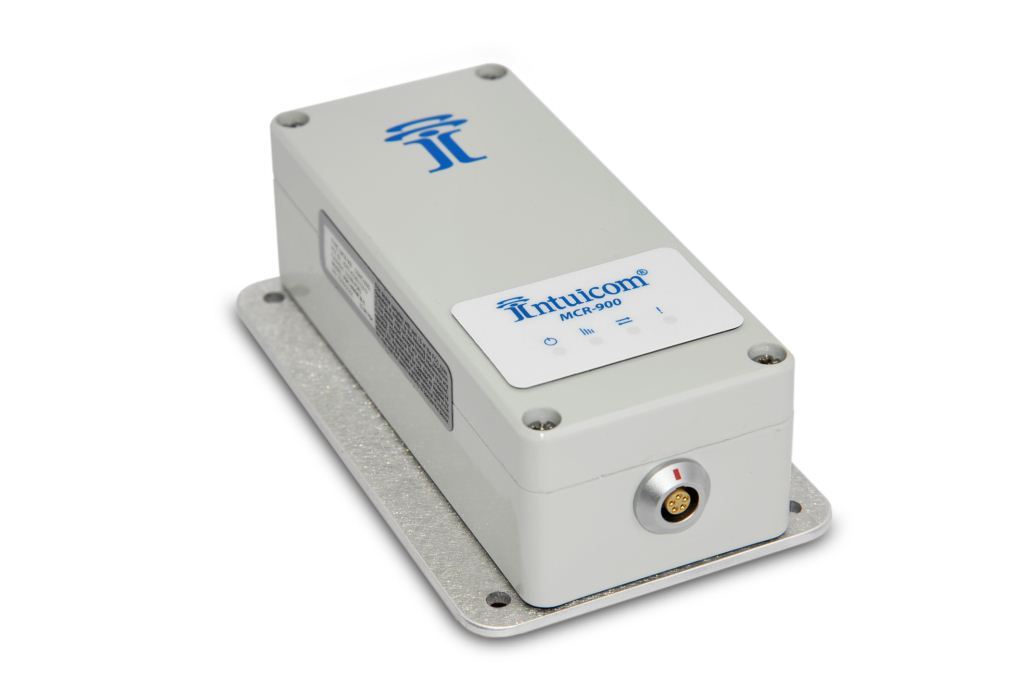
  • Intuicom Introduces Rugged MCR-900 900MHz Transceiver for RTK

    Photo: Intuicom Inc.

    Intuicom Inc. announced the MCR-900 to help increase productivity by extending the reach of wireless communications. Utilizing superior frequency hopping spread spectrum (FHSS) technology, the MCR-900 provides long-range data transport with continuous throughput of 115 Kbps. The MCR-900 offers the capability and flexibility to meet a variety of wireless networking challenges.

    According to the announcement, designed for broad functionality, the MCR- 900 offers the flexibility to serve in simple point to point communication or in more complex multipoint and IP-bridged networks. For example, when combined with the Intuicom RTK Bridge™-C, the MCR-900 provides a way to extend the reach of RTK corrections far beyond normal cellular coverage. This application will enable precision applications such as farming, survey, and construction that use GPS/GNSS-based RTK corrections to work in areas where it would otherwise be impossible.
    “The MCR-900 has been tested in the most extreme environments and continues to run day in and day out.  It fits in perfectly with our overall Machine Control portfolio at Leica Geosystems and we’re proud to offer it to our customers,” said Nick Guadagnoli, OEM Business Development Manager for Leica Geosystems Machine Control Division.
  • Location-Sharing App Glympse to Be Put in Mercedes A-Class

    Today from the Detroit Telematics Conference, location-sharing app maker Glympse announced it is teaming up with Mercedes-Benz to give users real-time location sharing in their cars by integrating Glympse into the new Mercedes-Benz A-Class.

    Drivers will be able to use the in-dash Mercedes DriveStyle to select a recipient, set a timer, and “send a Glympse” to anyone they choose. The recipient of the Glympse will receive a text or email link, which will show the driver’s real-time location on an interactive map.

    Consistent with Glympse’s approach to location sharing, when the timer expires, the location sharing will automatically stop. Because Glympse is a universal sharing solution, the recipient doesn’t require any special software or device, just a web browser.

    With its smart phone apps, Glympse shares location with others in real time. Users on iPhone, Android, Blackberry, and Windows phones can send a Glympse to others via email, SMS, Facebook, or Twitter. Now, that functionality is being integrated right into the A-Class.

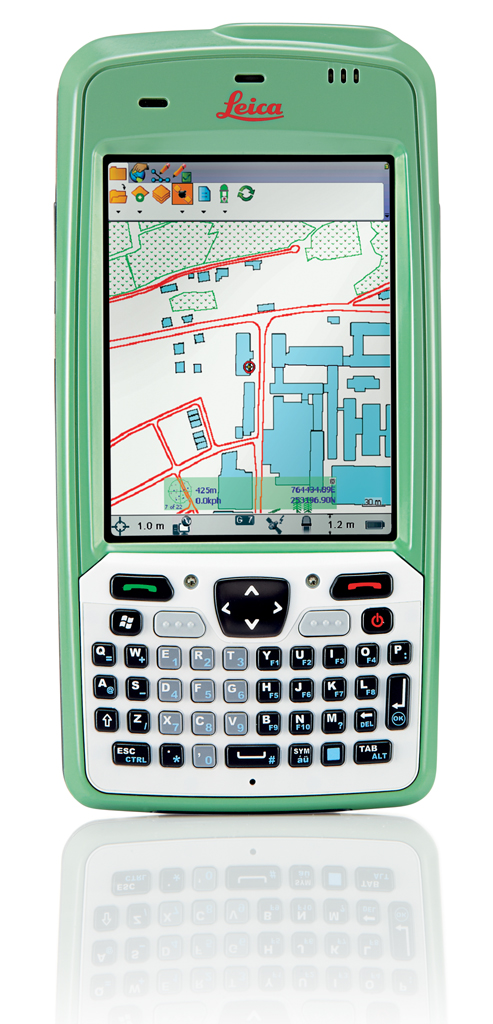
  • Leica Introduces Zeno 5 Rugged GPS Handheld

    Zeno 5 by Leica Geosystems.
    Zeno 5 by Leica Geosystems.

    Leica Geosystems announced a further enhancement to the Leica Zeno GIS family – the Leica Zeno 5, an entry-level, rugged PDA for organizations that require a durable compact device with integrated modem and high-sensitive GPS. The new Leica Zeno 5 supports field workers by combining a mobile phone with asset collection and management capabilities.

    Senior Product Manager Johannes Hotz comments ”Together with our Leica Zeno Field and Zeno Connect applications, the Zeno GIS family continues to grow and further addresses all mobile GIS market segments ranging from utilities and natural resources to municipalities”.

    The new Leica Zeno 5 provides a complete, integrated package of positioning, imaging and communications tools:

    • 48 channel, high-sensitivity GPS receiver (SirfStarIV)
    • GSM HSPA+ and CDMA with full phone capabilities, Wi-Fi and Bluetooth
    • Texas Instruments latest high performance processor, the Sitara 3715 (OMAP3) at 800 MHz
    • Large 3.7” full VGA transflective display
    • Windows Embedded Handheld 6.5.3 Operating System
    • Rechargeable and hot-swappable all-day battery (10 hours +)
    • Full range of interactive sensors including camera, digital compass, gyroscope, light sensor, proximity sensor and accelerometer

    “The new Leica Zeno 5 is the fastest and best equipped rugged PDA for a mobile user”, said Johannes Hotz. “Designed to be, at the same time, a mobile phone, GPS-enabled data collector and a controller for our out-standing Leica GG02 plus GNSS SmartAntenna. This new handheld will help users to get the maximum out of from their investment. Together with our Zeno Field application, the Zeno 5 provides an easy-to-use, streamlined GIS data collection and management solution. The Zeno Connect, as stand-alone application or SDK, enables our software partners to combine their industry specific solution with our high-accuracy data collection solutions”.

    According to the announcement, the Leica Zeno 5 is shock resistant, withstands a drop from to 1.8 m, and is protected against water and dust. The large 3.7 inch screen is optimized for sunlight readability and maintains exceptional clarity in outdoor conditions, including direct sunlight. Field workers can collect features and descriptive information using the in-built, high-sensitive GPS data, attach photos to the collected assets, and synchronize, with high-speed up- and download times, with the office using a single and compact device, all in a full working day without re-charging the Zeno 5.

  • Live Blogging from U.S. Joint Nav Conference

    Alan Cameron, publisher and editor, and Don Jewell, contributing editor for defense, will be blogging live from the 2012 JSDE/ION Joint Navigation Conference. The conference will be held June 12-15 in Colorado Springs, Colorado. Cameron and Jewell will be blogging twice a day with all the news from the defense-oriented conference.

    Among many other matters, we’ll be taking a close-up look at NovAtel’s and L-3’s new SAASM receiver. This is a classified piee of hardware, of course, but we should be able to glean some details on this and other new defense products and services being rolled out at the exhibit accompanying the conference.

    In addition, we’ll have a top-level view of the Warfighters’ Panel on June 15. A similar session was the undisputed highlight of the GPS Partnership Council in late April, and we expect more of the same here. GPS World columnist Don Jewell is organizing this panel.

    According to organizers, JNC 2012 will be the largest U.S. military navigation conference of the year with joint service and government participation. The event will focus on technical advances in positioning, navigation and timing (PNT) with emphasis on joint development, test and support of affordable PNT systems, logistics, and integration. From an operational perspective, the conference will also focus on advances in battlefield applications of GPS, critical strengths or weaknesses of fielded navigation devices, warfighter PNT requirements and solutions, and navigation warfare.

    Watch the home page Top Story for the blogs, beginning Tuesday, June 12.

  • Abaqus, 1Shop Wireless Launch myGeoTracking MRM Service for T-Mobile Business Customers

    Abaqus, Inc., developer of a device-neutral, cloud-based location and messaging platform, and 1Shop Wireless, national sales agent for T-Mobile USA, have teamed to provide the cloud-based myGeoTracking mobile workforce management service for T-Mobile customers.

    The Abaqus myGeoTracking platform provides a cloud-hosted solution that combines network-derived and phone-based GPS location information with fine-grained privacy control options, location-enhanced SMS, and a powerful rules engine to let companies quickly and easily manage their field-personnel and assets, the companies said. It does not require special devices or smartphones, expensive data plans, cumbersome applications, or software.

    Peter Giansante, director of Sales for 1Shop Wireless, called the service “an ideal device-neutral location-based-solution for companies that want to equip their employees with feature phones and smartphones, and want to avoid the deployment and training issues associated with mobile apps-based MRM services.”

    “Abaqus’myGeoTracking bizTeam service is a great fit for any field-force oriented T-Mobile customer that needs to deploy a mobile management solution,” said Gillian Foley, vice president of One Shop Wireless. “T-Mobile is constantly seeking innovative ways to meet customer demands. myGeoTracking fits the bill with its cloud-based approach that provides a lot of flexibility and choice to companies seeking a better way to affordably manage their mobile workforce.”

    Unlike smartphone-based applications that require special phones and client applications, the location-enhanced, SMS-based myGeoTracking mobile workforce management solution from Abaqus can locate any phone on a cellular network using either cell ID information, or a precise location using GPS inside the device. The platform provides fine-grained controls to the dispatcher or the employee in the field to pull or push location data using simple SMS commands.

    The myGeoTracking platform has a rich web API which can be used to integrate with a range of back-office Enterprise systems, the companies said. The service provides SMS-based messaging for team job status reports, and has a powerful rules engine that can use geofencing, time, device identity, workgroup, and other terms to integrate into a company’s mobile workflow needs on a day-to-day basis.

    • The myGeoTracking bizTeam service is an MRM solution which is completely cloud-based and does not require special GPS devices, special phones or any new software.
    • The myGeoTracking bizTeam MRM service can use any standard feature phone to send location and event information, and complies with USPS location standards.
    • The myGeoTracking bizTeam MRM service provides fine-grained privacy controls, which can be managed by the end-user from their mobile phones or from the web site
    • Location-enhanced SMS (myGeoText) lets mobile workers actively send the date, time, and location stamped status message from the field and trigger additional dispatch functions.
    • The myGeoTracking bizTeam MRM service provides geofencing, geo-corridors, and a variety of other events-based rules to enable easy integration of real-world alerts into a company’s workflow
    • The myGeoTracking bizTeam service provides rich reporting tools which can be exported to a company’s backoffice systems
    •  The myGeoTracking MRM bizTeam service provides an Enterprise SMS feature which lets customer’s enhance their dispatch and operations by messaging individuals, groups, or the whole company.
    •  The myGeoTracking Platform integrates with a range of back-office programs through a rich web API.

    “We’re thrilled to team up with 1Shop Wireless and T-Mobile to provide the myGeoTracking bizTeam service as a light MRM solution for small-to-medium business customers,” said Shailendra Jain, CEO/Founder or Abaqus, Inc. “We look forward to working with 1Shop Wireless and T-Mobile to grow the adoption of cloud-based location and messaging services with strong privacy controls, and help their customers achieve clear ROI and real bottom-line benefits from the service.”

  • Hexagon Acquires Minority Stake in Blom ASA

    Hexagon AB announced that it will acquire 25 percent of the shares in Blom ASA for a total amount of approximately 9 MEUR.

    According to the announcement, Blom ASA has headquarters in Oslo, Norway, and is listed on the Oslo Stock Exchange. The company is a European service provider in the geospatial arena, offering a wide selection of geographic services to the government, enterprise and consumer markets. Services include the acquisition, processing and modeling of maps and images. With subsidiaries in 13 countries, Blom’s geographic information database houses one of the largest collections of maps, aerial images, and geospatial models across Europe. Through its online services, Blom provides access to its expansive database enabling customers to update their own datasets and partners the ability to create applications using Blom’s location-based services and navigation solutions.

    “Our alliances with geospatial information providers around the globe strengthens our vision of providing “dynamic”, more accurate and in the end real-time updates of the world around us”, said Ola Rollén, president and CEO of Hexagon AB. “With this investment, Hexagon secures access to high resolution and up-to-date geospatial information which is becoming increasingly important to our entire customer base, especially within Intergraph, where access to such data provides the foundation for industry-specific software solutions”.

    Hexagon reports that it has no current plans for any further offer with respect to shares in Blom. The transaction will close as of Friday, June 1, 2012.

  • The System: Commercial GPS in Combat

    Partnership Council Affords Insight, Drama

    By Alan Cameron

    This year’s GPS Partnership Council provided among other highlights a discussion of the tensions between commercial off-the-shelf (COTS) receiver systems used in tactical combat operations versus official military GPS user equipment (MGUE), and an enthralling warfighters’ panel that revealed much of those COTS/MGUE dilemmas. The event, held May 1–2 in El Segundo, California, drew an enthusiastic and involved audience, including many GPS veterans. I was struck by the graying of the clan as well as the practiced and confident presentations of current civilian and military program staffs.

    Keynote speaker Brig. Gen. Martin Whelan, Director of Requirements, Headquarters Air Force Space Command, emphasized that ideas for improvement of the system would be hard sells under current budget realities, but good ideas for lower cost would be welcome. Referring to the three segments — space, ground, and user — he recommended that the segments should talk with each other and challenge requirements. In effect, he implied that the separate segments could reduce overall costs, rationalize requirements, and cooperate better in optimizing the resilience and flexibility of the system, including — this is my interpretation — taking advantage of the “competitive” GNSSs to effect user satisfaction.

    According to Whelan, resiliency of the space segment is a top priority; smaller satellites, hosted payloads, and net-centric designs were highlighted. He commented that multiple GNSSs should be employed in such a way that the user does not know the difference.

    Regarding the upcoming budget, he told us that Department of Defense will be cut by 22 percent, the Air Force will drop 9 percent — but the AF space budget only 1.5 percent. A notable exception to the generally favorable overview was his comment that the MGUE segment, from a distance, looked uncoordinated. Much more along this line came up later during both days of the Council.

    Widespread COTS. There was an air of defensiveness about the user segment, and many comments on both the success and the risks associated with the widespread use of COTS user equipment. We heard further commentary on the very infrequent use of SAASM keys, due to the difficulty of procedures to obtain and employ them, and due to the perception of very low risk of jamming and spoofing threats in current combat deployments.

    A session on “The Future Military Receiver” enlisted two panels of government experts and contractors from Deere-NavCom, Garmin, IEC, Johns Hopkins Applied Physics Labs, Raytheon, and Rockwell-Collins. Although the unclassified nature of the presentations limited the level of detail, it clearly emerged that many tactical, in-combat deployments of COTS GPS receiver systems had occurred and continue to occur.

    A video compared the jamming resistance of a Garmin receiver with that of approved GPS User equipment receivers. It showed a screen of the Garmin receiver losing satellites at greater distances from the jammer and losing lock at closer distances. Directorate employees and officers made several references to the risks from dependence upon COTS receivers, and related with considerable candor the difficulties with large, expensive, power-hungry MGUE, both mobile and platform-mounted, models of which were held up during the presentations — often to laughter from some in the audience.

    More on this followed in Day Two’s dramatic warfighters’ panel, which many people felt was by itself worth the price of admission. These experienced users of GPS under fire — from Coast Guard search and rescue to Air Force forward controllers calling in air strikes within range of small-arms fire — related direct personal experience in a broad array of critical applications. They clearly knew how to use COTS equipment to good advantage and described the operational protocols developed from hard and sometimes painful experience.

    Manipulation of multiple screens in a heavy device, which requires initialization or synchronization before dismounting, was often simply not an option. Translation of such experience into qualified requirements is a major challenge for the Air Force and Army. Overdependence on the anecdotal but very valid combat experiences would weaken a design against an enemy with even rudimentary jamming and spoofing capability.

    An astute questioner asked “Have you seen any evidence that the enemy (in Afghanistan) has changed tactics because of our technology?”

    The answer came “Not yet,” with a comment that the enemy’s early warning systems are very sophisticated and the target of a mission to capture a high-value individual (HVI) frequently knows that such a mission is underway; his support network spirits him away and attacks the mission with the advantage of surprise denied to our forces, abetted by the advantage of favorable terrain and numbers accruing to the enemy.

    The Puck. The Army-led MGUE program status was described as being at technology readiness level (TRL) 6.0; the request for proposals was released on April 16. The key to the success across platforms of this “system of systems” was said to be the Common GPS Module (CGM), also referred to as the Puck. This module is M, P, and C/A code-capable and SAASM-capable but has flexible interfaces and “emulates commercial.” The module itself is a system-on-chip (SoC) that can be integrated across many platforms. Depending upon the level of integration employed, it can be as small as chips found in smartphones or somewhat larger.

    The program schedule was defended as having only been funded two years ago and having very complex security and platform interfaces. This program presentation drew a large number of questions and commentary from the audience, much of it politely skeptical and showing impatience with the bureaucratic aspects of the program. Well-informed former military field-grade officers in the audience questioned its real availability. The answer that it would be available in quantity sometime in 2017 did not please the questioners.

    In short, procurement regulations appeared to be the highest barrier to a rapid, flexible program for a net-centric, open-architecture system development.

    Currently, the circuit boards for the MGUE are classified secret, but it is hoped to have these at a confidential or unclassified level for deployment by handling the encryption exclusively in software. The leader of this presentation indicated that software receivers were the ideal but were not available, so reduction in size, power consumption, and complexity in hardware was the goal.

    Trumping Military. One almost nostalgic comment hearkened back to the time when military systems were regarded as the height of technological excellence, whereas it is now generally perceived that commercial systems trump the military in sophistication. Garmin claimed to have developed SAASM receivers in the lab but found little interest from business leaders at that time.

    The CEO of Mayflower Communications, which makes and sells miniaturized SAASM receivers, pointed out that anybody could make a SAASM receiver employing a Sandia crypto-chip approved by the U.S. National Security Agency (NSA) but pointed out, as did several others, that the availability of certifications and authorizations was very limited, and that volume drove cost. Implicitly, NSA’s requirements and protocols got blamed for the limited distribution and use of SAASM receivers.

    Day Two

    The second day of the GPS Partnership Council comprised The Nation and The Warfighter. In the latter group came an outline of the Army’s COTS vision and — the hit of the entire conference — the Warfighter panel with a keynote introduction by a USAF colonel warrior now at the GPS Directorate.

    The Nation. Tony Russo, director of the National Coordination Office for Space-Based Positioning, Navigation, and Timing, disabused those who thought that the apparent demise of the LightSquared threat had eliminated that subject from his agendas; he still deals with it often. He provided entertaining and informative examples of non-obvious and valuable applications of GPS, from assessing rugby players’ game performance through detection of clandestine underground nuclear tests to a social application of matching available part-time and temporary workers with jobs when labor demand surges and a roster shows where the closest qualified candidates are.

    John Merrill of the Department of Homeland Security (DHS) identified 18 critical infrastructures that depend upon GPS integrity and showed the cascading effect of taking out sites like SCADA (Supervisory Control and Data Acquisition) systems. He related a threat-illustrative story of a DHS agent who required constant contact via his agency smart phone but who could not get reception while attending mass in church. The pastor later and very proudly showed him the mobile phone jammer in the sacristy; he had given up on asking parishioners to turn off their cell phones off during services.

    James Miller of the National Aeronautics and Space administration noted that only 5 percent of space missions lie outside the GPS coverage envelope (3,000 kilometers to geostationary altitude of 35,800 kilometers is the space service volume). Reducing the burden on spacecraft tracking networks is a highly profitable application for GPS.

    Warfighters Panel. These real-life experiences from combat and other vital operations could easily justify an entire article of their own. The following examples will illustrate the life-saving force multiplication of GPS, particularly the ubiquitous civil GPS technology in the current combat environment.

    •  An Air Force Special Operations Major described a mission to snatch an HVI, giving great detail on battlefield terrain, combat conditions, and how he worked between a COTS GPS receiver and a COTS handheld computer with Google Earth-like facilities to bring JDAMs (GPS-equipped smart munitions) onto an ambush mounted by defenders of the HVI, who were alerted to the raid by their extensive and sophisticated early-warning network consisting of sympathizers with cell phones. His description of the heroics of individual forward controllers, their injuries and fatalities, and the symbiosis of man and machine in a relatively benign electromagnetic interference but relatively malign electromagnetic propagation environment, and overtly and covertly hostile indigenous population, was dramatic and compelling.

    Clearly, unsophisticated  and easily-available  high-power jammers rapidly alter such situations to reduce our technological advantages. Also clear was the need to design user equipment, not just to reject interference but to minimize time and the inevitable ambiguities in actual combat situations.

    •  A Coast Guard lieutenant described the search-and-rescue missions he flies out of local airports to Pacific Ocean sites. Again, COTS equipment, aided by the near-ubiquity of commercial GPS equipment, along with VHF marine radio on boats and ships, enhances these mission results over those flown with standard USCG-issued navigation equipment.

    •  An Air Force tanker pilot major now attached to the GPS Directorate described three personal experiences. He once had to ask his boom operator to retrieve the Garmin receiver issued in the survival kit in order to navigate the tanker for rendezvous with tactical aircraft needing fuel when the tanker’s standard equipment failed.

    When tasked to fly into an airport in Afghanistan with unreliable navaids, under suddenly occurring zero-zero conditions, the onboard GPS enabled him to land safely.

    In a third instance in Iraq, he observed a downed airman being approached by gunmen. The gunmen with AK-47s were being targeted by drone operators. The major was able to discern that these gunmen were friendly forces moving to rescue the downed airman and avert a friendly-fire disaster. The downed airman’s ability to send his exact coordinates were key to the ability of the observer to get close enough to direct rescue efforts and to avoid a fatal error.

    • A Navy surface warfare lieutenant commander and a CWO Riverine or small boat skipper cited instances in which GPS was essential to missions and ways in which user equipment design could improve their operations — for example, by making it float.

    All the veterans repeated, during or after their accounts of ways in which GPS saved lives or enabled missions, “thank you for what you do,” addressed to the audience, the presenters, and their leaders. Going into denied territory places a high premium on user friendliness, battery life, robustness, size, and weight. In the future, inevitably, jam and spoof resistance will be an object of gratitude, as well.

    Final Review. We all know these things, intuitively and by doctrine, but hearing reports from people in harm’s way or retrieving comrades from harm’s way was a great addition to the usual program and technology descriptions by the development teams.

    I was particularly impressed with the very articulate, sophisticated, and focused presentations of these combat veterans. It is highly incumbent on the industry and the government GNSS leaders to translate these experiences into design requirements quickly, so that future systems are less dependent on individual ingenuity and on commercial gap-fillers.

    Much of this progress depends on truly incorporating the applications focus of commercial product development and on use of other GNSS systems for robustness, flexibility, and affordability — often quoted as mission goals by the leaders of this enterprise.


    MBOC Signal Furor

    A subsidiary of the UK Ministry of Defence has taken a UK patent on the new Galileo/GPS III MBOC signal design, the product of lengthy and cooperative negotiations between U.S. and European scientists. The patent, in the names of two UK engineers who participated in the project, is being used by a legal firm to demand royalty fees from receiver manufacturers, causing considerable controversy.

    LightSquared Bankrupt

    LightSquared, the company that mounted a powerful threat to GPS signals from November 2010 through February 2012, filed for bankruptcy protection on May 14 after losing a protracted battle in the court of the Federal Communications Commission. The war is not over, however. Exploding sprectrum demand for mobile data use makes it likely that future challenges to GPS and GNSS spectrum will emerge.

    Compass Muscling Up

    Two mid-Earth orbit (MEO) Beidou/Compass satellites were launched April 29. Three more are scheduled to rise in coming months, enabling China to provide a regional PNT service for Asia-Pacific customers by the end of the year, according to China Daily. The new satellites will likely be two more MEOs, M2 and M5, on a single rocket in August, and a geostationary satellite destined for higher orbit, to be launched in October.