Category: Applications

  • eLoran and UrsaNav: Timing Is Everything

    The first part of the recent UrsaNav press release says it best:

    This week for the first time since August 2010 advanced low frequency (LF) signals, including a new eLORAN, are on the air in North America! As a result of a Cooperative Research and Development Agreement (CRADA) between the United States Coast Guard (USCG) and UrsaNav, Inc. live testing of a wide-area precise timing solution has begun. These initial tests include a comprehensive pallet of signals, including eLoran, that are being evaluated for their ability to provide a robust, wide-area, wireless precise timing alternative that can operate cooperatively with GPS, or during periods of GPS unavailability.

    Why eLORAN

    Global government, industry, and academic experts recognize that advanced LF signals, of which eLORAN is just one example, can provide alternative timing — either as a stand-a-lone service, or as a component of an existing PNT service. The high power, virtually jam proof and spoof proof LF signals operate independently of GPS and GNSS, and provide a Universal Coordinated Time (UTC) time reference in the order of tens of nanoseconds. The recognition of the criticality of time to many aspects of our national critical infrastructure has led to establishment of the CRADA to evaluate the benefits of an LF wide-area timing system.

    UrsaNav on-air eLORAN tests continue at various sites throughout the United States (CONUS and Alaska). Broadcast demonstrations will test several different frequencies, waveforms, and modulation techniques using evolutionary state-of-the-art technology.

    Reception demonstrations of the eLORAN broadcasts are planned at both on- and offshore locations, and will include advanced LF data delivery techniques. Trial results will be presented at national and international conferences. Anyone interested in any part of the testing or interested in making their own measurements are invited to contact UrsaNav.


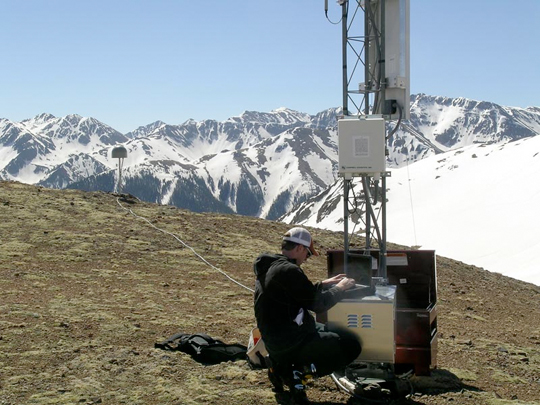
    UrsaNav eLORAN system. Arthur Helwig (UrsaNav) and
    Aaron Grant (Nautel) prepare the LF transmitter for the next
    set of on-air tests.

    Partnered with Symmetricom and Nautel, UrsaNav says it has the world’s most advanced LF alternate PNT and data solutions to include the world’s best high-performance eLORAN timing receivers. UrsaNav has partnered with two of the best in the business for timing and transmitters, and this alliance of expertise provides the foundation technology for the best wide-area terrestrial-based alternative to GNSS such as GPS, GLONASS, and Galileo.

    That being said, I would add that you should not only consider the UrsaNav LF system as an alternative, but during normal GPS operations as a complimentary and/or augmentation to GPS, and then as a back-up and integrity system when the situation warrants.

    As one of my professional colleagues, who is a retired USCG officer and once ran the USCG Navigation Center, stated, “This is a big deal! It is in fact the first and biggest piece of good news about a true PNT (position, navigation, and timing) backup for GPS since Loran-C was killed in the FY2010 budget.

    “Not only is this an independent timing backup, but the LF signals can also be used as pseudoranges mixed in with GPS, or if enough transmitters are available, as a fully independent PNT network. In other words, a true backup PNT capability for safety-of-life navigation, for dispatching first responders, and for supporting critical national infrastructures.”

    This is a pretty enthusiastic response, even from a LORAN aficionado, and it is indicative of the responses I received whenever I reached out for comments from knowledgeable PNT SMEs (subject matter experts) around the globe.

    The response nationally and internationally has been extremely positive as well — especially in light of the recent LightSquared debacle and the now better-understood vulnerabilities of the very low-power GPS signals.

    I hoped I would never have to type or have you read that word again, as a noun or a verb, but the whole LightSquared scenario did serve to point out a dire need and shortcoming in the U.S. PNT infrastructure. Fortunately, the proposed UrsaNav eLORAN system appears to be on track to fill that need perfectly.

    For the first 32 years that GPS signals were broadcast, LORAN-C served as a critical backup for timing and a less accurate but viable alternative for navigation. In fact, Loran-C, along with GPS and cesium clocks synchronized to UTC, were the only accepted Stratum 1 frequency sources at the time (Stratum 1 frequency sources provide a minimum frequency stability of 1 x 10-11 per day.). Then in 2010 the current U.S. administration was looking for government programs to cut and for some unknown reason they latched onto LORAN-C, which was in a critical state of transition at the time.

    LORAN-C has been around since World War II. I among many other aviators used it extensively in Vietnam, and frankly for many countries and users today it is still a totally adequate service. With USCG expertise and support for 52 years, LORAN-C provided unparalleled timing and navigation services around the United States and Canada until the pretender known as GPS came along and dethroned the aging monarch.

    Now, that may sound like a natural sequence of events, except that LORAN-C was in metamorphosis, 80% of the way through the process actually, of morphing into a new digital (1990s era technology) LORAN know as eLORAN or enhanced LORAN with better, more reliable transmitters, smaller receivers, and a virtually jam-proof signal structure. Many likened the legacy eLORAN to a strong ground-based GPS with coded signals for security. All that was in place and 80% complete when the whole process was killed by an administration with a strong Luddite orientation and subsequently the bean counters pulled the plug in 2010, despite recommendations to complete eLoran from both the Department of Transportation’s Positioning and Navigation (PosNav) Committee and the Department of Homeland Security Geospatial Committee and the strong personal support of the DOT Undersecretary for Policy and the DHS Deputy Undersecretary for Preparedness and National Protection and Programs. My sources tell me the Office of Management and Budget (OMB) was determined to do away with Loran-C and facilitated its ultimate demise. An unfortunate theme we have seen played out much too often: Non-technical people forcing ill-advised technical decisions. In a country whose greatness has always been its technical acumen, willingness to take risks, and self-assurance, OMB stands as a chilling element of focus today…but, that’s a subject for a future article.

    Since that time the U.S. Coast Guard spent more money dismantling the legacy LORAN-C infrastructure and antennas than it would have taken to complete the 20% upgrade for a full transition to eLORAN. Taking down the Port Clarence, Alaska, tower, the video of which was a YouTube favorite for many weeks, cost an estimated $8 million. The destruction of the towers in Attu (right), Shoal Cove and St. Paul were probably on average $5 million each. With the tower removal in Baudette, Minnesota, the cost of removing Loran towers to date cost close to $25 million. One could argue that the administration created some jobs in these “shovel-ready” tower tear downs, but I have no doubt that a better use of the funding would have been to deliver a robust positioning, navigation, and timing backup for the nation. But alas that is ancient history in the technology world, a whole 18 months to be exact.

    Then along comes the Lone Rang… I mean Chuck Schue, the CEO and president of UrsaNav, which is a small company originally founded by Charles “Chuck” Schue, because frankly he has always been interested in navigation. Chuck is a former ION (Institute of Navigation) Washington, D.C., Section Chair and is a current member of the ION Council. Chuck is also a retired USCG officer and his last job in the USCG was as Commanding Officer of the Loran Support Unit, providing direct support to a large portion of the functions supported by the USCG Navigation Center (NAVCEN). So it is no accident that Chuck and UrsaNav saw the gaping hole for GPS support that was created when LORAN-C and the legacy eLORAN programs were unceremoniously put on the chopping block. Now UrsaNav with their new 2012 version of eLORAN and the help of the USCG, through a CRADA, have stepped in to fill a very real need.

    In my opinion (pun intended) their timing could not have been better. LightSquared is hopefully behind us along with the threat of losing GPS capabilities and all GPS P&T (positioning and timing) enables without a viable backup. This is definitely not a scenario any sane person wants to see happen again and fortunately UrsaNav LF timing and eLORAN can provide a critical back-up, augmentation and integrity check while simultaneously providing the USG with a security blanket, as Linus would say.

    The USCG-UrsaNav CRADA

    Before considering reactions from other USG agencies and then international reactions to the UrsaNav program, maybe it would be best, in case any of you are wondering, to describe the function of the subject CRADA since it has been mentioned several times.

    In February 2012 the U.S. Coast Guard Research & Development Center (R&DCEN) announced it had entered into a Cooperative Research and Development Agreement (CRADA) with UrsaNav to research, evaluate, and document at least one alternative to the Global Positioning System (GPS) as a means of providing precise time. The alternative under consideration is a wireless technical approach for providing precise time using U.S. government facilities and frequency authorizations.

    While this is a very general statement and does not give much away, it is meant to be that way since it is, after all, an R&D effort and general statements give you the most leeway when considering options and trade space.

    CRADAs are authorized by the Federal Technology Transfer Act to promote the transfer of technology to the private sector for commercial use as well as specified research and/or development efforts that are consistent with the mission of the federal parties to the CRADA. The federal party or parties (USCG) agree with one or more non-federal parties (UrsaNav) to share research resources, but the federal party does not contribute funding.

    This means that the USCG and UrsaNav are sharing R&D efforts, data, and even non-monetary resources, but the USG is not providing any funding to UrsaNav for the project. So UrsaNav is footing the bill; at the same time, it has access to USG data and resources, to include buildings and transmitting towers, for example, and UrsaNav knows it has at least generated interest among government and commercial users for LF timing signals.

    DOT/FAA Reactions

    When I first saw the UrsaNav announcement, I immediately thought of the DOT and FAA, since they have been trying to think of ways to provide a common, non-GNSS, distributed timing backup for all their facilities and customers as part of their efforts to develop an alternate PNT (APNT) capability. One of the APNT alternatives is considering distributing time to air traffic control facilities and aircraft through their ground-based DME (distance measuring equipment) facilities. For the non-aviators among you, DME signals allow aircraft to determine their distance from a DME location. Properly equipped aircraft (primarily commercial and high-end general aviation) can use ranging from multiple DMEs to actually determine their position and follow area navigation (RNAV) procedures for more effective routing and flexibility. In order to utilize the DMEs as a ground-based, high-power (1000 W) equivalent of a satellite constellation will require each DME facility to be synchronized in time to around 30 nanoseconds or better. Now, with the possibility of an eLORAN time standard with a huge booming, virtually jam-proof and spoof-proof signal, across the CONUS and Alaska, this FAA alternative solution could be greatly facilitated. While the FAA also has the option to use GPS time, or time from its own WAAS ground-based clock ensemble, or WAAS retransmitted time combined with GPS time for remote locations and to back it all up and provide an integrity check, the availability of an eLoran alternative is certainly worthy of FAA APNT consideration. The FAA’s distribution problems would be solved, and since both GPS and eLORAN have the capability for encoded signals, the integrity (information assurance) and security problems are solved as well. Comparison of the vulnerable GNSS signal with the robust eLoran timing signal could alert an operator to possible spoofing or even a less sinister loss of integrity event. So this is a win/win for the FAA and several other critical national agencies and infrastructures that must remain nameless for security purposes.

    International Partners

    What makes the UrsaNav solution so promising and frankly exciting is that they are not conducting these experiments and demonstrations in isolation. For the past few months UrsaNav has been working with the Lighthouse Authorities of the United Kingdom and Northern Ireland as well as Chronos Technology, a world leader in GNSS jamming and interference detection, in Great Britain. To determine how the UrsaNav eLORAN program is progressing internationally, who are you going to call? Personally, if it concerns GPS, time, and the UK, there are two people who immediately come to mind: Dr. David Last and Martin Bransby.

    Professor David Last is a consultant engineer and internationally renowned expert witness specializing in radio navigation and communications systems. David is a Professor Emeritus (that means he is at least as old as I am) at the University of Bangor, Wales, and Past-President of the Royal Institute of Navigation (RIN), the equivalent of the U.S. ION, but RIN has only been around since 1947. David acts as a consultant on radionavigation and communications to companies and to governmental and international organizations worldwide and is active as an expert witness, especially in forensic matters concerning GPS.

    Both David and Martin are highly qualified SMEs and BLUF, or bottom line up front; their praise for the UrsaNav initiative could not be higher.

    According to Professor Last, “…a ‘sky-free’ timing service like the one UrsaNav will hopefully soon be radiating in the United States is already available across the British Isles and adjacent parts of Europe. The eLORAN system uses the GLAs’ prototype eLoran system plus GPS/eLoran timing receivers from UrsaNav and Chronos Technology.

    “The prototype eLoran service has been running 24/7 since January 2008, serving the eastern half of Britain and the North Sea. It now delivers 10-meter (~30 feet) navigation accuracy in the approaches to Harwich and Felixstowe, the UK’s major container ports, where a prototype full differential service has been in place since mid-2010.

    “In addition, the UK transmissions support a prototype robust, nationwide data channel that will benefit in future from the techniques currently being developed by UrsaNav to expand the data capacity of eLoran-compatible LF transmissions.

    “This is all part of the resurgence of terrestrial LF services in response to the vulnerability of GPS and all other GNSS (read LightSquared). The GLAs are leading this movement to adopt eLoran as the terrestrial complement at sea and supporting the use of the new eLoran transmissions for sky-free complementary navigation, timing, data, and tracking of land vehicles. And the neat thing about LF timing and data is that a single station serves a large area. So the UK station delivers data across the UK and timing even more widely. This appeals to all sorts of folks who aren’t interested in navigation. But once enough timing and data stations are on the air, you get back navigation!”

    Now, Martin Bransby is the R&RNAV (Research and Radionavigation) manager for the General Lighthouse Authorities (GLAs) of the UK & Ireland. Which simply means he is a senior engineering manager and program manager with extensive experience in R&D of highly technical assets, such as maritime aids to navigation, radar, C4ISTAR, and tactical data links, and he is the official GLA POC working the eLORAN program in the UK and Ireland, which he indicates is progressing extremely well. So well, in fact, the GLAs awarded a 15-year contract to provide a state-of-the-art eLORAN service to improve the safety of mariners in the UK and Western Europe. The service contract includes R&D work and the operation of an eLORAN service through 2022.

    Support: The Good News

    Back on this side of the pond, my sources at the USNO (U.S. Naval Observatory) our resource for Coordinated Universal Time or UTC are supportive of the UrsaNav eLORAN effort. A senior source, who prefers to remain anonymous, stated that the USNO will support any USG terrestrial time distribution system that may emerge from the UrsaNav eLORAN effort by providing the underlying timing reference “UTC (USNO).” However, to achieve true GPS independence, my source would like to see either fiber-optic or two-way satellite time transfer (TWSTT) utilized to sync the eLORAN ground transmitters. And in the end higher power, GPS independence, and good indoor reception are probably the greatest advantages. My source is looking forward to the results of this initial demonstration by UrsaNav and the USCG.

    According to Chuck Schue, UrsaNav, anticipated this USNO preference and is working with Symmetricom on a TWSTT while also developing a TWLFTT, or two-way low-frequency time transfer capability, which allows for time transfer from a UTC source such as USNO or NIST that is completely sky-free.

    The Bad News

    We’ve all heard the Biblical phrase that originated in Matthew concerning “the right hand not knowing what the left hand is doing.” In this instance, where eLORAN is concerned, the USCG may have adopted that as a program motto.

    Note: The real motto of course is Semper Paratus, and the brave men and women of the USCG live up to it everyday.

    Originally in the Unites States, CONUS, and Alaska, there were 24 LORAN-C transmitters with towers between 600 and 1350 feet tall; add the towers supporting the Joint U.S.-Canadian LORAN-C system plus the LORAN-C Support Unit tower, and there were a total of 30 huge LORAN-C towers with all the accompanying support structures for the transmitters, support crews, etc. Today, there are only 25 towers remaining — as the USCG engineers are in the process of dismantling the LORAN-C infrastructure — five towers in the last 18 months.

    As often happens in a large distributed organization, though Headquarters (CG-5) supports the eLORAN CRADA with UrsaNav and fully realizes that future eLORAN deployment depends on reuse of existing infrastructure, the civil engineering support organization gets its money and develops its project lists separately. Consequently the antenna towers at Attu (located at the end of the Aleutian chain) and Port Clarence (situated well north of Nome) have come down, as have the towers in St. Paul (in the Pribilof Islands, northern Bering Sea) and Shoal Cove (located in SE Alaska, near Ketchikan). Only two towers remain in Alaska; one in Kodiak (adjacent to the USAF-Alaska launch facility) and one at Tok Junction (on the ALCAN Highway, southeast of Fairbanks). Within CONUS, the USCG engineers are in the process of dismantling the facilities in Baudette — which is just about as isolated as some of the sites in Alaska.

    Operational Issues

    The operational problem is that while the much more powerful and economical energy-scavenging transmitters from UrsaNav’s partner Nautel, and new wave forms being produced by UrsaNav, probably only need to utilize 8-10 towers — the system is that much better and more powerful — no one knows where they need to be located until more tests are conducted. So how do the USCG engineers know which ones to dismantle? Obviously they don’t and there’s the rub, plus if the system is really successful and the data portion is a success, there could be a need for even more towers. Solution — the R&D guys (RH) need to coordinate with the engineering crews (LH) and put a hiatus on dismantling LORAN-C towers and the associated infrastructure, unless they pose a safety hazard, until the outcome of the CRADA and subsequent acquisition decisions have been made.

    Seriously, the USCG and UrsaNav are heroes for initiating the CRADA, and my hat is off to them for realizing the critical need for eLORAN, but seriously, somebody pick up a phone and call the engineers, call the Commandant, call somebody that can put the tower demolitions on hold.

    The bottom line is UrsaNav and the USCG are to be congratulated for their foresight and planning. Let’s hope the eLORAN demonstrations continue to be successful and that a contract is forthcoming quickly before we, and the powers that be, forget the LightSquared lessons learned…like we would ever let that happen.

    All in all, this is a win/win proposition for the USCG, the USG, and for GPS users everywhere. Stay tuned for more on this topic.

    While you are reading this I will be attending the Munich Satellite Summit in Germany, so guess what my topic will be next month?

    Until next time, happy navigating.

  • The Kinematic GPS Challenge: First Gravity Comparison Results

    By Theresa Diehl

    The National Geodetic Survey (NGS) has issued a “Kinematic GPS Challenge” to the community in support of NGS’ airborne gravity data collection program, called Gravity for the Redefinition of the American Vertical Datum (GRAV-D). The “Challenge” is meant to provide a unique benchmarking opportunity for the kinematic GPS community by making available two flights of data from GRAV-D’s airborne program for their processing. By comparing the gravity products that are derived from a wide variety of kinematic GPS processing products, a unique quality assessment is possible.

    GRAV-D has made available two flights over three data lines (one line was flown twice) from the Louisiana 2008 survey. For more information on the announcement of the Challenge and descriptions of the data provided, see Gerald Mader’s blog on November 29, 2011. The GRAV-D program routinely operates at long-baselines (up to 600 km), high altitudes (20,000 to 35,000 ft), and high speeds (up to 280 knots), a challenging data set from a GPS perspective. As of December 2011, ten groups of kinematic GPS processors have provided a total of sixteen position solutions for each flight. At two data lines per flight, this yielded 64 total position solutions. Only a portion of the December 2011 data is discussed here, but all test results will soon be available on when the Challenge website is completed.

    Why use the application of airborne gravity to investigate the quality of kinematic GPS processing solutions? Because the gravity measurement itself is an acceleration, which is being recorded with a sensor on a moving platform, inside a moving aircraft, in a rotating reference frame (the Earth). The gravity results are completely reliant on our ability to calculate the motion of the aircraft— position, velocity, and acceleration. These values are used in several corrections that must be applied to the raw gravimeter measurement in order to recover a gravity value (Table 1). The corrections in Table 1 are simplified to assume that the GPS antenna and gravimeter sensor are co-located horizontally and offset vertically by a constant, known distance.


    Table 1. GPS-Derived Values that are used in the Calculation of Free-Air Gravity Disturbances

    All Challenge solutions are presented anonymously here, with f## designations. For each flight of data, the software that made the f01 solution is the same as for f16, f02 the same as f17, and so on.

    Test #1: Are the solutions precise and accurate?

    The first Challenge test compares each free-air gravity result versus the unweighted average of all the results, here called the ensemble average solution (Figure 1). This comparison highlights any GPS solutions whose gravity result is significantly different from the others, and will group together solutions that are similar to each other (precise). Precision is easy to test this way, but in order to tell which gravity results are accurate calculations of the gravity field, a “truth” solution is necessary. So, the Challenge data are also plotted alongside data from a global gravity model (EGM08) that is reliable, though not perfect, in this area.

    Figure 1 shows two of the four data lines processed for the Challenge; these two data lines are actually the same planned data line, which was reflown (F15 L206, flight 15 Line 206) due to poor quality on the first pass (F06 L106, flight 6 Line 106). The 5-10 mGal amplitude spikes of medium frequency along L106 are due to turbulence experienced by the aircraft, turbulence that the GPS and gravity processing could not remove from the gravity signal.


    Figure 1.


    Figure 2.

    Data from Flight 6, Line 106 (F06 L106, top) and Flight 15, Line 206 (F15, L206, bottom) for all Challenge solutions (anonymously labeled with f## designators). Figures 1 and 2. Comparison of Challenge free-air gravity disturbances (FAD) to the ensemble average gravity disturbance (dotted black line) and comparison to a reliable global gravity model, EGM08 (dotted red line).


    Figure 3.


    Figure 4.

    Figures 3 and 4. Difference between the individual Challenge gravity disturbances and the ensemble average. The thin black lines mark the 2-standard deviation levels for the differences. For F15 L206, one solution (f23) was removed from the difference plot and statistics because it was an outlier. For both lines, the ensemble’s difference with EGM08 is not plotted because it is too large to fit easily on the plot.


    The results of test #1 are surprising in several ways:

    • The data using the PPP technique (precise point positioning, which uses no base station data) and the data using the differential technique (which uses base stations) produce equivalent gravity data results, where any differences between the methods are virtually indistinguishable.
    • There was one outlier solution (f23) that was removed from the difference plots and is still under investigation. Also, on F15 L206, solution f28 had an unusually large difference from the average though it performed predictably on the other lines. Of the remaining solutions, four solutions stand out as the most different from all the others: f03/f18, f04/f19, f05/f20, and f07/f22.
    • The solutions on the difference plots (right panels) cluster closely together, with 2-standard deviation values shown as thin horizontal lines on the plots. The Challenge solutions meet the precision requirements for the GRAV-D program: +/- 1 mGal for 2-standard deviations.
    • However, the large differences between the Challenge gravity solutions and the EGM08 “truth” gravity (left panels) mean that none of the solutions come close to meeting the GRAV-D accuracy requirement, which is the more important criterion for this exercise.

    Test #2: Does adding inertial measurements to the position solution improve results?

    NGS operates an inertial measurement unit (IMU) on the aircraft for all survey flights. The IMU records the aircraft’s orientation (pitch, roll, yaw, and heading). Including the orientation information in the calculation of the position solution should yield a better position solution than GPS-only calculations, but it was not expected to be significantly better. Figure 2 shows the NGS best loosely-coupled GPS/IMU free-air gravity result versus the Challenge GPS-only results and Table 2 shows the related statistics.


    Figure 5.


    Figure 6.

    Figures 5 and 6. F06 L105. (Figure 5) Comparison of Challenge FAD gravity solutions (ensemble=black dotted line) with EGM08 (red dotted line); (Figure 6) comparison of Challenge gravity solutions (all GPS-only; ensemble=black dotted line) with NGS’ coupled GPS/IMU gravity solution (red dotted line).


    Table 2. Statistics for Comparison of GPS-only Challenge Ensemble Gravity and NGS GPS/IMU Gravity.


    For all data lines, the GPS/IMU solution matches the EGM08 “truth” gravity solution more closely than any of the Challenge GPS-only solutions. In fact, the more motion that is experienced by the aircraft, the more that adding IMU information improves the solution. One conclusion from this test is that IMU data coupled with GPS data is a requirement, not optional, in order to obtain the best free-air gravity solutions.

    Additional Testing and Future Research

    Other testing has already been completed on the Challenge data and the results will be available on the Challenge website soon. Important results are:

    • Two Challenge participants’ solutions perform better than the rest, two perform worse, and one is a low quality outlier. The reasons for these differences are still under investigation.
    • A very small magnitude sawtooth pattern in the latitude-based gravity correction (normal gravity correction) is the result of a periodic clock reset for the Trimble GPS unit in the aircraft. This clock reset is uncorrected in the majority of Challenge solutions. The clock reset causes an instantaneous small change in apparent position, which results in a 1-2 mGal magnitude unreal spike in the gravity tilt correction at each epoch with a clock reset.
    • There are significant differences, as noted by Gerry Mader, in the ellipsoidal heights of the Challenge solutions and the differences result in unusual patterns and magnitude differences in the free-air gravity correction.

    In order to further explore these Challenge results, IMU data will be released to the GPS Challenge participants in the spring of 2012 and GPS/IMU coupled solutions solicited in return. Additionally, basic information about the Challenge participants’ software and calculation methodologies will be collected and will form the basis of the benchmarking study.

    We will still accept new Challenge participants through the end of February, when we will close participation in order to complete final analyses. Please contact Theresa Diehl and visit the Challenge website for data if you’re interested in participating.

  • Geospatial Mapping Enhances Arlington National Cemetery Management

    Officials at Arlington National Cemetery will use an Army-designed geospatial mapping system to manage cemetery operations, said the executive director of the Army National Cemeteries Program.


    Kathryn A. Condon testified before the House Veterans Affairs Committee's disability assistance and memorial affairs subcommitee to provide an update on the progress made in rectifying long-standing management problems at Arlington National Cemetery.

    Source: Arlington National Cemetary

    "Arlington is no longer a paper-based operation. By producing a single electronic map of Arlington, the staff will assign, manage and track gravesites with an authoritative digital map," Condon said. "It will allow us to synchronize in real time our burial operations at Arlington."

    The geospatial mapping system allows officials to synchronize burial operations with other daily operations, such as public ceremonies, infrastructure repair, grounds upkeep and public safety activities, Condon explained. The system is linked to Arlington's interment scheduling system, which allows schedulers to assign gravesites and assign procession routes. It also alerts Arlington staff of other activities in the area, she said.

    Arlington is the first national cemetery to use this technology, Condon told the panel.

    The geospatial mapping system will use the information collected and validated as part of the Army's gravesite accountability study. The gravesite accountability effort resulted in the first review, analysis and coordination of records kept in various ways at Arlington over the cemetery's history, Condon said.

    The Gravesite Accountability Task Force physically examined and photographed 259,978 gravesites, niches and markers using a custom-built smartphone application and matched each photo with records in a database. Arlington officials are 84 percent complete in validating records, officials said, and are on track to finish this summer.

    Once complete, Arlington's accountability effort will create a single, verifiable and authoritative database of all those laid to rest at Arlington, officials added, and it will be linked with Arlington's geospatial mapping system.

  • Continued Growth of Connected Vehicle and M2M Highlighted at MWC

    The Mobile World Congress in Barcelona is getting bigger every year — so much that it’s almost a mini CES that is hard to navigate and find companies…much less big location-based services news. While there were no big jaw-dropping mergers and acquisitions, big product roll-outs and partnerships, this conference will continue to be the main showcase for location companies wishing to establish a presence in Europe.


    BARCELONA — It was tough to find out what might be the big deal for the location industry here at the Mobile World Congress, among 67,000 attendees and more than 1,500 exhibitors. Two areas continued to stand out, as they had at the January Consumer Electronics Show: the rise of the connected vehicle and machine-to-machine connections.

    An MWC keynote was given by Ford Motor Co.’s chairman Bill Ford (right), who gave long-term strategies for the company, which includes big connected car components. Ford’s Sync, which is already on 4 million cars in the United States since it was launched in 2007, now is available in Europe. The company hopes to have 13 million cars equipped with the connected service by 2015 — 3.5 million of those in Europe.

    One of the more significant deals at MWC was Sprint Nextel’s announcement that it will be the strategic wireless partner for Chrysler Group’s Uconnect voice-activated vehicle communications system.

    In keeping with the connected theme, GSMA’s Connected House featured such companies as AT&T and Airbiquity that showcased the transfer of connected lifestyle from car to house. Airbiquity demonstrated its products for cloud-based services, mobile phones and application integration into vehicles. The company launched its Application Developer Program at MWC.

    TCS Offers Family Locator to Auto Makers for Connected Car Initiatives

    TeleCommunication Systems announced at the MWC that it’s incorporating the TCS Family Locator into connected vehicles and is offering it on the iPhone and Android platforms. TCS Family Locator allows users to locate family members’ vehicles through aerial photos or maps to monitor when they arrive or leave specific areas.

    TCS was a pioneer in enhanced 911 roll outs, which was the basis of today’s location-based services, said Jay Whitehurst, TCS senior vice president, commercial software group.

    The cloud-based Family Locator product is being offered to vehicle manufacturers, telematics service providers, and wireless carriers for connected car initiatives, the company said.

    Currently, Family Locator supports BlackBerry and other phones.

    For the enterprise market, TCS said its Workforce Locator mobile resource management product now has extended coverage to data cards and any device with a SIM card, which includes mobile Wi-Fi hotspots and tablets.

    Also at MWC, TomTom said it partnered with HTC to provide the maps, points of interest, and turn-by-turn directions for a line of HTC smartphones in India. TomTom views India as a growing market, citing a study that forecasts more than 5.2 million smartphones will ship to the country this year.

    The HTC deal is TomTom’s first major partnership in India, said Nuno Campos, the company’s vice president of sales and marketing for its licensing division. Campos said that Jocelyn Vigreux, formerly president of TomTom USA, has been consolidating all business units in India to steward the company’s HTC partnership there.


    TomTom also announced a partnership with NDrive to deliver maps and other content to its location-based applications. The three-year deal is big for TomTom as NDrive has millions of users worldwide, Campos said.

    When asked how TomTom is competing against the Googles of the world, Campos said that the market is big enough to run a profitable mapping business. His only crack at Google was that “they are finding that making maps isn’t easy.”

    TomTom, through its joint venture partner AutoNavi Holdings Limited, also announced a seven-year agreement with Qoros Auto, an international automotive corporation. TomTom and AutoNavi will deliver HD Traffic, marking the first real-time traffic customer for the newly expanded joint venture. In 2013 the first cars — aimed at young metropolitan users — will hit the streets in China equipped with HD Traffic, providing drivers with the most accurate, comprehensive, and up-to-date traffic information available.

    In other Mobile World Congress news:

    • Urban Airship said its new Unique Opt-In Report allows users to gain insight in to the numbers of distinct users opting in or out of push notifications. This enables companies to hone mobile messaging strategy based on users’ behavior.
    • Locaaid rolled out its Global Cell-ID at MWC. This new feature, accessible via Locaid’s Location-as-a-Service (LaaS) platform, allows enterprise mobile developers to acquire carrier-certified, permission-based location on their devices in more than 165 countries around the globe.
    • American Roamer changed its name to Mosaik Solutions at MWC. Through its partnership with Europa, the company’s Global Coverage Analyzer and CellMaps are marketed in Europe. Mosaik Solutions’ customers include AT&T International, OnStar, and Comcast.
    • ALK Technologies Inc., which previously charged for its navigation applications, now said its CoPilot GPS is a free app for iPhone, iPad, and Android devices. The company contends that CoPilot is a lot more than Google’s free map service and allows users to search millions of pre-installed points of interest for nearby restaurants, hotels, and gas stations. The company had a booth at MWC and exhibited at Showstoppers, as did Poynt.

    Indoor positioning continued to be a big topic to enable LBS markets at the Mobile World Congress. Richard Najarian, Broadcom senior director, business development, said that market is shaping up. The company also showed off its Bluetooth Low Energy modules that enable indoor location positioning.


    Some other MWC observations:

    1. Qualcomm had an off-site reception for its indoor positioning partners that included Cisco and others.
    2. The Android room at MWC was huge…with such companies as Glympse participating.
    3. Telmap, now owned by Intel, which has recently said it will invest millions into connected vehicle initiatives, has a strong presence in Europe with many LBS applications.

    The company says it’s the No. 1 local content aggregator in Europe, according to Motti Kushner, Telmap’s chief marketing officer.

    Neustar, which is partnering with TELUS and other major operators in North America to create mobile services, had a large presence at MWC. The company’s intelligent cloud helps operators to integrate location and messaging, said Gary Zimmerman, Neustar’s director of product marketing.

    Some of these applications include geofence, which Neustar works with partner ZOS, to create opt-in mobile campaigns that send offers to subscribers based on their location. The company also offers enhanced location that shows how a brand can personalize location information once a consumer gives consent to participate.

    GPS World Partnering with GPS-Wireless

    GPS World is the GPS-Wireless (www.gps-wireless.com) conference’s exclusive media partner. GPS World’s Chris Litton will be on site at GPS-Wireless 2012, which is March 21-22 at the Hyatt Regency San Francisco Airport, to discuss why location companies should advertise in the magazine and LBS Insider, which has more than 10,000 worldwide subscribers.

  • Unmanned Aerial Vehicles: The FAA is Taking Them Seriously, Should You?

    Unmanned Aerial Vehicles (UAVs) are making inroads as geospatial data collection devices (aerial photography). The laws governing the use of UAVs varies widely from country to country. In some countries, UAVs are being used, as we speak, for snapping aerial photographs for digital mapping (GIS). In the U.S., however, the commercial use of UAVs is prohibited by the Federal Aviation Administration (FAA).

    However, that is changing.

    Current FAA UAV Policy

    The FAA published a UAV Fact Sheet in July 2011. Summarized:

    Recreational UAVs (model aircraft). Recreational use generally limits operations to below 400 feet above ground level and away from airports and air traffic.

    Experimental UAVs. A Special Airworthiness Certificates in the Experimental Category (SAC-EC) is the only method available for civil users operate UAVs. While it allows for research and development, market surveys and crew training, it prohibits operating UAVs for profit-making entities.

    Public UAVs. The Certificates of Waiver or Authorization (COA) process is available to public entities, including military, law enforcement, and other governmental agencies who want to fly a UAS in civil airspace. Applicants apply online and the FAA evaluates the request. The FAA issues a COA generally based on the following principles:

    • The COA authorizes an operator to use defined airspace and includes special provisions unique to the proposed operation.  For instance, a COA may include a requirement to operate only under Visual Flight Rules (VFR) and/or only during daylight hours.  Most COAs are issued for a specified time period (up to one year, in most cases).
    • Most COAs require coordination with an appropriate air traffic control facility and may require the UAS to have a transponder to operate in certain types of airspace.
    • Due to the inability of UAS to comply with “see and avoid” rules as manned aircraft operations do, a visual observer or an accompanying “chase” aircraft must maintain visual contact with the UAS and serve as its “eyes” when operating outside of airspace that is restricted from other users.

    To read the entire FAA Fact Sheet, click here.

    To see how UAVs might be used for digital mapping, click on the following image to display a video (~ 5 minutes).


    Fast forward to 2012. The FAA is revising the rules governing the usage of UAVs, including commercial usage. Read a USA Today article about it by clicking here.

    Last month, President Obama signed into law a bill that orders the FAA to figure out how to integrate commercial UAV usage into the U.S. National Airspace System (NAS). This is exciting times for UAVs.

    As a result, on March 7, 2012 the FAA issued a press release asking “for public input on the agency’s selection process for six unmanned aircraft system (UAS) test sites. Once the pilot program is established, the agency expects it will provide valuable data to help the FAA safely and efficiently integrate UAS into the same airspace with manned airplanes”.

    The FAA also posted, on the Federal Register, a Request for Public Comment regarding the selection of the six test sites. You can read a detailed discussion presented by the FAA by clicking here. You can view a March 2012 FAQ on this discussion, published by the FAA, by clicking here.

    UAV technology is going to move forward very fast. As it’s clear the FAA will open up commercial usage of UAVs in the U.S., you should see a lot of really cool UAV techology developments continuing to surface. I think it’s so significant that I’ve invited some UAV experts to speak at our Field Technology Conference this September in Portland, Oregon and have made it part of our keynote session. Look for more details on registering for the Field Technology Conference in the next couple of weeks. In the meantime, following is a short Youtube video of last years conference.

    Thanks, and see you next week.

    Follow me on Twitter at http://twitter.com/GPSGIS_Eric

  • Blue Marble Releases 13.1 Update to Global Mapper

    Blue Marble Geographics announced the release of Global Mapper version 13.1. This update features new network licensing, enhanced geospatial PDF support and much more. Blue Marble’s geospatial data manipulation, visualization and conversion solutions are used worldwide by thousands of GIS analysts at software, oil and gas, mining, civil engineering, surveying, and technology companies, as well as governmental and university organizations.

    According to the announcement, Global Mapper 13.1 introduces Flex LM licensing to the software which provides multi-seat users with a flexible network licensing function. This efficient checkout or borrowing process allows easier access to the software across entire organizations, paving the way for new enterprise features in coming releases. The 13.1 update also introduces new geospatial PDF functionality such as the ability to import and export to 64-bit versions, the ability to select which layer to load from a geospatial PDF and the ability to load multi-page PDFs with geo-positioning. Additional enhancements include support for LAS version 1.4 and LASzip files, GeoJSON formatted data, Digital Bathymetric Database Variable Resolution (DBDB-V), LandXML files and over fifteen additional new formats. Version 13.1 also includes significant speed increases to the depression filling step when generating watersheds/drainage areas, added built-in access to land cover datasets and generation of grids from layers, significant enhancements to the Digitizer tool as well as many other minor enhancements and updates throughout the software.

    "For a minor version release, this update is quite comprehensive," stated Blue Marble President Patrick Cunningham. "We are just starting to bring the support of our development team to assisting lead product developer, Mike Childs and we’re already seeing some great gains. Look for many more great enhancements over the next year."

  • How GLONASS, Galileo, and Compass Will Affect High-Precision Users

    Join GPS World’s Survey and GIS Editor Eric Gakstatter March 15 for the webinar, “Everything Else but GPS: How GLONASS, Galileo, and Compass Will Affect High-Precision Users.” The webinar will be held at 10 a.m. Pacific (1 p.m. ET/6 pm. GMT); registration is free.

    “In a rapidly changing world — which is the world of GPS and GNSS — those who invest significant amounts of their operating capital in hardware must plan carefully for the future,” said Gakstatter, who serves as moderator of the webinar. “Will your survey receiver remain relevant and up to date long enough for you to recoup your investment? How could taking advantage of newly operational constellations improve your efficiency and competitiveness? GLONASS is operational now. Compass has put forward a very aggressive schedule for regional and then global operations. Galileo is moving steadily forward.”

    Gakstatter closely follows all these systems, and can relate their capabilities — current and future — directly to surveyors’ needs. His guest speakers will add to the insight. This webinar is required listening for anyone planning to stay on survey’s leading edge.

  • LightSquared: CEO, Executive VP Over and Out

    The LightSquared machine continues to implode as CEO Sanjiv Ahuja and Executive Vice President Martin Harriman resigned last week in the wake of the NTIA recommendations against LightSquared rolling out their system. This week, Bloomberg reported that Sprint will end its infrastructure sharing deal with LightSquared. Meanwhile, the FCC is accepting public comments on the NTIA’s recommendations.

    On February 28, 2012, LightSquared announced that CEO Sanjiv Ahuja and Executive VP Martin Harriman resigned. Forbes reported that Ahuja will remain as LightSquared board chairman. LightSquared announced that Harbinger Capital Partners CEO Phil Falcone was appointed to the LightSquared board of directors. Chief Network Officer Doug Smith and Chief Financial Officer Marc Montagner will serve as interim co-chief operating officers while the search for a new CEO is underway. Amid the announcement, Falcone remained steadfast that LightSquared is focused on finding a solution.

    “We are, furthermore, committed to working with the appropriate entities to find a solution to the recent regulatory issues. We, of course, agree that it is critical to ensure that national security, aviation and the GPS communities are protected. I am confident that working together, we can solve this problem…,” said Falcone.

    In the week prior, on February 20, Reuters reported that LightSquared missed a $56.25M payment due to satellite partner Inmarsat. While LightSquared stated that Imarsat hadn’t completed it’s obligations, Inmarsat said it was negotiating with LightSquared but didn’t know if or when a payment would be made. Inmarsat issued a notice of default, starting the 60-day clock in which LightSquared has to resolve the issue. Inmarsat is a vital partner as LightSquared needs rights to certain MSS spectrum that Inmarsat has rights to. LightSquared has paid Inmarsat a total of $420M under their agreement, of which $260M was paid in 2011.

    Inmarsat isn’t the only vital partner not happy with LightSquared. Yesterday (March 6), Bloomberg reported that Sprint will opt out of its infrastructure sharing agreement with LightSquared. LightSquared had planned to use 31,000 Sprint towers, in addition to contributing 3,400 of its own towers, to roll out their system. Building its own towers from scratch would be prohibitively expensive and would not allow LightSquared to meet the roll out schedule detailed in the January 26, 2011, FCC order.

    The LightSquared-Sprint agreement is contingent on LightSquared gaining FCC approval. The original agreement expired December 31, 2011. Sprint agreed to grant a 30-day extension, some speculating for ~$20M. At the end of January, Sprint granted another extension, this time for 45 days, to March 15. Rumors are circulating that Sprint is done granting extensions. To date, LightSquared has paid Sprint $310M in prepayment for work. Sprint’s SEC filing last month stated that if LightSquared doesn’t achieve FCC approval by the agreed date (now March 15), Sprint is allowed to keep all but $74M of LightSquared’s deposit. MSS industry expert Tim Farrar called the $236M  “the most expensive press release in the world” stating that Sprint had done “basically nothing in terms of deployment apart from some initial network planning.”

    If Sprint pulls out, LightSquared is in a really tough spot. Although LightSquared owns its satellites for satellite-to-earth communications services,  they are relying heavily on Sprint’s infrastructure for its terrestrial service.

    Investor Lawsuit

    Obviously, LightSquared investors aren’t happy about how their money was squandered. On February 17, 2012, a LightSquared investor filed a lawsuit against Harbinger Capital Partners and Phil Falcone. Investor Lili Schad, daughter of the inventor of the snowmobile and noted film director, says she invested $4M in Harbinger and that they “implemented a very different investment strategy, which bore little or no resemblance to the investment strategy described in the Offering Materials.”

    Furthmore, the lawsuit states “By going all in on LightSquared, Defendents materially deviated from the Offering Material’s representations that the Fund would seek to achieve attractive returns by investing in distressing debt, special situation equities, and private loans and notes. The risks, rewards and time horizon implicit in the LightSquared investment were not those attendant upon an investment in a hedge fund with the objectives and investment strategy described in Harbinger’s Offering Materials.”

    FCC Seeking Comments on NTIA Recommendations

    The more than year-long battle between wireless start-up LightSquared and the GPS industry peaked on February 14, 2012 when the National Telecommunications and Information Administration (NTIA), tasked by the Federal Communications Commission (FCC) to study the potential interference problem between LightSquared’s mobile wireless proposal and GPS receivers, issued a statement and report with the following conclusion:

    “The federal agencies and LightSquared have invested significant time and resources to identify and analyze proposed solutions to address the impact of LightSquared’s planned network implementations. Based on the testing and analyses conducted to date, as well as numerous discussions with LightSquared, it is clear that LightSquared’s proposed implementation plans, including operations in the lower 10MHz would impact both general/personal navigation and certified aviation GPS receivers. We conclude at this time that there are no mitigation strategies that both solve the interference issues and provide LightSquared with an adequate commercial network deployment.”

    Read the entire letter from the NTIA to the FCC here (pdf).

    Read the NTIA technical report here (pdf). 

    The FCC subsequently issued a statement including the following paragraph:

    “NTIA, the federal agency that coordinates spectrum uses for the military and other federal government entities, has now concluded that there is no practical way to mitigate potential interference at this time. Consequently, the Commission will not lift the prohibition on LightSquared. The International Bureau of the Commission is proposing to (1) vacate the Conditional Waiver Order, and (2) suspend indefinitely LightSquared’s Ancillary Terrestrial Component authority to an extent consistent with the NTIA letter. A Public Notice seeking comment on NTIA’s conclusions and on these proposals will be released tomorrow.”

    As promised, the FCC subsequently opened a Public Notice seeking comments based on NTIA’s report and conclusions. View the Public Notice here. Public comments close on March 16, 2012. If you have invested in GPS technology, you should enter your comments to protect your investment.

    Submitting your comments to the FCC only takes five minutes. You don’t need to write an essay. Just state that you support the NTIA’s conclusion.

    You can compose your comments in a text editor like Notepad, then save the file and attach it. Once you go to the FCC comment submission website, it will make sense. If you have any problems, email me.

    1. Go to the FCC comment submission website by clicking here.
    2. Type in the following information:
    • Proceeding Number: 11-109
    • Name of Filer: Enter your name
    • Address Line 1: Enter your address
    • City: Enter your city
    • State: Enter your state
    • Zip: Enter your zipe code
    • Attach your comments

    That’s it. Five minutes and you’re done.

    You might have heard about another Public Notice that the FCC issued regarding LightSquared. It is in response to LightSquared’s petition to rule that GPS receivers are not entitled to interference protection. I wrote about it last week. You can read my article here. At that time, I was planning to submit my comments, but that was before the NTIA released its report and conclusions this week. I wouldn’t suggest you not enter a comment to the earlier Public Notice, but certainly I’d focus on entering comments on the latest Public Notice in support of NTIA’s report and recommendations.

    March 15 Webinar: “Everything Else but GPS: How GLONASS, Galileo, and Compass Will Affect High-Precision Users”

    In a rapidly changing world — which is the world of GPS and GNSS — those who invest significant amounts of their operating capital in hardware must plan carefully for the future,” said Gakstatter, who serves as moderator of the webinar. “Will your survey receiver remain relevant and up to date long enough for you to recoup your investment? How could taking advantage of newly operational constellations improve your efficiency and competitiveness? GLONASS is operational now. Compass has put forward a very aggressive schedule for regional and then global operations. Galileo is moving steadily forward.

    The webinar will be held at 10 a.m. Pacific (1 p.m. ET/6 p.m. GMT); registration is free.
    Thanks, and see you next time.

    Follow me on Twitter at http://twitter.com/GPSGIS_Eric

  • F4Devices Announces Flint Rugged Handheld

    FlintF4Devices, a subsidiary of F4 Tech and strategic partner with BAP Precisions, Taiwan, has introduced a new generation of high-precision GNSS devices for GIS field applications, the Flint rugged handheld. With the new Flint handheld, field workers requiring a rugged mobile handheld device have a unit that is lightweight, compact, rugged, and cost-effective, the company said. The Flint fits well into GIS field data collection markets such as municipalities, oil and gas and forestry, F4Devices said.

    The Flint handheld offers a unique, one-of-a-kind combination of flexible GPS configurations, ranging from 1 to 3 meters to sub-meter accuracies, while supporting geotagging with the 5 megapixel autofocus camera as well as Wi-Fi, Bluetooth, and 3G data. There are two versions to choose from, the S812H (includes GPS, Bluetooth, Wi-Fi and 5 MP camera) and the S852H (includes GPS, Bluetooth, Wi-Fi, 5 MP camera and 3G data).

    “The new Flint handheld impresses, from the first moment you see it. The ruggedness of the device, IP65, in this small of a package while achieving the GPS accuracies we have been able to achieve is something to acknowledge as a leader in its class,” said Brian Holley, director of Distribution for F4Devices. “Add in its high-resolution, sunlight-readable VGA screen, extendable data storage and Microsoft Office Mobile standard on all units, this makes it even more impressive.”

    The Flint handheld is specifically designed for field professionals looking for a rugged, dependable feature-rich device, said F4Devices. The camera button is located as if the user was holding a camera. Combined with the GPS, it provides a powerful solution for precise geotagging.  In tough environments, whether it is extreme weather or high multi-path, the Flint handheld is up to the challenge, the company said.

    The F4Devices Flint is shock-proof, dust-proof, and waterproof. The battery supports the field users’ needs with at least 10 hours of performance.

    F4Devices, along with BAP Precisions, is focused on supporting solutions providers by working with them directly to integrate their applications with the Flint handheld. Any feature or application in the Flint handheld is accessible to software engineers for full and complete integration, allowing a fully developed solution to be offered to their clients, the company said. API’s are available for solutions providers to access and communicate with the features they require.

    The 3G data modem in the Flint handheld allows field users to stay in touch remotely, increasing productivity. This also allows real-time communications with the office for critical information upload. This also provides a level of safety for field users by easily staying in touch with supervisors or persons in charge.

    The Flint handheld is available now.

  • Sensing Location: Software Receiver Estimates Signal States During Outages

    By Hans-Georg Büsing, Ulrich Haak, and Peter Hecker

    Future safety-relevant driver assistant systems demand vehicle state estimations accurate enough to match the position within a road lane, which cannot be provided by standalone GPS. A promising approach to meet the requirements is the fusion of standalone or differential GNSS measurements with vehicle sensor data like odometers or accelerometers. To achieve deeper sensor integration, a software GNSS receiver was developed at the Institute of Flight Guidance (IFF) that is able to use dead reckoning sensors to support its signal acquisition. This article presents an approach to estimate the signal states during outages based on the tightly coupled vehicle state, which reduces the reacquisition time and significantly increases the signal availability.

    GNSS-based navigation is a key enabler for future advanced driver assistance systems (ADAS). Car manufacturers have identified automotive assistance systems as core devices to propose their uniqueness mainly in the luxury and upper-class market segments. While the precision and availability of loosely coupled single-frequency GPS navigation satisfies the requirements of typical route guidance systems, future automotive systems — especially those that enhance driving safety — are more demanding on positioning system performance.

    The Institute of Flight Guidance (IFF) of the Technische Universität, Braunschweig, Germany, is involved in two research projects evaluating the performance of unaided traditional GNSS receivers coupled with vehicle sensor measurements such as odometers in a tightly coupled architecture. Besides these involvements, the IFF has developed a general-purpose software-based GNSS receiver allowing full access to signal processing routines.

    The benefits of the tight sensor fusion are reliable state estimations even during total signal outages that are common in the automotive sector due to tunnels, parking decks, or urban canyons. In this architecture, the GNSS receiver works autonomously to deliver raw GNSS-measurements only. Additional knowledge provided by the vehicle sensors cannot be used to support the receiver in any way. Besides other beneficial aspects in the tracking channels, additional external knowledge about the vehicle state has the potential to reduce acquisition times and improve the measurement availability significantly.

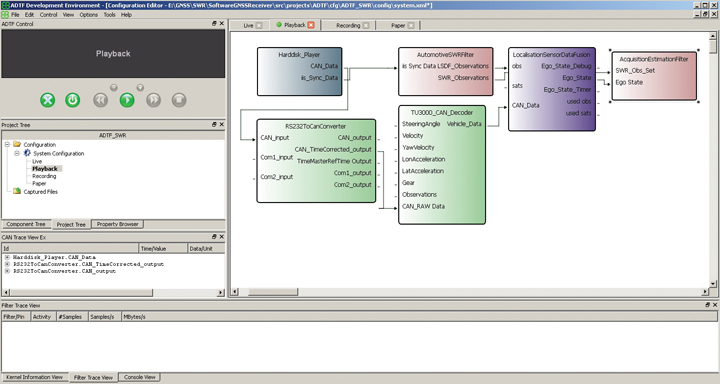
    The Institute of Flight Guidance uses a software environment called “Automotive Data and Time-Triggered Framework” (ADTF) for research in the field of ADAS and automotive navigation. In this software framework, the overall system architecture is assembled with independent modules. These modules are implemented as libraries and loaded into ADTF. Data is exchanged via pins that are defined as public variables. The framework also attaches timestamps to the individual measurements and adds a data recording and playback functionality.

    From a general-purpose software GNSS receiver, presented at the ION GNSS 2010, we have derived an automotive-specific ADTF software receiver module. The software framework adds the flexibility to synchronously process measurements from vehicle sensors additionally to the IF data from the front end. This gives us the opportunity to aid signal processing in the software GNSS receiver with additional external sensors.

    For positioning, a tightly coupled positioning filter based on GPS raw data measurements and the rear-wheel odometers is implemented. The vehicle’s motion is modeled using a kinematic relationship between the vehicle sensors and the GNSS measurements.

    Based on the tightly coupled vehicle state estimation, an acquisition state is processed during signal outages that enables the software GNSS receiver to reacquire the satellite signal instantaneously with high precision.

    In this article, the constituent parts of the system are presented and the estimation of the acquisition state derived. The system was tested in an urban scenario, and the state estimations validated with the recorded measurements.

    System Architecture

    The software-defined GNSS receiver developed by the IFF was designed to process the computationally expensive signal correlation on an Nvidia graphics board using the vast parallel processing capability of graphics processing units (GPUs). With the use of common graphics boards, an entire receiver can be implemented on an ordinary PC, needing only a front-end to receive digital GNSS signals in an intermediate frequency (IF) band.

    For research in the field of vehicle state estimation, a derivate of the software receiver of the Institute of Flight Guidance has been implemented in the “Automotive Data and Time-Triggered Framework” (ADTF). The software is commonly used in the automotive industry for the development of ADAS. Figure 1 shows a typical system layout in ADTF. A central component of the framework is the ability to record and play back measurement data, which is indicated by the buttons on the left of the screenshot.

    ADTF_Screenshot-B . By Hans-Georg Büsing, Ulrich Haak, and Peter Hecker
    Figure 1. System Architecture in ADTF. (Click to enlarge.)

    Within ADTF, the systems are assembled from modules that are shown as blocks within the graphical configuration editor. Standard modules such as the connection of common hardware are provided with the framework. Custom modules can be implemented in C++ by the user. Every module is implemented as a dynamic library (DLL) and interpreted by the framework. Modules can be featured with input and output pins.

    These pins are implemented by using specific data types from the framework. The communication and data exchange between the modules is handled via these pins. They can be connected by graphically drawing connector lines in the configuration editor.

    ADTF provides the user with classes for timing and threading. Processes can thereby be linked to the ADTF system time, which is especially important as the data replay can be slowed down or sped up for debugging.

    The instantaneous reacquisition algorithm is based on a traditional approach of tightly coupling GNSS raw data with vehicle sensor measurements. The fusion is based on a kinematic model following the Ackermann geometry establishing the relationship between the vehicle’s motion and the respective measurements.

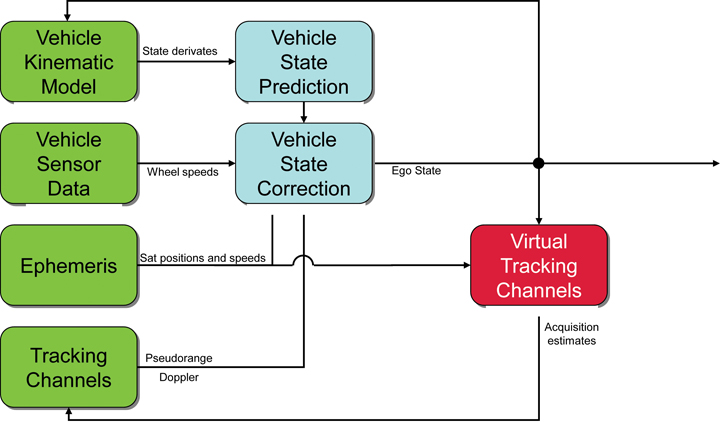
    At each time step of an arriving measurement, the vehicle’s motion is predicted based on the last estimated state with an extended Kalman filter. The prediction is then corrected using either measurements from the vehicle sensors or GNSS raw measurements. The range and Doppler measurements are calculated in the tracking channels of the ADTF software GNSS receiver. The corrected vehicle state is then fed back into the kinematic model for the next update cycle.

    In case the GNSS signal is lost in a tracking channel, a virtual tracking channel is initialized with the last calculated channel states. The change in the channel output is then predicted utilizing the change in the vehicle state and the current evaluation of the ephemeris. The schematic implementation of the channel state prediction is shown in Figure 2.

     Figure 2. Schematic of Channel State Prediction. (Click to enlarge.) By Hans-Georg Büsing, Ulrich Haak, and Peter Hecker
    Figure 2. Schematic of Channel State Prediction. (Click to enlarge.)

    Signal State Estimation

    Using the tightly coupled architecture presented above, an estimated position and velocity can even be provided during total signal outages. Assuming that the last valid observation of a satellite signal is stored together with its respective time to and position, an estimation of the signal state (that is, Doppler frequency, code- and carrier-phase) based on the estimation of the vehicle state during the signal outage at time t1 can be used for an instantaneous signal reacquisition. Using the ephemeris data provided by the respective GPS satellite the range between a user position xu and the satellite xsv can be calculated using the following terms
    E-1 .By Hans-Georg Büsing, Ulrich Haak, and Peter Hecker    (1)
    and
    E-2 . By Hans-Georg Büsing, Ulrich Haak, and Peter Hecker(2)
    with |…| indicating the Euclidian distance.

    Therefore the change of the range can be obtained with equations (1) and (2):
    E-3 . By Hans-Georg Büsing, Ulrich Haak, and Peter Hecker(3)
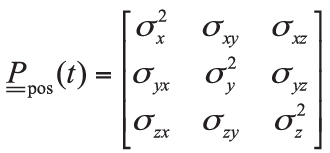
    Assuming an unbiased Gaussian error distribution of the measurements, the tightly coupled system provides an estimation of the covariance matrix of the vehicle state. Using only the submatrix
    E-4 . By Hans-Georg Büsing, Ulrich Haak, and Peter Hecker(4)
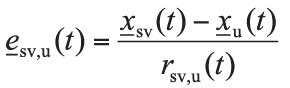
    related to the vehicle position, the covariance of the user position along the line-of-sight to the satellite can be obtained with the Euclidean norm of the line-of-sight vector
    E-5 . By Hans-Georg Büsing, Ulrich Haak, and Peter Hecker(5)
    and the law of error propagation:
    E-6 . By Hans-Georg Büsing, Ulrich Haak, and Peter Hecker(6)

    Furthermore, using the law of error propagation, it can be shown that the variance of the change of range estimation in equation (3) is obtained by:
    E-7 . By Hans-Georg Büsing, Ulrich Haak, and Peter Hecker   (7)

    With the last valid range measurement related to time to, the signal state at time t1 can be obtained for the pseudo-range PSR
    E-8 . By Hans-Georg Büsing, Ulrich Haak, and Peter Hecker   (8)
    and the carrier phase Φ:
    E-9 . By Hans-Georg Büsing, Ulrich Haak, and Peter Hecker    (9)

    The resulting variance of these estimations can by expressed by
    E-10 . By Hans-Georg Büsing, Ulrich Haak, and Peter Hecker   (10)
    and
    E-11 . By Hans-Georg Büsing, Ulrich Haak, and Peter Hecker   (11)
    respectively. The estimate of the Doppler and the related variance can be obtained analogous.
    Considering the variances of the estimation, it can be decided if the signal can be reacquired instantaneously or if the receiver has to find the signal using standard acquisition routines in a limited search space.

    Experimental Validation

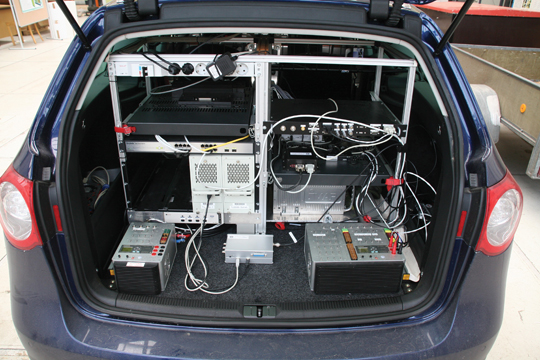
    The Volkswagen Passat station wagon operated by the Institute of Flight Guidance was used to evaluate the performance of the proposed algorithm (see PHOTO.) The test vehicle is customized from the standard by adding an additional generator to meet the power requirements of the measurement and processing hardware. In addition, the Controller Area Network (CAN) is mirrored and open to access the data collected by the sensors of the vehicle. The relevant sensors include a longitudinal accelerometer, a gyro for measuring the yaw rate as well as the odometers of all four wheels. The test vehicle is equipped with a GNSS front-end developed by the Fraunhofer Institute for Integrated Circuits. It is capable of streaming L1, L2, and L5 RF samples via two USB ports. The sampling rate of L1 is 40.96 MHz at an intermediate frequency of 12.82 MHz.

    Photo . By Hans-Georg Büsing, Ulrich Haak, and Peter Hecker
    Test Vehicle. A customized Volkswagen Passat was used to evaluate performance of the algorithm.

    The vehicle sensor data is streamed via CAN to an automotive PC from Spectra. It is equipped with an Intel quadcore CPU, 8 GB RAM, a Vector PCI CAN device and 256 GB SATA solid state disk allowing up to 195 MB/s writing speed. Additionally, it has been equipped with an Nvidia GeForce GT 440 graphics board that is used for processing the GNSS RF data. This specific graphics board was chosen because it offers a comparably high performance of the GPU at relatively low power consumption.

    Both GNSS RF data and data from the vehicle sensor network are streamed to an ADTF hard disk recorder. Due to the setup of the data acquisition, several challenges have to be solved. The first challenge is that the front-end needs to be used as hardware-in-the-loop. It is by itself not equipped with an automated gain control. Therefore, it is not possible to just stream the RF data but it has to be decoded, processed for adjusting the gain, and then stored to the hard drive.

    Secondly, the recording setup needs to cover high data rates. The GNSS front-end streams approximately 20 MB/s. As the data needs to be decoded and processed for gain control, the expanded data rate for recording is ~40 MB/s. In total including vehicle sensor measurements, >2000 data packets per second are streamed to the recorder. Because this could not be done using mechanical hard drives, we used solid state disks that also allow data storage during times of high vibration.

    Related to the before-mentioned challenges, an efficient thread management needed to be implemented. The software framework’s threading classes are utilized to parallelize the receiver processes. Additionally, it has arisen that a significant part of the processing time is taken by the data transfer to the memory of the GPU.

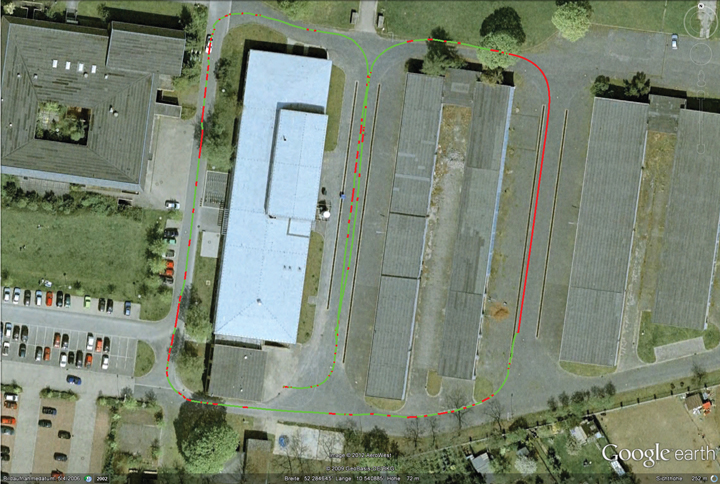
    In order to prove the advantages of an odometer-aided reacquisition, an applicable testing scenario was chosen. To distinguish an odometer-based aquisition approach from a model-based approach, a trajectory was chosen that features a right turn of 90 degrees immediately after cutting off the GNSS signal. A model-based kinematic prediction would project the trajectory in the direction of the latest known heading derived by the GNSS solution. Only a sensor-based state estimation is able to resolve the right turn. The driven trajectory is shown in Figure 3.

    The GNSS signal has been cut off for approximately 10 seconds, which is equivalent of a 75-meter drive on dead reckoning sensors only after the right turn.

     Figure 3. Trajectory of test drive includes a 90-degree turn. (Click to enlarge.) .By Hans-Georg Büsing, Ulrich Haak, and Peter Hecker
    Figure 3. Trajectory of test drive includes a 90-degree turn. (Click to enlarge.)

    Results

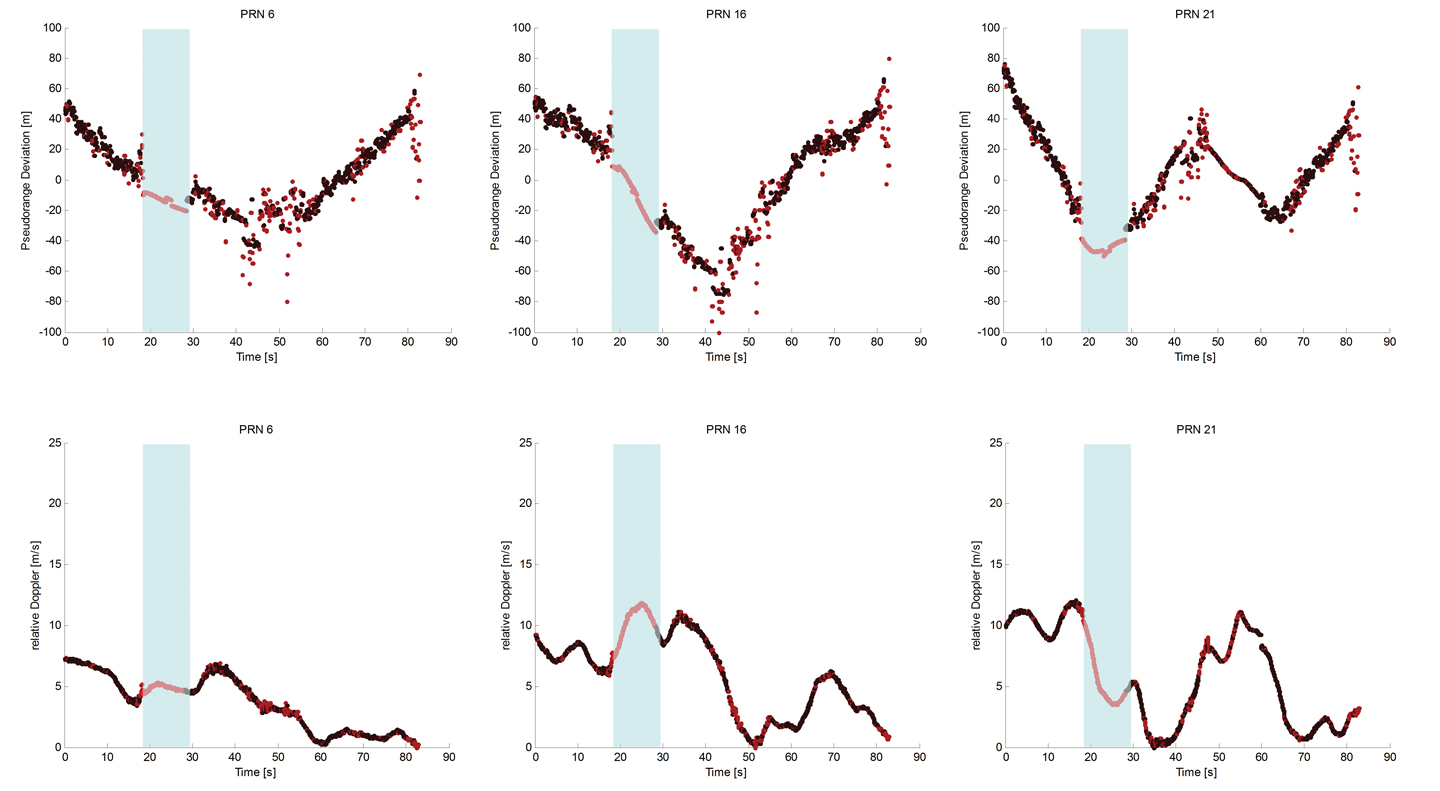
    The following plots in Figure 4 show the performance of the virtual tracking channels. The plots in the upper row show the pseudorange output over time. For vividness they have been corrected for the motion of the respective satellite that is dominant due to their high speeds. Over a short period of time the satellites’ motion relative to the receiver can be linearly approximated. The pseudorange measurements over time were fit using a linear regression. The respective value of the linear regression was then subtracted from the pseudorange and plot over time as shown in the figures in the second row, leaving only the approximated influence of the vehicle’s motion.

     Figure 4. Modified pseudorange and Doppler results of the virtual tracking channels. (Click to enlarge.) . By Hans-Georg Büsing, Ulrich Haak, and Peter Hecker
    Figure 4. Modified pseudorange and Doppler results of the virtual tracking channels. (Click to enlarge.)

    The Doppler measurements have been similarly compensated by just subtracting the minimum measurement. These modifications of the pseudorange and Doppler measurements allow a direct comparison of each other as the Doppler can be understood as the first derivate of the pseudorange over time.

    The results of PRN 6 show that the Doppler estimate during the GPS outage smoothly fits into the surrounding measurements without any major outliers. The plot of the pseudorange shows a similar behavior. The pseudorange could have potentially been modeled using a dynamic prediction that is not based on vehicle sensors due to the limited dynamics on the pseudorange measurements.

    The Doppler plot of PRN 16 shows a strong change in the relative velocity between satellite and receiver. If a further projection of the Doppler using a linear dynamic model would have been used instead of predicting with vehicle sensors, it would likely have misled the reacquisition by ~ 50 Hz. The trend in the pseudorange measurements is comparable to PRN 6 at a higher rate of change.

    The plots of PRN 21 probably show the advantages of using vehicle sensors for reacquisition best as the dynamics on pseudorange and Doppler are the most significant in the group. Both pseudorange and Doppler show a turning point during the GNSS outage. Especially, the pseudorange would have been mismodeled using a kinematic predicion that is not relying on additional sensors.

    Conclusion

    In this article, a tightly coupled positioning system implemented in the automotive-specific framework ADTF was presented that is based on the fusion of standard automotive sensor data and software receiver measurements. We showed that, using the tightly coupled solution, an acquisition state during signal outages can be estimated that allows the tracking channels to reacquire the signal instantaneously without the need of computationally expensive acquisition routines.

    Under the assumption of a tightly coupled RTK position and small outage times, a reacquisition of the carrier phase without loosing the information about the phase ambiguity seems possible.

    In the next version of the automotive GNSS receiver, the authors are planning to integrate the vehicle sensors to aid the tracking loops, which is likely to further improve tracking continuity especially in scenarios with high vegetation. Additionally, we plan to show that the implementation is capable of working in real time. Improvements of the initialization of the virtual tracking loops are also intended.

    Acknowledgments

    This article is based on a paper presented at ION-GNSS 2011, held September 19–23 in Portland, Oregon.

    This work was funded by the Federal State of Lower Saxony, Germany. Project: Galileo – Laboratory for the research airport Braunschweig.
    The authors would like to thank their colleagues working in the automotive navigation group for continuous support with the ADTF framework.


    Hans-Georg Büsing holds a Dipl.-Ing. in aerospace engineering from the Technische Universität Braunschweig and has been a research engineer at IFF since 2008. He works in the area of applied satellite navigation, especially in the field of vehicle positioning.

    Ulrich Haak holds a Dipl.-Ing. in mechanical engineering from the Technische Universität Braunschweig and joined IFF in 2008 as a research engineer. He works in the areas of receiver design and positioning algorithms.

    Peter Hecker joined IFF in 1989 as research scientist. Initial focus of his scientific work was in the field of automated situation assessment for flight guidance. From 2000 until 2005, he was head of the DLR Pilot Assistance department. Since April 2005, he has been director of IFF. He is managing research activities in the areas of air/ground cooperative air traffic management, airborne measurement technologies and services, satellite navigation, human factors in aviation, and safety in air transport systems.

  • Unmanned Air Systems: Precision Navigation for Critical Operations

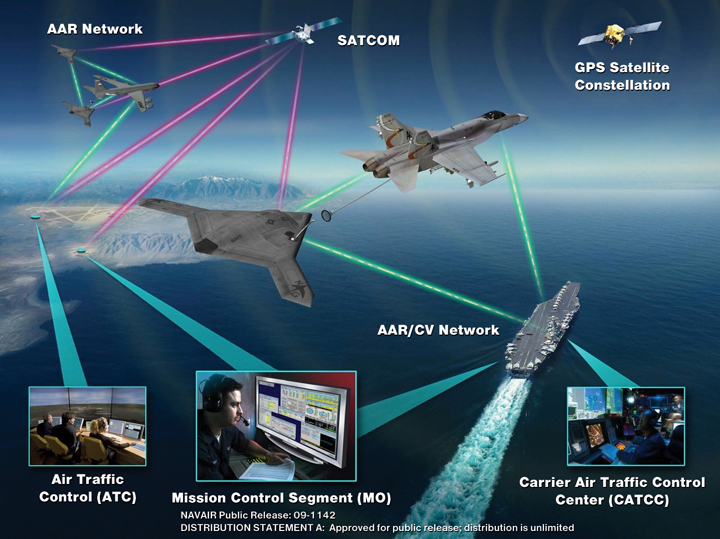
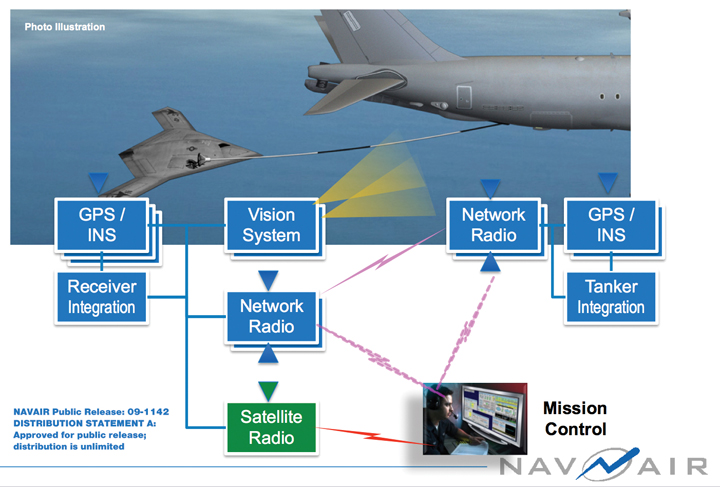
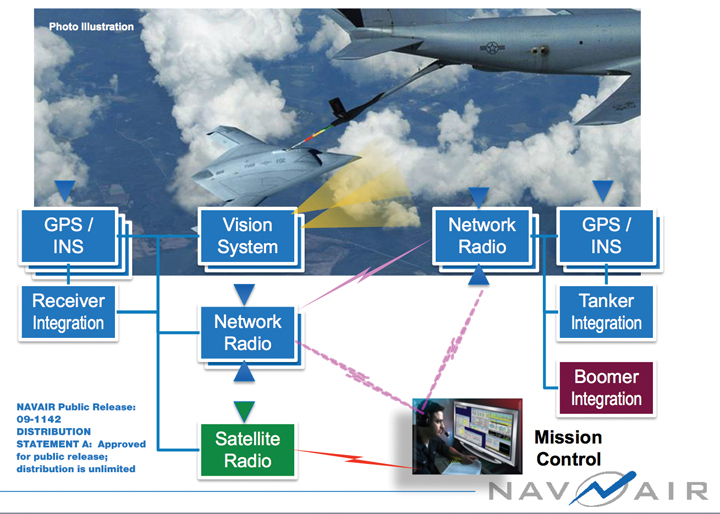
    Brown-Fig1 . By Alison K. Brown, Dien Nguyen, and Paige Felker, NAVSYS Corporation, Glenn Colby and Frank Allen, PMA-268 NAVAIR
    Figure 1. Autonomous air refuleing operational view.

    By Alison K. Brown, Dien Nguyen, and Paige Felker, NAVSYS Corporation, Glenn Colby and Frank Allen, PMA-268 NAVAIR

    An alternative precision GPS architecture, Precision RELNAV, enables an airborne tanker plane and a Navy unmanned combat aircraft to navigate independently to a high degree of precision without requiring carrier-cycle ambiguity resolution using precision GPS ephemeris updates to a tightly coupled GPS/inertial solution onboard each aircraft. The solution rivals that of conventional relative kinematic techniques while providing more robust positioning that reduces message traffic between aircraft and does not require a long filtering time.


    Naval Unmanned Combat Air System (N-UCAS) is the U.S. Navy’s program to demonstrate technologies and reduce risk for unmanned, carrier based strike and surveillance aircraft. The Unmanned Combat Air System Carrier Demonstration (UCAS-D) program is specifically maturing technologies for unmanned carrier operations and Autonomous Aerial Refueling (AAR). Successful demonstration of UCAS-D technologies provides for transition and risk reduction to future unmanned and manned programs.

    A key enabler for N-UCAS is the ability to perform AAR so that the N-UCAS can support long duration missions. As shown in Figure 1, the intent is for AAR operations to mirror current manned Aerial Refueling operations as much as possible and to operate using existing Navy probe and drogue and US Air Force boom receptacle refueling methods.

    The planned refueling architecture for probe and drogue and boom-receptacle refueling developed by PMA-268 is shown in Figure 2 and Figure 3. For both of these architectures, the GPS/inertial navigation system on the UAS and tanker are used to calculate a precise relative position to be used by the UAS to approach the tanker from astern. For drogue systems, the final connection to the basket is performed using aiding from a laser-based drogue positioning system. In addition, an optional machine vision system is used to aid both methods of refueling from the receiver. Under the UCAS-D demonstration program testing is being conducted with surrogate aircraft to verify the CONOPS procedures and performance of the precision GPS/inertial navigation solution alternatives being evaluated. NAVSYS is supporting this program through a Small Business Innovation Research (SBIR) contract and is demonstrating a Precision-RELNAV (P-RELNAV) tightly coupled GPS/inertial solution that improves the robustness of the relative navigation solution as described in the following sections.

     Figure 2. Probe and drogue refueling architecture. By Alison K. Brown, Dien Nguyen, and Paige Felker, NAVSYS Corporation, Glenn Colby and Frank Allen, PMA-268 NAVAIR
    Figure 2. Probe and drogue refueling architecture.
     Figure 3. Boom receptacle refuleing architecture. By Alison K. Brown, Dien Nguyen, and Paige Felker, NAVSYS Corporation, Glenn Colby and Frank Allen, PMA-268 NAVAIR
    Figure 3. Boom receptacle refuleing architecture

    Precision RELNAV Algorithm

    The first method that PMA-268 implemented for computing a relative GPS solution used the GPS/inertial integration approach illustrated in Figure 4. The inertial navigation solution from both aircraft was used to calculate the relative inertial vector e that is used for the real-time AAR guidance. The tanker’s raw GPS observations are also passed over the data link to the UAS where a relative kinematic solution is calculated to derive the carrier-phase based relative position between the aircraft, a. This approach relies on solving for the integer carrier cycle ambiguities on the observations from the two aircraft using the same algorithms that were previously developed for use in performing GPS precision approach and landings on the carrier. The precise GPS relative position is then applied to calibrate the inertial derived relative position and the resulting GPS/inertial solution is used to calculate an offset to the center of the refueling envelope (u) for guidance of the UAS to connect to the receptacle.

     Figure 4. Precision-GPS relative GPS positioning. By Alison K. Brown, Dien Nguyen, and Paige Felker, NAVSYS Corporation, Glenn Colby and Frank Allen, PMA-268 NAVAIR
    Figure 4. Precision-GPS relative GPS positioning.

    With the P-RELNAV approach shown in Figure 5, Precision GPS Ephemeris data is provided to both aircraft across the tactical data links using the NAMATH system. As shown in Figure 6, NAMATH provides global services across military tactical data links through the Joint Range Extension (JRE) to provide real-time corrections to the GPS system errors using Zero-Age Precision GPS Ephemeris data, which is refreshed by the GPS Control Segment every 15 minutes. The NAMATH system is currently being used operationally by the U.S. military to improve navigation accuracy and also precision weapons delivery.

    Brown-Fig5 . By Alison K. Brown, Dien Nguyen, and Paige Felker, NAVSYS Corporation, Glenn Colby and Frank Allen, PMA-268 NAVAIR
    Figure 5. Tightly-coupled P-RELNAV Solution.

    Brown-Fig6 .By Alison K. Brown, Dien Nguyen, and Paige Felker, NAVSYS Corporation, Glenn Colby and Frank Allen, PMA-268 NAVAIR
    Figure 6. NAMATH Precision Ephemeris Delivery.

    Using the PGE corrections significantly reduces the errors on the GPS observations allowing the GPS/inertial solution to rapidly converge and not exhibit step changes during satellite transitions from the GPS system bias errors. The GPS/inertial Kalman Filter on the tanker is used to observe the residual errors from the GPS satellites being tracked, and these residuals (δf) are sent from the tanker to the UAS which applies these as an update to its internal GPS/inertial Kalman Filter. As shown below, this final correction sets both the tanker and the UAS on a precise common reference frame resulting in a high accuracy relative position being derived from the vector difference of the two tightly-coupled GPS/inertial solutions (e*).

    Figure 7 shows the difference in the GPS position that is calculated using the Precision GPS Ephemeris as opposed to the Broadcast Ephemeris. This shows that over a month, there can be peak position excursions as high as 5 meters in the horizontal and 10 meters in the vertical based on the GPS broadcast ephemeris. With a GPS/inertial solution, these bias offsets will cause the solution to “trend” between different position bias offsets whenever the satellite selected set changes. This trending introduces significant errors into the relative inertial vector between two aircraft (e).

    Brown-Fig7A . By Alison K. Brown, Dien Nguyen, and Paige Felker, NAVSYS Corporation, Glenn Colby and Frank Allen, PMA-268 NAVAIR

    Brown-Fig7B .By Alison K. Brown, Dien Nguyen, and Paige Felker, NAVSYS Corporation, Glenn Colby and Frank Allen, PMA-268 NAVAIR
    Figure 7. GPS Peak Position Errors from Broadcast Ephemeris Offsets (March 2010).

    P-RELNAV Flight Test Set-Up

    The P-RELNAV performance was tested using data collected on a UH-1 helicopter at Eglin AFB. Two independent GPS/inertial systems were mounted on the equipment plate below the aircraft (Figure 8) and a GPS reference receiver on the ground was used to calculate a kinematic position post-test using a Magellan ZXW receiver on the aircraft as a truth system. The PGE corrections were uplinked to the aircraft through EPLRS for use in calculating a PGE-corrected navigation solution. NAVSYS used recorded GPS and inertial data from a Kearfott KN4073 and a NovAtel/LN-200 inertial system provided by Dahlgren NSWC. The raw GPS (Pseudo-range and carrier phase) and IMU (high rate acceleration and angular rate) data was processed using our InterNav solution and also recorded for post-processing. This data was then played back through InterNav to calculate independent GPS/inertial tightly coupled solutions from the two inertial systems with and without the PGE corrections and to compare the performance of the absolute and relative solutions against the kinematic positioning truth data.

     Figure 8. Flight test equipment. By Alison K. Brown, Dien Nguyen, and Paige Felker, NAVSYS Corporation, Glenn Colby and Frank Allen, PMA-268 NAVAIR
    Figure 8. Flight test equipment.

    P-RELNAV Flight Test Results

    The P-RELNAV algorithms were implemented in our InterNav software package. This has been previously used to generate very high accuracy relative kinematic solutions for providing high-rate Time Space Position Information (TSPI) for instrumenting F-16 aircraft. The InterNav software was upgraded to apply the tightly-coupled GPS updates to the inertial solution using the PGE Zero-Age Differential GPS (ZDGPS) corrections, and also to apply the GPS residual updates (δf) in the UAS Kalman Filter to compute the P-RELNAV relative position solution.

    Dual-frequency observations from the GPS receivers were used to correct for the ionospheric group delays in the solution.

    The performance of the P-RELNAV solution was evaluated by comparing the results from the two independent inertial solutions for the same location on the UH-1 aircraft. Tests were conducted over multiple flights with the GPS antennas at different locations on the UH-1.

    The results from the first flight test are shown in Figure 9 through Figure 13. Figure 9 shows the GPS/inertial results during the flight with a tightly-coupled solution but without PGE corrections. Figure 10 shows the GPS/inertial results during the flight with a tightly-coupled solution but with PGE enabled. Figure 11 shows the satellite visibility during the flight test. These plots show that the satellite geometry changes, dramatically affecting the inertial position covariance, whenever the satellites used in the solution change. The inertial filters these errors, but the relative solution is biased and drifts resulting in over 2 meter errors. In Figure 12 the same plot is shown when the PGE corrections are applied. This shows that the relative position error has been reduced to better than 1 m per axis and 35 cm 1-sigma. For flight critical operations, such as AAR, minimizing position excursions is essential. Figure 13 and Figure 14 show a statistical measure of the percentage of time that the data exceeds a horizontal or vertical threshold. This shows the benefit of the PGE corrections in removing GPS excursions caused by satellite ephemeris errors from the navigation solution. (See the Appendix for a definition of the Inverse Circular Error Probable (ICEP) metric and its comparison with other statistical measures).

     Figure 9. Flight 1: Relative position of KN and NovAtel/LN200 GPS/INS solutions. By Alison K. Brown, Dien Nguyen, and Paige Felker, NAVSYS Corporation, Glenn Colby and Frank Allen, PMA-268 NAVAIR
    Figure 9. Flight 1: Relative position of KN and NovAtel/LN200 GPS/INS solutions.
     Figure 10. Flight 1: Relative position of KN and NovAtel/LN200 PGE enabled GPS/INS solutions. By Alison K. Brown, Dien Nguyen, and Paige Felker, NAVSYS Corporation, Glenn Colby and Frank Allen, PMA-268 NAVAIR
    Figure 10. Flight 1: Relative position of KN and NovAtel/LN200 PGE enabled GPS/INS solutions.
     Figure 11. Flight 1: Valid PRNs used in KN GPS/INS solution. By Alison K. Brown, Dien Nguyen, and Paige Felker, NAVSYS Corporation, Glenn Colby and Frank Allen, PMA-268 NAVAIR
    Figure 11. Flight 1: Valid PRNs used in KN GPS/INS solution.
     Figure 12. Flight 1: Relative Position of KN and NovAtel/LN200 PGE enabled GPS/INS solutions. By Alison K. Brown, Dien Nguyen, and Paige Felker, NAVSYS Corporation, Glenn Colby and Frank Allen, PMA-268 NAVAIR
    Figure 12. Flight 1: Relative Position of KN and NovAtel/LN200 PGE enabled GPS/INS solutions.
     Figure 13. Flight 1: Horizontal ICEP comparison for PGE enabled GPS/INS and GPS/INS solutions. By Alison K. Brown, Dien Nguyen, and Paige Felker, NAVSYS Corporation, Glenn Colby and Frank Allen, PMA-268 NAVAIR
    Figure 13. Flight 1: Horizontal ICEP comparison for PGE enabled GPS/INS and GPS/INS solutions.
     Figure 14. Flight 1: Vertical ICEP comparison for PGE enabled GPS/INS and GPS/INS solutions. By Alison K. Brown, Dien Nguyen, and Paige Felker, NAVSYS Corporation, Glenn Colby and Frank Allen, PMA-268 NAVAIR
    Figure 14. Flight 1: Vertical ICEP comparison for PGE enabled GPS/INS and GPS/INS solutions.

    Since both GPS receivers used in the test had a reasonably clear view of the sky, they were both tracking the same satellites. In the AAR CONOPS, the UAS approaches the tanker from below and so will have some satellites obscured from view by the tanker (see Figure 4). In this case, the use of different satellites can significantly increase the relative position error when PGE corrections are not available. In the case shown where one satellite was forced as a drop-out, the non PGE corrected vertical error grew to 4 meters for the relative solution.

    Further improvements in the P-RELNAV performance will be achieved using the residual (δf) update mode in the InterNav Kalman Filter to set the estimated observation residuals for the common satellites to the same values for the UAS and Tanker GPS/inertial filters. This mode is currently being tested and the results will be presented in a follow-on paper.

     Figure 15. Flight 1: Horizontal ICEP plot for PGE enabled GPS/INS and GPS/INS solutions. Different satellites tracked by the receivers. By Alison K. Brown, Dien Nguyen, and Paige Felker, NAVSYS Corporation, Glenn Colby and Frank Allen, PMA-268 NAVAIR
    Figure 15. Flight 1: Horizontal ICEP plot for PGE enabled GPS/INS and GPS/INS solutions. Different satellites tracked by the receivers.
     Figure 16. Flight 1: Vertical ICEP comparison for PGE enabled GPS/INS and GPS/INS solutions. Different satellites tracked by the receivers. By Alison K. Brown, Dien Nguyen, and Paige Felker, NAVSYS Corporation, Glenn Colby and Frank Allen, PMA-268 NAVAIR
    Figure 16. Flight 1: Vertical ICEP comparison for PGE enabled GPS/INS and GPS/INS solutions. Different satellites tracked by the receivers.

    Conclusion

    The P-RELNAV solution has the following advantages over using a conventional relative kinematic positioning solution in meeting the Automated Aerial Refueling precision positioning requirements.

    • Fast initialization — does not require time for carrier ambiguity cycles to be resolved.
    • Robust operation during satellite obscuration by the tanker — is not dependent on common satellites being maintained in view between platforms.
    • Insensitive to loss of carrier lock — does not require cycle ambiguity reinitialization if carrier lock is lost during the UAS approach to the tanker.

    Work is proceeding on testing the P-RELNAV solution. Additional test data is being collected for performance evaluation under the UCAS-D demonstration program using dual aircraft as surrogates to demonstrate the P-RELNAV performance and compare the benefits of the P-RELNAV tightly coupled approach with the PGPS kinematic solution.

    This work was sponsored under NAVAIR contract N68335-10-C-0094. The authors gratefully acknowledge the support of PMA-268 and the assistance of NSWC Dahlgren in collecting the flight test data and providing the truth reference for the P-RELNAV analysis.


    Appendix: Inverse Circular Error Probable (ICEP)

    For safety-of-life applications, the statistic of the excursion events, for example when a horizontal error is outside the safe error bound, is often more important than the knowledge of the percentage of points that are within a smaller error bound, such as CEP or DRMS. These excursion, or low probability, statistics can be examined with the Inverse Circular Error Probability (ICEP) function. The ICEP provides the horizontal position error (HPE) with a specified probability that a result could be outside this value. An optional input to the function is a filtering time constant, with the filter applied to the time-series horizontal error data before calculating the ICEP. This separates the effect of bias errors from short term noise errors that could be filtered (for example with an inertial unit) from the HPE.

    HPE = ICEP (P%, τ)

    Where
    HPE= Horizontal Position Error value [m]
    P% = Percent of total horizontal errors (x) that are larger than HPE
    τ = filter time constant to reduce short term white noise

    Note that the Circular Error Probable (CEP) which is the radial value that encloses 50% of the positioning results is closely related to ICEP, with
    CEP = ICEP(50%, 0)

    Also the R95 which is the radial value that encloses 95% of the positioning results is related to ICEP, with
    R95=ICEP(5%,0)

    Other common statistics used are the DRMS and 2DRMS values which are defined below, are also related to ICEP through the following equations.

    Screen shot 2013-01-04 at 7.57.08 PM . By Alison K. Brown, Dien Nguyen, and Paige Felker, NAVSYS Corporation, Glenn Colby and Frank Allen, PMA-268 NAVAIR

    For a Gaussian, uncorrelated error distributions with sigma of one meter in the range and azimuth axes, the ICEP is shown in Figure A-1 in blue. For each horizontal position error value, the ICEP gives the percentage of the distribution that has larger errors. Also shown on this plot are the CEP, DRMS, 2DRMS and R95 values which match the 1-sigma scale factors shown in the table above. Figure A-2 is the same data with a log10 plot. In this plot the y-axis is probability rather than percent. This plot is useful for examination of outlier behavior, as it shows low probability events more clearly.

    Brown-FigA1 . By Alison K. Brown, Dien Nguyen, and Paige Felker, NAVSYS Corporation, Glenn Colby and Frank Allen, PMA-268 NAVAIR
    Figure A-1. ICEP(P,0) for a Gaussian Distribution with 1 m 1-sigma.
     Figure A-2. Log Scale ICEP(P,0) for a Gaussian Distribution with 1 m 1-sigma. By Alison K. Brown, Dien Nguyen, and Paige Felker, NAVSYS Corporation, Glenn Colby and Frank Allen, PMA-268 NAVAIR
    Figure A-2. Log Scale ICEP(P,0) for a Gaussian Distribution with 1 m 1-sigma.

    Screen shot 2013-01-04 at 8.01.11 PM . By Alison K. Brown, Dien Nguyen, and Paige Felker, NAVSYS Corporation, Glenn Colby and Frank Allen, PMA-268 NAVAIR


    Alison Brown is president and chief executive officer of NAVSYS Corporation, which she founded in 1986. NAVSYS Corporation specializes in developing next generation Global Positioning System (GPS) technology. She has a Ph.D. in mechanics, aerospace, and nuclear engineering from UCLA.

    Dien Nguyen works for NAVSYS Corporation as a research engineer specializing in Kalman filtering estimations, kinematic positioning, and related navigational optimization techniques. He holds an M.S. in electrical engineering from Clemson University.

    Paige Felker is a research engineer in the Algorithms and Analysis group at NAVSYS Corporation. She holds an M.S. in aerospace engineering from the University of Texas at Austin.

    Glenn Colby is the chief architect for the Navy Unmanned Combat Air System at the Naval Air Systems Command in Patuxent River, Maryland. He has led the research, development, and testing of advanced aircraft, navigation and communications systems for more than 26 years. He received his B.S. in aerospace engineering with honors at the University of Virginia in 1984.

    Frank Allen is the technology manager for the Navy Unmanned Combat Air System at the Naval Air Systems Command. In the last 16 years he has worked in management of research and development of advanced aircraft navigation and communications systems. Frank received his M.S. in physics from Northeastern University.

  • On the Edge: Southwest Shakes

    By Tracy Cozzens

    Using a large network of GPS stations, a team of researchers has found that the Rio Valley Rift in the Southwest United States — previously suspected to be dead — is slowly expanding, at a rate of about 0.1 millimeter per year.

    The Rio Grande Rift extends from Colorado’s central Rocky Mountains to Mexico.

    The study was conducted by scientists at the Cooperative Institute for Research in the Environmental Sciences (CIRES) at the University of Colorado at Boulder, in collaboration with the University of New Mexico, New Mexico Tech, Utah State University, and UNAVCO.

    “We don’t expect to see a lot of earthquakes, or big ones, but we will have some earthquakes,” said study author Anne Sheehan, CIRES Fellow and associate director of CIRES Solid Earth Sciences Division. “We use continuous measurements of GPS sites from across the Rio Grande Rift, Great Plains, and Colorado Plateau to estimate present-day surface velocities and strain rates,” Sheehan said.

    Using GPS instruments at 25 sites in Colorado and New Mexico, the team tracked the rift’s miniscule movements from 2006 to 2011. The team found an average strain rate of 1.2 nanostrain each year across the experimental area. A nanostrain is a change in length of one part per billion, thus 1.2 nanostrain per year is equivalent to 1.2 millimeter per year extension over a 1000-kilometer length.“If you picked two points in New Mexico, and one of them lies 100 kilometers to the west of the other, then they would be moving apart at a rate of 0.1 millimeter per year,” explained researcher Henry Berglund.

     Researchers used data from 25 continuous GPS stations installed as part of the EarthScope Rio Grande Rift GPS experiment, supplemented by data from other GPS monuments in the southwestern U.S., resulting in a data set of daily position estimates of 284 GPS monuments for the years 2006 through 2010.  Credit: Tracy Cozzens
    Researchers used data from 25 continuous GPS stations installed as part of the EarthScope Rio Grande Rift GPS experiment, supplemented by data from other GPS monuments in the southwestern U.S., resulting in a data set of daily position estimates of 284 GPS monuments for the years 2006 through 2010.

    “It is lower than we thought but it does exist,” Sheehan said. “Some people thought it was zero but we are seeing things are extending slowly.”

    The slow rates of motion made previous attempts to determine tectonic activity difficult. Previously, geologists had estimated the rift had spread apart by up to 5 millimeters each year but the errors introduced by the measuring instrumentations were significant. “The GPS has reduced the uncertainty dramatically,” Sheehan said. “This is the most comprehensive and accurate set of geodetic measurements in this area to date.”

    The extensional deformation is not concentrated in a narrow zone centered on the Rio Grande Rift. Instead, it is distributed broadly from the western edge of the Colorado Plateau into the western Great Plains — a span of more than 370 miles. “This unexpected pattern of broadly distributed deformation at the surface has important implications for our understanding of how low strain-rate deformation within continental interiors is accommodated,” Sheehan said. “Questions we wanted to answer are: how is the Rio Grande Rift deforming? Is it alive or dead? Is it opening or not?”

    Along the rift, spreading motion in the crust has caused magma to rise to the surface, creating long basins susceptible to earthquakes. “The rift is still active,” Sheehan said.

    The team plans to continue monitoring the Rio Grande Rift, and may attempt to determine vertical as well as horizontal activity to determine whether the Rocky Mountains are still uplifting.

     University of Colorado (Boulder) student Henry Berglund services GPS site RG20 west of Silverton, Colorado.  Credit: Tracy Cozzens
    University of Colorado (Boulder) student Henry Berglund services GPS site RG20 west of Silverton, Colorado.

    The study’s findings shed light on how continents deform away from plate boundaries, Sheehan said. At plate boundaries scientists can clearly see what is going on. “Things move past each other and crash into each other. At active plate boundaries, the rates of motion detected by GPS can be centimeters per year. Compare that with the fraction of a millimeter per year that we have measured for the Rio Grande Rift.”

    “Present day measurements of deformation within continental interiors have been difficult to capture due to the typically slow rates of deformation within them,” Berglund said. “Now, with the recent advances in space geodesy, we are finding some very surprising results in these previously unresolved areas.”

    The National Science Foundation funded the study. EarthScope and UNAVCO provided instruments, equipment, and engineering services. Results of the study were published in the January 2012 issue of Geology magazine.

     GPS monuments in the vicinity of the Rio Grande Rift and southern Rocky Mountains. The study included construction of 25 GPS monuments (blue circles) in Colorado and New Mexico in 2006 and 2007. Regional EarthScope Plate Boundary Observatory and Continuously Operating Reference Station monuments are shown by gray triangles. Credit: Tracy Cozzens
    GPS monuments in the vicinity of the Rio Grande Rift and southern Rocky Mountains. The study included construction of 25 GPS monuments (blue circles) in Colorado and New Mexico in 2006 and 2007. Regional EarthScope Plate Boundary Observatory and Continuously Operating Reference Station monuments are shown by gray triangles.