In the next two to four years, mobile device location platforms will be able to provide positioning performance that enables emergency call (E911) and location-based services (LBS) with excellent accuracy (5–10 meters) in all locations. We call this accurate everywhere location, and it will be a significant enabler of indoor navigation applications and for even wider adoption of consumer LBS.
In fact, we may eventually forget how we ever lived without it. This technology can enhance our lives by enabling our mobile devices to know precisely where we are at all times. Armed with this information, our devices can behave in a way that suits our specific situation, and they can do this without us having to do anything other than keep the phone with us.
Text and images will get significantly bigger while driving or walking. Facebook notifications can be automatically disabled while at work. Shopping lists can be automatically displayed when approaching a store that has an item on the list. The potential benefits are endless — provided that the privacy issues associated with location are handled appropriately.
GNSS is the superior technology when a mostly unobstructed sky is available, but it can’t deliver accurate position fixes in all environments — at least not at a cost and in a form factor that works for consumer mobile devices. Accurate everywhere location requires some form of advanced hybrid location technology. Because its definition is constantly evolving, the term hybrid can mean different things to different people. This article aims to clear that up.
Here is an overview of the hybrid positioning technology currently used in mobile devices, as well as what is coming in the next two to four years that will enable accurate everywhere location:
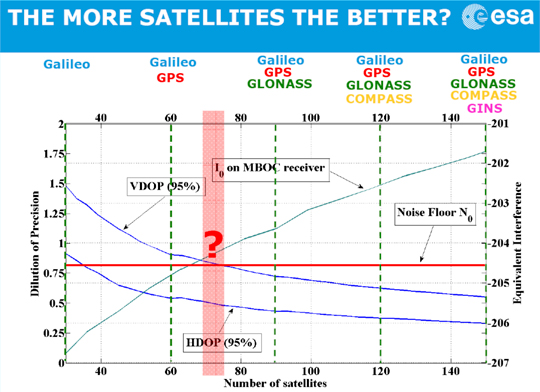
GPS + GLONASS. Multiple GNSS technologies are starting to be more common in new chipsets aimed at mobile devices, and assisted-GPS (A-GPS) + A-GLONASS is right around the corner. The benefit from this hybrid GNSS approach is that with more satellites in the sky, devices are likely to receive more line-of-sight signals in challenging environments where a significant portion of the sky is obstructed (like urban canyons). While this might improve performance on a street in downtown Manhattan, it does not help when you are in the middle of a building or in the subway.
Cellular Multilateration + A-GNSS. Mobile devices with CDMA cellular radios have supported hybrid A-GPS + advanced forward-link trilateration (AFLT) for more than a decade. This concept is now being applied to long-term evolution (LTE) devices, with support for A-GNSS + observed time difference of arrival (OTDOA) being written into the 3GPP standards. Both AFLT and OTDOA are forms of cellular multilateration, which means that devices can make measurements of relative timing offsets between multiple downlink cellular signals, and those measurements can be used in a hyperbolic multilateration formula to compute a position (one signal acts as reference and hyperbolic intersection of 2+ signals are used for position).
Does this sound familiar? It happens to be very similar to GNSS location computation, so it is possible to combine measurements from cellular signals and measurements from GNSS satellites to compute a hybrid position. For example, 2 satellites + 2 cellular measurements can be combined to compute a position, which makes this technique very attractive. Although it is used for both E911 positioning in North America and LBS worldwide, this technology will become even more widespread as LTE adoption increases.
A-GNSS + Wi-Fi Positioning + eCID. Many popular smartphones today support Wi-Fi positioning and enhanced cell ID (eCID) in addition to A-GNSS. This hybrid solution allows coarse positioning in indoor environments where A-GNSS does not work. Solutions for Wi-Fi and eCID positioning are currently very fragmented and proprietary. However, this is the reason you are able to get a semi-accurate position fix on your Android or iOS mobile device when GNSS satellites are impossible to measure (many other devices support this as well). These technologies are going to provide more accurate information as time goes on, but we don’t believe they will achieve accurate everywhere location on their own.
A-GNSS + Wi-Fi Positioning + Cellular Positioning + Sensors. You might have guessed it, but we think accurate everywhere location will be enabled by a combination of all the above hybrid techniques plus one more important technology: sensors. Integrated sensors like accelerometers, magnetometers, and barometers enable devices to sense changes in direction, orientation, and elevation. Given an accurate starting location (for example, GNSS position fix), sensors can track location accurately for several minutes (and this will continue to get better). Location error will accumulate over time, but this can be minimized when Wi-Fi, cellular, and GNSS positioning are used in conjunction to constrain the error. Furthermore, barometers can be used to track elevation changes, thereby allowing devices to know exactly what floor of a building a user is on. Other technologies, or signals of opportunity, may be used in the future to further improve performance, but we think this mix of A-GNSS, Wi-Fi, cellular, and sensor positioning is the key to accurate everywhere location in mobile devices.
With substantial R&D dollars being spent now, and standardized testing for hybrid positioning emerging this year, our best estimate is that the accurate everywhere technology will become commercially widespread by 2015.
Brock Butler is director of Spirent’s Wireless Location Technologies, part of a team that has made major contributions to development of the LBS standards in the 3GPP: Spirent filled the editor and rapporteur roles for the TS 51.010 and TS 34.171 A-GPS Terminal Conformance Specifications, as well as the editor role for the Enabler Test Specification for SUPL in the OMA. Butler holds a BSc in electrical engineering from Villanova University.
GPS trackers are a form of search, and to use them police must have a search warrant, according to a U.S. Supreme Court ruling today. The high court issued a unanimous ruling that a search warrant is required before police slap a GPS tracker on a criminal suspect’s vehicle to monitor the suspect’s movements, reports the Associated Press.
The decision was a defeat for the government and police agencies that increasingly rely on GPS surveillance. A GPS device installed by police on Washington, D.C., nightclub owner Antoine Jones’ Jeep helped them link him to a suburban house used to stash money and drugs. He was sentenced to life in prison before the appeals court overturned the conviction.
Associate Justice Antonin Scalia said that the government’s installation of a GPS device, and its use to monitor the vehicle’s movements, constitutes a search. The court ruled that GPS monitoring on the Jeep violates the Fourth Amendment’s protection against unreasonable search and seizure.
Justice Samuel Alito said the court should address how expectations of privacy affect whether warrants are required for remote surveillance using electronic methods that do not require the police to install equipment, such as GPS tracking of mobile telephones, reports AP. “If long-term monitoring can be accomplished without committing a technical trespass — suppose for example, that the federal government required or persuaded auto manufacturers to include a GPS tracking device in every car — the court’s theory would provide no protection,” Alito said.
Microsoft says this is its last year at the Consumer Electronics Show (CES). Fine. Move over because the car manufacturers are using the show to unveil stunning location and mobile offerings. It has only been a few years since automakers started coming to CES to pitch new in-vehicle mobile platforms. This year automakers have been knocking themselves out to bring smartphones, location and cloud content into the vehicle to enhance the driving experience. The CES invasion by the vehicle OEMs started in 2007 when Ford introduced Sync at CES. Kia followed in 2010 with UVO powered by Microsoft. 2012 brings a multitude of OEM mobile announcements, including one from first-time CES participant Mercedes-Benz.
Cars are getting smarter. Kia unveiled the next-generation UVO 2, which adds a crash notification assist feature that automatically dials 911 on a connected phone when an airbag deploys. It adds a number of location-based services that are controlled via a smartphone app that includes noting a car’s parked location on a map, transferring destinations from Google maps to the navigation system, and monitoring vehicle location and speed.
And the list goes on. Mercedes Benz made its initial appearance at CES to show off an app that allows drivers to plug iPhones into vehicles to enable the phone’s entertainment and navigation to appear on the in-dash display. Chevrolet introduced a new head unit that will use a smartphone’s apps, such as Pandora, to access cloud-based content and navigation. Ford added Roximity to provide contextual real-time discounts linked to the vehicle’s location and user’s preferences. TCS has its foot in this market, too. It will be supplying hybrid navigation solutions for the QNX in-vehicle car platforms.
Mercedes-Benz takes center stage at CES 2012.
After-market activity. You can tweet about your accident, make it a status update, or do both. TomTom has integrated Facebook and Twitter with its navigation app for iPhones and iPads. Information from Facebook events, places and friends will feed to create navigation routes. Destinations and arrival times can then be shared on these networks.
Heavy-weight skinny nav. Garmin has introduced the nüvi 3500 series, its new flagship personal navigation device, an ultra-thin GPS device with a five-inch screen. Capabilities include digital HD traffic and a smartphone link that can add live services, such as traffic information, traffic camera images, weather and fuel prices.
Good luck, Verizon. At a time when straight-up navigation is becoming a utility, Verizon is rolling out a new bundled application app package. It includes their navigation app, as well as NFL Mobile, ringback tones and Verizon Video for $12.99. I don’t know much about the NFL Mobile app, but it better be good. Given the poor marks received by Verizon Video and low interest in ringback tones, the package isn’t looking too appealing when navigation is often a freebie.
Need maps. TomTom will be providing Samsung with map and location content to power the Wave3 smartphone. TomTom will provide map coverage for more than 200 countries, POIs, traffic, 3D maps and landmarks and “safety-related speed cameras.” Safety-related speed cameras?
Enterprise routing trends. Enterprises using vehicle routing software for fleets of service and truck vehicles are increasing their buying of on-board computers, as well as smartphones for driver interfaces. These products are used for improved efficiencies in planning routes, and often feed analytics into a complex logistics system. Customers who used to be satisfied with just obtaining GPS positions of their fleets are now pushing for more telematics and a connected vehicle.
Lower prices and more pressure on productivity have pushed demand for on-board computers that can deliver data about the vehicle’s actual route, and sometimes connects to the engine to provide detail on how the vehicle was driven. Other fleets, particularly service fleets, are tending toward integrating routing apps with smartphones. The phones are cheaper than onboard computers, don’t need to integrated, and still can provide turn-by-turn directions to that day’s route. The trend is toward the Android operating system.
As the GNSS world starts to appreciate the era of multiple global constellations, it’s probably worth considering the impact on aircraft navigation, GNSS airborne receivers and what these changes might soon bring to those who develop and use GNSS for airborne en-route navigation and approaches. Design and manufacture of new breeds of receivers are only the first of many steps along the road to full-fledged use of new capabilities. In aviation in particular, and in other high-precision fields to a lesser extent, many stages of study, regulation, development, test, and certification must be undertaken to eventually reach the promised land. The following capsule history of our progress to date also sheds light on what we may have to undertake in the future.
When GPS first came along, it was seen as a godsend for aviation. We’d been struggling with long-range Omega, which gave us, wow, close to a mile accuracy, and trying to get affordable but highly accurate Dopplers out of the military world. And those expensive inertials which still drifted pretty fast. GPS let us get to meters of position accuracy, was affordable, and could be used together with inertials to give us both bounded long-term accuracy and inertial azimuth, elevation and roll. Autopilots loved this stuff!
But, hey, when you put electronics onto an aircraft, you need standards and you need regulations. The International Civil Aviation Organization (ICAO), to which virtually all air-faring nations subscribe, sets up international standards for airborne system performance. ICAO quickly understood that GPS would be the navigation system that the whole world would come to rely on. So we got top-level marching orders from ICAO that set out the basic performance that we should expect from an airborne GPS system — Minimum Aviation System Performance Standards (MASPS).
The Federal Aviation Administration (FAA) in the U.S. as the world’s leading aviation agency took up the challenge and turned to the Radio Technical Commission for Aeronautics (a volunteer organization that develops technical guidance for use by government regulatory authorities and by industry — RTCA) to put together the Minimum Operational Performance Standards (MOPS). MOPS provide standards for specific equipment(s) used by designers, manufacturers, installers and users of the equipment. In fact, when we got MOPS for GPS, it allowed manufacturers of receivers and avionics to figure out what to build, what it should do, and how to qualify it. MOPS allowed the FAA to move on to develop the Technical Standard Order (TSO), which allowed FAA staff to verify compliance and ultimately install GPS avionics on aircraft via a Supplemental Type Certificate (STC) or, for new aircraft, via a Type Certificate. There are other ways onto aircraft too, but these are probably the most commonly used.
So we don’t just write our own specs and just develop and test it and sell it to aviation — there are a host of regulations you say…? That’s correct.
Around the same time GPS was hitting the streets, the FAA and other agencies recognized that these gizmos were basically software widgits, and that nerds could even be developing them in their garages or on their kitchen tables. We wrote software then that got the job done, and it worked at least as well as Microsoft’s did at the time, but our design and testing might have benefited from more structure. So along came RTCA DO-178 and subsequent revisions that set out the sequence of steps you should take to ensure a low probability of undetected error in your software. We started spending a whole lot more time upfront figuring out what the requirements were before we designed anything, and we had to wait what seemed like eons to get to code the stuff. So although we got process and we were able to cross-check between each step that we were still doing what we set out to do, the level and intensity of what came to be known as “verification” went through the roof. What a couple of guys in jeans had previously been able to cobble together in a couple of months now began to take a group of ten people working as an exceptionally well-coordinated team, maybe over several years. And the bright creative guys in the garages and kitchen tables were out of the aviation business. And a good proportion of the software engineers in the industry actually began to shun the rigor of the airborne software qualification/certification process, and prefer the less regimented receiver development associated with commercial receivers, especially challenging complex dual-frequency and RTK applications. So engineers with the persistence of airborne software qualification specialists are a rare and desired breed for airborne receiver manufacturers.
And then FAA put the same processes in place for hardware, especially ASICS, and gave us RTCA DO-254. Luckily we were already implementing ASICS using tools that applied thoroughness and intensity to the process, so DO-254 didn’t hurt quite as much as software development changes had hurt.
But we persevered, and eventually we got the bugs out of the receivers and got people flying with them, and there was great rejoicing in the aviation community. The General Aviation (GA) guys were a little impatient and couldn’t wait for the lengthy aviation development wheel to turn, so they bought handhelds in the meantime and duct-taped them to their yokes. But the FAA caught up with them, and these receivers evolved to the point where today they are buried behind square feet of glass Electronic Flight Instrument Systems (EFIS) and all you get is an icon which says your navigation source is GPS.
Avidyne Entegra Release 9 glass cockpit.
All these GPS receivers were, of course, single-frequency L1 only. Why, when there are perfectly good high-precision dual-frequency L1/L2 receivers out there? Well, turns out that only L1 is within the protected Aeronautical Radio Navigation Service (ARNS) band. The International Telecommunications Union (ITU) is an agency of the United Nations that manages worldwide allocation and use of radio frequencies — every country subscribes and plays by the ITU rules. So L1 is protected for GPS navigation use, but L2 isn’t. You can blast away with X-band radars in the L2 band and you’ll interfere with GPS L2 quite effectively. LightSquared assaults on the GPS bands excepted, the regulations currently protect you and your L1 GPS aviation receiver from intended and unintended jamming while your flight management system using GPS flies you safely from LaGuardia to Boston Logan.
So after several million dollars of engineering sweat and tears by receiver manufacturers, we eventually got ourselves to a point where we could fly GPS enroute from place to place, and the FAA even constructed and approved GPS approaches so we can get into airports. Then along comes WAAS, and we have new MOPS and new TSOs and many more millions of R&D required to implement WAAS LPV (Localizer Performance with Vertical guidance) approaches into the already certified L1 GPS receiver population. Crank up the machine and ensure each step is verified and the checks and balances of the aviation certification process ensure that we have the safety level needed to fly plane-loads of people through clouds and down to 200 feet with a half-mile visibility to the runway. It’s taken a lot of people a long time to work up these safety levels to use GPS like this, and guess what — it works!
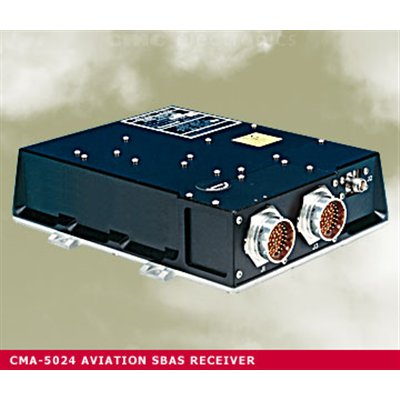
CMC airborne GPS receiver.
And Automatic Dependent Surveillance – Broadcast (ADS-B) is rolling out across the U.S. and other nations as we use GPS on-board aircraft to tell us where they are and to allow agencies to monitor air traffic with less radar tracking. Another leap in safety levels, which requires airborne receivers qualified to new MOPS.
Even though the accuracy might be there, the element we’ve struggled with all this time is integrity. And we get integrity by adding signals and ensuring there are always more signals than we have currently. So now we have L5 coming, and even Galileo and the prospect of multi-frequency, multi-constellation airborne receivers that add safety, raise integrity and get us closer to the runway on approach.
The FAA is mulling over the ground rules for the new L5 MOPS, which they would like to have done and receivers ready for when the next generation of WAAS is ready to go. Over in Europe, Eurocae (the European equivalent to RTCA in the U.S.) has already started to think about Galileo, and even L5. Over the coming years, as the U.S. GPS constellation adds L5 capability, maybe even at the same rate that Europe puts Galileo in place, aviation receiver manufacturers — a rare breed of specialists indeed — are trying to figure out how to finance the impending investments needed to make and certify this new generation of aviation receivers.
Some people have already started down this torturous development path, so they will be ready as the L5 and Galileo MOPS committees work through the intricacies of adding capability to the already highly structured spider’s web of regulations and requirements. As concepts are thought out, it’s always great to be able to test if they work on prototype hardware and provide validation back into the requirements process, so those who have working receivers will play a key role as these new capabilities are brought on line.
And let’s assume that Europe will want Galileo in its future aviation system, and that the pace of fielding L5 into the GPS constellation is unlikely to pick up given the economic restrictions under which the DoD will have to operate in the next few years.
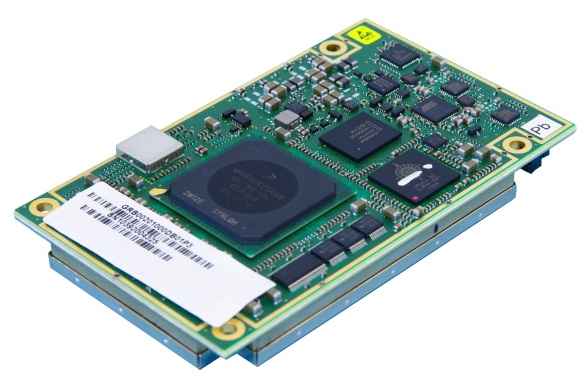
So, combined GPS L1/L5 Galileo E1/E5a receivers are favorite candidates for the next generation of airborne receivers. Rockwell Collins, Honeywell, CMC, Septentrio (at right, the Septentrio AiRx2 L1/L5 GPS E1/E5a airborne receiver), Accord, Garmin, and potentially others have their work cut out as we move out into a new generation of aviation satellite navigation capability. And yes, it’s very hard to do, folks.
Navigating your way through thousands of booths and 140,000 attendees is a challenge in itself at the 2012 Consumer Electronics Show. While there was a huge amount of location-based services news, the big deal was the presence of just about every automobile manufacturer. Such off-site meetings as the Consumer Telematics Show, Showstoppers and AT&T Developer’s Conference also highlighted the connected car.
LAS VEGAS — It took several years, but most major automobile manufacturers are onboard with the idea that a vehicle needs to be connected. Most automobile manufacturers came to the Consumer Electronics Show here to show off their connected devices and explain where they think the market is going.
“The connected vehicle has arrived, though it is not a smart phone on wheels. This the year we are seeing a lot of growth — and I have been doing this a long time,” said Thilo Koslowski, Gartner vice president. “From 2008 to 2012, the majority of car manufacturers have installed connected vehicles. From 2013 to 2016, we will see really major market adoption. A mature market expects connected vehicles — and that’s right around the corner.”
Koslowski says that automakers shouldn’t be locked into one specific market strategy. “They aren’t going to make it if they do. Technology and business approaches evolve in parallel,” he said. “The traditional value and supply chains may not be the best way to market these systems…and you will see some consolidation.”
The aftermarket will take over the connected marketplace if the car makers won’t adjust their strategies, Koslowski said. He said in 2004, the CRM opportunity seemed to be more important to auto makers, but now it’s somewhere in the middle of importance. “We are primarily in the product differentiation phase now,” he said. “It is an open playing field right now, but it will be a challenge for companies who think they have it all figured out.”
Gartner’s research has found that consumers want wireless map updates, real-time weather and traffic, remote software updates and parking availability. What they don’t like are family and friend location information, creating and reading e-mail in a car, anon-demand music book, and such social networks as Twitter in the vehicle.
TomTom Signs Deal With Samsung
One of the bigger announcements in the location space at CES, and maybe the one with the most LBS tie in, was TomTom’s deal with Samsung. TomTom’s maps and location content will power Samsung’s Wave 3 smartphone. The deal basically allows the phone to have LBS, said Charles Cautley, TomTom managing director, automotive licensing.
The business-to-business market has been a strong one for TomTom, which estimated that around 40 percent of its earnings came from that segment, said Cautley, who spent considerable time at General Electric in the commercial vehicle market before coming to TomTom three years ago.
To cap off a big week, TomTom rolled out three portable navigation devices, Start, Via and Go Live. It also signed a licensing agreement with high-end automaker Fisker Automotive. Through a three-year-deal, TomTom will provide map and location data for the Fisker Karma electric sedan. “We absolutely think the electric vehicle market is going to grow,” Cautley said.
TomTom competitor Magellan also rolled out some new PNDs, including the RoadMate 9055-LM and back-up camera. “Overall, the PND is becoming less a novelty and more a utility,” said Magellan’s Stig Pedersen, senior director of marketing strategy. “We are moving more towards safety features in the next year.”
Auto Companies Announce Offerings At CES
Some in the automobile industry are now saying that CES is the place where car makers are rolling out the new technology, not at the concurrent Detroit Auto Show, which is used to roll out new cars.
Chrysler Group’s Uconnect now has a website that allows its users to get in-car updates for their in-vehicle system through a mobile phone, said Joni Christensen, Uconnect head of marketing.
After the initial cost of Uconnect, all that a car owner needs to pay for, after a year’s free service, is the Sirius radio, Christensen said. The navigation system, like Ford’s Sync, is tied to one system — and like Cadillac’s Cue, can be switched from one screen to a view that is incorporated into a car’s speed gauge.
OnStar will give “selected” developers access to a proprietary application program interface (API) to create mobile apps designed with OnStar’s suite of services, the company said. The first partner to use OnStar’s API will be RelayRides, a peer-to-peer car sharing marketplace.
In other company news, OnStar and Verizon Wireless are working on a second-generation connected research vehicle. The Chevrolet Volt research will receive streaming content from the Cloud enabled by the Verizon 4G LTE network and building on OnStar’s Advanced Telematics Operating System (ATOMS).
Audi said it is also offering a 4G LTE capability for its Audi Connect services. The company will continue to use Google Earth maps and will show a driver their destination in 3D imagery.
Telenav launched a new product called Scout at CES that can work with Ford’s SYNC connected unit. Scout provides customized navigation, entertainment, and convenience features for connectivity between a smart phone, vehicle, or a computer. Scout Key features turn-by-turn directions, real-time traffic, and estimated drive times to specific destinations at different hours of the day. Scout also provides personal local search based on a user’s preferences for entertainment, restaurants, and other points of interest once they arrive at a destination.
“It’s free on iTunes right now, but we plan to launch it on other platforms,” said Sooner Heath, Telenav customer solutions manager.
Indoor Positioning Looking to Get Bigger
Soon all malls, shopping centers, airports, sporting venues and other businesses will feature indoor maps, which could be the boost LBS needs, particularly if big businesses come on board and advertise. At CES, CSR said it is working with Micello, Google and Nokia Location and Commerce on indoor positioning, that combines Wi-Fi and GPS.
Some of the capabilities include being able to see what floor in the building you are walking in, pedestrian dead reckoning, and turn-by-turn walking directions, said Blake Bullock, CSR product manager.
Fernando Villasol, Nokia Location and Commerce director of content, says the advent of indoor positioning will soon open up new market opportunities for developers.
In other CES news:
Kenwood says its marketing agreements with Garmin continue to produce great aftermarket sales. The company rolled out its $1,500 DNX7180 Navigation/Multimedia Receiver, which features navigation from Garmin, including Lane Assist with Junction View. A built-in free feature is the Navteq Live Traffic for the life of the product.
Location Labs’ new Safely line of services include phone controls to allow parents to lock kids’ phones, a family locator, a teen phone lock during drives that is available on Sprint and T-Mobile phones, and a social monitor for Facebook.
Like TomTom’s discontinuation of the Tele Atlas name, Nokia has basically done away with the Navteq company name, though many in the industry still say “Navteq” when talking about the mapping side of the business.
There was an LBS and Safety Zone at CES that was in a terrible area in the back of North Hall. While there was a lot of foot traffic, looks like smaller and international companies were thrown in the back — not near the bigger auto players which would have generated more attention to the booths/companies. Overall, CES is more of a connected vehicle show than LBS…a change that has been happening for two years.
This week, I’m pleased to present to you an essay written by Gavin Schrock, a licensed land surveyor (Washington), technology writer and administrator of the Washington State Reference Network (WSRN), which operates 103 GNSS reference stations that comprise the statewide RTK Network. He has written about surveying, mapping, GNSS, civil engineering, GIS, and data management for industry and association publications. He is usually not as cynical as he is when facing potential forced upgrades/replacements/production losses for his profession and the GNSS community.
With plenty of announcements, posturing and news, expect another newsletter shortly from me recapping the LightSquared events of December and January.
Eric Gakstatter
Should GPS Users Accept New “Fees”?
“Eat your spinach, you no good’ infink [infant]’. Eat it. EAT IT. Eat it.!” – Poopdeck Pappy [from Popeye]
By Gavin Schrock, LS
GPS is free of charge; period. Apart from any costs you incur in securing your own equipment to utilize the signals from the GPS constellation, or to subscribe to some augmentation service, there are no direct user fees. This is codified in our nation’s laws; GPS is free of user fees and this policy has remained consistent throughout the history of the U.S. Global Positioning System. End users, industry, public safety, and some international agreements, are based on or rely upon this fundamental, ubiquitous, irrefutable, concept of free!
Not that a fee would not be a great revenue generator; it has often humorously commented on within the Position Navigation and Timing (PNT) circles of the government that if one penny could be charged every time a GPS-based position is generated that there would be no debt. But this is not a serious consideration, and for the very reason we have GPS in the first place: we’ve already paid for it. GPS is essentially a military program, a weapons system “friend with benefits”. Taxpayers own this system. It was funded for and is operated (in an exemplary manner) by the military for specific purposes, but is almost exclusively unique as a military program in that it provides almost unprecedented direct economic and public safety benefits to the civilian world as well. In other words; we really get our money’s worth out of this investment.
The military can keep it free because they reap enough internal benefits to justify the expenditures; like valuable encrypted services for their own national security purposes. Many fear that the military might lose a substantial portion of this justification if such things as P-Code encryption were turned off, as some have suggest (without the newer “M-Code” being fully deployed first) and that bean counters might start looking at fees. Fees are universally so unpopular for dual-use GNSS systems that no other constellation provider does, nor plans to do so, with the possible exception of the European Galileo system; and there is still great internal debate and dysfunction within the EU and the Galileo program on the design of a franchise model for user fees. Some have also tried to characterize expenditures for developing, deploying, operating and modernizing the GPS constellation as “subsidies” for GPS manufacturers and users. Many more view it as: we paid for it, we own it, and it ain’t a subsidy. Are lighthouses and highways considered subsidies?
You can freely look for and receive GPS signals anywhere they may roam, worldwide and in any band they may wander, not just the GPS Band. There are absolutely no restrictions on receiving GPS signals. The FCC regulates transmissions, not reception. You are not breaking any laws or “squatting” if you look for GPS signals in the next band or the one beyond that. You can try to look into an FM band with your VHF radio if you want. It may not make any sense, but there are no restrictions. What one does with received signals can run afoul of the law though (like eavesdropping on private conversations or decoding encrypted national security transmissions), but when it comes to GPS, there are no current restrictions on what you listen to.
That the FCC only regulates transmissions and not reception discounts calls by some (guess who), for the FCC to develop and enforce standards for GPS receivers. The FCC is generally only concerned with what things emit or transmit. A receiver does neither as it is transmissions and emissions that harm other users. There may be no legal standing for the FCC to regulate receivers. The same kind of selective indignation is heard the characterization of GPS units as being “unlicensed” (got a license for your FM car radio?). This is another attempt to deflect from the immediate issue at hand by implying that your GPS gear is somehow breaking some rules, is deficient, or that the manufacturers have been negligent. More storms in teacups?
No Steps Backward, Only Steps Forward
To this date, the gracious hosts of the GPS constellation (USAF) has not implemented any fundamental design changes that would force you to have to change your GPS uses, or incur any additional costs in doing so. Quite the opposite, there have been many improvements along the way which would make one consider a voluntary upgrade. An example of changes for the better include Selective Availability (deliberate degradation of GPS signal) being turned off in 2000. That action was made permanent in 2007 and such actions acknowledge the tremendous lateral benefits of civilian uses. It will not be until December of 2020 (at the earliest) that there will be any major change in the GPS signal (or spectrum) that will render any method or solution for utilizing the GPS solutions unusable or substantially compromised. The planned change is an option that the constellation provider may exercise at that time to no longer support selected elements of the GPS L1 P(Y) and L2 P(Y) signal characteristics. The U.S. Government acknowledges global use of GPS codeless and semi-codeless techniques is committed to maintaining as such for a whole decade for transition. That is an important distinction; a whole decade… there are no “gotchas” (nor should there be) when it comes to such a valuable amenity. This decade for transition primarily provides time for other constellation upgrades to reach fruition, providing alternatives and mitigating for the possible loss of codeless and semi-codeless functionality. That is another important distinction and concept; do no harm to one capability until there are alternatives completely in place to mitigate for the harm/loss.
Don’t Fee on Me…
If the U.S. government was to try to start charging some end users fees directly or via some other means like a surcharge on GPS gear, that would be met with such opposition as to drag the debate out in process and possibly the courts for far more than a decade. Such an action would also be breaching some hard wrought international agreements. Implementation of direct fees would be as improbable as being struck by a falling GPS satellite.
Now, if the constellation host (USAF, or if forced by another agency) were to make a design change that enabled a specific private entity or group of entities to be able to charge for use of the system (i.e. like an encryption, or spectral change that might cause you to have to buy some proprietary gear) then that would be a fee and that scenario would surely cause an even bigger storm!
But what if a U.S. government regulatory action rendered your current gear to become obsolete in some way? That you would have to incur expenditures to continue to use the very system you paid for, and through no fault or action of your own – would this in affect be a “fee”? (You probably know where I’m going with this). Some say this is moot, because (in their eyes and marketing dreams) your gear is already “obsolete”, and you should buy their gear right away.
Obsolete?
One would not expect the definition of a word like “obsolete” to be highly debatable, but one would have never expected a word like “ancillary”, or Ancillary Terrestrial Component to be up for debate either.
From the FCC: (“We clarify that ‘integrated service’ as used in this proceeding and required by 47 C.F.R. § 25.149(b)(4) forbids MSS/ATC operators from offering ATC-only subscriptions. We reiterate our intention not to allow ATC to become a stand-alone system. . . . We will not permit MSS/ATC operators to offer ATC-only subscriptions, because ATC systems would then be terrestrial mobile systems separate from their MSS systems.”).
Sorry, got sidetracked there. Obsolete. Now look at your high precision GPS gear, the gear that you maybe even purchased within the past year. If you were to use that gear today, you would have a reasonable expectation of a certain level of precision and reliability from that gear. There are no planned constellation/signal changes before the end of 2020 that would otherwise negatively impact the expected precision and reliability of your gear. Barring events or conditions completely out of your control, or that of the constellation hosts (natural or manmade disasters, invasions of GPS eating zombies, etc) your gear will not be in any way “obsolete” (with regards to current functionality) before 2020 at the earliest (and may still function long after that).
Your smart phone might be deemed “obsolete” by some of your technophile buddies because a new one came out, but yours still works. On the other hand some have opined “just because a company builds an electric car does not mean we should shut down all gas stations”. Comparing consumer level devices to expensive and sophisticated high precision GNSS gear is like comparing grapes and watermelons. Folks do not take too kindly to others telling them their gear is obsolete, or poorly designed – quibble about the details, but they don’t take too kindly just the same.
But what could make your gear obsolete? Apart from the previous scenarios (and no insult to folks who believe in GPS eating zombies) there are things out there that could potentially compromise your ability to use your current gear, but none, other than things like space weather and malicious jammers (that deliberately set out to mess with current GPS capabilities), are not within your realm of control, or for the most part the control of the constellation providers. However, there is that controversial broadband plan under review that sets out to introduce a new source of interference (that does not currently exist in the specific form, strength, and coverage) being so heavily debated during this past year.
If this perpetually-revised broadband plan is to be given the go ahead, then a new source of interference will require an upgrade or replacement of many high precision and general navigation and aviation GPS units, and if the costs of upgrades and production interruptions fall on the end users, this will, in effect, be a “fee” (or at least smell like one). Likening these costs to a fee is not any crazier or out of line than the barrage of claims and counter-claims brought about by this recent GPS-Broadband “mad as a box of frogs” debate. There are all kinds of arguments, or rationalizations of unpopular positions, that run the gamut from specific technical considerations, politics, deflection, projection, test result rejection, lobbyist injection, to “we already have full rights to do this, GPS must accept the interference.” If that were the case, then why did there have to be a waiver? – and a waiver with strict conditions attached at that?
The broadband applicant and the GPS industry have sparred mightily. Have the conditions of the waiver been met? Who’s fault was it? Bad receiver designs or flawed and rushed broadband plan? [Insert your own favorite rhetoric or talking point here]. Leaving all that aside for a moment, a big overlooked question is, what about the innocent bystanders that will take the heat if it is approved? The end users subject to a new “fee” of sorts. While there is fleeting mention of the “who pays?” in the deliberations (that only seems to go as deep as “the other guys should pay”), no party has set forward a practical plan to cover those costs other than the end user eating them. The highest probability is that the end user will have to eat this “fee” and that will be quite a blow to many people.
Is the fix in, for the fix that is in?
There has been a lot of alchemy going on over the past year with regards to this matter; attempts to turn straw into gold; like the effort to turn low-cost satellite spectrum into golden terrestrial spectrum, and more recent efforts to try to spin what will amount involuntary upgrades (“fees”) as some kind of “gift”. Involuntary expenditures end users will have to incur, to continue to use their perfectly fine GPS gear and perfectly fine spectrum and perfectly fine constellation, as they were designed for and as they are accustomed to, are a defacto fee! To try to spin something so unsavory into a gift, gem, or blessing in disguise, is being viewed widely viewed as self serving and somewhat disingenuous. There is a reason why alchemy went out of style centuries ago by the way.
One way to help someone swallow something unsavory is to sugar coat it, convince someone that it does not taste too bad and won’t make them sick, or wrap it in something that appeals to them. It is very likely that all manufacturers will see fit (if the plan is indeed forced on us) to sweeten the deal to soften the blow, offer incentives, and throw in cool features. No matter how cool the deal is, and what amazing features “you’d be a fool to pass up” are, there is still an element of being forced to pay to be able to continue to use GPS as you are accustomed.
Setting aside this controversy for a moment, there are several schools of thought about upgrades. Like any product, developers (even sometimes with the purest of intentions) work very hard to develop new features and hope we see those as valuable enough to spark an upgrade or replacement purchase. This can be wonderful and with healthy competition we benefit from options for both “nice to have” new features to groundbreaking “must have” features. High precision GPS gear is not consumer GPS gear, and most folks do not buy every new unit that comes out. Do you buy a new car every year? Most need to get several years of use out of the gear to realize cost-benefit, but for others a constant upgrade can pencil out. The growing popularity among heavy users (especially construction) of leasing gear ensures all of newest features, configuration, and firmware (remember that every support call starts with “what firmware version are you on?”). This does not work for everyone and so far as there has not been a forced upgrade or other planned obsolescence, users have reasonably expected many years of reliable use out of their current gear.
Selling (and opposing) the controversial broadband plan that sparked this flurry of debate, has been a well-funded and ongoing effort. No one disagrees that more wireless would benefit a lot of people and even laterally the very end users that will have to pay the “fees” to make it a success. We’ve been told that this plan heralds a new chapter/era/breakthrough in wireless. But it is not like there is some amazing new technology in play that could not be served by other plans, existing or in the works, that do not hurt GPS, and then we find out that the plan might not be as ubiquitous as we might think.
We’ve been told that this is an epic battle between and “obstructionist GPS community and the very future of broadband!” Not quite; LTE is already here, growing, and there are quite a few other initiatives under way, including several hybrid satellite-terrestrial proposals that do not pose immediate threats to GPS. Opposition to this plan does not impact the entire future of all broadband. Plus there is a substantial amount of spectrum being “sat on”, and numerous tests show seriously underutilized spectrum. This has more to do with operational, marketing, and poorly functioning systems that just needs good management and policies. Of course more spectrum needs be sought over time, but why are some of the more recent (and vocal) advocates (even from within the GPS community) for this specific plan so hung up on the supposed “criticality” of this one specific plan. Wouldn’t it be better for both the expansion of broadband and the GPS community to advocate for better management of existing spectrum? Or is it better to zero in on one piece of spectrum that represents a hazard to current GNSS? How about working on underutilized spectrum and give sufficient time to work out solutions for the MSS/GPS bands? This haste and laser focus on this GPS-unfriendly option raises a lot of questions and hackles as we have seen.
We’ve been told variations over time how the interference can “all be fixed with a ten cent filter” to “some components only cost $6″, to $300, to $800, to $5,000, to a thousand bucks a year, to… (lets drop that for a moment). We’ve also been pitched that the plan will bring forth a new cut-rate nationwide RTK network (which may not be as practical or nationwide as some might think). Though there would be benefits of more wireless choices, and a great many investors would benefit as well; does one segment of the population have to take the bullet for this success?
New features added to sweeten the deal might be well worth the cost when separately considered as a voluntary purchase (or not), but if someone wants to eschew the sweeteners, can they get upgraded for free?
A spoon, or shovel full of sugar helps the medicine go down…
Manufacturers have always admirably striven to create new and amazing features, and then the sales and marketing folks have to turn those into “must have” features. This latest move with the “GPS upgrade fee sweeteners” is not an exception. Some sweeteners that will likely be added to the “GPS upgrade fee” might be “must have” to some, but might include features that are not quite ready for prime time in the view of some, or do not solve “make or break” issues for other end users. End users are savvy enough to decide what to buy and when, and if not forced to do so will buy based on business needs and cost benefits. Folks do not take too kindly to salesmen implying that they are “fools for not taking advantage of this deal”.
For example, a forced upgrade might be offered with modifications to get access to more constellations and signals (for the limited numbers of receivers that can take that kind of upgrade). A lot of folks already have with their current gear, L5, Galileo, and other signals capability (or at least placeholders and will be waiting years before those come to fruition). Others wait until a constellation or signal is fully deployed before making a big purchase or commitment. It was announced December 27th, 2011 that the Beidou/Compass constellation has been declared operational, but how many years before that will make any difference to you in the field? Trying to sell something that is not yet ready for prime time can have mixed results. Do you remember the dark times of the old Glonass constellation? Unlike today when it has been successfully modernized and is at full deployment, there were past precision issues reported when using Glonass. I asked a few manufacturers why a decade ago they did not heavily market their early Glonass capable gear, one response was “we did not want a customer to go out there and get [poor] results and then blame us for pushing Glonass on [them]”. Many users may be wise wait until these new constellations and signals have matured.
A noble ambition/feature is to solve the filtering for not only this pending issue but for all forms of interference, and this has been tacitly offered as up another sweetener. With the timeline too short to pull this off before approval of this broadband plan hanging over our heads aside, are end users currently really being crippled by existing sources of interference? Not to deny the potential harm of various types of interference, but is the timing of this “awareness heightening” by some supporters of the broadband plan a case of (to paraphrase L. Frank “Oz” Baum) “pay no attention to the [broadband plan] behind the curtain”?
The U.S. GPS Interference Detection and Mitigation Program (IDM) is a serious undertaking. There are reporting elements like the Patriot Watch portal (closed to the general public) and support/notification services (for not only interference but constellation updates and other alerts) from a “GPS Triad” formed by the USAF (military issues), the FAA (airspace issues), and U.S. Coast Guard (surface issues) already in place. I’ve queried these entities, as well as a number of RTK network operators and have not come up with a huge number of verified examples of interference that would significantly affect high precision users. I’m not saying that “the Orc we fear is worse than the Orc we hear”, but like any other element of risk assessment there should be serious analysis of incident data and testing before we rush off on a potentially costly course of action based in part on anecdotes and compound assumptions about interference.
There have been several (but few) well publicized cases of interference that do present cause for concern, in particular the accidental military source disruption in San Diego in 2007, and the cheap “trucker jammer” that affected an airport in New Jersey. But for non-jamming or military sources (that are not typically turned on in populated areas) the other more commonly suspected sources of interference are often recognized and avoided (e.g. certain types of power lines, some sat-phone handsets, and some high power distribution substations). There are also users successfully working in areas one would highly suspect for interference, but are not necessarily a hazard; like in and around airports, military installations, and even on hilltop antenna farms, without loss of precision.
That is not to say that interference is not a threat nor that jamming might not harm operations. Jammers are highly illegal and of course some folks will use them. You put the idea in a users head, and then the otherwise systematic debugging of field operations issues can take on a whole new element of paranoia. We’ve even fielded support calls this past year with frustrated field users asking “could this be interference from LightSquared?”, a system that has not even been turned on yet. Efforts to build affordable detection devices is a noble cause. There have been some great strides in analyzing this issue and developing new tools. The problem with serving up these things as a sweetener added to a forced upgrade, or as a tool to deflect attention away from the immediate broadband-plan issue, is that many view this in some way disingenuous. Right or wrong, the timing and nature of how this has been spun may serve to taint the otherwise worthy issue of a broader interference.
More at stake than your GPS unit
Sweetening the deal and softening the blow for one limited segment of GPS users, like the surveying profession, or other specific type of GPS equipment, completely ignores other issues that can be viewed as much more compelling than that of the individual.
Aviation: Can the same model of cheap, quickie upgrades (and sweeteners) be applied to aviation? Some of the most compelling concerns have come from the aviation community and FAA Advisory report. To assert that one could go up to a plane on the tarmac, crack open the GPS unit, put in a few cheap components and then send a hurtling can of people into the sky sounds more than reckless or insulting. Developing, acquiring, testing, certifying, installing and then testing again of aviation components is time consuming and expensive, and cannot be taken lightly.
The same solutions for limiting interference in cell phones may not be applicable to other types of gear, and may be completely ludicrous for others. In the case of cell phones, these are narrow band (only using about 6%, or 2MHz of the 32MHz of GPS signal) as they are not concerned with precision, and many utilize Assisted GPS (AGPS); an augmentation to improve the slim pickings from such a narrow band view. High precision units, and most general navigation GPS, plus aviation, and most military are “wide band”. There is a huge difference between a cell phone being tested in a purely pass/fail mode; more for “conformance”, than for “performance” and a high precision unit that uses (perfectly legitimately) as much signal as possible to achieve such high precisions as many rely upon.
No one would disagree that there are engineers that have been rolling up their sleeves and working on new and improved filtering options, but at this point in time, there is a sort of “spectral gun” being aimed at the end users. The view is quite a bit different from down here at the business end of said gun than from the point of view of those who are so cavalier about this subject on the trigger end. In this charged atmosphere of the current controversy, we may really need a “hype filter”. Is it too much to ask that such grand filtering ideas be backed up with solutions that have been developed and tested for every type of GPS unit well in advance of anyone monkeying with the spectrum? Sure one can assume that anything can be fixed with enough time and money; seems to be no shortage of money, but how about time? Back down the throttle a little and let this plane come in for a safe landing.
Hold the Cheeseburger
Wrap up something unsavory in a double-patty-pickles-onions-cheese-on-a-sesame-seed-bun and we are still being forced to consume something unsavory or disgusting– and don’t expect us to think folks are heroes for selling us a toothbrush.
Opposition to the plan has not been limited to the GPS manufacturers or satellite communications providers who would stand to lose something in this matter. The U.S. military, aviation, agriculture, and public safety are among the others who have arguably had more say in the matter. There have been some accusations that all opposition is contrived, or based solely on conflicted interests – don’t insult us. Yes, the end user may be only looking at the costs of upgrade/replacement/production interruption but what of those who stand to gain either financially or in stature from this if approved?
Why would parties from even within the GPS industry and community (some call “turncoats”) advocate for introduction of this new specific form of interference and inflicted forced upgrades/replacements on their own industry and end user community, and then try to spin that as some kind of gift, or path to a “better world”? Some would suspect profit, or there may be pure intentions involved, though the latter might make one think about those old spy/action movies where some group is planning to disrupt the world so that they can rebuild a more perfect world according to their plans or beliefs. Good intentions, but…
If this broadband plan is given the green light (and even if it looks like it might not fly), or not, it may serve as a harbinger of things to come. If it fails, it is not the end of broadband or the world as we know it, and perhaps a good long term plan to manage spectrum and constellation could come of this. It would be a fantastic goal/role for joint PNT/FCC cooperation, but these things cannot and should not be rushed. Wow, managing something effectively, am I dreaming?
If approved though, all of the manufacturers will have to offer some kind of deals to soften the blow. The end user may have no choice but to upgrade or replace, but they will have a choice in how they do this and who they patronize. Some sweetener peddlers have jumped the gun and have touted cost-benefit computations of the upgrades (based in part on some aforementioned arguable assumptions) that (they say) may only cost you the price of a burger a day; couple of bucks a day (or 50 Rubles, or whatever currency equivalent as many might turn to cheap GPS gear from overseas if forced into this). Many have expressed how insulted they feel about this attempt to minimize their concerns.
People will not easily forget those who blatantly advocated for what many consider to be a rushed-reckless spectral disruption. Many end users have indicated that they will seek to pay (if forced to) these “fees” to other companies who did not support the potential harmful broadband plan, exercising what little choice or influence they have in this matter. Or at least if the GPS eating zombies do attack, they might be tempted to trip some of those turncoats.
I have long advocated that our warfighters and first responders deserve the best equipment available so they can answer the basic question, “Where Am I?” quickly and with complete certainty. Or, “Where am I now and how do I get to someplace of relative safety quickly?” Unfortunately, government-furnished equipment (GFE), in this case the GPS handheld equipment we supply our warfighters, does not do a good or even adequate job of answering that question.
At this time of year, while everyone else is busy making New Year’s resolutions and breaking them, I tend to wax nostalgic. About 45 years ago when I was a college newspaper editor — yes my fascination for the written word has been going on for at least that long — I had the opportunity to interview a wonderful elderly professor who taught a combined psychology and philosophy course on the human condition. I am absolutely sanguine he gently pontificated marvelous, life-changing platitudes, many of which are unfortunately long forgotten, but I do remember his famous Daniel Boone quote related to being lost, and I present to you the slightly modified version. When Daniel Boone, the famous wilderness scout, became a legislator later in life, he was asked by a senator if he had ever been lost while he was roaming around in the wilderness. Daniel Boone thought for a moment and replied, “No, I have never been lost, but since my compass was government furnished equipment supplied by the lowest bidder, I was mighty bewildered once for about three weeks.” This kindly professor also encouraged his graduate students to constantly ask themselves, metaphorically of course, “Where Am I?”.
It is a philosophy that we should all adopt, one I have followed through the years. It has served me well, certainly much more so than the plaintive words from the 7th Cavalry General Custer query, where we hear the oft-cited and mournfully questioning lyric, What Am I Doing Here? Recently, the troubling aspects of the “Where am I?” and “What am I doing here?” questions have come home to roost. Of course, I am speaking of when and where I am physically, as in time and place, not metaphorically. While the answer seems straightforward and simple for most of us, emails I have received over the last ten years from our warfighters indicate this may not always be the case for everyone. Many of us, and in fact I hope, all of us, at one time or another, ask that question: Where in the heck am I anyway? When you and I ask that question and we are momentarily disoriented or just trying to find the location of our next appointment, it can be mildly frustrating, but when our warfighters ask that question in the heat of battle, it can be a life or death interrogative.
In this column from day one, I have strongly advocated that our warfighters and first responders deserve the best equipment available that enables them to answer that basic question — Where am I? — quickly and with complete certainty, no ambiguity. Where am I now and how do I get to someplace of relative safety quickly? Unfortunately the GFE or government furnished equipment, in this case the GPS handheld equipment we supply our warfighters, does not do a good or even adequate job of answering that question. Let’s face it — the government furnished equipment fails miserably at what should by now be a simple task.
Our warfighters may eventually be able to determine where they are located with the help of a paper map, but the handheld versions of GPS GFE do a lousy job providing situational awareness and indicating the route to a safe haven. If there are still doubters, one need only remember the Jessica Lynch story as you contemplate the disasters resulting from disorientation, being lost, or making a wrong turn in combat conditions. That one infamous wrong turn will affect Jessica Lynch and her comrades for the rest of their lives as well as the families of those who died because of a simple and basic navigational error.
Since that very public scenario played out almost eight years ago, our GFE GPS equipment has unfortunately not changed one iota for the better. Our warfighters are still using . . . let’s be precise, are still issued the same outdated, overweight, battery limited, lousy handheld equipment, with a monochrome screen, that they actually rarely use as a stand-alone device. The current GPS GFE functions almost adequately when it is embedded in another piece of equipment and our warfighters do not have to deal with the sorely antiquated and frustrating user interface. When bullets are flying and our warfighters are enmeshed in the fog of war is not the time to deal with an infuriating user interface.
The bottom line is thousands of our warfighters — if their cards, letters, telephone calls and public testimonials are any indication — consider the GFE GPS they are issued to be vastly inferior PNT equipment.
Apple iPhone 4S
As a natural consequence, many warfighters have turned to commercial equipment for their PNT (Position, Navigation and Timing) needs. Familiar commercial GPS providers such as Garmin, TomTom, Trimble, and Apple have seen their devices proliferate in theater. Service providers such as Verizon have seen a ten-fold increase in commercial spectrum since the conflicts began more than eight years ago. Face it: When your life is on the line, you are going to quickly determine what you really need to survive, purchase it, and learn how to use it. This is why in my previous column I mentioned that the new Apple iPhone 4S may prove to be the most useful and versatile PNT device on the market today. This is true especially for our warfighters and first responders, who have stated categorically in more than 8,000 letters and emails to me that availability of PNT signals is the critical metric for judging the efficacy of a handheld/portable PNT device in war time and emergencies.
Consider the following iPhone attributes:
Receives 30+ GPS satellites.
Receives 24+ GLONASS satellites.
Receives WASS and EGNOS GEO satellite transmissions where available. Note that a GEO (geosynchronous Earth orbit) PNT satellite may be the geometric equivalent of more than three MEO (medium Earth orbit) satellites. As I have said many times, where PNT is concerned geometry matters.
Receives Wi-Fi signals and un-encoded GPS signals processed by Skyhook wireless software, which providing a TTFF (time to first fix) of only four seconds.
Receives 3G and 4G signals from cellular towers and provides a position when all other signals are obscured or otherwise unavailable. Note: While the Apple iPhone GPS chip is sensitive enough to work indoors, even when that fails due to electrical interference or dense shielding, the Wi-Fi signals and cellular signals usually penetrate. Warfighters tell me even in Afghanistan it is rare not to have an accurate position and time displayed on an Apple iPhone, iTouch or iPad.
The iPhone user has access to 30+ PNT programs with highly accurate color terrain maps and satellite views that the GFE GPS does not provide.
The Apple iPhone fully incorporates the multi-sourced PNT derived position with other applications on the iPhone and makes the most of situational awareness, which is critical to a warfighter and first responder.
The Apple iPhone fully incorporates the PNT position with the communications capabilities of the iPhone to include cellular, Wi-Fi and SMS or texting for the younger generation.
The iPhone allows users to take photos of their surroundings and encode the photos with PNT information, alerting others to their situation. It provides situational awareness for the users and those communicating with the users.
The embedded and integrated communication capabilities of the iPhone allow the user to talk with mission planners, taskers and superiors while simultaneously reporting findings or accepting mission changes, all on the same device.
If the iPhone is lost, its position can be determined with another iPhone or Apple computer. If it has fallen into enemy hands, it can be tracked and found, or if that is not feasible all the information on the Apple device can be deleted and the device rendered inert.
While this is quite a list of capabilities, it is far from a complete or exhaustive list. The really tragic part of this true story is that with just a little imagination and subject-matter expertise combined with some planning, the GFE GPS could have incorporated the same capabilities, and more; who knows, The iPhone could be the future GFE for PNT. As it is of the eleven PNT and related capabilities listed for the Apple iPhone, only one can be accomplished by the current GFE handheld GPS — a tragic state of affairs!
To make matters worse, officially our warfighters cannot use the iPhone and its abundant situational awareness capabilities, or devices like it, for official mission or mission-related activities. To the U.S Army’s credit, it is attempting to change this inane and life-threatening policy. Until that happens or new GFE PNT equipment is developed, U.S. military personnel are forced to use the worst handheld equipment available, from a size, weight and power perspective (SWAP) that provides the least amount of information possible. This makes current DoD policy concerning PNT hardware, software and frequencies about 20+ years out of date and consequently, or should I say thankfully and to their credit, our warfighters have basically totally ignored this antiquated policy.
To be perfectly clear, I cannot and would never advocate ignoring official government policy or denigrate those who do. The current GFE GPS serves a purpose, or so I am told, and even though it is marginal, the equipment should be utilized where officially mandated. However, the smart warfighter will incorporate numerous GPS/PNT backups and utilize them judiciously — or as one clearly frustrated warfighter wrote, “…I use the GFE GPS and Viper combination, which is very unwieldy and cumbersome, to call in or direct fire because I can be prosecuted by the military if I don’t, but I use my iPhone [PNT capabilities] for everything else including communicating with and getting my comrades and I back to our unit at the end of our patrol. Why can’t the military furnish me with something like the iPhone that works, is a tenth the size and weight, and costs only one fifth what the current GFE GPS costs? It already exists, just authorize my teammates and me to use it. How hard can that be?”
You can literally feel the warfighter’s confusion in that statement. Let’s hope the U.S. military is successful in mandating desperately needed changes. We will keep track of those efforts and let you know. Meanwhile, buy your favorite warfighter a backup PNT device such as a Trimble, Garmin or iPhone — anything so they can answer the age-old question of “Where am I?” and then find their way safely home.
Until next time, with full apologies to CWO5 William Dagenhart (USMC) and to the men and women of the 7th Cavalry, happy navigating.
The U.S. Air Force has awarded Lockheed Martin a $21.5 million contract to provide a Launch and Checkout Capability (LCC) to command and control all GPS III satellites from launch through early on-orbit testing.
The LCC, which will be integrated into the Raytheon-developed Next Generation Operational Control System (OCX), will ensure launch availability for the first GPS III satellite in 2014. The LCC includes trained satellite operators and engineering solutions in partnership with OCX to support launch, early orbit operations and checkout of all GPS III satellites before the spacecraft are turned over to Air Force Space Command for operations.
“Achieving initial launch capability in 2014 is critical to introducing new GPS capabilities on time and will enable the GPS III program to continue its production pace, maximize efficiencies and reduce long term costs for the GPS enterprise as a whole,” said Colonel Bernard Gruber, director of the U.S. Air Force’s Global Positioning Systems Directorate. “The Launch and Checkout Capability will ensure we can launch in 2014, effectively closing the time gap between GPS III and the Next Generation Operational Control System.”
The GPS III program will replace aging GPS satellites while improving capability to meet the evolving needs of military, commercial and civilian users worldwide. The satellites will deliver better accuracy and improved anti-jamming power while enhancing the spacecraft’s design life and adding a new civil signal designed to be interoperable with international global navigation satellite systems, according to Lockheed Martin.
The GPS III team is led by the Global Positioning Systems Directorate at the U.S. Air Force Space and Missile Systems Center. Lockheed Martin is the GPS III prime contractor with teammates ITT Exelis, General Dynamics, Infinity Systems Engineering, Honeywell, ATK and other subcontractors. Air Force Space Command’s 2nd Space Operations Squadron (2SOPS), based at Schriever Air Force Base, Colo., manages and operates the GPS constellation for both civil and military users.
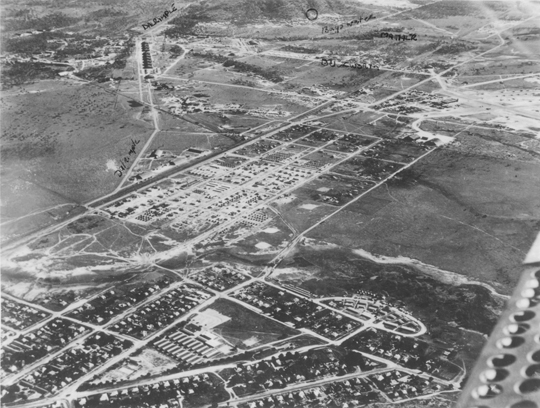
A U.S. Army camp near Townsville’s suburban areas, circa 1944.
By Tracy Cozzens
Beneath the surface of a tropical paradise in the city of Townsville on Australia’s Sunshine Coast lies a hidden maze of tunnels and underground bunkers, once said to be used by General Douglas MacArthur. Learning the secrets of this labyrinth that was a major World War II staging point for battles in the Southwest Pacific is the passion of Kevin Parkes of Geo Positioning Services, Townsville.
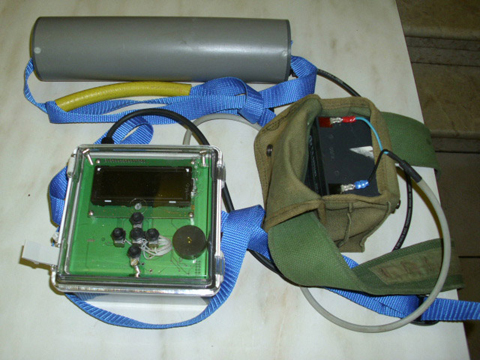
Parkes’ main tool is historic aerial photography, coupled with hours of research in the National Australian Archives and the National Library of Australia. To that he adds geophysical surveys of the infrastructure. Parkes is undertaking the geophysical surveying and mapping using an Ashtech ProMark 100 GNSS receiver and a Willy Bayot PPM Mk 3 magnetometer. He used the magnetometer and GPS receiver in parallel, later processing both data sets.
After the attack on Pearl Harbor and the Japanese advance through Asia, Townsville’s population bloomed from 30,000 to 120,000 by mid-1943. The rapid military influx stretched resources to the breaking point.
The U.S. Army 5th Air Force established the largest aircraft repair and maintenance facility ever built in the southern hemisphere at Townsville, and the site became the technical hub of U.S. military aviation. Air Force Service Command Depot #2 at Townsville was capable of overhauling 300 aircraft engines per month and performed aircraft assemblies, modifications, overhauls, and maintenance. Major resources and facilities serviced the Royal Australian Air Force, Australian and U.S. Armies, Royal Netherlands Air Force, Royal Air Force, Canadian forces, Royal Navy, and other allied forces.
“A visitor to Townsville today would be forgiven in asking where the artifacts of this massive military facility are today,” Parkes said. “There is very little remaining in any built structures that give any idea of what happened in this city 70 years ago.”
Parkes realized that underground cave shelters were most likely used for warehousing and storage, to keep stores out of the weather and protected from enemy action.
He describes one area he investigated, a park in Townsville used as an officer’s accommodation camp. Preliminary magnetic anomaly surveys indicated linear anomalies were beneath the park surface. A high-resolution survey gave samples of about 1.5-meter resolution.
“The difficulty was reducing all noise levels down to a minimum, including the X/Y positioning, so the GPS requirements came down to survey quality,” Parkes said. “It is absolutely critical that the GNSS receiver and magnetometer keep in synchronization during data collecting runs including under the frequently encountered tree canopies.”
To improve accuracy, Parkes avoids using real-time kinematic survey equipment. “That would involve having another electronic device operating and emitting more noise in the signal spectrum,” he said. The need to position the GPS antenna in close proximity to the magnetometer sensor was a major issue with all on-pole RTK systems.
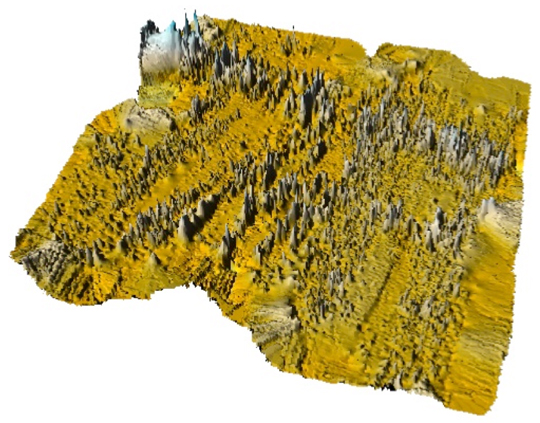
A U.S. Army air raid shelter under the officer’s accommodation camp, mapped with GPS and magnetometer data and using Surfer 3D surface mapping software.
With an Ashtech Promark 3, post-processed results were better than 100-millimeter X/Y coordinates. “The unit is lightweight and self-contained,” Parkes said. “The noise from the Ashtech survey-grade external antenna’s effect on the magnetometer data was insignificant.”
Still, this park had a grove of trees that defied every attempt to maintain GPS reception and consequently synchronize the magnetometer. Along came the Ashtech ProMark 100, a lightweight and self-contained receiver with external geodetic antenna with GPS and GLONASS. “My first attempt at surveying under the trees was spectacular to say the least,” Parkes said. “Synchronization with the magnetometer data was near perfect.”
The dual-constellation reception of the ProMark 100 became essential to the success of Parkes’ work. After more than a hundred data-collection passes with the magnetometer and ProMark 100 through the groves of trees, at no time did the Position Dilution of Precision (PDOP) rise to more than three, and at all times more than eight satellites were available. The ProMark 100 data is post-processed to improve accuracy. Parkes noted that ironically many of the most interesting finds have been collected under heavy tree canopy. Without the quality of the geographic positions enabled by the ProMark100 under tree canopy, Parkes said that much of his work would have been impossible to achieve.
Parkes’ surveying equipment includes a magnetometer and a ProMark 100 GNSS receiver.
In fact, when Parkes first began his mapping project in 2005, he used a single-constellation GPS system and post processed the results against the local International GNSS Service (IGS) reference station. The GPS-only system worked very well until a grove of trees would interfere with the sky. Now with the ProMark 100 GNSS receiver, Parkes surveys using GPS L1 and GLONASS in continuous kinematic mode at a one-second collection rate. He then post processes the data against another ProMark 100 used as a local reference station.
To date, Parkes has mapped an underground railway, artillery observation posts, several shelters, fuel terminals and other yet-to-be-identified pieces of the vast infrastructure.
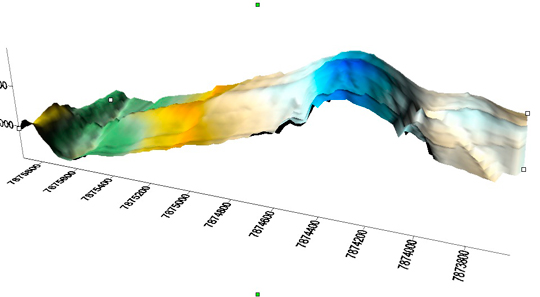
During his Research, Parkes mapped a major magnetic anomaly in Cleveland Bay. In 1770 Captain James Cook in the HMS Endeavour mapped the east Australian coast. Venturing into Cleveland bay, Cook noticed his compass behaving erratically, and named one island Magnetic Island. Today, a 3D surface model reveals a large magnetic anomaly heading across Cleveland Bay and straight towards Magnetic Island, 7 kilometers from Townsville. Experts who have examined the data believe that it is a naturally occurring magnetic anomaly about 800 meters wide. “It would appear that Captain James Cook was indeed a very capable navigator and cartographer,” Parkes said.
Across transportation, agriculture, industry, commerce, and finance, GPS has replaced earlier technologies, opened up innovative applications, and led to new ways of doing old things. GPS now plays a key role in the critical infrastructures of all industrialized nations, from the most sophisticated telecommunications system to the production of a simple loaf of bread.
Wheat is the world’s second staple food, and bread its main product. Bakers have been around for 30,000 years. GPS, among its manifold other duties, now also helps bring us our breakfast toast and midday sandwich.
British farmers sow 2 million hectares (5 million acres) of wheat per year, harvest 8 tonnes per hectare (3.6 U.S. tons per acre) and sell it at £150 a tonne ($214 per U.S. ton), making their harvest worth £2.5 billion ($3.9 billion). Nearly a billion pounds-worth ($1.6 billion) goes to make bread.
We use Britain as an example because we are British, but this same truth holds, at much grander scale, when you consider the United States, Russia, and many other European nations.
A vital value chain wends its way from farm to mill to bakery to store to home: in the UK, 99 percent of households buy bread, 99 percent of which is made in this country, 80 percent of it from domestic flour. This relatively closed value chain lets us see how GPS is used, and that its loss would increase the price of a loaf and translate into inflation.
GPS serves as the basis of the precision agriculture, cutting fuel costs and enabling selective and variable rate optimized application of fertilizers. It lets farmers use less manpower, reduces soil compaction, and even minimizes operator fatigue. Farmers now spend much more time on yield monitoring and within-paddock zone management than leaning on gates chewing straws. Though the capital cost of precision agriculture is high, the annual benefits are comparable with the investment. Losing GPS-based precision agriculture would increase the price of bread by at least 2 percent.
Transport logistics is the glue that joins our value chain together. GPS in fleet management optimizes routings, accelerates dispatching, prevents theft, improves driver behavior, and delivers fuel efficiencies. Loss of GPS in the transport links in our chain would increase fuel costs alone by 13 percent.
On top of all this, GPS is the ultimate source of precision timing supporting telecommunications links at every stage of the value chain, from wheat futures trading and banking transactions to voice, data, and Internet traffic.
The sudden loss of GPS in farming, transportation, communications, business management, and retail distribution, would substantially raise the price of bread, hit every household, and impact the national economy.
What applies to a traditional and at first glance low-technology product like bread applies across the board. The recent report on GNSS vulnerabilities by the Royal Academy of Engineering says that GPS and other satellite navigation services have applications so pervasive that there is now a real threat to global security if the systems should fail — or be interfered with. The signals are used by almost every industry: rail, road, aviation, space, maritime, agriculture, energy, surveying, construction, law enforcement and communications.
Dependence on GNSS connects many otherwise independent services into a so-called accidental system — with a single point of failure, the satellite signal. And a satellite signal, says the report, is a weak foundation for important services, since it can fail in dozens of ways.
GPS is no longer the only GNSS, of course, as many nations, recognizing its political and economic value, have developed their own systems, and augmentations to enhance accuracy and integrity. Over the next few years, the number of navigation satellites may approach 150. This will help reduce vulnerability to the loss of GPS and so will be a benefit in the short term.
But the long term is a very different matter. All these systems now use, or shortly will use, essentially the same technology. And, crucially, the same radio frequency bands.
In those frequency bands, GNSS is threatened by rising levels of radio interference. This threat has several strands that are being recognized separately and handled individually, but which taken together will determine the future of GNSS.
We face a Triple Whammy!
The First Threat
The first component of the Triple Whammy comes from the new satellite systems themselves. Each satellite transmitting in the GPS frequency band increases the noise level there. Satellite navigation receivers must find and lock onto the extremely weak signal that reaches the Earth, digging it out from the background noise of the cosmos. And the other GPS satellites add to the noise level.
Günther Hein of the European Space Agency shows this remarkable diagram (Figure 1): as the number of systems increases and the number of satellites heads for that 150, up rises the noise they make, the blue-green line. More than about 70 of them, and satellite noise exceeds the cosmic noise floor in red and becomes the main source of noise. The more satellites, the worse the reception as GNSS interferes with itself. Too many satellites, and you’d pick up none at all! The first threat of the triple whammy is self-inflicted.
Chart: David Last and Sally Basker
Figure 1. The first threat of the Triple Whammy: new satellite systems. Source: Günther Hein.
The Second Threat
Conflicts between nations as their new GNSSs compete for radio spectrum also threaten GNSS viability.
The frequency bands available to satellite navigation are essentially L2, L5, and the principal one we use currently, L1. On L1, the European Galileo system and the Chinese Compass system occupy the same areas. Now, that’s very desirable if the two systems are to share receivers. But they also compete for that spectrum, and there is conflict between Compass and Galileo.
This battle for spectrum is a highly complex engineering problem. But chiefly, the spectrum wars are political, even emotional.
Chinese satellites fly across American skies broadcasting signals that interfere with European receivers. Spectrum wars have everything to do with relationships between nations and little to do with battles between engineers. They are developing into a classic tragedy of the commons: a situation in which self-interest determines how a limited resource — here the radio spectrum — is to be shared in a regime in which regulation is weak. The International Telecommunication Union sets standards and registers claims. The UN Office for Outer Space Affairs seeks to mediate. But neither is a policeman; sovereign governments may sometimes be penniless, but they are very powerful.
The second threat of the Triple Whammy is also self-inflicted.
The Third Threat
Communications systems compete with GNSS for spectrum: witness the current LightSquared case of a powerful new broadband system. For existing receivers, including those in government systems and aviation, it seems there is no fix for its devastating interference. LightSquared is driven by rich and powerful commercial forces; it could well win this fight.
Communication technologies will continue to press upon the satellite navigation spectrum. LightSquared will likely erode spectrum gaps between communications and navigation services, the so-called guard bands.
Satellite navigation has become highly political. The intense use of GNSS across our economies makes them vulnerable. GNSS is threatened by a Triple Whammy, by jamming, and by spoofing. These increase the risks to our security and our economies, both in probability and impact. The solution of detecting jammers and making ownership illegal will help with local problems in local areas. But the Triple Whammy threats are not local; they are national and international, world-wide.
Today’s spectrum wars affect us all. That the loss of GPS would increase the price of a loaf — the very trigger for the French Revolution — brings this down to earth.
These are not technical issues, they determine the price of our food! They constitute a real and present danger to our societies — down to the mundane yet very real level of our daily bread.
David Last is a past-president of the Royal Institute of Navigation, a consultant and expert witness on radio-navigation and communications systems to companies, governmental and international organizations, and criminal investigators.
Sally Basker, former director of research and radionavigation at the General Lighthouse Authorities of the UK and Ireland, has opened Traxis Ltd: management, business, and technology advice with expertise in navigation service provision. See www.traxis.co.uk.
This article is adapted from a presentation at the European Navigation Conference, London, November 2011. A longer version of the talk appears in the Royal institute of Navigation News.
GALILEO PROTOFLIGHTMODEL satellite began transmitting E1 and E5 signals in early December. ESA reports them well within power and shape specifications, and suited for interoperability with GPS.
The Galileo ProtoFlightModel (PFM) in-orbit validation (IOV) satellite GSAT0101 began transmitting E1 signals on December 10 using the E11 ranging code, and E5 signals early on December 14. Launched at the same time, Flight Model 2 (FM2), GSAT0102, has not yet started transmitting navigation signals. Several companies and laboratories around the world immediately began processing the PFM signals. This story briefly aggregates their reports.
The European Space Agency (ESA) proudly released a statement: “Europe’s Galileo system has passed its latest milestone, transmitting its very first test navigation signal back to Earth. [. . . . ] The turn of Galileo’s main L-band (1200-1600 MHz) antenna came on the early morning of Saturday 10 December. A test signal was transmitted by the first Galileo satellite in the E1 band, which will be used for Galileo’s Open Service once the system begins operating in 2014. [. . . . ]
“The signal power and shape was well within specifications. The shape is especially important because its modulation is carefully designed to enable interoperability with the L1 band of U.S. GPS navigation satellites: Galileo and GPS can indeed work together as planned.
“The test campaign is concentrating on the first satellite for the reminder of the year, with the focus moving to the second Galileo satellite from the start of 2012. The plan is to complete In-Orbit Testing by next spring.
“The next pair of Galileo In-Orbit Validation satellites will also be launched next year, to form the operational nucleus of the full Galileo constellation. Meanwhile the next batch of Galileo satellites are currently being manufactured for launch in 2014.”
Thales Avionics. Thales Avionics has developed a Galileo receiver capable of processing the Open Service, Commercial Service, and Safety of Life service of the Galileo constellation.
Figure 1 shows a screenshot of the Thales Avionics receiver interface program, highlighting the L1 signal energy (top right) and the pilot secondary code (bottom). The satellite Doppler and C/N0 values have been recorded and are provided in Figure 2.
Figure 1. Screen of Thales Avionics receiver interface highlighting L1 signal energy (top right) and the pilot secondary code (bottom). (Click to enlarge).
Figure 2. Satellite doppler and C/N0 values from the Thales Avionics receiver.
Thales has developed a coherent processing of the Galileo E5 AltBOC(15,10) signal compatible with hardware architecture designed for independent processing of both E5a and E5b. This processing is fully compatible with the mismatch between the two RF channels on E5a and E5b, thanks to real-time calibration based on satellite signals. This processing only requires software implementation, without additional recurrent costs. The technique is relevant for future receivers operating in the E5 band, in order to significantly enhance the accuracy, with respect to thermal noise and multi-path, and to improve the cycle slip probability.
CONGO. Several COoperative Network for GIOVE Observation (CONGO) stations, including one at the University of New Brunswick, are tracking both the E1 and E5 signals. Figure 3 shows C/N0 values collected at UNB.
Figure 3. C/N0 values in dB-Hz of PFM 1-Hz data collected at the University of New Brunswick, on December 10. Time axis runs for 24 hours starting at 01:00 UTC. Receiver is a Javad Delta-G2T. JAVAD GNSS. On December 12, JAVAD GNSS announced that it has tracked the Galileo in-orbit validation satellite, temporarily designated PRN-11.
“An important point is that we tracked it with our units that are already in the market,” said Javad Ashjaee, CEO. “This is not a lab tests. Our customers can track it too.”
Figure 4 shows the company’s tracking results of PRN-11: plots of pseudorange (in chips), doppler (in Hz), and SNR (relative number).
Figure 4. JAVAD GNSS tracking results of Galileo PRN-11 for now, plots of pseudorange (in chips), doppler (in Hz), and SNR (relative number).
Calgary PLAN Group. The University of Calgary sent a detailed report. (See Figure 5 and next item.)
Figure 5. Raw correlator values for the E1 B/C, E5aI/Q and E5bI/Q signals. The bit periods can be clearly seen on E1B, E5aI and E5bI. The secondary code can be observed on E1C while the pilot signal can be seen on singals E5aQ and E5bQ. (From the Calgary Report.)
Galileo E1 and E5: the Calgary Report
By James T. Curran and Aiden Morrison
Researchers in the Position, Location and Navigation (PLAN) Group at the University of Calgary recorded E1 and E5 data using a single dual-channel front-end and subsequently acquired and tracked E1 B/C, E5a and E5b signals in the early morning of December 15.
Using a dual channel front-end designed in-house, a Novatel GPS-703-GGG antenna and a laptop computer, IF data was collected to examine these new signals. This data was processed by GSNRx, a reconfigurable a multi-system, multi-frequency software receiver developed by the PLAN Group.
At approximately 03:20 MST (UTC – 7:00) more than 20 GNSS satellites were visible from a rooftop mounted antenna. Having reconfigured the front-end to accommodate the E5 band, IF data was collected which included Galileo E1 B/C and E5 A/B, GIOVE-B E1 B/C and E5a, GPS L1 C/A and L5, and GLONASS L1 C/A. Following some last-minute modifications to GSNRx to include the Galileo E5b signals, the samples were processed, simultaneously tracking GPS and Galileo on both the L1/E1 and L5/E5 frequencies and GLONASS on L1.
A subset of the raw correlator values for the E1 B, E1 C, E5a I and E5a Q signals are shown in Figure 5 above. Note that the E1 C values have been offset by -2.0×10⁵ for clarity. A data-rate of 250 symbol/s is clearly visible on the E1 B and E5b signals while a 50 symbol/s stream can be observed on the E5a I signal. The 25 chip secondary code is also evident on E1 C at a rate of 250 chip/s.
All six components of the Galileo-PFM signals shown above (transmitted on PRN 11) were tracked independently and their signal modulations were found to agree with the Galileo Open Service ICD. A trace of the measured carrier-to-noise floor ratios for the Galileo signals is shown in Figure 6. As indicated by the ICD, the E5b signals were observed at 2 dB lower power than the E1 B and C signals. The E5a signals, however, were expected to be received at the same power as E5b and yet were observed at approximately 4 dB lower power. This is believed to be a combination of the antenna and IF filtering within the front-end as the E5a center frequency is located relatively near the pass-band edge of both. This front-end was initially designed for 40 MHz bandwidth, but used in this experiment at 50 MHz, as will be discussed later.
Figure 6. C/N0 for Galileo-PFM signals.
The software receiver was once again reconfigured, this time to produce signal correlator values spaced along a delay of approximately 700 m and 70 m for the E1 A/B and E5 A/B signals, respectively, such that the cross-correlation of the received and local-replica PRN sequences could be examined. The signals were tracked for 10 seconds and the 1 ms correlator values averaged, to produce estimates of the code cross-correlation function. The characteristic ripple of the CBOC modulation on E1 B/C can be seen in Figure 7 (left), particularly on the right-most ascending feature of the envelope. Likewise, the alt-BOC cross-correlation of E5a Q in Figure 7 (right) is as expected. It is noted that the E5a I signal has suffered some distortion due to the filtering effects mentioned above.
Figure 7. Measured cross-correlation functions for the Galileo PFM E1 B and C signals (left) and E5a I and E5b I signals (right).
For details of the PLAN group’s front-end, a flexible GNSS signal capture tool, and other specifics on the process employed, see the full-length article.
GPS III Testbed Sat Delivered
Lockheed Martin delivered the the GPS III Non-Flight Satellite Testbed (GNST), the program’s pathfinder spacecraft, to its Denver-area facility. The pathfinder will now undergo final assembly, integration, and test activities.
The GNST is a full-sized, flight equivalent prototype of a GPS III satellite used to identify and solve development issues prior to integration and test of the first space vehicle. According to the company, the approach reduces risk, improves production predictability, increases mission assurance and lowers overall program costs. In Denver, the GNST will be mated with its core structure, navigation payload, and antenna elements before completing pathfinding activities and checkout of environmental test facilities. The GNST will then be shipped to Cape Canaveral Air Force Station, Fla., for pathfinding activities at the launch site.
GPS III satellites, when launched as scheduled to being in 2014, will replace aging on-orbit GPS satellites to deliver better accuracy and improved anti-jamming power, while enhancing spacecraft design life and adding a new civil signal designed to be interoperable with international global navigation satellite systems.
In parallel with the GNST, progress on the first space vehicle is progressing on schedule. Lockheed Martin received the core structure for the first GPS III satellite in Stennis, Mississippi, on August 4, and is now integrating the space vehicle’s flight propulsion subsystem. The integrated core propulsion module will be shipped to the GPF in the summer of 2012 and will then undergo final assembly, integration and test in order to meet its planned 2014 launch.
The GPS III team is led by the GPS Directorate at the U.S. Air Force Space and Missile Systems Center. Lockheed Martin is the GPS III prime contractor with teammates ITT, General Dynamics, Infinity Systems Engineering, Honeywell, ATK and other subcontractors.
Drone Downed
Press reports speculate that GPS spoofing was used to get the RQ-170 Sentinel Drone to land in Iran. According to an Iranian engineer quoted in a Christian Science Monitor story, “By putting noise [jamming] on the communications, you force the bird into autopilot. This is where the bird loses its brain.” At that point, the drone relies on GPS signals to get home. By spoofing GPS, Iranian engineers were able to get the drone to “land on its own where we wanted it to, without having to crack the remote-control signals and communications.”
“The GPS navigation is the weakest point,” the Iranian engineer told the Monitor, giving a detailed description of Iran’s electronic ambush of the highly classified pilotless aircraft.
In 2011, the U.S. Air Force awarded two $47 million contracts to BAE Systems and Northrop Grumman for development of a navigation warfare sensor to replace military GPS receivers on aircraft and missiles, and designed to maintain freedom of action under extreme GPS countermeasures.
GLONASS Fully Operational
For the first time in more than 15 years, GLONASS is fully operational, with 24 satellites in their designated orbital slots, set healthy, and providing world coverage.
GLONASS 744, an M-class satellite and one of three launched from Baikonur on 4 November, was set healthy December 8, bringing the number of healthy operating satellites to the full complement of 24.
GLONASS briefly achieved a 24-satellite constellation in early 1996 but it degraded rapidly due to Russia’s economic difficulties following the break-up of the Soviet Union coupled with the short lifetime of the GLONASS satellites. Since 2002, the GLONASS constellation has slowly but surely been rebuilt with the Russian government’s commitment to provide a global positioning and navigation system comparable to that of GPS.
Luch SBAS. Roscosmos also launched the Luch-5A geostationary relay satellite on December 11.
Luch-5A is the first in a series of new data relay satellites designed to rebuild the Luch Multifunctional Space Relay System, which had ceased operating by 1998. Among other functions, 5A hosts a wideband satellite-based augmentation system (SBAS) transponder.
The SBAS transponder will transmit correction and integrity data for GLONASS and GPS on the GPS L1 frequency with a C/A pseudorandom noise code to be assigned by the GPS Directorate. The data will be provided by the System for Differential Correction and Monitoring or SDCM, which uses a ground network of monitoring stations on Russian territory as well as some overseas stations.
As the SDCM primary service area is Russian territory, the main lobe of the SBAS antenna beam will be directed to the north with an angle of 7 degrees relative to the direction to the equator. Transmitted power of 60 watts will give a signal power level at Earth’s surface roughly equal to that of GLONASS and GPS signals, about –158 dBW.
The current international SBAS data format has a limited capability for broadcasting corrections for both GLONASS and GPS satellites combined. There is space for only 51 satellites, insufficient for the current number of satellites on orbit. As a result, studies are being carried out in an attempt to resolve this problem. One option is to use a dynamic satellite mask, where an SDCM satellite would only broadcast corrections and integrity data for those GLONASS and GPS satellites in view of users in the territory of the Russian Federation.
Luch-5A is the first of three MSRS/SDCM satellites. Luch-5B will be launched in 2012 into a slot at 95 degrees east longitude and Luch-4, in 2014, into a slot at 167 degrees east longitude.
Beidou Launch Fills Regional Nav System
The Beidou-2/Compass IGSO-5 (fifth inclined geosynchonous orbit) satellite was launched on December. According to a Chinese government announcement, this launch completes the construction of the basic regional navigation system for service to China and will be operational by the end of the year. However, completion of the Phase II development, to provide service to the Asia/Pacific region, will require further satellite launches in 2012. Phase III global coverage, with a 30-satellite system, will be achieved by 2020 according to the Beidou website.
The GNSS community outside China still awaits a Compass interface control document (ICD), which has been promised by the end of 2012.
LightSquared Incompatibility Declared
U.S. government tests conducted in November showed that 75 percent of GPS receivers examined were interfered with at a distance of 100 meters from a LightSquared (LS)base station. The report states that “No additional testing is required to confirm harmful interference exists,” and “Immediate use of satellite service spectrum for terrestrial service not viable because of system engineering and integration challenges.”
The tests showed interference by the LS Low 10 terrestrial signal with an overwhelming majority of general-purpose GPS receivers. Data from LS handsets was collected, analysis is underway, but no results were given. Wideband and military receivers were tested, but neither specifications nor results were presented; a classified session was convened for that purpose.
Of the 92 receivers for which full data sets were compiled, 75 percent of them failed a 1db test, showing harmful interference at 100 meters from a LS base station. These 69 receivers failed at a broadcast level of around -15dBm from the LS transmitter.
In a December 7 filing with the FCC, LightSquared further revised its public plans to say that it would “limit its power on the ground when transmitting in the lower 10 MHz from 1526-1536 MHz to no more than –30 dBm until January 1, 2015, –27 dBm until January 1, 2017, and –24 dBm thereafter.” According to test data, at –30 dBm, approximately 17 percent of GPS receivers would be disrupted; at –27 dBm, 25 percent; at –24 dBm, 36 percent. Proceeding with this scenario would require the assumption that the FCC, or indeed anyone, believes anything that LightSquared says at any given instant, for any given duration.
By Kyle Wesson, Daniel Shepard, and Todd Humphreys
Disruption created by intentional generation of fake GPS signals could have serious economic consequences. This article discusses how typical civil GPS receivers respond to an advanced civil GPS spoofing attack, and four techniques to counter such attacks: spread-spectrum security codes, navigation message authentication, dual-receiver correlation of military signals, and vestigial signal defense. Unfortunately, any kind of anti-spoofing, however necessary, is a tough sell.
GPS spoofing has become a hot topic. At the 2011 Institute of Navigation (ION) GNSS conference, 18 papers discussed spoofing, compared with the same number over the past decade. ION-GNSS also featured its first panel session on anti-spoofing, called “Improving Security of GNSS Receivers,” which offered six security experts a forum to debate the most promising anti-spoofing technologies.
The spoofing threat has also drawn renewed U.S. government scrutiny since the initial findings of the 2001 Volpe Report. In November 2010, the U.S. Position Navigation and Timing National Executive Committee requested that the U.S. Department of Homeland Security (DHS) conduct a comprehensive risk assessment on the use of civil GPS. In February 2011, the DHS Homeland Infrastructure Threat and Risk Analysis Center began its investigation in conjunction with subject-matter experts in academia, finance, power, and telecommunications, among others. Their findings will be summarized in two forthcoming reports, one on the spoofing and jamming threat and the other on possible mitigation techniques. The reports are anticipated to show that GPS disruption due to spoofing or jamming could have serious economic consequences.
Effective techniques exist to defend receivers against spoofing attacks. This article summarizes state-of-the-art anti-spoofing techniques and suggests a path forward to equip civil GPS receivers with these defenses. We start with an analysis of a typical civil GPS receiver’s response to our laboratory’s powerful spoofing device. This will illustrate the range of freedom a spoofer has when commandeering a victim receiver’s tracking loops. We will then provide an overview of promising cryptographic and non-cryptographic anti-spoofing techniques and highlight the obstacles that impede their widespread adoption.
The Spoofing Threat
Spoofing is the transmission of matched-GPS-signal-structure interference in an attempt to commandeer the tracking loops of a victim receiver and thereby manipulate the receiver’s timing or navigation solution. A spoofer can transmit its counterfeit signals from a stand-off distance of several hundred meters or it can be co-located with its victim.
Spoofing attacks can be classified as simple, intermediate, or sophisticated in terms of their effectiveness and subtlety. In 2003, the Vulnerability Assessment Team at Argonne National Laboratory carried off a successful simple attack in which they programmed a GPS signal simulator to broadcast high-powered counterfeit GPS signals toward a victim receiver. Although such a simple attack is easy to mount, the equipment is expensive, and the attack is readily detected because the counterfeit signals are not synchronized to their authentic counterparts.
In an intermediate spoofing attack, a spoofer synchronizes its counterfeit signals with the authentic GPS signals so they are code-phase-aligned at the target receiver. This method requires a spoofer to determine the position and velocity of the victim receiver, but it affords the spoofer a serious advantage: the attack is difficult to detect and mitigate.
The sophisticated attack involves a network of coordinated intermediate-type spoofers that replicate not only the content and mutual alignment of visible GPS signals but also their spatial distribution, thus fooling even multi-antenna spoofing defenses.
Table 1. Comparison of anti-spoofing techniques discussed in this article.
Lab Attack. So far, no open literature has reported development or research into the sophisticated attack. This is likely because of the success of the intermediate-type attack: to date, no civil GPS receiver tested in our laboratory has fended off an intermediate-type spoofing attack. The spoofing attacks, which are always conducted via coaxial cable or in radio-frequency test enclosures, are performed with our laboratory’s receiver-spoofer, an advanced version of the one introduced at the 2008 ION-GNSS conference (see “Assessing the Spoofing Threat,” GPS World, January 2009).
To commence the attack, the spoofer transmits its counterfeit signals in code-phase alignment with the authentic signals but at power level below the noise floor. The spoofer then increases the power of the spoofed signals so that they are slightly greater than the power of the authentic signals. At this point, the spoofer has taken control of the victim receiver’s tracking loops and can slowly lead the spoofed signals away from the authentic signals, carrying the receiver’s tracking loops with it. Once the spoofed signals have moved more than 600 meters in position or 2 microseconds in time away from the authentic signals, the receiver can be considered completely owned by the spoofer.
Spoofing testbed at the University of Texas Radionavigation Laboratory, an advanced and powerful suite for anti-spoofing research. On the right are several of the civil GPS receivers tested and the radio-frequency test enclosure, and on the left are the phasor measurement unit and the civil GPS spoofer.
Although our spoofer fooled all of the receivers tested in our laboratory, there are significant differences between receivers’ dynamic responses to spoofing attacks. It is important to understand the types of dynamics that a spoofer can induce in a target receiver to gain insight into the actual dangers that a spoofing attack poses rather than rely on unrealistic assumptions or models of a spoofing attack. For example, a recent paper on time-stamp manipulation of the U.S. power grid assumed that there was no limit to the rate of change that a spoofer could impose on a victim receiver’s position and timing solution, which led to unrealistic conclusions.
Experiments performed in our laboratory sought to answer three specific questions regarding spoofer-induced dynamics:
How quickly can a timing or position bias be introduced?
What kinds of oscillations can a spoofer cause in a receiver’s position and timing?
How different are receiver responses to spoofing?
These questions were answered by determining the maximum spoofer-induced pseudorange acceleration that can be used to reach a certain final velocity when starting from a velocity of zero, without raising any alarms or causing the target receiver to lose satellite lock. The curve in the velocity-acceleration plane created by connecting these points defines the upper bound of a region within which the spoofer can safely manipulate the target receiver. These data points can be obtained empirically and fit to an exponential curve. Alarms on the receiver may cause some deviations from this curve depending on the particular receiver.
Figure 1 shows an example of the velocity-acceleration curve for a high-quality handheld receiver, whose position and timing solution can be manipulated quite aggressively during a spoofing attack. These results suggest that the receiver’s robustness — its ability to provide navigation and timing solutions despite extreme signal dynamics — is actually a liability in regard to spoofing. The receiver’s ability to track high accelerations and velocities allows a spoofer to aggressively manipulate its navigation solution.
Figure 1. Theoretical and experimental test results for a high-quality handheld receiver’s dynamic response to a spoofing attack. Although not shown here, the maximum attainable velocity is around 1,300 meters/second.
The relative ease with which a spoofer can manipulate some GPS receivers suggests that GPS-dependent infrastructure is vulnerable. For example, the telecommunications network and the power grid both rely on GPS time-reference receivers for accurate timing. Our laboratory has performed tests on such receivers to determine the disruptions that a successful spoofing attack could cause. The remainder of this section highlights threats to these two sectors of critical national infrastructure.
Cell-Phone Vulnerability. Code division multiple access (CDMA) cell-phone towers rely on GPS timing for tower-to-tower synchronization. Synchronization prevents towers from interfering with one another and enables call hand-off between towers. If a particular tower’s time estimate deviates more than 10 microseconds from GPS time, hand-off to and from that tower is disrupted. Our tests indicate that a spoofer could induce a 10-microsecond time deviation within about 30 minutes for a typical CDMA tower setup. A spoofer, or spoofer network, could also cause multiple neighboring towers to interfere with one another. This is possible because CDMA cell-phone towers all use the same spreading code and distinguish themselves only by the phasing (that is, time offset) of their spreading codes. Furthermore, it appears that a spoofer could impair CDMA-based E911 user-location.
Power-Grid Vulnerability. Like the cellular network, the power grid of the future will rely on accurate GPS time-stamps. The efficiency of power distribution across the grid can be improved with real-time measurements of the voltage and current phasors. Phasor measurement units (PMUs) have been proposed as a smart-grid technology for precisely this purpose. PMUs rely on GPS to time-stamp their measurements, which are sent back to a central monitoring station for processing. Currently, PMUs are used for closed-loop grid control in only a few applications, but power-grid modernization efforts will likely rely more heavily on PMUs for control. If a spoofer manipulates a PMU’s time stamps, it could cause spurious variations in measured phase angles. These variations could distort power flow or stability estimates in such a way that grid operators would take incorrect or unnecessary control actions including powering up or shutting down generators, potentially causing blackouts or damage to power-grid equipment.
Under normal circumstances, a changing separation in the phase angle between two PMUs indicates changes in power flow between the regions measured by each PMU. Tests demonstrate that a spoofer could cause variations in a PMU’s measured voltage phase angle at a rate of 1.73 degrees per minute. Thus, a spoofing attack could create the false indications of power flow across the grid. The tests results also reveal, however, that it is impossible for a spoofer to cause changes in small-signal grid stability estimates, which would require the spoofer to induce rapid (for example, 0.1–3 Hz) microsecond-amplitude oscillations in timing. Such oscillations correspond to spoofing dynamics well outside the region of freedom of all receivers we have tested. A spoofer might also be able to affect fault-location estimates obtained through time-difference-of-arrival techniques using PMU measurements. This could cause large errors in fault-location estimates and hamper repair efforts.
What Can Be Done? Despite the success of the intermediate-type spoofing attack against a wide variety of civil GPS receivers and the known vulnerabilities of GPS-dependent critical infrastructure to spoofing attacks, anti-spoofing techniques exist that would enable receivers to successfully defend themselves against such attacks. We now turn to four promising anti-spoofing techniques.
Cryptographic Methods
These techniques enable a receiver to differentiate authentic GPS signals from counterfeit signals with high likelihood. Cryptographic strategies rely on the unpredictability of so-called security codes that modulate the GPS signal. An unpredictable code forces a spoofer who wishes to mount a successful spoofing attack to either
estimate the unpredictable chips on-the-fly, or
record and play back authentic GPS spectrum (a meaconing attack).
To avoid unrealistic expectations, it should be noted that no anti-spoofing technique is completely impervious to spoofing. GPS signal authentication is inherently probabilistic, even when rooted in cryptography. Many separate detectors and cross-checks, each with its own probability of false alarm, are involved in cryptographic spoofing detection. Figure 2 illustrates how the jammer-to-noise ratio detector, timing consistency check, security-code estimation and replay attack (SCER) detector, and cryptographic verification block all work together. This hybrid combination of statistical hypothesis tests and Boolean logic demonstrates the complexities and subtleties behind a comprehensive, probabilistic GPS signal authentication strategy for security-enhanced signals.
Figure 2. GNSS receiver components required for GNSS signal authentication. Components that support code origin authentication are outlined in bold and have a gray fill, whereas components that support code timing authentication are outlined in bold and have no fill. The schematic assumes a security code based on navigation message authentication.
Spread Spectrum Security Codes. In 2003, Logan Scott proposed a cryptographic anti-spoofing technique based on spread spectrum security codes (SSSCs). The most recent proposed version of this technique targets the L1C signal, which will be broadcast on GPS Block III satellites, because the L1C waveform is not yet finalized. Unpredictable SSSCs could be interleaved with the L1C spreading code on the L1C data channel, as illustrated in Figure 3. Since L1C acquisition and tracking occurs on the pilot channel, the presence of the SSSCs has negligible impact on receivers. Once tracking L1C, a receiver can predict when the next SSSC will be broadcast but not its exact sequence. Upon reception of an SSSC, the receiver stores the front-end samples corresponding to the SSSC interval in memory. Sometime later, the cryptographic digital key that generated the SSSC is transmitted over the navigation message. With knowledge of the digital key, the receiver generates a copy of the actual transmitted SSSC and correlates it with the previously-recorded digital samples. Spoofing is declared if the correlation power falls below a pre-determined threshold.
Figure 3. Placement of the periodically unpredictable spread spectrum security codes in the GPS L1C data channel spreading sequence.
When the security-code chip interval is short (high chipping rate), it is difficult for a spoofer to estimate and replay the security code in real time. Thus, the SSSC technique on L1C offers a strong spoofing defense since the L1C chipping rate is high (that is, 1.023 MChips/second). Furthermore, the SSSC technique does not rely on the receiver obtaining additional information from a side channel; all the relevant codes and keys are broadcast over the secured GPS signals. Of course a disadvantage for SSSC is that it requires a fairly fundamental change to the currently-proposed L1C definition: the L1C spreading codes must be altered.
Implementation of the SSSC technique faces long odds, partly because it is late in the L1C planning schedule to introduce a change to the spreading codes. Nonetheless, in September 2011, Logan Scott and Phillip Ward advocated for SSSC at the Public Interface Control Working Group meeting, passing the first of many wickets. The proposal and associated Request for Change document will now proceed to the Lower Level GPS Engineering Requirements Branch for further technical review. If approved there, it passes to the Joint Change Review Board for additional review and, if again approved, to the Technical Interchange Meeting for further consideration. The chances that the SSSC proposal will survive this gauntlet would be much improved if some government agency made a formal request to the GPS Directorate to include SSSCs in L1C — and provided the funding to do so. The DHS seems to us a logical sponsoring agency.
Navigation Message Authentication. If an L1C SSSC implementation proves unworkable, an alternative, less-invasive cryptographic authentication scheme based on navigation message authentication (NMA) represents a strong fall-back option. In the same 2003 ION-GNSS paper that he proposed SSSC, Logan Scott also proposed NMA. His paper was preceded by an internal study at MITRE and followed by other publications in the open literature, all of which found merit in the NMA approach. The NMA technique embeds public-key digital signatures into the flexible GPS civil navigation (CNAV) message, which offers a convenient conveyance for such signatures. The CNAV format was designed to be extensible so that new messages can be defined within the framework of the GPS Interference Specification (IS). The current GPS IS defines only 15 of 64 CNAV messages, reserving the undefined 49 CNAV messages for future use.
Our lab recently demonstrated that NMA works to authenticate not only the navigation message but also the underlying signal. In other words, NMA can be the basis of comprehensive signal authentication. We have proposed a specific implementation of NMA that is packaged for immediate adoption. Our proposal defines two new CNAV messages that deliver a standardized public-key elliptic-curve digital algorithm (ECDSA) signature via the message format in Figure 4.
Figure 4. Format of the proposed CNAV ECDSA signature message, which delivers the first or second half of the 466-bit ECDSA signature and a 5-bit salt in the 238-bit payload field.
Although the CNAV message format is flexible, it is not without constraints. The shortest block of data in which a complete signature can be embedded is a 96-second signature block such as the one shown in Figure 5. In this structure, the two CNAV signature messages are interleaved between the ephemeris and clock data to meet the broadcast requirements.
Figure 5. The shortest broadcast signature block that does not violate the CNAV ephemeris and timing broadcast requirements. To meet the required broadcast interval of 48 seconds for message types 10, 11, and one of 30–39, the ECDSA signature is broadcast over a 96-second signature block that is composed of eight CNAV messages.
The choice of the duration between signature blocks is a tradeoff between offering frequent authentication and maintaining a low percentage of the CNAV message reserved for the digital signature. In our proposal, signature blocks are transmitted roughly every five minutes (Figure 6) so that only 7.5 percent of the navigation message is devoted to the digital signature. Across the GPS constellation, the signature block could be offset so that a receiver could authenticate at least one channel approximately every 30 seconds. Like SSSC, our proposed version of NMA does not require a receiver’s getting additional information from a side channel, provided the receiver obtains public key updates on a yearly basis.
Figure 6. A signed 336-second broadcast. The proposed strategy signs every 28 CNAV messages with a signature broadcast over two CNAV messages on each broadcast channel.
NMA is inherently less secure than SSSC. A NMA security code chip interval (that is, 20 milliseconds) is longer than a SSSC chip interval, thereby allowing the spoofer more time to estimate the digital signature on-the-fly. That is not to say, however, that NMA is ineffective. In fact, tests with our laboratory’s spoofing testbed demonstrated the NMA-based signal authentication structure described earlier offered a receiver a better-than 95 percent probability of detecting a spoofing attack for a 0.01 percent probability of false alarm under a challenging spoofing-attack scenario.
NMA is best viewed as a hedge. If the SSSC approach does not gain traction, then NMA might, since it only requires defining two new CNAV messages in the GPS IS — a relatively minor modification. CNAV-based NMA could defend receivers tracking L2C and L5. A new CNAV2 message will eventually be broadcast on L1 via L1C, so a repackaged CNAV2-based NMA technique could offer even single-frequency L1 receivers a signal-side anti-spoofing defense.
P(Y) Code Dual-Receiver Correlation. This approach avoids entirely the issue of GPS IS modifications. The technique correlates the unknown encrypted military P(Y) code between two civil GPS receivers, exploiting known carrier-phase and code-phase relationships. It is similar to the dual-frequency codeless and semi-codeless techniques that civil GPS receivers apply to track the P(Y) code on L2. Peter Levin and others filed a patent on the codeless-based signal authentication technique in 2008; Mark Psiaki extended the approach to semicodeless correlation and narrow-band receivers in a 2011 ION-GNSS paper.
In the dual-receiver technique, one receiver, stationed in a secure location, tracks the authentic L1 C/A codes while receiving the encrypted P(Y) code. The secure receiver exploits the known timing and phase relationships between the C/A code and P(Y) code to isolate the P(Y) code, of which it sends raw samples (codeless technique) or estimates of the encrypting W-code chips (semi-codeless technique) over a secure network to the defending receiver. The defending receiver correlates its locally-extracted P(Y) with the samples or W-code estimates from the secure receiver. If a spoofing attack is underway, the correlation power will drop below a statistical threshold, thereby causing the defending receiver to declare a spoofing attack. Although the P(Y) code is 20 MHz wide, a narrowband civil GPS receiver with 2.6 MHz bandwidth can still perform the statistical hypothesis tests even with the resulting 5.5 dB attenuation of the P(Y) code. Because the dual-receiver method can run continuously in the background as part of a receiver’s standard GPS signal processing, it can declare a spoofing attack within seconds — a valuable feature for many applications.
Two considerations about the dual-receiver technique are worth noting. First, the secure receiver must be protected from spoofing for the technique to succeed. Second, the technique requires a secure communication link between the two receivers. Although the first requirement is easily achieved by locating secure receivers in secure locations, the second requirement makes the technique impractical for some applications that cannot support a continuous communication link.
Of all the proposed cryptographic anti-spoofing techniques, only the dual-receiver method could be implemented today. Unfortunately the P(Y) code will no longer exist after 2021, meaning that systems that make use of the P(Y)-based dual-receiver technique will be rendered unprotected, although a similar M-code-based technique could be an effective replacement. The dual-receiver method, therefore, is best thought of as a stop-gap: it can provide civil GPS receivers with an effective anti-spoofing technique today until a signal-side civil GPS authentication technique is approved and implemented in the future This sentiment was the consensus of the panel experts at the 2011 ION-GNSS session on civil GPS receiver security.
Non-Cryptographic Methods
Non-cryptographic techniques are enticing because they can be made receiver-autonomous, requiring neither security-enhanced civil GPS signals nor a side-channel communication link. The literature contains a number of proposed non-cryptographic anti-spoofing techniques. Frequently, however, these techniques rely on additional hardware, such as accelerometers or inertial measurements units, which may exceed the cost, size, or weight requirements in many applications. This motivates research to develop software-based, receiver-autonomous anti-spoofing methods.
Vestigial Signal Defense (VSD). This software-based, receiver-autonomous anti-spoofing technique relies on the difficulty of suppressing the true GPS signal during a spoofing attack. Unless the spoofer generates a phase-aligned nulling signal at the phase center of the victim GPS receiver’s antenna, a vestige of the authentic signal remains and manifests as a distortion of the complex correlation function. VSD monitors distortion in the complex correlation domain to determine if a spoofing attack is underway.
To be an effective defense, the VSD must overcome a significant challenge: it must distinguish between spoofing and multipath. The interaction of the authentic and spoofed GPS signals is similar to the interaction of direct-path and multipath GPS signals. Our most recent work on the VSD suggests that differentiating spoofing from multipath is enough of a challenge that the goal of the VSD should only be to reduce the degrees-of-freedom available to a spoofer, forcing the spoofer to act in a way that makes the spoofing signal or vestige of the authentic GPS signal mimic multipath. In other words, the VSD seeks to corner the spoofer and reduce its space of possible dynamics.
Among other options, two potential effective VSD techniques are
a maximum-likelihood bistatic-radar-based approach and
a phase-pseudorange consistency check.
The first approach examines the spatial and temporal consistency of the received signals to detect inconsistencies between the instantaneous received multipath and the typical multipath background environment. The second approach, which is similar to receiver autonomous integrity monitoring (RAIM) techniques, monitors phase and pseudorange observables to detect inconsistencies potentially caused by spoofing. Again, a spoofer can act like multipath to avoid detection, but this means that the VSD would have achieved its modest goal.
Anti-Spoofing Reality Check
Security is a tough sell. Although promising anti-spoofing techniques exist, the reality is that no anti-spoofing techniques currently defend civil GPS receivers. All anti-spoofing techniques face hurdles. A primary challenge for any technique that proposes modifying current or proposed GPS signals is the tremendous inertia behind GPS signal definitions. Given the several review boards whose approval an SSSC or NMA approach would have to gain, the most feasible near-term cryptographic anti-spoofing technique is the dual-receiver method. A receiver-autonomous, non-cryptographic approach, such as the VSD, also warrants further development. But ultimately, the SSSC or NMA techniques should be implemented: a signal-side civil GPS cryptographic anti-spoofing technique would be of great benefit in protecting civil GPS receivers from spoofing attacks.
Manufacturers
The high-quality handheld receiver cited in Figure 1 was a Trimble Juno SB. Testbed equipment shown: Schweitzer Engineering Laboratories SEL-421 synchrophasor measurement unit; Ramsey STE 3000 radio-frequency test chamber; Ettus Research USRP N200 universal software radio peripheral; Schweitzer SEL-2401 satellite-synchronized clock (blue); Trimble Resolution SMT receiver (silver); HP GPS time and frequency reference receiver.
Full results of Figure 1 experiment are given in Shepard, D.P. and T.E. Humphreys, “Characterization of Receiver Response to Spoofing Attacks,” Proceedings of ION-GNSS 2011.
NMA can be the basis of comprehensive signal authentication: Wesson, K.D., M. Rothlisberger, T. E. Humphreys (2011), “Practical cryptographic civil GPS signal authentication,” Navigation, Journal of the ION, submitted for review.
Kyle Wesson is pursuing his M.S. and Ph.D. degrees in electrical and computer engineering at the University of Texas at Austin. He is a member of the Radionavigation Laboratory. He received his B.S. from Cornell University.
Daniel Shepard is pursuing his M.S. and Ph.D. degrees in aerospace engineering at the University of Texas at Austin, where he also received his B.S. He is a member of the Radionavigation Laboratory.
Todd Humphreys is an assistant professor in the department of Aerospace Engineering and Engineering Mechanics at the University of Texas at Austin and director of the Radionavigation Laboratory. He received a Ph.D. in aerospace engineering from Cornell University.