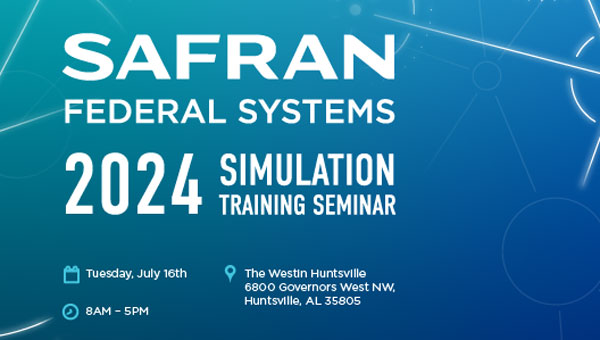
Safran Federal Systems will host a simulation training seminar on July 16, 2024, at The Westin Huntsville in Huntsville, Alabama.
Attendees are invited to engage in interactive training and hands-on sessions guided by experts for PNT and NAVWAR simulation using Safran Federal’s BroadSim and Skydel software.
Training topics include:
BroadSim fundamentals, M-Code, and automation
GNSS jamming and spoofing
NAVWAR simulation – bringing PNTAX to life
How to test CRPA antennas
Each attendee will earn a certificate to recognize participation and completion of the training. Click here to learn more and register.
AUVSI XPONENTIAL 2024 will be held April 22 to 25 at the San Diego Convention Center in San Diego, California.
The event’s key themes include infrastructure and operations, technical research and development, data and analytics, cybersecurity and policy and regulations. The conference will feature keynotes, educational sessions, specialized workshops, and an XPO Hall with more than 30 exhibit categories with technologies across air, land and maritime sectors.
XPONENTIAL attracts more than 7,500 attendees each year, who attend more than 200 educational sessions as part of the full conference. The current keynote sessions include innovators with diverse perspectives and backgrounds who will speak on pressing topics and address key questions affecting the autonomous community.
Confirmed speakers include:
Doug Beck
Director, Defense Innovation Unit
Operationalizing DIU 3.0
Responsible for accelerating the Department of Defense (DoD) adoption of commercial technology through the military, Beck will discuss how defense agencies and industry can collaborate to strengthen national security. This session will be moderated by Courtney Albon, emerging technology reporter for Defense News and C4ISRNET.
Michael Brasseur
Chief Strategy Officer, Saab Inc.
To Create, To Make, To Shape
Drawing upon his role in implementing Saab’s future capabilities strategy, Brasseur’s presentation will address how individuals and organizations can foster an environment of continuous improvement and advancement.
Hal Brands, Ph.D.
Henry A. Kissinger, professor of global affairs, Johns Hopkins School of Advanced International Studies
Advancing Technologies and Their Role in World Affairs
Using his knowledge in foreign policy, international relations and security strategy, Brands will help leaders conceptualize strategies to safeguard national interests and organizations to navigate geopolitical challenges.
Henrik I. Christensen, Ph.D.
Qualcomm chair of robotics and professor, computer science, director of contextual robotics institute, UC San Diego
Looking Ahead: Robotics and Artificial Intelligence
Henrik will explore the future of these technologies and how stakeholders can form strategies that capitalize on emerging opportunities.
Harry Yeff (aka Reeps One)
AI Artist and AI for Good Activist
Undoing a Narrative of Fear
Yeff, a London-born, neurodivergent artist, will share how we can foster a constructive dialogue on responsibly integrating technologies such as artificial intelligence (AI) and autonomy. His performance art pieces, integrated with AI and voice technology, have been exhibited internationally and garnered more than 100 million online views worldwide.
Additionally, a Federal Aviation Administration (FAA) Panel titled “Getting to Go,” will cover safety standards, implementation challenges and obstacles to technology development and testing. Panelists include three representatives from the FAA: Timothy Arel, chief operating officer of the air traffic organization, Marc Nichols, chief counsel and Laurence Wildgoose, assistant administrator for policy, international affairs and environment.
Matt McCardle, head of global regulatory affairs and strategy at Amazon Prime Air will moderate the discussion.
GPS World staff will be attending the conference. To follow our live coverage, click here.
More speakers will be announced in the coming weeks. Click here to learn more and register.
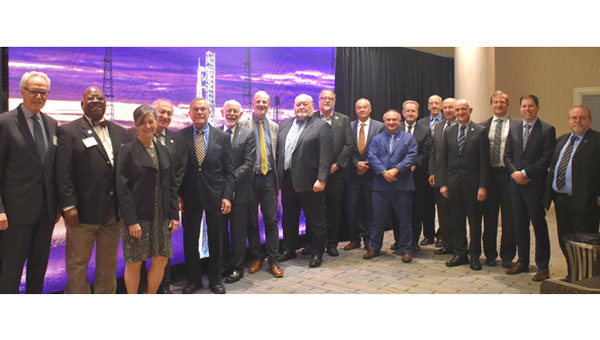
Join the Resilient Navigation and Timing Foundation for a reception with the President’s National Space-based Positioning, Navigation, and Timing Advisory Board on April 23 at The Antlers Hotel in Colorado Springs. The event begins at 6:00 PM. General David Thompson, U.S. Space Force (retired) will discuss his experience as the first Vice Chief of Space Operations, the state of GPS, and the future of PNT.
For more information and to RSVP, contact [email protected] by April 17.
Quickly prototype a GNSS interference detection and reporting system.
Implement an internet-based High Accuracy and Robustness Service (HARS)for GPS.
Relax export controls that currently restrict use of adaptive anti-jam antennas.
These are just three of the efforts the U.S. government is pursuing as a result of recommendations from the President’s National Space-based Positioning, Navigation and Timing (PNT) Advisory Board.
For 20 years the PNT Advisory Board has been providing the government independent expert advice about GPS and PNT.
Established by presidential directive in 2004 and administered under the Federal Advisory Committee Act by NASA, its charter has been regularly renewed. The charter provides that the board shall:
Be composed of experts from outside the United States government.
Seek input from state and local governments, industry and academia on developments in the application of space-based PNT technologies.
Evaluate national and international needs for changes in space-based PNT capabilities and assess possible trade-offs among options.
Provide independent advice and recommendations to the National PNT Executive Committee (co-chaired by the Deputy Secretaries of Defense and Transportation) on policy, system requirements, and program needs.
While “space-based” is in its name and charter, the board has long recognized that terrestrial assets also can play an important role in serving PNT users by augmenting, reinforcing, and complementing GPS. The use of complementary systems, for example, could help demotivate intentional jammers and spoofers and help safeguard users during any interference event. Thus, the board often considers a wide range of capabilities and systems.
The board also discusses policy, education, international relations and other issues important to the PNT community. As one board member commented, “Technology doesn’t exist in a vacuum. It is developed by, and intended to serve, people. If you don’t recognize that, you are missing most of the picture.”
The current board’s membership includes an impressive array of experts in PNT policy and technology. Its 29 members include a former governor, a retired admiral, three retired generals, GPS’ original chief architect, a former undersecretary, a former assistant secretary, three former presidents of the Institute of Navigation (ION), three international members and experts from across academia and industry.
Chaired by former Coast Guard Commandant Admiral Thad Allen, the board’s primary efforts are driven by its six subcommittees, reflecting a holistic approach to effective PNT:
Strategy, Policy & Governance
Protect, Toughen & Augment
Emerging Capabilities, Applications & Sectors
Education & Science Innovation
International Engagement
Communications & External Relations
While the subcommittees meet in fact-finding sessions to gather data, the PNT Advisory Board’s deliberations are public. Semi-annual meetings inWashington, D.C. and other locations may be attended by anyone, either in person or virtually. Announcements on the board’s webpage and in the Federal Register provide details before each meeting. By law, the minutes of each meeting are available to the public, and video recordings of meetings are normally posted as well.
Input from the public about PNT issues of concern is also welcome to inform the board’s current and future deliberations. Information on how to send input will be posted with the meeting announcement here.
According to board member Jeff Shane, former undersecretary at the U.S. Department of Transportation (DOT), the PNT Advisory Board is evidence of government at its best. “The very fact that the board was established underscores our government’s willingness to hear and consider the widest variety of views and input. It should be a source of optimism, and even pride, for the entire PNT community.”
National Space-based PNT Advisory Board
The next meeting will be from 9:00 a.m. to 6:00 p.m. MDT, April 24, 2024, and from 9:00 a.m. to noon April 25 at The Antlers Hotel in Colorado Springs, Colorado.Click here for information on a reception on April 23, featuring Gen. David Thompson.
The European Space Agency (ESA) and the European Commission’s Joint Research Centre (JRC) are collaborating to host the 15th edition of the International Summer School on Global Navigation Satellite Systems (GNSS).
The course is scheduled to take place in Novo Mesto, Slovenia, from July 15 to 26, 2024.
The summer school invites graduate students, Ph.D. candidates, postdoctoral researchers, engineers and academics from both the industry and agencies to attend. The wide range of attendees offers a dynamic environment conducive to learning and networking.
The deadline for registration is June 15. Those who register by April 15 will be offered reduced fees. Additionally, the ESA Education Office is offering up to four scholarships.
The comprehensive curriculum of the summer school encompasses all aspects of GNSS, starting from the fundamental principles of satellite navigation to recent advancements in positioning, navigation and timing services.
Participants will have the opportunity to learn from world-leading experts in the field, including ESA Director of Navigation, Javier Benedicto, former ESA Director General, Jean-Jacques Dordain and former ESA Director of Navigation, Paul Verhoef.
The U.S. Space Systems Command (SSC), part of the United States Space Force, is actively seeking insights from the GNSS industry through a Request for Information (RFI) regarding the development of a Global Positioning System (GPS) Rapid Prototype Demonstration, Tranche 0.
This initiative is part of a strategic effort to upgrade GPS capabilities to meet modern challenges in space navigation and ensure continued operational superiority. This RFI aims to collect information about the industry’s capacity to innovate and deliver solutions that can enhance the GPS infrastructure. The focus is on identifying technologies and approaches that can reduce the size, weight, power and cost (SWaP-C) of future GPS satellites, streamline their production and launch processes and improve compatibility with a variety of launch vehicles.
According to the SSC, the goal of Tranche 0 is to create a prototype satellite that can emit certain GPS signals that are compatible with existing user equipment. The operation of this prototype in medium-Earth orbit (MEO), approximately 20,000 km above Earth, aims to test and validate these innovations in a real-world setting. The SSC’s approach aims to encourage collaboration, inviting both established and emerging players in the industry to showcase their abilities in rapid development, fabrication, and integration of GPS payloads.
Respondents to the RFI are reminded to adhere to security protocols to ensure that all submissions are unclassified, though they may include Controlled Unclassified Information (CUI) if properly marked. The SSC has also provided references to essential GPS Interface Control Documents (ICDs) and performance standards.
The Volpe National Transportation Systems Center of the U.S. Department of Transportation (DOT) has issued a solicitation to obtain proposals from vendors with operationally ready complementary positioning, navigation and timing (CPNT) services to be used for testing and evaluation in the Rapid Phase of the DOT’s CPNT Action Plan.
The Volpe Center is seeking proposals from industry professionals to deploy PNT services with a technical readiness level (TRL) of eight or higher.
The evaluation conditions will include situations where GPS/GNSS service is disrupted or manipulated, and CPNT‐specific threat vectors are introduced. Proposals are encouraged to be tailored to critical infrastructure PNT user requirements with the expectation that Rapid Phase evaluation results will be shared with sector risk management agencies (SRMAs) through the Federal interagency process to drive CPNT adoption.
According to the Volpe Center, it is prepared to make multiple awards if multiple proposals meet the solicitation requirements.
Responses to the request for quotation (RFQ) should include the bidder’s preferred test range model(s) out of the following three proposed models, where the proposed CPNT service can quickly become operationally ready to meet the Rapid Phase timeline objectives — no later than six months after award:
Federal Government‐hosted test range
Critical infrastructure test range
Vendor-fielded test range
Offers are due March 25, 2024. Click here for more information.
Quectel’s upcoming webinar, “High-precision GNSS for industrial applications: best practice for design and implementation — North America” will take place Wednesday, Jan. 17, 2024, from 12:00 to 2:00 EST.
High-precision GNSS can be the difference between success and failure for industrial applications – equating as it does to increased efficiency, heightened safety, and superior performance. For example, it enables robotic lawnmowers navigating a lawn with cm-level precision, e-scooters gracefully weaving through bustling urban environments, or handheld devices with pinpoint GNSS location data for informed decision-making. For some industrial applications, including these and many others, high-precision GNSS isn’t just a commercial advantage – it is a necessity.
This webinar offers attendees a unique opportunity to understand high-precision GNSS and how it can revolutionize industrial applications from UAVs to handheld devices. Speakers Victor Pinzo, antenna PDM and Chang Xu, GNSS product manager at Quectel, cover the core components of high-precision GNSS – including GNSS modules, antennas, correction services, and connectivity.
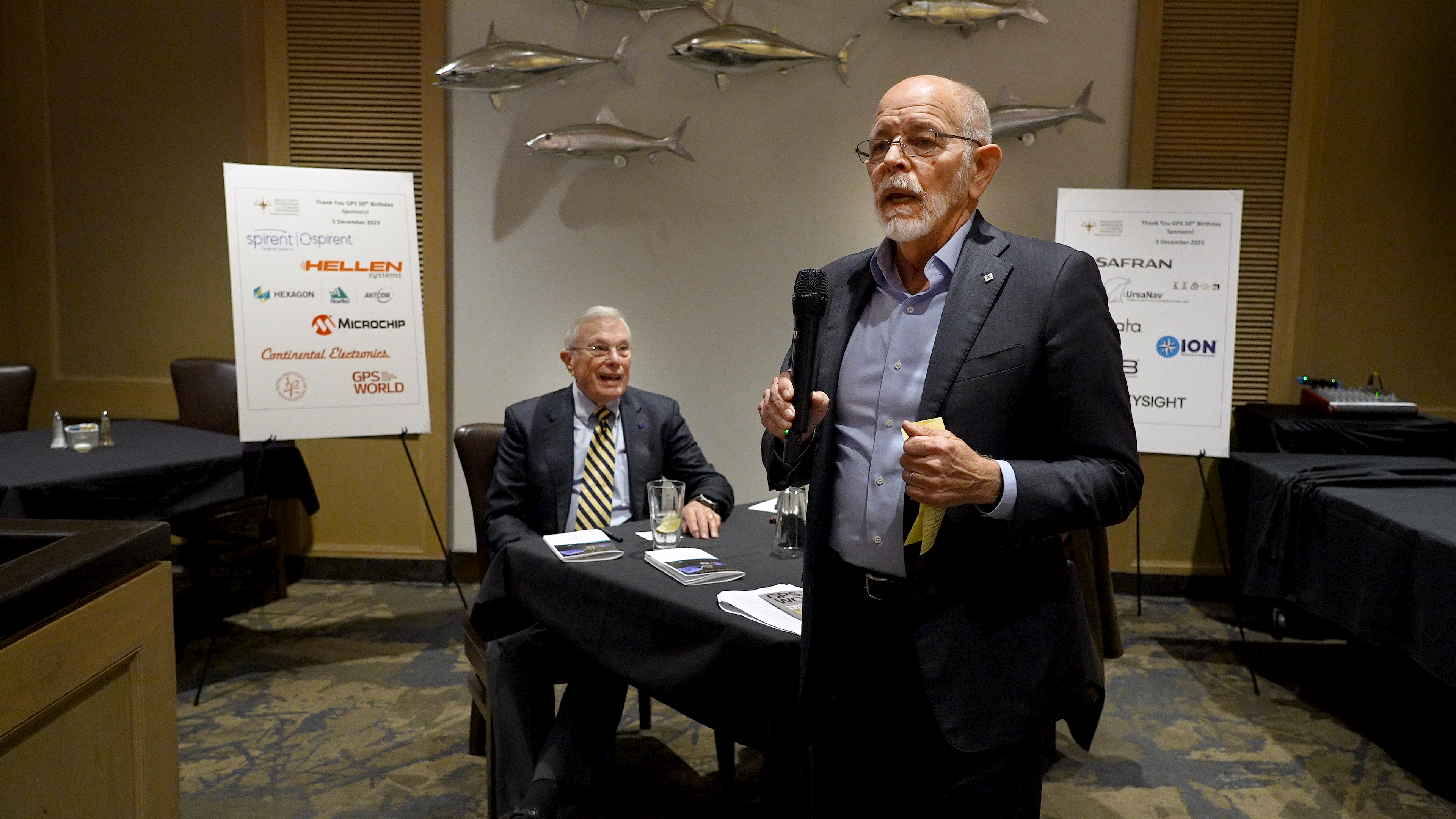
Dana Goward, President of the Resilient Navigation and Timing Foundation, introducing Brad Parkinson and Matteo Luccio, GPS World EIC. (Image: RNTF)
On December 5, in Houston, Texas, at a gala event to celebrate the 50th anniversary of GPS hosted by the Resilient Navigation and Timing Foundation, Matteo Luccio, Editor-in-Chief of GPS World, interviewed Brad Parkinson.
Here are two excerpts from the interview:
How does GPS today differ from the design that came out of the Lonely Halls meeting 50 years ago this past September?
Well, I’m very proud of what happened because, to my knowledge, there is no fundamental difference. Basically, that fundamental design has held up. … As a matter of fact, I still have one of the old Trimble handhelds, it’s called an EnsignGPS. It was one of those little devices that got shipped to the Iraq War. The other day, I pulled it out, batteries were kind of crummy, I got those squared away and went out, sure enough and navigated. I probably hadn’t pulled it out in at least 20 years. The point of the story is that evidently it still works.
What do you consider the most significant impact of GPS on society?
Well, the most significant impact is also probably the most perilous: kids today just take it for granted. They know where they are.
GPS turns 50 this year, marking five decades of transforming the world in ways that have profoundly impacted society. Since its approval as a program on December 17th, 1973, GPS has revolutionized the way we navigate and comprehend our world, often in ways few realize.
To honor this achievement, a special event will be held at the South Shore Harbor Resort and Conference Center in Houston, Texas, on December 5, at 6:00PM. This event aims to be a historic tribute to GPS’s journey and its impact on the global community.
At the special event, Matteo Luccio, editor in chief of GPS World, will lead an engaging discussion with Brad Parkinson, the original chief architect of GPS, shedding light on the system’s early days, its far-reaching impacts on humanity, and exciting prospects for the future.
Members of the press, federal employees, Resilient Navigation Timing Foundation members, PNT Advisory Board members, and presenters may attend the event for free. Others can secure their attendance for $75, which includes an optional one-year membership in the RNT Foundation.
To reserve your spot, RSVP at [email protected] no later than November 27.
The President’s National Space-based Positioning, Navigation, and Timing Advisory Board, which advises the government on GPS and related issues, will meet the following two days in the same location. Members of the public are welcome and encouraged to attend. Click here for more information on that event.
GPS World Editor-in-Chief, Matteo Luccio, discusses Harxon’s new GNSS technology and more from INTERGEO 2023 with Yong Deng, overseas sales manager at Harxon.