Category: Galileo

  • Galileo satellite team wins European Inventor Award

    The invisible signals that Europe’s Galileo satellites are beaming down to the world are officially award-winning: the team behind their design has won the European Inventor Award, run by the European Patent Office, reports the European Space Agency.

    The 12th European Inventor Award (Research) was given at a special ceremony on 15 June at the Arsenale di Venezia in Venice, Italy.

    Just like the Galileo satellites and their globe-spanning ground stations, the Galileo signals themselves needed to be designed, having to pack multiple Galileo services aimed at different classes of users within the limited frequency bands allocated for the system by the International Telecommunications Union.

    This task was accomplished by the Galileo Signal Task Force, a multinational group of experts who came up with a pair of innovative signal modulation techniques.

    This team was led by Spanish engineer José Ángel Ávila Rodríguez – now part of ESA’s Galileo team – and his French colleague Laurent Lestarquit from France’s CNES space agency, sharing in the European Patent Office’s European Inventor Award 2017.

    The team also includes German Günter Hein, formerly head of the department studying the evolution of EGNOS and Galileo for ESA, as well as Belgian Engineer Lionel Ries, now in ESA’s technical directorate, as well as French CNES engineer Jean-Luc Issler.

    “When the nations of Europe work together, the whole world benefits,” said José.

    With 18 satellites now in orbit, Galileo began Initial Services on 15 December 2016, so the two signals the team devised are now everyday reality.

    They took as their inspiration the GPS system, with signal shapes first designed back in the 1960s, but first fulfilling user needs today.

    The first signal technique is called Alternative Binary Offset Carrier modulation, or ‘AltBOC’ for short, combining four separate signals into one large ones – resulting in the largest bandwidth navigation signal ever transmitted.

    When used in its full performance AltBOC can support precision scientific applications such as geodetic measurements and seismic monitoring.

    The second modulation method, called Composite Binary Offset Carrier or ‘CBOC’, results in a signal for use by the mass market, possessing both narrowband and wideband components.

    The result is a signal that can work well with low-end receivers – such as those found in current smartphones – while the wideband component ‘future proofs’ the signal, allowing manufacturers to extend mass market receiver performance in the future.

    The other goal CBOC had to match was to be interoperable with GPS signals, allowing receivers to use both sets of signals at once on a seamless basis.

    With China planning to use a comparable CBOC-style solution for their Beidou satnav satellites, the resulting Galileo E1 Open Signal is set to become the new standard for mass market applications for the foreseeable future.

  • Project to advance multi-GNSS development uses Spirent test systems

    Project to advance multi-GNSS development uses Spirent test systems

    Spirent Communications’ testing systems are being used by the European Union TREASURE project (Training, REsearch and Applications network to Support the Ultimate Real-time high-accuracy EGNSS).

    The aim of the four-year project is to provide instantaneous and high-accuracy positioning anywhere in the world, exploiting different satellite systems operating together to provide users with positional accuracy of a few centimeters.

    Spirent’s GSS7000 test system.

    By 2020 Galileo, the European GNSS system (EGNSS), will be fully operational and provide positioning data of unprecedented accuracy. Galileo’s integration with other satellite systems through the TREASURE project is key to increasing Europe’s competitiveness in the field, which has been mainly based on the GPS system in the past 20 years.

    Higher accuracy services will not only assist safety-critical industries such as air and maritime navigation services, but also help industries such as the global agri-tech market, autonomous vehicles and capital-intensive sectors.

    Kimon Voutsis, Robust PNT Solutions Architect, works on a professional services project for a client.

    For example, more accurate real-time positioning data can assist farmers in maximizing food production, reducing costs and minimizing the environmental impact. Equally, a deep-sea drilling platform that experiences any temporary degradation in positioning accuracy could lead to significant financial losses.

    “Spirent is proud to support multi-national initiatives that advance our industry and provide better end user performance,” said Martin Foulger, general manager of Spirent’s positioning business unit. “More systems are using GNSS data, and users always want better accuracy, so TREASURE will help to provide this.”

    TREASURE is an EU-funded project under the H2020-Marie Skłodowska-Curie Innovative Training Network. It is coordinated by the University of Nottingham, and Spirent is the partner providing GNSS simulation systems.

    For more information on Spirent’s GNSS testing solutions, visit the website. To learn more about how to test receivers of GPS, Galileo and other GNSS, download Spirent’s eBook.

    To learn more about TREASURE, contact Marcio Aquino, Nottingham Geospatial Institute.

  • Two more satellites join Galileo constellation

    Two further satellites have formally become part of Europe’s Galileo satnav system, broadcasting timing and navigation signals worldwide while also picking up distress calls across the planet, reported the European Space Agency.

    Liftoff of Ariane flight VA233, carrying four Galileo satellites, on Nov. 17, 2016.

    These are the 15th and 16th satellites to join the network, two of the four Galileos that were launched together by Ariane 5 on Nov. 17, 2016, and the first additions to the working constellation since the start of Galileo Initial Services on December 15.

    The growing number of Galileo users around the world will draw immediate benefit from the enhanced service availability and accuracy brought by these extra satellites.

    The launch into space and the maneuvers to reach their final orbits still left a lot of rigorous testing before the satellites could join the operational constellation.

    Their navigation and search and rescue payloads had to be switched on, checked and the performance of the different Galileo signals assessed methodically in relation to the rest of the worldwide system.

    Galileo L-band antenna at ESA’s Redu ground station.

    This lengthy testing saw the satellites being run from the second Galileo Control Centre in Oberpfaffenhofen, Germany, while their signals were assessed from ESA’s Redu centre in Belgium, with its specialized antennas.

    The tests measured the accuracy and stability of the satellites’ atomic clocks – essential for the timing precision to within a billionth of a second as the basis of satellite navigation – as well as assessing the quality of the navigation signals.

    Oberpfaffenhofen and Redu were linked for the entire campaign, allowing the team to compare Galileo signals with satellite telemetry in near-real time.

    Making the tests even more complicated, the satellites were visible for only three to nine hours a day from each site.

    The satellites are now broadcasting working navigation signals and are ready to relay any Cospas–Sarsat distress calls to regional emergency services.

    Now that these two satellites are part of the constellation, the remaining pair from the Ariane 5 launch is similarly being checked to prepare them for service.

  • Galileo provides healthy signals 97.33 percent of the time

    Galileo provides healthy signals 97.33 percent of the time

    Europe’s Galileo satellite navigation system has undergone its first performance report since it started work at the end of last year, and it passed with flying colors, said the European Space Agency.

    The European GNSS Agency, GSA, through its GNSS Service Centre, has published the first of its regular quarterly performance reports on Galileo. This European GNSS (Galileo) Initial Services Open Service report, now available online, covers the first three months of 2017 and documents the good performance of Galileo Initial Services to date.

    The report shows the 11 satellites then operating in the Galileo constellation were able to provide healthy signals 97.33 percent of the time on a per satellite basis, with a ranging accuracy better than 1.07 m and disseminating global UTC time within its signal to within 30 billionths of a second on a 95 percentile monthly basis.

    “Galileo Initial Services were declared by the European Commission on 15 December 2016,” said Joerg Hahn of ESA’s Galileo System Office.

    “It was thanks to the tremendous effort of ESA’s Galileo team working closely together with colleagues from the commission and GSA that this milestone could be achieved: the key pillars for reaching are the currently deployed Galileo satellites in combination with the global Galileo ground segment infrastructure, defined and implemented by the ESA team with their respective industry partners.”

    The Initial Service performance levels achieved by the system are monitored using two complementary monitoring platforms: the Time and Geodetic Validation Facility, an independent precision time-measuring system accurate to a billionth of a second — using an ensemble of atomic clocks located at ESA’s ESTEC technical centre in Noordwijk, the Netherlands — and the Galileo System Evaluation Equipment, GALSEE, based in Rome.

    The steadily declining Signal in Space Ranging Error (SISE) of the Galileo constellation from 2014 to the present.

    In the future, the independent monitoring of the services will be carried out by GSA’s Galileo Reference Centre, currently taking shape beside ESTEC in Noordwijk. The results for the first quarter of 2017 show the measured performances are generally far better than the minimum performance levels identified in the Service Definition Documents.

    “Looking back over the ranging accuracy of the Galileo constellation from the time of the very first positioning fix in 2014 to the present, the overall performance trend for the Open Service is very positive,” Joerg said.

    “It has reached values of less than 1 m in recent months, being already competitive with other satellite navigation systems.

    “The high-quality ranging service enables user level positioning with a typical accuracy of around 3 m on the ground and 5 m in altitude during periods when four satellites are visible. With the limited infrastructure so far deployed, current horizontal position fixes can be achieved during more than 80 percent of the time with accuracies better than 10 meters.

    “This user level performance is expected to improve with the launch of more satellites making the provided Galileo services more accurate, more available and more robust for end users.”

  • Galileo signal team nominated for invention award

    Galileo signal team nominated for invention award

    José Ángel Ávila Rodríguez (left)) and Laurent Lestarquit holding a satellite model. (Credit: ESA)

    The engineering team behind the signal technology underpinning Europe’s Galileo satellite navigation system has reached the final of this year’s European Inventor Award, run by the European Patent Office, reported the European Space Agency.

    The team is led by Spanish engineer José Ángel Ávila Rodríguez — now part of ESA’s Galileo team — and his French colleague Laurent Lestarquit from France’s CNES space agency.

    The team also includes German Günter Hein, formerly head of the department studying the evolution of EGNOS and Galileo for ESA, as well as Belgian Engineer Lionel Ries, now in ESA’s technical directorate, as well as French CNES engineer Jean-Luc Issler.

    The engineers, who had previously worked together as members of the multinational Galileo Signal Task Force, came up with a pair of innovative signal modulation techniques to pack multiple Galileo signals together, simultaneously serving different sets of users while boosting signal performance and robustness. Both innovations have been adopted by Galileo and are in use today.

    The first technique, called Alternative Binary Offset Carrier modulation — AltBOC — combines four signals into one large one, resulting in the widest bandwidth navigation signal ever transmitted. Two of these signals are sitting on the one carrier, namely E5a, while the other two are on E5b.

    “AltBOC is a way of transmitting four components in a very wide bandwidth signal, using a single radio frequency chain on the satellite in an intelligent way, where originally two chains would have been needed to transmit in two separate frequency bands (E5a and E5b),” explains José Ángel, now ESA’s global navigation satellite system evolution signal and security principal engineer for Galileo.

    “The result is a frequency-rich signal that fundamentally improves positioning performance and robustness.

    “AltBOC is interoperable with GPS in E5a/L5 and allows receiver manufacturers to process it as one very large signal – extending over the whole E5a and E5b range – or as two separate signals, one at each frequency carrier (E5a or E5b).

    “AltBOC serves open service users in general. Moreover, when used in its full performance mode (E5a+E5b), it also facilitates geodetic and precision scientific applications such as gradual tectonic motion, or the use of accurate positioning on Earth — including proposed ‘reflectometry’ missions to make altimetry measurements from satnav signals reflected from Earth’s surface.

    “But the application of AltBOC could go beyond the current use by providing accurate positioning to satellites in space thanks to its unique bandwidth characteristics.”

  • Galileo boosts GNSS corrections services

    Trimble’s RTX-based correction services now support the Galileo constellation. As a true five-constellation technology that uses GPS, GLONASS, BeiDou, QZSS and now Galileo satellites, Trimble RTX delivers improved real-time positioning performance to its users worldwide.

    With accessibility to the Galileo constellation, users now have visibility to more satellites, which can be advantageous for extreme latitudinal positions or in environments where line-of-sight may be limited.

    Surveyors, farmers, mapping and GIS professionals now have a more versatile and robust correction solution wherever they may work, even in the most challenging terrain locales.

    Benefits of adding Galileo to Trimble RTX correction services includes:

    • Increasing the number of in-view satellites, improving the accuracy and reliability of corrections
    • Improving positioning integrity using observations from additional satellites to better mitigate errors
    • Operating at higher cut-off angles, delivering better performance in urban canyons and other less than optimal environments
    • Minimizing multipath and interference through the addition of available satellite signals

    “Trimble is continually investing in its correction service technology to remain at the forefront of the industry,” said Mark Richter, marketing director for Trimble’s Networks and Services business. “Our focus is to ensure that the latest GNSS developments are leveraged to continue to deliver productivity improvements for our customers across the globe.”

  • First Galileo open service performance report published

    Click for PDF.

    The European GNSS Agency (GSA) has published its first Galileo Open Service quarterly performance report.

    The report, which covers the first three months of 2017, is available online in the GSC Electronic Library, or directly here.

    Following the Declaration of Initial Services in December 2016, the GSA will publish a new Galileo Initial Services Open Service report after each quarter. The quarterly reports aim to provide the public with the latest information on the Galileo Open Service’s performance.

    The document reports on such parameters as:

    • Galileo Initial Open Service ranging performance
    • Galileo Coordinated Universal Time (UTC) dissemination and Galileo to GPS time offset (GGTO) determination performance
    • Galileo positioning performance
    • Timely publication of Notice Advisory to Galileo Users

    Each of these parameters is examined with respect to their minimum performance levels (MPLs), as declared in the European GNSS (Galileo) Open Service Definition Document (OS-SDD).

    Highlights from Q1 2017

    In the first quarterly reporting period after the Declaration of Galileo Initial Services, the measured Galileo Initial Open Service performance figures generally exceeded the MPL targets specified in the OS-SDD by significant margins.

    Some highlights from the report:

    • Availability of the Galileo ranging service at the worst user location, with monthly values of 100 percent, is significantly above expectations, where the MPL is 87 percent.
    • The signal in space ranging accuracy shows a 95th percentile monthly accuracy better than 1.07 [m] for individual space vehicles.
    • Availability of the Galileo UTC time determination service was achieved, with a monthly value of 100 percent, compared to the [OS-SDD] MPL target of 87 percent.
    • Availability of GGTO determination (not declared as a service in this phase) was 100 percent in January and March. February showed a slightly lower figure of 96.44 percent, although still well above the [OS-SDD] MPL target of 80 percent.
    • Excellent values were achieved for UTC time dissemination service accuracy. The measured Galileo Initial Open Service performance figures generally exceeded the MPL targets specified in the OS-SDD by significant margins.

    For up-to-date information, check the European GNSS Service Centre (GSC) website. For all support related to Galileo, contact the Galileo Help Desk. The Help Desk allows close interaction with users, both to support the exploitation of Galileo services and to collect relevant information on signal performance as observed by the users themselves.

  • System of Systems: Brexit may oust UK from Galileo work

    Brexit May Oust U.K. from Galileo Work

    Participation of the United Kingdom space industry in Galileo may be in doubt as negotiations get underway on details of the U.K. withdrawal from the European Union (EU).

    European Commission officials signaled that they want to rely solely on producers within the European Union for the block’s major programs, citing security concerns such as the possible acquisition of a U.K. contractor by a company from a non-EU country such as China.

    In particular, officials are concerned about protecting the heavily encrypted, jam-resistant Public Regulated Service capability designed for government use that is reserved for EU member states and where U.K. industry has had a significant role.

    Surrey Satellite Technology Ltd., based in Guildford, England, but a subsidiary of France-based Airbus, built 22 navigation payloads for Europe’s Galileo satellite fleet.

    Other companies with U.K. interests that could be affected include Qinetiq, CGI, Airbus and Scisys.


    Galileo SAR Service Launched

    Galileo’s Search And Rescue (SAR) service became officially operational with a public launch on April 6, as part of the COSPAS-SARSAT network for detecting and locating emergency beacons activated by aircraft, ships and hikers. According to the European Commission, Galileo SAR will help reduce the detection delay of a distress signal from up to several hours to 10 minutes.

    At sea, this makes SAR rescue operations easier thanks to a narrowed search box, since the vessel in distress has less time to drift. On land, acquisition of a precise position enables rescue teams to more quickly reach the operation zone and assist the victims. In the air, Galileo contributes to fulfilling International Civil Aviation Organization (ICAO) requirements for implementing the next-generation emergency management system Global Aeronautical Distress and Safety System (GADSS).

    SAR transponders on Galileo satellites can pick up signals emitted from 406-MHz distress beacons anywhere in the service coverage area and transmit this information to the dedicated ground stations, the Medium-Earth Orbit Local User Terminals (MEOLUTs). The SAR/Galileo infrastructure is interoperable with GPS and GLONASS SAR transponders.
    Once the beacon is located by the MEOLUTs, the location data is sent to the COSPAS-SARSAT mission control center, which distributes it to the relevant rescue centers. These then coordinate the required rescue efforts.

    Galileo provides a ground segment coverage of 40 million square kilometers over Europe as a contribution to MEOSAR global coverage. Galileo SAR service is one of the three services launched in December 2016 with the Initial Services. The SAR service represented 1 percent of total Galileo program costs, but should result in thousands of lives being saved, said the European Commission.


    Pile of Studies Produced Not a Lot

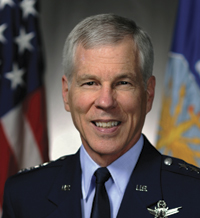
    Gen. Shelton
    Headshot: Gen. Shelton

    Testifying before a joint hearing of the House Homeland Security Committee and House Armed Services strategic forces subcommittee on March 29, Retired Gen. William Shelton, the former head of Air Force Space Command, warned that the U.S. needs to take action to protect GPS very soon.

    He cited demonstrated ability by the Chinese government in 2007 to destroy a satellite in orbit, and improved signal jamming and cyber attack capabilities against ground control systems. The U.S. is unprepared to meet those threats, he said.

    “Here we are 10 years later and we don’t really have a lot to show but a pile of studies,” Shelton said. “We’ve been part of this ‘one more study’ kind of attitude. ‘Well, that may not be the perfect answer, so let’s just do one more study’ and meanwhile time marches on. Satellites have fixed lifetimes, and you need to plan for the death of the satellite. A decision not to move forward is a de facto decision to maintain the status quo with no protection.”

    Shelton stated that space research and development is at a 30-year low, with 15–40 percent of R&D funds taken by management services and technical assistance rather than actual research and development.

    “The executive branch and the legislative branch could get together and agree on a strategy and a way forward and then execute … I don’t see any other way. There has to be some broad agreement here in the whole of government as we move forward.”


    June Launch in japan for QZSS Michibiki 2

    QZSS’s second satellite is scheduled for launch in June. Once completed, the Quasi-Zenith Satellite System will be a satellite augmentation system for GPS over Japan and other parts of the Pacific region.

    Michibiki 2 will be launched by the Japan Aerospace Exploration Agency (JAXA), with a launch window planned for June 1–30. The system’s first Michibiki satellite was launched in September 2010.


    OCX Back on Track

    OCX, the next-generation ground control system for GPS, is back on track following a 2016 government contract breach that prompted the Air Force to work with Raytheon to revise OCX’s budget and schedule, according to the company.

    Raytheon implemented a series of corrective actions through 2015 and 2016 to get the delayed program on a firm timeframe for completion. Coding on OCX was about 80 percent complete in late March, according to the company.

    Raytheon completed a re-baselining on OCX in March, setting up a new timeline for completion. Current delivery for the full system is planned for December 2020.

    DevOps. The OCX team reduced development cycle times to create more efficient software development by using a commercial best practice called DevOps, which adds more automation into coding and testing, and breaks coding down into units rather than focusing on the need to finish the complete system all at once.

    A subset of OCX, the Launch and Checkout System for GPS satellites is undergoing testing at Schriever Air Force Base in Colorado. Raytheon expects to complete testing and deliver the system by late September or early October.


    EGNOS Refreshes

    The geosynchrous Earth-orbit (GEO) satellites broadcasting EGNOS messages changed in March. PRN 123 was introduced in the operational platform, and PRN 136 was moved from the operational platform to the test platform.

    Regional aviation in the dense European air traffic system is a key market segment for EGNOS, according to Gian Gherardo Calini, the European GNSS Agency’s head of market development. More than 440 EGNOS-based approaches are available at nearly 220 airports across Europe. These figures are expected to dramatically increase in the coming years.

    A proposal from the European Aviation Safety Agency recommends that air ANSPs and aerodrome operators implement Performance Based Navigation (PBN) approach procedures with vertical guidance (APV), such as EGNOS LPVs, at all non-precision instrument runway ends by 2020.


    Second GPS III Launch Contracted

    The U.S. Air Force has awarded a second GPS III satellite launch contract to SpaceX.

    According to the $96.5 million agreement, the company will provide GPS III launch vehicle production, mission integration, launch operations, spaceflight worthiness and mission-unique activities. Work is expected to be complete by April 30, 2019.

    An earlier SpaceX launch contract, worth $82.7 million, calls for orbiting a GPS satellite aboard a Falcon 9 rocket in May 2018.

  • Skydel teams with Noffz to increase presence in Europe

    Skydel teams with Noffz to increase presence in Europe

    Skydel, a GNSS test solutions company, has partnered with Germany-based Noffz to deliver SDX GNSS simulation to clients in Europe.

    Noffz creates test systems and solutions in the area of the Internet of Things (IoT) — especially in automotive RF-test applications around eCall, network access devices, telematics control units, infotainment/multimedia units and automotive radar.

    With nearly 30 years of experience, Noffz delivers worldwide turnkey solutions and PC-based measurement, as well as automation systems.

    “With their broad expertise in test solutions, Noffz is well positioned to bring Skydel’s SDX GNSS simulation solutions to clients located in Europe and beyond,” Skydel said in a blog.

    “Technology is constantly evolving,” reads the blog. “With the advent of new satellite constellations, such as Galileo, expanding needs for position and navigation in the transportation industry, and the growing threats of RF interferences, GNSS simulation is more than ever a key component in the arsenal needed to design and validate new products.

    “Skydel SDX delivers a new paradigm in GNSS simulation, featuring an exclusive mix of performance, flexibility and unique capabilities. With the addition of Noffz’s know-how covering multiple industries, we now have an outstanding team that’s ready to tackle today and tomorrow’s technological integration challenges.”

    Galileot will reach Full Operational Capability (FOC) in 2019. Simulation of the complete Galileo constellation is possible with Skydel's SDX GNSS simulator.
    Galileot will reach Full Operational Capability (FOC) in 2019. Simulation of the complete Galileo constellation is possible with Skydel’s SDX GNSS simulator.
  • European satnav competition open for submissions

    The European Satellite Navigation Competition (ESNC) — the largest international competition for the commercial use of satellite navigation — is once again in search of outstanding ideas and business models for accelerating Galileo applications.

    Renowned institutions and regional partners are set to award prizes worth a total of more than 1 million in more than 20 categories.

    Submissions are due June 30.

    Innovation Network for Satellite Navigation

    Satellite navigation is indispensable when it comes to accurate, reliable and continuous localization, according to the ESNC. This technology is fundamental to a variety of current trends, including multimodal logistics, the Internet of Things (IoT) and machine-to-machine (M2M) communication, unmanned aerial vehicles (UAVs) and smart cities.

    First held in 2004, the ESNC has evolved into the leading innovation scouting mechanism in terms of Galileo-related applications across Europe and beyond. Moreover, the ESNC promotes the transformation of groundbreaking business ideas into market-ready products and new ventures.

    Each year, the competition offers advantages to more than 400 business ideas. It has awarded prizes to more than 300 winners, which represent just a fraction of the 3,700 innovative concepts submitted by 11,000 participants. Through its network — including the ESA Business Incubation Centres, other incubators across Europe and the new E-GNSS Accelerator co-funded by the European Commission — the ESNC plays a decisive role in the realization of promising ideas by supporting the foundation of startups and creating high-tech jobs.

    One of the main objectives of the ESNC is fostering the European space sector’s competitiveness globally by boosting the development of commercial space applications, especially for startups, SMEs and young entrepreneurs. Advancing Europe’s space programs and meeting user needs, especially when it comes to space data access to encourage alternative business models and technological progress, represent major goals of this strategy.

    ESNC-2017-kickoff

    The involvement of the pan-European spirit within the EU Space Strategy is realized in the ESNC by engaging multiple regions across Europe with their own dedicated prizes.

    “The investment in space technologies and applications as well as the support of forward-thinking entrepreneurs and startups ensure Europe’s increased competitiveness,” said Elżbieta Bieńkowska, commissioner for internal market, industry, entrepreneurship and SMEs. “To achieve this ultimate goal, the European Satellite Navigation Competition (ESNC) and the Copernicus Masters are a proven platform for trendsetting technologies and business models based on Galileo and Copernicus to implement the new EU Space Strategy.”

    Within this context, this year’s ESNC patronage taken over by Markku Markkula, president of the European Committee of the Regions (CoR), sets the tone for the innovation competition’s pan-European mission of uniting the European regions and cities through the support of space-related businesses and future-oriented entrepreneurs, increasing the market and user uptake of Galileo.

    “The European Committee of the Regions attaches great importance to the new opportunities linked to the involvement of European regions in innovation networks, such as the European Satellite Navigation Competition,” Markkula said. “I have therefore gladly taken on the role of patron for the ESNC as of 2017.”

    E-GNSS Accelerator

    As the high-tech platform for pioneering satellite navigation applications, the ESNC is now additionally equipped with the new E-GNSS Accelerator. This program is a unique opportunity for entrepreneurs and startups to accelerate their business case on a broad scale and bring their products and services to market.

    The E-GNSS Accelerator will run for three years and will directly support the winners of the ESNC 2017, 2018 and 2019. Thereby, the participants await even more prizes, services and three further business incubations worth an additional value of EUR 500,000.

    ESNC-2017-event

    ESNC Partners

    In the ESNC 2017, special prizes are to be offered in partnership with the following institutions: the European GNSS Agency (GSA), the European Space Agency (ESA), the German Aerospace Center (DLR), and the German Federal Ministry of Transport and Digital Infrastructure (BMVI).

    Prototypes can also be entered into the GNSS Living Lab Challenge.

    The University Challenge, meanwhile, is explicitly designed for students and research associates.

    In addition, participants choose from this year’s confirmed partner regions: Asia, Austria, Baden-Württemberg / Germany, Basque Country / Spain, Bavaria / Germany, Catalonia / Spain, Estonia, France, Hesse / Germany, Ireland, Madrid / Spain, The Netherlands, Norway, Poland, Romania, United Kingdom, and the Valencian Community / Spain.

    Stay tuned for more updates on additional ESNC regions.

    Obtain more information at the official website, www.esnc.eu, comprising all relevant information on prizes, partners, and terms of participation involved in the ESNC.

    Prizes for the Best Applications

    This year’s winners will take home prizes worth a more than EUR 1 million and be welcomed into the ESNC’s leading innovation network for global satellite navigation systems.

    Along with cash, the various prize categories offer primarily technical, business-related and legal support in realizing the winning business models. A jury of international experts from the realms of research and industry will also evaluate the winners of all the categories to select an overall winner, who will be revealed at the festive Awards Ceremony in early November 2017.

    Furthermore, three additional incubations, supported by the European Commission, will be awarded in front of a high-ranking audience.

    Those who enter the ESNC also stand to benefit greatly from the opportunity to work closely with leading institutions and regional partners. The ESNC is geared towards individuals and teams from companies, research facilities and universities around the world.

    Awards Ceremony and Space Conference

    A partner program, the Copernicus Masters (Earth observation), also kicked off on April 5 in Brussels.

    The Awards Ceremony for both the ESNC and the Copernicus Masters takes place in early November. The event brings together industry, politics, entrepreneurship and research to showcase the most disruptive space applications and discuss trendsetting developments in the satellite downstream sector and its various application fields.

  • Galileo search-and-rescue service officially launched

    The European Union's SAR zone.
    The European Union’s Galileo search-and-rescue zone.

    The Galileo Search And Rescue (SAR) service, made possible by the Galileo satellite constellation, is now active.

    Galileo SAR is Europe’s contribution to the COSPAS-SARSAT network, a distress alert detection and information distribution system best known for detecting and locating emergency beacons activated by aircraft, ships and hikers.

    By providing COSPAS-SARSAT with the coverage capacity of the Galileo constellation equipped with SAR transponders, Europe is helping to reduce the detection delay of a distress signal from up to several hours to 10 minutes.

    A return link, a signal informing the person in distress that the signal has been received and localized, will be added to the system by the end of 2018.

    Beacon Awareness Day

    The Galileo SAR launch day, April 6, is Beacon Awareness Day in the United States. It’s also named 406 day. 406 stands for 4/06 — the date in U.S. format — and the 406-MHz frequency of the SARSAT beacons.

    For Twitter and social media, special hashtags #406day, #406day17 and #savedbythebeacon already exist. The program has added the hashtag #getabeacon to complement it.

    The following video about the program focuses on maritime operations, which account for 75 percent of the alerts.

    Coming to the Rescue

    With Galileo, the time to identify the location of a beacon signal is reduced from several hours to a few minutes. At sea, this makes SAR rescue operations easier thanks to a narrowed “search box,” since the vessel in distress has less time to drift.

    On land, the quick acquisition of a precise position enables rescue teams to more quickly reach the operation zone and assist the victims.

    In the air, Galileo contributes to fulfilling International Civil Aviation Organization (ICAO) requirements for implementing the next-generation emergency management system Global Aeronautical Distress and Safety System (GADSS). In particular, it enhances location of an airplane in distress, which will be mandatory on Jan. 1, 2021.

    The Search And Rescue transponders on Galileo satellites can pick up signals emitted from any 406-MHz distress beacon anywhere in the service coverage area and transmit this information to the dedicated ground stations (MEOLUTs). The SAR/Galileo infrastructure is interoperable with GPS and GLONASS SAR transponders.

    Once the beacon is located by the MEOLUTs, the location data is sent to the COSPAS-SARSAT mission control centre (MCC), which distributes it to the relevant rescue centres. The rescue centres, under the responsibility of national competent authorities and administrations, then coordinate the required rescue efforts.

    Improving COSPAS-SARSAT

    Galileo plays an important role in the Medium Earth Orbit Search And Rescue system of COSPAS-SARSAT (MEOSAR), and provides a ground segment coverage of 40 million square kilometers over Europe as a contribution to MEOSAR global coverage.

    Thanks to the advanced European technology used, integration of Galileo into COSPAS-SARSAT improves the system by:

    • enabling faster detection and localization of distress signals anywhere in the service coverage area, reducing the delay between beacon activation and distress localization
    • making it easier to find the source of a signal by significantly boosting precision in comparison to the current situation
    • increasing availability and improving detection of signals in difficult terrain or weather conditions.

    The Galileo Search And Rescue service is one of the three services launched in December 2016 with the Initial Services. The SAR service represented just 1 percent of total Galileo program costs, but should result in thousands of lives being saved, according to the head.

  • Trimble incorporates Galileo support in GNSS infrastructure management software

    Higher-Accuracy Positioning to Improve GNSS Network Performance and Reliability

    Trimble has introduced version 3.10 of its Pivot Platform software, a modular solution for real-time GNSS infrastructure management, ranging from a single-base GNSS continuously operating reference station (CORS) to a full real-time network (RTN), serving thousands of end-users worldwide.

    Version 3.10 provides improvements to network performance and office and field productivity. The new features and capabilities include:

    • Galileo support provides access to five GNSS constellations — GPS, GLONASS, BeiDou, QZSS and now Galileo — allowing end-users to expect improved positioning accuracy and fix performance from the 50 percent increase of accessible satellites;
    • GPS L5 support utilizes all available L5 third-frequency GPS observations to enable end users to further improve field productivity;
    • Code Bias Calibration client and server improvements  provide a higher availability of network-modeled RTK corrections to allow field users to reduce dependency on station biases;
    • Sparse Network supports Galileo and BeiDou. Sparse Network, a Trimble technology, enables RTN operators to achieve the benefits of a full network-processed GNSS constellation even if the network is not fully covered with multi-constellation CORS.
    • Dynamic Station Coordinates (DSC) module improvements minimize the impact of erroneous reference station coordinates to improve system performance.

    “Trimble continues to transform the way our customers manage their real-time GNSS infrastructure by making networks more robust and easier to manage,” said Mark Richter, director of marketing for Trimble’s Advanced Positioning Division. “Accessibility to the Galileo constellation and the addition of the L5 third-frequency observations in particular, makes Trimble’s Pivot Platform significantly more versatile to improve functionality and performance for end users in the field.”

    Trimble Pivot Platform version 3.10 is available now from Trimble’s Distribution Network and Trimble Sales Representatives. Customers with a valid software maintenance agreement receive the new version at no additional cost.