Category: Galileo

  • Innovation: Galileo cycle-slip detection

    Innovation: Galileo cycle-slip detection

    How four frequencies help when the ionosphere is disturbed

    The authors explore how cycle slips in Galileo carrier-phase measurements can be more effectively detected using four frequencies.

    INNOVATION INSIGHTS with Richard Langley
    INNOVATION INSIGHTS with Richard Langley

    MORE SATELLITES OR MORE SIGNALS? That was the question put to the delegates at GNSS Election ’08, the stimulating and amusing entertainment provided at the GPS World Leadership Dinner held in conjunction with The Institute of Navigation’s meeting in Savannah in September 2008.

    During the debate ahead of the election, the Satellite Party advocated that the GNSS user community would be better served by more satellites than more signals. They argued that more satellites (more than those in the operational GPS constellation) would enable more continuous and reliable positioning in cities, mountainous areas and other difficult environments and that the legacy GPS signals were sufficient. Greg Turetsky, one of their candidates, stated, “I would maintain from an economic standpoint that it’s far more cost-effective for our constituents to have more of the same satellites to give them more of the same services that they enjoy today, in more areas, rather than creating new things for which they have no use.”

    The Signal Party, on the other hand, advocated for more signals with receivers capable of using them to provide high accuracies for a wide spectrum of GNSS uses. Signal Party candidate Javad Ashjaee opined, “We are the party of building roads, generating accurate maps, growing your food by automating agriculture, synchronizing your power stations. We are even working on automatically landing aircraft to use the air space more efficiently.”

    Although contested, the election was won by the Satellite Party, 62 votes to 46. But clearly, both sides offered beneficial advances to the GNSS user community, so why not work together, have the parties enter into an alliance, and provide both more satellites and more signals? 

    Fast forward to 2016. The alliance has come to pass and we have the best of both worlds. We have two complete GNSS constellations, GPS and GLONASS, with two more, Galileo and BeiDou, on track for completion within the next few years. We also have regional systems either supplying an independent local positioning service or augmenting GPS with NavIC (also known as the Indian Regional Navigation Satellite System) and QZSS, respectively. Not to mention a growing number of satellite-based augmentation system satellites. When I compiled The Almanac for the August issue, there were over 100 GNSS satellites transmitting signals to users. And not only more signals from more satellites, but more technologically advanced signals on more frequencies.

    The plethora of signals now being transmitted by GNSS satellites is already leading to further advances in positioning, navigation and timing—even before full constellations transmitting those signals are in place. A good case in point is Galileo’s Open Service, which is transmitted in the E1 and E5 bands. A modified version of binary-offset-carrier (BOC) modulation, called Alternative BOC or AltBOC, is used to generate the wideband E5 signal. Its structure is such that a receiver can track and make measurements on just the lower frequency part of the signal centered on 1176.450 MHz (E5a), just the upper frequency part centered on 1207.140 MHz (E5b), the whole AltBOC signal centered on 1191.795 MHz (E5a+b), or any combination of these including all three. Using all three together with the E1 signal provides us with a four-frequency positioning capability. What’s the benefit of using four frequencies? There are several, but in this month’s column, a recently graduated award-winning Belgian student and her supervisor tell us how cycle slips in Galileo carrier-phase measurements can be more effectively and efficiently detected using four frequencies.


    The availability of data offered in the Galileo GNSS Open Service on four carrier frequencies opens the way to new multi-frequency solutions for civil users. In the research reported in this article, we focused on one of the consequences of signal tracking loss, the appearance of cycle slips, and how the use of the four frequencies can help in their detection.

    Cycle-slip detection is a key issue for high-precision positioning applications. Any users in need of determining a precise and reliable position must be aware of the potential presence of cycle slips in their data, since they compromise data quality.

    Traditionally, two carrier frequencies were used for positioning; for instance, the GPS L1 and L2 frequencies. More recently, three-carrier positioning has allowed enhanced precision and accuracy. Though using a third carrier frequency has allowed us to partially solve the cycle-slip detection issue, existing procedures are still lacking in some aspects. One of today’s main challenges is cycle-slip detection under high ionospheric activity, which is why we focused on this specific case study. And since the use of three frequencies helps to improve reliable cycle-slip detection, might not the use of an additional fourth frequency further improve detection capability? Since Galileo supplies four frequencies in its Open Service, we thought we might be able to improve cycle-slip detection algorithm performance once more.

    Framework. In this article, a new quad-frequency cycle-slip detection algorithm is introduced — seemingly, an unexplored track in the literature until now. The algorithm uses undifferenced carrier-phase observations from a single-station static receiver. First developed for post-processing, the algorithm also has been adapted to real-time applications. This algorithm aims to improve cycle-slip detection under high ionospheric activity.

    CYCLE SLIPS

    Though code (pseudorange) measurements are commonly used for standard positioning, any precise positioning application needs to use carrier-phase measurements, due to their better quality. Unfortunately, the latter are potentially subject to cycle slips, generating a constant bias in data and, if undetected and uncorrected, impacting the inferred positioning.

    Carrier-phase measurements are made by observing the beat phase, that is, the difference between the received carrier from the satellite and a receiver-generated replica. At the first observation epoch, only the fractional part of this beat phase can be measured, but the integer offset between the satellite signal and the receiver’s replica is unknown. This integer number of cycles is called the initial phase ambiguity and remains constant during the observation period.

    The carrier-phase observable (between a satellite i and a receiver p), in meters, is given by the following equation:

    eq-1(1)

    where the subscript fk indicates the term dependency on the frequency and Φ on the carrier-phase observable. G is the geometric term (that is, a function of the geometric range between the receiver and the tracked satellite, the tropospheric delay, and satellite and receiver clock bias), I is the ionospheric delay, M is the multipath error, HW stands for satellite and receiver hardware delays, c is the vacuum speed of light, N is the initial phase ambiguity, and ε is the random error (also called phase noise).

    At the first observation epoch, an integer counter is initialized, and as the tracking goes on, it is incremented by one cycle whenever the beat phase changes from 2π to 0. If the receiver — even briefly — loses track on the signal, the counting is suspended and an integer number of cycles is lost. This loss can result from various causes (signal obstruction, rapid change in the carrier-phase observable, and so on).

    In the observation equation, the cycle slip will appear as a change in the value of the initial phase ambiguity. Thus, a one-cycle slip will involve a phase measurement shift of about 20 centimeters (equal to the carrier wavelength), depending on the affected carrier frequency. The cycle-slip size can be any value from one to thousands of cycles.

    Ionospheric delay is the only term that could possibly be confused with a small cycle slip. Indeed, during an ionospheric perturbation event, this delay variation between two observation epochs (spaced at 30-second intervals, say) often reaches 20 centimeters (the size of a one-cycle slip in the phase measurement) or more. The ionosphere activity has two main consequences. Firstly, as mentioned before, slips can be hidden in observation noise (including ionospheric variability) and not detected. Secondly, received signal variability can cause loss of lock and thus cycle slips.

    A lot of different configurations can arise when the signal is lost. Signal tracking can be interrupted on one single carrier resulting in an isolated cycle slip (ICS) or simultaneously on multiple carriers. In the second case, the slip magnitude on the different carriers can be the same (simultaneous cycle slips of the same magnitude, or SCS-SM) or different (simultaneous cycle slips of different magnitudes, or SCS-DM).

    Detection History. The first cycle slip detection algorithm using undifferenced observations, Turbo Edit, was developed in 1990 by Geoff Blewitt. Code and phase measurements from two carrier frequencies are used. It has been implemented in many data preprocessing programs, such as GIPSY-OASIS II, PANDA and Bernese. The Turbo Edit algorithm has been enhanced numerous times. In its latest version, it was adapted to detect cycle slips under high ionospheric activity, but it is still a dual-frequency technique.

    Availability of a third, simultaneous signal frequency permits the development of new combinations of observables. A low-noise phase-only combination eliminating geometric as well as first-order ionospheric terms was developed by Andrew Simsky and applied to cycle-slip detection. Studies have also been made to determine the best combinations to be used in triple-frequency positioning, and subsequently in cycle-slip detection and correction algorithms. These algorithms use both code and phase measurements, as well as a triple-frequency method developed by Maria Clara de Lacy and colleagues.

    Concern about cycle slips and the relationship with the ionospheric signature in data is trending. In 2011, Zhizhao Liu published a paper on using the rate of change of total electronic content to detect cycle slips. On the other hand, after studying ionospheric cycle slips, Simon Banville and Richard Langley concluded in a paper published in 2013 that the “increased measurement noise associated with an active ionosphere makes correcting cycle slips an ongoing challenge, which requires further investigation,” while Xiaohong Zhang and colleagues, in a paper published in 2014, came to the same conclusion while trying to repair cycle slips during scintillation events. See Further Reading for a list of the highlighted papers in the history of cycle-slip detection and correction.

    QUAD-FREQUENCY ALGORITHM

    Cycle-slip detection techniques use testing quantities (where the cycle slip is represented by a jump or significant change in the quantity). These are associated with a discontinuity detection algorithm, which aims to locate the jump.

    Testing Quantities. Testing quantities are linear combinations of observations. They differ in several aspects: the observables used (in our case, only phase measurements), the number of carrier frequencies used and inner properties of the combination (geometry-free, ionosphere-free and the noise level on the combination).

    In our study, we assumed values for the noise on Galileo carrier-phase measurements as given in TABLE 1.

    Table 1. Frequencies available in the Galileo Open Service.
    Table 1. Frequencies available in the Galileo Open Service.

    Triple-Frequency Simsky Combination. Our algorithm is mainly based on exploiting the triple-frequency Simsky combination. It is a geometry-free and ionosphere-free carrier-phase combination, in meters, as shown in Equation 2.

    eq-2   (2)

    When four frequencies are available, four triple-frequency combinations can be computed. Two of them are sufficient to detect slips on any of the four frequencies.

    The combination choice must first depend on its precision (given by σS in TABLE 2), obtained by applying the variance-covariance propagation law to raw measurement noise (see Table 1). Precision is not the only factor to be taken into account in the choice of suitable combinations. In each combination, carrier frequencies have different impacts due to their different wavelengths: the impact of a one-cycle-amplitude slip on the E1 frequency will indeed not be the same as the one on E5a, E5b or E5a+b (see Table 2). The smallest impact on a given combination is always the most difficult one to detect.

    Table 2. Simsky combinations.
    Table 2. Simsky combinations.

    Therefore, the efficiency of a given combination will depend on both the effect of the smallest cycle slip and the combination precision (given by the standard deviation): the higher the ratio between them, the more efficient the combination.

    Among the four combination possibilities, the two highest ratios are those formed by the E5a-E5b-E5a+b and E1-E5a-E5b combinations. These will thus be the ones used in our algorithm.

    The Simsky combination allows us to detect ICS as well as SCS-DM cycle slips. Nevertheless, this combination is insensitive to SCS-SM slips on all four frequencies (which is a rare phenomenon). We will therefore have to add another testing quantity to our algorithm.

    Dual-Frequency, Geometry-Free Combination. The dual-frequency, geometry-free (GF) combination, in meters, allows us to detect SCS-SM slips. It can be computed as follows:

    eq-3   (3)

    Unfortunately, the raw dual-frequency, geometry-free combination is affected by ionospheric delay. To mitigate the ionospheric smooth trend, a fourth-order time difference is computed. Still, the result suffers from rapid variations of ionospheric delay.

    When four frequencies are available, six dual-frequency combinations can be computed. One is sufficient to detect the presence of simultaneous cycle slips of the same magnitude. The choice will again depend on the ratio between combination precision and the smallest effect of simultaneous one-cycle slips.

    On the one hand, differencing the combination results affects precision. On the other hand, the cycle slip, thus the smallest effect to detect, will be amplified by high-order differencing. The best ratio is obtained with a fourth-order difference (see TABLE 3), even if a smooth variation due to the ionosphere is already removed in the second-degree differencing (see Figure 1).

    TABLE 3. Geometry-free combinations.
    TABLE 3. Geometry-free combinations.
    FIGURE 1. Time-differenced geometry-free combination: (a) raw combination, (b) first-order difference, (c) second-order difference and (d) fourth-order difference.
    FIGURE 1. Time-differenced geometry-free combination: (a) raw combination, (b) first-order difference, (c) second-order difference and (d) fourth-order difference.

    Even if one combination is sufficient, our approach will use two of them to double check their outputs: E1-E5a and E1-E5a+b, since they offer the best ratios.

    Detection Method. To detect a discontinuity due to a cycle slip in the testing quantity, it is necessary to establish detection thresholds. Thresholds are one of the key parameters in cycle-slip detection, since they lead to the decision on the presence of a cycle slip or not. If the threshold is too restrictive, some real slips can be missed (a false negative). On the other hand, if it is not restrictive enough, discontinuities that do not match with a cycle slip could be abusively detected (a false positive).

    It is important to notice, as our study highlights, that there is no perfect threshold that suits all the needs and constraints. The choice must be made considering the positioning application at hand. Threshold values given in this article are representative and were empirically determined to be optimal with respect to our goal of cycle-slip detection under high ionospheric activity. Results and further discussions about different thresholds can be found in the first author’s thesis (see Further Reading).

    Cycle slips will affect the raw Simsky combination by a shift in the mean combination value, whereas the time-differenced one will be affected by a spike.

    Detection Using Simsky Combination. Cycle-slip detection on the triple-frequency Simsky combination is performed in two cascading steps (see FIGURE 2).

    FIGURE 2. Detection method for the Simsky combination.
    FIGURE 2. Detection method for the Simsky combination.

    The first one uses a time-differenced combination to detect potential cycle slips using a 20-observation-sized forward and backward moving average window, in which the mean and standard deviation statistical parameters are computed. The current epoch is compared to the previous ones to detect a spike, which could correspond to a cycle slip. Two types of thresholds are used: statistical (or relative) and absolute.

    As shown in FIGURE 3, using a statistical threshold allows us to adapt detection to the inertia of statistical parameters. Assuming the noise on the observations (here, the Simsky combination results) follows a normal distribution, a confidence interval of 3-sigma around the mean includes 95 percent of the observations. Given the ratio of the two Simsky combinations used (computed earlier), the success rate reaches 100 percent for both combinations, which means any ICS and SCS-DM slips on data will be detected for sure (no false negatives). Nevertheless, false positives may occur because 5 percent of the data is statistically outside the 3-sigma bounds.

    FIGURE 3. Statistical and absolute thresholds.
    FIGURE 3. Statistical and absolute thresholds.

    To reduce this rate, an absolute threshold is also applied, equal to 0.4 times the smallest impact of a cycle slip on the combination (see Table 2). If we can take Figure 3 as a suitable example of an extreme ionospheric disturbance leading to unusually high variability in combination results, the absolute threshold will most of the time be far higher than the statistical one and will help to reduce the rate of wrong detections.

    As an output of this first step, a flag value is assigned to epochs with larger values than both thresholds, and which are therefore potentially affected by cycle slips.

    Once the locations of potential slips are achieved, the second step consists in comparing the mean before and after potential cycle slips for the flagged epochs. A second absolute threshold is applied, equal to 0.8 times the smallest effect. If another potential cycle slip is present in the detection window, the size of the detection window will be reduced to avoid calculation of statistical parameters on partially shifted data.

    The goal of the first step is to detect potential slips. Therefore, the priority is to avoid missing a real slip with low threshold values, sometimes leading to false positive detection. On the other hand, the second step aims to separate the potential remaining false positives — outlier spikes in the raw combination — from the real cycle-slip shifts on average. The theoretical performance of this two-step approach is 100 percent: neither false positives nor false negatives should be encountered.

    Detection Using Geometry-Free Combination. Since the fourth-order differenced geometry-free combination is affected by a residual ionospheric delay, the previous procedure cannot be applied. Like any time-differenced testing quantity, the slip will appear as a spike in the combination. Therefore, there is no way to distinguish cycle slips from outliers by a mean level comparison (second step).

    Consequently, the detection method only consists of a forward-and-backward moving average window, in which a 4-sigma confidence interval is compared to the current epoch combination value. Indeed, in this case, we cannot afford to encounter false positives on 5 percent of epochs (induced by the use of a 3-sigma threshold) since no further step can be set up to eliminate remaining false positives.

    The theoretical performances of the geometry-free detection method are also expected to reach 100 percent. Again, neither false positives nor false negatives should be encountered. Note that this calculation only takes ratios into account, neglecting the fact that the geometry-free combination is also sensitive to the variability of the ionosphere.

    VALIDATION

    We have tested the quad-frequency algorithm on 30-second quad-frequency Galileo observations from stations GMSD (in Nakatane, Japan) and NKLG (in Libreville, Gabon). The GMSD observations were used to test algorithm robustness towards simulated particular cases, whereas the NKLG data were used to assess algorithm behavior for cases met in the equatorial area.

    Methodology. Cycle slips were artificially inserted into the GMSD data, simulating the following cycle-slip scenarios: ICS, SCS-DM and SCS-SM. The benefit of such a simulation approach is that the algorithm output can easily be compared to the already-known solution. Moreover, these data had been used to determine whether the use of more carrier frequencies could increase cycle-slip detection performance.

    We analyzed a 50-day NKLG dataset, covering observations from Jan. 6 to Feb. 1 and from June 24 to July 19, 2014. This sample is made up of various ionospheric states: calm and extreme days, as well as typical equatorial activity. Since the solar cycle peak happened in 2014, data from that year perfectly fits a study of the effects of high ionospheric activity.

    We used NKLG raw data to achieve a dual goal. Firstly, we wanted to determine the proportion of epochs for which small cycle slips (one, two or five cycles) couldn’t be distinguished. This was performed by comparing the impact (in meters) of such scenarios to the instantaneous threshold associated with each epoch. In the case of a high cycle-slip detection threshold, potentially present slips of one, two or five cycles couldn’t be detected. The fraction of epochs in a day for which such small cycle slips would not be detected, for each combination used in the algorithm, seemed to be a suitable indicator of algorithm effectiveness in the equatorial area.

    Secondly, we analyzed results by visually assessing algorithm output using combination graphics, and tried to answer the following questions: Do flagged epochs seem to be affected by cycle slips? Are there actual cycle slips that remain undetected?

    Results. We looked closely at the results of both our simulations and the analysis of raw data.

    Simulation of Particular Cases. Compared to equivalent dual- and triple-frequency methods, our new quad-frequency algorithm gave better results: all inserted cycle slips were successfully detected and no false positive were noticed.

    NKLG Raw Dataset Analysis. The validation process using NKLG raw data highlights several trends in algorithm results. First of all, it is interesting to notice that the detection of isolated slips as well as slips of different magnitude (using the Simsky combinations) was guaranteed for every observation epoch of every analyzed day. Indeed, Simsky instantaneous thresholds never exceeded the effect of a slip of one-cycle amplitude.

    In addition, in 25 percent of the analyzed days, detection of cycle slips of the same magnitude could also be guaranteed. For the remaining days, detection of simultaneous cycle slips whose amplitudes are less than five cycles could not be guaranteed for a few observation epochs, which can reasonably be neglected because of the very small probability of experiencing such exceptional cases. This is due to the impact of ionospheric variability on the geometry-free combination, inducing high instantaneous threshold values.

    However, both the Simsky and geometry-free combinations suffer from false positive detection under extreme ionospheric events: if a cycle slip is detected, it sometimes corresponds to an outlier. This side effect is due to the threshold choices we made to match our initial purpose of detecting all cycle slips for sure, rather than risking missing one of them, even if false positives are part of the results list.

    FURTHER IMPROVEMENTS

    In addition to post-processing applications, we have also considered a real-time adaptation of the algorithm. The real-time constraint impacts both the Simsky and geometry-free detection methods. In this configuration, the statistical window can indeed only move forward, which neglects cycle-slip detection on the first 20 epochs. Further on, the mean level comparison (see the Simsky detection method described earlier) can no longer be considered because the mean following a potential cycle slip cannot be computed in real-time processing. Even if our quad-frequency detection algorithm suffers from the real-time constraint, it still proves efficient if the latter is taken into account for suitable thresholds choices.

    Cycle-slip detection is indeed only a first step, and cycle-slip correction should complete the procedure to avoid discontinuities. It should be pointed out, however, that simply being aware of the presence of a cycle slip in a dataset is precious information for a user, and at the corresponding epoch, the parameters in the solution may be reinitialized.

    Enhanced with a suitable cycle slip correction method and a real-time feature, our algorithm could be directly integrated into a software receiver, enabling the supply of continuous and corrected data to the user.

    CONCLUSION

    In this article, we have introduced the first quad-frequency cycle-slip detection algorithm, with an efficiency that is clearly a step forward.

    This innovative detection method opens new doors to numerous research and commercial applications. Every Galileo user, whether civil or military, will be able to benefit from better-quality positioning, especially under harsh ionospheric conditions: not only where the ionosphere is particularly restless such as in the equatorial and polar regions, but also at any latitude during an ionospheric disturbance.

    With regard to precise positioning, this is yet another step that reinforces Galileo’s competitiveness against other dual- or triple-frequency systems.

    ACKNOWLEDGMENTS

    This article is based on the paper “Cycle Slips Detection in Quad-Frequency Mode: Galileo’s Contribution to an Efficient Approach Under High Ionospheric Activity,” the winning submission to the 2014–2015 Students’ Contest of the Comité de Liaison des Géomètres Européens in the Galileo, EGNOS, Copernicus category, which was sponsored by the GSA, the European Global Navigation Satellite Systems Agency.


    LAURA VAN DE VYVERE received an M.Sc. in geomatics and geometrology from the Université de Liège, Belgium, in 2015. Her master’s thesis was dedicated to Galileo cycle-slip detection under extreme ionospheric activity. In 2015, she joined M3 Systems Belgium in Wavre as a radionavigation project engineer and is currently involved in GNSS reflectometry and GNSS hybridization projects.

    RENÉ WARNANT received an M.Sc. in physics in 1988 and a Ph.D. in physics with a specialty in GNSS in 1996, both from the Université catholique de Louvain, Louvain-la-Neuve, Belgium. He started his career as a geodesist at the Royal Observatory of Belgium in 1988. Since June 2011, he is a full-time professor and head of the Geodesy and GNSS Laboratory at the University of Liège where he is responsible for education in the field of space geodesy and GNSS.


    FURTHER READING

    • First Author’s Thesis and Award-Winning Paper

    Détection des sauts de cycles en mode multi-fréquence pour le système Galileo by L. Van de Vyvere, mémoire (thesis) for the Master en sciences géographiques orientation géomatique et géométrologie, Université de Liège, Belgium, June 2015.

    Cycle Slips Detection in Quad-Frequency Mode: Galileo’s Contribution to an Efficient Approach Under High Ionospheric Activity” by L. Van de Vyvere, the winning submission to the 2014–2015 Students’ Contest of the Comité de Liaison des Géomètres Européens in the Galileo, EGNOS, Copernicus category, which was sponsored by the GSA, the European Global Navigation Satellite Systems Agency.

    • Some Earlier Work on Cycle-Slip Detection and Repair

    An Efficient Dual and Triple Frequency Preprocessing Method for Galileo and GPS Signals” by M. Lonchay, B. Bidaine and R. Warnant, in Proceedings of the 3rd International Colloquium on Scientific and Fundamental Aspects of the Galileo Programme, Copenhagen, Denmark, Aug. 31 – Sept. 2, 2011.

    “A New Automated Cycle Slip Detection and Repair Method for a Single Dual-Frequency GPS Receiver” by Z. Liu in Journal of Geodesy, Vol. 85, No. 3, March 2011, pp. 171–183, doi: 0.1007/s00190-010-0426-y.

    Three’s the Charm: Triple-Frequency Combinations in Future GNSS” by A. Simsky in Inside GNSS, Vol. 1, No. 5, July/Aug. 2006, pp. 38–41.

    Instantaneous Real-Time Cycle-Slip Correction of Dual-Frequency GPS Data” by D. Kim and R. Langley in Proceedings of KIS 2001, the International Symposium on Kinematic Systems in Geodesy, Geomatics and Navigation, Banff, Alberta, June 5–8, 2001, pp. 255–264.

    Carrier-Phase Cycle Slips: A New Approach to an Old Problem” by S.B. Bisnath, D. Kim, and R.B. Langley in GPS World, Vol. 12, No. 5, May 2001, pp. 46–51.

    “An Automated Editing Algorithm for GPS Data” by G. Blewitt in Geophysical Research Letters, Vol. 17, No. 3, March 1990, pp. 199–202, doi: 10.1029/GL017i003p00199.

    • Cycle Slips and the Ionosphere

    “Improved Precise Point Positioning in the Presence of Ionospheric Scintillation” by X. Zhang, F. Guo and P. Zhou in GPS Solutions, Vol. 18, No. 1, Jan. 2014, pp. 51–60, doi: 10.1007/s10291-012-0309-1.

    “Cycle Slip Detection and Repair for Undifferenced GPS Observations Under High Ionospheric Activity” by C. Cai, Z. Liu, P. Xia and W. Dai in GPS Solutions, Vol. 17, No. 2, April 2013, pp. 247–260, doi: 10.1007/s10291-012-0275-7.

    “Mitigating the Impact of Ionospheric Cycle Slips in GNSS Observations” by S. Banville and R.B. Langley in Journal of Geodesy, Vol. 87, No. 2, Feb. 2013, pp. 179–193, doi: 10.1007/s00190-012-0604-1.

    • Real-Time Cycle-Slip Detection and Repair

    “Real-Time Detection and Repair of Cycle Slips in Triple-Frequency GNSS Measurements” by Q. Zhao, B. Sun, Z. Dai, Z. Hu, C. Shi and J. Liu in GPS Solutions, Vol. 19, No. 3, July 2015, pp. 381–391, doi: 10.1007/s10291-014-0396-2.

    “Real-Time Cycle Slip Detection in Triple-Frequency GNSS” by M.C. de Lacy, M. Reguzzoni and F. Sansò in GPS Solutions, Vol. 16, No. 3, July 2012, pp. 353–362, doi: 10.1007/s10291-011-0237-5.

  • High-precision positioning to improve as next-gen GNSS begins

    A four-satellite dispenser for Galileo’s Ariane 5 is shown during shaker testing at Airbus Defence and Space near Bordeaux, France. The dispenser has had four Galileo engineering models attached to it for test purposes. (Photo: ESA)
    A four-satellite dispenser for Galileo’s Ariane 5 is shown during shaker testing at Airbus Defence and Space near Bordeaux, France. The dispenser has had four Galileo engineering models attached to it for test purposes. (Photo: ESA)

    In Geospatial Solutions’ sister publication, GPS World magazine, I’ve written quite a bit about how high-precision GNSS is going to significantly improve over the next few years.

    Most GNSS users have receivers capable of using GPS (31 satellites) and Glonass (about 24 satellites). That generally equates to between 13 and 20 satellites in view with a clear sky and average terrain. However, add in variable terrain, some trees and perhaps a nearby building or two, and it can be a challenge to find enough solid satellites to track to obtain a high-precision GNSS position (less than a meter).

    As the demand for high-precision GNSS positioning continues to grow, users are going to want to work in increasingly more difficult environments where high-precision GNSS struggles. More satellites will help, but they won’t come from GPS, nor GLONASS.

    The GPS constellation is currently full, and is not going to grow any larger than 31 satellites (due to limitation in current GPS ground control software) in the foreseeable future. Even if GPS could fly more satellites, the orbit design accommodates only 27 satellites. GLONASS appears happy at 24 satellites and is not expanding anytime soon.

    The answer lies in Europe, with China following.

    After two decades of start, stop, restart, retool, regroup and start again, Europe’s Galileo constellation is real — very real. It’s all fun and games until Galileo starts launching four satellites at a time, which it is scheduled to start doing in a couple of months. Those four new satellites, added to the 12 in orbit (plus two in odd orbits), should be enough for Galileo to begin initial operation in Q4 of this year. Then, each new launch of four additional Galileo satellites will only improve the reliability and robustness of high-precision positioning. That’s a big deal for high-precision GNSS users.

    Get ready for another jump in performance in high-precision GNSS positioning.

    Do you remember the value that GLONASS added to GPS-only receivers 10-plus years ago? It was a premium feature on high-precision GNSS receivers in those days. Now, GLONASS is a standard feature on your smartphone.

    Not very long from now, we’ll be making similar comments about Galileo. Satellite positioning in general, and high-precision GNSS positioning specifically, are satellite-hungry. As high-precision GNSS technology continues to embed itself deeper into a wide variety of industries, users will expect the technology to work. Some of those expectations, maybe many expectations, will be unreasonable. In dense urban environments? Under heavy tree canopy? In rugged terrain?

    Unreasonable expectations are O.K. — that’s what pushes GNSS product managers and GNSS engineers to think outside of the box. More satellites will help meet some of the unreasonable user expectations.

    What’s even better is that China’s global BeiDou system isn’t far behind Galileo. China’s regional BeiDou system (16 satellites in regional orbits over China) already makes China the best place in the world for high-precision GNSS positioning. Like Galileo, China’s global constellation is said to consist of 30 satellites.

    That means in the not-too-distant future (about 2018 for Galileo and 2020 for BeiDou):

    31 x GPS
    24 x GLONASS
    30 x Galileo
    30 x BeiDou
    Total: 115

    This translates into more than double the satellites in view that we have at this point in time. But, you don’t have to wait. Galileo satellites are usable this year if your receiver has been designed to use them. With each new Galileo launch, you’ll have access to four more satellites until the constellation reaches 30. The same goes for BeiDou.

    Don’t take this wrong, GPS isn’t done. Not by a long shot. However, historically speaking, at one satellite per rocket launch, it’s only averaging about one launch every six months. To complicate things, the U.S. Air Force has launched all of the current GPS model (IIF) satellites and aren’t ready to launch GPS III satellites yet. See Don Jewell’s August column in GPS World magazine for details.

    The good news is that the user community doesn’t have to rely on an expanded GPS constellation to improve performance any more than the “gold standard” it has become. The difference-makers are going to be Galileo beginning this year and BeiDou beginning in 2018. So, get ready folks, and fasten your seatbelt. The next generation of GNSS is about ready to begin, and your geodatabase is about ready to get a double-shot of Vitamin B.

    Follow me on Twitter @GPSGIS_Eric.

  • Elliptically orbiting Galileo satellites to start broadcasting navigation messages

    News courtesy of CANSPACE Listserv.

    According to two Notice Advisories to Galileo Users (NAGUs), the two Galileo satellites launched into elliptical orbits in August 2014, GSAT0201 using PRN code E18 and GSAT0202 using PRN code E14, will start transmitting navigation messages for test purposes this Friday, Aug. 5.

    The Signal Health Status (SHS) flags will be set to “Test” and the Data Validity Status (DVS) flags will be set to WWG (working without guarantee).

    The satellites will not be included in the broadcast almanacs.

    Users are requested to provide feedback on usage of GSAT0201 and GSAT0202 by contacting the help desk on the European GNSS Service Centre web portal.

  • Jackson Labs releases Galileo-enabled oscillators

    Jackson Labs releases Galileo-enabled oscillators

    Jackson Labs Technologies Inc., a designer and manufacturer of GNSS, timing and frequency equipment, is releasing several new products with full support for the new and emerging Galileo satellite navigation system, as well as a free software retrofit to existing products that adds Galileo functionality.

    Jackson Labs' low-phase noise Rubidium GNSDO.
    Jackson Labs’ low-phase-noise Rubidium GNSS disciplined oscillators (GNSDO).

    The European Galileo satellite navigation system has now become a reality with recent launches and commissioning of Galileo satellites. Three to four Galileo satellites can now typically be tracked on average in the continental U.S., and additional space vehicle launches are planned for later this year and next year that will significantly improve Galileo availability.

    Jackson Labs has upgraded its Mini-JLT GPSDO with an eighth-generation GNSS NEO-M8T timing receiver from u-blox that allows receiving Galileo signals as well as concurrent GPS, GLONASS, BeiDou and QZSS signals.

    Users can choose to operate a single GNSS system, or multiple concurrent GNSS systems for redundancy. Concurrent operation aids performance by allowing reception of up to 72 GNSS satellites in challenged reception areas such as in urban canyons, under foliage, indoors, or close to the Earth’s poles.

    “A new era of global navigation system performance has arrived with the advent of enough usable Galileo space vehicles that are now allowing first positioning and timing operations,” said Jackson Labs President Said Jackson. “Galileo promises new technology and performance levels over the many decades-old GPS and GLONASS systems, and we are excited to lead the way with our new Galileo product line.”

    The Galileo GNSS promises significant improvements in timing and frequency performance due to improved on-board hydrogen maser atomic references (Cesium and Rubidium references are used in GPS and GLONASS satellites) and other system improvements.

    In stationary timing mode, the new Galileo-capable GNSS disciplined oscillator (GNSDO) products will operate with as little as one single satellite in-view, and can use additional satellites to improve timing stability and accuracy via an over-determined timing solution for oscillator disciplining. Indoor tracking is possible with a GNSS performance of down to -167 dBm.

    These new Galileo GNSDO’s provide 1 PPS timing, position and navigation (PNT) data, as well as highly stable and accurate 10-MHz reference outputs. The M12M replacement receiver also provides a user-adjustable timing/frequency output with 1 Hz to > 10 MHz adjustment range, while the low-noise rubidium GNSDO can provide a typical holdover performance of up to, and better than 500 nanoseconds over 24 hours.

    Besides introducing the new Mini-JLT GNSS module, JLT also makes available concurrent Galileo reception via a free software update to existing customers of the JLT M12M replacement receiver, and the low-noise Rubidium product line.

  • NDGPS loses interior, keeps coast

    Heartland Corrections Services Now Commercial or WAAS-only

    Original NDGPS coverage.
    Original NDGPS coverage.

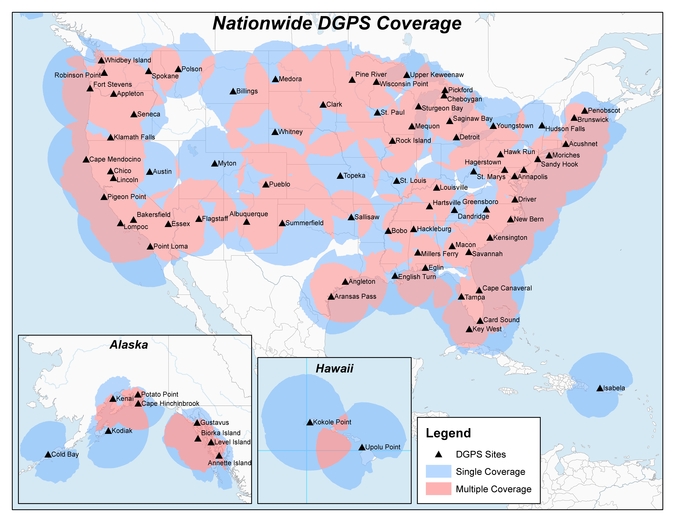
    The U.S. Coast Guard, Department of Transportation and Army Corps of Engineers have reduced the number of Nationwide Differential Global Positioning System (NDGPS) sites that will be decommissioned. The course correction keeps a coastal and Mississippi River network of stations largely intact, while discontinuing inland services.

    Last year at this time, the agencies sought public comment on a proposed shutdown of 62 of 84 NDGPS sites.

    “After a review of the comments received, we have reduced to 37 the number of NDGPS sites to be shut down, nine of which are USCG Maritime sites and 28 of which are DOT inland sites,” the notice reads. “The NDGPS system will remain operational with a total of 46 USCG and USACE sites available to users in the maritime and coastal regions.”

    Graphic depicting NDGPS coverage after site reductions. (U.S. Coast Guard)
    Graphic depicting NDGPS coverage after site reductions. (U.S. Coast Guard)

    Public use of NDGPS, never robust, has declined in large part due to limited availability of DGPS receivers. Many users and applications, particularly in precision agriculture, have shifted to commercially provided services or Wide Area Augmentation System (WAAS) corrections instead.
    NDGPS coverage is maintained in major maritime ports and waterways. See www.federalregister.gov for a list of sites to be decommissioned. Termination of the broadcast signal is scheduled to occur by Aug. 5.


    OCX Deep Dive Finds Progress, Need for Funds

    The Pentagon seeks $39.2 million from Congress to speed the next-generation GPS ground control system (OCX) towards completion. Without the infusion, OCX would be delayed an additional four months and cost $90 million more to complete, the Pentagon said.

    The embattled OCX showed progress in its July 7 quarterly review, according to an Air Force statement. DOD officials and Lt. Gen. Samuel Greaves, Space and Missile Systems Center commander, concluded Raytheon has made progress implementing critical changes.

    On June 30, OCX exceeded baseline cost estimates by at least 25 percent, triggering a Nunn-McCurdy breach and potentially halting all work. Further OCX review will wind up in October. The Pentagon announced in 2015 that it was delaying initial OCX operations for the ground system until July 2021.

    GPS III satellites. which may first launch in 2017, cannot use their full capabilities with the current ground control system, but the Air Force plans to use a retrofit to work with the GPS III designs until OCX is operational. See gpsworld.com/updatesyndrome for more details.


    Galileo and the Brexit Effect

    Tension Grows over the Public Regulated Service

    By Tim Reynolds, European editor

    UK involvement in the European Space Agency (ESA) should be unaffected by Brexit  — the UK leavetaking, as yet undetermined in its details, from the European Union. ESA is a separate institution from the EU. However, one could argue that non-EU-membership might diminish the UK voice and could require a higher financial contribution.

    Bids for the next Galileo satellite purchase contracts were due in mid-July, and the European Commission indicated that it will consider them purely on commercial terms. Airbus Defence and Space and Thales Alenia Space were expected to bid, as was the incumbent supplier of the first 22 satellites, OHB SE of Bremen, Germany, with Surrey Satellite Technology Ltd. (SSTL) of Britain as OHB’s satellite payload developer.

    The EU has historically been averse to non-EU companies taking major roles in Galileo, and the immediate question is whether the EC could accept an SSTL-built payload that would not be launched until after Britain’s exit is complete.

    Paul Verhoef, ESA’s director of navigation, said he will manage the competition as if Brexit had not occurred, with no discrimination against British bidders. Marco R. Fuchs, chief executive of OHB, said OHB would continue the front-line role for SSTL.

    Britain could negotiate a security similar treaty similar to one reached by Norway and the EU, that could become effective on the date of Britain’s departure.

    If I were a betting man, I’d still wager the house on the incumbent consortium winning the contract to provide the remaining satellites required to provide a sustainable, 24/7 operational constellation for first-generation Galileo. There would, in my opinion, be an unwarranted technical risk in doing anything else.

    However, for the next generation it is open season, of course.

    PRS at Risk. The real worry must be for the Public Regulated Service (PRS). This is the unique feature of Galileo that is of great interest to civil and military authorities in Europe and beyond, due to its more robust encrypted signal and its potential anti-jamming and spoofing characteristics. Currently, PRS will only be available to EU Member States. However, other countries, including the U.S. and Norway, have indicated that they would love to be able to use it as well. No final decision on this has yet been made.

    The loss of the automatic right to access PRS would be damaging to the UK, and potentially to the full Galileo deployment timetable, as the country is currently host to the back-up Galileo Security Monitoring Centre (GSMC) — an essential part of PRS infrastructure — and I cannot see any part of the PRS infrastructure being left in a non-member state. If the centre must be relocated, then deployment of the full service could be delayed.

    In addition, UK involvement in research and innovation activities around PRS may be curtailed, even if other work on Galileo projects is not.

    UK a PRS Leader. The UK has been a leader in developing PRS applications. Nottingham Scientific Limited (NSL) recently demonstrated cloud-based PRS applications including implementation of PRS authentication for an offender tag, done using live Galileo (and GPS) signals. The demonstration provided real-time authentication flag generation, release and delivery to users. A second demo used cloud-based PRS in a proof-of-concept remote, unattended timing station where the primary user requirement was 100-percent confidence for the validity of signal. A third demonstration illustrated the use of cloud-based PRS on a drone.

    Dual-Use Debate

    PRS was also a major talking point at the European Space Solution event in The Hague in May. A panel on Space and Security noted that despite the fact that Galileo is marketed as a civil controlled GNSS, “dual use” is becoming a potentially divisive area for debate.

    Rini Goos from the European Defence Agency (EDA) said that the EU needed space systems to be able to “intervene successfully,” and that space strategy needed to support Member State defence capabilities. This meant that the next generation of EU space systems must have dual-use capability. NATO is entrusted with external defence of the EU, but the commission also needs to be able to provide defence, not just consume it, he concluded.

    The current chairman of the Galileo Security Accreditation Board is a UK citizen, Jeremy Blyth. He said: “Space and security, security and space. Whichever way we say it, what is clear is that the two are inextricably linked together.” He believes that to ensure security, it must be “designed in from the beginning.” Security is an enabler, rather than a barrier, he claimed.

    He also believes that PRS gives the EU a real and competitive edge in secure positioning.

    However, he indicated that there is a need to think deeply and have a rational debate about dual-use systems and, in particular, about the interface between civil and military use.

    Clearly, there is a growing tension with regard to overtly military use of Galileo both now and in future generations of the system. Although a largely philosophical debate, given who in reality will be controlling and using PRS within many Member States, many European and national policy makers will want to retain the “purity” of Galileo as a global positioning system under fully civilian control.

    PRS Workshop

    Security was also a key feature of the PRS workshop organised by the Netherlands EU Presidency toward the end of European Space Solutions. Ger Nieuwpoort, director of the Netherlands Space Office (NSO), reminded the audience that “For civil authorities, PRS provides the same level of security for Member States as the military in GPS.”

    Bart Banning of the Netherlands Institute of Navigation asked “How will we use PRS?’” In terms of its use for protecting critical infrastructure, what if the owner of the infrastructure was a private company? Should it be granted access to PRS or have to make do with the Galileo Commercial Service, a.k.a. PRS-lite?

    He also pointed out that PRS was no more protected against jamming than any other GNSS. And, currently, it was “not good for in-building, underground or underwater.”

    He thought PRS could be a great time provider, but probably also needs ground transmission, possibly via legacy radio towers. However, he saw the “killer app” for PRS being asset tracking, such as for diamonds, VIPs or prisoners. He also agreed that for many EU countries, the ministry of defence will be overseeing PRS services. “PRS is a good and unique addition to GNSS — but not the answer to all our needs.”

  • GNSS Constellation Update

    Broadcast Date: Thursday, October 25, 2012
    Speaker: Eric Gakstatter, contributing editor for survey and GIS
    Summary: This month, a new GPS satellite was launched, India launched a new SBAS satellite, and two Galileo satellites are scheduled to launch. Last month, China launched two more BeiDou satellites. There’s a lot of activity of the satellite navigation industry. In the webinar, I will discuss what these new developments mean to the surveying/mapping user, as well as other current events.

  • Air Force jam-proof test range ready; Galileo teendom

    Locatalite transceiver installation in the White Sands Missile Range Ultra High-Accuracy Reference System, provided by the U.S. Air Force for testing equipment under conditions of GPS jamming.
    Locatalite transceiver installation in the White Sands Missile Range Ultra High-Accuracy Reference System, provided by the U.S. Air Force for testing equipment under conditions of GPS jamming.

    Provides high-accuracy PNT even when GNSS jammed

    A critical capability to predict for GNSS chips and receivers —and for devices using alternative or back-up PNT technologies — is how they will actually perform without GPS.

    Filling this need, the U.S. Air Force 746th Test Squadron has declared Initial Operational Capability (IOC) for its new truth reference, the Ultra High-Accuracy Reference System (UHARS) at the White Sands Missile Range in New Mexico. Even when GPS — or any other GNSS system — is being completely jammed, UHARS provides extremely accurate positioning, navigation and time (PNT) over the large area that the system was designed to cover.

    “Initial testing shows that UHARS delivers accurate independent PNT as good as, or better than, the Air Force’s current Central Inertial and GPS Test Facility Reference System, so it is perfectly able to support current customer requirements,” said Jim Brewer, chief scientist of the 746th Test Squadron. “However, more data are required to tune the UHARS filter and optimize its accuracy to meet even tighter PNT requirements, which is our objective. When this is achieved, UHARS will deliver truth accuracy for next-generation military capabilities, and we will declare UHARS Full Operational Capability.”

    “UHARS is a rack-mounted, tightly integrated system of improved navigation sensors, a data acquisition system and a new post-mission Kalman filter, all of which need to work together,” said John Cao, technical director of the 746th. “It’s working very well, but once we completely measure and characterize the individual components and then tune and validate the filter, the complete system will provide a significantly more accurate reference solution for future airborne and land-based test vehicles in navigation warfare environments where modernized and legacy GPS signals are jammed from friendly or hostile systems.”

    LocataLite Transceivers. To achieve these accurate reference solutions, UHARS requires a core Non-GPS Based Positioning System (NGBPS) component capable of operating and providing sub-meter position accuracy in a GPS-denied (jamming) environment.

    The NGBPS subsystem of the UHARS program employs a network of ground-based LocataLite transceivers and test vehicle receivers manufactured by the Locata Corporation. The Locata network delivers centimeter-level positioning and navigation as well as nanosecond-level synchronization, which may be useful for military applications requiring precise time transfer in GPS-denied environments.

    White Sands is a U.S. Army rocket range of almost 3,200 square miles in parts of five counties in southern New Mexico. It is the largest military installation in the U.S.

    The LocataNet truth reference system can also provide a 2D solution to support ground-vehicle testing. Reportedly, the 2D solution, while also very good, has not yet been fully characterized. Once the filter has been fully tuned in this respect, White Sands could serve as a test facility for autonomous driving. It has many miles of paved highway, possibly in the hundreds of miles.

    The importance and uniqueness of White Sands as GPS test facility springs from the fact that it is illegal to jam GPS elsewhere without a special permit, making it extremely difficult to create a real-world test scenario to see how GPS and other PNT devices perform under denied or restricted circumstances. This is of critical importance for flight testing (UAVs and other avionics) for which the UHARS was primarily designed and optimized.

    Ligado study flawed, says NovAtel

    Method shows lack of understanding of GPS uses

    NovAtel Inc. has submitted comments to the Federal Communications Commission (FCC) regarding Ligado Networks LLC’s (formerly LightSquared) License Modification Applications.

    NovAtel raises deep concerns about the testing methodology used and conclusions presented by Ligado regarding the impact of its proposed usage of L-band frequencies for a terrestrial wireless network.

    In its filing, NovAtel identified serious flaws in the testing methodology used to evaluate high-precision receivers. Although high-precision receivers were used during the testing, the high-precision position modes that are used to achieve centimeter-level positioning accuracy required by many professional and safety-critical applications were not evaluated.

    The study shows a lack of understanding of the uses of the GPS by assuming that all applications require the same positioning accuracy, NovAtel said.

    The filing also raises a number of concerns about the potential harmful interference impact on GPS receiver performance. NovAtel is particularly concerned that Ligado has moved away from what it understood to be an agreed-upon standard that interference tolerance should be limited to a received interference signal power level that causes no more than 1-dB degradation in the received C/N0 level.

    NovAtel disagrees with the conclusion in the RAA Study that there is no meaningful correlation between a 1-dB change and GPS performance. NovAtel submits any interference must not exceed 1-dB degradation in received C/N0 if robust, precise positioning is to be maintained. Ligado has not yet proven that its use of the spectrum will not be detrimental to high-precision GNSS users, which is what the 1-dB C/N0 degradation metric ensures.

    “To date, Ligado has not proven that its use of the proposed spectrum can be made compatible with high-precision GNSS,” NovAtel said in a press release. “The interference impact on the other GNSS constellations such as Galileo, GLONASS and BeiDou has not been addressed. These constellations are increasingly used in combination with GPS for many high-precision applications. Proposed, unverified mitigation methods such as narrowband antennas are presented in the Ligado filing without explanation of who will be responsible for the cost of such design modifications and retrofit programs.”

    Galileo reaches teendom

    Europe’s 13th and 14th Galileo satellites lifted off at 08:48 GMT from Europe’s Spaceport in French Guiana atop a Soyuz launcher. (Photo: ESA)
    Europe’s 13th and 14th Galileo satellites lifted off at 08:48 GMT from Europe’s Spaceport in French Guiana atop a Soyuz launcher. (Photo: ESA)

    The Galileo constellation system now has 14 satellites in orbit after a May 24 double launch. Birds 13 and 14 lifted off together at 08:48 GMT (10:48 CEST, 05:48 local time) atop a Soyuz rocket from French Guiana. The twin Galileos were deployed into orbit close to 23,522 km altitude, inclined 57.394 degrees to the equator, 3 hours and 48 minutes after liftoff. Following days saw a careful sequence of orbital fine-tuning to bring them to their final working orbit, followed by a testing phase so that they can join the working constellation later this year.

    Marconi Prize awarded to Brad Parkinson

    The Marconi Society awarded its 2016 Marconi Prize to Bradford Parkinson. The annual prize recognizes major advances in information and communication science that benefit humanity: in this case, the difficult yet ultimately successful development of GPS. See gpsworld.com/marconi for details and a brief history.

  • Geospatial World Forum looks at Galileo, EGNOS for GIS

    Tim Reynolds
    Tim Reynolds

    By Tim Reynolds
    Contributing Editor for Europe

    The eighth edition of the Geospatial World Forum took place May 23–26 in Rotterdam, The Netherlands, attracting professionals from the surveying and geospatial information system (GIS) sectors. I attended the event on May 24 and took part in a workshop that looked at the benefits of Galileo and EGNOS in geospatial applications in the context of the imminent launch of Galileo initial services.

    An industry survey undertaken by the GSA indicates that already more than 80 percent of GNSS receivers for surveying and mapping use are EGNOS-enabled, while 77 percent of geospatial reference network providers have enough information to upgrade Galileo and will be ready to provide a service by 2017. All good news. On the less positive side, more than 60% of professional surveyors did not know about EGNOS!

    The workshop also talked up the potential for synergies between Galileo GNSS and Copernicus Earth Observation (EO) systems — a topic of immense interest at the European Space Solutions as well. Hans Dufourmont from the European Environment Agency (EEA) highlighted the use of GNSS to track animal species and monitor migration paths when considering development opportunities. He saw a huge potential for synergies between geopositioning and surface imaging going forward.

    Maurice Barbieri, president of the Council of European Geodetic Surveyors (CLGE), also saw a “clear role for Galileo” in the surveying community with its potential ability to meet centimeter accuracy requirements much more than for EGNOS.

    He also speculated about the value of establishing a European Geoinformatic Agency that might coordinate the provision of European GNSS and EO data. He felt the private business community would appreciate such simplification.

  • What the ‘Brexit’ vote means for EU space programmes, Galileo

    What the ‘Brexit’ vote means for EU space programmes, Galileo

    A Kingdom Divided: Whither EU Space Programmes?

    Brexit-WGood grief, it has been a wild week or two. I was hoping that I wouldn’t need to talk about the incredible, excruciating UK referendum on European Union membership, but as the result has gone to the “leave” campaign, I feel obliged to pick over the wreckage.

    What does a UK exit from the EU mean for EU space programmes and Galileo in particular?

    First: UK involvement in the European Space Agency (ESA) should be unaffected by the exit of the UK from the European Union as this is a separate institution. However, one could argue that non-membership of the EU might diminish its voice and could require a higher financial contribution.

    Bids for the next Galileo satellite purchase contracts are due to be submitted in mid-July, and the European Commission has indicated that it will consider them purely on commercial terms. This is good news for the OHB System and Surrey Satellite Technology Limited (SSTL) consortium. And also for the Commission. If I were a betting man, I’d still wager the house on the incumbent consortium winning the contract to provide the remaining satellites required to provide a sustainable, 24/7 operational constellation for 1st generation Galileo. There would, in my opinion, be an unwarranted technical risk in doing anything else.

    However, for the next generation it is open season of course.

    Jewel in the Crown at Risk. But the real worry must be the Public Regulated Service (PRS). This is the unique feature of Galileo that is of great interest to civil and military authorities in Europe and beyond, due to its more robust encrypted signal and its potential anti-jamming and spoofing characteristics. Currently PRS will only available to EU Member States. In fact access to a PRS workshop at the European Space Solutions event (see below) was strictly “EU citizens only.” However, other countries, including the US and Norway, have indicated that they would love to be able to use it as well. No final decision on this has yet been made.

    The loss of the automatic right to access PRS would be damaging to the UK, and potentially to the full Galileo deployment timetable, as the country is currently host to the back-up Galileo Security Monitoring Centre (GSMC) — an essential part of PRS infrastructure — and I cannot see any part of the PRS infrastructure being left in a non EU Member State. PRS has been described as the “jewel in the Galileo crown,” but if the centre must be relocated then deployment of the full service could be delayed.

    In addition, the UK involvement in research and innovation activities around PRS may well be curtailed, even if other work on Galileo projects is not.

    The UK has been a leader in developing PRS applications. For example, Mark Dumville and colleagues at Nottingham Scientific Limited (NSL) have recently provided some very impressive demonstrations of cloud-based PRS applications including the first demonstration of the implementation of PRS authentication for an offender tag that was demonstrated using live Galileo (and GPS) signals. The demonstration provided real-time authentication flag generation, release and delivery to users. A second demonstration used cloud-based PRS in a proof-of-concept remote unattended, timing station where the primary user requirement was 100% confidence for the validity of signal. And a third demonstration illustrated the use of cloud-based PRS on a drone. “For users, demonstration of accreditation is key,” said Dumville when describing these results at the European Space Solutions event.

    Personally as a British citizen, and one who has spent the last 15 years in and out of the Brussels bubble, I see the EU referendum result as a national tragedy of epic proportions; and one that has been a long time in the making. Many global commentators are saying the UK has shot itself in the foot; sadly, in my opinion, it is much, much worse than that.

    United Europe

    The referendum news has certainly put a dampener on what I was hoping to be an optimistic, forward-looking article following the European Space Solution event in The Hague at the end of May. This was the fourth European Space Solutions conference and exhibition, attracting a large, global audience of policy-makers and industry players.

    At a press briefing just before the event kicked off on 30 May, and after an informal EU competitiveness ministerial council, Dutch minister for Economic Affairs Henk Kamp spoke about the ideas behind the forthcoming EU Space Policy. The policy, which should appear in the autumn/ fall, aims to elaborate a single and coherent European space strategy that will be the foundation of space programmes up to 2030.

    The policy will look to achieve three clear objectives:

    • to develop a strategy to ensure Europe maintains a strong and globally competitive space sector both upstream and in terms of use of data from space;
    • ensure independent access for Europe to space;
    • and maintain and upgrade the existing European space infrastructure — namely Galileo and Copernicus.

    Growth Vectors. Elżbieta Bieńkowska, the European Commissioner with responsibility for EU space programmes, indicated that the space policy would provide a “Coherent space vision for decades to come” and would be subject to public consultation. She was looking for “Maximum return on current programmes … and to respond to emerging needs in areas such as climate and security sectors.” The strategy will consider space-enabled solutions to societal challenges and as vectors for growth.

    She mentioned more than once that she is looking for long-term sustainability for the sector: a space sector that is able to adapt to disruptive technologies and maintain its competitive edge. My interpretation of this is that public money (from Europe) may not be as plentiful as previously, and the Commission will be looking for greater leverage of its tax Euros — that is, the private sector will need to invest more.

    Lowri Evans, Director-General for Internal Market, Industry, Entrepreneurship and SMEs, at the European Commission took up this theme. She saw huge opportunities as the cost of entry to the sector diminished, however private investment was still a problem. There was not enough in the EU and this must change. The Commission is aiming to create an environment for successful investment, she claimed.

    Jan Worner, the very positive Director-General of ESA said that “Space was indispensable” as an instrument for economic growth. It was also fascinating and inspiring. He felt it was also important that the different players in the EU space scene are working together for a “United Space in Europe.”

    The conference was also the venue for the official signing of the agreement for the future Galileo Reference Centre (GRC) that is to be established at Noordwijk in The Netherlands. The centre will play a crucial role in independently monitoring and reporting on Galileo’s performance and the quality of the system’s signal in space.

    Dual-Use Debate

    PRS was also a major talking point at the European Space Solution’s panel on ‘Space and Security.’ Despite the fact that Galileo is marketed as a civil controlled GNSS, “dual use” is becoming a potentially divisive area for debate. Marian-Jean Marinescu, MEP said there was a need for a common European defence and security strategy that includes securing all elements of the space value chain.

    Rini Goos from the European Defence Agency (EDA) said that the EU needed space systems to be able to “intervene successfully” and that space strategy needed to support Member State defence capabilities. This meant that the next generation of EU space systems must have dual-use capability. NATO is entrusted with external defence of the EU, but the Commission also needs to be able to provide defence, not just consume it, he concluded.

    Current Chairman of the Galileo Security Accreditation Board is a UK citizen – Jeremy Blyth. He said: “Space and Security, Security and Space. Whichever way we say it what is clear is that the two are inextricably linked together.” He believes that to ensure security it must be there “designed in from the beginning.” Security is an enabler, rather than a barrier, he claimed.

    He also believes that PRS gives the EU a real and competitive edge in secure positioning. However he indicated that there is a need to think deeply and have a rational debate about dual-use systems and in particular about the interface between civil and military use.

    Clearly there is a growing tension with regard to overtly military use of Galileo both now and in future generations of the system. Although a largely philosophical debate, given who in reality will be controlling and using PRS within many Member States, many European and national policy makers will want to retain the “purity” of Galileo as a global positioning system under fully civilian control.

    PRS Workshop

    Security was also a key feature of the PRS workshop organised by the Netherlands EU Presidency towards the end of European Space Solutions. Ger Nieuwpoort, Director of the Netherlands Space Office (NSO) reminded the audience that “For civil authorities, PRS provides the same level of security for Member States as the military in GPS.” While Christoph Kautz from the Commission said that the “Rationale for PRS was threats and user needs: better availability, high continuity, authentication, access control, exclusivity.”

    PRS offers defence in depth with a robust signal in space providing higher protection plus strong encryption on ranging codes, and the navigation and service messages. And the access to the technology is highly restricted.

    However some issues still need to be resolved. Bart Banning of the Netherlands Institute of Navigation asked ‘How will we use PRS?’ In terms of its use for protecting critical infrastructure, what if the owner of the infrastructure was a private company? Should it be granted access to PRS or have to make do with the Galileo Commercial Service aka PRS-lite?

    He also pointed out that PRS was no more protected against jamming than any other GNSS. And, currently, it was “not good for in-building, underground, or underwater.”

    He thought PRS could be a great time provider, but probably also need ground transmission, possibly via legacy radio towers. However, he saw the “killer app” for PRS being asset tracking of, for example, diamonds, VIPs or prisoners. He also agreed that for many EU countries the ministry of defence will be overseeing PRS services. “PRS is a good and unique addition to GNSS — but not the answer to all our needs.”

    Banning also highlighted the issue of commercial companies looking to buy LORAN / e-LORAN sites in Europe to provide a commercial service to back up GNSS. After the recent GPS timing glitch he said that the “timing community” had woken up to the vulnerability of their operations.

    Geospatial

    On a different tack, from 23–26 May the eighth edition of the Geospatial World Forum [www.geospatialworldforum.org] took place in Rotterdam, attracting professionals from the surveying and geoinformatic systems (GIS) sectors. I attended the event on 24 May and took part in a workshop that looked at the benefits of Galileo and EGNOS in geospatial applications in the context of the imminent launch of Galileo initial services.

    An industry survey undertaken by the GSA indicates that already more than 80% of GNSS receivers for surveying and mapping use are EGNOS-enabled, while 77% of geospatial reference network providers have enough information to upgrade Galileo and will be ready to provide a service by 2017. All good news. On the less positive side, more than 60% of professional surveyors did not know about EGNOS!

    The workshop also talked up the potential for synergies between Galileo GNSS and Copernicus Earth Observation (EO) systems — a topic of immense interest at the European Space Solutions as well. Hans Dufourmont from the European Environment Agency (EEA) highlighted the use of GNSS to track animal species and monitor migration paths when considering development opportunities. He saw a huge potential for synergies between geopositioning and surface imaging going forward.

    Maurice Barbieri, President of the Council of European Geodetic Surveyors (CLGE) also saw a “clear role for Galileo” in the surveying community with its potential ability to meet centimetre accuracy requirements much more than for EGNOS. He also speculated about the value of establishing a European Geoinformatic Agency that might coordinate the provision of European GNSS and EO data. He felt the private business community would appreciate such simplification.

    One presentation that caught my eye was from Laura van de Vyvere of M3 Systems in Belgium. She won the first-ever European Young Surveyor Prize with a paper taken from her Master’s thesis. The presentation addressed an innovative use of Galileo’s unique signal in space that is carried on four frequencies in the Open Service. Her work showed that the four frequencies enabled more precise phase measurements than with GPS so cycle slip is easier to detect and positioning data and reliability can be improved especially in harsh ionospheric conditions. The algorithm she developed could enable affordable multi-frequency receivers for mass-market applications, she claimed. An interesting idea.

    A bientôt, as they say in these parts.


  • Galileo program governance: New chair of GSA Administrative Board named

    Galileo program governance: New chair of GSA Administrative Board named

    Jean-Yves Le Gall
    Jean-Yves Le Gall (Photo: Liberation)

    Meeting on Thursday, June 23, at its headquarters in Prague, the Administrative Board of the European Global Navigation Satellite Systems Agency (GSA) elected its new chair: Jean-Yves Le Gall, Centre National d’Etudes Spatiales (CNES, the French space agency) president and France’s interministerial coordinator for European satellite navigation programmes.

    Le Gall succeeds Sabine Dannelke, German federal minister of Transport and Digital Infrastructures.

    Headquartered in Prague, GSA is in charge of managing operations of satellite navigation systems on behalf of the European Union since 2014 for the European Geostationary Navigation Overlay Service (EGNOS) and from 2017 for Galileo. Carlo des Dorides is GSA’s executive director.

    Commenting on his election, Jean-Yves Le Gall said: “I am most honoured to have been elected Chair today of the GSA Administrative Board, with Galileo now poised to enter its operational phase.

    “My election recognizes France’s key role in satellite navigation, reflected in the commitment of the members of the Interministerial Working Group (GTI) and CNES’s historic expertise in this domain, for which it has shown unwavering support for the EGNOS and Galileo programmes since their inception.

    “This election and that as Deputy Chair of Mark Bacon, representing the United Kingdom, also confirms EU member states’ desire to join forces through Europe’s Space Team on the cusp of a period that is set to prove most prolific for GSA, since it will be moving Galileo towards full operational capability.

    “I would like to thank Sabine Dannelke for her decisive action over the last few years as Chair of the Board, and I very much look forward to working hand in hand with Executive Director Carlo des Dorides and everyone at GSA, whom I know, like and respect.”

  • Four-satellite Galileo Ariane 5 dispenser in place

    Four-satellite Galileo Ariane 5 dispenser in place

    News from the European Space Agency (ESA)

    A four-satellite dispenser for Galileo's Ariane 5 is shown during shaker testing at Airbus Defence and Space near Bordeaux, France. The dispenser has had four Galileo engineering models attached to it for test purposes. Copyright: ESA
    A four-satellite dispenser for Galileo’s Ariane 5 is shown during shaker testing at Airbus Defence and Space near Bordeaux, France. The dispenser has had four Galileo engineering models attached to it for test purposes.
    Copyright: ESA

    Following rigorous testing in France and Germany, a new type of dispenser designed to carry four navigation satellites into orbit at once is now in French Guiana, in place for Galileo’s first Ariane 5 launch later this year.

    The dispenser is an essential element of launch success, with a double role to play. It first must hold the quartet of satellites securely in place during the stresses of liftoff, and then the nearly four-hour long flight to medium-Earth orbit.

    Then, once the Ariane 5 EPS upper stage reaches its target altitude of 23,222 kilometers , the dispenser will release the four Galileo satellites using a pyrotechnic release system triggered by separate igniters, each one firing half a second after the other.

    The separated satellites are then pushed away from the dispenser in separate directions using a spring-based distancing system.

    The 447-kilogram dispenser, designed by Airbus Defence and Space, must support a satellite mass of 738 kilograms each – nearly three tons total.

    Made from a combination of metal and composite materials for maximum stiffness, the dispenser has undergone very comprehensive testing at Airbus Defence and Space near Bordeaux, France, and the IABG testing centre in Ottobrunn, Germany – using both Galileo engineering models and an actual flight satellite, including fit, shock and separation testing.

    A four-satellite dispenser for Ariane 5 Galileo launches with engineering models attached for test purposes. Copyright: CNES/ESA
    A four-satellite dispenser for Ariane 5 Galileo launches with engineering models attached for test purposes.
    Copyright: CNES/ESA

    The test campaign met all objectives, reports the ESA, confirming the behavior performs as predicted, after which the dispenser was shipped to Europe’s Spaceport in French Guiana.

    This fall, four Galileo satellites will be launched together for the very first time on a specially customized launcher — the Ariane 5 ES Galileo.

    In development since 2012, the new launcher variant has evolved from the Ariane 5 ES (Evolution Storable), used to place ESA’s 20,000-kilogram ATV supply vehicle into low-Earth orbit.

    This launder has to carry a lower mass payload – four fully fuelled 738-kilogram Galileo satellites plus their supporting dispenser – but needs to take it up to the much higher altitude of medium-Earth orbit, approximately 23,222 kilometers up.

    The target orbit is actually 300 kilometers below the Galileo constellation’s final working altitude, which leaves the Ariane’s EPS upper stage in a stable “graveyard orbit,” while the quartet of Galileos maneuver themselves up to their final set height.

    Once the Ariane 5 ES Galileo flight is complete, there should be 18 Galileo satellites in orbit.

  • Congress yanks OCX funding; Galileo grows

    Congress yanks OCX funding; Galileo grows

    Congress Yanks OCX Funding

    SecDef Must Demonstrate Its Essential Nature

    The U.S. Senate Armed Services Committee withheld the full amount requested by the Pentagon for Fiscal Year (FY) 2017 for OCX, the Next-Generation Operational Control System (ground control) for GPS, heretofore deemed necessary to operate the next generation of satellites, GPS III. The Pentagon had asked for $394 million in the upcoming funding cycle, to enable Raytheon to continue work on the program.

    If allowed by Congress to continue, OCX may cost as much as $5.3 billion, and there is no certainty that the bill will not rise further.

    The Senate committee will not release the $394 million until the Defense Department complies with the requirements of the Nunn-McCurdy Act governing defense programs. Otherwise, Congress could act to terminate OCX.

    The terms of the Act now require the Secretary of Defense to conduct an in-depth review and then state that the program is essential to national security, is more important than other programs that will have to be cut to accommodate its cost overruns, and that there are no acceptable alternatives.

    From the Defense Department point of view, the new GPS III satellites are essential because of, among other things, their signals’ improved resistance to jamming and cyberattack, an oft-cited peril in the modern global security scenario.

    How GPS III could be launched — the first satellite is scheduled for sometime in 2017 — and operated without OCX is not entirely clear, although in February, Lockheed Martin received a $96 million contract to provide contingency control operations for the first GPS III satellites upon launch because OCX won’t be ready. Raytheon and the U.S. Air Force announced a month ago that OCX “successfully passed the first formal qualification test milestone” needed to check out the system and for the early monitoring of satellites in orbit. That “validates the maturity of the OCX launch and checkout system,” according to a statement by Bill Sullivan, Raytheon’s OCX program director.

    Raytheon won the OCX contract in 2010 with a bid somewhat more than $1.5 billion. The Air Force recently made its FY 2017 budget request for $393 million as part of an overall anticipated program cost of $4.82 billion. However, a Bloomberg news report states that the total cost may have risen to $5.3 billion.

    Galileo Launch and Production

    At press time, the latest pair of Galileo satellites was expected to launch into orbit on May 24: the 13th and 14th satellites in the constellation.

    A second launch is planned for this fall, carrying four satellites aboard a customized Ariane 5 for the first time. This would bring the count to 18 Galileo satellites in orbit by the end of the year.

    Final Payload Delivered. Surrey Satellite Technology Ltd. in the United Kingdom has delivered the 22nd Galileo navigation payload to prime contractor OHB System in Bremen, Germany. This is SSTL’s final payload under Galileo Full Operational Capability (FOC) Works Orders 1 and 2.

    Europe’s 13th and 14th Galileo satellites lifted off at 08:48 GMT from Europe’s Spaceport in French Guiana atop a Soyuz launcher. (Photo: ESA)
    Europe’s 13th and 14th Galileo satellites lifted off at 08:48 GMT from Europe’s Spaceport in French Guiana atop a Soyuz launcher. (Photo: ESA)

    BeiDou 30 over 5

    China plans to launch 30 Beidou navigation satellites during the five-year period 2016–2020, said Ran Chengqi, director of the China Satellite Navigation Office, during the China Satellite Navigation Conference in early May.

    This would realize the country’s three-step strategy to build a global navigation system by 2020. A batch of 18 satellites will be launched before 2018. China and Russia have agreed to make BeiDou and GLONASS compatible, and BeiDou has successfully synchronized its frequency with Galileo, Chengqi added.