Category: GPS

  • Building a Wide-Band Multi-Constellation Receiver

    Building a Wide-Band Multi-Constellation Receiver

    The Universal Software Radio Peripheral as RF Front-End

    By Ningyan Guo, Staffan Backén, and Dennis Akos

    The authors designed a full-constellation GNSS receiver, using a cost-effective, readily available, flexible front-end, wide enough to capture the frequency from 1555 MHz to 1607 MHz, more than 50MHz. This spectrum width takes into account BeiDou E2, Galileo E1, GPS L1, and GLONASS G1. In the course of their development, the authors used an external OCXO oscillator as the reference clock and reconfigured the platform, developing their own custom wide-band firmware.

    The development of the Galileo and BeiDou constellations will make many more GNSS satellite measurements be available in the near future. Multiple constellations offer wide-area signal coverage and enhanced signal redundancy. Therefore, a wide-band multi-constellation receiver can typically improve GNSS navigation performance in terms of accuracy, continuity, availability, and reliability. Establishing such a wide-band multi-constellation receiver was the motivation for this research.

    A typical GNSS receiver consists of three parts: RF front-end, signal demodulation, and generation of navigation information. The RF front-end mainly focuses on amplifying the input RF signals, down-converting them to an intermediate frequency (IF), and filtering out-of-band signals. Traditional hardware-based receivers commonly use application-specific integrated circuit (ASIC) units to fulfill signal demodulation and transfer the range and carrier phase measurements to the navigation generating part, which is generally implemented in software. Conversely, software-based receivers typically implement these two functions through software. In comparison to a hardware-based receiver, a software receiver provides more flexibility and supplies more complex signal processing algorithms. Therefore, software receivers are increasingly popular for research and development.

    The frequency coverage range, amplifier performance, filters, and mixer properties of the RF front-end will determine the whole realization of the GNSS receiver. A variety of RF front-end implementations have emerged during the past decade. Real down-conversion multi-stage IF front-end architecture typically amplifies filters and mixes RF signals through several stages in order to get the baseband signals. However, real down-conversion can bring image-folding and rejection. To avoid these drawbacks, complex down-conversion appears to resolve much of these problems. Therefore, a complex down-conversion multi-stage IF front-end has been developed. But it requires a high-cost, high-power supply, and is larger for a multi-stage IF front-end. This shortcoming is overcome by a direct down-conversion architecture. This front-end has lower cost; but there are several disadvantages with direct down-conversion, such as DC offset and I/Q mismatch. DC offset is caused by local oscillation (LO) leakage reflected from the front-end circuit, the antenna, and the receiver external environment.

    A comparison of current traditional RF front-ends and different RF front-end implementation types led us to the conclusion that one model of a universal software radio peripheral, the USRP N210, would make an appropriate RF front end option. USRP N210 utilizes a low-IF complex direct down-conversion architecture that has several favorable properties, enabling developers to build a wide range of RF reception systems with relatively low cost and effort. It also offers high-speed signal processing. Most importantly, the source code of USRP firmware is open to all users, enabling researchers to rapidly design and implement powerful, flexible, reconfigurable software radio systems. Therefore, we chose the USRP N210 as our reception device to develop our wide-band multi-constellation GNSS receiver, shown in Figure 1.
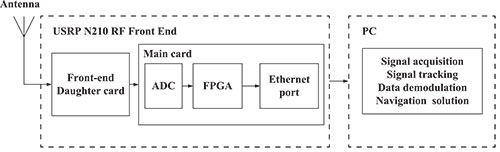
    Figure 1 Custom wide-band multi-constellation software receiver architecture based on universal software radio peripheral (USRP).
    Figure 1. Custom wide-band multi-constellation software receiver architecture based on universal software radio peripheral (USRP).
    USRP Front-End Architecture

    The USRP N210 front-end has wider band-width and radio frequency coverage in contrast with other traditional front-ends as shown by the comparison in Table 1. It has the potential to implement multiple frequencies and multiple-constellation GNSS signal reception. Moreover, it performs higher quantization, and the onboard Ethernet interface offers high-speed data transfer.
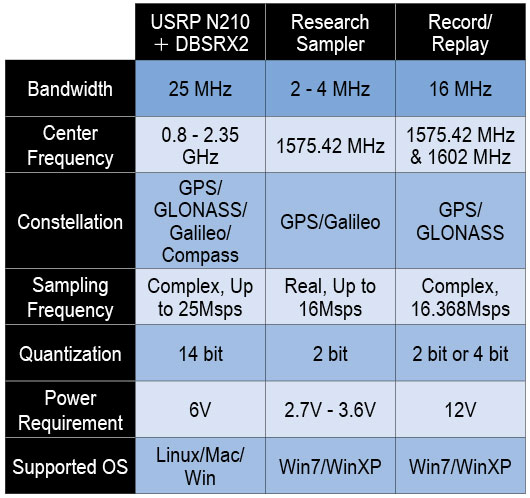
    Table 1. GNSS front-ends comparison.
    Table 1. GNSS front-ends comparison.

    USRP N210 is based on the direct low-IF complex down-conversion receiver architecture that is a combination of the traditional analog complex down-conversion implemented on daughter boards and the digital signal conditioning conducted in the motherboard. Some studies have shown that the low-IF complex down-conversion receiver architecture overcomes some of the well-known issues associated with real down-conversion super heterodyne receiver architecture and direct IF down-conversion receiver architecture, such as high cost, image-folding, DC offset, and I/Q mismatch.

    The low-IF receiver architecture effectively lessens the DC offset by having an LO frequency after analog complex down-conversion. The first step uses a direct complex down-conversion scheme to transform the input RF signal into a low-IF signal. The filters located after the mixer are centered at the low-IF to filter out the unwanted signals. The second step is to further down-covert the low-IF signal to baseband, or digital complex down-conversion.

    Similar to the first stage, a digital half band filter has been developed to filter out-of-band interference. Therefore, direct down-conversion instead of multi-stage IF down-conversion overcomes the cost problem; in the meantime, the signal is down-converted to low-IF instead of base-band frequency as in the direct down-conversion receiver, so the problem of the DC offset is also avoided in the low-IF receiver. These advantages make the USRP N210 platform an attractive option as GNSS receiver front-end.

    Figure 2 shows an example GNSS signal-streaming path schematic on a USRP N210 platform with a DBSRX2 daughter board. Figure 3 shows a photograph of internal structure of a USRP N210 platform.
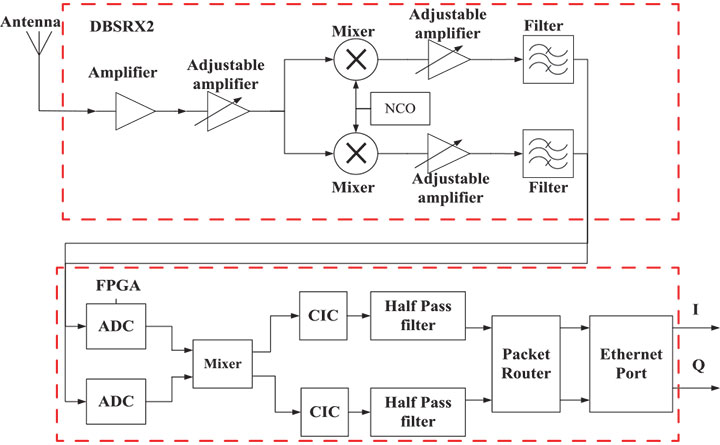
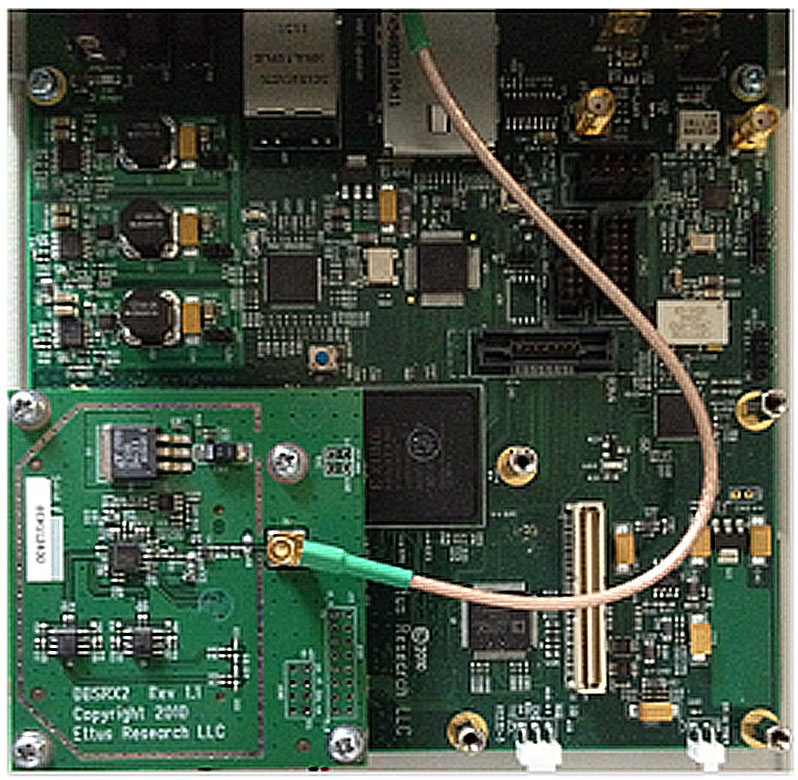
    Figure 2  GNSS signal streaming on USRP N210 + DBSRX2 circuit.
    Figure 2 GNSS signal streaming on USRP N210 + DBSRX2 circuit.
    G-Fig3
    Figure 3. USRP N210 internal structure.

    The USRP N210 platform includes a main board and a daughterboard. In the main board, 14-bit high precision analog-digital converters (ADCs) and digital-analog converters (DACs) permit wide-band signals covering a high dynamic range. The core of the main board is a high-speed field-programmable gate array (FPGA) that allows high-speed signal processing. The FPGA configuration implements down-conversion of the baseband signals to a zero center frequency, decimates the sampled signals, filtering out-of-band components, and finally transmits them through a packet router to the Ethernet port. The onboard numerically controlled oscillator generates the digital sinusoid used by the digital down-conversion process. A cascaded integrator-comb (CIC) filter serves as decimator to down-sample the signal.

    The signals are filtered by a half pass filter for rejecting the out-of-band signals. A Gigabit Ethernet interface effectively enables the delivery of signals out of the USRP N210, up to 25MHz of RF bandwidth. In the daughterboard, first the RF signals are amplified, then the signals are mixed by a local onboard oscillator according to a complex down-conversion scheme. Finally, a band-pass filter is used remove the out-of-band signals.

    Several available daughter boards can perform signal conditioning and tuning implementation. It is important to choose an appropriate daughter board, given the requirements for the data collection.

    A support driver called Universal Hardware Driver (UHD) for the USRP hardware, under Linux, Windows and Mac OS X, is an open-source driver that contains many convenient assembly tools. To boot and configure the whole system, the on-board microprocessor digital signal processor (DSP) needs firmware, and the FPGA requires images. Firmware and FPGA images are downloaded into the USRP platform based on utilizations provided by the UHD. Regarding the source of firmware and FPGA images, there are two methods to obtain them:

    •   directly use the binary release firmware and images posted on the web site of the company;
    •   build (and potentially modify) the provided source code.
    USRP Testing and Implementation

    Some essential testing based on the original configuration of the USRP N210 platform provided an understanding of its architecture, which was necessary to reconfigure its firmware and to set up the wide-band, multi-constellation GNSS receiver. We collected some real GPS L1 data with the USRP N210 as RF front-end. When we processed these GPS L1 data using a software-defined radio (SDR), we encountered a major issue related to tracking, described in the following section.

    Onboard Oscillator Testing. A major problem with the USRP N210 is that its internal temperature-controlled crystal oscillator (TCXO) is not stable in terms of frequency. To evaluate this issue, we recorded some real GPS L1 data and processed the data with our software receiver. As shown in Figure 4, this issue results in the loss of GPS carrier tracking loop at 3.18 seconds, when the carrier loop bandwidth is 25Hz.
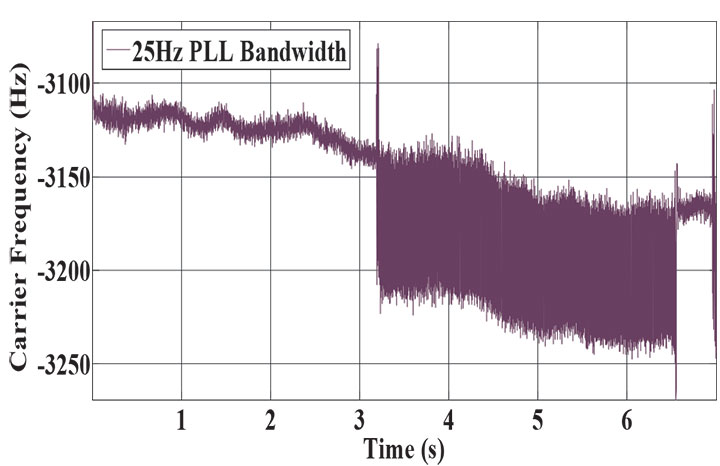
    Figure 4. GPS carrier loop loss of lock.
    Figure 4. GPS carrier loop loss of lock.

    Consequently, we adjusted the carrier loop bandwidth up to 100Hz; then GPS carrier tracking is locked at the same timing (3.18s), shown in Figure 5, but there is an almost 200 Hz jump in less than 5 milliseconds.
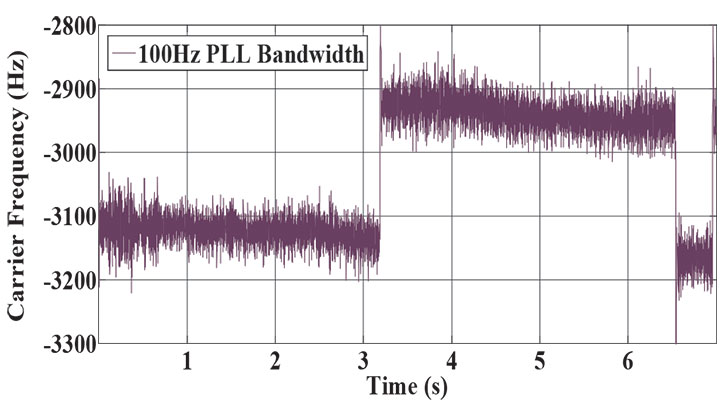
    Figure 5. GPS carrier loop lock tracking.
    Figure 5. GPS carrier loop lock tracking.

    As noted earlier, the daughter card of the USRP N210 platform utilizes direct IF complex down-conversion to tune GNSS RF signals. The oscillator of the daughter board generates a sinusoid signal that serves as mixer to down-convert input GNSS RF signals to a low IF signal. Figure 6 illustrates the daughter card implementation. The drawback of this architecture is that it may bring in an extra frequency shift by the unstable oscillator. The configuration of the daughter-card oscillator is implemented by an internal TCXO clock, which is on the motherboard. Unfortunately, the internal TCXO clock has coarse resolution in terms of frequency adjustments. This extra frequency offset multiplies the corresponding factor that eventually provides mixer functionality to the daughter card. This approach can directly lead to a large frequency offset to the mixer, which is brought into the IF signals.
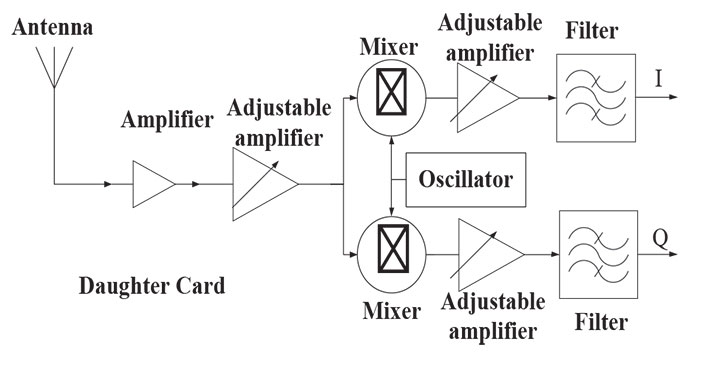
    Figure 6. Daughter-card tuning implementation.
    Figure 6. Daughter-card tuning implementation.

    Finally, when we conduct the tracking operation through the software receiver, this large frequency offset is beyond the lock range of a narrow, typically desirable, GNSS carrier tracking loop, as shown in Figure 4.

    In general, a TCXO is preferred when size and power are critical to the application. An oven-controlled crystal oscillator (OCXO) is a more robust product in terms of frequency stability with varying temperature. Therefore, for the USRP N210 onboard oscillator issue, it is favorable to use a high-quality external OCXO as the basic reference clock when using USRP N210 for GNSS applications.

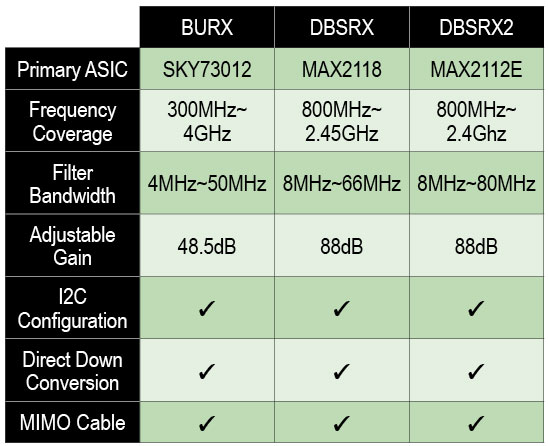
    Front-End Daughter-Card Options. A variety of daughter-card options exist to amplify, mix, and filter RF signals. Table 2 lists comparison results of three daughter cards (BURX, DBSRX and DBSRX2) to supply some guidance to researchers when they are faced with choosing the correct daughter-board.
    G-table2
    Table 2. Front-end daughter-card options.

    The three daughter cards have diverse properties, such as the primary ASIC, frequency coverage range, filter bandwidth and adjustable gain. BURX gives wider radio frequency coverage than DBSRX and DBSRX2. DBSRX2 offers the widest filter bandwidth among the three options.

    To better compare the performance of the three daughter cards, we conducted another three experiments. In the first, we directly connected the RF port with a terminator on the USRP N210 platform to evaluate the noise figure on the three daughter cards. From Figure 7, we can draw some conclusions:

    • BURX has a better sensitivity than DBSRX and DBSRX2 when the gain is set below 30dB.
    • DBSRX2 observes feedback oscillation when the gain set is higher than 70dB.
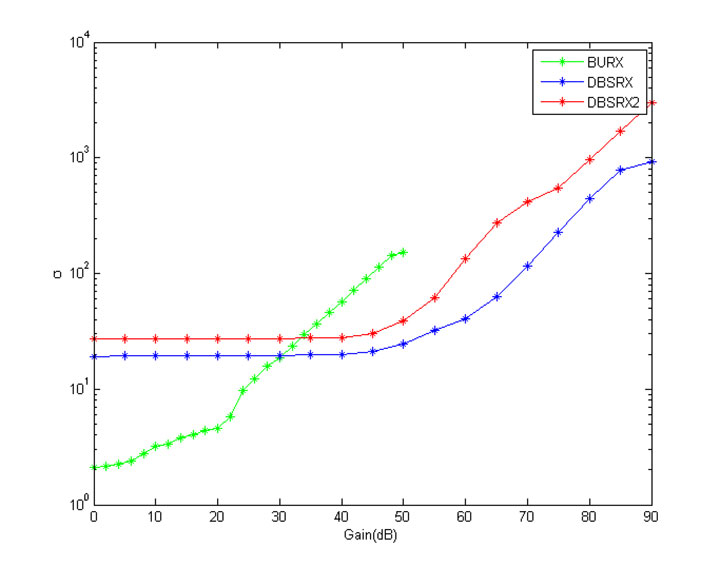
    Figure 7  Noise performance comparisons of three daughter cards.
    Figure 7. Noise performance comparisons of three daughter cards.

    The second experimental setup configuration used a USRP N210 platform, an external OCXO oscillator to provide stable reference clock, and a GPS simulator to evaluate the C/N0 performance of the three daughter boards. The input RF signals are identical, as they come from the same configuration of the GPS simulator. Figure 8 illustrates the C/N0 performance comparison based on this experimental configuration. The figure shows that BURX performs best, with DBSRX2 just slightly behind, while DBSRX has a noise figure penalty of 4dB.
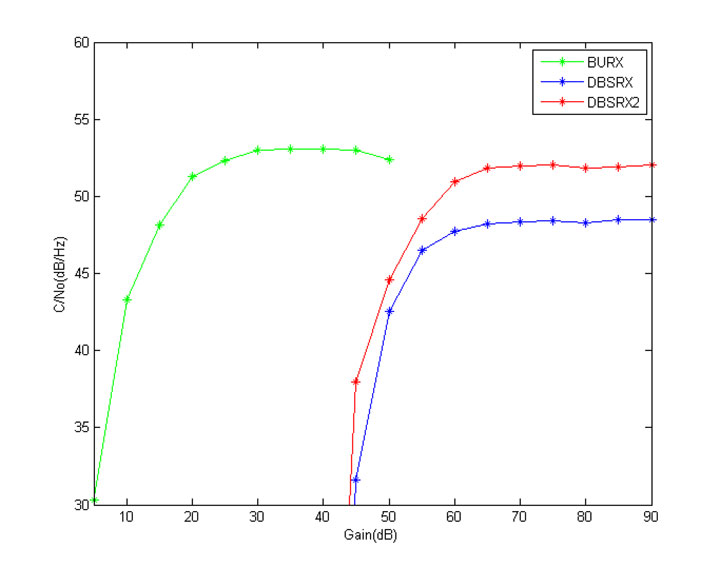
    Figure 8. C/N0 performance comparisons of three daughter cards.
    Figure 8. C/N0 performance comparisons of three daughter cards.

    In the third experiment, we added an external amplifier to increase the signal-to-noise ratio (SNR). From Figure 9, we see that the BURX, DBSRX and DBSRX2 have the same C/N0 performance, effectively validating the above conclusion. Thus, an external amplifier is recommended when using the DBSRX or DBSRX2 daughter boards.
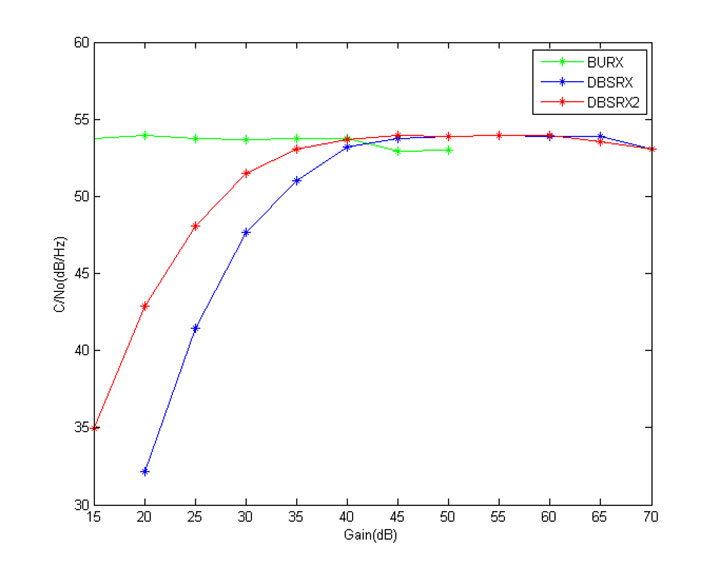
    Figure 9. C/N0 performance comparisons of three daughter cards with an external amplifier.
    Figure 9. C/N0 performance comparisons of three daughter cards with an external amplifier.

    The purpose of these experiments was to find a suitable daughter board for collecting wide-band multi-constellation GNSS RF signals. The important qualities of an appropriate wide-band multi-constellation GNSS receiver are:

    • high sensitivity;
    • wide filter bandwidth; and
    • wide frequency range.

    After a comparison of the three daughter boards, we found that the BURX has a better noise figure than the DBSRX or DBSRX2. The overall performance of the BURX and DBSRX2 are similar however. Using an external amplifier effectively decreases the required gain on all three daughter cards, which correspondingly reduces the effect of the internal thermal noise and enhances the signal noise ratio. As a result, when collecting real wide-band multi-constellation GNSS RF signals, it is preferable to use an external amplifier.

    To consider recording GNSS signals across a 50MHz band, DBSRX2 provides the wider filter bandwidth among the three daughter-card options, and thus we selected it as a suitable daughter card.

    Custom Wide-band Firmware Development. When initially implementing the wideband multi-constellation GNSS reception devices based on the USRP N210 platform, we found a shortcoming in the default configuration of this architecture, whose maximum bandwidth is 25MHz. It is not wide enough to record 50MHz multi-constellation GNSS signals (BeiDou E2, GPS L1, Galileo E1, and GlonassG1). A 50MHz sampling rate (in some cases as much as 80 MHz) is needed to demodulate the GNSS satellites’ signals.

    Meanwhile since the initiation of the research, the USRP manufacturer developed and released a 50MHz firmware. To highlight our efforts, we further modified the USRP N210 default configuration to increase the bandwidth up to 100MHz, which has the potential to synchronously record multi-constellation multi-frequency GNSS signals (Galileo E5a and E5b, GPS L5 and L2) for further investigation of other multi-constellation applications, such as ionospheric dispersion within wideband GNSS signals, or multi-constellation GNSS radio frequency compatibility and interoperability.

    Apart from reprogramming the host driver, we focused on reconfiguring the FPGA firmware. With the aid of anatomizing signal flow in the FPGA, we obtained a particular realization method of augmenting its bandwidth. Figure 10 shows the signal flow in the FPGA of the USRP N210 architecture.
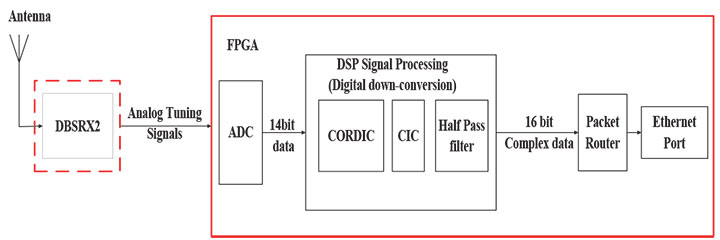
    Figure 10. Signal flow in the FPGA of the USRP N210 platform.
    Figure 10. Signal flow in the FPGA of the USRP N210 platform.

    The ADC produces 14-bit sampled data. After the digital down-conversion implementation in the FPGA, 16-bit complex I/Q sample data are available for the packet transmitting step. According to the induction document of the USRP N210 platform, VITA Radio Transport Protocol functions as an overall framework in the FPGA to provide data transmission and to implement an infrastructure that maintains sample-accurate alignment of signal data. After significant processing in the VITA chain, 36-bit data is finally given to the packet router. The main function of the packet router is to transfer sample data without any data transformation. Finally, through the Gigabit Ethernet port, the host PC receives the complex sample data.

    In an effort to widen the bandwidth of the USRP N210 platform, the bit depth needs to be reduced, which cuts 16-bit complex I/Q sample data to a smaller length, such as 8-bit, 4-bit, or even 2-bit, to solve the problem. By analyzing Figure 10, to fulfill the project’s demanding requirements, modification to the data should be performed after ADC sampling, but before the digital down-conversion. We directly extract the 4-bit most significant bits (MSBs) from the ADC sampling data and combined eight 4-bit MSB into a new 16-bit complex I/Q sample, and gave this custom sample data to the packet router, increasing the bandwidth to 100 MHz.

    Wide-Band Receiver Performance Analysis. The custom USRP N210-based wide-band multi-constellation GNSS data reception experiment is set up as shown in Figure 11.
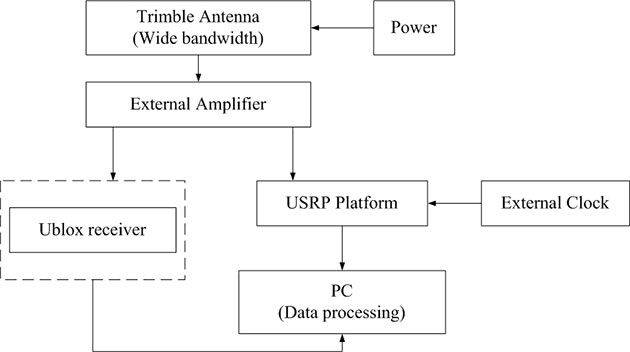
    Figure 11  Wide-band multi-constellation GNSS data recording system.
    Figure 11. Wide-band multi-constellation GNSS data recording system.

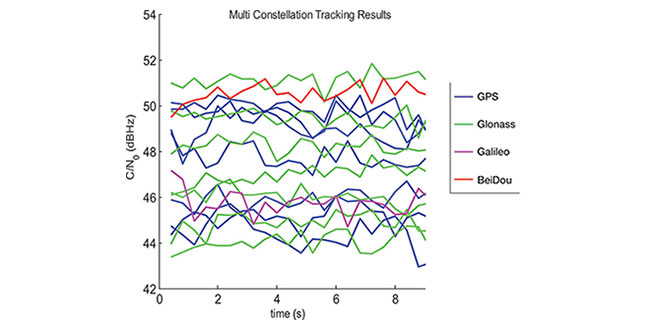
    A wide-band antenna collected the raw GNSS data, including GPS, GLONASS, Galileo, and BeiDou. An external amplifier was included to decrease the overall noise figure. An OCXO clock was used as the reference clock of the USRP N210 system. After we found the times when Galileo and BeiDou satellites were visible from our location, we first tested the antenna and external amplifier using a commercial receiver, which provided a reference position. Then we used 1582MHz as the reception center frequency and issued the corresponding command on the host computer to start collecting the raw wide-band GNSS signals. By processing the raw wide-band GNSS data through our software receiver, we obtained the acquisition results from all constellations shown in Figure 12; and tracking results displayed in Figure 13.
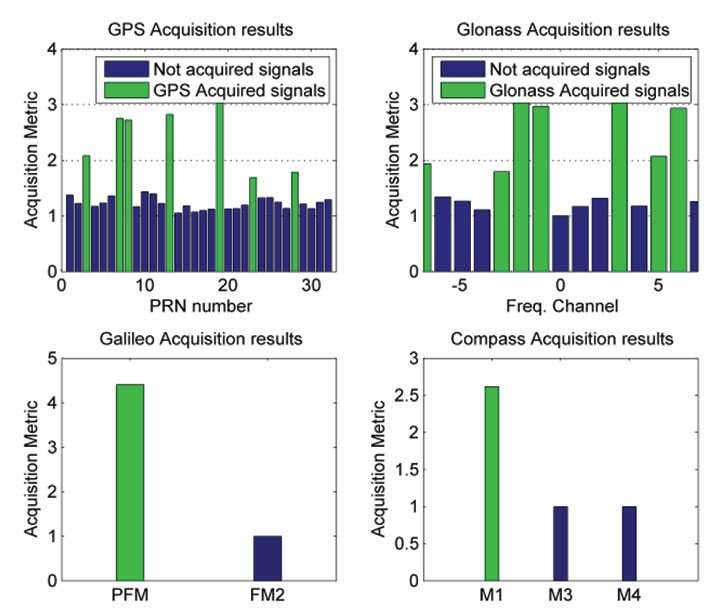
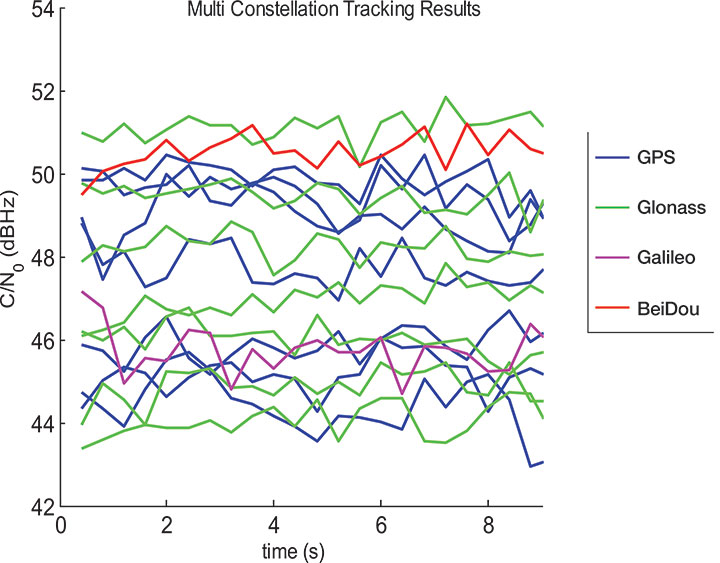
    Figure 12  Acquisition results for all constellations.
    Figure 12. Acquisition results for all constellations.
    Guo_opener
    Figure 13. Tracking results for all constellations.

    We could not do the full-constellation position solution because Galileo was not broadcasting navigation data at the time of the collection and the ICD for BeiDou had not yet been released. Therefore, respectively using GPS and GLONASS tracking results, we provided the position solution and timing information that are illustrated in Figure 14 and in Figure 15.
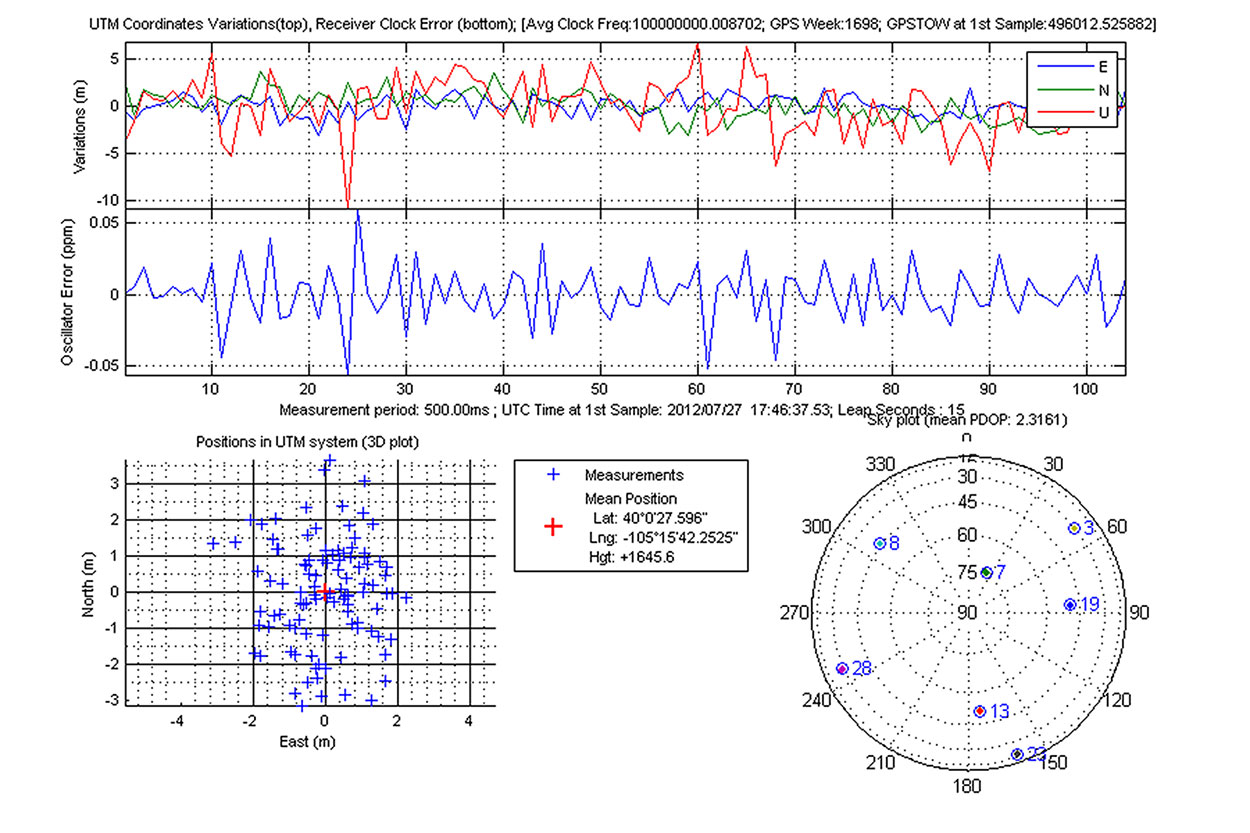
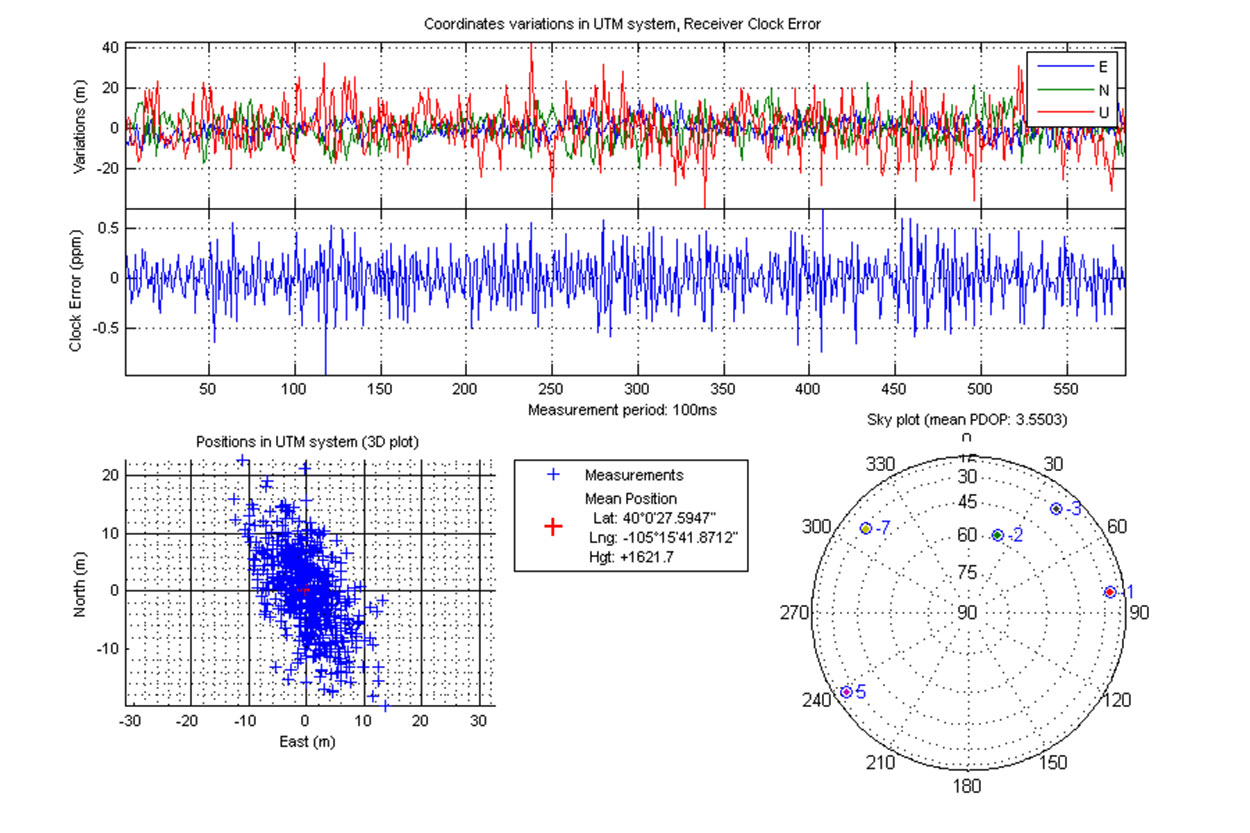
    Figure 13. GPS position solution and timing information.
    Figure 14. GPS position solution and timing information.
    Figure 14. GLONASS position solution.
    Figure 15. GLONASS position solution.
    Conclusions

    By processing raw wide-band multi-constellation GNSS signals through our software receiver, we successfully acquired and tracked satellites from the four constellations. In addition, since we achieved 100MHz bandwidth, we can also simultaneously capture modernized GPS and Galileo signals (L5 and L2; E5a and E5b, 1105–1205 MHz).

    In future work, a longer raw wide-band GNSS data set will be recorded and used to determine the user position leveraging all constellations. Also an urban collection test will be done to assess/demonstrate that multiple constellations can effectively improve the reliability and continuity of GNSS navigation.

    Acknowledgment

    The first author’s visiting stay to conduct her research at University of Colorado is funded by China Scholarship Council, File No. 2010602084.

    This article is based on a paper presented at the Institute of Navigation International Technical Conference 2013 in San Diego, California.

    Manufacturers

    The USRP N210 is manufactured by Ettus Research. The core of the main board is a high-speed Xilinx Spartan 3A DSP FPGA. Ettus Research provides a support driver called Universal Hardware Driver (UHD) for the USRP hardware. A wide-band Trimble antenna was used in the final experiment.


    Ningyan Guo is a Ph.D. candidate at Beihang University, China. She is currently a visiting scholar at the University of Colorado at Boulder.

    Staffan Backén is a postdoctoral researcher at University of Colorado at Boulder. He received a Ph.D. in in electrical engineering from Luleå University of Technology, Sweden.

    Dennis Akos completed a Ph.D. in electrical engineering at Ohio University. He is an associate professor in the Aerospace Engineering Sciences Department at the University of Colorado at Boulder with visiting appointments at Luleå University of Technology and Stanford University

  • Septentrio Demonstrates BeiDou+GPS+GLONASS Positioning

    Septentrio announced on January 7 that it has successfully implemented BeiDou support in the company’s high-precision receiver software, taking advantage of the recent official release of BeiDou’s Interface Control Document (ICD) to including the Chinese satellite navigation signals into its position-velocity-time (PVT) solution.

    According to the Belgian GNSS receiver manufacturer, its engineers “are currently processing further data sets to finalize the implementation of full BeiDou support. Although the BeiDou constellation is still being deployed, the data analysis already shows promising results.”

    The top panel of Figure 1 compares the height from a stand-alone solution of GPS-only with a GPS+GLONASS solution and a third (in light blue) including BeiDou. “The value added by BeiDou is more than what was expected from a constellation that is still being deployed,” according to Septentrio business development manager Laurent Le Thuaut. “Although the solution is not aided by differential corrections, the position shows an increase in accuracy when sufficient BeiDou satellites are included.”

    The bottom panel of Figure 1 shows that, even with the current BeiDou constellation (15 satellites total, of which five are geostationary over China, five in full mid-Earth orbit similar to GPS and GLONASS, and five in inclined geosynchronous orbit over Asia), the total number of satellites used over the European region reached 26 for a short moment.

    Figure 2 shows the L1 pseudorange residuals for all constellations individually. This comparison highlights the advantage of the GPS constellation, which builds on two decades of real-time orbit prediction. The BeiDou orbits are “quite accurate for a relatively young constellation, but show typical meter-level jumps when ephemerides are updated,” according to Septentrio.

    Septentrio says that the new feature will soon become available on selected company platforms. Users of its multi-constellation receivers will then benefit from improvements in urban availability and signal integrity, thanks to the augmented signal coverage.

  • Leica Geosystems Begins E-Commerce Sales

    Leica Geosystems Inc. announced the launch of the e-commerce site for Leica Geosystems Solutions Centers. The grand opening of the Leica Geosystems Solutions Center is marked by an unprecedented online-only promotion.

    Logo: Leica Geosystems

    Providing 24/7 personalized access to the products essential to the surveying, engineering, and construction industries, the site is a resource for more than purchases. It also enables customers to compare thousands of products based on features, shipping options and availability, and to create wish lists.
    The Leica Geosystems Solutions Centers e-commerce site offers a range of supplies, accessories and rentals, from paint and flagging, safety supplies, total stations and GPS systems for surveying, construction lasers and building layout systems. Relevant products and pricing are presented based on each customer’s unique profile, and subscription and quick-order capabilities make it easy to reorder frequently needed products.
    “We are committed to continually delivering value to our customers, and it is exciting to respond to customer needs by bringing this e-commerce site to the market,” said Mike Strom, General Manager, Solutions Centers for Leica Geosystems. “Our customers are busy, and they often need to place orders outside of standard business hours. Our new e-commerce website provides customers a more convenient way to buy from us, and we will be offering online-only promotions on a regular basis – similar to the tremendous grand opening deals – so it’s easier than ever for customers to begin reaping the benefits of Leica Geosystems solutions.”
    The Leica Geosystems Solutions Center is factory-owned and operated, which guarantees that customers will receive the quality products and service expected from Leica Geosystems. Additionally, because support is critical at every step of the way, even during the purchase process, the site features multiple avenues to online support: customers get real answers, from real factory-trained experts.

  • Leica Geosystems Begins E-Commerce Sales

    Leica Geosystems Inc. announced the launch of the e-commerce site for Leica Geosystems Solutions Centers. The grand opening of the Leica Geosystems Solutions Center is marked by an unprecedented online-only promotion.

    Logo: Leica Geosystems

    Providing 24/7 personalized access to the products essential to the surveying, engineering, and construction industries, the site is a resource for more than purchases. It also enables customers to compare thousands of products based on features, shipping options and availability, and to create wish lists.
    The Leica Geosystems Solutions Centers e-commerce site offers a range of supplies, accessories and rentals, from paint and flagging, safety supplies, total stations and GPS systems for surveying, construction lasers and building layout systems. Relevant products and pricing are presented based on each customer’s unique profile, and subscription and quick-order capabilities make it easy to reorder frequently needed products.
    “We are committed to continually delivering value to our customers, and it is exciting to respond to customer needs by bringing this e-commerce site to the market,” said Mike Strom, General Manager, Solutions Centers for Leica Geosystems. “Our customers are busy, and they often need to place orders outside of standard business hours. Our new e-commerce website provides customers a more convenient way to buy from us, and we will be offering online-only promotions on a regular basis – similar to the tremendous grand opening deals – so it’s easier than ever for customers to begin reaping the benefits of Leica Geosystems solutions.”
    The Leica Geosystems Solutions Center is factory-owned and operated, which guarantees that customers will receive the quality products and service expected from Leica Geosystems. Additionally, because support is critical at every step of the way, even during the purchase process, the site features multiple avenues to online support: customers get real answers, from real factory-trained experts.

  • Directions 2013: Plans Set in Motion for GPS

    GPS Directorate: Receivers Will Operate in Environments Impossible Today

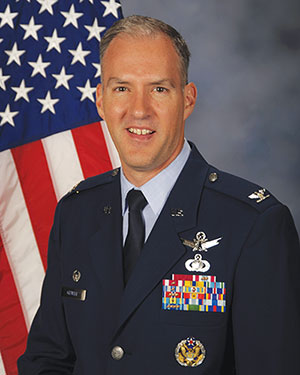
    By Col. Bernie Gruber

    Headshot: Col. Bernie Gruber

    I believe the future of global navigation satellite systems (GNSS) and particularly GPS will only be limited by our ingenuity and imagination. In terms of economic benefit, GPS contributes $60 billion to our economy, and that’s no stretch considering the positive and real advantages GPS affords us every day through fuel savings, transportation optimization, banking transactions, recreational activities, and certainly the defense of our great nation.

    GPS consists of three segments — space, ground and user equipment — all contributing synchronistically to provide the world positioning, navigation, and timing (PNT). Having joined the GPS program office (for the first time) in 1992, I was privileged to lead the very first Foreign Military Sales contracts and the development of the Selective Availability Anti-Spoofing module (SAASM) — both focused within the realm of user equipment. As program director of GPS reflecting back on the monumental change of the past 20 years, I am encouraged and look forward to seeing the fruition of the projects and plans we have already set in motion for the next 20. This is why:

    Space Segment. The launch and handover of the third GPS IIF satellite on October 4 proves once again our commitment to mission success. We have exceeded our published worldwide accuracy standard since 1993, and the NavStar GPS constellation remains robust with 31 satellites currently available.

    In regards to the satellite systems, next-generation Block IIF and III satellites are in various states of test, integration, or production in an effort to improve the average user range error (URE) from 0.9 meters, achieved and maintained for the last 3 years, to a root-mean-squared URE of 0.5 meters by 2016. Along with increased civil and military signals, I also envision digital waveform generation (that is, the ability to change on-orbit signals in space via software) as an integral part of our architecture.  Digital waveform generation coupled with an augmentation of the GPS III constellation for affordability and resiliency will pave our way to the future.

    Ground Segment. Along with a host of additional satellite capabilities and signals, we will correspondingly modernize our ground segment. Our Next-Generation Operational Control System (OCX) is designed to command and control our modernized secondary civil signal L2C, safety-of-life signal L5, and the internationally compatible signal L1C. In fact, users such as John Deere and NavCom are already accessing the currently broadcast L1 C/A and L2C (with a default code) for dual-frequency ionospheric correction to improve upon accuracy. As the modernized signals become operational, users will see faster signal acquisition, enhanced reliability, and a greater operating range. The information assurance, expandability, and service-oriented architecture will afford users and operators with security and information they simply don’t have today.

    User Segment. All that said, I am thrilled to look at the future of user equipment. We need to take advantage of the use of civil GPS. Apple and Android have shown the way to interface with and use applications, displays, and packaging; Google Map overlays, smart phone apps, time-to-first-fix augmentations from cell towers, and multi-GNSS international coverage are already in use, with the growth of apps, users will only get smarter and more sophisticated in their GPS expectations.

    To that end, the Air Force is augmenting its pilots with digital maps and starting to integrate GPS with the digi-maps beginning with the C-130J. The Army is paving the way with an app store for military use and beginning to integrate GPS with its equipment, such as the use of a GPS integrated wind app for calibrating bullet trajectories.

    Security, authentication, integrity, and the ability to operate in almost any environment is vital to our warfighters. The Department of Defense is posturing to operate in an anti-access area denial (A2AD) environment. Make no mistake; the list of potential adversaries also includes a list of known attacks on GPS — along with use of GPS and other GNSS systems against us. For that purpose, the modernized GPS is working on better and improved items like key management, M-Code power and cryptography, and Blue Force Electronic Attack (BFEA). In this area too, I see the commercial market burgeoning with new ideas to protect the calculation of GPS PNT solutions.

    In the selective-availability anti-spoofing module, we introduced positive control and resiliency to the military GPS receivers. Now with M-Code we are taking it one step further. M-code will leverage the National Security Agency (NSA) Key Management Infrastructure and augment it with more tools to ensure only authorized users have access to M-Code. This provides greater protection from spoofing, ensures that keys are readily available to the United States and her Coalition partners, and that security cost drives for our user equipment are minimized.

    With more signal power, almost every aspect of GPS is better. While the 6–10 dB of additional power in GPS III will not in itself defeat known threats, more power complements anti-jam techniques as well as improves operation under foliage and in the presence of pervasive unintentional interference. We’re going to see receivers that operate in navwar environments that would be impossible today. Similarly, I see us having the flexibility to operate with other GNSS systems in benign environments, but the ability to also operate in hostile or contested environments.

    Blue Force Electronic Attack was always a principle driver for GPS modernization. It is embodied in the White House Directives and Title 10 U.S.C [Title 10 of the United States Code outlines the role of armed forces in the U.S. Code, a compilation and codification of the general and permanent federal laws of the United States — Ed.] Today’s Block II systems do not have enough spectral separation for effective BFEA. As M-Code becomes readily available, along with the additional filtering available in military GPS user equipment (MGUE), we are providing Joint Task Force Commanders with options to deny GPS; options that they don’t have today.

    The future of GPS is bright indeed! From the originators of GPS to present day men and women who work tirelessly to deliver and operate it, we are all striving to improve and enhance this magnificent capability. The economic benefits of a system that, in reality, pays for itself guarantees the world’s desire to see improvements and growth in the overall GPS system. The Air Force is a proud steward of the GPS system, but it is our collective job to proliferate new ideas to use it and secure it.


    Colonel Bernie J. Gruber is director, Global Positioning Systems (GPS) Directorate, Space and Missile Systems Center, Air Force Space Command, Los Angeles Air Force Base, California. He is responsible for a multiservice, multinational systems directorate which conducts development, acquisition, fielding and sustainment of all GPS space segment, satellite command and control (ground) and military user equipment. The $32 billion GPS program, with a $1 billion annual budget, maintains the largest satellite constellation and the largest avionics integration and installation program in the Department of Defense. He has served in key positions at Major Command, Air Staff, Joint Staff and Defense Agency levels. Prior to assuming his current position, Colonel Gruber was Chief, Space Superiority and Global Integrated Intelligence, Surveillance and Reconnaissance Division, Directorate of Programs, Deputy Chief of Staff, Strategic Plans and Programs, Headquarters, United States Air Force, Washington, D.C.

  • The System: OCX, GPS III Show Launch Readiness

    Illustration: Lockheed Martin
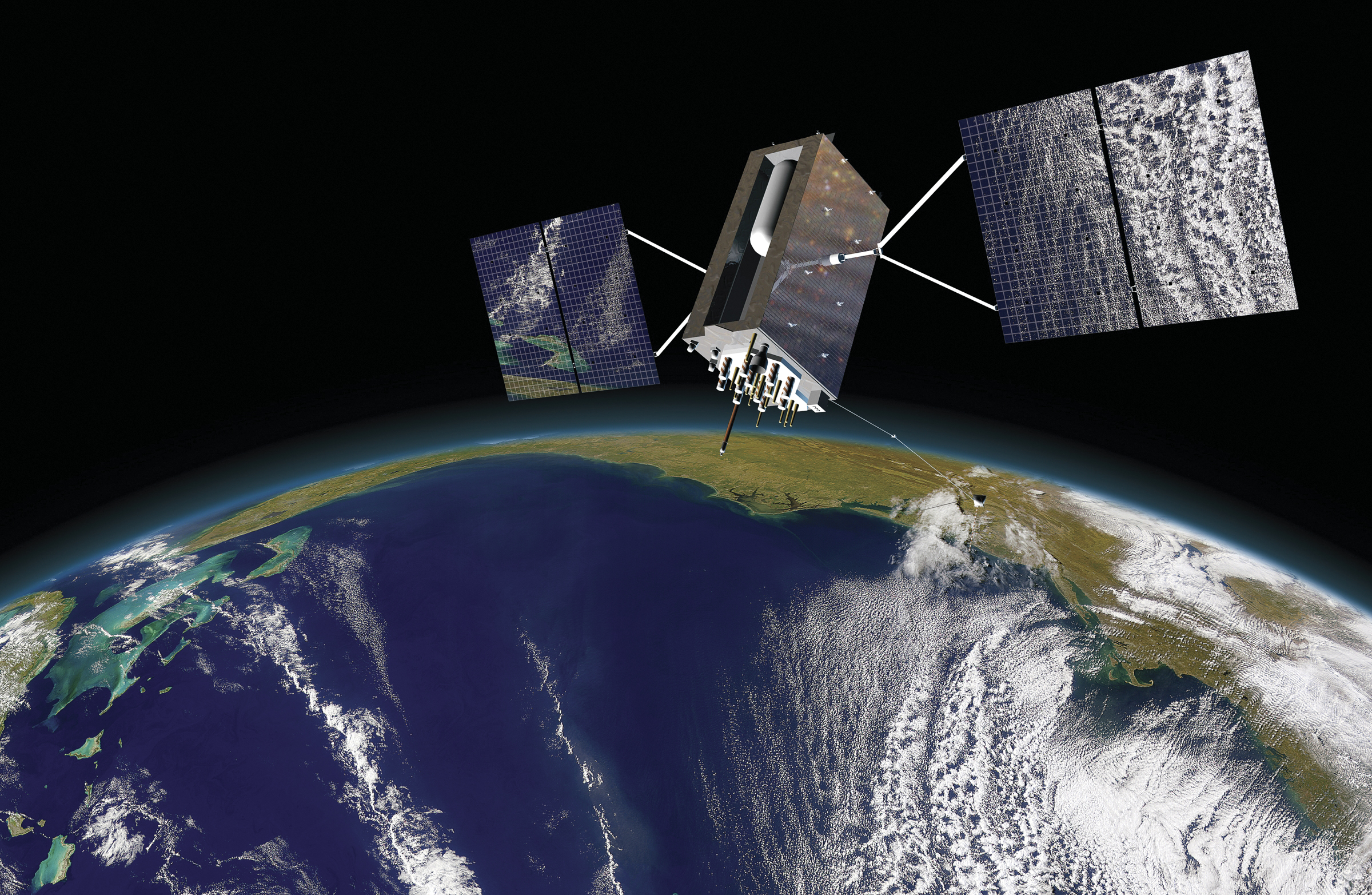
    GPS III SATELLITE, artist’s rendering, courtesy Lockheed Martin.

    Raytheon Company and Lockheed Martin successfully completed the first launch readiness exercise for the U.S. Air Force’s next-generation GPS III satellites. The exercise is a key milestone demonstrating the team remains on schedule to achieve launch availability in 2014, the companies said.

    The Lockheed Martin-built GPS III satellites and the Raytheon-developed next generation GPS operational control system, known as OCX, are critical elements of the U.S. Air Force’s effort to affordably replace aging GPS satellites while improving capability to meet the evolving demands of military, commercial and civilian users worldwide. This is the first space and ground enterprise successfully building the ground control and space vehicles by two independent prime contractors.

    The launch readiness exercise, completed over a three-day period by mission operations personnel, validated the basic satellite command and control functions, tested the software and hardware interfaces and demonstrated basic on-console procedures required for space vehicle contacts during the launch and early orbit mission.  The event sets the stage for the first GPS III satellite’s mission readiness timeline, which includes five short-duration exercises and six, five-day mission rehearsals leading up tolaunch.

    To achieve first launch availability in the 2014 timeframe, the U.S. Air Force awarded Lockheed Martin and Raytheon contracts in January of this year to provide a Launch and Checkout Capability (LCC) for launch and early on-orbit testing of all GPS III satellites.  At the heart of the LCC is Raytheon’s Launch and Checkout System that will provide satellite command and control capability, an integral part of OCX’s  support of the first GPS III launch.

    Rockets on the Pad

    As this magazine goes to press on September 17, several GNSS satellite launches are pending, and may have already occurred by the time you read this. Launch dates this fall for GNSS satellites in the coming season are as follows, according to various, not always official, sources. Compilation courtesy of CANSPACE.

    Compass M2 and M5. September 18, 18:12 UTC (speculative).

    GSAT-10. Carrying a satellite-based augmentation system (SBAS) transponder for  the  GPS-aided geo-augmented navigation system (GAGAN), a planned implementation of a regional SBAS by the Indian government: September 21.

    Compass G6. No earlier than October 1.

    GPS IIF-3. October 4. Launch window: 12:10-12:29 UTC.

    Galileo IOV FM3 and FM4. October 10, 18:31 UTC.

    Luch-5B. For the Russian SBAS. Originally scheduled for October 15, launch has slipped to no earlier than November 1 due to an issue with the Briz-M upper stage, which caused the loss of the Telkom-3 and Ekspress-MD2 communication satellites during their launch on August 6.

    GLONASS-K1 (block K2s). November 14.

    Photo: Raoul Kieffer
    The fourth Galileo flight model satellite is unloaded at Cayenne Airport in French Guiana August 17. (ESA/EADS Astrium, Raoul Kieffer)

    JAVAD: Filters Protect GPS L1, L2, L5; GLONASS L1, L2; Galileo L1, L5

    Javad Ashjaee, founder and CEO of JAVAD GNSS, filed a September 7 letter with the U.S. Federal Communications Commission (FCC) concerning his company’s development of technical possibilities in GNSS filter designs and components. He stated “I hope this will be helpful in establishing realistic guidelines for the characteristics of high-precision GNSS receivers that will be used in critical applications.”

    The letter reads, in part:

    “We have improved our previous L1 filter and have extended the design to include all commercial GNSS bands.”

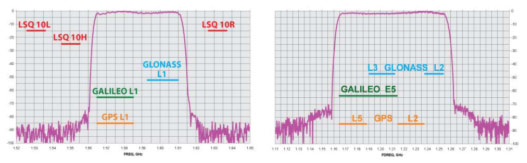
    “Our filter . . . protects GPS L1, Galileo L1 and GLONASS L1 bands. It brings in all the useful signals intact and rejects out of band signals with the slope of about 12 dB/Mhz. Similarly . . . our filter . . . . protects GPS L2, GPS L5, GLONASS L2 and Galileo L5 and has slope of about 9 dB/Mhz.

    “These filters not only protect GNSS signals against all LightSquared signals (10L, 10H and 10R handsets) but also from all similar signals that may appear near all commercial GNSS bands in the future. We are proud that our filters help allow better usage of these precious bands, in particular for broadband wireless communication that our country desperately needs.

    “These filters apply to wideband high precision GNSS receivers and the cost is even less than earlier conventional filters. The case of narrow-band low precision receivers (e.g. Garmin) is much simpler, as has been demonstrated by GPS receivers in more than 300 million cell phones and mobile devices which are not affected by LightSquared signals. The low precision receivers (L1 C/A code only) require filter slopes 10 times less steep than those presented here and do not necessitate additional costs.”

    Galileo Headquarters Moves to Prague

    On September 6, the European GNSS Agency (GSA) inaugurated its new premises in Prague, Czech Republic. Previously headquartered in Brussels, the headquarters of the Galileo program moved its seat to Prague this summer, as agreed by the EU heads of state and government in December 2010.
    Galileo is expected to be partly operational by the end of 2014. Two in-orbit validation (IOV) satellites will be launched in October, bringing the total in space to four, sufficient for initial check-outs.  Beginning in 2013, four more Galileo satellites will be launched every six months until the network of 30 is completed in 2020.

    GSA ensures security of satellites and prepares ground for new GNSS products. The agency is responsible for a number of implementation tasks for the European Satellite Navigation programmes Galileo and  the European Geostationary Navigation Overlay Service (EGNOS), which are managed by the European Commission. Its two main tasks are:

    • Security accreditation of satellites, launchers, and sites, and the operation of the Galileo Security Monitoring Centre, and
    • Market development for the European satellite navigation systems, such as new products and services possible using Internet access to satellite navigation data, among others.

    Future Role. A European Commission (EC) proposal for revising the GNSS Regulation foresees that operational responsibility for the GNSS programmes will be gradually transferred from the EC to the GSA over the next multi-annual financial framework (2014-2020). This represents a reversal of an earlier move, or a restoration of a previous state; after delays and budget disputes with manufacturers during the tentative public-private partnership (PPP) phase, the European Commission took direct control of the Galileo program, effectively sidelining the GSA.

    The transfer of responsibility will start with EGNOS in 2014, and already a number of preparatory tasks have been allocated to the GSA, including the procurement for the future operations of EGNOS.

    To carry out these new functions, the GSA’s staff is expected to increase from about 60 today to more than 180 by the end of next financial framework in 2020.

    Budget. The GSA has an annual budget of about €12.75 million ($16.75 million) in 2012, plus €34.4 million ($45 million) for exploitation activities.
    According to European Commission calculations, a total budget of € 7 billion ($9.2 billion) is necessary to complete the deployment phase of the Galileo programmes and finance the exploitation phase of the GNSS programmes over the 2014-2020 period.

    Compass Energizes China’s Economy

    China’s Beidou/Compass system will spur the country’s economic development in the satellite-navigation industry, geoinformation, and location-based services, according to an article in China Daily. China’s civil navigation providers are likely to experience rapid growth during the 12th Five-Year Plan (2011-15) period.

    The deputy director-general of the National Administration of Surveying, Mapping and Geoinformation said the government is likely to introduce policies to help the geoinformation industry grow.

    “In addition, the nation’s self-developed satellite navigation network, the Beidou Navigation System, will come into commercial use by the end of this year, a move that may stimulate the development of the geoinformation industry in China.”

    Aviation NextGen May Show Slow ROI

    An inspector from the U.S. Department of Transportation testified in Congress that benefits from the GPS-based air traffic control system Next Gen may take longer to realize than had been expected. Although the Federal Aviation Administration (FAA) has improved its management of the modernization program, years of delays and cost over-runs have left airlines dragging their feet in turn over multibillion-dollar equipment upgrades needed for the new system to work.

    The inspector stated the investment will be worth the taxpayer cost in the long run, and will produce significant safety and scheduling benefits. U.S. air travel is expected to nearly double over the next two decades, bringing an unbearable burden onto the current air traffic control system, if not significantly upgraded.

    By 2020, the new system is expected to reduce delays by 38 percent compared with the current system; airlines, passengers, and taxpayers are estimated tosave $24 billion.

    The FAA plans to spend $2.4 billion over the next five years on a collection of six programs evolving from an outdated, radar-based system to one that uses GPS and telecommunications advances for precision tracking, making routes more direct, eliminating many weather delays, and enabling planes to fly safely at closer distances. Once fully in place, the modernization program will save 1.4 billion gallons of fuel and reduce carbon dioxide emissions by 14 million metric tons, the FAA says.

    However, planes must be equipped with new equipment at a cost of hundreds of thousands of dollars per aircraft. NextGen doesn’t start yielding full benefits until a critical mass of planes have the new technology.

  • JAVAD Asserts Filters Protect GPS L1, L2, L5; GLONASS L1, L2; Galileo L1, L5

    Javad Ashjaee, founder and CEO of JAVAD GNSS, has filed a letter with the U.S. Federal Communications Commission (FCC) concerning his company’s development of technical possibilities in GNSS filter designs and components. He states “I hope this will be helpful in establishing realistic guidelines for the characteristics of high-precision GNSS receivers that will be used in critical applications.”

    Below is the full text of the letter.


    September 7, 2012

    The Honorable Julius Genachowski
    Chairman
    Federal Communications Commission
    445 12th Street, S.W.
    Washington, D.C. 20554

    The Honorable Lawrence E. Strickling
    Assistant Secretary for Communications and Information
    National Telecommunications & Information Administration
    United States Department of Commerce
    1401 Constitution Avenue, N.W.
    Washington, D.C. 20230

    Dear Chairman Genachowski and Assistant Secretary Strickling:

    In this communication I want to inform you of the current status of technical possibilities in GNSS filter designs and components. I hope this will be helpful in establishing realistic guidelines for the characteristics of high precision GNSS receivers that will be used in critical applications.

    We have improved our previous L1 filter and have extended the design to include all commercial GNSS bands.

    Javad's FCC filing

    Figure left above is our filter that protects GPS L1, Galileo L1 and GLONASS L1 bands. It brings in all the useful signals intact and rejects out of band signals with the slope of about 12 dB/Mhz. Similarly, Figure right above is our filter that protects GPS L2, GPS L5, GLONASS L2 and Galileo L5 and has slope of about 9 dB/Mhz.

    These filters have been extensively tested with five different innovative tests and prove that the filters also improve the performance of GNSS receivers. These extensive innovative tests are embedded in the receivers that we mass-produce today and every user can test their receivers in all environments. These tests are much more extensive than those previously employed by PNT and other organizations. These embedded tests are not only much more extensive, but it takes only a few minutes to perform these by any novice user by clicking some receiver buttons. Compare that to the limited tests by PNT and others that took weeks to perform and needed experts with very expensive equipment in some laboratories to perform.

    Attached is our 8-page commercial advertisement that has more details on filters and embedded test features.

    These filters not only protect GNSS signals against all LightSquared signals (10L, 10H and 10R handsets) but also from all similar signals that may appear near all commercial GNSS bands in the future. We are proud that our filters help allow better usage of these precious bands, in particular for broadband wireless communication that our country desperately needs.

    These filters apply to wideband high precision GNSS receivers and the cost is even less than earlier conventional filters. The case of narrow-band low precision receivers (e.g. Garmin) is much simpler, as has been demonstrated by GPS receivers in more than 300 million cell phones and mobile devices which are not affected by LightSquared signals. The low precision receivers (L1 C/A code only) require filter slopes 10 times less steep than those presented here and do not necessitate additional costs.

    In summary, the technology exists today of improved filter design and better performing GNSS receivers and can actually be done at a cost lower than current conventional GNSS receiver filter designs. I trust that the information that I have presented can be used in establishing the performance guidelines and requirements for all GNSS receivers used in critical applications.

    I also would like to invite your representatives to ION-2012 GNSS conference where we present details and answer questions at 2:00 PM on September 20.

    Regards,
    Javad Ashjaee, Ph.D.
    Javad Ashjaee, Ph.D.
    CEO, Javad GNSS
    San Jose, California
    USA

  • Geneq Bluetooth GNSS Receiver Uses both GPS and GLONASS with SBAS

    Geneq Inc. has announced the SXBlue II GNSS, a GNSS receiver that uses both GPS and GLONASS with SBAS (WAAS/EGNOS/MSAS/GAGAN) to attain 30-cm/1-foot (RMS) accuracy in real-time using free SBAS corrections. It connects wirelessly to any smartphone, handheld, tablet computer, or notebook computer that is Bluetooth-compliant.

    For years, the SXBlue GPS product line has lead the market in squeezing the most out of SBAS for high-precision mapping and surveying users. New technology used in the SXBlue II GNSS allows it to utilize both GPS and GLONASS with SBAS, enabling it to track and use nearly twice as many satellites compared to typical SBAS receiver technology.

    “More satellites means more accurate positioning in tougher environments, such as under tree canopy and near buildings,” said Jean-Yves Lauture, product engineer. “GLONASS has proven itself valuable for RTK, and now we are bringing GLONASS to SBAS, with impressive accuracy and tracking results.”

    The SXBlue II GNSS builds on the success of the proven SXBlue II GPS that was designed to optimize SBAS performance under tree canopy and in rugged terrain. With the ability to track 55 satellites (31 operational GPS, 24 operational GLONASS), the SXBlue II GNSS uses between 12 and 19 satellites in view at any time, providing superior performance when working under and around tree canopy, buildings, and rugged terrain, Geneq said.

    The next-generation SXBlue II GNSS is the same, small, palm-sized unit as the SXBlue II GPS and uses a small 2.7-inch diameter GNSS antenna. The unit is completely waterproof (submersible), dustproof, and ruggedized, with an IP-67 rating. Its Class 1 long-range Bluetooth 2.0 has a typical range of 250 meters. The internal, rechargeable, field replaceable Li-Ion battery has on-board LEDs let the user know how much battery life is left. The operating temperature range of the SXBlue II GNSS is -40°C (-40°F) to 85°C (185°F).

    In addition to the built-in long-range Bluetooth transceiver, the SXBlue II GNSS has a standard DE-9 RS-232 port and a USB Type B port with outputs fully programmable up to 10-Hz standard, with a 20-Hz option. Other optional features are L1 RTK for <2-cm real-time accuracy and base station RTCM output.

    There is no need for post-processing or other sources of differential corrections as the SXBlue II GNSS uses WAAS (North America), EGNOS (Europe), MSAS (Japan), and GAGAN (India) satellite corrections. Users receive real-time, 30-cm/1-foot positioning all day long, Geneq said.

    The SXBlue II GNSS is targeted at GPS/GIS mapping professionals in industries such as forestry, utility, agriculture, and other natural resource industries in addition to local, state, and federal government users.

    Geneq will be showing the SXBlue II GNSS at the Esri International User Conference July 24-26 in San Diego, California, booth #1203.

  • SuperGeo Technologies Introduces SuperPad 3.1

    SuperGeo Technologies introduces SuperPad 3.1, which mainly enhances the user interface, adjusts toolbar icons, adds SBAS extension, and improves the display of GPS status. For customization, SuperPad 3.1 provides sample codes for developing extensions and offers Microsoft Visual Studio templates to assist users in developing the functions they need. To have a smoother GIS workflow, SuperPad 3.1 improves the connection with SuperGIS Server 3 to make data synchronization more effective.

    User Interface Enhancement

    • To enhance the efficiency of data editing and collecting, SuperPad 3.1 improves the user interface and toolbar allocation. Therefore, users are able to achieve the task target with better efficiency.
    • To have the toolbar button display more clearly, SuperPad 3.1 adjusts the icon style and size so that users can choose the most suitable icon size for different mobile devices.

    Newly-Added SBAS Extension

    • The whole new SBAS extension supports to turn on SBAS function of mobile device to improve the accuracy of GPS data collection.
    Providing Custom Samples and Templates
    • A number of sample codes of extensions are provided; users can directly use the objects of SuperGIS Mobile Engine to design the GIS functions they need.
    • Microsoft Visual Studio templates for customizing GIS functions are provided so that users can customize SuperPad with ease.

    Improved Capability of Synchronizing SuperGIS Server Data


    • The capability of synchronizing the map data published by SuperGIS Server is improved. Thus, users can synchronize the data with SuperGIS Server while surveying outdoor.
  • Symmetricom Offers GPS Disciplined Atomic Oscillator Modules and High-Frequency Source Modules


    Symmetricom, Inc., precision time and frequency technology company, today announced the company will sell GPS disciplined oscillator (GPSDO) modules and high-frequency source modules from Jackson Labs Technologies, Inc., a designer and manufacturer of cutting-edge precision time and frequency products. GPSDOs provide time and frequency reference signals that have the same long-term accuracy as the GPS signal itself, and also provide a “holdover” capability to maintain system synchronization when GPS reception outages occur, Symmetricom said, adding that this new set of solutions provides Symmetricom’s customers with a broader range of product options, supporting a variety of price and performance levels.

    “The new GPSDO Modules and High-Frequency Source Modules are a natural extension of our existing product line and enable us to better meet our customers’ needs. Symmetricom customers can now select full instruments containing GPSDOs or board-level GPSDOs if they don’t need full instrument functionality,” said Steve Fossi, director of new business development at Symmetricom. “For systems that require an embedded GPSDO, incorporating a proven board-level GPSDO reduces design cycle time and risk compared to developing a custom solution.”

    Symmetricom has the following GPSDO and source modules available for purchase:

    • GPS-1000 Std. Temp. 10 MHz OCXO-based GPSDO
    • GPS-2000 Std. Temp. 10 MHz OCXO-based GPSDO
    • GPS-2500 Std. Temp. 10 MHz DOCXO-based GPSDO
    • GPS-2550 Ext. Temp. 10 MHz DOCXO-based GPSDO
    • GPS-2600 Std. Temp. 100 MHz DOCXO-based GPSDO
    • GPS-2650 Ext. Temp. 100 MHz DOCXO-based GPSDO
    • SSM-2000 Std. Temp. 100 MHz OCXO-Source Module
    • SSM-2650 Ext. Temp. 100 MHz DOCXO-Source Module
    • GPS-2700 Std. Temp. 10 MHz CSAC-based GPSDO
    • GPS-2750 Ext. Temp. 10 MHz CSAC-based GPSDO
    • GPS-500 Low-Cost Ext. Temp. 10 MHz OCXO-based GPSDO

    Today’s announcement is an extension of an existing relationship with Jackson Labs and comes one year after Jackson Labs selected Symmetricom’s Quantum(TM) SA.45s Chip Scale Atomic Clock (CSAC) as the holdover oscillator for the high-performance GPS-2700 and GPS-2750 GPSDOs. Symmetricom’s GPS-27xx GPSDOs provide capability for mission-critical applications in GPS-denied environments. Because the Quantum SA.45s CSAC provides the stability of an atomic clock with breakthrough reductions in size, weight, and power consumption, the GPS-27xx GPSDOs offer benefits in portable applications such as dismounted IED jammers, unmanned aerial vehicles (UAVs), and man-pack radios, Symmetricom said.

  • Survey/GIS Editor Eric Gakstatter to Conduct GPS/GNSS Workshop at East Carolina University May 10, 2012

    GPS World Survey/GIS editor Eric Gakstatter will conduct a one day workshop at the East Carolina University Center for Geographic Information Science in Greenville, NC on May 10, 2012. The workshop is suited for professional GPS/GNSS users in GIS, land surveying, engineering, construction, agriculture, and other high precision applications.

    Workshop Theme:

    “GNSS technology is going to change much more in the next five years than it has in the past five years”

    Workshop Topics:

    1. GPS/GNSS: How does it work and how accurate is it?
    2. What is GNSS and what can it do for me?
    3. Market survey of professional and consumer GPS/GNSS receivers.
    4. The future of GPS/GNSS receivers. New signals? How much? How accurate?
    5. Real-time corrections or post-processing. Which should I use?
    6. Sources of real-time corrections. Free and subscription-based.
    7. Source of post-processing software and data.
    8. GPS/GNSS for high-precision GIS: The value and the headaches.
    9. Evaluating GPS/GNSS equipment: Which one is right for you?
    10. How to measure the accuracy of a GPS/GNSS receiver. Accuracy vs. Precision
    Venue:
    East Carolina University Center for Geographic Information Science
    Greenville, NC USA
    Date/Time:
    Thursday, May 10, 2012. 8:30a – 5:00p
    Click here for details and registration form.
  • New DNRGPS Replaces DNRGarmin

    The DNRGarmin application has been a popular tool for GPS users worldwide since 1999. Developed at the Minnesota Department of Natural Resources (MNDNR) to facilitate field data collection by staff, DNRGarmin use grew quickly soon after being released as freeware to the public. In addition to thousands of Minnesota users, DNRGarmin has been used worldwide by fishermen in Japan, search and rescue teams in New York, wildland firefighters across North America, professional adventurers in Brazil, and miners in Africa.

    MNDNR has released numerous updates of DNRGarmin over time to add functionality and maintain compatibility with software and handheld GPS receivers. Escalating changes in technology, an expanding user base, and requests for additional functionality prompted DNR staff to examine new ways of maintaining the application.

    DNRGPS is a new iteration of DNRGarmin created by MNDNR and the National Park Service. The new name reflects a focus to expand the compatibility of the application to more brands and models of GPS receivers. DNRGPS is also able to consume more geospatial data formats, has more data projections, and is compatible with the latest versions of ArcMap and Google Earth.

    DNRGPS is being released as Open Source software so that any programmer can download and alter the code. It is hoped the Geospatial Community will “adopt” DNRGPS as its own, testing and checking-in enhancements to the code, thereby contributing to the timely maintenance and expanded functionality of the program for all users.

    A public DNRGPS webpage has been created for the distribution of DNRGPS and accompanying documentation. The site highlights functionality, lists prerequisites, and includes links to DNRGPS mailing lists.