Category: GNSS

  • Research Online: Narrowband interference mitigation, spoofing interference classification

    Research Online: Narrowband interference mitigation, spoofing interference classification

    Spectrum of the Adaptive Notch Filter output signal for various interference levels
    Spectrum of the Adaptive Notch Filter output signal for various interference levels Photo: Adaptive Notch Filter

    Limits of narrowband interference mitigation using adaptive notch filters

    By J. Wendel, Frank M. Schubert, Airbus DS GmbH, and A. Rügamer and S. Taschke, Fraunhofer IIS.
    Presented at ION GNSS+, September 2016.

    The robustness of a GNSS receiver against interferences can be increased significantly by using an adaptive notch filter, which estimates the instantaneous frequency of the interfering signal and suppresses it. In this paper, the foundations of adaptive notch filtering are described. Then, experiments are performed with an arbitrary waveform generator for jamming signal generation combined with a space segment simulator for GNSS signal generation. The resulting signals are recorded and post-processed in a software GNSS receiver, which implements an adaptive notch filter for interference mitigation. This setup is used to demonstrate mechanisms that limit the interference mitigation capabilities of adaptive notch filters.

    Spoofing, jamming and multipath interference classification using a maximum-likelihood multi-tap multipath estimator

    By Jason N. Gross, West Virginia University and Todd E. Humphreys, University of Texas at Austin.
    Presented at ION ITM, January 2017.

    This paper experimentally evaluates the application of existing multipath mitigation technology in conjunction with in-band power monitoring for the purpose of GNSS interference classification. Interference detection and classification metrics derived from the output of a multiple-correlation tap, maximum-likelihood multipath estimator are jointly used for the alarming the presence of GNSS spoofing, jamming or multipath. This approach is evaluated against a dozen sets of deep urban multipath recordings, several recordings of wideband jammers at several different power levels, and clean static data recordings. Two detection approaches are proposed, and one is shown to be better at discriminating between spoofing and jamming attacks.

  • Recommendations: RTCM on BeiDou use, DHS on critical timing receivers

    Two documents of interest and importance to GNSS designers and manufacturers have been published, one from the Radio Technical Commission for Maritime Services (RTCM) and one from the U.S. Department of Homeland Security (DHS).
    Improving_the_Operation_and_Development_of_Global_Positioning_System_(GPS)_Equipment_Used_by_Critical_Infrastructure_S508C-cover

    The latter document is the subject of a news story concerning receivers used in critical infrastructure, with an emphasis on timing receivers. It provides owners, operators, researchers, designers and manufacturers with information to improve the security and resilience of PNT equipment across the spectrum of equipment development, deployment and use. It makes specific recommendations.

    The first-mentioned document is a white paper issued by the RTCM. It follows here, largely verbatim. It is titled “GNSS Community Benefit from Strong International Coordination and Cooperation,” and it addresses an important issue for GNSS receiver manufacturers and others concerning use of BeiDou signals. The authors believe that early publication and dissemination of the recommendation is needed to prevent possible confusion down the line.


    GNSS Community Benefit from Strong International Coordination and Cooperation

    Introduction

    The ephemeris broadcast by China’s BeiDou Navigation Satellites do not directly provide unique identifiers that are similar to the GPS’s “Issue of Data, Ephemeris” (IODE) and “Issue of Data, Clock” (IODC) values. Special Committee #104 (SC-104) of the Radio Technical Commission for Maritime Services (RTCM) has been working with the China Satellite Navigation Office (CSNO) to ensure that equivalent BeiDou IODE and IODC values can be generated.

    This paper presents the BeiDou IODE and IODC calculation algorithms that were developed by RTCM’s SC-104 and are being shared with the GNSS community in an effort to promote consistent BeiDou IODE and IODC computational approaches within the community.

    Background

    Most GNSS position and timing related algorithms need to know exactly where the satellite was at the moment the signal component of interest was transmitted. The signal sent from these satellites also contain messages, which contain parameters used to calculate the position and clock errors of that satellite for a moment of interest within the validity period of those orbital parameters. Because this validity period is relatively short (e.g., +/-4 hours of the current time), the satellites are periodically broadcasting new orbital parameters. These orbital parameters are often referred to as the satellite broadcast ephemeris. Plots from the different broadcast ephemeris for the same satellite do not directly overlay each other because there are forces acting on those satellites (such as solar wind, ionospheric drag, and gravitational anomalies) that do not permit long term exact prediction of orbits and clocks.

    Many differential correction services require both the correction generator system (e.g., reference station and reference networks) and the correction consumer (e.g., GNSS rover receivers) know and use the exact same orbital parameters. That is, the consumer of the corrections needs to apply those corrections using the exact same orbital parameters as those used to create the corrections. Failure to do so results in errors and biases for reasons earlier described. In such correction services, the correction message contains information enabling the consumer to uniquely identify the orbital parameters used by the generator.

    Correction services need a mechanism to uniquely identify the orbit parameters used by the correction generator system. The GPS Broadcast ephemeris messages are uniquely identified for a certain period of time by what are known as the “Issue Of Data, Ephemeris” (IODE) and the “Issue of Data, Clock” (IODC). Other GNSS constellations have similar concepts, or at least other parameters that can be used for similar purposes. Unfortunately, the 2011, 2012 and 2013 BeiDou Signal-In-Space Interface Control Documents (BDS-SIS-ICD) have offered no information enabling one to develop some mechanism for such a unique identification.

    In 2013 RTCM SC-104 created the BeiDou Working Group (BDS WG). Since then, the BDS WG has worked closely with the China Satellite Navigation Office (CSNO) to ensure proper inclusion of BeiDou in RTCM standards and recommendations. As part of this effort, RTCM SC-104 and the CSNO explored several avenues concerning equivalent BeiDou values of IODE and IODC. Ultimately an approach was selected by the CSNO. The selected approach stems from a ground-segment based approach which does not require a change to the BeiDou broadcast message format. However, it does then require that the users of BeiDou needing IODE and/or IODC values ensure that they employ the exact same algorithm to compute those values from the data available in the broadcast ephemeris.

    In May 2016, Kendall Ferguson (RTCM SC-104 Chair), Shaowei Han (Wuhan Navigation and LBS, Ltd. and Chair of the RTCM SC-104 BDS WG), and Dr. Hui Liu (Wuhan University /Wuhan Navigation and LBS, Ltd. and co-Chair of the RTCM SC-104 BDS WG) met with the Deputy Director of the CSNO. In that meeting, the CSNO Deputy Director indicated that a soon to be release BDS-SIS-ICD would provide information that would enable calculation of equivalent BeiDou IODE and IODC values. In November 2016, the CSNO released the BDS-SIS-ICD, Version 2.1, and that ICD contains the needed information.

    The language in the new BDS-SIS-ICD indicates that the normal ephemeris update (i.e., with new ephemeris parameters) will occur every hour on the hour when everything is normal.  If new parameters are needed for whatever reason, they will occur on 12 minute slots within the hour.  Any parameter that is changed in a broadcast ephemeris that is related to toc will result in a new toc (coincident with the 12-minute slot of the hour).  Likewise, any parameter that is changed in a broadcast ephemeris that is related to toe will result in a new toe (coincident with the 12-minute slot of the hour).  Whenever toc changes so will toe.  There will be no repeated toc or toe values within a week.

    On February 3, 2017, RTCM SC-104 formally approved algorithms for BeiDou ephemeris unique identifiers that can be computed by both message generators and message consumers. The reason for announcing this approval is to proactively prevent a wide variety of BeiDou IODE/IODC algorithms from emerging throughout the GNSS community.

    These RTCM BeiDou IODE and IODC algorithms are:

    BDS IODC=mod (toc / 720, 240)

    BDS IODE=mod (toe / 720, 240)

    The modulo 240 gives an 8-bit IODE (and an 8-bit IODC) that provides 2 days of uniqueness and which offers the smaller bit size needed for correction messages.   The values from 240 to 255 thus offer some future expansion should additional cases be needed.

    Unlike the relationship between the GPS IODE and GPS IODC, the BDS IODC may not be equal to the BDS IODE. The BDS IODC may be updated much more often than BDS IODE. However, whenever the BDS IODE is changed, the BDS IODC is also changed at the same time. Thus, RTCM will be using the BDS IODC as the unique ephemeris identifier in its messages.

    Conclusions

    Special Committee #104 (SC-104) of the Radio Technical Commission for Maritime Services (RTCM) has been working with the China Satellite Navigation Office (CSNO) seeking methods where by BeiDou equivalents of the GPS IODE and IODC might become available. The BDS-SIS-ICD, Version 2.1, released November 2016, provides information about the constellation allowing computation of IODE and IODC values from its broadcast ephemeris. In February 2017, RTCM SC-104 approved the algorithms it will use to compute unique ephemeris identifiers that will be contained in its messages, thus allowing the recipients of RTCM BeiDou related messages to identify the ephemeris used by the sender of such messages. RTCM is announcing these algorithms in an effort to prevent a variety of such algorithms from emerging and thus causing community confusion.


  • Homeland Security spells out receiver improvements

    In early January, a new U.S. Department of Homeland Security (DHS) document appeared: “Improving the Operation and Development of Global Positioning System (GPS) Equipment Used by Critical Infrastructure.”

    Improving_the_Operation_and_Development_of_Global_Positioning_System_(GPS)_Equipment_Used_by_Critical_Infrastructure_S508C-coverThe document focuses on receivers used in critical infrastructure, with an emphasis on timing receivers. It provides owners, operators, researchers, designers and manufacturers with information to improve the security and resilience of PNT equipment across the spectrum of equipment development, deployment and use.

    Specifically, its recommendations address:

    • installation and operation strategies that can be implemented for current equipment,
    • strategies that can result in more robust and resilient new and/or improved products based on existing technology and knowledge,
    • research and development that can lead to improved future capabilities.

    It introduces clear definitions of different categories of threats and hazards, including the new term “data spoofing.” It recommends some creative ways to install receive antennas, such as using decoy antennas and obscuring the location of the actual antennas being used, presumably to foil some spoofing attacks. It also points out that modern GNSS receivers are computers, and need to be operated and maintained with good cyber hygiene, just like other computers.

    The extensive list of recommended development strategies will challenge manufacturers while informing purchasers about the features they can seek in new equipment.

    Implementing these recommendations will lead to increased competence — that is, equipment that is better able to accommodate imperfect or faulty inputs, intentional or not.

    The document reflects the recognition that many reported problems or difficulties with GPS could be prevented or mitigated by improvements in GPS user equipment and how it is installed and operated. It is encouraging to see DHS taking steps to remedy this situation, and important that manufacturers of timing receivers, as well as critical infrastructure owners and operators that use timing receivers, follow through on these recommendations.

    The document is posted on the website for DHS’ National Cybersecurity & Communications Integration Center, National Coordinating Center for Communications-Computer Emergency Readiness Team.

  • Korean SBAS contract awarded, 2022 set as service launch

    The Korea Aerospace Research Institute and Korean telecom company KT will co-develop Korea’s first satellite-based augmentation system, reports The Korea Herald. The SBAS is expected to bring technological advancements to transportation, defense and science.

    A consortium led by KT has been selected as the preferred bidder for the project by Korea’s Ministry of Land, Infrastructure and Transport, which commissioned the project to improve the safety of flights during takeoffs and landings.

    The government has been devising measures to cut the error range of the current GPS system from 30 meters to 1 to 2 meters, offering more precise location information for flights, helping improve safety and cutting fuel costs, the Herald reports.

    The KT consortium, comprised of mobile carrier KT and satellite manufacturer KT SAT, is planning to integrate its fifth-generation (5G) wireless network system with satellite-related technologies for the project.

    By 2020, the consortium will complete the installation of the required network equipment and run test services for various industries for two years, with the ultimate goal of launching the GPS service in about October 2022.

  • Galileo Commercial Service Implementing Decision enters into force

    Galileo Commercial Service Implementing Decision enters into force

    Galileo-European-GNSS-Header1

    The European Commission and the European GNSS Agency (GSA) confirm that the first generation of Galileo will already provide users with high accuracy and authentication services. Both the commission and GSA have adopted the Galileo Commercial Service Implementing Decision.

    The Commercial Service will complement the Galileo Open Service by providing an additional navigation signal and added-value services in a different frequency band. Unlike the Open Service, the Commercial Service signal can be encrypted in order to control access to Galileo Commercial Services.

    “The Commercial Service is unique in that its services are not provided by any other GNSS programme and thus represents a unique opportunity for Galileo to differentiate itself from other systems and offer users an added value to the standard positioning services already available,” says GSA Executive Director Carlo des Dorides.

    With the Commercial Service, Galileo users will benefit from:

    • High Accuracy service based on the transmission of Precise Point Positioning information through its E6-B signal, delivering accuracy below one decimeter worldwide; and
    • Commercial Authentication service based on the E6 signal code encryption, allowing for increased robustness of professional applications.

    Following the Commercial Service Implementing Decision, the user community will also be able to use the Open Service Navigation Message Authentication (OS NMA) for free. The OS NMA is capable of protecting users from spoofing attacks by digitally signing the Open Service message in the E1 band.

    The High Accuracy and Commercial Authentication services will most likely be provided for a fee, and at least one signal component of the Galileo E6 signals will remain freely available, allowing user communities to benefit from signals in all Galileo bands.

    To avoid disrupting existing professional markets, the Commercial Service will be most likely be operated by at least one yet-to-be-determined commercial service provider. All three services are compatible with the current signal definition and are based on existing infrastructure.

    After a test period, the Galileo Commercial Service will become available when Galileo reaches Full Operational Capability, which is expected by 2020. It will complement the Galileo Open Service, Public Regulated Service and Search and Rescue service — all available now via the Galileo Initial Services.

    Additional satellites will be successively added to the constellation, with the launch of the next four foreseen in 2017.

    Learn more about Galileo Commercial Service demonstration activities.

  • Emergency 112 calls in Europe saving lives with GNSS

    Emergency 112 calls in Europe saving lives with GNSS

    On Feb. 11, the European Union (EU) celebrated 112 Day in honor of the single European emergency phone number. The 112 system uses Advanced Mobile Location (AML) to receive location information from mobile phones.

    112_map_EU-location-W
    Photo: 112 SOS

    Every year, about 300,000 people who call the emergency services cannot describe their location because they may not know where they are, because they are too young to say or they are too injured to communicate. In these situations, knowing the exact location of the caller can help emergency services react quickly and save lives, according to the European Commission.

    Europeans can dial 112 for free in any EU country if they need to contact emergency services, thanks to EU legislation introduced in 1991. Today’s mobile and smart devices are able to provide emergency services with accurate caller location via an SMS or data channel using GNSS or Wi-Fi capabilities.

    An EU-financed project — HELP 112 — looked into how GNSS can improve caller location using the AML solution. It was tested in the United Kingdom, Lithuania, Italy and parts of Austria.

    A new report shows significant improvement for caller location in several EU countries. Lithuania upgraded its network-based location solution to ensure significantly more accurate caller location. The United Kingdom and Estonia deployed the AML handset-based caller location solution that can locate a person to within 100 meters.

    Currently, AML handset-based caller location for emergency services is available only on Android phones.

    Life-saving assistance

    (Photo: North West Air Ambulance/Flickr)
    (Photo: North West Air Ambulance/Flickr)

    The system has already saved lives. On Jan. 10, an emergency call was received by the Klaipeda Public Safety Answering Point in Lithuania. The caller was an 8-year-old boy who reported he had found his father unconscious or dead, probably struck by electricity. He told the operator that he didn’t know his address or the telephone number of any of his relatives.

    Although the boy unaware of his address, cell-ID location information received by the emergency services had a radius of 14 kilometers. Fortunately, around one minute after the call was received, the operator received the location via Android Emergency Location (Advanced Mobile Location), with a radius of 6 meters.

    The police and ambulance services were dispatched, and emergency responders provided acute medical care to the man who had suffered an epileptic seizure.

    In Austria, a woman riding a horse fell on her head and was unable to describe where she was. GNSS provided emergency services with her exact location within seconds, so she could be rescued.

    Galileo increases accuracy

    “Satellite navigation is crucial in determining the precise location of the 112 caller and saving lives,” says Commissioner Elżbieta Bieńkowska, responsible for internal market, industry, entrepreneurship and SMEs. “Galileo, Europe’s own satellite navigation system, will be able to locate the caller with much greater accuracy. The launch of Galileo’s initial services and first Galileo smartphones available on the market show how space data is making a difference in daily lives of EU citizens.”

    In addition to funding research, the commission is also improving EU rules on 112. In September 2016, the commission proposed an update of EU telecom rules in the form of an Electronic Communication Code. The commission wants to enhance the relevant provisions of the Universal Service Directive to facilitate the use of handset-based caller location as complement to network-based location data.

    According to the proposal, member states will be obliged to ensure that caller location, be it network based (provided by the mobile operator) or handset based (retrieved from a GNSS or Wi-Fi enabled phone), arrives in a timely manner to the public safety answering point that handles emergency calls.

    Whichever technology is used, caller location will be free for citizens and the public safety answering points.

  • KU Leuven: Galileo signals will become more difficult to falsify

    Researchers from the Department of Electrical Engineering at KU Leuven (University of Leuven, Belgium) have designed authentication features that will make it more difficult to send out false Galileo signals.

    Professor Vincent Rijmen and doctoral student Tomer Ashur from the Department of Electrical Engineering (ESAT) at KU Leuven have advised the European Commission on ways to make Galileo signals more difficult to falsify. Their authentication method involves electronic signatures, similar to methods used for online banking.

    Navigation systems are based on satellites that send out signals, including their location. The distance to four or more satellites makes it possible to determine someone’s geographical position and time. But this process may go wrong when hackers send out signals of their own that drown out the real ones. As the authentic signals are blocked, the position information for the navigation system is no longer correct.

    To avoid delaying the launch of Galileo, the researchers could only use the remaining “bits” in the signals for authentication purposes.

    “This is why we support the TESLA method for electronic signatures,” Rijmen says.

    TESLA (Timed Efficient Stream Loss-Tolerant Authentication) signatures fit into 100 bits,” he adds. “They quickly expire, but this is not a disadvantage in the case of satellite navigation because the location is authenticated every 30 seconds or less anyway.”

    The method still needs to be tested and validated before it can be made available to the general public.

    “The authentication service is scheduled to become publicly available on a number of Galileo satellites in 2018,” Rijmen says. “By 2020, the method will be fully operational. To use it, however, you will need a special receiver for Galileo signals that can also verify the electronic signatures. These receivers are currently in development.”

    The European Union activated its Galileo satellite navigation system in December 2016.

  • Name the alt-PNT leader for a $50 gift card

    Quick, what’s the best alternative when GNSS signals are not available? This is not a simple question, but we’re asking for a simple answer. Among the multiple avenues pursued at the U.S. Defense Advanced Research Projects Agency (DARPA), as described in February’s PNT Roundup, which has the most promise?

    • Inertial sensors
    • Chip-scale atomic clocks
    • Cell signals
    • Low-Earth orbit communications satellites
    • Video cameras
    • Ground-based beacons
    • eLoran
    • Other (please specify)

    Go to gpsworld.com/17febpoll to give us your opinion by Feb. 22 and we’ll enter you in a drawing to receive a $50 gift card.

  • US Air Force Airlift Squadron transports GPS IIIA model satellite

    US Air Force Airlift Squadron transports GPS IIIA model satellite

    Senior Airman Mathew Snyder, 3d Airlift Squadron loadmaster, loads ramp shoring onto a C-17 Globemaster III. The cargo load required 7,000 pounds of shoring. (Photo: USAF)
    Senior Airman Mathew Snyder, 3d Airlift Squadron loadmaster, loads ramp shoring onto a C-17 Globemaster III. The cargo load required 7,000 pounds of shoring. (Photo: USAF)

    Thanks in part to a Team Dover aircrew, the next generation of Air Force GPS satellites will soon be launched into orbit.

    A C-17 Globemaster III, operated by the 3d Airlift Squadron, transported a GPS Block IIIA Satellite Pathfinder and its shipping container from the Space Coast Regional Airport in Titusville, Florida, to Buckley Air Force Base, Colorado, Jan. 29-31.

    According to Eric Smith, Lockheed Martin Space Systems associate manager of transportation, the Pathfinder was sent to Florida in December to validate the required transportation procedures needed to get a satellite to the launch facility. He explained that the Pathfinder is not a true mocked-up satellite, but a model that is being used to test and certify transportation methods for future satellites.

    Personnel load a shipping container, with a GPS Block IIIA Satellite Pathfinder inside, onto a C-17 Globemaster III, operated by the 3d Airlift Squadron. (Photo: USAF)
    Personnel load a shipping container, with a GPS Block IIIA Satellite Pathfinder inside, onto a C-17 Globemaster III, operated by the 3d Airlift Squadron. (Photo: USAF)

    “It’s as close to a fully built satellite as we could get,” Smith says. “The shipping container is essentially a mobile cleanroom.”

    Prior to the mission, the aircrew expected the move would to be challenging. This was the first time an active duty C-17 squadron loaded and moved this type of cargo.

    “We prepositioned two loadmasters down to Titusville, at Cape Canaveral, because it was a complicated load,” says Capt. Shawn McDonald, 3d AS pilot and chief of tactics. “They went to figure out some of the logistics about two days in advance.”

    Prepositioning loadmasters is not commonplace for the 3d AS.

    “We only do it if it’s for something that’s going to be extremely complicated or extremely expensive,” says Senior Airman Mathew Snyder, 3d AS loadmaster. “We were told that the piece itself was worth half-a-billion dollars.”

    This was first time an active duty C-17 squadron loaded and moved this type of cargo. (Photo: USAF)
    This was first time an active duty C-17 squadron loaded and moved this type of cargo. (Photo: USAF)

    The entire Pathfinder and container payload weighs more than 67,000 pounds, is 42 feet long, 16 feet wide and 11 feet high.

    “It was a challenge,” Snyder says. “Just the sheer size of the container took up most of our cargo compartment, came in at over 500 inches long, over 140 inches high, and it really only left us with a foot left or right of the aircraft. There was no kind of wiggle room for mistakes. So we really had to be spot on, working together and make sure everything went smoothly.”

    Between the loading team and loadmasters, it took 24 people to successfully load over a five-hour period. It took an additional six hours to offload the cargo in Colorado.

    Between the loading team and loadmasters, it took 24 people to successfully load the container. (Photo: USAF)
    Between the loading team and loadmasters, it took 24 people to successfully load the container. (Photo: USAF)

    “I would say [onloading cargo] was most challenging,” Snyder says. “Because for the other two loadmasters, it was the first time we were setting eyes on the piece of cargo. The offload was essentially doing everything in reverse, and by then, we had already done it once.”

    The load itself was not the only challenging part of the mission, according to McDonald, who was the aircraft commander.

    “Getting to Titusville, it’s a small field, somewhere where we are not usually going,” he says. “Talking about the cargo, though, there were some specifications on how we had to park the plane, nose high attitude to get this thing on and off.”

    Personnel offload a shipping container with a GPS Block IIIA Satellite Pathfinder inside. (Photo: USAF)
    Personnel offload a shipping container with a GPS Block IIIA Satellite Pathfinder inside. (Photo: USAF)

    The GPS III is the next generation of Navstar GPS satellites built by Lockheed Martin Space Systems and operated by the Air Force. There are currently 10 GPS Block III satellites on order, with the first scheduled for launch in the spring of 2018.

    The 3d AS aircrew was made up of pilots Capt. Shawn McDonald, Capt. Ricardo Morales, and 1st Lt. Benjamin Bertelson, and loadmasters Master Sgt. David Feaster, Master Sgt. Jason Massey, Staff Sgt. Ryan Thompson, and Senior Airman Mathew Snyder. Also part of the crew were two flying crew chiefs from the 736th Aircraft Maintenance Squadron, Staff Sgt. Daniel Scheuerman and Staff Sgt. Lance Wright.

  • Geoscience Australia, Lockheed collaborate on multi-GNSS SBAS research

    Geoscience Australia, Lockheed collaborate on multi-GNSS SBAS research

    Geoscience Australia, an agency of the Commonwealth of Australia, and Lockheed Martin have entered into a collaborative research project to show how augmenting signals from multiple GNSS constellations can enhance positioning, navigation and timing for a range of applications.

    Other partners are Inmarsat and GMV.

    The research project aims to demonstrate how a second-generation Satellite-Based Augmentation System (SBAS) testbed can — for the first time — use signals from both GPS and the Galileo constellation, as well as dual frequencies, to achieve greater GNSS integrity and accuracy.

    Over two years, the testbed will validate applications in nine industry sectors: agriculture, aviation, construction, maritime, mining, rail, road, spatial and utilities.

    To improve precision navigation, a second-generation SBAS will use signals from both GPS and Galileo, and dual frequencies, to achieve even greater GNSS integrity and accuracy.
    To improve precision navigation, a second-generation SBAS will use signals from both GPS and Galileo, and dual frequencies, to achieve even greater GNSS integrity and accuracy. (Graphic: Lockheed Martin)

    In January, the Australian Government announced $12 million in funding for the trial of SBAS technology.

    “Many industries rely on GNSS signals for accurate, safe navigation. Users must be confident in the position solutions calculated by GNSS receivers. The term ‘integrity’ defines the confidence in the position solutions provided by GNSS,” says Vince Di Pietro, chief executive of Lockheed Martin Australia and New Zealand. “Industries where safety-of-life navigation is crucial want assured GNSS integrity.”

    Ultimately, the second-generation SBAS testbed will broaden understanding of how this technology can benefit safety, productivity, efficiency and innovation in Australia’s industrial and research sectors, according to Lockheed.

    “We are excited to have an opportunity to work with Geoscience Australia and Australian industry to demonstrate the best possible GNSS performance and proud that Australia will be leading the way to enhance space-based navigation and industry safety,” Di Pietro adds.

    Basic GNSS signals are accurate enough for many civil positioning, navigation and timing users. However, these signals require augmentation to meet higher safety-of-life navigation requirements. The second-generation SBAS will mitigate that issue.

    Once the SBAS testbed is operational, basic GNSS signals will be monitored by widely-distributed reference stations operated by Geoscience Australia. An SBAS testbed master station, installed by teammate GMV of Spain, will collect that reference station data, compute corrections and integrity bounds for each GNSS satellite signal, and generate augmentation messages.

    “A Lockheed Martin uplink antenna at Uralla, New South Wales, will send these augmentation messages to an SBAS payload hosted aboard a geostationary Earth orbit satellite, owned by Inmarsat,” says Rod Drury, director of international strategy and business development for Lockheed Martin Space Systems Co. “This satellite rebroadcasts the augmentation messages containing corrections and integrity data to the end users. The whole process takes less than six seconds.”

    By augmenting signals from multiple GNSS constellations — both Galileo and GPS — second-generation SBAS is not dependent on one GNSS. It will also use signals on two frequencies — the L1 and L5 GPS signals, and their companion E1 and E5a Galileo signals — to provide integrity data and enhanced accuracy for industries that need it.

    Research partners

    Lockheed Martin will provide systems integration expertise in addition to the Uralla radio frequency uplink. GMV-Spain will provide its magicGNSS processors. Inmarsat will provide the navigation payload hosted on the 4F1 geostationary satellite. The Australia and New Zealand Cooperative Research Centre for Spatial Information will coordinate the demonstrator projects that test the SBAS infrastructure.

    Lockheed Martin has significant experience with space-based navigation systems. The company developed and produced 20 GPS IIR and IIR-M satellites. It also maintains the GPS Architecture Evolution Plan ground control system, which operates the entire 31-satellite constellation.

  • Agricultural robot market impacted by urbanization, less land


    Robots are way cool. Anyone three or older knows that. And agricultural robots were among the first envisioned civilian applications of GPS. When Brad Parkinson went to Stanford in 1984, one of the earliest demonstrations he and his bright new students conducted was fully automatic GPS control of farm tractors on a rough field to an accuracy of 2 inches. Now it’s a bazillion global industry. See “Agriculture robots market projected to reach US$5.7 billion by 2024” for a few figures on that.

    The market report underpinning that story contained a couple unquantified yet provocative assertions. Here’s one: Rural flight to the cities is a big force in this market’s growth.

    “Progress . . . has primarily driven a growing number of people towards the urban areas and the suburbs. . . . This, in turn, has caused a twofold need for the incorporation of agriculture robots in several countries. Firstly, the growing global population — a lot of it being urban — is pressuring countries to increase food production while steadily reducing the hands available for the agriculture industry. Secondly, the overall land slotted for agriculture in nearly all countries is reducing, thanks to the burgeoning industrial sector and residential construction projects.”

    I find this a bit chilling, a bit 1984-ish, and goodness knows we’ve got enough of that going on already. Will our future trips through the countryside, the shrinking countryside, take us through landscapes populated by nothing by smoothly chuffing engines? Will the term “bucolic” lose all meaning?

    A second factor driving the agricultural robots market is “the increasingly accepted modes of corporate farming.” Now, I know that multitudes must be fed. Still, personally, I buy my food from small, local farmers as much as possible. It simply tastes better. That is indisputable. Arguments rage about whether it’s better for you; I believe that it is.

    I hope the small farmers that my family and neighbors depend on benefit from GPS even though they don’t have huge expensive pieces of equipment. I’ll have to ask them next time I go on a visit. Meanwhile if any GPS and/or robotics manufacturers supply products to the artisanal, shall we say, as opposed to the corporate side of farming, I’d like to hear from you.

  • Septentrio GNSS technology guarantees DEME’s operations in areas of interference

    Septentrio GNSS technology guarantees DEME’s operations in areas of interference

    The Belgian dredging, environmental and engineering group DEME relies on the accuracy and reliability of the AsteRx family of precise GNSS positioning solutions from Septentrio.

    DEME is using Septentrio’s AsteRx GNSS receivers to obtain centimeter-level accuracy for all its dredging and marine construction operations worldwide. These receivers are specifically designed to operate in difficult conditions, from dredging a few meters from the coastline to constructing wind turbines kilometers out at sea.

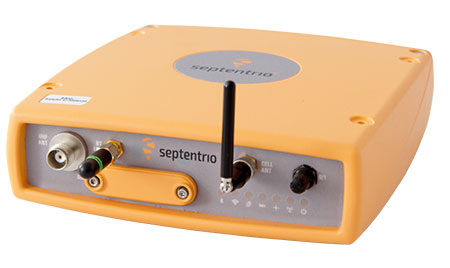
    AsteRx-U dual-antenna receiver.
    AsteRx-U dual-antenna receiver.

    DEME began using Septentrio’s solutions more than 10 years ago. While dredging in the Belgian town of Oostende, DEME was unable to obtain a reliable RTK position from their GNSS equipment because of interfering radio signals from a local radio tower.

    Septentrio worked with DEME to identify the source of the interference and modified a standard RTK receiver with special firmware to address the jamming problem. This case, along with others faced by Septentrio’s customers in the field, encouraged the development of a dedicated interference mitigation technology called AIM+, which is now standard in Septentrio’s GNSS solutions.

    Septentrio’s AsteRx GNSS receivers have been deployed on DEME’s ships around the world. They have been vital to DEME for the success of projects such as the creation of Gateway Port in London, U.K.; the construction of Deurganckdok in Antwerp, Belgium; the Pearl Qatar City; the Thornton Bank Offshore Windfarm in Belgium; the extension of the Suez Canal in Egypt; and many more.

    “’Creating land for the future’ is the slogan here at DEME and this is thanks, in part, to the accuracy and robustness of the solutions offered by Septentrio,” says Lorentz Lievens, head of the survey department.

    “Jamming is a concern which DEME has seen more and more all over the world,” Lievens says. “Septentrio’s receivers are unique in that they continue to provide an accurate solution even in areas of high radio and ionospheric interference allowing DEME to deliver projects on time and on budget. Septentrio’s precise positioning solutions will remain vital for DEME to deliver quality and cost-effective operations around the world for many years to come.”