Category: GNSS

  • Building a Wide-Band Multi-Constellation Receiver

    Building a Wide-Band Multi-Constellation Receiver

    The Universal Software Radio Peripheral as RF Front-End

    By Ningyan Guo, Staffan Backén, and Dennis Akos

    The authors designed a full-constellation GNSS receiver, using a cost-effective, readily available, flexible front-end, wide enough to capture the frequency from 1555 MHz to 1607 MHz, more than 50MHz. This spectrum width takes into account BeiDou E2, Galileo E1, GPS L1, and GLONASS G1. In the course of their development, the authors used an external OCXO oscillator as the reference clock and reconfigured the platform, developing their own custom wide-band firmware.

    The development of the Galileo and BeiDou constellations will make many more GNSS satellite measurements be available in the near future. Multiple constellations offer wide-area signal coverage and enhanced signal redundancy. Therefore, a wide-band multi-constellation receiver can typically improve GNSS navigation performance in terms of accuracy, continuity, availability, and reliability. Establishing such a wide-band multi-constellation receiver was the motivation for this research.

    A typical GNSS receiver consists of three parts: RF front-end, signal demodulation, and generation of navigation information. The RF front-end mainly focuses on amplifying the input RF signals, down-converting them to an intermediate frequency (IF), and filtering out-of-band signals. Traditional hardware-based receivers commonly use application-specific integrated circuit (ASIC) units to fulfill signal demodulation and transfer the range and carrier phase measurements to the navigation generating part, which is generally implemented in software. Conversely, software-based receivers typically implement these two functions through software. In comparison to a hardware-based receiver, a software receiver provides more flexibility and supplies more complex signal processing algorithms. Therefore, software receivers are increasingly popular for research and development.

    The frequency coverage range, amplifier performance, filters, and mixer properties of the RF front-end will determine the whole realization of the GNSS receiver. A variety of RF front-end implementations have emerged during the past decade. Real down-conversion multi-stage IF front-end architecture typically amplifies filters and mixes RF signals through several stages in order to get the baseband signals. However, real down-conversion can bring image-folding and rejection. To avoid these drawbacks, complex down-conversion appears to resolve much of these problems. Therefore, a complex down-conversion multi-stage IF front-end has been developed. But it requires a high-cost, high-power supply, and is larger for a multi-stage IF front-end. This shortcoming is overcome by a direct down-conversion architecture. This front-end has lower cost; but there are several disadvantages with direct down-conversion, such as DC offset and I/Q mismatch. DC offset is caused by local oscillation (LO) leakage reflected from the front-end circuit, the antenna, and the receiver external environment.

    A comparison of current traditional RF front-ends and different RF front-end implementation types led us to the conclusion that one model of a universal software radio peripheral, the USRP N210, would make an appropriate RF front end option. USRP N210 utilizes a low-IF complex direct down-conversion architecture that has several favorable properties, enabling developers to build a wide range of RF reception systems with relatively low cost and effort. It also offers high-speed signal processing. Most importantly, the source code of USRP firmware is open to all users, enabling researchers to rapidly design and implement powerful, flexible, reconfigurable software radio systems. Therefore, we chose the USRP N210 as our reception device to develop our wide-band multi-constellation GNSS receiver, shown in Figure 1.
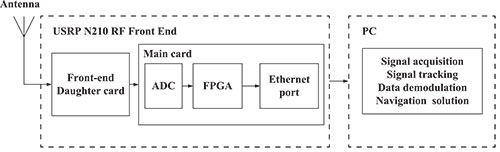
    Figure 1 Custom wide-band multi-constellation software receiver architecture based on universal software radio peripheral (USRP).
    Figure 1. Custom wide-band multi-constellation software receiver architecture based on universal software radio peripheral (USRP).
    USRP Front-End Architecture

    The USRP N210 front-end has wider band-width and radio frequency coverage in contrast with other traditional front-ends as shown by the comparison in Table 1. It has the potential to implement multiple frequencies and multiple-constellation GNSS signal reception. Moreover, it performs higher quantization, and the onboard Ethernet interface offers high-speed data transfer.
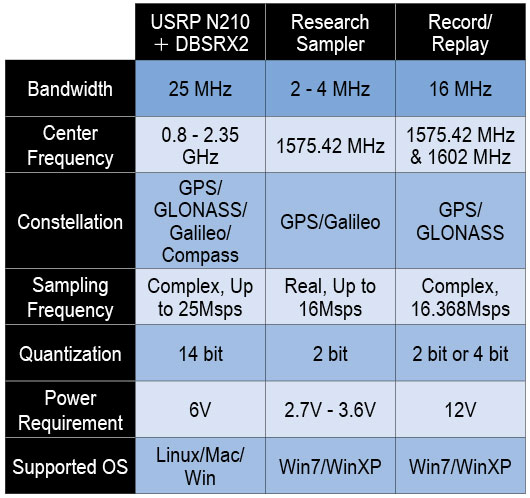
    Table 1. GNSS front-ends comparison.
    Table 1. GNSS front-ends comparison.

    USRP N210 is based on the direct low-IF complex down-conversion receiver architecture that is a combination of the traditional analog complex down-conversion implemented on daughter boards and the digital signal conditioning conducted in the motherboard. Some studies have shown that the low-IF complex down-conversion receiver architecture overcomes some of the well-known issues associated with real down-conversion super heterodyne receiver architecture and direct IF down-conversion receiver architecture, such as high cost, image-folding, DC offset, and I/Q mismatch.

    The low-IF receiver architecture effectively lessens the DC offset by having an LO frequency after analog complex down-conversion. The first step uses a direct complex down-conversion scheme to transform the input RF signal into a low-IF signal. The filters located after the mixer are centered at the low-IF to filter out the unwanted signals. The second step is to further down-covert the low-IF signal to baseband, or digital complex down-conversion.

    Similar to the first stage, a digital half band filter has been developed to filter out-of-band interference. Therefore, direct down-conversion instead of multi-stage IF down-conversion overcomes the cost problem; in the meantime, the signal is down-converted to low-IF instead of base-band frequency as in the direct down-conversion receiver, so the problem of the DC offset is also avoided in the low-IF receiver. These advantages make the USRP N210 platform an attractive option as GNSS receiver front-end.

    Figure 2 shows an example GNSS signal-streaming path schematic on a USRP N210 platform with a DBSRX2 daughter board. Figure 3 shows a photograph of internal structure of a USRP N210 platform.
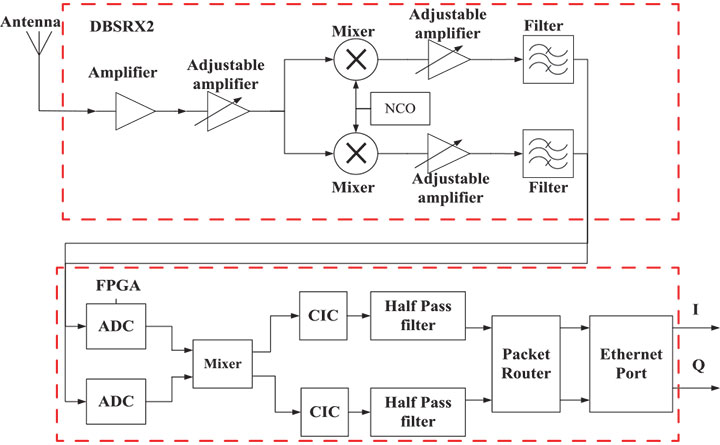
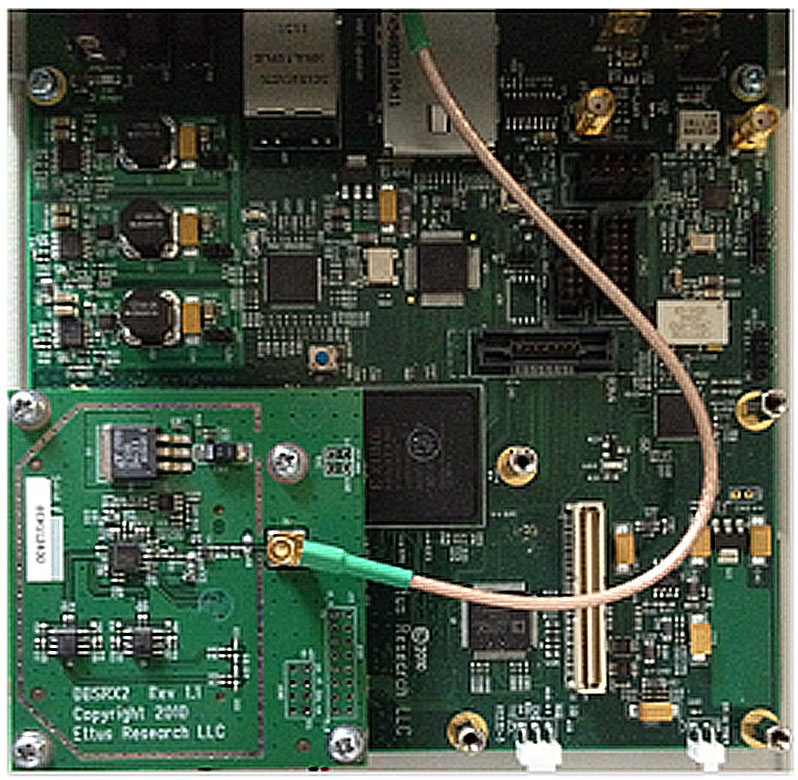
    Figure 2  GNSS signal streaming on USRP N210 + DBSRX2 circuit.
    Figure 2 GNSS signal streaming on USRP N210 + DBSRX2 circuit.
    G-Fig3
    Figure 3. USRP N210 internal structure.

    The USRP N210 platform includes a main board and a daughterboard. In the main board, 14-bit high precision analog-digital converters (ADCs) and digital-analog converters (DACs) permit wide-band signals covering a high dynamic range. The core of the main board is a high-speed field-programmable gate array (FPGA) that allows high-speed signal processing. The FPGA configuration implements down-conversion of the baseband signals to a zero center frequency, decimates the sampled signals, filtering out-of-band components, and finally transmits them through a packet router to the Ethernet port. The onboard numerically controlled oscillator generates the digital sinusoid used by the digital down-conversion process. A cascaded integrator-comb (CIC) filter serves as decimator to down-sample the signal.

    The signals are filtered by a half pass filter for rejecting the out-of-band signals. A Gigabit Ethernet interface effectively enables the delivery of signals out of the USRP N210, up to 25MHz of RF bandwidth. In the daughterboard, first the RF signals are amplified, then the signals are mixed by a local onboard oscillator according to a complex down-conversion scheme. Finally, a band-pass filter is used remove the out-of-band signals.

    Several available daughter boards can perform signal conditioning and tuning implementation. It is important to choose an appropriate daughter board, given the requirements for the data collection.

    A support driver called Universal Hardware Driver (UHD) for the USRP hardware, under Linux, Windows and Mac OS X, is an open-source driver that contains many convenient assembly tools. To boot and configure the whole system, the on-board microprocessor digital signal processor (DSP) needs firmware, and the FPGA requires images. Firmware and FPGA images are downloaded into the USRP platform based on utilizations provided by the UHD. Regarding the source of firmware and FPGA images, there are two methods to obtain them:

    •   directly use the binary release firmware and images posted on the web site of the company;
    •   build (and potentially modify) the provided source code.
    USRP Testing and Implementation

    Some essential testing based on the original configuration of the USRP N210 platform provided an understanding of its architecture, which was necessary to reconfigure its firmware and to set up the wide-band, multi-constellation GNSS receiver. We collected some real GPS L1 data with the USRP N210 as RF front-end. When we processed these GPS L1 data using a software-defined radio (SDR), we encountered a major issue related to tracking, described in the following section.

    Onboard Oscillator Testing. A major problem with the USRP N210 is that its internal temperature-controlled crystal oscillator (TCXO) is not stable in terms of frequency. To evaluate this issue, we recorded some real GPS L1 data and processed the data with our software receiver. As shown in Figure 4, this issue results in the loss of GPS carrier tracking loop at 3.18 seconds, when the carrier loop bandwidth is 25Hz.
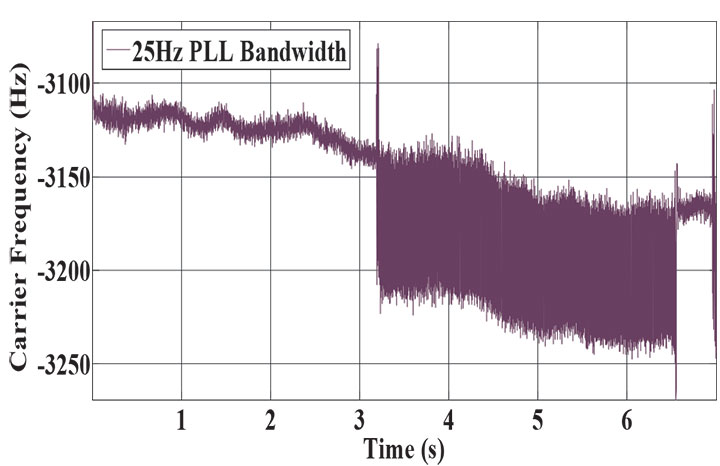
    Figure 4. GPS carrier loop loss of lock.
    Figure 4. GPS carrier loop loss of lock.

    Consequently, we adjusted the carrier loop bandwidth up to 100Hz; then GPS carrier tracking is locked at the same timing (3.18s), shown in Figure 5, but there is an almost 200 Hz jump in less than 5 milliseconds.
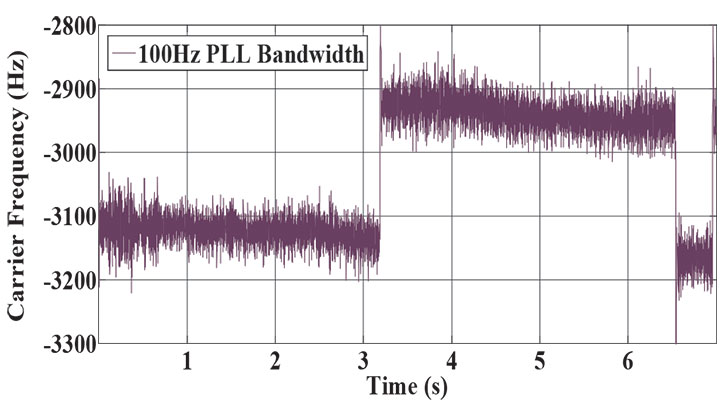
    Figure 5. GPS carrier loop lock tracking.
    Figure 5. GPS carrier loop lock tracking.

    As noted earlier, the daughter card of the USRP N210 platform utilizes direct IF complex down-conversion to tune GNSS RF signals. The oscillator of the daughter board generates a sinusoid signal that serves as mixer to down-convert input GNSS RF signals to a low IF signal. Figure 6 illustrates the daughter card implementation. The drawback of this architecture is that it may bring in an extra frequency shift by the unstable oscillator. The configuration of the daughter-card oscillator is implemented by an internal TCXO clock, which is on the motherboard. Unfortunately, the internal TCXO clock has coarse resolution in terms of frequency adjustments. This extra frequency offset multiplies the corresponding factor that eventually provides mixer functionality to the daughter card. This approach can directly lead to a large frequency offset to the mixer, which is brought into the IF signals.
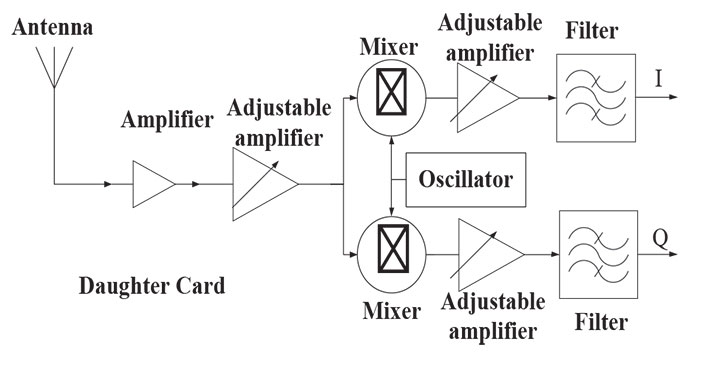
    Figure 6. Daughter-card tuning implementation.
    Figure 6. Daughter-card tuning implementation.

    Finally, when we conduct the tracking operation through the software receiver, this large frequency offset is beyond the lock range of a narrow, typically desirable, GNSS carrier tracking loop, as shown in Figure 4.

    In general, a TCXO is preferred when size and power are critical to the application. An oven-controlled crystal oscillator (OCXO) is a more robust product in terms of frequency stability with varying temperature. Therefore, for the USRP N210 onboard oscillator issue, it is favorable to use a high-quality external OCXO as the basic reference clock when using USRP N210 for GNSS applications.

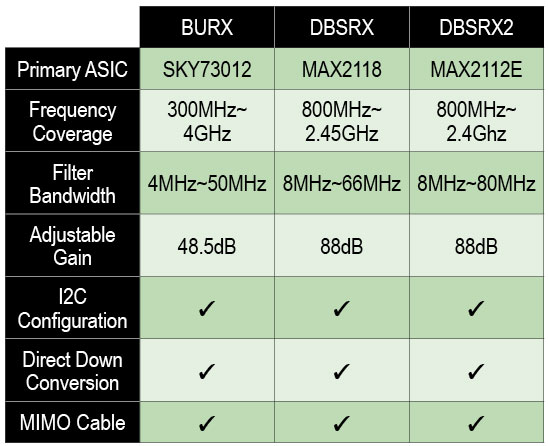
    Front-End Daughter-Card Options. A variety of daughter-card options exist to amplify, mix, and filter RF signals. Table 2 lists comparison results of three daughter cards (BURX, DBSRX and DBSRX2) to supply some guidance to researchers when they are faced with choosing the correct daughter-board.
    G-table2
    Table 2. Front-end daughter-card options.

    The three daughter cards have diverse properties, such as the primary ASIC, frequency coverage range, filter bandwidth and adjustable gain. BURX gives wider radio frequency coverage than DBSRX and DBSRX2. DBSRX2 offers the widest filter bandwidth among the three options.

    To better compare the performance of the three daughter cards, we conducted another three experiments. In the first, we directly connected the RF port with a terminator on the USRP N210 platform to evaluate the noise figure on the three daughter cards. From Figure 7, we can draw some conclusions:

    • BURX has a better sensitivity than DBSRX and DBSRX2 when the gain is set below 30dB.
    • DBSRX2 observes feedback oscillation when the gain set is higher than 70dB.
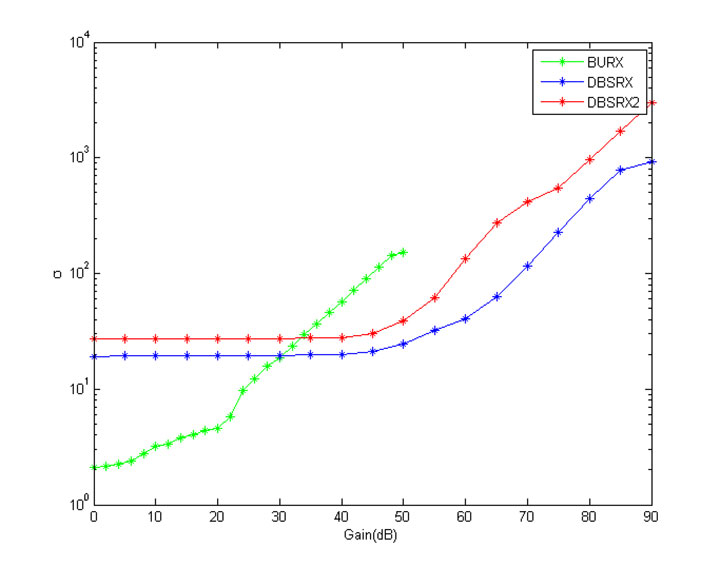
    Figure 7  Noise performance comparisons of three daughter cards.
    Figure 7. Noise performance comparisons of three daughter cards.

    The second experimental setup configuration used a USRP N210 platform, an external OCXO oscillator to provide stable reference clock, and a GPS simulator to evaluate the C/N0 performance of the three daughter boards. The input RF signals are identical, as they come from the same configuration of the GPS simulator. Figure 8 illustrates the C/N0 performance comparison based on this experimental configuration. The figure shows that BURX performs best, with DBSRX2 just slightly behind, while DBSRX has a noise figure penalty of 4dB.
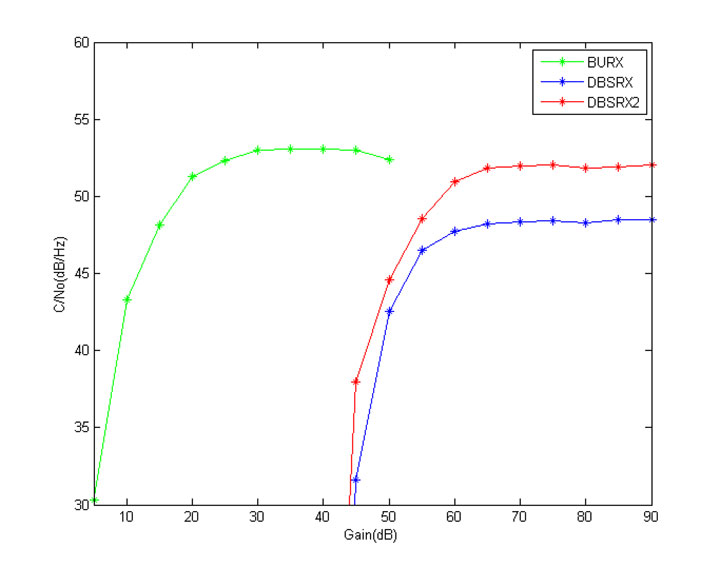
    Figure 8. C/N0 performance comparisons of three daughter cards.
    Figure 8. C/N0 performance comparisons of three daughter cards.

    In the third experiment, we added an external amplifier to increase the signal-to-noise ratio (SNR). From Figure 9, we see that the BURX, DBSRX and DBSRX2 have the same C/N0 performance, effectively validating the above conclusion. Thus, an external amplifier is recommended when using the DBSRX or DBSRX2 daughter boards.
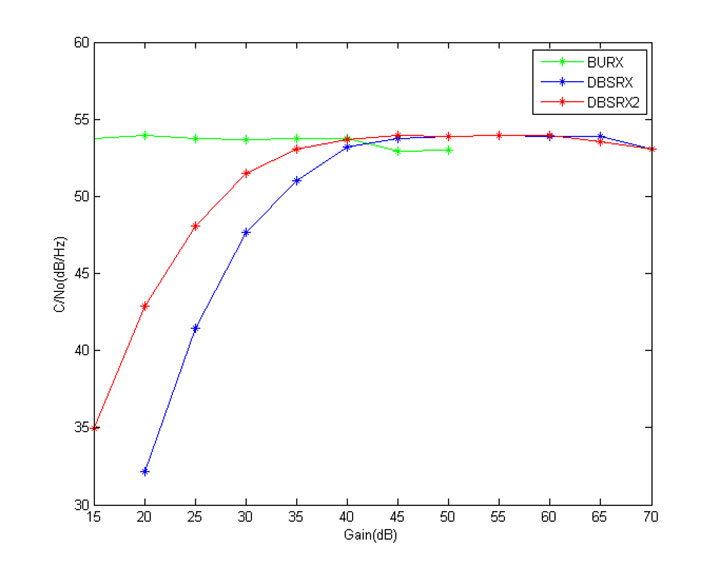
    Figure 9. C/N0 performance comparisons of three daughter cards with an external amplifier.
    Figure 9. C/N0 performance comparisons of three daughter cards with an external amplifier.

    The purpose of these experiments was to find a suitable daughter board for collecting wide-band multi-constellation GNSS RF signals. The important qualities of an appropriate wide-band multi-constellation GNSS receiver are:

    • high sensitivity;
    • wide filter bandwidth; and
    • wide frequency range.

    After a comparison of the three daughter boards, we found that the BURX has a better noise figure than the DBSRX or DBSRX2. The overall performance of the BURX and DBSRX2 are similar however. Using an external amplifier effectively decreases the required gain on all three daughter cards, which correspondingly reduces the effect of the internal thermal noise and enhances the signal noise ratio. As a result, when collecting real wide-band multi-constellation GNSS RF signals, it is preferable to use an external amplifier.

    To consider recording GNSS signals across a 50MHz band, DBSRX2 provides the wider filter bandwidth among the three daughter-card options, and thus we selected it as a suitable daughter card.

    Custom Wide-band Firmware Development. When initially implementing the wideband multi-constellation GNSS reception devices based on the USRP N210 platform, we found a shortcoming in the default configuration of this architecture, whose maximum bandwidth is 25MHz. It is not wide enough to record 50MHz multi-constellation GNSS signals (BeiDou E2, GPS L1, Galileo E1, and GlonassG1). A 50MHz sampling rate (in some cases as much as 80 MHz) is needed to demodulate the GNSS satellites’ signals.

    Meanwhile since the initiation of the research, the USRP manufacturer developed and released a 50MHz firmware. To highlight our efforts, we further modified the USRP N210 default configuration to increase the bandwidth up to 100MHz, which has the potential to synchronously record multi-constellation multi-frequency GNSS signals (Galileo E5a and E5b, GPS L5 and L2) for further investigation of other multi-constellation applications, such as ionospheric dispersion within wideband GNSS signals, or multi-constellation GNSS radio frequency compatibility and interoperability.

    Apart from reprogramming the host driver, we focused on reconfiguring the FPGA firmware. With the aid of anatomizing signal flow in the FPGA, we obtained a particular realization method of augmenting its bandwidth. Figure 10 shows the signal flow in the FPGA of the USRP N210 architecture.
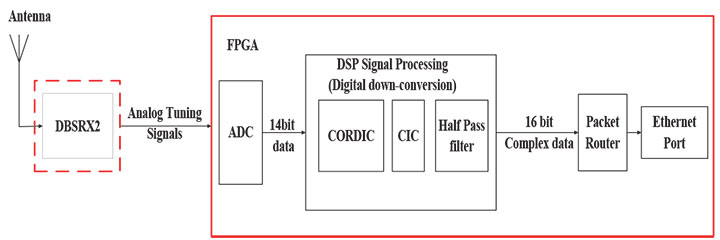
    Figure 10. Signal flow in the FPGA of the USRP N210 platform.
    Figure 10. Signal flow in the FPGA of the USRP N210 platform.

    The ADC produces 14-bit sampled data. After the digital down-conversion implementation in the FPGA, 16-bit complex I/Q sample data are available for the packet transmitting step. According to the induction document of the USRP N210 platform, VITA Radio Transport Protocol functions as an overall framework in the FPGA to provide data transmission and to implement an infrastructure that maintains sample-accurate alignment of signal data. After significant processing in the VITA chain, 36-bit data is finally given to the packet router. The main function of the packet router is to transfer sample data without any data transformation. Finally, through the Gigabit Ethernet port, the host PC receives the complex sample data.

    In an effort to widen the bandwidth of the USRP N210 platform, the bit depth needs to be reduced, which cuts 16-bit complex I/Q sample data to a smaller length, such as 8-bit, 4-bit, or even 2-bit, to solve the problem. By analyzing Figure 10, to fulfill the project’s demanding requirements, modification to the data should be performed after ADC sampling, but before the digital down-conversion. We directly extract the 4-bit most significant bits (MSBs) from the ADC sampling data and combined eight 4-bit MSB into a new 16-bit complex I/Q sample, and gave this custom sample data to the packet router, increasing the bandwidth to 100 MHz.

    Wide-Band Receiver Performance Analysis. The custom USRP N210-based wide-band multi-constellation GNSS data reception experiment is set up as shown in Figure 11.
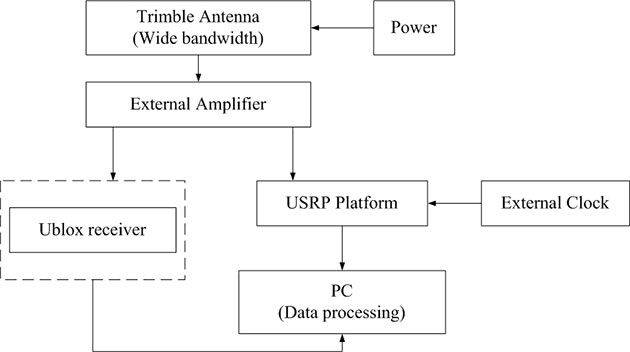
    Figure 11  Wide-band multi-constellation GNSS data recording system.
    Figure 11. Wide-band multi-constellation GNSS data recording system.

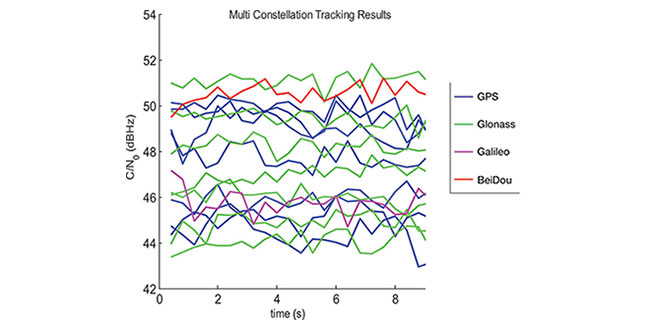
    A wide-band antenna collected the raw GNSS data, including GPS, GLONASS, Galileo, and BeiDou. An external amplifier was included to decrease the overall noise figure. An OCXO clock was used as the reference clock of the USRP N210 system. After we found the times when Galileo and BeiDou satellites were visible from our location, we first tested the antenna and external amplifier using a commercial receiver, which provided a reference position. Then we used 1582MHz as the reception center frequency and issued the corresponding command on the host computer to start collecting the raw wide-band GNSS signals. By processing the raw wide-band GNSS data through our software receiver, we obtained the acquisition results from all constellations shown in Figure 12; and tracking results displayed in Figure 13.
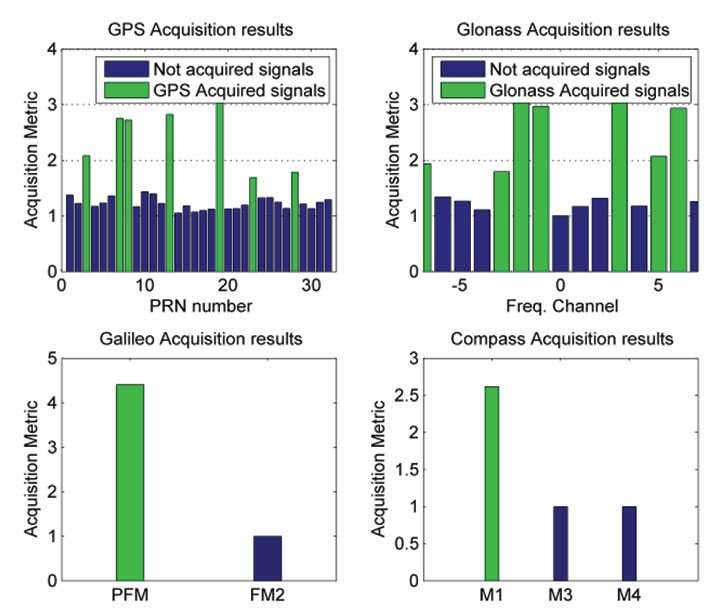
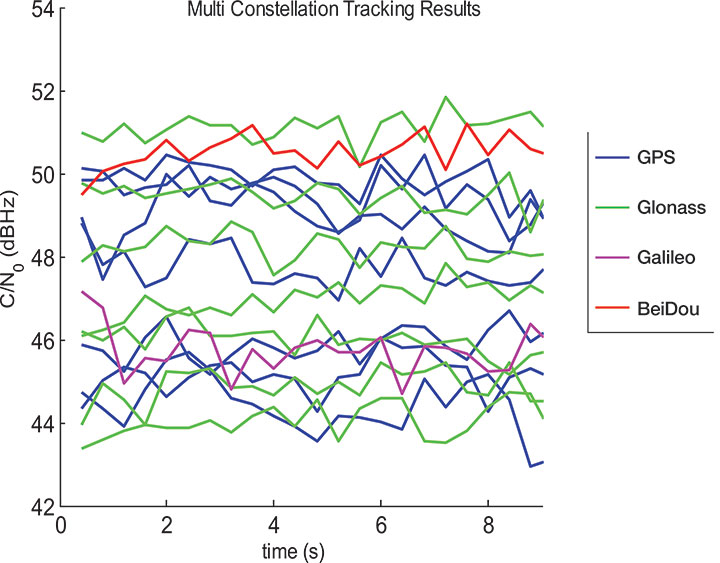
    Figure 12  Acquisition results for all constellations.
    Figure 12. Acquisition results for all constellations.
    Guo_opener
    Figure 13. Tracking results for all constellations.

    We could not do the full-constellation position solution because Galileo was not broadcasting navigation data at the time of the collection and the ICD for BeiDou had not yet been released. Therefore, respectively using GPS and GLONASS tracking results, we provided the position solution and timing information that are illustrated in Figure 14 and in Figure 15.
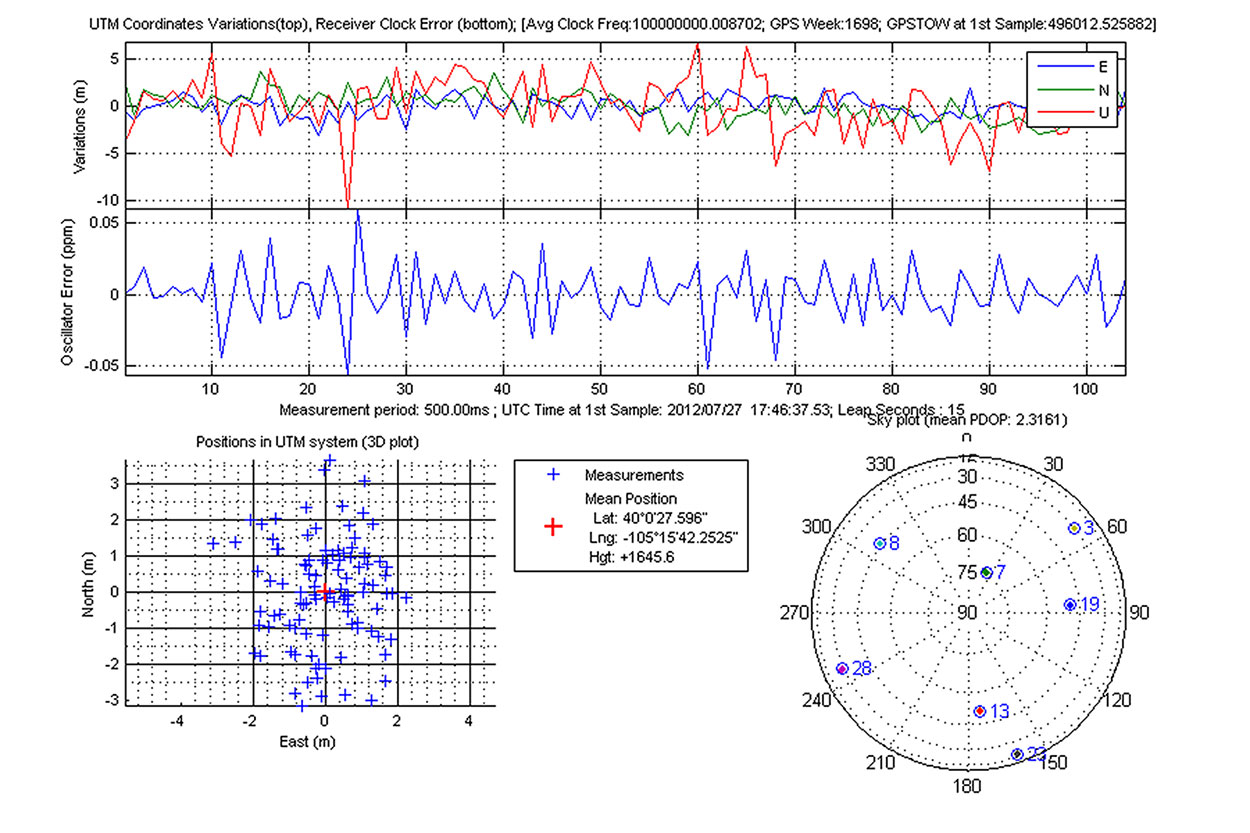
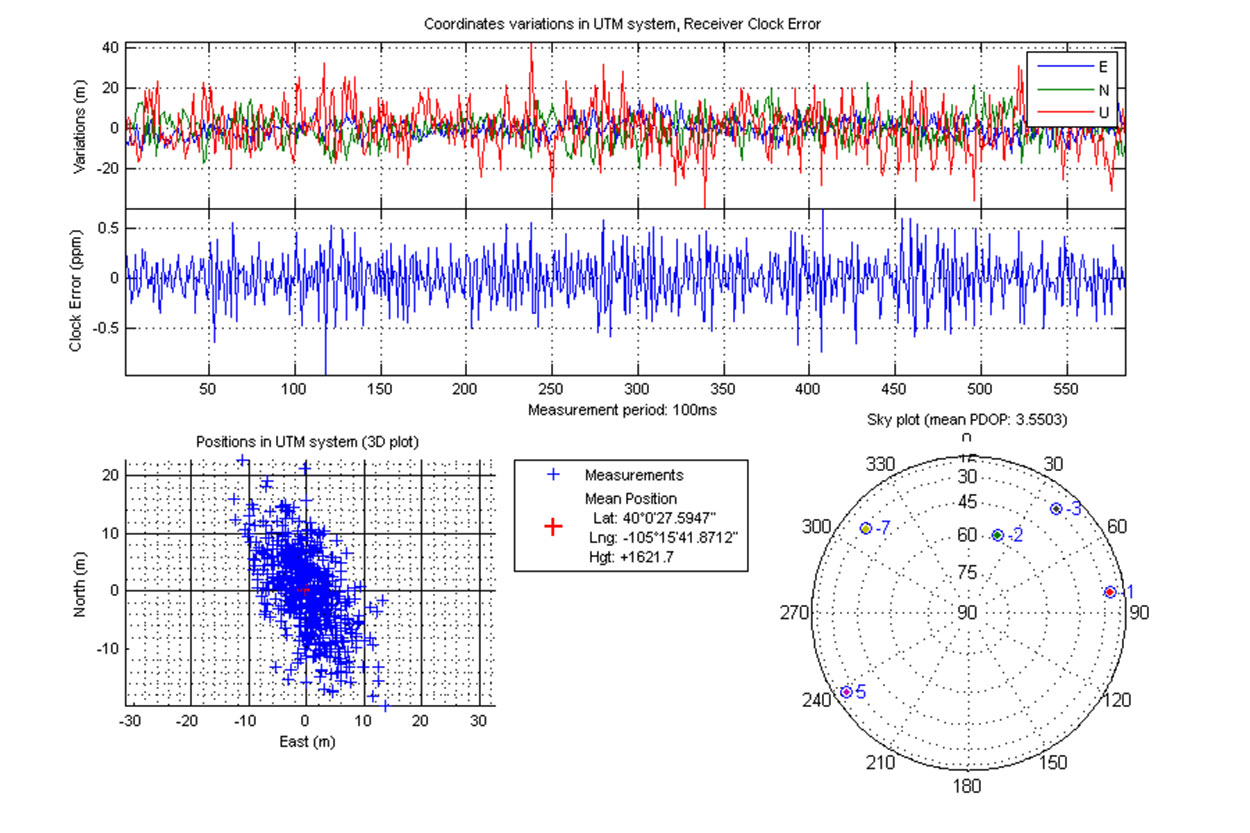
    Figure 13. GPS position solution and timing information.
    Figure 14. GPS position solution and timing information.
    Figure 14. GLONASS position solution.
    Figure 15. GLONASS position solution.
    Conclusions

    By processing raw wide-band multi-constellation GNSS signals through our software receiver, we successfully acquired and tracked satellites from the four constellations. In addition, since we achieved 100MHz bandwidth, we can also simultaneously capture modernized GPS and Galileo signals (L5 and L2; E5a and E5b, 1105–1205 MHz).

    In future work, a longer raw wide-band GNSS data set will be recorded and used to determine the user position leveraging all constellations. Also an urban collection test will be done to assess/demonstrate that multiple constellations can effectively improve the reliability and continuity of GNSS navigation.

    Acknowledgment

    The first author’s visiting stay to conduct her research at University of Colorado is funded by China Scholarship Council, File No. 2010602084.

    This article is based on a paper presented at the Institute of Navigation International Technical Conference 2013 in San Diego, California.

    Manufacturers

    The USRP N210 is manufactured by Ettus Research. The core of the main board is a high-speed Xilinx Spartan 3A DSP FPGA. Ettus Research provides a support driver called Universal Hardware Driver (UHD) for the USRP hardware. A wide-band Trimble antenna was used in the final experiment.


    Ningyan Guo is a Ph.D. candidate at Beihang University, China. She is currently a visiting scholar at the University of Colorado at Boulder.

    Staffan Backén is a postdoctoral researcher at University of Colorado at Boulder. He received a Ph.D. in in electrical engineering from Luleå University of Technology, Sweden.

    Dennis Akos completed a Ph.D. in electrical engineering at Ohio University. He is an associate professor in the Aerospace Engineering Sciences Department at the University of Colorado at Boulder with visiting appointments at Luleå University of Technology and Stanford University

  • The System: GPS Alliance, Galileo Budget, EGNOS Safe Skies

    New Organization Advocates for GPS Industry; Galileo Lives to Fly Another Day, Budget Passed; Safer Skies for EGNOS; and GLONASS in Brazil

    New Organization Advocates for GPS Industry

    A new group, the GPS Innovation Alliance, has formed and announced itself as the voice of the U.S. GPS industry and community of users, to “support the ever-increasing importance of GPS” in the U.S. capital, Washington, D.C.  The organization subsumes and replaces both the U.S. GPS Industry Council, an entity of longstanding, and the Coalition to Save Our GPS, which arose in March 2011 in response to a Federal Communications Commission (FCC) conditional waiver granted to LightSquared.

    The alliance appears to reflect a desire on the part of some industry members to take a more aggressive approach inside the Washington Beltway, a sign, it would seem, of the political times. Some of those involved spoke informally of a desire to take advantage of contacts made on Capitol Hill and in the media during the highly visible LightSquared combat, fought in the glare of media attention heretofore unknown in industry circles.

    GPSIA_logo
    GPSv Innovation Alliance logo

    Members of the Alliance are drawn from a variety of fields and businesses reliant on GPS, as well as leading manufacturers of GPS equipment. The former group includes, aviation, agriculture, construction, transportation, first responders, and surveying and mapping, and consumer organizations representing users of GPS for boating and other outdoor activities, and in automobiles, smartphones, and tablets.

    Joining John Deere, Garmin, and Trimble — three lead drivers of the Coalition effort at the FCC — are NovAtel Inc. and Topcon Positioning Systems. All five were previously long-time members of the USGIC, and they appear as founding members of the alliance at www.gpsalliance.org.

    Affiliate members listed on the website include the Association of Equipment Manufacturers, General Aviation Manufacturers Association, National Association of Manufacturers, Association for Unmanned Aerial Vehicles International, and Boat Owners Association of the United States.

    The alliance plans to build on “the proud heritage and extensive expertise of the United States GPS Industry Council (USGIC), which was formed in 1991 to promote broader commercial applications of GPS and to expand global markets while assisting in safeguarding the technology’s military advantages. The council has a long history of highly effective advocacy on behalf of the GPS industry, as well as serving as a trusted source of objective information for policy makers, the media and the public both in the U.S. and around the world.” The alliance website gives a longer statement about the history and record of the USGIC, highlighting its role in international negotiations.

    Michael Swiek, executive director of the USGIC, has transitioned to become the executive director, executive branch and international, of the Innovation Alliance. In addition to working closely with leading offices of executive branch departments of the U.S. government, he will continue well-established dialogs with governmental, private sector and academic entities in areas critical to GPS and satellite navigation among key players in Europe, Japan, Russia, Korea, China, and elsewhere.

    Heather Hennessey, a principal of Innovative Federal Strategies LLC, a “comprehensive government relations firm,” has taken the position of executive director, legislative, at the alliance. Hennessey has seven years of service in the House of Representatives, including two years as chief of staff for Congressman Jack Kingston of Georgia.

    An active voice in alliance representations on Capitol Hill will presumably be that of Jim Kirkland, vice president and general counsel for Trimble. Kirkland was the most prominent spokesperson for the coalition during the LightSquared battle, which appears to be either over or nearly so. “The alliance is committed to ensuring constructive, robust dialog between GPS users, manufacturers and policy makers on critical policy issues affecting GPS,” Kirkland said, “a commitment Trimble is pleased to be a part of as the industry continues to innovate and modernize.”

    The alliance mission statement cites the importance of GPS to global economy and infrastructure; vows to aid further GPS innovation, creativity and entrepreneurship; and to protect, promote and enhance the use of GPS.

    The GPS Innovation Alliance officially launched on February 13 with a reception on Capitol Hill, a traditional lobbying tactic that previous efforts had perhaps not envisioned.  The organization has also hired a public relations firm, Prism Public Affairs, and commissioned a logo.

    Galileo Lives to Fly Another Day, Budget Passed

    European Union leaders approved a scaled-down budget in early February, with none of the cuts to the Galileo program that had been widely feared. The project, conducted by the European Space Agency (ESA) under close supervision of the European Commission (EC),  will draw on funding of 6.3 billion euros (about $8.5 billion) from 2014 to 2020. The satellite navigation program held onto its requested revised budget of 6.3 billion euros, even as telecommunications research and broadband deployment projects, including another ESA pet project, the somewhat related Copernicus Global Monitoring for Environment and Security (GMES), underwent severe cuts. Galileo has already spent more than 3 billion euros ($4 billion), three times its original budget, to launch four of an envisioned 30-satellite constellation.

    The EU deliberative system requires unanimous approval of budget decisions, so what smaller countries seek for their farmers or fishermen carries practically equal weight to the desire of industrial/aerospace giants like Germany, closely followed by France and the United Kingdom. Negotiation is a delicate matter indeed, and reached an impasse in November 2012; resolution came only after a 24-hour marathon session of talks. The total budget represents the first decrease in the European Union’s history; austerity is the watchword in  a region beset with an ongoing bevy of international debt crises and serious recession in many of the smaller EU countries.

    Galileo supporters within the European Commission, the EU’s policy-making arm, continued to maintain that Galileo will “open a whole new world” for business to develop applications, as Antonio Tajani, EC vice president stated recently. The program drew strong support, for once, from powerful backers in the EU administrative capital, Brussels, and among industrial and political interests in key member states: France, Germany, and for an exception Britain, often a proponent of deep cuts.

    Negotiators helped Galileo’s chances by placing it in a research group labeled “Competitiveness for Growth and Jobs.” This category actually rose in budget allocation by nearly 40 percent over the last seven-year allotment.

    The allocation should cover operational costs for EGNOS and Galileo, the completion of the initial Galileo constellation of 14, and early procurement stages of a full, or second-generation orbiting set of 30.

    The program still faces an extremely unlikely date for the establishment of early services by the end of 2014. “Then, the market, as well as the governments of the Member States, will start increasing their interest and promoting further investments,” the ever-optimistic Tajani maintained.

    The budget must still secure approval by the European Parliament. Its president, Martin Schulz of Germany has stated, “The further we step away from the Commission’s proposed figures, the more likely the proposal will be rejected. More and more tasks, and less and less money — the inevitable result is budget deficits. The Parliament will not go along with this.”

    Parliament’s decision is forecast for the summer months. Parliament’s budget power consists of a direct yes-or-no vote to accept or reject the budget. The body cannot make modifications, and if rejecting would simply send it back to the EU ministers to begin all over again.  The picture is further complicated somewhat by the 20-nation make-up of ESA, whereas the European Union and its executive commission have 27 national members.

    Safer Skies for EGNOS

    Results of a September 2012 flight test in the Galileo Test and Development Environment (GATE) near Berchtesgaden, Germany, the one place on Earth where Galileo services are already routinely available, show that adding Galileo signals to the European Geostationary Navigation Overlay Service (EGNOS) should boost accuracy significantly. EGNOS augments the accuracy and reliability of GPS signals over Europe, rendering satnav usable for safety-critical applications such as aircraft guidance, as well as more general precision uses.

    Operational horizontal and vertical distance “protection levels” for safety were cut by half by combining use of GPS and Galileo within EGNOS. In addition, new integrity algorithms installed within the user receiver turned out to reliably detect and exclude reflected or otherwise faulty signals.

    Next-generation EGNOS, planned for 2020, is envisaged to augment both constellations and dual frequencies at the same time, making the system much more robust.

    GLONASS in Brazil

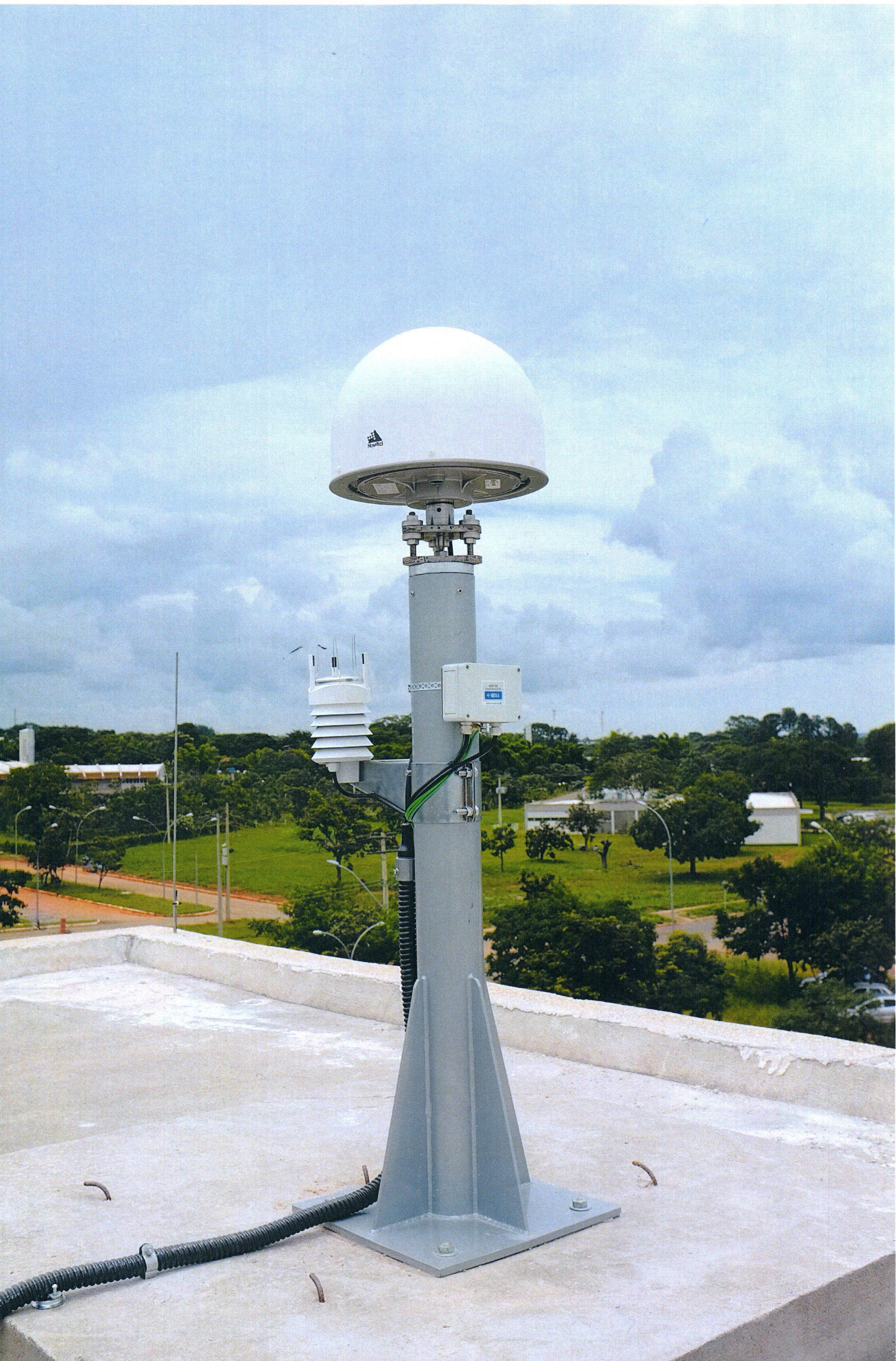
    The first overseas GLONASS ground monitoring station for differential correction and monitoring outside Russian territory opened in Brasilia, Brazil, in mid-February. The station represents an early step in an initiative to modernize and significantly improve the accuracy of GLONASS signals.

    Plans call for similar monitoring stations “in more than 30 countries of the world. Most of the countries that received the offers for the installation of the stations responded positively.However, the process is slow because of the need to conclude appropriate intergovernmental agreements. The documents with Brazil were signed in 2012. Agreements with Spain, Indonesia and Australia will be finalized soon,” according to a Pravda story.

  • Two Active GLONASS Satellites Could Cause Users Difficulties

    On day 53 (February 22) around 09:15 GPS Time, GLONASS 743 began transmitting on frequency channel 6 using almanac slot 8 (R08). It should replace GLONASS 701K (801) transmitting on frequency channel -5, previously using almanac slot 8. However, GLONASS 701K was not immediately switched off and/or did not switch slot numbers and continued to transmit on frequency channel -5 for several days, continuously identifying itself as a slot 8 satellite.

    While most receivers were just tracking GLONASS 743, some tracked both GLONASS 743 and 701K. While 701K was not in the broadcast almanac, it was transmitting ephemeris records identifying itself as a satellite in slot 8. The net result was that RINEX observation files from certain stations had a mixture of GLONASS 743 and 701K data, with no indication of which satellite was which. Of course, one could use expected Doppler shift and/or code/carrier rate of change to figure out which data records correspond to which satellite.

    Furthermore, the GLONASS navigation files from certain stations contained a mixture of ephemeris records from GLONASS 743 and 701K. For day 54, for example, GLONASS navigation files for 146 (non-MGEX) stations were available at CDDIS. A number of these did not contain any R08 entries, presumably because the corresponding receivers were set to not track unhealthy satellites. Some of the files contained R08 ephemeris records from earlier dates. These were ignored.

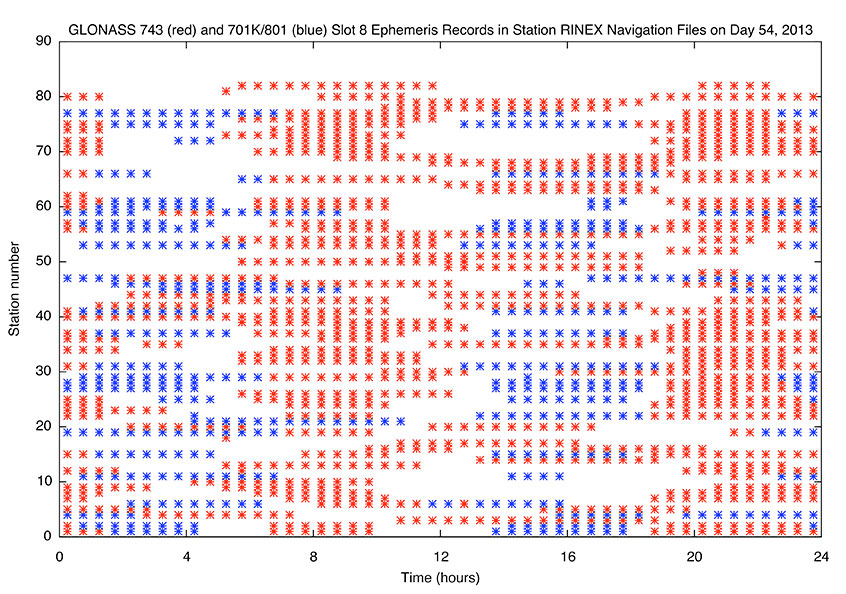
    This left 82 files containing either GLONASS 701K and/or 743 ephemeris records for day 54. These files were parsed to determine, for each file, for which times ephemeris records were available for which satellites. The results are summarized in the following plot (PDF available):

    glonass_slot8_in_nav_files_054_2013
    Results of Glonass

    The station numbers correspond to those in this table.

    The navigation files from 29 stations contain both GLONASS 701K and 743 records. It seems that JAVAD GNSS and Topcon receivers were primarily affected.

    Note that the CDDIS brdc***0.13g files on affected days have a mixture of GLONASS 743 and 701K ephemeris records, but at any one epoch, only one satellite is represented.

    Files from days 53 through 56 are affected.

    It appears that GLONASS 701K stopped identifying itself as a slot 8 satellite after about 15:15 GPS Time on day 56 and was not subsequently tracked by any station supplying data files to CDDIS.

    See also IGSMail-6734, “Irregular GLONASS constellation change (for R08).

  • Air Force Awards Lockheed Martin Contracts for Next Set of GPS III Satellites

    The U.S. Air Force has awarded Lockheed Martin two fixed-price contracts totaling $120 million to procure long lead parts for the fifth, sixth, seventh and eighth next-generation GPS III satellites.

    The GPS III program will replace aging GPS satellites while improving capability to meet the evolving demands of military, commercial and civilian users. GPS III satellites will deliver better accuracy and improved anti-jamming power while enhancing the spacecraft’s design life and adding a new civil signal designed to be interoperable with international global navigation satellite systems, Lockheed Martin said.

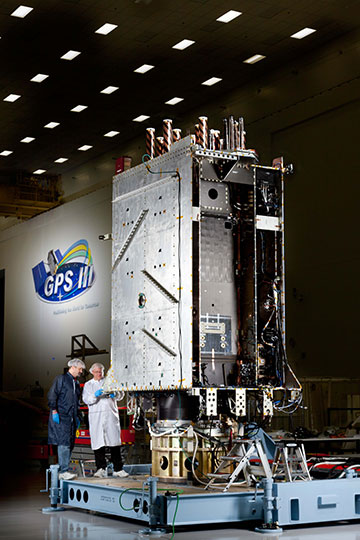
    Lockheed Martin engineers work on the full-sized prototype of the GPS III satellite in the company’s GPS Processing Facility (GPF) near Denver.
    Lockheed Martin engineers work on the full-sized prototype of the GPS III satellite in the company’s GPS Processing Facility near Denver. In November, the team completed thermal vacuum testing for the Navigation Payload Element of the GPS III Non-Flight Satellite Testbed.

    “The GPS III program was laid out at the very beginning to reduce risk early and facilitate affordable satellite production over the long term,” said Lt. Col. Todd Caldwell, the U.S. Air Force’s GPS III program manager. “This most recent award and our team’s ability to convert the contract structure to fixed price is a sign that we are on track to meet the affordability objectives and commitments we originally set out to achieve.”

    Incorporating lessons learned from previous GPS programs, the Air Force initiated a “back-to-basics” acquisition approach for GPS III. The strategy emphasizes early investments in rigorous systems engineering, industry-leading parts standards, and the development of a full-size GPS III satellite prototype to significantly reduce risk, improve production predictability, increase mission assurance and lower overall program costs. These investments early in the GPS III program are designed to prevent the types of engineering issues discovered on other programs late in the manufacturing process or even on orbit.

    “The Air Force’s back-to-basics acquisition strategy and the progress we have already made on our GPS III prototype gives us high confidence in our ability to perform efficient and affordable fixed-price satellite production going forward,” said Keoki Jackson, vice president of Lockheed Martin’s Navigation Systems mission area. “As our world becomes increasingly dependent on GPS technology, the new GPS III satellites will be a critical element of both our national and economic security, and we are committed to achieving mission success for the billions of military, commercial and civilian users worldwide.”

    Lockheed Martin is currently under contract for production of the first four GPS III satellites, and will now begin advanced procurement of long-lead components for the fifth, sixth, seventh and eighth satellites. The Air Force plans to purchase up to 32 GPS III satellites.

    The GPS III team is led by the Global Positioning Systems Directorate at the U.S. Air Force Space and Missile Systems Center. Lockheed Martin is the GPS III prime contractor with teammates ITT Exelis, General Dynamics, Infinity Systems Engineering, Honeywell, ATK and other subcontractors. Air Force Space Command’s 2nd Space Operations Squadron (2SOPS), based at Schriever Air Force Base, Colo., manages and operates the GPS constellation for both civil and military users.

  • New Organization Advocates for GPS Industry

    A new group, the GPS Innovation Alliance, has formed and announced itself as the voice of the U.S. GPS industry and community of users, to “support the ever-increasing importance of GPS” in the U.S. capital, Washington, D.C.  The organization subsumes and replaces both the U.S. GPS Industry Council, an entity of longstanding, and the Coalition to Save Our GPS, which arose in March 2011 in response to a Federal Communications Commission (FCC) conditional waiver granted to LightSquared.

    The alliance appears to reflect a desire on the part of some industry members to take a more aggressive approach inside the Washington Beltway, a sign, it would seem, of the political times. Some of those involved spoke informally of a desire to take advantage of contacts made on Capitol Hill and in the media during the highly visible LightSquared combat, fought in the glare of media attention heretofore unknown in industry circles.

    Members of the Alliance are drawn from a variety of fields and businesses reliant on GPS, as well as leading manufacturers of GPS equipment. The former group includes, aviation, agriculture, construction, transportation, first responders, and surveying and mapping, and consumer organizations representing users of GPS for boating and other outdoor activities, and in automobiles, smartphones, and tablets.

    Joining John Deere, Garmin, and Trimble — three lead drivers of the Coalition effort at the FCC — are NovAtel Inc. and Topcon Positioning Systems. All five were previously long-time members of the USGIC, and they appear as founding members of the alliance at www.gpsalliance.org.

    Affiliate members listed on the website include the Association of Equipment Manufacturers, General Aviation Manufacturers Association, National Association of Manufacturers, Association for Unmanned Aerial Vehicles International, and Boat Owners Association of the United States.

    The alliance plans to build on “the proud heritage and extensive expertise of the United States GPS Industry Council (USGIC), which was formed in 1991 to promote broader commercial applications of GPS and to expand global markets while assisting in safeguarding the technology’s military advantages. The council has a long history of highly effective advocacy on behalf of the GPS industry, as well as serving as a trusted source of objective information for policy makers, the media and the public both in the U.S. and around the world.” The alliance website gives a longer statement about the history and record of the USGIC, highlighting its role in international negotiations.

    Michael Swiek, executive director of the USGIC, has transitioned to become the executive director, executive branch and international, of the Innovation Alliance. In addition to working closely with leading offices of executive branch departments of the U.S. government, he will continue well-established dialogs with governmental, private sector and academic entities in areas critical to GPS and satellite navigation among key players in Europe, Japan, Russia, Korea, China, and elsewhere.

    Heather Hennessey, a principal of Innovative Federal Strategies LLC, a “comprehensive government relations firm,” has taken the position of executive director, legislative, at the alliance. Hennessey has seven years of service in the House of Representatives, including two years as chief of staff for Congressman Jack Kingston of Georgia.

    An active voice in alliance representations on Capitol Hill will presumably be that of Jim Kirkland, vice president and general counsel for Trimble. Kirkland was the most prominent spokesperson for the coalition during the LightSquared battle, which appears to be either over or nearly so. “The alliance is committed to ensuring constructive, robust dialog between GPS users, manufacturers and policy makers on critical policy issues affecting GPS,” Kirkland said, “a commitment Trimble is pleased to be a part of as the industry continues to innovate and modernize.”

    The alliance mission statement cites the importance of GPS to global economy and infrastructure; vows to aid further GPS innovation, creativity and entrepreneurship; and to protect, promote and enhance the use of GPS.

    The GPS Innovation Alliance officially launched on February 13 with a reception on Capitol Hill, a traditional lobbying tactic that previous efforts had perhaps not envisioned.  The organization has also hired a public relations firm, Prism Public Affairs, and commissioned a logo.

  • Galileo Lives to Fly Another Day; Budget Passed

    European Union leaders approved a scaled-down budget in early February, with none of the cuts to the Galileo program that had been widely feared. The project, conducted by the European Space Agency (ESA) under close supervision of the European Commission (EC),  will draw on funding of 6.3 billion euros (about $8.5 billion) from 2014 to 2020. The satellite navigation program held onto its requested revised budget of 6.3 billion euros, even as telecommunications research and broadband deployment projects, including another ESA pet project, the somewhat related Copernicus Global Monitoring for Environment and Security (GMES), underwent severe cuts. Galileo has already spent more than 3 billion euros ($4 billion), three times its original budget, to launch four of an envisioned 30-satellite constellation.

    The EU deliberative system requires unanimous approval of budget decisions, so what smaller countries seek for their farmers or fishermen carries practically equal weight to the desire of industrial/aerospace giants like Germany, closely followed by France and the United Kingdom. Negotiation is a delicate matter indeed, and reached an impasse in November 2012; resolution came only after a 24-hour marathon session of talks. The total budget represents the first decrease in the European Union’s history; austerity is the watchword in  a region beset with an ongoing bevy of international debt crises and serious recession in many of the smaller EU countries.

    Galileo supporters within the European Commission, the EU’s policy-making arm, continued to maintain that Galileo will “open a whole new world” for business to develop applications, as Antonio Tajani, EC vice president stated recently. The program drew strong support, for once, from powerful backers in the EU administrative capital, Brussels, and among industrial and political interests in key member states: France, Germany, and for an exception Britain, often a proponent of deep cuts.

    Negotiators helped Galileo’s chances by placing it in a research group labeled “Competitiveness for Growth and Jobs.” This category actually rose in budget allocation by nearly 40 percent over the last seven-year allotment.

    The allocation should cover operational costs for EGNOS and Galileo, the completion of the initial Galileo constellation of 14, and early procurement stages of a full, or second-generation orbiting set of 30.

    The program still faces an extremely unlikely date for the establishment of early services by the end of 2014. “Then, the market, as well as the governments of the Member States, will start increasing their interest and promoting further investments,” the ever-optimistic Tajani maintained.

    The budget must still secure approval by the European Parliament. Its president, Martin Schulz of Germany has stated, “The further we step away from the Commission’s proposed figures, the more likely the proposal will be rejected. More and more tasks, and less and less money — the inevitable result is budget deficits. The Parliament will not go along with this.”

    Parliament’s decision is forecast for the summer months. Parliament’s budget power consists of a direct yes-or-no vote to accept or reject the budget. The body cannot make modifications, and if rejecting would simply send it back to the EU ministers to begin all over again.  The picture is further complicated somewhat by the 20-nation make-up of ESA, whereas the European Union and its executive commission have 27 national members.

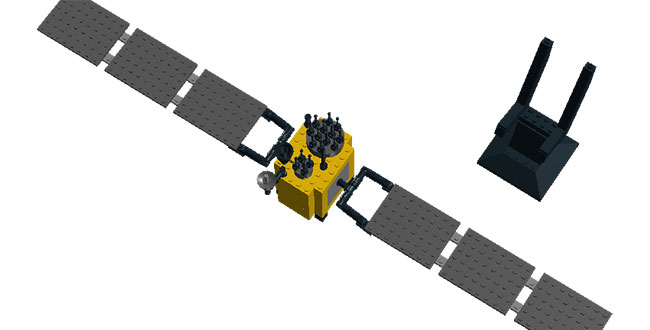
  • Build Your Own GPS IIF Satellite — with LEGOs

    Build Your Own GPS IIF Satellite — with LEGOs

    So, you thought GPS satellites were only built by government contractors with millions of dollars? Think again.

    A California company that specializes in LEGO kits of space vehicles is offering a GPS IIF satellite kit. The kit, which sells for $45, includes 142 LEGO Bricks, instructions, and a display stand. Once constructed, the model measures 21 1/4-inches from the tip of one solar array to the other, is 2 3/4-inches wide, and 4 1/4 inches tall.

    OK, it’s not space worthy. Or the right size. And it doesn’t produce any signals. But the wings rotate!

    The company, Space Satellite Models, also offers LEGO models of other Department of Defense and NASA satellites.

  • Spectracom Simulator Compatible with China’s Beidou System

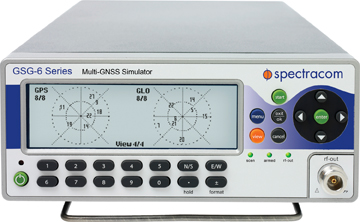
    Spectracom has announced its upgrade capability to China’s global navigation satellite system, Beidou. The Spectracom GSG Series 5 and Series 6 GNSS signal simulators, released in 2012, are designed to be field upgradeable to simulate current and future GNSS constellations. GSG simulators are capable of outputting the frequencies, modulations and data formats of anticipated GNSS systems. The January release of the Beidou ICD specification has confirmed that Spectracom GPS/GNSS simulators will be able to emulate these satellite signals with a simple field-upgradeable firmware update.

    “In anticipation of the deployment of these new, major GNSS systems, Spectracom ensures that every GSG simulator that leaves the factory is tested for compliance with all the signal frequency and modulation specifications as defined in their ICDs. Customers who have purchased our Series 5 or 6 simulators since June 2012 have this upgrade capability,” Spectracom CTO John Fischer said.

    Spectracom_GSG-62_W
    Spectracom GSG-6 series simulator. Photo: Spectrum

    The Series 5 single frequency simulator is fully capable of the all the signals in the L1 (GPS and GLONASS) / E1 (Galileo) / B1 (Beidou) band, including all the GLONASS FDMA satellites.

    The Series 6 multi-frequency simulator is fully capable of all four bands of all the systems: L1 / E1 / B1; L2 / L2C; L5 /E5 /B2; and E6 / B3.

    Fischer added, “As the need for new signals arise, firmware upgrades will be available. This ensures our customer’s investment is protected. Galileo signals will be available this year and Beidou will be available next year.”

  • ESA’s Navigation Lab Helps Set Global Time

    The European Space Agency (ESA) is helping to set the world’s time. Ultra-accurate atomic clocks of ESA’s Navigation Laboratory, which will be used to assess performance of the Galileo satnav system, have joined the global effort setting Coordinated Universal Time down to a billionth of a second.

    The replacement for Greenwich Mean Time, Coordinated Universal Time (UTC) is the timing used for Internet, banking, and aviation standards, and other international timescales, maintained by the Paris-based Bureau International de Poids et Mesures (BIPM).

    Participating measurement institutes and observatories around the globe use collections of atomic clocks to estimate a current value for UTC. These clock data are fed through to the BIPM to be carefully weighted and averaged to derive a combined global value. The complexity of this effort is such that it takes around six weeks to arrive at a definitive final figure, ESA said.

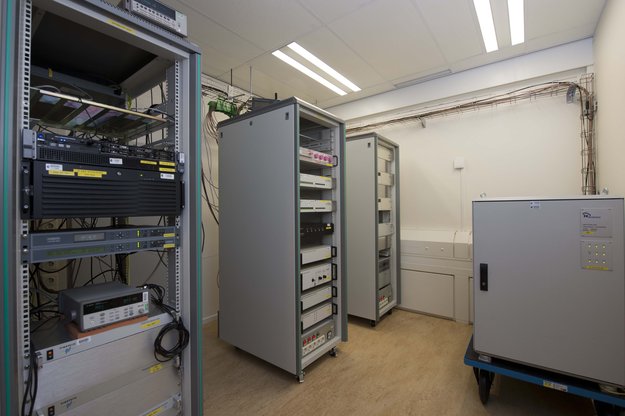
    Atomic clocks at ESTEC's Navigation Laboratory. Once Galileo services start, ESA’s Navigation Lab will play an important role independently validating Galileo timing performance. Its atomic clocks, offering precise timings for ESA  missions and experiments, are also contributing to the global setting of Coordinated Universal Time (UTC), the replacement for GMT.
    Atomic clocks at ESTEC’s Navigation Laboratory. Once Galileo services start, ESA’s Navigation Lab will play an important role independently validating Galileo timing performance. Its atomic clocks, offering precise timings for ESA missions and experiments, are also contributing to the global setting of Coordinated Universal Time (UTC), the replacement for GMT.

    ESTEC Director Franco Ongaro has signed an agreement with BIPM to mark the international recognition of the ESA timescale and the addition of ESA’s atomic clock data to the UTC calculations. “This is an independent timing capability that ESA’s Navigation Laboratory — based in ESTEC in the Netherlands — built up to support validation of Galileo timing performances, and before it the experimental Galileo GIOVE satellites,” explained Pierre Waller of ESA’s RF Payload Systems division.

    “But it makes sense to apply it more widely, and this BIPM recognition reflects the quality of our data. Our UTC estimate — formally known as UTC (ESTEC) — is also available for projects within ESA: there are many space applications beyond just navigation, such as precision technical experiments or synchronization of telecommunications and deep-space ground stations.

    “Incidentally, it is important to note that our contribution to UTC does not replace the existing input from the Netherlands’ own national timing metrology institute, Van Swinden Laboratories (VSL) in Delft. Instead we are adding to it, for enhanced global accuracy overall.”

    Galileo, like all other satellite navigation systems, is based on the highly precise measurement of time. A receiver on the ground pinpoints its position by calculating how long signals from satellites in orbit take to reach it.

    Matching the receiver and satellite clocks then multiplying the time taken by the speed of light gives the range between the user and the satellite. This allows the receiver to fix its longitude, latitude and time when in contact with four or more satellites. Atomic clocks on each satellite keep time to a matter of nanoseconds — billionths of a second — synchronized by a worldwide ground network.

  • First GLONASS Station Outside Russia Opens in Brazil

    Brazilian_GLONASS_SDMC_stationNews courtesy of CANSPACE Listserv.

    The Moscow Times is reporting that the first overseas GLONASS ground station for differential correction and monitoring was launched in Brasilia, Brazil, on Tuesday, citing information from the Russian Federal Space Agency (Roscosmos). The station will become the first correction point in the Western Hemisphere and will significantly improve the accuracy of GLONASS navigation signals, the agency said.

    GLONASS stations will also be installed in the United States, according to Pravda.Ru. “GLONASS stations are to be installed in the U.S.. This will improve the accuracy of the system. In general, stations like these are planned to be located in more than 30 countries of the world. Most of the countries that received the offers for the installation of the stations responded positively.

    “However, the process is slow because of the need to conclude appropriate intergovernmental agreements. The documents with Brazil were signed in 2012. Agreements with Spain, Indonesia and Australia will be finalized soon,” Pravda.Ru said.

    The Brazilian SDCM station is located on the campus of the University of Brasilia.

  • GLONASS 743 Maneuvers toward New Position

    News courtesy of CANSPACE Listserv.

    According to tracking data from NORAD/JSpOC, GLONASS 743 experienced a delta-V maneuver on or about February 12 as it approached its new orbital position at Slot 8 in Plane 1.

    Note that GLONASS 743 is not currently in service but will likely rejoin the active constellation once the move is completed, replacing GLONASS 701K in the broadcast almanac.

    Although GLONASS 701K, the test GLONASS K1 satellite, is currently transmitting on frequency channel -5, it continues to be set unhealthy in the almanac.

  • Test Confirms EGNOS + Galileo = Safer Skies

    Test Confirms EGNOS + Galileo = Safer Skies

    Europe’s two satellite navigation systems could combine in the future for heightened performance, an airborne test has confirmed. A helicopter flight took place above an alpine valley in Germany, the one place on Earth where Galileo services are already routinely available.

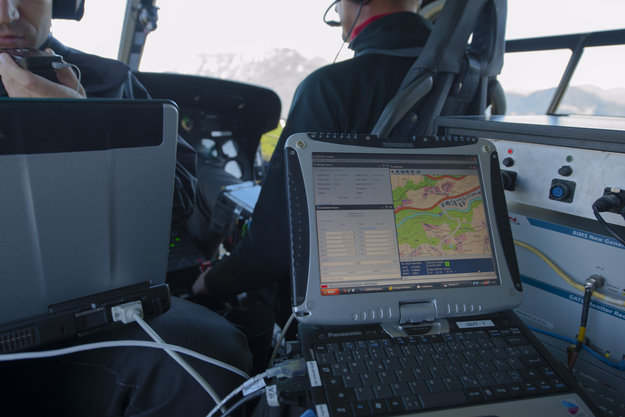
    The test receiver. The helicopter flew a variety of manoeuvres, from fast loops to mid-air hovering, to see how satnav signals were received in practice.
    The test receiver. The helicopter flew a variety of maneuvers, from fast loops to mid-air hovering, to see how satnav signals were received in practice.

    Results of the flight test, conducted in September 2012, show that adding Galileo signals to the European Geostationary Navigation Overlay Service (EGNOS) should boost its accuracy significantly. EGNOS, which augments the accuracy and reliability of GPS signals over Europe, renders satnav usable for safety-critical applications such as aircraft guidance, as well as more general precision uses.

    Operational horizontal and vertical distance “protection levels” for safety were cut by half by combining use of GPS and Galileo within EGNOS. In addition, new integrity algorithms installed within the user receiver turned out to reliably detect and exclude reflected or otherwise faulty signals.

    The first test of real Galileo navigation fixes is scheduled for later this year from the four satellites already in orbit, with more satellites set to join them by the end of the year.

    EGEP testbed combined GPS/GALILEO
    The Galileo Test and Development Environment – GATE – is a giant outdoor laboratory where prototype Galileo receivers can be used freely without any modifications.

    As the constellation takes shape, satnav researchers and industrial developers can already try out Galileo services with prototype receivers at the German Galileo Test and Development Environment, or GATE, a giant outdoor laboratory. GATE, in and around the town of Berchtesgaden in the Bavarian Alps, is Europe’s go-to place for Galileo testing: transmitters atop eight neighbouring mountains cover 65 square kilometers of territory with simulated Galileo signals.

    ESA’s Global Navigation Satellite System Evolution program carried out helicopter-based testing here on September 24–26. The results will help to guide the development of next-generation satnav systems.

    The helicopter flew a variety of maneuvers, from fast loops to mid-air hovering, to see how satnav signals were received in practice. The test relied on ESA’s SPEED platform — Support Platform for EGNOS Evolutions & Demonstrations, co-funded by French space agency CNES and operated by Thales Alenia Space France — which enabled the receiver to receive simultaneous realtime augmentation for both GPS and Galileo.

    Europe’s next-generation EGNOS, planned for around 2020, is envisaged to operate in the same way, with augmentation of both constellations and dual-frequencies at the same time making the system much more robust.

    EGEP testbed combined GPS/GALILEO
    A helicopter flies over the Galileo Test and Development Environment – GATE – in Berchtesgaden, Germany, gathering data on how EGNOS and Galileo will work together. The promising results from the testing are now being analyzed.