Category: GNSS

  • Next Galileo Satellite Reaches French Guiana Launch Site

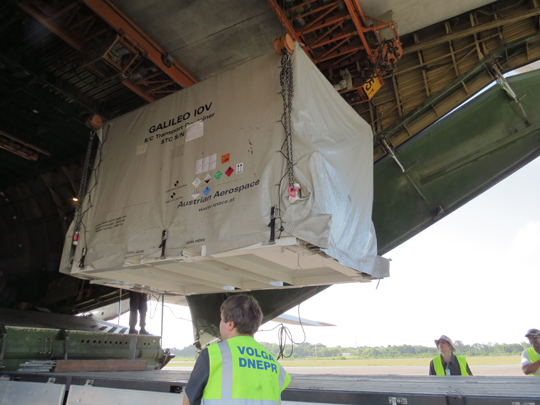
    The third Galileo In-Orbit Validation flight model satellite being unloaded from its Antonov 124-100 transport aircraft at Cayenne Airport in French Guiana on August 7.
    The third Galileo In-Orbit Validation flight model satellite being unloaded from its Antonov 124-100 transport aircraft at Cayenne Airport in French Guiana on August 7.

    The next Galileo navigation satellite has touched down at Europe’s Spaceport in French Guiana, to begin preparations for its launch in October, reports the European Space Agency. Cocooned within a protective, air-conditioned container, the satellite left the Thales Alenia Space Italy plant in Rome on Monday evening for nearby Fiumicino Airport.

    At 23:15 CEST it boarded an Antonov 124-100 aircraft for its overnight flight across the Atlantic, stopping in Tenerife at 03:50 CEST for refuelling.
    The satellite touched down on Tuesday, August 7, in French Guiana’s Cayenne Airport at 07:55 local time (12:55 CEST). It was accompanied by a four-person team from Thales, plus one representative each from Astrium and ESA, as well as all the specialized test and support equipment that will be needed during the launch preparations. The satellite was then moved onto a lorry for transport to the Guiana Space Centre, for subsequent removal from its container.

    These third and fourth Galileo In-Orbit Validation (IOV) satellites are due to be launched aboard a Soyuz ST-B vehicle in October. These new satellites will join the first two Galileo satellites — launched last year — in medium-Earth orbit at 23,222 kilometer. This will mark a significant step in Europe’s program because it will complete the deployment of infrastructure required for the IOV phase and will allow for the first time a computation of on-ground position based solely on Galileo satellites, ESA said.

    The IOV phase is being followed by the deployment of additional satellites and ground segment as required to achieve the Full Operational Capability, leading to provision of services. 
The first 22 of these Final Operational Capability satellites are being built by OHB in Germany, responsible for the platforms and final satellite integration, and UK-based Surrey Satellite Technology Ltd., producing the payloads.

    The first four Galileo IOV satellites have been built by a consortium led by EADS Astrium, Germany, with Astrium producing the platforms and Astrium UK responsible for the payloads.

  • CGSIC Subcommittee to Hold Meeting August 14

    The CGSIC States and Local Government Subcommittee, chaired by the Federal Highway Administration, is conducting a meeting in downtown Seattle on August 14. CGSIC is chartered to be an information portal direct from the U.S. government’s GPS program to (and from) the world’s civil users of GPS.

    The Coast Guard’s Navigation Center is assigned responsibility as the operational arm and executive secretariat for the committee and assists the States and Local Government Subcommittee to bring this information to state government and private personnel in regional areas of the United States. View an agenda and directions to the meeting on the Navigation Center’s website.

    CGSIC meetings are free and open to all and present an opportunity to personally interact directly with the people that manage the GPS program. For more information, call CGSIC Executive Secretariat Rick Hamilton at 703-313-5930.

  • Update on EGNOS and GAGAN SBAS Satellites

    Source: GPS
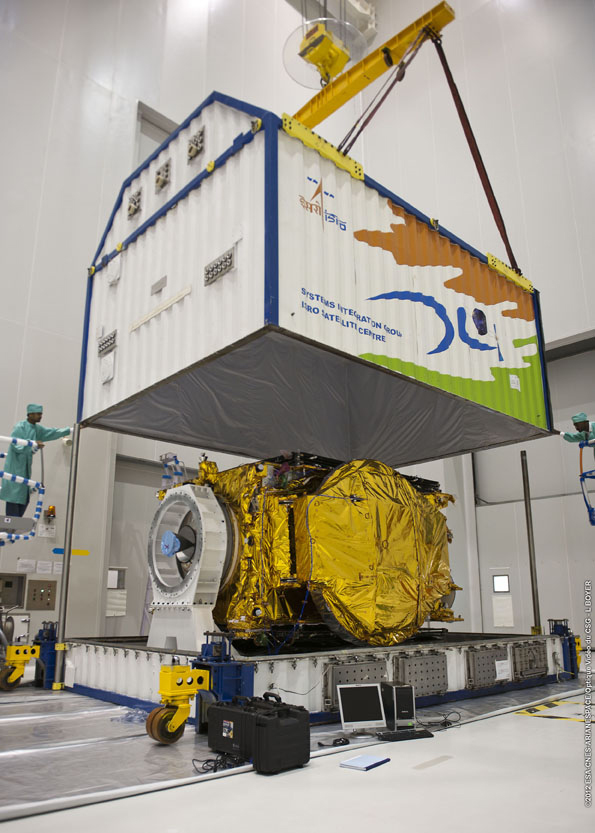
    The shipping container that protected GSAT-10 during its travels from India to French Guiana is removed inside the Spaceport’s S5 payload preparation facility, revealing the spacecraft.


    News courtesy of CANSPACE Listserv.

    UPDATE: According to an Arianespace press release issued Thursday, the launch of the GSAT-10 and Astra 2F satellites is now scheduled for September 21.
    SES-5. The SES-5 geostationary communications satellite (also known as Sirius 5 and Astra 4B), which was launched on July 9, 2012, arrived at its orbital slot of 5 degrees east longitude on or about July 19. The current position is actually about 5.2 degrees.

    The satellite carries L1 and L5 transponders for the European Geostationary Navigation Overlay Service (EGNOS) satellite-based augmentation system. According to a spokesperson from the Space and Missile Systems Center, the Global Positioning Systems Directorate has assigned C/A PRN code 136 and L5 PRN code 136 for use by the satellite.

    GSAT-10. The Indian Space Research Organisation’s GSAT-10 geostationary communications satellite has arrived at the European spaceport in Kourou, French Guiana. The satellite carries a transponder for the GPS and GEO Augmented Navigation (GAGAN) satellite-based augmentation system.

    GSAT-10 will be launched together with the Astro 2F satellite by an Ariane 5 rocket on September 21. GSAT-10 is expected to be positioned at 83 degrees east longitude and use PRN code 128. It will join the first GAGAN-equipped satellite, GSAT-8, which is at 55 degrees east longitude and is transmitting test signals on the L1 frequency using C/A PRN code 127.

    Although GSAT-8 reportedly carries a dual-frequency transponder, no L5 signals from this satellite have yet been detected by International GNSS Service tracking stations.

  • Second Russian SBAS Satellite Prepared for Launch

    News courtesy of CANSPACE Listserv.


    Luch-5B, the second of a set of three geostationary satellites being launched to reactivate Roscosmos’s Luch Multifunctional Space Relay System, has been delivered to the Baikonur Cosmodrome. It arrived together with the Yamal-300K satellite in a single shipping container aboard an Antanov An-124-100 Ruslan flight from Krasnoyarsk.

    This marked the first time that Information Satellite Systems – Reshetnev has used the special container, which is large enough to carry two middle-class spacecraft at one time. According to the company, sophisticated equipment fitted with a control system that helps monitor the environment inside the container helps avoid any chances of external damage or unwanted environmental impact during transportation.

    Luch-5B is now undergoing preparations for launch.

    The Luch system will be used to relay communications and telemetry between low-Earth-orbiting spacecraft, such as the the Russian segment of International Space Station, and Russian ground facilities.

    The system’s satellites also carry transponders for the System for Differential Correction and Monitoring (SDCM), Russia’s satellite-based augmentation system. The transponders will broadcast GNSS corrections on the standard GPS L1 frequency using C/A PRN codes assigned by DoD’s Global Positioning Systems Directorate.

    As previously reported, Luch-5A, which was launched on 11 December 2011, has been placed in an orbital slot at 95 degrees east longitude. It began transmitting corrections on July 12, 2012, using PRN code 140.

    Luch-5B, scheduled for launch on September 7, 2012, will be positioned at 16 degrees west longitude.


    Satellite Luch-5B in an anechoic chamber at ISS-Reshetnev.

  • Second Russian SBAS Satellite Prepared for Launch

    News courtesy of CANSPACE Listserv.

    Luch-5B, the second of a set of three geostationary satellites being launched to reactivate Roscosmos’s Luch Multifunctional Space Relay System, has been delivered to the Baikonur Cosmodrome. It arrived together with the Yamal-300K satellite in a single shipping container aboard an Antanov An-124-100 Ruslan flight from Krasnoyarsk.

    This marked the first time that Information Satellite Systems – Reshetnev has used the special container, which is large enough to carry two middle-class spacecraft at one time. According to the company, sophisticated equipment fitted with a control system that helps monitor the environment inside the container helps avoid any chances of external damage or unwanted environmental impact during transportation.

    Luch-5B is now undergoing preparations for launch.

    The Luch system will be used to relay communications and telemetry between low-Earth-orbiting spacecraft, such as the the Russian segment of International Space Station, and Russian ground facilities.

    The system’s satellites also carry transponders for the System for Differential Correction and Monitoring (SDCM), Russia’s satellite-based augmentation system. The transponders will broadcast GNSS corrections on the standard GPS L1 frequency using C/A PRN codes assigned by DoD’s Global Positioning Systems Directorate.

    As previously reported, Luch-5A, which was launched on 11 December 2011, has been placed in an orbital slot at 95 degrees east longitude. It began transmitting corrections on July 12, 2012, using PRN code 140.

    Luch-5B, scheduled for launch on September 7, 2012, will be positioned at 16 degrees west longitude.


    Satellite Luch-5B in an anechoic chamber at ISS-Reshetnev.

  • The System: Fly the Pilotless Skies: UAS and UAV


    Unmanned aerial vehicles and civil aircraft may co-habit the airspace after September 2015.

     As the U.S. Federal Aviation Administration (FAA) moves ahead with plans for unmanned aerial systems/vehicles (UAS/UAV) to have regular access to U.S. airspace by 2015, it has encountered several barriers. For UAVs to be treated like manned aircraft, their systems likley need to be qualified to the same standards as civil avioncs. This is a challenge, as each UAS has largely unique systems. UAS equipment standards are emerging, but threats to GNSS abound, requiring defense/mitigation.

    Demand for UAS has produced many different types flying in a range of applications. With no apparent standard avionics fit or uniform safety standards, each UAS type is basically configured for specific tasks. Commercial UAS applications continue to emerge, and major market growth is anticipated. One forecast indicates that the UAS market could reach $7.26 billion this year alone. The promise of new and better ways to reduce costs, improve safety, and increase operational efficiency feeds market expansion.

    However, in the United States the FAA currently requires each UAS commercial project desiring access to controlled airspace to obtain an FAA-approved Certificate of Authorization. While the FAA has made efforts to speed up approvals, this process slowed widespread commercial adoption of UAS. Nevertheless, opportunities abound in pipeline and transmission line inspection, crop spraying, law enforcement, security, and surveillance, survey/mapping, remote area mail delivery, and hundreds of other applications. The FAA may have felt some pressure to move forward, because Congress has put in place the Modernization and Reform Act of 2012, which calls on the FAA to fully integrate unmanned systems, including those for commercial use, into the national airspace by September 2015.

    UAS in the NAS. Meanwhile, a project called the Unmanned Aircraft Systems Integration in the National Airspace System (UAS in the NAS), undertaken by NASA’s Dryden Flight Research Center, seeks to reduce technical barriers related to safety and operational challenges associated with enabling routine UAS access to the NAS.

    Europe has also launched a study on the integration of UAS in non-segregated airspace for the future Single European Sky. The ICONUS study will be carried out by a consortium within the European air traffic management program called Single European Sky ATM Research Programme (SESAR). The study will drive the definition of the requirements, capabilities, and equipment which UAS will need to operate safely and efficiently in the coming European SESAR environment.

    The U.S. RTCA SC-203 committee is drafting UAS operational requirements, and there has been significant progress towards publishing Minimum Aviation Performance Standards (MASPS), including requirements for navigation. Europe has similar activities underway aimed at improving UAS access to its airspace.

    MOPS. The big picture is that requirements for unmanned aircraft are being brought into conformance with the standards applied to the performance and behavior of manned aircraft. Navigation requirements for UAS are expected to specify that systems will need to be qualified to Minimum Operational Performance Standards (MOPS). This means that on-board electronics, including GNSS systems, will probably need to be FAA Technical Standard Orders (TSO) qualified, just as they are now for manned aircraft.

    Why do we need to investigate certified avionics now? In the scheme of avionics, more than two years breathing space to certify UAS avionics systems is not a long time, not at all, until the September 2015 deadline. FAA airborne software and hardware qualification will take much time and effort to implement, and re-configuration of systems, interfaces, and operating procedures may take even longer.

    For Manufacturers. UAS makers have the option to move forward in stages. For instance, by selecting a few existing airborne-qualified OEM avionics, they could minimize the internal effort to comply. As the first UAS with certified avionics emerge, they will probably get good support from FAA to adopt U.S. operating rules for the NAS. Embedding an existing certified GPS receiver in UAS avionics will reduce the internal work needed and allow more effort for developing commercial market opportunities that look to quickly adopt UAS.

    Meanwhile, efforts are in full swing to change the U.S. and European navigation landscapes over the next few years. So it would be better to be ready with a capable GNSS receiver that is already built to meet the challenges of NextGen and SESAR.

    GPS III and Galileo. The L5 civil GPS frequency may be operational around the time that UAS unrestricted access becomes possible. GPS L1/L5 dual-frequency operations will enable higher navigation accuracy, reliablity, and integrity. The FAA is already developing NextGen WAAS to include L5, and revisions to the GPS MOPS to include L5 should begin shortly, in time for a usable GPS L5 constellation in 2015/2016. The FAA is already preparing for L5 avionics, and industry investigative work is underway. Its possible that GPS L1/L5 may meet the accuracy and integrity requirements for CAT II/III automated landings. In Europe, Eurocae work is expected to gain momentum for the Galileo E1/E5a MOPS as the Galileo satellite navigation system becomes operational.

    The new GNSS environment also includes WAAS/SBAS precision approach (localizer performance with vertical guidance, or LPV) capability: LPV is available now in the United States and will soon be in wider operation in Europe. Automatic Dependendant Surveillance (ADS-B) is rolling out in the United States and around the world. ADS-B is being mandated within the U.S. NAS as the means for air-traffic control to track all aircraft, so UAS avionics will need to include certified ADS-B Out capability.

    In one commercial instance, the Septentrio AiRx2 receiver comes out of the box as a certified L1 GPS with ADS-B and WAAS LVP, but is also ready for GPS L5 and Galileo E1/E5a.

    Even as greater steps forward enhance how GNSS is used in this wider definition of aviation that will soon include UAS, a team at the University of Texas demonstrated how a UAV could be maliciously side-tracked (see article on page 30 of this issue) —  reminiscent of the Iranian downing of a U.S. surveillance drone in December 2011.

    Admittedly the GPS on the vehicle in the UT test was not a qualified airborne receiver, but how could this happen when there was also an inertial sensor and a radio-altimeter on the UAV? A good question, which UAV manufacturers will need to consider when they implement their on-board Kalman filters, knowing that spoofing is now an additional threat to parry.

    Couldn’t we detect that high-power RF spoofing signal at the front-end of the GPS receiver? Even if only to tell the on-board systems that there could be hazardous misleading information about? Or run separate GPS and GPS/inertial position solutions, detect significant divergence, and set the same warning flag? And multi-constellation, multi-frequency receivers, and even controlled radiation pattern antennas — all things to investigate.  More work for the aviation receiver guys who labor tirelessly to improve GNSS integrity.

    Of course if you hijack a UAV with a high-power spoofer, you are also spoofing civil transports operating in the same airspace, so now there is the potential to trigger a Federal investigation. It will probably be easier to detect this stuff with moving airborne sensors rather than the fixed ground equipment used to find jammers on trucks at Newark airport, and lots of pilots likely providing real-time location information on radios if their GPS goes even a little haywire. All would help to quickly locate and shut down any spoofer. Nevertheless, it’s a threat to be mitigated.

    Fatal Crash. In South Korea, the effects of intermittent North Korean jamming of GPS to disrupt seal, land, and air navigation in the South may have contributed to the recent fatal crash of a Schiebel Camcopter S-100 drone, a 150-kilogram rotorcraft capable of 220 km/h flight. It should have coped with loss of GPS as the Camcopter has multiple inertial measurement units that allow safe operation and recovery in the absence of GPS signals. Emergency procedures to ensure a safe recovery in such a situation do not appear to have been correctly and adequately followed, manufacturer Schiebel alleges.

    NovAtel may have found one way to help mitigate spoofing on UAVs; the company released a combined civil/SAASM GPS receiver, the OEM625S, aimed specifically at UAVs. Granted, the idea is to add SAASM anti-spoofing capability to a number of UAVs which currently use NovAtel commercial receivers, mostly in military systems. That may be motivated by the desire to avoid further Iranian incidents!

    BAE Systems has been thinking of giving GPS a back-up for just those situations where jamming or even spoofing is detected. BAE’s Navigation via Signals of Opportunity (NAVSOP) system was just announced at the Farnborough air show in the UK and is still in research phase, but looks extremely promising. It interrogates the radio environment for the ID and signal strength of local digital TV and radio signals, plus air traffic control radars, with finer grained adjustments coming from cellphone masts and Wi-Fi routers. Mapping the location of all these sources might be quite an undertaking, and given that these are all non-safety-of-life commercial signals, the sources are subject to the vagaries of power outages, regular maintenance, and breakdowns. Nevertheless, with such a multitude of signals, NAVSOP could well turn out to be a viable back-up for GNSS.

    So, shared access to civil airspace, wider applications in commercial operations, and changes in equipment qualification, along with potential solutions for GNSS jamming and spoofing: lots to consider for the UAS industry.


    Taking It to the House

    U.S. House of Representatives Committee on Homeland Security; Subcommittee on Oversight, Investigations, and Management; Hearing, July 19, 2012:  Using Unmanned Aerial Systems Within the Homeland: Security Game Changer?

    Testimony by Todd E. Humphreys, Ph.D.; Assistant Professor, Cockrell School of Engineering, The University of Texas at Austin. [Excerpted. Prof. Humphreys is a co-author of the article “Drone Hack” in the August issue of GPS World.]

    The vulnerability of civil GPS to spoofing has serious implications for civil unmanned aerial vehicles (UAVs), as was recently illustrated by a dramatic remote hijacking of a UAV at White Sands Missile Range.

    Hacking a UAV by GPS spoofing is but one expression of a larger problem: insecure civil GPS technology has over the last two decades been absorbed deeply into critical systems within our national infrastructure. Besides UAVs, civil GPS spoofing also presents a danger to manned aircraft, maritime craft, communications systems, banking and finance institutions, and the national power grid.

    Constructing from scratch a sophisticated GPS spoofer like the one developed by the University of Texas is not easy. It is not within the capability of the average person on the street, or even the average Anonymous hacker. But the emerging tools of software-defined radio and the availability of GPS signal simulators are putting spoofers within reach of ordinary malefactors.

    There is no quick, easy, and cheap fix for the civil GPS spoofing problem. What is more, not even the most effective GPS spoofing defenses are foolproof. But reasonable, cost-effective spoofing defenses exist which, if implemented, will make successful spoofing much harder.

    I recommend that for non-recreational operation in the national airspace civil UAVs exceeding 18 lbs be required to employ navigation systems that are spoof-resistant.

    More broadly, I recommend that GPS-based timing or navigation systems having a non-trivial role in systems designated by DHS as national critical infrastructure be required to be spoof-resistant.

    Finally, I recommend that the DHS commit to funding development and implementation of a cryptographic authentication signature in one of the existing or forthcoming civil GPS signals.

    Complete testimony (PDF) covers:

    • The potential vulnerabilities of U.S. national transportation, communications, banking and finance, and energy distribution infrastructure;
    • What does it take to build a spoofer? Buy a spoofer?
    • Range and required knowledge of target.
    • Fixing the problem:

    •    Jamming-to-noise sensing defense;
    •    Defense based on SSSC or NMA on WAAS signals;
    •    Multi-system multi-grequency defense;
    •    Single-antenna defense;
    •    Defense based on spread-spectrum security codes on L1C;
    •    Defense based on navigation message authentication on L1C, L2C, or L5;
    •    Correlation prole anomaly defense;
    •    Multi-antenna defense;
    •    Defense based on cross-correlation with military signals.
  • Boeing Ships Third GPS IIF Satellite to Cape Canaveral for Launch

    On July 9, Boeing shipped the third of 12 GPS IIF satellites for the U.S. Air Force from the company’s Satellite Development Center in El Segundo to Cape Canaveral Air Force Station, Florida, aboard a Boeing-built C-17 Globemaster III airlifter.

    SVN-65 is scheduled to be launched in the fourth quarter of this year aboard a United Launch Alliance Delta IV rocket. It will join the first and second Boeing-built GPS IIF satellites, launched May 27, 2010, and July 16, 2011, to continue the sustainment and modernization of the GPS network.

    “As each IIF satellite becomes operational, we continue the seamless transformation of the GPS constellation into an even more accurate, reliable and durable navigation resource for the U.S. military and the global civilian user community,” said Craig Cooning, vice president and general manager of Boeing Space & Intelligence Systems. “Our efficient pulse-line manufacturing process, adapted from Boeing’s commercial airplane production lines, also ensures that we deliver each spacecraft on time and on cost.”

    SVN-65 will now undergo preflight checkout, fueling, and integration to prepare for the early October launch. When on orbit, it will be controlled by the Operational Control Segment, the GPS network’s ground control system. Developed by a Boeing-led team, the OCS entered service in 2007 and was turned over to the Air Force 50th Space Wing in April 2011.

    GPS IIF features greater navigational accuracy through improvements in atomic clock technology, a more secure and jam-resistant signal for the military, and a protected, more precise, and interference-free civilian L5 signal for commercial aviation and search-and-rescue operations. Other enhancements to the IIF include an extended 12-year design life and a re-programmable on-orbit processor that can receive software uploads for improved system operation.

    Of the remaining nine IIFs that Boeing is building for the Air Force, three are complete and in storage, and six are being assembled and tested.

  • GLONASS Designer Honored with Royal Institute of Navigation Award

    The Royal Institute of Navigation has awarded the Duke Of Edinburgh’s Navigation Award for Technical Achievement to Professor Nicolai Testoedov, who received it on behalf of Yuri Urlichich, the chief designer of GLONASS, “in recognition of the achievement of a complete operational constellation of satellites in December 2011, thus providing a full global positioning and timing service.”

    This award honours a specific achievement by a team or individual in the field of navigation systems development, research, or education. The presentation was made at the RIN Annual General Meeting on July 11 by Sir John Charnley, a past president of the Institute (in the absence of Prince Philip who was engaged in a Diamond Jubilee event). The award has been instituted to mark the 90th birthday of His Royal Highness The Prince Philip, Duke of Edinburgh, Patron of the Royal Institute of Navigation.

    In 2011, the RIN’s Technical Excellence Award changed its name, becoming the Duke of Edinburgh’s Navigation Award for Technical Achievement. In that year, it was awarded awarded to Barry Wade of Kelvin Hughes for his work on the SharpEye radar system.

  • Geneq Bluetooth GNSS Receiver Uses both GPS and GLONASS with SBAS

    Geneq Inc. has announced the SXBlue II GNSS, a GNSS receiver that uses both GPS and GLONASS with SBAS (WAAS/EGNOS/MSAS/GAGAN) to attain 30-cm/1-foot (RMS) accuracy in real-time using free SBAS corrections. It connects wirelessly to any smartphone, handheld, tablet computer, or notebook computer that is Bluetooth-compliant.

    For years, the SXBlue GPS product line has lead the market in squeezing the most out of SBAS for high-precision mapping and surveying users. New technology used in the SXBlue II GNSS allows it to utilize both GPS and GLONASS with SBAS, enabling it to track and use nearly twice as many satellites compared to typical SBAS receiver technology.

    “More satellites means more accurate positioning in tougher environments, such as under tree canopy and near buildings,” said Jean-Yves Lauture, product engineer. “GLONASS has proven itself valuable for RTK, and now we are bringing GLONASS to SBAS, with impressive accuracy and tracking results.”

    The SXBlue II GNSS builds on the success of the proven SXBlue II GPS that was designed to optimize SBAS performance under tree canopy and in rugged terrain. With the ability to track 55 satellites (31 operational GPS, 24 operational GLONASS), the SXBlue II GNSS uses between 12 and 19 satellites in view at any time, providing superior performance when working under and around tree canopy, buildings, and rugged terrain, Geneq said.

    The next-generation SXBlue II GNSS is the same, small, palm-sized unit as the SXBlue II GPS and uses a small 2.7-inch diameter GNSS antenna. The unit is completely waterproof (submersible), dustproof, and ruggedized, with an IP-67 rating. Its Class 1 long-range Bluetooth 2.0 has a typical range of 250 meters. The internal, rechargeable, field replaceable Li-Ion battery has on-board LEDs let the user know how much battery life is left. The operating temperature range of the SXBlue II GNSS is -40°C (-40°F) to 85°C (185°F).

    In addition to the built-in long-range Bluetooth transceiver, the SXBlue II GNSS has a standard DE-9 RS-232 port and a USB Type B port with outputs fully programmable up to 10-Hz standard, with a 20-Hz option. Other optional features are L1 RTK for <2-cm real-time accuracy and base station RTCM output.

    There is no need for post-processing or other sources of differential corrections as the SXBlue II GNSS uses WAAS (North America), EGNOS (Europe), MSAS (Japan), and GAGAN (India) satellite corrections. Users receive real-time, 30-cm/1-foot positioning all day long, Geneq said.

    The SXBlue II GNSS is targeted at GPS/GIS mapping professionals in industries such as forestry, utility, agriculture, and other natural resource industries in addition to local, state, and federal government users.

    Geneq will be showing the SXBlue II GNSS at the Esri International User Conference July 24-26 in San Diego, California, booth #1203.

  • First Positioning Results Using Galileo Announced

    A team of Canadian and German researchers have obtained precise three-dimensional positions using measurements from the four prototype Galileo satellites now in orbit.

    The two In-Orbit Validation (IOV) satellites launched in October 2011 joined the two Galileo In-Orbit Validation Element (GIOVE) satellites launched in 2005 and 2008, forming a mini-constellation. For a few hours on certain days, signals from all four satellites could be received by state-of-the-art multi-frequency, multi-constellation GNSS receivers. The researchers used the GIOVE plus IOV satellite observations made by a Trimble Navigation NetR9 receiver operated at the University of New Brunswick in Fredericton, Canada, together with precise orbit and clock data derived from observations collected on the COoperative Network for GIOVE Observation (CONGO) to obtain receiver positions converging to an accuracy of a few centimeters.

    An article describing the researchers’ procedure and results obtained will appear in the September issue of GPS World.

  • Russian SBAS Satellite Begins Transmissions

    News courtesy of CANSPACE Listserv.


    Luch-5A, the Russian geostationary communications satellite that carries a System for Differential Correction and Monitoring (SDCM) transponder, has started transmitting GPS corrections according to Javad Ashjaee, CEO of Javad GNSS. He has reported that L1 signals using PRN code 140 have been received by Javad receivers today and used to compute code-differential positions. Only GPS corrections are being received currently, no GLONASS corrections.

    As previously reported through CANSPACE, Luch-5A was recently repositioned to 95 degrees east longitude in an apparent switch of positions with Luch-5B, scheduled for launch later this year. Now, it appears, Luch-5A is using the PRN code previously assigned by the Global Positioning Systems Directorate to Luch-5B.

  • SSTL Signs €80M Contract with OHB for Second Batch of Galileo Payloads

    Surrey Satellite Technology Ltd (SSTL) Director of Telecommunications & Navigation, John Paffett, has today signed a contract with Ingo Engeln, member of the Executive Board of OHB System AG at the Farnborough International Airshow, for the construction of a further eight navigation payloads for the European Galileo programme.

    Under the contract, worth approximately €80 million, SSTL will construct the navigation payloads for the second batch of Full Operational Capability satellites (Work Order No. 2), continuing a successful cooperation between the two companies to build the first 14 satellites (Work Order No. 1) under the supervision of the European Space Agency (ESA).

    Matt Perkins, CEO of SSTL, commented, “We value our role in the Galileo programme greatly. SSTL is committed to the FOC programme and together with OHB we are making great strides towards the completion of the first satellites — a momentum which we will carry forward with these next eight payloads.”

    "It is a pleasure to witness this signature, it shows OHB and SSTL are preparing at full speed the building of the additional eight satellites ordered at the beginning of 2012 for the GALILEO constellation. These will complement the order of 14 satellites initiated in 2010," said Giuliano Gatti, head of the ESA Galileo Space Segment Procurement Office.

    Today’s contract formalizes arrangements between the two companies following the award of Work Order No. 2 to the OHB-SSTL team by Antonio Tajani, European Commission vice president in February of this year. Work has already begun on the new batch of payloads and the first is due for delivery in early 2014.

    SSTL is responsible for the navigation payloads that will provide all of Galileo’s services. Assembled and tested at SSTL’s Kepler Technical Facility in the UK, the sophisticated payloads are based on European-sourced equipment, including highly accurate atomic clocks, navigation signal generator, high-power traveling wave tube amplifiers, and antennas.

    The SSTL-OHB team is currently integrating the first of the FOC Work Order No. 1 satellites in at OHB’s facilities in Bremen, Germany, which are scheduled for launch next year.

    The Full Operational Capability phase of the Galileo program is managed and fully funded by the European Union. The Commission and ESA have signed a delegation agreement by which ESA acts as design and procurement agent on behalf of the commission.