Category: GNSS

  • NOAA Planning Changes to Space Weather Alerts


    The National Oceanic and Atmospheric Administration (NOAA) announced that effective Wednesday, July 25, 2012, at 1600 UTC (10:00 AM MDT), the Space Weather Prediction Center (SWPC) will modernize its geomagnetic storm watch products. These products will now be issued relative to the highest expected geomagnetic storm category (NOAA Scale) and will be based on the 3-hour geomagnetic K-index rather than the 24-hour A-index.
     
    According to the announcement, SWPC watch products will still be valid for the entire UTC day, just as they are under the A-based watches today. This change will better align SWPC's geomagnetic watch products with its geomagnetic warning and alert products and NOAA Scale designations. Product Subscription Service customers are not required to take any action regarding this change. The current A-based watches contain expected geomagnetic storm scale (G-level) information so all subscriptions will be automatically transferred to the new G-based watch products.  
     
    For more information, please see the NWS Service Change Notification or contact SWPC Customer Support at [email protected].
  • SES-5 SBAS Satellite Successfully Launched

    SES-5 SBAS Satellite Successfully Launched

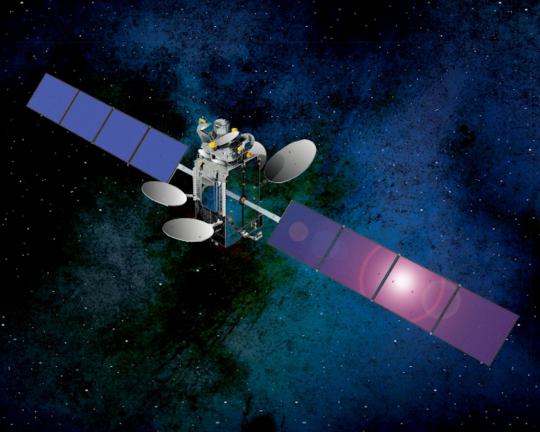
    Artist's rendering of the SES-5. Photo: CANSPACE Listserv
    Artist’s rendering of the SES-5. Photo: CANSPACE Listserv

    News courtesy of CANSPACE Listserv.

    The SES-5 geostationary communications satellite (also known as Sirius 5 and Astra 4B) was launched from the Baikonur Cosmodrome on July 9 at precisely 18:38:29.994 UTC. After a number of manoeuvres by the various rocket stages, the satellite was released from the Breeze-M upper stage into its geostationary transfer orbit (GTO) at 03:50:15.150 UTC on July 10.

    The planned GTO has a perigee height of 4,170 km, an apogee height of 35,786 km, and an orbital inclination of 23.1 degrees. The satellite’s apogee-kick motor should place the satellite into its geostationary Earth orbit (GEO) within the next few days. The GEO sub-satellite point will be at 5 degrees east longitude.

    SES-5 hosts a dual-frequency transponder for the European Geostationary Navigation Overlay Service (EGNOS). The pseudorandom noise codes to be used by the satellite are not yet known.

    “SES-5 is an important addition to our fleet serving both our commercial and government customer with our first L-band payload for EGNOS to augment the GPS system for Europe. This is a great accomplishment by all of the teams who worked on the SES-5 mission — SES, ILS, Khrunichev, and Space Systems/Loral — and we thank them for their dedicated work on the successful launch,” said SES President and CEO, Romain Bausch.

  • Navilock Offers New u-blox-Based GLONASS Receivers

    Navilock, a trademark of Tragant Handels- und Beteiligungs GmbH, announces a new family of GLONASS receiver products including the NL-662U USB-based receiver, equipped with a u-blox GLONASS chipset.

    Since the end of 2011 the Russian satellite navigation system GLONASS has been available worldwide. Similar in functionality to the US-NAVSTAR GPS system, GLONASS satellites transmit positioning data over distinct frequencies (Frequency Division Multiple Access, or FDMA, versus GPS which uses Code Division Multiple Access, or CDMA).

    The new GLONASS receiver products have internal patch antenna in various configurations to serve different installation requirements. Four housing variants with USB or serial MD6/TTL interfaces are available for installation on vehicles or boats.

    The u-blox GLONASS chipset features high accuracy to support precision location-based applications such as navigation, datalogging or tracking.

    The products provide -158-dBm signal sensitivity with extremely low power consumption to insure reliable performance and long battery life. The u-blox GLONASS chipset facilitates hot starts in less than 3 seconds.

    For more information, visit Navilock’s website and click on “new products.”

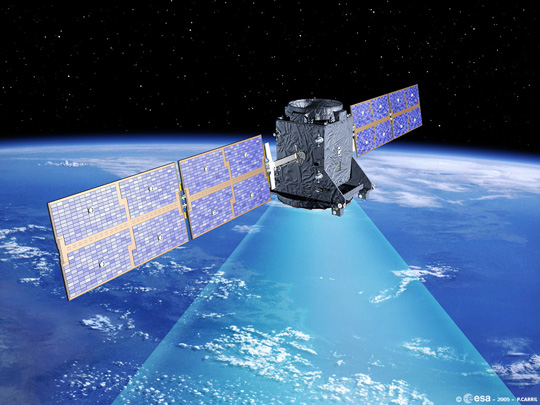
  • Mission Accomplished for Galileo’s Pathfinder GIOVE-A

    Artist's impression of GIOVE-A in orbit. (Photo by ESA - P. Carril)
    Artist’s impression of GIOVE-A in orbit. (ESA, P. Carril)

    With the initial satellites of the Galileo constellation working well in orbit, it has been decided to end the mission of ESA’s pioneering GIOVE-A navigation satellite, reports the European Space Agency.

    Launched on December 28, 2005, this first experimental satellite performed the vital task of securing the radio frequencies provisionally set aside for Galileo by the International Telecommunications Union.

    It also flight-tested Galileo atomic clocks and other equipment in space for the very first time and investigated the radiation environment of medium-altitude orbits, never used before by a European mission.

    ESA formally ended GIOVE-A’s mission at the end of June, although it will go on being operated for now by prime contractor Surrey Satellite Technology Ltd of Guildford, UK, to gather radiation data and performance results from a GPS receiver.

    “GIOVE-A had a design life of only 27 months, so to continue operating for 78 months is impressive,” said Valter Alpe, managing GIOVE activities for ESA.

    “In August 2009, the satellite was moved into a graveyard orbit around 100 km above its normal 23,222 km to make way for the Galileo validation satellites.

    “The first two of these were launched on 21 October 2011 and are performing well, so while GIOVE-A has served ESA well it no longer has a job to do.”

    Built to a tight deadline by SSTL, GIOVE-A carries a rubidium atomic clock accurate to three seconds in a million years.

    On 27 April 2008 it was joined by GIOVE-B, built by an Astrium-led consortium, which carries an even more accurate passive hydrogen maser clock — the first to be flown in space for navigation, accurate to one second in three million years — as well as a second rubidium clock. Operational Galileo satellites carry two pairs of both kinds of clock, for redundancy. They are very different missions in other ways too. The GIOVEs were modified from existing satellite platforms: a prototype geostationary minisatellite for GIOVE-A, and a commercial French Proteus platform typically used for Earth observation for GIOVE-B.

    Galileo satellites are based on an entirely new platform and improved payload, specifically engineered for extremely high reliability, only intended to go into safe mode for a few days over their planned 12 years of operation thanks to a robust design based on reconfigurable redundancy.

    Even when entering ‘intermediate safe mode’ they can continue to supply navigation signals, although without the usual service guarantee. GIOVE-B, with an orbital lifetime of 50 months and counting, will be used in payload fine calibration tests this summer with the two Galileo satellites.

    Then, in September, it will be manuvered into a graveyard orbit 300 km higher. At this point, GIOVE-B’s own mission will end.

    “Early October will see the launch of the next two Galileo satellites by Soyuz rocket from Europe’s Spaceport in French Guiana,” added Valter.

    “This will be an important step forward because four satellites are the minimum to perform navigation measurements, so Galileo system testing can proceed.” A follow-up batch of full operational capability Galileo satellites is being built by Germany’s OHB and SSTL, with initial Galileo services forecast to be available by 2014.

  • UPDATE: Launch of EGNOS Satellite Delayed until Monday


    News courtesy of CANSPACE Listserv.

    Roscosmos is conducting further tests on the launch vehicle for the SES-5 satellite, and have postponed the launch for two days. The new launch date is Monday, July 9, with an approximate launch time of 18:24 UTC.

    The launch of SES-5 from the Baikonur Cosmodrome, originally scheduled for June 18, was first rescheduled to July 7 due to a problem with a first stage subsystem on the Proton launch vehicle.

    SES-5 is also known as Sirius 5 stemming from the development of the Sirius satellite constellation by Nordic Satellite AB, now ownded by Luxembourg's SES. The satellite carries a transponder for the European Geostationary Navigation Overlay Service (EGNOS). The transponder is intended to eventually replace or supplement one of those on the currently used EGNOS satellites (Inmarsat 3-F2 at 15.5 degrees west using PRN 120, Inmarsat-4-F2 at 25 degrees east using PRN 126, and Artemis at 21.5 degrees east using PRN124, and designated for industry tests).

    Unlike the present L1-only EGNOS satellites, SES-5 will have transponders on both the L1 and E5 frequencies similar to the setup on the Wide Area Augmentation System satellites, which broadcast on L1 and L5.

    SES-5 is to be stationed at 5 degrees east longtiude. A second SES satellite with EGNOS transponders is under construction. The SES Astra 5B satellite is scheduled for launch in the second quarter of 2013 and will be positioned at SES Astra's 31.5 degrees east orbital position.

  • Luch-5A Relay Satellite Arrives at New Position

    News courtesy of CANSPACE Listserv.


    The Russian SBAS satellite, Luch-5A, has been repositioned so that its sub-satellite longitude is 95 degrees east. The satellite had been drifting from its original geostationary position at 58.5 degrees east longitude since about May 30.

    The orbital slot of 95 degrees east had been previously announced for Luch-5B, so perhaps Luch-5A is switching positions with Luch-5B, which is scheduled for launch on August 30, although a recent Roscosmos presentation indicates the launch might not happen until October.

    Luch-5A is the first of a set of three geostationary satellites being launched to reactivate Roscosmos’s Luch Multifunctional Space Relay System. The system will be used to relay communications and telemetry between low-Earth-orbiting spacecraft, such as the the Russian segment of International Space Station, and Russian ground facilities.

    The satellites also carry transponders for the System for Differential Correction and Monitoring (SDCM), Russia’s satellite-based augmentation system. The transponders will broadcast GNSS corrections on the standard GPS L1 frequency using C/A PRN codes assigned by DoD’s Global Positioning Systems Directorate. Luch-5A was assigned PRN 125; Luch-5B, PRN 140; and Luch-5V (previously called Luch-4), PRN 141.

    Luch-5A was launched on December 11, 2011.

  • The System: British Patent Filings Threaten GPS III and Galileo Progress

    Two British technologists backed by the U.K. Ministry of Defense have filed patents on the future interoperable GPS and Galileo signal designs that severely disrupt modernization plans for both systems and suddenly, unexpectedly place receiver manufacturers in a highly uncertain and unfavorable situation. Some of the patents have been granted in the U.K. and in Europe, and applications are pending in U.S. patent court, with a ruling expected at any time.

    Companies in the United States and outside the country are being approached and asked to pay royalties, on the basis of the patent filings, for use of the European E1 Open Service signal and the modernized GPS L1C signal. Should such initiatives prevail, costs would presumably be passed along to end users of GPS and Galileo — the same taxpayers who have already paid once for the systems.

    The purveyor of the royalty solicitations is Jim Ashe, vice president for sales and intellectual property at Ploughshare Innovations Ltd., Hampshire, UK. The patents, if successfully used to collect fees from satellite manufacturers or receiver manufacturers, would have a chilling effect on the use of the new interoperable signals that all parties have labored so hard, for so long, to design. They could quite possibly lead to a return to a BOC(1,1) structure for these signals, losing the benefits of MBOC.

    “There’s quite an argument going on,” said one person familiar with the controversy. “Some of the methods of arguing have not been too kind.”

    The Background. A great deal of work was accomplished cooperatively between the United States and the European Union (EU) to develop the landmark 2004 signal agreement that emerged from the Galileo Signal Task Force, formalizing cooperation on satellite navigation between the United States and more than two dozen European countries, including the U.K. Part of that agreement concerned a common signal structure (spectrum) for the civilian signals for both the E1 Open Service (OS) signal — the Galileo equivalent of GPS L1 — and the new U.S. GPS L1C signal to be implemented on the GPS III satellites, coming as early as 2015.

    The EU said during that process, in effect, “Even though we have agreed on this, Europe wants to be able to optimize the E1 OS signal beyond the agreement on that civilian signal being a binary offset carrier BOC(1,1) signal.” Both international entities had agreed that would be the waveform or the spectrum of the new signal.

    The Europeans began to evaluate methods of optimizing their signal. They had some designs called composite binary coded symbols (CBCS), a mechanism of putting a higher frequency componenent into the signal structure, and also a version called CBCS*, meaning that they found there was a bias generated by that extra signal, and so they had to invert every other one of its repetitions.

    The signal structure that they were playing with was centered on a plus and a minus 5-MHz component. (Actually five times 1.023, because of the inherent clock of GPS, you can think of it as 1.023 MHz. Everyone in doing compatible or interoperable signals agreed upon that; when reference is made to 5 or 10 MHz, or an even 5 or an even 10, it means that number multiplied by 1.023).

    The Europeans were were putting an additional BOC signal on top of the BOC 1,1, and it would have plus or minus 5 MHz as the centers of those two BOC peaks, and then some kind of waveform to modulate that.

    The United States pushed back against that to some degree, and proposed adoption of the so-called MBOC waveform, in which case the U.S. signal was equally optimized with a concept called time-multiplexed BOC (TMBOC). The Europeans used the CBOC approach. So, very different ways of doing this. In the European way, they transmitted a continuous but very low-power BOC(6,1) term. The U.S approach transmits four BOC(6,1) chips out of every 33 chips of code (see “Future Wave” sidebar).

    A chip in this case means a part of the spreading code, so each signal has its spreading codes, just like the C/A code is a spreading code, meaning a pseudorandom code modulating the carrier. L1C and E1 OS have a pseudorandom spreading code.

    The U.S. approach does not put BOC(6,1) components onto the data; that’s what is commonly called MBOC. The U.S. approach is TMBOC, on the pilot carrier only, not on the data component. The European system is like two separate signals, the BOC(1,1) signal having both pilot and data, and a BOC(6,1) signal having both pilot and data. They’ve put the (6,1) into both data and pilot components.

    Cue the Antagonists. Part of the task force from Europe and the United States considering the future signals’ make-up were Tony Pratt and John Owen, who works for the U.K. Ministry of Defense and whose office sponsored Pratt’s work. The two participated heavily in all these signal discussions. They stated in early meetings they planned to file patents in some areas.

    “Frankly,” states one source, “people should have paid more attention when they said that, and asked ‘What do you mean, and how’s it going to work, etcetera?’ And secondly, there probably should have been a written agreement between parties that nobody will take advantage or patent any of these ideas that we are developing.”

    Pratt and Owen filed a number of patents domestically, in the U.K., and and in the European Union, in 2003 and in 2006, and in other places around the world, such as Japan, Canada, and in the United States as well. Some of the U.K. and European patents have been granted. The first of some of those U.S. patents may be issued in the near future.

    The original patent filings were later amended to include new claims. The new claims were much more specifically oriented toward TMBOC and CBOC, whereas the original claims were more generally oriented toward modulated methods. The claims have been modified over the years; this is fairly standard patent practice.

    As a result, the original 2003 patent doesn’t necessarily read on a particular signal, but its early filing date has precedence. The claims have been updated and modified, and if the patent office issues those, as a true patent, then the new claims apply. Plenty of big patent battles have been fought over just such issues.

    Once the patent is issued, a satellite or receiver  manufacturer must assume that it is valid, and has only two responses to make, other than acquiescing to royalty claims. The manufacturer can either say, if building a product, “No, my product does not infringe, and I will prove that it doesn’t.’” The other choice for manufacturers is to go back into the patent office and sue the patent filer (and grantee) in the patent courts and prove that the patent was invalid in the first place that the patentee should not have been granted it.

    The United States and others were taken off-guard when the U.K. company Ploughshare, which is owned and controlled by a part of the British MoD called Defense Science and Technology Laboratory (DSTL), started making claims on manufacturers. The DSTL is similar to the U.S. Defense Advance Research Products Agency (DARPA), which is credited with inventing the Internet. If taxpayer money goes into something new and interesting, it is considered in some circles legitimate to file patents on those and attempt to recover taxpayer money through royalties on that taxpayer investment. That concept is not being challenged. Questions as to whether the patents are legitimate are very much in discussion.

    Ploughshare has contacted companies, saying, “If you use these signals coming from either the European satellites or the U.S. satellites, we will go after companies using these signals.” There are different patents issued, one by the European Patent Office, applying to most of the EU countries, that applies directly to the TMBOC signal, the E1 OS signal, and possibly also to Europe’s E5 signal, which is E5a and E5b; and there is also a patent for GPS III, the L1C signal.

    The Devil. For details on the various patents, see Application 10594128 and Application 12305401. See also European patent specification EP 1 664 827 B1, and International Application WO2007/148081. These are examples; there are other applications as well. It is to be argued in some future court as to how those patents are to be interpreted.

    “If you take the patent that hits TMBOC, and you take the broadest possible interpretation of that patent against receiver companies, it says: if you bring into your antenna and process that signal, whether you use all parts of it or not, for instance if you use the BOC(1,1) and not the BOC(6,1) part — then you infringe the patent. Others argue that if you don’t use both components, you don’t infringe.

    “But the claim is written broadly enough that it would apply to any receiver receiving and processing the signal. Nobody says what processing means. The patent says if you receive and process the TMBOC signal, as defined in the prior claim, you infringe the patent.

    “There is confusion as to whether that will apply or not apply — some people expect that it doesn’t and some people think that it might. That’s up in the air.”

    George Is Getting Upset. Various factions in the United States are upset by and trying to figure out what to do about the impasse. From a government point of view, there are three paths that the U.S. government can follow:

    • Put pressure on the U.K. diplomatically. That would be up to the State Department to put pressure on the EU or the U.K. in particular. The EU and the continental Europeans are equally furious at the British for doing this, as far as parties in the U.S. understand. This can’t be stated as a fact but is widely understood and thought to be the case. The diplomatic approach has its limits, obviously.
    • Go into Europe and fight the patents in European patent court and try to prove them invalid, to invalidate the patents. Companies could do the same thing, go into various courts, whether they be U.S. or European or Japanese, and say: “Our receivers don’t infringe,” and then have to prove that to the court; or say “The whole patent should not have been allowed, and I’ll fight the legitimacy of the patent.”
    • Some believe — and there is controversy and anger on this point — that, just as Galileo’s IOV satellites have the capability to transmit without the BOC(6,1) component, the United States should be able to do that with the GPS III satellites as well. Because if the signal is not there, and if the receivers are therefore not designed to process the signals that are not there, then the patent no longer has any relevance.

    “If we are to turn off the BOC(6,1) term for a period of time until the legal or diplomatic or other approaches worked, then we would be able to turn the BOC(6,10) term back on again, and return to the original agreed MBOC and TMBOC signals. That requires some coordination between the United States and Europe, and it requires some work to make that possible in the GPS III satellites, putting a switch in the GPS III satellites to permit the operators to turn that (6,1)BOC on and off. This is being hotly debated.”

    Some parties object, stating that L1C is too important a signal to mess with, and this proposal runs the risk of slowing down the program, and/or making it more expensive. They believe strongly that the off/on switch is not the best or most far-sighted option: why should the United States be forced to change its signal design due to an illegitimate patent, and in the end wind up with a less capable system?

    It is not publicly known whether the Air Force is or is not looking into that option.

    During the week of June 25 there was Working Group-A meeting in Washington D.C. followed by a plenary meeting between the EU and United States. The patent controversy was presumably discussed in some fashion, but whether formally addressed or lurking in the background is unknown at this time.

    “There is some naivete around this,” said the magazine’s soure. “It’s a serious threat. People think maybe they’ll only go after the high-end receivers, and maybe the royalties won’t be so bad. Ploughshare is trying to lull people into a false sense of security. The impact of this will be great unless it is defeated.”


    Future Wave

    Excerpted from the “Future Wave” article on L1C, GPS World, April 2011:

    “The L1C waveform originally was to have been a pure BOC(1,1) (a 1.023 MHz square wave modulated by a 1.023 MHz spreading code). Negotiations between the U.S. and the European Union (EU) at that time resulted in an agreement that both GPS and Galileo would use a baseline BOC(1,1) signal. However, the EU reserved the right to further optimize their signal within certain bounds. Some of the optimization proposals were known as CBCS and CBCS*. However, in further EU/US discussions it was decided that L1C and the Galileo E1 open service signal should have identically the same spectrum. This was a significant challenge because of different baseline signal structures and existing designs.

    “The breakthrough came when [U.S. representative] John Betz proposed what is called MBOC. The MBOC waveform has 10/11th of its power in BOC(1,1) and 1/11th in BOC(6,1). However, L1C and E1 OS achieve this result in very different ways. The Galileo technique is called CBOC. The GPS technique is called TMBOC. Whereas Galileo has a 50/50 power split between pilot and data and includes the BOC(6,1) component in each, GPS includes the BOC(6,1) waveform only in the pilot component by modulating four of every 33 spreading code chips with a 6 MHz square wave and 31 chips with a 1 MHz square wave. With 75 percent of the power in the pilot, the result is 3/4 x 4/33 or 1/11, as required. It is likely the BOC(6,1) signal component will be ignored by consumer-grade GNSS receivers where a narrow RF bandwidth is preferred. Fortunately that is a loss of only 12 percent (0.56 dB) of the L1C pilot power. However, for commercial and professional grade receivers, the extra waveform transitions (wider Gabor bandwidth) can be used to improve code tracking signal-to-noise ratio, and with certain advanced techniques it should be possible to improve multipath mitigation. This final point depends on careful control or calibration of the transmitted code timing and symmetry.”


    EGNOS and Galileo IOV Satellites Shift Right

    The next EGNOS satellite, originally scheduled for a June 18 launch, now has a rise date of July 7 from Baikonur Cosmodrome in Kazakhstan. The launch was delayed by a problem with a first-stage subsystem on the Proton rocket. SES-5 is also known as Sirius 5, stemming from the development of the Sirius satellite constellation by Nordic Satellite AB, now owned by Luxembourg’s SES.

    The satellite carries a transponder for the European Geostationary Navigation Overlay Service (EGNOS). The transponder is intended to eventually replace or one of those on the currently used EGNOS satellites (Inmarsat 3-F2 at 15.5 degrees west using PRN 120, Artemis at 21.5 degrees east using PRN124, and Inmarsat-4-F2 at 25 degrees east using PRN 126 and designated for industry tests).

    Unlike the present L1-only EGNOS satellites, SES-5 will have transponders on both L1 and E5 frequencies similar to the Wide Area Augmentation System satellites, which broadcast on L1 and L5.

    SES-5 is to be stationed at 5 degrees east longtiude.

    A second SES satellite with EGNOS transponders is under construction. The SES Astra 5B satellite is scheduled for launch in the second quarter of 2013 and will be positioned at SES Astra’s 31.5 degrees east orbital position.

    Role Switch. On March 22 and 23, Inmarsat-4-F2 at 25 degrees east using PRN126 and Artemis at 21.5 degrees east using PRN124 switched roles. PRN126 became an EGNOS operational signal-in-space satellite, while PRN124 became the test satellite, transmitting message type 0. PRN120 and PRN126 returned to service around 17:00 UTC on Tuesday, June 26.

    According to an EGNOS service announcement dated April 3, the switch was due to the aging state of the Artemis satellite.

    Galileo October Birds. According to a usually reliable source, the launch date for the second set of Galileo IOV satellites, previously announced as September 28, has been pushed back a couple of weeks to October 12.
  • Reminder: Leap Second This Weekend

    News courtesy of CANSPACE Listserv.

    Likely none of us needs a reminder as the upcoming leap second has been all over the news outlets for the past few days. But just to provide the details again, read this article.

    Presumably, all GPS receiver manufacturers have checked to make sure their receivers will handle the leap second properly. However, at least one late-model high-end receiver from a leading manufacturer is currently reporting incorrect advance leap second information in its data files.

    The European Satellite Services Provider (ESSP), the EGNOS system operator and EGNOS safety-of-life service provider, announced in a service notice dated 22 May that there might be an interruption in service for a 72-hour period should the leap second not be managed correctly.

    AGI, a company that develops commercial modeling and analysis software for the space, defense and intelligence communities, has warned: “The consequence of failing to accommodate this event is that orbit in-plane motion and corresponding Earth orientation will both become inaccurate by at least one second until the leap second is properly implemented. This will also affect estimating orbits using time sequences of observations spanning this leap second event. GEO satellites might be inaccurate to about 3 km and LEO satellites to about 8 km. How great the discrepancy will be depends on how long one waits to implement the leap second. The probable inaccuracies may be within the collision keep-out zones of many satellites, causing either false alarms or totally missed threat detections.”

    And it has also been reported that some computer operating systemsmight hang due to improper handling of the leap second.

    An article on the upcoming leap second for the popular press may be found here. And, in case you missed it, a recent Physics Today article on the leap second and its future can be found here.

  • UPDATE: EGNOS Satellite Launch Set for August 6

    News courtesy of CANSPACE Listserv.


    UPDATE: The Interfax news agency has announced that the rescheduled launch date for SES-5 from the Baikonur Cosmodrome, originally scheduled for June 18, is August 6, 2012.

    The launch is being delayed due to a problem with a first stage subsystem on the Proton launch vehicle. The rocket has been rolled back to the assembly building for further tests.

    SES-5 is also known as Sirius 5 stemming from the development of the Sirius satellite constellation by Nordic Satellite AB, now owned by Luxembourg's SES.

    The satellite carries a transponder for the European Geostationary Navigation Overlay Service (EGNOS). The transponder is intended to eventually replace or one of those on the currently used EGNOS satellites (Inmarsat 3-F2 at 15.5 degrees west using PRN 120, Artemis at 21.5 degrees east using PRN124, and Inmarsat-4-F2 at 25 degrees east using PRN 126 and designated for industry tests).

    Unlike the present L1-only EGNOS satellites, SES-5 will have transponders on both the L1 and E5 frequencies similar to the setup on the Wide Area Augmentation System satellites, which broadcast on L1 and L5.

    SES-5 is to be stationed at 5 degrees east longtiude.

    A second SES satellite with EGNOS transponders is under construction. The SES Astra 5B satellite is scheduled for launch in the second quarter of 2013 and will be positioned at SES Astra's 31.5 degrees east orbital position.

    Role Switch. On March 22 and 23, Inmarsat-4-F2 at 25 degrees east using PRN126 and Artemis at 21.5 degrees east using PRN124 switched roles. PRN126 became an EGNOS operational signal-in-space satellite while PRN124 became the test satellite, transmitting message type 0. PRN120 and PRN126 returned to service around 17:00 UTC on Tuesday, June 26.

    According to an EGNOS service announcement dated April 3, the switch was due to the aging state of the Artemis satellite.

  • GSA Begins Preparations for Future EGNOS Services

    The European GNSS Agency (GSA) Wednesday published a contract notice in the Official Journal of the European Union inviting operators to bid for the provision of EGNOS services over the 2014-2021 period. This contract will consist in operating, maintaining and upgrading the EGNOS system infrastructure, and ensuring the continuous and safe provision of the three services offered by EGNOS.
     
    The new EGNOS service provision contract is planned to be awarded in 2013 and is aimed at guaranteeing the provision of EGNOS services for eight years starting on January 1, 2014, without service interruption. The future EGNOS operator shall become certified for provision of the EGNOS services according to the Single European Sky (SES) regulation. The requests to participate shall be transmitted to the GSA by July 16 and the deadline for submission of initial tenders is expected to be in November 2012.
     
    The GSA is carrying out this procurement on behalf of the European Commission and is expected to become responsible for the management of EGNOS from 2014.
     
    The EU Official journal notice can be accessed here.
     
    All the documentation related to this call for tender can be found on the GSA procurement link here.
     
    The European Geostationary Navigation Overlay Service (EGNOS) improves the accuracy of GPS by using 34 ranging and integrity monitoring stations (RIMS) that receive signals from the U.S. GPS satellites. Four mission control centers handle data processing and differential corrections counting and six navigation land earth stations manage accuracy and reliability data for sending to the three geostationary satellite transponders for relay to end-user devices.

    EGNOS offers 3 services:

    1. Open Service: free and open for anyone with an EGNOS-enabled GPS device.
    2. Safety-of-life Service: provides an integrity message warning the user of any malfunction of the GPS signal in 6 seconds. This is essential when satellite navigation is used for applications where lives are at stake. EGNOS was certified for civil aviation in 2011.
    3. The EGNOS Data Access Service (EDAS): provides EGNOS information in real time over the internet.

    EGNOS is the first pan-European satellite navigation system. Similar services are provided in North America by the Wide Area Augmentation System (WAAS) and in Japan by the Multifunctional Satellite Augmentation System (MSAS).
     

  • UPDATE: EGNOS Satellite Launch Set for August 6


    News courtesy of CANSPACE Listserv.

    UPDATE: The Interfax news agency has announced that the rescheduled launch date for SES-5 from the Baikonur Cosmodrome, originally scheduled for June 18, is August 6, 2012.

    The launch is being delayed due to a problem with a first stage subsystem on the Proton launch vehicle. The rocket has been rolled back to the assembly building for further tests.

    SES-5 is also known as Sirius 5 stemming from the development of the Sirius satellite constellation by Nordic Satellite AB, now owned by Luxembourg’s SES.

    The satellite carries a transponder for the European Geostationary Navigation Overlay Service (EGNOS). The transponder is intended to eventually replace or one of those on the currently used EGNOS satellites (Inmarsat 3-F2 at 15.5 degrees west using PRN 120, Artemis at 21.5 degrees east using PRN124, and Inmarsat-4-F2 at 25 degrees east using PRN 126 and designated for industry tests).

    Unlike the present L1-only EGNOS satellites, SES-5 will have transponders on both the L1 and E5 frequencies similar to the setup on the Wide Area Augmentation System satellites, which broadcast on L1 and L5.

    SES-5 is to be stationed at 5 degrees east longtiude.

    A second SES satellite with EGNOS transponders is under construction. The SES Astra 5B satellite is scheduled for launch in the second quarter of 2013 and will be positioned at SES Astra’s 31.5 degrees east orbital position.

    Role Switch. On March 22 and 23, Inmarsat-4-F2 at 25 degrees east using PRN126 and Artemis at 21.5 degrees east using PRN124 switched roles. PRN126 became an EGNOS operational signal-in-space satellite while PRN124 became the test satellite, transmitting message type 0. PRN120 and PRN126 returned to service around 17:00 UTC on Tuesday, June 26.

    According to an EGNOS service announcement dated April 3, the switch was due to the aging state of the Artemis satellite.

  • GLONASS Antenna

    Taoglas is launching the AA.16X Dominator series of antennas, which have a wider bandwidth to cover the GLONASS operating frequencies up to 1610 MHz, a good axial ratio, and a double resonance design for optimum reception at the center frequencies.

    Taoglas’ GPS antennas are being used in the field by many different M2M solution providers including tracking, telematics, and GPS manufacturers, the company said.

    The AA.161 Dominator is a magnetic mount GPS-GLONASS IP67, external antenna incorporating a 35-millimeter ceramic patch. It is a wide-band active patch antenna product with a large integral ground that delivers a gain up to 35 dB. With the Dominator antenna series, Taoglas has a comprehensive range of GPS-GLONASS active embedded antennas (AGGP series) and passive embedded (CGGP) antennas for automotive first-tier TS16949 and after-market applications.

    “In the coming months, for the first time the true availability of GPS and GLONASS satellites along with the latest generation of GNSS receivers are going to dramatically change the performance of M2M location devices,” said Ronan Quinlan, Director Taoglas. “With close to double the amount of satellites to draw from compared to a stand-alone GPS constellation, we are now going to see quicker time to first fixes with accuracy improving from meters to sub one meter. The ability to view and lock on four or more satellites in traditionally difficult reception areas such as urban canyons, city centers or locations with restricted views of the horizon, will give M2M manufacturers the ability to triangulate and pinpoint locations with greater accuracy and with quicker time to first fix.

    Taoglas’ new Dominator antennas have been rigorously tested and pre-approved by the GNNS receiver companies worldwide and have been shown to display higher and more consistent gain in comparison to competing antennas, the company claimed. Two key components have been engineered from scratch for the Dominator series, a wide-band front-end SAW filter (critical to prevent out of band noise entering on both GPS and GLONASS degrading the signal) and a high-gain 35-mm patch.

    CONTACT INFO

    Company: Taoglas
    Country: United States (USA)
    URL: http://www.taoglas.com