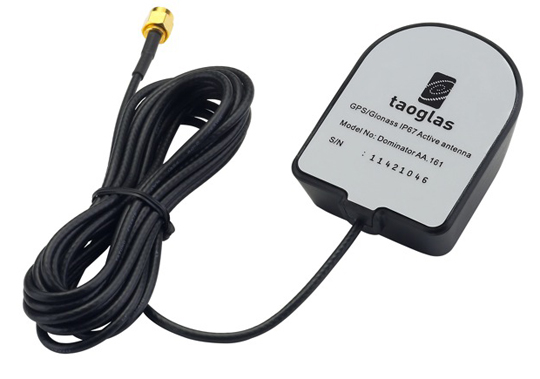
Category: GNSS

  • Taoglas Offers Dominator Antenna with Wider GLONASS Bandwith

    Taoglas Offers Dominator Antenna with Wider GLONASS Bandwith


    Photo: Taoglas

    Taoglas is launching the AA.16X Dominator series of antennas, which have a wider bandwidth to cover the GLONASS operating frequencies up to 1610 MHz, a good axial ratio, and a double resonance design for optimum reception at the centre frequencies. The company will showcase its line of antennas at CTIA in New Orleans May 8-10.

    Taoglas’ GPS antennas are being used in the field by many different M2M solution providers including tracking, telematics, and GPS manufacturers, the company said.

    The AA.161 Dominator is a magnetic mount GPS-GLONASS IP67, external antenna incorporating a 35-millimeter ceramic patch. It is a wide-band active patch antenna product with a large integral ground that delivers a gain up to 35 dB. With the Dominator antenna series, Taoglas has a comprehensive range of GPS-GLONASS active embedded antennas (AGGP series) and passive embedded (CGGP) antennas for automotive first-tier TS16949 and after-market applications.

    “In the coming months, for the first time the true availability of GPS and GLONASS satellites along with the latest generation of GNSS receivers are going to dramatically change the performance of M2M location devices,” said Ronan Quinlan, Director Taoglas. “With close to double the amount of satellites to draw from compared to a stand-alone GPS constellation, we are now going to see quicker time to first fixes with accuracy improving from meters to sub one meter. The ability to view and lock on four or more satellites in traditionally difficult reception areas such as urban canyons, city centers or locations with restricted views of the horizon, will give M2M manufacturers the ability to triangulate and pinpoint locations with greater accuracy and with quicker time to first fix.”

    Taoglas’ new Dominator antennas have been rigorously tested and pre-approved by the GNNS receiver companies worldwide and have been shown to display higher and more consistent gain in comparison to competing antennas, the company claimed. Two key components have been engineered from scratch for the Dominator series, a wide-band front-end SAW filter (critical to prevent out of band noise entering on both GPS and GLONASS degrading the signal) and a high-gain 35-mm patch.

  • Lockheed to Lose Fee on GPS III Satellites from Cost Overrun

    The U.S. Air Force says defense contractor Lockheed Martin will lose its entire fee of about $70 million to defray an 18 percent cost overrun on the first of its newly designed GPS III satellites, the Washington Post reported.

    Lockheed had estimated that it would cost $1.5 billion to develop, test and build the first two GPS III satellites, but Air Force spokeswoman Vicki Stein said the cost had risen to $1.62 billion.

    The new GPS III satellites are designed to deliver more accuracy, an anti-jamming capability and a civilian signal that can operate with Europe’s Galileo system.

  • First Payload Ready for Next Batch of Galileo Satellites


    These payload panels for the first Galileo Full Operational Capability satellite are undergoing
    final testing in the Assembly Integration Test hall at Surrey Satellite Technology Ltd. in
    Guildford, UK, in April 2012 before being boxed up for shipment to prime contractor OHB in Germany.

    The first of 14 Galileo Full Operational Capability (FOC) navigation payloads has been shipped from Surrey Satellite Technology Ltd. in the United Kingdom to prime contractor OHB System AG in Bremen, Germany, according to the European Space Agency. The payload, which provides Galileo’s precision positioning measurements and services to users, will then be added to the waiting satellite platform.

    “The payload for the fifth satellite in the Galileo constellation is ready,” said Didier Faivre, ESA’s director of the Galileo Programme and Navigation-related Activities. “While the next two satellites to be launched are currently undergoing testing, the next ones are being built. Another important step forward for the programme was made today.”

    The SSTL payload is engineered to provide all Galileo navigation services, and is based on European atomic clocks, navigation signal generators, high-power amplifiers and antennas. “The delivery of our first Galileo payload is an important milestone towards achieving full satellite qualification at the end of the year,” commented Matt Perkins, SSTL CEO.

    The first two Galileo satellites entered orbit October 21, 2011, with two more due at the end of this summer. These initial satellites carry payloads built by Astrium UK in Portsmouth, with Thales Alenia Space in Italy integrating them with their satellite platforms.

    The new satellites are the follow-up batch of Galileo satellites, planned to begin launches in 2014. Once all 14 are in orbit, the 18-satellite Galileo constellation will achieve Initial Operational Capability and will be able to provide initial navigation services — the full range of services will be available once all 30 satellites are in place in 2018.

    In addition to these first 14 FOC satellites, the OHB–SSTL consortium was awarded a contract to build a further eight satellites for the Galileo system in February this year.

  • Symmetricom Offers GPS Disciplined Atomic Oscillator Modules and High-Frequency Source Modules


    Symmetricom, Inc., precision time and frequency technology company, today announced the company will sell GPS disciplined oscillator (GPSDO) modules and high-frequency source modules from Jackson Labs Technologies, Inc., a designer and manufacturer of cutting-edge precision time and frequency products. GPSDOs provide time and frequency reference signals that have the same long-term accuracy as the GPS signal itself, and also provide a “holdover” capability to maintain system synchronization when GPS reception outages occur, Symmetricom said, adding that this new set of solutions provides Symmetricom’s customers with a broader range of product options, supporting a variety of price and performance levels.

    “The new GPSDO Modules and High-Frequency Source Modules are a natural extension of our existing product line and enable us to better meet our customers’ needs. Symmetricom customers can now select full instruments containing GPSDOs or board-level GPSDOs if they don’t need full instrument functionality,” said Steve Fossi, director of new business development at Symmetricom. “For systems that require an embedded GPSDO, incorporating a proven board-level GPSDO reduces design cycle time and risk compared to developing a custom solution.”

    Symmetricom has the following GPSDO and source modules available for purchase:

    • GPS-1000 Std. Temp. 10 MHz OCXO-based GPSDO
    • GPS-2000 Std. Temp. 10 MHz OCXO-based GPSDO
    • GPS-2500 Std. Temp. 10 MHz DOCXO-based GPSDO
    • GPS-2550 Ext. Temp. 10 MHz DOCXO-based GPSDO
    • GPS-2600 Std. Temp. 100 MHz DOCXO-based GPSDO
    • GPS-2650 Ext. Temp. 100 MHz DOCXO-based GPSDO
    • SSM-2000 Std. Temp. 100 MHz OCXO-Source Module
    • SSM-2650 Ext. Temp. 100 MHz DOCXO-Source Module
    • GPS-2700 Std. Temp. 10 MHz CSAC-based GPSDO
    • GPS-2750 Ext. Temp. 10 MHz CSAC-based GPSDO
    • GPS-500 Low-Cost Ext. Temp. 10 MHz OCXO-based GPSDO

    Today’s announcement is an extension of an existing relationship with Jackson Labs and comes one year after Jackson Labs selected Symmetricom’s Quantum(TM) SA.45s Chip Scale Atomic Clock (CSAC) as the holdover oscillator for the high-performance GPS-2700 and GPS-2750 GPSDOs. Symmetricom’s GPS-27xx GPSDOs provide capability for mission-critical applications in GPS-denied environments. Because the Quantum SA.45s CSAC provides the stability of an atomic clock with breakthrough reductions in size, weight, and power consumption, the GPS-27xx GPSDOs offer benefits in portable applications such as dismounted IED jammers, unmanned aerial vehicles (UAVs), and man-pack radios, Symmetricom said.

  • Survey/GIS Editor Eric Gakstatter to Conduct GPS/GNSS Workshop at East Carolina University May 10, 2012

    GPS World Survey/GIS editor Eric Gakstatter will conduct a one day workshop at the East Carolina University Center for Geographic Information Science in Greenville, NC on May 10, 2012. The workshop is suited for professional GPS/GNSS users in GIS, land surveying, engineering, construction, agriculture, and other high precision applications.

    Workshop Theme:

    “GNSS technology is going to change much more in the next five years than it has in the past five years”

    Workshop Topics:

    1. GPS/GNSS: How does it work and how accurate is it?
    2. What is GNSS and what can it do for me?
    3. Market survey of professional and consumer GPS/GNSS receivers.
    4. The future of GPS/GNSS receivers. New signals? How much? How accurate?
    5. Real-time corrections or post-processing. Which should I use?
    6. Sources of real-time corrections. Free and subscription-based.
    7. Source of post-processing software and data.
    8. GPS/GNSS for high-precision GIS: The value and the headaches.
    9. Evaluating GPS/GNSS equipment: Which one is right for you?
    10. How to measure the accuracy of a GPS/GNSS receiver. Accuracy vs. Precision
    Venue:
    East Carolina University Center for Geographic Information Science
    Greenville, NC USA
    Date/Time:
    Thursday, May 10, 2012. 8:30a – 5:00p
    Click here for details and registration form.
  • Bradford Parkinson to Discuss ‘GPS for Humanity’

    Brad Parkinson
    Brad Parkinson

    As part of the Stanford Engineering Hero Lecture Series, Brad Parkinson will present a talk on “GPS for Humanity” Monday, April 30, at 7 p.m. Pacific Time. The lecture will be broadcast online at no charge. If you would like to view the live broadcast, register at the Stanford University site.

    In large part, Parkinson will present the story he told in GPS World, The Origins of GPS, Part 1 and Part 2. Here is the lecture description:

    More than anything else, GPS has become the United States’ gift to humanity. Cell phones rely on GPS for timing. Ship and aircraft carry multiple GPS receivers to provide positioning information. Other applications range from earth movement to disease tracking to search and rescue. Dr. Bradford Parkinson, chief GPS architect and Stanford Professor Emeritus of Aeronautics and Astronautics, will describe the origins and applications of GPS and explore its future, including one application enabled when the world has more than 50 interchangeable civil signals.

    Bradford Parkinson is chief architect of the now-ubiquitous Global Positioning System (GPS), which he led as a U.S. Air Force colonel in 1973. As a professor at Stanford, he pioneered GPS for aviation and other applications, including the Wide Area Augmentation System (WAAS) used by the FAA. More recently, he led the NASA/Stanford Gravity Probe B program that validated Einstein’s General Theory of Relativity to an unprecedented accuracy. Parkinson is co-editor and an author of the best-selling textbook, Global Positioning System: Theory and Applications.

  • GLONASS 701K Reactivated


    News courtesy of CANSPACE Listserv.

    GLONASS 701K, the first GLONASS-K1 satellite, launched on February 26, 2011, has been reactivated on frequency channel -5. GLONASS 701K, still undergoing flight tests, had previously been active, transmitting legacy FDMA signals on channel -5 between April 8 and October 10, 2011, using almanac slot 4 although the satellite was (and still is) physically in/near orbital slot 21. Transmissions resumed on October 31, 2011, using almanac slot 3, and ceased again on November 30, 2011. During these tests, the satellite was set unhealthy in the broadcast almanac.

    GLONASS 701K does not currently appear in the broadcast almanacs but its broadcast ephemeris gives its designation as 26 or R26 in IGS nomenclature.

    Some receivers may not currently track GLONASS 701K (also known as GLONASS 801 by the IGS to distinguish the satellite from an earlier GLONASS-M satellite also numbered 701) given that it is not in the almanacs and/or has a non-orthodox slot number. Some software providing conversions between receiver data formats and RINEX formats may not recognize the satellite either.

    However, according to reports, at least Javad receivers can successfully track the satellite at the moment.

    The reactivation of GLONASS 701K may be a hint that plans to expand the GLONASS constellation from 24 to 30 satellites, as previously reported, are actually underway.

    Thanks to T.S. Kelso and Javad Ashjaee for information concerning the reactivation of the satellite.

  • NVS Technologies AG Releases Raw Data Firmware for NV08C Multi-GNSS Receivers

    NVS Technologies AG, GNSS receiver developer, announces today the release of the optimized and raw data output enabled firmware v0204 for its NV08C-CSM and NV08C-MCM GPS/GLONASS receivers.

    Firmware v0204 provides significant performance improvements, as well as a group-delay calibrated raw data (carrier phase, code phase, and Doppler) output function, to the highly integrated NV08C-CSM SMT receiver module and the compact NV08C-MCM BGA SiP receiver. Firmware v0204 enables the NV08C-CSM and NV08C-MCM receivers to be utilized in a wide range high-precision applications, including survey equipment, GIS portable devices, and machine control and precision agriculture systems.

    NVS Technologies’ customers can take full advantage of NVS Technologies’ professional grade NV08C-CSM and NV08C-MCM multi-GNSS receivers’ capabilities. These receivers deliver true simultaneous multi-constellation navigation + up to 10Hz NMEA and raw data outputs, the company said.

    Firmware v0204 is download-able free of charge at www.nvs-gnss.com/support/firmware.

  • New DNRGPS Replaces DNRGarmin

    The DNRGarmin application has been a popular tool for GPS users worldwide since 1999. Developed at the Minnesota Department of Natural Resources (MNDNR) to facilitate field data collection by staff, DNRGarmin use grew quickly soon after being released as freeware to the public. In addition to thousands of Minnesota users, DNRGarmin has been used worldwide by fishermen in Japan, search and rescue teams in New York, wildland firefighters across North America, professional adventurers in Brazil, and miners in Africa.

    MNDNR has released numerous updates of DNRGarmin over time to add functionality and maintain compatibility with software and handheld GPS receivers. Escalating changes in technology, an expanding user base, and requests for additional functionality prompted DNR staff to examine new ways of maintaining the application.

    DNRGPS is a new iteration of DNRGarmin created by MNDNR and the National Park Service. The new name reflects a focus to expand the compatibility of the application to more brands and models of GPS receivers. DNRGPS is also able to consume more geospatial data formats, has more data projections, and is compatible with the latest versions of ArcMap and Google Earth.

    DNRGPS is being released as Open Source software so that any programmer can download and alter the code. It is hoped the Geospatial Community will “adopt” DNRGPS as its own, testing and checking-in enhancements to the code, thereby contributing to the timely maintenance and expanded functionality of the program for all users.

    A public DNRGPS webpage has been created for the distribution of DNRGPS and accompanying documentation. The site highlights functionality, lists prerequisites, and includes links to DNRGPS mailing lists.

  • u-blox Launches GLONASS/GPS/QZSS Positioning Module

    u-blox, the Swiss positioning and wireless module and chip company, announces an all-in-one satellite positioning receiver module, the LEA-6N. The low-power, cost-effective module delivers fast, high-accuracy positioning, u-blox said. It is targeted at industrial telematics applications in Russia such as vehicle tracking, mobile resource management and the ERA-GLONASS emergency call system.

    The module works with GPS, Russian GLONASS, and Japanese QZSS satellite positioning systems. It also supports all civilian Satellite-Based Augmentation Systems (SBAS).

    “The LEA-6N module delivers clear new benefits for our industrial customers in terms of global support of all available satellite positioning systems, easy to mount LCC form factor, low power consumption and cost effectiveness” said Thomas Nigg, VP Product Marketing at u-blox, “LEA-6N will also support our CellLocateTM hybrid indoor positioning system; when used together with our wireless modules, the location of valuable assets or people can be determined anywhere, indoors and outside.”

    Samples of LEA-6N are available mid-April 2012, with evaluation kit EVK-6N and mass production in June 2012. For more information, contact the u-blox office nearest you, or visit with company representatives at Machine to Machine 2012 stand E21 April 3-5 in Paris.

  • Spectra Precision Introduces ProFlex 800 GNSS for Positioning Applications


    Spectra Precision introduced today the new ProFlex 800, a GNSS solution with Z-Blade GNSS-centric technology. The ProFlex 800 delivers fast and reliable RTK positioning, even in environments where GNSS signals may be difficult to acquire, Spectra Precision said. Rugged and IP67 rated, the ProFlex 800 is built to withstand harsh operating conditions for a variety of positioning applications.

    “The ProFlex 800 is an ideal solution for customers wanting a single GNSS receiver for multiple applications,” said François Erceau, general manager of Trimble’s Spectra Precision, Nikon and Ashtech Business Area. “It offers a unique design with a range of mounting and communications options.”

    Used as a backpack rover or reference station, the ProFlex 800 with Z-Blade technology is a flexible GNSS solution for land surveying. Its innovative design also makes it ideal for hard-mounted survey applications such as coastal work, dredging, bathymetry or offshore vessel operations.

    The weatherproof, high-impact-resistant molded aluminum housing allows the ProxFlex 800 to operate in harsh conditions.

    In addition to a 3.5G internal cellular modem, the ProFlex 800 can use a variety of internal or external UHF modules, providing stable and reliable wireless communications. It can be used as a rover or a base without additional accessories in the field. Its Z-Blade long-range RTK capability combined with industry-leading UHF options help to ensure maximum productivity while in the field.

    With its built-in Ethernet capability and embedded web server, users can access the ProFlex 800 from any computer connected to the Internet. This capability allows instant real-time multi-data streaming over an Ethernet connection to build an RTK corrections server without any additional software or equipment, the company said.

    Spectra Precision ProFlex 800 CORS Receiver. The Spectra Precision ProFlex 800 is also available as a Continuously Operating Reference Station (CORS). This configuration is an optimal solution when collecting, storing and transferring high-quality GNSS raw data for post processing surveys, geodetic and other applications. Automatic sessions programming, a user-friendly Web-interface, an embedded RINEX converter, FTP push functionality and many other advanced CORS features make the ProFlex 800 CORS a powerful, robust and easy-to-use GNSS solution.

    Advanced Ashtech Z-Blade Technology. Z-Blade is a new GNSS centric signal processing technology. Z-Blade uses all of the available satellite signals equally, without preference to any particular satellite constellation, maximizing the user’s ability to obtain reliable GNSS positions in tough conditions. Z-Blade allows users to receive and maintain RTK positioning even if GPS coverage is insufficient. In many work locations, just a few GPS and GLONASS satellites may be visible due to obstacles such as trees or buildings.

    The ProFlex 800 is now available through the Spectra Precision global dealer network. For more information visit: www.spectraprecision.com and www.ashtech.com or email: [email protected]

  • The System: eLoran Gets Trials, Possibly a New Life

    eLoran Gets Trials, Possibly a New Life

    As result of a Cooperative Research and Development Agreement (CRADA) between the U.S. Coast Guard and UrsaNav, Inc., on-air tests are being conducted from the former Loran Support Unit site in New Jersey.

    One of the CRADA’s goals is to research, evaluate, and document a wireless technical approach as an alternative to GPS for providing precise time. The ability to obtain precise time to at least one microsecond is necessary for the proper operation and functioning of many critical industries and systems. Examples include telecommunications networks, banking and finance, energy and power delivery, emergency services, transportation systems, and military and homeland security systems.

    Additional on-air tests are planned at various sites throughout the United States. Broadcasts will test several different frequencies, waveforms, and modulation techniques using evolutionary, state-of-the-art technology. Reception of these broadcasts are planned at both on-shore and off-shore locations, and will include advanced LF data delivery techniques. The results of these trials will be presented at national and international conferences. Parties interested in any part of the trial, or interested in doing their own measurements, are invited to contact UrsaNav.

    The company has partnered with precise-time synchronization company Symmetricom and Nautel, supplier of high-power RF transmitters. According to UrsaNav, this “alliance of expertise” provides the foundation technology for a wide-area, terrestrial-based alternative to satellite systems such as GPS, GLONASS, and Galileo.

    For further background and commentary, see Don Jewell’s Defense e-newsletter for April.

    “Global government, industry, and academic experts recognize that advanced LF signals, of which eLoran is just one example, can provide alternative timing — either as a stand-alone service, or as a component of an existing positioning, navigation, and timing (PNT) service. The high-power, virtually jam-proof and spoof-proof LF signals operate independently of GPS and GNSS, and provide a Universal Coordinated Time (UTC) time reference in the order of tens of nanoseconds. The recognition of the criticality of time to many aspects of our national critical infrastructure has led to establishment of the CRADA to evaluate the benefits of an LF wide-area timing system.”

    The LF signals can also be used as pseudoranges mixed in with GPS, or if enough transmitters are available, as a fully independent PNT network. In other words, a true backup PNT capability for safety-of-life navigation, for dispatching first responders, and for supporting critical national infrastructures.

    First Galileo PRS Signal Received

    Septentrio and QinetiQ, in close partnership with the European Space Agency (ESA) and their industrial partners, achieved the first successful reception of the encrypted Galileo Public Regulated Service (PRS) signal from the first Galileo satellites, launched in November 2011.

    The signal was received on the Galileo PRS Test User Receiver (PRS-TUR) jointly developed by Septentrio (Leuven, Belgium) and QinetiQ (Malvern, United Kingdom) under an ESA contract. For the reception test, the receiver was installed in the Galileo Control Centre in Fucino, Italy, and operated by technical experts from ESA.

    Septentrio and QinetiQ are long-term contributors to the Galileo Programme, working closely with ESA, the European GNSS Agency (GSA), and European industrial partners since 2003.

    Count Five Compass IGSOs

    The BeiDou-2/Compass G5 satellite launched on February 24 has achieved an initial approximately geostationary orbit.

    The current sub-satellite east longitude is 57.23 degrees. The intended final orbital slot may be 58.75 degrees, one of the previously announced orbital locations and one used by the BeiDou-1 demonstration system.

    GPS Use in FAA’s NextGen 2012 Plan

    An overview of NextGen benefits and accomplishments is available in the 2012 update to the NextGen Implementation Plan, published by the Federal Aviation Administration (FAA)

    The 2012 NextGen Plan specifically mentions GPS/GNSS as follows:

    Performance Based Navigation (PBN). The current aircraft fleet is well equipped with PBN capability. In the air carrier community, the heart of the PBN capability is the Flight Management System, which uses input from multiple distance measuring equipment (DME), or from the GNSS using a GPS sensor or a GPS with Wide Area Augmentation System (WAAS) sensor.

    Ground Based Augmentation System Landing System (GLS) Enabler. This program researches use of differential GPS corrections to support Category III (Cat III) approaches. This capability will be the same as Cat III instrument landing system (ILS), without the need to restrict taxiing aircraft near antennas and at reduced cost to the FAA.

    Automatic Dependent Surveillance–Broadcast (ADS-B). Aircraft position (long-lat, altitude, and time) is determined using GPS, an internal inertial navigational reference system or other navigation aids. ADS-B Out involves transmission of a GPS position (or of comparably performing navigation equipment meeting integrity and accuracy requirements) from an aircraft to display its location to controllers on the ground or to pilots in other aircraft equipped with ADS-B In.

    Low-Visibility/Ceiling Approach. Localizer Performance (LP) with Vertical Guidance (LPV) Approaches. These are more cost-effective to implement compared to additional ground-based navigation aids (NAVAIDs) and their approach procedures. Increasing the number of LPV/LP approaches will provide further incentives for users to equip with GPS/WAAS. This will provide increased utility to the more than 40,000 general aviation aircraft that are already WAAS-capable. The FAA will also deliver LP approaches to runways that do not qualify for LPVs due to obstacles.

    Ground Based Augmentation System (GBAS) Precision Approaches. GPS/GBAS support precision approaches to Cat I and eventually Cat II/III minima for properly equipped runways and aircraft. GBAS can support approach minima at airports with fewer restrictions to surface movement and offers potential for curved precision approaches. GBAS may also support high-integrity surface movement requirements.

    — Bill Thompson, GPS World aviation editor

    LightSquared-Sprint Contract Terminated

    Business Case for GPS Threat Gone Away

    The principal business prop under the LightSquared plan for ancillary terrestrial component (ATC) broadcast of a powerful signal that would have disrupted GPS operations dropped out from under the company on March 16, as wireless carrier Sprint terminated its $9 billion agreement with LightSquared. LightSquared had several such partnership agreements, but the Sprint deal was the largest, and in many eyes the driver of the aggressive plan. With it gone, LightSquared’s other deals will likely dissipate — and the current threat, at least, to GPS industry and users should effectively go away.

    Sprint has apparently concluded that LightSquared has no prospect of reversing the revocation of its conditional waiver last month by the Federal Communications Commission, as a result of extensive testing conducted by the company, various government agencies, and the GPS industry. Earlier, Sprint had twice extended its tentative agreement with LightSquared as the tests took place over the last year, but reached the end of its road March 16 — which is also the last day the FCC is accepting public comments on its decision to revoke the waiver.

    An official LightSquared statement said termination of the Sprint agreement was “in the best business interests of both companies, and was not unexpected given the regulatory delays.” Sprint will return $65 million in prepayments that LightSquared made to Sprint.

    Some analysts have predicted that LightSquared may be forced to sell off its assets by the end of the year. Among these assets are the spectrum licenses for the lower LightSquared band (1526–1536 MHz), the so-called Low 10, and the higher band (1545-1555 MHz), known as the Upper 10, adjacent to GPS L1. These bands have a history of trading hands as their owners go into bankruptcy or otherwise out of business.

    The next touchpoint of concern for the GPS community is the outcome or perhaps various outcomes of the FCC workshop on spectrum efficiency and receivers that took place March 12–13. The workshop was convened to discuss the characteristics of receivers and how their performance can affect the efficient use of spectrum and opportunities for the creation of new services, according to the FCC.