Category: GNSS

  • Three More BeiDou-2/Compass Satellites to Be Launched This Year

    News courtesy of CANSPACE Listserv.


    China will launch three more satellites for its Beidou GNSS, reports CRIenglish.com and People’s Daily Online. Two satellites will be launched in June, and another in October.

    The system is expected to be adopted by some of China’s neighboring countries in the next year or two such as Pakistan and Mongolia, said Ran Chengqi, director of the China Satellite Navigation Office. He spoke at the third China Satellite Navigation Conference in the southern city of Guangzhou.

  • SuperGeo Technologies Introduces SuperPad 3.1

    SuperGeo Technologies introduces SuperPad 3.1, which mainly enhances the user interface, adjusts toolbar icons, adds SBAS extension, and improves the display of GPS status. For customization, SuperPad 3.1 provides sample codes for developing extensions and offers Microsoft Visual Studio templates to assist users in developing the functions they need. To have a smoother GIS workflow, SuperPad 3.1 improves the connection with SuperGIS Server 3 to make data synchronization more effective.

    User Interface Enhancement

    • To enhance the efficiency of data editing and collecting, SuperPad 3.1 improves the user interface and toolbar allocation. Therefore, users are able to achieve the task target with better efficiency.
    • To have the toolbar button display more clearly, SuperPad 3.1 adjusts the icon style and size so that users can choose the most suitable icon size for different mobile devices.

    Newly-Added SBAS Extension

    • The whole new SBAS extension supports to turn on SBAS function of mobile device to improve the accuracy of GPS data collection.
    Providing Custom Samples and Templates
    • A number of sample codes of extensions are provided; users can directly use the objects of SuperGIS Mobile Engine to design the GIS functions they need.
    • Microsoft Visual Studio templates for customizing GIS functions are provided so that users can customize SuperPad with ease.

    Improved Capability of Synchronizing SuperGIS Server Data


    • The capability of synchronizing the map data published by SuperGIS Server is improved. Thus, users can synchronize the data with SuperGIS Server while surveying outdoor.
  • LightSquared Bankrupt, But Spectrum Void Still Beckons

    By Alan Cameron.

    LightSquared, the company that mounted a powerful threat to GPS signals, declared bankruptcy on May 14, after losing a lengthy struggle in the court of the Federal Communications Commission (FCC) with the GPS industry, the U.S. military (behind the scenes), the Federal Aviation Administration, and many other GPS users. However, the vacuum into which Lightsquared sought to step — a dearth of spectrum for exploding mobile data use, up 123 percent last year — remains a gaping hole that will likely attract other entrants.

    The Lightsquared bankruptcy move followed collapse of negotiations with lenders to the company, and will likely give CEO Philip Falcone several further months of control. It is not known whether his efforts will seek to salvage the business plan to provide wholesale broadband capacity to wireless carriers, who need more capacity to feed a ravenous market. In her May Wireless Pulse column, GPS World contributing editor Janice Partyka writes, “Carriers [at the CTIA industry show] sounded alarms about running out of spectrum to support ballooning mobile data consumption.”

    As a result of the February FCC decision to revoke LightSquared’s conditional waiver to broadcast a powerful terrestrial signal immediately adjacent to a band reserved for satellite services, the company’s main asset, its spectrum license, lost most of its potential value, unless significantly repackaged and redirected, or traded for another spectrum band..

    In late 2010, when the LightSquared threat first surfaced, Falcone maintained that LightSquared’s interference issues were not his to solve, because GPS users were encroaching on his spectrum. “People who are in adjacent bands have to understand that there is now a new driver in town driving on that highway,” he said. “And they can’t be weaving in and out of that highway.”

    Falcone now has to deal with creditors who include Carl Icahn, the near-legendary corporate raider. Icahn and other investors have bought about $300 million of LightSquared debt. “Icahn is a take-control, alpha-male investor,” said Brad Balter, head of Balter Capital Management, as quoted in a May 3 Business Week story. “Falcone is both desperate and naive if he thinks of Icahn as anything other than an adversary who would wrest control of the spectrum if LightSquared went into bankruptcy.” What Icahn might venture if he gained control of LightSquared spectrum represents another unknown on the GPS horizon.

    Spectrum Shortage. Meanwhile, writes GPS World editor Partyka, “Verizon Wireless and T-Mobile executives complained that the future of data use is at risk if more spectrum isn’t put to use. FCC Chairman Julius Genachowski defended the agency’s decision to block the AT&T T-Mobile deal with a rejoinder about spectrum shortage. ‘Some have argued that transactions — let’s be frank, one transaction — is somehow causing a shortage,’ said Genachowski. ‘But the overall amount of spectrum hasn’t changed.’  While this is true, spectrum is a concern. CTIA reports that U.S mobile data traffic surged 123 percent in 2011.”

    In a statement regarding the company’s bankruptcy filing, Marc Montagner, interim co-chief operating officer and chief financial officer, stated “All LightSquared distribution partners and customers, including public safety, emergency response, government, and military users of LightSquared’s satellite-based communications services can continue to rely on LightSquared to provide them with mission critical communications services. The filing was necessary to preserve the value of our business and to ensure continued operations. The voluntary Chapter 11 filing is intended to give LightSquared sufficient breathing room to continue working through the regulatory process that will allow us to build our 4G wireless network.”

  • BeiDou/Compass Satellites Launched April 29 Now Being Tracked

    BeiDou/Compass Satellites Launched April 29 Now Being Tracked

    News courtesy of CANSPACE listserv.


    The two BeiDou-2/Compass satellites launched on April 29 became active on May 6. Several tracking stations in the Asia/Pacific area began tracking the satellites at about 08:00 UTC.

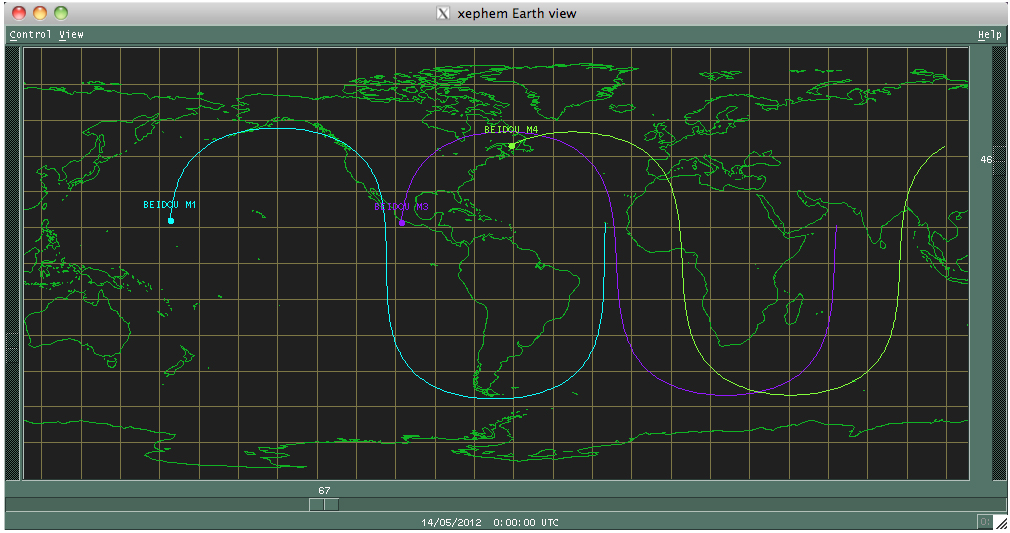
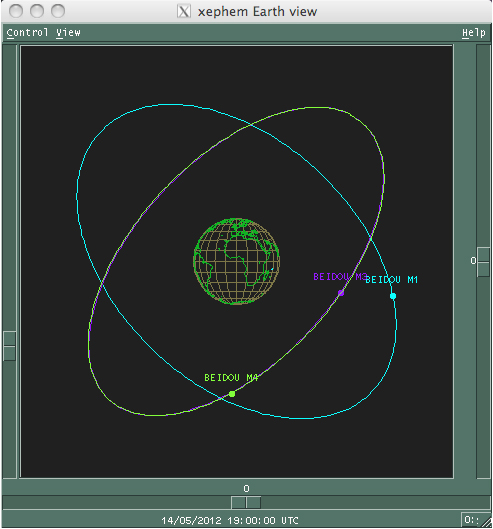
    The medium Earth orbit (MEO) satellites, identified by their international designators 2012-018A and 2012-018B and by Chinese officials as M3 and M4, are using pseudorandom noise codes 11 and 12. M3 and M4 are in the same orbit plane,  a different one than that of M1, the first BeiDou-2/Compass MEO satellite launched.

    A view of the three MEO satellites in their orbit planes is pictured here:

    cmpass-1

    The one-orbit ground tracks of the satellites are pictured here (click to enlarge):

    Compass-2


    Tracking of the satellites by NORAD/JSpOC appears to have been interrupted when the satellites fired their apogee kick motors to circularize the orbits. The last days the satellites were tracked in their transfer orbits were 30 April and 1 May. They were recovered by NORAD/JSpOC on 9/10 May. Likely the orbit circularizations occurred around April 30 / May 1.

    Recent two-line element sets for the three MEO satellites are given below:

    BEIDOU M1
    1 31115U 07011A   12134.10254588 -.00000105  00000-0  10000-3 0  5834
    2 31115 056.7122 028.7463 0003954 199.1314 301.1397 01.86191632 34665

    BEIDOU M3
    1 38250U 12018A   12132.52529875 +.00000052 +00000-0 +10000-3 0 00275
    2 38250 055.1626 116.9959 0024183 186.6025 335.0953 01.86239286000385

    BEIDOU M4
    1 38251U 12018B   12133.86489950  .00000061  00000-0  10000-3 0   262
    2 38251 055.0887 116.4855 0024672 179.1060 208.4713 01.86163690   419

  • Soyuz Takes Shape in French Guiana for Dual Galileo Launch

    Assembly process for the Soyuz launcher began with integration of the four first-stage strap-on boosters to the Block A core second stage (photos at left and center).  At right, the Block I third stage is seen after its mating to the launcher’s core.

    The launcher for Arianespace’s next Soyuz mission from the Spaceport in French Guiana is completing its initial checkout for a flight in the second half of 2012, which will carry another two spacecraft for Europe’s Galileo satellite navigation constellation, according to Arianespace.

    During activity at the Spaceport’s Soyuz Launcher Integration Building — known by its Russian “MIK” designation — the vehicle’s four first-stage strap-on boosters have been mated with the Block A core second stage, followed by integration of the Block I third stage.

    With its initial build-up concluded, the Soyuz is undergoing regular maintenance checks that are standard for the Russian-built vehicles that have been in storage prior to their mission. Such verifications include testing of the launcher’s pneumatic and electrical systems, Arianespace said.

    This Soyuz will carry Europe’s next two Galileo In-Orbit Validation (IOV) satellites, joining the first pair of spacecraft lofted on Arianespace’s historic maiden flight of the Russian-built launcher from French Guiana in October 2011. Once the four IOV satellites are in orbit, they will provide the minimum information needed for space-based navigation: latitude, longitude and altitude data, along with ranging accuracy, enabling assessment of the Galileo system’s performance, while also allowing suppliers to realistically check their receivers and services against actual signals.

    Arianespace has been chosen to deploy the entire Galileo constellation of 30 satellites. This began with the launch of the first two experimental satellites, GIOVE-A and GIOVE-B, orbited by Arianespace’s Starsem affiliate on Soyuz launchers from Baikonur Cosmodrome in 2005 and 2007. Subsequently, Arianespace lofted the initial pair of In-Orbit Validation spacecraft on Soyuz’ October 2011 inaugural mission from the Spaceport.

    The remaining 24 Galileo constellation satellites will be orbited through 2015, using six additional Soyuz vehicles carrying two spacecraft each, along with three Ariane 5s configured with four per launch.

    Initial phases of the Galileo program were carried out by the European Space Agency (ESA) in activity co-funded with the European Commission. Galileo’s Full Operational Capability phase is being managed and funded by the European Commission, with ESA and the Commission having signed a delegation agreement by which the space agency acts as design and procurement agent.

    The upcoming Galileo mission is designated VS03 in the numbering system for Arianespace’s launcher family — which is composed of the medium-lift Soyuz, heavy-lift Ariane 5 and light-lift Vega – all operated at the Spaceport. The “V” represents the French word for “flight” (Vol), while “S” signifies the use of a Soyuz launch vehicle. Its “3” denotes the third Arianespace mission of Soyuz from French Guiana.

  • Two New Galileo Satellites to Rise in September

    The European Commission announced a September 28 launch date for the next pair of Galileo satellites. These will launch together on a Soyuz rocket from French Guiana,  joining the two Galileo in-orbit validation (IOV) satellites already in space.

    The new launch will take place within a year of the flight of the first two Galileo IOV satellites, which reached orbit on October 21,  2011.  
     
    The September launch will bring the nascent constellation to four, representing the minimum needed under optimal circumstances for satellite navigation — to measure latitude, longitude and altitude while checking ranging accuracy.  Therefore, according to the EC statement,  these four Galileo IOV satellites can be used to assess the performance of Galileo’s global ground system, which serves to maintain the precision of the Galileo system.

    In addition, manufacturers worldwide should be able to realistically test prototype Galileo-based receivers and services against actual satellite signals.
     

  • GPS IIA Satellites a Concern for OCX

    One of the long-standing issues for support of IIA vehicles after the future GPS Operational Ground Control Segment’s (OCX’s) ready-to-operate (RTO) date, which should fall in December 2016 at the latest, is what ground command-and-control (C2) system will steer GPS IIA satellites, do navigation uploads, and so on. The issue is that AEP, the current C2 system, will no longer be available once the transition to OCX takes place, and OCX has no requirement to control IIA satellites.

    The OCX program, which struggled early, is now under new Program leadership within Raytheon Space Systems, and while Ray Kolibaba, the new OCX program manager, is making great progress, OCX does not need to be burdened with additional requirements at this stage of the program.

    Just how big an issue is GPS IIA C2? Initially the Aerospace projections were that there would only be one or two GPS IIAs left on orbit in 2017, and it was not worth the costs to include the C2 software for the legacy system in the new software code. However, I have long maintained that Aerospace and Space Missile Systems Command (SMC) neglected to count the residual satellites, maintained by Launch, Anomaly, and Disposal Operations (LADO), which might very well actually amount to 3–4 additional IIAs. Added to the two IIAs on orbit, this could amount to six IIA SVs that need to be maintained.

    The solution announced during the National Space Symposium (NSS, April 16–19) by General William Shelton, the four-star chief of Air Force Space Command, is to fund the current LADO operator, Braxton Technologies, to build in this support for the IIAs. This is significant for several reasons: One of course is that it solves the IIA C2 issues, it does it now, and at a relatively modest cost, and it utilizes more of the capabilities of the Braxton Technologies’ LADO software. Additionally it provides a true backup capability for assets on orbit that become increasingly valuable as the number of available launch slots for GPS decreases.

    Braxton Technologies initially demonstrated this capability years ago in a lifeboat drill during the transition to AEP, but the navigation upload capability was never maintained for LADO after the successful transition. This is certainly a step in the right direction and provides a simple solution to a vexing problem that has plagued the GPS program for the last several years.

    Dual Launch. I asked General Shelton if he would support an approach that would allow the United States to go to dual launch of GPS III on vehicles 5–6 instead of waiting until 8–9 as planned today. He said the Air Force would certainly support that, and is looking at making it possible with vehicle 7 currently. That will come even sooner if the program advances with glitches.

    I also asked him about the gap between GPS III launch and OCX RTO. The gap seems to be getting wider, not narrower, and he agreed that OCX could probably not move to the left, and GPS III has moved significantly to the left, so this is still an issue that needs to be addressed. There are plans in place, but the recent budget activity has caused some uncertainty.

    Sequestration. On the subject of sequestration — a highly charged Congressional effort to force another $500 billion-plus in additional defense cuts — General Shelton said it would amount come on top of the approximately $487 billion already cut from programs, and that many space programs might be unsustainable in their current mode if that occurs.

    However, the U.S. Armed Services have been informed by the White House Office of Management and Budget not to make plans for sequestration. So right now, the services and other agencies of the U.S. government have been forbidden to make programmatic decisions based on a possible sequestration. Interesting.

    By the way, attendance at NSS this year surpassed 9,000.

  • The System: GPS III Endures Bad Press, IIAs an OCX Concern

    GPS III Endures Bad Press, IIAs an OCX Concern

    Reports in daily news media such as the Washington Post and Denver Post that “Lockheed Martin will lose its entire fee of about $70 million to defray an 18 percent cost overrun” on GPS III satellites misconstrue the facts.

    Don Jewell, contributing editor for GPS World, said after informal talks with key Lockheed executives, “This is a good story, but it has been sensationalized.”

    Lockheed Martin’s fee is 5 percent of the target cost, which includes one-time engineering tasks, test equipment, and satellite assembly, according to the Air Force.

    The first GPS III satellite remains on schedule to be available for launch in 2014, Lockheed Martin spokesman Michael Friedman said via email.

    “While we have encountered challenges associated with higher standards for parts testing and first-time technical issues, the program is on firm footing and our cost estimate remains within the original Air Force budget,” Friedman stated, adding that the company doesn’t discuss specifics of fees.

    “In their defense,” Jewell reports, “the program was initially identified as stable with no government change request allowed, to keep it on schedule and budget. The recent budget furor has introduced chaos into the requirements process and contributed significantly to the increased costs.”

    Lockheed Martin is using a full-sized prototype to identify and solve many assembly issues “that would have cost more and presented more risk if they had been discovered later in production,” Lockheed’s Friedman said.

    “We have identified tens of millions of dollars in cost savings for the production satellites and in some cases we are seeing 50 to 80 percent reductions in labor costs,” he added.

    Ground Control to Aged Birds

    By Don Jewell

    One of the long-standing issues for support of IIA vehicles after the future GPS Operational Ground Control Segment’s (OCX’s) ready-to-operate (RTO) date, which should fall in December 2016 at the latest, is what ground command-and-control (C2)system will steer GPS IIA satellites, do navigation uploads, and so on. The issue is that AEP, the current C2 system, will no longer be available once the transition to OCX takes place, and OCX has no requirement to control IIA satellites.

    The OCX program, which struggled early, is now under new program leadership within Raytheon Space Systems, and while Ray Kolibaba, the new OCX program manager, is making great progress, OCX does not need to be burdened with additional requirements at this stage of the program.

    Just how big an issue is GPS IIA C2? Initially the Aerospace projections were that there would only be one or two GPS IIAs left on orbit in 2017, and it was not worth the costs to include the C2 software for the legacy system in the new software code. However, I have long maintained that Aerospace and Space Missile Systems Command (SMC) neglected to count the residual satellites, maintained by Launch, Anomaly, and Disposal Operations (LADO), which might very well actually amount to 3–4 additional IIAs. Added to the two IIAs on orbit, this could amount to six IIA SVs that need to be maintained.

    The solution announced during the week at the National Space Symposium (NSS, April 16–19) by General William Shelton, the four-star chief of Air Force Space Command, is to fund the current LADO operator, Braxton Technologies, to build in this support for the IIAs. This is significant for several reasons: One, of course, is that it solves the IIA C2 issues, it does it now, and at a relatively modest cost, and it utilizes more of the capabilities of the Braxton Technologies’ LADO software. Additionally it provides a true backup capability for assets on orbit that become increasingly valuable as the number of available launch slots for GPS decreases.

    Braxton Technologies initially demonstrated this capability years ago in a lifeboat drill during the transition to AEP, but the navigation upload capability was never maintained for LADO after the successful transition. This is certainly a step in the right direction and provides a simple solution to a vexing problem that has plagued the GPS program for the last several years.

    Dual Launch. I asked General Shelton if he would support an approach that would allow the United States to go to dual launch of GPS III on vehicles 5–6 instead of waiting until 8–9 as planned today. He said the Air Force would certainly support that, and is looking at making it possible with vehicle 7 currently. That will come even sooner if the program advances with glitches.

    I also asked him about the gap between GPS III launch and OCX RTO. The gap seems to be getting wider, not narrower, and he agreed that OCX could probably not move to the left, and GPS III has moved significantly to the left, so this is still an issue that needs to be addressed. There are plans in place, but the recent budget activity has caused some uncertainty.

    Sequestration. On the subject of sequestration — a highly charged Congressional effort to force another $500 billion-plus in additional defense cuts — General Shelton said it would come on top of the approximately $487 billion already cut from programs, and that many space programs might be unsustainable in their current mode if that occurs.

    However, the U.S. Armed Services have been informed by the White House Office of Management and Budget not to make plans for sequestration. So right now, the services and other agencies of the U.S. government have been forbidden to make programmatic decisions based on a possible sequestration. Interesting.

    By the way, attendance at NSS this year surpassed 9,000.


    Galileo Launches Accelerated, First Payload Shipped

    Javier Benedicto, head of the Galileo Project Office for the European Space Agency (ESA), set an aggressive schedule for launching some Galileo satellites as many as four at a time in 2014 and 2015, to meet a target provision date of Galileo initial services in 2014 and full services in 2015. The announcement came at the Munich Summit, March 14.

    The hurry-up to carry 22 satellites into orbit proceeds with dual-satellite launches aboard Russian Soyuz rockets, as was the case for the most recent in-orbit validation (IOV) launch in October 2011. There will be three Soyuz launches in 2013, for a total of six new satellites in orbit, and two Soyuz launches in 2014, adding four more. Then the burden will shift to European rockets from Arianespace, according to a contract signed in February of this year. One Ariane 5 rocket is slated to carry four Galileo satellites aloft in 2014, bringing the projected total of IOV and eventually operational Galileo satellites in space to 16 by the end of 2014. ESA had ealier aired plans for further Soyuz IOV launches in 2012, but the Munich statement did not mention these.

    In 2015, two more Ariane 5 launches will add eight satellites, for a total on orbit of 24, estimated to be sufficient for Galileo full operational capability (FOC).

    In subsequent talks with European satellite manufacturers OHB Systems and Astrium, GPS World contributing editor Don Jewell was told that the future launch schedule is “subject to change.”

    ESA headquarters has made no official announcement of a detailed launch schedule; inquiries regarding the Benedicto remarks were referred to the February contract statement, cited above.

    Payloads. Meanwhile, Surrey Satellite Technology Ltd. (SSTL) delivered the first of 14 FOC satellite payloads to prime contractor OHB System AG, for mechanical integration of the payload with the satellite platform and the beginning of overall vehicle assembly, integration, and testing for what will eventually become the fifth satellite in the Galileo constellation.


    Compass on the Grow

    Discussions in Internet forums indicate that the next BeiDou-2/Compass launch will take place on or about April 28, after this magazine goes to press. The launch purportedly will place two mid-Earth orbit satellites into space: BeiDou M3 and BeiDou M4. Sometime in June, plans call for BeiDou M2 and BeiDou M5 to be launched.
  • Greenspan Awarded Kershner at ION PLANS Conference

    The IEEE/ION Positioning, Location and Navigation Symposium (PLANS) 2012 Executive Committee presented its Richard B. Kershner Award to Dr. Richard Greenspan at the IEEE/ION PLANS 2012 Conference on Thursday, April 26, in Myrtle Beach, South Carolina.

    Greenspan was recognized for his pioneering work in the integration of GPS receivers with inertial navigation systems and the development and perfection of carrier-phase GPS interferometry for the high-precision measurement of fixed and moving baselines with applications to relative and differential ranging that cover the alphabet from agriculture to zoogeography.

    Greenspan has been a member of the technical staff of The Charles Stark Draper Laboratory since 1978 where he has held both high-level management and technical positions. He currently holds the highest rank on Draper’s engineering ladder, where he is the technical lead on several initiatives to improve the situational awareness of our warfighters and reduce any “collateral damage” from their actions. These activities rely on the creative uses of unmanned aerial vehicles (UAVs) that exploit GNSS when they are available and other means when satnav is not fully available. U.S. warfighters are greatly benefiting from Greenspan’s sustained contributions to the art and science of satellite navigation that is highly integrated with other sensors, according to ION, the Institute of Navigation.

    Greenspan has lectured worldwide on “Innovative Applications of Satellite Navigation” under sponsorship by the Advisory Group for Aerospace Research and Development of the North Atlantic Treaty Organization. He is a Fellow and a Past President of ION. He is also an Associate Fellow of the AIAA, a lifetime member of the IEEE, and a member of the AGU. He has been an associate editor of NAVIGATION: Journal of the Institute of Navigation since 1992 and has been consulting editor on navigation for McGraw-Hill’s Encyclopedia of Science and Technology since 1998. He holds several patents in the area of satellite navigation technology, has published many excellent and often referenced technical papers and was the invited author of the “GPS and Inertial Integration” chapter in the classic AIAA book Global Positioning System: Theory and Applications, Volume I.” He received his BS (1960), MS (1962) and Ph.D. (1968) in electrical engineering from MIT, all with high honors.

    The Kershner Award is granted in recognition for substantial contribution to the technology of navigation and positioning equipment, systems or practices over their lifetime and is given in memory of Dr. Richard B. Kershner who participated in the initial conception and led the development of Transit, the world’s first navigation satellite system.

  • Russia to Increase Number of Space Service Centers to 25

    The number of Russian centers providing services based on data received via GLONASS satellites will reach 25, Deputy Prime Minister Vladislav Surkov said  Tuesday, according to a RIA Novosti report. The space service centers are engaged in satellite monitoring of traffic safety, road planning and cargo transportation on federal highways as well as natural dangers such as landslides, avalanches, and mud flows.

    “Ten space service centers have already been established in Russia, the establishment of another 15 is planned,” Surkov said at a satellite navigation forum in Moscow. So far, there are centers in Moscow, Sochi, Kazan, Kaluga, Ryazan and five more Russian cities.

    Russia has 31 GLONASS satellites in orbit, with 24 operating to provide global coverage, four in reserve, two under maintenance, and one undergoing trials. According to Russia’s space agency Roscosmos, two Glonass satellites are under maintenance, one is on standby, and one recently launched satellite is being integrated into the grouping. The complete Glonass grouping needs 24 functioning and 2-3 reserve satellites to operate with global coverage.

  • PRN Codes Assigned to Russian SBAS Satellites


    According to a spokesperson from the Space and Missile Systems Center, GPS Directorate, the Russian Space Agency (RSA) has been assigned L1 pseudorandom noise (PRN) C/A codes for its System of Differential Correction and Monitoring (SDCM) transponders on the Luch series of geostationary relay satellites.

    SDCM is a satellite-based augmentation system that will be compatible with the U.S. Federal Aviation Administration’s Wide Area Augmentation System, the European Geostationary Navigation Overlay Service, and Japan’s MTSAT Satellite-based Augmentation System.

    The SDCM transponders will be hosted on the satellites of the Luch Multifunctional Space Relay System (Mnogofunktsional’noi Kosmicheskoi Sistemy Retranslyatsii). In addition to seven transponders in the Ku-and S-bands to be used to relay communications and telemetry between low-Earth-orbiting spacecraft (such as the Russian segment of the International Space Station) and Russian ground facilities, the satellites will host COSPAS/SARSAT search and rescue transponders, as well as the SDCM transponders.

    The first of the new Luch satellites, Luch-5A, was launched on December 11, 2011. The satellite has passed the initial inspection carried out at its temporary location at about 58.5 degrees east longitude. According to published documents, Luch-5A will eventually be relocated to its designated operational location at 16 degrees west longitude.

    Two more Luch satellites are to be launched: Luch-5B, scheduled for launch around the end of August 2012 into an orbit at 95 degrees east longitude and Luch-5V (“V” is the transliteration of the third letter in the Russian alphabet) in 2014 into an orbit at 167 degrees east longitude (Luch-5V replaces the previously designed Luch-4 satellite).

    The C/A codes assigned to the Luch SDCM transponders are as follows: Luch-5A, PRN 125; Luch-5B, PRN 140; and Luch-5V (Luch-4), PRN 141. Notification of the assignments was sent to the RSA on December 20, 2011.

    No signals from the Luch-5A SDCM transponder have yet been detected by the monitoring stations of the International GNSS Service.

  • GPS III Endures Bad Press

    Reports in daily news media such as the Washington Post and Denver Post that “Lockheed Martin will lose its entire fee of about $70 million to defray an 18 percent cost overrun” on GPS III satellites misconstrue the facts.

    Don Jewell, contributing editor for GPS World, said after informal talks with key Lockheed executives, “This is a good story, but it has been sensationalized.” Lockheed Martin’s fee is 5 percent of the target cost, which includes one-time engineering tasks, test equipment and satellite assembly, according to the Air Force.

    The first GPS III satellite remains on schedule to be available for launch in 2014, Lockheed Martin spokesman Michael Friedman said via e-mail. “While we have encountered challenges associated with higher standards for parts testing and first-time technical issues, the program is on firm footing and our cost estimate remains within the original Air Force budget,” Friedman stated, adding that the company doesn’t discuss specifics of fees.

    “In [Lockheed’s] defense,” Jewell reports, “the program was initially identified as stable with no government change request allowed, to keep it on schedule and budget. The recent budget furor has introduced chaos into the requirements process and contributed significantly to the increased costs.”

    Lockheed Martin is using a full-sized prototype to identify and solve many assembly issues “that would have cost more and presented more risk if they had been discovered later in production,” Lockheed’s Friedman said.

    “We have identified tens of millions of dollars in cost savings for the production satellites and in some cases we are seeing 50 to 80 percent reductions in labor costs,” he added.