Category: SBAS

  • Innovation: EGNOS in Northeastern Europe

    Innovation: EGNOS in Northeastern Europe

    How Well Does It Perform?

    We examine the performance of EGNOS in Finland, which lies near the northeast periphery of the coverage area, and how this performance can be improved now and in the future.

    By Mohammad Zahidul H. Bhuiyan, Heidi Kuusniemi, Auryn Soderini, Salomon Honkala and Simo Marila

    INNOVATION INSIGHTS with Richard Langley

    “[O]NE ORBIT, WITH A RADIUS OF 42,000 KM, has a period of exactly 24 hours. A body in such an orbit, if its plane coincided with that of the earth’s equator, would revolve with the earth and would thus be stationary above the same spot on the planet. … [A] transmission received from any point on the hemisphere could be broadcast to the whole of the visible face of the globe, and thus the requirements of all possible services would be met.” So wrote writer and futurist Arthur C. Clarke in his October 1945 Wireless World article “Extra-terrestrial Relays: Can Rocket Stations Give World-wide Radio Coverage?,” envisaging the geostationary orbit (GEO) communication satellite.

    The first GEO satellite was Syncom III, orbited by the United States in August 1964. Since then, more than 1,000 satellites have been launched into what is known as the Clarke Belt and around 450 are presently active. Most of them are used for civil or military communication. Some are used for direct-to-user TV and radio. Some are used for weather monitoring and other kinds of surveillance. And some are used for augmenting GPS.

    While GPS is a remarkable positioning system, its real-time accuracy using L1-frequency pseudorange measurements and its instantaneous integrity are not sufficient for some applications such as aircraft navigation. That is why the U.S. Federal Aviation Administration developed the Wide Area Augmentation System (WAAS), the first satellite-based augmentation system (SBAS). WAAS provides differential correction data and integrity information to GPS users in real time throughout most of North America using a “bent pipe” from a ground station through the GEO satellite to a user’s equipment. It uses a state-space-domain correction approach, which provides corrections for the satellite orbit and clock data transmitted by GPS satellites along with ionospheric propagation delays, all computed from measurements collected by a continent-wide tracking network.

    The WAAS concept has been duplicated for other regions. Three other SBASs are in full operation: the European Geostationary Navigation Overlay Service (EGNOS), Japan’s Multifunctional Transport Satellite Satellite-based Augmentation System, and India’s GPS-aided GEO Augmented Navigation System. Russia’s System for Differential Correction and Monitoring is currently in development.

    One hitch with GEO satellites whatever their function is their inability to service high latitudes well. At a latitude of 65°, a GEO satellite has an elevation angle of only around 17° at most and at 75°, it’s about 6° or less. Even if a GEO satellite is above the local horizon, communication might be difficult due to the longer signal path length between the satellite and the user.

    And so it is with GEO satellites used for SBAS at high latitudes. And there is an additional problem that even if the signals from an SBAS satellite can be received, corrections for some GPS satellites will not be received if they are outside the coverage area of the SBAS tracking network. In this month’s column, we examine the performance of EGNOS in Finland, which lies near the northeast periphery of the EGNOS coverage area, and how this performance can be improved now and in the future.


    FIGURE 1. Finnish national GNSS network, FinnRef. The three stations highlighted in red had the worst positioning accuracy in our analyses.

    The European Geostationary Navigation Overlay Service (EGNOS) is the first European-operated satellite navigation system and is a precursor to Galileo, Europe’s independent global navigation satellite system (GNSS), now being deployed. EGNOS, as a satellite-based augmentation system (SBAS) similar to the U.S. Wide Area Augmentation System (WAAS), was developed with the vision to improve the performance of GNSSs, such as GPS and Galileo. At the moment, EGNOS only augments GPS, making it suitable for safety-critical applications such as flying aircraft or navigating ships through narrow channels.

    Additionally, EGNOS also supports new applications in many different sectors, such as agriculture (for high-precision spraying of fertilizers), transport (enabling automatic road-tolling or pay-per-use insurance schemes) or even precise personal navigation services for general and specific use.

    At present, there are two operational geostationary Earth orbiting (GEO) satellites and until March 2017, these satellites had pseudorandom noise code (PRN) numbers 120 and 136 that simultaneously broadcast EGNOS correction messages to European GPS users. The PRN satellites 120 and 136 are located at 15.5°W and 5.0°E. (Since March, PRN 123 has replaced PRN 136 as one of the operational EGNOS satellites.) The use of EGNOS in the northern Europe is much more challenging than elsewhere in Europe due to the relatively low-elevation angle of some EGNOS satellites as seen from there of about 14° or less.

    To improve our understanding of the true performance of EGNOS in Finnish territory, we recently carried out a project entitled “Finland’s EGNOS Monitoring and Performance Evaluation (FEGNOS).” At the northeastern edge of the EGNOS coverage area, the availability of the EGNOS geostationary satellites is compromised due to their low-elevation angles. The Finnish Geospatial Research Institute (FGI) at the National Land Survey of Finland (NLS) maintains a network of 20 permanent GNSS reference stations (FinnRef) all over Finland. The core objective of the FEGNOS project is to evaluate the performance of EGNOS at all of those reference stations to determine if the EGNOS system performance reaches its target in Finland.

    Building on our initial research, in this article we report on the analysis of EGNOS performance at all 20 FinnRef stations for a year-long time-frame from November 2015 until October 2016. As it is of importance to compare the performance of EGNOS in a geographic region where EGNOS satellite visibility can be poor due to low-elevation angle, we assessed the performance of EGNOS by comparing the receivers’ own decoded SBAS messages against the SBAS messages provided by the EGNOS Data Access Service (EDAS). The daily EDAS SBAS messages can be freely downloaded from the EDAS server with prior authentication from EDAS. The performance analysis has been carried out for the following three cases:

    • Applying EGNOS corrections obtained from the EDAS server
    • Applying EGNOS corrections obtained from the receiver-decoded (Rx-decoded) EGNOS messages
    • GPS stand-alone solution without any EGNOS corrections.

    We carried out the data analysis using the EGNOS analyzing tool called PEGASUS (which originally stood for Prototype EGNOS Analysis Using SAPPHIRE, where SAPPHIRE stands for Satellite and Aircraft Database Programme for System Integrity Research) from Eurocontrol. The results show that the Rx-decoded EGNOS performance is not as good as the performance obtained from the EDAS-offered message corrections. The ongoing experience and knowledge learned from the project has helped to identify weaknesses of the EGNOS system at high northern latitudes.

    FINNISH NATIONAL GNSS NETWORK, FINNREF

    The Finnish National GNSS network, FinnRef, was established on the initiative of the Nordic Geodetic Commission and the director generals of the Nordic Mapping Authorities in the 1990s. FinnRef is part of the Nordic GNSS network, and some stations of the FinnRef network also contribute to the global International GNSS Service (IGS) network and to the European Permanent Network (EPN). The primary function of FinnRef is to offer geodetic-grade GNSS measurements, which have been continuously used for forming and maintaining the national coordinate system (EUREF-FIN). In addition, the FinnRef network is used for many GNSS-related research activities. For example, it is now possible to analyze the positioning performance of different augmentation services via the FinnRef network. Currently, FinnRef also offers an open positioning service based on the differential GNSS (DGNSS) corrections for GPS and GLONASS.

    The FinnRef network was renewed during the 2012–2013 timeframe. The renewed FinnRef network now consists of 20 GNSS reference stations, as shown in FIGURE 1. The raw GNSS data from all 20 reference stations is used in the FEGNOS project for EGNOS performance monitoring and analysis.

    DATA COLLECTION

    EGNOS signal monitoring at all FinnRef stations was carried out for one year from Nov. 4, 2015, until Oct. 31, 2016. There are in total about 360 days of data from the 20 stations out of a possible 366 days (2016 was a leap year). The day-of-year (DOY) information for the collected data set is detailed in TABLE 1. No data was available during DOY 233 and 234 of 2016 due to a technical fault at the FinnRef stations. There are 57 days of data from the year 2015 and 303 days of data from 2016.

    Table 1. DOY information for the year-long data set.

    Each FinnRef station is equipped with a dual-frequency geodetic-grade receiver. Each receiver generates 1-hour binary proprietary data files with a 1-Hz data rate. Data is pushed to the network server and saved at the conclusion of each hour. This means that there are in total 24 data sets for each single day for one single station. All the stations’ binary data files are then organized under one directory, which is named after DOY for that particular year. The FEGNOS data Collection Tool (FEGCoT) was developed in Matlab to collect data every day automatically from all 20 FinnRef stations.

    These three steps are followed for automatic data collection:

    • Collect: 1-Hz hourly data is collected from the FinnRef server, and then saved to the local hard disk for further processing.
    • Convert: The saved raw binary-formatted hourly data files from the receivers are converted to RINEX observation, navigation and SBAS data files via the receiver manufacturer’s converter.
    • Combine: In this step, all 24 one-hour data sets from each station are combined into one single 24-hour data set for every RINEX file type (that is, observation, navigation and SBAS files).

    The combined 24-hour RINEX data file for each station is then processed using the PEGASUS software. The key configuration parameters used in the data analysis are listed in TABLE 2. (Note that airborne accuracy designator refers to specifications in the WAAS Minimum Operational Performance Standards,  MOPS.)

    TABLE 2. PEGASUS configuration parameters.

    Two PEGASUS modules are used for data analysis:

    • Convertor module: The Convertor module translates the RINEX observation, navigation and SBAS data into a generic format, which can then be used by the GNSS_Solution module for detailed analysis. Convertor can also use input from different GNSS/SBAS receivers and then transform the recorded binary data into readable ASCII data.
    • GNSS_Solution module: The GNSS_Solution module is used to compute a position solution in conformance with the MOPS for GNSS receivers used in avionics (GPS, SBAS or ground-based augmentation systems). In other words, the GNSS_Solution module can be considered as a post-processing MOPS-compliant GNSS receiver. It interfaces with other PEGASUS components, notably the Convertor module.

    The elevation cut-off angle and the minimum accepted signal-to-noise ratio are kept low so as to have more satellites available for user-position computation. (The European Global Navigation Satellite Systems Agency (GSA) advises that range measurements from EGNOS satellites not be used for position computation.)

    A Matlab-script was written to download EDAS-provided daily SBAS messages automatically from the EDAS server. All the PEGASUS-related processing was also executed by a Matlab-based script.

    ANALYSIS OF RESULTS

    We analyzed the EGNOS/GPS performance for the above-mentioned cases with the collected year-long data set from the 20 FinnRef stations. The operational time or uptime of each FinnRef station was monitored throughout the FinnRef network nodes on a daily basis. The average uptime of each station for the one-year data set is shown in FIGURE 2. The “b” in station names indicates one of the two data streams available from each station. The figure shows that most of the stations were up for more than 98% of the time, while only few have uptimes close to 95%.

    FIGURE 2. Station uptime for all FinnRef stations for the year-long data set.

    According to EGNOS Open Service (OS) horizontal and vertical accuracy requirements, the 95% Horizontal Navigation System Error (HNSE) should be less than 3 meters, and the 95% Vertical Navigation System Error (VNSE) should be less than 4 meters in the EGNOS service provision area. The horizontal and vertical position errors at a defined time epoch are computed as the difference between the estimated navigation position and the actual position in horizontal and vertical planes, respectively. The HNSE (95%) and VNSE (95%) were computed for all FinnRef stations with the year-long data set.

    The yearly EGNOS performance in terms of HNSE (95%) and VNSE (95%) are shown in FIGURES 3 and 4, respectively. It can be observed that GPS+EGNOS offers significant accuracy improvement compared to GPS stand-alone solutions for all of the stations. Vertical accuracy improvement for EGNOS is greater than the horizontal improvement, mostly due to the better mitigation of ionospheric error compared to stand-alone GPS. We also observed that the Rx-decoded EGNOS performance is not as good as the performance when corrections are obtained from the EDAS server. This might be due to the poor visibility of the EGNOS satellites at northeastern latitudes, which resulted in data aging or partial data loss of EGNOS messages.

    FIGURE 3. HNSE (95%) for all FinnRef stations.
    FIGURE 4. VNSE (95%) for all FinnRef stations.

    In FIGURES 5 and 6, the daily EGNOS performance in terms of VNSE (95%) are shown for the two cases: 1) applying EGNOS corrections from EDAS-provided EGNOS messages, and 2) applying EGNOS corrections from Rx-decoded EGNOS messages, respectively.

    FIGURE 5. VNSE (95%) performance over time with GPS+EGNOS (EDAS) corrections.
    FIGURE 6. VNSE (95%) performance over time with GPS+EGNOS (Rx-decoded) corrections.

    For a better understanding, the percentage of EGNOS OS requirement failure when analyzed on a daily basis with EDAS offered corrections is presented in FIGURE 7.

    FIGURE 7. Percent of EGNOS OS requirement failure with EDAS-provided EGNOS correction messages.

    The percentage of EGNOS OS requirement failure was computed from the number of days where the HNSE (95%) ≥3 meters in the case of horizontal navigation solution error and VNSE (95%) ≥ 4 meters in the case of vertical navigation solution error. As observed from Figures 5 and 7, the EDAS offered EGNOS corrections fail to meet the OS requirement only in a few instances. Similarly, the percentage of EGNOS OS requirement failure when analyzed on a daily basis with Rx-decoded corrections is presented in FIGURE 8. It can be easily seen from Figures 6 and 8 that the Rx-decoded EGNOS performance fails to meet the OS requirement in many instances. However, the daily fluctuations are averaged out when the year-long data is taken into account, providing satisfactory performance on the whole.

    FIGURE 8. Percent of EGNOS OS requirement failure with Rx-Decoded EGNOS correction messages.

    The yearly EGNOS performance in terms of VNSE (99%) is shown in FIGURE 9.

    FIGURE 9. Sorted VNSE (99%) performance with GPS+EGNOS (EDAS) corrections for all FinnRef stations.

    The three stations with the worst accuracy are highlighted in red in Figure 1. These stations are located on the northeastern border of the EGNOS coverage area. The EGNOS User Differential Range Error Indicator (UDREI) figure for three stations (FINb, VIRb, and SAVb) is shown in FIGURE 10(a), 10(b) and 10(c), respectively.

    FIGURE 10. EGNOS UDREI as seen at (a) FINb, (b) VIRb and (c) SAVb.

    The stations were chosen so that they represent a wide geographical spread over Finland. According to Figure 10, the satellite UDREI values are in the range of 14 and 15 (marked as blue) at the northeastern edge of the sky plot. A UDREI of 14 indicates “not monitored” and 15 indicates “do not use” for a particular satellite. Even though the satellites had a moderate elevation angle with respect to the user, the EGNOS system was unable to offer corrections to those satellites in the northeastern sky. Relatively lower availability of GPS satellites coupled with the lower number of EGNOS Ranging and Integrity Monitoring Stations (RIMS) at northeastern latitudes contributed to the poorer than expected positioning performance in the northeastern coverage area of EGNOS.

    CONCLUSIONS

    In this article, we presented a summary of an analysis of EGNOS in Finland for a year-long period, and we explained our automated data collection and data analysis procedure. The following key observations can be made based on the analysis of the year-long data set:

    • The use of EGNOS significantly improves the positioning performance compared to GPS stand-alone operation.
    • The vertical accuracy improvement for EGNOS is higher than the horizontal improvement compared to GPS stand-alone performance.
    • The performance of EGNOS with the receivers’ own decoded message corrections is not as good as the performance obtained through EDAS-provided EGNOS corrections.
    • EGNOS does not offer corrections for those GPS satellites that are setting in the northeastern sky of the EGNOS coverage area.
    • The percentage of EGNOS OS requirement failure when analyzed on a daily basis with Rx-decoded corrections is significant. This is mostly due to the poor visibility of GEO satellites from northeastern latitudes.

    These findings emphasize the fact that there is a great need at northeastern latitudes for an alternative solution to the GEO satellites broadcasting EGNOS corrections. The existing alternative solution is to download the corrections from the Internet through EDAS at the cost of an additional communication link. The other possible alternative could be to broadcast corrections via inclined geosynchronous orbit satellites, or by some other means.

    ACKNOWLEDGMENTS

    This article is based on the paper “Performance of EGNOS in North-East European Latitudes” presented at the 2017 International Technical Meeting of The Institute of Navigation held Jan. 30–Feb. 1, 2017, in Monterey, California. The research was conducted within the FEGNOS project, funded by the Finnish Transport Agency and the Finnish Geospatial Research Institute at the National Land Survey of Finland. More information about the FEGNOS project can be found at www.fegnos.net.

    MANUFACTURER

    The receivers in the FinnRef network are JAVAD GNSS Inc. Delta-G3Ts and the antennas are JAVAD RingAnt_DMs with SCIS radomes.


    MOHAMMAD ZAHIDUL H. BHUIYAN received his Ph.D. degree in 2011 from the Department of Electronics and Communications Engineering, Tampere University of Technology, Finland. He is a research manager in the Department of Navigation and Positioning at the Finnish Geospatial Research Institute (FGI) of the National Land Survey of Finland in Kirkkonummi. He is also the acting deputy head of the institute’s Satellite and Radio Navigation Research Group.

    HEIDI KUUSNIEMI is the director of FGI’s Department of Navigation and Positioning. She is also an adjunct professor in the Department of Built Environment at Aalto University in Espoo and in the Department of Electronics and Communications Engineering at Tampere University of Technology. She is also the current president of the Nordic Institute of Navigation. She received her M.Sc. and D.Sc.(Tech.) degrees from Tampere University of Technology in 2002 and 2005, respectively.

    AURYN SODERINI is an M.Sc. student in the Department of Electronics and Communication Engineering at Tampere University of Technology. He received his B.Sc. in 2012 from the Department of Electronics Engineering at The Third University of Rome.

    SALOMON HONKALA is a researcher at FGI. He holds an M.Sc. (Tech.) degree in electrical engineering from Aalto University.

    SIMO MARILA is a research scientist in FGI’s Department of Geodesy and Geodynamics. He received an M.Sc. degree in 2011 from Aalto University.

    FURTHER READING

    • Authors’ Conference Paper

    “Performance of EGNOS in North-East European Latitudes” by M.Z.H. Bhuiyan, H. Kuusniemi, A. Soderini, S. Honkala and S. Marila in Proceedings of the 2017 International Technical Meeting of The Institute of Navigation, Monterey, California, Jan. 30–Feb. 1, 2017, pp. 627–636.

    • Authors’ Related Work

    “Performance Comparison of Differential GNSS, EGNOS and SDCM in Different User Scenarios in Finland” by S. Marila, M.Z.H. Bhuiyan, J. Kuokkanen, H. Koivula and H. Kuusniemi in Proceedings of ENC 2016, European Navigation Conference 2016, Helsinki, Finland, May 30–June 2, 2016, doi: 10.1109/EURONAV.2016.7530550.

    “Low-Cost Precise Positioning Using a National GNSS Network” by M. Kirkko-Jaakkola, S. Söderholm, S. Honkala, H. Koivula, S. Nyberg and H. Kuusniemi in Proceedings of ION GNSS+ 2015, the 28th International Technical Meeting of the Satellite Division of The Institute of Navigation, Tampa, Florida, Sept. 14–18, 2015, pp. 2570-2577.

    “Finnish Permanent GNSS Network: From Dual-frequency GPS to Multi-satellite GNSS” by H. Koivula, J. Kuokkanen, S. Marila, T. Tenhunen, P. Häkli, U. Kallio, S. Nyberg and M. Poutanen, in Proceedings of UPINLBS 2012, the 2nd International Conference and Exhibition on Ubiquitous Positioning, Indoor Navigation and Location-Based Service, Helsinki, Finland, Oct. 3–4, 2012, doi: 10.1109/UPINLBS.2012.6409771.

    • European Geostationary Navigation Overlay Service

    EGNOS Safety of Life (SoL) Service Definition Document, Version 3.1, European GNSS Agency, Prague, Sept. 26, 2016.

    EGNOS Open Service (OS) Service Definition Document, Version 2.2, European GNSS Agency, Prague, Feb. 12, 2015.

    The Future is Now: GPS + GLONASS + SBAS = GNSS” by L. Wanninger in GPS World, Vol. 19, No. 7, July 2008, pp. 42–48.

    EGNOS – the European Geostationary Navigation Overlay System – A Cornerstone of Galileo, edited by J. Ventura-Traveset and D. Flament, ESA SP-1303, European Space Agency, Noordwijk, The Netherlands, 2006.

    • EGNOS Data Access Service

    “EDAS (EGNOS Data Access Service): Differential GNSS Corrections for Land Applications” by J. Vázquez, E. Lacarra, M.A. Sánchez and Pedro Gómez in Proceedings of ION GNSS+ 2016, the 29th International Technical Meeting of the Satellite Division of The Institute of Navigation, Portland, Oregon, Sept. 12–16, 2016, pp. 3550–3561.

    EGNOS Data Access Service (EDAS) Service Definition Document, Version 2.1, European GNSS Agency, Prague, Dec. 19, 2014.

    EGNOS Data Access Service (EDAS) website.

    • Finland’s EGNOS Monitoring and Performance Evaluation

    Website: https://fegnos.net/

    • PEGASUS EGNOS Analyzing Tool

    PEGASUS Software User Manual, PEG-SUM-01, Issue M, Eurocontrol, Brussels, Jan. 16, 2004.

    • Satellite-Based Augmentation Systems

    “Satellite Based Augmentation Systems” by T. Walter, Chapter 12 in Springer Handbook of Global Navigation Satellite Systems, edited by P.J.G. Teunissen and O. Montenbruck, published by Springer International Publishing AG, Cham, Switzerland, 2017.

    Minimum Operational Performance Standards for Global Positioning/Satellite-Based Augmentation System Airborne Equipment, RTCA/DO-229E, prepared by SC-159, RTCA Inc., Washington, D.C., Dec. 15, 2016.

  • Spirent helps civil aviation industry respond to GNSS interference threats

    Spirent Communications plc is offering a solution that enables the civil aviation industry to evaluate the growing threat of GNSS interference, jamming and spoofing.

    The new GSS200D Interference Detector was developed as part of Spirent’s partnership with Nottingham Scientific Limited.

    Spirent’s GSS200D interference detector.

    As skies and airports become more congested, there is increasing pressure on airports to be safely accessible at all times — which cannot be achieved by relying solely on non-precision approaches with high minimums or on today’s expensive and rigid ground-based infra­structure such as ILS (Instrument Landing Systems).

    Ground-Based Augmentation System (GBAS) and instrument approach procedures based on Satellite Based Augmentation Systems (SBAS), such as Localizer Performance with Vertical Guidance (LPV) and Required Navigation Performance (RNP), provide Air Traffic Management with flexible, cost-effective alternatives while providing equivalent operational performance.

    For example, the European Geostationary Navigation Overlay Service (EGNOS) launched the LPV-200 service in Europe that enables aircraft approaches without the need for visual contact with the ground until a height of only 200ft. above the runway.

    With this service, accessibility, sustainability, efficiency and safety of the landing are greatly improved, especially in bad weather conditions.

    Spirent’s new GSS200D solution monitors the radio bands used by EGNOS, as well as other GNSS augmentation systems such as the Wide Area Augmentation System (WAAS) or the GPS Aided Geo Augmented Navigation system (GAGAN), to ensure awareness of interference that could compromise positioning information.

    Since local interference near the runway in the GNSS bands could degrade position accuracy or lead to a total loss of the navigation service, it is critical to continuously monitor and understand the RF environment and level of interference around airports.

    The GSS200D collects quantitative data on interference allowing assessment of the risks, so that robust mitigation plans can be created. The new Spirent solution has been trialed at a number of European airports, and has collected numerous interference signatures from both unintentional man-made interference and intentional jamming.

    “As more airports begin to use GNSS-based instrument approach procedures, they need to know what could be affecting their GNSS signals,” said Martin Foulger, general manager of Spirent’s positioning business. “With this latest solution we can detect interference in the key radio bands, based on levels defined by the United Nations International Civil Aviation Organization and European Organisation for Civil Aviation Equipment. This enables the aviation industry to gain a much better understanding of the electronic environment, helping to avoid dangerous situations going forward.”

    For more information on Spirent’s GNSS testing solutions, visit the website. To learn how to test receivers of GPS, Galileo and other GNSS, download Spirent’s latest eBook.

  • EGNOS satellite messages changing this month

    EGNOS satellite messages changing this month

    The GEO satellites broadcasting EGNOS messages are going to be changed.

    On March 20, PRN 123 (now in test) will be introduced in the operational platform, and on March 21, PRN 136 will be moved from the operational platform to the test platform.

    Users equipped with non-(E)TSO-certified SBAS receivers (such as those used in agriculture, surveying, mapping and maritime, but not in aviation), it is recommended that users reassess the equipment configuration after the change, to ensure that both operational EGNOS GEO satellites (PRN 120 and PRN 123) are configured in the equipment.

    More details on this change are available in the official Service Notice #15.

    Depending on the receiver, users can check equipment manuals or contact product manufacturer/dealer. Guidance is provided on the EGNOS website on how to configure an EGNOS receiver for some of the most common equipment used in agriculture.

    EGNOS-chart EGNOS-table

    For questions or support, can contact EGNOS Helpdesk.

  • System of Systems: DHS Receiver Improvements, Australian SBAS

    System of Systems: DHS Receiver Improvements, Australian SBAS

    DHS Spells Out Receiver Improvements

    In early January, a new Department of Homeland Security (DHS) document appeared: “Improving the Operation and Development of Global Positioning System (GPS) Equipment Used by Critical Infrastructure.”

    The document focuses on receivers used in critical infrastructure, with an emphasis on timing receivers. It provides owners, operators, researchers, designers and manufacturers with information to improve the security and resilience of PNT equipment across the spectrum of equipment development, deployment and use.

    Specifically, its recommendations address:

    • installation and operation strategies that can be implemented for current equipment,
    • strategies that can result in more robust and resilient new and/or improved products based on existing technology and knowledge,
    • research and development that can lead to improved future capabilities.

    It introduces clear definitions of different categories of threats and hazards, including the new term “data spoofing.” It recommends some creative ways to install receive antennas, such as using decoy antennas and obscuring the location of the actual antennas being used, presumably to foil some spoofing attacks.

    It also points out that modern GNSS receivers are computers, and need to be operated and maintained with good cyber hygiene, just like other computers.

    The extensive list of recommended development strategies will challenge manufacturers while informing purchasers about the features they can seek in new equipment.

    Implementing these recommendations will lead to increased competence — that is, equipment that is better able to accommodate imperfect or faulty inputs, intentional or not.

    This document reflects the recognition that many reported problems or difficulties with GPS could be prevented or mitigated by improvements in GPS user equipment and how it is installed and operated. It is encouraging to see DHS taking steps to remedy this situation, and important that manufacturers of timing receivers, as well as critical infrastructure owners and operators that use timing receivers, follow through on these recommendations.


    Also for Receiver Manufacturers

    The Radio Technical Commission for Maritime Services (RTCM) has issued a paper with calculation algorithms to promote consistent BeiDou IODE and IODC computational approaches within the community.


    To improve precision navigation, a second-generation SBAS will use signals from both GPS and Galileo, and dual frequencies, to achieve even greater GNSS integrity and accuracy.
    To improve precision navigation, a second-generation SBAS will use signals from both GPS and Galileo, and dual frequencies, to achieve even greater GNSS integrity and accuracy.

    Second-Generation SBAS

    Geoscience Australia, an agency of the Commonwealth of Australia, will collaborate with Lockheed Martin,  Inmarsat and GMV on research to show how augmenting signals from multiple GNSS constellations can enhance positioning, navigation and timing for a range of applications.

    The project aims to demonstrate how a second-generation satellite-based augmentation system (SBAS) testbed can for the first time use signals from both GPS and Galileo, as well as dual frequencies, to provide greater integrity and accuracy. Over two years, the testbed will validate applications in nine industry sectors: agriculture, aviation, construction, maritime, mining, rail, road, spatial and utilities.

    Basic GNSS signals require augmentation to meet higher safety-of-life navigation requirements. The second-generation SBAS will mitigate that issue. Once the testbed is operational, basic GNSS signals will be monitored by widely distributed reference stations operated by Geoscience Australia.

    A master station, installed by GMV, will collect the data, compute corrections and integrity bounds for each GNSS satellite signal, and generate augmentation messages.

    A Lockheed Martin uplink antenna at Uralla, New South Wales, will send these augmentation messages to an SBAS payload hosted aboard a geostationary Earth orbit satellite, owned by Inmarsat, which rebroadcasts the augmentation messages containing corrections and integrity data to end users. The whole process takes less than six seconds.

  • Korean SBAS contract awarded, 2022 set as service launch

    The Korea Aerospace Research Institute and Korean telecom company KT will co-develop Korea’s first satellite-based augmentation system, reports The Korea Herald. The SBAS is expected to bring technological advancements to transportation, defense and science.

    A consortium led by KT has been selected as the preferred bidder for the project by Korea’s Ministry of Land, Infrastructure and Transport, which commissioned the project to improve the safety of flights during takeoffs and landings.

    The government has been devising measures to cut the error range of the current GPS system from 30 meters to 1 to 2 meters, offering more precise location information for flights, helping improve safety and cutting fuel costs, the Herald reports.

    The KT consortium, comprised of mobile carrier KT and satellite manufacturer KT SAT, is planning to integrate its fifth-generation (5G) wireless network system with satellite-related technologies for the project.

    By 2020, the consortium will complete the installation of the required network equipment and run test services for various industries for two years, with the ultimate goal of launching the GPS service in about October 2022.

  • Geoscience Australia, Lockheed collaborate on multi-GNSS SBAS research

    Geoscience Australia, Lockheed collaborate on multi-GNSS SBAS research

    Geoscience Australia, an agency of the Commonwealth of Australia, and Lockheed Martin have entered into a collaborative research project to show how augmenting signals from multiple GNSS constellations can enhance positioning, navigation and timing for a range of applications.

    Other partners are Inmarsat and GMV.

    The research project aims to demonstrate how a second-generation Satellite-Based Augmentation System (SBAS) testbed can — for the first time — use signals from both GPS and the Galileo constellation, as well as dual frequencies, to achieve greater GNSS integrity and accuracy.

    Over two years, the testbed will validate applications in nine industry sectors: agriculture, aviation, construction, maritime, mining, rail, road, spatial and utilities.

    To improve precision navigation, a second-generation SBAS will use signals from both GPS and Galileo, and dual frequencies, to achieve even greater GNSS integrity and accuracy.
    To improve precision navigation, a second-generation SBAS will use signals from both GPS and Galileo, and dual frequencies, to achieve even greater GNSS integrity and accuracy. (Graphic: Lockheed Martin)

    In January, the Australian Government announced $12 million in funding for the trial of SBAS technology.

    “Many industries rely on GNSS signals for accurate, safe navigation. Users must be confident in the position solutions calculated by GNSS receivers. The term ‘integrity’ defines the confidence in the position solutions provided by GNSS,” says Vince Di Pietro, chief executive of Lockheed Martin Australia and New Zealand. “Industries where safety-of-life navigation is crucial want assured GNSS integrity.”

    Ultimately, the second-generation SBAS testbed will broaden understanding of how this technology can benefit safety, productivity, efficiency and innovation in Australia’s industrial and research sectors, according to Lockheed.

    “We are excited to have an opportunity to work with Geoscience Australia and Australian industry to demonstrate the best possible GNSS performance and proud that Australia will be leading the way to enhance space-based navigation and industry safety,” Di Pietro adds.

    Basic GNSS signals are accurate enough for many civil positioning, navigation and timing users. However, these signals require augmentation to meet higher safety-of-life navigation requirements. The second-generation SBAS will mitigate that issue.

    Once the SBAS testbed is operational, basic GNSS signals will be monitored by widely-distributed reference stations operated by Geoscience Australia. An SBAS testbed master station, installed by teammate GMV of Spain, will collect that reference station data, compute corrections and integrity bounds for each GNSS satellite signal, and generate augmentation messages.

    “A Lockheed Martin uplink antenna at Uralla, New South Wales, will send these augmentation messages to an SBAS payload hosted aboard a geostationary Earth orbit satellite, owned by Inmarsat,” says Rod Drury, director of international strategy and business development for Lockheed Martin Space Systems Co. “This satellite rebroadcasts the augmentation messages containing corrections and integrity data to the end users. The whole process takes less than six seconds.”

    By augmenting signals from multiple GNSS constellations — both Galileo and GPS — second-generation SBAS is not dependent on one GNSS. It will also use signals on two frequencies — the L1 and L5 GPS signals, and their companion E1 and E5a Galileo signals — to provide integrity data and enhanced accuracy for industries that need it.

    Research partners

    Lockheed Martin will provide systems integration expertise in addition to the Uralla radio frequency uplink. GMV-Spain will provide its magicGNSS processors. Inmarsat will provide the navigation payload hosted on the 4F1 geostationary satellite. The Australia and New Zealand Cooperative Research Centre for Spatial Information will coordinate the demonstrator projects that test the SBAS infrastructure.

    Lockheed Martin has significant experience with space-based navigation systems. The company developed and produced 20 GPS IIR and IIR-M satellites. It also maintains the GPS Architecture Evolution Plan ground control system, which operates the entire 31-satellite constellation.

  • Australia to invest $12 million to test SBAS positioning technology

    The Australian Government will invest $12 million in a two-year program looking into the future of positioning technology in Australia.

    The funding includes testing of satellite-based augmentation systems (SBAS) that can offer instant, accurate and reliable positioning technology. The improvements in positioning could provide future safety, productivity, efficiency and environmental benefits across many industries in Australia, including transport, agriculture, construction and resources.

    The two-year project will test SBAS technology that has the potential to improve positioning accuracy in Australia to less than five centimeters. Currently, positioning in Australia is usually accurate to five to 10 meters. While highly accurate positioning technologies are already available in Australia, they are expensive and only available in specific areas and to niche markets.

    Research has shown that the widespread adoption of improved positioning technology has the potential to generate upwards of $73 billion of value to Australia by 2030.

    Federal Minister for Infrastructure and Transport Darren Chester said the program could test the potential of SBAS technology in the four transport sectors — aviation, maritime, rail and road.

    “SBAS utilizes space-based and ground-based infrastructure to improve and augment the accuracy, integrity and availability of basic GNSS signals, such as those currently provided by the USA Global Positioning System (GPS),” Chester said.

    “The future use of SBAS technology was strongly supported by the aviation industry to assist in high accuracy GPS-dependent aircraft navigation. Positioning data can also be used in a range of other transport applications including maritime navigation, automated train management systems and in the future, driverless and connected cars,” he said.

    Minister for Resources and Northern Australia Matt Canavan said access to more accurate data about the Australian landscape would also help unlock the potential of Northern Australia.

    “This technology has potential uses in a range of sectors, including agriculture and mining, which have always played an important role in our economy, and will also be at the heart of future growth in Northern Australia,” Senator Canavan said. “Access to this type of technology can help industry and Government make informed decisions about future investments.”

    The SBAS testbed will use existing national GNSS infrastructure developed by AuScope as part of the National Collaborative Research Infrastructure Strategy. It will test two new satellite positioning technologies — next-generation SBAS and Precise Point Positioning, which provide positioning accuracies of several decimeters and five centimeters respectively.

    The SBAS testbed is Australia’s first step towards joining countries such as the U.S., Russia, India, Japan and many across Europe in investing in SBAS technology and capitalizing on the link between precise positioning, productivity and innovation.

    Early this year, Geoscience Australia with the Collaborative Research Centre for Spatial Information (CRCSI) will call for organizations from a number of industries including agriculture, aviation, construction, mining, maritime, rail, road, spatial and utilities to participate in the testbed.

    For more information about the SBAS testbed and National Positioning Infrastructure Capability visit the Geoscience Australia website.

  • Europe EGNOS technology sold to South Korea

    Europe EGNOS technology sold to South Korea

    News from the European Space Agency

    Technology developed as part of Europe’s satellite navigation-augmenting EGNOS system has been sold to South Korea to serve its national equivalent system.

    Thales Alenia Space has signed a contract with South Korea’s space agency, the Korea Aerospace Research Institute, to supply ground infrastructure for the Korea Augmentation Satellite System (KASS) on behalf of the South Korean Ministry of Land, Infrastructure and Transport.

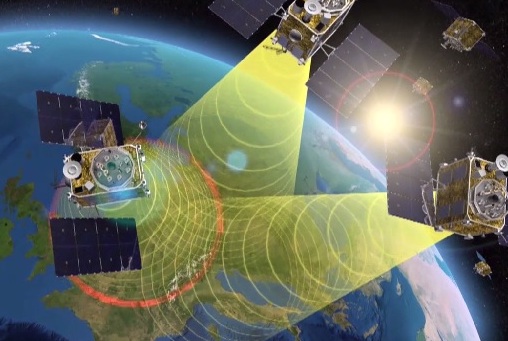
    EGNOS is Europe’s first venture into satellite navigation. EGNOS broadcasts augmented information through a trio of geostationary satellites linked to a network of monitoring ground stations, to sharpen the accuracy and reliability of GPS signals across the continent.
    EGNOS is Europe’s first venture into satellite navigation. EGNOS broadcasts augmented information through a trio of geostationary satellites linked to a network of monitoring ground stations, to sharpen the accuracy and reliability of GPS signals across the continent.

    The infrastructure is derived from that developed by Thales Alenia Space under contract to ESA and in its role as prime contractor for EGNOS, which has been operational since 2009 for general use and since 2011 for safety-of-life applications, including aviation.

    Designed by ESA and being exploited by Europe’s Global Navigation Satellite System Agency, EGNOS improves the precision of GPS signals over most European territory, while also providing continuous and reliable updates on the integrity of the GPS signals.

    A network of 40 ground monitoring stations throughout Europe performs an independent measurement of GPS signals, so that corrections can be calculated and then passed to users immediately via a number of geostationary satellites.

    The result is that the EGNOS-augmented signals are guaranteed to meet the extremely high performance standards set out by the International Civil Aviation Organisation standard, adapted for Europe by Eurocontrol, the European Organisation for the Safety of Air Navigation.

    Satellite Based Augmentation Systems (SBAS) such as EGNOS and the U.S. Satellite Wide Area Augmentation System (WAAS) operate by ensuring the integrity and positioning accuracy of GPS, as well as, in the decade to come, the European Galileo, Russian GLONASS and Chinese BeiDou systems.

    KASS is projected to be the ninth regional SBAS in service when it becomes operational at the end of the decade. The various systems are designed to be fully interoperable, ensuring air traffic safety as aircraft move between different zones, and jointly providing an almost worldwide service.

    Below is a video about EGNOS.

  • South Korea, Thales to develop SBAS for aviation

    South Korea and France’s Thales Group will jointly develop an advanced Satellite-Based Augmentation System (SBAS) for GPS by 2021.

    The country’s state-run Korea Aerospace Research Institute (KARI) will sign a $40 million deal with Thales Group on Oct. 26, according to the Ministry of Land, Infrastructure and Transport.

    The new SBAS, dubbed KASS (Korean Augmentation Satellite System), especially will help reduce errors in aviation GPS, which currently occur at a rate of one in 5 million and by up to 16 meters horizontally and 20 meters vertically.

    “By reducing the error and providing more accurate location of aircraft by using satellites, the SBAS is expected to help set the shortest air route possible while also helping reduce the cost of fuel for flights and thus expanding their capacities,” the ministry said in a press release.

    A separate agreement will be signed with the European Aviation Safety Agency to jointly verify the new GPS augmentation system following its development.

    KASS will rely on EGNOS (European Geostationary Navigation Overlay System) developed by Thales Alenia Space as prime contractor for the European Commission, with the European Space Agency (ESA) as contracting authority. The EGNOS system is operating in Europe since 2009 for Safety of Life services.

    South Korea will initially be using KASS to provide aeronautical applications, including Safety of Life services so that it can be used during different flight phases, especially landings. It will eventually extend these services to other applications, including maritime, road and rail.

    “Our first export success with this sophisticated and powerful navigation system is the upshot of Thales Alenia Space’s involvement with Europe’s satnav projects since the outset, in 1996,” said Jean Loïc Galle, president and CEO of Thales Alenia Space. “We are drawing on 20 years of experience to help the Korean space agency, and allow government bodies in the country to develop applications that will improve its people’s comfort and safety for all types of transportation.”

    Thales Alenia Space’s contract with KARI concerns the supply of the ground infrastructure. It will initially operate via a relay provided by an existing geostationary satellite, and it will be interoperable with other SBAS worldwide, which guarantee air traffic safety when planes move between different zones. KARI and Thales Alenia Space will be applying an approach based on partnership, which means that an integrated French-Korean team will be in charge of the project.

  • GNSS Constellation Update

    Broadcast Date: Thursday, October 25, 2012
    Speaker: Eric Gakstatter, contributing editor for survey and GIS
    Summary: This month, a new GPS satellite was launched, India launched a new SBAS satellite, and two Galileo satellites are scheduled to launch. Last month, China launched two more BeiDou satellites. There’s a lot of activity of the satellite navigation industry. In the webinar, I will discuss what these new developments mean to the surveying/mapping user, as well as other current events.

  • Demonstration tests positioning in the far north

    Demonstration tests positioning in the far north

    News from the European Space Agency

    A sea-based test is demonstrating the potential of extending satnav augmentation coverage into north polar regions, offering a safety-of-life standard of navigation performance to users including shipping or aircraft in flight.

    Norwegian research vessel Gunnerus, owned by the Norwegian University of Science and Technology, is equipped to pick up satnav signals from GPS and GLONASS as well as augmentation signals specially generated for the test, modeled on Europe’s existing European Geostationary Navigation Overlay System (EGNOS).

    Norwegian research vessel Gunnerus, owned by the Norwegian University of Science and Technology. (Photo: ESA)
    Norwegian research vessel Gunnerus, owned by the Norwegian University of Science and Technology. (Photo: ESA)

    Gunnerus is making use of the signals during five days of sailing off Trondheim. The demonstration is part of the Arctic Test Bed project, conducted within the European Global Navigations Satellite System Evolutions Programme (EGEP) of ESA.

    The ESA-designed EGNOS improves the precision of US GPS signals over most European territory, while also providing continuous and reliable updates on their integrity.

    A 40-strong network of ground monitoring stations perform an independent measurement of GPS signals, so that corrections can be calculated and then passed to users immediately via a trio of geostationary satellites. The result is a several-fold increase in precision.

    “Simply due to Earth’s curvature, EGNOS signals are not visible above about 70 degrees north, but they are needed to support polar routing,” explains Marco Porretta, overseeing the Arctic Test Bed project.

    To investigate possible methods for improving Satellite-Based Augmentation System (SBAS) performance in this Arctic region, the test campaign will assess the benefits of augmentation for various types of satnav signals: single-frequency GPS; dual-frequency GPS; and dual-constellation dual-frequency, where GPS signals are combined with those of its Russian counterpart, thus increasing the number of observations.

    “The planned next-decade upgrade of EGNOS, along with other augmentation systems operated over other continents (such as the U.S. equivalent Wide Area Augmentation System, WAAS), will perform multi-constellation augmentation as standard,” adds Marco. “That means data from this test case should be especially valuable to support interoperability between future augmentation systems.”

    The Arctic Test Bed makes use of some EGNOS reference stations along the north of Europe, along with additional stations in locations including Greenland, Jan Mayen Island, Spitsbergen and Norway.

    Model of the well-known Oct. 30, 2003, Halloween solar storm produced by the MIDAS tomographic ionospheric model from the University of Bath. (Image; ESA)
    Model of the well-known Oct. 30, 2003, Halloween solar storm produced by the MIDAS tomographic ionospheric model from the University of Bath. (Image; ESA)

    Marco explains, “These stations will allow specific monitoring of the ionosphere — the electrically active segment of Earth’s atmosphere — in the Arctic region. The ionosphere is significant because it is an important source of satnav signal delay, or in some cases can cause receivers to lose signal lock due to ionospheric scintillations.”

    With geostationary satellites out of sight, navigation corrections for the Arctic Test Bed will be transmitted via terrestrial radio. In future, an operational version of the system could either stick with this solution or rely on other satellite-based means of dissemination from non-geostationary orbit.

    The all-important generation of the augmentation correction message will take place at a processing center in Hønefoss, Norway, using adapted EGNOS algorithms.

    An operational version of the Arctic Test Bed could potentially extend augmentation coverage to as high as 85 degrees north, as high as Greenland, extending to the edge of WAAS coverage.

    The Arctic Test Bed project was initiated by ESA, with Kongsberg Seatex serving as prime contractor, GMV Aerospace and Defence, Thales Alenia Space France, Logica, Terma, the Norwegian Mapping Authority, Technical University of Denmark, Septentrio and the University of Calgary.

  • The System: Galileo Turning Ten

    The System: Galileo Turning Ten

    Galileo 9 and 10 lift off. (Credit: ESA)
    Galileo 9 and 10 lift off. (Credit: ESA)

    Galileo satellites 9 and 10 are functioning perfectly, and the initial series of flight operations is continuing as part of the critical launch and early orbit phase, according to a European Space Agency Rocket Science blog by Daniel Scuka, senior editor for Spacecraft Operations at ESOC, ESA’s European Space Operations Centre, Darmstadt, Germany.

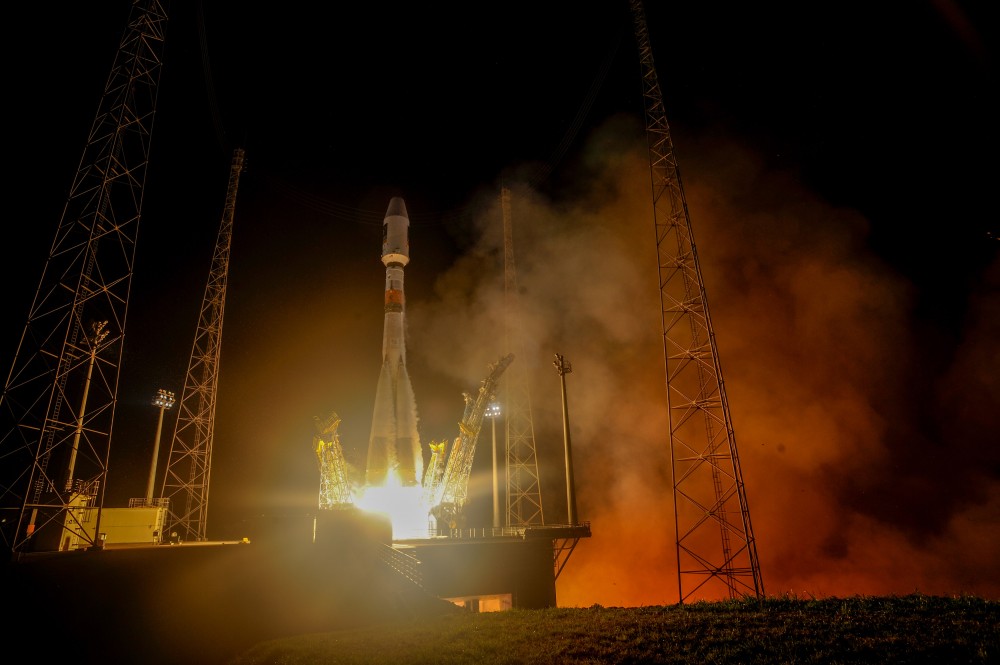
    Galileo 9 and 10 lifted off together on Sept. 11 from Europe’s Spaceport in French Guiana atop a Soyuz launcher, bringing the total number of Galileo satellites in orbit to 10.

    “The pair are being stepped through an intense series of check-outs, confirmations, mode changes, configurations and health verifications by the joint ESA/CNES mission team working around the clock at ESOC, Darmstadt, Germany,” according to the blog. “The team are now focusing on conducting a series of thruster burns designed to start the drift of the two satellites toward their target orbital positions.”

    “Following the burns performed during the LEOP (launch and early orbit phase), the satellites will continue naturally drifting, ending up in their final desired operational orbits at about 23,222 km after another set of thruster burns, planned to achieve fine positioning in orbit, around the end of October,” said Liviu Stefanov, co-flight director from ESA.

    With the excellent performance of the spacecraft and the ground teams, the LEOP is expected to wrap up soon.

    All the Soyuz stages performed as planned during the September 11 launch, relieving anxieties tied to a faulty Soyuz launch in September of last year. The Fregat upper stage released the satellites into their target orbit close to 23,500 km altitude, around 3 hours and 48 minutes after liftoff.

    “The deployment of Europe’s Galileo system is rapidly gathering pace,” said Jan Woerner, director general of the European Space Agency (ESA). “By steadily boosting the number of satellites in space, together with new stations on the ground across the world, Galileo will soon have a global reach. The day of Galileo’s full operational capability is approaching. It will be a great day for Europe.”

    Two more Galileo satellites are scheduled for launch by end of this year. These satellites have completed testing at ESA’s ESTEC technical centre in Noordwijk, the Netherlands, with the next two satellites also undergoing their own test campaigns.

    More Galileo satellites are being manufactured by OHB in Bremen, Germany, with navigation payloads coming from Surrey Satellite Technology Ltd in the UK, in turn utilizing elements sourced from all across Europe.

    “Production of the satellites has attained a regular rhythm,” said Didier Faivre, ESA’s Director of Galileo and Navigation-related Activities. “At the same time, all Galileo testing performed up to now — including that of the ground segment — has been returning extremely positive results.

    “And while the continuing deployment of Galileo remains our priority, along with exploitation of EGNOS — Europe’s already operational satellite navigation augmentation system — ESA is also looking farther ahead.

    “With the European Commission, we are doing the technical work to ensure Galileo goes on forever — locking in continuity of Europe’s navigation services into the long term, to meet performance on a par with the other global satellite navigation systems.”

    Next year Galileo deployment will be boosted by operation of a specially customized Ariane 5 launcher that can double, from two to four, the number of satellites that can be inserted into orbit with a single launch.

    European SBAS Advances, Improves

    After extensive ground and space testing, the SES-5 GEO satellite has entered into the European Geostationary Navigation Overlay Service (EGNOS) operational platform, broadcasting EGNOS Signal-In-Space (SIS). Replacing Inmarsat-4F2, SES-5 will ensure reliable EGNOS services until 2026, and will enable a range of performance improvements. In particular, EGNOS will offer even greater stability during periods of high ionospheric activity.

    “SES-5 is the first step of the complete renewal of the EGNOS Space Segment, securing the EGNOS services for the next decade and the future transition to the dual-frequency multi-constellation services,” said Carlo des Dorides, European GNSS Agency executive director. “It will be completed by the introduction of the ASTRA-5B signals and the procurement of a new EGNOS payload which are both planned for 2016.”

    SES-5, carrying EGNOS L1 and L5 band payloads, was launched in July 2012. The integration of a second EGNOS SBAS L1/L5 band payload on SES ASTRA-5B GEO satellite is currently ongoing. The introduction of the second SES GEO satellite for EGNOS is planned at the end of 2016.

    GAO Report Spotlghts OCX Delays, Cost Increases

    According to a report released by the U.S Government Accountability Office (GAO) on Sept. 9, titled “Actions Needed to Address Ground System Development Problems and User Equipment Production Readiness,” the Air Force has experienced significant difficulties developing the GPS next-generation operational control system (OCX). According to the report, completion of OCX will require $1.1 billion and four years more than planned to deliver OCX. The report Highlights section states, “The Air Force began OCX development in 2010,” and “accelerated OCX development in 2012 to meet optimistic GPS III satellite launch timeframes even as OCX development problems and costs grew, and then paused development in 2013 to address problems and resolve what it believed were root causes.

    “However . . . OCX cost and schedule growth have persisted due in part to a high defect rate, which may result from systemic issues. Further, unrealistic cost and schedule estimates limit OSD visibility into and oversight over OCX progress. “ The full report may be read online.

    During the course of development the Air Force made changes, updating the specifications for connections to other government systems and in the M-code signal requirements. Officials for Raytheon, the prime OCX contractor, estimated that, as a result of various modifications “nearly two-thirds of the requirements baseline as of [preliminary design review] had changed by mid-2012.” Subsequent software updates and modifications contributed to a high defect rate in the OCX software. “

    If you have requirements change at the same time you’re developing the software, it’s more likely that you could have a higher amount of defects that you have to change after the fact,” said Matthew Gilligan, Raytheon’s vice president for navigation and environmental solutions.