Category: Opinions

  • How GIS — and you — can aid in disaster response

    Whether you are on the helping end of a disaster aiding in the rescue and recovery, or on the receiving end being aided, GIS is supercharging the rescue efforts.

    How can I help you if I don’t know where you are?

    Hurricane Harvey hits. The storm was worsening. Winds were sustained at over 120 mph. Landfall of Hurricane Harvey was expected in 48 hours. Worse, the storm was forecast to stall once overland creating the single worst rain event in United States history.

    Texas Governor Greg Abbott  encouraged people to evacuate, especially those in low lying areas. Mayor Turner had only hours to decide the possible fate of millions. Making the call not to evacuate a category 4 hurricane approaching the city could be political suicide. Consider the fallout after Hurricane Katrina. The models clearly showed the extent of flooding and how many people would be trapped in their cars on flooded roads.

    “You cannot put 6.5 million people on the road,” said Houston Mayor Sylvester Turner. The mayor’s ultimate decision not to issue an evacuation declaration was based on geospatial models, and as devastating as they were, it showed a better outcome if everyone stocked up, stayed put, and helped each other out after the storm. At least by staying home we will know where people are after the storm.

    Gov. Abbott fully mobilized the National Guard and another 30 state agencies responded to the crisis. U.S. Federal Emergency Management Agency (FEMA) calls to action went out to the Coast Guard and volunteer organizations. Small boats, raised axel trucks and Vietnam-era looking personnel carriers were brought in for support, along with helicopters, drones and search and rescue airplanes.

    First responders were issued full body waders and foul weather gear. Thousands of hypothermia blankets were stockpiled and cargo trucks carrying food, water and cots headed south. Volunteers from the Cajun Navy, Team Rubicon, the Red Cross, Open Street Maps, Samaritan’s Purse and others positioned their able-bodied forces along the periphery of the storm’s path ready to move in as soon as given the word.

    Thursday afternoon the winds and rains began getting increasingly worse. Darkness fell and by 10 p.m. the eye of the storm had made landfall. Rivers and streams began overflowing due in part to the storm surge moving waters upstream. Streets no longer drained the waters. The flooding continued to rise.

    Tremendous thermodynamic forces. Hurricanes aren’t a single, solid storm, though they may look like it from satellite imagery. They are enormous atmospheric depressions like a hole formed in the sky and air masses from thousands of miles around rush in to fill the void. These converging air masses create immense thermodynamic forces extending outward from a central vortex in long sweeping radial bands like blades of an enormous turbine.

    A hurricane is the cumulative fury of these destructive forces storm after storm after in rapid succession. Winds increase and decrease as the radial bands pass overhead becoming stronger and more constant as the eye approaches. Every plank, nail and screw is tested. Immense gusts like giant hammers breaks away loose thing. Strains of timber and steel shriek in the wind. In seconds sounds of groaning trees and the air fills with flying debris. Rain comes down in torrents.

    But in between these spiral bands it slows, sometimes stopping all together, even sunshine or moonlight might break through, but to believe the storm is over would be wrong — maybe dead wrong. Another band will sweep in with gusting, howling wind, thick, heavy clouds and dark skies, and rain, more and more rain, and the rising waters turning into gushing floods. Moments of endless terror turn into hours, the waters rising higher ever higher.

    Finally, 49 inches of rain and three days later the storm ended moving offshore. Its destruction shut down the fourth largest city in the United States.

    “…Texans have suffered a great hardship, their warmth and resiliency is truly inspiring,” said Gov. Abbott. The overwhelming willingness of people and organizations to help once the storm passed brought its own challenges. A convergence of rescue and recovery teams began.

    Leaders needed. It was obvious a coordinated effort needed to happen. Volunteers and organizations needed to work in unison. FEMA had to establish that order. The coordination center was formed, not unlike other disasters, but this time another dimension was added to it. FEMA was aware of social media’s ability to positively impact rescue operations tapping into briefly during Superstorm Sandy, the last large scale disaster to hit the United States, but FEMA lacked the necessary skills and expertise to capitalize on the technology.

    It is times like these that the greatest of all resources is realized. When asked what is the greatest asset, the answers most often given are manpower, money, equipment or supplies; however, even if there are plenty of the above, it is quickly realized the greatest resource is leadership. In times of crises, normal authority is laid aside and given to those who can bring order to the chaos.

    Christopher Vaughn, the geospatial information officer for FEMA, and Adrian Gardner, the chief information officer for FEMA, were those individuals stepping up to the task at hand. They understood getting better data faster and putting it into geospatial context held the answer. Once done that would be the foundational layer. All the other elements could then be added, like imagery, lots and lots of imagery, both before and after; and then overlay crowdsourced data.

    Vaughn, working with his counterparts in the Department of Homeland Security, brought in Homeland Infrastructure Foundation Level Data (HIFLD) layers, along with the Civil Air Patrol and DigitalGlobe’s Open Data Program. Launched in 2017, the program provides before and after imagery. Vaughn understood that the citizen-as-a-censor model provided raw, real-time and relevant information. It had to be tapped into to get control of the rescue operations.

    Sophia Liu, Ph.D., an Innovation Specialist and expert in crowdsource efforts was brought in from the United States Geographic Survey (USGS). Liu was the key to unlocking the crowd. She shared her greatest challenge was the misconceptions around the use of social media and an apprehension to using it without proper approvals from public relations. It took some convincing to change these mindsets.

    What helped tip the scales in her favor was Hurricane Irma coming right on the heels of Hurricane Harvey and then Hurricane Maria. The disasters were coming in way too fast and the detractors were drowned out by the need for information. Once they saw the value of crowdsourcing, there was little resistance.

    Challenges in Puerto Rico. The results spoke for themselves. In Puerto Rico, within only a few weeks of Hurricane Maria’s devastation, 1.4 million homes were analyzed for damage and 24,000 miles of roads were digitized through volunteer groups like GIS Corps and OpenStreetMaps.

    One of the greatest challenges in Puerto Rico was the lack of street addresses. That is more common than one might realize. In many parts of the world there is no established address system and locations are more or less oriented to significant landmarks. It is difficult for Americans to understand, but in other cultures generations of families grow up in the same neighborhoods. Everyone knows everyone else. Location is personal. In the case of disasters this poses a huge challenge, especially when roads and landmarks are destroyed, and people have evacuated.

    The company What3Words (W3W) is tackling this issue. W3W works uses a pixelated Earth system of 3 meter by 3 meter squares. Each grid can be defined by a set of three words. As I write this I am sitting in bump.cans.dome.

    W3W does away with traditional numerical latitude and longitude. It works in any language, in fact, eight countries have partnered with W3W as either the nation’s official addressing system or an alternate system, and the United Nations has it among their disaster reporting tools. Art Kalinski, the former writer of this column wrote an article last year about W3W, what3words: The geospatial advancement of the year?

    In Puerto Rico, since there aren’t addresses except in urban areas, the remainder of the island had to be geospatially configured to communicate “where” something was located. Digitizing Puerto Rico is a huge geospatial effort that would take years through normal government protocols and cost millions of dollars.

    Instead, by enlisting the support of the crowd, it was accomplished in weeks, proving the power if crowdsourcing operations.

    Crowdsourcing to the rescue. The power of the crowd was unlocked even more by using geoforms for filling out damage reports like bridge assessments, damaged roads, debris removal, etc. This allowed navigation apps to route around impassable areas saving time and ultimately lives. No more sending a rescue vehicle out only to find it can’t access the area because a tree is down, a bridge is collapsed, or flood waters are too high. Those delivering food could do so to where the people were.

    Interactive, real-time, geospatial, command and control forever changed dispatching. Instead of waiting for teams to return before retasking them with new assignments dispatching could be of done on the fly as survivors were identified. The nearest rescue craft with available space could be routed to the exact location.

    GIS allowed dispatchers to see where all the rescue teams were and how many survivors they had onboard and how many more they could take on. Data about each survivor was recorded allowing preparations for the arrival of anyone with special needs and the person’s information could immediately show up on a notification board that they had been found and rescued, important for family and friends to know.

    The information also helps with forecasting needs of shelters and the reporting of numbers to those in operational authority.

    Daily coordination calls were conducted over a variety of platforms with all interested and active participants. Important information was posted on a shared cloud drive. Slack, the peer to peer online collaboration platform was used so FEMA and the various groups were able to collaborate and keep the three different hurricane rescue operations segregated.

    Recovery continues. The recovery efforts continue in Houston, Florida, Puerto Rico and the Virgin Islands. In efforts to increase the attention GIS played in mitigating damage from these disasters and the value of crowdsourced information FEMA hosted several events. The final event was held on Saturday, October 21, 2017. It was information about the situation on the ground in the multiple locations and the ongoing operations. It was also a celebration of the successes achieved during these crises; and, a tinge of sadness marked the event bringing to a close to some great working relationships.

    If you are interested, there are still ways to get involved no matter what your skillset or expertise. If you have a desire to help, there are opportunities either on scene in the theater of operation, or remotely working from your computer at home. Check with the organizations mentioned below. Even a couple hours of your time can help.

    What GIS offers next. GIS in the future of disaster response will make greater use of emerging technologies. Drones will fly preprogrammed paths ahead of a disaster if given enough time, and the imagery and the drone’s flight path will be stored. Then, immediately after the event passes drones will fly the same programmed path capturing imagery with the exact oblique and nadir angles as the original dataset.

    Change detection analysis can then be used to find the exact locations of change. This method will become increasingly valuable using high resolution 3D imagery point clouds and used in a change detection system.

    Geospatial artificial intelligence systems will identify the areas of greatest damage and assist by directing other resources such as mobile data signals to direct rescue operations towards possible survivors even using the last reported mobile data signal. It can direct human analysts to those specific areas that are inconclusive or require manual verification. This will increase analysis from several weeks to several days.

    That is in the future, the near future, perhaps next year’s hurricane season, or tornado season, or snowstorms this winter.

    This year, in total, there were 10 Atlantic hurricanes resulting in 431 deaths and an estimated $3.17 billion in damage; which by comparison, is 1/10th the number of casualties from Hurricane Katrina yet nearly twice the level of damage. It just so happens, I went through Hurricane Katrina living along the coast in Bay Saint Louis, Missouri, at the time where the eye the storm passed over. I tried to evacuate but being caught in a 13 hour traffic jam I was unable to outrun the storm. I personally experienced a category 4 hurricane. You may have picked that up in the opening of this article. Those experiences were very real. You might have also picked up my meteorological background from my days in the U.S Navy as a weather analyst.

    By the end of 2017, more than hurricanes had inflicted damage. Wildfires in the western U.S. killed another 36 people and destroyed 6,000 buildings. Now, with winter upon us, there will be snowstorms, and GIS will help with those recovery efforts as well.

    We are lucky to live in this day and age. Whether you are on the helping end of a disaster aiding in rescue and recovery, or on the receiving end being aided, GIS is supercharging the rescue efforts.

    Disaster response agencies and support groups

    Most of the above groups support all types of disaster response efforts and many do so throughout all regions of the world.

  • GNSS & Surveying 2017: The year in review

    GNSS & Surveying 2017: The year in review

    Another year gone by

    As another holiday season passes us by, it is customary to look back at the year and recall the trends, new products and services, and breakthroughs we experienced with the GNSS environment and its effect on the professional surveyor. While 2017 was not filled with groundbreaking instruments and programming, it did provide a good look at what are going to be trends and gamechangers for the near future. From new innovations on GNSS receivers, new UAV platforms, and geospatial advances, it was also a year that saw location spoofing of shipping vessels, trade relations among super powers being tested, and more opportunities to put satellites into orbit from the private sector. Let us look back at what the surveying community experienced with the GNSS industry:

    The constellation scorecard

    GNSS continued to expand to all reaches of the globe with enlargement of existing constellations along with introductions of several new ones, (see GPS World magazine “The Almanac,” December 2017). The European satellite system, Galileo, has led the expansion with four (4) new vehicles. This joint venture of the European Commission and the European Space Agency was declared operational at the end of 2016 and looks to keep increasing its coverage in the coming years. For surveyors, this means additional redundancy for our positional data. More confirming redundancy translates into increased confidence in our work product.

    Next in numbers of vehicles being sent to space is the Japanese effort named Quasi-Zenith Satellite System (QZSS) and operated by the Japan Aerospace Exploration Agency (JAXA). While their first bird was sent up in 2010, this was the breakout year with three (3) more satellites installed this past year. It is anticipated that the constellation will be operation in 2018 and we can expect most of the GNSS manufacturers to include the positional data from QZSS if they haven’t already built in this capability.

    Coming in next are the Chinese with their regional-based system called BeiDou with two (2) more satellites installed in 2017. Their current program is scheduled to have several more vehicles included in the constellation and provide worldwide positional coverage by 2020. With the rapid expansion of China as a world leader, we can anticipate more GNSS developers to work closely with BeiDou as the system becomes more effective on the global stage.

    The other world leader, Russia, continues their expansion of GLONASS with the installation of one (1) new satellite in 2017 with plans to upgrade several existing vehicles in the coming years. The inclusion of GLONASS signal reception by survey-grade GNSS receivers has greatly increased the redundancy of data collection, (as mentioned with Galileo). It has also expanded our timeframes in which we can work with reliable positional solutions, thus keeping our downtime to a minimum.

    The United States is by no means bringing up the rear in GNSS constellation development but 2017 was a transitional year for the program. A new government administration has led to revisiting our national budget, with the Department of Defense looking to prosper under preliminary plans. While the schedule for constellation expansion have been in place for several years, the installation of Block III satellites has become a higher priority. These satellites will provide higher positional accuracy than previously experienced without any correction signal utilized. This will help the surveyor with better positional accuracies in shorter timeframes and looking forward to its expanded capability.

    Once these constellations are operational (with more to come), the ability to record positional locations and attribute data will be greater than ever. A potential challenge to these satellite constellations, however, is the ever-growing fear of potential conflicts between the United States and several countries, including North Korea, Syria, Iran, and Russia. The threat of nuclear war with North Korea could result in our GPS network being shut down to civilians or blocked by an electromagnetic pulse weapon. Cold War tactics with Russia could lead to spoofing or blocking of GLONASS signals that many of our GNSS receivers have become reliant upon. There are alternatives being developed in case our GPS goes away (see “The Day GPS Went Away,” September 2017) but we are several years from having a true secondary option. We will need to keep our fingers crossed we can maintain peace across the globe but do not look forward when something happens and takes our GNSS ability away.

    Data mining and the surveyor

    One thing that has emerged from 2017 has been the importance of data; where it is housed, how we use it, and what it can tell us about our future endeavors. GNSS has revolutionized the data mining industry with the surveying industry being right in the middle of the fray. Prior articles were published about geolocation (see Geolocation and the surveyor: Looking back to the future) so the rapid expansion of the data collection into most business environments shouldn’t surprise most readers, especially if one reads technical sources like GPS World magazine. The surveying community has watched and experienced the astronomical growth of this data collection in various arenas, none of which was more obvious than the “Geospatial 4.0” initiative at Intergeo 2017 in Berlin, Germany. While summarizing to readers on a trip through the annual conference in the last article (Intergeo 2017: A surveyor’s perspective), it was also here that a bigger picture was coming into focus regarding data and its effect on our world.


    While doing homework for this article, the term “Geospatial 4.0” was coined for the 2015 Intergeo conference in Stuttgart, Germany. This term was developed by the conference team regarding the advancing developments in the data world that incorporate geolocation, time, and unlimited information attributes, all while stored in a central location “in the cloud.” This environmental condition exists for most us already, as it is estimated there are three to four billion smartphone users worldwide. The data that is being collected every day is a small part of how our lives and relative actions have become digital snapshots to assist those charged with forecasting and planning of our future cities and environments. Much of this data is being used to advance the places where we live through an initiative called “Smart Cities.” Installation of data collection sensors and control systems in various applications monitor and store information to help make necessary changes to the existing systems. The organizations and municipalities behind this effort are attempting to create better work and home environments with increased efficiency and sustainability.

    The professional surveying community plays a big part in the continuing development of geospatial world around us. Our job is not only to collect data for a boundary survey, topographical information for an engineering design, or provide layout assistance for construction; we are also historians in establishing the current positions of required information at a specific point in time. The world around us can move quickly, so providing the precise moment in time when data is collected is sometimes just as important as the location itself. Our role as surveyors becomes even more important as the increased development and implementation of geographical information systems (GIS) emerges within more public and private entities. Where the surveyor previously shunned being included within the collection process and framework of GIS, our profession has become quite efficient at the data acquisition and database maintenance necessary for geospatial success.

    The surveyor’s friend in the technical world of geodesy, the geodesist, has not always been an accepted member of the GIS world, either. Once seen as mathematicians stuck in laboratories calculating “perfect world geometric solutions,” the geodesist carries a significant amount of beneficial information to the realm of geospatial data. It has been through their data collection and research that has brought our shifting continents to light and the simple fact our land-based coordinate systems must be modified to change positions as time rolls along. The common theme here is that spatial data comes down to several distinct factors: position, navigation, and time.

    PNT (not just another dull government acronym…)

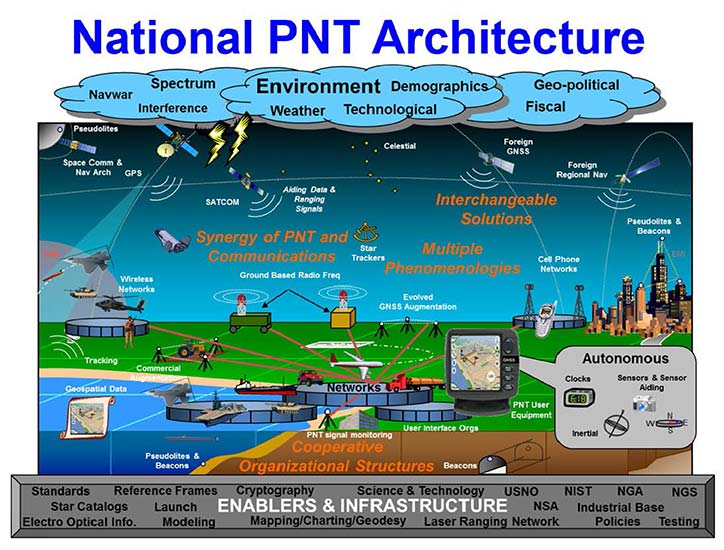
    Another big step forward taken in 2017 was the continued implementation of positioning, navigation, and timing, otherwise known as PNT. These three bits of information provide the geographic basis of collected data for any GIS or other environmental study. According to the U.S. Department of Transportation website, here is the definition of PNT:

    “…a combination of three distinct, constituent capabilities:

    Positioning, the ability to accurately and precisely determine one’s location and orientation two-dimensionally (or three-dimensionally when required) referenced to a standard geodetic system (such as World Geodetic System 1984, or WGS84);

    Navigation, the ability to determine current and desired position (relative or absolute) and apply corrections to course, orientation, and speed to attain a desired position anywhere around the world, from sub-surface to surface and from surface to space; and

    Timing, the ability to acquire and maintain accurate and precise time from a standard (Coordinated Universal Time, or UTC), anywhere in the world and within user-defined timeliness parameters. Timing also includes time transfer.”

    (Source: https://www.transportation.gov/pnt/what-positioning-navigation-and-timing-pnt)

    The basis for PNT can be used for any data collection. From fixed monuments utilized by surveyors to any municipal utility installation, the use of PNT now becomes an important part of the GIS database, if not for anything more than simple tracking. By establishing the location of any entity at any given time and comparing its position to an earlier collection, we can determine the navigation of that entity. A good example of PNT and our daily interaction is the satellite navigation systems installed in our phones and vehicles. When we utilize our favorite mapping program on our phone or in our car, we are implementing a PNT system to show us where we are, how fast we are going and help determine how soon we will be getting where we are going. This wonderful practice is being made possible by GNSS data collection and computer processors turning the positional data into useful information.

    Surveyors are doing the same thing by the data collection they are performing every day. Any data that is collected by a modern survey instrument is being tagged with two of the main components of PNT; position and time. When the same entity is collected again later, its navigational information can be determined if needed as well. This type of data collection is becoming more apparent with laser scanning and lidar point clouds, as this data can be revisited to determine how much entities within the project area has changed. I foresee a time in the not-to-distant future where much of the Earth is scanned for historical purposes and can be analyzed by future generations for changes. A surveyor could benefit greatly by knowing where a water feature (rivers, creeks, streams, and lake and ocean shores) existed at a specific point in time and how much it has changed over time. Many land boundaries are based upon these water features as natural delineators, so knowing how much title area has changed with the natural movement of a waterway would be very beneficial to the surveyor and how land boundary disputes are handles. Same could be said of buildings and other improvements within developed areas, too. By establishing geospatial data on physical improvements, it could greatly help the surveyor determine historical and future land boundaries by their known location.

    The simple fact is that our ability to collect, analyze and retain geospatial information has never been greater than now and only gets better over time. The surveyor now has similar tools to other sciences and technologies, so now is an appropriate time as any to truly embrace geospatial data collection.

    UAV’s continuing growth

    One market that continues growing at rapid pace is the unmanned aerial vehicle (UAV) sector. 2017 brought more aircraft innovations and expansion of sensors available for a multitude of data collection purposes. This greatly expanding segment of specialized equipment was quite evident at Intergeo 2017, where over 150 UAV vendors were provided their own space solely for the exhibiting as well as an outside arena for demonstrations. While there are other UAV trade shows that rival in the size, the Intergeo show brings the best vehicles, software and ideas for geospatial data collection and imagery directly to the surveyor’s hands.

    Other innovations that are taking shape in the UAV world include larger multi-rotor aircraft with increased payloads, vertical takeoff and landing (VTOL) platforms, and a plethora of sensors designed specifically for UAV use. These modules include various methods of lidar for high accuracy scanning, hyperspectral cameras for analyzing plant characteristics, infrared scanners for heat detection, along with camera possibilities that are endless. The main reason to highlight these high-tech applications is simple; these technologies consist of location-based data collection. The surveyor, known professionally as the expert measurer, should make themselves more aware of the rapidly expanding ability to collect data of varying types new to the land surveying field but still relies heavily on accurate and precise measurement methods. The UAV, while still new to many surveyors, is becoming a standard measuring tool in our world. These latest sensors are a result of applying emerging technology for non-traditional surveying clients directly into our wheelhouse. The professional surveyor successfully adapted to new methods and instruments when electronic distance meters, GNSS receivers and laser scanners were introduced, so our profession needs to step up again and take note of what data collection methods and challenges are out there.

    Wingtra One in the air. (Photo: Wingtra)

    Staying on the subject of surveyors and the UAV, one of the next breakthroughs will be the introduction of affordable aircraft with RTK capability. There are currently several manufacturers of survey-grade UAV aircraft but these are sold at higher price point that is considered out of reach for the typical surveyor. Many have relied on less expensive models in conjunction with their existing RTK receivers to collect physical points or features for use with post-processing software. While not resulting in immediate data for project review, the end product of the post-processed method is quite good and at much lower cost of entry. However, there are times and places where ground control is not available or accessible so flights with photos or scans are not possible. The mainstream UAV manufacturers are taking note of the need for RTK capability and beginning to introduce models with this positional feature, so maybe the tide is turning to lowering the price point for this technology as well. Here is another place the surveyor will need to enter the UAV arena as the long-time RTK expert and utilize the latest technology for expanded data collection purposes. To my fellow surveyors: you’ve been warned, so be ready to get your checkbook out in order to stay competitive.

    Survey-grade GNSS receivers

    While 2017 wasn’t a breakout year for radically new GNSS technology, it did see its share of minor yet significant improvements. Along with the expansion of existing constellations and preparation for new ones, the technology behind the microprocessor within the GNSS receiver continues to allow for miniaturization and increased speed and accuracy. Several manufacturers are producing survey-grade receivers capable of acquiring hundreds of GNSS signals yet fit in the palm of your hand. Batteries, like most technologies using it, continues to decrease in size yet gain in power-up time. This rapidly shrinking footprint of the GNSS receiver is allowing for placement in more devices and places so the surveyor will need to take advantage of these gains to assist with providing positional and data collection expertise.

    A sector of the positioning market that will see rapid increases is the smartphone division. Coupled with the growing GNSS constellations with increasing accuracy signals and more sophisticated computing power programmed specifically for positioning, we will see more smartphones being used for data collection purposes. Google has made significant strides in the customization of the Android operating system to allow for the processing of raw GNSS data to provide positional accuracies beyond the normal smartphone capability. It is safe to say that Apple is likely working on the same type of application for the iOS operating system, so we could see another battle for smartphone supremacy be waged on a highly technical front that surveyors can readily use for their profession.

    Another advancement in GNSS technology that will see more in 2018 and beyond will be the use of the inertial measurement unit (IMU) in conjunction with receivers and sensors. Several manufacturers have incorporated IMU’s into their measuring devices to augment the data being collected. The application that has surveyor’s attention is a GNSS receiver with an IMU to record the measurement correlation of the pole tip to the center of the antenna. The IMU has also been configured on various vehicles built for mobile data collection to measure velocities and acceleration to assist with reducing errors within the GNSS measurements by environmental factors. As GNSS receivers continue to evolve and reduce in size, it will also allow for further inclusion of an IMU to help with reduce data errors. Surveyors should take note of these advancements and be prepared to upgrade their equipment and knowledge to stay current with emerging technology and data collection accuracies.

    VectorNav’s new Tactical Series includes the VN-110 IMU/AHRS, the VN-210 GPS/INS and the VN-310 dual-antenna GPS/INS.

    Into 2018 and beyond…

    Some of the items worth watching in the immediate future include:

    Autonomous travel

    From Elon Musk’s Tesla projects to the Uber/Volvo collaboration with driverless vehicles, autonomous travel will dominate tech news for the next few years. Because these vehicles rely heavily on GNSS positioning in conjunction with road-reading sensors, the focus on the GNSS constellations will stay very much in front of the tech and political worlds. Another portion of the driverless equation is the effective mapping of the roadway system, which come right back into the realm of the surveyor. While we see various mapping vehicles (Google, Apple, and others) out and about digitizing our roadways, the surveyor is the professional entity that is relied upon for the location establishment for existing and future rights-of-way. Our inclusion in mapping these byways is critical to minimizing harm to the public for potential accidents and disasters.

    Lightsquared 2.0

    The battle over bandwidth several years ago seemed to end with the FCC denying the implementation of ground-based signal amplification by an upstart firm known as Lightsquared. Now with the new administration at the FCC and an atmosphere of deregulation, the firm has rebranded itself as Ligado and is back to try again. Hopefully the same coalition that helped defeat the prior attempt will be back, but with the new ideology running the FCC, all bets are off. The surveyor without GNSS capability (as previous discussed) will mostly be rendered lifeless without it.

    Internet of Things (IoT)

    Also fighting for bandwidth is a new generation of sensors and monitors being used for a multitude of products and procedures. This movement toward automation is proving to be useful in many environments but is beginning to tax an already overworked data stream. These components are more appropriate in mostly urban areas where broadband coverage is most effective but their implementation in rural America is starting to drive a greater need for more data availability in harder to get places. This push to get more broadband into rural areas will be a wonderful opportunity for those surveyors to complete their projects with similar effectiveness their counterparts in the urban areas already utilize. But the move by the FCC to repeal net neutrality poses a significant threat to that opportunity and equality, so we must wait and see how this plays out as well.

    Final thoughts…

    While covering a lot of ground here, the main thread is to emphasize the important link between the professional surveyor and the use of GNSS equipment and procedures. Prior to most of the emerging technology, the surveyor was relied solely for boundary determination and not much else. As engineering design became more reliant on detailed topographic surveys, the surveyor increased their responsibility to provide that vital information. As measuring and positional determination has become more complex, the surveyor has adapted to technology and provided that expertise in their duty to protect the public’s interest. Our world is getting more complex every day and we rely on specialized professions for a multitude of tasks. The surveyor can and should be relied upon for tasks discussed herein but making sure both the surveyor and the public knows that is a big key to success. Accurate positioning and reliable measurements requires someone with the knowledge of the subject and technology and the professional surveyor is that someone. To my fellow practitioners; stay involved, advance your education, and continue to be professional.

  • Horizon broad but troubled for 2018

    It is the best of times, it is the worst of times. GPS modernization, once gasping for breath by the side of the track, is back in the race and pulling ahead. Relentless innovation in user equipment and newly opened software access mean that high-precision positioning may soon be available to owners of mere tablet computers. Spoofing counter-measures are growing in sophistication and availability. GPS continues to drive many sectors of the economy, with a  benefit of as much as $65 billion per day to the U.S.

    Yet there are a few flies in the modernization ointment. And GPS may soon collide, catastrophically, with that other U.S. military invention from the 1970s that also leaped the fence into the civic domain and life-changed billions of people around the world: the Internet.


    Note: After this issue, we are temporarily suspending publication of the GNSS Design & Test e-newsletter. Subscribers who do not already receive the Navigate! Weekly e-newsletter will in 2018 find it in their inbox each Tuesday.  Navigate! covers a broad range of GNSS and PNT industry news and all GNSS constellation and signal updates.  You may freely unsubscribe if you wish.  The final Navigate! newsletter of each month will carry my GNSS Design & Test column — so, I’m not going away!
    — AC


    Let’s open these boxes one by one.

    Modernization. The first satellite GPS III satellite, declared available for launch in September, appears headed for a March 2018 lift-off. Both the GPS III digital navigation payload and the ground-control software programs are recovering momentum following earlier hiccups and delays. The first III satellite has successfully “talked” with the OCX system on the ground. Lockheed Marting is building 10 of the satellites for the Air Force. Harris Corporation delivered the fourth of 10 digital payloads to Lockheed, and said it would ship four more in 2018. Raytheon is the prime contractor for OCX.

    The Government Accountability Office (GAO) projected that the current constellation of 31 GPS II satellites will remain operational until 2021, two years longer than previously estimated. This affords some breathing room for the seven GPS III satellites scheduled to be in orbit by then to start replacing the long-lived II generation. No longer need we fear the constellation gap, an alarm sounded by the same GAO back in 2009.

    Problems Ahead. But this year’s GAO report also warns that GPS III’s increasing program complexity and upgrades required for new encrypted signals mean that it will take longer for ground infrastructure and user equipment to catch up in capability afforded by the new satellites.

    Five programs are now encompassed under the rubric of GPS modernization: the satellites, next-generation ground control (OCX), military user equipment, contingency operations and military code (M-code) early use.

    Just because the satellite schedule has regained its footing and is racing forward does not mean that M-code software and installing the receivers needed to acquire it aboard major U.S. weapon systems are keeping up pace with the pack. “Additional development is necessary to make M-code work with over 700 weapon systems that require it,” according to GAO analyst Christina Chaplain. Long message short: the new satellite constellation may be orbiting in the skies years before user equipment and software are in place. “War fighters will have to operate with a mix of older and newer receiver cards.”

    Consumer Access to Precision. The January cover story in GPS World magazine will show the results of very promising new tests taking advantage of access to raw GNSS observables now possible thanks to Android. “For those who want high accuracy, but don’t need it full time, high-productivity dedicated professional solutions may not be cost-justified,” writes Stuart Riley along with his co-authors, all from Trimble. “In these cases, a positioning-as-a-service subscription could offer a viable use model. Achieving precision positioning with just a standard mobile device, a correction stream using the mobile device’s data connection and a high-accuracy positioning application produces a very low barrier to achieving high accuracy.”

    One of the figures from “Positioning with Android.” Code RTX performance the dataset sampled Nov 20 and corresponding RTK and RTX phase solutions — cell-phone GNSS antenna.

    “While we expect that dedicated system approaches employing a custom GNSS chipset and firmware and purpose-built precision applications will continue to be the right solution for industry professionals,” they continue, “it is clear that the ubiquity of consumer mobiles, with increasing compute power, ruggedness and an expanding feature set represents a fertile ground for new development of improved positioning systems that don’t have strict professional requirements.

    “A range of new use models and applications will be enabled by consumer mobile phones with technology that improves positioning performance. The goal of the work presented here is to assess what level of performance can be achieved by using proprietary PVT (Position Velocity Time) engine(s) utilizing GNSS measurements from the Android GNSS measurement API.”

    Look for the January issue in your mailbox by mid-next month.

    Spoofing. This has been the hottest issue, by far, during the past year — maybe two — at technical conferences around the world. Its role has been speculated in some rather notorious seafaring accidents. Its potential to wreck many carefully wrought schemes of transport, finance, safety, security, defense, power supply and more has been resoundingly aired. But help is on the way. Javad Ashjaee in the January magazine’s Expert Opinion column lays out an anti-spoofing strategy that has been installed, as an option, in all OEM boards offered by JAVAD GNSS.

    In its most basic form, it amounts to “it is vital that in areas that spoofing danger exists, users employ OEM boards that provide more satellite systems and more signals, rather than using a simple GPS C/A code, for example.”

    Heartbreak Dead Ahead. Finally, the January issue contains a lengthy treatise by Brad Parkinson, variously the grandfather, godfather, or just plain father of GPS, on a burgeoning danger that threatens the whole system and the vast economic benefit it provides.

    Widespread big data streaming, storage in the cloud, and the much-ballyhooed Internet-of-Things are accelerating the World Wide Web’s breakneck consumption of broadband. More, more, more is needed, and more again tomorrow. We are all complicit, to use a current term, in this.

    Macro urban transmitter, high-precision receiver. 1530 MHz

    Every single sliver of radio-frequency band is now worth billions. And this is neither an infinite nor a renewable resource. There’s only so much. No one’s talking about taking away the small radionav portion of the spectrum (yet), but serious, well-funded and well-friended efforts seek to park massive transmitters right next door to it and effectively obliterate the signal, not only of GPS but other GNSS as well.

    LightSquared tried this once, in 2010-11, and failed. Now the company is back under a new name, and in the current political climate it has more than a fighting chance of knocking the RF legs out from under the PNT community and all who depend upon it. Which, again, is all of us.

    Talk about conflicting priorities.

    “I believe the concept of allowing the installation of transmitting towers that, by design, will interfere with normal GPS use at some distance away, opens the door to tacit approval of short-range (or not-so-short-range) GPS jammers,” writes Parkinson.

    Well, let’s put all that trouble aside, just for a few more weeks. Enjoy, everyone out there, your winter holidays if you are lucky enough to have some, and we’ll return to business in January.

    Warmest wishes,

    Alan Cameron|
    GPS World and Geospatial Solutions


  • Drone-bird to scare away flocks tested at airport

    Drone operational rules have quite a few restrictions, largely aimed at keeping unmanned aircraft away from manned and commercial aircraft operations. The Federal Aviation Administration (FAA) has set a boundary limit for UAV operations to stay a minimum of 5 miles away from any airport. So it’s a little surprising that at least one airport is actually carrying on trials to fly drones within airport property.

    The reason is birds. Most airports are large, open spaces where birds love to land in large numbers to seek food and to rest, so airports and aircraft have to cope with the problem of avoiding bird-strikes in the critical phases of take-off and landing.

    Airports have used remotely compressed air cannons, and manually fired ordinance that “screams” or explodes making various forms of loud noise, or dogs or even hunting falcons of different species. Birds, however, become habituated to cannons and guns, and neither dogs nor hunting falcons can be relied on to actually herd birds away from runways.

    All this is in an effort to drive flocks of birds away from runways and low-altitude aircraft traffic corridors. At high altitude, a bird strike is usually survivable and an aircraft still has sufficient energy to be able to glide in the event of a complete engine-out situation, giving the pilot time to find a landing place. U.S. Air’s Chesley Sullenberger was a great airman to save his passengers and aircraft, but he was also lucky to have the Hudson right there to ditch into. He was some cool dude when he put his Airbus A320 down on the river, once losing both engines at low altitude on take-off after flying through a flock of Canada Geese.

    Enter Robird, a drone that looks — and behaves, in the right operator’s hands — like a female peregrine falcon, with flapping wing propulsion and attack moves emulating the predatory bird. Flown by a pilot and accompanied by an observer whose primary job is to ensure the UAV “bird” stays away from runways, the pair seeks resting flocks of birds that pose risk to aircraft within the boundaries of an operational airport.

    https://youtu.be/-gc8kBmzOOI

    Clear Flight Solutions in Holland has recently undertaken a trial at Edmonton airport in Alberta, Canada, where it obtained special flight clearance to fly within the airport grounds to demonstrate how its mechanical falcon could clear birds away from airport danger zones.

    Of course, drones and aircraft don’t mix either, so flight rules within the drone systems (GPS/autopilot?) apparently include geofenced no-go areas corresponding with runways and approach areas, and there is a shutdown mode in case of loss of signal or other failure — avoiding runway incursion is all important.

    Registration is back on

    Since U.S. Federal Aviation Administration (FAA) regulations requiring registration of small UAVs (sUAV) and model aircraft were struck down last spring by the appeals court, the need to register has been in abeyance. However, Congress has rolled a new requirement back into the recently signed $700 billion National Defense Authorization Act, making registration of any sUAS or recreational model aircraft a legal requirement, subject to fines for lack of compliance.

    The FAA has continued to advocate registration as a means to track wayward operators and to enforce separation of drones from manned aircraft. AUVSI has also continued to support the FAA position. A 2012 law, on the other hand, was said to prevent the FAA from making rules covering “model aircraft,” defined as “unmanned aircraft” flown for recreational purposes.

    The new regulation within the Defense Authorization Act has now apparently clarified and overcome any contradictions — recreational model aircraft and drones all have to be registered.

    DJI claims and counter-claims

    The U.S. Immigration and Customs Enforcement’s (ICE’s) recent claims that manufacturer DJI could be spying for the Chinese Government have been refuted by DJI.

    DJI has responded that allegations are wrong and that ICE should consider withdrawing or correcting unsupportable assertions. But claims persist that the Chinese government may be using information gathered by DJI UAVs to target potential assets for purchase.

    A large wine producer in California used DJI UAS to survey its vineyards and monitor grape production, but soon afterwards a number of Chinese companies apparently purchased vineyards in the same area. So it’s being alleged that the companies appear to somehow have used DJI data.

    DJI UAVs collects reflective images of leaves to calculate the nitrogen levels of plants using a specialized infrared scanner. The scanner enables growers to deduce how much nitrogen to add to the soil to optimize plant growth. Information on the location and stages of crop growth can also be collected. As of May, it’s been reported that DJI’s only customers using this particular scanner were wine producers along California’s Pacific Coast.

    Most UAVs would seem to be capable of collecting location and geographic information data; however, these claims are being leveled at manufacturer DJI. In a website statement, DJI denied any wrongdoing but hinted that some of its data storage may have been compromised.

    This story may be far from over.

    Potential new aircraft control systems?

    I recall climbing around in the fuselage of a Jet Provost training jet back in my apprenticeship years at BAE in the UK — I was wiring in auxiliary systems. But the thing I remember most was the mass of control cables running down the top center of the aircraft and winding their way to control surfaces via pulleys, with in-line tensioners and rubber lined holes to pass through bulkheads. I thought, How reliable could this be? Of course, it’s the way almost every aircraft control system has been constructed since Wilber, Orville and wing-warping. Up until we got fly-by wire and electrical actuators, that is — then mechanical cables became less prevalent, except for reversionary back-up.

    But making surfaces pop up into the airstream around an aircraft is how we’ve been able to take off, maneuver and land aircraft/UAVs — up to now. Elevators, rudders, ailerons, leading and trialling edge flaps, speed brakes — all of them control pitch (up and down), yaw (left to right), roll and manage lift. These mechanical control surfaces sprout out of the wings and horizontal and vertical stabilizers, and provide control for the pilot, autopilot or onboard flight computer.

    Now BAE Systems and Manchester University (MAN U) in the UK have come up with a different way to control a flying vehicle without using moving control surfaces. If the smooth surfaces of a stealth aircraft were to be never disturbed, the stealth radar signature of the vehicle would remain unchanged even during maneuvering — a handy enhancement to have to keep an aircraft as invisible as when it’s “clean” in level flight.

    The BAE/MAN U innovation, incorporated into a new MAGMA drone, uses internal, redirected air from the engine to “blow” the aircraft into a different direction. The small demonstration UAV has apparently completed a successful first flight.

    These innovations could both reduce mechanical complexity and improve the integrity of a stealth signature, by removing conventional control surfaces. Wing circulation control redirects supersonic air from the engine and blows it through the trailing edge of the wing. Thrust vectoring changes the direction of the aircraft’s exhaust.

    When used together, these control the direction of the aircraft by manipulating the air around it. Hydraulic and electrical actuators have been replaced by air redirecting ducts and air blowers, which may simplify build and flight controls without making the air vehicle more visible to radar. Of course, taking additional airflow from the engine means the engine has to be more powerful to provide the additional airflow, so this doesn’t come for free.

    The technologies being developed may enable cheaper, higher performance, next-generation aircraft. Its hoped that R&D will contribute towards technological improvements for advanced military aircraft. These trials are an important step forward in the exploration of adaptable airframes — along with other work to improve the performance of UAVs in collaboration with the University of Arizona and NATO Science and Technology Organization.

    MicroPilot adds sense and avoid

    MicroPilot in Manitoba, Canada, is a leading supplier of autoflight solutions for the UAS industry. The latest MicroPilot autopilots include integrated control datalinks, and they are small, lightweight and interface with a wide range of sensors. MicroPilot has now integrated its UAV autopilot with the FLARM sense and avoid system, adding an essential element for autonomous and beyond-visual-line-of-sight (BVLOS) operations.

    FLARM is a traffic awareness and collision avoidance technology used by light aircraft and UAVs. When integrated with MicroPilot’s autopilot, the system alerts the autopilot of any close-by, suitably equipped aircraft. FLARM outputs the velocity and altitude of these detected targets, and the autopilot then decides how to avoid them.

    FLARM collision avoidance systems, used by manned aircraft for more than a decade, now come with an ADS-B out option that broadcasts the UAV’s position to alert other aircraft to its location. Together, the MicroPilot autopilot and integrated FLARM system offer a unique combination of automated flight control and sense-and-avoid capability for UAS developers.

    Summary

    So bird-hunting, wing-flapping, bird-like UAVs being used to clear airports to prevent collisions between birds and aircraft; you will need to put down your $5 registration fee with the FAA if you want to fly your own UAV because new legislation has replaced that previously struck down in the courts; DJI and the U.S. ICE seem to be on some sort of a collision course; BAE and MAN U appear to be on the verge of a potentially revolutionary system with which to affect flight control of aircraft and a combined system for autoflight and collision avoidance — just a few of the many things happening this month in the UAV industry.

  • Search engine offers range of opportunities using satellite imagery

    Where are baseball stadiums in the world?

    Where are all the windmills on Earth? Or oil derricks? How about baseball stadiums?

    You could scan through the millions of satellite images snapped by hundreds of satellites now circling the planet. Or you could try Descartes Labs’ demo search engine.

    Satellites are snapping images of the Earth every day. Alongside Planet Inc. and DigitalGlobe satellites, imaging constellations are planned from companies such as Urthecast and Astro Digital (the latter launched its first pair of satellites in July). But how do we make use of all of that data in an organized, searchable way?

    New Mexico startup Descartes Labs has created a cloud-based supercomputing platform to apply machine intelligence to massive data sets, using satellite imagery to model complex systems on the planet.

    While Descartes started by focusing on forestry and agriculture, its new Geovisual Search tool allows users to find similar-looking objects of any kind all over the globe. Just click anywhere on the map and a red tile appears, enabling users to search for similar objects. Descartes was inspired by a team at Carnegie Mellon University, who applied the principles of visual search to seven cities around the world in a demo called Terrapattern. Descartes has built three demo maps on three different scales: The continental United States, China and the entire world.

    Check out GeoVisual Search at https://search.descarteslabs.com, and Terrapattern at www.terrapattern.com.

  • The promises of M-code and quantum

    November has certainly been a busy month, and I’ve been lucky enough to be involved in a number of standout events where defense PNT was discussed.

    The National Space-Based Positioning, Navigation, and Timing (PNT) Advisory Board met in California; GPS World hosted a webinar on military PNT technology; and the International Navigation Conference took place in the U.K. Check out a brief roundup of what’s been taking place.

    Next-generation GPS takes steps in the right direction

    The December issue of GPS World magazine has an excellent update from Col. Steven Whitney. GPS itself is often referred to as the “gold standard” by which other GNSS and PNT solutions are benchmarked. And GPS is undergoing a fairly monumental modernization program, in order to stay current and provide the right services to the military. There are broadly three aspects to this: the next-generation ground segment, the space segment, and the user equipment.

    It’s fair to say that the ride hasn’t been a particularly smooth one, and the Next Generation Operational Control System (OCX) has been plagued by delays and challenges. Following a Nunn-McCurdy breach in 2016, the future of the OCX development program looked to be hanging on a knife edge, but the program was recertified and continued.

    At the PNT Advisory Board meeting on Nov. 15, Col. Gerry Gleckel (deputy director, GPS Directorate, Space & Missile Systems Center) gave an upbeat presentation on the status of GPS modernization. Describing the current status of OCX as “working through program challenges,” he described how the first integrated launch rehearsal between GPS III and OCX Block 0 had been completed in August.

    The GPS III satellites themselves are in full production flow, with five satellites at various stages of assembly.

    Figure 1. Five GPS III satellites are in production flow. (Credit: Gerry Gleckel, Nov. 15, 2017).

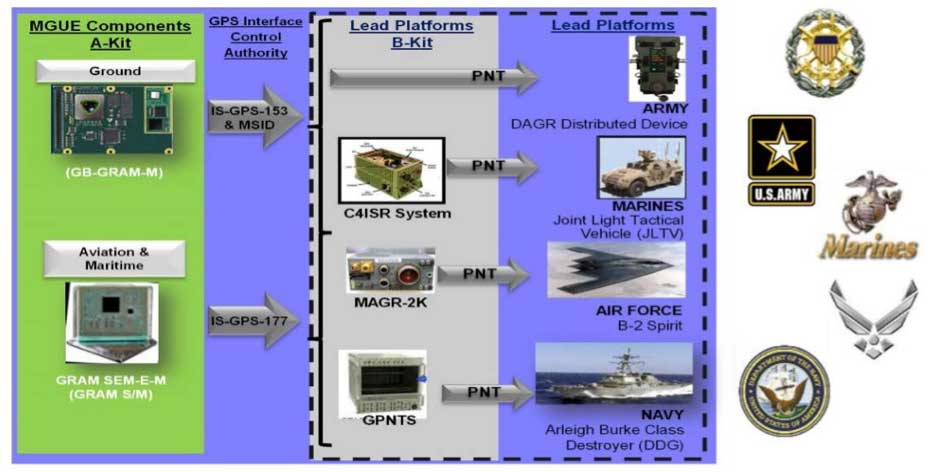
    The next-generation military receivers, known as Military GPS User Equipment (MGUE), are also under development by a range of vendors, of which L-3 Technologies was the first vendor to receive security certification in 2016. A number of equipment form factors are being developed to address land, sea and air platforms, and great progress is being made.

    Figure 2. Military GPS User Equipment (MGUE) will address a range of platforms. (Credit: Gerry Gleckel, Nov. 15, 2017)

    The U.S. Air Force recently completed a number of successful test flights of a prototype M-code receiver on board a B-2 stealth bomber, which marks an important milestone for the GPS modernization effort. Let’s remind ourselves what M-code is, and what it does for us.

    The promise of M-code

    Until now, the military has relied on the encrypted P(Y) code to provide advantage on the battlefield. Compared to the civilian C/A code, the P(Y) offered improved accuracy, ionospheric correction, resistance to spoofing and a marginal level of jamming resistance.

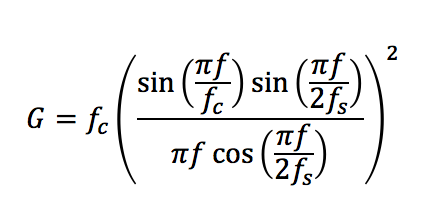
    M-code is quite a different picture. Rather than the traditional BPSK modulation schemes used by legacy signals, M-code utilizes a type of binary offset carrier (BOC) signal. In the case of M-code, the signal is a BOCsin(10,5) modulation, which has a power spectral density given by:

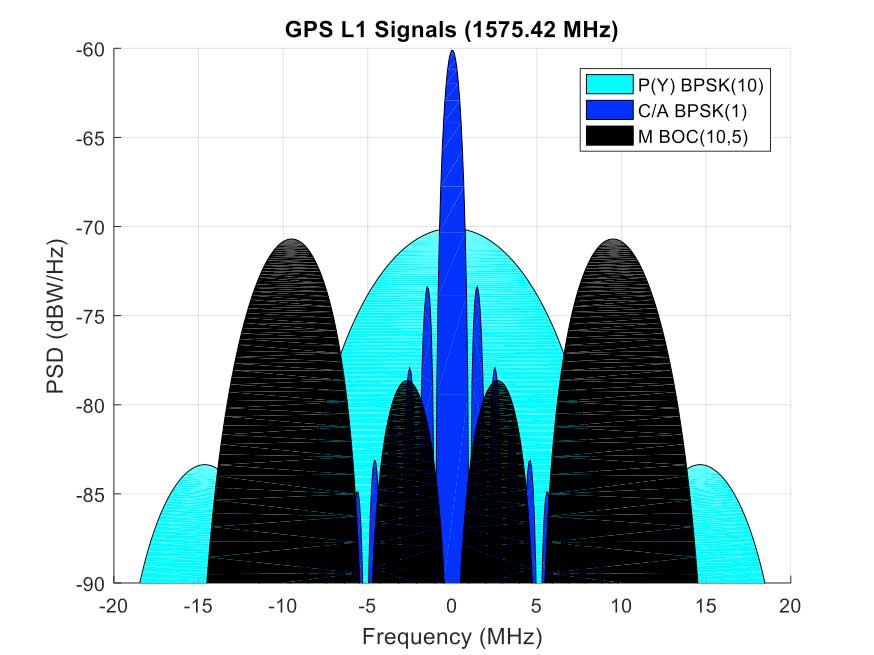
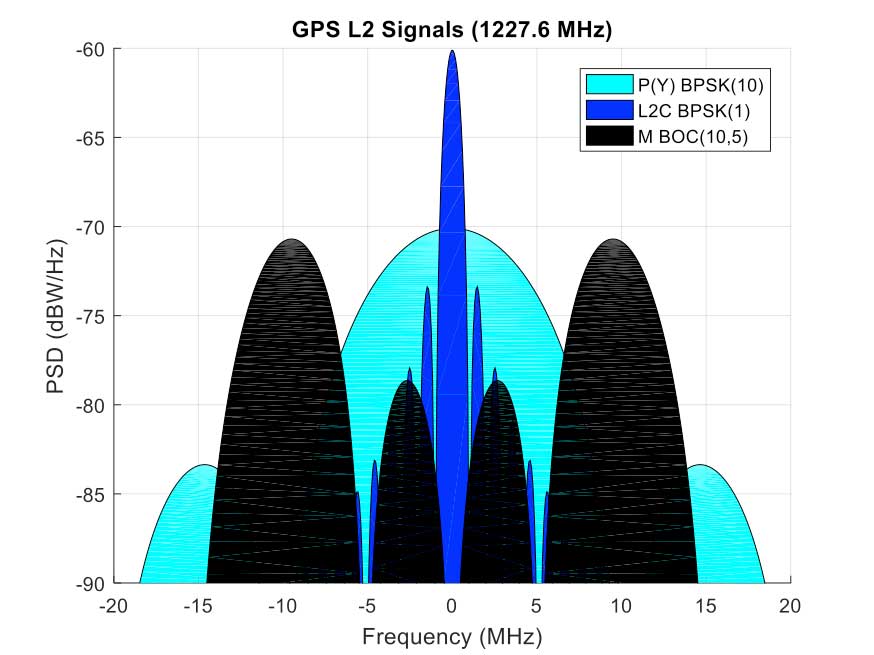
    This power spectral density can be seen in the figures below, along with legacy C/A and P(Y) codes (and also the new L2C signal on L2). The M-code BOC signal has a number of important properties; I won’t describe all of them, but I will pick out a couple.

    Firstly, the signal is able to support navigation warfare activities. Because the energy in the signal is spread in two lobes away from the center, it allows for the C/A code to be selectively jammed without affecting the military receivers. This is often referred to as “blue force jamming” or “blue on blue jamming,” where friendly forces might wish to perform jamming in an environment in which they are themselves operating. Currently, such blue force jamming is not possible with P(Y) code receivers, without also degrading the friendly force’s receiver.

    Another promise of M-code is the ability to use spot-beam transmissions from Block III satellites. This is where a high-gain antenna on the satellites aims the M-code signal at a specific region of the earth, with much greater received satellite power in that region. The received signal from the spot beam is expected to be around 20-dB more powerful than the conventional full-Earth coverage beam. This means that, in a given conflict region, military GPS receivers should be able to benefit from a large increase in jamming resistance.

    Figure 3a. M-code signal compared to traditional L1 GPS signal. (Image: Michael Jones)
    Figure 3b. M-code signal compared to traditional L2 GPS signal. (Image: Michael Jones)

    Shortly after the GPS Advisory Board meeting in California, on the other side of the Atlantic a range of defense PNT technologies was also discussed.

    International PNT experts gather in the UK

    The International Navigation Conference (INC 2017) is now in its third year, and has been steadily growing in prominence. This year’s event, which took place Nov. 27-30, focused on the themes of resilient PNT, autonomy, and sensor and data fusion. As usual, there was a substantial defense presence.

    I had the pleasure of chairing a few sessions, including a panel discussion on resilient PNT. The event began with a cross-government meeting, where representatives from across the UK government met to discuss PNT issues concerning defense and national security.

    What I loved about this conference is the sheer diversity of PNT topics that were discussed. In the military domain, it wasn’t just the traditional subjects of GNSS, inertial, visual and signals-of-opportunity that were discussed. Also considered was cognitive navigation — how does a soldier’s brain work when in an unfamiliar battlefield? And how will quantum technology benefit defense PNT in the medium to long term?

    The promise of quantum

    Quantum technology has for some time been touted as the future of PNT: clocks so accurate that you’ll never need to worry about timing again. Inertial measurement units that have so little drift, you’ll never need anything else for navigation.

    If you’re not familiar with quantum technology, let me explain. Quantum technology exploits science that cannot be explained by classical physics, such as Newtonian mechanics, thermodynamics and Maxwell’s electromagnetism.

    As atoms get colder, they have lower energy levels and move more slowly. Taking this argument all the way down to absolute zero, the atoms would stop moving. By using lasers to cool atoms to very near absolute zero, the atoms are essentially placed under precise control, and hence are sensitive to changes in the local magnetic and gravitational fields. What does this mean for navigation?

    An excellent INC 2017 session on quantum navigation revealed some of the answers. Dr. Tim Freegarde of the University of Southampton gave the keynote “Navigator’s Introduction to Quantum Technologies,” which was followed by sessions on quantum/classical combined navigation, and quantum technology for performing gravity gradient map matching.

    Quantum sensors rely on a phenomenon known as entanglement, where two physically separated systems are linked in such a way that a measurement of one affects the results of the other. Once atoms have been cooled, they can be made to travel in opposite directions around a loop, where the interference pattern generated allows rotation to be sensed.

    But the atoms can also be sensitive to gravitational and magnetic fields, and frequency. So, amongst many other things, quantum technology allows for more accurate atomic clocks, and rotational and gravitational sensors.

    A huge amount of money has been poured into quantum research in recent years and, whilst it’s clear there is still a long way to go, progress is certainly being made. At the UK National Quantum Technology Hub in Sensors and Metrology, the focus is on achieving sensors that are useful, and not necessarily to look for the highest possible precision. This is essential if quantum sensors for PNT are to be adopted by governments and industry.

    Cyber takes center stage

    At the end of the conference, I had the pleasure of chairing a lively panel discussion on resilient PNT, where I put a number of questions to both the panel and the audience.

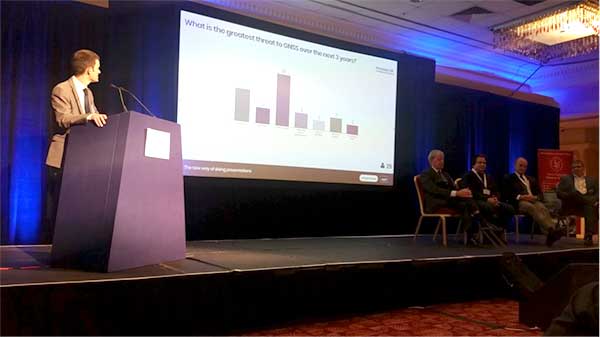
    Coming back to satellite navigation, my first question was, “What is the greatest threat to GNSS over the next three years?” You may be forgiven for thinking that “jamming” or “spoofing” was the top answer because, no, the top answer was in fact “cyber attack”.

    Figure 4. At the International Navigation Conference, the audience voted “cyber attack” as the greatest threat to GNSS. (Photo: Michael Jones)

    But what exactly do we mean by “cyber attack”? The word “cyber” is a pretty loose word, which is often misused as a catch-all phrase to cover anything that’s not RF related. Let’s quote the NIST definition of cyber attack:

    “An attack, via cyberspace, targeting an enterprise’s use of cyberspace for the purpose of disrupting, disabling, destroying or maliciously controlling a computing environment/infrastructure; or destroying the integrity of the data or stealing controlled information.”

    How does this apply to military PNT? Well, a key theme from the conference was the trend towards more complex PNT systems. No longer do we have a simple GPS receiver, but an ever-increasing mix of different PNT sensors, and a system more comparable to a computer than a traditional GPS receiver.

    What this means is that modern and future military PNT will be susceptible to the full range of cyber attacks currently associated with computing environments. Guy Buesnel from Spirent Communications gave an excellent keynote presentation where he covered this topic. Describing the “attack surface” for GNSS, he noted how many GNSS receivers currently run embedded operating systems such as VxWorks or Linux, and many support standard protocols such as TCP/IP and USB, all of which leaves them vulnerable to cyber attacks.

    But let’s not despair. The good news is that there is an awful lot to learn from the computing domain. After all, when computers first became vulnerable to cyber attacks, we quickly learned to make use of virus checkers, firewalls and other such mechanisms available to us. And now the domain of cyber security gives us an arsenal of defensive measures to combat cyber-space risks.

    I’ll finish by returning to the PNT Advisory Board meeting in California on Nov. 15, where Harold Martin, director of the National Coordination Office for Space-Based PNT, said “GPS is more computer than radio… GPS receivers lack cyber resilience. This is a national issue.”

    Don’t forget it.


    Equation figure: Michael Jones

  • Global satnav system leaders share visions for future

    Global satnav system leaders share visions for future

    Photo: LMCO

    Views from the top drive this issue of the magazine: personal essays from the directing officers and/or architects of each global satnav system.

    The plots of the four articles are the same: what innovations were accomplished in 2017, and what new features to look for in 2018. But the themes differ. If you reflect at the end of each article, try to read between the lines, divine what message seems most important to the author — then distinctions surface.

    I’m not suggesting that the directors of each satnav system are trying to accomplish different things. All share the goal of providing the highest quality product and service. I posit that the hands above these guiding hands, atop the top — that is, the national governments paying for each system and directing the directors — do indeed have different priorities. These priorities may produce differing results for industry, markets and users.

    Read the cover story articles

    The column in November’s GNSS Design & Test e-newsletter elaborates on this hypothesis, as there’s not sufficient space here. Hyper-briefly: the most marked contrast appears between the United States on the one hand and Europe and China on the other. The former appears focused on maintaining the Gold Standard of signals, on beefing up security, and then pretty much letting the market take care of innovation once the space signal hits the Earth’s surface. The other two project clear messages of working closely with industry sectors to encourage and intensify use. For them, GNSS is an economic tool, not merely a political one.

    As for my 2018, I will attend both events below, and hope to talk with as many readers as possible there.

    Cognizant Autonomous Systems for Safety-Critical Applications Workshop

    January 29, 2018
    Reston, Virginia

    Join a full day of expert presentations and discussions on the opportunities and challenges (technical, commercial, ethical and legal) associated with developing fully autonomous systems that are cognizant and trustworthy for safety-critical applications. Free; sponsored by the Institute of Navigation. Speakers from the National Science Foundation, Department of Transportation, Air Force Research Laboratory, Top Flight Technologies, University of California-Santa Barbara, Santa Clara University, The Ohio State University and more. View more details here.

    Munich Satellite Navigation Summit: GNSS — The key to autonomy?

    March 5–7, 2018
    Munich, Germany

    This three-day international conference focuses on the latest developments in satellite-based navigation, gathering high-ranking speakers from industry, science and governments for a broad overview and differing perspectives. Topics include status and real-world results of Galileo; modernization of GPS, GLONASS and BeiDou; developments of QZSS and NavIC; the need for GNSS authentication; civil use of Galileo Public Regulated Service; legal aspects of GNSS; and autonomy within a single GNSS — still possible? Get more details here.

  • Directions 2018: BeiDou builds, diversifies, expands

    Directions 2018: BeiDou builds, diversifies, expands

    By Changfeng Yang,
    Chief Architect of BeiDou Navigation Satellite System

    Changfeng Yang

    As one of the four major GNSS providers, the establishment of BeiDou Navigation Satellite System (BDS) has been steadily developed, following a three-step strategy. By around 2020, BDS will form a nominal space constellation consisting of 30 satellites, including three satellites in geostationary Earth orbit (GEO), three satellites in inclined geosynchronous satellite orbit (IGSO) and 24 satellites in medium Earth orbit (MEO). It will provide global users with open and high-quality services free of charge, including navigation, positioning, timing, short message communication, search and rescue and so on.

    BDS is aimed at developing into a world-class global navigation satellite system, with innovative and advanced technologies, extraordinary user experience, international development and worldwide presence, which can provide fundamental time and space reference for national defense and economic-social development, and advance the progress of high-tech and IT industries.

    BDS has initiated several innovative attempts in the fields of both international satellite navigation and domestic aerospace for the first time, and paved a unique development path of a satellite navigation system, with an eye on the state conditions and distinctive features. On Jan. 9, 2017, the BD-2 Project won the top National Scientific and Technological Progress Award. In 2017, BDS achieved fruitful results in the aspects of system construction, integrated applications and international development.

    System Construction

    Through upgrading and reconstructing the ground system, the service performance, stability and availability of the BD-2 constellation have been improved. To achieve user-oriented services, the updated Interface Control Document (ICD) for B1C and B2a open service signals (Version 2.1) was released in accordance with the constellation change.

    The international GNSS Monitoring and Assessment System (iGMAS) has been built, consisting of eight domestic monitoring stations and 16 overseas stations, to monitor and assess the service performances of BDS, GPS, GLONASS and Galileo at real-time worldwide. It has taken all factors into consideration, including constellation status, signal-in-space, navigation message, service performance and high-precision products, and so on. According to its analysis results, the nominal positioning accuracy of the BD-2 system in the coverage area has been optimized from 10 meters to 8 meters.

    Development of the BD-3 System. On Nov. 5, the first pair of the 24 BD-3 MEO satellites were successfully launched, while another pair is planned to be launched by the end of the year.

    Liftoff of the first pair of the BD-3 MEO satellites on Nov. 5, 2017. (Credit: Xinhua)

    The BD-3 satellites are equipped with B1C and B2a signals with optimized performance, which are compatible and interoperable with other GNSS signals. The interface control document of B1C and B2a signals (beta version) was released in September. The BD-3 satellites also adopt the higher-performance rubidium atomic clock with stability of E-14 and hydrogen atomic clock with stability of E-15. By utilizing new technologies, the signal-in-space (SIS) accuracy will be superior to 0.5 m; the position accuracy will be doubled or quadrupled, and reach 2.5 m to 5 m.

    The BD-3 system will retain the short message communication service of its predecessors, and further enhance basic positioning, navigation and timing (PNT) service capabilities. Satellite-based augmentation system (SBAS) and search-and-rescue (SAR) services will be added and developed according to international standards.

    After in-orbit tests and networking validation, the BD-3 satellites will be able to provide operational services, and accelerate the global coverage of BDS.

    Ground-Based Augmentation. The Phase I construction of the BDS/GNSS ground-based augmentation system has been completed, consisting of 150 framework reference stations, 1,200 reference stations of higher density network, national data processing center, six industrial data-processing centers, and manufacturing of user terminals. This system has achieved basic service capabilities, and its service performance standard (version 1.0) has been released. Through integration with the internet, a cloud platform has been established to provide high-precision space-time information services, including real-time navigation services at meter-level and decimeter-level, as well as precise positioning services at centimeter-level and millimeter-level.

    Satellite-Based Augmentation. Based on the International Civil Aviation Organization (ICAO) standards, system demonstration and validation work on the BeiDou Satellite-Based Augmentation System (BDSBAS) has been completed, and the technical status of the system has been confirmed in accordance of the next-generation SBAS Dual Frequency Multiple Constellation (DFMC) standards.

    Integrated Applications

    Currently, a great number of independent, self-controlled intellectual property rights on the fundamental BDS products have been achieved. World-class, advanced technologies have been developed. With the release of the first Chinese in-house developed meter-level fast positioning BDS chip, BDS applications have begun to embrace the era of meter-level positioning.

    In 2017, the sales volume of BDS navigation chips and modules exceeded 50 million pieces, and that of high-precision surveying boards and navigation antenna captured 30% and 90% of market shares respectively. There are more than 14,000 enterprises (including more than 50 publicly listed companies), and more than 450,000 employees in China engaging in BDS-related business.

    The annual output value of the publicly listed company in 2017 is more than RMB 50 billion (US $7.53 billion). The number of terminals produced by domestic enterprises surpasses 40 million pieces/sets. BDS has gained recognition from mainstream chip producers such as Qualcomm, Trimble, Hemisphere GNSS, Huawei, Samsung, u-blox, MTK, Broadcom, NovAtel and more, and the total number of terminals is estimated to surpass 300 million pieces or sets.

    BDS continues to:

    • promote integrated applications and development of related industries;
    • bring GNSS high-precision services in combination with cloud computing, Internet of Things, big data and other technologies;
    • push forward the integration between BDS-related industries and high-end manufacturing, software, and integrated data industries.

    BDS has been applied in the transportation, logistics, emergency rescue, marine fishing and other fields, which has greatly improved production efficiency, reduced resource consumption, and lowered pollution. For example, benefiting from the BDS applications in traffic management industry, the number of major accidents has decreased by 46.7%, and the death toll has been reduced by 48.9%. With BDS-based maritime applications, more than 10,000 lives have been saved.

    BDS/GNSS augmentation services have been applied to precision agriculture, land mapping, monitoring on deformation and displacement of large-scale public facilities, and earthquake and geological hazard measurement and survey; the latter has provided important monitoring for public safety. As a result, the production of precision agriculture has increased by 5%, and the oil consumption by agricultural machinery has decreased by 10%. The time for surveying and mapping of national land is shortened from a few days to several seconds.

    BDS has been fully put into mass applications. BDS-based navigation services have been adopted by various enterprises, such as Huawei, ZTE, Baidu, Autonavi, Alibaba, JD and others in the fields of manufacturing of mobile and smart terminals, location-based services (LBS), e-commerce, and so on. BDS-based LBS have been widely applied in the mass consumption sector and people’s livelihood, and many innovative applications have emerged, such as caring for seniors and children, shared vehicles, BDS-based logistics, and so on, which have been changing people’s lives and providing more convenience for the public.

    International Development

    At present, BDS has covered more than 50 countries and more than 3 billion people. BDS-related products have gained access to the markets of more than 70 countries and regions, more than 30 of which are along the (land-based) Belt and (maritime) Road (in line with the Belt and Road Initiative). Through joint applications with other compatible navigation satellite systems, BDS provides global users with diversified choices for better application experience.

    Meanwhile, the iGMAS has contributed to the implementation of the Asia-Pacific Space Cooperation Organization project, iGMAS-International GNSS Service Pilot experimental project, and Sino-Russian monitoring and assessment cooperation, and has provided GNSS users with authentic third-party assessment results. China continuously pushes forward BDS to be recognized by the ICAO, International Maritime Organization (IMO), mobile communication standard Partnership Project and other organizations, to serve the world in line with international conventions.

    In October, three PRN codes which are essential to the development of BDSBAS were assigned; the SBAS service provider identifier and UTC standard identifier have been assigned to BDSBAS by ICAO, which marks BDSBAS an official SBAS provider in the ICAO family, and lays the foundation for the follow-up construction of BDSBAS, as well as its provision of standard navigation services for the civil aviation sector.

    In March, a multi-system (including GPS, BDS and GLONASS) ship-borne receiver standard was approved by the IMO. BDS has also been included in the PNT guidelines of maritime applications.

    In the field of mobile communication, 26 technical standards that support the BDS positioning function have been adopted by the third- and fourth-generation mobile communication standard Partnership Projects.

    Future Plans

    BDS will keep improving its continuous stability and service accuracy. Two more BD-2 replacement satellites will be launched in 2018, ensuring its regional service performance will be remain stable and be enhanced.

    Eighteen BD-3 MEO satellites and one BD-3 GEO satellite will be launched by around the end of 2018. Upon the deployment of those 19 satellites, BD-3 will possess the initial operational capability and serve the countries along the Belt and Road. The official version of ICD for B1C and B2a open service signals, as well as other system documents, will be released, in line with the operational status of BD-3 satellites, for the convenience of public applications.

    In regard to augmentation systems, China plans to complete the construction of Phase II BDS/GNSS ground-based augmentation system in 2018, and advance the recognition of BDS-based high-precision services as public goods. In 2018, the first BDSBAS GEO satellite with the BDSBAS payload will be launched to start the deployment of the BDSBAS system.

    In terms of applications and international development, China will give full play to the role of BDS in the integration procedure between industrialization and IT applications, to promote the development of information industry, adjustment and upgrading of industrial structure.

    China will also strengthen the cooperation and communication with other navigation satellite system providers, carry out coordination under the framework of international organizations and multilateral platforms, improve the international development of BDS, provide better services for users along the Belt and Road, and expand BDS services to serve users worldwide.

  • Directions 2018: Galileo ascendant

    Directions 2018: Galileo ascendant

    By Paul Verhoef
    Director of the Galileo Programme and Navigation-related Activities,
    European Space Agency

    Paul Verhoef, director of the Galileo Programme addresses the audience at ESA's annual Navigation Days, held Jan. 26. (Photo: ESA)
    Paul Verhoef, director of the Galileo Programme. (Photo: ESA)

    The European Space Agency (ESA) and the European GNSS Agency (GSA) are starting 2018 with the commissioning and In-Orbit Testing (IOT) of four new Galileo satellites.

    This work is fairly routine for us as we have achieved the process successfully many times. But the impact of four new satellites for Galileo services is a different story.

    This batch of satellites provided by OHB of Germany — 19, 20, 21 and 22  — will bring our constellation to 22 satellites. Together with the necessary ground segment delivered by Thales Alenia Space (TAS) and Airbus Defense and Space (ADS) and their many subcontractors throughout Europe, this will be providing availability to users anywhere in the world in order to achieve a high-quality position solution 99.8% of the time. “High quality” is hereby meant that the position dilution of precision (PDOP) will be smaller than 5, with our final accuracy for a full 24 FOC satellites operating at full potential being PDOP ~ 2.4.

    This achievement will create a step change in the ability of service providers and equipment manufacturers to utilize the Galileo service. For all intents and purposes, it means the Galileo signal can always be relied upon to be there, and industry can sell products and design the power budget of devices based upon that fact.

    Dual Frequency. The first mass-market GNSS receiver chip for smartphones and mobile devices that is able to utilize dual-frequency Galileo signals was released by Broadcom in September, able to employ both L1/E1 and L5/E5 signals. In 2018, dual-frequency technology like this will provide an order of magnitude increase in the performance of mobile device location-based services (LBS), especially in urban environments, and Broadcom advertises a 50% reduction in power consumption. The world of mobile-device LBS is going to change in 2018, and it will be due to the availability of Galileo.

    It will not be the first time the partnership of ESA, the European Commission (EC) and the GSA has made a service available that has changed the nature of the marketplace. The GSA already has in service the ESA-designed EGNOS LPV200 aircraft approach service performing so well that countries like France have taken the decision to phase out the terrestrial Instrument Landing System that has burdened the capital expenditure budgets of airports in the past.

    We have had discussions with several commercial organizations that are interested in building products around Galileo, and I am excited to see what they are going to come up with. With Galileo Initial Services the world had a new navigation signal to study and trial. In 2018 the world will have a new star to navigate by — well, a new constellation of 22 to 24 stars, I should say!

    FOC. In the summer of 2018 we will launch the final part of the Galileo FOC constellation (geometrically speaking) with four more satellites taking us beyond the 24 needed for 100% coverage and minimum performance limitation from satellite geometry. The launch will also provide our first in-orbit spares, enabling us to plan for the end of life of our old validation phase satellites or otherwise supplement the constellation to improve performance.

    What might we do with these in-orbit spares? Our first priority is to complete a constellation of 24 satellites in the correct orbits for minimum PDOP; as you know, a Fregat upper-stage malfunction left GSAT 0201 and 0202 in orbits too elliptical to correct fully, so the current plan is to complete the 24-satellite geometry. 0201 and 0202 are foreseen to be fully integrated in the Galileo operational system in 2018 following further testing and preparations, allowing us to have a 24+2 constellation with “hot back-up” from 0201 and 0202 contributing at around current GPS satellite levels of accuracy.


    “It will not be the first — nor the last — time the partnership of ESA, the EC and the GSA has made a service available that has changed the nature of the marketplace.”


    Of course, as is known to the community, the validation-phase satellite GSAT 0104 is down to single frequency, and we routinely monitor the health of all satellites. 0104 is the only satellite that has lost part of its function; designed-in redundancy has managed all other problems.

    However, obviously we will be examining all options for deployment to ensure that the Galileo schedule is not impacted by in-orbit failures, and those we have experienced we have learned from and mitigated successfully without impacting the service.

    The first two spares are not the end of our ability to maintain the constellation and our system performance. All four validation phase satellites will need to be replaced, and so the “Batch 3” satellite procurement will continue to regularly roll out satellites for replenishment of the constellation.

    Enhancements. That won’t mean we will be resting on our laurels. In 2018 we also plan to release enhancements to the ground segment for Galileo, a process that will be a first as the system is already being operated by the GSA.

    The process of managing an in-service upgrade program with the GSA is going to be new and challenging, but we have a strong engineering support team deployed as part of our working arrangement with the GSA to help ensure the process goes smoothly.

    Of course, the need for GSA to be able to continue smooth operations imposes extra discipline and imposes on us a balance between stable operations and continued build-out of the infrastructure. We do not consider this to be a problem; on the contrary, the focus will be on robust operations and availability to the user.

    Back at base (ESTEC in the Netherlands for Galileo and Toulouse, France, for EGNOS) we are full steam ahead on preparing the future. We are moving forward at considerable pace with our next-generation designs that develop new functionality for continuous service improvements.

    Free PPP. Galileo was designed to broadcast a Commercial Service signal providing services such as precise point positioning to paying customers, but we are pleased to able to report that the EC has confirmed that this service will be provided for free by the European Union. In 2018/2019 the GSA will select the providers and get that unique, free service on the air.

    In 2017 the EC confirmed the decision to implement the commercial service using E6-B with both encrypted and open components so all users could benefit for all frequency bands. Now, with the decision to make the service available free of charge, all users of Galileo, with the right type of receiver, will be able to achieve position fixes with an accuracy around 10 cm from Galileo’s first-generation constellation by 2020/2021.

    The Galileo Public Regulated Service will also be a focus, with the EC soon to decide upon release dates for the first milestones on the service roadmap. The infrastructure and equipment to support a secure service is being put in place, and I can’t say more for security!

    The next generation of European GNSS technology will include multi-constellation EGNOS, Galileo 2nd Generation (G2G) and a transition batch of satellites between the first and second generations to get the best technology proven in flight and working for Galileo users as soon as possible. G2G will reach its System Requirements Review stage in the first half of 2019. To be ready for that we are looking at:

    • clock technology and ensembles
    • inter satellite links
    • propulsion technology
    • flexible payloads and power allocation
    • 5G telecoms networks standards and what we need to do ensure we provide the timing services those networks will need and new signals with time to first fix (TTFF) and power requirements for acquisition of signal that are compatible with 5G devices. Look out for a new pilot signal E1-D to move forward on this.
    • Open Service authentication and support for ARAIM (Advanced Receiver Autonomous Integrity Monitoring).

    Finally, 2018 will see the first contract awards of the Navigation Innovation Support Programme. This is a programme specifically designed to encourage R&D, new concepts and new products and to ensure that 2018 is not the last time ESA with the EC and its industrial partners deploy a GNSS service for GSA to operate that changes the world.

  • Discussing the new North American-Pacific Geopotential Datum of 2022 — Part 4

    Discussing the new North American-Pacific Geopotential Datum of 2022 — Part 4

    My last column focused on the National Geodetic Survey’s (NGS) current plans for estimating North American-Pacific Geopotential Datum of 2022 (NAPGD2022) GNSS-derived orthometric heights and incorporating geodetic leveling data into NAPGD2022 to establish orthometric heights consistent with GNSS-derived NAPGD2022 orthometric heights. It emphasized that after NAPGD2022 is established, the primary means for deriving orthometric heights on monuments will be using GNSS observations combined with the geoid model.

    Recently, NGS published its second blueprint for the 2022 document titled “Blueprint for 2022, Part 2: Geopotential Coordinates.” The report addresses NAPGD2022 in detail. The intent of the document is to provide to the public the current status of plans by NGS to modernize the geopotential component of the National Spatial Reference System (NSRS) in 2022. This particular document covers the definition and determination of orthometric heights, geoid undulations, gravity, deflections of the vertical, dynamic heights, and any other quantity directly related to the geopotential field of the Earth. As mentioned my previous columns, NAPGD2022 will be replacing the North American Vertical Datum of 1988 (NAVD 88). The executive summary of report NGS 64 is provided in the box titled “Executive Summary, NOAA Technical Report NOS NGS 64, Blueprint for 2022, Part 2: Geopotential Coordinates.” Surveyors and mappers should obtain a basic understanding of the four interrelated products of NAPGD2022. They are GM2022, GEOID2022, DEFLEC2022, and GRAV2022. I’ve highlighted them in executive summary box below.

    Executive Summary


    NOAA Technical Report NOS NGS 64

    Blueprint for 2022, Part 2: Geopotential Coordinates
    In 2022, the entire National Spatial Reference System (NSRS) will be modernized. This document addresses the geopotential aspects of the NSRS, including every vertical datum, the geoid, gravity, deflections of the vertical, and other quantities related to Earth’s gravity field. Every one of these related, yet semi-independent sources of information will be replaced with an internally consistent geopotential datum called the North American-Pacific Geopotential Datum of 2022 (NAPGD2022). Within NAPGD2022 four primary, interrelated time-dependent products will exist:

    • A global model of Earth’s geopotential field (GM2022)
    • Regional gridded geoid undulation models (GEOID2022)
    • Regional gridded deflection of the vertical models (DEFLEC2022)
    • Regional gridded surface gravity models (GRAV2022)

    The three regions for the gridded models will be North America (covering CONUS, Alaska, Hawaii, the Caribbean, Canada, Mexico, Central America and Greenland), American Samoa and Guam/Commonwealth of Northern Mariana Islands (CNMI).

    NAPGD2022 will be built upon the IGS frame, as only minor (entirely horizontal) differences will exist between the IGS frame and the four new terrestrial reference frames developed as part of the NSRS in 2022 (see NGS, 2017). Since these differences will be relatively small horizontal displacements (mainly due to Euler pole rotations), NAPGD2022 will operate equally well in any of four new frames.
    Orthometric heights in NAPGD2022 will be defined through ellipsoid heights and GEOID2022. This means NAPGD2022 orthometric heights will primarily be accessed through Global Navigation Satellite System (GNSS) technology. GEOID2022 will be defined in a manner that best fits global mean sea level at the epoch of NAPGD2022. When global sea level changes by a threshold level of 20 centimeters, a new geoid model, and thus geopotential datum, will be released. Until then, updates to any component of NAPGD2022 will result in updating all components of NAPGD2022 using sequential version numbering.

    Leveling in NAPGD2022 will retain its current role of providing high-accuracy local differential orthometric heights. The determination of absolute heights, however, which will provide the context of local differential heights, will reside in the GNSS domain (i.e., will be based on IGS ellipsoid heights).

    Find this entire report here.

    There is a lot of good information in the report and I would encourage everyone to download the report and read it. Some of the report is technical but most of it provides simple and easy to understand explanations of very technical terms. Pages 22 and 23 of NGS 64 provides a good summary of the different components of NAPGD2022 (see box tilted “Excerpt from Section 9 of NGS 64”).

    Excerpt from Section 9 of NGS 64

    9 The 2022 Geopotential Datum


    1. In 2022, the NSRS will contain one geopotential datum, capable of providing (at a minimum) the geoid undulation, acceleration of gravity, geopotential number, and deflection of the vertical at any given latitude, longitude, ellipsoid height, and time in a global ideal reference frame, such as the International Terrestrial Reference Frame (ITRF) or International GNSS Service (IGS) frames. The name of this datum will be the North American-Pacific Geopotential Datum of 2022 (NAPGD2022).
    2.  

    3. The foundational component of NAPGD2022 will be a spherical13 harmonic model of Earth’s external gravitational potential, called (for now) the Geopotential Model of 2022 (GM2022).
       
      The GM2022 will be created for the entire Earth and will contain two components:
      1. The first component will be time independent, fixed at some epoch (TBD14) to a at least degree and order of 2160,15 called (for now) the Static Geopotential Model 2022 (SGM2022).
      2. Complementing SGM2022 will be a time-dependent model of Earth’s external gravitational potential, capable of capturing both secular and episodic changes of significance. This time-dependent model will be called (for now) the Dynamic Geopotential Model 2022 (DGM2022).


    4. Three derivative products, based upon GM2022, but requiring additional information and providing higher-resolution regional information than is contained in GM2022 will be created:
      1. A gridded geoid model GEOID2022,16 which will contain two components:
        1. The first will be time independent, fixed at some epoch (TBD) called (for now) the Static Geoid model of 2022 (SGEOID2022).
        2. Complementing this will be a time-dependent geoid undulation model, encompassing permanent geoid changes >= 1 millimeter per year, called the Dynamic Geoid model of 2022 (DGEOID2022).
      2. A gridded deflection of the vertical, DoV, model (at the surface of the Earth) DEFLEC2022, which will contain two components:
        1. The first will be time independent, fixed at some epoch (TBD) called (for now) the Static Deflection of the Vertical model of 2022 (SDEFLEC2022).
        2. Complementing this will be a time-dependent DoV model, called the Dynamic Deflection of the Vertical model of 2022 (DDEFLEC2022).
      3. A model for interpolating surface gravity GRAV2022, which will contain at least one, possibly two components:
        1. The first will be time independent, fixed at some epoch (TBD) called (for now) the Static Gravity model of 2022 (SGRAV2022).
        2. As a second, possible component, NGS will investigate the feasibility of a time-dependent surface gravity model.


    The three derivative-gridded products (GEOID2022, DEFLEC2022, and GRAV2022) will encompass three non-global areas. These three areas will be (latitude and longitude convention being positive north, positive east):

    The boxes titled “Figure 9-1 From NOS NGS 64,” “9-2 from NOS NGS 64,” and “9-3 from NOS NGS 64” depict the regions that GEOID2022, DEFLEC2022 and GRAV2022 will cover.

    Figure 9-1 From NOS NGS 64

    The North American region for GEOID2022, DEFLEC2022 and GRAV2022

    Figure 9-2 From NOS NGS 64

    The American Samoa region for GEOID2022, DEFLEC2022 and GRAV2022
    Figure 9-3 From NOS NGS 64

    The Guam and CNMI region for GEOID2022, DEFLEC2022, and GRAV2022

    So, what does this mean to the surveying and mapping community? First, as mentioned in my previous columns, there will be significant differences between NAPGD2022 and NAVD 88. Figure 1 depicts the approximate differences between NAPGD2022 and NAVD 88 in the conterminous United States.

    Figure 1 – Approximate Change Between NAPGD2022 and NAVD 88 Using GPS on BMs Data (units = cm). [Figure 1 is from June 2017 Survey Scene column.]

    For those still referring their products to NGVD 29, figure 2 depicts the approximate differences between NAPGD2022 and NGVD 29 in the conterminous United States.

    Figure 2 – Approximate Change Between NAPGD2022 and NGVD 29 Using GPS on BMs Data (units = cm). [Figure 2 is from the June 2017 Survey Scene column].

    My April 2017 Survey Scene column provided an estimate of the change between NAPGD2022 and NAVD 88 at bench marks with GNSS-derived ellipsoid heights in Alaska. Figure 3 is a plot of the GPS on BMs residuals computed using xGeoid16b geoid values, IGS08 ellipsoid heights, and NAVD 88 orthometric heights.

    Figure 3 – Approximate Change Between NAPGD2022 and NAVD 88 Using GPS on BMs Data (units = cm). GPS on Bench Mark Residuals Using xGeoid16b in the State of Alaska – Referenced to IGS08 (units = cm) – Green Line Represents the Leveling Lines [Figure 3 is from the April 2017 Survey Scene column.

    As outlined in NOS NGS 64 report and previously mentioned in this column, there are four interrelated products of NAPGD2022 – GM2022, GEOID2022, DEFLEC2022, and GRAV2022. What most surveyors will be using is GEOID2022 (SGEOID2022 and DGEOID2022). As explained in my last column, and part of NGS’ frequently asked questions about the new datums, users will access the NSRS using GNSS-derived ellipsoid heights and GEOID2022.

    How will accessing the National Spatial Reference System (NSRS) change with the release of the new datums?
    The NSRS will be accessed using Global Positioning System (GPS) technology that references Continuously Operating Reference Stations (CORS) and relies on a time-dependent gravimetric geoid model. This method of accessing the NSRS is a paradigm shift from accessing NAD 83 and NAVD 88 through the use of geodetic survey marks.

    It will not be necessary to connect to a geodetic monument, i.e., a bench mark, because the NATRF2022 ellipsoid height (hNATRF2022) is determined using the NGS CORS and the geoid model (NGEOID2022) is consistent with NATRF2022. In other words, GNSS ellipsoid heights (e.g., NATRF2022) combined with the geoid model (e.g., GEOID2022) will become the primary means for deriving orthometric heights on marks.

    There will be a static geoid model of 2022, denoted as SGEOID2022, which will be fixed at a specific epoch. Since the geoid model changes due to various factors, such as changes in sea level, glacial rebound, and seismic activities, there will be a dynamic aspect of the 2022 geoid model, denoted as DGEOID2022. The permanent changes to the geoid model are small and will take several years to become significant to affect the typical survey and mapping product. Saying that, it is important to understand that there is a static and a dynamic aspect of the National geoid model. NGS will provide a single GEOID2022 value which will apply the appropriate static and dynamic components of the geoid model.

    Even though, the primary access to NAPGD2022 will be using GNSS and a geoid model, users will still want to perform precise leveling observations and incorporate the results into NAPGD2022. My last column discussed incorporating leveling data into NAPGD2022. Differential leveling of high precision is used to observe elevation differences which are then used to establish precise heights of vertical control points (bench marks) above or below a reference surface, e.g., the North American Vertical Datum of 88 (NAVD 88) or North American-Pacific Geopotential Datum of 2022 (NAPGD2022). Differential leveling, conceptually a simple procedure, in practice lends itself to many types of small errors. To detect, reduce, and control these errors, specific procedures need to be adhered to and corrections must be applied. FGCS has documented the necessary procedures to be used in first-, second- and third-order geodetic leveling projects. Procedures do not always reduce error to tolerable values; therefore, additional corrections are applied by the office processing the data to remove known systematic errors.

    The box titled “Excerpt from Special Report Results of the General Adjustment of the North American Vertical Datum of 1988” provides a summary of the corrections applied to the leveling data used in NAVD 88. As you can see, gravity (highlighted in the box) plays an important role in estimating accurate orthometric heights. This is where GRAV2022 is important, it is used during the process of converting observed leveling height differences into orthometric height differences.

    Excerpt from Special Report – Results of the General Adjustment of the North American Vertical Datum of 1988

    (https://www.ngs.noaa.gov/PUBS_LIB/NAVD88/navd88report.htm)
    David B. Zilkoski, John H. Richards, and Gary M. Young
    American Congress on Surveying and Mapping Surveying and Land Information Systems, Vol. 52, No. 3, 1992, pp.133-149
    Corrections Applied to Leveling Data

    The leveling observations used in NAVD 88 were corrected for rod scale and temperature, level collimation, and astronomic, refraction, and magnetic effects (Balazs and Young 1982; Holdahl et al. 1986). All geopotential differences were generated and validated, using interpolated gravity values based on actual gravity data. Geopotential differences were used as observations in the least-squares adjustment, geopotential numbers were solved for as unknowns, and orthometric heights were computed using the well-known Helmert height reduction (Helmert 1890): H = C/(g + 0.0424H), where C is the estimated geopotential number in gpu, g is the gravity value at the benchmark in gals, and H is the orthometric height in kilometers. The weight of an observation was calculated as the inverse of the variance of the observation, where the variance of the observation is the square of the a priori standard error multiplied by the kilometers of leveling divided by the number of runnings.

    This column highlighted two components of NAPGD2022 – the geoid undulation model of GEOID2022 and gravity model of GRAV2022. It expressed that these two models will be very important to future surveyors and mappers that are incorporating geodetic data into the North American-Pacific Vertical Datum of 2022 (NAPGD2022). As previously mentioned, I would encourage everyone to download and read NGS recently published second blueprint for 2022 document, titled “Blueprint for 2022, Part 2: Geopotential Coordinates.” This column also emphasized the significant differences between NAPGD2022 and the U.S. National Vertical Datums of NAVD 88 and NGVD 29. My next column will provide the latest details of NGS’ 2018 GPS on BMs campaign which will be used to develop transformation tools for converting products and services from NAVD 88 to NAPGD2022.

  • Directions 2018: GLONASS focuses on user needs

    By Sergey Karutin, GLONASS designer general;
    Nicolay Testoedov, Director General, SC Information Satellite Systems;
    and Andrey Tulin, Director General, SC Russian Space Systems

    This year has marked the 35th anniversary of the first GLONASS launch. During these years, the world has made great strides through high tech, and now no modern society can progress without satellite-based navigation.

    Today’s urban resident can hardly do without a smartphone planning his route through traffic, determining the paid parking site location or getting a reminder of parking session completion once he has left the parking lot.

    The search for the nearest pharmacy, gas station, restaurant or any other point of interest is of vital necessity today. The growing dependence of modern society on navigation signals-in-space increases the responsibilities of GNSS providers. At the same time, users long for simplicity in getting quality services. That is why this year the GLONASS team is going to set up its most ambitious program: improving the quality of the GLONASS services at a user level.

    The traditional GLONASS conception of signal-in-space accuracy is now being augmented by the user level performance estimation. Due to the fact that the signal propagation environment contributes a lot to the positioning error budget, it is obvious that users need information that would reduce the influence of signal propagation path on the positioning accuracy.

    Glonass-M satellites currently form the core of the GLONASS constellation, and with six ground spares now in stock, they will continue to do so for at least the next eight years. Therefore, in 2018 the new edition of L1 and L2 FDMA Interface Control Documents are to be published which will include the ionospheric and tropospheric models recommended in the recently released GLONASS CDMA Signals ICDs.

    Glonass-K2 satellite (artist’s rendering).

    We plan to use the spare bits within the navigation superframe of FDMA signals to transmit ionospheric parameters described in the General Description of the GLObal NAvigation Satellite System with the Code Division Multiple Access Signals ICD.

    Studies being performed demonstrate up to 70 percent reduction in impact of ionospheric refraction when using the adaptive model transmitted by the three parameters: the numerical factor for the peak TEC (Total Electron Content) of F2 ionosphere layer, the solar activity index and the daily geomagnetic activity index. In the new CDMA signal message, these parameters are initially provided.

    To enable the unanimity of technologies for reducing the hydrostatic component of the tropospheric delay, which accounts for 80 percent of its value, the both FDMA and CDMA Signals ICDs will include the latitudinal tropospheric model based on the preliminary set tabular values.

    The preliminary design review for the technical baseline of the fourth-generation Glonass-K2 satellite has been passed this year. The new cubic arrangement of the platform enables mitigation of unmodeled forces and transition of propellant tank to the satellite’s center of mass.

    This provides for the relative position constancy for the satellite’s center of mass and the satellite’s antenna phase center during the satellite’s lifetime. This platform arrangement also accommodates the whole ensemble of navigation signals (both CDMA and FDMA) on the single phased-array antenna system.

    Glonass-K2 is equipped with the new atomic frequency standard composed of the legacy quantum frequency standard based on the cesium beam tube and the passive hydrogen maser. The miniature PHM with the relative daily stability of 5×10-15 will be installed onboard the satellite to be launched in 2020.

    Introduction of the new satellite will enable a new constellation sustainment strategy — through the both dual launches by Angara-A5 launcher from Vostochny and single launches by Soyuz from Plesetsk — to provide on-demand replenishment of the constellation.

    By 2020, when we celebrate the 25th anniversary of GLONASS full operational capability, all the efforts mentioned above will offer new quality of services to GLONASS users prioritized as per their needs.

  • US Supreme Court considers privacy — or not — of your location data

    The U.S. Supreme Court heard arguments last week on a case that could determine whether authorities can search cellphone location data without a warrant.

    In Carpenter v. U.S., the Court will eventually rule on whether the Fourth Amendment of the U.S. Constitution’s Bill of Rights, enacted in 1791 to safeguard citizens’ rights against unreasonable searches and seizures, extends to cover personal cellphone records tracking user location.

    The case began when police used records, obtained from a phone company and drawing on cell-tower location, to show that an individual’s cellphone was used in the vicinity of several armed robberies in Michigan and Ohio in 2010 and 2011.

    The appellants contend that the government had violated the Fourth Amendment when it collected their cellphone location records without a warrant. A federal appeals court ruled against the appeal, finding the Fourth Amendment doesn’t “yet” extend to cellphone location data.

    That court distinguished between the “content” of a communication and the “information necessary to send it.” The government can’t read letters or emails or listen to wiretapped conversation without a warrant, but it is entitled to the metadata used to send such content — in this case the phone company data showing in which tower’s cell area the phone was activated.

    “The business records here fall on the unprotected side of this line. Those records say nothing about the content of any calls,” the court ruled. “Instead the records include routing information, which the wireless providers gathered in the ordinary course of business.”

    The Supreme Court, in hearing the appeal on this decision, is expected to review — and possibly revise — its heretofore opinion that when users share information with a third party, such as a bank or telephone company, they lose the expectation that it will remain private. At question is whether cellphones have activated a new era of privacy expectations, in essence, whether legal doctrine needs to be subject to updates for the digital age.

    One tenet that no one questions is that cell phone users have no idea to what extent their phone companies know where they go and how long they stay there. Whether they care or not, or whether they are willing to sacrifice some amount of privacy for the convenience of cell phone access, remains to be seen. The limits for this have been explored but never completely settled, in controversies around Facebook’s (and others’) access to and use of customer data and profiles.

    Apple, Facebook, Google and Verizon have all filed an amicus (“friend of the court”) brief in Carpenter v. U.S. The tech gargantua seem to want, on the one hand, to discourage the possibility of government and law enforcement being able to access location data without a warrant, while also maintaining a clear and unencumbered route for themselves to use it. They argue that “Fourth Amendment doctrine must adapt to the changing realities of the digital era” and that “rigid analog-era rules should yield to consideration of reasonable expectations of privacy in the digital age.”

    After a related 2012 Supreme Court decision that attaching a GPS tracker to a car without a search warrant violated the Fourth Amendment, Justice Sonia Sotomayor wrote that the so-called third-party doctrine was “ill suited to the digital age” and that privacy case law should adapt to changes in society’s views that are occurring thanks to smartphones and other technology.

    For a summary of the arguments presented to the Court on November 29 in Carpenter v. U.S., see the SCOTUS blog here. Further developments in the case will appear on this page, and viewers may sign up for push updates as well.

    In 2008, GPS World published an editorial on this subject, in the guise of a parodized future film noir scenario, “The Call Tease Factor.” An expandable image appears at left. The essay opined that “Government agencies and police routinely tracked cell users’ location without a warrant or court oversight. . . . Challenges had faltered, and no one seemed to notice any more, or care much.”

    “Privacy, as least as far as location, no longer existed.”