Category: Opinions

  • Ubiquitous PNT and Sequestration: The World Runs on GPS Time

    A couple of years ago, wearing a different hat, I found myself on a guided tour of a key military C2 (Command and Control center) that was about as big as a football field and was to be deployed somewhere in Southwest Asia. My colleagues and I, who are all GPS SMEs (Global Positioning System Subject Matter Experts), asked the same question of almost everyone we saw that day. Near the end of the day and the tour, we had yet to receive an adequate answer. The typical response was, “Please save that question for our senior communications officer.”

    Finally, at the end of the tour and demonstration, we met the communications chief, and we once again asked our persistent and, for some of us paramount, question: “What would happen if we walked into this facility in the middle of a major military operation and activated a Coke-can-size GPS jammer that we were surreptitiously carrying in a backpack? In other words, what would happen if we disrupted your GPS signal reception?”

    The communications expert thought awhile and then answered. Unfortunately, the answer was a bit perplexing and yet all too common, inside the military and out. The communications officer hesitantly replied, “Well, this is a C2 center, and we are all about computers, networks and communications, and although I have to admit I don’t know much about GPS, other than we use it to navigate our military and civilian vehicles, I guess I would have to say it would not make any difference. In fact I am not even sure we would notice.”

    Quick as lightning, before I even had a chance to challenge the response or thought process, a grizzled old E9, who proved his operational savvy that day, interjected, “Beg your pardon, but all of our radios, computers, networks and communications gear are referenced and synchronized to GPS time. A GPS jammer would take us out of business until we brought up our backup atomic reference system. So, initially a Coke-can jammer activated in our facility would be catastrophic, but we would soon be back in business because we have backup atomic reference systems.”

    Fast-forward, and today that transition between GPS and atomic reference system is seamless. There is no down time, and yet the systems still run on GPS time. But during that initial visit, I could tell by the looks on the junior communications officers faces that surrounded us that, while they appreciated the save by the old chief, they were also still wondering, just how pervasive is the actual impact of GPS time for computers, networks and communications?

    The answer is simple. The world as we know it today runs on GPS time.


    GPS — Time and Frequency

    This is unfortunately a scenario my colleagues and I encounter all too often. While it is not my intention to launch into GPS 101, it bears repeating that of the approximately 3.5-billion-plus users of GPS and PNT (Position, Navigation and Timing) systems in the world today, 90% use the signals for incredibly accurate time-keeping and frequency stability, not just for positioning and navigation.

    Indeed, GPS SVs (space or satellite vehicles) today typically contain either three or four atomic reference systems (atomic clocks), primarily long-term, stable Rubidium systems with shorter term stable Cesium clocks as a Primary Reference Source, that continually broadcast Stratum-1 timing signals with stability on the order of 1×10-E13 or a pico second (a trillionth of a second) or greater.

    For the mathematically challenged, that means the stability of the atomic clocks are such that if the GPS atomic reference system could be maintained in a perfect environment for the lifetime of the clock, nominally 20-30 years for Rubidium systems, it would never lose a second of time. To put this number in perspective, consider that the navigation revolution (easily the biggest change in navigation since the sextant was invented) brought about by Harrison’s chronometer, perfected in 1759, allowed accurate navigation by Longitude and Latitude, by keeping and transferring time aboard ships with accuracies in the 10-second range over periods of weeks. And even though at the time it was hailed as a chronometer, its lack of accuracy is such that most navigators today could not tolerate the inaccurate time or lack of stability, not when they can measure time to the trillionth of a second or better simply by receiving a free GPS timing and frequency signal available globally.

    Interestingly, the clocks on the Boeing IIF GPS satellites (currently four SVs on orbit), which certainly have other issues, are proving to be the most stable Rubidium atomic reference systems ever flown in space to date, as they are currently displaying an unexpectedly high degree of frequency stability. Hopes are that future spaceborne atomic reference systems (such as in the GPS III LMCO SVs) may achieve two orders of magnitude greater stability at 1×10-E15. Compared to Harrison’s chronometer, that is an improvement on the order of 17 orders of magnitude!

    Now, if you are still wondering what all this clock stability means to you, consider that one nanosecond, or merely one billionth of a second, equates to a foot of positioning accuracy on the Earth, but even more importantly, for 90% of GPS users globally, time and frequency stability equates to an incredible, dependable, stable, ubiquitous timing source for the initiation and synchronization of networks and communications systems worldwide.

    When you consider that almost everything we do today involves timing, networks, computers and communications in some form, it also means that when we consider our (United States) Critical National Infrastructure (there are 16 critical infrastructure sectors defined today), all 16 depend in some form or function on GPS time and frequency stability. That is a sobering thought, and is exactly why we often use the words “ubiquitous” and “utility” when referring to the Global Positioning System. Make no mistake about it: almost every major country you can name today has the same dependency on time and frequency stability for their Critical National Infrastructures, and the majority use GPS as their primary timing, frequency and/or reference source.


    Dependence

    Some of you — and you don’t necessarily have to be a conspiracy theorist to think this way — will immediately see this dependence on one space constellation or system as a vulnerability. You would be correct, if there were no backup systems, augmentations or alternatives. Fortunately, just like the military C2 center, the majority of our Critical National Infrastructure sectors today have interim or temporary backups. While you should view that as a fortunate circumstance, it is also the limiting factor, or LIMFAC, in our infrastructure; the majority of the backups are terrestrial, oftentimes temporary in nature, and they rarely have the same degree of coverage, reliability or stability of GPS.

    Many of you may still be saying to yourself, so what? Here’s the so what: without GPS timing and frequency stability, we as a nation may be able to generate electricity, but we would not be able to distribute it. We may be able to drill for oil and produce products such as gasoline and diesel, but we could not distribute them, and you would not be able to dispense or purchase them at the pump. You could earn money, but you would not be able to access your bank account or bank records online or at an ATM. All of these systems depend on computers, networks and communications, and they all depend on GPS time and frequency for synchronization. Get the point!?


    Knee-Jerk Reactions

    Unfortunately, this realization has led many of our senior leaders in the services and the federal government, who should know better, to make broad and blanket knee-jerk statements concerning the need to replace GPS that are entirely unwarranted. As I said earlier, if you think of GPS as a global utility, that is exactly what it is. Then you must treat it just like you would electricity, for example. Certainly much of the world runs on electricity, and as you have seen, much of the world also runs on or certainly depends on GPS timing and frequency signals.

    However, as much as we depend on electricity, we don’t scream “find another energy source” every time the lights go out due to a storm, or power cables are cut by an accident or a farmer’s plow. Instead, prudence dictates that we plan for these occurrences, and we utilize other temporary or alternative methods of generating electricity such as backup generators. Indeed, we routinely use solar power, wind power, and batteries to hold us over until the main power is restored.

    We should think of GPS in the same way. When the GPS signal is interrupted, we should not immediately call it unreliable. Rather, we should use atomic clocks, inertial systems, and other PNT systems until the gold standard GPS signals are once again available. The solution is all in how you parse the problem.


    eLORAN

    If there were only a persistent, wide-area, wireless solution to our problem. Fortunately, there is, and as a nation we are well acquainted with one answer and one solution, which in my opinion is the answer and a time-proven solution. For more than 70 years, since before WWII until 2010, we as a nation had the answer. The near-perfect backup and/or augmentation system for GPS was already in place; it was a coterminous system originally designated LORAN-A (long range navigation). The legacy system (LORAN-C) was in the process (90% complete) of being updated to eLORAN, a modern digital system, when inexplicably the current administration decided the entire project was a waste of money; it’s a well known government condition or disease better known as myopia or shortsightedness. Now that same administration is spending more money every year ($50M) to tear down the LORAN-C and existing e-LORAN infrastructure and remediating land at the 28 transmission sites. The annual cost of operating the e-LORAN system for one year ($16M) means these same funds could operate the eLORAN system for more than three years.

    The sad part is that while our government is wasting taxpayer dollars in a severely constrained, sequestered budget environment, destroying badly needed LORAN-C and eLoran infrastructure, the rest of the world is busy building modern eLORAN systems (there are currently ~75 LORAN towers in the world today) as a backup and augmentation to GPS — countries such as Great Britain, Japan, South Korea, and Russia with their CHAYKA system, just to name a few.

    A recent RNTF (Resilient Navigation and Timing Foundation) white paper (more on this new organization later) on GPS and LORAN points out that an independent think tank known as IDA (the Institute for Defense Analyses), an organization of which I am proud to be a member and which includes Dr. Bradford Parkinson, who many call the father of GPS, recently conducted a study on GPS and LORAN and recommended that, “an existing and outdated nationwide navigation system called ‘Loran-C’ be greatly updated and modernized to ‘eLoran’.’’ Such a system would provide a navigation and timing signal comparable with and complementary to GPS. The IDA study concluded that: “eLoran is the only cost-effective backup for national needs; it is completely interoperable with and independent of GPS, with different propagation and failure mechanisms, plus significantly superior robustness to radio frequency interference and jamming. It is a seamless backup, and its use will deter threats to U.S. national and economic security by disrupting (jamming) of GPS reception.”

    The story of how the United States, which pioneered LORAN, wound up without an eLORAN system today, would be comical if it were not so sad. It is a long and sometimes incredulous tale, as Shakespeare once said, “full of sound and fury,” that I will not take the time to relate; however, I will say that it is not too late. Indeed, if we were to merely admit our mistakes and take the money budgeted for one year of LORAN-C and eLORAN destruction, we could not only build an entirely modern eLORAN system (for ~$40M) but we could operate it for the better part of a year while we figured out ways to make it pay for itself, and believe me when I say there are numerous viable courses of action that make this a real possibility. Then we, as a nation, would not only have a 4,000 KW terrestrial backup and augmentation to GPS, but we would have a backup and augmentation for timing and frequency stability for all of our Critical National Infrastructure sectors that would be nearly impossible to jam or spoof. Consequently, if you can’t jam or spoof the backup, then why bother trying to jam or spoof the primary system, GPS? In this instance, a modern e-LORAN system becomes a security blanket for GPS as well. It is indeed a win/win proposition.


    NSPD-39 and RNTF

    Lest you think I am a lone voice crying in the wilderness, in 2004 President Bush issued a National Space Policy (NSPD-39) that addressed the problem of GPS dependence. The space policy directed DOT and DHS (Departments of Transportation and Homeland Security) to find a suitable backup and augmentation for GPS. Six years later, a new administration unabashedly began destroying the only viable system that currently meets the parameters spelled out in NSPD-39. Fortunately, there are many today in and out of government that think as I do, and fortuitously they are doing something about it.

    Several months ago, I wrote about Charles (Chuck) Schue and his new digital e-LORAN system at UrsaNav being tested and supported by a CRADA or Cooperative Research and Development Agreement with the U.S. Government, and I promise you an update on that endeavor soon.

    Now there is an independent non-governmental foundation, the Resilient Navigation and Timing Foundation (RNTF), that supports a P3, or Private-Public-Partnership, to help develop and fund eLORAN as a private/public leased service to the government, and any other interested parties for that matter. In other words, the foundation proposes, among other ideas, to build and operate a modern digital eLORAN system for the United States, for all the reasons mentioned earlier, and lease that service to the U.S. government among others. Using P3 means that in this sequestered budget environment there are no upfront development or deployment costs to the government, and yet the system that augments and backs up GPS and critical timing for our Critical National Infrastructure is in place and operating as a private entity, employing people, paying taxes and providing a critical service. As I said, a winning proposition for all concerned.

    If that were not enough, just this week the GAO came out with a report entitled GPS Disruptions: Efforts to Assess Risks to Critical Infrastructure and Coordinate Agency Actions Should Be Enhanced. You can find the highlights for the report at the following link: http://www.gao.gov/products/GAO-14-15. Once there, you can click on the PDF link for the report, which is about 58 pages. So, it is a hot topic, and one that can be easily solved once common sense again reigns in our government.


    What Is Don Reading?

    This month, I am going to recommend two edited books that are worlds apart in concept but are both highly related to the use of GPS, one theoretically and the other physically and fundamentally.

    The Global Positioning System: Theory and Applications, by Parkinson and Spilker.
    The Global Positioning System: Theory and Applications, by Parkinson and Spilker.

    The Global Positioning System: Theory and Applications,
    by Dr. Bradford Parkinson and Dr. James Spilker

    1996, American Institute of Aeronautics and Astronautics
    ISBN 978-1-56347-106-3

    This exhaustive two-volume compendium of GPS knowledge is my daily bible for almost any GPS technical query you can muster. The two volumes total 781 pages and, truth be told, they are certainly doorstops, and while they are essential to your encyclopedic knowledge of GPS, they are certainly not to be carried around as textbooks. They are reference books, and the kind that should remain in your library at home. I treat my copies very gingerly, since they are about to fall apart from constant use. Plus, both volumes are signed by both editors, since they are both close friends and colleagues — but that is not why I recommend them. If Dr. Bradford Parkinson is the father of GPS, then Dr. James Spilker is the father of the GPS frequency and signal structure. Both Brad and Jim are currently Professors Emeritus at Stanford University and we visit on a regular basis, but again, friendship does not enter into my recommending these volumes.

    I recommend them because they are simply the best compiled and edited volumes on GPS that exist today. They are authoritative and technical to a fault. As I said before, the word exhaustive comes to mind, and frankly, I don’t know how any GPS aficionado or SME could make it through the day without these incredible reference tools. I know from first-hand knowledge that both Brad and Jim have been approached about an updated edition, but I don’t know how they would find the time. They are both in great demand and are constantly writing and speaking about GPS in venues around the globe. But it would be wonderful if they could fit it in. Now a digital, searchable version — that would be something.

    Guide to Super Snipers, Soldier of Fortune Magazine, edited by Brown and Spencer.
    Guide to Super Snipers, Soldier of Fortune Magazine, edited by Brown and Spencer.

    Guide to Super Snipers, Soldier of Fortune Magazine,
    edited by Lt. Col. Robert K. Brown and Vann Spencer

    2013, Skyhorse Publishing
    ISBN 978-1-62636-067-9

    This book is an edited history of snipers and their equipment that in the last 15 years has included GPS and other PNT systems on a consistent basis. Soldier of Fortune magazine and the editors interviewed literally hundreds of snipers around the world, and this is their story. Some of the snipers made headlines, like Audi Murphy, and were popular American heroes. Others you will have never heard of, but that does not make them any less meaningful or important in the roles they have played keeping their country safe.

    This book includes great details about legacy and current sniper rifles and the expert marksmen behind the scopes and sights. It may be more than you ever wanted to know about the art and science of snipers, but it is an inspiring and patriotic book that many will thoroughly enjoy. Be aware there are numerous typographical and grammatical errors — try not to let that impair your enjoyment of this one-of-a-kind book.

    Until next time, visit the RNTF site, support eLORAN, read a good book, and I wish you happy navigating.

     

  • Drone Moans and Satellite Woes


    As some of you may know, I also write a monthly column for Geospatial Solutions, which is all about geospatial technology encompassing GIS, surveying, engineering, and anything regarding geospatial technology. On occasion, I write something that fits very well with both my Survey Scene newletter and Geospatial Solutions Monthly newsletter. This is one of those months.

    Drones, UAVs, UAS…whatever you want to call them, are getting a lot of press coverage, both in the mainstream media and the surveying trade media. Rightly so — there are a terrific number of uses for drones in surveying and mapping from forensic mapping to crop monitoring to creating terrain models for volume estimations. A little later below, I’ll give you a link to my more detailed article about applications and my personal experience.

    In this article, I’d like to focus on the U.S. law regarding using drones for commercial purposes (eg. mapping, surveying, etc). I’ll start with a blanket statement.

    Under the current law, it is illegal for any commercial entity to operate a drone in the U.S. Period. 

    The only exception is that the Federal Aviation Administration (FAA) is issuing special airworthiness certificates in the experimental category for testing, market survey, and training of drones. However, the FAA specifically states that drone users awarded such an experimental certificate are not licensed to use drones for “hire or compensation.”

    The only other possibility is if the commercial entity has an airworthiness certificate for the drone like what’s required for any other aircraft such as an airliner. However, you can bet that no drone within your price range has such a certificate.

    What about hobby users?

    This is where it gets interesting and where some commercial users think there is wiggle room.

    Under the current FAA rules, hobbyists (the FAA calls them modelers) can fly drones up to 400 feet above ground level (AGL) and must notify the airport operator if flying within three miles of the airport. Hobbyists are covered under the AC 91-57 rules, a simple one-page document.

    Some (maybe many) companies and/or individuals who are operating drones for mapping in the U.S. think this is a loophole in the FAA rules, and that as long as they do not charge for the drone flight-time, they are not violating the FAA rules (they say they only charge for processing the data). The FAA begs to differ. When I asked the FAA this question, FAA Spokesperson Alison Duquette responded:

    “They would be violating FAA rules. Please read this policy link. The FAA recognizes that people and companies other than modelers might be flying UAS with the mistaken understanding that they are legally operating under the authority of AC 91-57. AC 91-57 only applies to modelers, and thus specifically excludes its use by persons or companies for business purposes.”

    This begs the question, is the FAA following a “don’t ask, don’t tell” informal policy? The best way to determine this is to look at their enforcement activity. When I asked the FAA if it would send me the list of enforcement activity regarding drones, the agency said I’d have to submit a Freedom of Information Act (FOIA) request, which I did this week. I’m told by my colleagues it may take some time before I get a response.

    I know of at least one instance where the FAA told an entity to shut down its use of drones. Take a look at this three-minute CBS news video.

    My Geospatial Solutions article “Is it Legal to Fly Drones for Mapping in the United States?” explores this topic in more depth.

    Let’s talk a little about RTK

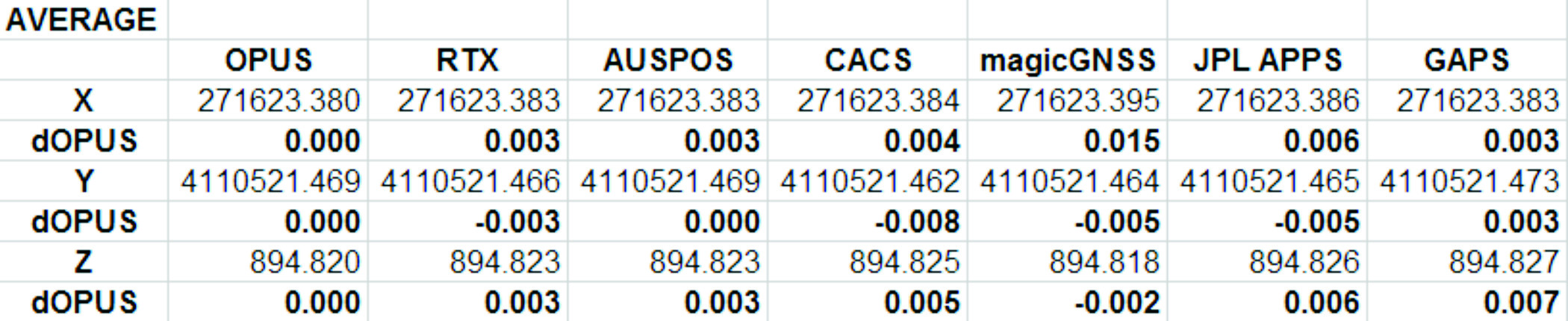
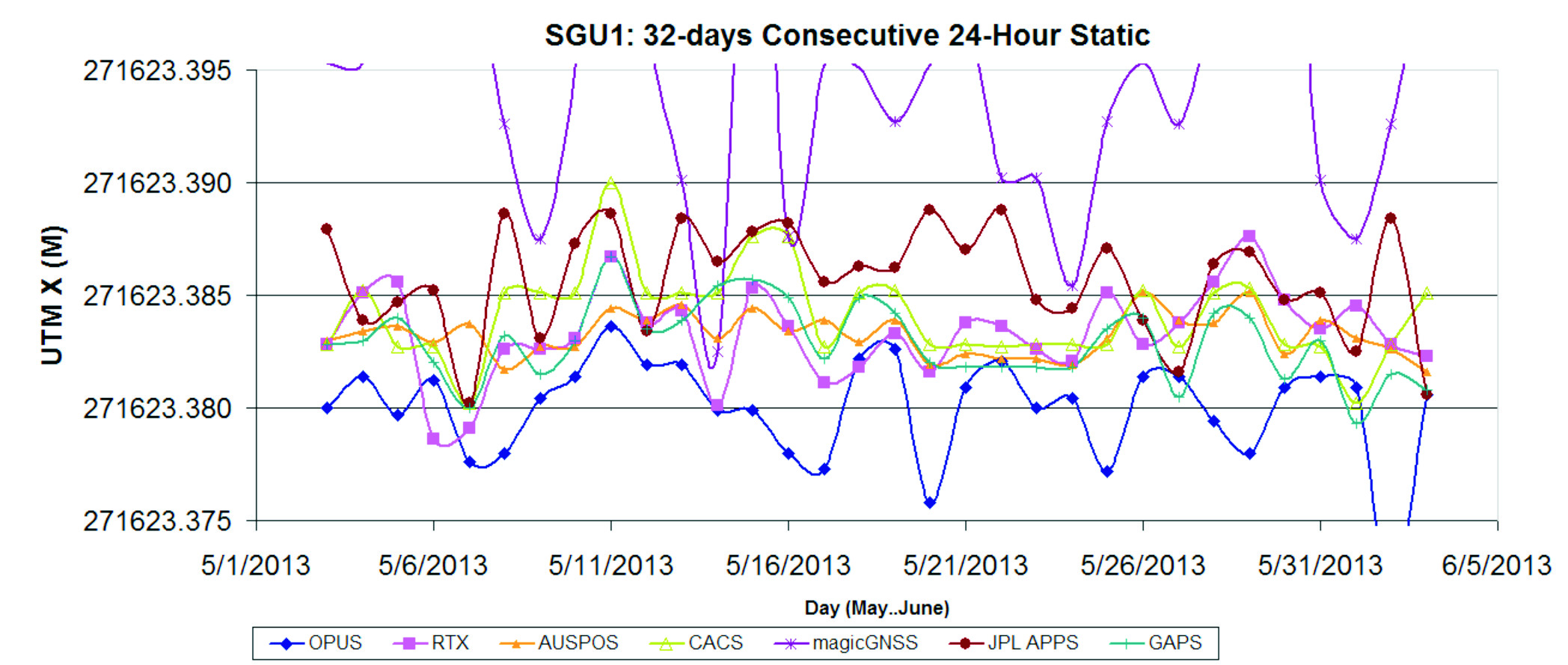
    Last month’s article about post-processing alternatives, “Seven Free Alternatives to OPUS GPS Post-Processing During U.S. Federal Government Shutdown,” was one of the all-time, most-read articles ever published on the GPS World website. It’s ironic because I’m not a fan of post-processing in general. Mind you, I coordinated the development of several post-processing (both L1 and L1/L2) software packages back in the 1990s, so it’s not like I’m afraid to post-process or don’t understand the technology. It’s just that it’s so inefficient compared to RTK. However, I do concede that OPUS, AUSPOS, CSRS, Centerpoint RTX, GAPS, Scout, and MagicGNSS online post-processing tools combined with an increasing number of publicly available, worldwide GNSS reference stations make centimeter-level post-processing a lot easier (and less expensive) than ever before. It seems like a lot of you still prefer it!

    RTK technology is advancing too, from both a receiver perspective and a satellite system perspective. Which geographic region of the world do you think is the most well-suited for RTK positioning?

    It may seem like an odd question, and it would have been to me had I not attended the ION GNSS+ conference in Nashville, Tennessee, in September and the Intergeo 2013 conference in Essen, Germany, in October. How could one geographic region be significantly better for RTK positioning than another? Terrain? Nope. It’s the same country that consumes more L1/L2 receivers than any other country in the world: China.

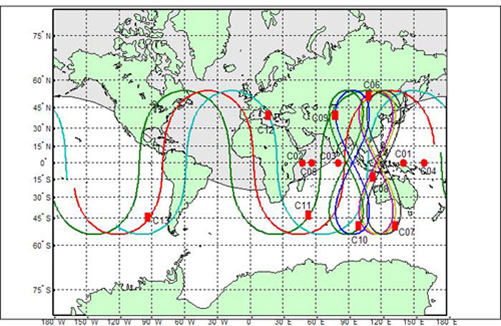
    Why China? A picture (well, two pictures) is worth a thousand words:

    BDS
    BDS (BeiDou) orbit plot.
    Beidou_Navigation_Satellite_System_2012
    BDS (BeiDou) coverage map.

    At this point, China’s BeiDou (now referred to as BDS) navigation system is a regional system. If you look at the above graphic of the BDS satellite orbits, you can see the satellite figure eight orbits above southeast Asia. These satellites, combined with GPS and GLONASS, give the RTK user a tremendous number of usable satellites. Furthermore, since the BDS satellites are in figure-eight orbits, they stay “in view” longer ,which is ideal for RTK.

    The result is that GNSS users in the BDS coverage area have more satellites in view than any other region in the world, and we all know that more satellite observations make for better RTK positioning.

    China’s plans don’t stop with BDS being a regional system. By 2020, China says it plans for BDS to be a global system similar to GPS and GLONASS. The BDS presenter at ION GNSS+ said, “China always regards BeiDou belonging to both China and the world.”

    GPS and Galileo Delays

    Meanwhile, as it seems China is pushing forward, both GPS and Galileo suffered delays last month.

    The fifth GPS IIF satellite (IIF-5) launch scheduled for last month was postponed. A fuel leak in the Delta 4 launch rocket seems to be the culprit. No new launch date has been scheduled for IIF-5. The United Launch Alliance (ULA) issued the following statement:

    “The ongoing Phase II investigation has included extremely detailed characterization and reconstructions of the instrumentation signatures obtained from the October 2012 launch and these have recently resulted in some updated conclusions related to dynamic responses that occurred on the engine system during the first engine start event.

    “The GPS IIF-5 Delta IV launch is being delayed to allow the technical team time to further assess these updated conclusions and assess the improvements already implemented and determine whether additional changes are required prior to the next Delta IV launch.

    “The Delta IV booster for the GPS IIF-5 mission has completed the standard processing and checkout on the launch pad and will be maintained in a ready state for spacecraft mate and launch pending completion of this assessment. A new launch date will be established when the assessment of the updated dynamic response information is completed in the coming weeks.”

    Meanwhile, Europeans have been waiting on pins and needles for the first production launch of dual Galileo satellites. A fall 2013 launch date was expected, but has been postponed until Summer 2014.

    According to European officials, the European Space Research and Technology Centre (ESTEC) thermal vacuum chamber for testing satellites under orbit conditions was not ready for the two FOC satellites delivered by OHB in late summer.

    The satellites thus cannot ship to the Guiana spaceport in South America in time for a planned 2013 launch on a Soyuz rocket. The Galileo schedule is also running into bottlenecks with scheduled launches by other satellite programs aboard Guiana Soyuzes.

    A six-week test of the first Galileo satellite at ESTEC reportedly got under way in October.

    The pressure is rising for Galileo to start delivering usable satellite observations, which China is already doing, albeit for themselves and their neighbors.

    See you next month.

    Follow me on Twitter at https://twitter.com/GPSGIS_Eric

  • Is It Legal to Fly Drones for Mapping in the United States?

    There is no doubt about it: drones (also referred to as UAVs and UAS) are a disruptive technology that will significantly impact geospatial professionals not only in the U.S., but around the world. While the mainstream media has mostly pushed the panic button with regards to privacy and drones, you don’t often read a discussion about using drones for mapping.

    3D Matterhorn image produced from senseFly's drone mapping effort
    3D Matterhorn image produced from senseFly’s drone mapping effort.

    In Switzerland, where drones weighing less than 30 kg (66 lbs) are legal to operate without a license as long as the operator maintains line of sight, drones mapped the famous Matterhorn Mountain (4,478 meters/14,692 feet) in the Swiss alps, at a resolution of 20 cm. This illustrates the power of drones for 3D mapping, and mapping in general. More efficient and less costly than traditional photogrammetry and airborne lidar, there is no doubt in my mind you will begin working with drones and/or data collected via drones in the near future. Of course, mapping the Matterhorn in 3D at 20-cm resolution is a monumental effort. Even using drones, senseFly reported that it took 11 flights, 5 hours and 40 minutes of flight time, and a total of 2,188 images to process covering 2,800 hectares (~6,920 acres). senseFly didn’t report how many manhours of post-processing the Matterhorn project required, but you know it must be a healthy number. Also, remember that Swiss regulations require that the drone operator must be within “direct eye contact” of the drone at all times, so you can bet the senseFly team had to do some serious mountain climbing.

    While generating precise 3D images of a mountain certainly push the limits of drone technology, there are plenty of uses for mapping drones that make a lot of sense and are less complex. The Association for Unmanned Vehicle Systems (AUVSI) reports that in the United States, in the first three years of UAS integration more than 70,000 jobs will be created with an economic impact of $13.6 billion. AUVSI further reports that by 2025, the jobs number will increase to 100,000 jobs, and the economic value to $82 billion. Earlier this year, The Daily Beast reported that agriculture may end up being the largest user of drone technology. Other uses, according to AUVSI, include wildfire mapping, environmental mapping, disaster management, power-line surveys, oil and gas exploration, and general aerial mapping.

    So what are we waiting for? Let’s start flying!

    Not so fast. In many countries in the world, you can purchase a drone mapping kit and start flying tomorrow. Last month, I witnessed the massive offering of drones at the Intergeo 2013 conference. Copters and fixed-wing aircraft in all shapes and sizes were on display.

    20130711_110814   20131010_132907 20131010_132515

    However, in the U.S. it’s not so easy. In fact, it’s illegal to operate any drone for mapping unless you have a special permit from the U.S. Federal Aviation Administration (FAA). If you think XYZ Corp. down the road who is using drones for mapping have such a permit, you are wrong. Despite the rumors and gossip you may have heard, and the fact that many companies are using drones for mapping in the U.S., it is not legal, by any stretch of the imagination.

    Let’s have a look at what the FAA regulations state.

    The FAA divides drone users into two categories: public and civil.

    Public Users

    Examples of public users by the FAA include the U.S. military and U.S. Customs and Border Protection, as well as other government agencies. Public users must apply for a Certificate of Waiver or Certificate of Authorization (COA) and adhere to the following guidelines:

    • The operator is required establish the drone’s airworthiness either from FAA certification, a Department of Defense airworthiness statement, or by other means.
    • The operator must demonstrate that a collision with another aircraft or other airspace user is extremely improbable.
    • The operator must comply with appropriate cloud and terrain clearance requirements.
    • The PIC (Pilot in Command), the operator in control of the drone, must maintain minimum qualifications and currency requirements.
    • An observer must be present to observe the drone and surrounding airspace via line-of-sight on the ground or via chase aircraft.
    • The PIC and observer must be within, generally speaking, one mile horizontally and 3,000 feet vertically of the drone.
    • Direct communications between the PIC and Observer must be maintained at all times.

    As you imagine, these requirements are not easy to meet and issued to a select few entities. if you want to take a look at the list of Certificates of Authorization issued by the FAA, click here and scroll down to find links to redacted CoA awards that aren’t exempt from the Freedom of Information Act (FOIA).

    As of February 15, 2013, the FAA reports there were 347 active COAs.

    Civil Users

    Civil users include any entity other than Public users, and includes commercial users.

    Civil users must obtain an FAA airworthiness certificate just like you would need for any type of aircraft such as an airliner.

    The FAA is issuing special airworthiness certificates in the experimental category for testing, market survey, and training of drones. The FAA is very clear that no Certificate of Authorization (CoA) or experimental certificates will be issued to commercial users. In fact, the FAA specifically states that drone users awarded an experimental certificate are not licensed to use drones for “hire or compensation.”

    That’s it: short, sweet and to the point.

    What about model aircraft users?

    Interestingly enough, model aircraft users are allowed to operate drones and have a surprising amount flexibility in doing so. The guidelines for model aircraft users can be found here, but essentially the only concrete rules are that the “hobby” drone cannot exceed 400 feet AGL (above ground level), and that when flying within three miles of an airport, notify the airport operator. That’s it!

    Even more interesting is that some hobby-class drones can be very useful for businesses. For example, last month I bought an AR Drone 2.o for US$370. The manufacturer calls it a quadracopter. It operates like a helicopter with four rotor blades. It’s controlled by an app that runs on your smartphone or tablet. I use a Samsung Galaxy III to control it. It’s amazingly easy to control with my smartphone.

    AR Drone 2.0
    AR Drone 2.0

    I took the AR Drone 2.0 to the Field Technology Conference to demonstrate it and give conference attendees an idea of what is possible for very little expense. The response from attendees was a little surprising. I didn’t expect geospatial users to appreciate the limited capabilities of the AR Drone 2.0, but attendees spoke of applications like checking birds’ nests for eggs and close-up inspection of structures that aren’t easily accessible. After spending some time flying it, even I began to think about the inspection app and the ability to create video fly-throughs of golf courses, environmental areas, proposed developments, etc. The AR Drone 2.0’s forward-looking, high-definition camera generates stunningly crisp video.

    So, that begs the question…

    Why can’t a user, following the hobby rules (fly below 400 feet AGL), use the AR Drone 2.0 or any other drone for commercial purposes?

    The answer is simple. The FAA rules state that you can use a drone all day long as a hobbyist (following the AC 91-57 rules), but once you start using it for commercial purposes, you are violating the law. Some drone users have said that to skirt the FAA rules, they don’t charge for drone flight time, but just the image processing (data) after the flight. I don’t think this concept has been tested in court yet, but the FAA says this activity is illegal.

    “They would be violating FAA rules,” says FAA Spokesperson Alison Duquette. “Please read this policy link. The FAA recognizes that people and companies other than modelers might be flying UAS with the mistaken understanding that they are legally operating under the authority of AC 91-57. AC 91-57 only applies to modelers, and thus specifically excludes its use by persons or companies for business purposes.”
    To understand how serious the FAA is about enforcing the no-business-use of hobby rules, I asked the FAA for a list of enforcement citations, cease and desist orders, etc. I was told I had to file a Freedom of Information Act (FOIA) request, which I did, but I’m warned by colleagues not to expect a speedy response.
    Check out the following short (three-minute) video news report on a company in Minnesota that was “grounded” by the FAA for flying a drone for commercial use.

    The good news is that in January 2012, the U.S. Congress ordered and funded the FAA to figure out how to integrate commercial drone use into the U.S. airspace by the end of 2015. In September 2013, the FAA released a document entitled “UAS Comprehensive Plan” and a document entitled “Integration of Civil Unmanned Aircraft Systems (UAS) in the National Airspace System (NAS) Roadmap“. If you’re really interested in learning more about drone usage in the U.S. and understand the FAA’s perspective, it’s worth a few minutes to scan these documents.

    It’s going to be fascinating to see what rules the FAA establishes for commercial drone usage. Don’t be surprised if the PIC (Pilot in Command) must be a licensed pilot, and expect tough restrictions on altitude constraints, flight time, visibility, and control tower communications. I have my private pilot license (although I haven’t flown as PIC in years), and I recall that FAA rules state that you can fly as low as 500 feet AGL over rural areas and 1,000 feet AGL over populated areas. That doesn’t give commercial drone operators a lot of room to work with if they want to map a wide area.

    Thanks, and see you next time.

    Follow me on Twitter at https://twitter.com/GPSGIS_Eric.

  • GEOINT 2013: The Conference that Almost Was

    Tampa ConvCenter

    As you would guess, it takes a lot of planning and preparation to put on a technical conference of the scope of GEOINT. So imagine the hand wringing the USGIF staff went through deciding to postpone a conference of about 4,000 attendees and 300 exhibitors because of the untimely government shutdown. There really was no choice, with the majority of federal attendees canceling due to travel restrictions. Without their participation, holding the conference would have been futile. Since the city of Tampa was so accommodating and easy to work with, USGIF rescheduled the conference at the same Tampa venue, April 14-17. They tried their best to minimize scheduling conflicts with other geospatial and USGIF conferences such as the NGA Tech Showcase West (also scheduled for April) and USGIF’s GEOINT Community Week, including Tech Days.

    Prior to a major conference, manufacturers send out press releases and invitations to see new products being shown on the exhibit floor. So, although GEOINT 2013 was postponed, I’m still doing my column as a “virtual conference” report. This is a very broad sample of new developments that I received from vendors who planned to be at the October conference, now rescheduled for April.

    Thermopylae

    Thermopylae Sciences & Technology

    Thermopylae focuses on commercially-based knowledge-fusion capabilities in the geospatial, cloud, and mobile arenas. It has three solutions: iSpatal, a web-based collaborative framework that leverages Google Earth and Maps in a flexible, task-based approach to solve complex problems; iHarvest, a standards-based enterprise analytic service that organizes, analyzes, and reports activities to enable critical decisions; and Ubiquity, a proprietary platform for creating dynamic, customized, and geocentric native mobile applications. Thermopylae is also bringing back the popular Liquid Galaxy immersive virtual-reality display showcasing Google Glass and Leap integration, showing a unified demonstration of all of its products in the Liquid Galaxy display.

    KEYW Corporation

    KEYW’s geospatial capability exploits cyberspace as a domain for collecting, processing, and supporting actionable imagery intelligence to the warfighter and for civilian and commercial uses. The company matches aircraft to mission requirements and modify the aircraft with integrated airborne sensor systems for onboard, geospatially referenced digital imagery collection and processing. KEYW planned to showcase its intelligence, surveillance, and reconnaissance (ISR) imaging and mapping; and its Precision Geo-location via handheld, backpack and mobile solutions, along with several other innovations.

    brocadeBrocade Communications Systems, Inc.

    Brocade provides networking solutions for government agencies and has expanded its product line with a new compact, fanless switch that simplifies network operations. It’s a secure, enterprise-quality network that is responsive to the complex needs of warfighter and civilian missions. The ICX 6450-C switch is deployable outside the wiring closet, without interfering with other critical activities. Using power over Ethernet, the switch can operate in remote locations, where access to an external power source is limited or not available.

    touchshare

    TouchShare, Inc. 

    TouchShare has extended its multi-touch solutions for immersive geospatial collaboration to anyone, regardless of location or device, through the TouchShare Mobile Access. The new TouchShare Mobile Access significantly improves teamwide productivity as it gives all collaborators the ability to simultaneously view and contribute to what other team members are seeing in real-time and interact with visual geospatial information (live data, 2D imagery, video, etc.) via any device. This allows all participants to easily and quickly see the big picture for making better decisions faster.

    Surrey Satellite Technology US LLC

    Surrey Satellite Technology provides small satellite solutions, applications, and services for Earth observation, science, technology demonstration, and communications. Since 1981, Surrey has launched 41 satellites as well as provided training and development programs, consultancy services, and mission studies for NASA, the United States Air Force, Los Alamos National Laboratory, and other institutional and commercial customers.

    GameSim

    GameSim planned to show off its latest version of Conform, a software product for geospatial visualization. Conform imports, fuses and renders LiDAR content in near real time, while offering a variety of unique abilities, including an instantaneous 3D view of raw source data. Users are able to easily import large amounts of data (such as Shape Files, DTED, GeoTIFFs, LIDAR) and immediately view them in both 2D and 3D displays.

    headwallHeadwall Photonics, Inc. 

    Hyperspectral sensing offers advantages over traditional multispectral imaging with respect to the number of spectral bands being covered. Use enhances target recognition, material identification, and elimination of false positive alarms. Hyperspectral imaging yields much more spectral data than multispectral by producing a continuous spectrum of data representing the chemical composition of objects or spectral “signatures” of everything within the sensor’s field of view. Headwall’s Micro-Hyperspec have been miniaturized and optimized for deployment aboard small, tactical UAVs, including small hand-launched versions.

    orbit-all

    Orbit Communication Systems, Inc. 

    Orbit Communication Systems provides ground-station solutions for Earth observation and remote-sensing applications. It has a new product family known as the Gaia series that supports a range of antenna sizes. These ground stations offer an ideal combination of high performance in a compact footprint. “With our new Gaia family, Orbit addresses a void in the market, and opens the door to new Earth observation markets that could not afford to purchase legacy ground stations due to their size and cost,” said Ofer Greenberger, Orbit CEO.

    The antennas are designed to withstand extreme weather conditions and to handle a broad range of applications, operated anywhere on Earth. The series comprises three different sized antennas: 2.4 meters (7.9 feet); 3.7 meters (12.1 feet); and 4.5 meters (14.7 feet). Each antenna supports X-band or S-Band (both transmit and receive) feeds, as well as a dual-band (S&X) feed.

    astrium STRM 90

    astrium WorldDEM

    Astrium Services

    Astrium’s Street Factory, an advanced 3D urban mapping solution, was awarded “most valuable product in the geo-information field 2012” at the World Geospatial Developers Conference. Building on that success, Astrium planned to demonstrate WorldDEM, a high-resolution elevation data set that covers the Earth’s entire land surface, pole to pole. The accuracy of the German high-resolution radar satellites TerraSAR-X produces data intended to replace SRTM data. It has excellent ground-position accuracy with vertical accuracy of 2m (relative) / 10m (absolute) in a 12m x 12m raster GSD. WorldDEM will be available in 2014 with data less than 2.5 years old. Shown above is a comparison of STRM 90 elevation data compared to WorldDEM.

    epson 2

    Epson Plotters

    Ever since my experience supporting Katrina recovery efforts, I’ve be a strong advocate for simple low-tech hard-copy imagery plots overlaid with vector data to support emergency responders. Many times this low-tech embodiment of our high-tech capability suits the needs of first responders better than computer displays. However, paper plots ideally need to be laminated on foam core to be useful in wet and windy environments. Epson has one solution, a plotter that prints on ridged media. Epson engineers developed the SureColor T-Series printers with an all-new design that prints directly on ridged substrates that have a thickness of 1.5 mm. This is especially important to agencies that have a need for fast print output on thick media eliminating the hassle of laminating or marrying to thicker carriers for immediate use. The SureColor T-series also features Epson UltraChrome XD pigment-based ink technology for smudge and water-resistant prints.

    This is just a sample of the nearly 300 exhibitors that will be at GEOINT in April. I’ll bet you thought that GEOINT was just imagery and big data. Quite the contrary — it takes a lot diverse players and pieces to build a strong GEOINT capability.

    epson

  • Out in Front: Tell the Truth, Now

    Here are a few things about your colleagues that perhaps you did not know: they are a quite colorful, varied, and shall we even say motley crew. Hidden backgrounds came to light during the magazine’s Leadership event in Nashville, during a game called “Guess Who’s Spoofing the Dinner?” One person at each table, secretly recruited in advance, lied freely in response to three questions, while everyone else was bound to tell the strict truth. The table then had to identify the spoofer in their midst.

    The truths turned out to be stranger than the fictions. As ever. This is what’s known, appropriately, as a truism.

    The questions posed:

    • What is the farthest from your birthplace that you have traveled?
    • What was the shortest time you ever held a job? What job?
    • Who is the most famous person you have met?

    One person had met Hillary Clinton, another the first lady of China, and two people had met the Queen.

    One met Janis Joplin (throwing that table into a total tizzy), another had an audience with two popes, Benedict and John Paul II (not simultaneously), while yet another had met John Paul II and Sophia Loren (again, presumably, not on the same occasion).

    But the most elevated encounter was described by a soft-spoken gentleman who taught the Dalai Lama to play frisbee. His Holiness had never done, and evinced some curiosity as to how it worked.

    Janis Joplin’s crony claimed his shortest employment was installing fire alarms at a Catholic home for girls in a delicate way in the early Sixties. His table declared him the spoofer. But they were wrong. They were wrong.

    The shortest employment for one engineer at the dinner was also his longest, not to mention his most current: 30 years. He has never held another job.

    One young researcher worked briefly as a shepherdess, until getting trampled by a flock of sheep. Imagine your lab-coated colleague in a long white frock, ruffled cap, and crook stick.

    In their travels, folks had reached Tierra del Fuego, Tasmania, Everest Base Camp, China (and conversely, Nashville from China by a select few), and Capetown, South Africa, but the furthest flung had landed on Antarctic ice in a Hercules C-130, on skis.

    Ironically, one travel tale was challenged not because of the furthest destination but the start point. A well known GNSS scientist vowed that he came from Texas, but a gentleman from the European Commission — the same who had met John Paul and Ms. Loren — doubted this severely, because the teller did not sport cowboy boots nor a big belt buckle. Worse, he could not recall what Sam Houston’s boys cried out as they went into the Battle of San Jacinto, winning glory and Texas independence.

    Italians, it seems, are quite well versed in Texan history.

    There is a lesson in this for all of us, though our scientist claims it’s all just an invention of  the movies.

    Remember the Alamo!

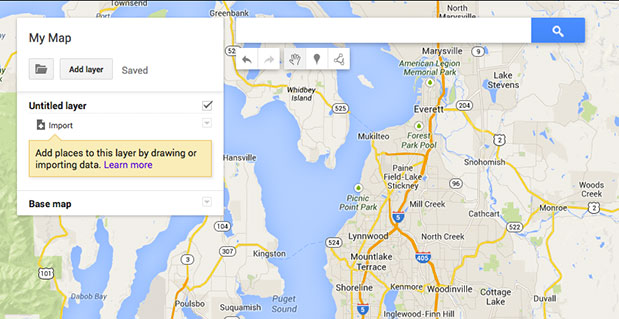
  • Google Rolls out Maps Engine Pro for Small Businesses

    Google Rolls out Maps Engine Pro for Small Businesses

    Google-Map-O

    Google Maps aren’t just for finding directions for consumers. The company is courting small businesses to grab a greater market share and provide differentiation from its competitors. In a slow news month, it appears Google, the 800-pound gorilla in the location industry, has a strong start in business markets.

    Google’s recent decision to roll out Maps Engine Pro, its software that allows small business to use the company’s location tools to create maps from location databases, is a solid step in the business-to-business market. However, the company also said there will be a mobile application for Maps Engine Pro, called Google Maps Engine, which will allow small businesses and users to edit and create maps while mobile.

    Companies can use the app to optimize personnel and assets, build mapping apps, and create internal and external maps that use data layers to make business decisions. Depending on licensing, Maps Engine Pro costs $5 per user, per month — or $50 per user, per year.

    One reason to roll out the enterprise product: Brian McClendon, vice president of Google Maps, said that there are 1 billion monthly active Google Maps users, making the business product familiar to companies who want to plot location data.

    Magnetic Indoor Positioning? 

    Although much-hyped in the last two years, most indoor positioning has been powered by both GPS and Wi-Fi positioning in most tests and rollouts worldwide. However, a startup called IndoorAtlas, which recently opened an office in Sunnyvale, California, and partnered with Finnish grocery chain Fonella, according to published reports, is using magnetic technology via compass chips in smartphones.

    Rather than using Wi-Fi signals to triangulate a device’s location, IndoorAtlas tracks differences in the Earth’s magnetic field to pinpoint location within a building. The magnetic field is all around most objects and animals. On the company website, this tidbit is found: “Many animals utilize local variations in the Earth’s magnetic field to find their way around. These magnetic variations commonly exist inside buildings as well. Many sources can contribute to these variations including Earth’s magnetic field, and the structures of the building. Modern smartphones can sense and record these magnetic variations to map indoor locations.”

    IndoorAtlas’ technology doesn’t require additional infrastructure like wireless access points, so the technology can be used by retailers. Other markets include search and rescue, museum tours, and a navigation aid for disabled people.

    Location Companies Going After Higher End Markets As Commoditization Settles In      

    As location technology, specifically GPS, becomes more of a commodity as many industry observers say, companies are looking at higher-margin market segments. For instance, Garmin, which has seen the portable navigation device market decrease, has been focusing on more expensive and specialized products.

    While still a big business for Garmin, PNDs’ market share has been eroded by tablets, smartphones — and even expensive installed telematics systems, which have grown with the connected vehicle’s rise.

    Garmin has offered several different types of high-end watches for swimmers, pilots, runners, golfers and others in the outdoor market. The newest entry is a $450 watch called Tactix, which any Navy SEAL could love. It features an altimeter, barometer, and jumpmaster software for airborne operations, and it’s even waterproof to a 50-meter depth.

    LBS Insider to Cover CES in January

    LBS Insider will be on site in Las Vegas to cover the huge Consumer Electronics Show. At CES, the connected vehicle market continues to be showcased. In published reports, Scott Keogh, Audi USA president, said that the company will make announcements about Audi Connect at the show.

    T-Mobile US provides 3G connectivity to Audi’s Connect service in the United States through an embedded SIM in the car’s dash. T-Mobile’s plan, which includes Wi-Fi for as many as eight devices, is offered to new and existing owners of cars equipped with Audi Connect. It costs $450 for data services for 30 months — or users pay $30 per month if they select the month-to-month option. Some of the features includes access weather, real-time news and fuel prices. Both Google Earth and Google Voice are offered.

    At CES, the LBS market has been de-emphasized by wireless carriers in the past three years.  Instead, most location-related panels have been dedicated to connected vehicles.

  • New Ways to Track Mobile Users

    New Ways to Track Mobile Users

    Companies like Drawbridge indentify a user's devices across platforms.
    Companies like Drawbridge indentify a user’s devices across platforms.

    In the location business, we used to talk about tracking — namely, vehicle tracking.  We stopped using the term as it sounded too close to Big Brotherism. Vehicle and employee tracking is much more prevalent today, but we have delicately renamed it “mobile resource management.”

    Tracking is back in the news, and it is rightfully being called what it is, tracking. You may have seen the New York Times article about new ways people are being tracked via their mobile phones and other devices.

    Tracking mobile phone behavior hasn’t been prevalent, because mobile apps don’t use cookies, the small files that can watch our behavior on our desktops and laptops. This has changed. Now Internet advertising companies like Drawbridge are using powerful algorithms to analyze anonymous browsing patterns on devices and look at the dates and times, location and websites visited, and user activities on sites. The companies can determine that a mobile phone, home computer, work computer and tablet belong to the same person.  The devices do not need to be connected for the match to be made. In a household full of people and devices, these companies can even distinguish among users.

    This isn’t in its infancy. One company alone says it has matched 1.5 billion devices this way. The incentive of the industry is to arm advertisers with behavior knowledge to enable hyper-personalized ads on the device that makes the most sense. The ad may be delivered on one device based on a person’s activity on another device. For instance, Greg is looking at a website for basketball shoes at his computer at work. He goes home and gets an ad for those shoes on his tablet, and it maybe a hyper-local ad for a store where he often shops. The ad may come at a time that he is primed to shop, on the device he will likely be using then. Mobile advertisers that are  exploiting this data include Drawbridge, Flurry, Velti and SessionM. Companies that are advertising based on this mobile tracking data include Ford Motor, American Express, Fidelity, Expedia, Quiznos and Groupon.

    As we know, phone data is not the sole interest of commercial companies. It is of interest to the government as well. This month, the National Security Agency (NSA) admitted that it was tracking the location of the U.S. population. Between 2010 and 2011, the NSA used cell towers to locate Americans. The NSA claims that it obtained the data, but didn’t use it.

    What’s next? There is something left that mobile advertisers still haven’t figured out. They have no sure way to know the results of an ad placed on a mobile phone. Has the person viewed the ad and gone to the website on their computer, or walked into a store and placed an order?  It probably won’t be a mystery for long.

  • Esri User Conference and Intergeo: Mobile Devices, UAVs and High-Precision GNSS

    When looking at geospatial technology, I like to use the analogy that GIS software is the engine and GIS data is the fuel. We have many choices of powerful GIS software engines (Esri, Intergraph, QGIS, GlobalMapper, MapInfo, etc.). That technology remains relatively unchanged. Before the software vendors harp on me, yes, I get that new bells and whistles are added to software every year to enhance software functionality. Yes, maybe there’s a new database technology that indexes massive databases significantly faster. Yes, maybe there’s a new software tool that makes generating 3D visualizations or augmented reality much easier and faster. But just like your automobile, motorcycle, train, airplane, etc., they all need fuel to run. Data is the fuel.

    The analogy doesn’t fit perfectly. After fossil fuels are used once, they are not reusable. Obviously, that’s not the same for GIS data. Some GIS data, like street data, is used daily over and over again by millions of people around the world in their Garmin, TomTom, and Magellan auto navigation units. However, in the fossil-fuel world, engines and fuel are matched reasonably well. In the geospatial world, the engines and fuel aren’t matched. The GIS fuel (data) is far behind the engine (software). In other words, GIS software is starving for data. There are so many applications for GIS yet to be realized, and vast majority of the unrealized apps are due to the lack of data.

    For example, imagine carrying your iPad (or other tablet) in the street and pointing it down at pavement. Imagine, on the screen of your iPad, being able to “see” all of the infrastructure underneath the pavement such as water lines, sewer lines, and communications lines. What’s keeping those types of apps from being deployed today? The answer: the lack of accurate geospatial data.

    The lack of geospatial data is no more apparent than at the 2013 Esri International User Conference in July and the Intergeo conference in Germany earlier this month.

    In the exhibition areas, three trends were clearly apparent:

    1. Mobile devices

    2. UAVs

    3. High-precision GNSS receivers

    Clearly, all three of these are related to collecting GIS data.

    Following are some comments and photos of each trend.

    Mobile Devices

    A few short years ago, mobile devices suitable for GIS data collection were a specialty item, and we had a few limited choices. Ever since the smartphone explosion and Apple introducing the iPad, it’s been mobile devices galore. A tremendous number of consumer mobile devices have been introduced. Most have failed, but the trend has generated a tremendous amount of R&D effort that manufacturers have leveraged to make industrial mobile devices for the geospatial community, such as the following:

    Hi-Target

    HandheldUS

    Carlson

    Altus

    Most, if not all, of these devices are designed and manufactured in China.

    20131008_125155
    Juniper Systems is one of the few remaining U.S.-based rugged handheld manufacturers, introducing the new Archer 2 at Intergeo.


    UAVs

    There’s no denying that UAVs are going to play a large role in geospatial applications. In some geographic regions of the world, they are already being deployed for mining, agriculture, accident reconstruction and other mapping applications. The low-cost and and quick, convenient deployment make it a very attractive technology for time-sensitive and cost-sensitive applications that require imagery.

    In the U.S., it is illegal to use UAVs for commercial applications unless you have a Certificate of Authorization from the Federal Aviation Administration (FAA), which are only granted to some universities and some government agencies. President Obama ordered the FAA to generating guidelines for integrating the use of commercial UAVs into the U.S. airspace by 2015. For the latest FAA progress on matters regarding UAVs, you can visit this FAA web page.

    The current FAA rules are a bit odd. In the U.S., you are allowed to fly “hobby” UAVs up to 400 feet above the ground if you’re at least 1/4 mile away from an airport. If you take that same UAV and abide by the same restrictions as hobbyists, but use it for commercial purposes, it’s illegal. Take a look at this article by NBC News.

    20131010_132515

    20131010_132907

    20131010_132726

    20130711_110814


    High-Precision GNSS Receivers

    I’ve been writing about this for awhile, but it’s worth mentioning that RTK GNSS receivers are getting cheaper and cheaper. Whereas in the past, there have only been a handful of RTK GNSS receiver vendors, there are now at least twice as many as before, and increasing every year. This is good for the user community because it increases competition. The result is better products at lower prices. This trend will continue.

    20130710_103040

    20131008_115224

    20131008_142213

    20131008_123027

    20131010_131123

    20131010_123915

    20131008_163050


    NSPS (Formerly ACSM) Radio Hour

    Last week, I was a guest along with David Doyle (retired NGS Geodesist) on the NSPS Radio Hour discussing a variety of GNSS-related items such as the U.S. federal government shutdown and LightSquared. A recording of the radio show is available in MP3 format. You can listen or download it here.

    Thanks, and see you next time.

    Get the latest news by following me on Twitter at https://twitter.com/GPSGIS_Eric.

    Photos: Eric Gakstatter


  • Decisions, Decisions: GeoGathering and ION GNSS

    Decisions, Decisions: GeoGathering and ION GNSS

    Many may consider it a distinction without a difference, but quality matters, whether it concerns a life-changing decision or something as simple as which conference to attend. When resources are scarce, making the right decision, or sometimes just making any decision, matters — for many in our government this paradigm should reign supreme.

    Over the past 24 months, it seems there have been more conferences and symposia that depend on government attendees cancelled or postponed than there have been quality events to attend. Politics aside, the U.S. government’s fiscal woes, which include sequestration and the latest partial U.S. government shutdown, are merely endemic of a much greater problem. Decision makers are unable to make decisions, negotiate or even consider compromise, and the last time I checked, decisions, indeed quality decisions, are critical to the success of any endeavor, be it government or business.

    More than 2500 years ago, Pythagoras (yes the Pythagorean Theorem mathematician) said Choices are the hinges of destiny,” and make no mistake about it, the decision to not make a decision or the inability to act is still in the end a decision, just not an action or non-action of which one should be proud. And this inability to make a decision still affects your destiny today or our destiny where Congress is concerned. William James may have been thinking about the U.S. Congress when he said, “When you have to make a choice and don’t make it, that in itself is a choice.” Actually, my secretary summed it up nicely, extolling her frustration with our do-nothing Congress, “…in the end if I conducted myself as your employee the way Congress has conducted their affairs for the last 24 months, I would no longer be in your employ. You would have fired me long ago.”

    Fortunately, for the rest of the world, there are people who seem capable of making momentous decisions on a daily basis — imagine that. And despite what the entrenched U.S. Congress doesn’t decide, the world does go on, even as the somnolent U.S. government shuts down and irrationally decides not to allow government employees and the military to attend critical conferences or symposia. Since Congress can’t do anything, it appears they want to mandate that everyone else emulate their indecisiveness. Despite the governmental ennui, there are some bright spots. In the last two months I had the pleasure of attending two separate conferences concerning GIS, GPS, GNSS, and PNT respectively that I highly recommend for your consideration. As I said earlier, quality matters, and both of these conferences have quality in abundance, especially in the areas of planning, presentations, location and attendees.

    GeoGathering

    As the comfortable, casual name implies, GeoGathering 2013 was more of a gathering than a full-blown mega conference, but then, that is also what sets this event apart. Especially from the National Space Symposium, which also takes place in Colorado Springs at a major resort but which draws more than 10,000 participants.

    GeoGathering 2013 managed to gather ~150 GIS participants from around the globe, and in its own way was just as informational as many larger events. The four-star venue was outstanding, as the Cheyenne Mountain Resort has always been a laid-back location with restaurants and ambiance almost second to none. GeoGathering played out comfortably, with little stress, over two days, 21-22 August, during which the Rocky Mountain weather graciously cooperated.

    The event was subtitled “GIS for Gathering and Production Lines,” which simply means it was primarily about gathering and using GIS data and meta-data successfully in a business environment. If that sounds a bit dry, in actuality it was a wonderful conference, since the prime ingredient for any successful conference is the people and the venue. Both were outstanding. The networking time between speakers and panels made for a very productive two days. I highly recommend this conference for those interested in anything to do with GIS (geographical information systems). GeoGathering 2015 will be held somewhere in Colorado, and right now you can influence that decision by going to the GeoGathering website and voting on a location. See you there.

    ION GNSS 2013

    Institute of Navigation Global Navigation Satellite System Symposium

    The first question I typically hear when I mention the acronym GNSS in a non-PNT-oriented crowd is “What is GNSS?” GNSS stands for Global Navigation Satellite System(s), and is the standard generic term for satellite navigation systems that provide autonomous geospatial positioning, and sometimes time and frequency data, with global and/or regional coverage. This oft-used term has expanded to include GPS, GLONASS, Galileo, BeiDou and other regional or global PNT systems. And for me, there is no better global technical GNSS event than the annual ION GNSS symposium. For the last two years, with an attendance figure of about 1,000 per year, this seminal event has been held in Nashville, Tennessee. Next year and the following year, ION GNSS moves to Tampa, Florida, the home of our elite military special forces.

    If you would like the bottom line up front, several years ago I penned a review of the ION GNSS event and it went something like this: “The ION GNSS Symposium is simply the best international technical symposium on GNSS that exist today, bar none.” Frankly, my opinion has not changed. The GNSS symposium has not changed in quality, even though the U.S. military participation has dwindled significantly due to circumstances detailed earlier in this column, but in many ways the symposium continues to improve.

    The venue for the last two years was the Nashville Convention Center in Nashville, Tennessee — or Music City, as those of us in the U.S. know it — and it was a great location. This year, there were also FOUO sessions, which were extremely interesting, but because of the classification, I cannot say much more in this medium. The FOUO sessions were essentially a hold-over from the ION Joint Navigation Conference (JNC) event that was canceled earlier in the year due to the last-minute lack of participation by government participants. However, Lisa Beaty, the executive director for ION, assured me that the JNC 2014 event will take place come h*** or high water.

    The new ION Military Division, which is headed by my long-time friend and colleague Jim Doherty (USCG, Ret), a former president of ION, now sponsors the Joint Navigation Conference, which is billed as the largest U.S. military navigation conference with joint service and government participation. The event focuses on technical advances in guidance, navigation, and control (GN&C) with emphasis on joint development, test and support of affordable GN&C systems, logistics and integration.

    ION describes the JNC event as a conference that includes technical exhibits that showcase guidance, navigation and control technology products and services as well as operational products and demonstrations. With a decidedly operational perspective, the conference focuses on advances in battlefield applications of GPS, critical strengths or weaknesses of fielded navigation devices, warfighter PNT requirements and solutions, and navigation warfare.

    As I mentioned, JNC is the annual ION event that normally features the FOUO U.S.-only presentations. Next year, ION JNC conference attendance June 16-18, 2014, is controlled by the Joint Navigation Warfare Center (JNWC) and is restricted to U.S. citizens only. The classified sessions on June 19, which typically feature a warfighter panel, which I have had the honor to help populate for the last several years, will feature 4-eyes access for citizens of the U.S.A., Australia, Canada and the United Kingdom. All participants must establish a need to know and be approved by the Joint Navigation Warfare Center security office. The 2014 Joint Navigation Conference takes place at the Renaissance Orlando at SeaWord in Orlando, Florida.

    But that is JNC next year and I digress, so let’s get back to this years ION GNSS symposium. The amazing feature of this event is that you can literally attend a presentation on any aspect of GPS/PNT that you can name. For example, I wanted to attend specific presentations on: GPS time, PNT frequency stability, PNT atomic reference systems, L2C, L5, AEP, OCX, L1C, M2PS, and M-code, as well as jamming and spoofing mitigations. The problem, of course, is that there are numerous presentations on these topics, and many of them occur simultaneously.  You have to carefully plan your time, and I frequently found myself, along with many others, sprinting from presentation to presentation. I did not want to miss anything, and I can truthfully say there are very few conferences where this is the case. The ION Papers Committee does a great job screening the papers and making sure they are relevant.

    Plus, one of the best perks of being an official ION member is that, in case you miss a presentation, the symposia papers are all available online at the ION site within just a few days of the event.

    Don Jewell visits the Exelis table at the GPS World Leadership Dinner.
    Don Jewell visits the Exelis table at the GPS World Leadership Dinner.

    Galas and Awards

    The after-hours highlight of the ION GNSS event every year is the GPS World Leadership Dinner or gala, which includes the GNSS Leadership Awards. Only 150 guests may attend, by invitation only, because there are typically more than 1,000 attendees at ION GNSS. This has become one of the “must-attend” events. This year, both Exelis and Lockheed Martin sponsored the dinner along with GPS World, and we are grateful for their sponsorship. Each GPS World editor nominates 10 guests, so be nice to your favorite editor this year and, who knows, maybe you will be among the elite next year (hint, hint)!

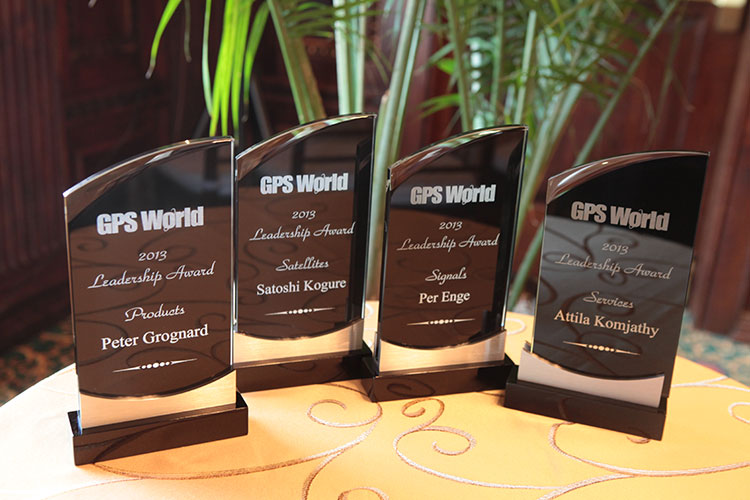
    The GPS World 2013 Leadership Awards.
    The GPS World 2013 Leadership Awards.

    This year, as last, the gala was held in the sumptuous ballroom of the Hermitage Hotel in Nashville, which was built in 1910, exudes Southern charm, and is dedicated to General and President Andrew Jackson, a true son of the South. Harking back to our earlier theme concerning decision-making, President and General Andrew Jackson made many difficult decisions in his tenure and one of his greatest quotes certainly applies:

    “Any man worth his salt will stick up for what he believes right, but it takes a slightly better man to acknowledge instantly and without reservation that he is in error.” — Andrew Jackson

    image003And if you can’t quite remember your history, just pull out a $20 bill and there he is.

    The food and camaraderie were outstanding as usual. The evening’s entertainment, which is always provided in the form of an original Alan Cameron game that has dinner guests participating in a novel event, this year was based on a clandestine “spoofer” at each table that had to be identified by Q&A only. It was a fine and fun evening, and for the award winners, it was a special evening. Four awards were given this year, to Satoshi Kogure, Attila Komjathy, Peter Grognard and my good friend Per Enge from Stanford. Congratulations to all the award winners — you never know, you could be a guest or an award winner next year. (A full report on this year’s dinner and awards will appear in the December issue of GPS World.)

    ION Kepler Award

    ION GNSS also presents prestigious awards at this event. This year, the coveted Kepler Award went to a good friend and colleague Dr. John Betz.

    Dr. John Betz, winner of the ION 2013 Kepler Award.
    Dr. John Betz, winner of the ION 2013 Kepler Award.

    Now, the ION GNSS awards committee keeps the name of the award winner totally secret, in a mayonnaise jar on Funk and Wagnall’s front porch. No wait, that’s another award, but they do keep it a closely held secret — so close, in fact, that this year’s award winner’s wife was not in attendance, even though she made the trip with him. So, while I had no idea who would win, I did happen to be sitting at Dr. John Betz’s table, right across from him, when the hints were announced by Dr. Jade Morton, the ION Satellite Division Chair and therefore also the luncheon and award master of ceremonies.

    You see, there is a long-held presentation tradition associated with this award. No one knows who has won the award, but the announcement is not just blurted out. Rather, there are about ten hints given about the identity of the person. As the identify of the winner becomes apparent to those in the room, they are asked to stand up, signifying they have determined the identity of the award winner. It was clear to me who had won with the first hint, and of course it was clear to Dr. Betz as well. It was very interesting to watch his facial expression as he realized he had finally won. It dawned on him, and then there was a slight smile, but at the same time a very humble expression.

    Dr. John Betz, a MITRE and ION Fellow, certainly deserves this award, and indeed, has deserved it for some time, so it was great to see his considerable accomplishments recognized. And, BTW, remember that you heard it here first: John is working on a book about GNSS that should be published in the next six months. It is not an edited volume, but rather an original work by Dr. Betz, and I for one can’t wait to read it. You can bet I will review it here at GPS World. Congratulations, John.

    The other outstanding features of ION GNSS are the excellent and numerous exhibits, plus the time allowed between sessions that provide an excellent atmosphere for networking. And the excellent Nashville Renaissance Hotel, which is attached to the Nashville Conference Center, provided numerous quiet and semi-secluded locations for extemporaneous meetings and is a networking friendly location. The restaurants were excellent, as was the ubiquitous Starbucks barista-manned coffee shop located in the hotel. In other words, Lisa Beaty and her team always manage to choose an event location with accommodations and amenities perfect for this event. I am looking forward to next year in Tampa. Hope to see you there.

    What Is Don Reading?

    Both books reviewed this month came to my attention because, contrary to the old adage, I was able to tell a good book by its cover.

    Phantom, by John Bell.
    Phantom, by John Bell.

    Phantom
    An Adventure Novel by Ted Bell

    This is a singular novel, frighteningly prophetic in many respects and virtually unprecedented in the multitudinous grappling-hook approach employed to entice the reader. This is not a criticism, merely an observation, as I obviously thoroughly enjoyed the yarn.

    Many novelists “set the hook” by using the old standby, “It was a dark and stormy night…the wind howled, lightning flashed.” Many novelists hook you with rollicking train stories, or Romanoff tales of excruciatingly frigid White Russian winters with Tsars, Tsarinas and Tsarvitches. They hook you with stories of beautiful bounding yachts or fancy racing cars. Or, in the late Tom Clancy style, they hook you with stories of Air Force One and the president versus terrorists, or of course the most modern genre hook concerns terrorism in any guise. In Phantom, Ted Bell does not pick just one of these hooks, he includes them all and more. It is a riveting high-action drama that will keep you turning pages late into the night. The cherry on top of this action-filled sundae of a novel is that the story is really about Singularity (with a capital S), which Ted Bell and many computer scientists today define as “that epic moment in human evolution when artificial, or machine, intelligence (in the form of extremely powerful, superhuman computers) first matches and then exceeds human intelligence by a factor incalculable.”

    Author Ted Bell.
    Author Ted Bell.

    In other words, this novel is about all the hooks mentioned, plus it foretells a time when computers obtain parity with and then rapidly exceed human intelligence. Now, if that is not a hook, I don’t know what is. If you are wondering how Ted managed to pull it all together, you will just have to read the book. You won’t be disappointed.

    Remember, I was hooked by the cover, and it was not the picture of the beautiful yacht on the cover but rather the quote: “Ted Bell can really write” by James Patterson. Hook, line and sinker.

    West with the Night, by Beryl Markham.
    West with the Night, by Beryl Markham.

    West With the Night
    An Autobiography by Beryl Markham (1902-1986)

    The aviation enthusiasts among you may be scratching your heads and thinking, “Wait a minute, where have I heard the name Beryl Markham?” Beryl initially gained fame and notoriety not as a novelist but as a Kenyan-born British aviatrix in the tradition of Amelia Earhart. Indeed, Beryl was the first solo aviatrix to fly the Atlantic eastbound in the pioneering days of aviation. She was also an adventurer and renowned (the first female) racehorse trainer in Kenya, or in all of Africa, for that matter. She married three times, conducted numerous affairs, and was anything but conventional in most every aspect of her life. And, of course, she could write, and write very well. Many of her thoughts are so riveting and presented in such a unique way that you may find yourself going over them again and again just to experience the sheer beauty of her prose. The autobiography covers her early life and upbringing in Africa, and it is a tour de force of the written word. But don’t take my word for it, because this is the quote that caught my attention on the cover of this incredibly well-written piece of literature, that in my opinion should be required reading in every English Literature class today.

    Beryl Markham in 1936.
    Beryl Markham in 1936.

    “Written so well, and marvelously well, that I was completely ashamed of myself as a writer…[Markham] can write rings around all of us who consider ourselves as writers…It is really a bloody wonderful book.” — Ernest Hemingway

    Until next time, happy navigating. Now, go register for a PNT conference, and then go read a good book.


  • ION GNSS+: A GISP Peeks over the GPS Wall

    By Art Kalinski, GISP

    Last week I attended the ION GNSS+ Conference (Institute of Navigation / Global Navigation Satellite Systems) in Nashville, touted as the largest GNSS conference in the world. Although Geospatial Solutions is closely aligned with GPS World, my focus is on GIS, and like most GIS people, we look at GPS devices as data collection tools and most of us don’t get heavily involved with the workings of the equipment or GPS community.

    Since I only live two hours away from Nashville, my editor, Alan Cameron, invited me to attend so I could meet the GPS World staff and peek over the wall into the GPS community. It was time well spent, since I was exposed to the ongoing evolution and problems being addressed by the GPS community, which seems to have a higher percentage of Ph.D.s than any other conference I’ve attended. There was a lot of hardware and software outside my realm of experience, so some of my observations may be simplistic or old news to some of you. Please bear with me as I share topics that I believe may be of interest to the GIS community.

    From Learn Celestial
    From Learn Celestial

    GPS Basics and History

    For starters, GPS is just a modern tool to do global navigation, not much different from when I was doing celestial navigation on a Navy destroyer in the ’70s and ’80s. The concept is fairly simple, although the execution is not.

    Every star in the sky is fixed in space with an observer on earth either at the nadir point where the star is directly overhead at 90 degrees or most likely somewhere between 90 degrees and the horizon, 0 degrees. A sextant is used to measure that angle, and all possible points at that angle describe a unique circle on the Earth where that measurement can exist. Intersection of two other star circles can then locate a unique point on the earth. This sounds simple in theory, but the actual process is not, since the Earth is constantly rotating, wobbling and moving through its annual orbit. Additionally, cloud cover can obscure the stars, and rough weather can make precision observations all but impossible. Then, after shooting the stars, over an hour of work was required looking up data in celestial tables and doing tedious computations to get each line of position.

    British Atmospheric Data Centre (BADC).
    British Atmospheric Data Centre (BADC).

    Early electronic navigation systems such as Omega and Loran C helped made some navigation a bit easier. They used time delay and phase shifting between radio transmitters to create hyperbolic lines of position between two transmitters. Three transmitters produced two sets of lines, and the intersection was your position. Both celestial and early electronic navigation were not very accurate and not particularly easy to use. Both were phased out in favor of GPS, which sort of combines the concept of celestial with electronic navigation.

    GPS even uses the term a “constellation” of satellites. The satellites provide very exact position information to GPS receivers, which calculate the observer’s position similar to celestial fix. Additionally, accurate and precisely measured time is so important that scientists actually take into account the theory of relativity and dilation of time caused by the very fast travel of GPS satellites to have system accuracy that is adequate.

    New Players

    GPS was developed in the ’60s and ’70s by the U.S. military, but opened to civil use by Ronald Reagan after the shooting down of KAL flight 007 by the Soviet Union. They thought the 747 was spying, but in reality the inaccurate navigation systems erroneously put the civilian airliner into Soviet airspace. In the late ’90s, the U.S. Navy moved to GPS and away from traditional celestial and land-based electronic navigation because it was so tedious and prone to errors. However, there are second thoughts about complete reliance on GPS. The Naval Academy and Navy navigation school currently teach a shortened celestial course using a sextant and specialized calculator that performs the complex and tedious calculations.

    Although GPS was developed by the U.S. military, there are other players — the Russian GLONASS system operational in 1995, the more recent European Galileo, Chinese Compass (now called BeiDou,) and soon India’s IRNSS and Japan’s proposed QZSS. What that means for us users is cheaper systems with greater accuracy, redundancy and better coverage.

    RTK (Real Time Kinematics)

    Several years ago, RTK satellite navigation was developed to enhance the precision of GNSS, usable with GPS, GLONASS and/or Galileo. Rather than relying only on the GNSS position information, the RTK system also uses phase measurements of the GNSS carrier signals and combines that with a single or network of ground reference stations, similar to Differential GPS, which provides real-time corrections with centimeter-level accuracy. RTK hardware is becoming ubiquitous, and prices are dropping dramatically. A new entry, Piksi by Swift Navigation, is promising a complete RTK system suitable for UAVs for less than $900.

    Geodesy and MSL

    I never had a strong interest in geodesy, but talking to Kevin Kelly, ESRI’s geodesist, I was surprised to learn that something as basic as mean sea level is being challenged by GPS measurements. There has been a concern for years that the universally used datum has numerous intrinsic errors (See an ESRI paper for more information). The errors are caused by local conditions such as variations in the Earth’s gravitational field, sea currents, air-pressure variations, temperature and salinity variations, etc. Scientists are looking to move from MSL to a GPS-generated gravity model to serve as a more accurate datum.

    Indoor Location Technology

    I’ve had a long-term interest in indoor location technology after learning how critical the need was in tracking first responders inside buildings. Two years ago, I wrote about a promising device by NAViSEER that combined GPS with a new microchip-based IMU (inertial measurement unit). The IMU contained three accelerometers and three gyroscopes capable of measuring inertial acceleration and movement in three axes. Regrettably, drift of the IMUs have limited their usefulness.

    Another approach is reading of RFID tags, but these have to be installed and mapped in advance.

    A technology I was able to test was a Time Domain ranging radio. The low-cost device has 2-mm accuracy and is being used in many robotic plant operations. Although very accurate, it is a line-of-sight device. Bottom line: There still is no overarching solution to indoor tracking.

    GNSS Problems and eLoran

    There were several presentations on how vulnerable satellites were to jamming, spoofing, cyber attacks and even severe solar storms. Several presenters discussed defensive strategies and equipment. Other presentations discussed current efforts to reestablish Loran as an alternative to GNSS. A new Loran system, eLoran, seems to have strong following in some foreign countries, with serious ongoing discussions with U.S. users. Enhanced Loran (eLoran) is built with modern transmission and receiver design that increase the accuracy and usefulness of traditional Loran, with reported accuracy as good as ± 8 meters. Not great, but a good alternative if GNSS goes down.

    Other Non-Satellite Positioning Systems

    A keynote presentation that created a stir with the GNSS crowd was given by Nunzio Gambale, founder of the Australian firm Locata. His thesis was that satellites have run their course and are potentially vulnerable to numerous hazards and limitations. You can view his keynote speech video.

    His firm invented a radio-location technology that gives precise positioning in environments where GPS is either marginal or unavailable, or to use during GNSS outage. Locata also offers a precision indoor navigation solution using a patented VRay antenna technology that defeats errors in high-multipath environments.

    Locata antenna as White Sands.
    Locata antenna as White Sands.

    The basic system consists of a local network of terrestrially based transceivers that provide well-synchronized signals that operate in combination with standard GPS or totally independent of GPS. The system has the ability to replicate a GPS satellite constellation locally — on the ground. He envisions a cell-phone-tower-like system that could back up GNSS. The system is especially useful in mines, construction sites, warehouses, airports, strategic infrastructure, and heavy urban canyon cities that suffer from multipath interference. A Leica/Locata system is being used by Newmont in open-pit gold mining with better than 10-cm accuracy. The Air Force installed Locata at the expansive White Sands Missile Range as a reference system that can provide truth reference data during GPS vulnerability testing (jamming experiments). The Locata system delivers <18-cm 3D positioning over 2,500 square miles.

    A Geospatial Vendor

    There was one geospatial vendor in the Expo, so my attention was caught. Consolidated Resource Imaging, LLC (CRI) was demonstrating its LodeStar real-time camera system. It’s a persistent wide area airborne surveillance system similar to Gorgon Stare that is touted as offering smaller size and lower weight, power and price. Dr. Gregg Wildes, CRI’s senior program manager, demonstrated examples of Wide Area Motion Imagery (WAMI) with their tracking and analysis tools.

    Shown here is a CRI LodeStar wide area imagery screen capture with tracks and a time playback feature.
    Shown here is a CRI LodeStar wide area imagery screen capture with tracks and a time playback feature.
    A CRI LodeStar wide area imagery screen capture showing zoomed-in tracks of vehicles.
    A CRI LodeStar wide area imagery screen capture showing zoomed-in tracks of vehicles.

    The system has the ability to track and back track vehicles to their origins within the motion imagery footprint. The geo-referencing is accomplished by mounting a high-accuracy CRI NAV 100 GPS/IMU navigation system to the camera plane. This approach is similar to the system used by Pictometry to capture geo-referenced oblique imagery. The actively stabilized sensor system provides improved resolution and accurately geo-referenced imagery exportable to Google Earth and other WMS GIS applications.

    Conclusions

    My key takeaway was that, like Moore’s Law, GNSS equipment continues to get faster, cheaper and more accurate while other location technologies grow in use and capability. My one nagging concern is the potential vulnerability of satellite systems. We’ve become extremely dependent on GNSS and I don’t need yet one more thing to worry about.

  • Seven Free Alternatives to OPUS GPS Post-Processing During U.S. Federal Government Shutdown

    On October 1, 2013, the U.S. federal government shut down and furloughed 800,000 non-essential workers. While services considered essential remained active, those considered non-essential services, like the National Geodetic Survey’s Online Positioning User Service (OPUS), were shutdown. OPUS is a free, online GPS post-processing service. If you try to access www.ngs.noaa.gov, the following screen will be displayed:

    Photo: NOAA
    Photo: NOAA

    For those of you who rely on OPUS for GPS post-processing, now is a great time to try one of the other seven online post-processing services available and not subject to the U.S. federal government. Yes! I wrote seven, and the results from those seven are comparable to OPUS. The other seven, free online GPS post-processing services are:

    CSRS-PPP: Canadian Spatial Reference System, Natural Resources Canada

    AUSPOS: Geoscience Australia

    GAPS: University of New Brunswick

    APPS: Jet Propulsion Laboratory

    SCOUT: Scripps Orbit and Permanent Array Center (SOPAC), University of California, San Diego

    magicGNSS: GMV

    CenterPoint RTX: Trimble Navigation

    My colleague Mark Silver, creator of the X90-OPUS receiver I wrote about a few months ago, embarked on an effort to run test data through each of the online post-processing services to demonstrate that there are free, online GPS post-processing services available worldwide that produce results comparable to OPUS. The following report is the result of his efforts:


    A Comparison of Free GPS Online Post-Processing Services

    By Mark Silver

    You are probably familiar with the National Geodetic Survey’s OPUS suite of online post processing tools (OPUS-Static, OPUS-Rapid Static and OPUS-Projects.) These services are capable of producing centimeter-level positioning from static GPS observations. What you may not realize is there are at least six viable alternatives to OPUS.

    All are free, easy to use, provide world-wide coverage, and generate surprisingly similar results.

    Since each uses a unique baseline tool and processing strategies they form an excellent reality check against each other.

    IGS orbits and the IGS permanent CORS arrays are used by many of the services, however some use proprietary equipment arrays and orbit products that provide additional redundancy.

    How comparable are these services? Which one is the best?

    Criteria for Comparing

    Comparing results is a difficult proposition:

    • The true/correct answer for any site is unknown.
    • What grading scale should be used? Should elevation differences be weighted differently than horizontal differences?
    • Should the peak-to-peak range or the standard-deviation be prized?
    • Should comparisons be made on long 24-hour data sets or short 2-hour occupations?
    • Is a single data set sufficient for a meaningful comparison or are multiple data sets preferable?
    • Should a service be ‘thrown out’ of consideration because the solutions are substantially different from the mean?

    The answer to all of these questions is “it depends.” Your evaluation will depend on your specific application.

    For this evaluation, the following rules governed the data set selection:

    • Choose a site known to be stable with a clean EMI environment.
    • Use 24-hour observation sets to enable ‘best case’ processing.
    • Use a sufficiently large data set, 32-consecutive days, to expose trends.
    • Choose a time period, 90-days in the past, so precise orbits are available to reduce ephemeris effects.
    • Only consider GPS data.
    • Use default settings for every option on each processing service.

    Scoring

    This would not be as interesting without a little competition.

    To keep the evaluation simple, the sum of the X, Y and Height range will be the score and the services will be ranked from lowest score to highest score, with the low score being the ‘best.’

    Range was chosen as an indicator of the expected maximum error that might be encountered if only a single 24-hour file was observed.

    The combined range rewards a processing scheme that best estimates delays, interference, clock errors and other sources of change that occurred during the 32-day trial.

    Remember that the every aspect of this ‘competition’ is arbitrary: from the selection of observation sets, to the final scoring system.

    The real take-away from this evaluation is not that one service is better, but how close all of the services are to each other.

    Two services (JPS’s APPS, magicGNSS) won’t be acceptable to the average user and a third (RTX Centerpoint) may not work for some users based on receiver and antenna support. Details of these problems are presented with the service descriptions below.

    The Test Data

    SGU1 in St. George, UT USA was chosen as the observation base. The observations consist of 32 consecutive days (May 3, 2013 through June 3, 2013), 24-hour observation files, 30-second interval, GPS only data. The data files were downloaded from the NGS CORS archive.

    Each of the 32 files were submitted to each of the processing services and the results have been tabulated for X, Y and Ellipsoid Height. All data is presented in IGS08 current epoch framed coordinates. All data has been projected to UTM Meters for these comparisons.

    The Average Values

    Remember, the real story is how close each of these services produce results to one another. Let’s look at the average positions from each service and the difference from OPUS:

    Fig 1: Average Solution Difference from OPUS
    Fig 1: Average Solution Difference from OPUS

    As you can see in Figure 1 above, the services were generally within 5mm of OPUS in X, Y and Height.

    Position Tracking vs. Time

    Fig 2: Service Results X vs. Time
    Fig 2: Service Results X vs. Time


    Fig 3: Service Results X Range, Average
    Fig 3: Service Results X Range, Average


    Fig 4: Service Results vs. Time
    Fig 4: Service Results vs. Time


    5_YGrid
    Fig 5: Service Results Y Range, Average


    Fig 6: Service Results Z vs. Time
    Fig 6: Service Results Z vs. Time


    Fig 7: Service Results Z vs. Time
    Fig 7: Service Results Z vs. Time


    And the Winner Is…

    Following are the scores, based on the combination of X, Y and Height range:

    Fig 8: The Scores
    Fig 8: The Scores


    Score ranking (remember this is just for fun as the services provided remarkably similar results):

    1. AUSPOS
    2. CenterPointRTX
    3. GAPS
    4. APPS
    5. OPUS
    6. CSRS-PPP
    7. magicGNSS

    There is a significant issue in the JPL APPS’s reported output positions, which will keep it from being of any use to most users. magicGNSS’s results are significantly different than the other services. User’s should independently evaluate magicGNSS’s suitability for their purpose. SOPAC’s SCOUT could not be evaluated because it patently does not support either the receiver or antenna that was used at the test site.


    AUSPOS: Geoscience Australia

    Score: 0.023

    Submittal Page: http://www.ga.gov.au/bin/gps.pl

    AUSPOS is a free service from Geoscience Australia. Access is via a simple web interface, the antenna height and type are entered along with a email address for the returned report set. File submission is via FTP or directly from the web interface.

    The returned PDF report is the best looking of the reviewed services and includes a Processing Summary showing a map of the CORS sites that were used in the solution. SINEX files are also available.

    AUSPOS uses the Bernese GNSS Software for processing baselines, IGS orbits and IGS network stations. Solutions are available for anywhere on the earth.

    RINEX files need to be at least 1-hour in length, 6-hour files are recommended. Compact RINEX files are also accepted. Files may be compressed with UNIX, Hatanaka, ZIP, gzip or bzip compression.


    Centerpoint RTX Post Processing: Trimble Navigation Limited

    Score: 0.030

    Submittal Page: http://www.trimblertx.com/UploadForm.aspx

    CenterPoint RTX Post Processing is a free service offered by Trimble.
    It works anywhere in the world and is based on a proprietary Trimble 100+ worldwide CORS network. Accuracy is 2 cm with 1-hour of observation data; 1 cm with 24-hours. Files longer than 24-hours are not accepted.

    RTX uses GPS, GLONASS and QZSS tracked SV’s.

    The reported output frames include ITRF2008 at current epoch and a user selectable frame like NAD83/2011 2010.0. RTX is one of the few services that will directly export NAD83 framed results.
    A single page PDF and a XML result file are returned by RTX. Unfortunately, it is not possible to copy numerical results from the read-only PDF result file to the clipboard.

    RTX supports a limited number of receivers (Trimble, Ashtech, Javad, some Leica, some Topcon) and a relatively small subset of IGS modeled antennas. For this test, TEQC was used to stuff the RINEX headers with a comparable Trimble receiver to the actual Ashtech ProFlex 500 receiver that is in use at SGU1. This was all that was required to spoof an accepted device. If the antenna had not been listed, it would have been necessary to spoof the antenna and adjust the height to reflect the difference in L1 phase center offset.


    GAPS: University of New Brunswick

    Score: 0.032

    Submittal Page: http://gaps.gge.unb.ca/indexv520a.php

    GAPS is an ongoing project at the University of New Brunswick and was developed by the Department of Geodesy and Geomatics Engineering.

    File submission is by a web page and GAPS provides a large number of user inputs and potentially allows the highest level of customization of any of the reviewed services:

    • You may enter a priori coordinates, and a priori constraints
    • GAPS accepts static or kinematic files
    • You can set the elevation mask
    • The Neutral Atmosphere Delay model is selectable
    • Earth Body Tides and Ocean Tidal Loading can be applied or disabled

    GAPS only processes GPS data (no GLONASS.)

    Submitted filenames must adhere to the SSSSDDDh.YYt file format. GAPS accepts RINEX and compact RINEX files, they may optionally be gzip, unix compressed or ZIP compressed.


    APPS: Jet Propulsion Laboratory

    Score: 0.033

    Submittal Page: http://apps.gdgps.net/apps_file_upload.php

    WARNING! APPS only reports the derived position to the nearest decimeter-meter in geographic (lat/lon) coordinates, while reporting ECEF coordinates to a fraction of a millimeter. If you choose to use APPS, you will need to manually convert the ECEF XYZ to geographic coordinates.

    JPL’s APPS is based on GIPSY-OASIS (currently version 5). APPS uses NASA’s 70+ Global GPS Network plus densification from other systems (100+ total receivers distributed globally.) Solutions are typically available with 5 seconds delay from observation.

    APPS is easy to use, you just specify a file to upload and then click on ‘Upload’ it takes only 15 seconds to get a result after the file upload is complete. You can optionally register for a free account and use email or FTP for bulk uploads.

    APPS also has receiver Live Performance Monitoring: (http://www.gdgps.net/monitoring/index.html) which generates a real time graph of three receivers spread through the world.


    OPUS: U.S. National Geodetic Survey

    Score: 0.035

    Submittal Page:  http://www.ngs.noaa.gov/OPUS/

    OPUS solutions are the most common PPP Post-Processed solution in the United States. Two flavors of OPUS are available for single points:

    1. OPUS-Static: Available worldwide, requires 2-hours of data
    2. OPUS-Rapid Static: Available with sufficient nearby CORS stations, requires 15-minutes of data

    Long occupations (6+ hours) result in excellent horizontal and GPS-derived ellipsoid heights.

    The new OPUS-Projects service processes multiple receivers through multiple sessions to a final processed network adjustment.


    CSRS-PPP: Natural Resources Canada

    Score: 0.039

    Submittal Page: http://webapp.geod.nrcan.gc.ca/geod/tools-outils/ppp.php

    Before using CSRS-PPP, you will need to register for a free user account.

    CSRS has a fantastic desktop application named PPP-Direct that you can just drag and drop files onto. PPP-Direct automatically submits the file and saves all typing, greatly reducing the chance of error.

    CSRS-PPP uses both GPS and GLONASS (if available) observables. Ocean Title Loading corrections can be overridden.

    CSRS-PPP will accept single frequency files for processing. CSRS will accept RINEX and Compact RINEX, and will decode ZIP, GZIP and unix compression formats.

    CSRS-PPP has a fantastic PDF report, a .csv file detailing results epoch by epoch and a great machine readable summary file.

    The desktop submission tool, coupled with the great output reports made CSRS-PPP my favorite tool.


    magicGNSS: GMV

    Score: 0.081

    Submittal Instructions: http://magicgnss.gmv.com/ppp/

    magicGNSS Blog: http://magicgnss.gmv.com/wordpress/

    magicGNSS accepts emailed files and returns solutions by email. Turnaround time is fast and features a nice PDF report plus SINEX, receiver clock bias files, tropospheric delay, KML trajectory and RINEX CLK clock bias files.

    Static and kinematic files with observations from GPS, GLONASS are processed by magicGNSS and the service reportedly Galileo-ready.

    magicGNSS uses a subset of IGS stations to provide core coverage.


    SCOUT: Scripps Orbit and Permanent Array Center (SOPAC). University of California, San Diego

    Scout accepts RINEX and compact RINEX files, compressed (Z, gz, ZIP) submitted from an FTP site or pushed onto a provided FTP server.

    Files must be generated on a limited subset of receivers and antennas. While the IGS antenna and receiver files are the basis for acceptable devices, not all IGS-listed devices are on the allowable device list. SCOUT documentation specifically warns against spoofing devices and antennas.

    SCOUT uses the GAMIT processing engine.

    Because the test data for this article is from a unsupported receiver and the submittal process requires a FTP host server with anonymous access which most users will not bother with, the output from SCOUT was not evaluated.


    Conclusion

    The similarity of results between all of the services I processed is amazing. That they differ only by millimeters demonstrates the robustness of the algorithms and processes they use.

    The difference between AUSPOS, RTX, GAPS, OPUS and CSRS-PPP solutions are negligible. For important positioning projects, it undoubtedly makes sense to use them all.

    For locations in the United States, OPUS and RTX return NAD83-2011 framed results. Only OPUS returns derived orthometric heights using GEOID12A. While OPUS has more provenance than the other services, it is easy enough to submit important observations to multiple services as a reality check for important positions.

    ###

    As you read from Mark’s report above, even though OPUS is shut down until the U.S. Congress can resolve its differences, don’t let that stop you from processing your GPS static sessions. However, some level of due diligence on your part is needed as requirements vary for each service. For example, static sessions for the OPUS-RS service can be as short as 15 minutes while other services require two hour GPS static sessions. Furthermore, some services process GPS L1 data while others require both GPS L1 and GPS L2 observations.

    See you next month.

    Follow me on Twitter at https://twitter.com/GPSGIS_Eric