Category: Opinions

  • Enter to Win a Handheld GPS Computer

    Enter to Win a Handheld GPS Computer

    Juno-T41_Yellow_Android_face-WReal-time 1-2 meter GPS accuracy in the palm of your hand — a spanking new June  T41 rugged handheld computer from Trimble is up for grabs. One lucky winner of the drawing among all entrants who complete the 2013 State of the GNSS Industry Survey will take it home. Other raffle prizes also offered.

    In addition to a handheld computer and smartphone configuration, the Juno T41   includes enhanced, real-time 1-2 meter GPS accuracy and high-speed 1D/2D barcode imaging technology.

    The 2013 State of the GNSS Industry Survey is going on now at env-gpsworld-integration.kinsta.cloud/State13, until August 10. The survey covers economic outlook, technological frontiers, industry concerns including “The Issue of the Year,” and several questions specific to vertical industry sectors. All those completing the survey will be entered into a drawing to win the Trimble Juno T41.

    Prizes. Those completing the survey will be entered into a drawing to win (First Prize) the Trimble Juno T41 rugged computer with GPS; (Second Prize) a pair of tickets to GPS World’s 2013 Leadership Dinner (for those not attending ION, we’ll send a voucher for a comparable dinner in your hometown); (Third Prizes) $50 Mastercard gift cards.

    The results will be published as the “State of the Industry Report” in the September issue of GPS World, and analyzed in an August 15 webinar, register here.

    New this year, the Survey delves into topics of specific interest to the following industry sectors:

    • Survey and High Precision
    • Machine Control, Transportation, Unmanned Autonomous Vehicles
    • Wireless and Consumer
    • Satellites, Signals, and Simulation
    • Defense, Security, Government
    • Other, please specify

    Also new this year, the Survey contains a healthy sampling of questions suggested by participants in the 2012 Survey, in response to “What question(s) do you think it would be interesting and illuminating to ask in the 2013 State of the Industry Survey?”

    Note that this is an industry survey, with core questions about business outlook, issues of business concern, revenue ranges, and GNSS products supplied, specified, or purchased. Thus, some GNSS community members from academia or government may find that they cannot answer many of the questions — and a majority of the questions must be answered to qualify for the prize drawing. We regret this — we don’t mean to exclude such members of the community, but in this project our goal is to build a picture of the industry.

  • Apple Maps Another Foray, Still Needs Google

    Kevin Dennehy
    Kevin Dennehy

    By Kevin Dennehy

    Trying to shake off last year’s mapping debacle, Apple recently bought two companies, HopStop and Locationary.  The purchases, whose financial details were not disclosed, get Apple rooted once more in the location business; how firmly those roots prove to be, and how well they serve the company against arch-rival Google, time will tell.

    Apple has been stockpiling companies and mapping software since last year’s introduction of Apple Maps on iOS devices, which turned out to be a big fiasco. GPS World’s LBS Insider reported extensively on the problems Apple encountered with its mapping software. Some of these problems included sending drivers to a wrong location and direction.

    After the mapping software problems were made public, Apple CEO Tim Cook apologized for the mapping software’s problems and even suggested that users go to such competitors as Waze, MapQuest and Microsoft’s Bing. The fallout from the Maps debacle was swift.  Apple fired Richard Williamson, who oversaw the company’s Maps team, according to Bloomberg.  The company put pressure on Apple partner TomTom to update mapping data and consulting with third-party mapping experts.

    The fiasco proved how important maps and navigation are to users of mobile phones.  Industry experts noted two further points:

    • Maps are extremely hard to do, and
    • Maps are really important for a major platform to own, rather than rent from Google.

    Hopping Forward. The HopStop app provides directions to users in 600 urban areas, with an emphasis on mass transit — real-time transit maps and schedules —  as well as pedestrian- and bicycle-oriented guidance.

    HopStop’s purchase may be Apple’s answer to Google’s recent purchase of Waze.  HopStop traffic data, like Waze, is based on updates from people using the application; that is, crowd-sourced data.

    Staying With It. The Locationary acquisition constitutes a further measure to keep current, going beyond the pressure Apple put on partner TomTom.  Locationary checks on and seeks to eliminate out-of-date points of interest and business data with a platform that collects and verifies crowd-sourced and other data. It also checks the actual physical location of businesses and other places.

    Coming Inside. To top off the company’s location awareness, Apple is even getting into the hotly-contested indoor positioning and navigation space, spending $20 million for Silicon Valley start-up WiFiSLAM in late March. According to published reports, WiFiSLAM can pinpoint a user’s indoor location to within 8 feet, using Wi-Fi. Apple rival Google already has been in the indoor positioning and navigation market, mapping shopping malls, airports and sports venues in several countries.

    Google Maps Now Major Apple Feature

    Speaking of the strange bedfellows, Google recently rolled out an iOS version of Google Maps for use on the iPad. For the last nine months, iPad users who wanted to use Google Maps have been required to use one designed for the iPhone, according to published reports.  Google also updated the iPhone version of Google Maps.

    Both the iPhone and iPad mapping software feature live traffic updates during turn-by-turn navigation.  The app includes live incident reports, road closure information, construction sites, accident reports and other features.  Apparently, Apple users won’t get the rerouting capability that Android folks will get, according to published reports.

    Real Power. The cool factor, and one that industry experts believe is the real power of location-based services, is an “explore” function that both Apple and Android have with Google Maps. This proximity feature allows users to find nearby restaurants, shopping areas, gasoline and other sites. Google also introduced a rating system for the iOS application that allows users to rate restaurants and other businesses.

    The Google Maps for iOS also has turn-by-turn directions for bicyclists, featuring more than 330,000 miles of bike paths and trails worldwide.

    Previous versions of Google Maps, which were designed for the iPad, were removed by Apple last September.  Apple, to replace the version, brought out the infamous mapping software that featured many errors.


  • Get Back, Loretta: DARPA Seeks to Eliminate GPS Dependence

    Get Back, Loretta: DARPA Seeks to Eliminate GPS Dependence

    By Alan Cameron

    Call it irony, poetic justice, or just the nature of the beast. The same impulse that led to the invention of GPS now has engendered a drive to beget non-GPS.

    In the 1970s, the U.S. military began putting together a program “to drop five bombs in the same hole.” The program office, to the wall of which that mission statement was tacked, went on to develop the first satellite navigation positioning system: GPS. In 2012, the U.S. Defense Advanced Research Projects Agency (DARPA) declared that this system no longer sufficed for reliable delivery of precision munitions under every circumstance.

    “More than 98 percent of the missiles currently in the U.S. arsenal have mission durations of less than 20 minutes, and today, almost all of these missions are critically dependent on GPS for achieving the required level of delivery accuracy,” a communiqué stated.

    Because of vulnerability to jamming, spoofing, and other intentional or unintentional modifications of position, orientation, and time information, the agency has put forth a new goal “to completely eliminate dependence on GPS or any other external signals during the mission and rely solely on self-contained solutions such as inertial navigation,” which is immune to such extrinsic actors.

    The Chip-Scale Combinatorial Atomic Navigator program has made 10 exploratory grants to investigate and develop this concept, to large corporations, a small start-up, national labs, and academic groups. Only one has been announced, by contracting agent Wright Patterson Air Force Base, to AOSense. DARPA wishes to emphasize that this is a sample of what is happening in C-SCAN, and should not been viewed by readers as the only technical approach paving the way.

    The company, located in Sunnyvale, California, has gotten busy building an experimental navigation-system-on-a-chip that combines traditional, solid-state, and atomic inertial guidance technology. Their goal: create a sensor on a chip that works reliably, without drift, over considerable distances for at least 20 minutes.

    AOSense is exploring how to shrink and fabricate atomic sensors together with high-performance solid-state inertial sensors. DARPA hopes the C-SCAN program will lead to a breed of inertial microsystems, with a wider range of operating conditions and greater immunity to the environment, reduced start-up time, increased sensitivity, and improved bias and scale factor stability. Oh, and not cost too awful much per piece.

    Another project at Northrop Grumman seeks to develop a  micro-gyro for personal and unmanned vehicle navigation.

    Despite impressive micro-PNT work to date, current mechanisms remain complex, bulky, power-hungry — and pricey. They have limited resolution and poor long-term stability. Alternative forms give excellent resolution and bias stability, but are limited in bandwidth and generally do not allow high-frequency measurements.

    Make no mistake, however. Yankee (and whatever other forms that can be brought to bear) ingenuity will, eventually, win the day. Where then will GNSS find itself?

  • Accuracy, Datums, and Geospatial Data and other Updates

    Plus GLONASS Update

    If you were able to attend the webinar “Nightmare on GIS Street: GNSS Accuracy, Datums and Geospatial Data” held on June 20, thanks for attending. If not, you can view the webinar here. We had a world-class panel of experts discussing the nightmare of accurately combining different sources of geospatial data as well as on-the-fly datum transformations in the field when using high-precision GPS/GNSS receivers.

    Let me apologize in advance if it seems like I’m “beating a dead horse” in writing about this issue. I intended to address the questions raised during the webinar. After addressing one of the first issues below (WGS-84), I expended my allocated space and energy. Rest assured I will publish answers to the other questions that were raised before and during the webinar.

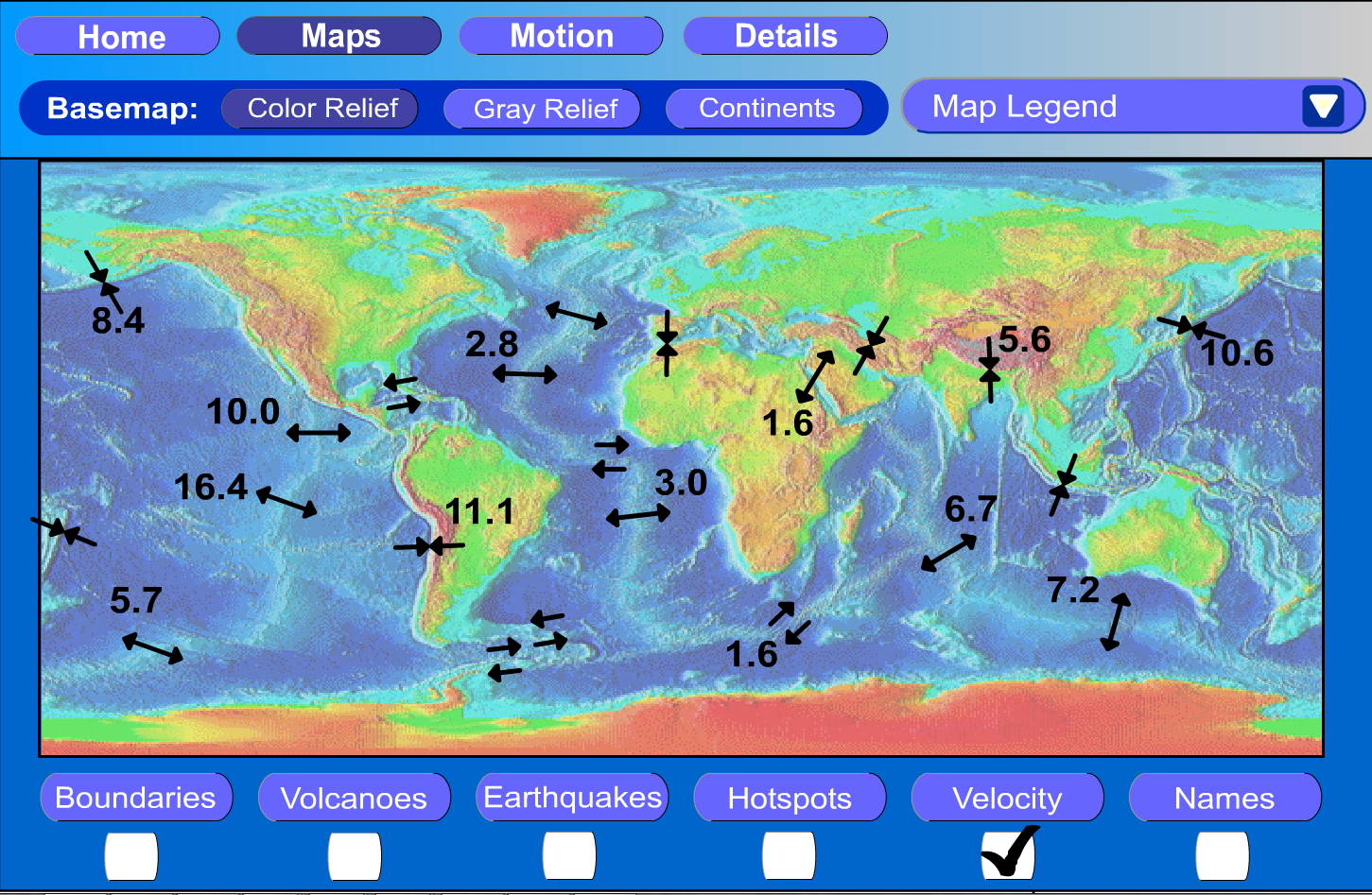
    Very few of the geospatial software vendors (GIS or surveying) are handling horizontal datum transformations correctly or in a manner that is easy for the average GIS operator to understand. The good news is that hopefully we’re raising awareness and some are responding, such as Carlson Software. Carlson recently released version 3.0 of their SurvCE surveying software for GNSS data collection. It includes a 14-parameter transformation from ITRF08/WGS-84 G1674 to NAD83/2011. You might want to watch the four minute video below demonstrating the transformation process in SurvCE 3.0. You’ll see the difference after the transformation is about two tenths of a foot (~6cm). If I were to guess, I would say majority of the difference after the transformation is the tectonic plate movement that is unaccounted for. Reconciling the tectonic plate movement is difficult because you need to have an accurate velocity (movement) model for the software to reference. In some geographic areas, the movement is minor (1mm per year) while other geographic regions move 6cm per year or more. Lastly, what if there’s a major earthquake such as the 2011 earthquake off the coast of Japan or the 2010 earthquake off the coast of Chile. During those events, the ground shifted many meters in some cases.

    Just a reminder from my last article on this issue in Geospatial Solutions, here’s a rough tectonic plate velocity model from the University of Kentucky:

    TectonicUKY
    Source: Michael Dennis – US National Geodetic Survey

    I’d like to spend a little time on the subject of the WGS-84 reference frame. It’s a term that’s used and abused a lot, including by myself on occasion.

    Taking a Look at the WGS-84 Reference Frame

    First, let me begin with the statement that WGS-84 should not be in your geospatial vocabulary. In fact, I’ve been corrected in the past that it is actually a reference frame rather than a datum, but you’ll likely see it listed as a datum in your geospatial software.

    WGS-84 is not something you’ll find physical marks on the ground that you can use to verify GNSS equipment performance. WGS-84  is defined by the U.S. National Geospatial-Intelligence Agency (NGA), which serves the U.S. Department of Defense and the U.S. Intelligence Community. In other words, one of its roles doesn’t include serving the civilian community. Originally, the accuracy of data referenced to WGS-84 could not be defined more accurately than a couple of meters. In fact, the definition of WGS-84 has changed several times over the years, usually without your knowledge, and usually not accounted for in the geospatial software you are using.

    Originally (1987), the Department of Defense transformation values between WGS-84 and NAD83 (dX, dY, dZ) were set to 0, which led people to believe they were considered the same. A footnote that was largely ignored is that the standard deviation of the WGS-84 to NAD83 transformation values was ~2 meters (Doyle, D., 2013 email). The bottom line is that if someone hands you a GIS dataset and says it’s referenced to WGS-84, an alarm should immediately sound in your brain prompting you to query the presenter of the data. When and how was the data referenced to WGS-84? Likely, they won’t know the answers to the questions you ask. In that case, you have no choice but to tag the data as only accurate to two meters, at the very best. Of course, if it was data collected by a consumer-grade GPS unit, the accuracy is likely much worse.

    The history of WGS-84 is as follows:

    ——————————————————–

    WGS-84 (Original) – 1987

    Aligned with NAD83/86 (original) but standard deviation of the transformation was +/- 2 meters.

    ——————————————————–

    WGS-84 (G730) – 1994

    Aligned with ITRF91 (epoch date 1994.0). A significant shift took place with this adjustment.

    ——————————————————-

    WGS-84 (G873) – 1996

    Aligned with ITRF97 (epoch date 1997.0)

    ——————————————————-

    WGS-84 (G1150) – 2002

    Aligned with ITRF00 (epoch date 2001.0)

    ——————————————————-

    WGS-84 (G1674) – 2012

    Aligned with ITRF08 (epoch date 2005.0)

    ——————————————————-

    As you can see from above, if someone hands you a dataset and states it’s in WGS-84 format, it begs the question of “which one?”, not unlike the same question you should ask if someone states a dataset is “NAD83”

    As I mentioned above, while the 14-parameter transformation to move from one datum to another is not commonplace in geospatial software yet, but it’s gaining traction and it’s not difficult to implement. The trickier, and more difficult variable to reconcile is the tectonic plate movement. It may not seem like the earth you stand on is moving very much, but years of movement can add up when you’re using GNSS equipment capable of 1-2cm accuracy.

    Example: Let’s say you’re using OmniSTAR’s HP real-time correction service. The accuracy of that service is rated at 10cm horizontal 2DRMS. OmniSTAR informed me that their system is referenced to ITRF08 using the current epoch date (eg. the date you collect the data). Let’s say your GIS basemap is referenced to NAD83/2011 (epoch 2010.0), which is the most current version of NAD83 (I apologize to non-US readers for this example, but you likely have a similar situation). The 14-parameter transformation will transform your data from ITRF08 (current date epoch) to NAD83/2011 (current date epoch), but then you have to account for the tectonic plate movement from current epoch date (assume 2013.5) to 2010.0. That’s 3.5 years of crustal movement. The tectonic plate movement in some parts of the US are only 2mm/year so 3.5 years x 2mm/year = 7mm. Since OmniSTAR’s HP service is 10cm, you could say that 7mm of plate movement is below the noise floor. However, let’s say you’re in California where the tectonic plate movement is 5cm/year in some places. Reconciling the tectonic plate movement in that environment becomes important when you think about 3.5 years x 5cm/year = 17.5cm!

    So, when populating your GIS database, especially with “high-accuracy” data, it’s important to understand not only the datum the incoming data is referenced to, but also the epoch date the data is referenced to. An answer of “WGS-84” is not good enough and probably not accurately represented in the geospatial software you’re using. More than likely, ITRFxx is more accurately defined in your software, if it is present.

    Regardless, WGS-84 should not be in our geospatial vocabulary, or at least be quickly fading.

    By way of background, the ITRF (International Terrestrial Reference Frame) Center are funded by the Institut National de l’Information Géographique et Forestière (IGN), hosting the IERS ITRS Product Center, and partly by the Space Geodesy Research Group (GRGS).

    ————————————————————————————————————-

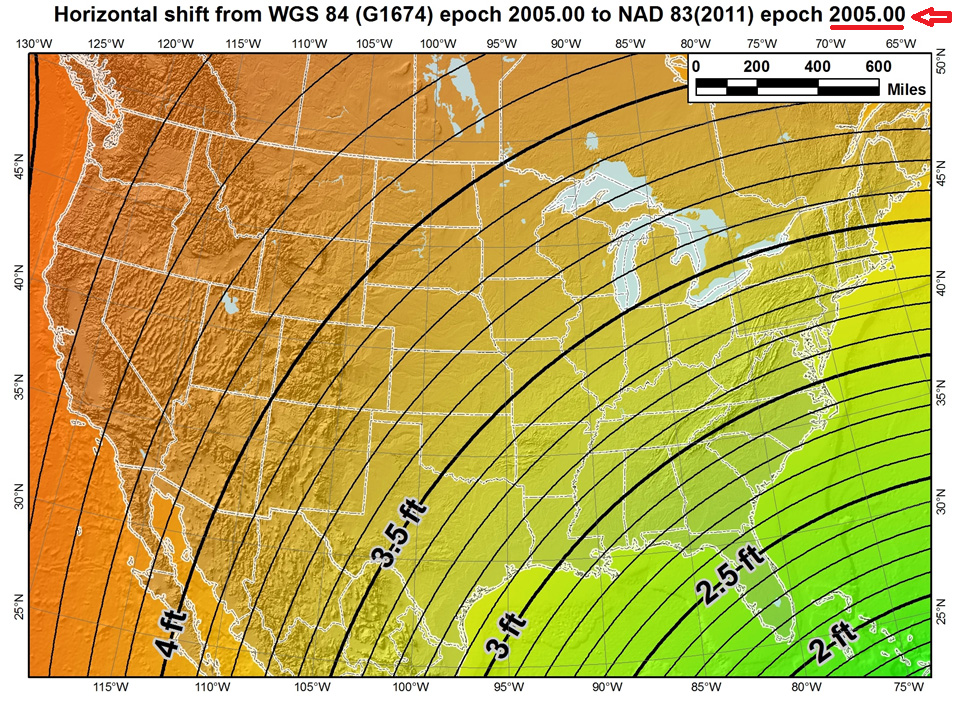
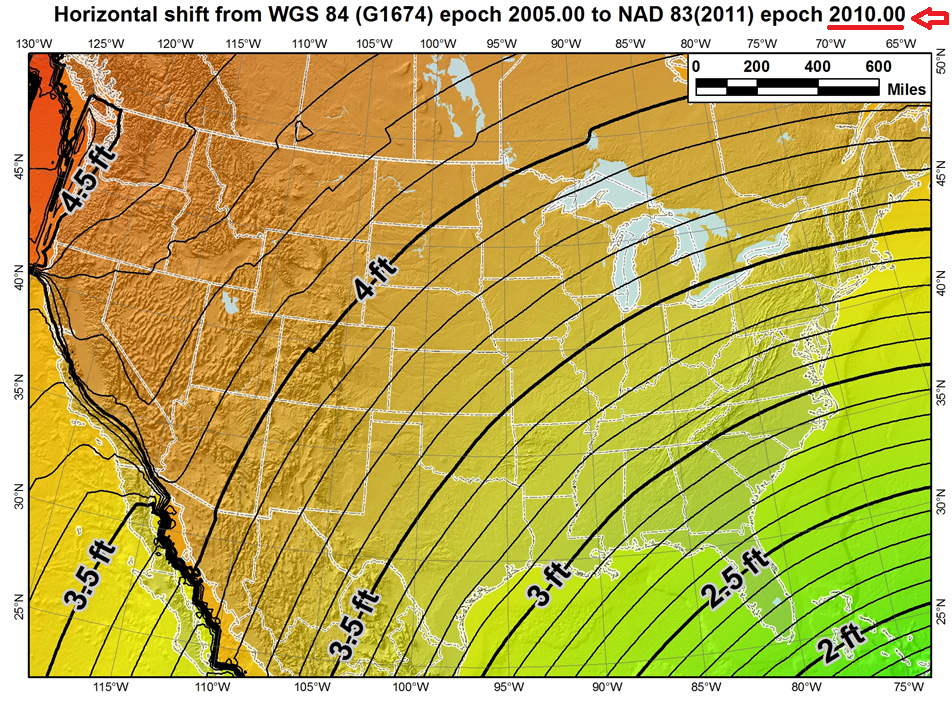
    To illustrate the effect of tectonic plate velocities, please view the following two images:

    The first image shows the the difference between the latest definitions of WGS-84 (G1674)/ITRF08 epoch 2005.0 and NAD83/2011 epoch 2005.0. Notice the smooth contour lines. This is using the 14-parameter transformation.

    Source: Michael Dennis - US National Geodetic Survey
    Source: Michael Dennis – US National Geodetic Survey

    However, the correct US definition of NAD83/2011 is referenced to epoch 2010.0, a full five years later than the first image where it was referenced to 2005.0. Notice the dramatic effect of the tectonic plate movement in the western part of the US. In this case, the 14-parameter transformation was used as well as the velocity model to estimate the tectonic plate movement.

    Source: Michael Dennis - US National Geodetic Survey
    Source: Michael Dennis – US National Geodetic Survey

    This illustrates that increasingly, geospatial data consumers will need to consider that “time is of the essence” when combining geospatial datasets.

    GLONASS Rocket Crash

    On July 2, 2013, a rocket carrying three GLONASS satellites crashed shortly after lifting off from its launch pad in Kazakhstan’s Baikonur cosmodrome. It’s the second launch crash for GLONASS, costing Russia six GLONASS satellites in the past three years. According to several sources, the cause of the July 2 crash was blamed on incorrectly installed angular velocity sensors. Despite the loss, GLONASS still has a full constellation of 24 satellites and, since GLONASS is largely used as an augmentation to GPS, people using GPS/GLONASS receivers should experience no change in performance.

    Rumors are circulating that this crash signals the beginning of the end of the GLONASS program, but I don’t believe it. Although this crash is a serious blow to Russia’s space program and will certainly set back the GLONASS program due to the nature of the crash (at the launch pad), I believe that GLONASS is here to stay.

    GPS suffered a major setback when, in 1986, the Space Shuttle Challenger exploded 73 seconds after lift-off because the space shuttle was the planned launch vehicle for GPS satellites. Subsequent launches were shifted to the Delta II rocket, causing a two-year delay in GPS satellite deployment. However, GPS never subsequently strayed from its course and for nearly three decades has been the so-called gold standard of satellite-based positioning, navigation, and timing.

    с надеждой (here’s hoping) GLONASS can similarly recover its momentum and progress as planned.

    Update: On July 9th, Ria Novosti reports that Russia will launch two GLONASS navigation satellites later this year to make up for the loss of three satellites in the recent Proton rocket explosion after launch from the Baikonur space center in Kazakhstan, according to a senior space industry official.

    “We are planning to launch two satellites from the Plesetsk space center [in northern Russia] to replenish the GLONASS orbital grouping following the recent Proton-M accident,” said Nikolai Testoyedov, the head of the Information Satellite Systems (ISS) company, which manufactures satellites for the GLONASS project.

    The first GLONASS is scheduled for launch in the beginning of September, and the second at the end of October, according to Testoyedov. The official added that both satellites will be launched on board the Soyuz carrier rockets, which has proven to be more reliable than ill-fated Protons.

    A group of 29 GLONASS satellites is currently in orbit, with 24 spacecraft in operation, three spares, one in maintenance, and one in test flight phase, according to Russia’s space agency, Roscosmos.

    Join me on the NSPS Radio Hour – Monday, July 22, 11:00am US Eastern Time/8:00am Pacific Time

    I, along with Michael Dennis of the US National Geodetic Survey, will be guests on the National Society of Professional Surveyors (NSPS) radio hour talking about interesting geospatial data and GNSS subjects. You can tune in live or download the mp3 audio recording onto your smartphone or mp3 player. Feel free to send me an email ahead of time if there’s a particular subject you’d like to hear us discuss.

    See you next time.

    Follow me on Twitter at https://twitter.com/GPSGIS_Eric

  • Trimble Juno T41: Rugged, Sturdy, and a Great Display

    I keep waiting for the cryptic phone call or emphatic email from Trimble that says, “You have had our evaluation units for over four months — when can we expect to see a review and when will you be returning our equipment?” Fortunately, Trimble is very understanding and would never make such a call or send such an email, I hope. The truth is Trimble sent me a T41 and Yuma 2 for review back when it was still snowing in the Rocky Mountains and I am still evaluating the units. You see that’s the rub with excellent equipment — it is a pleasure to review GPS equipment that exceeds all expectations, and frankly, it is difficult to send it back because there is always one more project, one more test or one more application that needs to be run. Fortunately the Trimble PNT equipment (position, navigation and timing) has never been found wanting. So here finally is the T41 review that so many of you have requested.

    First, however, for those of you who are of a similar age to yours truly — and let’s just say it hopefully relates to a certain level of maturity and in my case familiarity with GPS since 1978 — I just can’t see the designation T41 without thinking of: (1) a basic USAF pilot and navigation training aircraft once flown at Mather Air Force Base in California and one I still see every day at the Unites States Air Force Academy and flying over my home on a regular basis, and (2) the first successful commercial GPS unit built by my think-tank colleague Philip Ward at Texas Instruments, designated the T1-4100. I have no idea if Trimble was aware of these associations when naming conventions were considered for the T41, but for many of us seniors the associations certainly exist. That is not a bad thing — it probably even extends to goodwill in a business sense, if you understand that jargon. But, as usual, I digress!

    BLUF (Bottom Line Up Front)

    As loyal readers are aware, I never give a product a bad review. That is not to say I do not receive my share of simply “bad” GPS equipment to review. I just refuse to take the time to pen a bad review — my philosophy being, why should I take the time to write and why should you take the time to read about something you can’t or won’t use? There are enough “good,” even exceptional, GPS devices out there today that deserve to be written about — so let’s just skip the bad ones and save us all some grief and deflated expectations. So the very fact that I am writing about the Trimble T41 means that it has passed all my tests for ruggedness and usefulness. In fact (I checked the figures with my review logs for the past seven years), for every 20 GPS devices I receive, I only review one on average. This month it is the Trimble JunoT41/5 X-Model with gray pin striping and an IP68 ruggedness rating, and you will see why that level of model detail is important shortly.

    Who Matters as Much as What

    Before I get into the technical aspects of the T41, let’s consider for a moment who would want to use this unit. Without a doubt, it is perfect for warfighters and first responders or I probably would not write about it, but it is also perfect for anyone that needs a rugged handheld computer with embedded GPS running either the Windows or Android operating system (OS). The touchscreen display covers about the same real estate as the new iPhone 5 but the T41 is slightly larger, heavier, thicker and, it almost goes without saying, incredibly rugged. I guess that is why I have received several letters from T41 users that use it on horseback.

    Now, while I perceive the equine GPS market to be a niche market, another one of my think-tank colleague, the Honorable Jim Geringer, who ran the great state of Wyoming from 1995 to 2003, has mentioned several times in passing, and I mistakenly thought jokingly, ranchers using GPS on horseback. Now that I think about it and read some of my email from Colorado, Wyoming, and Montana ranchers, it makes sense. Think about navigating thousands of acres of ranch land that in some cases all looks the same, looking for lost cattle or damaged fences. Think about wanting to mark the spot where cattle or damaged fences were found and then being able to quickly communicate that information to someone who could help, and then just as quickly navigate back to civilization, even in a blizzard. The fact is my correspondence from several ranchers tells me that GPS has become indispensible – and not just any GPS, but a reliable, accurate and rugged GPS that has a long battery life, comes with a built-in camera, and the option for a solar charger, and of course has embedded communication capabilities. Sounds a great deal like the T41 – I think you will agree.


    Basics and Specifications

    The Juno T41/5 approximates a slightly larger iPhone 5 in size, but one with an extremely rugged case. The case  makes it bigger and heavier, but at the same time much more useable in all weather conditions, to include snow, ice, water, dust, all of which I personally tested for, and I suspect it will survive being dropped in horse manure, although I will admit this is one test that I have not personally performed. I will graciously defer to my equine mounted readers when it comes to performing this particular test. Can you say rubber gloves, Purell Hand Sanitizer and Fabreze?


    Trimble Juno T41/5 Specifications

    FEATURES

    • Processor: 800 MHz or 1 GHz, Texas Instruments DM3730
    • RAM: 256 MB or 512 MB
    • Flash Storage: 8 GB or 16 GB
    • 4.3” WVGA sunlight-readable Gorilla® Glass display
    • Light sensor to auto-adjust display brightness
    • Capacitive multi-touch interface
    • Integrated 3.75G cellular data, text and voice capability
    • 8 megapixel camera with geo-tagging and dual LED flash
    • Bluetooth 2.1 with Enhanced Data Rate
    • Wi-Fi (802.11 b/g/n)
    • GPS Receiver, 2-4 meter accuracy (WAAS/SBAS Capable)
    • MCX port for optional External GPS Antenna
    • Electronic Compass
    • Accelerometer
    • Robust Custom Port with USB 2.0 Full Speed Protocol
    • Conversion Cables available for 9-pin Serial or USB host
    • Micro SD memory card slot (supports SDHC up to 32 GB)
    • Integrated speaker and microphone
    • 3.5 mm Headset Jack with Audio Capability

    OPERATING SYSTEMS

    • Windows Embedded Handheld 6.5
    • Android 4.1 – which is faster, has better battery usage, more secure and with better developer specifications than the older version 2.3.4
    • Language Support: Chinese (Simplified), English, French, German, Italian, Japanese, Korean, Portuguese, Russian or Spanish

    Windows Embedded Handheld 6.5

    Standard Software:

    • Trimble SatViewer (GPS interface application)
    • Trimble CellStart (WWAN configuration application)
    • Microsoft Office Mobile 2010 (Word Mobile, Excel Mobile, PowerPoint Mobile, Outlook Mobile)
    • Internet Explorer Mobile 6
    • Microsoft My Phone with SMS Text Messaging
    • Camera Control Application
    • Flashlight Control Mode Application
    • Calculator
    • Calendar
    • Microsoft Pictures and Videos
    • Windows Media Player
    • Windows Live Messenger
    • Microsoft Task Manager and Notes
    • Adobe Reader LE 2.5

    Android 4.1 Advanced Software:

    • Trimble Outdoors Navigator
    • Email
    • Phone and SMS Text Messaging
    • Picture and Video Gallery
    • Multimedia Player
    • Web Browser
    • Camera Control Application
    • Flashlight Mode Control Application

    Application Developer Support:

    • Software Developer Kit with Documentation for WEH 6.5
    • Software Developer Kit with Documentation for Android 4.1

    STANDARD ACCESSORIES

    • International AC Charging Kit
    • T412 USB Cable
    • Wrist Strap
    • Ultra Clear Screen Protectors (qty-2) Kit
    • Quick Start Kit

    OPTIONAL ACCESSORIES

    • 9-pin Serial Adapter
    • USB Host Adapter
    • Capacitive Stylus with Tether
    • External Battery Pack
    • Port Cover
    • Ultra Clear Screen Protectors (qty-10) Kit
    • Anti-reflective Screen Protectors (qty-2) Kit
    • Vehicle Charging Kit
    • Capacitive Touch Screen Gloves
    • Trimble Headset
    • External GPS Antenna

    ENVIRONMENTAL SPECIFICATIONS

    Water: Survives immersion at 3.3 feet (1 meter) for two hours (gray models), IEC-60529 IPx8. Survives driving rain & water spray (yellow models), IEC-60529 IPx5, water jet 12.5 mm diam @ 2.5-3 m.
    Dust: Protected against dust, IEC-60529 IP6x, dust chamber with under-pressure
    Drops: Survives multiple drops of 4 ft. (1.22 m), MIL-STD-810G, Method 516.6, Procedure IV, Transit Drop
    Operating Temperature: -22 ºF to 144 ºF (-30 C to 60 C), MIL-STD-810G, Method 502.5, Procedure I, II, III (Low Temp Operating -30 C); Method 501.5, Procedure I & II (High Temp Operating 60 C)
    Storage Temperature: -40 ºF to 158 ºF (-40 C to 70 C), MIL-STD-810G, Method 502.5, Procedure I, II, III (Low Temp Storage -40 C); Method 501.5, Procedure I & II (High Temp Storage 70 C)
    Temperature Shock: Cycles between -22 ºF and 144 ºF (-30 C and 60 C), MIL-STD-810G, Method 503.5, Procedure I-C
    Humidity: 90% relative humidity with temperatures between 22 ºF and 144 ºF (30 C and 60 C), MIL-STD- 810G, Method 507.5, Procedure II
    Altitude: 15,000 ft (4,572 m) at 73 °F (23 C) to 40,000 ft (12,192 m) at -22 °F (-30 C), MIL-STD-810G, Method 500.5, Procedure I, II & III
    Vibration: General minimum integrity and loose cargo tests, MIL-STD-810G, Method 514.6, Procedure I & II, Category 5
    Solar Exposure: Survives prolonged UVB exposure, MIL-STD- 810G, Method 505.5, Procedure II
    Chemical Exposure: Resistant to mild alkaline and acid cleaning solutions, fuel hydrocarbons, alcohols and common vehicle and factory machine lubricants.

    PHYSICAL

    Size. . . . . . . . . .6.1 in . 3.2 in . .9 in (15.5 cm x 8.2 cm x 2.5 cm)
    Weight. . . . . . . . . . . . . . . . . . . . 13.5 oz (.4 kg), including battery
    Color . . . . . . . . . . . . . . . . . . .Black with Yellow or Black with Gray (Color does make a difference; see Product Models below.)

    ELECTRICAL

    Processor: 800 MHz or 1 GHz, Texas Instruments DM3730
    Memory: 256 MB or 512 MB
    Storage: 8 GB or 16 GB, non-volatile
    Expansion: micro SD card slot, SIM card slot
    Display: 4.3 in (10.9 cm), 480 x 800 pixel, WVGA TFT
    Battery: 3.7 V, 3.3 Ah, 12.2 Wh, Lithium-ion polymer
    I/O: 3.5mm audio jack; Custom Port that supports USB 2.0 Host, USB Client, 9-pin Serial and 5.6 V (5.0 V to 5.9 V) DC input power
    GPS Receiver: 2-4 m accuracy with WAAS/SBAS correction; MCX port for optional external antenna
    Radios: Bluetooth 2.1 +EDR; Wi-Fi 802.11 b/g/n
    WWAN radios: UMTS / HSPA+, GSM / GPRS/ EDGE; UMTS Bands (WCDMA/FDD): 800, 850, 1900, AWS and 2100 MHz; GSM Bands: 850, 900, 1800, 1900 MHz

    CERTIFICATIONS

    FCC, CE, R&TTE, IC (Canada), C-tick, GCF compliant, RoHS compliant, Section 508 compliant, PTCRB, SAR, AT&T network compatible, Wi-Fi Alliance certified, CCX, USB 2.0 Full Speed, MIL-STD-810G, IP65/IP68, MIL-STD-461E.

    PRODUCT MODELS

    Color

    IP Rating

    Processor          RAM       Storage

         WWAN

          GPS

    Camera

    M

    Gray

    IP68

    800 MHz

    256 MB

    8 GB

    2-4 m

    C

    Yellow

    IP65

    800 MHz

    256 MB

    8 GB

    2-4 m

    8 MP

    C

    Gray

    IP68

    800 MHz

    256 MB

    8 GB

    2-4 m

    8 MP

    X

    Yellow

    IP65

    1 GHz

    512 MB

    16 GB

    3.75G

    2-4 m

    8 MP

        X

    Gray

    IP68

    1 GHz

    512 MB

    16 GB

    3.75G

    2-4 m

    8 MP

    The M model features a GPS receiver, 800-MHz processor, 256 MB RAM, 8-GB storage and is available in gray with IP68 rating. The C model adds an 8-megapixel camera with dual LED flash, Bluetooth and Wi-Fi to the M model feature set and is available in yellow with IP65 rating or gray with IP68 rating. The X model adds penta-band GSM cellular phone and data capability to the features of the C model, has a 1 GHz processor, 512 MB RAM and 16 GB storage and is available in yellow with IP65 rating or gray with IP68 rating.


    Key Features

    WVGA Sunlight-Readable Gorilla Glass Display. I found the 4.3-inch color display to be readable in all lighting conditions. From very low light to bright sunlight, even sun reflecting off snow, which I have found to be the most difficult condition. The Gorilla glass is aptly named, as its unique composition allows for a deep layer of high compressive stress, which is created through an ion-exchange process during the manufacturing process by Corning Glass. This compression acts as a sort of “armor,” making the glass exceptionally tough and durable, and yet the display is crystal clear.

    Multi-Touch User Interface with Capacitive Stylus Compatibility. Now, I am well aware that one of my heroes, Steve Jobs, once said that “…if you are required to use a stylus on a computer, you have lost your advantage.” However, there are just simply times, especially with GIS (geographical information systems) and map displays, when something smaller and more accurate than the end of your little finger is called for, and on the T41 you have your choice. The display also functions with a capacitive glove, which you can purchase from Trimble as an option or from many other vendors. The bottom line is the 4.3-inch high resolution screen is very clear, and as Trimble says “…the multi-touch support allows complex selections and controlled zoom to optimize the user experience with maps and detailed information.”

    3.75G Cellular Data, Text and Voice Capability. A GPS or PNT device today without communication capabilities is a device that simply cannot compete, in the marketplace or in any situational awareness competition/situation you would care to name. Communication capabilities allow any PNT device to make use of PNT augmentation available over the Internet and through private networks such as the Trimble VRS or Virtual Reference Station and the John Deere StarFire network. Indeed, the Trimble VRS network enables precise, real-time GNSS positioning through the distribution of correction data. The global networks provide a highly reliable method for surveyors, warfighters, and other geospatial and PNT professionals to work faster and achieve accurate GNSS results, as precise as three centimeters in real time, for a variety of positioning applications including geodetic and cadastral surveying, road and bridge construction, mapping, agriculture, earthquake and tectonic plate movement monitoring, warfighter applications, and scientific research, as well as other high-accuracy positioning applications. Trimble’s VRS networks use RTK (real-time kinematic) solutions that, when combined with the Trimble RTKNet software, provide high-accuracy RTK GNSS positioning for wide areas. A VRS network improves productivity while reducing complexity and the global footprint for warfighters, by eliminating the need to set up a base station.

    A VRS network is made up of the latest in GNSS hardware, modeling, and networking software, plus communications interfacing. Once set up, RTK roving receivers in the field or AOR (Area of Responsibility) have access to real-time network modeled corrections. In the field you also have the reassurance of the built-in integrity monitoring system that warns if there are any problems with the data.

    Today Trimble’s VRS networks are considered an integral tool for providing fast, high-precision, wide area positioning for warfighters and first responders in countries around the world. The Trimble VRS and John Deere RTK StarFire systems also give the device, especially in the case of a warfighter, additional situational awareness, along with the capability to act not only as a receiver, but as a networked device, a sensor, and a monitoring station. The T41 handheld has voice, SMS text, and 3.75G cellular data transfer capabilities on GSM cellular networks worldwide. You can upload and download data from the cloud using Wi-Fi or WWAN connections. The 8-megapixel camera can be set to automatically include time and location metadata from the GPS receiver. The T41 not only has the ability to increase the individual warfighter’s situational awareness but to increase the SA for all users on the network and in the AOR as well.

    Bluetooth 2.1 + EDR and Wi-Fi b/g/n. You may well wonder why I have listed this as a separate feature when it could just be included under communications. I have listed it separately because of the Army’s laudable Puck and Hub endeavors. (See my GPS World May column for the detailed briefing). Without going into too much detail, the Puck and Hub are sorely needed PNT receivers with augmentation capabilities to include Wi-Fi, inertial, and CSAC (Chip Scale Atomic Clocks) that are hopefully multi-GNSS signal-capable. The only feature both devices lack is a suitable and rugged display mechanism. This is where the Bluetooth, Wi-Fi and Android capabilities of the T41 come into play. The Army seems, for the time being, to have mysteriously settled on the Android OS as a basic capability and building block that, when combined with Bluetooth and Wi-Fi, make the T41 the perfect display device. I cannot say much more in this venue, but take my word for it when I say I have never tested another purpose-built rugged PNT-capable device more suitable for the Army’s Puck and Hub applications. Suffice it to say that Software Developer Kits (SDK) for both Android and Windows OS enable custom application software to easily interface, wired and wirelessly, with the many built-in sensors, radios, and data ports on the T41. For instance, a secured Bluetooth signal embodied in the 2.1 and EDR (Enhanced Data Rate) specifications would allow users to transfer data to and from the Puck or Hub while maintaining voice or SMS connectivity with other networked users and commanders, who are able to make faster and hopefully better decisions based on real-time information.

    GPS Receiver with 2-4 Meter Accuracy. At its core, the T41 is indeed a GPS receiver that is SBAS (Satellite Based Augmentation System) capable, which means it can take advantage of the augmentation and integrity signals from the U.S. WAAS (Wide Area Augmentation System) and the European EGNOS (European Geostationary Navigation Overlay Service). However, when combined with the device’s prodigious communications capabilities — Wi-Fi, Bluetooth, and the Internet — the device becomes a truly multi-GNSS capable receiver with ports that can, hopefully in the future, accommodate such devices as the CGM (common GPS module) that includes SAASM (Selective Availability Anti-Spoofing Module) and M-Code capabilities. It also includes the Trimble and John Deere networks as mentioned earlier, and this gives the device the capability of 3-centimeter RTK accuracy. Think about it: I have never heard a warfighter say, “I need a less capable, less versatile and less accurate device.”

    Accelerometer and Electronic Compass. Ask a warfighter if he needs an accelerometer, and he might scratch his head, but ask about an electronic compass and the answer is an emphatic yes. Think map reading, orienteering, and getting out of Dodge fast. Think urban canyons or vast, featureless deserts where a warfighter has no intrinsic idea which way is which. That’s when you need a compass, but an accelerometer —as any iPhone aficionado will tell you — is almost indispensible. The accelerometer detects physical movement and is primarily used for motion sensing and tilt controls. It also detects vibration and acceleration, allowing the T41 to detect the distance and speed it has moved in three-dimensional space. Combined with the right software, it may prove to be a key component of determining position, distance, and speed in challenged environments.

    Nine-Pin Serial and Power Port. The last feature I will highlight about the T41 is the nine-pin serial data and power port. The serial cable is secured to the T41 for power and data by a secure data/power cable that is attached with thumb screws on one end and by a USB connector on the other. In rugged environments it provides both a secure means of power from multiple sources and a universal data connector, neither of which are going to work their way loose and leave you with a dead battery or no data. It is almost legacy in design, but innovative in that one multi-function cable provides power and serial data inputs. I used it for both power and data and it worked flawlessly — plus I never had to worry about a loose or lost connection.

    Bottom Line

    The bottom line is I highly recommend the Trimble Juno T41 in any of its configurations, which are many. It is rugged to a fault, sturdy and has one of the best displays I have ever seen. I reviewed the Windows OS version but have no doubt the Android OS works equally well, and that is, after all, the OS on which the Army is pinning its future plans and hopes for PNT devices. However, as I said in the beginning, I do not want to limit this device to the warfighter. It certainly fills the bill there, but it also competes well and indeed exceeds the capabilities of many similar devices that lack the built-in ruggedness and the Trimble reputation for consistently producing superior devices. This review is already 3,500 words, and I could easily write another 5,000 words, but hopefully you get the point. If you need a very rugged phone, a computer in a handheld form factor with embedded 3-cm level GPS capabilities that sports a crystal clear display and is a device with huge growth potential, then the T41 is exactly what you need. I know of nothing better in the marketplace today. It is really going to be tough to send this one back.

    Now I wonder just how long I can keep it before that dreaded emphatic phone call or cryptic email…

    Until next time, happy navigating and give the T41 a test-drive.


    Editor’s note: Readers interested in owning a Juno T41 can enter a GPS World drawing by filling out our State of the Industry Survey.

     

  • Oblique Imagery: The New Kids on the Block

    Last month I covered current vendors of ortho imagery with some pros and cons regarding the different sources. There wasn’t room to also include oblique imagery, so I’m covering that topic this month.

    I’ve been a very strong proponent of oblique imagery for many years based on my experience as the GIS manager for the Atlanta Regional Commission, where I found that there was no single geospatial tool that had such a positive and dramatic impact on our first responders as oblique imagery. (See my 2008 article that describes why.) I felt so strongly that it could make our troops more effective and help save lives that I joined Pictometry for a few years to help promote oblique imagery military projects. At that time, Pictometry was the only oblique game in town, since it had patent protection dealing with much of the technology. However, the patent protection is ending and many new players are entering the field.

    A Graflex camera circa World War I.
    A Graflex camera circa World War I.

    Early History

    Few people realize that the first serious aerial surveillance collections were oblique images taken with old Graflex cameras held out of a biplane cockpit. The images were good but users soon learned that it was a nightmare to try to assemble the oblique perspective images into a large mosaic. So analysts switched to ortho imagery that could be stitched together nicely, and we’ve been pretty much stuck in that straight down world. Fortunately, sophisticated algorithms and digital image processing have changed all of that.

    The underlying reason that oblique imagery works so well for visualization compared to ortho imagery is a function of our mind-eye vision referred to as anamorphic illusion.  Our eyes can look at 2D images and perceive them as 3D objects if the right visual cues are present. There are some interesting examples of anamorphic illusions on the web.

    So let’s look at the current sources of oblique imagery.

    Pictometry International, Corp.

    Pictometry has been the dominant force in oblique imagery capture for more than a decade, thanks partially to patents and surrounding technology the company has developed. Not only does Pictometry have the tools and technology to capture, serve and exploit the oblique imagery, it also amassed a huge library of images covering almost 90 percent of U.S. populated areas. Pictometry has desktop viewing software that permits users to view and measure almost any aspect related to the oblique image — x,y location, length, width, and very accurate heights, while also displaying overlaid GIS data including elevation data and contour lines. Pictometry does this by re-projecting the GIS vector data to match the trapezoidal footprint of a perspective oblique image. Pictometry also serves its extensive library of images, over two petabytes, through an online service called POL (Pictometry On Line). Users can view imagery and do the same measurements as with the desktop software.

    Pictometry's desktop viewing software.
    Pictometry’s desktop viewing software.

    My experience showed that the positional accuracy ranged in the 3- to 15-foot range. To meet USGS National Map standards, Pictometry developed AccuPlus, which includes ground surveys and image correction of the ortho view to meet USGS’s 30-cm product specification.

    For users who want to view and use the oblique imagery inside the ortho footprint ArcGIS environment, the Pictometry engineers developed a transform tool that effectively stretches the back of the trapezoidal oblique footprint to a rectangular image that can be used just like an ortho image but with an oblique view. The only downside is that without perspective the image looks a little funny. Note this example and the fact that the garage is the same width in front as in back. This is what happens when the perspective is removed. This transform tool is now part of ESRI’s ImageServer so users can import an oblique image and the transformation is automatic. Pictometry also supplies oblique imagery for Microsoft Bing, called the Birdseye View.  The imagery supplied for Bing has slightly less resolution and cannot be measured, as with Pictometry software.

    The Pictometry transform tool.
    The Pictometry transform tool.

    Woolpert, Inc.

    Woolpert has been in the oblique imagery capture business almost as long as Pictometry, but it uses a completely different technology, the push broom method. Most oblique capture systems take five oblique single frame photos — north, south, east, west, and straight down.  Those oblique images show natural perspective so the image footprint is a trapezoid. Woolpert uses a three-camera system – one ortho and a forward and aft oblique image scanner. The continuous 45-degree scanning has a big benefit in that the system produces an oblique image with a true ortho footprint right out of the box, so the resultant oblique image can be viewed by GIS software as if it was an ortho image. The down side of push broom capture is that the geometry of tall buildings is distorted so that some of the buildings seem to lean toward each other.

    The Sanborn Map Company, Inc.

    Sanborn is a large and well-established aerial imagery firm now getting into the oblique business. Although I haven’t had any broad experience with its imagery and navigation tools, the online demo has a very slick interface and very nice quality imagery.  Try it yourself.  As an oblique newcomer, Sanborn’s coverage is limited, and I can’t judge its accuracy, but it has a strong reputation of producing quality work and products so it is a company to watch. Some of the company’s imagery is credited as part of Google Maps, but both are secretive as to the extent or parameters.

    Fugro EarthData, Inc.

    I’ve had no personal experience with Fugro data and software, but I did see a trade show demo of its software, PanoramiX. The software and imagery looked good, but as a newcomer its image library is limited and the accuracy of its imagery is unknown.

    GEOSPAN, Corp.

    On its website, GEOSPAN lists oblique imagery capture in addition to Street level imagery, orthophotography, 3D models, street centerline creation, and GIS feature extraction. There is no information available as to coverage or accuracy.

    ControlCam

    ControlCam is the newest entry into the oblique market. It is a Florida-based aerial imagery company that pioneered and perfected a process of identifying cable TV leaks through the use of aerial surveillance. The company owns and manages its own fleet of aircraft  capturing both orthogonal and oblique imagery. ControlCam will soon launch a software platform, including a mobile app, that will permit clients to have quick and seamless access to the imagery with measurement tools.  The sample image shown here is 2-inch GSD, very nice for a newcomer to the oblique business.

    A ControlCam image.
    A ControlCam image.

    Microsoft Bing and Google

    If you have any doubt about the popularity and value of oblique imagery, just look at Bing Maps and Google Maps, the two elephants battling for eyes-on-site time. Both have incorporated oblique imagery in their viewers. Both bring up the oblique views as you zoom in from a high-level ortho image, then transition to street-level imagery. The key difference is that Bing uses Pictometry oblique images, which show a natural perspective, and Google uses oblique imagery from different sources. Bing shifts from one optimal oblique to another while Google stitches together multiple oblique images. This multiple-image stitch is good at ground level, but causes funny building lean similar to a push-broom capture (see the sample images). Both are very good for their intended purpose, but neither permits measurement, nor do they include accurate metadata.

    By their own admission and licensing agreements, neither Bing nor Google claim to be authoritative GIS data sources. So be cautious how you use their imagery. Note the problem I cited in my article last month about a police SWAT team raid using Google. Another issue for federal users is FARS and licensing restrictions, so make sure your legal staff reads the fine print.

    A Google oblique image.
    A Google oblique image.
    A Bing oblique image.
    A Bing oblique image.

    Other Systems

    If you’d like to do a deep dive into oblique cameras and capture systems including overseas operations, I recommend reading “Systematic Oblique Aerial Photography Using Multiple Digital Cameras” by Professor Emeritus Gordon Petrie of the University of Glasgow. In his presentation he quotes the ISPRS 2008 Congress that “There is a strong movement towards combining traditional nadir images with oblique images acquired at high angles to build 3D models of cities with the texture of building walls taken from the oblique photos. For non-specialists in the emergency services (military, police, fire and ambulance), the combination of oblique and nadir images improves their interpretation while special software allows simple measurements on the oblique photos.”

    The Future

    I have no doubt that within a few years the zoom-in from space to orthos, obliques, accurate 3D models, ground-level imagery, and interiors of buildings will be smooth and seamless. Ultimately, accurate, detailed and up-to-date 3D models draped with actual imagery, not textures, will be optimal. This will be especially important if 3D or holographic display technology reach acceptable quality levels. 3D model creation keeps improving, and I believe that the merging of ortho imagery, oblique imagery, LiDAR, and ground-level photos with more powerful computers and software will make accurate 3D models practical and ubiquitous.

    For some closing amusement, somewhat related to our current discussion, take a look at what 360 Cities is doing with very high resolution fixed panoramic cameras.  Note the 80 gigapixel photo of London and this zoom-in to a London Eye giant Ferris wheel pod.  Although coverage is limited to one viewer location, I could see this being one of several resources to drape 3D modes.

    Contact me at [email protected].

    A zoom-in on the London Eye with 360 Cities.
    A zoom-in on the London Eye with 360 Cities.
  • Expert Advice: Cooperative Updates with Maps 2.0

    Oliver Kuhn, Skobbler
    Oliver Kuhn, Skobbler

    By Oliver Kühn, Skobbler

    Not so long ago, paper maps were a necessity in many walks of life. Today, they are increasingly a nostalgic novelty, to coin a term.

    It’s not difficult to understand why digital maps replaced their paper brethren. Digital maps are more accurate, more adaptable, and most importantly, in an increasingly real-time environment, much faster at making the appropriate updates and amends.

    Now, however, digital mapping finds itself at a crossroads. Crowdsourced navigation platforms like OpenStreetMap — affectionately referred to as the “Wikipedia of maps” — are forcing digital maps and the map-building process to evolve significantly. As a result, the future of mapping is now in the hands of location enthusiasts and everyday map users. These people are redefining what a map is, how data is sourced and utilized, and how much it can cost to harness that information both efficiently and effectively. Those of us who have been in this space for years can see the writing on the wall.

    Some, however, are eager to write off crowdsourced mapping. Corporate digital map providers, for instance, often refer dismissively to these mapping platforms as “hobby maps.” Nevertheless, they recognize the potential for change such innovation brings and are vulnerable to it.

    What potential? Consider the benefits attainable through a crowdsourced approach, in the following sections.

    Scalability

    As with any process, cost is critical. It is particularly core to building a digital map. Truth be told, the fewer dollars ultimately spent on a map’s construction, the more its long-term operational preservation and, through that, scalability can be ensured. Despite massive innovation in our field, collecting data and creating a usable international digital map is far from cost-effective or efficient today. Candidly, it is one of the clunkier processes in technology, perhaps because it appears compulsory.

    Look no further than Google, which spends billions of dollars a year to maintain its platform, yet we marvel at the huge scope of its operation. In truth, it is an effort in dire need of real streamlining. Google, via its recent acquisition of Waze, along with Navteq, TeleAtlas, and the like, leverage laser-enabled cars and high-tech backpacks that are astoundingly inefficient from a pricing standpoint, costing hundreds of thousands of dollars. Nokia’s Map Mobiles, for example, are each outfitted with more than $25,000 of computing equipment.

    To think this is sustainable in the long term, on an international level, is wrong. It will inevitably cripple a map’s quality and viability, with corporate providers choosing to limit global detail and upkeep to balance costs.

    For crowdsourced map platforms, this problem does not exist. They can and are scaling rapidly, without the exorbitant costs corporate players are used to — and tired of. These costs secondarily manifest in mapping service usage fees for third parties, as well as subscription costs for consumer navigaton products. For either use case (business-to-business or business-to-consumer) crowdsourcing delivers cost benefits traditional players cannot match. Again, this leads directly to scalability, with crowdsourcing the most enduring maps option.

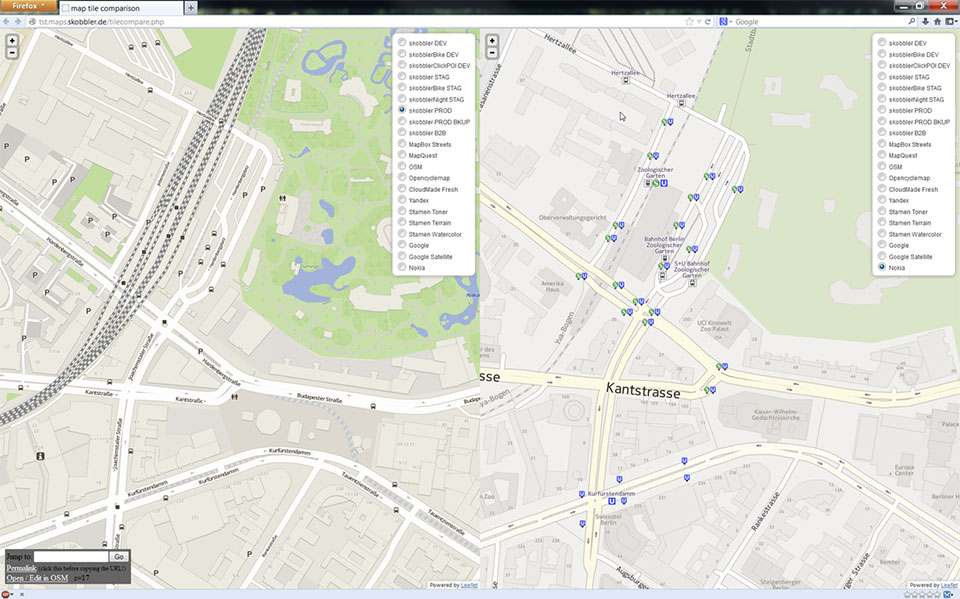
     Same time, same place — different look. Crowdsourced OpenStreetMap (left) and Nokia map (right) of central Berlin, Germany. Photo: Oliver Kühn
    Same time, same place — different look. Crowdsourced OpenStreetMap (left) and Nokia map (right) of central Berlin, Germany. Photo: Oliver Kühn

    Detail

    Crowdsourced mapping services and platforms like OpenStreetMap are more than just cost-efficienct tools to coax scale. As a crowdsourced dataset built using more than a million dedicated mappers, OpenStreetMap inherently delivers benefits above and beyond those obtained from corporate map providers like TeleAtlas and Navteq.

    The most visible benefit is the unrivaled map quality. With an army of contributors, the data dynamically and constantly evolves — just as places do. Locations are rarely fixed or stable. They change and progress over time. No other service or platform can immediately provide developers with the real-time, on-the-ground granularity of a crowdsourced map. Google and the others are trying, but the costs they incur will ultimately be too taxing to maintain detail.

    Firsthand influence carries equal weight. Mappers who edit an open-source map have often had personal interactions with a place or locale. They know places intimately, and this makes their contributions detailed, rich, and hyperlocal. More companies and developers are looking to OpenStreetMap for this reason: they want to future-proof their services and products, making sure that they always have the best and most up-to-date data. Only a platform like OpenStreetMap can do this. Corporate map providers are painfully aware of it, too.

    Flexibility

    Google owns Google Maps, and TeleAtlas owns its TomTom platform. Not surprisingly, this affects what a third party, whether an automotive company or a travel brand, can and cannot do with the service. It is essentially a copyrighted product like an MP3, an audio digital file. So, Google can limit the way you visually render and showcase its platform. Needless to say, this can be suffocating for those interested in building their own unique services. This is what makes crowdsourced mapping such a significant development for those interested in integrating additional data with a digital map. Do with OpenStreetMap what you will, visually or design-wise; there are absolutely no limitations. Every map can be made unique and rendered differently. This also speaks to the flexibility of crowdsourcing more generally.

    Beyond design, crowdsourced maps can harness the data to build completely new maps that cater to a specific concept, creating thematic maps for different uses, such as walking, hiking, bicycling, routes for those with disabilities, and more. More traditional digital maps lack this flexibility; it affords possibilities to source non-traditional location data to build even more accurate maps.

    The Future — Through Cars

    Despite the fact that crowdsourced maps are forcing digital mapping to adopt a more scalable, cost-efficient, detailed, flexible andaltogether long-term approach, digital mapping definitely has room to grow.

    One of the most exciting opportunities for crowdsourced maps specifically, and digital maps generally, lies in car user data, which is just coming into its own. Cars are obviously one of the largest travel tools utilized by individuals on a daily basis, and, with the advent of the connected car, the data that they collect via internal/external sensors has grown more nuanced, granular, and specific over the years.

    Cars are simply getting smarter, with sensors capable of providing everything from weather conditions to speed-zone information.

    Making this information available in the cloud and combining it with data available via crowdsourced mapping platforms produces remarkable possibilities for innovation.

    Imagine adding road-condition data, as just one example, to crowdsourced mapping services. By marrying a crowdsourced map with crowdsourced car-sensor data, the map’s overall utility multiplies immeasurably.

    To avoid missteps that have positioned companies like Google to spend billions on building a digital mapping service — unsustainable long-term figures — we must always look to embrace that which is cutting-edge. We find that today in crowdsourced mapping platforms, as they enable us to maintain, update, and enrich maps as never before. We must also consider the limitations of the cutting edge and understand how to improve the latest innovation (car-sensor data, and more) before the once cutting edge becomes the next paper map, so to speak. This is key to evolving maps for the better and for the future.


    Oliver Kühn has an MBA from the University of Cologne, Germany. He has 10 years of location-based service experience and was Head of Product Management Special Projects at navigation systems specialist Navigon AG (acquired by Garmin). In late 2008, he co-founded skobbler GmbH, being responsible for business development and legal matters. He is also a board member of the OpenStreetMap Foundation.

  • Expert Advice: Little Tigers versus Wolves

    Expert Advice: Little Tigers versus Wolves

    Greg Turetzky
    Greg Turetzky

    By Greg Turetzky, Intel

    I recently attended the Fourth China Satellite Navigation Conference (CSNC, held May 15–17 in Wuhan, China), as an invited speaker and panelist. I had attended the third CSNC last year in Guangzho, and as expected this year’s was a little bigger and a little better. The Chinese GNSS industry is growing quickly, as evidenced by the more than 2000 attendees with as many as 10 simultaneous sessions at some times, with more than 200 presentations over three days, and nearly 150 exhibitors on the show floor. The conference is mainly attended by Chinese, but they are working hard to attract an international audience by providing simultaneous translation of all presentations, and dual-screen projection for slides in English and Chinese if the author chooses.

    I couldn’t possibly see everything, so I chose to spend most of my time in a series of sessions on industrial policy, regulations, standards, and intellectual property. I thought those sessions would provide the most unique information this conference had to offer. I expected to hear a lot of standard or official position statements without much audience discussion, but I was pleasantly surprised by the level of information from personal experience that the speakers offered and the amount of lively debate that often followed the presentations. The simultaneous translation was essential and not only allowed me to follow but created the opportunity for multi-language Q&A which allowed more complex questions to be asked.

    I was particularly interested in understanding what changes were going to occur since the full release of the BeiDou Interface Controld Document (ICD) in December. One thing I noticed right away is that the term Compass has pretty much gone away. The official name, and what everyone used in their presentation, is BDS. I am not quite sure I follow the methodology, but it’s an abbreviation for the BeiDou Satellite System. I would certainly recommend to anyone meeting with Chinese business associates that you appear very up to date by using BDS instead of Compass in all your presentations, oral, written or PowerPoint.

    The changing of the official name is just the first ripple in what I expect will be a wave of changes in the BDS industry (see, I learn fast). One of the most interesting talks was given by Hua Xu, whose affiliation was given in the English program as “BDS specific policies and regulations expert team, ex-director of the policy and regulations Division of Development and Reform Commission.” His talk was entitled “Thoughts of perfecting China’s BDS Industry System Construction.” He related several interesting anecdotes about the history of the satellite program, going back many years, all the way to the Cultural Revolution of the 1970s. As an example of how different the Chinese setting is for legal issues, he told us that in China, if a car hits a pedestrian, the car driver has to pay damages regardless of fault, because since he is driving the car, and the car damaged the pedestrian, he must accept responsibility. Mr. Xu spent more time talking about how China’s GNSS industry must grow in terms of industrial capability, intellectual property, and mass production, and how the government is encouraging that growth.

    To date, that growth has been very rapid, as embodied by a vast array of small companies focusing on domestic Chinese applications of BDS, in particular in survey and mapping and in search and rescue. The growth impetus now moves to the automotive sector, where there is continued investment by both the national government and regional governments to promote the use of BDS in transportation projects involving trucks, taxis, and government vehicles. Some may view this as protectionist, due to the approved vendor lists and subsidies that are provided, but I think it is just a natural effort to create local centers of excellence and jobs in a new technology; this process occurs all over the world. The companies that are in this business are the 150 or so who exhibited on the CSNC show floor, and they are the little tigers of my title.

    Most of the names of the little tigers are not that familiar outside of China: unicore, BDstar, Olinkstar, and many more. They have developed their own GPS+BDS chips and are selling them in moderate quantities of thousands for domestic customers. At CSNC, they presented lots of results that clearly show the advantages of multi-GNSS (GPS+BDS) within today’s BDS regional coverage area. Furthermore, the accuracy and time-to-first-fix performance of their solutions is comparable to the overall market. However, as market needs in China grow from thousands of units to millions of consumer devices, the little tigers are not quite ready yet to support the Lenovos (computers), HTCs (smartphones) and Huaweis (mobile phones and tablets).

    But China wants to see BDS in all those consumer devices, to demonstrate to the world the benefit of BDS; hence the ICD was released in December. The ICD release opened the gate to China’s domestic market that previously was solely hunted by the little tigers. The wolves were waiting at the gate and they have charged in. Broadcomm, CSR, Trimble, NovAtel, and others have already publicly announced BDS support in their mainstream products, in the first few months following the release.

    This was the topic of the discussions in CSNC that were most revealing for a foreigner like me to hear. I was ready to ask the tough question of what the future holds in the consumer market, because I figured no one else would. But much to my surprise, the moderator of the session put up a slide that translated to: “B1 ICD was released while Regional System is officially operational, will affect domestic BDS receiver industry? Pros? Cons?” (See opening photo.)

    The ensuing discussion was quite lively but polite on both sides of the issue. Would subsidies continue for domestic suppliers? How could local companies hope to attract investment to scale up with international competition? Where could Chinese companies carve out intellectual property to protect their inventions? What could that government really do without running afoul of the World Trade Organization?

    Many more questions were raised than answers arrived at, and I think most of the really interesting discussions took place away from the microphones and the simultaneous translation. So I cannot provide them for you.
    Even without answers, the act of discussion was enlightening. I think the fact that these discussions are happening in public forums indicates the growth and transformation of Chinese society. There were finance people, engineers, businessmen, government regulators, all debating a difficult topic.

    I don’t know the answers, but the little tigers know that the wolves are coming. And they are not running in fear. The openness of the internal debate within China indicates that the little tigers are working on a new plan, and no one should assume that the wolves are going to win. The competition in the domestic Chinese market — the very largest market, by far, of any in the world — is going to be very interesting over the next few months and years.


    Greg Turetzky is a principal engineer at Intel responsible for strategic business development in Intel’s Wireless Communication Group focusing on location. He has more than 25 years of experience in the GNSS industry at JHU-APL, Stanford Telecom, Trimble, SiRF, and CSR. With this issue, he joins GPS World’s Editorial Advisory Board.

    The statements, views, and opinions presented in this article are those of the author and are not endorsed by, nor do they necessarily reflect, the opinions of the author’s present and/or former employers or any other organization the author may be associated with.

  • Out in Front: Uh-oh for Information

    Back around 1992, in the early days of the World Wide Web, a starry-eyed pundit trumpeted “The Internet will do for information what TV did for entertainment!”

    “Uh-oh for information,” riposted an editorial cartoonist at the time.

    To be sure, television since the 1950s has brought a few new high points of entertainment into homes around the world, as well as faster and farther-reaching news coverage. It has also brought widespread new lows, entire days’ and evenings’ worth of dumb-down, and news that is broad but shallow. In the process television birthed the terms “a vast wasteland” and “sound bite.”

    The Internet followed a similar path. As a consequence, more information is far more widely available. But is it any better, more reliable, more accurate, or conducive to better decisions? A strong argument can be made for the position that it is not; that, on the contrary, it is actually worse, or at the very least, less robust.
    At the same time that the Web began climbing into society’s lap, nevermore to budge, the cellular telephone attached

    itself to the human ear, not merely in the accustomed indoor stationary position but on the street, in the supermarket aisle, at the restaurant, behind the wheel. Now the smartphone has taken over that role and staked its ownership to the field of view as well, if not to total sensory consciousness.

    And what do you know? Along came GPS in the technological bargain. All apps, if not all things, become possible when you combine: Internet, mobile phone, and satellite-based positioning.

    From the interbreeding of these three springs the latest guest to the party: Big Data.

    What the heck is big data?

    “Data sets . . .  gathered by ubiquitous information-sensing mobile devices, aerial sensory technologies (remote sensing), software logs, cameras, microphones, radio-frequency identification readers, and wireless sensor networks. The world’s technological per-capita capacity to store information has roughly doubled every 40 months since the 1980s; as of 2012, every day 2.5 quintillion (2.5×10¹⁸) bytes of data were created.”

    I had to check Wikipedia (I know, I know, the prophet hoisted by his own petard) because I had only a vague sense of it myself.

    According to Adam Jacobs, writing in the ACMQueue of the Association for Computing Machinery, big data is so hefty that “[its] analysis requires massively parallel software running on tens, hundreds, or even thousands of servers.”

    Sounds like a job for Biggest Brother.

    Indeed, the government has stepped forward to shoulder the burden; we have only just learned that it did so some time ago. Now not only our phone calls but our locations, our travels, our appointments, can be well known to anyone behind the giant curtain who has a curiosity. If they feel bothered enough to get a warrant, warrants can be got. Cases on record show that the government has opened personal cell-phone records both with and without warrants.

    To rehearse the evident, those records now contain our location data. Breadcrumbs. The granularity, the precision, and the hertz-rate of that location data will only increase over time.

    This time around, the “uh oh” comes from the information.

    Uh oh for us.

  • Expecting Twins: A How-To Guide to Dual Launch

    Expecting Twins: A How-To Guide to Dual Launch

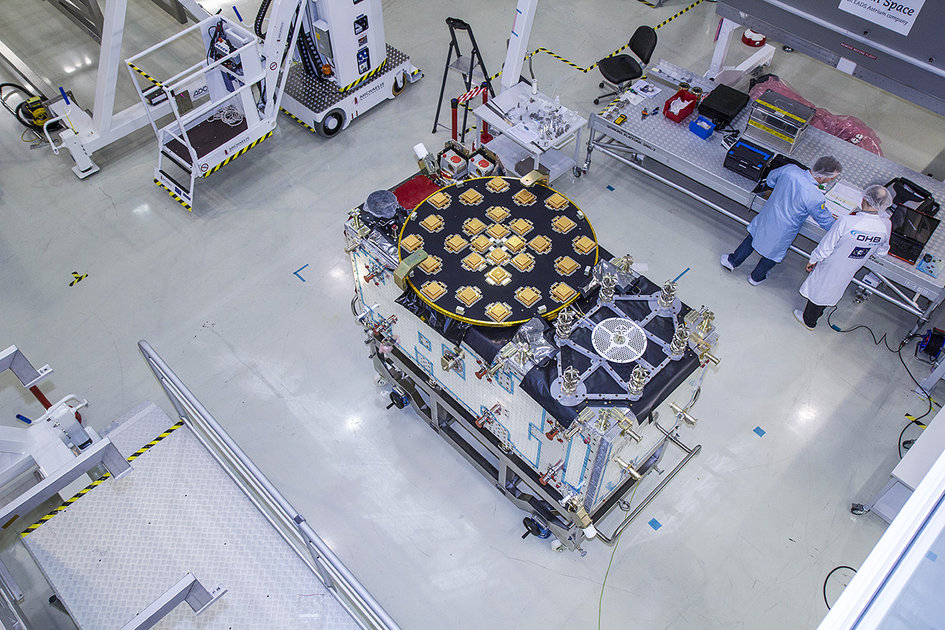
    Recently released views of the next two Galileo satellites in the European Space Agency’s testing lab, along with dual-launch rumblings from the U.S. Air Force and Lockheed Martin, occasion this story about two birds with one drone. That is, an unmanned autonomous vehicle bound for the exosphere. The rest of the GNSS world is on board with this topic; isn’t it about time GPS caught up?

    The first two Galileo Full Operational Capability (FOC) satellites will launch as a pair, earlier advertised as a September blast, now possibly delayed until December; a second dynamic duo will follow sometime thereafter. Then two again, and two, and two, until the Ariane 5 rocket launches four at once. Four!

    The latest official U.S. Air Force plans say that by the ninth GPS III satellite (SV-09), the program plans to initiate programmatic and hardware changes to allow for the first-ever GPS dual launch. The motive, of course, is cost savings. The GPS program (probably) has no need to hurry, as other GNSSes do, in order to have a full constellation operative broadcasting — previous predictions about constellation gaps notwithstanding.

    Even with dual launch, according to Lockheed Martin Navigation Systems vice president Keoki Jackson (and here I am drawing from Don Jewell’s Space Symposium column), from SV-09 forward the savings will only amount to about $70 million per launch, because it will require a larger launch vehicle.

    Only $70 million. Well, to quote Senator Everett Dirksen, adjusting for inflation, “$70 million here, $70 million there, pretty soon, you’re talking real money.”

    Take this all in the context of GPS III having reached the point that it will cost nearly $450 million to place a single GPS space vehicle and payload in orbit.

    Rising costs and the possibility to combat them with dual launches constitute at least one of the driving forces behind the NavSat or NibbleSat drawing-board concept: a small GPS satellite, without the burden of other non-nav payloads.

    Coincidentally, an initiative underway seeks to evaluate “new launch entrants,” according to General Willie Shelton, commander, Air Force Space Command. “If a new entrant can come in and provide a cost-effective launch capability for several launches, then we will look seriously at them as well,” he told Don Jewell in an interview nearly a year ago.

    Jewell: “Why don’t we move into the arena of trying to pin down a vehicle or set of vehicles for dual launch? You and I once discussed GPS III vehicles 7-8 for that honor, and you mentioned at the time that it was a moving target. Where do we stand today?

    General Shelton: Don, I think we are now probably talking about GPS III vehicles 9-10.  We are still in the  study phase on this issue with Lockheed Martin and United Launch Alliance. We are still trying to figure out how we would do dual launch and what kind of capabilities we need to develop. I think this is really the wave of the future…being able to put two up simultaneously will save us a lot in launch costs.”

    In April of this year, John Frye, Lockheed Martin’s GPS III capability and affordability insertion manager, reiterated, in comments regarding the Delta Preliminary Design Review (dPDR) for the GPS III satellite, “The design modifications from this dPDR address ways to further reduce Air Force launch costs by $50 million per satellite through dual launch of two GPS III space vehicles on a single booster. This successful dPDR milestone sets the stage to proceed with SV09 design maturation.”

    Rockets. Recently,  the U.S. Air Force Space and Missile Systems Center (SMC) signed a Cooperative Research and Development Agreement (CRADA) with Space Exploration Technologies Corp., better known as SpaceX, as part of the company’s effort to certify its Falcon 9 v1.1 launch system for National Security Space (NSS) missions.

    SMC and SpaceX will look at the Falcon’s flight history, vehicle design, reliability, safety systems, and other aspects. Once the evaluation is complete, the SMC commander will determine whether SpaceX has the capability to successfully launch NSS missions using the Falcon 9 v1.1.

    Currently, United Launch Alliance’s Delta IV and Atlas V are the only certified launch vehicles capable of lifting NSS payloads — such as the GPS satellites — into orbit.

    The Falcon CRADA may be a preliminary, tentative move towards dual-launch capability.  Consider:

    An earlier iteration, Falcon 9, can reportedly lift payloads of 4,850 kilograms (10,700 lb) to geostationary transfer orbit (GTO). The Falcon 9 v1.1— subject of the CRADA and scheduled for first flight in mid-2013—will use a longer first stage powered by nine Merlin 1D engines arranged in an octagonal pattern. Development testing of the v1.1 Falcon 9 first stage was just completed in June. These improvements will increase the payload capability by nearly 50 percent. The new first stage can also be used as side boosters on Falcon Heavy, which reportedly will have a capability of lifting 12,000 kg (26,000 lb) to GTO.

    According to an Air Force fact sheet, the GPS III satellite has a launch weight of 8,115 lb.

    The Atlas V 401 rocket, most recently used to launch the GPS IIF-4 satellite in May, has a GTO launch capability of 4,750 kg. (10,472 lb.)  A steroid version of the Delta IV, the Delta IV Heavy, has a GTO launch capability of 13,130 kg (28,950 lb), more than any other currently available launch vehicle. It also carries a more substantial price tag.

    To sum up these various vectors pointing largely in the same direction, GPS has a potential in the somewhat near-mid distant future of going to dual launch.

    Meanwhile, this has been fait accompli for the other GNSSes.

    Galileo

    The first two in-orbit validation (IOV) satellites built by Astrium traveled aloft together in October 2011, as did the third and fourth IOV satellites in October 2012.

    According Paul Flament, European Commission Programme Manager and Head of the EU Satellite Navigation Programme Unit, in an interview earlier this year with GPS World, “Satellites 5 and 6 will be launched in September of this year, aboard a Soyuz launcher from Kourou, and numbers 7 and 8 will follow in December.” These launches may since have been re-adjusted to later dates, respectively.

    “Then, in 2013 we will see three Soyuz launches of two satellites each. We do not have the precise launch dates yet, but they are likely to be in April, June, and September. In December 2014, we expect to have the first launch using the Ariane 5 launcher, which is capable of deploying four satellites in one go. This means that by the end of 2014 Galileo will have deployed 18 satellites in orbit.

    “In 2015, there will be two Ariane 5 launches, one in the middle of the year, one at the end, each carrying four satellites.”

    GLONASS

    Within days, perhaps, three GLONASS-M satellites will blast off together from Baikonur: GLONASS 48, 49, 50. This is only the latest of GLONASS triple launches.

    As Richard Langley is my witness, the Russians accomplished a GLONASS hat-trick as long ago as September 1986!  The first in a more recent series of triplets, in December 2010, failed rather spectacularly and cost Russia an estimate 5 billion roubles ($160 million), setting back GLONASS by six months. The system has since intermingled single- and triple-satellite launches.

    Compass

    China has demonstrated success with two dual launches of mid-Earth orbit satellites, among its constellation lodged at varied heights. Compass-M3 and Compass-M4 rose together in April 2012, as did M5 and M6 in September of that year.


  • Google’s $1.1 Billion Purchase of Waze Under FTC Scrutiny

    Google’s $1.1 Billion Purchase of Waze Under FTC Scrutiny

    Kevin Dennehy
    Kevin Dennehy

    In a year of ho-hum location deals, or the lack of any, the recent Google purchase of Waze for more than $1 billion is a big one. In fact, readers of GPS World magazine’s LBS Insider would have to go back to the summer of 2007, when TomTom purchased Tele Atlas and Nokia bought Navteq, to find an industry acquisition as big as this one.

    The Federal Trade Commission is reviewing Google’s $1.1 billion acquisition of Israel-based mapping startup Waze, according to published reports.  The big issue is that while Waze’s revenue was too low to trigger automatic review by the FTC, it may have hundreds of millions of users worldwide.

    The fact that Google’s acquisition of Waze has caught the FTC’s attention is not unusual, said Mike Dobson, TeleMapics president, who authors a location industry blog at www.telemapics.com. “Google, in an attempt to speed the acquisition, declared that the assets of Waze based in the United States are worth less than the $70.9 million that requires an antitrust review. Google maintains, and I agree, that the majority of the [intellectual property] for which they were willing to pay $1 billion was created in Israel, where it is currently located, and in that location it continues to be revised and enhanced,” he said.

    One of the supposed reasons, which were publicized in media reports, is that the deal with Facebook fell through because the social media giant wanted to relocate the Waze development activities to the U.S. and the Israel-based company declined.

    Google’s purchase of Waze ends months of rumors and stops other suitors, including Facebook, Apple and Microsoft, from moving in on the mapping startup. Google has said that its mapping technology will be incorporated into Waze.

    The Waze deal may strengthen Google, but won’t be the deciding factor on whether it has an unfair advantage in the [location] market, said Marc Prioleau, president of Prioleau Advisors. “They will have that regardless of Waze. I am not sure the criteria for the FTC, but I think Waze is just a spark to trigger a look at Google’s mapping position overall,” he said. “The FTC will have a hard time making the case that Google dominates the industry when Google can point to market share for Apple Maps, Nokia/Here [through its own sites as well as Bing, Amazon, Facebook and others] and even MapQuest, which stubbornly hangs on to a high market share with the over-50 demographic.”

    When it comes down to it, it is all about money. “It appears that the FTC’s preliminary interest in the Google acquisition of Waze is in determining if the U.S.-based assets are worth more than $70.9 million, and whether or not Google’s position regarding the Waze IP being located in Israel is justified,” Dobson said. “Many would argue that a considerable portion of the value of the Waze IP affects consumers in the United States, resides on cell phones of users in the United States, and has a functional impact in the United States beyond the $70.9 million that Google is claiming. Functional impact is a difficult issue, but since Waze generates little income, Google is probably in a good position here.”

    Dobson said that other pundits are commenting that the problem here is that Noam Bardin, Waze CEO, described Google as its only competition during a recent press conference. “Oh, how unusual, someone selling their company trying to increase the value of the company,” he said. “Has everyone forgotten about Nokia and TomTom? Does anyone really think they are incapable of competing with Google, Waze or the combination of both companies?”

    Google Made Strategic Decision Not to Buy Tele Atlas and Navteq                          

    Dobson said that, more troubling for the FTC and other antitrust interests, is this:  If Google wanted to monopolize the mapping world, why did it not choose to bid (or counterbid) when Navteq and Tele Atlas were sold in 2007?

    “I think the answer to this question is quite plain. Google did not participate in either acquisition because it had tried both companies’ data and found that the content quality and spatial coverage was not quite what Google had set as goals when developing its strategy for mapping. Instead, Google built its own ‘map machine’ and has managed to out-innovate either of these companies over the last several years,” Dobson said. “In addition, both Nokia and TomTom have fallen on hard times, not because of Google’s success, but because both companies overpaid for the assets they acquired, just before a worldwide economic downturn. Reduced budgets (for research and compilation) at TomTom and Nokia have had a lot to do with Google’s success in the mapping world.”

    The big deal in Google’s interest in Waze lies in the success that the mapping startup has had in capturing traffic information, as well as how it has attracted a large user community willing to contribute traffic data, Dobson said.

    “I doubt that Google will find that the map coverage provided by Waze has data they have not already mapped and mapped more exhaustively than Waze. However, it is somewhat camp to be an ‘anybody but Google’ fan boy and I suspect conspiracy theories about the acquisition will abound,” Dobson said. “I doubt that the FTC will find anything actionable. If Google were to announce next week that it was acquiring Inrix, I suspect that the FTC might have a real case with real antitrust issues.”

    While Waze hasn’t generated much revenue, its real-time maps and traffic information are valuable. This value was magnified last year when Apple tried to replace Google Maps on the iPhone with a not-so-good alternative.

    Analysts are looking around at what other companies are out there as potential acquisition targets — particularly as the smartphone industry becomes even more competitive. The apps on the smartphones will need to be distinguishable, particularly the mapping systems and capability, say several analysts.

    One company that stands out as a potential acquisition target is TomTom, which is the last independent provider of digital maps, now that Navteq was gobbled up by Nokia.

    Send all of your LBS stories to [email protected].