Category: Uncategorized

  • JPL Team Uses GPS for Tsunami Early Warning


    Led by Dr. Attila Komjathy, who received his Ph.D. from the University of New Brunswick in 1997, a team from NASA’s Jet Propulsion Laboratory has demonstrated a technique that has the potential to significantly improve tsunami monitoring and warning.

    The technique uses data from multiple Global Positioning System receivers on the ground to measure small perturbations in the ionosphere’s electron density caused by a tsunami.

    The changing sea level of a tsunami, even far from a coast, generates waves in the atmosphere that make it all the way up to the ionosphere, some 350 kilometres or so above the sea surface. Here, they disturb the electrons that affect the propagation of GPS signals. The disturbance is so small that ordinary GPS receivers do not notice the passage of the waves. However, with advanced software processing of the data collected by specialized receivers used, for example, by surveyors and geodesists, the waves can be visualized and used to track the progress of the tsunami.

    The JPL team has dramatically demonstrated their technique for the devastating tsunami associated with last year’s massive offshore Japanese earthquake. They used data from the more than 1,000 receivers of Japan’s permanent GPS monitoring network. The propagating ionospheric waves can be clearly seen in a video the team has posted to YouTube.

    The video can also be downloaded from the GGE website.

    An earlier report on NASA’s tsunami-detection work can be found here.

    NASA is investing in research to obtain real-time GPS measurements from around the world so that researchers can integrate this technology into a global tsunami warning system. Additional potential applications might include the remote sensing of ionospheric perturbations generated by other natural hazards such as earthquakes and volcanic eruptions and human-made events such as nuclear tests.

    Dr. Komjathy was one of the first to investigate the use of GPS signals to study the ionosphere. His pioneering Ph.D. research under Prof. Richard Langley was awarded a Gold Medal from the Governor General of Canada.

  • Intermap Introduces NEXTMap World 30

    Intermap announced the release of NEXTMap World 30, the first and only commercial 3D terrain product to provide seamless, void free coverage, with a 30 meter ground sampling distance, across the entire 150 million square kilometers of the Earth’s surface.

    According to the announcement, satellite images provide 2D datasets, which are not always sufficient for business planning purposes or government feasibility studies. Filling the void for accurate and reliable height data, Intermap’s NEXTMap World 30 offers the most comprehensive digital surface models for the entire world. The NEXTMap World 30 dataset can benefit planners in multiple industries including telecommunications, energy, agriculture, risk planning, water management, topographic mapping, military and a host of government services.

    Intermap reports the key benefits of NEXTMap World 30 include:

    • Accurate: NEXTMap World 30 aggregates data from ASTER, SRTM and GTOPO using worldwide control, combined with Intermap’s proprietary data fusion technology, to create the most seamless, void-filled and consistent dataset with accuracies starting at 5 meters.
    • Comprehensive: Other products available in the market offer up to only 30 percent of the Earth’s surface. With NEXTMap World 30, customers have available to them 100 percent coverage of the earth’s surface. The combination of photogrammetry, interferometry and LiDAR technologies provides the most detailed and current elevations of the entire Earth.
    • Affordable: NEXTMap World 30 pricing can be as low as $0.01 per square kilometer.
    • Updated: NEXTMap World 30 is regularly enhanced with the very latest and best elevation data. Under the NEXTMap Maintenance program, customers can enjoy regular NEXTMap World 30 updates automatically.
    • Flexible: NEXTMap World 30 is ideal for applications such as image orthorectification, line-of-sight calculations, feature extraction and topographic map development, flood risk management, infrastructure planning, precision farming, emergency response and 3D visualization.

    “The availability of Intermap’s NEXTMap World 30 product will have a tremendous impact on plantation planning and management,” said LF Lee, Managing Director, Agribusiness Publishing Sdn Bhd, in Malaysia. “In the plantation industry, for example, knowledge of land elevation and bare ground or terrain elevations is essential to identifying and screening out unsuitable areas initially; and for planning of infrastructures, land conservation measures and drainage requirements later on. Unfortunately, most developing countries—where plantation projects are usually located—only have access to topographic sheets with wide contour intervals of dubious reliability.”

    “Intermap’s new NEXTMap World 30 data will definitely fill the void for accurate and reliable height data,” said Perry Mandeville, President of PT Earthline in Jakarta, Indonesia. “With Asia growing so quickly, there is a need for quality 3D geospatial information that 2D satellite images cannot provide.”

    “NEXTMap World 30 is an excellent way for governments and commercial enterprises to cost-effectively perform their important elevation work,” said Todd Oseth, Intermap president and CEO. “We’re looking forward to bringing the benefits of NEXTMap World 30 to customers and partners everywhere.”


  • South Miami Senior High Wins 2012 ION Mini-Urban Challenge

    muc-2012-1st-place

    The Institute of Navigation (ION) announces that South Miami Senior High School won the 2012 ION Mini-Urban Challenge held May 26 at the Smithsonian’s Lemelson Center for the Study of Invention and Innovation at the National Museum of American History.

    Sponsored by the Institute of Navigation and the Air Force Research Laboratory (AFRL), the ION Mini-Urban Challenge is a national event that challenges high school students to work in teams to design and operate a robotic car, built from a LEGO Mindstorms NXT kit, that can accurately navigate autonomously through a model city. The competition is intended to expose students to the areas of science, technology, engineering, and mathematics (STEM).

    More than 600 students from 66 high schools competed in five regional competitions held in Louisiana, Florida, California, Washington, D.C., and Ohio. First- and second-place winners from each of the five ION Mini-Urban Challenge Regional Competitions were invited to compete in the National Competition. Each team was judged based on their cumulative scores earned throughout the competition phases: 30% of the total score was based on a technical presentation, and 70% of the total score was based on the course navigation portion of the competition.

    First place was awarded to the “Legotron” Team from South Miami Senior High School, Miami, Florida. The first place prize included $2,500 for the winner’s school and a trophy. Second place was awarded to the “305” Team, also from South Miami Senior High School. The second place prize included $1,000 for the winner’s school and a trophy. Third place was awarded to Perry High School, Perry, Ohio. The third place prize included $500 for the winner’s school and a trophy. Best in Show went to the “Legotron” Team from South Miami Senior High School and Best Presentation went to West High School, Torrance, California, who won based on their ambulance robot, complete with working siren.

    Sponsors for the 2012 ION Mini-Urban Challenge included: the Air Force Research Laboratory Munitions Directorate, The Smithsonian’s Lemelson Center for the Study of Invention and Innovation at the National Museum of American History, Boeing, John Deere, the Joint Services Data Exchange (JSDE), Northrop Grumman, Raytheon, the Consortium of Ohio Universities on Navigation & Timing (COUNT), CSR, JAVAD GNSS, Overlook Systems, The University of Calgary, Schulich School of Engineering, UrsaNav, and Lego.

  • Nexteq Navigation Offers NexGeo Software Update

    Nexteq Navigation Offers NexGeo Software Update

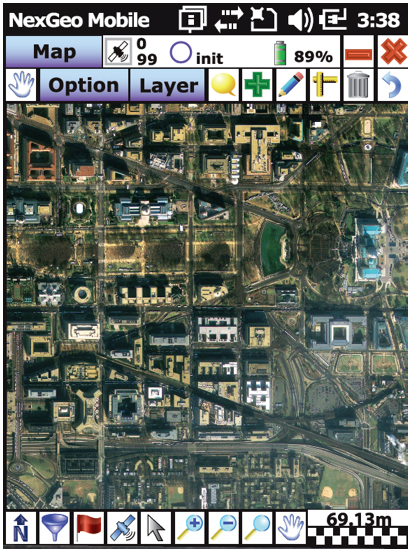
    Photo: Nexteq Navigation Nexteq Navigation has release the newest version of its NexGeo software line-up: NexGeo Mobile, NexPos and NexGeo Office. Optimized for Nexteq handhelds, NexGeo Mobile integrates Nexteq Freedom, i-PPP, and RTK positioning augmentation technology into a more reliable, user-friendly data collection software, the company said. With easy display of features, background images, labeling and attributes, data is readily collected, accessed and edited. The tracking feature now allows for efficient communication and management between field workers and the office. Raw data recorded in NexGeo Mobile can be used for post processing in NexGeo Office.

    Those using third-party software with a Nexteq handheld are not left behind. NexPos was created with the intent of allowing freedom in benefitting from Nexteq position augmentation technology, the company said. The NexPos software acts as a bridge, applying Freedom, i-PPP, or RTK algorithms to GPS measurements. The final positions are transferred to third-party software via virtual COM port, allowing users to benefit from improved position accuracy while NexPos runs discreetly in the background. Raw data can also be recorded and used for post processing in NexGeo Office.

    On the desktop, NexGeo Office ties together collected data, attributes, and post-processing information to provide efficient project management capabilities, data organization, live field monitoring and integration with a wide variety of other software, Nexteq said. Building and maintaining a project specific database is easy using NexGeo Office: import existing data, build on the project using a Nexteq handheld and transfer it back to the office for editing. Exporting the project to ESRI or AutoCAD file formats allows for users to seamlessly continue expanding.

    NexGeo software suite is available and included with all Nexteq Navigation handhelds.

  • ikeGPS Releases ikeTools

    ikeGPS announced it has released its new toolbox, ikeTools, for rapidly capturing GIS location data and making measurements of complex objects from a remote location. Now you have the ability, right from your ikeGPS screen, to complete the most demanding field data capture jobs far more quickly and efficiently than ever before.

    ikeTools Data Capture Modes:

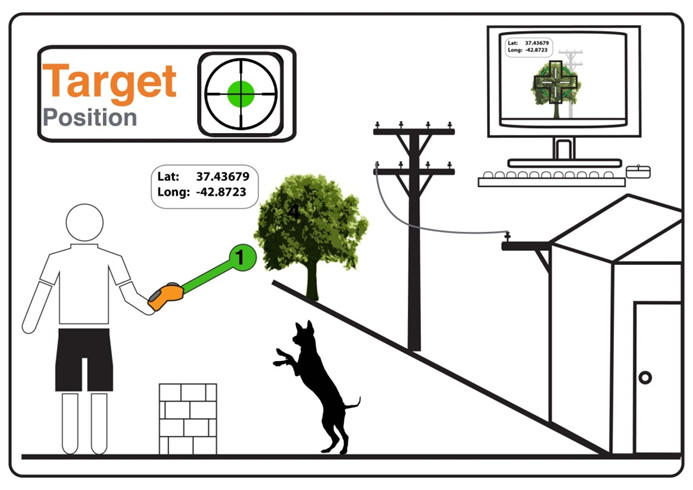
    Target Position: The work horse of ikeGPS mobile GIS data capture. Point ikeGPS at a remote object such as a tree, pole or building and capture its GPS location using the onboard GPS, laser range finder and compass. One shot and you’re on to the next object.

    Photo: ikeGPS

    Three Shot Height: Directly measure the height of an object, such as a pole, from a remote position, even when the base of the object is obscured.

    Missing Line: Calculate the horizontal distance between any two objects.

    Span Height: Calculate the vertical height above ground of a point on a span, for example the mid-span height of a cable or wire.

    Photo Only: Capture a high resolution photo of an object. Useful for documenting the conditions of located or measured objects, for identifying hazards for field crews and for including in assessments.

    True Size Poles: Capture a calibrated (TrueSize) photo of an utility or telecommunications pole with one shot, then transfer to a PC application for measuring the heights of the pole and its attachments.

    True Size PLS: Capture calibrated photos that are used on a PC to measure the heights of objects on electric utility poles. Exports directly to software products from Power Lines Systems, Inc.

    True Size UVM: A variety of measurements for utility vegetation management. Conduct Tree Assessments by measuring tree height, crown width, and trunk diameter at breast height (DBH).

  • Abaqus, 1Shop Wireless Launch myGeoTracking MRM Service for T-Mobile Business Customers

    Abaqus, Inc., developer of device-neutral, cloud-based location and messaging platform that enables high-quality, low-cost mobile workforce and asset management solutions, and 1Shop Wireless, a national business partner sales (BPS) master agent for T-Mobile USA, have teamed to provide the cloud-based myGeoTracking mobile workforce management service for T-Mobile customers.

    “We’re really excited to work with Abaqus to offer their myGeoTracking MRM service to T-Mobile customers,” said Peter Giansante, director of sales for 1Shop Wireless. “It’s an ideal device-neutral location-based-solution for companies that want to equip their employees with feature phones and smartphones, and want to avoid the deployment and training issues associated with mobile apps-based MRM services.”

    The Abaqus myGeoTracking platform provides a unique cloud-hosted solution that combines network-derived and phone-based GPS location information with fine-grained privacy control options, location-enhanced SMS, and a powerful rules engine to let companies quickly and easily manage their field-personnel and assets. It does not require special devices & smartphones, expensive data plans, cumbersome applications, or software.

    “Abaqus’ myGeoTracking bizTeam service is a great fit for any field-force oriented T-Mobile customer that needs to deploy a mobile management solution,” said Gillian Foley, vice president of One Shop Wireless.

    Unlike smartphone-based applications that require special phones and client applications, the location-enhanced, SMS-based myGeoTracking mobile workforce management solution from Abaqus can locate any phone on a cellular network using either Cell ID information, or a precise location using GPS inside the device. The platform provides fine-grained controls to the dispatcher or the employee in the field to pull or push location data using simple SMS commands. The myGeoTracking platform has a rich web API which can be used to integrate with a range of back-office Enterprise systems, Abaqus said. The service provides SMS-based messaging for team job status reports, and has a powerful rules engine that can use geo-fencing, time, device identity, workgroup and other terms to integrate into a company’s mobile workflow needs on a day-to-day basis.

    • The myGeoTracking bizTeam service is an MRM solution which is completely cloud-based and does not require special GPS devices, special phones or any new software.
    • The myGeoTracking bizTeam MRM service can use any standard feature phone to send location and event information, and complies with USPS location standards.
    • The myGeoTracking bizTeam MRM service provides fine-grained privacy controls which can be managed by the end-user from their mobile phones or from the web site
    • Location-enhanced SMS (myGeoText ™) lets your mobile workers actively send you a date, time and location stamped status message from the field and trigger additional dispatch functions.
    • The myGeoTracking bizTeam MRM service provides Geofencing, Geo-corridors, and a variety of other events-based rules to enable easy integration of real-world alerts into a company’s workflow
    • The myGeoTracking bizTeam service provides rich reporting tools which can be exported to a company’s backoffice systems
    • The myGeoTracking MRM bizTeam service provides an Enterprise SMS feature which lets customer’s enhance their dispatch and operations by messaging individuals, groups, or the whole company.
    • The myGeoTracking Platform Integrates with a range of back-office programs through a rich web API.
  • OpenGeo Suite 2.5 Released

    OpenGeo released version 2.5 of their flagship product, the OpenGeo Suite. Version 2.5 bundles many improvements and bug fixes from the open source communities and adds special OpenGeo features, including a toolkit for developing and deploying applications powered by the OpenGeo Suite, and improved raster format support. OpenGeo, an innovator who introduced unlimited support on a complete open source mapping stack, continues to innovate with the 2.5 release. The fully integrated suite takes the pain out of installing and upgrading open source components. Stand-alone, production-ready downloads make it simple for users to install and upgrade scalable, multi-tier deployments of the OpenGeo Suite.

    According to the announcement, the highlight of version 2.5 is the the introduction of the OpenGeo Suite Client SDK. The much anticipated SDK provides tools for developing and deploying web mapping applications backed by the OpenGeo Suite. By providing a plugin-based architecture and leveraging OpenLayers, Ext JS, andGeoExt the SDK allows users to build powerful web mapping applications by providing a JSON configuration.

    When reached for comment about the SDK Tim Schuab, OpenGeo CTO said “The Client SDK provides a robust toolkit for rapidly creating, debugging, and deploying browser based mapping apps. We’re excited to include the initial version of the SDK in the 2.5 release and will continue building on it, focusing on customizing server side functionality and developing mobile applications.”

    The 2.5 release also comes with support for publishing data from formats supported by the Geospatial Data Abstraction Library (GDAL), including: DTED, EHdr, AIG, ENVIHdr, and more. MrSID is available to those with a license for LizardTech’s decoding software development kit. Other noteworthy changes include:

    • Improvements to the GeoServer Layer Importer, including Oracle and SQL Server options and support for importing ZIP files containing multiple Shapefiles.
    • Options in GeoServer to allow layers to be available but not advertised as well as options for producing lenient capabilities documents to prevent invalid XML output from misconfigured layers.
    • Better WFS output from GeoServer, including paging and sorting in the WFS capabilities and user-defined WFS GetFeatureInfo output.
    • Better 3D support in GeoServer and GeoTools, including proper handling of read/write of 3D polygons from Oracle and proper handling of 3D data in GML3 encoding.

    More specific information is available in the release notes. OpenGeo Suite 2.5 is available for download free of charge with a 30 day trial of OpenGeo’s enterprise support.

  • Spirent Launches Entry-Level Multi-GNSS Simulator

    Spirent Launches Entry-Level Multi-GNSS Simulator

    Photo: Spirent Communications

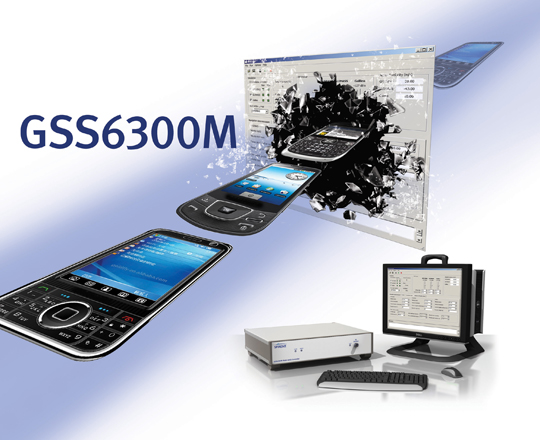
    Spirent Communications today announced the launch of its new GSS6300M Multi-GNSS simulator designed for integration, verification, and production testing where a quick and accurate functional test is needed. The platform supports simulation of signals from individual or combined GPS/SBAS, GLONASS, and Galileo constellations, with eight satellites per constellation.

    The GSS6300M supports two modes of operation — integrated into an Automated Test Equipment (ATE) environment or using Spirent’s SimCHAN software. For automated operation, the GSS6300M can be synchronized with other equipment and controlled remotely over Ethernet, IEEE-488 (GPIB), or RS232 interfaces. The SimCHAN software interface supplied with the GSS6300M enables the user to create unlimited scenarios and specify parameters such as user position, date, and time. Both modes support precise user control over power level and atmospheric effect selection.

    “The GSS6300M is designed for customers who want an affordable, easy-to-use multi-GNSS test system with the quality, reliability and support that is expected from Spirent,” said Rahul Gupta, product manager with Spirent’s Positioning Technology business. “The GSS6300M enables testing of fundamental receiver functionality including time to first fix, sensitivity, and accuracy.”

    The GSS6300M is now available for order. A field upgrade pack is available for existing Spirent GSS6300 customers who want to leverage the multi-channel capabilities of the GSS6300M.

  • GPS Monitoring of Sex Offenders Can Cut Recidivism

    The United States Department of Justice’s National Institute of Justice (NIJ) recently released a study that evaluated the use of global positioning systems (GPS) technology to monitor high-risk sex offenders on parole in California.

    Offenders in the GPS group demonstrated significantly better outcomes than offenders who were monitored in traditional ways. The evaluation showed that risk for a sex-related violation was nearly three times greater for offenders who received traditional parole supervision, than offenders who received GPS supervision. The risk of committing an offense that resulted in an arrest was twice as high for offenders who received traditional parole supervision than for offenders in the GPS group. When compared to traditional supervision, the study found that GPS monitoring costs approximately $8.51 more per day. The outcomes of GPS monitoring, however, are significantly better.

    TITLE: Monitoring High-Risk Sex Offenders with GPS Technology: An Evaluation of the California Supervision Program


  • Racelogic Wins Two Queen’s Awards for Enterprise

    Simulator company Racelogic, based in the United Kingdom, has been honored with two 2012 Queen’s Awards for Enterprise. The awards were given April 21 to 209 companies to mark Queen Elizabeth’s birthday. Racelogic was one of four companies to be honored with the awards for both Innovation and International Trade.

    Racelogic won the Innovation award for advances in GPS/GLONASS test simulation, with customers such as Broadcom, ST-Ericsson, and Telefonica using LabSat to test their devices.

    Almost 90% of Racelogic’s sales are now to countries other than the UK, with customers in 92 countries around the world. Racelogic received the International Trade Award to recognize this achievement.

    “We are extremely proud to be named as a winner of these two awards, with many highly reputable companies in the UK competing for these honors,” Racelogic’s CEO, Graham Mackie, said. “As a company we continue to grow and now employ more than 50 people in the UK alone. We have distributors located all over the world who help us to market and sell our systems to a wide variety of markets and customers.”

    All winners will be invited to collect their awards at a reception hosted by the Queen in Buckingham Palace later this year.

  • Spectracom Releases Dual-Frequency Multi-GNSS Constellation Simulator

    GSG-62 simulator

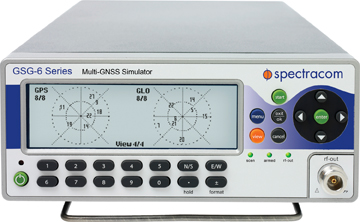
    Spectracom announced its new L1+L2 dual-frequency 32-channel multi-GNSS simulator, the GSG-62. The GSG-62 offers multiple frequency band operation, multiple GNSS constellation simulation, and expansion capability for more frequency bands and channels, the company said.

    The new simulator provides expanded capabilities for those who are testing more than GPS L1, according to the company. “We understand the challenges our customers have in fast-paced development, migration and delivery of products with ever changing embedded GNSS receivers,” said John Fischer, Spectracom CTO. “As such, we are excited to introduce this next-generation multi-signal instrument that allows for real-time scenarios, is intuitive to understand, quick to deploy and, given its design to support upgrades to L2C, L5, and future GNSS frequencies and systems, protects our customer’s investment in test gear.”

    Fischer continued, “In addition to a wide variety of technical challenges, we also understand our customers must balance the ability to quickly develop solutions and improve cost performance in their operations. We believe the price, unique features, and form factor of the GSG-62 will allow them to do both.”

    The GSG-62 is designed for manufacturing and development testing with its ability to simulate all the visible satellites for the receiver under test. With 16 channels for L1 frequency and 16 channels for L2 frequency, channels can be assigned to GPS or GLONASS, P-code or C/A code. Channels may also be used for SBAS simulation of EGNOS, WAAS, GAGAN, or MSAS satellites, or for multipath and interference signals.

    The GSG-62 incorporates all the features of Spectracom’s previous models, including compatibility with GSG StudioView PC software for creation and editing of simulation scenarios via Google Maps.

    Spectracom is a business of the Orolia Group and provider of practical test solutions for GPS and GNSS devices and systems.