Category: Uncategorized

  • Another GPS Chip Merger: NXP to Acquire GloNav

    European chip maker NXP Semiconductors plans to acquire U.S.-based fabless GPS chip maker GloNav Inc., the companies announced today.

    NXP will purchase the company for $85 million in cash plus up to $25 million more, contingent upon GloNav reaching certain revenue and product development milestones over the next two years. The transaction will give NXP immediate access to GloNav’s GPS products and technology, including its single-chip and 90nm design capability, the company said. It expects the deal to close in Q1 2008.

    “This is the second major acquisition that we have made this year to strengthen our Mobile and Personal Business Unit that quickly adds complementary technologies to our existing portfolio and meets our customers’ demands for innovative products,” said Frans van Houten, NXP CEO. “We are a leader in cellular system solutions. Combining GloNav’s GPS expertise with NXP’s FM Radio, Bluetooth, USB and NFC leadership, enables us to offer a broader connectivity suite to the mobile phone market.

    “We already turned the cell phone into a multimedia wallet,” he continued. “It’s only natural that we also want to use our mobile phones to navigate and to find local goods and services. GPS integration allows us to create these and many more interesting and dynamic features, continuously enriching the cell phone in our pocket.”

    GloNav has approximately 50 employees and contractors at locations in the United States, United Kingdom, Ireland and Taiwan. It will join NXP’s Mobile and Personal Business Unit.

    With the merger pending, GloNav investor Ceva Inc. said that it will divest its ownership stake in the company. European private equity firm Atlantic Bridge Venture created GloNav in 2006 through the divestment of Ceva’s GPS technology and product lines and a merger with California-based RFDomus Inc. Ceva’s ownership in GloNav is 19.9 percent on a fully diluted basis.

    The value of Ceva’s shareholding in GloNav, based on its ownership percentage and the acquisition purchase price, is approximately $17 million, more than four times the recorded value of approximately $4 million for the GloNav investment as accounted in in Ceva’s financial statements. “Today’s announcement that NXP Semiconductors is to acquire GloNav is great news for Ceva and in line with the company’s strategy to focus on its strength as a leading silicon intellectual property SIP provider for DSP cores, multimedia, Bluetooth and SATA products.” said Gideon Wertheizer, Ceva CEO.

    NXP’s acquisition of GloNav caps a busy year of high-profile acquisitions in the GPS sector of the semiconductor industry. A week ago wireless chip and chipset provider Atheros Communications Inc. announced plans to acquire GPS tech supplier u-Nav Microelectronics in a $54 million deal. Prior to that, SiRF Technology acquired Centrality Communications while Broadcom acquired Global Locate.

  • Hexagon Closes on NovAtel Merger Deal

    NovAtel Inc. announced today that Hexagon Canada Acquisition Inc. has successfully taken up all of the shares tendered and not validly withdrawn pursuant to its tender offer for all the outstanding common shares of NovAtel, at an offer price of U.S. $50 in cash per share.

    The tender offer and withdrawal rights expired at 5:00 p.m., New York time, on November 27 2007. According to the depositary for the offer, a total of 8,647,240 common shares of NovAtel were tendered and not validly withdrawn prior to the expiration of the offer (including 306,716 shares delivered pursuant to the guaranteed delivery procedures). Shareholders who validly tendered prior to the expiration of the offer and whose shares were not validly withdrawn will promptly receive the offer price of US $50 in cash per share.

    As a result of the purchase of the common shares of NovAtel in the tender offer, Hexagon, through Hexagon Canada Acquisitions Inc., now owns approximately 93.3% of the outstanding common shares of NovAtel, including shares owned by Hexagon or any of its affiliates prior to the offer.

    Hexagon intends to acquire the remaining outstanding common shares of NovAtel not previously tendered by means of a compulsory acquisition in accordance with Canadian law, on the same terms as the common shares acquired under the tender offer. After the consummation of the compulsory acquisition, Hexagon intends to cause NovAtel’s common shares to cease to be traded on the Nasdaq Global Select Market.

    Following the completion of the compulsory acquisition, NovAtel will become a wholly owned subsidiary of Hexagon but will conduct its business relations with other subsidiaries of Hexagon on an arms length basis.

    “Hexagon is excited for NovAtel to be joining the Hexagon group. We expect great things from NovAtel as it continues to operate independently and grow as a pure play supplier in the market for high precision Global Navigation Satellite System technology solutions to OEMs,” said Ola Rollen, CEO and president of Hexagon AB.

  • Geospatial Systems, Leica Geosystems Geospatial Imaging Announce TAMS System

    Geospatial Systems, Inc. (GSI) has announced the development of a new Tactical Airborne Mapping and Surveillance (TAMS) system designed to produce National Imagery Transmission Format (NITF)-compliant imagery supporting forward area mapping requirements. TAMS is platform-agnostic, with a multisensor payload capable of in-theater fixed wing, helicopter, and unmanned aerial vehicles and unmanned aerial systems (UAV/UAS) deployment.

    GSI and Leica Geosystems Geospatial Imaging (LGGI) unveiled the TAMS-UAV system at the GEOINT Conference, which was held October 21-24, 2007, in San Antonio, Texas.

    GSI and LGGI recently began testing the tactical mapping system, responding to interest in end-to-end sensor software capabilities within the DoD, and specifically by military services responsible for in-theater data collection. The team completed its initial testing of the TAMS system during NGA’s Empire Challenge 2007. During the July 2007 exercises, the team produced NITF-compliant image products from more than a terabyte of raw data.

    The TAMS system is built upon GSI’s metric mapping-grade camera line. The plug-and-play camera modules include 2-megapixel high definition, 11MP, 39MP and Thermal IR metric cameras. The cameras are connected to a small, lightweight controller that stores, processes, compresses, and disseminates the map information to a ground station in NITF format.

    “Geospatial Systems is pleased to collaborate with Leica Geosystems Geospatial Imaging on this considerable undertaking. We are excited to use our technology and breadth of products to satisfy the needs of the defense intelligence community,” said Maxime Elbaz, CEO, Geospatial Systems, Inc.

    Christopher Tucker, senior vice president, National Programs, Leica Geosystems Geospatial Imaging, said, “Developing this partnership with Geospatial Systems further enables us to address our customer’s priority mission challenges, with a modular, and rapidly deployable suite of sensors and software.”

  • USGIF Accepting 2007 Awards Program Nominations

    The United States Geospatial Intelligence Foundation (USGIF) is reminding colleagues in academia, industry, and the defense and intelligence communities that October 1 is the deadline to submit nominations for the 2007 USGIF Awards Program. Award nomination forms for the Academic Achievement Award, Research Achievement Award, Government Achievement Award, Industry Achievement Award, and Military Achievement Award are available to download on the USGIF Web site.

    Influential and innovative members of the geospatial intelligence community, as well as customers that have experienced exceptional services and solutions within the geospatial intelligence community, are asked to nominate deserving peers for the 2007 USGIF Awards Program. Those who have made outstanding contributions to the geospatial field will be recognized at the GEOINT 2007 Symposium Hall of Fame Dinner & Awards Banquet, held on the last night of the symposium, Wednesday, Oct. 24.

    “The USGIF Awards Program highlights the important contributions professionals, companies and government agencies are making in the geospatial intelligence discipline,” said Stu Shea, USGIF president and chairman. “We believe it is vital to celebrate the accomplishments of those who further advance and promote our tradecraft and hope to bring broad visibility to this impressive body of work.”

    The USGIF Awards Program includes three categories recognizing members of the geospatial intelligence community who have produced or participated in exceptional geospatial intelligence tradecraft activities. The Lifetime Achievement Award is presented, upon selection by the USGIF Board, to an influential member of the geospatial intelligence community for his or her extended commitment and dedication to the geospatial intelligence tradecraft. The Geospatial Academic Achievement Award commends the achievements of the top graduate of a nationally recognized geospatial intelligence academic program, as well as the organization or individual that demonstrates the top geospatial intelligence research program or project. The Geospatial Intelligence Achievement Award recognizes outstanding achievement in the tradecraft by an individual or team each from government, industry, and military sectors.

    Collectively, these programs recognize the substantive achievements of a variety of individuals and organizations, from promising students to high-achieving corporate, government and military teams, and individuals who have demonstrated a lifetime of leadership in the geospatial intelligence field.

  • Leica Geosystems Geospatial Imaging Participating in 2007 AAG Annual Meeting

    Leica Geosystems Geospatial Imaging has announced its participation at the 2007 AAG Annual Meeting, April 17-21, 2007, at the San Francisco Hilton, San Francisco, California. Leica Geosystems Geospatial Imaging will be exhibiting in booth #906 and showcasing the following products: ERDAS IMAGINE 9.1, Image Analysis for ArcGIS, Stereo Analyst for ArcGIS, IMAGINE Easytrace, Leica MosaicPro, and IMAGINE DeltaCue. In addition, geospatial imaging experts from Leica Geosystems will be present to answer questions and provide information.

    “The AAG Annual Meeting is a premier event for both the educational and commercial geographic community that crosses many existing and new markets,” said Steve Jennings, Director of Americas Sales, Leica Geosystems Geospatial Imaging. “As a proud participant, Leica and its partners are committed to providing the most accurate and efficient solutions to the academic and professional attendees at AAG. The explosion of geographic information, imagery and visualization in 2007 is unprecedented.”

    This year’s annual meeting will discuss research, education, and developments in geography.

  • GPS Insights – April 2007

    Ubiquity and the Joint Navigation Conference

    OK, there I was, straight and level at 6,000 feet, when . . . .

    Now, fellow aviators among you will recognize this as the classic opening line at the bar when aviators talk with their hands, shoot their watch, and probably tell a tall tale while they are at it. But seriously, folks, there I was at 6,000 feet, which in the Rocky Mountains simply means I was headed North toward the Denver airport at o-dark-thirty on a snowy morning.

    I was enroute to the Joint Navigation Conference in Orlando and was naturally thinking about my next column. My newest GPS appliance shone brightly against a dark windscreen, the snow flew, and my favorite national public radio station played softly in the background.

    As I thought about how tp address the phrase “GPS has become a utility” in my column, I heard a report about British special operations hostages held in Iran for supposedly being in the wrong place at the wrong time. Hoping to hear they had been released, I turned up the volume just in time to hear a female interviewer ask the on-scene reporter something like, “Isn’t there some satellite thingy that will tell us where the British soldiers really were? I mean, you know, something in space that tells us where we are. Didn’t they have something like that?”

    No doubt she was talking about GPS, and while that’s heartening, my point here is she did not know what it was. GPS has become such a ubiquitous global utility in our daily lives that some don’t know any more about it other than that it is some satellite ‘thingy’ in space.

    That’s fine as far as it goes, but it points out a vulnerability of our current system. If you were to ask the American public or any global “public” to vote on whether to continue to fund and support the United States GPS, would they even know what it was? I am not denigrating reporters or the American public here, but just making the point that “the satellite thingy in space” is a ubiquitous global utility that we take for granted, and would find it inconvenient at best, and crippling at worst, to live without.

    Think I am overstating my case? Think again. I recently had the pleasure to participate in a very high-level think-tank study that determined, among other things, that if GPS were to fail today, there is an excellent chance that credit cards would not function, gas pumps would not operate, cell phones would not work, internet, bank and stock transactions would slow to a crawl, and on and on.

    To fully understand this, remember that the Global Positioning System is also known as a PNT or Positioning, Navigation and Timing system. The position and navigation part is what we generally think of, but in reality more than 90 percent of the users of GPS worldwide use it primarily for a timing reference. GPS is based on atomic clocks in space, and the timing signal is classified as a Stratum 1 signal, which means it is accurate and stable to 1×10-11 or better.

    At this minimum accuracy, a properly calibrated source will provide bit-stream timing that will not change relative to an absolute or perfect standard more than once every five months. Atomic standards such as Cesium clocks, which are used in GPS satellites, have far better performance. I won’t belabor this point now because I plan a series of articles considering the importance of GPS time at a later date. Suffice it to say this is a very accurate timing signal and is the heart of the GPS infrastructure.

    This timing discussion provides a nice segue to the topic of LORAN and eLORAN, which last month I listed as a key augmentation for the perfect handheld GPS transceiver. Several of you asked why and there are a myriad of reasons including: LORAN is a mature and proven system with much greater signal strength (you can use it indoors), but for our purposes here, know that it is also classified as a Stratum 1 timing signal, and for North America and certain other parts of the world it can and does currently serve as a GPS time reference augmentation/back-up system.

    JNC Briefing on Jamming Incident

    Why do we need a backup? Here is a classic case in point.

    At the JNC in Orlando, we heard from U.S. Coast Guard Captain Matthew Blizard, the commander of the USCG Center of Excellence for Navigation (NAVCEN), including GPS. Captain Blizard detailed a case study that should be a wake-up call for all GPS users and help point out the criticality of augmentations and back-ups for our ubiquitous global utility that we all too often take for granted (GPS World editor-in-chief Alan Cameron briefly mentioned this incident in the March issue).

    The quick version of the incident, which is full of irony, goes something like this. The U.S. Navy was conducting a scheduled communications jamming training exercise in the Port of San Diego. Two Navy ships participated in the exercise for approximately two hours. Although it involved communications jamming, GPS agencies such as the GPS Operations Center at Schriever AFB, Colorado (GPSOC) and the USCG NAVCEN were not notified because the intended jamming was not planned in the GPS L-band regime. But jam GPS they did — unintentionally of course — and the jamming continued for approximately two hours.

    When the technicians involved could not get their GPS on the second ship (the one being jammed) to initialize, they began to suspect there might be a problem. They suspected ‘they’ were the problem and were inadvertently jamming GPS. They immediately returned to the first ship and shut down the jammer.

    However, once the jamming began, it was less than 30 minutes before NAVCEN and the GPSOC and other organizations started receiving calls concerning GPS outages in the San Diego harbor area. The outages affected telephone switches and cellular phone operations and even shut down a hospital’s mobile paging system. General aviation GPS navigation equipment outages were reported, but no commercial airlines were affected, or at least none officially reported any outages. Reports continued to flow in for more than four hours.

    The Navy technicians shut down the unintentional jamming signal, but did not report the incident outside of normal channels. Consequently, it took NAVCEN and supporting agencies 72 hours to pinpoint the jamming source.

    The irony here is that the SPAWAR Systems Center for the GPS JPO (now GPS Wing) NAVWAR effort is located in San Diego and they routinely run jamming scenarios, simulations, and engage in modeling exactly what happened that day in the San Diego harbor — but reports indicate they were unaware of this incident until after it had occurred.

    Captain Blizard accepts that 72 hours to locate a jamming source, intentional or otherwise, is entirely too long. He and his NAVCEN team are working with the GPSOC, the Joint Space Operations Center (JSPOC) at Vandenberg AFB in California, and other agencies to put procedures in place to effectively shrink the timeline to find the source of the jamming to 20 minutes or less. All these players want to ensure that in the future, these incidents are so short-lived that users will not even notice them before they are resolved.

    There are lots of lessons learned here, and too many to go into in the space remaining, but this incident clearly emphasizes the vulnerability of our extremely low-power GPS signal to jamming and unintentional interference. It is also clear that we are not yet equipped nor have sufficient procedures in place to pinpoint jamming in a timely manner and take actions to negate it. However, it inspires confidence when you hear Captain Blizzard relate the incident, because you know he is working the solution hard. There was no attempted cover-up, it is all out in the open, warts, ironies and all, and it is clear that the solution is getting plenty of attention.

    The Perfect Military Receiver

    In light of the above incident, where does this leave us with our Perfect Handheld GPS Transceiver? Would it have been affected, or would it have continued to perform normally?

    Although I have not mentioned anti-jam capabilities specifically, using that nomenclature, almost all the features we have mentioned so far (see last month’s newsletter for the list) would have had an effect on the jamming problem.

    Since it receives all the GPS frequencies, those not affected by the jamming would have continued to perform — M-code for example — plus GLONASS would have still been received, along with any out-of-band pseudolite signals and hopefully several augmentations. The point is that almost any additional features that boost the power of the signal, receive additional signals, and monitor jamming or interference, would have made our transceiver impervious to the incident in question. They are all anti-jam modalities in one form or another. Of course, a stronger GPS signal in the first place might have made the entire scenario moot, but that is a discussion for another time.

    What shall we add to our Perfect Handheld GPS Transceiver this time to make it more complete? Several of you wrote to say that anti-jam features should be at the top of my list, and hopefully I have explained that they indeed already are, but they are not just anti-jam features, they are much more than that, when you consider them in the correct venue.

    So this time, let’s add the following technologies and features to our Perfect Handheld GPS Transceiver (PHGPST):

    • micro-electromechanical systems (MEMS) technology or nanotechnology
    • An embedded atomic clock or Stratum-1 time source
    • Gigabytes of storage
    • Fast processor

    By the time you read this column, I will have attended the ESRI Partners-only Conference in Palm Springs, California, the Joint Navigation Conference in Orlando, Florida, and the 23rd Annual National Space Symposium in Colorado. All three events contained enough new and vital information about GPS, GIS, and GNSS to keep me busy writing columns for months. The hard part is to filter out what you want and need to hear now as a government or military user.

    Thanks to everyone who took time to stop by the booth to say hello, and especially thank you to those who signed up for new subscriptions.

    I also want to thank everyone who responded so positively to my first column. The mail was very encouraging and helpful. Lots of new sources for me to pursue. I promise to answer all my mail, positive or not, as quickly as I can. Just be patient, there were many of letters and emails. My editor tells me we set some kind of record for response to new publications. Certainly for response to new e-publications.

    I’ll see you right here next month.

  • 700,000 IKONOS Images Available through EVC Store

    East View Cartographic (EVC) has added 700,000 IKONOS satellite images to the online EVC Store. According to EVC, this is the first time that IKONOS imagery has been available in a fully functioning e-commerce environment complete with the support of experienced customer service representatives. Customers can browse available images geographically and place an order directly online, or get further personalized help from a representative.

    EVC President and CEO Kent Lee described this addition as “A significant step forward in online imagery sales. Customers can buy IKONOS imagery online as easily and quickly as they can book a flight on Expedia.” Lee added, “This will allow GIS professionals to easily order an IKONOS scene informed by full scene metadata and a large preview pane of the scene without having to wait for a quote. It will also allow customers without GIS experience to quickly see what is available over their area of interest.” East View Cartographic is an authorized reseller of IKONOS imagery via an agreement with GeoEye.

    This extensive catalog of satellite imagery could not be easily browsed and purchased online without EVC’s MetaLog Store. MetaLog Store is a robust platform with the ability to display large collections of data geographically, sort and filter using metadata, and allow online purchases. MetaLog Store powers EVC Store and is also available as a turnkey geospatial data management system.

    This selection of IKONOS imagery with less than 25 percent cloud cover is the first of EVC’s imagery offerings to be added to EVC Store. New IKONOS data will be added on an ongoing basis, and SPOT imagery will be added to the website in the near future. Currently, SPOT imagery, QuickBird imagery, customized IKONOS scenes, and additional satellite imagery can all be ordered through EVC customer service representatives.

  • Grant Applicants Run for the ROSES

    At this moment, National Aeronautics and Space Administration (NASA) satellites outfitted with advanced sensors are gathering masses of data about phenomena that affect all of us: rainfall patterns, solar irradiation, and tropical deforestation, to name a few. Even great volumes of data, however, aren’t worth much unless they inform decision making. That’s why NASA’s Applied Sciences Program seeks to integrate Earth science research findings into decision support systems serving “applications of national priority,” and to document the resulting improvements in the performance of those systems.

    To complete its ambitious decision support goals, the agency enlists some outside help. In February, the NASA Science Mission Directorate issued a request for proposals (RFP) entitled Research Opportunities in Space and Earth Sciences — 2007 (ROSES-2007). Academic, private, federal, public, and nonprofit organizations are invited to apply, and the program encourages applications from teams that comprise multiple organizational sectors and types of expertise.

    In particular, said Lawrence Friedl of the Applied Sciences Program, the program is “hoping to build more private-sector involvement.” He explained that it’s a low-risk opportunity for companies with limited geospatial experience to learn “how other Earth observation data can be blended with datasets the private sector is already familiar with [such as high-resolution imagery]. It’s a way to get different parts of the community talking to each other . . . making connections, trying out unfamiliar technologies.” Ultimately, that cross-pollination effort will result in the development of new products and services.

    NASA also teams with other federal agencies for benchmarking purposes, encouraging its partners to run their decision support processes without and with Earth observation data, quantifying benefits of the addition. In the case of homeland security, partner agencies include the Department of Defense (DoD), the National Oceanic and Atmospheric Administration (NOAA), and the Federal Emergency Management Agency. According to Friedl, limited staff forced a focus on the civil sector when the project began, but “over the past year, we have been increasing our interaction with the DoD side and intelligence communities.”

    Homeland security is one of the 12 “applications of national priority” identified by NASA; the list also includes public health, disaster management, air quality, and energy management. NASA sensors contribute to homeland security by monitoring water supplies and checking for airborne toxins. Friedl gave the example of dispersion modeling, which enables the Department of Homeland Security to predict patterns of air movement in a particular city, as well as the downwind effects after a contamination incident.

    Interested organizations should note that full proposals are due May 25, 2007, and project selection announcements are planned for September. Successful proposals will be awarded grants of approximately $240,000 to $320,000 per year for three years, beginning in 2008. This is the fourth such RFP in recent years, said Friedl, and the solicitation process is slated to continue on an annual basis.

  • NSGIC Honors FGDC’s Ivan DeLoatch with Distinguished Service Award

    The National States Geographic Information Council (NSGIC) Board of Directors has given its NSGIC Distinguished Service Award to Ivan DeLoatch, staff director of the Federal Geographic Data Committee (FGDC). The award recognizes an organization or individual who has demonstrated leadership in advancing the National Spatial Data Infrastructure (NSDI) by promoting NSGIC’s goal of efficient and effective government through prudent implementation of geospatial technologies. DeLoatch was cited for his work with the FGDC pertaining to the Geospatial Line of Business, one of the president’s E-Government initiatives.

    The NSGIC Distinguished Service Award recognizes exemplary service that exceeds the normal expectation of duty and that has occurred over an extended period of time. Criteria for nominations for the Distinguished Service Award include actions that: benefit more than just the nominee’s own agency or organization; demonstrate measurable improvements in implementing the NSDI; provide leadership that benefits the nation; and work as a champion for all stakeholder groups.

    Chris Cannon, (R) Representative for Utah’s Third District, and Geraldine Otremba, director of Congressional Relations at the Library of Congress, were the featured speakers during the event. The main topic of the breakfast was NSGIC’s “Imagery for the Nation” proposal, which is gaining increased interest among federal agencies and in Congress.

  • Seen + Heard: GPS Adventure Game Out the Window

    Seen + Heard: GPS Adventure Game Out the Window

    GPS DATA maintains a 3D model that keeps a car correctly positioned while passengers hunt down werewolves.
    GPS DATA maintains a 3D model that keeps a car correctly positioned while passengers hunt down werewolves.

    Looking out the window during a long car trip becomes an interactive adventure with a new GPS-based game developed by The Interactive Institute in Stockholm, Sweden. The Backseat Playground uses GPS to turn passing sights such as forests, buildings, and rivers into locations for in-game characters and events, reports New Scientist magazine. Backseat Playground consists of a GPS receiver, a handheld computer, and headphones connected to a laptop in the trunk of the car.

    A geographical database extending over an area of 35 square kilometers in Stockholm matches events in the game to suitable locations. Game characters and events are all generated dynamically during the car trip. As the car travels its route, the player receives phone calls and messages from in-game characters. The team has received positive initial feedback and hopes to add voice recognition to the set-up. “Being able to talk directly to the characters would be great,” said co-creator John Paul Bichard.

    GPS tagging will help determine the size of protected area the snow leopard needs.

    In the Know Over Snow Leopards

    In the first study of its kind, a female snow leopard received a GPS collar that will provide researchers with precise data on the endangered animal’s movements and habitat use, reports BBC News.

    The 78-pound snow leopard was captured November 17 in Chitral Gol National Park in northern Pakistan.

    Their solitary nature, the steep, rocky terrain they inhabit, and typical twilight activity make snow leopards extremely difficult to study, say researchers. The project, carried out jointly by the Snow Leopard Trust, the Northwest Frontier Province Wildlife Department, and WWF-Pakistan, seeks to collar as many as five of the rare, elusive cats with GPS over the next several months.

    Geotagging: Giving Photos Context

    The New York Times highlighted the value of geotagging in a lengthy November 2 feature story, “Pictures, With Map and Pushpin Included.” Geotagging enables users to plot where they have taken their pictures.

    “It’s kind of a geek obsession,” said Kathleen Bennett, a software engineer and amateur photographer. “But it’s also a combination of the geek aspect, the community aspect, and the love of good old-fashioned travel photography.”

    Stewart Butterfield, co-founder of the photo-sharing website Flickr, says linking pictures to maps lends a new dimension to photography, helping people make sense of the mounds of photos accumulating on their hard drives.

    “The value may not be immediately apparent,” Butterfield said. “But 10 years from now, nobody who’s geotagging their photos is going to regret it. Most people have just one or two or three iconic photos of their grandparents. Now people are going to have tens of thousands of photos, and when that happens, every little bit of context helps.”

  • The Business — January 2007

    » AVIONICS & TRANSPORTATION

    Pay As You Drive Insurance Gets Brit Road Test

    Under a plan offered by British insurer Norwich Union, GPS helps determine how much drivers pay for their auto insurance.

    The company’s Pay As You Drive plan uses GPS to calculate monthly insurance premiums based on how often, when, and where a person drives, basing the premium on the individual’s driving habits — rather than everyone else’s — and potentially saving the customer some money.

    A black-box GPS unit provided by Trafficmaster is installed in the trunk or under the dashboard so it cannot be disturbed or tampered with. Once the unit is fitted on the car, the insured motorist’s journeys are monitored to see what types of road they drive on, and whether they drive at peak or off-peak times. This generates a price per mile that is totaled on their monthly bill.

    The objective is to help drivers control insurance costs by making informed choices about when to use the car. Examples of pricing might be 1 penny per mile for off-peak motorway driving for 24 to 65 year olds, and as much as £1 per mile for an under 24-year-old driver at night.

    Norwich Union has been piloting the project since 2004, with 5,000 customers recording data on 100 million miles from more than 10 million trips.

    The program especially targets young motorists. “We tested young drivers because they have an issue with high insurance charges so we wanted to find ways to help them,” said Norwich Union’s product development manager Sue Rowland. “On average, they saved 30 percent on their premium.”

    The Pay As You Drive bill looks similar to a mobile phone bill, with premiums for each journey calculated and totaled. According to Iain Napier, director of Pay As You Drive insurance, this transparent approach to motor insurance will help customers control insurance costs.

    “We’re confident that Pay As You Drive insurance is simply a fairer way of calculating premiums and gives customers greater control, flexibility, and choice,” Napier said. “That is why we expect this unique UK proposition to be a huge success with motorists.”

    The Association of British Drivers (ABD) is not fond of the plan. “Aside from the obvious implications for privacy and civil liberties, the ABD warns drivers that this information can also be used for the government’s planned road charging scheme.” In that proposal, aimed at cutting congestion, “pay-as-you-go” road charges would replace road and gas taxes. Every vehicle would be equipped with a GPS black box to track its journey. Costs would range from as little as 2 cents per mile in rural areas to £1.34 per mile for peak time in city areas.

    An ABD spokesman who participated in the initial 5,000-vehicle trial said, “Insurance premiums are already based on a driver’s accident/ conviction history, age, the number of miles traveled annually, and the vehicle’s insurance group. Why do we need to attempt a micro-managed premium calculation? We don’t. The government’s own research shows that they are not trusted with an individual’s personal journey details by the majority of the British public. The use of service providers, such as insurance companies, is seen as a way around the problem.”

    Norwich Union is the UK’s largest general insurer with a market share of around 14 percent, and a focus on insurance for individuals and small businesses.


    » LOCATION-BASED SERVICES

    Philips Exits PND Market Before Entry

    Philips Electronics, the Netherlands-based electronics giant that is Europe’s largest consumer electronics company, said in June, 2006, that it would enter the personal navigation device (PND) market in the fall, to compete with Garmin, TomTom, Magellan, and other PND makers. But it abruptly pulled the plug on that effort in early December, stating that it was no longer interested. A spokesperson confided that the company had watched the market closely and decided it was too crowded.

    This marks the second time Philips has retreated in this sector. Although its Carin system was an early dedicated in-vehicle nav system (circa 1990), and the company was an early investor in NavTeq, it later abandoned that market.

    The booming European PND market, which analysts say could double to about 5 million units, has attracted Japanese consumer-electronics giants as well as many smaller Taiwanese manufacturers. Hardly a day goes by without a trumpeting of a new PND, often from a company heretofore unheard of in GPS and nav circles.

    “It’s a very competitive market and it puts a lot of pressure on profit margins,” stated the Philips spokeperson. “We decided we need some focus, and navigation devices like these don’t fit within this focus.”

    The company remains interested in GPS in general, but not for stand-alone products. “We don’t want to go further with GPS as a single device, but it’s an interesting technology to implement in other products,” she added. Mobile phones or digital music players remain as possible candidates for GPS capabilities.


    » TRANSPORTATION & AVIONICS

    Trimble Acquires @Road, Spacient

    Trimble will acquire @Road, Inc. of Fremont, California for $496 million. This expands Trimble’s role in mobile resource management (MRM), formerly known as fleet tracking. Trimble acquired Spacient Technologies, an MRM software supplier, in November.

    An early sector pioneer, @Road has a scalable software infrastructure, relationships with telecom carrier partners, system integrators, and a strong field presence in transportation, distribution, telecommunications, utilities, facilities management, and public works. This complements Trimble Mobile Solutions division’s business in construction supply, store delivery, and public safety.

    Frost and Sullivan forecasts MRM growth to $2.6 billion by 2010, from $1.2 billion in 2006.


    Carnegie Mellon’s Sandstorm racer, veteran of both Mojave and
    Grand Challenges

    » MILITARY & GOVERNMENT

    Driving for Dollars: Urban Challenge Purse Put at $3.5 Million

    The Defense Advanced Research Projects Agency (DARPA) will award $2 million, $1 million and $500,000 awards to the top three robotic finishers who complete its new Urban Challenge course in November 2007.

    Under Secretary of Defense for Acquisition, Technology and Logistics Kenneth J. Krieg approved the cash prizes, evidencing the Department’s interest in making one-third of all combat vehicles — principally supply vehicles — driver-less by 2015.

    DARPA has staged two desert Grand Challenges, in 2004 and 2005 in the Mojave, with significant difficulties posed by geography and terrain. The 2007 Urban Challenge will feature fully autonomous ground vehicles conducting simulated military supply missions in a mock urban area. The race will take place on November 3, 2007, at a location to be announced later, in the western United States.

    Robotic vehicles will attempt to complete a 60-mile course through traffic in less than six hours, operating under their own computer-based control. Vehicles must obey traffic laws while merging into moving traffic, navigating traffic circles, negotiating busy intersections, and avoiding obstacles.

    Learning Curve. Participants in past Grand Challenges have truly risen to the occasion, learning and innovating as they go. The number of sensors and software applications integrated into most of the experimental vehicles increased dramatically between the first and second races. Inertial sensors proliferated, with cost, size, and power consumption going down, while performance went up. Inertial systems, along with various camera/vision apparati, function as the workhorses covering the ground in most of the vehicles. GPS generally teams with a central processing unit (CPU) to act as the brain guiding the process.

    William “Red” Whittaker of Carnegie Mellon University’s Robotics Institute and Louis Nastro of Applanix Corporation co-authored a detailed technical article in September 2006 GPS World on their experience with the students of Carnegie Mellon’s Red Team Racing effort, designing and outfitting two vehicles that competed and placed in the 2005 race.

    To qualify for the race or simply watch, see the Grand Challenge website for additional information and rules for the Urban Challenge.


    » AGRICULTURE & NATURAL RESOURCES

    Accuracy on the Move

    The American Society of Agricultural and Biological Engineers (ASABE) announced an effort to develop a standard on the dynamic accuracy of GPS equipment used in precision agriculture. In unveiling Project X587, Assessment and Reporting of GPS Receiver Dynamic Accuracy, in its October 2006 newsletter, the Society states: “GPS receivers are used in many agricultural field operations. There are standards in place to guide assessment of the static accuracy of GPS receivers, but static performance is not always indicative of the performance when the receiver is used dynamically.”

    The ASABE seeks to develop such dynamic accuracy standards to enable evaluation of moving GPS units. Farmers spend thousands of dollars on mobile, high-precision GPS units that are components of tractor guidance systems, variable-rate application equipment, and crop- yield monitoring equipment. The proposed standards will provide prospective purchasers with a benchmark to compare the specifications of units for accuracy.

    Current specifications assume that GPS units that monitor satellite signals five times per second deliver greater positional accuracy than units that monitor the signals one time per second. The proposed ASABE standards will provide a more definitive measurement on the way GPS units must function on moving vehicles.


    » LOCATION-BASED SERVICES

    Cingular TeleNavs Mobiles

    Cingular Wireless has launched its first generally available, location-based service with TeleNav Inc’s GPS Navigator. Cingular business and government customers can get turn-by-turn voice and onscreen GPS directions, while driving or walking, on Cingular business devices including the HP iPAQ hw6920 and hw6500 Mobile Communicators, the Cingular 8125 Pocket PC, and the Palm Treo 650. The latter two devices require a Bluetooth GPS receiver. A GPS receiver is built into the Mobile Communicators. Features include:

    • full-color moving maps
    • a “Biz Finder” for locating nearby businesses such as cash machines, restaurants, hotels, and gas stations
    • a spot marker for locating a parked car
    • a fuel finder for finding low gas prices
    • pedestrian mode.

    Pricing is $5.99 per month for up to 10 trips, or $9.99 per month for unlimited trips.

    “Location-based services on wireless phones have disrupted the navigation market and created a more versatile solution for both businesses and consumers,” said Ken Hyers, principal mobile wireless analyst at ABI Research, of the launch of TeleNav GPS Navigator.


  • Make Every Shot Count

    A JDAM being transferred to a fighter jet.
    A GBU-38 is transferred to an F-15 fighter jet. Photo: US Air Force

    GPS technology helped the U.S. Air Force take out al-Qaeda leader Abu Musab Al-Zarqawi in a June 8 airstrike.

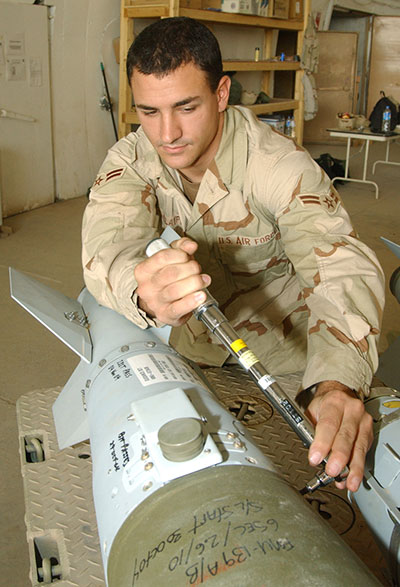
    An airman assembles a GBU-38 500-pound Joint Direct Attack Munition, the same weapon that destroyed Zarqawi's safe house.
    An airman assembles a GBU-38 500-pound Joint Direct Attack Munition, the same weapon that destroyed Zarqawi’s safe house. Photo: US Air Force

    A GBU-38 Joint Direct Attack Munition (JDAM) equipped with GPS guidance was one of the two munitions used in the bombing of Zarqawi’s safe house outside the city of Baqouba, 30 miles northeast of Baghdad.

    Air Force Space Command delivered space combat effects for the precision strike that resulted in the death of Zarqawi, said Brigadier General Donald Alston, director of Air and Space Operations.

    “Once again, GPS-aided munitions played a significant role in the success of an important operation,” he said. “When you’re after an elusive, high-value target, you’ve got to make every shot count.”

    Alston said the military is depending on satellite technology like GPS more than ever in conducting the war in Iraq. “GPS provides the precision timing and navigation absolutely instrumental in both protecting our troops on the ground and taking out the bad guys.” Alston recently returned from Iraq as the Multinational Force-Iraq Director of Communications.

    In the attack, a single F-16 fighter jet fired two precision-guided 500-pound munitions sequentially, first a laser-guided GBU-12 and then a GPS-guided GBU-38. The GBU-38 is a traditional gravity bomb, which in this case had an added tail kit — the JDAM —with a GPS guidance package to increase both range and accuracy.

    A GBU-38 is being detached from an F-16 Fighting Falcon. Photo: US Air Force
    A GBU-38 is being detached from an F-16 Fighting Falcon. Photo: US Air Force
    GPSBomb-3-W Photo: US Air Force
    Photo: US Air Force

    JDAM: Military’s Smart Choice

    Since its debut in 1999, the Joint Direct Attack Munition, or JDAM, has been used more than 15,000 times.

    JDAM is a tail kit that turns an unguided dumb munition into an accurate smart bomb. With a range of about 15 nautical miles, the autonomous JDAM can be released from almost every aircraft in the Air Force and Navy inventory from a low or high altitude in almost any type of weather. Once in the air, the weapon uses GPS and inertial navigation to find its target.

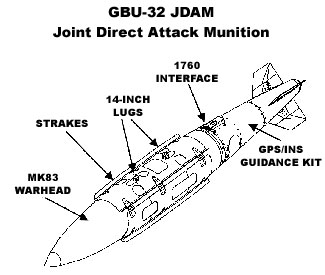
    The JDAM.
    The JDAM kit is at the tail of the munition.

    In 1991, the United States used much less accurate, unguided munitions during Operation Desert Storm. The few laser-guided weapons used were only effective in near-perfect weather and were very expensive, at $120,000 apiece. After the conflict, research and development of an “adverse-weather precision-guided munition” began.

    In 1995, McDonnell Douglas, which later merged with Boeing, was chosen to develop the low-cost JDAM. The first JDAMs were delivered in 1997 with operational testing conducted in 1998 and 1999. More than 450 JDAMs were dropped during testing, recording an unprecedented 95 percent system reliability while achieving a 9.6-meter accuracy rate. JDAM performance has been demonstrated in operationally representative tests including drops through clouds, rain and snow.

    As a result, the Air Force and Navy ordered 87,000 tail kits at $18,000 a piece, which has since increased to more than 200,000 units because of the weapon’s affordable price and operational success. The first international sale was made to Israel in 2000. Since then, 12 additional international customers have purchased JDAMs.

    The JDAM was first used during Operation Allied Force in the Balkans in 1999. In Operation Enduring Freedom in Afghanistan, B-52 Stratofortresses loaded with 2,000-pound JDAM-equipped bombs provided close air support in addition to their regular missions. In Operation Iraqi Freedom, warfighters first used the smaller 500-pound version of the weapon, which has allowed its use in urban environments.

    Bomb Cutaway Labels

    Tail Kit. The JDAM tail kit includes adjustable tail fins, a control computer, an inertial guidance system, and a GPS receiver. Before dropping a bomb, the aircraft uses its own GPS receiver to pinpoint particular targets on the ground. Just before releasing the bomb, the aircraft’s computer feeds the bomb’s computer its current position and velocity vectors and the GPS coordinates of the target.

    In the air, the JDAM’s GPS receiver updates the weapon’s trajectory all the way to impact, adjusting the flight fins to “steer” the bomb to the target coordinates. Target coordinates can be loaded into the aircraft before takeoff, manually altered by the aircrew before weapon release, or automatically entered through target designation with onboard aircraft sensors.

    When GPS data is available, the JDAM system is accurate to within 40 feet during free flight, generally hitting within a few feet of the target.

    Retasking. The pilots who struck Zarqawi’s safe house were in the air on a sortie in support of ground forces and were retasked while in flight. This “rapidly changing battlespace” demands agile forces that can deliver lethal effects before an enemy can move, Alston explained. “GPS is essential to success in this challenging environment.”

    General Kevin P. Chilton assumed command of Air Force Space Command on June 27, succeeding General Lance W. Lord who retired April 1.

    Manufacturers

    Boeing produces the JDAM kits, with Rockwell Collins providing the GPS receiver and Honeywell Inc. supplying the inertial measurement unit.