Tag: automotive

  • Software steers autonomous vehicle testing

    Assessing the performance of autonomous systems under real-world conditions requires an ultra-precise ground truth reference against which to benchmark vehicle performance. A GNSS-plus-inertial post-processing software can provide this capability, taking real-time GNSS data — which are subject to outages, obstructions, weather-induced errors and more — from the vehicle and correcting the solution. This can improve meter-level data to centimeter-level, a critical standard for safe autonomous performance. A free webinar on Nov. 30 gives both a high-level overview and close-in details of this process.

    Autonomous vehicle testing requires ultra-precise ground truth.

    Many sub-systems must function flawlessly and interact seamlessly for safe autonomous vehicle performance.  Fielding such a vehicle requires rigorous testing, repeated many times; this in turn requires close comparison of the vehicle’s real-time GNSS data to a ground truth of its performance. Post-processing software that combines GNSS with inertial navigation system (INS) data, to bridge GNSS outages common in real-world driving, can provide this capability. Whether the tests are evaluating potential sensor suites, benchmarking their own solutions, or generating high-definition maps, post processing maximizes the accuracy of the solution by processing previously stored GNSS and INS data forward and reverse in time, and combining the results.

    Novatel’s Waypoint software package, Inertial Explorer, offers this capability, whether lower-grade or high-end inertial sensors are employed. An examination of the process is afforded in the free webinar, from the converging viewpoints of three speakers:

    Steven Waslander, associate professor at the University of Waterloo, heads a project collecting 1,000 km of data in all-weather conditions for a new public road driving dataset focused on autonomous driving challenges. He directs the Waterloo Autonomous Vehicle Laboratory (WAVELab), extending the state of the art in autonomous drones and autonomous driving through advances in localization and mapping, object detection and tracking, integrated planning and control methods and multi-robot coordination.

    Terry Lamprecht, director of products at AutonomouStuff, a supplier of components, services and software that enable autonomy, will discuss verifying proper installation, and creating a baseline data set to benchmark against data collected on autonomous vehicles in real-time.

    Natasha Wong Ken, product manager at Waypoint, will give a high-level technical overview of post-processing techniques and settings, including forward and reverse processing, tightly vs. loosely coupled, PPP vs. differential, and more.

    Registration for the November 30 webinar is free. For those not able to attend the live broadcast, all audio and presentation slide components can be downloaded after air date for viewing at convenience.

    Some of the new capabilities explored jointly by NovAtel and AutonomouStuff are covered in the August cover story, Autonomous Assembled.


  • How soon a driverless car? You be the judge

    How soon will driverless cars achieve 20 percent market share in the United States?

    This is the question in GPS World’s Readers Poll for May.

    In 2020? 2022? 2025?

    Or 2028? Maybe 2030.

    Road-Driverless-WHow about 2032?  2035 or after?

    Finally, the ever-popular “Other (please specify).”

    Go to gpsworld.com/17maypoll and fill in your answer by May 12.

    See results in the June issue.

    All poll takers will be entered in a drawing for a $50 gift card.

    ____________

    Meanwhile, here’s a preview of the V2V Countdown article from the May issue, introduced by Chaminda Basnyake, an engineer at Locata Corporation:

    The U.S. Department of Transportation (USDOT) released a Notice of Proposed Rulemaking (NPRM) in December 2016 for the deployment of Dedicated Short Range Communications (DSRC)-based vehicle-to-vehicle (V2V) safety applications as part of the connected vehicles (CV) and automated vehicles (AV) initiative. If all goes well, this mean a V2V deployment mandate for new passenger vehicles likely starting in 2021 and reaching all new vehicles within 2–3 years.

    Standards required for V2V deployment were published in 2016 or before, including the V2V Minimum Performance Requirements SAE 2945/1, leading the way for commercial product development. The USDOT, which has been the catalyst behind V2V industry R&D starting from the automaker collaboration CAMP (Crash Avoidance Metrix Partnership) in 2001, is conducting CV Pilot programs in New York, Wyoming and Florida. These offer the opportunity for state DOTs, vendors and all other stakeholders to test the technology in real-life scenarios.

    Automotive OEMs have been developing this technology for more than a decade, and the NPRM is the beginning of a race toward integrating V2V to production vehicles. Deploying V2V technology requires the close cooperation of OEMs, their suppliers and many other stakeholders.

    This article captures the views of major players in the CV marketplace on expected deployment timelines, remaining challenges such as reliable positioning technology, integration with existing systems, and the implications on AV technology.

  • Autonomous vehicles drive innovation in the GNSS industry

    The May issue of GPS World carries these three expert opinions on the question: How are autonomous vehicles and V2V technologies driving innovation within the GNSS industry?

    Chaminda Basnyake
    Chaminda Basnyake

    Chaminda Basnyake
    Principal Engineer, Market Development,
    Locata Corporation

    We still have technical and cost versus performance challenges to meet the PNT needs of V2V and AV. Positioning and even timing expectations in deep urban areas are still not met reliably. As a result, ad hoc methods such as HD map-based nav — methods that work but are not scalable — have emerged. Innovations to deal with multipath, signal visibility and geometry are critical. Solutions that enable real-time mapping will be essential for scalable AV deployment.


    Curtis Hay
    Curtis Hay

    Curtis Hay
    Technical Fellow, GPS & Maps,
    General Motors

    Four key areas the commercial GNSS industry is pursuing include: low-cost, high-volume dual-frequency chipsets; broadly available PPP and network RTK corrections delivered either through mobile IP or satellite; precise maps for highways, urban centers and trunk roads that achieve 10-cm localization relative to WGS-84; and improved integrity monitoring and fault detection. The National Highway Transportation and Safety Administration also released a proposed rule-making with tight standards for GNSS performance: 1.5 meters, 1-sigma confidence.

    Jonathan Auld
    Jonathan Auld

    Jonathan Auld
    Director, Safety Critical Systems,
    NovAtel

    Unlike traditional GNSS applications, automotive positioning requires high-precision accuracy at extremely low cost and size. Most importantly, this performance must be achieved with high reliability while operating in the toughest environments.  Solving this positioning challenge is driving innovation in the system engineering of multi-frequency receivers and antennas along with extending performance through sensor fusion with lower cost devices.  Additionally, there is significant work in the area of safety and integrity for land-based applications.

    Here’s a preview of the V2V countdown article from the May issue, introduced by Chaminda Basnyake, an engineer at Locata Corporation:

    The U.S. Department of Transportation (USDOT) released a Notice of Proposed Rulemaking (NPRM) in December 2016 for the deployment of Dedicated Short Range Communications (DSRC)-based vehicle-to-vehicle (V2V) safety applications as part of the connected vehicles (CV) and automated vehicles (AV) initiative. If all goes well, this mean a V2V deployment mandate for new passenger vehicles likely starting in 2021 and reaching all new vehicles within 2–3 years.

    Standards required for V2V deployment were published in 2016 or before, including the V2V Minimum Performance Requirements SAE 2945/1, leading the way for commercial product development. The USDOT, which has been the catalyst behind V2V industry R&D starting from the automaker collaboration CAMP (Crash Avoidance Metrix Partnership) in 2001, is conducting CV Pilot programs in New York, Wyoming and Florida. These offer the opportunity for state DOTs, vendors and all other stakeholders to test the technology in real-life scenarios.
    Automotive OEMs have been developing this technology for more than a decade, and the NPRM is the beginning of a race toward integrating V2V to production vehicles. Deploying V2V technology requires the close cooperation of OEMs, their suppliers and many other stakeholders.

    This article captures the views of major players in the CV marketplace on expected deployment timelines, remaining challenges such as reliable positioning technology, integration with existing systems, and the implications on AV technology.

  • Tallysman introduces NMO mounts for dual- and triple-band GNSS antennas

    Tallysman, a manufacturer of high-performance GNSS antennas and related products, released its NMO (New Motorola) mounts for its dual- and triple-band GNSS antennas. NMO mounts are used in a variety of applications such as automobiles, railway cars and emergency vehicles.

    nmo with antenna 300ppiWith the introduction of this mount, customers can now upgrade  existing GPS L1-only antennas to dual (L1/L2) and triple (L1/L2/L5) band GNSS antennas.

    The NMO mount is available for Tallysman’s TW3872 (GPS L1/L2, GLONASS G1/G2, BeiDou B1, and Galileo E1) and the TW3972 (GPS L1/L2/L5, GLONASS G1/G2/G3, BeiDou B1/B2, Galileo E1/E5a+b + L-band correction) antennas.
    The NMO mount is able to accept a ground plane (also available from Tallysman) to increase the gain of the antenna.
    Tallysman antennas are housed in an IP67 compliant housing and are REACH and RoHS compliant.

  • M3, Averna join to test auto infotainment

    M3, Averna join to test auto infotainment

    Averna AST-1000.
    Averna AST-1000.

    Averna has entered a strategic partnership with M3 Systems to distribute M3’s StellaNGC GNSS Simulator on National Instruments’ VST platforms for the infotainment segment of the automotive market.

    M3 Systems’ GNSS simulator, based on National Instruments’ Vector Signal Transceiver (NI VST), will now be available as part of Averna’s AST-1000 platform, extending its capability to navigation and GNSS testing.

    Launched in July 2016, the AST-1000 is an RF solution designed for radio, navigation, video and connectivity testing. Also based on the NI VST, the software-defined AST-1000 supports all common infotainment RF signals, including AM/FM, DAB, RDS, HD Radio and Sirius/XMas, as well as GNSS navigation.

    The combination provides a comprehensive solution and enables unprecedented applications for the testing of infotainment systems.

    M3 Systems’ GNSS simulator is a good fit to extend the capability of the AST-1000 for navigation testing because both instruments are based on the NI VST, the companies said.

    Averna is aiming for an all-in-one platform for the complete validation of infotainment systems, including radio, navigation, audio/video and connectivity testing.

    The Averna AST-1000 is available to customers worldwide.

  • Sierra Wireless acquires GlobalTop’s GNSS embedded module business

    The GlobalTop Firefly X1 GNSS module.
    The GlobalTop Firefly X1 GNSS module.

    Sierra Wireless, a provider of fully integrated device-to-cloud solutions for the Internet of Things, has completed the acquisition of GlobalTop Technology’s GNSS embedded module business for $3.2 million.

    GlobalTop’s GNSS embedded module portfolio will become part of the Sierra Wireless OEM Solutions product line, and the GNSS staff from GlobalTop will join Sierra Wireless.

    GlobalTop’s GNSS products generated $5 million in revenue in the last 12 months, and the business is break-even, Sierra Wireless said.

    “Building on our portfolio of cellular, Wi-Fi and Bluetooth modules, we will have additional products to offer to our customers in markets where positioning data is critical, including high-value asset tracking, telematics, drones and automotive,” said Dan Schieler, senior vice president and general manager of OEM Solutions for Sierra Wireless.

    The TitanX1 GNSS antenna.
    The TitanX1 GNSS antenna.

    GlobalTop GNSS modules include the Firefly, Ivory and Hummingbird series (GNSS standalone), and the Titan and Ladybird (GNSS with antenna). GlobalTop launched the Titan X1 module in February.

    “With a wide array of modules and established sales channels, as well as a proven engineering team, we believe that the GlobalTop GNSS business is an important addition to Sierra Wireless,” Schieler said.

  • Panasonic showcases connected airport at Mobile World Congress

    Panasonic showcases connected airport at Mobile World Congress

    Panasonic Business introduced its connected airport concept at Mobile World Congress, which is taking place this week in Barcelona, Spain, and is showcasing a suite of intelligent technology solutions for the first time in Europe.

    Panasonic LinkRay.
    Panasonic LinkRay. Photo: Panasonic

    High-tech airports

    A key technology on display is LinkRay, a one-to-one customer engagement tool for public spaces. With LinkRay, dozens of people can simultaneously get native language information from display panels and LED lighting to their smartphone, so that display panels in an airport can contain links to transport information in multiple languages.

    Also on display is HD Beacon technology, which can assist localized mapping and wayfinding within the terminal buildings at an airport. So, for instance, airport staff or people with limited mobility could use their mobile device to find the nearest electric cart to get them quickly to their gate.

    At MWC, Panasonic is displaying at the 120m2 booth (Hall 6, Booth H31) with technology for retail, car rental, communications, security, logistics and ground handling.

    Car rentals

    In the car rental area of the booth, Ficosa, who has had a business alliance with Panasonic since 2015, will introduce the latest technologies in connected cars. These solutions will transform the in-vehicle experience, providing innovative vehicle services, enabling more autonomous driving with higher levels of safety and efficiency.

    Within the airport logistics hub area, Panasonic’s Parcel Picking Director uses barcode technology to project key parcel information onto parcels themselves, making it viewable by workers at a distance.

    Panasonic Media Track allows organizations to track and optimize the deployment of mobile assets such as baggage containers, trolleys and wagons, perfect for ground handling operations. While Intelligent Warehouse Software (iWS) use CCTV cameras and software to find lost parcels or luggage in minutes rather than hours spent manually searching through security footage.

    “We know that our connected, intelligent technology solutions are well matched for the transportation market,” said Tony O’Brien, managing director of Panasonic System Solutions in Europe. “Our research tells us that improving the passenger journey through better connectivity and information sharing is an important driver in this space and Mobile World Congress gives us the opportunity to showcase what Panasonic can do to innovate within transportation.”

  • U-blox receives certification for Toby modules offering IoT access

    U-blox receives certification for Toby modules offering IoT access

    U-blox has received PTCRB certification of its TOBY-R202 and TOBY-R200 LTE Cat 1 modules for T-Mobile’s U.S. 4G LTE network.

    The u-blox Toby module.
    The u-blox Toby module. Photo: uBlox

    Both modules will be available for both of T-Mobile’s IoT Access packs, which offer simple IoT pricing with a Cat 1 module and support a broad range of industrial internet of things (IIoT) applications, reducing the cost for product makers to introduce new LTE devices on the network.

    The TOBY-R202 and TOBY-R200 modules deliver true industrial performance. They are robust and reliable with extended temperature range of negative 40 degrees Celcius to 85 degrees Celcius and manufacturing in ISO/TS 16949 certified production sites.

    LTE Cat 1 provides efficient power consumption with battery life lasting up to five years, depending on the application. In addition, TOBY-R200 includes a wider supply voltage input that allows for less expensive design and further lowers power consumption.

    “U-blox is a global leader in developing cellular modules designed for IoT and M2M applications,” said Drazen Drinic, product manager of cellular at u-blox. “We are excited to now have two LTE Cat 1 modules available to IoT product makers as part of T-Mobile’s IoT Access packs.”

    The u-blox modules will now be included in T-Mobile’s IoT Access packs, which provide product makers with a simplified launchpad for their IoT devices. For a limited time, customers can get unlimited data at 64 kbps for $20 per year per device, with up to $16 per certified module covered via a bill credit from T-Mobile upon activation.

    “T-Mobile’s low-cost IoT access packs give our customers industry-leading Category 1 chipset options to quickly launch their devices on the nation’s fastest 4G LTE network,” said Doug Chartier, senior vice president at T-Mobile.

    The two u-blox TOBY-R2 LTE Cat 1 modules support many IoT and M2M applications and are specifically targeted at those markets requiring industrial performance, such as smart metering, alarm and security systems, connected health, automotive and transportation, as well as smart payment solutions.

    They come in a compact 24.8 millimeter by 35.6 millimeter form factor and operate on LTE bands 2, 4, 5 and 12. TOBY-R202 provides fallback on 3G bands 2 and 5, while TOBY-R200 provides global 2G and 3G fallback. Thanks to u-blox nested design, migration between the TOBY-R2 modules and other u-blox 2G, 3G and 4G modules is easy, while enabling future-proof, seamless mechanical scalability across technologies.

  • GNSS spoofing will attain virus status, warns expert

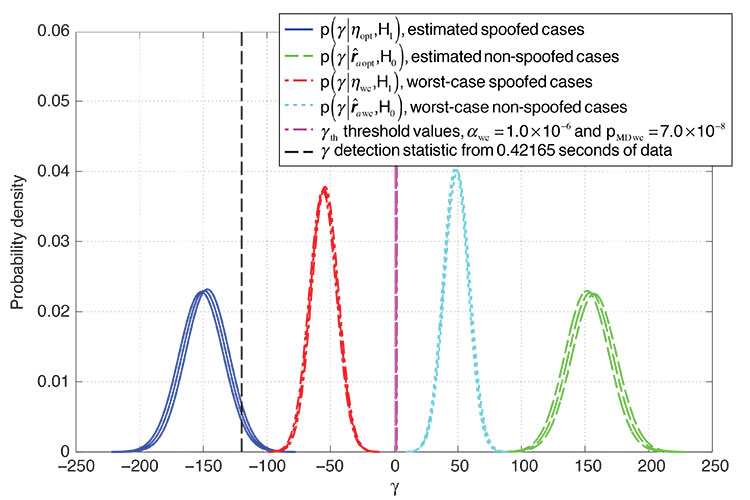
    Figure 6. Performance of a typical spoofed case with live data: spoofing detection statistic, threshold, and related probability density functions.

    As manufacturers convert machines and appliances into remotely controllable objects (the Internet of Things), the potential for spoofing expands, perhaps exponentially. Hackers could interfere with the data supplied to autonomous cars or tracks, remotely forcing them to crash.

    Although the dangers of GPS spoofing have been pointedly discussed in may technical papers and articles in GPS World since the early 2000s, manufacturers have not devoted much attention to them because there weren’t many devices making use of location-based technologies, according to associate professor Dinesh Manandhar of the University of Tokyo.

    With the proliferation of GPS-capable smartphones and other networked devices, “anyone can become a target of the attack,”  Manandhar told the Japan Times in a recent interview.

    “Too many things today use GPS as a reliable source of location information,” Manandhar said.  “People trust the location information from GPS satellites like God. When PCs became common for many people, the sudden outbreak of computer viruses became an issue around the world, and anti-virus software become an essential tool for everyone to protect their data,” he added. “The same thing is now happening around GPS. We need a system to fight back against the risk.”

    Manandhar cited some possible examples of spoofing, both by consumers — “You can falsify your smartphone’s information and make it look like you are going back and forth between Tokyo and Hawaii within just three minutes,”  and by sophisticated criminals. “Let’s say I were a top manager of a major bank. I could access all the information while sitting at my desk, but I wouldn’t be able to access it from the room next to it. But people could get access to such information if they disguised the location information received by computer.”

    Manandhar and many other researchers around the world are developing and testing anti-spoofing techniques, but it is a long step from demonstrated results to integration into products reaching market. “The products we are designing today are ones that we will use five years later. So we must assume the possible risks and prepare for the threats that might jeopardize our society in the future.”

    Manandhar co-authored the article “Opening Up Indoors: Japan’s Indoor Messaging System, IMES” in the May 2011 issue of GPS World. The graphic heading this news story is drawn from “GNSS Spoofing Detection: Correlating Carrier Phase with Rapid Antenna Motion,” the Innovation column in the June 2013 issue.

  • Automotive abstract: INS to protect against GNSS spoofing

    Automotive abstract: INS to protect against GNSS spoofing

    iongnss16_manickam

    Using Tactical and MEMS Grade INS to Protect Against GNSS Spoofing in Automotive Applications

    By Sashidharan Manickam and Kyle O’Keefe PLAN Group, Department of Geomatics Engineering, University of Calgary

    This paper analyzes the GNSS signal authentication limits in using different grades of IMU (Tactical and MEMS) to detect errors in combination with different grades of GNSS receiver (Geodetic grade and Automotive). To test these combinations, a tightly-coupled 23 state navigation Kalman Filter is implemented with a constant velocity dynamics model for the position, velocity, attitude and clock states and first-order Gauss-Markov processes to model the 12 sensor errors.

    Presented at ION GNSS+, September 2016.

  • u-blox launches new firmware for ADR GNSS modules

    u-blox_NEO-M8Lu-blox has released its fourth generation firmware for 3D Automotive Dead Reckoning (ADR) GNSS modules and chip sets, the company announced during TU-Automotive 2016, which is being held June 8-9 in Novi, Michigan.

    The Swiss-based company develops GPS technology, chip sets, miniaturized GPS modules, smart antennas and dead reckoning products. Designed for first mount or aftermarket road vehicle applications, such as in-car navigation, infotainment systems, telematics units and fleet management, the upgraded GNSS receiver now offers real-time continuous navigation output with an update rate of 20Hz, enabling low latency for applications such as interactive head-up displays.

    The new firmware supports Galileo, GPS, GLONASS, Beidou, QZSS and SBAS. It also supports the Galileo-based eCall European emergency call system, which will be required in new vehicles starting in 2018.

    The DR performance has been enhanced, the company says, which improves navigation performance, especially in highly urban environments where satellite signals are heavily blocked by and reflected from buildings. The high performance of the u-blox M8 concurrent positioning engine combined with the latest u-blox 3D ADR technology results in 100 percent coverage and continuous 3D positioning.

    The new firmware will be delivered on u-blox NEO-M8L modules and is available for UBX-M8030-Kx-DR dead reckoning chips, including the new automotive grade variant supporting operation up to 105 degrees Celsius.

  • GM, Volkswagen to use Mobileye auto mapping technology

    Mobileye, a developer of vision and data analysis for Advanced Driver Assistance Systems (ADAS) and autonomous driving, has introduced a new mapping technology development called Road Experience Management (REM).

    REM enables crowd-sourced real-time data for precise localization and high-definition lane data that forms an important layer of information to support fully autonomous driving.

    Mobileye is engaged with General Motors to integrate REM into existing program launches in an expedited timeframe, as part of GM’s heightened partnership with Mobileye. In addition, on Jan. 5, Mobileye signed a Memorandum of Understanding with Volkswagen and announced a strategic partnership to explore and integrate REM into Volkswagen’s fleet.

    The technology is based on software running on Mobileye’s EyeQ processing platforms that extracts landmarks and roadway information at extremely low bandwidths, approximately 10 kb per kilometer of driving. Additionally, backend software running on the cloud integrates the segments of data sent by all vehicles with the on-board software into a global map.

    “We leveraged advanced artificial intelligence, used for creating environmental models from camera input, in order to create maps based on local coordinate systems while requiring very low bandwidth,” said Prof. Amnon Shashua, co-founder, chairman and Chief Technology Officer of Mobileye. “The low bandwidth of the model, and the fact that it requires only a camera, which is already available in most new car models as part of the trend towards growing driver assistance deployment, enables the map creation and update to be managed by a cooperative crowd sourcing mechanism.”

    A third OEM customer of comparable size is expected to be announced later this year.

    Shashua discussed the future of autonomous driving and road mapping at the Consumer Electronics Show in Las Vegas in January.