LizardTech, a provider of software solutions for managing and distributing geospatial content, has been awarded a U.S. patent for the compression of lidar point clouds (US 9753124).
The patented technology provides lossless compression of point clouds captured by airborne lidar sensors or terrestrial laser scanners for easy and cost-effective processing, storage and transmission of data sets.
Point cloud data goes from staggering to manageable when lidar files are compressed to the MrSID format.
“Lidar systems capture terabytes of data containing rich information that can be difficult to exploit due to the difficulty processing such massive files,” said John Hayes, the LizardTech senior engineer who received the patent. “Our lidar compression technique allows users to maximize their return on investment in point cloud data collection.”
LizardTech developed the lidar compression technology in 2009 by leveraging the wavelet transformation algorithms used to compress satellite and aerial image data sets into MrSID formats. The point cloud compression technique was first released as a stand-alone LizardTech product called LiDAR Compressor and then integrated into GeoExpress in 2015.
GeoExpress is LizardTech’s flagship software product originally created to enable geospatial professionals to manipulate digital satellite/aerial image and losslessly compress them to industry-standard MrSID or JPEG2000 files. The addition of lidar handling gave GeoExpress the ability to natively compress lidar data to MrSID and LAZ formats with no loss of data content, saving up to 75% on storage, and time in processing files.
Lidar systems are flown extensively on aircraft and unmanned aerial vehicles to collect highly accurate measurements of terrain elevations for a variety of mapping applications.
Another form of lidar, known as terrestrial laser scanning, captures point clouds at ground level — both inside and outside of building structures — for visualization of crime scenes, re-creation of accident sites, and 3D modeling of building interiors.
“Lasers are even being mounted on earth-moving equipment at construction sites for real-time capture of grading progress so that engineering managers can make on-the-spot decisions,” said Toby Martin, vice president of development and strategy at Extensis. “Lidar compression makes this possible and is revolutionizing workflows in the architecture, engineering and construction (AEC) industry.”
The lidar compression algorithms can be licensed via the LizardTech SDK to incorporate the technology into third-party geospatial software solutions. Already, LizardTech is seeing interest in this technology from hardware sensor developers who want to place data compression capabilities at the source of collection.
Aircraft to Provide Wildfire Measurements in Support of NOAA Fire Weather Forecasting
The U.S. National Oceanic and Atmospheric Administration (NOAA) has selected a small unmanned aircraft system (sUAS) for wildfire measurements and observations in support of its FIREX field mission and the fire weather forecasting initiative.
Black Swift Technologies will deliver to NOAA a tightly integrated system consisting of an airframe, avionics and multiple sensors capable of research-quality measurements of CO2, CO, aerosol, RH, p and T in wildfire plumes, as well as multispectral high-resolution maps of wildfires.
The SuperSwift sUAS will be operated by the University of Colorado’s Integrated Remote & In Situ Sensing Program (IRISS) in close collaboration with NOAA.
“One of the purposes of IRISS is to work with the science community to develop and deploy platforms which make primarily in situ measurements,” said Brian Argrow, IRISS director. “This naturally lead us to partnerships with NOAA on the science perspective, and to Black Swift Technologies for their sUAS technology and expertise. It’s a partnership that looks like a three-legged stool with the science interest of NOAA, the technology and engineering expertise of IRISS, and the unique sUAS platform designed by Black Swift Technologies, as the corresponding legs.”
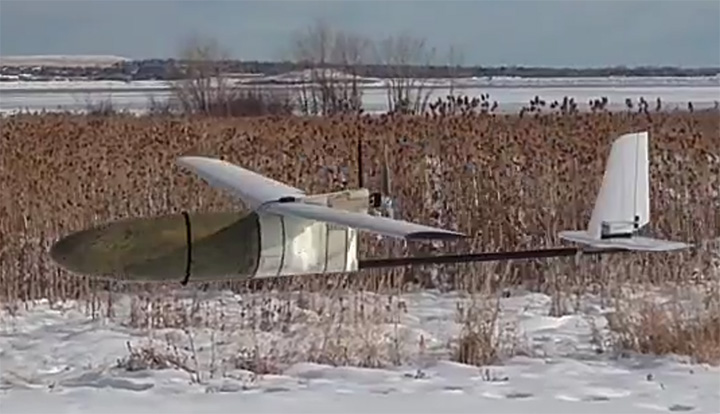
The FireFOX sUAS is based on Black Swift’s commercially available SuperSwift airframe and SwiftCore Flight Management System — designed to be cost-effective, powerful and easy to operate in the field.
The SuperSwift is specifically engineered to meet the demands of high-altitude flights through strong winds and damaging airborne particulates typical of nomadic scientific field campaigns in harsh environments.
The SuperSwift sUAS has a forward-located, spacious, interchangeable nose-cone payload bay. (Photo: Black Swift)
“While there are many sUAS manufacturers for agencies like NOAA to consider, most are simply not suitable for scientific atmospheric measurements,” said Jack Elston, CEO of Black Swift Technologies.
The SuperSwift addresses NOAA’s requirements for endurance and operational radius (> 2 hours and between 30 to 60 km) sufficient for fire observations, its payload capability (up to 5 pounds), and its unique forward-facing payload bay, “ideal for atmospheric sampling and for easy instrument package swapping,” Elston said.
The ultimate goal of NightFOX is to perform nighttime in situ measurements of wildfire plumes and remote measurements of wildfire properties, with the measurement data used to improve fire weather forecasting.
Because of safety concerns and dangers associated with nighttime operations, manned aircraft flights are limited to daytime operations. Ground observations using a mobile laboratory provide detailed chemical information on fire plumes, but lack information on plume spatial distribution to put the point measurements in context.
UAS observations are the only technology capable of this task. sUAS observations can provide useful information for firefighting efforts by accurately detecting fire perimeter and identifying fire hotspots, but have not attempted to make measurements relevant to studying fire emissions or incorporate observations into fire forecast models.
“Our proposed work, if successful, will significantly advance the integration of UAS-based observations of wildfires into fire-weather modeling and forecasting,” said Ru-Shan Gao, principal investigator, Chemical Sciences Division, Earth Systems Research Laboratory, NOAA.
The collected data will also provide otherwise missing data for studying the impact of North American wildfires on the atmosphere and human health. It will ultimately support better land-management decisions and practices, contributing to NOAA’s core mission to advance understanding and prediction of the Earth system to enhance society’s ability to make effective decisions.
IRISS, a pillar of the CU Boulder Grand Challenge, is a multi-disciplinary team that leads the design, development and deployment of novel remote and in-situ sensing systems to exploit mobility enabled by aerospace systems to enhance data collection from the ground, in the atmosphere and from
space.
With its partners, IRISS explores commercial opportunities and fosters discussions on the ethical, legal, and social policy implications of new technologies and big-data collection.
The existence of a sUAS capable of carrying the necessary instruments routinely through harsh environments adds an invaluable contribution to the calibration and validation of data collected from ground- and satellite-based methods.
The innovations of the SuperSwift, including the total sensor suite, can be used for scientific research by federal and state public agencies and other state-funded laboratories to collect data on coherent atmospheric structures such as smog, volcano plumes, wildfire smoke, chemical fires, forest humidity, and studying oil and gas field flares for calibration/validation of satellite measurements.
“NOAA is interested in a UAS observational system (UASOS) that can use be used for fire-related measurements, and so in a sense what we want to know is when and where does the fire flow and ultimately what kind of fire and air quality will result regionally,” Gao said. “We want to monitor the fire and incorporate the remote and in situ measurements into a fire forecast model so ultimately we’ll be able to do better fire forecasts that will help firefighters better fight the fire and keep human and property losses to a minimum.”
Trimble has introduced Penmap for Android, a cloud-connected application for field surveying and high-accuracy geographic information system (GIS) data collection that works on mobile handhelds, smartphones and tablets.
Trimble Penmap for Android focuses on core survey and mapping tasks such as cadastral and boundary surveys, as well as establishing local control, stake-outs, quality checks and asset management for utilities. It provides both professional surveyors and field workers with an intuitive, easy-to-use map-based interface to manage features and attributes for high-accuracy GIS and complete survey documentation.
The application is also ideal for use in the energy distribution industry for locating infrastructure and recording critical information on encroachments, clearways and existing monuments, the company said.
The application runs on a variety of Android devices, including the rugged Trimble TDC100 handheld, and supports full-featured Trimble GNSS receivers such as the Trimble R10, R8s and R2 receivers.
Trimble Penmap for Android is optimized to integrate with the new Trimble Catalyst service, a software-defined GNSS receiver that connects to the small, inexpensive plug-and-play DA1 antenna, and allows surveyors to choose an accuracy level from meter to centimeters to suit their application needs.
Together, Penmap and Trimble Catalyst — both purchased through a fixed monthly subscription — offer an on-demand, lightweight and low-cost professional surveying system that provides value, convenience and flexibility, the company added.
“The addition of Penmap expands our portfolio to address the needs of organizations that require a value-packed, flexible survey system,” said Matt Delano, general manager of Trimble’s Land Administration solutions. “Surveyors using the Penmap application with Trimble Catalyst can easily manage seasonal shifts in survey activity by scaling up or down without a capital investment. Survey managers will find it an efficient way to carry out field checks without tying up expensive equipment used by their field crews. They can simply use a phone, the Penmap application, a Catalyst subscription and the DA1 antenna.”
Trimble Penmap for Android includes the Penmap Project Manager, which is used to set up projects, create templates and add team members.
Penmap Project Manager works with the Trimble Connect platform for storing and transferring data between the field and office.
Trimble Connect, which is also included in the Penmap subscription, is a collaborative cloud-based platform that enables organizations to set up and deploy projects to their field users. Information collected in the field is synced back to the office in real-time where it is stored, managed and communicated to team members.
Data can also be exported from Penmap Project Manager into back-office systems in a variety of file formats for viewing and sharing.
Time has great impact in the enterprise mobility continuum. Developing tools for mobile workers has long been the sole province of IT, but the demand for mobile apps is stretching IT to the breaking point. Demand for mobile apps is five times greater than IT capacity, according to one market study.
This makes many organizations reluctant to jump in to mobile development or to change traditional processes that aren’t broke — so why fix them? The trend also explains the emergence of zero-code app development platforms that can reduce a one-year IT backlog to a few hours. The equation changes when end users become “citizen developers,” allowed to create the custom apps by selecting features, interfaces from a menu of capabilities.
Zero code is being called both a game-changer and disruptive technology because it offers a new approach to mobile data collection, with new, easy-to-use technology to develop tools.
One such example is Terrago’s Magic, a zero-code development studio, which is growing both vertically and horizontally, with both directions responding to customer input.
GPS World readers and all other interested parties have an opportunity to learn more about these time-saving tools in a free webinar on May 25: How to Build Custom Trimble Apps for Any Industry with Zero-Code. See env-gpsworld-integration.kinsta.cloud/webinar for further details and immediate registration.
Participants will learn how to:
Create custom mobile apps with your branding and selected features using a click-not-code app studio;
Integrate your custom mobile app with Trimble GNSS and many other enterprise platforms;
Publish to the AppStore, Google Play and the Cloud with the click of a button;
Deploy cloud-based or private-hosted enterprise servers; and
Reduce development costs by 90 percent.
Vertical growth comes through a software development process that generates a new version every 4-6 weeks, each with new features. Magic custom app development basically involves selecting workflow elements from a menu. Since anything with a menu is limiting by definition, TerraGo does not claim that Magic can be all things to all people. But as limitations are reduced with each version’s new menu, Magic is becoming more things to more people – and can complement less-limiting (if more time and money consuming) low-code app development organizations by reducing the strain on their IT departments.
Horizontal growth is coming through partnerships with companies such as CompassTools and Duncan-Parnell. These firms have the vertical expertise to customize and deploy tailored solutions at speeds not achievable with traditional approaches.
CompassTools, headquartered in Denver, serves eight Midwestern states from Canada to Mexico with high-precision field data collection solutions. For many years Compass offered handheld GPS devices as the foundation of those solutions with great success. Still, the data typically required manual processing once the devices were returned from the field, introducing expensive delays. Now positioning, mobile and cloud innovations are reducing that time.
“We really believe that TerraGo’s approach represents an important part of the future data collection tools that our customers are going to need in the field,” said Andew Carey, an account manager with CompassTools.
“Because TerraGo apps provide direct integration with Trimble receivers, they can help us deliver the best of both worlds for customers with easy-to-use field apps and proven Trimble accuracy,” said York Grow, MGIS solutions manager at Duncan-Parnell.
TerraGo has entered a partnership with Duncan-Parnell, a provider of geospatial solutions to the surveying, construction and other infrastructure industries in Delaware, Washington, D.C., Georgia, Maryland, North Carolina, South Carolina, Tennessee, Virginia and West Virginia.
“Our customers depend on Duncan-Parnell to provide innovative, reliable solutions for their geospatial and infrastructure management needs,” said York Grow, MGIS Solutions Manager at Duncan-Parnell. “Because TerraGo apps provide direct integration with Trimble receivers, they can help us deliver the best of both worlds for customers with an easy-to-use field app and proven Trimble accuracy.”
“Duncan-Parnell provides the expertise and level of service that complements our mobile technology to help our customers complete projects on time and on budget,” said John Timar, vice president, Worldwide Sales, TerraGo. “The latest Trimble GPS and positioning technology combined with our user-customizable apps means they get their field work done faster and cheaper, with the precision they already know and trust.”
Duncan-Parnell specializes in providing high quality hardware, innovative software, and invaluable services to make projects successful. With 13 locations to serve customers, Duncan-Parnell is an authorized reseller of TerraGo Edge and TerraGo Magic products in addition to Trimble, Esri and other leading geospatial technologies.
The companies are hosting a webinar at 12 p.m. ET on Tuesday, March 14 that includes a live demonstration of mobile GIS and GPS solutions available from TerraGo and Duncan-Parnell.
Trimble has introduced Catalyst, a software-defined GNSS receiver that works with select Android mobile handhelds, smartphones and tablets. When combined with a small, lightweight, plug-and-play digital antenna and subscription to the Catalyst service, the receiver provides on-demand GNSS, geo-location capabilities to transform consumer devices into high-accuracy mobile data collection systems.
The announcement of the new product, designed for GIS professionals, was made at Trimble Dimensions.
Through smartphone and tablet developments accelerated by the bring your own device (BYOD) to work movement, field workers and consumers increasingly have access to positioning technologies for geospatial data use and collection. The Catalyst software receiver collects data and inspects or manages assets using smart devices. The software-defined GNSS receiver is designed to be integrated into a wide range of applications—providing a dual-frequency, multi-constellation receiver. The mobile device receives dual-frequency signals from the plug-and-play Trimble DA1 digital antenna. The small size and light weight of the antenna makes it possible to store in a car glove box or backpack, available for use on demand. By adding a Trimble Catalyst subscription, users can choose the level of accuracy to suit their application needs from meter level to centimeters.
Trimble calls its Catalyst service Positioning-as-a-Service. It is available on-demand. Users download applications to suit their business needs, purchase the low-cost DA1 digital antenna and subscribe to the level of service required for the application. For GNSS corrections, the solution automatically selects the best available correction service based on the user’s location and subscription level. Corrections powered by Trimble RTX technology and the Trimble VRS Now networks are supported. Trimble RTX corrections can be received either via IP/cellular connection or L-band satellite. The subscription cost is based on usage, allowing users to scale up/down for projects with minimal capital expense.
“The addition of Trimble Catalyst expands our portfolio to address the needs of organizations that have adopted a workplace Bring Your Own Device (BYOD) strategy for their businesses and individuals who periodically need accurate positioning to support various work activities,” said Ron Bisio, vice president of Trimble’s Geospatial Division.
TerraFlex Geospatial Data Collection. The first available application for the Trimble Catalyst service is the Trimble TerraFlex cloud-based mapping and GIS field software, enabling users to achieve up to centimeter-level accuracy. TerraFlex is a scalable cloud-based solution addressing a variety of field requirements including attribute-rich GIS data collection on consumer devices. With an intuitive interface and streamlined toolset for creating custom digital form templates, TerraFlex keeps the data flow standardized and streamlined from the field to the office.
TerraFlex provides a common interface for users across a range of common mobile and smart devices to provide robust, high-accuracy GNSS positioning and detailed asset attribution collection. The Catalyst service for TerraFlex provides a new option for a higher level of accuracy for users’ workflows without the upfront investment of traditional hardware GNSS receivers. It enables scaling up to meet specific project demands and allows a workforce to collect high-accuracy location in conjunction with other work tasks.
Availability. Catalyst service subscriptions and Catalyst DA1 antenna are expected to be available in the first quarter of 2017. In addition, a Software Development Kit (SDK) is expected to be available in the fourth quarter of 2016 for developers who are interested in developing new applications that use the Trimble Catalyst positioning on-demand service. Information and updates.
Geneq’s iSXBlue receivers are now fully compatible with Esri’s Collector for ArcGIS 10.4. for iOS, according to Geneq.
The high sub-metric accuracy which characterizes the iSXBlue receivers is thus available in real time for field workers and Collector users.
Users of the high-recision receivers can take advantage of new features of data collection with the Collector software, particularly:
Detailed information about the location and its related accuracy
An easy way of setting a minimal precision value during data collection
A new simple interface for Bluetooth connection setting with the iSXBlue receiver
New correction profile setting to define datum transformations
Capture GNSS metadata (accuracy, correction type, DOP,…) and attach it to features you collect
Improved notifications for receiver changes or configuration issues
Users that need centimeter accuracy can use Geneq’s iSXBlue RTN software, available at the Apple App Store. iSXBlue RTN allows users to receive and use RTK corrections via an Internet Protocol (IP) connection (NTRIP or DIP) along with iSXBlue receivers.
Broadcast Date: Thursday, March 28, 2013 Moderator:Art Kalinski, Editor, GeoIntelligence Insider Newsletter Speakers: Eric Gakstatter, Editor, Geospatial-Solutions.com, Survey Scene Newsletter; Dr. Dan Tolley, CEO, Soft Power Solutions; Gen. Edwin “Skip” Vincent (USAF Ret.), Founder, Soft Power Solutions; Bob Dowling, Co-founder, GeoCOP; Steve Lutton, Director, Product Management, Geosemble Solutions. Summary: Experts in this growing field will discuss the basics for those new to leveraging the technology in their GIS operation. Topics will include different kinds of social media, human geography, traits of each, other related public media, and several case studies and examples.
Sponsored by: NavCom Broadcast date: Thursday, October 16, 2014 On-Demand Available Until: Friday, October 16, 2015 Speakers: Alan Cameron, Group Publisher, GPS World and Geospatial Solutions, and Eric Gakstatter, Editor, Survey Scene & Geospatial Solutions Monthly Summary: UAVs (unmanned aerial vehicles) are taking over the surveying industry, thanks to their ever-improving sensors and the fact that they are getting lighter and can therefore remain in the air for longer. They complete surveying and inspection tasks that would otherwise be difficult to tackle, and do so with impressive cost-efficiency. UAV trends and technology were among the focal points at the InterGeo conference in Berlin in early October.
A new speaker and a new mapping technology have joined the line-up for next Thursday’s (July 28) free webinar, “Laser Rangefinders, Lidar, Cameras and More: Other Sensors Integrated with GNSS for Special Mapping Requirements.” Survey and mapping consultant Eric Gakstatter will speak on the use of digital cameras, laser rangefinders, and lidar.
Eric GakstatterHe joins Joakim Rydell, author of the magazine’s July cover story, “See Into the Smoke with Inertial,” and Paul Adkins, global communications manager for Laser Tech, Inc. Overall, the panelists will present valuable business and technical information to increase workflow efficiency with smart devices, apps, rangefinders and cameras, and to keep attendees on the forefront of new GIS field data collection methods.
Field data collection and mapping is booming in many industrial, business, defense and other organizational workflows. The demand for accuracy and data richness constantly increases, and the frontiers for mapping and navigation are steadily pushing outward through all types of obstructed environments — or inward. These new positioning challenges are met by a range of sensors complementing GNSS: laser range-finders, inertial measurement units, cameras of various kinds and more.
Practitioners and researchers in these industries will find this GPS World webinar material profitable:
Survey and Defense
Mining and Construction
GIS Mappping and GPS Mapping
Forestry and Natural Resource Management
Utilities and Telecommunications
Speakers:
Joakim Rydell Senior Scientist, Swedish Defense Research Agency
“Inertial Navigation and Dense Distance Measurements from a Range Camera”
A prototype for soldiers and first responders in dangerous environments integrates inertial navigation with near-infrared images and dense distance measurements from a range camera using active illumination. This produces real-time results on a tablet computer. Experiments demonstrate that the system provides good positioning and mapping performance in a range of indoor environments, including darkness and smoke.
Paul Adkins Global Marketing Communications Manager, Laser Technology, Inc.
“GIS Field Data Collection Using Smart Devices “
Learn how to increase GIS field data collection workflow efficiency utilizing smart devices (BYOD), internal GPS and apps with compact total station laser rangefinders. Also, using the camera function on the smart devices and/or laser.
Eric Gakstatter Contributing Editor, GPS World, Geospatial Solutions
Gakstatter is a contributing editor for the Geospatial Solutions Monthly e-newsletter, an e-newsletter focused on geospatial technologies. He owns and operates his own drone or UAV. Following 10 years of work experience within the GPS/GNSS industry, since 2000, he’s been a power user of GPS/GNSS technology as well as a consultant with capital management companies; federal, state and local government agencies; and private companies on the application and/or development of GPS technology. Since 2006, he’s been a contributing editor to GPS World magazine and the Geospatial Solutions website.
Moderator:
Alan Cameron Editor-In-Chief, GPS World
Cameron is editor-in-chief and publisher of GPS World magazine, where he has worked since 2000. He also writes the monthly GNSS System Design e-newsletter and the Wide Awake blog.
Laser Technology Inc. (LTI) is offering a close-up look at its new geospatial information systems (GIS) technology at the 2016 Esri User Conference, which is being held June 27 to July 1 in San Diego, California.
Attendees are invited to stop by booth #2525 to discover how LTI can help professionals stay connected and map smarter by using its lasers and a personal smart device. The company will be handing out vouchers for a complete mapping solution, which could save GIS professionals hundreds of dollars.
The New TruPoint 300 with MapSmart on Android, by LTI.
The company’s MapSmart on Android software combines all of the sophisticated technology that is typically required to collect field data and puts it into a straightforward app for smart devices. The software simplifies the mapping process by allowing users to establish an origin quickly and begin mapping in minutes, LTI said.
With MapSmart now available on Android, users gain an improved workflow that includes wireless data transfer, a larger display and built-in help support. Users also have the ability to integrate location data by utilizing the GPS from a smart device or improve accuracy with an external antenna.
LTI is redefining the traditional total station with its brand-new TruPoint 300. A lightweight, compact, simple point-and-shoot laser with survey-grade accuracy, the TruPoint 300 costs a fraction of alternative technology. The unit measures the distance between two remote points and has onboard solutions for volume, heights and 2D and 3D areas.
Users can collect 3D measurements from a single location using a personal smart device and capture a photo of every shot taken. With the ability to collect on-site, extremely precise data in half the time, the modern total station is a go-to tool for collecting measurements quickly, easily and safely, LTI said.
“Achieving survey-grade accuracy with a compact and affordable unit is very exciting,” says Derrick Reish, senior product manager for Laser Technology’s Professional Measurement division. “Having the TruPoint 300 and our flagship TruPulse laser products communicate with MapSmart on Android allows us to offer a complete solution for field measurement and mapping.”
Imagine if you didn’t have to occupy the location you needed to map. LTI has made this possible with LaserGIS for Esri’s ArcPad data-collection software. This software allows users to fully maximize field work productivity. Working seamlessly with the current ArcPad platform, LaserGIS improves the data-collection process by making laser integration faster and easier. Users can now cover more ground in less time and measure the slope distance, inclination, azimuth and position remote features with one, simple shot.
Laser Technology Inc. is a Colorado-based designer and manufacturer of reflectorless laser measurement devices for GIS, forestry, natural resource management, general construction, utilities, mining and telecommunication applications.
Broadcast Date: April 14, 2016 On-Demand Available Until: April 14, 2017 Sponsor:TerraGo Summary: Our expert speaker panel examines how five organizations from five industries (oil & gas, engineering, water utility, transportation and natural resources) made the switch from GPS handhelds to smartphones and tablets for their field data collection needs. Speakers: Michael Gundling and Bryan Burns, TerraGo