Tag: data collection

  • Innovation: There’s an app for that

    Innovation: There’s an app for that

    Using a smartphone for GNSS ionospheric data collection

    By Andrew Kennedy, Ryan Kingsbury, Anthea Coster, Victor Pankratius, Philip. J. Erickson, Paulo Roberto Fagundes, Eurico R. de Paula, Kerri Cahoy and Juha Vierinen


    INNOVATION INSIGHTS with Richard Langley
    INNOVATION INSIGHTS with Richard Langley

    DO YOU REMEMBER YOUR FIRST PERSONAL COMPUTER? I do.

    It was a Timex Sinclair 1000. Released in 1982, it used a Zilog Z80A processor running at 3.25 MHz and sported a whopping two kilobytes of memory and a wonky membrane keyboard. You had to hook it up to a tape recorder to record and load programs (in BASIC) and it used a TV tuned to channel 3 or 4 as a display device. We’ve certainly come a long way in the past almost 35 years. Now, I have a computer I can hold in my hand with more than one thousand times the computing power and more than one million times the memory and a built-in interactive display. It’s an Apple iPhone 5S smartphone. I am one of the billions of owners of a smartphone. In 2015 alone, almost 1.5 billion smartphones were sold worldwide.

    We use our smartphones for a wide range of tasks. Besides voice phone calls, we use them to text, to wake us up, to listen to our tunes, to watch movies, to take photographs and videos, to surf the Web, to navigate. The list goes on and on. In 2015, there were about 1.5 million applications or apps available for both Apple and Android smartphones.  Those with the ability can even program their smartphones to perform tasks specific to their lifestyles, hobbies, or professions.

    In this month’s column, we take a look at the use of a smartphone app to collect GNSS ionospheric data. Why would you want to do that?

    In the experience of the developers of the app, GNSS receivers are often characterized by a complex, proprietary data interface that differs for each manufacturer. In practice, this leads to significant investments in understanding interfaces and software tools. Human operators must familiarize themselves with the commands used to configure each receiver as well as with proprietary graphical user interfaces and tools specific to each receiver. The authors’ app-centric approach provides a software framework and output format that remain the same for different receivers. Receiver-specific commands are configurable within the app, so users can easily attach new receivers while reusing the existing infrastructures for data collection and processing. And smartphones have more than enough power and connectivity to do the job and can be easily moved from site to site.

    The smartphone as a handheld device to help scientists study the ionosphere? Probably not even Clive Sinclair foresaw that.


    Continuous and high-resolution dual-frequency GNSS observations are required to capture the ionospheric response to external forcing from events such as the 2011 Tohoku-Oki earthquake and tsunami or the 2003 Halloween geomagnetic storms that severely impacted the U.S. Federal Aviation Administration’s Wide Area Augmentation System. These events, as well as other natural and man-made disasters, have been shown to produce structure of various scales in the ionospheric total electron content (TEC). TEC estimates can be directly derived from dual-frequency GNSS observations and so these observations are a valuable source of information about the ionosphere.

    However, with the exception of a few areas such as Japan, where the GNSS Earth Observation Network (GEONET) has an average spacing of 5 kilometers, the density of ground-based GNSS sensors needed to capture displacements of the ionosphere is lacking. This is primarily due to data acquisition costs. Networks on the order of 50-kilometer spacing would provide the density of coverage needed to capture the propagation of medium-scale traveling ionospheric disturbances (TIDs), which have horizontal wavelengths of up to hundreds of kilometers and speeds of hundreds of meters per second. Irregularity structures in the polar regions may require even denser networks to capture the fine-grained auroral structures.

    The Mahali project, supported by the U.S. National Science Foundation, aims to improve the ability of the GNSS community to perform large-scale science by facilitating increases in the density of required sensors. The “last mile data transport” problem remains critical, and Mahali explores new ways to efficiently and effectively move data from the many types of GNSS receivers deployed across the world to the cloud, at affordable cost. “Kila Mahali” means “everywhere” in the Swahili language, a term that epitomizes the project’s ambitions for data collection.

    A short-term objective of Mahali is to demonstrate the utility of mobile phones as low-cost preprocessors and relays that transport TEC observation data to cloud-computing environments for more advanced processing and storage. We eventually envision an “ecosystem” of open-source software, which includes various smartphone tools that aid researchers in interfacing with GNSS sensors.

    In this article, we present one such smartphone software application (hereafter denoted “app”) from the Mahali software ecosystem that researchers can install on their Android smartphones. They can then link the smartphone directly to a dual-frequency GNSS receiver over a USB port. Thus, data can be immediately collected, pre-processed on the smartphone, and sent to cloud storage environments like Dropbox whenever an Internet connection is available. This approach tests out a building block for large-scale data-collection networks, which can grow incrementally by adding more GNSS receivers and smartphones.

    Smartphones for science

    Modern mobile processors offer ever-increasing computing capabilities. For example, Nvidia offers mobile multicore processors with four central-processing-unit cores and more than 60 graphics-processing-unit cores on a single chip.

    While most mobile applications are leveraging this power for multimedia, photography or gaming, these hardware capabilities are now available for scientific data processing. Everyday smartphones like the Samsung Galaxy S5 smartphone have a quad-core processor running at 2.5 GHz, 2 GB of random-access memory, and a variety of sensor and network connectivity options.

    The smartphone also features reliable backhaul via Wi-Fi and the world’s ever-growing cellular data network, qualities highly relevant for scientific applications. Even in Africa, there was an average of 60 mobile-cellular subscriptions per 100 inhabitants in 2012 according to the International Telecommunication Union. Smartphones therefore have a significant advantage over other platforms for large-scale, distributed applications.

    Today’s smartphones are typically only equipped with single-frequency GNSS receivers, and thus it is not yet possible to entirely replace dual-frequency GNSS receivers by smartphones running a data-collection app. To make the necessary scientific measurements to recover TEC, receivers require dual-frequency tracking capability. In the current work, we focus primarily on using smartphones as data-collection and relay devices. We anticipate, however, that future consumer demands, such as precision navigation, will eventually push dual-frequency capabilities into next-generation mobile devices. In that case, our app would not need to be connected to external receivers, but instead would use the smartphone’s internal receiver.

    Mahali GNSS Logger App

    This section describes the Mahali GNSS Logger App we developed at the Massachusetts Institute of Technology (MIT) to collect data from a GNSS receiver and relay scientific data to the cloud.

    Setup. The app interfaces with a GNSS receiver over a USB-to-serial connector, as shown in FIGURES 1 and 2. It collects observation data output from the receiver, and stores it to files on local storage on the smartphone. The app allows the uplink of data files to a cloud-based storage medium available through the Internet, where further data processing and analysis can be performed. For our evaluation, we demonstrate this uplink by interfacing with Dropbox, a widely used cloud data storage service.

    Figure 1. Smartphone and a USB-to-serial adapter.
    Figure 1. Smartphone and a USB-to-serial adapter.
    Figure 2. Android smartphone connected to a GNSS receiver over a USB-to-serial adapter.
    Figure 2. Android smartphone connected to a GNSS receiver over a USB-to-serial adapter.

    The GNSS data logger app facilitates the process of collecting GNSS data from a variety of commercially available receivers. The app was developed in the Java/Android programming language for deployment on mobile devices running Google’s Android operating system (OS).

    Usage scenarios. Figure 3 illustrates the concept of operations for a scenario involving multiple smartphones and GNSS receivers. Data is initially generated by each GNSS receiver (step 1). A smartphone connected to each receiver runs the app (step 2) and gathers the data on local storage. After establishing a connection to a cloud-based server, the app acts as a relay and transmits the local data to the cloud (step 3).

    Figure 3. Concept of operations for the Mahali GNSS Logger App involving data collection from multiple receiver types.
    Figure 3. Concept of operations for the Mahali GNSS Logger App involving data collection from multiple receiver types.

    The app is intended for usage scenarios in which a particular smartphone connects to a single GNSS receiver. The app collects the data from the serial output of the receiver and forwards that data to a cloud-based storage location for subsequent analysis. We focused primarily on Dropbox for this purpose, used through Android’s “share” interface. In addition, the app can also configure the GNSS receiver by issuing specific commands on the serial port.

    User interface. The app was structured to provide a convenient user interface for the quick commencement of data-collection sessions and upload of data files to the cloud. FIGURE 4 illustrates the typical user interface that a scientist would see when starting the app, and FIGURE 5 shows how scientists can configure commands that the smartphone issues to initialize a GNSS device.

    Figure 4. Main screen of the Mahali GNSS Logger App.
    Figure 4. Main screen of the Mahali GNSS Logger App.
    Figure 5. Command configuration screen for the GNSS receiver initialization.
    Figure 5. Command configuration screen for the GNSS receiver initialization.

    The “Edit GPS Config” button (item 1 in Figure 4) allows access to a basic text editor screen (shown in Figure 5), which lists a series of ASCII character commands that are sent to the GNSS receiver upon commencement of a data-collection session. This approach lets a user configure the app to work with different types of GNSS receivers.

    The “Session control” toggle button (item 2 in Figure 4) allows the user to start and stop a data-collection session. When a session is created, it is assigned a file name using a UTC time tag from the smartphone’s clock and a file extension corresponding to the GNSS receiver type. The file is stored in a dedicated directory in the smartphone’s external bulk memory (such as an SD card). This directory location is defined within the app at a set location.

    The real-time status display (item 3 in Figure 4) shows the name of the current session file and the number of bytes that have been collected from the receiver interface and saved to the file.

    The scrollable “Previous Sessions” display (item 4 in Figure 4) lists all previous session files found in the external storage directory. The user can tap on any session within the list to upload the file to the cloud. The user can delete session files from a submenu accessible through the three dots at the top of the screen.

    File formats. The app currently logs data in a binary format that is dependent on the particular GNSS receiver. An example is the “nvd” format shown in Figure 4. Once the data is in the cloud, a variety of software tools are available to convert these files to other formats, such as the widely used RINEX format.

    Currently, our post-processing of “nvd” files stored in the cloud is done in a custom Python script that converts them to the RINEX format in batch mode. To validate the generated RINEX format, we use the “TEQC” tool provided by UNAVCO.

    Software architecture. The Android OS implements “threads” as a way to let users run multiple tasks at the same time, to manage multiple user interface updates, or to perform various background actions. “Activity” threads handle a user’s interaction with the main screen and GNSS configuration screens. Other app-specific threads are spawned by the main activity thread in response to user prompts. The spawned threads perform specific actions asynchronously in the background, so the user can continue to interact with the app while uploads are in progress.

    In particular, the main activity thread handles the user’s interaction with the main screen. The activity calls the appropriate software functions that respond to button taps. The main thread also updates the user interface with the latest status information and manages the creation of new threads for serial input/output (I/O) as well as uploads to Dropbox.

    The GNSS receiver config activity thread presents the user with a light-weight text editor, which captures all necessary GNSS receiver configuration commands. In the current version of the app, these commands are permanently stored in the smartphone internal bulk memory using the Android SharedPreferences module. This can be easily extended in the future, such as to store and download command configuration files to and from the cloud.

    When a user toggles the “Session Control” button (in other words, a “Start Session” event), the serial I/O manager thread starts storing all the bytes received from a GNSS receiver to a GNSS session file. The bytes are read from the smartphone’s USB serial data interface and written to a file in binary format. The file and its properties are represented internally by a “GNSS Session” object. The file itself is a raw byte file; it is formatted in exactly the same way that the GNSS receiver outputs data. When interfacing with one modern multi-GNSS receiver specifically designed for scintillation studies and TEC monitoring, every hour of data collected took about 18 MB of storage. We have not yet tested the app’s performance at extremely high data output rates from a GNSS receiver, but we expect that it should be able to support all standard serial data rates.

    When a user stops the data collection, the main activity updates the “Previous Sessions” list with a new session. The code ensures that at most one serial I/O manager thread is created, that is, a GNSS receiver data stream can only be logged to one session file at a time.

    A DB (Dropbox) upload task is created upon user prompt. The task sends the selected session file to a directory within a Dropbox account specified by the user. The first time a user attempts file upload, the app obtains the necessary account authorization from the user.

    Testing in the field

    To test the app and the Mahali system concept, field trials were conducted from January to February 2015 in Brazil at the sites shown in TABLE 1. Data were collected from one multi-GNSS scintillation receiver, and two older GPS scintillation receivers, using two types of Android smartphones.

    Table 1. Summary of app field test sites.
    Table 1. Summary of app field test sites.

    We chose Brazil for our test because it is in a region of significant interest for space weather studies. Manaus, one of the sites visited, is located at the magnetic dip latitude 5.1° N. São José dos Campos, the other site visited, is located south of the geomagnetic equator at a dip latitude of 18.9° S and is within the equatorial, or Appleton, anomaly region. This anomaly region, consisting of enhanced TEC, forms 10 to 20 degrees north and south of the geomagnetic equator due to the well-known “ionization fountain” effect. During geomagnetic storms, electric fields of magnetospheric origin can penetrate into the equatorial region and directly influence ionospheric density, neutral composition and temperature at low latitudes.

    Geomagnetic storms generate large-scale gravity waves that propagate from high to low latitudes. Because of Brazil’s location in the tropics, gravity waves associated with tropospheric convection patterns can also propagate upwards producing a myriad of small- to medium-scale TIDs. Finally, it is suspected that the South Atlantic Anomaly, a region of weakened geomagnetic field that falls over Brazil, exerts considerable influence on the development of space weather phenomena in both hemispheres. Large day-to-night and day-to-day variations in TEC are frequently observed in this region. For all of these reasons, having a dense pattern of GNSS observations from this region is of significant scientific interest.

    Our test campaign was primarily motivated by a desire to test the utility of the smartphone-based solution and to demonstrate the feasibility of easily setting up remote field sites for the purpose of filling in gaps in data coverage. During this campaign, we collected data at the three sites listed in Table 1 using three different receivers. About 220 MB of data were collected in total at all of the sites.

    Table 1 summarizes the relevant information about the field test sites. The first field site visited was the Universidade Luterana do Brasil (ULBRA) campus in Manaus on Jan. 30, 2015. This site is in close proximity to the geomagnetic equator. Because the receiver at the ULBRA campus is involved in ongoing scientific observations, we were only able to collect data for a short period of time, approximately an hour in total. Nevertheless, we were able to attach the smartphone, configure the GNSS receiver to produce the appropriate data products and start data collection all within about 10 minutes. In total, only 20 minutes of GPS data were collected at this location, but the experience demonstrated how quickly the app-based solution can be installed.

    The second and third field sites visited were near São José dos Campos on the campuses of the Instituto Nacional de Pesquisas Espaciais (INPE) and Universidade do Vale do Paraíba (UNIVAP). São José dos Campos is well to the south of the geomagnetic equator and in the Appleton anomaly region. We successfully collected observations from both sites, but were only able to conduct long-duration testing at the UNIVAP site (approximately 9.5 hours in total). This data is shown in FIGURE 6, in total electron content units (TECu = 1016 electrons per square meter) in the bottom plot (with the four-letter site name SAUN).

    Figure 6. Total electron content in TECu across South America on Feb. 5, 2015, between 19:00 UTC and 19:15 UTC.
    Figure 6. Total electron content in TECu across South America on Feb. 5, 2015, between 19:00 UTC and 19:15 UTC.

    The other data in Figure 6 (site names MCL1, RJCG, ONRJ) were processed from GPS receivers operated by Instituto Brasileiro de Geografia e Estatística (IBGE). These observations show a progression of TEC values as a function of latitude and were collected on Feb. 5, 2015, a day of minor geomagnetic activity (the highest value reached of the Kp index, an indication of global geomagnetic activity, was 3.3) and of moderate solar flux (10.7-centimeter solar flux, an indicator of solar activity, was 142). The data collected at UNIVAP covers the period from 10:00 until 20:00 UTC. Note that for the earlier, more geophysically active period shown in Figure 6 between 0:00 and 5:00 UTC, the smartphone did not collect data due to resource limitations on available battery power.

    Figure 7. Total electron content in TECu across South America on Feb. 5, 2015, between 19:00 UTC and 19:15 UTC.
    Figure 7. Total electron content in TECu across South America on Feb. 5, 2015, between 19:00 UTC and 19:15 UTC.

    FIGURE 7 illustrates the overall geophysical picture. It shows the locations of the data-collection sites overlaid onto vertical TEC estimates obtained separately from the aforementioned Brazilian GNSS receiver network and receivers owned and operated by the Red Argentina de Monitoreo Satelital Continuo (RAMSAC) continuously operating reference station network of the Instituto Geográfico Nacional de la República Argentina and the Low Latitude Ionospheric Sensor Network. This data was averaged over 15 minutes and binned in 1° by 1° bins. The southern Appleton anomaly region clearly appears as a red band that extends diagonally north of São José dos Campos parallel to the geomagnetic equator that dips in this region. Because this day is geomagnetically quiet, São José dos Campos lies in a region of smaller TEC south of the anomaly region. During more geomagnetically active conditions, it can lie directly under the anomaly.

    Figure 8. Differential vertical total electron content in TECu reflecting traveling ionospheric disturbances on Feb. 5, 2015, at 19:15 UTC.
    Figure 8. Differential vertical total electron content in TECu reflecting traveling ionospheric disturbances on Feb. 5, 2015, at 19:15 UTC.

    By contrast, FIGURE 8 shows data that is neither binned nor averaged over time. This alternate processing method using the same underlying data set reveals TIDs moving across the region. The low concentration of electrons in the region 40°–55° W longitude and 5°–10° S latitude and the high concentration of electrons in the region 40°–55° W longitude and 15°–20° S latitude suggest the shape of a TID. Relevant to the potentials of distributed Mahali sensor systems, better interpretations could be made in this scientific context with more data points.

    Both Figures 7 and 8 clearly show the need for more receiver sites to fill in the gaps in data coverage. This is where the Mahali concept can make a real contribution, as it enables receiver deployment in areas with less developed infrastructure such as the Amazon area.

    We have also recently undertaken a campaign in Alaska and have reported on that experience elsewhere (see Further Reading).

    Conclusion

    This article presents one app in the Mahali software ecosystem, designed to directly connect smartphones to GNSS receivers for scientific data collection. The initial Brazil field tests described here have provided a proof of concept that smartphones can be used as versatile relays of data to cloud storage environments. The results have demonstrated that the Mahali concept can make a new and fundamental contribution to observational science by enabling receiver deployment in areas with less developed infrastructure. Observations from these regions contain crucial geophysical information and are at the forefront of geospace scientific research.

    We released the source code of our app on GitHub.com under the MIT license. Released files of the Mahali project are available at https://github.com/mahali-dev/mahali.

    Acknowledgments

    The Mahali project is funded by a National Science Foundation Integrated NSF Support Promoting Interdisciplinary Research (INSPIRE) grant. We would also like to acknowledge our collaborators at Boston College, Virginia Tech, Johns Hopkins University, the University of New Brunswick and Colorado State University, as well as the support of UNAVCO for loans of dual-frequency GNSS receivers for use in this project. We also thank Intel for loans of mobile smartphones.

    Travel to Brazil was kindly supported by the MIT International Science and Technology Initiatives program. This article is based on the paper “A Smartphone App for GNSS Ionospheric Data Collection: Initial Field Test Results” presented at ION GNSS+ 2015, the 28th International Technical Meeting of the Satellite Division of The Institute of Navigation held in Tampa, Florida, Sept. 14–18, 2015.

    Manufacturers

    The GNSS receivers used for our tests in Brazil included a NovAtel GPStation-6 GNSS Ionospheric Scintillation and TEC Monitor (GISTM) receiver and earlier generation NovAtel GSV4004B GISTM receivers. We employed Samsung Galaxy S3 and Motorola Moto G smartphones.


    ANDREW KENNEDY is a doctoral candidate in the Space, Telecommunications, Astronomy and Radiation Laboratory at the Massachusetts Institute of Technology (MIT) in Cambridge, Mass.

    RYAN KINGSBURY is a recent doctoral graduate from the Space, Telecommunications, Astronomy and Radiation Laboratory at MIT.

    ANTHEA COSTER is an assistant director and principal research scientist at MIT Haystack Observatory, Westford, Mass., and a co-principal investigator (co-PI) of the Mahali project.

    VICTOR PANKRATIUS is a research scientist at MIT Haystack Observatory where he leads the Astro- & Geo-Informatics Group. He also serves as the principal investigator of the Mahali project.

    PHILIP ERIKSON is an assistant director and principal research scientist at MIT Haystack Observatory and a co-PI of the Mahali project.

    PAULO ROBERTO FAGUNDES is professor at Universidade do Vale do Paraíba, São José dos Campos, Brazil.

    EURICO R. de PAULA is a senior researcher in the Aeronomy Division of the Instituto Nacional de Pesquisas Espaciais, São José dos Campos, Brazil.

    KERRI CAHOY is the Boeing Assistant Professor of Aeronautics and Astronautics at MIT.

    JUHA VIERINEN is a research scientist at MIT Haystack Observatory.


    FURTHER READING

    • Authors’ Conference Papers

    “The Mahali Project: Deployment Experiences from a Field Campaign in Alaska” by A. Coster, V. Pankratius, T. Morin, W. Rogers, F. Lind, P. Erickson, D. Mascharka, D. Hampton and J. Semeter in Proceedings of ITM 2016, the 2016 International Technical Meeting of The Institute of Navigation, Monterey, Calif., Jan. 25–28, 2016, pp. 885–892.

    “A Smartphone App for GNSS Ionospheric Data Collection: Initial Field Test Results” by A. Kennedy, R. Kingsbury, A. Coster, V. Pankratius, P.J. Erickson, P. Fagundes, E.R. de Paula, K. Cahoy and J. Vierinen in Proceedings of ION GNSS+ 2015, the 28th International Technical Meeting of the Satellite Division of The Institute of Navigation, Tampa, Fla., Sept. 14–18, 2015, pp. 3745–3754.

    “The Mahali Space Weather Project: Advancing GNSS Ionospheric Science” by A. Coster, V. Pankratius, F. Lind, P. Erickson and J. Semeter in Proceedings of ION GNSS+ 2014, the 27th International Technical Meeting of the Satellite Division of The Institute of Navigation, Tampa, Fla., Sept. 8–12, 2014, pp. 1213–1221.

    • Crowd Sourcing and the Internet of Things

    Measuring the Information Society Report, International Telecommunication Union, Geneva, Switzerland, 2015.

    “Mobile Crowd Sensing in Space Weather Monitoring: The Mahali Project” by V. Pankratius, F. Lind, A. Coster, P. Erickson and J. Semeter in IEEE Communications Magazine, Vo. 52, No. 8, Aug. 2014, pp. 22–28, doi: 10.1109/MCOM.2014.6871665.

    • GNSS and Space Weather

    GNSS and the Ionosphere: What’s in Store for the Next Solar Maximum?” by A.B.O. Jensen and C. Mitchell in GPS World, Vol. 22, No. 2, Feb. 2011, pp. 40–48.

    A Beginner’s Guide to Space Weather and GPS” by P.M. Kintner, Jr., October 31, 2006.

    “Automated GPS Processing for Global Total Electron Content Data” by W. Rideout and A. Coster in GPS Solutions, Vol. 10, No. 3, July 2006, pp. 219–228, doi: 10.1007/s10291-006-0029-5.

    Space Weather: Monitoring the Ionosphere with GPS” by A. Coster, J. Foster, and P. Erickson in GPS World, Vol. 14, No. 5, May 2003, pp. 42–49.

    • Traveling Ionospheric Disturbances

    “Medium-scale Traveling Ionospheric Disturbances Observed by GPS Receiver Network in Japan: A Short Review” by T. Tsugawa, N. Kotake, Y. Otsuka and A. Saito in GPS Solutions, Vol. 11, No. 2, March 2007, pp. 139–144, doi: 10.1007/s10291-006- 0045-5.

    “Traveling Ionospheric Disturbances as a Diagnostic Tool for Thermospheric Dynamics” by K.C. Yeh in Journal of Geophysics, Vol. 77, No. 4, Feb. 1972, pp. 709–719, doi: 10.1029/JA077i004p00709.

    • Ionospheric Scintillations

    Scintillating Statistics: A Look at High-Latitude and Equatorial Ionospheric Disturbances of GPS Signals” by Y. Jiao, Y. (J.) Morton, S. Taylor and W. Pelgrum in GPS World, Vol. 25, No. 10, Oct. 2014, pp. 56–62.

    Ionospheric Scintillations: How Irregularities in Electron Density Perturb Satellite Navigation Systems” by the Satellite-Based Augmentation Systems Ionospheric Working Group in GPS World, Vol. 23, No. 4, April 2012, pp. 44–50.

    • Ionospheric Perturbations Due to Natural Hazards

    Recent Developments in Understanding Natural-Hazards-Generated TEC Perturbations: Measurements and Modeling Results” by A. Komjathy, Y.-M. Yang, X. Meng, O. Verkhoglyadova, A. Mannucci and R. Langley in Proceedings of IES2015, the 14th Ionospheric Effects Symposium, Alexandria, Va., May 12–14, 2015.

    “Detecting Ionospheric TEC Perturbations Caused by Natural Hazards Using a Global Network of GPS Receivers: The Tohoku Case Study by A. Komjathy, D.A. Galvan, P. Stephens, M.D. Butala, V. Akopian, B. Wilson, O. Verkhoglyadova, A.J. Mannucci and M. Hickey in Earth, Planets and Space, Vol. 64, No. 12, Dec. 2012, pp. 1287–1294.

  • GNSS and the real-time network: The surveyor’s best friend

    A lot of talk is being made about UAVs these days and how this technology is going to revolutionize many industries, with surveying being one of the biggest users.

    I won’t deny the impact this new tool is going to have on our profession (as written in my last column). But I don’t think it will compare to the use of GNSS technology and how it modernized measuring methods for the surveyor.

    Gammon-reelI’m often asked by young surveyors what I think is the biggest improvement experienced by the surveying profession. Ironically, I asked that same question to my teachers when I was a new survey technician. My mentors will talk of the electronic distance meter, the theodolite or the total station. (Some old timers even told me the best improvement was the gammon reel for their plumb bob or the reel for a steel “chain”!)

    While these were good advancements, for me the biggest improvement was the introduction of GPS into surveying, followed by the advancement to real-time network capability. Now, coupled with modern communication methods of radio or cellular transmission to permanent base stations, the GNSS rover has become one of the most valuable tools in the surveyor’s toolbox.

    To understand the importance of GNSS technology and its use by the surveying community, first take a look at the history of the profession and method/devices used for measuring. Land surveyors have been measuring boundaries of parcels for centuries, dating back to Egyptian times and workers known as “rope stretchers.” Their use of rope with knots tied at specific intervals was the measuring stick of the time period.

    As centuries passed and measuring units were developed, surveyors used these dimensional tools for measuring and describing land parcels. By the time the early settlers of America began traveling westward, surveyors were using a 66-foot-long Gunter’s chain made with 100 links, each almost eight inches long. Over time the links would stretch until the surveyor’s measurements were not accurate for land surveys.

    By the early 1900s, tapes made from low-expansion steel became more widely used and much more accurate for surveying. The early 1960s brought new technology with measurement systems using laser light beams with the ability to travel several miles with sufficient accuracy.

    A total station.
    A total station.

    The electronic distance meter (EDM) allowed the surveyor to cover longer distances in much less time than the conventional method of the steel tape, leading to more productive field time. This technology was further refined to be installed inside of traditional theodolites to create the modern total station instrument — still used today for basic measuring of angles and distance. Almost all surveying projects can be completed using a total station, but the invention of a remotely available measuring device would be a welcome tool in the surveyor’s toolbox.

    Enter the 1980s and the adaptation of the military’s satellite measuring system for civilian use. While early users and developers needed a Ph.D. in mathematics to configure its use, GPS measurement revolutionized long-distance measurement for the surveying profession. Static GPS measurement took many hours of data collection and even longer processing time, but with terrific results and with tremendous accuracy.

    Further refinements with hardware and software configurations brought more affordable and user-friendly systems that gave surveying community another resource for accurate measurement. While the use of real-time kinematicc (RTK) expanded greatly in the late 1990s and 2000s, the big difference in the past 10+ years has been the introduction of real-time networks and permanent base stations. This advancement helps by eliminating the need for a base receiver and radio with an amplified repeater, and thus another employee guarding the idle base station equipment.

    Depending on the surveyor’s location, real-time networks are readily available by paid subscription or through publicly funded transportation department. These systems are very reliable and don’t require a six-figure investment in equipment.

    All survey data-collection methods, no matter the measuring procedure used and positional accuracy required for the project, needs to follow a strict quality-control procedure for verification of its content and position. The old adage “Measure twice, cut once” works well here, too, so let’s discuss what is involved with good measuring procedures.

    Measuring procedures

    Prior to any field measurements are taken, it is good practice to verify satellite availability during your planned measuring period. The U.S. GPS currently consists of 31 active and healthy units orbiting the planet and crisscrossing the sky 24/7. The geometry created by radio signals received from these satellites constantly vary in size and strength. By using mission-planning software, the user can accurately predict the best times of the day to collect positional locations with the highest accuracy and repeatability. Low numbers of satellites or strength of constellational geometry can lead to inaccurate locations and incorrect measurements between points.

    The introduction and allowance of other satellite systems into our data collection system (GLONASS, Galileo, BeiDou, IRNSS) will enhance the availability and strength of constellation geometry throughout the data-collection process.

    Another potential problem for GNSS data collection is solar storms, sunspots and other radio interruptions. Most manufacturers will notify the user of major atmospheric radiation events, but check the NOAA Space Weather Prediction Center (SWPC) website for updates on potential events. The key here is to plan your field collection prior to execution, in order to reduce errors in measurement or even interruptions to completing the work in a timely manner.

    Survey results are only as good as the measurements, and following strict guidelines is very important. When using survey-grade GNSS equipment in a real-time function, many items need to be monitored while collecting data to ensure good quality positions. Here are items as listed by the National Geodetic Survey (NGS) in the “User Guidelines for Single Base Real-Time GNSS Positioning” manual on the NGS website:

    • Accuracy versus precision
      • Accuracy is how your collected data compares to the defined standard.
      • Precision is how often the solution is repeated.
      • Achieving both provides necessary confidence in field measurements.
    • Redundancy
      • The ability to collect similar measurements at different times, satellite constellation geometry and atmospheric conditions.
    • Multipath
      • Minimizing opportunities for measurement to be affected by reflected or misdirected signals.
    • Position dilution of precision (PDOP)
      • Higher readings usually achieved when measuring during periods of weak satellite constellation geometry.
    • Root-mean-square (RMS)
      • Statistical measurement of precision notifying the user of the positional quality of the measurement based upon quality of satellite signals.
    • Site localizations/calibrations
      • Basing the strength of survey network on the location of the base station and the accuracy of the monument it is located upon.
      • Typically used when real-time network connectivity is not achievable.
    • Latency
      • The delay of the received satellite signal data and correction information at the base, sent to the rover for computing correction values.
    • Signal-to-noise ratio (S/N)
      • Ratio in which burdening noise is measured versus the actual signal from the satellite.
    • Float and fixed solutions
      • Floating solutions occur when precision for survey-grade measurements is not met due to noise, lack of satellites, weak satellite geometry and latency.
    • Elevation mask
      • This setting is a filter to eliminate signals from satellites below the user-defined angle, thus eliminating opportunities for weak constellation geometry and noise interference.
    • Geoid model
      • Correction model used to improve vertical measurement with GNSS data collection by incorporating previously determined elevations across a wide area.

    While all of these components are necessary for quality data collection, one of the most critical steps is horizontal and vertical verification on published or previously established control points or monuments. By checking into a known point before every data-collection session, you can eliminate errors in rod/antenna height and/or coordinate system setup. Checking a known point can also help determine if the correction signal is providing accurate information, either from the RTK base station or as part of a subscription service via cellphone or radio. It will also help discover poor PDOP or RMS due to weak satellite configurations. Also, if the rover unit takes longer than usual to initialize, a potential data-collection issue may occur to bad conditions.

    The biggest complaint I get (and see) is field crews not checking the accuracy of the GNSS unit during the course of a survey. Hopping out of the vehicle, firing up the data collector, and taking a measurement multiple times without redundant measurements or verifying existing control points/monuments is a recipe for disaster.

    Here are my keys to successful data collection with GNSS technology:

    1. Keep the equipment is good working order: batteries charged, receivers and collectors in travel cases when not in use, poles kept in safe places and regularly checked for plumb.
    2. Utilize a checklist for project startup.
      a. Horizontal coordinate system to be used.
      b. Vertical datum to be used.
      c. List of multiple published or previously established control points for datum verification.
    3. Once receiver has a fixed solution, verify horizontal and vertical position on known point.
    4. Minimize loss of fixed solution times, recheck when establishing new fixed positions.
    5. If possible, recheck main control points at various time throughout the day to establish redundancy.
    6. Reverify at the end of the session and at the end of the day.

    While GNSS has greatly decreased field time for covering large areas quickly, it must still be used correctly in order to provide accurate positional locations. The accuracy of these positions are what the measurements of the surveyor relies upon, and they must meet a high standard of confidence. Our profession prides itself on being called upon as the “expert measurer,” so our methods of measurement must be up to those standards.

    While it took a little time to get the cost-effectiveness, reliability and user friendliness to a level of affordability for the surveyor, GNSS has become one of the best tools in our toolboxes. GNSS has revolutionized modern surveying, and I, for one, appreciate its ability to help me offer my services as an expert measurer.

  • Canadian UAVs partners with Measure for U.S. and Canadian drone services

    As part of its effort to deliver cost-effective actionable data to enterprise customers, Measure, a drone operator in the United States, has partnered with Canadian drone company Canadian UAVs. Together, the two companies will use drone technology to provide real-time data analysis to businesses in both the U.S. and Canada.

    “Measure can now truly offer cross-border drone services,” said Measure CEO Brandon Torres Declet. “As a result of this partnership with Canadian UAVs, we can deliver cost-effective, actionable data to businesses across all 50 states and 10 provinces.”

    The partnership between Measure and Canadian UAVs provides businesses with real-time response capability. With Canadian UAVs use of helicopters, fixed-wing aircraft and drones, Measure can now fly anywhere in Western Canada to acquire data for enterprise customers. Both companies conduct flights that are safe, legal and insured using only licensed pilots.

    “Measure has a great depth in expertise regarding the American market, as well unprecedented approvals from the FAA,” said Canadian UAVs President and CEO Sean Greenwood. “Teaming up ensures our customers have clarity and piece of mind when it comes to trans-border operations.”

  • Canadian UAVs partners with Measure for US and Canadian drone services

    As part of its effort to deliver cost-effective actionable data to enterprise customers, Measure, a drone operator in the United States, has partnered with Canadian drone company Canadian UAVs. Together, the two companies will use drone technology to provide real-time data analysis to businesses in both the U.S. and Canada.

    “Measure can now truly offer cross-border drone services,” said Measure CEO Brandon Torres Declet. “As a result of this partnership with Canadian UAVs, we can deliver cost-effective, actionable data to businesses across all 50 states and 10 provinces.”

    The partnership between Measure and Canadian UAVs provides businesses with real-time response capability. With Canadian UAVs use of helicopters, fixed-wing aircraft and drones, Measure can now fly anywhere in Western Canada to acquire data for enterprise customers. Both companies conduct flights that are safe, legal and insured using only licensed pilots.

    “Measure has a great depth in expertise regarding the American market, as well unprecedented approvals from the FAA,” said Canadian UAVs President and CEO Sean Greenwood. “Teaming up ensures our customers have clarity and piece of mind when it comes to trans-border operations.”

  • Webinar explores BYOD for field data collection

    A GPS World webinar on April 14 explores how five organizations made the switch to using their own tablets and smartphones for field data collection (also known as bring your own device, or BYOD).

    In BYOD GPS Gets Real: Lessons Learned with the New Rules of GPS Data Collection, TerraGo’s Michael Gundling and David Basil will discuss case studies from five industries — oil & gas, engineering, water utility, transportation and natural resources.

    Lance Fugate of Enmapp based in Calgary inspects pipelines using TerraGo Edge on iPads.
    Lance Fugate of Enmapp based in Calgary inspects pipelines using TerraGo Edge on iPads.

    Webinar participants will learn about and benefit from the real-world challenges faced during the five deployments of BYOD GPS field data-collection solutions. These customers and projects span very different industries, working conditions and requirements for GPS field data collection. Each offers a unique perspective based on their requirements and ultimately their approach to using smartphones and tablets for GPS-powered asset inspections, surveys, field service and remote workforce management.

    • The City of Sebring Water Utility faced challenges with field crew use of CAD diagrams, as well as obtaining RTK accuracy on iPads. Read more about the Sebring project in this article from our March issue.
    • The State of Louisiana needed to complete more than 4,000 miles of annual levee inspections while syncing field data from tablets to the cloud. Read more about the project.
    • Kleinfelder engineers needed to shift to real-time GPS on tablets so they could eliminate four hours per day of post-field processing, and bring projects in faster and under budget.
    • Empire Electric needed a method for customers to approve GPS-tagged work orders in real-time from the job site to avoid delays and lower costs.
    • Enmapp needed to cut pipeline inspection hardware and labor costs in the face of the oil industry’s low-price and margin-challenged cost environment.

    Register today for the free webinar.

  • Nationwide BYOD submeter and RTK GNSS rental program announced

    Anatum Field Solutions (AFS) has launched a nationwide BYOD (Bring Your Own Device) submeter GNSS and centimeter (RTK) GNSS receiver rental program. With the explosion of smartphones and tablets in recent years and the availability of universal Bluetooth submeter and real-time kinematic (RTK) GNSS receivers, high-accuracy GNSS data collection is available to everyone.

    AFS rentals target high-accuracy users in GIS, UAV, environmental, engineering, surveying, agriculture, electric/gas/water utilities, pipeline, forestry, mining, transportation, construction, architecture, and federal/state/local government markets.

    AFS offers all mobile GIS devices including Apple iOS, Android, Windows and Windows Mobile/EHH. It also stocks various GNSS receivers such as Eos Arrow (submeter and centimeter), SXBlue (submeter and centimeter), Trimble R1 (1 meter) and BadElf (1-3 meters) in a variety of configurations.


    “We intend to make centimeter and submeter accuracy GNSS receivers available to everyone, even if you only need it for a couple of days,” said Matt Alexander, Vice President at AFS. “Our full rental systems come complete with GNSS receiver, tablet with cellular data, data collection software and accessories. You can literally be collecting centimeter-accurate data within minutes of opening the box, no matter what your experience level is.”

    AFS can accommodate a wide variety of mobile GIS software solutions with its systems, including Esri’s ArcGIS Collector, Survey123 and ArcPad; iCMTGIS; TerraGo; AmigoCloud; Avenza PDF Maps; Fulcrum; and tMap. AFS provides the software tools and technical support to turn mobile GIS software into centimeter or submeter-accurate data-collection systems.

    AFS offers three different rental configurations:

    • Complete systems including GNSS receiver, tablet computer with cellular data plan, mobile GIS software and accessories. Ready to map.
    • GNSS receiver and tablet computer with cellular data plan (user logs into their own mobile GIS account).
    • GNSS receiver (centimeter or submeter) only. Ready to connect to your mobile device.

    All rentals come with a return shipping label so the user can leave the box at a FedEx pick-up location, hotel counter, office counter or anywhere that Fedex picks up.

  • Topcon introduces new data controller for surveying

    Source: GPS world staff
    Topcon’s FC-5000 data controller.

    Topcon Positioning Group has added the FC-5000 to its line of data controllers for construction and surveying professionals. The 7-inch sunlight-readable display field controller is designed to provide operators a larger, more versatile and faster handheld computer for the modern construction site.

    “At 7-inches, the FC-5000 has the largest handheld data controller screen in our product line,” said Ray Kerwin, director of global surveying products. “The display has a capacitive touch interface — with finger, glove, small tip stylus and water capable options — that is optically bonded to increase visibility. With the press of a key, a user can change the orientation of the screen from portrait to landscape to increase visibility when viewing maps or drawings.”

    The controller is compatible with all Topcon GNSS receivers and total stations — operating MAGNET Field, Site and Layout software.

    “The FC-5000 comes with two built-in cameras — an 8 MP camera with autofocus and LED flash for field photography — and a 2 MP camera on the front for video meetings. With 64GB of flash storage, users can store hundreds of photos in the unit, which can be easily transferred to any computer or USB stick,” Kerwin said.

    Additional features include an optional 4G LTE cellular modem, internal GPS navigation, Bluetooth and Wi-Fi, and a battery life of 10-plus hours.

  • HarvestMaster releases field applicator for improved efficiency

    Harvestmaster-W

    HarvestMaster, provider of agricultural data collection solutions, has introduced a new field applicator that applies various treatments to specific field plots. The field applicator is easily controlled from within HarvestMaster’s Mirus field data-collection software using a software plugin.

    Using the Mirus field applicator plugin, users can select which treatments to apply to individual plots from within the Mirus dashboard, and can choose to control the field applicator either manually or automatically, based on GPS location. The system significantly reduces error in treatment applications and improves productivity by streamlining the application process in the field, according to Juniper Systems, parent company of HarvestMaster.

    Compatible with a wide range of research spray systems, the Mirus field applicator plugin eliminates the usual bulky and often confusing toggle switch boxes that are typically used to control field applicators. The user imports a file that specifies which formulation is to be applied to each plot, then selects whether to control the applicator either manually or through GPS positioning data, and the system is ready to go.

  • Juniper Systems launches Windows 10 rugged tablet

    Windows 10 and a new large display are key features of Juniper Systems’ latest tablet, Mesa 2 Rugged Tablet, released today.

    Juniper Systems is a provider of ultra-rugged field data collection solutions.

    Featuring the largest display produced by Juniper Systems to date, the Mesa 2 is also Juniper Systems’ first handheld to run on the new Windows 10, which the company said allows for improved decision-making in the field, as well as smooth transitioning from field data collection to office work and back.

    With a full Windows 10 operating system, the Mesa 2 provides users with access to a broader range of software options to meet their data collection needs and is powerful enough to use in place of a desktop computer when in the office. The Mesa 2’s 7-inch display strikes a perfect balance between providing ample viewing area for collected data and reducing overall weight for minimal fatigue and superior, all-day comfort, the company said.

    The Mesa 2 is designed to perform reliably in harsh environments, and is the only IP68-rated rugged Windows tablet available, providing complete protection against water and dust. It maintains a seal while its ports are in use, while most other tablets on the market are exposed to damage from water and dust if the port cover is not securely in place.

    The Mesa 2 also features an extraordinary IllumiView display, providing best-in-class visibility in any lighting conditions, and its chemically-strengthened Dragontrail glass touch screen provides superior durability, reducing haze from surface scratches and cracks normally caused by accidental impact.

    The Mesa 2 battery provides users with a full 8-10 hours of runtime, allowing for maximum productivity throughout the workday. Users may also purchase an optional expansion battery from Juniper Systems that provides an additional 4-5 hours of runtime plus hot swap capabilities for those extra-long days where overtime is required.

    “The Mesa 2 is in a new sphere relative to our other ultra-rugged devices,” said Nate Holman, Director of Sales and Marketing at Juniper Systems. “While it features the same degree of outstanding quality and ruggedness as other Juniper products, the Mesa 2 provides users with more software options and greater processing capabilities, due to its full Windows 10 operating system and Intel quad-core processor. The Mesa 2 is designed to improve productivity along every point of the data collection process, from the initial planning and gathering of data, to the later data analysis, and finally through the decision-making process. It’s a tablet optimized for efficiency, designed to be ‘your office, anywhere’.”

    The Mesa 2 Rugged Tablet will begin shipping in the first quarter of 2016.

  • Geneq GNSS and RTK data collector heads to the field

    Geneq has introduced a new “all-in-one” GPS, GNSS and RTK Data Collector Series, the SXPro.

    The professional-grade series of handheld receivers is accurate, rugged and competitively priced, the company said.

    Standard features include an extra-long battery life of more than 10 hours on a charge as well as a large outdoor-viewable touchscreen. The handhelds are rated IP65 for protection against water and dust.

    The SXPro handheld is also equipped with a 5-megapixel autofocus camera and Microsoft utilities. The SXPro is sold as a fully loaded package that includes a spare battery, hard carrying case and Field Genius Survey Data Collection software.

    The SXPro series is built for mobile survey and GIS users for applications such as water, electric and gas utilities; transportation; mining; agriculture; and forestry.

    The SXPro RTK (real-time kinematic) model offers 220 multi-constellation channels for centimeter accuracy with RTK networks. A surveyor-grade external dual-frequency antenna and cables are included.

    The SXPro GNSS offers 372 multi-constellation channels for sub-meter accuracy with SBAS corrections.

  • Topcon Offers Rotary-Wing UAS for Data Collection

    Topcon Offers Rotary-Wing UAS for Data Collection

    The Topcon Falcon 8 rotary wing UAS.
    The Topcon Falcon 8 rotary wing UAS.

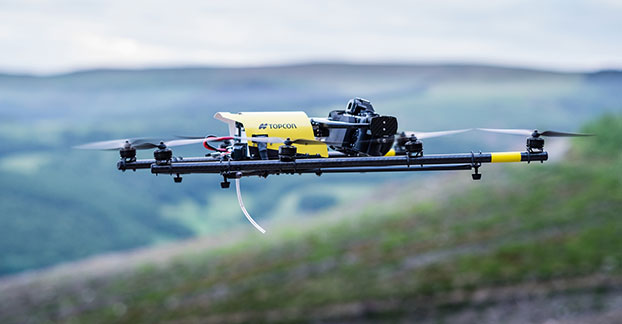
    Topcon Positioning Group has added a rotary-wing unmanned aerial system (UAS) to its mass data-collection solutions line. The Falcon 8 — powered by Ascending Technologies — is designed for inspection and monitoring, as well as survey and mapping applications.

    “Rotary-wing systems provide the perfect solutions for small-scale sites and projects for which flexibility of takeoff and landing or an oblique perspective is required,” said Charles Rihner, vice president of the Topcon GeoPositioning Solutions Group. “The Falcon 8 offers the flexibility to maneuver in small spaces and can cope with challenging environments often presented in inspection and monitoring. It is also well suited for smaller mapping or modeling projects up to 85 acres that require high-resolution imaging.”

    The Falcon 8 features new AscTec Trinity technology, an autopilot safety feature that provides three levels of redundancy for protection against performance drop or loss of control. Three IMUs (inertial measurement system) synchronize all sensing data and identify, signal and compensate when needed.

    Two models are available — the GeoEXPERT for surveying, modeling and mapping projects, and InspectionPRO for industrial inspection and monitoring applications. The GeoEXPERT includes a HD RGB camera payload, while the InspectionPRO features an HD RGB camera and infrared sensor combination.

    “Both versions offer easy deployment and operation with real-time video and data monitoring capability, navigation software for planning and optimizing flights, as well as photo-tagging and desktop software to quickly generate high-quality and easy-to-edit material,” said Rihner.

    The Falcon 8 complements the Topcon Sirius Pro fixed-wing UAS, providing large area accurate mapping without the requirement for traditional ground control.

  • Have Accuracy, Will Travel

    Have Accuracy, Will Travel

    Photo courtesy of Trimble.
    Photo courtesy of Trimble.

    BYOD Sub-Meter Positioning for Mapping and GIS Professionals

    Employees bringing their own mobile phones and tablets to their jobs in the field enables them to complete more tasks using fewer devices. However, this practice introduces operational and security vulnerabilities.

    By Matt van Doorn

    In the mapping and GIS industries, mobile devices such as smart phones and tablets have a growing presence in the field; they enable businesses to work smarter and more efficiently. The Bring Your Own Device (BYOD) trend — essentially the use of commercial-grade devices for work purposes — will likely not slow down. BYOD is not without its pain points. Organizations face many security vulnerabilities when commercial-grade devices access critical data via corporate IT networks. Additionally, there are applications where a mobile device’s location capabilities are not accurate enough for GIS professionals to efficiently and effectively locate an asset and collect data.

    Company IT departments have multiple options that control and monitor access to combat BYOD security issues; however these options do not resolve the accuracy issue. Traditional company-issued handheld integrated receivers for data collection are designed to meet accuracy demands in almost any physical environment condition. While these devices are the most appropriate technology option for some applications, they tend to be expensive for the positioning tasks where a smart phone or mobile device is “good enough.”

    What to do when better accuracy on a mobile device is required, but it doesn’t make sense to invest thousands of dollars in a traditional receiver? With proper research, field professionals will find professional solutions that pair with consumer-grade smart devices to produce the requisite accuracy for a fraction of the cost of a traditional receiver.

    Requirements and Accuracy

    At a minimum, handheld receivers destined to work in conjunction with mobile devices must meet the following requirements:

    • The device must have moisture ingress protection to function properly in snow, ice, rain or dust environments.
    • The device must survive falls in hard terrain. It should have shock, drop and vibration protection.
    • The device must last the full workday for the professional to complete all workflows on a single battery charge.

    Legacy company-owned receivers typically meet the requirements above and have had a long-term reputation for accurately providing positioning data. These devices are still the appropriate solution for environments where it does not make sense to take a smart device, such as a remote location in rough terrain where the smart device may not perform.

    However, a smart device can in many cases enable the employee to be more efficient. Thanks to the accessory market, many of the above-listed requirements can be easily addressed. For example, smart-phone juice packs can fix the battery longevity issue; cases can protect against weather, shock or dropping; and screen covers can address the sunlight screen visibility issue. With a smart device in hand, GIS and mapping professionals not only have access to GPS data, but they are able to access and complete other work-related tasks from the same device such as email, internet access and voicemail. Plus, a smart phone is only a fraction of the cost of traditional receivers.

    The most critical component that smart devices still cannot address is sub-meter accuracy, which many mapping and GIS professionals require to successfully do their job.

    Accuracy Drives Cost. Mapping and GIS businesses are acutely aware of the efficiencies created by greater accuracy. With poor information, errors become increasingly costly. When robust, accurate data is collected, there is a direct correlation to improved workflows and operations. This allows professionals to be more strategic in ensuring that applications are effective and efficient across operations.

    Aerial and satellite imagery made initial steps toward generating more accurate data collection, bringing mapping and GIS professionals to within a 50-centimeter range of the assets. Subsequently, high-speed lidar collection tools, designed to capture large areas at 5–10 cm accuracy, came to the market. While these tools significantly improved data collection, precise measurement typically requires more time, more expense and highly specific instruments in order to generate more data.

    Today, handheld receivers can achieve high accuracy without using survey-grade tools, in applications that include:

    • Mapping: Any application, including locations, quantities, densities, specific areas and map change.
    • Aquatic monitoring
    • Buried utility infrastructure/cable location
    • Water/wastewater disposal
    • Location and elevation measurements: for example, elevation data on manholes or trunk lines.

    Requirements vary across applications and industries. The mapping/GIS professional must determine the level of accuracy their workflow requires.

    Accuracy Evaluation

    A typical smart device, properly assisted, can achieve an accuracy range of up to 5–6 meters when used to locate an asset. In many cases this is good enough. To obtain positioning data, iOS devices use the application “Location Services,” which is available on multiple mobile platforms. Location Services enables location-based apps and other applications to use information from GPS and cellular and Wi-Fi networks to determine location information. The location provided by a hybrid system with cellular-assisted GPS (A-GPS) allows the device to identify location within a 5–6 meter range of an asset. Wi-Fi positioning alone can determine a location with an accuracy of about 74 meters, and cellular positioning alone offers about a 600-meter range for location, according to industry sources (www.windowscentral.com/gps-vs-agps-quick-tutorial).

    However, cellular positioning can be limited when there is no network available. In remote or industrial settings, this could create difficulties in asset location. In water/wastewater, for example, when a GIS professional is in a ditch looking for a valve or a meter and there isn’t a network connection, the accuracy level provided without GPS may not be sufficient for that application. When A-GPS is not available due to a lack of cellular network, GIS professionals also have to deal with convergence time.

    Another example involves searching for a manhole cover when the ground is covered by a couple feet of snow. In this case, the 5-6 meter range is quite large and could lead to a lot of time spent digging until the manhole is uncovered. This wastes time and energy, and leads to higher costs. Some receivers have the sub-meter capability and can provide the location data directly to the professional’s consumer-grade smart device through Bluetooth. By simply pairing the receiver with a cellphone, the GIS professional can quickly locate the asset, collect data and move on to the next task.

    Accuracy Solutions

    Location shortcomings in consumer-grade devices generally boil down to antenna performance. Consumer-grade smart devices are designed for exactly that: consumers. With antennas for Wi-Fi, Bluetooth and GPS built into the small device, there will be compromises in location accuracy. When location must be pinpointed, an integrated handheld receiver can enhance accuracy. Receivers are readily available with 12 channels parallel tracking. Some receivers can also support multiple satellite constellations, including GPS, GLONASS, Galileo, Beidou, and QZSS with up to 44 channels of parallel tracking. The accuracy of these devices is further supported by augmentation: WAAS, EGNOS, MSAS and GAGAN. These receivers can provide sub-meter accuracy, with asset location with as close as 60 centimeters. Some devices also support Virtual Reference Stations (VRS) and Trimble’s Real Time eXtended (RTX) correction service for sub-meter accuracy. Some RTX services achieve real-time sub-meter accuracy with IP and cellular connectivity, or over satellite L-band.

    A receiver that integrates with the workflows of various mapping and GIS softwares as well as third-party applications will pair up nicely with a mobile device. The computations are all done for the professional, and will transmit signals via Bluetooth into the host devices using NMEA protocol. On iOS and Android devices, the location is available through the Location Services API. Third-party applications are also able to work with the receiver through consumer-grade devices that utilize the location services API. Some receivers are available across operating systems including iOS, Android and Windows, and are available to upgrade to the latest smart device whenever needed.

    Important Device Attributes

    Receivers designed to be compatible with a variety of smart devices can be shared among multiple devices. When it is time for a smart device upgrade, the new device can easily integrate with the receiver. Additional features that make these receivers especially convenient to use in the field include:

    • Small size: Mapping and GIS professionals don’t always have an extra hand available to carry an extra device. If it can fit in a vest, jacket pocket, pouch, clipped onto a belt, or pole mounted it will function in many scenarios.
    • Lightweight.
    • Rugged: Some receivers comply with MIL-STD-810 ruggedness with IP65 rating for shock, drop and vibration.
    • Battery life: for field performance for a full work day.
    • External antenna port: An accessory port for external data if the collecor needs to be mounted on top of a vehicle, or in a hard hat situation; a bonus feature worth consideration.

    BYOD Trend and Limitations

    The smart-device market will not cool down anytime soon. Gartner Research predicts that in 2015, almost 2.3 billion devices will be shipped worldwide. Whether these smart devices are provided by the company or truly BYOD, they will need to be augmented to effectively serve the applications they are intended to support.  Solving the security issue can have a bearing on whether a company chooses to let employees use their own device or provide one; either way, enhancing the location capabilities of the device can be easily achieved with accurate receivers.


    Matt van Doorn is a product management, product marketing, market management and business development professional at Trimble Navigation. He has years of experience in the data communication and telecommunication industry with deep knowledge of international markets.