Tag: Esri

  • Esri to donate software to in-need nations for census work


    Through the new Esri Official Statistics Modernization Program, the company will donate perpetual use licenses for ArcGIS software to eligible official statistical agencies in least developed countries (LDCs) and small island developing states (SIDS).

    The program provides access to Esri ArcGIS Enterprise technology in support of the upcoming census counts that all countries will undertake during the Census, 2020 Round.

    The data collected as part of these census counts is crucial to nations for competing on the global stage. By using authoritative methods of collection and the cutting-edge mapping and analytics tools that Esri is donating, developing nations can gain an advantage in making data-driven policy decisions suited to a globalized economy.

    The Esri Official Statistics Modernization Program provides access to the same software that hundreds of thousands of Esri customers—from public agencies to private enterprises—rely on every day to run their organizations. Esri will also provide guidance and best practices workflows at no cost so countries can implement their own systems to help with collecting data for their census.

    “Population and housing censuses are big efforts for countries, especially those that may not have the resources readily available,” said Linda Peters, Esri global business development manager. “These censuses are important, as the data collected is one of the primary sources of information needed for formulating, implementing, and monitoring policies aimed at inclusive socioeconomic development and sustainability.”

    Modernization efforts around census activities are helping countries leapfrog from paper-based workflows to digital and mobile ones. The United Nations (UN) expert group that specifically focuses on integrating statistical and geospatial information advised all countries to use a Global Statistical Geospatial Framework (GSGF) to aid in the modernization program.

    This framework requires nations using GIS technology like Esri’s to ensure the implementation of up-to-date capabilities like data accessibility, ease of use of the technology, and the conversion of addresses into geographic coordinates on maps (geocoding).

    The Esri Official Statistics Modernization Program was announced at the GIS for a Sustainable World conference in Geneva, Switzerland, co-organized by Esri and the UN. For more information on the program and nation eligibility, visit go.esri.com/officialstatisticsprogram.

  • 6 story maps show how data can illustrate the world

    Story maps combine geographic data with  multimedia to tell a story and present information in a useful, interesting way. 

    While many story maps are designed for general, non-technical audiences, some story maps can also serve highly specialized audiences. They use the tools of GIS, and often present the results of spatial analysis, but don’t require their users to have any special knowledge or skills in GIS.

    This has resulted in a veritable explosion of story maps.

    “Story maps use geography as a means of organizing and presenting information. They tell the story of a place, event, issue, trend or pattern in a geographic context,” explains Esri’s press staff in a blog. “They combine interactive maps with other rich content — text, photos, illustrations, video and audio — within intuitive user experiences.”

    Haven’t yet dipped your toe into Story Maps? This Esri blog takes users through story map creation step by step.

    Below are six visual narratives that provide timely information using Esri’s Story Map creation tools.

    Faces Show Personal Impact of Opioid Epidemic

    The National Safety Council is adopting the Celebrating Lost Loved Ones map, which allows family and friends of those lost to the opioid epidemic to place an image and description of their late loved one on an interactive map. The project helps raise awareness of the broad impact of the opioid crisis and advances the council’s mission of ending opioid deaths. Unintentional opioid overdose deaths totaled 37,814 in 2016.

    Jeremiah Lindemann, a solution engineer for Esri, created the map in 2016 following the death of his younger brother. Since its launch, the map has gathered more than 1,300 memorials from people across the U.S.

    The map has been a crowdsourced effort, allowing grieving friends and family members to honor their loved ones, share their stories with others and find a supportive community in return.

    Communities Potentially Affected by DACA Policy Changes

    When elected officials talk about changing our immigration system, just who and where are people affected? That’s the question Esri is trying to help answer with a new interactive story map that explores communities with the highest shares of non-citizen residents and DACA (Deferred Action for Childhood Arrivals) recipients.

    The map shows estimates on DACA eligible, recipients, and annual GDP loss from removing DACA workers by congressional district. Data comes from USC’s Dornsife Center for Immigrant Integration.

    The size of the symbol shows the estimate of DACA recipients, and the color of the symbol shows the estimated GDP loss from removing DACA workers. This map shows that the economies of many states in the Southwest and several major urban cities could be substantially disrupted if DACA recipients are no longer permitted to work.

    The Ever-Changing Minimum Wage

    National, state and local government policies toward the minimum wage vary widely and are continually changing. On Jan. 1, new or adjusted minimum wage policies took effect in 18 states and territories. Varying rates, policies, and impacts across the nation make it challenging to understand the minimum wage landscape.

    This Esri story map provides an overview of the the nation’s changing minimum wage policies. A few notable findings:

    • At the highest level, the variability of minimum wage policies from state to state is striking — this ranges from some states in the South that don’t even require a minimum wage, to places like D.C. that have a $12.50 minimum wage (currently the highest for a state or territory).
    • Similarly, the number of cities and counties that have taken it upon themselves to raise wages locally is impressive; these cities and counties have robust plans for raising minimum wages over the next few years.

    Regardless of an area’s minimum wage, all states fail to guarantee minimum wages that actually match up to the cost of living for their respective areas. As such, there is a growing divide between states that have raised minimum wages and are at least bringing minimum wages closer to the cost of living, versus those states that are slower to raise minimum wages (or don’t raise wages at all) and fall much further below the local cost of living.

    Even while minimum wages have nominally increased, inflation has devalued the dollar in such a way that even in 2018 some wages today have less purchasing ability than nominally lesser wages in the 1970s.

    Ireland Encourages Emmigrees to Come Home

    Like much of Ireland, the history of County Donegal is inextricably wedded to the geography of migration. Now county officials are using a story map to try and woo émigrés back to the Emerald Isle.

    The Irish government views the loss of its citizens so seriously that a minister for diaspora affairs was appointed to the Irish cabinet in 2014.

    Ireland’s Call — To Return Its Global Diaspora Home” displays key factors to assist those in contemplating returning. The story map launches the Global Skills Locator to link its global diaspora with job opportunities back home.

    Smart City 3.0 Book Explained

    Esri China (Hong Kong) Limited uses the story map tools in a unique way — to highlight its new book Smart City 3.0. The book and map discuss artificial intelligence, the internet of things, robotics and the sharing economy, and how all of them are shaping a new phase of development for the smart city.

    Hurricane Harvey’s Lasting Effects

    Within cities, poor communities often live in segregated neighborhoods with higher flood risks. This is especially true in Houston, where Hurricane Harvey hit this past August.

    As in previous disasters like Katrina and Sandy, the heaviest cost of Harvey’s destruction is likely going to be borne by the most vulnerable communities in its path.

    Humanitarian aid organization Direct Relief’s  interactive Esri maps used the Centers for Disease Control and Prevention’s social vulnerability index to show the geographic distribution of households with elderly or disabled members (in orange), immigrant and limited English-speaking populations (in purple), and pockets of poverty (in green). The darker the color, the higher the concentration of these factors in each region.

    Learn more about story maps and how to create them here.

  • Esri FedGIS Conference showcases spatial analytics for government action

    Esri will be hosting the 21st annual Esri Federal GIS (FedGIS) Conference March 20-21 at the Walter E. Washington Center in Washington, D.C. All federal government agency workers are invited to join an anticipated audience of 3,000 attendees and share their experience in collaborating, innovating and connecting their work using spatial analytics technology.

    Esri founder and president Jack Dangermond will discuss how location intelligence can be used to derive a deeper understanding of complex issues through data, as well as how it enables collaboration to develop innovative solutions for government.

    He will be joined on the main stage by representatives from several leading organizations, including the following:

    • U.S. Department of Agriculture Animal and Plant Health Inspection Service (USDA APHIS) — “Protecting Plants and Animals to Feed Our Country and the World”
    • U.S. Department of Health & Human Services Office of Inspector General — “Fighting Fraud, Waste, and Abuse through Spatial Analytics”
    • American Red Cross — “Connecting and Helping Volunteers, Partners, and Citizens in Need”

    On Wednesday, March 21, Dangermond will lead a thought-provoking conversation with the Honorable Susan M. Gordon, principal deputy director of National Intelligence at the Office of the Director of National Intelligence on the importance of connecting intelligence agencies through spatial analytics.

    “It is always inspirational to attend this conference and hear how location intelligence has helped federal workers share information across agencies and connect to citizens,” said Jeff Peters, head of the national government sector at Esri. “Attendees will get a chance to hear directly from top government and technology leaders as they share their experiences collaborating, innovating, and connecting using spatial analytics.”

    The conference is the site for announcements about the innovative use of Esri’s ArcGIS platform in federal, state and local government. The latest enhancements to ArcGIS and ArcGIS Pro, along with updates on desktop and enterprise mobile app environments, will be shared.

    Other organizations will be providing use cases and best practices during workshops throughout the two days of the conference. Learn more at esri.com/events/federal.

  • Esri releases Survey123 for ArcGIS with new Spike integration

    Esri releases Survey123 for ArcGIS with new Spike integration

    The new software release of Survey123 for the ArcGIS mobile application now has Spike, a laser measurement solution by ikeGPS.

    The paired technology dramatically accelerates field data capture and asset inspection activities.

    Spike allows users to measure hard-to-reach objects from a distance by taking a photo with their smartphone or tablet. Users can then capture real-time measurements from that image, including areas, elevations, distances between two points, and GPS/GNSS location.

    Use of the Survey123 integration with Spike will be of interest to organizations that use mobile workflows for asset and facilities management, field asset inventories and inspections, damage assessments, and tactical operations including disaster response.

    Using Spike with Survey123 relieves fieldworkers of the burden of carrying paper maps to find the object of interest and lugging multiple pieces of specialized, expensive measuring equipment. Instead, with a single mobile device, fieldworkers can locate the correct asset, record measurement data, and report accurate data directly back to the office.

    “The new Spike integration with Survey123 is a game changer for many field data collection and inspection workflows where the dimension of physical objects needs to be captured. Spike and Survey123 provide quick return on investment,” said Ismael Chivite, Esri product management lead. “The simplicity of the solution enables it to be quickly deployed and with little training. Customers are very enthused about this low-cost solution that will streamline many of their critical workflows.”

    The ability to capture accurate measurements in the field is particularly useful when working in areas that don’t lend themselves to hands-on or close-up measurement. Spike’s laser can be used in ranges from 6 to 650 feet, with the option to select units of measurement in inches, feet, meters or centimeters. With it, a single fieldworker is able to more quickly and safely accomplish what may otherwise have taken multiple field staff and costly equipment.

    The Spike laser device mounts to smartphones and tablets and connects via Bluetooth with the mobile device’s camera.

    Survey123 with Spike runs on Apple iOS and Google Android smartphones and tablets.

  • Blade Runner 2049 special effects powered by Esri CityEngine get Oscar nod

    UPDATE: Denis Villeneuve’s Blade Runner 2049 took home the Oscar for Achievement in Visual Effects on March 4. Visual effects supervisors John Nelson, Paul Lambert, and Richard R. Hoover, plus special effects supervisor Gerd Nefzer, took the stage to accept the award.


    Framestore, a visual arts studio in Montréal, Québec, has received an Oscar nomination for Best Visual Effects made possible, in part, by Esri CityEngine.

    Designers at Framestore used the software to create a detailed futuristic city based on present-day Las Vegas for the movie Blade Runner 2049.

    “We were tasked in creating a futuristic Las Vegas for the year 2049. We had to fly over the main strip of Vegas on a long sequence shot,” said Didier Muanza, lead environment TD, Framestore. “CityEngine seemed to be the best choice to help us generate a modern-day model of Vegas, which was used as the base for the futuristic version.”

    Esri CityEngine is a sophisticated 3D modeling software used in professions such as urban planning and architecture as well as film and other entertainment industries. Esri is a global spatial analytics company.

    Framestore designers used CityEngine for only one month, yet generated a set that was 6.759 kilometers long and 4 kilometers wide and included more than 1,400 buildings. Realistic textures were based on aerial and oblique photos of the Las Vegas main strip.


    Blade Runner 2049 has already received the BAFTA award for Special Visual Effects. The 2018 Academy Awards ceremony takes place Sunday.

  • Esri acquires ClearTerra location data extraction technology

    Esri acquires ClearTerra location data extraction technology

    Spatial analytics company Esri has acquired technology from ClearTerra, a company that offers geospatial and activity-based intelligence tools.

    The acquisition will provide ArcGIS platform users the ability to easily discover and extract geographic coordinates from unstructured textual data like emails, briefings and reports, instantly generating intelligent map-based information.

    This capability will make mapping this elusive information easier across many industries. Defense, intelligence and public safety organizations tend to have massive volumes of unstructured data, as do other fields, such as petroleum, utilities and maritime, where locating information on the Earth is not as easy as searching for a street address.

    Esri’s acquisition of ClearTerra technology brings workflow-enhancing software technologies into the ArcGIS platform.

    “We have been close partners with Esri for a number of years,” said Jeff Wilson, former vice president of sales for ClearTerra, now an executive for defense and intelligence with Esri. “Esri has the platform and resources to provide a solid path going forward for our technology, allowing us to expand this capability to the global market.”

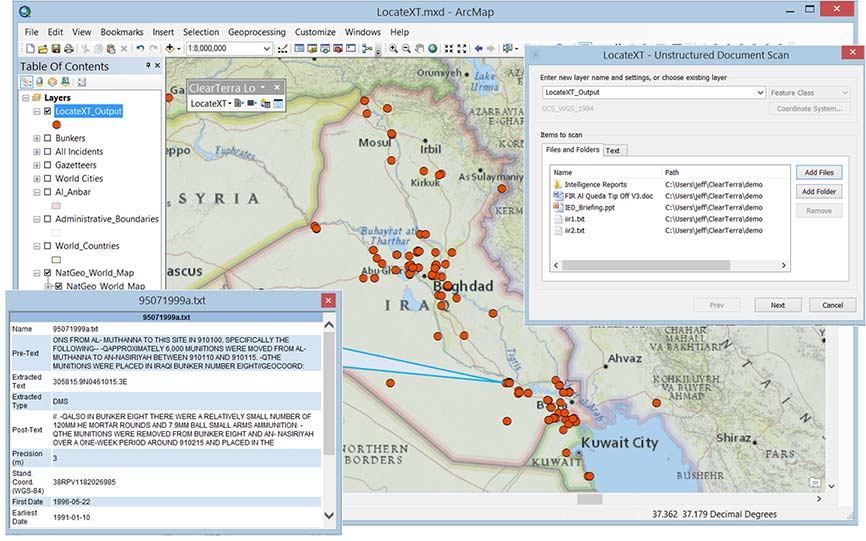
    ClearTerra LocateXT technology allows analysts to rapidly scan through documents without having to spend hours reading, copying, pasting and running spreadsheet formulas, placing the results instantly into geospatial features.

    Additionally, ClearTerra FindFZ technology provides enhanced search capabilities for the ArcGIS platform, incorporating the powerful techniques found in internet search engines, including a tolerance for misspelled words, as well as wildcard and Boolean logic searches.

    The LocateXT extension for ArcMap is used to extract locations from unstructured data (messages, reports, briefings) into a geodatabase feature class. (Image: ClearTerra)
    The LocateXT extension for ArcMap is used to extract locations from unstructured data (messages, reports, briefings) into a geodatabase feature class. (Image: ClearTerra)

    “We are excited to bring ClearTerra technology into the Esri family,” said Jeff Peters, Esri director of national government. “The unstructured data tools are powerful not only for those who have made use of this technology for a number of years, such as in the military, but it also has useful applications for so many more Esri users.”

    ClearTerra has been an active member of the Esri partner program, providing their software to ArcGIS users via desktop, server, and the cloud. Support and maintenance for the software will continue via Esri with no interruption of service, and is readily available for licensing.

    ClearTerra specializes in geospatial and activity based intelligence software products, custom solutions, technical services, consulting and training. ClearTerra is a business unit of ClearShark.

  • Esri releases Operations Dashboard for ArcGIS to manage events in real time

    Esri has released a new web browser application, allowing users to create reporting dashboards that use charts, gauges, maps and other visual elements to reflect the status and performance of people, services, assets and events in real time.

    Using dynamic dashboards through Operations Dashboard for ArcGIS, organizations of all types — from emergency operations centers to public utilities — can view crucial activities and key performance indicators that are vital to meeting their objectives.

    “The Chicago Office of Emergency Management and Communication [OEMC] GIS team has been using Operations Dashboard to support various events with access to real-time information,” said Joe Kezon, GIS manager for the Chicago OEMC. “We are looking forward to the enhancements that will further increase our ability to ensure the safety and security of the City of Chicago.”

    With an easily accessible web app, executives can monitor their organizations’ activities to assess what is working well and what needs attention.

    Esri-Operations-Dashboard-ArcGIS-W

    “The Emergency Management division of the Chicago Office of Emergency Management and Communications works very closely with our public safety partners and the city’s infrastructure departments in our comprehensive approach to event and incident management,” said Thomas Sivak, deputy director, Emergency Management, Chicago OEMC. “The Operation Dashboard allows us to effectively coordinate among agencies and adjust resources to make Chicago a safe place to live, work, and play.”

    Having this type of authoritative data allows decision-makers to reduce the risk of costly errors due to inaccurate or outdated information, better control the allocation of resources, maintain real-time awareness of where assets and human resources are located, monitor conditions live such as weather and traffic, and achieve real-time insight to respond to changing conditions.

    “The new Operations Dashboard web app enables, at a glance, decision-making better than ever,” said Jeff Shaner, Esri product manager. “Not only can dashboards be authored online — anywhere, at any time — but the common platform allows greater collaboration among personnel.”

    Operations Dashboard also provides a common interface to monitor progress and identify vulnerabilities that could compromise the success of an organization’s mission. Dashboards can be authored completely in a web browser. There is no need to download and install an app anymore.

    Users can launch Operations Dashboard by using their ArcGIS organizational account. They can also browse and manage dashboards within their ArcGIS organizational content or on the dashboard home page.

    Photo: Esri

  • Esri workbook teaches top 20 GIS skills

    Esri-GIS-20-Essentials-cover-WEsri, the spatial analytics company, has published The GIS 20: Essential Skills, Third Edition, a book designed to quickly prepare those who need to use a geographic information system (GIS).

    The GIS 20 is aimed at readers who are new to or unfamiliar with GIS, such as a professional interested in using the technology on the job to conduct analysis and create maps, or a student majoring in a subject other than GIS who could benefit from geospatial knowledge.

    Avoiding a focus on the inner workings of a GIS and sticking instead to teaching the tasks and functions most frequently and commonly used, this quick-start guide provides clear, step-by-step instructions on how to do common GIS tasks.

    These include downloading shapefiles and using essential tools in the software, preparing data for a map, geocoding addresses, making thematic and other types of maps, mapping latitude and longitude points collected with a GPS, using aerial photography in maps, and publishing maps.

    Author Gina Clemmer is president of New Urban Research, Inc., a social research and training company based in Portland, Oregon. She has spent her career teaching everyone from executives in New York City to residents of fishing villages in Alaska to how understand the core concepts and use the tools of GIS for decision-making.

    “This book is an extension of my passion to help everyday people quickly learn the fundamentals of ArcGIS,” Clemmer wrote in The GIS 20. “Once you see the power of GIS and see that you yourself can create maps easily, you simply can’t unsee it. GIS will change the way you think about presenting data and solving problems.”

    The GIS 20: Essential Skills is available in print (ISBN: 9781589485129, 180 pages, US$49.99) and as an e-book (ISBN: 9781589485136, 180 pages, US$49.99). The print and e-book editions of the book can be obtained from online retailers worldwide, at esri.com/esripress, or by calling 1-800-447-9778. Outside the United States, visit esri.com/esripressorders for complete ordering options, or visit esri.com/distributors to contact your local Esri distributor. Interested retailers can contact Esri Press book distributor Ingram Publisher Services.

  • Esri releases complete utility GIS platform

    New utility network management extension combines advanced system of record with location-based analytics.

    Esri, the geographic information system (GIS) technology and spatial analytics company, is releasing advanced network capabilities for utilities as part of the company’s ArcGIS platform.

    The ArcGIS Utility Network ManagementEsri-utilities_Analytics extension, which delivers the new utility network, lets users create, manage and share complete data about networks from source to demand, such as residential meters for electric, water, wastewater, gas, district heating and telecommunications companies.

    These network management capabilities enhance Esri’s current utility platform for handling billions of data elements while providing access to the utility network on any device, anytime, anywhere. For the first time, workers will be able to edit and trace the path of a network from a smart device while in the field and share information securely and more easily with those who need it. Previously, each utility subnetwork — like transmission lines, substations, and distribution and low-voltage networks — had its own separate GIS database.

    The utility network provides a holistic system for every component of the utility supply chain right down to the customer, as well as the ability to store unprecedented detail on each of these components, which will be very important as utilities evolve to provide higher fidelity information to operational systems.

    “We are very excited about the release of our next-generation utility platform,” said Jeff Rashid, Esri global director for utilities and communications. “These advanced capabilities will help utilities and telecoms provide greater details about their networks across their organization, at a rate of speed not seen in the past.”

    The ArcGIS Utility Network Management extension allows the utility network to be completely cross-platform capable, meaning it is not confined to users of desktop GIS software. Before this innovation, location data was not easily accessible for fieldworkers or executives, managers, service technicians, and accountants who needed to have accurate, real-time understanding of utility assets.

    In addition, Esri partners in the utility field will be able to use this network to add greater value to their workflow, create new solutions allowing personnel to be more efficient, and to better satisfy the needs of their customers.

    “We are excited about the new capabilities in Esri’s utility network management platform and look forward to evolving the ArcFM Solution XI Series to offer utilities unprecedented value,” said Jay Stinson, general manager, Schneider Electric Geospatial Business. “This next generation platform enables us to build a world class ecosystem for managing the design and construction workflow. The continued strength of the historic Esri and SE partnership will help utilities realize the full potential of their GIS investment, equipping them to address the challenges facing today’s digital utility.”

  • Esri tech to help power UN’s new global data hub

    Esri and the United Nations Statistics Division (UNSD) are working with a number of member states to utilize a data hub that will allow countries to measure, monitor and report on sustainable development goals (SDGs) in a geographic context.

    This new hub, called the Federated System for the SDGs, is based on Esri’s ArcGIS platform and will use location intelligence to make it easier for countries to collect, analyze, and share the data required to monitor progress toward the SDGs.

    The SDGs are a set of global goals that include such objectives as poverty eradication, access to safe water, clean oceans, eliminating hunger, gender equality, climate action, peace and justice, education and other important areas on the U.N. agenda.

    The Federated System explores new pathways for facilitating dataflows and action through data hubs. It then supports and informs data-driven decision-making by making the data open, usable, interoperable and visual.

    Based on the early success, UNSD and Esri are working to advance the initial research exercise to support broader adoption by other member states and organizations in 2018.

    “The Federated System for the SDGs leverages enabling technologies and capabilities to strengthen the ability of the national and global statistical systems to manage and share data and good practices for the SDGs,” said Gregg Scott, inter-regional advisor, UNSD Global Geospatial Information Management. “This has already provided the opportunity for National Statistical Offices to condition and structure data so that it can be portrayed in a geographic context and provide more insights and enable us to look at dependencies and interdependencies across SDG indicators.”

    First introduced as a research project, participation was by invitation only and consisted of six countries: Ireland, Mexico, the Philippines, Qatar, South Africa and Senegal. These countries helped define the requirements and deployment of a web mapping and data management platform that would eventually become the hub.

    The Federated System was announced in Mexico City, Mexico, by Esri founder and president Jack Dangermond.

    “The key challenge to collaboration between nations is a common digital context,” said Dangermond. “Data hubs provide this context with location intelligence and use organizations’ core data to engage stakeholders, communicate policy, inform the public, and measure progress.”

    Participants of the UN forum in Mexico City issued a declaration on the importance of geospatial technology’s role in implementing the SDGs. Using Esri’s capabilities to enable access, collaboration, analyticsand powerful maps provides visualization and awareness that supplies the critical information needed to ensure each country meets its commitment to these goals.

    Most importantly, the Federated System allows collaboration across countries and makes it possible to measure the success of global SDG initiatives for the first time.

    For more information on how Esri supports the UN and SDG requirements, visit go.esri.com/Sustain_Dev.

  • "Scariest commute of my life": California wildfires erupt

    Two fires erupted Monday in Southern California, fueled by strong Santa Ana winds. The Thomas fire in Ventura County started Monday night and has burned 45,000 acres and destroyed more than 150 structures. The Creek fire is burning near Sylmar and has prompted officials to evacuate more than 8,000 homes.

    Now a dramatic new wildfire erupted in Los Angeles early Wednesday. Flames exploded before dawn on the steep slopes of the Sepulveda Pass, which carries heavily traveled Interstate 405 through the Santa Monica Mountains where ridgetops are covered with expensive homes, including Bel Air. It is also the site of the Getty Center arts complex.

    More than a third of Ventura, California, residents have been forced from their homes. About 38,000 of the coastal city’s 100,000 residents have been evacuated since the fires started Monday night.

    Esri is providing this interactive map to keep up-to-date on events around the fires.

  • Esri joins with Airbus on global intelligence enterprise agreement

    Esri has entered into an enterprise agreement with the intelligence program line of Airbus Defence and Space. With this new agreement in place, the core GIS will be expanded to meet Airbus’s pivotal mission of using creativity and innovation to address the massive economic, social, and environmental challenges our planet faces.

    The enterprise agreement is global in nature and includes all Airbus Defence and Space intelligence affiliates. The agreement also includes several addendums to cover the complete use of Esri’s ArcGIS platform by Airbus Defence and Space.

    Airbus Defence and Space has used Esri technology as part of its GIS for 26 years.

    “The potential of this agreement can be expected to reach far beyond today’s use of the Airbus Defence and Space core geographic information systems,” says Greg Buckman, head of Airbus Defence and Space’s intelligence business activities in North America. “Enterprise-wide access to the ArcGIS platform will provide new and faster spatial analytical functionality through web services to support key Airbus initiatives. This bears the potential for significant cost savings and speed to market while enhancing crucial cross-domain functionality on a global basis.”

    “Esri shares in this vision and looks forward to supporting Airbus Defence and Space through the deployment of ArcGIS Enterprise,” said Lawrie Jordan, Esri’s director of imagery and remote sensing. “Having a complete GIS platform is vital to organizations such as Airbus Defence and Space that operate on a global scale and for whom geographic awareness is crucial.”

    To learn more about how Esri helps the intelligence community make the most of location data with The Science of Where, visit go.esri.com/arcgis-intel.