Tag: FAA

  • FAA tests FBI drone detection system at JFK

    FAA tests FBI drone detection system at JFK

    The United States Federal Aviation Administration (FAA) and its government partners are expanding research on ways to detect “rogue” drones around airports. Together, they are evaluating drone detection technology at John F. Kennedy International Airport (JFK) in New York.

    Over the last two years, the FAA has received numerous reports from pilots and residents about unmanned aircraft systems — UAS, or “drones” — around some of the nation’s busiest airports, including JFK.

    “We face many difficult challenges as we integrate rapidly evolving UAS technology into our complex and highly regulated airspace,” said Marke “Hoot” Gibson, FAA senior advisor on UAS integration. “This effort at JFK reflects everyone’s commitment to safety.”
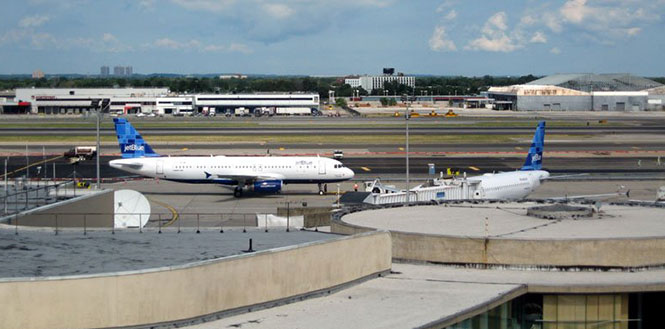
    Terminal 6 at JFK Airport. (Photo: New York Photo Gallery)
    Terminal 6 at JFK Airport. (Photo: New York Photo Gallery)

    Beginning May 2, the FAA conducted evaluations at JFK to study the effectiveness of a Federal Bureau of Investigation (FBI) UAS detection system in a commercial airport environment.  Five different rotorcraft and fixed-wing UAS participated in the evaluations, and about 40 separate tests took place.

    The JFK evaluation involved extensive government inter-agency collaboration, and cooperation from industry and academia. The tests expanded on research performed earlier this year at Atlantic City International Airport.

    In addition to the FAA and the FBI, the agencies combining forces in this research included the Department of Homeland Security (DHS), Department of Justice, Queens District Attorney’s Office and the Port Authority of New York and New Jersey. DHS and the FBI want to identify unauthorized UAS operators for law enforcement purposes, and the FAA’s mission is to provide a safe and efficient airport environment for both manned and unmanned air traffic.

    “We applaud the FBI and FAA for their efforts to detect and track unmanned aerial systems (UAS),” said Thomas Bosco, Port Authority aviation director.  “We look forward to supporting continued U.S. government efforts to identify and deploy countermeasures to neutralize the threat posed by rogue UASs.”

    The team evaluating the FBI’s detection system also included contributions from one of the six FAA-designated UAS test sites. The Griffiss International Airport test site in Rome, New York, provided expertise in planning the individual tests as well as the flight commander for the tests and two of the UAS used.

    The FY 2016 Appropriations law mandates that the FAA continue research into detection of UAS in airport environments. The agency is continuing to formulate an inter-agency strategy to evaluate detection systems in a variety of airport environments.

  • FAA expands drone detection Pathfinder initiative

    The Federal Aviation Administration (FAA) is expanding the part of its Pathfinder Program that focuses on detecting and identifying unmanned aircraft systems (UAS) flying too close to airports.

    On Monday, the FAA signed Cooperative Research and Development Agreements (CRDAs) with Gryphon Sensors, Liteye Systems Inc. and Sensofusion. The FAA will evaluate procedures and technologies designed to identify unauthorized UAS operations in and around airports. This research effort, part of the FAA’s Pathfinder Initiative, addresses one of the significant challenges to safe integration of UAS into the nation’s airspace.

    “Sometimes people fly drones in an unsafe manner,” said Marke “Hoot” Gibson, FAA Senior Advisor on UAS Integration. “Government and industry share responsibility for keeping the skies safe, and we’re pleased these three companies have taken on this important challenge.”

    “Gryphon Sensors, LLC is excited to collaborate with the FAA on utilizing technologies that detect, track and identify errant or hostile UAS in and around our nation’s airports and sensitive areas.  Detecting these threats is challenging because most of them are very small, fly low to the ground and can be pre-programed to fly autonomously,” said Gryphon Sensors President Tony Albanese.

    “Our AUDS team is very excited to join the FAA’s efforts to counter rogue UAVs,” stated Thomas Scott, President of Liteye Systems. He added, “As the legitimate use of unmanned vehicles becomes more prevalent in many industries, unfortunately this large number of aircraft also makes them readily available for illicit use. With the right technologies we can assist the UAV operator to conduct his mission, while protecting against those who wish us harm.”

    “We first developed the technology to detect, locate, track and gain control over UAS three years ago as a military project and operated it with three European armies under NATO,” said Sensofusion CEO Tuomas Rasila. “Fast forward to the present time, and AIRFENCE is now protecting various customer sites in Europe, including prisons, high profile government buildings, police, and military sites. Since the technology is software based, it improves with over-the-air updates, ensuring that we are always ahead of the commercial UAS market.”

    The companies’ prototype UAS sensor detection systems will be evaluated at airports selected by the FAA. The agency and its federal government partners — particularly the Department of Homeland Security (DHS) — will work with the companies to study how effective their respective technologies are, while ensuring they do not interfere with the safety and security of normal airport operations.

    The CRDAs with Gryphon, Liteye and Sensofusion expand upon collaborative efforts with industry to develop system standards to identify unauthorized UAS flights near airports, which could pose a hazard to manned aircraft. The agency has seen a steep increase in reports of small UAS close to airports over the last two years.

    The FAA has also partnered with DHS and CACI International on similar research to explore how that company’s prototype detection technology may help detect UAS.

    The FAA supports DHS in an inter-agency effort to meet the threat of unauthorized UAS from a “whole of government” perspective. Other participating federal agencies include: the Department of Defense, Department of Energy, U.S. Secret Service and the Federal Bureau of Investigation.

  • Harris offers comprehensive solution for drone safety

    Harris offers comprehensive solution for drone safety

    Harris Corporation has introduced a comprehensive solution to increase the safety of drones and other commercial unmanned aircraft systems (UAS) flying at low altitudes in the U.S. The announcement was made during Xponential 2016 being held May 2-5 at the Ernest N. Morial Convention Center in New Orleans.

    Harris’ ADS-B Xtend service provides critical surveillance information to help UAS operators and airspace managers to increase safety of their operations by providing them with a real-time view of other aircraft flying at low altitudes under 500 feet.

    The ADS-B tower with the Xtend antenna. (Photo: Harris Corp.)
    The ADS-B tower with the Xtend antenna. (Photo: Harris Corp.)

    The system supplements the FAA’s existing ADS-B network, which provides precise and reliable satellite-based surveillance for the nation’s air traffic control system. The solution features a networked, dual-band receiver and relay system that can be attached to existing structures or to mobile vehicles for roaming coverage.

    ADS-B Xtend expands the benefits of the company’s existing UAS situational awareness tool, Symphony RangeVue, which provides data for higher altitude flight traffic. Symphony RangeVue puts real-time FAA aircraft tracking data, flexible background maps and weather information in the hands of UAS operators through a web-hosted platform so they can make better informed decisions.

    Data from networks of ADS-B Xtend relays is fused with all FAA system derived real-time aircraft surveillance data from more than 650 ADS-B ground stations with more than 425 FAA radar systems. This unique combination of local infrastructure and NAS surveillance data makes ADS-B Xtend a comprehensive situational awareness solution for the UAS market.

    “Strategically deploying ADS-B Xtend receivers will close gaps in ADS-B coverage, significantly increasing the quality and quantity of data available UAS operators,” said Ed Sayadian, president, Harris Mission Networks. “This will increase surveillance data available to UAS operators and enhance safety and efficiency. ADS-B Xtend is yet another step in our commitment to develop the most comprehensive surveillance airspace data set available.”

  • Insitu and PrecisionHawk form commercial drone alliance

    Insitu and PrecisionHawk form commercial drone alliance

    Insitu and BNSF officials launch ScanEagle in support of the FAA's Pathfinder initiative. (Photo: Insitu)
    Insitu and BNSF officials launch ScanEagle in support of the FAA’s pathfinder initiative (Photo: Insitu)

    Insitu and PrecisionHawk have formed a strategic alliance to provide UAS solutions that help commercial enterprises achieve safe unmanned flight for extended and beyond-visual-line-of-sight operations. Insitu is a provider of information and unmanned aircraft systems (UAS) for commercial, civil and military operations, and PrecisionHawk is an aerial data provider.

    Both companies are exhibiting at this week’s AUVSI Xponential 2016 show in New Orleans.

    The alliance also leverages the extensive research and testing capabilities of two of the participants of the Federal Aviation Administration (FAA) Pathfinder Program, which is dedicated to expanding the use of UAS within the nation’s airspace.

    “While our businesses are diverse, the areas where we intersect have tremendous potential for creating new opportunities in the commercial industries we both serve,” said Ryan M. Hartman, Insitu President and CEO. “This alliance ensures that more businesses will explore what unmanned technology can offer.”

    Thanks to the integration of each company’s proprietary platforms, hardware and software, Insitu and PrecisionHawk plan to deliver even more data insights.

    “Our customers are always pushing us to bring more advanced and comprehensive solutions, and we go above and beyond to make sure we are developing tools that serve their specific needs,” said PrecisionHawk president Christopher Dean. “We believe this alliance with Insitu will help us deliver on our promise even more.”
    The emphasis of the U.S.-based alliance is on providing business intelligence support for commercial operations, including asset protection, property preservation, safety enhancement and environmental monitoring.

  • FAA establishing advisory committee on UAV integration

    Speaking today at Xponential, the AUVSI annual conference in New Orleans, FAA Administrator Michael Huerta announced the agency is establishing a broad-based advisory committee that will provide advice on key unmanned aircraft integration issues. He also announced plans to make it easier for students to fly unmanned aircraft as part of their coursework.

    Huerta said the drone advisory committee is an outgrowth of the successful stakeholder-based UAS registration task force and the MicroUAS aviation rule-making committee.

    Those panels were set up for a single purpose and for limited duration. In contrast, the drone advisory committee is intended to be a long-lasting group. It will help identify and prioritize integration challenges and improvements, and create broad support for an overall integration strategy.

    “Input from stakeholders is critical to our ability to achieve that perfect balance between integration and safety,” Huerta said. “We know that our policies and overall regulation of this segment of aviation will be more successful if we have the backing of a strong, diverse coalition.”

    Huerta said he has asked Intel CEO Brian Krzanich to chair the group.

    Student UAS operation

    Huerta also announced the FAA will start allowing students to operate UAS for educational and research purposes today.

    As a result, schools and students will no longer need a Section 333 exemption or any other authorization to fly provided they follow the rules for model aircraft. Faculty will be able to use drones in connection with helping their students with their courses.

    “Schools and universities are incubators for tomorrow’s great ideas, and we think this is going to be a significant shot in the arm for innovation,” Huerta said.

  • SOAR Oregon backs UAS FutureFarm for digital agriculture

    SOAR Oregon backs UAS FutureFarm for digital agriculture

    SOAR Oregon, a non-profit organization focused on the development of the unmanned aircraft systems (UAS) industry in Oregon, has given the city of Pendleton a grant for the establishment of a FutureFarm project at the Pendleton UAS Test Range.

    The Oregon UAS FutureFarm is a real-world proving ground designed to help digital agriculture pioneers accelerate product development, reduce cycles and expand market growth.

    SOAR Oregon is exhibiting at AUVSI Xponential 2016, being held in New Orleans this week.

    FutureFarm-signing-W
    Pendleton Mayor Phil Houk (right) signs the FutureFarm grant agreement with SOAR Oregon. SOAR Oregon’s John Stevens (front left), Roundup City Development Corporation’s Mike Short (back left), and Pendleton UAS Range’s Steve Chrisman (back right) were on hand to witness the signing.

    Once established in June, it will be the only digital agriculture proving ground of its caliber in the United States, SOAR Oregon said. Developers of agriculture-focused unmanned robotics and data systems will find the Oregon UAS FutureFarm has a broad spectrum of high value and commodity crops, multiple layers of remote sensing for benchmarking, and access to the agricultural knowledge base they need to test, validate and innovate the next generation of interconnected unmanned and automated agricultural systems.

    The Oregon UAS FutureFarm features a network of research-friendly farmers growing a large variety of irrigated and dry-land crops in both traditional and modern farming infrastructures. Strategic partners include the City of Pendleton, Digital Harvest, SOAR Oregon, Blue Mountain Community College, Oregon State University and USDA Columbia Basin Agricultural Research Center.

    “We believe that the Oregon UAS FutureFarm fills a clearly defined market niche for UAS platform and payload developers who are working on the next generation of technologies for precision agriculture,” said SOAR Oregon Executive Director Chuck Allen. “We are especially pleased that this project is taking place at one of Oregon’s FAA-designated UAS test ranges.”

    “We are pleased to be supporting the Oregon UAS FutureFarm as both a partner and user,” said Young Kim, CEO of Digital Harvest. “The fact that the test range includes high-value tree fruit orchards, premium wine grape vineyards, hundreds of automated irrigated plots, and hundreds of thousands of acres of dry land farms makes it a unique and special zone.”

    “The Oregon UAS FutureFarm is open to UAS developers, sensor makers, robotics companies, universities and any others who are looking for a real-world digital agriculture proving ground that is supported by a collaborative innovation focused community,” said Jeff Lorton, Oregon UAS FutureFarm project manager.

    Pendleton Mayor Phil Houk signed the agreement with John Stevens and Mike Short from SOAR in attendance. “The FutureFarm represents what we’d hoped the Pendleton UAS Range could become — not just an environment for the development of technology, but the place where real-world questions could be solved with unmanned aircraft,” said Steve Chrisman, Pendleton director of Economic Development. “We are excited about the potential of this project to develop solutions which benefit growers across the Northwest.”

  • Echodyne offers detect and avoid radar for small UAS

    Echodyne offers detect and avoid radar for small UAS

    echodyne-saa-auvsiEchodyne today announced the development of MESA-DAA, an Airborne Detect and Avoid (DAA) radar for small to medium-sized unmanned aircraft systems (UAS).

    Echodyne made the announcement at AUVSI’s Xponential 2016 trade show and conference.

    The small, lightweight and low power DAA radar will operate at K-band and be capable of rapidly scanning a broad field of view in azimuth and elevation at ranges out to 3 kilometers. MESA-DAA is based on Echodyne’s patented Metamaterials Electronically Scanning Array (MESA), which offers breakthrough cost, size, weight, and power (C-SWAP) improvements over traditional electronically scanning array technology.

    The MESA-DAA radar is scheduled for release at the end of 2016 and will be an evolution of the MESA-K-DEV radar, which Echodyne released today.

    “Detect and avoid is the single biggest technical hurdle to opening up the National Airspace System to UAS,” said Jim Williams, former head of the Federal Aviation Administration’s (FAA) UAS Integration Office and current Principal at Dentons US, LLP and Echodyne advisor.

    uav-Echodyne-W“NASA, the FAA, industry and academia have spent years studying the DAA problem and have determined radar is by far the best sensor, if not the only sensor, capable of providing the all-weather, long-range, and broad field of view scanning that is necessary for safe, highly reliable DAA. MESA-DAA technology may well represent the key to safely opening up airspace for beyond visual line of sight operations.”

    Detect and Avoid Requirement

    One of the FAA’s central aircraft operating rules is that pilots maintain vigilance so as to see and avoid other aircraft. To fulfill this requirement, UAS need to remain within visual line of sight of their pilot.

    Although the regulations for UAS are still in development, there is widespread acceptance that for UAS to fly beyond line of sight of their operator, they will need DAA sensors and systems that safely replace the pilot’s see and avoid capability. This DAA capability will need to detect both cooperative objects (those transmitting their position with a transponder) and non-cooperative objects (aircraft without transponders, birds, etc.).

    Radar is the only sensor capable of reliably performing DAA in all weather conditions and at the ranges, broad fields of view and scanning speeds necessary for safe operation of UAS in the NAS. Radar is the only sensor that directly measures the position of an object (such as range, azimuth, elevation) as well as its relative speed of approach (via Doppler).

    “We believe MESA-DAA will be a critical technology for safely opening up the National Airspace System to small UAS for beyond visual line of sight operations,” said Eben Frankenberg, founder and CEO of Echodyne. “Radar is the sensor of choice for DAA, but existing radar technology is too slow, too bulky and too expensive to provide DAA radar capabilities on small UAS. The C-SWAP characteristics of MESA and our DAA radar are completely unparalleled and uniquely well suited for small UAS.”

    In the April 7 “FAA Aerospace Forecast,” the FAA reports that it has already granted more than 4,000 Section 333 Exemptions for commercial UAS operations, clear evidence of the high demand for UAS applications. The FAA forecasts that sales of commercial small UAS could exceed 600,000 for 2016 and grow to 2.7 million by 2020, noting that “the overall demand for commercial UAS will soar once regulations more easily enable beyond visual line of sight operations and operations of multiple unmanned aircraft by a single pilot.”

    MESA-DAA Specifications. MESA-DAA is based largely on Echodyne’s existing MESA-K-DEV radar. Package size and weight are expected to be less than MESA-K-DEV, especially if the unit is placed inside the UAS. Range is expected to be 3 kilometers, and scanning speed is expected to be 1 Hz for the entire field of view and as fast as 10 Hz for updating locations on previously detected objects. The field of view for a single unit is expected to be ±60 degrees in azimuth (120 degrees total) and ±45 degrees in elevation. Multiple units can be combined if greater field of view is desired.

    MESA-K-DEV. Echodyne also announced availability of MESA-K-DEV, an ultra-low C-SWAP, fast electronically scanning radar based on its patented MESA. The radar operates at K-band. The fully self-contained and packaged unit measures 22 by 7.5 by 2.5 centimeters and weighs 820 grams.

    Unlike conventional mechanical apertures that steer a radar beam using motorized gimbals, Echodyne’s MESA requires no moving parts to steer its beam. And unlike phased array radars or active electronically scanning array radars that require complicated and expensive transmit/receive modules — including phase shifters, amplifiers, circulators and low noise amplifiers behind every single antenna element — MESA uses a simpler meta-materials architecture. The net effect of this simplified architecture is lower cost, size, weight and power.

  • CMD Flight gains FAA approval for ADS-B solution

    CMD Flight Solutions has received U.S. Federal Aviation Administration (FAA) approval on its third Collins TDR-94/94D Transponder and GPS pairing, the FreeFlight Systems WAAS 1203C.

    CMD Flight Solutions develops, markets and provides FAA-certified modifications to support NextGen avionics mandates and assists service and installation facilities with modification solutions to satisfy FAA-mandated requirements. The company provides Automatic Dependent Surveillance-Broadcast (ADS-B) Out on more than 5,000 business and personal aircraft.

    The supplemental type certificate (AML STC) of its ADS-B OUT solution for Part 25 airplanes covers installation of FreeFlight’s 1203C SBAS/GNSS GPS position sensor with Rockwell Collins TDR-94/94D transponders. According to FreeFlight, “The pairing is a cost-effective way to help aircraft owners meet the ADS­-B mandate.”

    ADS-B OUT compliance is due Jan. 1, 2020, in the United States.The 1203C, a 15-channel GPS sensor, is also an approved position source for NextGen applications such as CPDLC, TAWS/FMS, RNP and others.

  • FAA makes progress accommodating commercial UAS operations

    The sensefly eXom UAV in flight.
    The sensefly eXom UAV in flight.

    The Federal Aviation Administration (FAA) took a major step forward in expanding commercial UAS/UAV operations in the U.S. airspace. It’s chief said April 19 that the FAA is preparing to take another major step forward in further opening up commercial UAS/UAV operations by eliminating the need for a 333 Exemption for operating small UAS/UAV.

    On March 29, the FAA announced it was doubling the altitude for blanket nationwide CoAs (Certificates of Waiver or Authorization) to 400 feet above ground level (AGL). The FAA has typically issued a blanket nationwide CoA with each 333 Exemption it has granted.

    Before the announcement, the maximum altitude allowed for commercial operations under the blanket CoA was 200 feet AGL. Now, it is 400 feet AGL. At the stroke of a pen, the 3,000+ 333 Exemption holders with blanket CoAs are now authorized to fly to 400 feet. This is significant because UAS operators can now fly higher and cover more area more efficiently, and still meet the precision and accuracy requirements of most clients.

    Another announcement, perhaps even more important, was made by FAA Administrator Michael Huerta, who spoke at the 2016 FAA UAS Symposium held April 19-20 in Daytona Beach, Florida. Huerta announced that the FAA is close to finalizing the FAA rules for small UAS.

    “In late spring we plan to finalize our small UAS rule to eliminate the need for most 333 exemptions,” Huerta said. He was referring to the Small UAS Notice of Proposed Rulemaking (NPRM) that was announced Feb. 15, 2015, and opened for public comment through April 24, 2015. There were 4,650 public comments made. You can read the comments about the proposed rule here.

    The proposed small UAS rule differs significantly from the current FAA requirements for operating UAS in the United States for commercial purposes. One of the major differences is that there will be a “UAS operator’s certificate” created so that commercial UAS pilots will no longer be required to have a FAA Pilot Certificate. Currently, the FAA requires commercial UAS pilots to have at least an FAA Sport Pilot certificate, which requires a substantial investment in money and time to achieve.

    To summarize, the general proposed small UAS rules are:

    UAS pilot

    • Must be at least 17 years old.
    • Must pass an aeronautical test at FAA-approved testing center, and renewed every 24 months.
    • Must be vetted by the Transportation Security Administration (TSA).
    • Must obtain an unmanned aircraft operator certificate with a small UAS rating

    UAS operation

    • UASmust weigh less than 55 pounds.
    • Pilot in Command or Visual Observer must maintain visual line of sight (VLOS).
    • Can’t operate over people who are not part of the UAS operation.
    • Daylight operations only.
    • Yield to manned aircraft.
    • May use Visual Observer (VO), but not required.
    • First-person view camera cannot satisfy “see-and-avoid” requirement but can be used as long as requirement is satisfied in other ways.
    • Maximum airspeed of 100 mph.
    • Maximum altitude of 500 feet AGL (above ground level).
    • Minimum weather visibility of 3 miles from control station.
    • Can’t operate more than one UAS at a time.
    • No careless or reckless operations.
    • Operations in Class B, C, D and E airspace are allowed with the required ATC permission.
    • Operations in Class G airspace are allowed without ATC permission.

    With these rules, neither a 333 Exemption nor a CoA is required, which would significantly ease the requirements for a surveying or geospatial company to begin offering UAS services.

    Phantom-4-Action-4-O
    The DJI Phantom 4 UAV.

    In addition, the small UAS rule includes a framework to adapt future rules such as Micro UAS (0.55 pounds and under) rules that are being actively discussed within the FAA as well as a discussion about commercial operation of UAS over people.

    In the meantime, consumer UAS are becoming more powerful with each new product introduction. DJI, the world’s largest UAS manufacturer (by far) introduced the Phantom 4. It’s a huge step forward due to one new feature: automatic collision avoidance. This feature will help operators avoid trees, buildings and potentially other UAS. I’m pretty sure this feature will eventually be included in all commercial UAS.

    Intel CEO Brian Krzanich demonstrated the broad capabilities UAV technology during his keynote presentation at the 2016 Consumer Electronics Show Jan. 5, in Las Vegas. Krzanich showcased the Yuneec Typhoon H with Intel RealSense Technology. (Photo: Intel)
    Intel CEO Brian Krzanich gives his keynote presentation at the 2016 Consumer Electronics Show Jan. 5, in Las Vegas, where he also announced the acquisition of Ascending Technologies for drone collision avoidance. (Photo: Intel)

    Automatic collision avoidance is such a hot subject that in January, Intel acquired Ascending Technologies, a UAS manufacturer that has incorporated automatic sense and avoid technology in their UAS. According to the announcement, Intel sees “incredible opportunity for innovation across a multitude of industries. As a result, Intel is positioning itself at the forefront of this opportunity to increasingly integrate the computing, communications, sensor and cloud technology required to make drones smarter and more connected.”

    Thanks, and see you next month.

    Follow me on Twitter at GPSGIS_Eric

  • FAA reviewing micro UAS report

    The Federal Aviation Administration (FAA) is now reviewing the report and recommendations of the Micro Unmanned Aircraft Systems (UAS) Aviation Rulemaking Committee. The agency had tasked the group to develop recommendations for performance-based regulations that would let certain unmanned aircraft operate over people not directly involved in the flight of the aircraft.

    The rulemaking committee, which began meeting March 8, worked under a tight deadline of April 1 to deliver its report. The task force included a diverse set of aviation stakeholders, including UAS manufacturers, UAS operators, consensus standards organizations, researchers and academics.

    “We commend the committee members for their sincere dedication and for producing a comprehensive report in such a short time,” said FAA Administrator Michael Huerta. “This type of collaborative government and industry partnership is exactly what is needed to keep pace with this rapidly changing industry and will serve as a model for future rulemaking advisory tasks.”

    The ARC’s consensus report recommends establishing four small UAS categories, defined primarily by risk of injury to people below the flight path. For each category, the group recommends assigning a potential risk linked to either weight or impact energy. The report also addresses operational restrictions and standards to minimize the risks associated with each category.

    The FAA will use the information in the report to develop a flexible, performance-based proposed rule. The public will have an opportunity to comment on the proposal based on the ARC’s recommendations.

    View a copy of the report.

  • FAA expands online UAV registration to commercial users

    Starting March 31, owners of small unmanned aircraft systems (UAS) used for commercial, public and other non-model aircraft operations will be able to use the FAA’s new, streamlined, web-based registration process to register their aircraft.

    The web-based process will significantly speed up registration for a variety of commercial, public use and other users. Registration for those users is $5, the same fee that model aircraft owners pay.

    “Registration is an important tool to help us educate aircraft owners and safely integrate this exciting new technology into the same airspace as other aircraft operations,” said FAA Administrator Michael Huerta.

    All owners of small UAS used for purposes other than as model aircraft must currently obtain a 333 exemption, a public certificate of authorization or other FAA authorization to legally operate, in addition to registering their aircraft. Before today, the FAA required all non-hobby unmanned aircraft owners to register their aircraft with the FAA’s legacy aircraft registry in Oklahoma City, Oklahoma.

    Those owners who already have registered in the legacy system do not have to re-register in the new system. However, the FAA is encouraging new owners who are registering for the first time to use the new, web-based registration system.

    Owners who register under the new system can easily access the records for all of the aircraft they have registered by logging into their on-line account.

    Small UAS owners who have registered under the web-based system who intend to use their aircraft for purposes other than as model aircraft will also need to re-register to provide aircraft specific information.

    The FAA first opened up the web-based registration for model unmanned aircraft owners on Dec. 21, 2015.

    The agency is expanding that existing website to accommodate owners of aircraft used for purposes other than model aircraft. This registration process includes additional information on the manufacturer, model and serial number, in addition to the owner’s physical and email addresses. Like the model aircraft registration process, a certificate is good for three years, but each certificate covers only one aircraft.

    Register here.

  • FAA doubles ‘blanket’ altitude for many UAS flights

    FAA doubles ‘blanket’ altitude for many UAS flights

    After a comprehensive risk analysis, the U.S. Federal Aviation Administration (FAA) has raised the unmanned aircraft (UAS) “blanket” altitude authorization for Section 333 exemption holders and government aircraft operators to 400 feet. Previously, the agency had put in place a nationwide Certificate of Waiver or Authorization (COA) for such flights up to 200 feet.

    The new COA policy allows small unmanned aircraft — operated as other than model aircraft (i.e. commercial use) — to fly up to 400 feet anywhere in the country except restricted airspace and other areas, such as major cities, where the agency prohibits UAS operations.

    “This is another milestone in our effort to change the traditional speed of government,” said FAA Administrator Michael Huerta. “Expanding the authorized airspace for these operations means government and industry can carry out unmanned aircraft missions more quickly and with less red tape.”

    The FAA expects the move will reduce the workload for COA applications for industry UAS operators, government agencies and the FAA’s Air Traffic Organization. The agency also estimates the move will lessen the need for individual COAs by 30 to 40 percent. Other provisions of an FAA authorization, such as registering the UAS and making sure pilots have the proper certification, still apply.

    Under the blanket COA, the FAA will permit flights at or below 400 feet for UAS operators with a Section 333 exemption for aircraft weighing less than 55 pounds and for government UAS operations. Operators must fly under daytime Visual Flight Rules, keep the UAS within visual line of sight of the pilot and stay certain distances away from airports or heliports:

    • Five nautical miles (NM) from an airport having an operational control tower; or
    • Three NM from an airport with a published instrument flight procedure, but not an operational tower; or
    • Two NM from an airport without a published instrument flight procedure or an operational tower; or
    • Two NM from a heliport with a published instrument flight procedure.

    AUVSI releases statement

    “The FAA’s decision to raise the operating altitude of the blanket COA from 200 feet to 400 feet provides greater flexibility to those receiving FAA exemptions and makes it easier for more commercial UAS operators to access the skies,” said Brian Wynne, president and CEO of the Association for Unmanned Vehicle Systems International (AUVSI), in a statement. “While regulation by exemption is not a long-term solution for the many industries waiting to operate UAS for commercial purposes, this is another positive step toward the overall integration of UAS into the NAS.

    “However, the FAA still needs to finalize its small UAS rule as quickly as possible to allow anyone who follows the rule to fly. The new blanket COA altitude remains lower than the operating ceiling of 500 feet proposed in the small UAS rule. In addition, other requirements for UAS operators under the Section 333 exemption process are more onerous than those contemplated in the proposed rule.

    “The UAS industry is poised to be one of the fastest-growing in American history, and we urge the FAA to finalize the small UAS rule without further delay so this technology can truly take off.”

    In May 2014, the FAA announced it would consider granting exemptions for certain low-risk commercial UAS applications under Section 333 of the FAA Modernization and Reform Act of 2012. The agency began granting exemptions in September 2014. To date, the FAA has granted more than 4,200 exemptions.

    According to AUVSI’s report on the first 1,000 exemptions, businesses in more than 25 industries representing more than 600,000 jobs and $500 billion in economic impact now are using UAS technology. The full report can be found here.

    Cover of the AUVSI report on UAV exemptions.
    Cover of the AUVSI report on UAV exemptions.